Super Bowl Halftime Show History: The Cultural Evolution
Super Bowl halftime show history from 1967 marching bands to Michael Jackson in 1993, hip-hop and Bad Bunny in 2026, with Nielsen and social figures.
Latest Story
The Super Bowl halftime show history runs from college marching bands in January 1967 to Bad Bunny’s Spanish-language headline set on 8 February 2026. The turn came on 31 January 1993, when Michael Jackson showed the NFL that one superstar could hold a huge audience through the break. Since then the show has absorbed pop, rock, hip-hop and Latin music, a broadcast-standards fight in 2004, and a new problem: counting an audience that now lives on television and on social feeds. Related: Indian Cinema History.
💡 Short Answer
The Super Bowl halftime show began on 15 January 1967 with college marching bands. After Fox lured viewers away in 1992, the NFL booked Michael Jackson for 31 January 1993 and drew 133.4 million viewers. Hip-hop led the show in 2022 and Latin music in 2026. Kendrick Lamar’s 2025 show holds the Nielsen record at 133.5 million; Bad Bunny’s averaged 128.2 million, plus about 4 billion social views that are a different measure.
Super Bowl Halftime Show: Key Questions
Halftime Show History in Nine Points
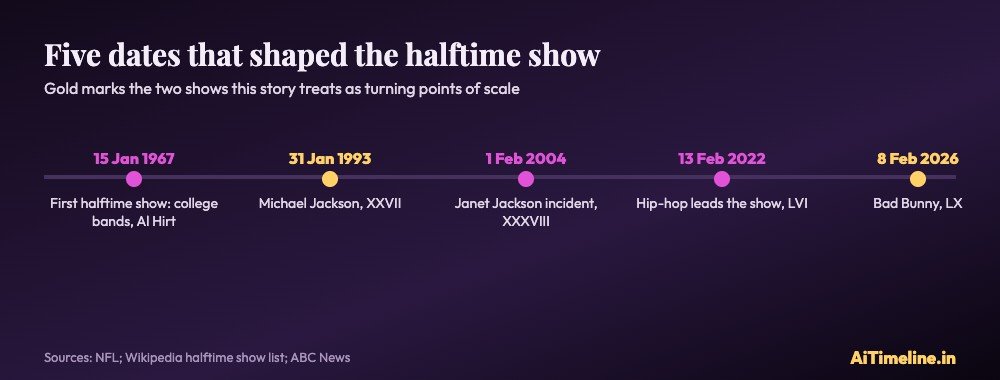
- 1967: college bands and a trumpeter, an interval for the stadium crowd.
- 1992: Fox’s In Living Color pulled viewers from CBS, and the NFL went looking for a star.
- 1993: Michael Jackson drew 133.4 million, and ratings rose between halves.
- 2002: U2’s 11 September tribute showed halftime could be a national moment.
- 2004: a nine-sixteenths-second incident cost eight years of litigation, which CBS won.
- 2022: hip-hop led the show for the first time, reports said.
- 2025: Kendrick Lamar’s 133.5 million is the record, by 0.1 million.
- 2026: Bad Bunny: 128.2 million TV viewers and about 4 billion social views, which are not the same thing.
- Next: Super Bowl LXI, 14 February 2027; headliner unconfirmed.
From Marching Bands to a Global Stage: The Historical Overview
Four eras, drawn from the NFL’s own halftime lists.
1967 to 1991: pageantry. The first show featured two college bands and trumpeter Al Hirt. Through the 1970s and 1980s the formula stayed close to that: marching bands, drill teams, themed productions and groups such as Up with People, with occasional entertainers like Ella Fitzgerald (1972) and Chubby Checker (1988). The show served the live crowd and the broadcast, and was rarely the reason to watch.
1993 to 2003: the superstar era. After Michael Jackson, the bills were built around recording artists: Diana Ross, Aerosmith with *NSYNC, Gloria Estefan and Stevie Wonder. U2’s 2002 tribute to the victims of 11 September gave the show a new emotional weight.
2004 to 2010: caution. After the Houston incident, the next six headliners were veteran acts: McCartney, the Rolling Stones, Prince, Tom Petty, Bruce Springsteen and The Who. The NFL did not call this a policy in the sources reviewed, but the sequence is clear in the record.
2012 to 2026: the platform era. Madonna, Beyoncé, Bruno Mars and Katy Perry set a pop-spectacle template, and from 2020 Latin pop, hip-hop and Spanish-language music took the central slot. Streaming and social platforms began to rival the television audience, and Apple Music replaced Pepsi as presenting sponsor in 2023.
The 1993 Turning Point: How Michael Jackson Changed the Format
Super Bowl XXVII, Rose Bowl, Pasadena, 31 January 1993.
The trigger was a ratings loss. In January 1992 Fox aired a live special episode of In Living Color against the Super Bowl XXVI halftime show, a skating-and-hockey-themed production called “Winter Magic”, and many viewers stayed away from CBS; one account puts the CBS audience loss at 22% (Wikipedia; Wikipedia). To keep viewers through the break, the NFL booked Michael Jackson for the following year.
The show. Jackson stood frozen and silent for almost two minutes before guitarist Jennifer Batten began the music. The set ran “Jam”, “Billie Jean”, “Black or White”, “We Are the World” with a children’s choir, and “Heal the World”, and more than 3,000 Los Angeles-area children took part (Wikipedia).
The result. The game drew 133.4 million US viewers and a 45.1 rating, up 12% on the previous year, and the halftime show itself earned a 45.5 rating. For the first time in Super Bowl history, ratings rose between halves. Frito-Lay sponsored the show. Jackson took no appearance fee: the NFL and Frito-Lay gave $100,000 to his Heal the World Foundation and provided commercial time for its Heal L.A. campaign (Wikipedia).
Why it endures. The 1993 show set the formula: recruit an internationally known performer, build the production around their catalogue, and treat halftime as an attraction in its own right. Its 133.4 million audience stood as the largest on Billboard’s list for 32 years, until Kendrick Lamar’s 133.5 million in 2025.
Super Bowl Halftime Show Timeline, Latest First
Published and last updated 26 October 2026. Each entry is tagged by style, with its sources linked.
2026
Bad Bunny puts Puerto Rican culture and Spanish on the stage Latin pop
Puerto Rican artist Bad Bunny headlined the Apple Music Super Bowl LX Halftime Show, with Ricky Martin and Lady Gaga among the guests (Wikipedia). The set centred on his music and Puerto Rican heritage, with a strong Spanish-language presence.
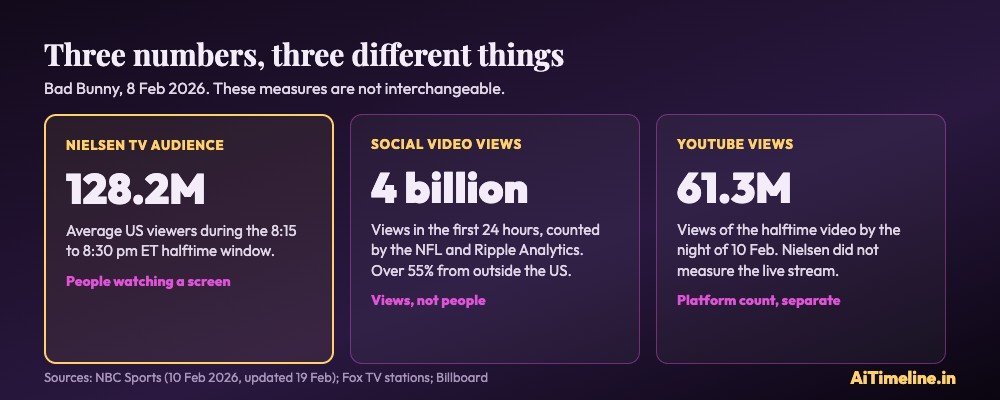
Nielsen put the halftime audience at an average of 128.2 million US viewers between 8:15 and 8:30 pm ET, short of Kendrick Lamar’s 133.5 million a year earlier (ABC News). Separately, the NFL and Ripple Analytics counted about 4 billion social-media views in the first 24 hours, up 137% on 2025, with over 55% from outside the US (Fox; NBC Sports). Those are views, not viewers, and the two numbers are not comparable.
2025
Kendrick Lamar makes hip-hop the centrepiece Hip-hop
Kendrick Lamar headlined Super Bowl LIX in New Orleans, with SZA as a guest; Samuel L. Jackson, Serena Williams and Mustard also appeared (Wikipedia). The NFL announced the show in September 2024 as a partnership between Lamar, Roc Nation and Apple Music, and it was his second halftime appearance after 2022 (NFL).
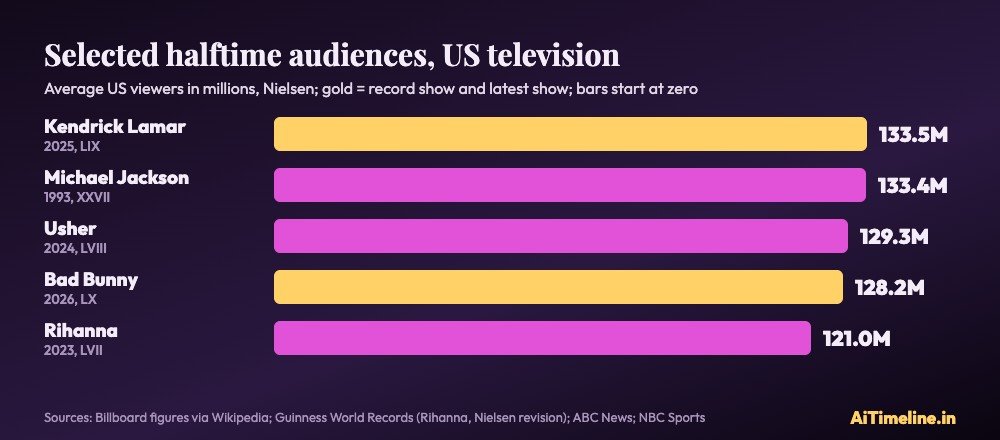
It drew a reported 133.5 million viewers, the largest halftime audience on Billboard’s list, just ahead of Michael Jackson’s 133.4 million in 1993 (ABC News).
2024
Usher turns the show into an R&B and dance revue Pop spectacle
Usher headlined Super Bowl LVIII in Las Vegas with guests Alicia Keys, Jermaine Dupri, H.E.R., will.i.am, Lil Jon and Ludacris (Wikipedia). The career-spanning set was watched by a reported 129.3 million US viewers, third on Billboard’s list.
2023
Rihanna performs above the field and reveals a pregnancy Pop spectacle
Rihanna delivered a medley of hits from elevated platforms and revealed her second pregnancy during the set (TheWrap). It was the first halftime show under Apple Music’s sponsorship; Pepsi had said in May 2022 it was ending its halftime title sponsorship (ABC7).
Fox first reported 118.7 million viewers; Nielsen later revised it to 121.017 million (Guinness World Records).
2022
Hip-hop leads the halftime show Hip-hop
Dr. Dre, Snoop Dogg, Eminem, Mary J. Blige and Kendrick Lamar headlined, with 50 Cent as a surprise guest and Anderson .Paak as a special guest; Jesse Collins and Roc Nation produced it (Wikipedia). Rappers had appeared in earlier shows; coverage at the time, including The New York Times, described it as the first to put hip-hop at the centre.
Wikipedia’s halftime list reports more than 322 million views of the show on the NFL’s YouTube channel alone. That is a platform count, not a Nielsen audience (Wikipedia).
2021
The Weeknd stages a cinematic set during the pandemic Pop spectacle
The Weeknd headlined Super Bowl LV in Tampa, with no guests listed (Wikipedia). The production used a maze-like set and tightly choreographed dancers, and it took place under pandemic conditions that affected the wider event.
2020
Shakira and Jennifer Lopez celebrate Latin pop Latin pop
Shakira and Jennifer Lopez co-headlined, with Bad Bunny, J Balvin and Emme Muñiz as guests. About 103 million US viewers watched, up 4% on the previous year, and a WFAA investigation found more than 1,300 complaints to the FCC; reactions ranged from praise to sharp criticism (Wikipedia).
Bad Bunny’s guest appearance came six years before he headlined.
2019
Maroon 5 plays amid the Kaepernick dispute Controversy
Maroon 5 headlined with Travis Scott and Big Boi as guests (Wikipedia). The booking came amid criticism of the NFL’s treatment of Colin Kaepernick. Rihanna later confirmed she had declined the show in solidarity with him (Sports Illustrated), Cardi B said she had turned it down (ABC13/AP), and comedian Amy Schumer urged Maroon 5 to pull out.
2017
Lady Gaga opens high above the stadium Pop spectacle
Lady Gaga headlined Super Bowl LI, opening with a dramatic sequence above the stadium before moving to the field (Wikipedia). She returned as a guest in Bad Bunny’s 2026 show.
2016
Coldplay, Beyoncé and Bruno Mars share Super Bowl 50 Pop spectacle
Coldplay headlined the 50th Super Bowl with Beyoncé, Bruno Mars, Mark Ronson and Gustavo Dudamel (Wikipedia). Beyoncé’s appearance prompted political discussion because commentators read her dancers’ costumes as a reference to the Black Panther Party.
2015
Katy Perry’s spectacle becomes a viral moment Pop spectacle
Katy Perry headlined with Lenny Kravitz and Missy Elliott as guests (Wikipedia). Oversized props and rapid visual changes suited a social-media era in which single moments, such as a dancer in a shark costume, circulate apart from the broadcast.
2013
Beyoncé reunites Destiny’s Child Pop spectacle
Beyoncé headlined and was joined by Kelly Rowland and Michelle Williams of Destiny’s Child (Wikipedia).
2007
Prince delivers a live-musicianship landmark in the rain Rock
Prince headlined with the FAMU Marching 100 Band (Wikipedia). The set is remembered for his guitar work and for the rain that fell during it.
2006
The Rolling Stones play Super Bowl XL Rock
The Rolling Stones headlined in Detroit (Wikipedia). After Paul McCartney in 2005, the next halftime headliners were all veteran acts: the Stones, Prince (2007), Tom Petty (2008), Bruce Springsteen (2009) and The Who (2010). The NFL did not describe this as a policy in the sources AiTimeline reviewed.
2005
Paul McCartney follows the 2004 controversy Rock
Paul McCartney headlined alone in Jacksonville, the year after the Houston incident (Wikipedia).
2004
The Janet Jackson and Justin Timberlake incident Controversy
Janet Jackson headlined a bill that also included P. Diddy, Nelly, Kid Rock, Justin Timberlake and Jessica Simpson (Wikipedia). An onstage incident, widely called a ‘wardrobe malfunction’ and lasting nine-sixteenths of one second on air, became one of the most litigated moments in US broadcasting.
The FCC fined CBS $550,000, the maximum $27,500 on each of 20 stations. The Third Circuit threw the fine out in 2011 on the ground that the FCC had changed its policy without fair notice, and the Supreme Court declined to hear the government’s appeal in 2012 (ABA Journal; Hollywood Reporter).
2002
U2 pays tribute to the victims of 11 September Tribute
U2 played “Beautiful Day,” “MLK” and “Where the Streets Have No Name.” The names of the 11 September victims were projected on a 120-foot scrim and across the Superdome’s interior, and Bono opened his jacket at the end to show an American flag lining. The show drew 82.9 million viewers, and sales of All That You Can’t Leave Behind rose 142% in the US the following week (Wikipedia).
The source brief dated this show 1 February; the game was played on 3 February 2002.
2001
Rock and pop acts share one stage Pop spectacle
Aerosmith and *NSYNC headlined, with Britney Spears, Mary J. Blige and Nelly (Wikipedia). The multi-artist format showed several stars could share one tightly choreographed production.
1999
Soul, salsa and swing Pop spectacle
Gloria Estefan and Stevie Wonder led the show, with Big Bad Voodoo Daddy among the performers (Wikipedia). Themed, multi-genre productions continued, but the show had not yet reached today’s scale.
1993
Michael Jackson changes the format Pop spectacle
Covered in full in the 1993 turning point above: a lone superstar, a 133.4 million audience and ratings that rose between halves for the first time (Wikipedia).
1992
Winter Magic loses viewers to a Fox sketch show Pageantry
“Winter Magic” featured Gloria Estefan, Brian Boitano, Dorothy Hamill and members of the 1980 US Olympic hockey team, with nearly 2,000 performers. Fox aired a live In Living Color special against it and kept many viewers; the game drew an estimated 79.6 million on CBS (Wikipedia).
1987
Salute to Hollywood’s 100th anniversary Pageantry
The show marked Hollywood’s 100th anniversary with George Burns, Mickey Rooney, the Grambling and USC bands and Disney characters (Wikipedia). The source brief tied it to the Statue of Liberty centennial and dated it 1 February; the list records Hollywood as the theme and 25 January as the date.
Themes, pianos and Up with People Pageantry
Up with People appeared in 1980, 1982 and 1986. Other shows used the Los Angeles Super Drill Team (1983), Florida and Florida State bands (1984), Tops in Blue (1985), Chubby Checker with the Rockettes and 88 grand pianos (1988), and an Elvis impersonator (1989) (Wikipedia).
Bands, big-band leaders and a few stars Pageantry
Marching bands dominated, with some established entertainers: Carol Channing and Lionel Hampton (1970), Ella Fitzgerald (1972), Woody Herman and Andy Williams (1973), and Up with People (1976) (Wikipedia).
1967
The first Super Bowl halftime show Pageantry
The first AFL-NFL championship featured the University of Arizona and Grambling bands, trumpeter Al Hirt and the Anaheim High School drill team (Wikipedia).
Nielsen Audiences vs Social-Media Views
Two ways of measuring the same show, which cannot be added or ranked together.
Nielsen counts people watching on a TV or connected device in a set window; for Bad Bunny that was 8:15 to 8:30 pm ET, with 128.2 million on average. The NFL and Ripple Analytics count social-video views, which can include repeat views by one person and views from outside the US, and the NFL says over 55% came from international markets. YouTube views are a third count, and Nielsen did not measure the YouTube live stream (NBC Sports; Fox).
| Measure | What it counts | Bad Bunny, 2026 | Compare with TV? |
|---|---|---|---|
| Nielsen halftime average | People watching on a TV or connected device, 8:15 to 8:30 pm ET | 128.2 million | Yes, with earlier Nielsen halftime figures |
| Game average | Whole-game audience across NBC, Peacock, Telemundo, NBC Sports Digital and NFL+ | 125.6 million (NBC, updated 19 Feb; 124.9 million in early reports) | No, a different window |
| Game peak | Highest minute, second quarter | 137.8 million | No, a peak, not a halftime average |
| Social views, 24 hours | Video views on social platforms, counted by the NFL and Ripple Analytics | About 4 billion, up 137% | No, views, not viewers; self-reported |
| YouTube views | Views of the halftime video on YouTube; Nielsen did not measure the live stream | 61.3 million by 10 Feb | No, platform count |
Selected Halftime Audiences, US Television
Nielsen audience figures only; social views are excluded.
| Show | Super Bowl | US TV audience | Source |
|---|---|---|---|
| Kendrick Lamar, 2025 | LIX | 133.5 million | Billboard list; ABC News |
| Michael Jackson, 1993 | XXVII | 133.4 million | Billboard list; Wikipedia |
| Usher, 2024 | LVIII | 129.3 million | Billboard list |
| Bad Bunny, 2026 | LX | 128.2 million | Nielsen via ABC News and NBC Sports |
| Rihanna, 2023 | LVII | 121.017 million | Nielsen revision, Guinness World Records |
| Shakira and Jennifer Lopez, 2020 | LIV | About 103 million | Wikipedia |
Every Halftime Headliner Since 1993
From Wikipedia’s list of halftime shows; names are as listed there.
| Year | Super Bowl | Host city | Halftime performers |
|---|---|---|---|
| 2026 | LX | Santa Clara | Bad Bunny, with Ricky Martin, Lady Gaga |
| 2025 | LIX | New Orleans | Kendrick Lamar, with SZA |
| 2024 | LVIII | Paradise | Usher, with Alicia Keys, H.E.R., will.i.am, Lil Jon, Ludacris |
| 2023 | LVII | Glendale | Rihanna |
| 2022 | LVI | Inglewood | Dr. Dre, Snoop Dogg, Eminem, Mary J. Blige, Kendrick Lamar |
| 2021 | LV | Tampa | The Weeknd |
| 2020 | LIV | Miami Gardens | Shakira, Jennifer Lopez, with Bad Bunny, J Balvin |
| 2019 | LIII | Atlanta | Maroon 5, with Travis Scott, Big Boi |
| 2018 | LII | Minneapolis | Justin Timberlake |
| 2017 | LI | Houston | Lady Gaga |
| 2016 | 50 | Santa Clara | Coldplay, with Beyoncé, Bruno Mars |
| 2015 | XLIX | Glendale | Katy Perry, Lenny Kravitz, Missy Elliott |
| 2014 | XLVIII | East Rutherford | Bruno Mars, Red Hot Chili Peppers |
| 2013 | XLVII | New Orleans | Beyoncé, Destiny’s Child |
| 2012 | XLVI | Indianapolis | Madonna, LMFAO, Nicki Minaj, M.I.A., Cee Lo Green |
| 2011 | XLV | Arlington | The Black Eyed Peas, Usher, Slash |
| 2010 | XLIV | Miami Gardens | The Who |
| 2009 | XLIII | Tampa | Bruce Springsteen and the E Street Band |
| 2008 | XLII | Glendale | Tom Petty and the Heartbreakers |
| 2007 | XLI | Miami Gardens | Prince |
| 2006 | XL | Detroit | The Rolling Stones |
| 2005 | XXXIX | Jacksonville | Paul McCartney |
| 2004 | XXXVIII | Houston | Janet Jackson, P. Diddy, Nelly, Kid Rock, Justin Timberlake, Jessica Simpson |
| 2003 | XXXVII | San Diego | Shania Twain, No Doubt, Sting |
| 2002 | XXXVI | New Orleans | U2 |
| 2001 | XXXV | Tampa | Aerosmith, *NSYNC, with Britney Spears, Mary J. Blige, Nelly |
| 2000 | XXXIV | Atlanta | Phil Collins, Christina Aguilera, Enrique Iglesias, Toni Braxton |
| 1999 | XXXIII | Miami Gardens | Gloria Estefan, Stevie Wonder |
| 1998 | XXXII | San Diego | Boyz II Men, Smokey Robinson, Martha Reeves, The Temptations, Queen Latifah |
| 1997 | XXXI | New Orleans | The Blues Brothers, ZZ Top, James Brown |
| 1996 | XXX | Tempe | Diana Ross |
| 1995 | XXIX | Miami Gardens | Patti LaBelle, Tony Bennett, Miami Sound Machine, Arturo Sandoval |
| 1994 | XXVIII | Atlanta | Clint Black, Tanya Tucker, Travis Tritt, The Judds |
| 1993 | XXVII | Pasadena | Michael Jackson |
Five Forces That Changed the Halftime Show
1. Superstar headliners. Jackson’s 1993 show proved the value of one globally known artist at the centre, and later performers were chosen for their pull beyond football fans.
2. Television and production technology. Moving stages, lighting and rapid set changes turn a short interval into a compact concert while the field is cleared for the second half.
3. Controversy and regulation. In 2004 a few seconds of live television overshadowed the music and led to a fine that courts threw out; later shows drew complaints over lyrics, symbolism and politics, such as more than 1,300 FCC complaints about the 2020 show.
4. Cultural representation. Hip-hop in 2022, Latin pop in 2020 and Bad Bunny’s Spanish-language set in 2026 show the headline slot following where popular music has gone.
5. Social media and global distribution. Clips, reaction videos and streams spread worldwide within minutes. The top three NFL social clips of all time are from the 2026 show, led by an Instagram clip with 179 million views, according to NBC Sports.
How the Halftime Show Became a Business
Pepsi was the halftime title sponsor for about a decade, and the NFL named Apple Music as its replacement in September 2022; the first Apple Music show was Rihanna’s on 12 February 2023 (ABC7). The NFL has long treated the slot as a promotion rather than a paid booking: in 1993 it paid Jackson no fee, and later reporting says performers receive exposure and covered production costs, though AiTimeline did not confirm current terms. The value comes from the afterlife of the show: streaming spikes, catalogue rediscovery and clips that keep circulating.
What Comes Next: Super Bowl LXI
Super Bowl LXI is scheduled for 14 February 2027 at SoFi Stadium in Inglewood, California, on ABC. Wikipedia’s page for the game says Jay-Z is reported to headline, citing Puck and Deadline on 20 October 2026, and that the NFL has not confirmed it (Wikipedia). This page will be updated after the game, checking performers and viewership against NFL, broadcaster and Nielsen reporting.
What Is Confirmed and What Is Open, as of 26 October 2026
The source brief and public reports disagree in places, so the table says which is which.
| Question | What the sources show | Status |
|---|---|---|
| Bad Bunny: date, venue, headliner | 8 Feb 2026, Levi’s Stadium, Santa Clara (ABC News, Wikipedia) | Confirmed |
| 128.2 million halftime viewers | Nielsen, 8:15 to 8:30 pm ET (ABC News, NBC Sports, Billboard) | Confirmed |
| 4 billion social views | Counted by the NFL and Ripple Analytics; repeated by NBC Sports and Fox stations | Reported, self-counted |
| Source brief: social figure on the ABC page | The ABC page opened gives no social figure; NBC Sports and Fox do | Re-sourced |
| Lamar 133.5 million vs Jackson 133.4 million | A 0.1 million gap on Billboard’s list | Effectively tied |
| U2 date 1 Feb 2002; 1987 theme and date | Game dates were 3 Feb 2002 and 25 Jan 1987; the 1987 theme was Hollywood’s centennial | Brief corrected |
| Whether performers get a normal headline fee | In 1993 the NFL paid no fee and gave $100,000 to Jackson’s foundation; current arrangements not confirmed in sources read | Not independently confirmed |
| Super Bowl LXI halftime performer (14 Feb 2027) | Jay-Z reported by Puck and Deadline on 20 Oct 2026; NFL has not confirmed | Unconfirmed |
| AP and Washington Post links in the brief | AP returned an access block; the Washington Post page did not respond | Cited, unread |
Explore More Timelines
People Also Ask
Frequently Asked Questions
More Than a Football Intermission
The halftime show began as pageantry for a stadium crowd and became a measure of where popular culture stands. Michael Jackson showed the power of a single headliner; 2004 showed the risk of live television; hip-hop and Latin music then widened the stage. In 2026 Bad Bunny’s Spanish-language show averaged 128.2 million US viewers and generated about 4 billion social views, two numbers that tell different stories and should not be merged.
Related AiTimeline Stories
⚠️ Editorial Note
Published and last updated 26 October 2026; updated after each Super Bowl. Corrections to the source brief: U2’s show was on 3 February 2002 (not 1 February); Super Bowl XXI was on 25 January 1987 and its theme was Hollywood’s 100th anniversary, not the Statue of Liberty centennial; the 4 billion social-views figure is in NBC Sports and Fox reporting, not on the ABC page the brief linked; and Lamar’s record exceeds Jackson’s by only 0.1 million. Added from the sources: the 1992 Fox counter-programme, the FCC fine outcome, 2026 guests Ricky Martin and Lady Gaga, and the viewers-versus-views distinction. The brief’s AP and Washington Post links could not be opened (an access block and no response) and are not relied on; the NFL halftime page is cited as given. The 2022 ‘first hip-hop show’ framing rests on a New York Times line seen in a search summary. Nielsen figures may be revised. This is not an official NFL source.
Sources & further reading
Every dated entry above was checked against these references. Last reviewed 26 October 2026.
- ABC News: Bad Bunny halftime show viewership announced
- NBC Sports: Super Bowl LX viewership and halftime social figures
- Fox TV stations: Bad Bunny halftime show, how many people watched
- Wikipedia: List of Super Bowl halftime shows
- Wikipedia: Super Bowl XXVII halftime show
- NFL: Kendrick Lamar to perform at Apple Music Super Bowl LIX Halftime Show
- NFL: Super Bowl halftime show
- Guinness World Records: largest TV audience for a Super Bowl half-time performance