Aircraft Contrails Timeline 1915–2026: How White Lines in the Sky Became a Climate Problem
Explore the aircraft contrails timeline from early aviation to WWII, the jet age, 9/11 research and 2026 AI trials cutting climate-warming contrails.
Latest Story
Look up on a clear day and you may see a plane drawing a white line across the sky. For decades, contrails looked harmless, almost poetic. But climate scientists now pay close attention to the trails that do not disappear. Under certain cold, humid conditions, they can persist, spread into cirrus-like clouds and trap heat in the atmosphere. This aircraft contrails timeline traces that story from early aviation observations to 2026, when the industry is testing a surprisingly simple idea: instead of redesigning the aircraft, use AI to help pilots avoid the thin layers of sky where the worst contrails form.
Should Planes Avoid Contrails?
🧠 Quick Answer
Contrails are condensation trails formed when aircraft exhaust mixes with cold upper-atmospheric air. Most vanish quickly, but some persist in ice-supersaturated air and spread into contrail cirrus clouds. These persistent contrails can have a net warming effect, especially at night. AI contrail-avoidance systems try to predict where warming contrails are likely, so pilots can make small altitude or route changes when safe and practical.
Aircraft Contrails: Key Questions
What the contrail story really shows
- Contrails are not the same as smoke — they are ice-crystal clouds that form under specific temperature and humidity conditions, first noticed as aviation began flying at higher altitudes in the 1910s and 1920s.
- Most contrails disappear within minutes, but a smaller share forms in cold, ice-supersaturated air and can spread into thin, cirrus-like clouds that persist for hours.
- Persistent contrails can have a net warming effect, especially at night, when there is no sunlight for the cloud to reflect and only outgoing heat for it to trap.
- Roughly 2–3% of flights are estimated to cause about 80% of total contrail warming in a given year, according to Google-linked research — which is why airlines are targeting specific flights rather than redesigning every route.
- A 2023 Google, American Airlines and Breakthrough Energy pilot flew 70 test flights using AI-based contrail forecasts and reported a 54% reduction in contrail formation versus flights that made no changes.
- A larger 2025 American Airlines/Google trial covered 2,400 transatlantic flights with forecasts built directly into flight-planning software and reported a 62% reduction in contrail formation.
- In September 2026, Cathay Pacific and Google expanded AI contrail trials to Asia-Pacific, reporting that more than 80 avoidance flights cut estimated contrail warming by roughly 40%, per Reuters and the companies’ joint statement.
- AI can forecast where warming contrails are likely, but it cannot erase contrails already formed — pilots still have to balance safety, fuel use, air-traffic rules and weather before making any adjustment.
- Contrail avoidance is not a substitute for cutting aviation CO2 — CO2 lasts far longer in the atmosphere, so avoidance is best understood as a fast, near-term tool alongside cleaner fuels and efficiency gains, not a replacement for them.
One Flight. Two Routes. Different Climate Effects.
The exhaust is the same. The sky it flies through decides whether the contrail vanishes or lingers.
The fix aviation is testing in 2026 is not a new engine or a new fuel. It is flying a little higher, lower or around one invisible, contrail-forming layer of sky.
Timeline: Aircraft Contrails, 1915–2026
Newest first — from September 2026’s Cathay Pacific trial back to aviation’s earliest sky trails
Read in order, this sequence shows a slow shift: from a curiosity noticed by early aviators, to a wartime tactical concern, to a climate-science question that took most of a century to attract serious funding, to a live operational trial running on real passenger flights today.
Cathay Pacific and Google Expand AI Contrail Trials
What happened: Cathay Pacific and Google announced an expansion of AI-powered contrail-avoidance trials across Asia-Pacific, with Cathay becoming Google’s first commercial airline partner in the region and the first airline globally to test avoidance on ultra-long-haul flights. An operational trial that began in late 2025 targeted more than 100 flights across Cathay’s network; more than 80 followed AI-recommended avoidance routes, and Google’s satellite-imagery analysis estimated those flights cut contrail warming by roughly 40%. The Hong Kong–Singapore corridor alone accounted for over half of the trial’s total climate benefit.
Why it matters: This is the current news hook behind the whole story: a major full-service airline is now running contrail avoidance as an operational trial, not a lab study, using small altitude adjustments much like pilots already make to avoid turbulence. Not every targeted flight could participate, due to airspace and payload restrictions, which the companies say ongoing trials will study further.
American Airlines Builds Contrail Forecasts Into Flight Planning
What happened: American Airlines, Google, Contrails.org and Flightkeys ran a 16-week trial that integrated Google’s AI contrail forecasts directly into the airline’s existing flight-planning software, covering roughly 2,400 transatlantic flights operating on American’s standard schedule. Flights that used the forecasts to make small routing adjustments showed a statistically significant 62% reduction in contrail formation compared with flights that made none.
Why it matters: Moving from a hand-picked test group to forecasts embedded in everyday flight planning is the step that turns contrail avoidance from a research finding into something an airline can actually run at scale, without hours of manual coordination for every flight.
Google, American Airlines and Breakthrough Energy Test AI Predictions
What happened: Google Research and Breakthrough Energy, working with American Airlines, ran the first test of whether AI could reliably predict contrail-forming zones. A small group of American pilots flew 70 test flights, using AI-based forecast maps built from weather and satellite data to make small altitude changes on routes projected to create persistent contrails. The trial reported a 54% reduction in contrail formation compared with flights that made no changes, at a fuel-burn cost of about 2% on the adjusted flights.
Why it matters: This was the first real proof point that commercial flights could verifiably avoid contrails and measurably cut their climate impact — and that the fuel penalty for doing so, for a targeted subset of flights, was small. It also gave researchers the data behind a striking finding: roughly 2–3% of flights are estimated to cause about 80% of total annual contrail warming, which is why later trials focused on identifying and rerouting that small share rather than every flight.
Satellites and Atmospheric Models Improve
What happened: Satellite imagery from instruments like MODIS aboard NASA’s Terra and Aqua satellites, combined with improved numerical weather models, made it far easier to detect contrails from space and to model the narrow, ice-supersaturated layers of the upper atmosphere where they persist and spread into contrail cirrus. Researchers developed algorithms to distinguish young contrails from natural cirrus cloud in satellite data.
Why it matters: Better detection and modelling in this decade built the scientific and technical foundation that AI-based forecasting tools would later rely on — without satellite-verified atmospheric models of where ice-supersaturated air actually sits, there was no reliable way to predict, let alone avoid, the contrails most likely to warm the planet.
Post-9/11 Grounding Creates a Natural Experiment
What happened: The temporary grounding of almost all commercial flights over the United States after the September 11 attacks gave atmospheric researchers an unusual, unplanned opportunity: several days of largely contrail-free skies to compare against normal air-traffic days. Some published research from this period reported a measurably wider range between daytime and nighttime temperatures during the no-fly days.
Why it matters: The finding was influential in raising scientific interest in contrails’ climate role, but it came from a short, unusual window and should not be treated as final proof of contrails’ exact warming effect — later, more comprehensive research built on it rather than simply confirming it outright.
Aviation’s Non-CO2 Effects Enter Global Climate Assessments
What happened: The Intergovernmental Panel on Climate Change published a dedicated special report assessing aviation’s climate impact, framing it as more than just CO2: nitrogen oxides, water vapour, aerosols, contrails and aviation-induced cirrus cloudiness were all identified as parts of the industry’s broader atmospheric footprint.
Why it matters: This report put contrails and contrail cirrus on the record as a formal, internationally assessed part of aviation’s climate effect, not just an aesthetic curiosity in the sky — giving later researchers, and eventually airlines, an official reference point to build on.
Aviation-Induced Cloudiness Becomes a Climate Question
What happened: As commercial jet traffic kept growing, atmospheric scientists began systematically studying whether contrails that spread into cirrus-like sheets could measurably alter regional cloud cover, and by extension, local climate. Research increasingly framed contrails and their spreading cirrus alongside aviation’s nitrogen oxide and aerosol emissions as a distinct, still poorly quantified, non-CO2 climate factor.
Why it matters: This period marks the shift from noticing contrails to actually trying to measure their climate significance — the scientific groundwork that made the 1999 IPCC assessment possible.
The Jet Age Expands Contrail Formation
What happened: The introduction of commercial jet airliners let passenger flights cruise higher, faster and farther than propeller aircraft, and global route networks expanded rapidly through the postwar decades. More flights, flying more often through the cold upper troposphere where ice-supersaturated air is common, meant far more opportunities for contrails, including persistent ones, to form.
Why it matters: This is when contrails went from an occasional sight to a routine one over major flight corridors — setting the stage for later questions about their cumulative climate effect once air travel became a mass-market industry.
WWII Makes Contrails Impossible to Ignore
What happened: Large formations of high-altitude bombers left dense, highly visible bands of contrails across the sky during World War II. The trails became operationally significant, since they could reveal a formation’s position and heading to observers on the ground or in the air, well before the aircraft themselves were visible.
Why it matters: Wartime experience turned contrails from an aviation curiosity into something militaries actively planned around, and it produced some of the widest public exposure to condensation trails the world had yet seen.
Scientists Begin Understanding the Physics
What happened: As aircraft flew higher and more consistently, researchers began working out the basic mechanism behind the trails: engine exhaust releases water vapour and small particles into very cold air, and under the right temperature and humidity conditions, that vapour condenses and freezes into visible ice crystals.
Why it matters: Understanding the mechanism — not just observing the effect — is what eventually made it possible to predict where a contrail would form and, decades later, to build AI forecasts around that same physics.
Early Aircraft Trails Are Observed
What happened: As aircraft began flying high enough, and under the right cold and humid atmospheric conditions, pilots and observers on the ground started noticing thin white trails forming behind engines and propellers. The effect was inconsistent and poorly understood, appearing only under specific weather conditions.
Why it matters: This is the earliest point in the story: a visual curiosity tied to how high and how fast aircraft could climb, more than a century before anyone thought to ask whether it mattered for the climate.
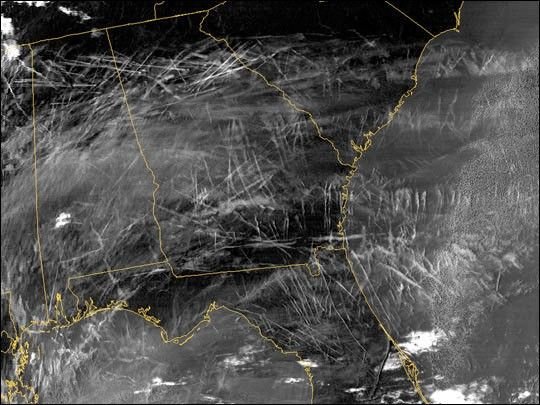
Enhanced infrared satellite imagery showing widespread contrails over the southeastern United States, captured by MODIS aboard NASA’s Terra satellite. Credit: NASA Langley Research Center.
AI Contrail-Avoidance Trials, Side by Side
How the three publicly reported trials compare, from a small research pilot to a live airline operation
| Trial | Year | Flights | Reported reduction | Status |
|---|---|---|---|---|
| Google / American Airlines / Breakthrough Energy | 2023 | 70 test flights | 54% fewer contrails | Research pilot |
| American Airlines / Google (transatlantic) | 2025 | ~2,400 flights | 62% reduction | Flight-planning integration |
| Cathay Pacific / Google (Asia-Pacific) | 2026 | 80+ avoidance flights of 100+ targeted | ~40% less warming | Ongoing operational trial |
The reported percentages are not directly comparable — they use different baselines, regions and measurement methods — but the direction is consistent across all three: modest, planned altitude or route changes on a targeted subset of flights meaningfully cut contrail formation or its estimated warming effect, each time the idea was tested.
Aviation’s Climate Impact Stack
Contrails are one layer of a bigger picture, not the whole story
| Factor | Atmospheric lifetime | Climate role |
|---|---|---|
| CO2 emissions | Centuries | Long-lived, cumulative warming; the industry’s largest long-term climate liability |
| Nitrogen oxides (NOx) | Days to weeks | Complex short-term effects on ozone and methane, both warming and cooling |
| Non-persistent contrails | Seconds to minutes | Minimal lasting climate effect; the majority of all contrails |
| Persistent contrails / contrail cirrus | Hours | Short-lived but potentially significant warming, especially overnight |
Because contrail cirrus lasts only hours rather than centuries, avoiding it delivers a climate benefit almost immediately — unlike a CO2 cut, whose benefit accumulates over decades. That is the core argument for treating contrail avoidance as a fast, near-term lever, not a replacement for the slower work of cutting aviation’s actual carbon emissions.
Facts Worth Knowing
- Contrails are made of ice crystals formed from water vapour and soot in engine exhaust — not smoke, and not the “chemtrail” conspiracy theory sometimes confused with them.
- The September 11, 2001 flight grounding gave researchers a rare, if brief and imperfect, natural experiment in what US skies look like with sharply reduced air traffic.
- Google-linked research estimates that roughly 2–3% of flights are responsible for about 80% of total annual contrail warming, which is why avoidance efforts target specific flights rather than every route.
- The 2023 American Airlines pilot trial showed a real fuel trade-off: contrail-avoiding flights burned about 2% more fuel on average, a cost researchers say is small relative to the estimated climate benefit.
- Cathay Pacific is the first airline reported to test AI contrail avoidance on ultra-long-haul flights, not just short regional routes.
Explore More Timelines
People Also Ask
Frequently Asked Questions
Related AiTimeline Coverage
⚠️ Editorial & Sources Note
Author: The AiTimeline Editorial Team · Editor: AiTimeline Editorial · Last updated: 7 September 2026. This article does not claim every contrail warms the planet, does not confuse contrails with the unsubstantiated “chemtrails” theory, and does not claim AI will solve aviation’s climate impact on its own — contrail avoidance is presented as one near-term tool alongside cleaner fuels and long-term CO2 cuts, not a replacement for them. The 2026 Cathay Pacific figures are sourced to Cathay Pacific’s own joint statement with Google and Reuters-based reporting; the 2023 and 2025 American Airlines figures are sourced to Google Research, Breakthrough Energy and American Airlines’ own published trial results. Figures may be revised as further trial data is published.
Sources & further reading
Every dated entry above was checked against these references. Last reviewed 15 September 2026.
- Cathay Pacific and Google Partner to Research and Trial AI-Powered Contrail Avoidance
- Google AI Is Helping Airplanes Avoid Contrails in New Study
- American Airlines Participates in First-of-Its-Kind Research on Contrail Avoidance
- American Airlines: Contrail Avoidance
- NASA Earth Observatory: Aircraft Contrails
- IPCC Special Report: Aviation and the Global Atmosphere
- NASA Earthdata: On the Trail of Contrails