Delhi Riots 2020 Timeline: Causes, 53 Deaths, Court Cases and Aftermath
Delhi riots 2020 timeline: the CAA protests, four days of violence, 53 deaths, the conspiracy case, bail rulings and the court cases still pending.
Latest Story
The Delhi riots of 2020 were four days of communal violence in northeast Delhi, from 23 to 26 February, that left 53 people dead and hundreds injured, and destroyed homes, shops, vehicles and places of worship. They broke out during protests for and against the Citizenship Amendment Act (CAA), passed in December 2019. More than six years later, the courts are still deciding hundreds of separate cases, from individual murders and arson to a police case alleging a planned conspiracy. This page keeps the historical record of the violence apart from the question of who is criminally responsible, and treats every allegation as an allegation unless a court has ruled. For context, see AiTimeline’s timelines of the 1984 anti-Sikh riots, the Bhagalpur riots, student protests in India and the 2018 Supreme Court judges’ press conference.
Tap a stage. The key point: there is no single verdict, only hundreds of separate cases.
Choose a stage above.
💡 Short Answer
The Delhi riots took place in northeast Delhi from 23 to 26 February 2020, amid protests over the Citizenship Amendment Act. 53 people died, most of them Muslims, along with Hindus including a police head constable. About 757 cases were registered. By February 2025, 90 of the 109 decided district-police cases had ended in acquittal. In the separate UAPA conspiracy case, no charges had been framed by October 2026.
Current Court Status, as of 23 October 2026
Kept separate from the historical timeline because each case has its own outcome. “Not verified” means AiTimeline could not confirm the latest step, not that nothing has happened.
| Case or question | Court or agency | Latest position AiTimeline verified | Status |
|---|---|---|---|
| Larger-conspiracy case, FIR 59/2020 (UAPA) | Special court, Karkardooma (ASJ Sameer Bajpai) | Police rebuttal on charge concluded mid-July 2026; High Court restraint on a final charge order lifted 5 Jun 2026; no order framing charges reported | Pending; no trial yet |
| Bail: Umar Khalid and Sharjeel Imam | Delhi High Court; Supreme Court | Refused by the Supreme Court 5 Jan 2026, the trial court 4 Jul 2026 and the High Court 30 Sep 2026 | In custody |
| Bail: Gulfisha Fatima, Meeran Haider, Shifa-ur-Rehman, Mohd Saleem Khan, Shadab Ahmad | Supreme Court | Granted 5 Jan 2026 | On bail; trial pending |
| Bail: Tasleem Ahmad and Abdul Khalid Saifi | Supreme Court | Granted after a May 2026 ruling questioned parts of the January judgment | On bail; larger-bench reference pending |
| Bail: Natasha Narwal, Devangana Kalita, Asif Iqbal Tanha | Delhi High Court; Supreme Court | Bail 15 Jun 2021; police appeal dismissed May 2023 | On bail; trial pending |
| Ankit Sharma murder | Sessions court, Karkardooma (ASJ Praveen Singh) | Tahir Hussain and four others convicted 13 Jul 2026, life sentence 31 Jul 2026 | Trial verdict; appeal announced |
| Hashim Ali murder | Sessions court, Karkardooma | 12 accused acquitted, order dated 30 Apr 2025 | Appeal not verified |
| Head Constable Ratan Lal murder | Sessions court | Charge sheet filed in 2020 | Outcome not verified |
| Faizan’s death in police custody | CBI, under Delhi High Court order of 23 Jul 2024 | CBI reported to have identified suspects (Feb 2026) | Charges not verified |
| 695 district-police riot cases | Karkardooma courts | 109 verdicts by Feb 2025 (90 acquittals, 19 convictions); 116 verdicts by end-Aug 2025 | Most still pending |
| Further probe of Kapil Mishra | Rouse Avenue sessions court | Magistrate’s 1 Apr 2025 order set aside 10 Nov 2025 | Not charged |
| Challenge to the CAA | Supreme Court | Petitions pending; rules notified 11 Mar 2024 | Pending |
Delhi Riots 2020: Key Questions
The Delhi Riots in Ten Points
- The law: the CAA passed Parliament on 9 and 11 December 2019 and received assent on 12 December.
- The flashpoint: a sit-in under the Jaffrabad Metro station on 22 February 2020, and a speech by Kapil Mishra near Maujpur on 23 February.
- The violence: four days, 23 to 26 February, across Chand Bagh, Shiv Vihar, Mustafabad, Gokalpuri and nearby areas.
- The toll: 53 dead, most of them Muslims, along with Hindus including Head Constable Ratan Lal and IB staffer Ankit Sharma.
- The cases: about 757 FIRs, 695 of them filed by the Northeast district police.
- The verdicts: 90 acquittals and 19 convictions among 109 decided cases by February 2025.
- The conspiracy case: FIR 59/2020 under the UAPA, with charge sheets in September and November 2020 and no charges framed by October 2026.
- Bail: several co-accused on bail, five of them by the Supreme Court in January 2026; Umar Khalid and Sharjeel Imam refused by the Supreme Court in January 2026 and the High Court in September 2026.
- A murder verdict: Tahir Hussain and four others sentenced to life in July 2026 for Ankit Sharma’s murder, with an appeal announced.
- The caution: a charge sheet or bail order is not a verdict, and an acquittal is not proof that nothing happened.
Delhi Riots 2020: The Timeline, Latest First
Each entry is tagged as a court ruling, investigation and charges, the violence, law and politics, or counts, and ends with why it matters.
Filter the timeline: court rulings, investigation and charges, the violence, law and politics, or counts.
–
2026
The Delhi High Court again refuses bail to Umar Khalid and Sharjeel Imam Court ruling or order
A division bench of the Delhi High Court dismissed appeals by Umar Khalid and Sharjeel Imam against the trial court’s refusal of regular bail on 4 July 2026. The bench said it was “bound by judicial discipline” to follow the Supreme Court’s January 2026 order, which allowed the two to seek bail again only after the protected witnesses had been examined or a year had passed, whichever came first (judgment, The Indian Express, Business Standard).
It also rejected their claim to parity with co-accused Tasleem Ahmad and Abdul Khalid Saifi, who had been granted bail after a separate Supreme Court bench in May 2026 voiced “serious reservations” about parts of the January judgment; that difference in views has been referred to a larger bench (The Indian Express). The Delhi Police had called the two the “masterminds”, which they deny (LiveLaw, The Wire).
Read it with care: the draft brief dated this ruling 1 October; reports date it to Wednesday, 30 September 2026. It is a bail order. It does not decide guilt, and charges in the case had not been framed when AiTimeline checked.
2026
A trial court convicts Tahir Hussain and four others in the Ankit Sharma murder case Court ruling or order
In the case over the killing of Intelligence Bureau staffer Ankit Sharma, whose body was recovered from a drain in the Chand Bagh and Dayalpur area in February 2020, Additional Sessions Judge Praveen Singh convicted former AAP councillor Tahir Hussain and four co-accused, Javed, Anas, Nazim and Kasim, on 13 July 2026. The offences included murder, kidnapping, rioting, unlawful assembly and promoting enmity between groups; Hussain was acquitted of criminal conspiracy and one other charge (The Quint).
On 31 July the court sentenced all five to life imprisonment, refusing the prosecution’s plea for the death penalty, and fined Hussain Rs 50,000 and each co-convict Rs 10,000 for kidnapping (ANI). The defence argued that no specific act in the killing was attributed to any of them and that they were convicted as members of an unlawful assembly; Hussain said he would appeal to the High Court.
Keep it separate: this is the trial court’s verdict in one murder case, open to appeal. It is not a verdict in the larger-conspiracy case, in which Hussain is also an accused. The brief dated the sentence to August; it was 31 July.
2026
The trial court refuses fresh bail as arguments on charge near their end Investigation and charges
On 4 July 2026 Additional Sessions Judge Sameer Bajpai dismissed fresh bail applications by Umar Khalid and Sharjeel Imam, saying the Supreme Court had laid down specific conditions for when they could apply again (ANI). The High Court upheld that order on 30 September.
In the same case the Delhi Police finished their rebuttal arguments on the framing of charges against the accused, including Tahir Hussain, Khalid, Imam, Devangana Kalita and Natasha Narwal, in mid-July (India Gazette, ANI). AiTimeline found no report of an order framing charges by 23 October 2026.
2026
The High Court lifts its restraint on a charge order Court ruling or order
Justice Neena Bansal Krishna dismissed Devangana Kalita’s plea for access to video recordings, which she said had been made by people engaged by the Delhi Police through a tender, and to police WhatsApp communications. The judge held that all the evidence the prosecution relied on was already on record and that copies had been supplied under section 207 of the CrPC (Bar and Bench).
The dismissal ended an interim order of 12 September 2024 under which the trial court could hear arguments on charge but pass no final order. The court partly allowed a separate application, letting Kalita inspect documents in the police malkhana that the prosecution does not rely on; her counsel said she would approach the Supreme Court (ANI).
2026
The Supreme Court grants bail to five accused and refuses it to two Court ruling or order
Hearing appeals against the High Court’s September 2025 refusal, the Supreme Court granted bail to Gulfisha Fatima, Meeran Haider, Shifa-ur-Rehman, Mohammad Saleem Khan and Shadab Ahmad, and refused it to Umar Khalid and Sharjeel Imam. It held that a prima facie case under the UAPA was made out against the two, and that the accused “do not stand on equal footing” (judgment, 2026 INSC 2, Verdictum).
The Court said Khalid and Imam could apply again after the protected witnesses had been examined or after one year, whichever was earlier, and directed the trial court to take those witnesses without delay. A different bench later expressed reservations about parts of this reasoning in a separate UAPA case.
What it was: a bail ruling, based on the prima facie standard that UAPA bail requires. It is not a finding of guilt or innocence for any of the seven.
A magistrate orders a further probe into Kapil Mishra; a sessions court sets it aside Court ruling or order
On 1 April 2025 Additional Chief Judicial Magistrate Vaibhav Chaurasia at Rouse Avenue Courts, acting on a complaint by Mohammad Ilyas, held that a cognisable offence was prima facie made out against BJP leader Kapil Mishra, then Delhi’s Law Minister, and directed further investigation. The Delhi Police had told the court that Mishra had no role in the riots (The Week).
Mishra challenged the order, and a sessions court stayed it in April. On 10 November 2025 the sessions court set it aside as “fundamentally flawed, illegal and improper”, holding that a magistrate could not direct further investigation in a matter already under trial (Business Standard, ANI).
Where it stands: Mishra has not been charged in connection with the riots. The setting aside was a ruling on the magistrate’s power, not a finding on the allegations either way.
2025
The High Court refuses bail in the conspiracy case; the accused go to the Supreme Court Court ruling or order
The Delhi High Court rejected bail pleas by Umar Khalid, Sharjeel Imam and co-accused including Gulfisha Fatima, Meeran Haider, Mohd Saleem Khan, Shifa-ur-Rehman, Athar Khan, Shadab Ahmed and Abdul Khalid Saifi, saying the grant of bail to co-accused did not by itself entitle others to it, and rejecting the argument that more than five years in custody justified release (The Tribune).
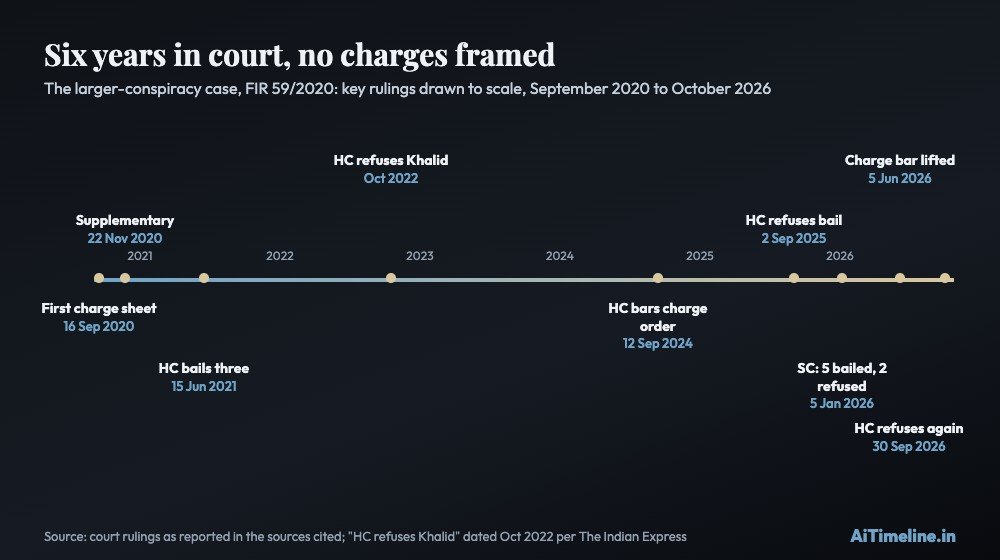
The accused appealed, and on 22 September 2025 the Supreme Court issued notice to the Delhi Police (The Week). The appeals were decided on 5 January 2026. The High Court had first refused Khalid bail in October 2022 (The Indian Express).
2025
Twelve men are acquitted in the Hashim Ali murder case Court ruling or order
A Karkardooma court acquitted 12 men accused of murder and criminal conspiracy over the killing of Hashim Ali in the Gokalpuri area on 26 February 2020. Eyewitnesses did not support the prosecution on identifying the accused, and the court held that the circumstantial evidence was too thin to tie any of them to the mob that killed him (LiveLaw, The Tribune).
The court also rejected the prosecution’s argument that WhatsApp chats in a group called “Kattar Hindu Ekta” amounted to confessions, and said a person could not be presumed to be part of a murder mob because he was seen in a mob elsewhere at another time.
Read it with care: an acquittal means the charge was not proved against these men. It does not mean that Hashim Ali was not killed, and AiTimeline did not find whether the prosecution appealed.
2025
Five years on, most decided riot cases have ended in acquittal Counts and aftermath
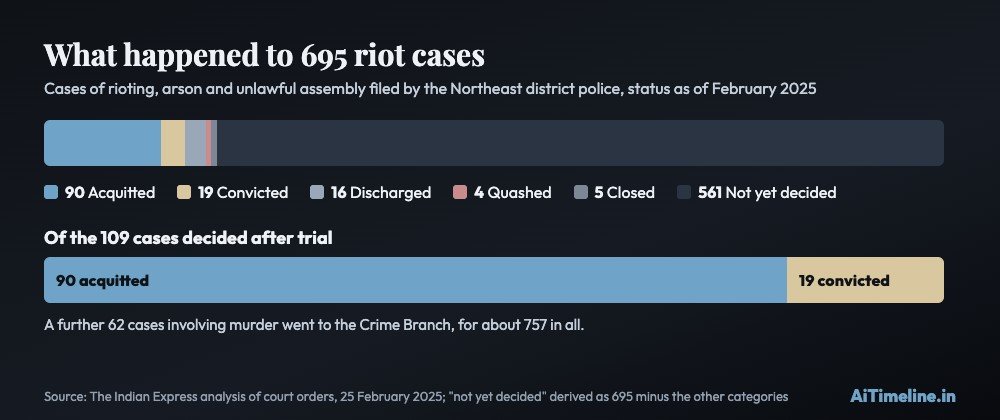
The Indian Express examined the orders in every verdict delivered in the 695 cases of rioting, arson and unlawful assembly filed by the Northeast district police. Judgments had been delivered in 109; 90 were acquittals (82 percent) and 19 convictions. Another 16 cases ended in discharge, four FIRs were quashed and five were closed. The paper said the acquittals were split evenly between the two communities (The Indian Express).
Witnesses turned hostile in 51 of the 90 acquittals. In 19, courts noted that police had identified the accused after a long delay, and in 19 they found contradictions in police witnesses’ statements. A further 62 cases involving murder were handled by the Crime Branch, bringing the total to 757; of those, four had ended in acquittal, one in conviction and one in closure by then. A later update to the end of August 2025 counted 116 verdicts (Maktoob, citing The Indian Express).
2024
The High Court bars a final charge order for now Court ruling or order
On Devangana Kalita’s plea for access to police video and communications, the Delhi High Court said the trial court “may continue with the arguments on charge, but no final order shall be made” (Bar and Bench). The order stayed in force until June 2026.
Arguments on charge had to restart more than once as judges changed: Additional Sessions Judge Amitabh Rawat heard the case from the first charge sheet until 2023, followed by Sameer Bajpai, who was briefly transferred and then returned to the case in July 2025.
2024
The High Court hands the Faizan case to the CBI Investigation and charges
Faizan, 23, was one of several men seen in a video being beaten by policemen and apparently made to sing the national anthem during the riots. He died after being released from Jyoti Nagar police station. Justice Anup Jairam Bhambhani transferred the investigation from the Delhi Police to the CBI, calling the police probe “tardy and sketchy” and saying the conduct in the video amounted to a hate crime by people who should have been custodians of the law (The Wire).
Newslaundry reported in February 2026 that the CBI had identified suspects (Newslaundry). AiTimeline did not verify whether anyone has been charged.
Jan 2022
The first conviction in a riot case Court ruling or order
Dinesh Yadav was convicted of rioting, arson, house trespass and robbery as an active member of a mob that set fire to the house of a 73-year-old woman, Manori, in Gokalpuri. The court held that being part of the mob made him responsible even though he was not seen setting the fire. On 20 January 2022 he was sentenced to five years in prison and fined Rs 12,000; his lawyer said he would appeal (Al Jazeera).
2021
The Supreme Court upholds the Delhi Assembly panel’s summons to Facebook Court ruling or order
The Delhi Assembly’s Peace and Harmony Committee, set up after the riots, summoned Facebook India’s head Ajit Mohan over the platform’s role. The Supreme Court refused to quash the summons, holding that the Assembly could inquire into matters such as peace and harmony, but that it could not enter the “prohibited domains” of law and order and criminal prosecution, which belong to the Union in Delhi, and that a witness could decline questions in those areas (judgment, Internet Freedom Foundation).
2021
The High Court bails three student activists, warning about blurring protest and terror Court ruling or order
The Delhi High Court granted bail to Natasha Narwal, Devangana Kalita and Asif Iqbal Tanha in the conspiracy case, warning that in its anxiety to suppress dissent the State had blurred the line between the right to protest and terrorist activity (LiveLaw, Al Jazeera). They were released on 17 June.
On 18 June 2021 the Supreme Court declined to interfere with their release but directed that the judgment not be treated as a precedent. In May 2023 it dismissed the Delhi Police’s appeal, noting that the three had been on bail for two years (Verdictum).
Police file charge sheets in the larger-conspiracy case Investigation and charges
The Delhi Police Special Cell filed its first charge sheet in FIR 59/2020, the case alleging a larger conspiracy behind the riots, against 15 people under the UAPA and the Indian Penal Code. It ran to about 17,000 pages and built its case partly on WhatsApp groups (The Quint). Umar Khalid had been arrested on 13 September 2020.
On 22 November 2020 police filed a 930-page supplementary charge sheet against Khalid, Sharjeel Imam and Faizan Khan, and on 24 November the court found sufficient material to proceed under the UAPA (The Quint, LiveLaw). Imam had been arrested in January 2020 over his speeches in other cases. The draft brief’s “June 2023 supplementary charge sheet” could not be confirmed.
What a charge sheet is: the prosecution’s case. The accused dispute it, and it proves nothing until a court tests it at trial.
Investigations begin, and hundreds of cases are registered Investigation and charges
Two Special Investigation Teams of the Crime Branch took over the most serious cases, including the killings of Ratan Lal and Ankit Sharma, while the Northeast district police handled cases of rioting and arson (The Quint). In all about 757 cases were registered: 695 by the district police and 62 involving murder that went to the Crime Branch (The Indian Express).
Separately, the Special Cell registered FIR 59/2020, which alleged that the violence was planned. A person accused in one case was not automatically accused in others, and the case files followed different courts and timetables.
2020
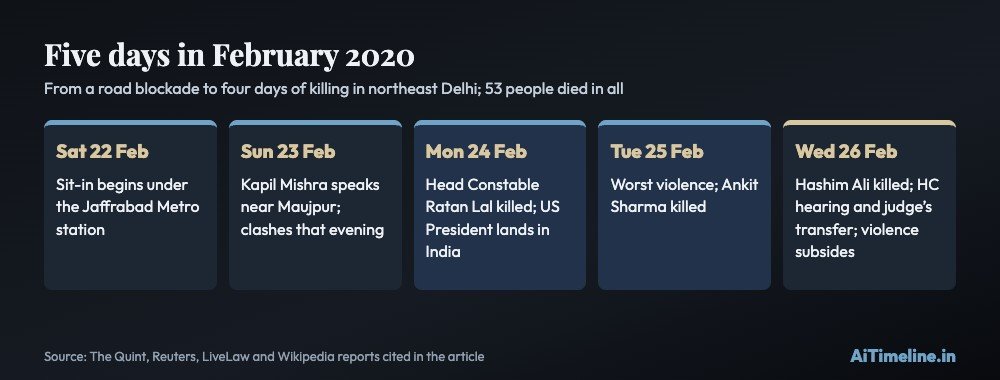
A High Court hearing on hate speech, and the judge’s transfer that night Court ruling or order
At a late-night hearing on 25-26 February and again on the 26th, a bench led by Justice S. Muralidhar ordered police protection for ambulances, and pressed the Delhi Police over why FIRs had not been registered for alleged inflammatory speeches by BJP leaders Kapil Mishra, Anurag Thakur and Parvesh Verma, asking the Police Commissioner to watch the videos and decide (The Quint).
That night the Law Ministry notified his transfer to the Punjab and Haryana High Court. The government said the Supreme Court collegium had recommended it on 12 February and the judge had agreed; critics, including the Delhi High Court Bar Association, condemned the timing (The Wire). Former Chief Justice K. G. Balakrishnan called the timing a coincidence but said the government should have been more careful (The Week). The case moved to another bench, which adjourned it.
2020
The worst of the killing, then the violence subsides The violence
Mobs attacked people, homes, shops, places of worship and other property in neighbourhoods across northeast Delhi, including Chand Bagh, Shiv Vihar, Mustafabad, Bhajanpura and Gokalpuri. Ankit Sharma, an Intelligence Bureau staffer, was killed and his body recovered from a drain; Hashim Ali was among those killed in Gokalpuri on the 26th (Wikipedia, LiveLaw). The violence subsided from 26 February as more security forces were deployed.
The widely reported toll is 53 dead. Most of those killed were Muslims, according to news reports, and the dead included Hindus, among them Ankit Sharma and Head Constable Ratan Lal (Al Jazeera). The Indian Express gave the injured as more than 500; other counts are higher, depending on the date and what was counted (The Indian Express).
Keep it separate: who committed each act is for the court in each case. The death toll is not a verdict on any person or community.
2020
Clashes spread; Head Constable Ratan Lal is killed The violence
Clashes, stone-pelting and arson spread from the Jaffrabad-Maujpur area to other parts of northeast Delhi. Head Constable Ratan Lal, 42, attached to the office of the ACP Gokalpuri, was killed during stone-pelting at Chand Bagh; the post-mortem found a bullet in his body. Shahdara DCP Amit Sharma and ACP Anuj Kumar were seriously injured (The Quint, The Indian Express).
US President Donald Trump arrived in India the same day for a two-day visit that included Delhi (Reuters). Restrictions were imposed in affected areas. The draft brief placed Ratan Lal’s death on 25 February; the reports date it to the 24th.
2020
Kapil Mishra’s speech at Maujpur and the first clashes Law and politics
On the afternoon of 23 February BJP leader Kapil Mishra, who had lost the Delhi Assembly election two weeks earlier, addressed supporters near Maujpur with a senior police officer beside him. In a widely shared video he told the police to clear the roads blocked by protesters and said that once the US President had left, his supporters would not listen even to the police (Wikipedia). Stone-pelting between groups for and against the CAA was reported later that day (Reuters).
Critics say the remarks helped set off the violence. Mishra has denied wrongdoing and said he was asking the police to clear a blocked road; the Delhi Police told a court in 2025 that he had no role in the riots (The Week). He has not been charged.
2020
A sit-in begins under the Jaffrabad Metro station Law and politics
On the night of 22 February a group of protesters, many of them women, began a sit-in against the CAA under the Jaffrabad Metro station, blocking a main road. Delhi had seen similar sit-ins for two months, the best known at Shaheen Bagh (Wikipedia).
The blockade became the focus of the confrontation in the following hours. Its existence is part of the context; it does not establish who was responsible for the violence that followed.
2019
The Citizenship (Amendment) Act becomes law Law and politics
The Citizenship (Amendment) Bill passed the Lok Sabha on 9 December 2019 and the Rajya Sabha on 11 December, and received assent on 12 December (PRS). It offered a faster path to citizenship for Hindus, Sikhs, Buddhists, Jains, Parsis and Christians from Afghanistan, Bangladesh and Pakistan who entered India on or before 31 December 2014. Muslims from those countries were not included in this route (Wikipedia).
The government said the law protected persecuted minorities. Critics argued that a religious test broke with secular equality, especially alongside a proposed National Register of Citizens. Protests followed across India, including at Jamia Millia Islamia and Shaheen Bagh from mid-December; for the campus side, see AiTimeline’s student protests timeline. Petitions challenging the law are before the Supreme Court, and the rules to implement it were notified on 11 March 2024.
What Caused the Delhi Riots of 2020?
No single factor explains every incident. Several overlapping ones formed the background.
The Citizenship Amendment Act. The CAA gave a faster route to citizenship to six non-Muslim religious groups from Afghanistan, Bangladesh and Pakistan. Opponents said its religious test conflicted with secular equality, especially when combined with a proposed National Register of Citizens; the government defended it as a humanitarian measure for persecuted minorities. Sit-ins and counter-rallies kept Delhi tense for two months (PRS).
Local confrontation and rhetoric. The Jaffrabad road blockade, rallies by supporters of the law and the speech near Maujpur on 23 February raised tension within hours. The role of any speech is disputed and, where it has reached a court, is being tested there.
Communal polarisation. The violence unfolded amid deep mistrust between sections of Hindu and Muslim communities, and the attacks deepened it. Polarisation explains the climate in which violence spread; it does not assign guilt to either community.
Policing and prevention. How the police responded to warnings, how quickly they acted, and the conduct of some officers became central questions. Courts have examined parts of this, notably in the Faizan case, which the High Court moved to the CBI. Claims about police conduct are attributed here to the specific reports or rulings they come from.
The February 2020 Delhi Assembly election, held two weeks earlier with a bitter campaign over the CAA protests, was the immediate political backdrop. For how Delhi’s protests of that period fit wider patterns, see AiTimeline’s timeline of opposition protests and the 2020-21 farmers’ protest.
Human Cost: Deaths, Injuries and Destruction
The widely reported toll is 53 dead. Most of those killed were Muslims, according to news reports, and Hindus were also killed, among them Head Constable Ratan Lal and Intelligence Bureau staffer Ankit Sharma (Al Jazeera). The Indian Express gives the injured as more than 500; other counts run higher, depending on the date and what is counted (The Indian Express).
Homes, shops, schools, vehicles and places of worship were burned or looted, and many families left their neighbourhoods for weeks. Within a month the country went into the COVID-19 lockdown, which compounded the loss of livelihoods for families who had just lost homes and businesses; see AiTimeline’s COVID-19 lockdown and migrant crisis timeline.
For many families the aftermath meant years of court dates, compensation claims and rebuilding, often while the cases over their relatives’ deaths were still pending.
Investigations and Court Cases: Why the Legal Picture Is Complex
“The Delhi riots case” can mean any of hundreds of prosecutions.
Individual cases. Each of the roughly 757 FIRs concerns particular deaths, assaults, arson or rioting. Outcomes depend on the evidence in each, and they differ: some ended in conviction, most decided so far in acquittal (The Indian Express).
The larger-conspiracy case. In FIR 59/2020 the Delhi Police allege that the violence was planned, and they have charged activists, students and others, some under the UAPA. The accused deny the allegations. Six years of litigation has been mostly about bail and procedure, not guilt.
Why bail is so hard. Under section 43D(5) of the UAPA a court may not grant bail if it finds reasonable grounds to believe the accusation is prima facie true. That is why bail rulings in this case run to hundreds of pages, and why they say nothing final about guilt.
Why numbers need a date. Counts of convictions, acquittals, pending cases and people on bail change every month. Every figure on this page gives its date and the set of cases it covers.
Allegation, Finding or Data?
The same story, sorted by how strong each statement actually is.
| Statement | Where it came from | Type | What the record shows |
|---|---|---|---|
| The riots were a planned conspiracy | Delhi Police charge sheets, FIR 59/2020 | Prosecution allegation | Disputed by the accused; no court has ruled on the charge, and charges were not framed by Oct 2026 |
| Umar Khalid and Sharjeel Imam were the masterminds | Delhi Police in court | Prosecution allegation | The Supreme Court found a prima facie case for the bail stage only; that is not a finding of guilt |
| Kapil Mishra’s speech set off the riots | Critics, complainants | Allegation | Mishra denies it; police said he had no role; a further-probe order was set aside on jurisdiction in Nov 2025 |
| The police failed to stop the violence or took part in it | Victims, the Faizan case, some court orders | Allegation, partly examined | The High Court called the Faizan probe tardy and sketchy and moved it to the CBI; no general finding on policing |
| Tahir Hussain took part in Ankit Sharma’s murder | Prosecution | Trial court finding | Convicted 13 Jul 2026 as part of an unlawful assembly; acquitted of conspiracy; appeal announced |
| Most riot cases end in acquittal | The Indian Express analysis | Data | 90 of 109 verdicts to Feb 2025 were acquittals, split evenly between communities |
| Justice Muralidhar was moved for his hate-speech hearing | Critics, Bar Association | Allegation | The government said the collegium had recommended the transfer on 12 Feb 2020 with his consent |
| 53 people died | Delhi Police, widely reported | Official count | The figure most sources use; injury counts vary from about 500 upward |
The Aftermath: What Remains Unresolved?
Justice and accountability. For victims’ families, the court process is the main route to accountability, and it has been slow: witnesses turned hostile in more than half of the acquittals The Indian Express examined, and in many cases the accused were identified only long after the event.
Long custody without trial. Some accused in the conspiracy case have spent more than six years in custody without charges being framed. Courts have weighed that delay against the UAPA’s bail bar, with different benches reaching different views; the question has gone to a larger Supreme Court bench.
Community relations. Rebuilding trust in mixed neighbourhoods depends on safety, fair treatment and credible investigations. The record of police conduct in some cases, like Faizan’s, is part of that question.
Citizenship and protest. The CAA remains in force, its rules were notified in March 2024, and challenges to it are pending before the Supreme Court. For other constitutional disputes the Supreme Court has handled, see AiTimeline’s Article 370 timeline and the Emergency of 1975-77.
The Story at a Glance
Dates from the sources listed below, with the type of each entry.
| Date | Event | Type |
|---|---|---|
| 9-12 Dec 2019 | CAA passes Parliament, assent 12 Dec | Law and politics |
| 22 Feb 2020 | Sit-in at Jaffrabad Metro station | Law and politics |
| 23 Feb 2020 | Kapil Mishra speech at Maujpur; first clashes | Law and politics |
| 24 Feb 2020 | Head Constable Ratan Lal killed | The violence |
| 25-26 Feb 2020 | Worst killings; Ankit Sharma, Hashim Ali among dead | The violence |
| 26 Feb 2020 | Muralidhar hearing and transfer | Court ruling or order |
| Mar 2020 | About 757 FIRs; FIR 59/2020 | Investigation and charges |
| 13 Sep 2020 | Umar Khalid arrested | Investigation and charges |
| 16 Sep 2020 | First conspiracy charge sheet, 15 accused | Investigation and charges |
| 22 Nov 2020 | Supplementary charge sheet: Khalid, Imam, Faizan Khan | Investigation and charges |
| 15 Jun 2021 | High Court bails Narwal, Kalita, Tanha | Court ruling or order |
| 8 Jul 2021 | Supreme Court on the Facebook summons | Court ruling or order |
| 6 Dec 2021 | First conviction, Dinesh Yadav | Court ruling or order |
| Oct 2022 | High Court first refuses Khalid bail | Court ruling or order |
| 11 Mar 2024 | CAA rules notified | Law and politics |
| 23 Jul 2024 | Faizan case to the CBI | Investigation and charges |
| 12 Sep 2024 | High Court bars a final charge order | Court ruling or order |
| 25 Feb 2025 | 109 of 695 cases decided | Counts and aftermath |
| 30 Apr 2025 | 12 acquitted in Hashim Ali case | Court ruling or order |
| 2 Sep 2025 | High Court refuses bail to Khalid, Imam and others | Court ruling or order |
| 10 Nov 2025 | Kapil Mishra probe order set aside | Court ruling or order |
| 5 Jan 2026 | Supreme Court bails five, refuses two | Court ruling or order |
| 5 Jun 2026 | High Court lifts charge restraint | Court ruling or order |
| 13-31 Jul 2026 | Tahir Hussain convicted and sentenced | Court ruling or order |
| 30 Sep 2026 | High Court refuses Khalid and Imam bail again | Court ruling or order |
| Term | Meaning | Why it matters here |
|---|---|---|
| FIR | First Information Report, which starts a police case | About 757 were registered after the riots |
| Charge sheet | The police report setting out the prosecution’s case | Allegations, not proof |
| Framing of charges | The court decides whether there is enough to put an accused on trial | Not reached in FIR 59/2020 by Oct 2026 |
| Discharge | An accused is released at the charge stage for lack of a prima facie case | 16 district-police cases ended this way by Feb 2025 |
| Acquittal | A finding after trial that the charge was not proved | Most decided riot cases |
| UAPA | Unlawful Activities (Prevention) Act, India’s anti-terror law | Its section 43D(5) makes bail very hard |
| Protected witness | A witness whose identity is shielded by the court | Their examination is a condition in the Jan 2026 bail ruling |
| Special Cell | Delhi Police’s anti-terror unit | Investigated the larger-conspiracy case |
| SIT | Special Investigation Team | Crime Branch SITs took the murder cases |
| Section 149 IPC | Every member of an unlawful assembly is guilty of an offence committed in its common object | The basis of several riot convictions |
Who Is Who in the Story
Delhi Police Special Cell
Registered FIR 59/2020 and alleged a planned conspiracy under the UAPA.
Crime Branch SITs
Took over the 62 cases involving murder, including those of Ratan Lal and Ankit Sharma.
Karkardooma courts
The sessions courts in Shahdara where most riot cases, and the conspiracy case, are heard.
Delhi High Court and Supreme Court
Have ruled mostly on bail, investigation and procedure in the conspiracy case.
Ratan Lal, Ankit Sharma, Hashim Ali, Faizan
Four of the 53 dead whose cases reached a court ruling covered here.
Activists, students and others
Including Umar Khalid, Sharjeel Imam, Gulfisha Fatima, Natasha Narwal, Devangana Kalita and Tahir Hussain; all deny the charge and are presumed innocent.
Kapil Mishra
BJP leader whose 23 February speech critics blame; he denies wrongdoing and has not been charged.
Delhi Assembly Peace and Harmony Committee
Summoned Facebook India over the riots; the Supreme Court set limits on its inquiry in July 2021.
The Popular Story vs the Record
| Popular version | What the record shows |
|---|---|
| There was one Delhi riots case | About 757 FIRs were registered, each with its own evidence and court |
| The conspiracy accused have been convicted | No. Charges were not framed by Oct 2026; rulings so far are on bail |
| A bail refusal means the court found them guilty | A UAPA bail ruling tests only whether the accusation looks prima facie true |
| An acquittal means nothing happened | Courts often accepted rioting took place but found the accused were not identified |
| The riots lasted one day | The main violence ran from 23 to 26 February 2020 |
| Only one community suffered | Most of the dead were Muslims; Hindus were also killed, including a police head constable |
| The Supreme Court decided the CAA | Challenges to the CAA are still pending; the law is in force |
Explore More Timelines
People Also Ask
Frequently Asked Questions
Sources and Further Reading
- Supreme Court of India: Gulfisha Fatima and others v State (NCT of Delhi), 2026 INSC 2, judgment of 5 January 2026
- Supreme Court of India: Ajit Mohan and others v Legislative Assembly, NCT of Delhi, judgment of 8 July 2021
- Delhi High Court via Indian Kanoon: Sharjeel Imam v State of NCT of Delhi, judgment of 30 September 2026
- PRS Legislative Research: The Citizenship (Amendment) Bill, 2019
- The Indian Express: Northeast Delhi riots five years on, where do the 700 cases stand (February 2025)
- The Indian Express: ‘Bound by judicial discipline’, no bail for Umar Khalid, Sharjeel Imam (30 September 2026)
- The Indian Express: Chronology of events in the Delhi riots case involving Umar Khalid and Sharjeel Imam
- Business Standard: Delhi HC denies bail to Umar Khalid, Sharjeel Imam in 2020 riots case
- LiveLaw: Umar Khalid, Sharjeel Imam bail denied in Delhi riots UAPA case
- The Wire: Over six years without trial, Delhi High Court denies bail to Umar Khalid and Sharjeel Imam
- Verdictum: Supreme Court denies bail to Umar Khalid, Sharjeel Imam, grants bail to Gulfisha Fatima and others
- The Quint: Tahir Hussain sentenced to life in prison for Ankit Sharma’s murder
- ANI: Delhi court sentences Tahir Hussain, 4 others to life imprisonment in Ankit Sharma murder case
- ANI: Karkardooma court rejects bail pleas of Umar Khalid, Sharjeel Imam (4 July 2026)
- India Gazette (ANI): Delhi Police conclude rebuttal arguments on framing of charges
- Bar and Bench: Delhi High Court allows trial court to pass order on charge in Delhi riots case, lifts earlier stay
- ANI: Delhi High Court vacates stay on order of framing of charges in 2020 riots conspiracy case
- The Tribune: After Imam and Gulfisha, Khalid moves SC for bail in Delhi riots case
- The Week: Supreme Court issues notice on bail pleas of Umar Khalid, Sharjeel Imam, Gulfisha Fatima
- The Week: Delhi court orders further probe against Kapil Mishra over 2020 riots (1 April 2025)
- Business Standard: Delhi court sets aside probe order against Kapil Mishra in 2020 riots case
- ANI: Court sets aside order to further investigate role of Kapil Mishra in 2020 Delhi riots
- LiveLaw: Delhi riots, court acquits 12 men in Hashim Ali murder case
- The Tribune: 2020 Delhi riots, court acquits 12 of murder charge
- Maktoob Media: Delhi courts find serious issues in reports filed by police in 2020 riot cases
- The Wire: While acquitting accused, Delhi court flags mechanical probe and unreliable statements
- The Wire: Delhi riots, HC orders CBI probe into death of man beaten and forced to sing national anthem
- Newslaundry: Who killed Faizan? Over 5 years later, CBI finally has names
- Al Jazeera: India jails man in first conviction over 2020 New Delhi riots
- Internet Freedom Foundation: Supreme Court upholds Delhi Assembly’s summons to Facebook
- LiveLaw: Delhi High Court grants bail to Devangana Kalita, Natasha Narwal and Asif Iqbal Tanha
- Al Jazeera: Indian court grants bail to activists arrested over Delhi riots
- Verdictum: Supreme Court dismisses Delhi Police challenge to bail of Devangana Kalita and others
- The Quint: Delhi riots conspiracy charge sheet, FIR 59 and the CAA protests
- The Quint: Court accepts supplementary charge sheet against Umar Khalid, Sharjeel Imam, Faizan Khan
- LiveLaw: Court takes cognisance of charge sheet against Sharjeel Imam, Umar Khalid in UAPA case
- The Quint: Justice Muralidhar, who heard the Delhi violence case, transferred
- The Wire: Government wastes no time moving Justice Muralidhar out of Delhi High Court
- The Week: Govt should have been careful in issuing Justice Muralidhar’s transfer order, Justice Balakrishnan
- The Quint: Inside the police charge sheet into Head Constable Ratan Lal’s death
- The Indian Express: Hours before Trump’s landing, 2 dead, several injured in Delhi clashes (24 February 2020)
- Reuters via Yahoo News: Protests in Delhi against India’s citizenship law (23 February 2020)
- Wikipedia: Citizenship (Amendment) Act, 2019
- Wikipedia: 2020 Delhi riots
Related AiTimeline Stories
⚠️ Editorial Note
Last updated 23 October 2026. This is a historical overview, not a determination of criminal responsibility, and not legal advice. Allegations in charge sheets, complaints and public statements are reported as allegations; bail orders are reported as bail orders, not verdicts; and a conviction by a trial court is reported with the fact that it can be appealed. Except where a court has convicted them, every person named as accused on this page is presumed innocent. The current court status is kept in its own table, separate from the historical chronology, and is dated. Corrections to the draft brief: the High Court’s latest bail refusal was on 30 September 2026, not 1 October; Tahir Hussain and four others were convicted on 13 July and sentenced on 31 July 2026, not in August; Head Constable Ratan Lal was killed on 24 February 2020, not the 25th; the Lok Sabha passed the CAA on 9 December 2019; and the “June 2023 supplementary charge sheet” could not be confirmed, so the page dates the supplementary charge sheet against Umar Khalid, Sharjeel Imam and Faizan Khan to 22 November 2020. Not verified: the trial outcome in the Ratan Lal case, appeals in the Hashim Ali case, charges in the Faizan case, and any order framing charges in FIR 59/2020 after mid-July 2026. AiTimeline has no CAA-specific timeline yet; related links point to the nearest existing stories.
Sources & further reading
Every dated entry above was checked against these references. Last reviewed 23 October 2026.
- Supreme Court of India: Gulfisha Fatima and others v State (NCT of Delhi), 2026 INSC 2, judgment of 5 January 2026
- Supreme Court of India: Ajit Mohan and others v Legislative Assembly, NCT of Delhi, judgment of 8 July 2021
- Delhi High Court via Indian Kanoon: Sharjeel Imam v State of NCT of Delhi, judgment of 30 September 2026
- PRS Legislative Research: The Citizenship (Amendment) Bill, 2019
- The Indian Express: Northeast Delhi riots five years on, where do the 700 cases stand (February 2025)
- The Indian Express: 'Bound by judicial discipline', no bail for Umar Khalid, Sharjeel Imam (30 September 2026)
- The Indian Express: Chronology of events in the Delhi riots case involving Umar Khalid and Sharjeel Imam
- Business Standard: Delhi HC denies bail to Umar Khalid, Sharjeel Imam in 2020 riots case
- LiveLaw: Umar Khalid, Sharjeel Imam bail denied in Delhi riots UAPA case
- The Wire: Over six years without trial, Delhi High Court denies bail to Umar Khalid and Sharjeel Imam
- Verdictum: Supreme Court denies bail to Umar Khalid, Sharjeel Imam, grants bail to Gulfisha Fatima and others
- The Quint: Tahir Hussain sentenced to life in prison for Ankit Sharma's murder
- ANI: Delhi court sentences Tahir Hussain, 4 others to life imprisonment in Ankit Sharma murder case
- ANI: Karkardooma court rejects bail pleas of Umar Khalid, Sharjeel Imam (4 July 2026)
- India Gazette (ANI): Delhi Police conclude rebuttal arguments on framing of charges
- Bar and Bench: Delhi High Court allows trial court to pass order on charge in Delhi riots case, lifts earlier stay
- ANI: Delhi High Court vacates stay on order of framing of charges in 2020 riots conspiracy case
- The Tribune: After Imam and Gulfisha, Khalid moves SC for bail in Delhi riots case
- The Week: Supreme Court issues notice on bail pleas of Umar Khalid, Sharjeel Imam, Gulfisha Fatima
- The Week: Delhi court orders further probe against Kapil Mishra over 2020 riots (1 April 2025)
- Business Standard: Delhi court sets aside probe order against Kapil Mishra in 2020 riots case
- ANI: Court sets aside order to further investigate role of Kapil Mishra in 2020 Delhi riots
- LiveLaw: Delhi riots, court acquits 12 men in Hashim Ali murder case
- The Tribune: 2020 Delhi riots, court acquits 12 of murder charge
- Maktoob Media: Delhi courts find serious issues in reports filed by police in 2020 riot cases
- The Wire: While acquitting accused, Delhi court flags mechanical probe and unreliable statements
- The Wire: Delhi riots, HC orders CBI probe into death of man beaten and forced to sing national anthem
- Newslaundry: Who killed Faizan? Over 5 years later, CBI finally has names
- Al Jazeera: India jails man in first conviction over 2020 New Delhi riots
- Internet Freedom Foundation: Supreme Court upholds Delhi Assembly's summons to Facebook
- LiveLaw: Delhi High Court grants bail to Devangana Kalita, Natasha Narwal and Asif Iqbal Tanha
- Al Jazeera: Indian court grants bail to activists arrested over Delhi riots
- Verdictum: Supreme Court dismisses Delhi Police challenge to bail of Devangana Kalita and others
- The Quint: Delhi riots conspiracy charge sheet, FIR 59 and the CAA protests
- The Quint: Court accepts supplementary charge sheet against Umar Khalid, Sharjeel Imam, Faizan Khan
- LiveLaw: Court takes cognisance of charge sheet against Sharjeel Imam, Umar Khalid in UAPA case
- The Quint: Justice Muralidhar, who heard the Delhi violence case, transferred
- The Wire: Government wastes no time moving Justice Muralidhar out of Delhi High Court
- The Week: Govt should have been careful in issuing Justice Muralidhar's transfer order, Justice Balakrishnan
- The Quint: Inside the police charge sheet into Head Constable Ratan Lal's death
- The Indian Express: Hours before Trump's landing, 2 dead, several injured in Delhi clashes (24 February 2020)
- Reuters via Yahoo News: Protests in Delhi against India's citizenship law (23 February 2020)
- Wikipedia: Citizenship (Amendment) Act, 2019
- Wikipedia: 2020 Delhi riots