Why Are Thousands of Seabirds Struggling Along California’s Coast?
Explore California's coastal bird mortality timeline, from DDT and oil spills to algal blooms, marine heatwaves and the 2026 seabird starvation crisis.
Latest Story
Dead seabirds on California coast beaches are not the result of one disaster. Over seven decades, pesticides, oil spills, algal toxins, disease and marine heatwaves have each killed or crippled coastal birds, and each leaves a different kind of evidence. The latest crisis, running since autumn 2025 and still active in November 2026, has hit common murres, Brandt’s cormorants and brown pelicans. California’s wildlife department has named starvation as the primary cause, with an extreme marine heatwave the leading suspect. This page sets that event against the long record of California coast dead birds, from the DDT years and the 1969 Santa Barbara blowout to the leaking Luckenbach wreck, the Blob and the record rescue numbers of 2026.
💡 Short Answer
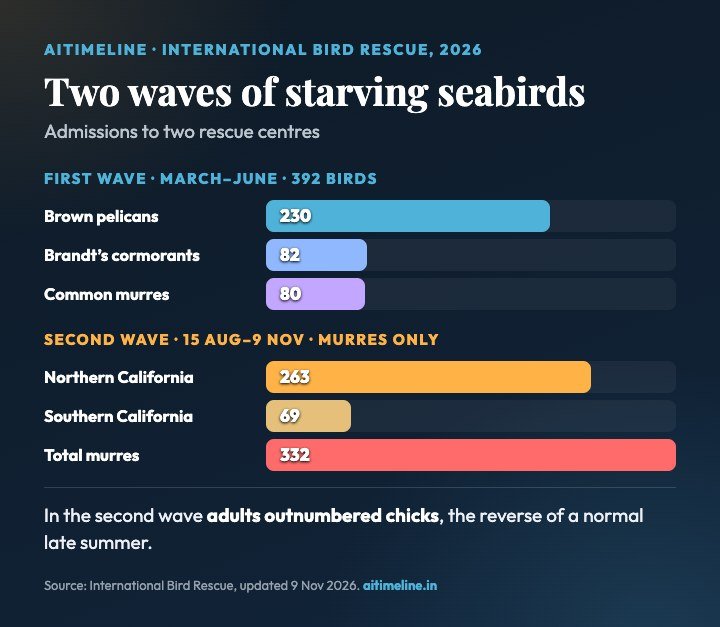
Seabirds are dying along California’s coast in 2026 mainly because they are starving. On 27 March 2026 the California Department of Fish and Wildlife said nearly all birds examined were young and emaciated, and that bird flu was largely unrelated. An extreme marine heatwave, 4 to 8°F above average in places, is the main suspected driver because it pushes prey fish out of reach. Rescue centres admitted 392 seabirds from March to June and 332 more murres from mid-August to 9 November 2026.
Dead Birds on the California Coast: Key Questions
California’s Seabird Crises in Ten Points
- Different causes: pesticides, oil, algal toxins, disease and heat have each produced dead birds; the evidence differs for each.
- 2026 verdict: CDFW named starvation as the primary cause on 27 March 2026.
- Not bird flu: testing found H5N1 largely unrelated to the 2025–26 deaths.
- Heat: water 4 to 8°F above average in places pushed prey fish out of reach.
- Two waves: 392 admissions from March to June, then 332 murres from 15 August to 9 November.
- Adults too: in the second wave adult murres outnumbered chicks, which is unusual.
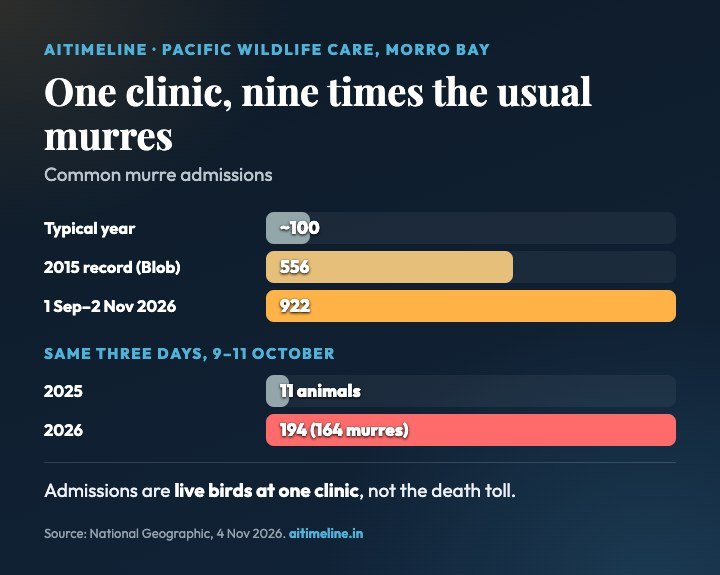
- Record clinic numbers: Morro Bay’s Pacific Wildlife Care took in 922 murres in two months.
- Precedent: the 2014–16 Blob killed an estimated 4 million murres in Alaska alone.
- Oil’s long tail: a ship sunk in 1953 killed an estimated 51,539 seabirds between 1990 and 2003.
- Recovery is possible: brown pelicans came back from near-zero breeding after DDT was banned.
How a Warm Ocean Starves a Seabird
The chain behind the 2026 deaths, step by step.
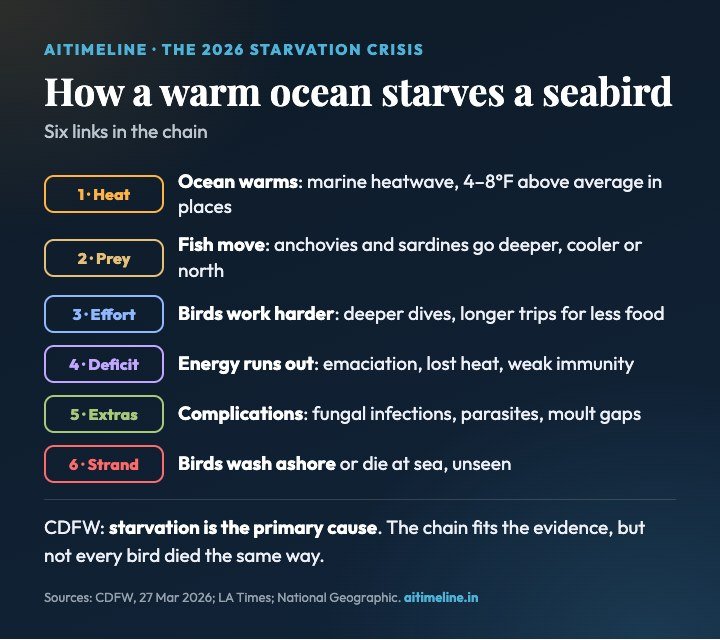
A common murre weighs about two pounds and needs a great deal of food for its size. It catches small schooling fish by diving, usually between 60 and 160 feet, using its wings to swim. In a normal year that works. In a marine heatwave the fish move down into cooler water or north out of the area, and every dive costs more than it returns.
The deficit compounds. A thin bird has less fat to keep warm, less energy for its immune system and, in late summer, gaps in its plumage as it moults. Rescuers in 2026 saw exactly that: emaciation, fungal lung infections, blood parasites and worn, broken feathers. This sequence is consistent with what investigators found, but it is an explanation, not proof that every bird died the same way. CDFW’s own lead investigator has said the heatwave is probably not the only factor.
Six Ways Seabirds Die on This Coast
Each cause leaves different evidence.
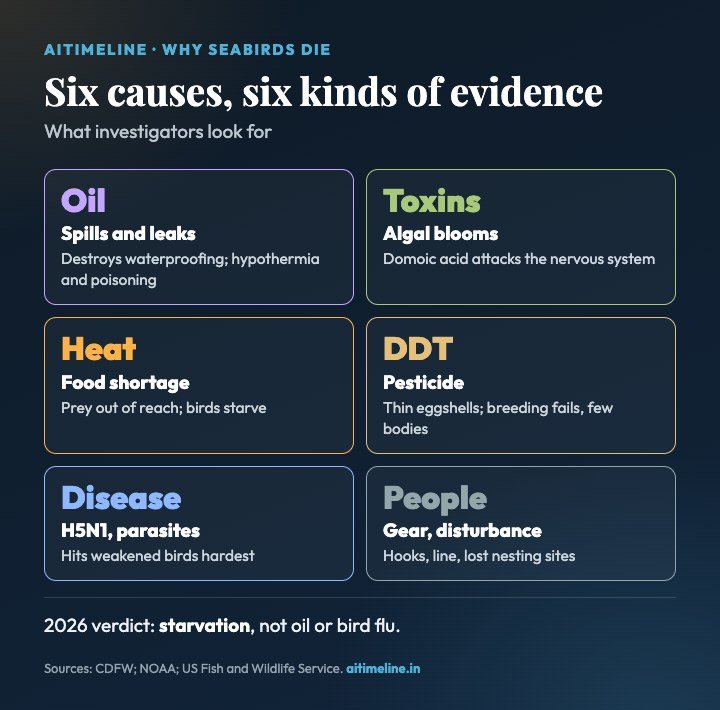
Oil shows up on the feathers. Domoic acid shows up in tissue samples and in neurological symptoms. Starvation shows up as emaciation: wasted breast muscle and no fat. DDT left almost no bodies at all, just empty nests and crushed eggs. Telling these apart is the first job in any die-off, and it is why the same beach scene in 1990, 2015 and 2026 led to three different explanations.
Timeline: California Coast Dead Birds, 1953–2026
Newest first. Colour shows the type of crisis.
International Bird Rescue counts 332 murres in the second wave 2025–26 emergency
What happened: International Bird Rescue’s running tally showed 332 common murre admissions since 15 August 2026: 263 at its Northern California centre and 69 in Southern California.
Condition of the birds: Staff described severe emaciation, worn and broken feathers and, in many birds, the blood parasite Babesia uriae.
Why it matters: The first wave, March to June, had already brought 392 seabirds of three species. A second wave dominated by murres means the event did not end when spring did.
National Geographic reports 922 murres at a single Morro Bay clinic 2025–26 emergency
What happened: National Geographic reported that Pacific Wildlife Care, the county’s only licensed wildlife rehabilitation centre, received 922 common murres between 1 September and 2 November 2026. In a typical year without a major marine heatwave it admits around 100.
The peak: During a coastal heatwave from 9 to 11 October the centre took in 194 animals, 164 of them murres. On the same three dates in 2025 it received 11 animals in total.
The mechanism: Warm surface water pushes anchovies and sardines deeper. Murres can dive very deep but do most of their hunting at 60 to 160 feet, so they burn more energy than they catch. During the late-summer moult, gaps in their feathers let cold water in, and weakened birds can no longer fight the currents pushing them ashore.
A second wave begins, and this time adults outnumber chicks 2025–26 emergency
What happened: International Bird Rescue began logging an unusual influx of severely emaciated common murres, many with worn, broken and weathered feathers.
The unusual pattern: Late summer normally brings large numbers of orphaned murre chicks and a smaller number of adults. In 2026 adults arrived in greater numbers than chicks.
Why it matters: The March findings had pointed to young, inexperienced birds. Starving adults suggest the food problem had become severe enough to defeat experienced hunters too.
A marine heatwave becomes the main suspect Ocean heat & food
What happened: The Los Angeles Times reported that ocean temperatures off parts of California had climbed 4 to 8 degrees Fahrenheit above average. Nearly 30% of readings off the Scripps Pier in La Jolla that year had broken previous records.
What scientists said: Tamara Russell of Scripps Institution of Oceanography explained that fish needing cooler water move north or deeper, and that warm water can choke off the nutrients feeding the whole food web.
The caveat: CDFW’s Krysta Rogers said the heatwave may play a role but is likely not the only factor: a strong 2025 breeding season had produced many young birds, and young birds die in greater numbers in lean winters.
295 dead-bird reports reach CDFW in four months 2025–26 emergency
The count: Members of the public submitted 295 reports of dead birds: 193 Brandt’s cormorants, 68 common murres and 34 brown pelicans, grebes and loons combined.
What it does not show: These are reports, not a verified carcass count. Many birds die at sea and never reach a beach, and one report can cover several birds or the same bird twice.
Why it matters: The species mix explains why the event drew attention: pelican strandings had become familiar, but a wave of dead cormorants and murres pointed to something broader.
First wave: 392 seabirds admitted for starvation 2025–26 emergency
The numbers: International Bird Rescue admitted 392 birds between March and June 2026: 230 brown pelicans, 82 Brandt’s cormorants and 80 common murres. Southern California accounted for 271 of them.
How the organisation described it: A “widespread starvation event” affecting seabirds along the California coast.
Care given: Food, fluids, housing and veterinary treatment. Fungal lung infections (aspergillosis) were common in birds whose immune systems had been weakened by hunger.
CDFW: starvation is the primary cause, not bird flu 2025–26 emergency
Finding: CDFW said nearly all birds examined were young and emaciated, some with fungal respiratory infections, heavy parasitism or secondary injuries. Starvation was the primary cause.
Bird flu testing: Avian influenza was not detected in 33 Brandt’s cormorants examined by CDFW or in roughly 34 common murres tested by CDFW and partners. Partners reported preliminary detections in two of 22 further cormorants and in four murres. CDFW concluded the mortality appeared “largely unrelated” to avian influenza.
Context: Seabird researchers had reported that 2025 was an unusually good breeding year for these species. A boom in young birds is often followed by high juvenile mortality.
Reports of weak and dead seabirds start to climb 2025–26 emergency
What happened: CDFW began receiving more reports of debilitated and dead seabirds, first Brandt’s cormorants and common murres, later brown pelicans along the central and southern coast.
Who was dying: Mostly birds hatched that year. Rehabilitation centres began admitting unusual numbers of all three species.
Why it matters: These early reports became the basis for the state investigation announced in March 2026.
Pelicans again: hungry fledglings and domoic acid Disease & toxins
What happened: From late March 2025 International Bird Rescue received a surge of brown pelicans, first in Los Angeles, then in Northern California.
Two problems at once: Many were fledglings that had just left offshore colonies and did not yet know how to feed themselves. Adults were coming in with domoic acid poisoning, an algal neurotoxin increasingly affecting Southern California seabirds.
The numbers: By 7 August 2025: 273 admissions (178 in Southern California, 95 in Northern California) and 163 releases.
Science study: about 4 million murres died in Alaska Ocean heat & food
What happened: Using colony counts from 13 sites across the Gulf of Alaska and eastern Bering Sea, researchers estimated that about 4 million common murres, roughly half of Alaska’s population, starved during the 2014–2016 marine heatwave.
Bigger than thought: The total was four to eight times the early estimates. Colonies showed no sign of recovering to their earlier numbers.
Why it matters for California: It showed how far a single marine heatwave can push a common, widespread seabird, and why researchers watch California’s murres closely when the ocean warms again.
Starving brown pelicans flood rescue centres Ocean heat & food
What happened: From late April 2024 CDFW received rising reports of stranded brown pelicans. Its 10 May update said preliminary results showed the birds were succumbing to starvation-related problems.
The rescue effort: International Bird Rescue admitted 330 pelicans within a month and 413 in all. It released 254; 133 died in care.
Secondary injuries: Many birds had been hurt by fishing gear, mostly through entanglement.
H5N1 bird flu confirmed in California’s wild birds Disease & toxins
What happened: CDFW announced the first detections of highly pathogenic H5N1 in wild birds in California: two Canada geese and one American white pelican, collected on 5 July and confirmed by USDA on 13 July.
Where: Colusa and Glenn counties in the Sacramento Valley, inland, not on the coast.
Why it matters: H5N1 became a standing concern for every later die-off. In 2026 it was tested for and largely ruled out as the driver.
Nearly 800 pelicans go into rehabilitation Ocean heat & food
What happened: A large brown pelican stranding event put nearly 800 pelicans into California wildlife rehabilitation facilities.
Outcome: 394 were successfully returned to the wild, according to CDFW.
Why it matters: It was the first of four pelican crises in five years, 2022, 2024, 2025 and 2026.
Huntington Beach pipeline spill Oil spill
What happened: Late on 1 October 2021 the San Pedro Bay Pipeline broke and released an estimated 24,500 gallons of crude oil. Inspection suggested a ship’s anchor had hooked and partly torn the line.
Bird toll: Responders recovered 116 dead birds and collected more than 30 live oiled birds for rehabilitation, including threatened western snowy plovers.
Status: The natural resource damage assessment was still under way in 2026; NOAA and co-trustees submitted an assessment funding claim to the responsible party on 2 February 2026.
Up to a million murres: the Blob’s first count Ocean heat & food
What happened: A USGS-led study estimated that the 2015–2016 die-off killed close to one million common murres, and documented colony-wide breeding failures during and after it.
The carcasses: About 62,000 dead or dying murres washed ashore from California to Alaska; three-quarters were found in the Gulf of Alaska.
Later revision: The 2024 study in Science raised the Alaska estimate to about 4 million.
California’s murre die-off: starvation plus algal toxin Ocean heat & food
What happened: Beach surveys recorded a rise in dead and weakened common murres. Researchers collected more than 1,000 murres.
Findings: Starvation was the likely cause of death. An unprecedented bloom of Pseudo-nitzschia played a secondary role: domoic acid was found in 24 of 29 birds tested. USGS found no infectious disease.
Food-web effect: The toxin lingered for a year and helped close fisheries, including the northern anchovy fishery, a main murre prey.
Refugio oil spill on the Santa Barbara coast Oil spill
What happened: An onshore pipeline ruptured and spilled more than 100,000 gallons of crude oil, much of it running through a storm drain and into the ocean.
Wildlife: Field teams found dead fish, invertebrates, birds and marine mammals. Affected birds included brown pelicans, common murres, Pacific loons and snowy plovers.
Settlement: A $22.3 million natural resource settlement was finalised in October 2020.
The Blob: a marine heatwave rewires the food web Ocean heat & food
What happened: An unusually large patch of warm water formed in late 2014 and lasted about two years. Scientists called it the Blob; the 2015–2016 El Niño added to the heat.
Effect: Plankton, forage fish and their predators were all hit. Deep-diving murres that depend on small fish could not find enough to eat.
Why it matters: It is the template for the 2026 event: warm water, scarce prey and starving seabirds.
Brown pelican removed from the endangered list Pesticides & recovery
What happened: The federal rule removing the brown pelican from the endangered species list was published, after a recovery tied to the end of DDT use and protection of nesting colonies. California had removed it from the state list on 5 February 2009.
The recovery: The Southern California Bight population, fewer than 1,000 pairs in the late 1960s, had about 11,695 breeding pairs at 10 sites in 2006.
What it did not mean: Delisting ended the pesticide crisis, not the risks. Food shortages, toxins, fishing gear and oil can still kill pelicans.
Cosco Busan hits the Bay Bridge Oil spill
What happened: The container ship Cosco Busan struck a tower of the San Francisco–Oakland Bay Bridge. A gash about 100 feet long released about 53,000 gallons of fuel oil.
Bird toll: NOAA estimates 6,849 birds killed across 65 species, including the threatened marbled murrelet and snowy plover. More than 3,000 acres of shoreline were oiled.
Settlement: Trustees settled with the ship’s owner and operator in September 2011; more than $32 million went to restoration.
Over 100,000 gallons pumped from the Luckenbach Oil spill
What happened: A large-scale operation removed more than 100,000 gallons of fuel oil from the sunken freighter.
What remained: About 85,000 gallons could not be reached and may be released as the wreck deteriorates.
Result: Seabird oiling on the scale of 1997–98 and 2001–02 had not recurred by the time of the 2006 final report.
Oiled birds again, and the source is finally named Oil spill
What happened: Oiled seabirds washed ashore in large numbers from late November 2001. Responders collected nearly 2,000 live and dead birds in the first episode.
The breakthrough: In January 2002 oil samples were matched to the wreck of the S.S. Jacob Luckenbach, which also explained many earlier “mystery” spills.
Toll: A 2006 report for California’s Office of Spill Prevention and Response estimated 9,209 birds killed from November 2001 to January 2003, including 6,159 common murres.
The Point Reyes Tarball Incidents Oil spill
What happened: From 16 November 1997 tarballs and oiled seabirds came ashore, mostly near Point Reyes but from north of Bodega Head to Point Lobos, until March 1998. No vessel had reported a spill.
Toll: 2,959 birds were recovered. Modelling later estimated 38,539 seabirds killed, the worst of the Luckenbach events.
Source: Most of the oil sampled was later traced to the Luckenbach wreck.
American Trader spills oil off Huntington Beach Oil spill
What happened: The tanker American Trader ran over its own anchor while approaching an offshore mooring, puncturing its hull and spilling an estimated 416,598 gallons of crude oil.
Toll: An estimated 3,400 birds were killed, along with fish, and beaches were closed.
Settlement and law: The bird and fish claims settled for $3.45 million. Later in 1990 Congress passed the Oil Pollution Act and California created its Office of Oil Spill Prevention and Response.
Pelican eggshells return to near normal Pesticides & recovery
What happened: Mean pelican eggshell thickness from 1986 to 1990 was only 4.6% thinner than the pre-1947 average.
Why it matters: Breeding tends to fail when shells average 15 to 20% thinner than normal. By the late 1980s DDE was no longer causing population-wide reproductive failure.
Context: Recovery was slow: removing a pollutant does not instantly restore a colony.
The US bans most uses of DDT Pesticides & recovery
What happened: The EPA announced the cancellation of most DDT uses in the United States, following evidence of its effects on wildlife including eggshell thinning.
Effect on pelicans: Contaminant levels in pelican eggs fell over the following years and breeding gradually recovered.
Why it matters: It is the clearest case in this timeline of a policy decision reversing a seabird decline.
800,000 gallons of bunker fuel in San Francisco Bay Oil spill
What happened: A collision between two tankers near the Golden Gate spilled about 800,000 gallons of bunker fuel into the bay.
Impact: The California Coastal Commission describes a devastating impact on local species. Diving birds were especially exposed.
Why it matters: Coming two years after Santa Barbara, it reinforced how exposed California’s coast was to shipping accidents.
Brown pelican listed as endangered Pesticides & recovery
What happened: The brown pelican was listed as endangered under the law that preceded the 1973 Endangered Species Act.
The reason: Reproductive failure linked to DDT and related pesticides, plus disturbance of nesting colonies.
Why it matters: It made the California brown pelican one of the best-known cases for stronger wildlife protection.
Santa Barbara blowout Oil spill
What happened: A blowout at a Union Oil offshore platform spilled crude oil into the channel and onto beaches. Estimates range from 80,000 barrels (about 3.4 million gallons) to 4.2 million gallons.
Impact: Oil coated beaches, rocks and seabirds. Images of oiled birds became symbols of the damage.
Why it matters: The California Coastal Commission calls it a catalyst for the modern environmental movement.
Pelican breeding collapses off Southern California Pesticides & recovery
What happened: The brown pelican population of the Southern California Bight fell to fewer than 1,000 pairs and reproductive success was nearly zero.
The cause: DDE from DDT accumulated in the fish pelicans ate and thinned their eggshells, so eggs broke under incubating adults.
Why it matters: This was mass mortality without bodies on the beach: chicks simply were not produced.
The S.S. Jacob Luckenbach sinks Oil spill
What happened: The freighter sank in 55 metres of water en route to Korea, carrying 457,000 gallons of bunker fuel.
A slow leak: It is suspected of leaking from at least 1973, mostly after strong winter storms.
Why it matters: For decades it produced “mystery” oiled birds that no one could trace.
The 2026 Crisis in Numbers
Two waves, three species, one clinic overwhelmed.
| Species | Southern California | Northern California | Total |
|---|---|---|---|
| Brown pelicans | 154 | 76 | 230 |
| Common murres | 55 | 25 | 80 |
| Brandt’s cormorants | 62 | 20 | 82 |
| First wave total | 271 | 121 | 392 |
The two sets of numbers measure different things. International Bird Rescue’s figures are live birds admitted to its two centres; Pacific Wildlife Care’s are admissions to one clinic on the central coast; CDFW’s 295 reports are dead birds reported by the public from January to April. None is a death toll. Researchers stress that birds dying miles offshore rarely drift to a beach, so every count here is a floor.
🔍 What is established
- Starvation is the primary cause (CDFW, March 2026).
- Most birds examined were young; adults joined in the second wave.
- Bird flu was largely ruled out as the driver.
- Water was far warmer than average along much of the coast.
❓ What is not yet known
- How many birds have died in total.
- How much of the toll is heat versus the 2025 breeding boom.
- The effect on breeding colonies in 2027 and beyond.
- Whether El Niño storms this winter make it worse.
Oil: The Crises You Could See
Estimated birds killed, by spill.
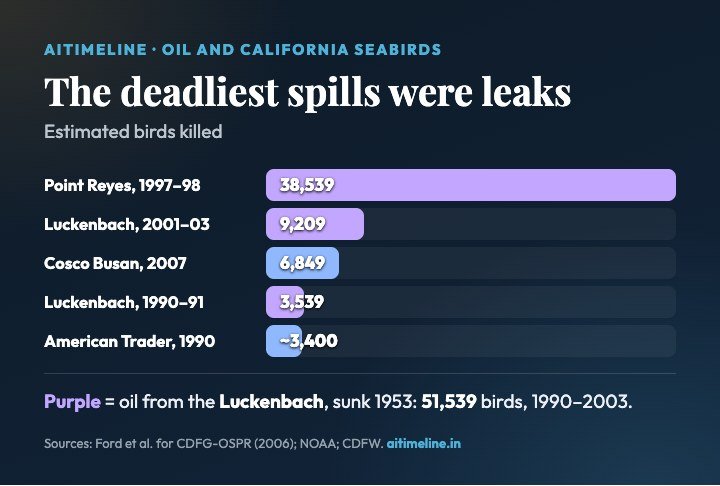
Oil is the cause most people picture, and the one where blame is easiest to assign. Yet the deadliest oil source on this coast was not a dramatic collision but a slow leak. The freighter S.S. Jacob Luckenbach sank off San Francisco in 1953 and for decades released fuel after winter storms. Because nobody reported a spill, the oiled birds that washed up were “mystery” cases until samples were matched to the wreck in January 2002. A 2006 report for California’s spill office put the toll from 1990 to 2003 at 51,539 seabirds, about 62% of them common murres.
The big visible spills also changed the law. After the American Trader in February 1990 and the Exxon Valdez the year before, Congress passed the Oil Pollution Act, which required double hulls on tankers, and California created its Office of Oil Spill Prevention and Response. Spills did not stop: Cosco Busan in 2007, Refugio in 2015 and Huntington Beach in 2021 all killed birds. But they became smaller and better documented.
The Major Crises Compared
| Crisis | When | Main pressure | Impact on birds |
|---|---|---|---|
| DDT contamination | 1950s–1970s | Pesticide (DDE) | Pelican breeding near zero, under 1,000 pairs |
| Santa Barbara blowout | 1969 | Crude oil, 3.4–4.2m gallons | Oiled seabirds and shoreline |
| San Francisco Bay spill | 1971 | Bunker fuel, ~800,000 gallons | Local wildlife damage |
| American Trader | 1990 | Tanker spill | ~3,400 birds killed |
| Luckenbach wreck | 1990–2003 | Chronic leaks | ~51,539 birds killed |
| Cosco Busan | 2007 | Ship collision | ~6,849 birds killed |
| The Blob | 2014–2016 | Marine heatwave | ~4 million murres in Alaska |
| California murre die-off | 2015 | Starvation, algal toxin | 1,000+ murres collected |
| Refugio | 2015 | Pipeline spill | Pelicans, murres, loons, plovers |
| Huntington Beach | 2021 | Pipeline spill | 116 dead birds recovered |
| Pelican strandings | 2022, 2024, 2025 | Starvation, domoic acid | ~800, 413 and 273+ admissions |
| Seabird starvation event | 2025–2026 | Starvation, marine heatwave | Murres, cormorants, pelicans; ongoing |
The Brown Pelican: Collapse, Recovery, New Trouble
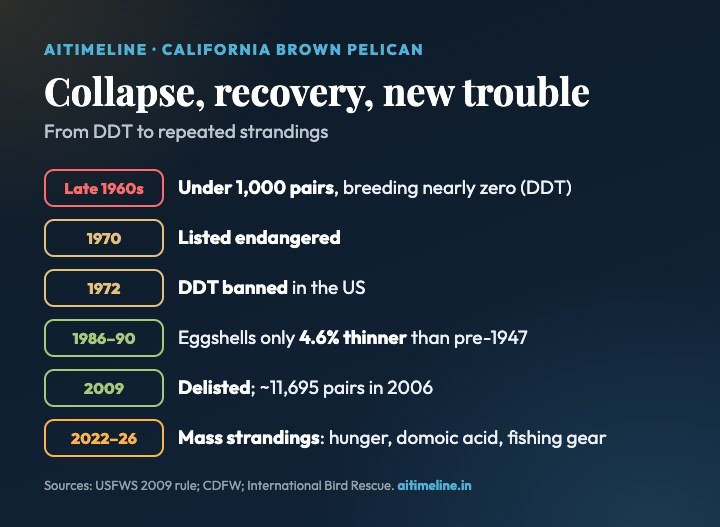
The brown pelican is the coast’s clearest success and its clearest warning. DDT almost erased it from Southern California without leaving many bodies: eggs broke, chicks were never hatched. Once the chemical was banned in 1972, shells thickened, colonies refilled and the bird left the endangered list in 2009. Since 2022, though, pelicans have stranded in large numbers almost every year, from hunger, algal toxins and fishing-gear injuries. Recovery from one threat does not protect a species from the next.
What Dead Birds Tell Scientists About the Ocean
- Emaciated birds: prey is scarce or out of reach.
- Neurological symptoms: possible exposure to algal toxins such as domoic acid.
- Oiled feathers: a spill or leak, even one nobody has reported.
- Empty or failed nests: long-term chemical or habitat damage.
- Mostly juveniles: a hard winter after a boom year; adults too signals a deeper food problem.
- New species on the beach: a shift in ocean conditions.
Seabirds feed across several levels of the food web, so their condition reflects things that are hard to observe offshore. A die-off is not proof that a whole population is collapsing, but a run of them, as in 2014–16 and again since 2022, shows an ocean under repeated stress.
Who Responds When Seabirds Die
| Organisation | Role |
|---|---|
| California Department of Fish and Wildlife (CDFW) | Investigates mortality, runs necropsies and disease tests, leads oil-spill response through its spill office |
| US Fish and Wildlife Service | Protects migratory birds; managed the pelican’s listing and recovery |
| NOAA | Monitors algal blooms and marine heatwaves; assesses oil-spill damage |
| US Geological Survey | Wildlife disease testing and population research |
| International Bird Rescue | Treats seabirds at centres in Fairfield and San Pedro |
| Pacific Wildlife Care | Wildlife rehabilitation in San Luis Obispo County |
| COASST | Trains volunteers to survey beaches and record dead birds |
Terms Explained
- Marine heatwave: a prolonged period of unusually warm ocean water in a region.
- Forage fish: small schooling fish such as anchovies and sardines that seabirds eat.
- Emaciation: severe loss of fat and muscle from starvation.
- Domoic acid: a neurotoxin made by some Pseudo-nitzschia algae.
- DDE: the breakdown product of DDT that thins eggshells.
- Necropsy: an animal post-mortem examination.
- Aspergillosis: a fungal lung infection common in weakened seabirds.
Explore More Timelines
People Also Ask
Frequently Asked Questions
Based on CDFW, NOAA, US Fish and Wildlife Service, USGS and International Bird Rescue records.
⚠️ Editorial Note
Figures come from primary records where possible: CDFW news releases, NOAA damage assessment pages, the 2009 federal delisting rule, the 2006 Luckenbach mortality report and International Bird Rescue’s live tallies (as of 9 November 2026). Rescue admissions and public reports are not death tolls. Oil-spill bird tolls are modelled estimates. Santa Barbara 1969 volumes differ by source, and both are given. This is an ongoing event; we will update it as new findings are published.
Related Reading on AiTimeline
Sources & further reading
Every dated entry above was checked against these references. Last reviewed 11 November 2026.
- CDFW Finds Starvation to be Primary Cause of Increased Mortalities in California Seabirds (27 March 2026)
- 2026 California Starvation Event
- Across a fevered Pacific Ocean, seabirds are starving (4 November 2026)
- As ocean temperatures spike, more dead sea birds are washing up on California shores (18 May 2026)
- Findings on 2015 California Seabird Die-off Published
- Extreme mortality and reproductive failure of common murres resulting from the northeast Pacific marine heatwave of 2014-2016
- Four Million Murres Missing
- Acute seabird mortality resulting from the S.S. Luckenbach and associated mystery oil spills, 1990-2003 (Final report, 2006)
- California Oil Spills
- American Trader Oil Spill
- M/V Cosco Busan Oil Spill
- Refugio Beach Oil Spill
- Pipeline P00547 Huntington Beach Oil Spill
- Removing the Brown Pelican From the List of Endangered and Threatened Wildlife (Federal Register, 17 November 2009)
- High Number of California Brown Pelicans Show Signs of Malnutrition (10 May 2024)
- 2024 Brown Pelican Crisis
- 2025 Brown Pelican Crisis
- Avian Influenza Virus Detected in Wild Birds in California (14 July 2022)