Kathua Case: How a Crime Triggered a National Debate on Justice
Kathua case timeline: the 2018 investigation and political row, the Supreme Court's move to Pathankot, the 2019 convictions and appeals still pending.
Latest Story
In January 2018 an eight-year-old girl from the nomadic Bakarwal community went missing near Rasana village in Jammu and Kashmir’s Kathua district. A week later her body was found. What followed was one of India’s most fiercely contested criminal cases: police officers accused of destroying evidence, ministers at a rally backing the accused, lawyers trying to block a chargesheet, and a Supreme Court order moving the trial out of the state. On 10 June 2019 a Pathankot court convicted six of seven accused. Appeals and a separate trial are still running. This Kathua case timeline sets out what happened, what the courts decided, and what remains open in November 2026.
Indian law bars identifying a victim of sexual assault. This article does not name the child or her family, publish photographs of them, or reproduce graphic details. We refer to her as the child.
💡 Short Answer
The Kathua case is the January 2018 abduction, rape and murder of an eight-year-old Bakarwal girl in Kathua, Jammu and Kashmir. The Supreme Court moved the trial to Pathankot on 7 May 2018. On 10 June 2019, three men got life sentences, three police personnel got five years for destroying evidence, and one accused was acquitted. An eighth accused, held an adult by the Supreme Court in 2022, is on trial separately, and appeals are pending in the Punjab and Haryana High Court.
Kathua Case: Key Questions
The Kathua Case in Ten Points
- The crime: an eight-year-old Bakarwal girl went missing on 10 January 2018; her body was found on 17 January.
- The investigation: the Crime Branch took over on 22 January and charged eight people, including four police personnel.
- The motive alleged: to frighten the nomadic Bakarwal community out of the area.
- Resistance: rallies backed the accused, two BJP ministers attended one, and lawyers tried to block the chargesheet.
- Ministers out: Lal Singh and Chander Prakash Ganga resigned on 13 April 2018.
- Fair-trial order: the Supreme Court moved the trial to Pathankot on 7 May 2018.
- Verdict: six convicted, one acquitted, on 10 June 2019; three life sentences.
- Police accountable: three officers jailed for destroying evidence.
- Privacy enforced: 12 media houses paid ₹10 lakh each for naming the child.
- Still open: appeals pending and the eighth accused’s trial running in 2026.
Why the Supreme Court Moved the Trial to Pathankot
The decision that made Kathua a national test of fair trials.
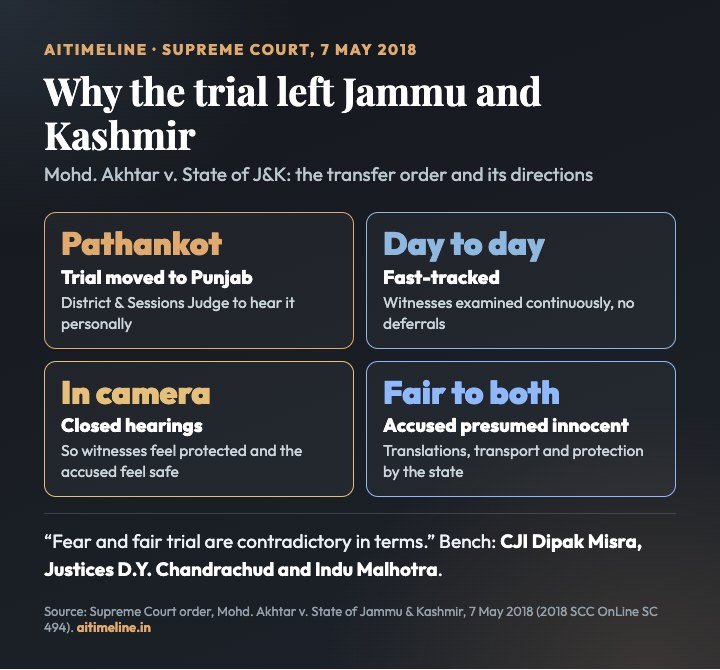
By April 2018 the conditions for a fair trial in Kathua were in doubt. On 9 April lawyers outside the Chief Judicial Magistrate’s court tried to stop the Crime Branch filing its chargesheet; it went in only after police reinforcements arrived. Groups demanding the release of the accused had marched through the district for weeks. The child’s father went to the Supreme Court saying his family and their lawyer were in danger.
The court first ordered protection for the family on 16 April, then paused the Kathua trial on 27 April. On 7 May a bench of Chief Justice Dipak Misra and Justices D.Y. Chandrachud and Indu Malhotra moved the case to Pathankot. The order was careful about balance: a fair trial, it said, must be fair to the accused as well as to the victims, and the accused were to be treated as innocent until found guilty. The trial would run day to day, in camera, under the Ranbir Penal Code, with the state paying to bring witnesses across the border.
“Fear and fair trial are contradictory in terms and they cannot be allowed to co-exist.”
— Supreme Court of India, transfer order, 7 May 2018
The Legal Path in Eight Dates
From a missing child to the appeal courts.
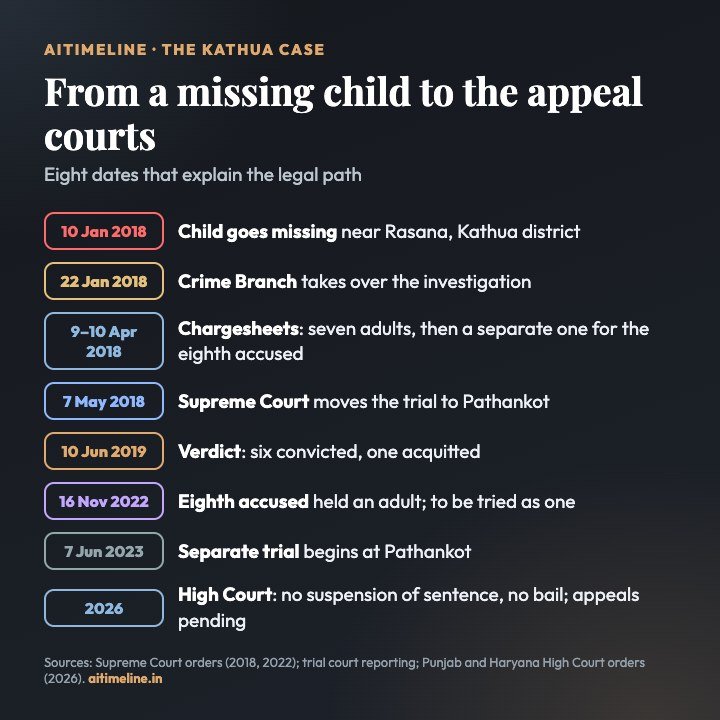
Timeline: The Kathua Case, January 2018 to November 2026
Newest first. Colour shows the type of event.
Two strands of the case are still open Courts
The appeals: The appeals against the 2019 convictions are pending before the Punjab and Haryana High Court. In March 2026 the court directed that Sanji Ram’s appeal be listed for final hearing in September 2026. As of 12 November 2026 we found no report of that hearing or of any judgment.
The eighth accused: The separate adult trial of the eighth accused continues at Pathankot. In April 2026 the High Court asked the trial court to finish it, preferably within a year.
What this means: The 2019 verdict stands unless an appeal court changes it. The case as a whole has not reached a final end point.
High Court refuses bail to the eighth accused Courts
What happened: A single-judge bench rejected the bail plea of Shubam Sangra, saying the alleged acts “shock the collective conscience of the society and judicial conscience of the court”. The order was made public the next day.
Defence argument: His counsel said he had been in custody since January 2018 and that only 41 of 309 listed witnesses had been examined.
Direction: The court told the Pathankot trial court to expedite the trial and conclude it, preferably within one year, citing the right to a speedy trial.
High Court refuses to suspend Sanji Ram’s life sentence Courts
What happened: The division bench dismissed Sanji Ram’s application to suspend his life sentence while his appeal is pending: “Without commenting on the merits… it is not a case where the applicant deserves the concession of suspension of sentence at this stage.”
The arguments: His counsel, Vinod Ghai, argued that no concrete evidence linked him to the crime and that he had spent more than eight years in custody. R.S. Cheema, for the Union Territory, said the evidence established his complicity.
Next step: The court directed that the main appeal be listed for final hearing in September 2026. The three-page order was reported by PTI on 18 March.
Separate trial moves slowly Courts
What was reported: 57 hearings had taken place in about two years. At the 29 May 2025 hearing the case was still at the prosecution-evidence stage.
Why: Lawyers told the paper that, unlike the main trial, there was no Supreme Court direction for day-to-day hearings.
How he appears: The accused, held in Gurdaspur Central Jail, was being produced by video conference.
Adult trial of the eighth accused begins Courts
What happened: Proceedings against Shubam Sangra began at Pathankot under the Supreme Court’s 2022 direction that he be tried as an adult.
The charges: The chargesheet accuses him of murder, rape, kidnapping and wrongful confinement. Arguments on the framing of charges followed later in June 2023.
Media deposits sent to the victims’ fund Media & privacy
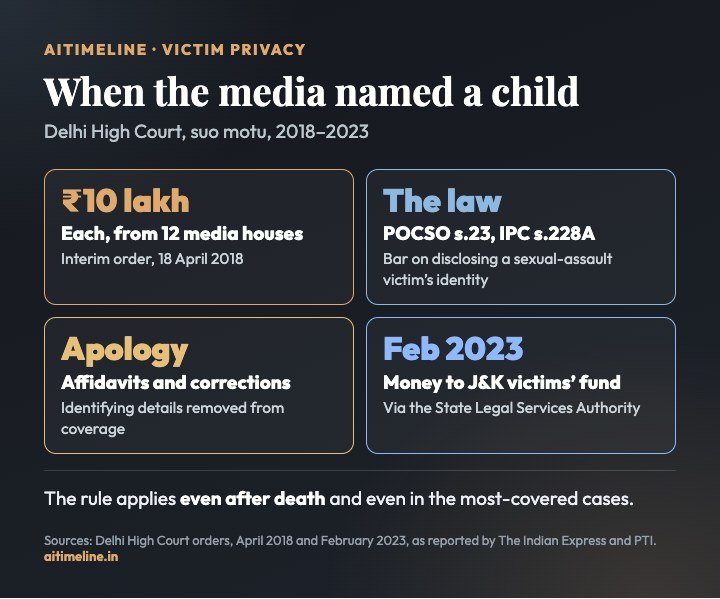
What happened: The Delhi High Court directed its Registrar General to transfer the money deposited by media houses in 2018 to the Jammu and Kashmir State Legal Services Authority’s compensation fund for survivors of sexual violence and their families.
Compliance: The court recorded that the media houses served with notice had complied with the April 2018 direction.
Supreme Court: the eighth accused was an adult Courts
What happened: The court set aside the Kathua Chief Judicial Magistrate’s order of 27 March 2018, upheld by the Jammu and Kashmir High Court on 11 October 2019, that had treated the accused as a juvenile, and directed that he be tried as an adult.
The reasoning: A medical board had put his age at 19 to 23 at the time of the offence. The court said a medical opinion is not a statutory substitute for proof of age, but should not be ignored when the documents relied on are doubtful.
Careful reading: This was a ruling on age and the trial process. It was not a finding of guilt.
Court orders FIR against investigators Investigation
What happened: A Jammu court ordered an FIR against members of the Crime Branch’s Special Investigation Team on a complaint by three men who alleged they had been tortured to give false evidence against Vishal Jangotra, the accused who was acquitted.
Careful reading: These were allegations. The order did not affect the six convictions.
The motive, as the court saw it Courts
What was reported: According to the judgment, the accused’s own statements “reflected and echoed” the prosecution’s case that animosity towards the Bakarwal community lay behind the crime.
The prosecution case: The Crime Branch said Sanji Ram opposed the Bakarwals’ settlement in Rasana, Kootah and Dhamyal and urged others not to give them land for grazing. It called the crime part of a conspiracy to “dislodge” the community.
Sentences: three life terms, three five-year terms Courts
The sentences: Sanji Ram, Deepak Khajuria and Parvesh Kumar received life imprisonment for murder and 25 years on the gang-rape charge, with fines. Sub-Inspector Anand Dutta, Head Constable Tilak Raj and Special Police Officer Surinder Kumar received five years for destroying evidence.
Why it matters: Three police personnel were convicted for trying to cover up the crime.
Six convicted, one acquitted Courts
What happened: The court convicted six of the seven accused tried together and acquitted Vishal Jangotra, Sanji Ram’s son, giving him the benefit of the doubt.
The trial: Under the Supreme Court’s directions it ran day to day, in camera. 114 witnesses were examined in about a year.
Trial concludes Courts
What happened: The in-camera trial of the seven accused ended, and the court fixed 10 June for the verdict.
Not included: The eighth accused was not part of this trial because of the dispute over his age.
BJP pulls out of the Mehbooba Mufti government Politics
What happened: The BJP withdrew support, saying the coalition had become “untenable”. Mehbooba Mufti resigned and Governor’s rule followed.
Kathua’s role: The Kathua controversy was one of several disagreements between the partners. The BJP’s stated reasons were the security situation and the Ramzan ceasefire, so the case should not be described as the sole cause.
Charges framed; accused plead not guilty Courts
What happened: The court framed charges against the seven accused, including criminal conspiracy, murder and gang rape under the Ranbir Penal Code. All pleaded not guilty and said they had been framed.
Trial opens in Pathankot Courts
What happened: The transferred trial began before the Pathankot District and Sessions Judge, held in camera and day to day.
The rule: Because the Supreme Court was monitoring the case, no other court could entertain petitions about it.
Supreme Court moves the trial to Pathankot Courts
What happened: On the victim’s father’s petition, the court transferred the trial from Kathua to the District and Sessions Judge, Pathankot, in Punjab.
The directions: Day-to-day hearings; continuous examination of witnesses; trial in camera; Urdu statements translated into English; the state to transport and protect witnesses; and equal fair treatment of the accused.
The principle: “Fear and fair trial are contradictory in terms and they cannot be allowed to co-exist.”
Supreme Court pauses the Kathua trial Courts
What happened: While it considered the father’s plea to move the case, the court stayed the trial in Kathua until 7 May.
Earlier order: On 16 April it had ordered security for the family and their lawyer.
Jammu and Kashmir moves to toughen child-rape law Politics
What happened: Days after the Centre’s own ordinance, the state cabinet approved an ordinance amending the Ranbir Penal Code to allow the death penalty for rape of a girl under 12, along with a separate child-protection ordinance. Governor N.N. Vohra later promulgated them.
Why a separate law: Under Article 370 the state had its own penal code, so central criminal-law changes did not apply automatically.
Delhi High Court fines media houses for naming the child Media & privacy
What happened: After taking notice of coverage on 13 April, the court ordered 12 media houses to pay ₹10 lakh each for disclosing the child’s identity, as an interim measure.
The law: Section 23 of the POCSO Act and Section 228A of the IPC bar disclosure of a sexual-assault victim’s identity. The media houses apologised and said they had acted in ignorance of the law.
Trial begins in Kathua Courts
What happened: The trial opened in Kathua. The accused pleaded not guilty and asked for narco-analysis tests.
In Delhi: The same day, the Supreme Court ordered the state to protect the family and their lawyer and sought its response on moving the trial.
Two BJP ministers resign Politics
What happened: Forest Minister Lal Singh and Industries Minister Chander Prakash Ganga submitted their resignations to the state BJP president after criticism of their appearance at the 1 March rally. The resignations were accepted on 14 April.
Their account: Ganga said the party had sent them to the rally. Lal Singh later led his own march demanding a CBI inquiry.
Same day: Prime Minister Narendra Modi said justice would be done in the Kathua and Unnao cases.
National outrage and a candlelight march Protests & public
What happened: After the chargesheet’s details became public, protests spread across India. Congress leaders led a candlelight march at India Gate; protests in many cities linked Kathua with the Unnao rape case.
Abroad: UN Secretary-General António Guterres called the crime “horrific” and said those responsible must be held accountable.
Separate chargesheet for the eighth accused Investigation
What happened: The Crime Branch filed a separate chargesheet against the eighth accused, who said he was a juvenile.
The age dispute: Investigators said a medical test put him at about 19. The Chief Judicial Magistrate had already held him a juvenile on 27 March 2018, relying on documentary records; the Supreme Court reversed that in 2022.
Chargesheet filed against seven, amid lawyers’ protest Investigation
What happened: The Crime Branch filed its chargesheet against seven accused, including four police personnel, under sections for conspiracy, murder, rape and destruction of evidence of the Ranbir Penal Code.
Obstruction: Lawyers protesting outside the court tried to stop the filing; it went ahead after police reinforcements arrived, and an FIR was registered against the protesting lawyers.
The allegation: The chargesheet alleged the crime was planned to intimidate the Bakarwal community into leaving the area.
Alleged mastermind surrenders Investigation
What happened: Sanji Ram, a retired revenue official and caretaker of the village shrine, surrendered to the Crime Branch a day after his son Vishal Jangotra was arrested in Meerut.
Why it matters: Investigators named him as the man who planned the crime. He was convicted in 2019.
Two ministers attend a Hindu Ekta Manch rally Politics
What happened: Two serving BJP ministers in the PDP–BJP government spoke at a rally organised by the Hindu Ekta Manch, which was demanding a CBI probe and opposing the arrests.
Why it mattered: Opposition parties and civil society asked why ministers were appearing at a protest linked to the accused. It became the coalition’s biggest crisis over the case.
First arrest, and rallies backing the accused Protests & public
Arrest: On 10 February the Crime Branch arrested Special Police Officer Deepak Khajuria, who had been part of the team searching for the missing child.
Protests: Within days, the newly formed Hindu Ekta Manch held a march carrying the national flag, demanding his release and a CBI investigation. Chief Minister Mehbooba Mufti called the use of the flag a desecration.
Crime Branch takes over Investigation
What happened: Following protests, the state transferred the investigation from local police to the Crime Branch, which formed a Special Investigation Team.
Why: The case appeared to involve several people, including police personnel later accused of destroying evidence.
Opposition walks out of the Assembly Politics
What happened: Opposition members staged a walkout over the killing and demanded action. Chief Minister Mehbooba Mufti promised a quick investigation.
The child’s body is found Investigation
What happened: Villagers found the child’s body about a kilometre from the village, a week after she disappeared. A post-mortem was carried out the same day.
The charges that followed: The investigation became a case of abduction, rape and murder.
Missing-person complaint at Hiranagar Investigation
What happened: The child’s father reported her missing at Hiranagar police station, and an FIR was registered after the family’s own search failed.
An eight-year-old girl goes missing Investigation
What happened: The child, from the nomadic Bakarwal community, went missing while out tending the family’s horses near Rasana.
The community: The Bakarwals are pastoral nomads who move with their herds between the Jammu plains and the mountains.
What the 2019 Trial Court Decided
Seven accused tried together; six convicted.
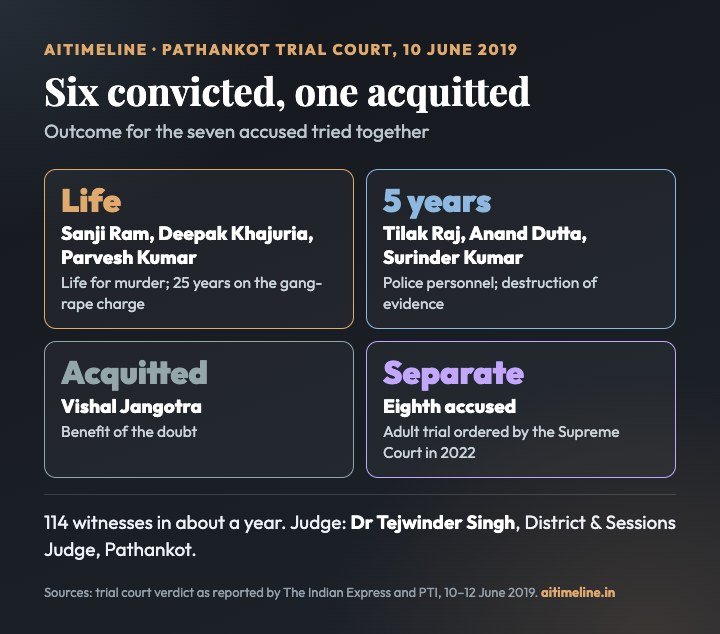
| Accused | Role in the proceedings | Trial-court outcome |
|---|---|---|
| Sanji Ram | Retired revenue official; caretaker of the village shrine; named as the planner | Convicted; life imprisonment, plus 25 years on the gang-rape charge |
| Deepak Khajuria | Special Police Officer | Convicted; life imprisonment, plus 25 years |
| Parvesh Kumar | Co-accused | Convicted; life imprisonment, plus 25 years |
| Tilak Raj | Head Constable | Convicted of destroying evidence; five years |
| Anand Dutta | Sub-Inspector | Convicted of destroying evidence; five years |
| Surinder Kumar | Special Police Officer | Convicted of destroying evidence; five years |
| Vishal Jangotra | Sanji Ram’s son | Acquitted; benefit of the doubt |
| Shubam Sangra | Eighth accused; claimed to be a juvenile | Not part of this trial; separate adult trial since June 2023 |
The judgment also addressed motive. According to reporting on it, the court found that the accused’s own statements “reflected and echoed” the prosecution case: that hostility towards the Bakarwals, and disputes over their grazing and settlement in the Rasana area, lay behind the crime. That finding is why the case is remembered not only as a crime against a child but as an attack aimed at a vulnerable nomadic community.
The conviction of three police personnel matters just as much. The trial court found that officers responsible for investigating the child’s disappearance had destroyed crucial evidence. All the convicts retain the right to appeal, and those appeals are what the Punjab and Haryana High Court is now hearing.
The Eighth Accused: A Separate Case
How an age dispute kept one trial running for years.
From the start, one accused said he was under 18 in January 2018. The Crime Branch disagreed, citing a medical test that put him at about 19, and filed a separate chargesheet on 10 April 2018. The Kathua Chief Judicial Magistrate had already relied on documentary records to hold him a juvenile on 27 March 2018, and the Jammu and Kashmir High Court affirmed that on 11 October 2019.
On 16 November 2022, in State of Jammu and Kashmir v. Shubam Sangra, Justices Ajay Rastogi and J.B. Pardiwala reversed both courts. A medical board had estimated his age at 19 to 23; the court held that such an opinion is not conclusive proof, but should not be brushed aside when the documents are doubtful. He would be tried as an adult. This was a ruling on age, not a finding of guilt.
His trial opened at Pathankot on 7 June 2023, without the day-to-day direction that had driven the main trial. By June 2025 there had been 57 hearings. In April 2026, refusing bail, the High Court noted his counsel’s statement that only 41 of 309 witnesses had been examined, and asked the trial court to finish, preferably within a year.
Political Impact: How Kathua Shook a Coalition
A criminal case that became a test for the PDP–BJP government.

Kathua landed in the middle of an uneasy alliance. Chief Minister Mehbooba Mufti’s PDP led the government with the BJP, whose base was in the Jammu region. When the Crime Branch arrested a special police officer in February 2018, a new group, the Hindu Ekta Manch, marched with the national flag demanding his release and a CBI inquiry. The Chief Minister called the use of the flag a desecration and refused to hand the case to the CBI.
On 1 March two BJP ministers, Lal Singh and Chander Prakash Ganga, spoke at a Hindu Ekta Manch rally. When the chargesheet’s details became public in April, national outrage followed, and on 13 April both resigned. Ganga said the party had sent them to the rally. The BJP had said in February that its stand was that the accused should be punished and the law should take its course.
On 19 June 2018 the BJP withdrew from the government, calling the alliance “untenable”. Contemporary reporting counted Kathua among the differences between the partners, but the BJP’s stated reasons were security and the Ramzan ceasefire. It would be inaccurate to call Kathua the sole cause of the collapse.
The Media and Victim-Privacy Question
A case that set a marker for reporting on child victims.
✔️ What the court required
- ₹10 lakh from each of 12 media houses.
- Affidavits of apology within days.
- Steps to remove identifying details.
📝 What responsible coverage means
- No name, photograph or family details of a child victim.
- No graphic description of sexual violence.
- Allegations kept separate from court findings.
As the case became national news in April 2018, several outlets published the child’s name and photographs. The Delhi High Court took notice on its own on 13 April, and on 18 April Acting Chief Justice Gita Mittal and Justice C. Hari Shankar ordered 12 media houses to pay ₹10 lakh each as an interim measure. The outlets apologised, saying they had misunderstood the law. In February 2023 the court sent the money to the Jammu and Kashmir State Legal Services Authority’s fund for survivors of sexual violence and their families.
Where the Kathua Case Stands in November 2026
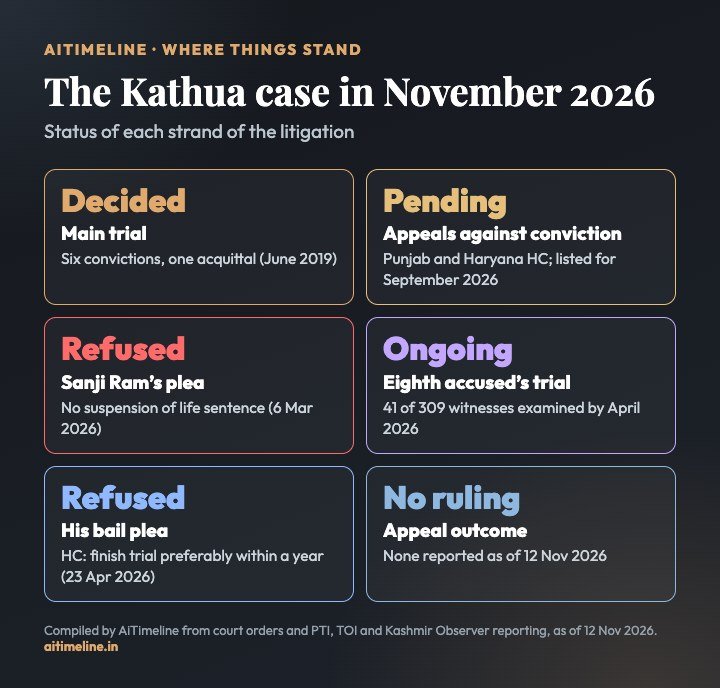
| Proceeding | Position as of 12 November 2026 |
|---|---|
| Main trial (seven accused) | Decided 10 June 2019: six convicted, one acquitted |
| Appeals against conviction | Pending, Punjab and Haryana High Court; Sanji Ram’s listed for final hearing in September 2026; no judgment reported |
| Sanji Ram’s sentence | Suspension refused, 6 March 2026; still serving life |
| Eighth accused’s age | Settled: adult, Supreme Court, 16 November 2022 |
| Eighth accused’s trial | Ongoing at Pathankot since 7 June 2023; bail refused 23 April 2026 |
| Media identity case | Closed in effect: deposits sent to the J&K victims’ fund, February 2023 |
Why the Kathua Case Matters
- Fair trial: a trial can be moved when fear makes a fair hearing impossible, and fairness covers the accused too.
- In-camera hearings: closed, day-to-day trials can protect witnesses and still finish within a year.
- Police accountability: officers who destroy evidence can be convicted alongside the principal offenders.
- Age determination: medical evidence of age cannot simply be ignored when records are doubtful.
- Nomadic communities: the motive finding drew attention to the vulnerability of the Bakarwals.
- Political conduct: two ministers lost their posts over appearing at a rally for the accused.
- Media ethics: naming a child victim is unlawful, however widely a case is covered.
Explore More Timelines
People Also Ask
Frequently Asked Questions
Based on Supreme Court and High Court orders and contemporary court reporting.
⚠️ Editorial Note
We checked dates against court orders and contemporary reporting. Some summaries say Sanji Ram was arrested in February 2018; he surrendered on 20 March 2018. Lawyers’ obstruction of the chargesheet took place on 9 April 2018, not 10 April. We could not confirm an exact date for the first Hindu Ekta Manch march, reported only as days after the 10 February arrest. Defence and prosecution arguments are reported as arguments, not findings. We found no report of a High Court judgment on the appeals after the September 2026 listing. This page is information, not legal advice.
Related Reading on AiTimeline
Sources & further reading
Every dated entry above was checked against these references. Last reviewed 12 November 2026.
- State of Jammu and Kashmir v. Shubam Sangra, Supreme Court judgment, 16 November 2022
- SC transfers Kathua rape-murder trial to Pathankot; in-camera, day-to-day proceedings (Mohd. Akhtar v. State of J&K, 7 May 2018)
- Kathua rape case verdict: a timeline of investigation and proceedings (10 June 2019)
- Animosity between accused and Bakarwal community led to Kathua crime, concludes trial court (12 June 2019)
- Kathua rape case: two BJP ministers resign (13 April 2018)
- Delhi HC asks media houses to pay Rs 10 lakh for revealing Kathua victim's identity (April 2018)
- Kathua case: Delhi HC directs transfer of money deposited by media houses to J&K legal aid (February 2023)
- BJP pulls out of Mehbooba Mufti government, says alliance with PDP untenable (19 June 2018)
- Kathua case: trial against eighth accused continues at snail's pace even after 2 years (June 2025)
- HC denies suspension of life sentence in 2018 Kathua rape-murder case (18 March 2026)
- Punjab and Haryana HC rejects Kathua rape-murder accused's bail (24 April 2026)
- Pathankot court frames charges against seven accused in Kathua case (7 June 2018)
- Kathua case: alleged mastermind surrenders before Crime Branch after son's arrest (20 March 2018)
- Hindu Ekta Manch, BJP leaders protest in support of SPO arrested in Kathua case (February 2018)
- J&K cabinet approves ordinance on death penalty for child rapists (24 April 2018)