Maharashtra 2019: How a Pre-Dawn Government Changed the State’s Politics
Maharashtra's 2019 government formation crisis, from the BJP-Shiv Sena split and President's Rule to the 80-hour Fadnavis-Ajit Pawar government and MVA.
Latest Story
Maharashtra government formation in 2019 took 35 days and produced a result nobody predicted on counting day. The BJP and Shiv Sena won a clear joint majority on 24 October, then fell out over who would be Chief Minister. The Governor invited three parties in turn, President’s Rule followed, and before dawn on 23 November Devendra Fadnavis and the NCP’s Ajit Pawar were sworn in. Three days later, with a Supreme Court-ordered floor test due, both resigned. On 28 November the Shiv Sena’s Uddhav Thackeray became Chief Minister at the head of a coalition with its old rivals, the NCP and Congress. This page sets out every step in order, from the result to what happened to the people involved afterwards.
💡 Short Answer
The BJP (105 seats) and Shiv Sena (56) won a joint majority in October 2019 but split over the Sena’s demand for a rotating chief ministership. After the BJP, Sena and NCP were each invited and none formed a government, President’s Rule was imposed on 12 November. It was lifted at 5:47 am on 23 November and Fadnavis was sworn in with Ajit Pawar, but Sharad Pawar kept the NCP away. Facing a Supreme Court-ordered open floor test, both resigned on 26 November. Uddhav Thackeray took oath on 28 November and won a confidence vote with 169 votes on 30 November after the BJP walked out.
Maharashtra 2019: Key Questions
The Crisis in Ten Points
- A clear result: the BJP and Shiv Sena won 161 of 288 seats as pre-poll allies on 24 October 2019.
- The dispute: the Sena demanded a rotating chief ministership; the BJP said it was never promised.
- Three invitations: the Governor asked the BJP, Shiv Sena and NCP in turn between 9 and 11 November.
- Central rule: President’s Rule was imposed on 12 November under Article 356.
- The dawn oath: President’s Rule was lifted at 5:47 am on 23 November; Fadnavis and Ajit Pawar took oath at about 8 am.
- The NCP split that failed: Sharad Pawar disowned his nephew’s move, and almost all NCP MLAs stayed with him.
- The court: the Supreme Court ordered an open, televised floor test for 27 November.
- 80 hours: Ajit Pawar and Fadnavis resigned on 26 November without facing the House.
- A new coalition: Uddhav Thackeray became Chief Minister on 28 November and won 169 votes on 30 November.
- It did not last: the Sena split in 2022, the NCP in 2023, and Fadnavis was Chief Minister again by December 2024.
From One Alliance to Another
The same Assembly, two very different majorities.
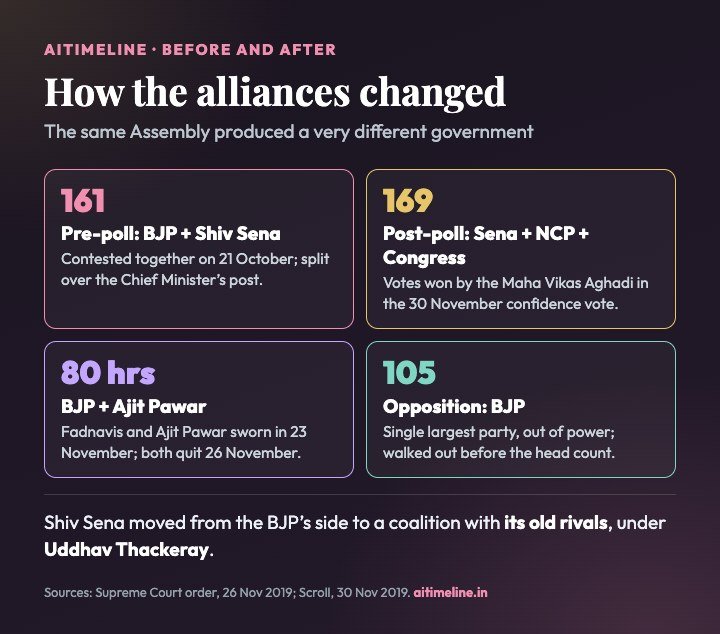
The election did not produce a hung Assembly in the usual sense. Voters gave a majority to an alliance that had campaigned together. What broke was the alliance itself, and the 35 days that followed were a contest to build a new majority out of the same 288 MLAs.
Three possible governments were on the table at different points: the BJP with the Sena, the BJP with a breakaway NCP group, and the Sena with the NCP and Congress. Only the last one ever won a vote in the House.
Why the BJP–Shiv Sena Alliance Broke
One post, two accounts of what was agreed.
| Question | Shiv Sena said | BJP said |
|---|---|---|
| The deal | Equal sharing of power and posts, agreed before the 2019 Lok Sabha polls | Seats and responsibilities were to be shared; not the top post |
| Chief Minister | Two and a half years each | Fadnavis for the full five years |
| Evidence offered | A video of Fadnavis speaking of “equal” posts and responsibilities | The clip did not mention the chief ministership |
| Written record | None published by either side | |
The BJP had fallen from 122 seats in 2014 to 105, which gave the Sena leverage. Within hours of the result, Sena leaders were talking about the “50:50 formula”. When Fadnavis ruled it out on 29 October, the Sena called off talks, and the two sides never got back to the table.
Timeline: Maharashtra Government Formation, 2019–2026
Newest first. Colour shows the strand each event belongs to.
Ajit Pawar killed in a plane crash Elections & aftermath
What happened: A chartered aircraft carrying Deputy Chief Minister Ajit Pawar crashed while landing at Baramati on the morning of 28 January 2026. The DGCA said all five people on board died. The Aircraft Accident Investigation Bureau opened an inquiry.
Link to 2019: Ajit Pawar was the central figure of the November 2019 pre-dawn government. He served as Deputy Chief Minister under Fadnavis for three days, under Uddhav Thackeray from December 2019, and again under Shinde and Fadnavis after 2023.
After: His wife, Sunetra Pawar, later became Deputy Chief Minister.
Fadnavis returns as Chief Minister Elections & aftermath
What happened: Five years after his 80-hour government, Devendra Fadnavis was sworn in as Chief Minister for a third time, with Eknath Shinde and Ajit Pawar as his deputies. The BJP-led Mahayuti alliance had won a large majority in the November 2024 election.
Why it matters: The two men who took oath at Raj Bhavan before dawn on 23 November 2019 were again Chief Minister and Deputy Chief Minister, this time with a clear legislative majority.
Election Commission backs Ajit Pawar’s NCP Elections & aftermath
What happened: The Election Commission ruled that Ajit Pawar’s faction was the real Nationalist Congress Party and gave it the party name and the clock symbol. Sharad Pawar’s group was later recognised as NCP (Sharadchandra Pawar).
Link to 2019: In 2019 Sharad Pawar had kept almost all NCP MLAs with him within three days of Ajit Pawar’s move. In 2023 the balance went the other way.
Ajit Pawar splits the NCP Elections & aftermath
What happened: Ajit Pawar was sworn in as Deputy Chief Minister in the Eknath Shinde government, with a group of NCP MLAs, splitting the party his uncle founded.
Why it matters: His November 2019 rebellion had collapsed within three days. This one held, and by 2024 his faction controlled the party name.
Fadnavis says Sharad Pawar knew of the 2019 deal Coalition talks
The claim: Fadnavis said the 2019 BJP–Ajit Pawar arrangement had gone ahead only after a go-ahead from Sharad Pawar, and that the NCP chief later changed his mind.
The response: Sharad Pawar denied it. A week later he remarked that the swearing-in had at least led to President’s Rule being lifted, a comment read in different ways. Supriya Sule said the oath took place without his knowledge.
Status: Claim and denial. No document has been made public that settles what was agreed in 2019.
The MVA government falls Elections & aftermath
What happened: A revolt by Shiv Sena MLAs led by Eknath Shinde left Uddhav Thackeray without a majority. He resigned on 29 June 2022, the day before a Governor-ordered floor test, and Shinde was sworn in as Chief Minister with Fadnavis as his deputy.
Why it matters: The coalition formed in November 2019 lasted about two and a half years. Shinde had been one of the six ministers sworn in with Thackeray on 28 November 2019.
Cabinet expansion; Ajit Pawar back as Deputy CM Coalition talks
What happened: Thackeray expanded his government by 36 ministers. Ajit Pawar was sworn in as Deputy Chief Minister for the second time in just over a month, this time in the coalition he had broken ranks with in November.
Split: Raj Bhavan’s note counts 25 Cabinet ministers and 10 ministers of state besides Ajit Pawar. Among them were Aaditya Thackeray and Ashok Chavan.
Nana Patole elected Speaker Assembly
What happened: Congress MLA Nana Patole was elected Speaker after the BJP withdrew its candidate, Kisan Kathore. Devendra Fadnavis was named Leader of the Opposition the same day.
Why it matters: A permanent Speaker completed the Assembly’s set-up. The Speaker’s chair would later become central to the 2022 Shiv Sena split.
Thackeray government wins confidence vote Assembly
The count: The Maha Vikas Aghadi won 169 votes in a head count. Four MLAs abstained: two from the AIMIM and one each from the CPI(M) and the MNS. The BJP’s 105 MLAs walked out.
BJP objection: Fadnavis said the session was not convened according to the rules, that a trust vote had never been held before electing a permanent Speaker, and that ministers’ oaths had not followed the prescribed form. Pro-tem Speaker Dilip Walse Patil said the session had the Governor’s permission.
Ajit Pawar: He voted for the Thackeray government.
New pro-tem Speaker named Assembly
What happened: The new government replaced the BJP’s Kalidas Kolambkar, appointed pro-tem Speaker on 26 November for the floor test that never took place, with the NCP’s Dilip Walse Patil.
Objection: Fadnavis objected. Walse Patil said the state cabinet had full authority to name a pro-tem Speaker.
Uddhav Thackeray sworn in as Chief Minister Coalition talks
What happened: Uddhav Thackeray took oath as Chief Minister at Shivaji Park, the Mumbai ground of the Shiv Sena’s annual Dussehra rallies. Six ministers were sworn in with him, two from each party: Eknath Shinde and Subhash Desai (Sena), Jayant Patil and Chhagan Bhujbal (NCP), Balasaheb Thorat and Nitin Raut (Congress).
Common Minimum Programme: The three parties released a four-page joint programme the same day. It promised an immediate farm loan waiver, a law reserving 80% of jobs for locals, filling vacant government posts, Re 1 health clinics in every taluka and a Rs 10 meal, and committed the partners to “secular values enshrined in the Constitution”.
First: He was the first member of the Thackeray family to hold the office, and was not then a member of either House of the legislature.
Newly elected MLAs take oath Assembly
What happened: More than a month after the results, the 288 MLAs were sworn in. The floor test the Supreme Court had ordered for that day was no longer needed because the Fadnavis government had resigned.
Claim staked: The Shiv Sena, NCP and Congress MLAs had met on the evening of 26 November and elected Uddhav Thackeray their leader. The Governor invited him to form the government.
Supreme Court orders a floor test; Fadnavis resigns Courts
The order: The court asked the Governor to ensure a floor test on 27 November. A pro-tem Speaker was to be appointed for that purpose alone, all MLAs were to take oath before 5 pm, the vote was to follow immediately, there would be no secret ballot, and the proceedings were to be telecast live.
Reason: A month after the results, MLAs had not even taken oath. The court said an early floor test was needed “to curtail unlawful practices such as horse trading”.
Left open: Maintainability, the scope of judicial review and the validity of the Governor’s satisfaction were to be decided “at an appropriate time”. The court gave the respondents eight weeks to reply.
Resignations: That afternoon Ajit Pawar resigned as Deputy Chief Minister. Fadnavis then resigned, saying the BJP did not have the numbers.
Court hears the letters; order reserved Courts
Government side: The Solicitor General placed the letters before the court. Fadnavis claimed 170 MLAs: 105 BJP, 54 NCP and 11 independents. The Governor, he argued, was not obliged to make a roving enquiry. Mukul Rohatgi, for Fadnavis, said the court could not set the floor-test date.
Petitioners: The three parties argued that the NCP signatures had been collected to elect a legislature-party leader, not to support the BJP, and asked for a floor test within 24 hours.
Outside court: That evening the three parties gathered what they said were 162 MLAs at a Mumbai hotel and had them pledge loyalty in public.
Sunday hearing in the Supreme Court Courts
What happened: The three parties had moved the court on the evening of 23 November. In a rare Sunday sitting, the court issued notice and asked the Solicitor General to produce the Governor’s letter revoking President’s Rule, his letter inviting Fadnavis and the support letters by the next morning.
The ask: The petitioners wanted the 23 November invitation quashed and an immediate floor test.
Sharad Pawar disowns Ajit’s move Coalition talks
Sharad Pawar: “Ajit Pawar’s decision to support the BJP to form the Maharashtra Government is his personal decision and not that of the Nationalist Congress Party,” he wrote at 9:27 am. “We do not support or endorse this decision.”
The letter: Ajit Pawar had submitted a letter with the signatures of 54 NCP MLAs. The NCP said those signatures had been collected to elect him legislature-party leader. That evening the party removed him from that post and chose Jayant Patil.
MLAs: Several NCP MLAs who had been at Raj Bhavan said they had not known why they were taken there. Within days nearly all were back with Sharad Pawar.
President’s Rule lifted at 5:47 am; Fadnavis sworn in Governor & Centre
Overnight: According to The Indian Express, Fadnavis gave the Governor a letter of support at about 9:30 pm on 22 November, and Ajit Pawar a letter claiming 54 NCP MLAs at about 12:30 am. The President revoked President’s Rule at 5:47 am under Article 356(2).
The oath: At about 8 am Governor Bhagat Singh Koshyari swore in Devendra Fadnavis as Chief Minister and Ajit Pawar as Deputy Chief Minister. The ceremony was not announced in advance.
Reactions: Fadnavis said the state needed a stable government, not a “khichdi”. The Congress called it a betrayal of the mandate. The Shiv Sena’s Sanjay Raut called it a crime committed by Raj Bhavan “in the dead of the night”.
Three parties agree on Uddhav Thackeray Coalition talks
What happened: After weeks of talks the Shiv Sena, NCP and Congress agreed that Uddhav Thackeray would lead their coalition. Sharad Pawar announced the consensus at about 7:30 pm.
The gap: The parties had not yet finalised power sharing or met the Governor. That gap was filled overnight by someone else.
President’s Rule imposed Governor & Centre
What happened: With the NCP asking for more time before its deadline expired, the Governor reported that no party could form a stable government. The Union Cabinet recommended President’s Rule and President Ram Nath Kovind signed the proclamation the same day.
Court: The Shiv Sena challenged the Governor’s refusal to give it more time in the Supreme Court, but did not press the plea the next day.
Effect: The Assembly was kept in suspended animation, not dissolved, so a government could still be formed without new elections.
Sena stakes claim; Governor turns to the NCP Governor & Centre
Shiv Sena: The Sena told the Governor it was willing to form a government and had majority support, but asked for three more days to submit letters of support from the NCP and Congress. The Governor refused and did not accept its claim.
NCP: The Governor then invited the NCP, the third-largest party, to show whether it could form a government.
Same day: The Shiv Sena’s only Union minister, Arvind Sawant, resigned from the Modi government, signalling the break with the BJP.
BJP declines; Shiv Sena invited Governor & Centre
BJP: The BJP told the Governor it would not form a government because the Shiv Sena would not support it.
Sena: The Governor invited the Shiv Sena, the second-largest party, to say within 24 hours whether it was willing and able to form a government.
Governor invites the BJP Governor & Centre
What happened: Governor Bhagat Singh Koshyari asked the BJP, as the single largest party, to indicate its willingness and ability to form the government.
Timing: The term of the previous Assembly had ended. No new government had been formed 16 days after the results.
Fadnavis resigns; Thackeray digs in Coalition talks
Fadnavis: Devendra Fadnavis resigned as Chief Minister on the last day of the outgoing Assembly’s term and was asked to continue as caretaker. He said a rotating chief ministership had never been agreed.
Thackeray: Uddhav Thackeray said the BJP’s leadership had agreed to share power equally, including the top post, and that he resented being called a liar.
Fadnavis rules out a 50:50 chief ministership Coalition talks
Fadnavis: “The Shiv Sena was not promised the CM’s post for two-and-a-half years when the alliance was formalised before the Lok Sabha polls,” he told reporters.
Shiv Sena: The Sena cancelled talks set for that afternoon and circulated an old video of Fadnavis speaking of “equal” sharing of posts and responsibilities. Sanjay Raut said the chief ministership was also a post.
Results: alliance wins, but no party near 145 Elections & aftermath
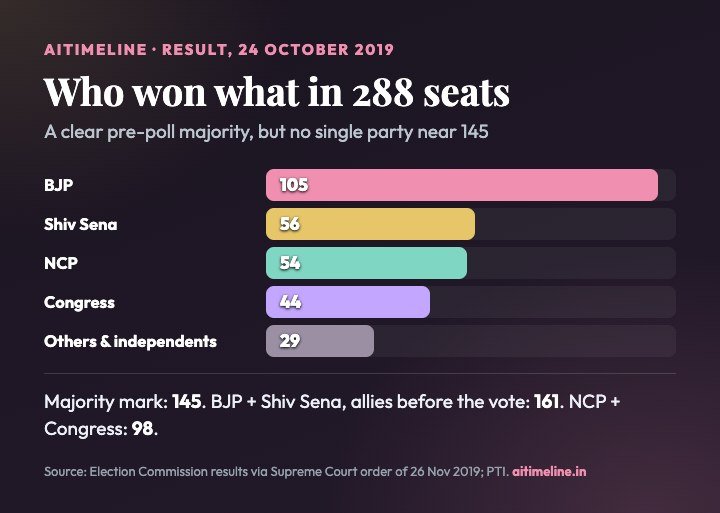
Result: The BJP won 105 seats and the Shiv Sena 56, a combined 161. The NCP won 54 and the Congress 44. Smaller parties and independents took 29.
The problem: The BJP had fallen from 122 seats in 2014 and could not govern without the Sena. Within hours the Sena reminded it of the “50:50” formula.
Maharashtra votes Elections & aftermath
The contest: The BJP and Shiv Sena fought as allies (the Mahayuti); the Congress and NCP fought as a rival alliance.
Background: The BJP and Sena had governed together since 2014, after briefly contesting that election separately.
Three Invitations, Then President’s Rule
How the Governor worked through the parties, 9 to 12 November.
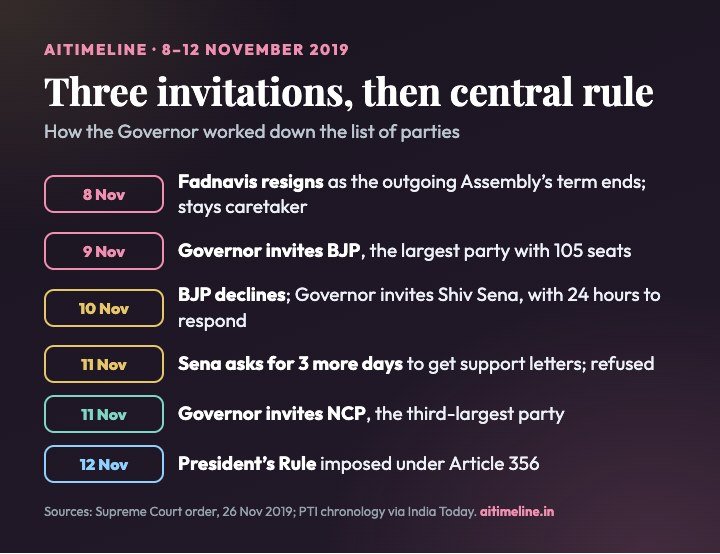
The order of invitations followed the convention of starting with the largest party. The disputed point was time. The BJP got 48 hours to respond; the Sena got 24 and was refused three more days; the NCP’s deadline had not run out when the Governor sent his report. The Sena went to the Supreme Court over the refusal, then let the plea lapse once President’s Rule was in place.
President’s Rule did not end the Assembly. It was kept in suspended animation, which is why a government could be sworn in eleven days later without a fresh election.
The 80-Hour Government
From an overnight letter to two resignations.
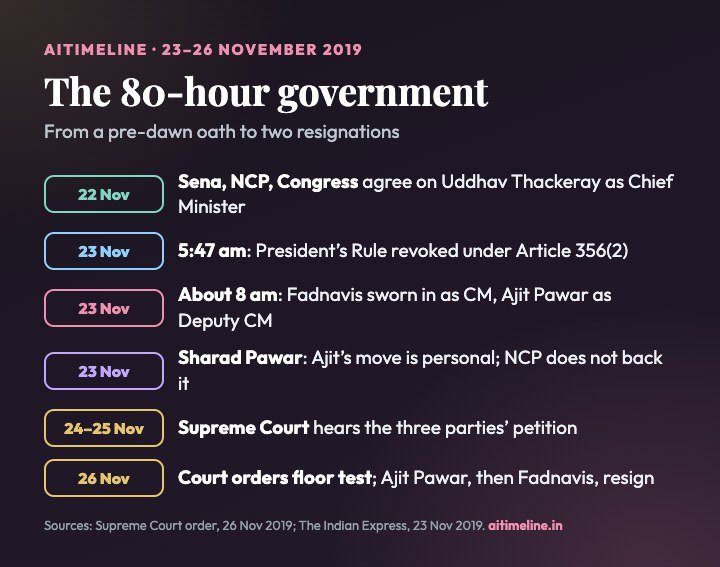
| Time | What happened |
|---|---|
| 22 Nov, ~7:30 pm | Sharad Pawar announces consensus on Uddhav Thackeray |
| 22 Nov, ~9:30 pm | Fadnavis submits a letter of support to the Governor |
| 23 Nov, ~12:30 am | Ajit Pawar submits a letter with 54 NCP MLAs’ signatures |
| 23 Nov, 5:47 am | President’s Rule revoked |
| 23 Nov, ~8:00 am | Fadnavis and Ajit Pawar sworn in at Raj Bhavan |
| 23 Nov, 9:27 am | Sharad Pawar: the decision is personal; NCP does not endorse it |
| 26 Nov, afternoon | Ajit Pawar, then Fadnavis, resign |
Times for 22 and 23 November are as reported by The Indian Express on the day; 5:47 am and the 8 am oath are also recorded in the Supreme Court’s order. The disputed question was the letter. The BJP said it showed NCP support. The NCP said the signatures had been gathered to elect Ajit Pawar legislature-party leader, a routine step after an election, and were never meant as support for a BJP government.
“Ajit Pawar’s decision to support the BJP to form the Maharashtra Government is his personal decision and not that of the Nationalist Congress Party (NCP). We place on record that we do not support or endorse this decision of his.”
Sharad Pawar, 23 November 2019
What the Supreme Court Decided, and What It Did Not
Shiv Sena v. Union of India, order of 26 November 2019.

✅ Ordered
- Floor test on 27 November 2019.
- Pro-tem Speaker for that purpose alone.
- Oath for all MLAs before 5 pm.
- Open vote, no secret ballot.
- Live telecast.
❓ Left open
- Whether the petition was maintainable.
- How far courts can review a Governor’s choice.
- Whether the Governor’s satisfaction was valid.
- Whether the 23 November invitation was lawful.
The court relied on earlier cases, including the 1994 S.R. Bommai judgment, which held that the floor of the House is the place to test a majority. Its new contribution was procedural: a short deadline, an open vote and a camera in the chamber. Once Fadnavis resigned, the floor test the court ordered was not needed. We have found no later judgment deciding the questions it left open.
Key Leaders and Their Roles
| Leader | Party / office | Role in 2019 | Later |
|---|---|---|---|
| Devendra Fadnavis | BJP | Caretaker CM; sworn in 23 Nov, resigned 26 Nov | Deputy CM 2022; CM again from Dec 2024 |
| Uddhav Thackeray | Shiv Sena | Led the post-poll coalition; CM from 28 Nov | Resigned June 2022 |
| Sharad Pawar | NCP president | Built the coalition; disowned Ajit Pawar’s move | Lost the party name to Ajit in 2024 |
| Ajit Pawar | NCP | Deputy CM with Fadnavis, 23–26 Nov; back as Deputy CM 30 Dec | Split the NCP 2023; died 28 Jan 2026 |
| Bhagat Singh Koshyari | Governor | Invited the parties; recommended President’s Rule; administered the dawn oath | Left office in 2023 |
| Sanjay Raut | Shiv Sena | The Sena’s main public voice through the talks | Stayed with Thackeray |
| Sonia Gandhi | Congress president | Cleared the Congress’s entry into a Sena-led government | — |
| Eknath Shinde | Shiv Sena | One of six ministers sworn in with Thackeray | Led the 2022 revolt; CM 2022–24 |
What Happened Next
Every party in the 2019 coalition later split or changed sides.
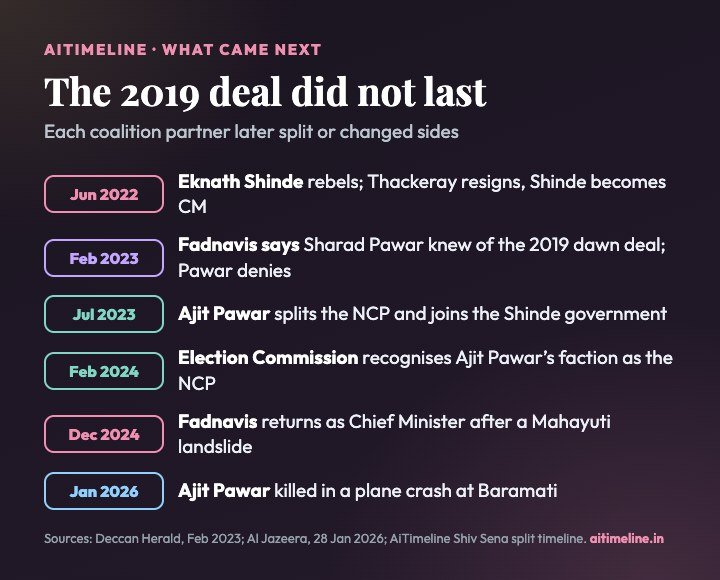
The Maha Vikas Aghadi governed through the Covid-19 pandemic and lasted until June 2022, when Eknath Shinde led most Shiv Sena MLAs out. A year later Ajit Pawar did to the NCP what he had tried and failed to do in 2019. By the 2024 election, the Shiv Sena and NCP that sat with the BJP were the breakaway factions, and the alliance that had won in 2019 was, in a different shape, back in power. Our Shiv Sena split timeline follows the 2022 crisis and its court cases in detail.
Key Facts at a Glance
| Question | Answer |
|---|---|
| Polling day | 21 October 2019 |
| Results | 24 October 2019 |
| Seats / majority | 288 / 145 |
| BJP / Shiv Sena / NCP / Congress | 105 / 56 / 54 / 44 |
| Fadnavis rejects 50:50 | 29 October 2019 |
| President’s Rule | 12 November 2019, revoked 5:47 am on 23 November |
| Fadnavis–Ajit Pawar oath | 23 November 2019, about 8 am |
| Supreme Court order | 26 November 2019, WP (C) 1393 of 2019 |
| Resignations | 26 November 2019 |
| Uddhav Thackeray sworn in | 28 November 2019, Shivaji Park; 19th Chief Minister |
| Confidence vote | 30 November 2019; 169 for, 4 abstained, BJP walked out |
| Speaker | Nana Patole, 1 December 2019 |
| Cabinet expansion | 30 December 2019; 36 ministers |
Terms Explained
- Floor test: a vote in the Assembly to show whether a government has the support of a majority of members.
- Pro-tem Speaker: a temporary presiding officer who swears in new members and runs the House until a Speaker is elected.
- President’s Rule: central rule over a state under Article 356 when its government cannot be carried on under the Constitution.
- Suspended animation: the Assembly is not dissolved, only put on hold, so a government can still be formed from it.
- Common Minimum Programme: a written agenda that coalition partners agree on as the basis for governing together.
- Legislature-party leader: the leader elected by a party’s MLAs; the NCP said its MLAs’ signatures were collected for this purpose.
Explore More Timelines
People Also Ask
Frequently Asked Questions
Checked against the Supreme Court’s order of 26 November 2019, the PTI chronology, The Indian Express, Scroll, ThePrint, The Wire and Deccan Herald.
⚠️ Editorial Note
Claims about what the BJP and Shiv Sena agreed before the 2019 election, and about what Sharad Pawar knew of the 23 November arrangement, are attributed to those who made them; no written record has been published. Times on 22 and 23 November are as reported on the day. The Supreme Court’s 26 November order was an interim order and did not decide the validity of the Governor’s actions. This page does not support any party.
Related Reading on AiTimeline
Sources & further reading
Every dated entry above was checked against these references. Last reviewed 10 November 2026.
- Supreme Court of India: Shiv Sena and Ors. v. Union of India and Ors., WP (C) 1393 of 2019, order of 26 November 2019
- Lok Sabha Secretariat: Journal of Parliamentary Information, March 2020
- In Maha twist, Devendra Fadnavis, Ajit Pawar take oath: A timeline of events
- Chronology of events in Maharashtra government formation (PTI)
- Fadnavis says no 50-50 pact, Shiv Sena cancels govt formation talks
- Sharad Pawar: Ajit's decision to form government with BJP personal, NCP does not endorse it
- Maharashtra: Secularism, immediate farm loan waiver in joint document
- Uddhav Thackeray government wins floor test after BJP MLAs walk out of Assembly
- NCP's Dilip Walse Patil appointed pro-tem Speaker ahead of Maharashtra floor test
- Maharashtra state govt inducts 36 ministers, Ajit Pawar returns as deputy chief minister
- Fadnavis-Pawar swearing-in back in news again
- Plane crash kills prominent Indian politician Ajit Pawar