Telangana State Formation: A Timeline of the Movement, Struggle and Statehood
Explore the Telangana state formation timeline, from the 1956 Andhra Pradesh merger and 1969 agitation to KCR's movement and statehood on 2 June 2014.
Latest Story
Telangana became India’s 29th state on 2 June 2014, but the demand behind it is almost as old as Andhra Pradesh itself. The Telugu-speaking districts of the Nizam’s Hyderabad State were merged with Andhra in 1956 on the strength of promises about jobs, money and representation. The Telangana state formation story is the story of what happened to those promises: a mass agitation in 1969, four decades of safeguards, a new party in 2001, a hunger strike in 2009 and an Act of Parliament in 2014. This page follows the record from Operation Polo in 1948 to the issues the two states are still dividing in November 2026.
The movement had two mass phases, in 1969 and from 2009 to 2014, separated by long periods of negotiation and safeguards. The grievances at its heart, about jobs, water, revenue, education and identity, were political claims that were contested at the time, and we present them as such. Casualty figures are attributed to the sources that give them. Where common accounts get a date wrong, we say so in the entry and in the editorial note at the end.
💡 Short Answer
Telangana was formed on 2 June 2014 under the Andhra Pradesh Reorganisation Act, 2014, after a movement that began soon after the region was merged with Andhra to form Andhra Pradesh in 1956. Major agitations in 1969 and 2009-14, the founding of the TRS in 2001 and K. Chandrashekar Rao’s 2009 fast led the Centre to divide the state. KCR became its first Chief Minister.
Telangana State Formation: Key Questions
Telangana’s Road to Statehood in Ten Points
- Origins: Telangana was part of the Nizam’s Hyderabad State, which joined India after Operation Polo in September 1948.
- Advice ignored: the States Reorganisation Commission suggested in 1955 that Telangana stay separate until at least 1961.
- The merger: Andhra Pradesh was formed on 1 November 1956, on the basis of the Gentlemen’s Agreement’s safeguards.
- 1969: the Jai Telangana agitation, led by students and the Telangana Praja Samithi, ended in 1971 when the TPS merged into Congress.
- Safeguards: the Six-Point Formula, Article 371D and the 1975 Presidential Order replaced the Mulki Rules.
- Revival: K. Chandrashekar Rao founded the TRS on 27 April 2001.
- The fast: KCR’s 2009 fast led to the Centre’s 9 December announcement, paused on 23 December.
- Options: the Srikrishna Committee preferred a united state, with Telangana as second best.
- The law: Congress decided in July 2013; Parliament passed the Bill in February 2014 over the state legislature’s rejection.
- Since: Hyderabad became Telangana’s sole capital in 2024, but asset division with Andhra Pradesh is still incomplete.
Six Decades to Statehood
The whole movement on one page, from Hyderabad’s integration to 2 June 2014.
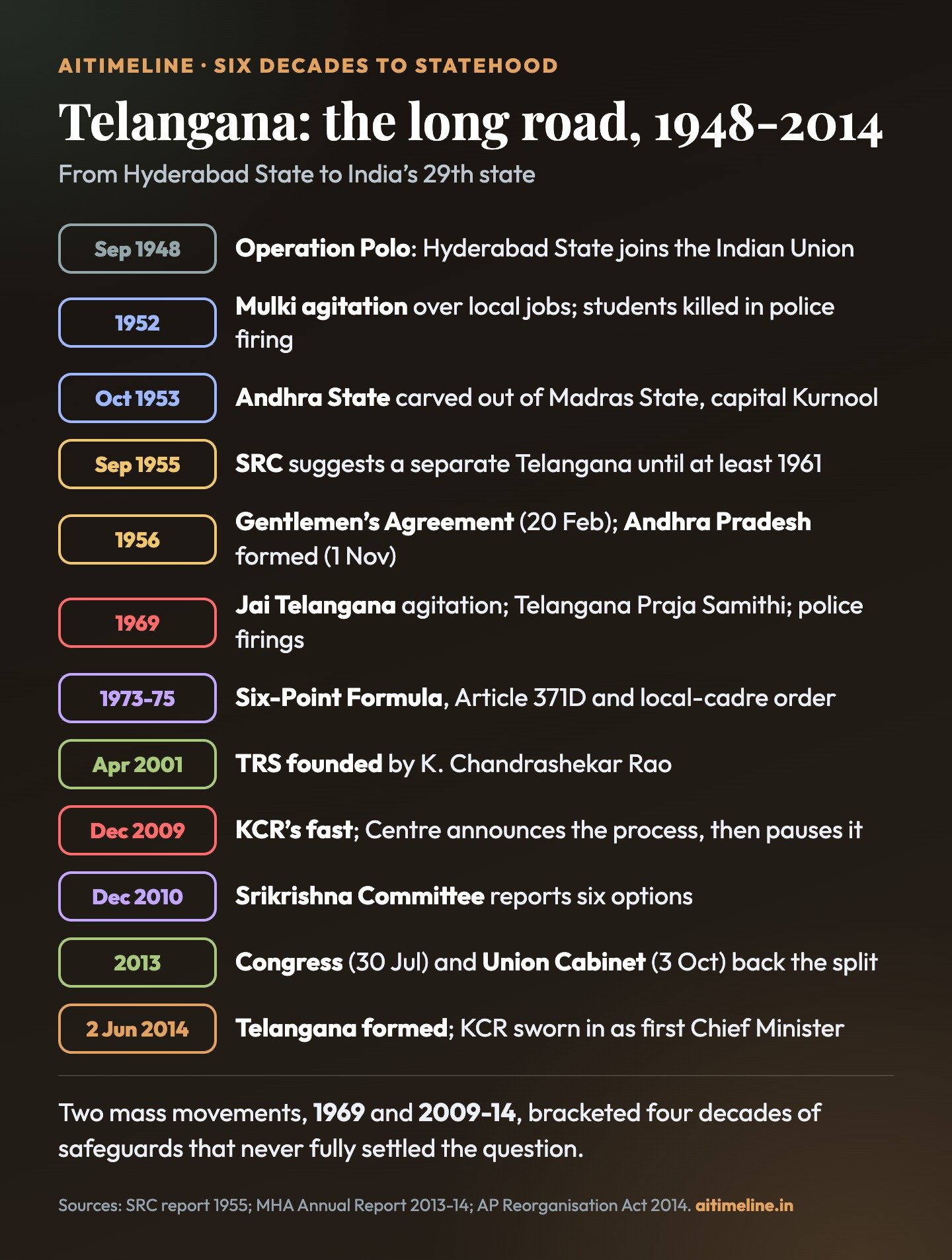
The movement was not continuous. It flared in 1969, faded after its leaders joined the Congress in 1971, and was managed for three decades through constitutional safeguards. What linked the phases was a single argument: that Telangana had been promised protection in 1956 and had not received it. When the demand returned in the 1990s and found a party in 2001, it drew on the memory of 1969 and on the record of those safeguards.
What finally moved the Union government was a combination of pressure and politics: a fast that threatened a leader’s life in 2009, a mass movement that kept going for four years, and a Congress party that by 2013 had decided division was its best electoral option. The legal mechanism was ordinary. Article 3 of the Constitution lets Parliament form a new state by simple majority, after hearing, but not obeying, the state legislature.
Why People Demanded a Separate State
Five grievances recurred from 1952 to 2014. All were argued over.
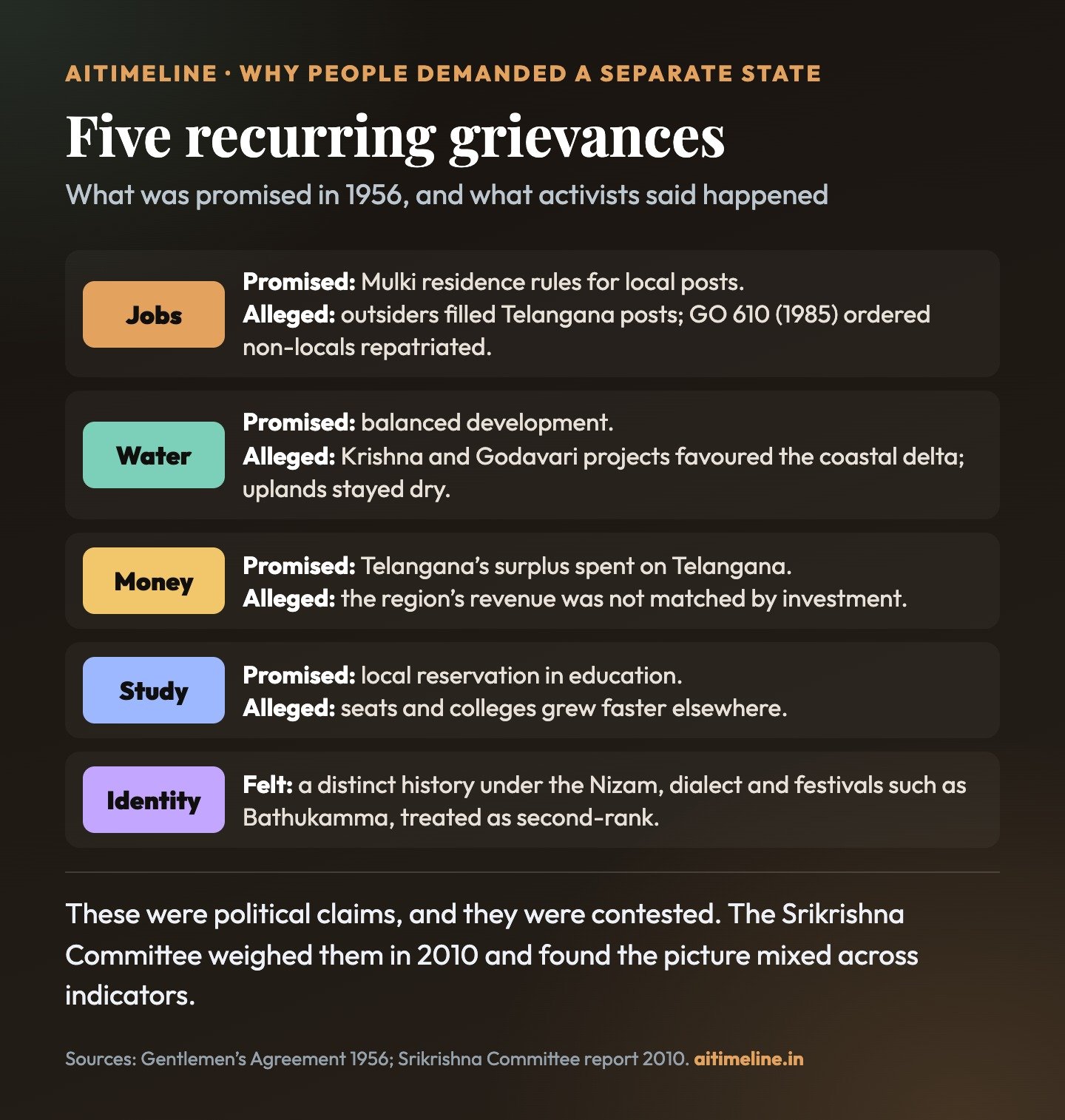
Jobs came first. The Mulki Rules of the Nizam’s administration reserved posts for local residents, and the first protest after independence, in 1952, was about outsiders being appointed. After the merger, Telangana employees repeatedly complained that the residence safeguards were evaded, and the jobs question sparked the 1969 agitation and recurred in the 1985 dispute over GO 610.
Water and money were the economic core. Telangana lies upstream on the Krishna and Godavari but on higher, drier ground, while the coastal delta had a century-old canal system. Activists argued that new projects and the state’s spending favoured the coast, and that Telangana’s revenue, which the Gentlemen’s Agreement had promised to ring-fence, was used elsewhere. Successive governments disputed the figures.
Education and identity gave the movement its energy. Osmania and Kakatiya universities were its centres in both 1969 and 2009, and the movement drew on Telangana’s dialect, its festivals such as Bathukamma and Bonalu, and a history under the Nizam that was distinct from coastal Andhra’s under British rule. The Srikrishna Committee in 2010 found real gaps on some measures and not on others; it did not accept or reject the case wholesale.
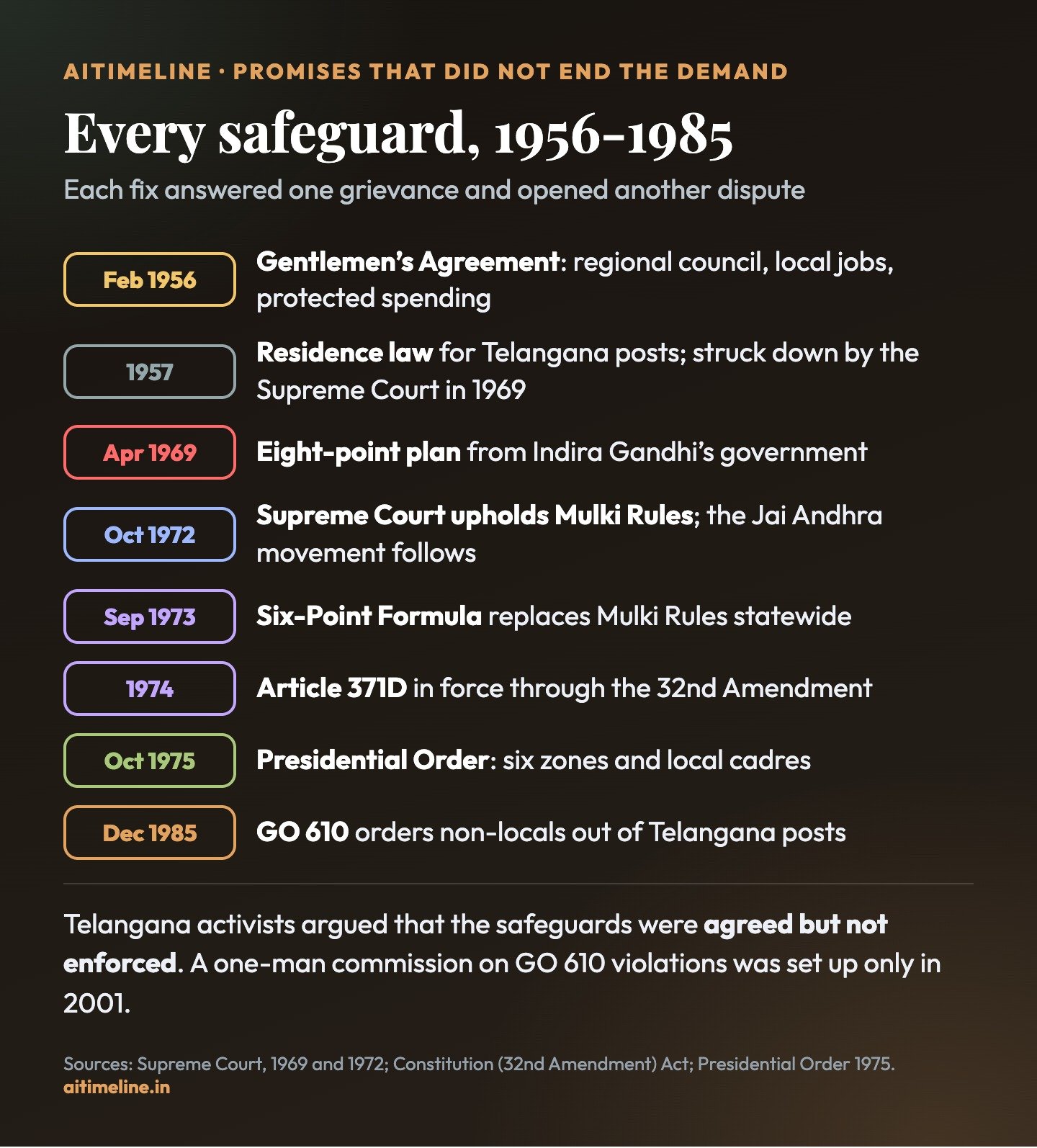
The 1956 Merger and the Safeguards That Followed
How Telangana joined Andhra, and why the promises became the dispute.
Telangana’s history before 1956 is that of Hyderabad State, the largest princely state, ruled by the Nizam. Its Telugu-speaking districts saw an armed peasant uprising against landlords from 1946 to 1951, and the state itself joined India only after the Indian Army’s Operation Polo in September 1948. When Andhra State was carved from Madras in 1953, after Potti Sriramulu’s death, the question was whether Telangana would join it.
The States Reorganisation Commission advised waiting. Its 1955 report said Telangana should remain a separate state until after the general election due around 1961, and merge only if two-thirds of its legislature agreed. Instead, leaders of the two regions negotiated the Gentlemen’s Agreement in February 1956, and Andhra Pradesh was formed that November. The safeguards in that agreement, and the later attempts to enforce them, are set out below.
1969 and 2009-14: Two Movements Compared
The same demand ended very differently four decades apart.
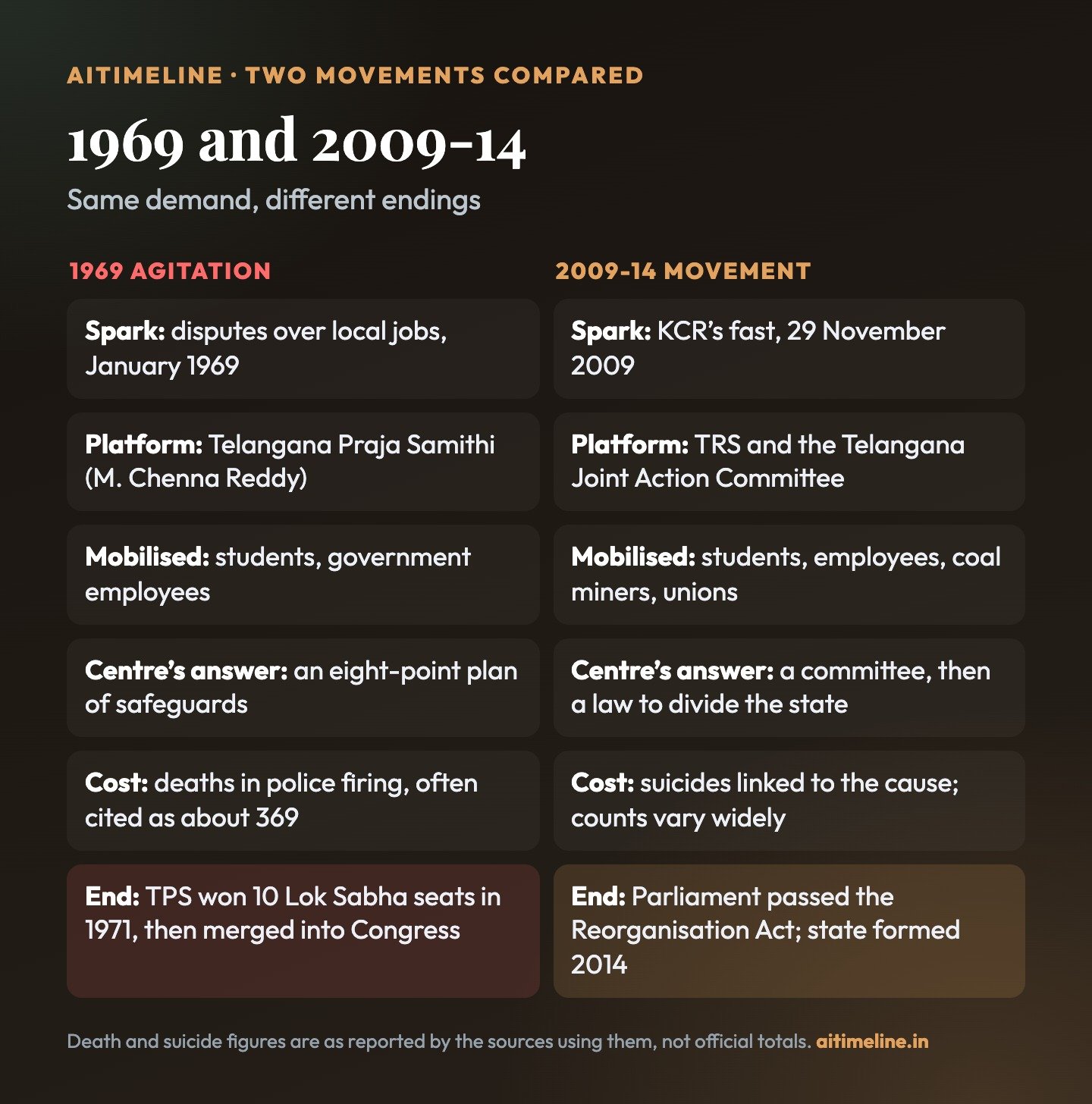
The difference was not the strength of feeling. In 1969 the Telangana Praja Samithi won ten Lok Sabha seats and then folded into the Congress, its leaders absorbed by the party in power. In 2009 the movement had a party, the TRS, that had built its identity around never being absorbed, and a broad Joint Action Committee of employees, students and civil groups that kept protests going even when the parties hesitated. It also faced a Union government whose own party in the state was split along regional lines.
Timeline: Telangana from Hyderabad State to 2026
Newest first. Colour shows the strand: Hyderabad and the merger, safeguards and courts, agitation, politics and Parliament, or after statehood.
Where things stand After statehood
Settled: Telangana has existed as a separate state for more than twelve years. Hyderabad has been its sole capital since 2 June 2024, when the ten-year common-capital period under Section 5 of the Andhra Pradesh Reorganisation Act ended.
Not settled: The division of the institutions listed in Schedules IX and X of the 2014 Act, electricity dues and some employee transfers were still unresolved when the two states’ chief secretaries met in June 2026. In November 2026 Telangana Today reported that 589 government buildings in Hyderabad allotted to Andhra Pradesh had still not been handed back.
Twelfth Formation Day After statehood
What happened: Chief Minister A. Revanth Reddy paid tribute at the Martyrs Memorial at Gun Park and led the state celebration, presenting the government’s “Telangana Rising 2047” plan. On 1 June he thanked Manmohan Singh and Sonia Gandhi for statehood.
Why it matters: Formation Day remains politically contested: Congress credits the UPA government that passed the law, while the BRS credits K. Chandrashekar Rao’s movement and marks 9 December, the date of the 2009 announcement, as its own milestone.
Hyderabad becomes Telangana’s alone After statehood
What happened: The ten-year period for which Hyderabad served as the common capital of both states ended. Under the Act, Hyderabad is from then the capital of Telangana only. Andhra Pradesh, which had moved its administration to Amaravati years earlier, began handing back buildings it held in the city.
Why it matters: It closed the last statutory link that had kept the two governments sharing one city. The state’s tenth anniversary also saw the adoption of “Jaya Jaya He Telangana” as the official state song.
Congress wins Telangana Politics & Parliament
What happened: Congress won 64 of the 119 Assembly seats, ending nine and a half years of rule by K. Chandrashekar Rao’s party, by then renamed Bharat Rashtra Samithi (BRS). A. Revanth Reddy became the state’s second Chief Minister.
Why it matters: Congress had paid heavily in Andhra Pradesh for dividing the state in 2014 and had failed to convert it into votes in Telangana in 2014 or 2018. The 2023 win was its first in the state it created.
An early election, a bigger win Politics & Parliament
What happened: The KCR cabinet recommended dissolving the Assembly about nine months before its term ended. In the December election the TRS won 88 of 119 seats, up from 63 in 2014.
Why it matters: It showed that the party born from the statehood movement had turned into a dominant governing party in the new state.
Ten districts become 31 After statehood
What happened: The Telangana government redrew its map, creating 21 new districts from the original ten. Two more, Narayanpet and Mulugu, followed in 2019, taking the total to 33.
Why it matters: The ten districts in this article are those of 2014. Maps of the movement and of the 1956 merger use the old boundaries.
Telangana is formed; KCR sworn in After statehood
What happened: Telangana came into existence as India’s 29th state, with ten districts. K. Chandrashekar Rao, whose TRS had won 63 of 119 seats in the April-May election, was sworn in as the first Chief Minister. President’s Rule, imposed on the undivided state on 1 March, ended.
Why it matters: It ended a demand that had been raised in 1956, fought over in 1969 and revived in 2001. The new state’s area was reduced soon after when seven mandals of Khammam district were moved to Andhra Pradesh for the Polavaram irrigation project.
Hyderabad: Under Section 5 of the Act the city stayed the common capital of both states for up to ten years.
Assent and an appointed day Politics & Parliament
What happened: President Pranab Mukherjee gave assent to the Andhra Pradesh Reorganisation Bill, which became Act No. 6 of 2014. On 4 March the Union government notified 2 June 2014 as the appointed day on which the new state would come into being.
Why it matters: The three-month gap let the Assembly and Lok Sabha elections be held for the undivided state, with seats then allotted to the two successor Assemblies.
Parliament passes the Bill Politics & Parliament
What happened: Home Minister Sushilkumar Shinde introduced the Bill amid chaos: on 13 February an MP from coastal Andhra used pepper spray in the Lok Sabha and 16 members were suspended. The Lok Sabha passed the Bill by voice vote on 18 February, with the House’s live broadcast cut. The Rajya Sabha passed it on 20 February after Prime Minister Manmohan Singh announced a package for the residual state, including special category status for five years.
Why it matters: The BJP, then in opposition, supported the Bill, which gave the government the numbers. The unfulfilled special category promise became a lasting grievance in Andhra Pradesh.
The state legislature says no Politics & Parliament
What happened: Both Houses of the Andhra Pradesh legislature adopted, by voice vote, a resolution moved by Chief Minister Kiran Kumar Reddy rejecting the draft Reorganisation Bill, which the President had referred to them on 12 December 2013.
Why it matters: Under Article 3 of the Constitution, Parliament must seek a state legislature’s views before changing its boundaries, but it is not bound by them. The rejection was symbolic.
Draft Bill cleared and sent to Hyderabad Politics & Parliament
What happened: After the Group of Ministers reported, the Union Cabinet approved the draft Andhra Pradesh Reorganisation Bill, 2013. The President referred it to the state legislature for its views.
Why it matters: This was the formal Article 3 step. From here the timetable was set by the 2014 general election, which the government wanted the Bill passed before.
Union Cabinet approves Telangana Politics & Parliament
What happened: The Union Cabinet approved creating Telangana from ten districts of Andhra Pradesh and set up a Group of Ministers to work out the division of assets, rivers, employees and institutions. Hyderabad was proposed as the common capital for ten years.
Why it matters: It turned a party decision into a government one, and set off weeks of strikes in coastal Andhra and Rayalaseema.
Congress decides Politics & Parliament
What happened: The Congress Working Committee and the UPA coordination committee resolved to ask the Union government to create Telangana, with Hyderabad as its capital and a common capital for ten years.
Why it matters: Nearly four years after the December 2009 announcement, this was the decision that made division a certainty. It triggered the Samaikyandhra (united Andhra) protests in the other two regions.
Sagara Haram and Chalo Assembly Agitation
What happened: The Telangana Joint Action Committee kept up pressure with mass events in Hyderabad: the Sagara Haram (Telangana March) along Necklace Road in September 2012 and the Chalo Assembly march in June 2013, both met with heavy police deployment and arrests.
Why it matters: They kept the issue in the capital and on television through the long wait between the Srikrishna report and the Congress decision.
Sakala Janula Samme Agitation
What happened: Government employees, teachers, transport workers, Singareni coal miners and others in Telangana stopped work for about six weeks. Bus services, government offices and coal output were badly hit, and power generation in the state suffered.
Why it matters: It was the largest sustained action of the movement and showed that the demand had support far beyond students and parties.
The Million March Agitation
What happened: Tens of thousands of supporters reached Tank Bund despite police restrictions. Statues of Telugu cultural figures along the bund, seen by protesters as symbols of the united state, were damaged or thrown into Hussain Sagar.
Why it matters: The protest was modelled on the Tahrir Square gatherings in Egypt weeks earlier, and it showed the movement could fill Hyderabad itself.
Srikrishna Committee reports Safeguards & courts
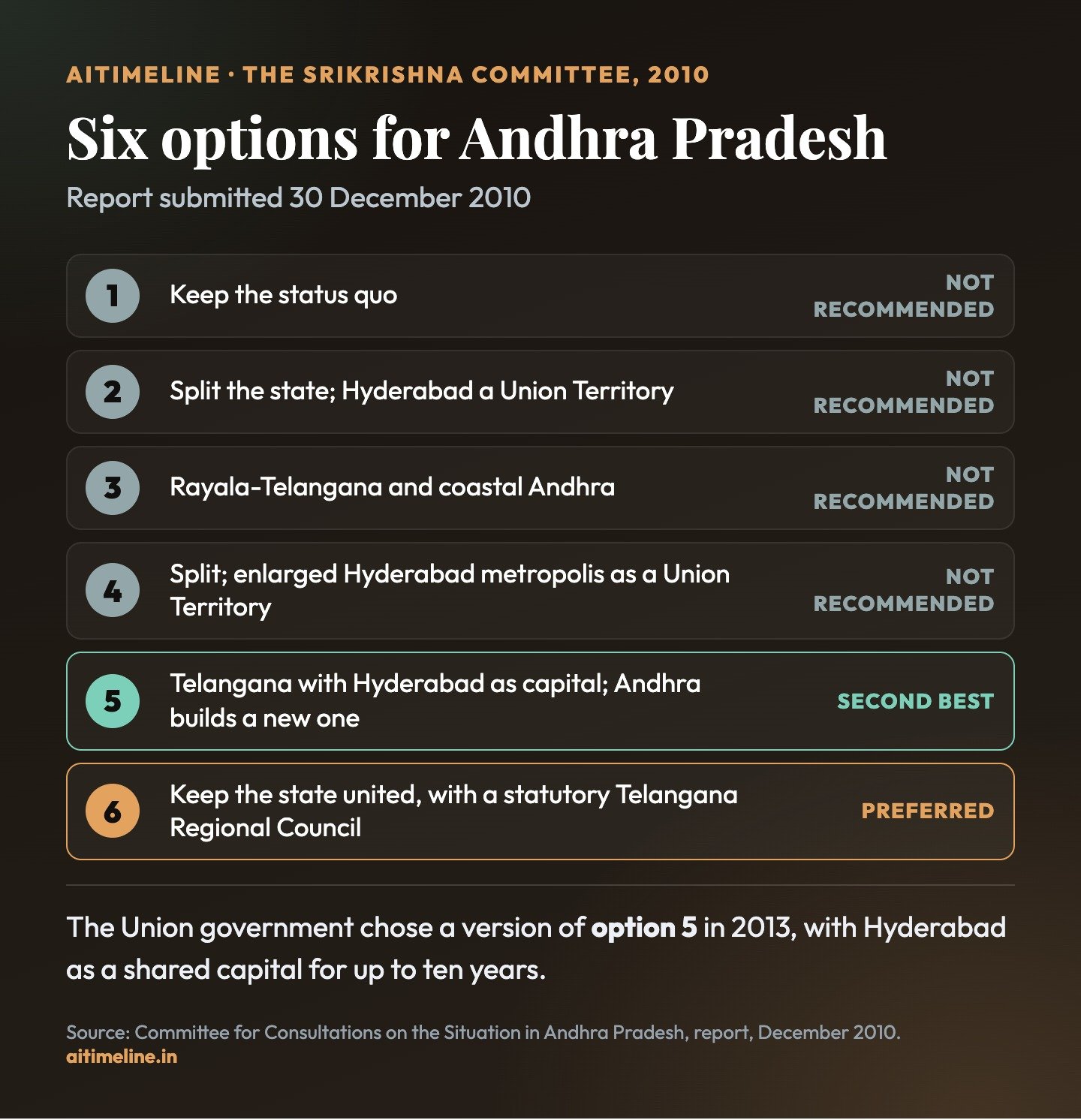
What happened: The five-member committee set out six options. It called keeping a united Andhra Pradesh with a statutory Telangana Regional Council the most workable, and a separate Telangana with Hyderabad as its capital the second best. It found the status quo and the Union Territory options for Hyderabad not practicable.
Why it matters: Both sides found something in it, so it settled nothing. The government eventually adopted a version of the second-best option.
A committee to consult Safeguards & courts
What happened: The Union government set up a Committee for Consultations on the Situation in Andhra Pradesh, chaired by former Supreme Court judge B.N. Srikrishna, to examine the demand for a separate state and the demand for keeping the state united.
Why it matters: It was the Centre’s way of buying time after the reversal of December 2009. The committee took representations from parties, groups and individuals across the three regions.
The process is put on hold Politics & Parliament
What happened: After mass resignations by legislators and MPs from coastal Andhra and Rayalaseema and protests in those regions, the Home Minister said the situation had altered and that wide consultations were needed with all parties.
Why it matters: Telangana activists read it as a betrayal. Protests resumed, and the gap between the 9 December promise and the 23 December reversal became the movement’s central grievance for the next three years.
The Centre says it will begin the process Politics & Parliament
What happened: Union Home Minister P. Chidambaram announced that the process of forming a State of Telangana would be initiated and that an appropriate resolution would be moved in the state Assembly. KCR ended his fast in hospital the same night.
Why it matters: It was the first time the Union government had committed to a separate state. The statement did not create Telangana and set no date, which is why it could be paused two weeks later.
KCR’s fast unto death Agitation
What happened: K. Chandrashekar Rao began an indefinite fast and was arrested on his way to the venue near Karimnagar. He continued it in custody in Khammam and later at the Nizam’s Institute of Medical Sciences in Hyderabad. Students at Osmania University and Kakatiya University led protests across the region. On 7 December the Chief Minister, K. Rosaiah, held an all-party meeting.
Why it matters: By 8 December doctors said his health was in danger. The Rajya Sabha was later told that the 9 December statement followed the all-party meeting; Congress leader Jairam Ramesh later called the fast a major factor in the decision.
The death of Y.S. Rajasekhara Reddy Politics & Parliament
What happened: Chief Minister Y.S. Rajasekhara Reddy, the most powerful opponent of division within the Congress, was killed in a helicopter crash. K. Rosaiah succeeded him.
Why it matters: It left a weak state government and a divided state Congress just as the movement prepared a new push.
TDP backs Telangana Politics & Parliament
What happened: N. Chandrababu Naidu’s Telugu Desam Party, long seen as a party of the united state, declared support for a separate Telangana and went into the 2009 election in a “grand alliance” with the TRS.
Why it matters: By 2009 every major party in the state except the ruling Congress’s state leadership had at some point endorsed the demand.
TRS leaves the UPA Politics & Parliament
What happened: Accusing Congress of stalling, KCR resigned as Union Labour Minister and quit the UPA. He also resigned his Karimnagar Lok Sabha seat and won it back in a by-election with a large majority.
Why it matters: It set the TRS pattern of resignations and by-elections as a show of strength, used again in 2008 and 2010.
TRS joins Congress Politics & Parliament
What happened: The TRS contested the 2004 Assembly and Lok Sabha elections in alliance with Congress and won 26 Assembly and 5 Lok Sabha seats. It joined the UPA government, whose Common Minimum Programme promised to consider the Telangana demand at an appropriate time after consultations.
Why it matters: It was the first time the demand was written into a national government’s programme.
Telangana Rashtra Samithi founded Politics & Parliament
What happened: K. Chandrashekar Rao, a TDP legislator from Siddipet, resigned as Deputy Speaker of the Assembly and from the party, and founded the Telangana Rashtra Samithi with one aim: a separate state with Hyderabad as its capital.
Why it matters: For the first time since 1971 the demand had a party of its own. Professor K. Jayashankar, an economist and long-time campaigner, became its chief ideologue.
BJP’s Kakinada resolution Politics & Parliament
What happened: The BJP’s state unit, meeting in Kakinada, passed a resolution supporting a separate Telangana and campaigned in 1998 on the slogan “One vote, two states”.
Why it matters: The party shelved the promise after allying with the TDP. When the Vajpayee government created Jharkhand, Chhattisgarh and Uttarakhand in 2000, it left Telangana out.
The demand revives Agitation
What happened: Groups such as the Telangana Jana Sabha and the Telangana Aikya Vedika, writers, balladeers and academics including K. Jayashankar revived the demand through meetings, songs and studies of regional spending and water use.
Why it matters: They built the arguments and the cultural repertoire that the TRS would carry into electoral politics.
GO 610 Safeguards & courts
What happened: The state government issued Government Order 610 to repatriate employees appointed to Telangana posts in violation of the 1975 Presidential Order.
Why it matters: Its weak implementation became a long-running complaint. A one-man commission under J.M. Girglani was set up in 2001 to examine the violations.
Presidential Order on local cadres Safeguards & courts
What happened: The President issued the Andhra Pradesh Public Employment (Organisation of Local Cadres and Regulation of Direct Recruitment) Order, dividing the state into six zones, two of them in Telangana, with local preference in recruitment.
Why it matters: It replaced the Mulki Rules with a statewide system. It also fed the 2009-14 dispute over whether Hyderabad was a “free zone” open to all.
Six-Point Formula and Article 371D Safeguards & courts
What happened: Leaders of both regions agreed a Six-Point Formula to end the Jai Andhra crisis: Mulki Rules abolished, local preference in jobs and education statewide, accelerated development of backward areas, and an administrative tribunal. The 32nd Amendment inserted Articles 371D and 371E to give it constitutional backing; it came into force in 1974.
Why it matters: It ended both agitations for a generation, without settling the underlying distrust.
Mulki Rules upheld; Jai Andhra Agitation
What happened: In Director of Industries and Commerce v. V. Venkata Reddy, the Supreme Court held the Mulki Rules valid. Students and politicians in coastal Andhra and Rayalaseema responded with the Jai Andhra movement, demanding their own separate state. President’s Rule followed in January 1973.
Why it matters: For a few months the demand for division came from the other side.
TPS wins, then merges Politics & Parliament
What happened: The Telangana Praja Samithi won 10 of the 14 Lok Sabha seats it contested. Months later, after Chief Minister Kasu Brahmananda Reddy resigned, M. Chenna Reddy took the party into the Congress.
Why it matters: It ended the first movement as an organised force. P.V. Narasimha Rao, from Telangana, became Chief Minister on 30 September 1971.
The Jai Telangana agitation Agitation
What happened: Protests over the violation of local-employment safeguards began in January 1969 and spread from Khammam across the region. Osmania University students led them, and the Telangana Praja Samithi became the political platform, with M. Chenna Reddy at its head from May. Police firing killed many people; the figure of about 369 is widely cited but is not an official count.
Why it matters: It turned grievances about the 1956 terms into a mass demand for separation, and created the movement’s first martyrs.
Centre’s answer: Prime Minister Indira Gandhi announced an eight-point plan of safeguards in April 1969.
A residence law for jobs Safeguards & courts
What happened: Parliament passed a law allowing residence requirements for some posts in Telangana, giving the Mulki safeguard of the Gentlemen’s Agreement a statutory form.
Why it matters: Activists alleged it was widely evaded. Its key section was struck down by the Supreme Court in A.V.S. Narasimha Rao in 1969.
Andhra Pradesh is formed Hyderabad & merger
What happened: The Telugu-speaking districts of Hyderabad State were merged with Andhra State to form Andhra Pradesh, with Hyderabad as its capital. N. Sanjiva Reddy became the first Chief Minister.
Why it matters: The merger came five years before the date the States Reorganisation Commission had suggested, on the strength of political agreement rather than a vote of the Hyderabad legislature.
The Gentlemen’s Agreement Hyderabad & merger
What happened: Four leaders from each region, including B. Ramakrishna Rao, K.V. Ranga Reddy and M. Chenna Reddy for Telangana and N. Sanjiva Reddy and B. Gopala Reddy for Andhra, agreed safeguards for the merger: Telangana’s surplus revenue to be spent there, Mulki residence rules for local posts, a Regional Council, and a Telangana Deputy Chief Minister if the Chief Minister came from Andhra.
Why it matters: Every later Telangana grievance was framed as a breach of these terms.
The States Reorganisation Commission reports Hyderabad & merger
What happened: The commission, announced in December 1953, recommended that Telangana be a separate state for the time being, with merger into Andhra possible after the general election due around 1961 if two-thirds of its legislature agreed.
Why it matters: Telangana activists later cited it as proof that the merger had been rushed against the experts’ advice.
Andhra State is created Hyderabad & merger
What happened: After Potti Sriramulu died on 15 December 1952 following a 58-day fast, the Union government agreed to carve the Telugu-speaking districts of Madras State into Andhra State.
Why it matters: It was India’s first state formed on linguistic lines and raised the question of whether Telugu-speaking Telangana should join it.
The Mulki agitation Agitation
What happened: Students protested against the appointment of non-locals to jobs in Hyderabad State. Police opened fire in Hyderabad and several students were killed.
Why it matters: It was the first post-independence protest about jobs in Telangana, years before the merger, and set the theme of every later agitation.
Operation Polo Hyderabad & merger
What happened: The Indian Army entered Hyderabad State. The Nizam’s forces surrendered on 17 September, and the state came under military and then civilian administration. A Standstill Agreement of November 1947 had expired without a settlement.
Why it matters: Telangana was part of the Nizam’s state, not British India. Its separate administrative and legal history, including the Mulki Rules, carried into the 1950s.
How it is remembered: 17 September is marked variously as Hyderabad Liberation Day, Integration Day or Praja Palana Day.
The Final Push, 2009 to 2014
From a fast in Karimnagar to an Act of Parliament.
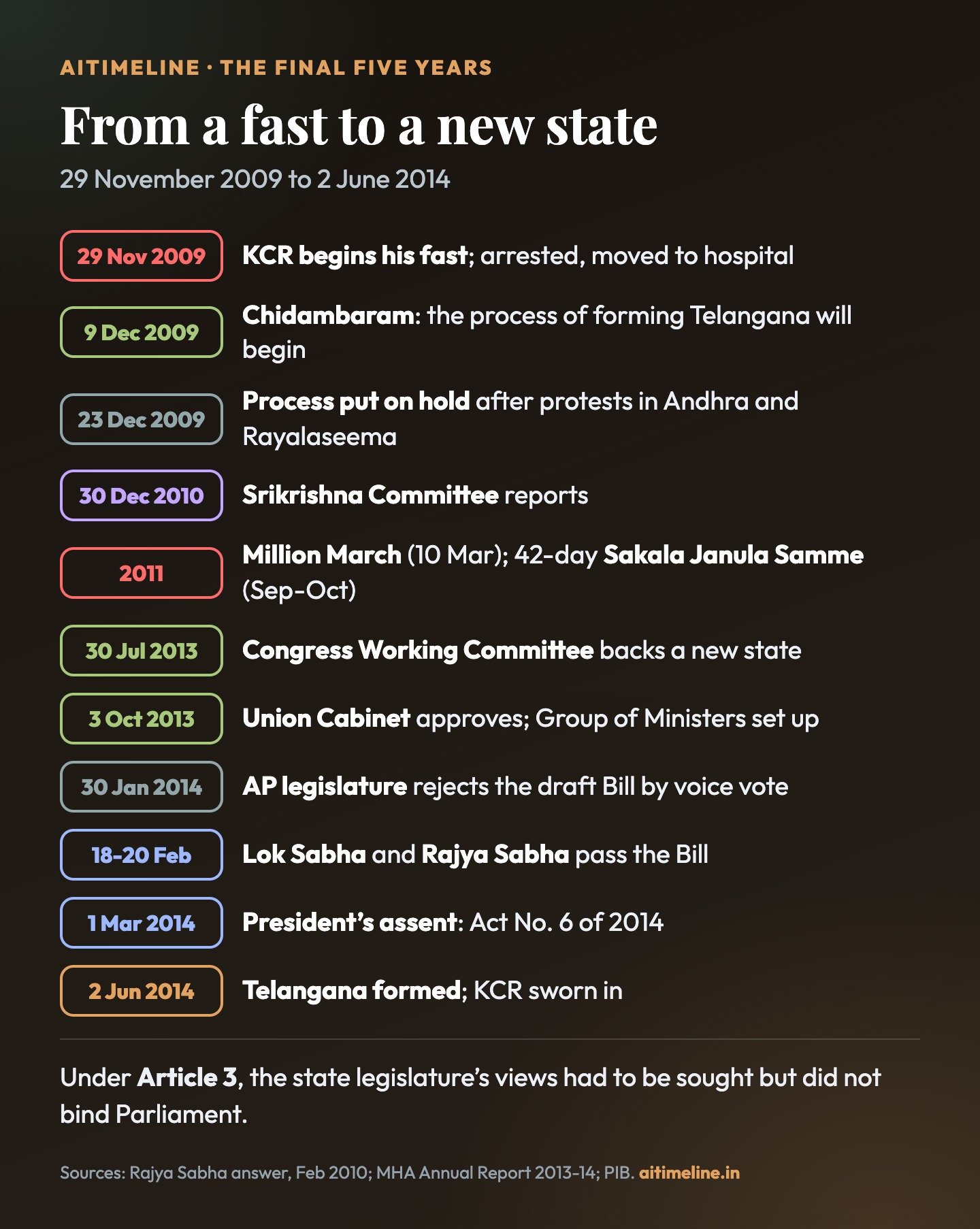
Two dates in December 2009 define the period. On the 9th the Union Home Minister said the process of forming Telangana would begin; on the 23rd, after resignations and protests in the other two regions, he said it would wait for wider consultation. The four years in between were spent on a committee, mass protests and party calculation.
The Srikrishna Committee’s six options gave each side an argument without settling anything. When Congress finally decided in July 2013, it chose the committee’s second-best option, adapted to give Andhra Pradesh a share of Hyderabad for up to ten years.
The Division: One State Becomes Two
What the 2014 Act gave each successor state.
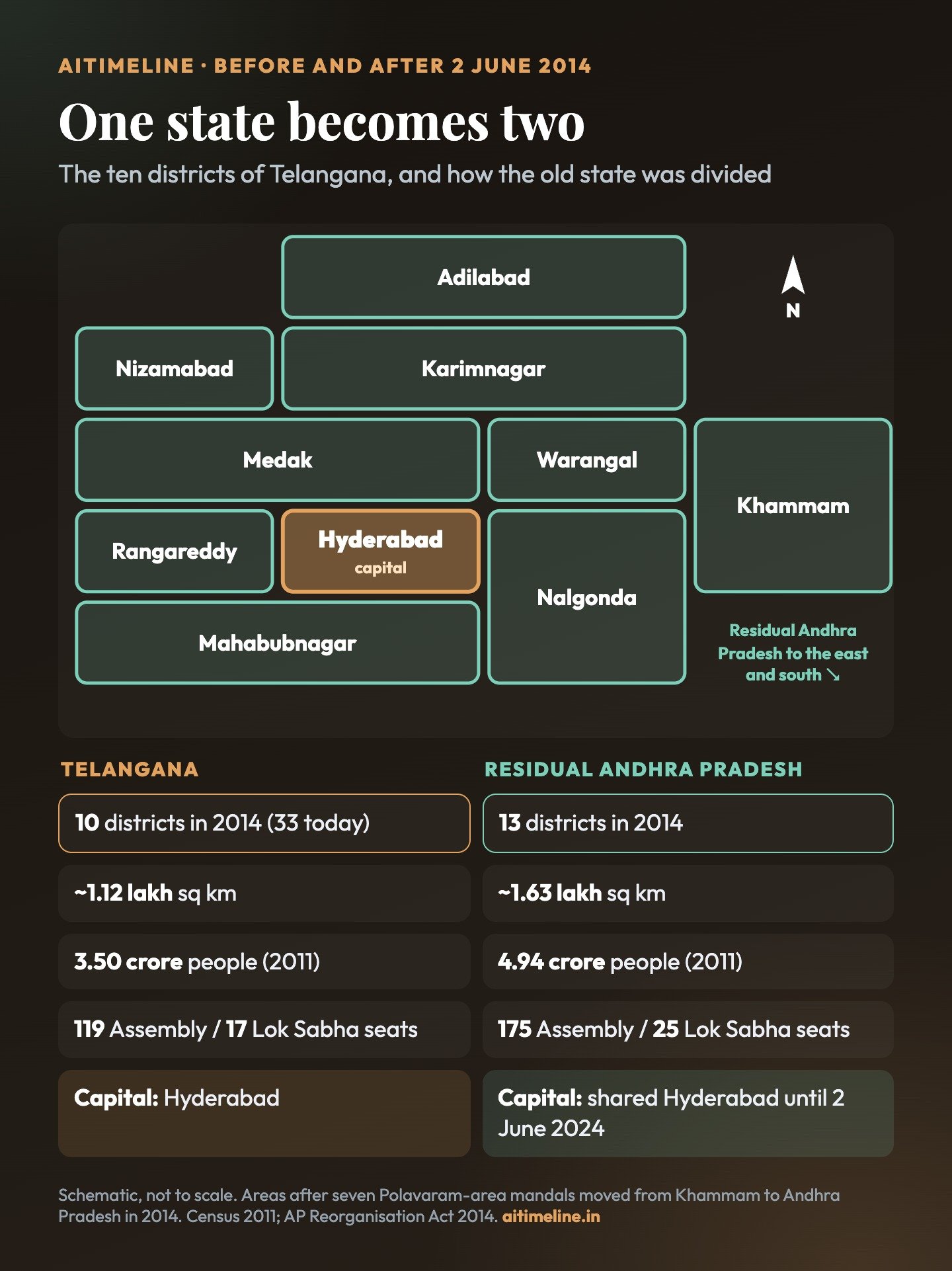
The Andhra Pradesh Reorganisation Act, 2014 did far more than draw a boundary. It split the Assembly, Council and parliamentary seats, provided for a common High Court until a separate one was set up, divided the state’s employees, assets and debts, set up boards to manage the Krishna and Godavari, and listed in Schedules IX and X the public companies and institutions to be divided. Section 5 made Hyderabad the common capital for up to ten years.
The new state’s borders changed almost at once. Seven mandals of Khammam district that lay in the submergence area of the Polavaram project were moved to Andhra Pradesh in 2014, first by ordinance and then by amending the Act. In 2016 Telangana reorganised its ten districts into 31, and it now has 33.
Since Statehood
The TRS, the party of the movement, governed for nearly a decade. K. Chandrashekar Rao won 63 seats in 2014 and 88 in an early election in December 2018, renamed the party the Bharat Rashtra Samithi in 2022, and lost to the Congress in December 2023, when A. Revanth Reddy became Chief Minister. Both parties now claim credit for the state: Congress for the law, the BRS for the movement.
The division is still being finished. Hyderabad became Telangana’s alone on 2 June 2024. But when the two states’ chief secretaries met in June 2026, the division of Schedule IX and X institutions, power dues and some employee transfers remained unresolved, and in November 2026 Telangana was still waiting for the return of 589 government buildings in Hyderabad allotted to Andhra Pradesh in 2014.
Key People and Organisations
| Person or organisation | Role |
|---|---|
| K. Chandrashekar Rao (KCR) | Founded the TRS in 2001; fasted in 2009; first Chief Minister, 2014-2023 |
| Prof. K. Jayashankar | Economist and the movement’s chief ideologue; died in 2011 |
| M. Chenna Reddy | Led the Telangana Praja Samithi in 1969; later twice Chief Minister of the united state |
| M. Kodandaram | Convenor of the Telangana Joint Action Committee from 2009 |
| Burgula Ramakrishna Rao | Chief Minister of Hyderabad State, 1952-56; signed the Gentlemen’s Agreement |
| Potti Sriramulu | His 1952 fast led to Andhra State, setting up the question of a merger |
| Fazal Ali | Chaired the States Reorganisation Commission, 1953-55 |
| Indira Gandhi | Prime Minister during the 1969 agitation and the Six-Point Formula |
| P. Chidambaram | Home Minister who made the 9 and 23 December 2009 statements |
| Justice B.N. Srikrishna | Chaired the 2010 consultation committee |
| Sushilkumar Shinde | Home Minister who introduced the Bill in 2014 |
| N. Kiran Kumar Reddy | Last Chief Minister of the united state; opposed division and resigned in February 2014 |
| A. Revanth Reddy | Congress Chief Minister of Telangana since December 2023 |
Key Dates at a Glance
| Milestone | Date |
|---|---|
| Hyderabad forces surrender | 17 September 1948 |
| Andhra State formed | 1 October 1953 |
| SRC report | 30 September 1955 |
| Gentlemen’s Agreement | 20 February 1956 |
| Andhra Pradesh formed | 1 November 1956 |
| Jai Telangana agitation | From January 1969 |
| Supreme Court upholds Mulki Rules | 3 October 1972 |
| Six-Point Formula | 21 September 1973 |
| Presidential Order on local cadres | 18 October 1975 |
| TRS founded | 27 April 2001 |
| KCR’s fast begins | 29 November 2009 |
| Centre announces process / puts it on hold | 9 / 23 December 2009 |
| Srikrishna Committee report | 30 December 2010 |
| Congress Working Committee decision | 30 July 2013 |
| Union Cabinet approval | 3 October 2013 |
| State legislature rejects draft Bill | 30 January 2014 |
| Lok Sabha / Rajya Sabha pass Bill | 18 / 20 February 2014 |
| Presidential assent | 1 March 2014 |
| Telangana formed | 2 June 2014 |
| Hyderabad becomes sole capital | 2 June 2024 |
Explore More Timelines
People Also Ask
Frequently Asked Questions
Based on the 2014 Act, the SRC and Srikrishna reports, official statements and reporting to 15 November 2026.
⚠️ Editorial Note: Dates Often Got Wrong
KCR ended his 2009 fast on the night of 9 December, after the Union government’s announcement, not on 11 December; the fast lasted about 11 days. The 1972 Supreme Court judgment upholding the Mulki Rules was Director of Industries v. V. Venkata Reddy (3 October 1972); A.V.S. Narasimha Rao was a 1969 judgment that struck down the 1957 residence law. The States Reorganisation Commission was announced on 22 December 1953 and formally constituted by a resolution of 29 December. The armed peasant struggle in Telangana is usually dated 1946 to 1951. The 9 December 2009 statement began a process and did not itself create the state. The 1969 death toll of about 369 is widely cited but not an official figure, and counts of suicides linked to the 2009-14 movement vary widely. The grievances described here were political claims, contested at the time.
Related Reading on AiTimeline
Sources & further reading
Every dated entry above was checked against these references. Last reviewed 15 November 2026.
- PIB: Creation of Telangana, Union Cabinet decision (3 October 2013)
- Rajya Sabha: Starred Question No. 25 on Telangana, 24 February 2010
- Government of Telangana: State Profile
- Indian Kanoon: Director of Industries and Commerce v. V. Venkata Reddy (Supreme Court, 3 October 1972)
- PRS Legislative Research: Parliament Diary, February 17-20, 2014
- The Indian Express: 10 years of Telangana, how India's youngest state was formed (June 2024)
- Business Standard: Andhra Assembly rejects Telangana bill (30 January 2014)
- Deccan Herald: KCR pulls a fast one in just 11 days (December 2009)
- Telangana Today: AP, Telangana resolve issues in Reorganisation Act; deadlock continues over assets, power dues (June 2026)
- Telangana Today: Telangana awaits transfer of 589 government buildings from Andhra Pradesh (November 2026)