All India Radio History: How AIR Shaped India’s Story
All India Radio history from 1923 radio clubs and the 1936 AIR name to Gandhi's broadcast, Vividh Bharati, the Emergency, FM and today's Akashvani.
Latest Story
Before television, smartphones and 24-hour news, most Indians who followed national events at all heard them on a radio. That voice carried Nehru’s independence speech, Gandhi’s only broadcast, cricket commentary, film songs, farm advice, election results and, in June 1975, the announcement of the Emergency. The institution behind it is All India Radio, now officially called only Akashvani. Its roots are in the private radio clubs of 1923. It got the name All India Radio on 8 June 1936. At independence it had six stations reaching about 11% of the population. Prasar Bharati now says the network reaches 99.19%. This timeline explains how that expansion happened, and how AIR’s closeness to the government shaped what India heard.
🧠 AI Overview Summary
All India Radio grew out of the Radio Club of Bombay’s broadcasts in June 1923 and the Indian Broadcasting Company, whose Bombay station opened on 23 July 1927. The company went bankrupt in 1930, and the government took over broadcasting as the Indian State Broadcasting Service, which became All India Radio on 8 June 1936. At independence AIR had six stations covering about 2.5% of India’s area and 11% of its population. It took the on-air name Akashvani in 1956 and launched Vividh Bharati in 1957. Television split off in 1976, FM began in 1977, and Prasar Bharati took over AIR in 1997. Today Prasar Bharati says it reaches 99.19% of the population through 262 broadcasting centres.
All India Radio: Key Questions
100 Years of Indian Radio in Ten Lines
- Radio came before AIR: amateur clubs broadcast in Bombay (June 1923), Calcutta (November 1923) and Madras (July 1924).
- The private model failed: the Indian Broadcasting Company opened in 1927 and went into liquidation in 1930. The government has run the national broadcaster ever since.
- 8 June 1936: the Indian State Broadcasting Service was renamed All India Radio.
- At independence it was small: six stations, 18 transmitters and about 2.75 lakh radio sets, reaching roughly 11% of the population.
- A film-song ban created Vividh Bharati: AIR lost listeners to Radio Ceylon and launched Vividh Bharati in 1957.
- Television began inside AIR: Delhi’s experimental TV service started in 1959 and split off as Doordarshan on 1 April 1976.
- The Emergency showed the risk: it was announced on AIR in 1975, and Kishore Kumar’s songs were blacked out in 1976 after he declined to perform for the government.
- The network kept growing: FM in 1977, hourly news in 1985, the 100th station in 1990 and the 150th in 1993.
- Prasar Bharati, 1997: a statutory public broadcaster took over AIR and Doordarshan, but it is still funded and overseen by the government.
- Still reaches almost everyone: 99.19% population coverage, plus DTH, streaming and apps. Since May 2023 it is called only Akashvani.
1923–1936: From Radio Clubs to All India Radio
Amateur clubs, a failed company, then a government takeover.
India’s first broadcasts were run by amateur clubs, not the state. The Radio Club of Bombay put out programmes in June 1923. The Calcutta Radio Club followed in November 1923, and the Madras Presidency Radio Club began a service on 31 July 1924. Receivers were expensive, transmitters were weak, and the audience was mostly hobbyists and colonial officials.
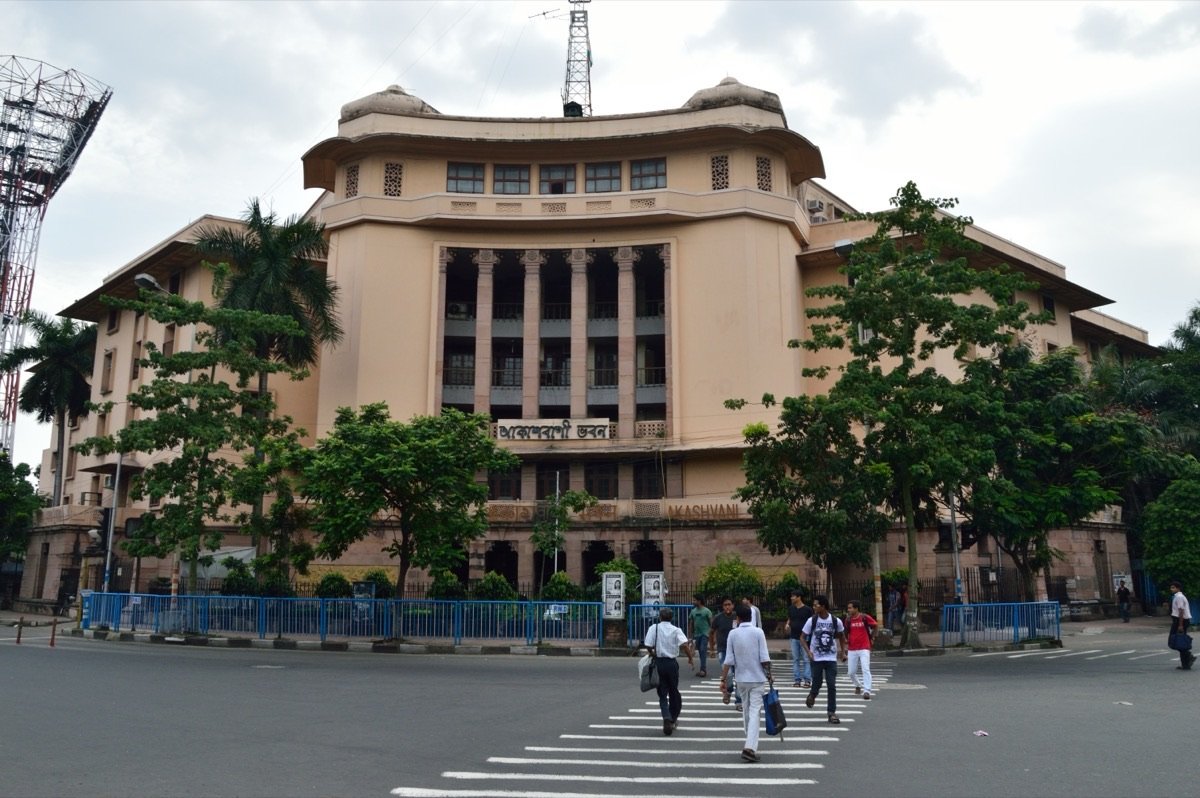
The first commercial attempt was the Indian Broadcasting Company. Its Bombay station was inaugurated by the Viceroy, Lord Irwin, on 23 July 1927, and the first news bulletin in India went out from that station the same day. A Calcutta station followed on 26 August 1927 with a bulletin in Bengali. The company could not sell enough licences to pay its costs, and it went into liquidation on 1 March 1930.
The government stepped in a month later. The Indian State Broadcasting Service started on 1 April 1930 under the Department of Industries and Labour, at first on an experimental basis. In August 1935, Lionel Fielden, a BBC producer, became India’s first Controller of Broadcasting. Delhi’s station opened in January 1936 and aired its first news bulletin on 19 January 1936. On 8 June 1936 the service was renamed All India Radio. The Central News Organisation followed on 1 August 1937, with Charles Barnes as its first news editor.
The word Akashvani (“voice from the sky”) also comes from this period. It was the name of a private station set up in Mysore in 1935–36 by M.V. Gopalaswamy, a psychology professor. Accounts differ on who coined it, and writer N. Kasturi is often credited. AIR adopted Akashvani as its own on-air name in 1956.
1939–1946: The War Turns Radio Strategic
Monitoring foreign broadcasts and talking back to them.
The Second World War changed what radio was for. AIR set up a Monitoring Service in 1939 to listen to foreign broadcasts. It launched its External Service on 1 October 1939 with a Pushtu broadcast aimed across the north-west frontier, and in 1943 it created an External Broadcast Unit under the Director of News. By 1945 the Central News Organisation was putting out bulletins in several Indian languages. On 24 October 1941, AIR was moved to the Department of Information and Broadcasting.
This was government radio in a colony at war. Nationalists had to go elsewhere to be heard: during the Quit India Movement in 1942, Usha Mehta and her colleagues ran the underground Congress Radio from Bombay for about three months until police traced and shut it down. From 1942, Netaji Subhas Chandra Bose also broadcast to India from Germany and later Southeast Asia. From its start, AIR was an official voice. Nationalists had to reach listeners from underground or from abroad.
1947–1948: The Voice of a New Country
Six stations, a Partition, and a Mahatma in the studio.
At Partition, Peshawar, Lahore and Dacca stations went to Pakistan. India kept six stations: Delhi, Bombay, Calcutta, Madras, Lucknow and Tiruchirappalli. They had 18 transmitters between them and covered about 2.5% of India’s area and 11% of its population. There were only about 2.75 lakh licensed radio sets in a country of roughly 34 crore people. On the night of 14–15 August 1947, AIR broadcast Jawaharlal Nehru’s “Tryst with Destiny” speech from the Constituent Assembly.
On 12 November 1947, which was Diwali, Mahatma Gandhi made the only visit of his life to a radio station. He could not travel to the Kurukshetra camp, where lakhs of Partition refugees were living in tents, so he spoke to them from AIR’s Delhi studio for about 20 minutes. India has marked 12 November as Public Service Broadcasting Day since 2001. Less than three months later, after Gandhi’s assassination, AIR commentator Melville de Mellow described the funeral procession live, in one of the most remembered broadcasts in AIR’s history.
In September 1948, the Central News Organisation was split into a News Services Division and an External Services Division, a structure that still exists.
1952–1957: The Film-Song Ban That Created Vividh Bharati
AIR tried to decide what listeners should hear. Listeners switched stations.
In the early 1950s, AIR’s programming reflected the tastes of its minister. B.V. Keskar, Information and Broadcasting Minister from 1952, wanted radio to promote Indian classical music. He saw Hindi film songs as vulgar and Westernised, first capped them at a small share of airtime, and then removed them from AIR almost completely. AIR started the National Programme of Music on 20 July 1952, the National Programme of Talks (English) on 29 July 1953 and the first Radio Sangeet Sammelan in 1954. These programmes brought Hindustani and Carnatic musicians to audiences far from their home regions. The National Programme of Plays followed on 15 August 1956.
Listeners who wanted film songs went elsewhere. Radio Ceylon had started a Hindi service in 1950, and its commercial programmes, especially Binaca Geetmala, which started in 1952 with Ameen Sayani as presenter, drew huge audiences across north India. AIR was losing listeners to a foreign station playing Indian music. On 3 October 1957, AIR launched Vividh Bharati (then the All India Variety Programme), with film music at its core. Commercial advertising came to Vividh Bharati on 1 November 1967. Prasar Bharati now describes it as the country’s largest entertainment radio network.
Two Ideas of What Radio Is For
1959–1993: Building a Network Across India
Television, superpower transmitters, FM and the 100th station.
Indian television started as part of AIR. An experimental service from a Delhi studio began on 15 September 1959, the date Doordarshan uses (Prasar Bharati’s AIR chronology lists 1 November 1959). For 17 years radio and TV were one organisation, until Doordarshan became a separate department on 1 April 1976.
Radio’s reach depended on transmitter power. AIR commissioned a 1,000 kW superpower medium-wave transmitter at Calcutta (Mogra) on 15 August 1969 and another at Rajkot on 8 January 1971. The Yuv Vani youth service began in Delhi on 21 July 1969. On 26 October 1962, during the war with China, AIR relaunched its daily commentaries as Spotlight and Current Affairs, adding explanation to its news bulletins.
The first FM service began experimentally in Madras on 23 July 1977, fifty years to the day after the Bombay station opened. Hourly news bulletins started on 15 August 1985, the same year all AIR stations got satellite receiver terminals. The National Channel began on 18 May 1988, and the Integrated North East Service on 8 April 1989. The 100th station opened at Warangal on 2 March 1990, and the 150th at Berhampur, Odisha, on 1 April 1993. AIR Delhi began its first phone-in programme on 10 January 1993, which let listeners call in and speak on air.
1975–1977: Who Controls the Microphone?
The Emergency showed what a government-run broadcaster can be made to do.
On the morning of 26 June 1975, Prime Minister Indira Gandhi announced the Emergency on All India Radio, telling listeners there was no reason to panic. For the next 21 months, newspapers faced censorship officers. AIR needed no censor, because it was already a department of the Information and Broadcasting Ministry, headed from June 1975 by V.C. Shukla.
The best-known example involved Kishore Kumar. In April 1976 the singer declined a request to perform at a government programme promoting the Emergency. According to the Shah Commission, which investigated Emergency excesses, his songs were then kept off AIR and Doordarshan from May 1976. The blackout eased after he wrote to the ministry that July. Shukla later accepted responsibility before the commission. After the Emergency, AIR introduced broadcasts by political parties in 1977, and the demand for an autonomous broadcaster led to the Prasar Bharati Act of 1990.
1990–2004: Prasar Bharati, FM Slots and the First Websites
AIR lost its monopoly, got a public-service charter and went online.
The Prasar Bharati Act was passed in 1990 but took seven years to come into force. Prasar Bharati came into existence on 23 November 1997, with Akashvani and Doordarshan as its two constituents. Its charter lists objectives including safeguarding “the citizen’s right to be informed”, presenting “a fair and balanced flow of information”, promoting national integration, and covering agriculture, rural development, health, science and India’s languages.
Competition came slowly, then all at once. From 15 August 1993, AIR sold time slots on its FM channel in Delhi and Mumbai to private producers. That experiment ended in April 1998. Licences for fully private FM stations followed, and the first ones went on air in 2001. Meanwhile AIR went online. It launched an internet information service on 2 May 1996, began real-time audio on 13 January 1997, put news on the telephone and the internet in February 1998, launched a digital satellite home service in 2002, and started AIR on DTH on 16 December 2004. On 1 April 2004, Kisan Vani started from 12 stations, carrying crop, weather and market information for farmers.
| Need | Before radio | With AIR | Why it mattered |
|---|---|---|---|
| Breaking news | Next morning’s paper, if you could read | Heard the same evening | Worked for people who could not read |
| Farm advice | Wait for an extension officer’s visit | Farm & Home, Kisan Vani | Weather and crop alerts in local languages |
| Music | Buy records or attend concerts | National Programme, Vividh Bharati | Northern and southern classical music reached new audiences |
| National address | Read a speech later in print | Hear the voice live | Gandhi in 1947, the Emergency in 1975, Mann Ki Baat from 2014 |
| Sport | Scorecards in the paper | Ball-by-ball commentary | Listeners followed a match without seeing it |
2014–2026: Mann Ki Baat, COVID and “Akashvani Only”
An old medium that kept its reach by adding new platforms.
The best-known radio programme of the smartphone era is Mann Ki Baat, the Prime Minister’s monthly address, first broadcast on 3 October 2014. It runs on AIR’s national and regional networks, with regional-language versions, and is also streamed and posted on social media. Its 100th episode aired on 30 April 2023. Supporters see it as radio showing it still matters. Critics point out that a public broadcaster regularly carries a head of government’s address.
During the COVID-19 lockdowns of 2020, AIR’s regional stations carried health advisories, lockdown rules and school lessons in local languages. That mattered in areas where broadband was unreliable.
In May 2023, the Akashvani Director General’s office told all stations to stop using “All India Radio” on air. The name Akashvani, which the Prasar Bharati Act already uses, became the only official name. The network is also available on the NewsOnAIR app, DTH and live web streams. 8 June 2026 marked 90 years since the name All India Radio was adopted.
99.19% of people
Nearly 92% of India’s area, per Prasar Bharati’s Akashvani profile.
23 languages, 179 dialects
Home service programming, plus External Services in Indian and foreign languages.
262 centres
Including 116 regional channels and 86 local FM stations, per Prasar Bharati.
The Complete All India Radio Timeline
Newest first.
90 Years of the AIR Name
Akashvani marks 90 years since the Indian State Broadcasting Service became All India Radio. Prasar Bharati puts its reach at 99.19% of India’s population.
“Akashvani” Becomes the Only Name
A May 2023 order from the Akashvani Director General’s office told stations to drop “All India Radio” on air, enforcing the name used in the Prasar Bharati Act. Mann Ki Baat aired its 100th episode on 30 April.
COVID-19 Lockdown Broadcasting
Regional stations carried health advisories, lockdown rules and school lessons in local languages while schools were closed.
Mann Ki Baat Begins
The Prime Minister’s monthly radio address begins on AIR’s national and regional networks, with regional-language versions, web streams and social-media clips.
Kisan Vani and AIR on DTH
Kisan Vani starts from 12 stations with local farm information. On 16 December, Prime Minister Manmohan Singh inaugurates the DTH service carrying AIR channels via satellite.
Public Service Broadcasting Day and Private FM
12 November is declared Public Service Broadcasting Day, marking Gandhi’s 1947 broadcast, and the Museum of Radio and Doordarshan opens. The first private FM stations go on air the same year.
Prasar Bharati Takes Over
Prasar Bharati comes into existence with Akashvani and Doordarshan as its constituents, seven years after the Act was passed. Earlier that year, AIR began streaming audio online in real time.
Phone-Ins, 150th Station, FM Slots
AIR Delhi starts phone-in programmes. The 150th station opens at Berhampur, Odisha. FM time slots are sold to private producers in Delhi and Mumbai.
100th Station at Warangal
AIR commissions its 100th station at Warangal, then in Andhra Pradesh, 43 years after independence with six. Parliament passes the Prasar Bharati Act the same year.
National Channel and North East Service
The National Channel starts, followed by the Integrated North East Service for the north-eastern states.
Hourly News
Hourly news bulletins begin, and every AIR station gets satellite receiver terminals.
FM Arrives in Madras
India’s first FM service starts experimentally in Madras, fifty years to the day after the Bombay station opened. After the Emergency, political party broadcasts are also introduced.
Doordarshan Splits Off; Kishore Kumar Blackout
Doordarshan becomes a separate department. From May, according to the Shah Commission, Kishore Kumar’s songs are kept off AIR and Doordarshan after he declined to perform for a government programme.
The Emergency Announced on AIR
Indira Gandhi announces the Emergency on All India Radio. For 21 months, AIR operates as the government’s direct voice.
Yuv Vani and Superpower Transmitters
Yuv Vani starts in Delhi for younger listeners. 1,000 kW medium-wave transmitters are commissioned at Calcutta (August 1969) and Rajkot (January 1971).
Advertising on Vividh Bharati
Commercials are introduced on Vividh Bharati, giving AIR an ad-funded entertainment service alongside its public-service channels.
Wartime Commentaries
During the war with China, AIR’s daily commentaries are relaunched as Spotlight and Current Affairs, explaining the news as well as reporting it.
Television Begins Inside AIR
An experimental television service begins from a Delhi studio as part of AIR. It becomes Doordarshan.
Vividh Bharati Launched
After losing film-music listeners to Radio Ceylon, AIR launches Vividh Bharati, built around Hindi film songs.
National Programmes and the Name Akashvani
The National Programme of Music (20 July 1952), Talks (29 July 1953), the first Radio Sangeet Sammelan (1954) and Plays (15 August 1956) begin. In 1956 AIR adopts Akashvani as its on-air name.
Independence, Gandhi’s Broadcast, and a New Structure
Six stations remain in India after Partition. Gandhi speaks to Kurukshetra refugees from AIR’s Delhi studio. In 1948 the news organisation splits into the News Services and External Services Divisions.
War: Monitoring and External Services
A Monitoring Service is set up, and the External Service starts with a Pushtu broadcast. An External Broadcast Unit follows in 1943.
All India Radio Is Named
Delhi airs its first news bulletin. The Indian State Broadcasting Service becomes All India Radio. The Central News Organisation is set up, with Charles Barnes as news editor.
Government Takeover
After the Indian Broadcasting Company’s liquidation, the Indian State Broadcasting Service begins. Lionel Fielden becomes the first Controller of Broadcasting in 1935.
First Station and First News Bulletin
Lord Irwin opens the Indian Broadcasting Company’s Bombay station, and India’s first radio news bulletin goes on air. A Bengali bulletin starts from Calcutta a month later.
The Radio Clubs
The Radio Club of Bombay (June 1923), the Calcutta Radio Club (November 1923) and the Madras Presidency Radio Club (July 1924) make India’s first broadcasts.
Quiz: How Well Do You Know AIR?
Tap a question to reveal the answer.
1. When did the name All India Radio come into use?
2. Where did India’s first radio news bulletin go on air?
3. Which rival station drew away AIR’s film-music listeners in the 1950s?
4. How many times did Gandhi visit a radio station?
5. Where did India’s first FM service start?
6. What share of India’s population did AIR reach in 1947?
7. Which city got AIR’s 100th station?
Explore More Timelines
People Also Ask
Frequently Asked Questions
Related AiTimeline Stories
⚠️ Editorial Note
Dates and figures come from Prasar Bharati’s official AIR chronology, its Akashvani and AIR News pages, and reporting on Gandhi’s 1947 broadcast, the Keskar-era film-song policy, the Shah Commission and the 2023 naming order. Where sources differ, both are given: Delhi television started on 15 September 1959 per Doordarshan (1 November 1959 in AIR’s chronology), and the network is counted as 262 centres or 479 stations. This is editorial, AI-assisted content, not an official Prasar Bharati publication.
Sources & further reading
Every dated entry above was checked against these references. Last reviewed 25 September 2026.
- Prasar Bharati -- Akashvani (network, coverage, chronology)
- Prasar Bharati -- AIR News (history of the News Services Division)
- Wikipedia -- All India Radio
- Wikipedia -- Vividh Bharati
- Wikipedia -- B. V. Keskar
- Cinemaazi -- Play 'Filmy' for Me: The Keskar Decade, AIR and the Rise of Radio Ceylon
- The Tribune -- Mahatma Gandhi addressed Partition refugees in Kurukshetra on radio
- Swarajya -- Kishore Kumar, Dev Anand and the Emergency
- The Tribune -- It's Akashvani now: Prasar Bharati drops references to AIR
- Wikipedia -- Doordarshan
- Wikimedia Commons -- Akashvani Bhavan, Kolkata (Biswarup Ganguly, CC BY 3.0)