Anna Hazare’s 2011 Movement: How the Lokpal Law Took Shape
Explore Anna Hazare's anti-corruption movement, the 2011 protests, Jan Lokpal demand, 2013 Act, AAP's formation and the Lokpal's impact since 2019.
Latest Story
In April 2011 the social activist Anna Hazare began an indefinite fast at Jantar Mantar in New Delhi, demanding a strong anti-corruption ombudsman. Within months the campaign had filled Ramlila Maidan, forced a special debate in Parliament and made corruption the defining political issue of the decade. This timeline of the Anna Hazare Lokpal movement follows the idea from its first mention in 1963 to the Lokpal and Lokayuktas Act of 2013, the five-year wait for the first appointment in 2019, and the institution’s record and controversies to November 2026.
25 March 2026: the government told the Lok Sabha that the Lokpal registered 389 complaints and disposed of 336 in 2025–26 up to 28 February. 1 January 2026: the Lokpal cancelled a criticised tender for seven BMW cars. June 2026: Anna Hazare, 89, threatened a fresh fast, this time over Maharashtra’s new RTI rules. Jump to the latest entries.
💡 Short Answer
The Anna Hazare Lokpal movement was the 2011 India Against Corruption campaign for a strong anti-corruption ombudsman. Hazare’s fasts in April and August 2011 forced a joint drafting committee and a Sense of the House in Parliament. Parliament passed the Lokpal and Lokayuktas Act in December 2013; it came into force on 16 January 2014, and the first Lokpal took office in March 2019.
Anna Hazare Lokpal Movement: Key Questions
The Lokpal Movement in Ten Points
- An old idea: the word Lokpal dates from 1963, and the first bill from 1968.
- Repeated failure: ten bills between 1968 and 2008 never became law.
- The trigger: the 2G and Commonwealth Games controversies of 2010 fed public anger.
- First fast: 5–9 April 2011 won a joint drafting committee of ministers and activists.
- Second fast: Hazare’s arrest on 16 August 2011 and the Ramlila Maidan fast drew national crowds.
- Not a law yet: Parliament’s 27 August Sense of the House was a non-binding commitment.
- The split: activists who wanted to contest elections launched AAP in November 2012; Hazare did not join.
- The Act: passed in December 2013, in force on 16 January 2014, as a compromise on the Jan Lokpal draft.
- The wait: the first Lokpal took office only in March 2019.
- Still tested: its jurisdiction over judges and its sanction powers are before the Supreme Court in 2026.
From Idea to Institution: 1963 to 2019
The movement lasted months. The law took decades, and the institution five years more.
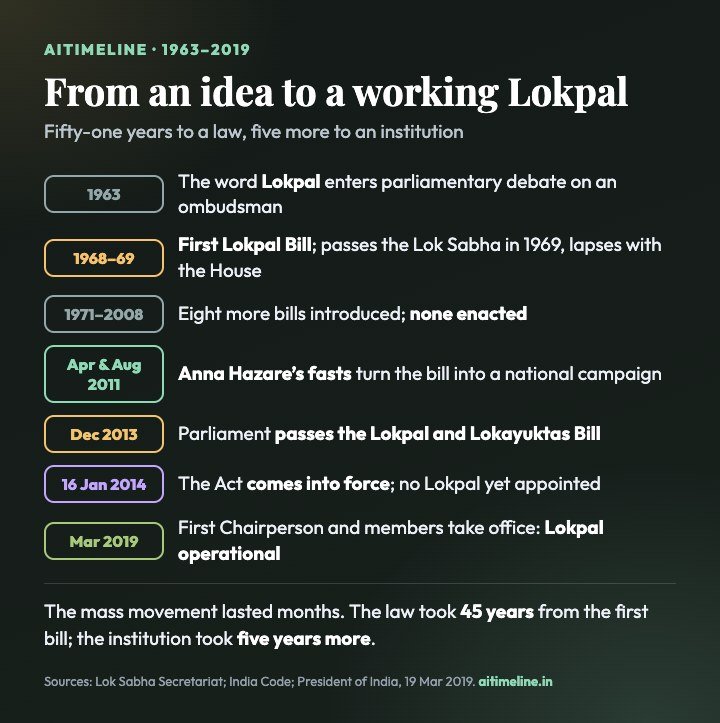
The Administrative Reforms Commission recommended a Lokpal and state Lokayuktas in 1966, and a bill passed the Lok Sabha in 1969. Then the idea stalled. Bills were introduced in 1971, 1977, 1985, 1989, 1996, 1998, 2001, 2005 and 2008, and every one lapsed or was withdrawn, often because the Lok Sabha was dissolved before the Rajya Sabha acted. Some states moved first: Maharashtra set up a Lokayukta in 1972.
What changed in 2011 was public pressure. The campaign’s argument was simple: governments would not create a strong watchdog over themselves unless forced to. The movement got the law passed in a little over two and a half years. But the Act’s own selection rules, and a Lok Sabha without a recognised Leader of Opposition, meant the first Lokpal was appointed only on 19 March 2019, more than five years after the law came into force.
The 2011 Fasts: Jantar Mantar and Ramlila Maidan
Two hunger strikes that set the national agenda.
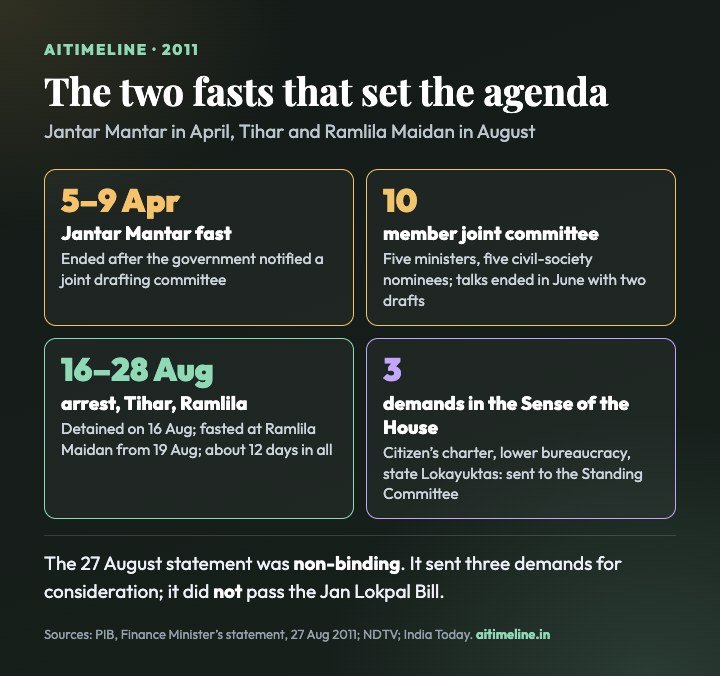
Hazare, then 73, was a veteran of fasts in Maharashtra, where his campaigns had preceded the state’s Right to Information Act in 2003. His Jantar Mantar fast from 5 April 2011 lasted about 98 hours. Vigils and candle marches spread across cities, and on 9 April the government notified a Joint Drafting Committee chaired by Finance Minister Pranab Mukherjee, with Shanti Bhushan as co-chair.
The committee met from 16 April and broke down on 21 June with two drafts. When the Cabinet approved its own, narrower bill on 28 July, Hazare announced a second fast. His arrest on the morning of 16 August turned it into the movement’s biggest moment: he refused to leave Tihar Jail for three days, then fasted at Ramlila Maidan from 19 August before crowds of tens of thousands. On 27 August both Houses debated the Lokpal and agreed a Sense of the House on three of his demands, and he broke his fast the next morning. Hazare’s campaign was one of several in Indian history in which public mobilisation pushed Parliament; the JP movement of the 1970s is the comparison most often made.
Timeline: The Anna Hazare Lokpal Movement, 1963 to 2026
Newest first. Colour shows the type of event.
Where things stand The Lokpal at work
The institution: The Lokpal has a Chairperson and members in office, a complaints system and a growing caseload: 389 complaints were registered in 2025–26 up to 28 February 2026. Its powers over judges and its sanction powers in the Mahua Moitra case are being tested in the Supreme Court.
The movement: Anna Hazare, now 89, lives in Ralegan Siddhi and still uses the threat of a fast to press the Maharashtra government, most recently over its Lokayukta law and its 2026 RTI rules.
Hazare threatens a fast over Maharashtra’s RTI rules Protests & fasts
What he said: Hazare announced an indefinite fast from 5 July 2026 unless the state withdrew the Right to Information Rules, 2026, notified on 12 June. He objected to higher fees, identity-document requirements and a one-subject-per-application rule.
Outcome: We found no reliable report of whether the fast went ahead or of any change to the rules.
Government gives Parliament the Lokpal’s complaint figures The Lokpal at work
The figures: 389 complaints registered and 336 disposed of in 2025–26 up to 28 February 2026, against 292 registered and 260 disposed of in 2024–25.
How to read them: Disposal can mean closure, a direction for preliminary inquiry or another procedural step. The figures do not show how many complaints led to prosecution or conviction.
Lokpal marks its foundation day The Lokpal at work
What happened: Chairperson A.M. Khanwilkar recalled the public movement behind the law, naming Anna Hazare and Justice N. Santosh Hegde, and pointed to a rise in complaints and work on digital complaint processing.
Why the date: The Lokpal and Lokayuktas Act came into force on 16 January 2014.
Lokpal cancels its tender for seven BMW cars The Lokpal at work
The row: The tender for seven BMW 3 Series long-wheelbase sedans for the Chairperson and members drew criticism from opposition MPs and activists, including Prashant Bhushan, who had been part of the 2011 campaign.
The decision: The full bench of the Lokpal resolved to cancel the tender, officials said.
Delhi High Court sets aside the Lokpal’s sanction against Mahua Moitra Courts
What happened: A division bench quashed the Lokpal’s order allowing the CBI to file a chargesheet against the Trinamool Congress MP, holding that the ombudsman had misread its sanction powers under the Act, and asked it to reconsider.
What followed: The Lokpal challenged the reading of its powers in the Supreme Court, which in 2026 stayed the part of the High Court order directing a fresh decision. The case is pending.
Hazare announces a fast over the Maharashtra Lokayukta law Protests & fasts
His demand: Hazare said the Maharashtra Lokayukta Act, passed by the legislature and sent for presidential assent, had still not been brought into force, and that seven letters to Chief Minister Devendra Fadnavis had gone unanswered.
The state: In December 2025 the legislature passed amendments recommended by the Centre, and the government said it would bring the new law into force. We found no reliable report of whether the January fast took place.
Supreme Court stays the Lokpal’s order on High Court judges Courts
The Lokpal’s view: Hearing complaints against a sitting High Court judge, the Lokpal held that a judge of a High Court set up by an Act of Parliament could be a public servant within its jurisdiction.
The court’s response: A Supreme Court bench took up the matter on its own, called the order very disturbing for judicial independence, stayed it and issued notice to the Union government.
First Lokpal Day The Lokpal at work
What happened: The Lokpal began marking the anniversary of the Act’s commencement as its foundation day, with the Chief Justice of India as chief guest.
Significance: Eleven years after the Act came into force, it was the first time the institution formally commemorated it.
Justice A.M. Khanwilkar sworn in as Chairperson The Lokpal at work
What happened: The former Supreme Court judge took over a post that had had no full-time holder since May 2022. Judicial and non-judicial members, including former Chief Election Commissioner Sushil Chandra, were appointed with him.
Why it matters: The appointments brought the Lokpal back towards full strength of a Chairperson and eight members.
Lokpal orders a CBI inquiry against Mahua Moitra The Lokpal at work
What happened: The Lokpal directed the CBI to investigate allegations that the Trinamool MP took gifts and favours in return for parliamentary questions. Moitra, who had been expelled from the Lok Sabha in December 2023, denied wrongdoing.
Why it matters: It was one of the first high-profile cases in which the Lokpal used its power to send a complaint against an MP to an investigating agency.
First Chairperson’s term ends The Lokpal at work
What happened: Justice Pinaki Chandra Ghose completed his term on 27 May 2022. From 28 May, judicial member Justice Pradip Kumar Mohanty acted as Chairperson.
The gap: The post had no full-time holder for almost two years, a second long vacancy in the institution’s short history.
Lokpal members take office The Lokpal at work
What happened: The eight members took office, making the Lokpal of India operational more than five years after the Act came into force.
Who: Judicial members included former Chief Justices of High Courts; non-judicial members included former civil servants and police officers.
Justice Pinaki Chandra Ghose sworn in as first Lokpal The Lokpal at work
Appointment: President Kovind had appointed the former Supreme Court judge and eight members on 19 March 2019, on the Selection Committee’s recommendation.
The context: The Selection Committee met without the Leader of the largest Opposition party, Mallikarjun Kharge, who refused to attend as a special invitee without voting rights.
Hazare fasts again for a Lokpal and a Lokayukta Protests & fasts
What happened: Hazare began an indefinite fast demanding the appointment of the Lokpal at the Centre and a Lokayukta law in Maharashtra.
How it ended: He ended the fast on its seventh day after talks with Chief Minister Devendra Fadnavis and Union ministers, who said the Lokpal selection process was under way.
Search Committee for the Lokpal is set up Courts
What happened: The government constituted the eight-member Search Committee to shortlist names for the Selection Committee, after telling the Supreme Court and Parliament earlier in 2018 that the process was moving.
Why it took time: The government had cited the lack of a recognised Leader of Opposition and proposed amendments to the selection rules.
Hazare’s Ramlila Maidan fast Protests & fasts
His demands: The appointment of the Lokpal and Lokayuktas, and relief for farmers.
How it ended: He ended the seven-day fast after Maharashtra Chief Minister Devendra Fadnavis conveyed the Centre’s assurances.
Supreme Court: Lokpal appointments need not wait Courts
The issue: The government said the Lokpal could not be appointed until Parliament amended the Act to let the leader of the largest Opposition party replace the Leader of Opposition on the Selection Committee.
The ruling: The court held the Act was workable as it stood and that a Selection Committee short of one member could still make appointments.
Parliament amends the Lokpal Act Bills & Parliament
What changed: The amendment changed how public servants and their spouses and dependent children declare assets and liabilities, leaving the form and manner to rules made by the government.
Why: Officials and NGO office-bearers had objected to the original requirement to publish detailed family asset declarations.
Lokpal Act comes into force Bills & Parliament
What happened: The Act came into effect, creating the legal framework for a national Lokpal and requiring states to set up Lokayuktas within a year by their own laws.
What was missing: No Lokpal was appointed. Search, selection and staffing rules were still to be made.
President Pranab Mukherjee gives assent Bills & Parliament
What happened: The bill became law nearly 45 years after the Lok Sabha first passed a Lokpal Bill in 1969.
Why it matters: It created India’s first statutory national anti-corruption ombudsman.
Lok Sabha passes the amended Lokpal Bill Bills & Parliament
What happened: The Lok Sabha passed the bill as amended by the Rajya Sabha, completing parliamentary approval.
Hazare’s response: He ended the fast he had begun on 10 December at Ralegan Siddhi and welcomed the law, while Arvind Kejriwal called it weak.
Aam Aadmi Party launched Politics
What happened: Activists from India Against Corruption who favoured electoral politics formally launched the Aam Aadmi Party, choosing Constitution Day for the event.
Hazare’s position: Hazare did not join and asked that his name and photograph not be used by the party.
Kejriwal announces a political party Politics
What happened: Arvind Kejriwal said he and colleagues would form a party, with a formal launch planned for 26 November.
The split: Hazare had already said he would not join, and Kiran Bedi and Santosh Hegde also stayed out.
Team Anna ends its Jantar Mantar fast and disbands Protests & fasts
What happened: The fast drew smaller crowds and no government response. The group ended it saying it would offer a political alternative, and Hazare dissolved Team Anna days later.
Why it matters: It marked the end of the unified campaign and the start of the path to a political party.
Mumbai fast cut short Protests & fasts
What happened: Hazare began a fast as Parliament debated the government bill, but turnout was thin and he ended it on 28 December on medical advice.
The contrast: It was a sharp drop from the August crowds and a sign that the movement’s momentum was ebbing.
Bill stalls in the Rajya Sabha Bills & Parliament
What happened: The Lok Sabha passed the government’s Lokpal Bill on 27 December, though a constitutional amendment to give the Lokpal constitutional status failed. In the Rajya Sabha, with more than 180 amendments moved, the session ended at midnight on 29 December without a vote.
What followed: The bill went to a Rajya Sabha Select Committee in May 2012, which reported in November 2012.
Hazare ends the Ramlila Maidan fast Protests & fasts
What happened: Hazare ended his fast the morning after Parliament’s Sense of the House, saying he had only suspended the agitation.
The result: The fast put the anti-corruption law at the centre of national politics, but no bill had been passed.
Parliament’s Sense of the House Bills & Parliament
What was agreed: The Houses agreed that three of Hazare’s demands — a citizen’s charter, bringing the lower bureaucracy under the Lokpal through an appropriate mechanism, and Lokayuktas in states — would go to the Parliamentary Standing Committee.
What it was not: It was a non-binding expression of the House’s view, not passage of the Jan Lokpal Bill. Accounts differ on whether a formal vote was held.
Hazare moves from Tihar to Ramlila Maidan Protests & fasts
What happened: After three nights in Tihar Jail, where he refused to leave until allowed to protest on his terms, Hazare moved to Ramlila Maidan with permission for a 15-day fast.
The crowds: Tens of thousands gathered daily, and solidarity events were held across India.
Hazare arrested before his fast Protests & fasts
What happened: Delhi Police detained Hazare in the morning before he could begin an indefinite fast, after he refused to accept conditions on the protest. Other leaders, including Arvind Kejriwal, were also detained.
The reaction: The arrest set off protests across the country and was widely criticised, and the government ordered his release the same evening.
Union Cabinet approves the government’s Lokpal Bill Bills & Parliament
What it contained: The bill kept the Prime Minister, higher judiciary and MPs’ conduct inside Parliament out of the Lokpal’s reach, and did not cover lower bureaucracy.
The reaction: Team Anna called it a joke-pal and burned copies, and Hazare announced a fresh fast from 16 August.
Joint Drafting Committee holds its last meeting Bills & Parliament
What happened: The government and civil-society sides failed to agree on the Prime Minister, judiciary, MPs, lower bureaucracy and the CBI, and sent two drafts to the Cabinet.
Background: Tension had grown after the government’s June crackdown on Baba Ramdev’s protest at Ramlila Maidan, which led Team Anna to boycott one meeting.
Joint Drafting Committee’s first meeting Bills & Parliament
Members: Government: Pranab Mukherjee, P. Chidambaram, Veerappa Moily, Kapil Sibal and Salman Khurshid. Civil society: Anna Hazare, Shanti Bhushan, Prashant Bhushan, Arvind Kejriwal and N. Santosh Hegde.
Why it was unusual: It was a rare experiment in ministers and activists drafting a bill together.
Hazare ends his first fast Protests & fasts
What happened: The government notified the Joint Drafting Committee, and Hazare broke his fast.
The bargain: The committee was to have five ministers and five civil-society nominees. The government had agreed in principle on 8 April.
Fast begins at Jantar Mantar Protests & fasts
The demand: A joint committee of ministers and civil-society representatives to draft a stronger Lokpal bill based on the Jan Lokpal draft.
The response: Supporters held vigils, candle marches and fasts across India; television coverage was continuous.
India Against Corruption marches Protests & fasts
What happened: Supporters of India Against Corruption marched in several cities demanding a strong Lokpal and a role for citizens in drafting the law.
The context: The 2G spectrum and Commonwealth Games controversies had dominated headlines through 2010.
Eight more Lokpal Bills fail Bills & Parliament
What happened: Successive governments introduced versions of the bill; each lapsed, was withdrawn or was overtaken by the dissolution of the Lok Sabha.
Why it mattered: Repeated failure became an argument for the 2011 campaign that governments would not create a watchdog over themselves without pressure.
First Lokpal Bill introduced Bills & Parliament
What happened: Following the Administrative Reforms Commission’s 1966 recommendation for a Lokpal and Lokayuktas, the bill was introduced and passed by the Lok Sabha.
Why it failed: It was pending in the Rajya Sabha when the Lok Sabha was dissolved, and lapsed.
The idea of a Lokpal enters Parliament Bills & Parliament
What happened: Members of Parliament raised the idea of an ombudsman to hear complaints against public officials, and the word Lokpal came into use.
The model: The Scandinavian ombudsman, an independent official who investigates complaints against the administration.
What the Jan Lokpal Movement Demanded, and What It Got
The 2013 Act was a compromise, not the campaign’s draft.
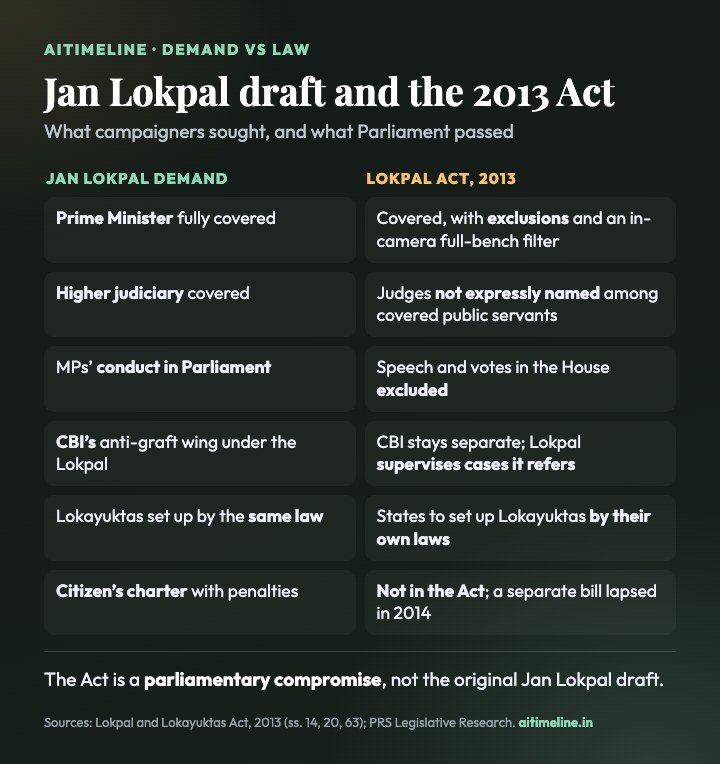
| Demand | What campaigners sought | What the 2013 Act did |
|---|---|---|
| Independence | A watchdog free of executive control | Appointment by a Selection Committee including the Speaker, Leader of Opposition and Chief Justice |
| Prime Minister | Full coverage | Covered, with exclusions and a two-thirds full-bench filter held in camera |
| Judiciary | Higher judges covered | Judges not expressly named |
| Investigation | Own investigation wing; CBI’s anti-graft unit merged in | Inquiry Wing; can refer cases to the CBI and supervise those cases |
| Prosecution | Independent prosecution powers | Prosecution Wing; Directorate of Prosecution in the CBI |
| Citizen services | Citizen’s charter with penalties | Not included |
| States | Lokayuktas under the same law | States to set up Lokayuktas within a year by their own laws |
| Whistleblowers | Protection for complainants | Handled by a separate Whistle Blowers Protection Act, 2014 |
What the Lokpal and Lokayuktas Act, 2013 Provides
- Jurisdiction: the Prime Minister (with exclusions for international relations, security, public order, atomic energy and space), Union ministers, MPs, Group A to D central employees, and office-bearers of bodies funded by the government or receiving foreign contributions above set limits.
- Composition: a Chairperson and up to eight members; at least half judicial; at least half of members from SC, ST, OBC, minority communities or women.
- Selection: the Prime Minister, the Speaker, the Leader of Opposition in the Lok Sabha, the Chief Justice of India or a nominated judge, and an eminent jurist.
- Process: preliminary inquiry, then investigation by the CBI or another agency, with the Lokpal able to sanction prosecution before special courts.
- States: each state to set up a Lokayukta by its own law within a year of commencement.
- Limits: the Lokpal is not a general grievance office; it deals with corruption allegations under the Prevention of Corruption Act against public servants in its jurisdiction.
Five Years Without a Lokpal
Why a law in force had no one to run it.
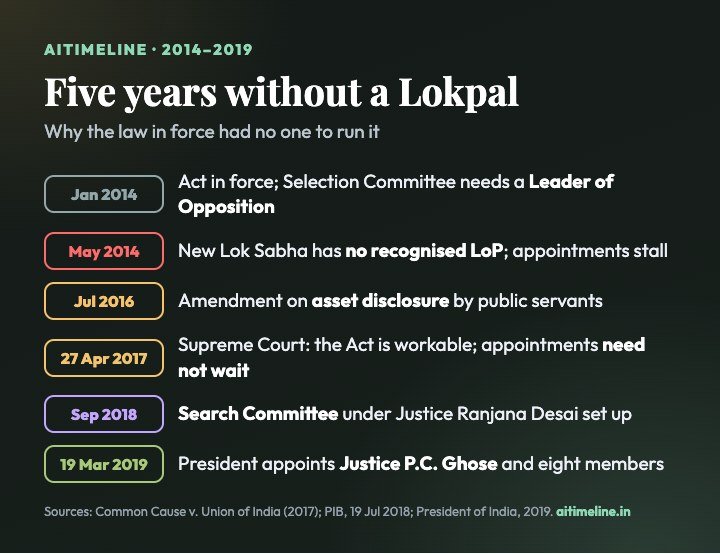
The government’s position was that the Selection Committee could not function without a Leader of Opposition, and it introduced an amendment to let the leader of the largest opposition party take that seat. The amendment never passed. In Common Cause v. Union of India on 27 April 2017, the Supreme Court held the Act was workable as it stood. Even then, the search committee was set up only in September 2018, and the Congress leader Mallikarjun Kharge declined to attend selection meetings as a special invitee without a vote. The same tension over who sits on selection panels runs through India’s other institutional debates, such as the fight over judicial appointments.
Anna Hazare and the Aam Aadmi Party
A political consequence, not a Hazare creation.
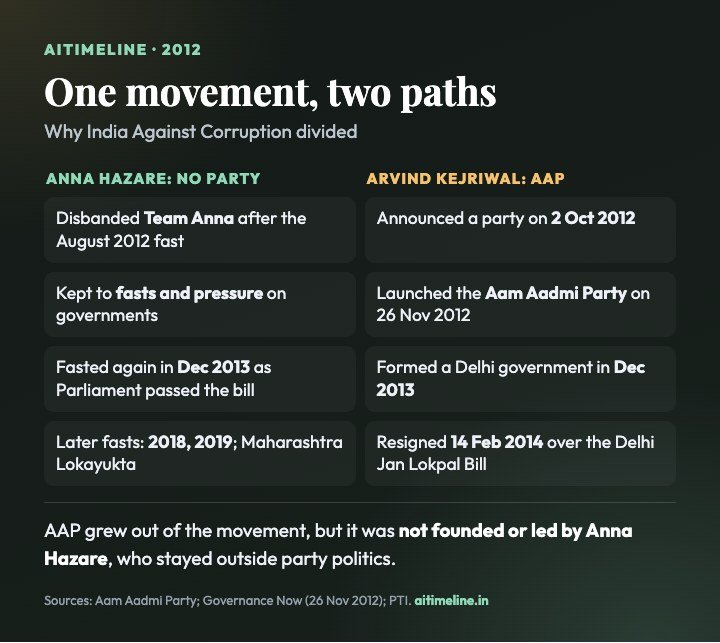
After the poorly attended fast of July–August 2012, the movement’s leaders disagreed over whether to contest elections. Arvind Kejriwal, Manish Sisodia, Prashant Bhushan and others chose politics. Kejriwal announced the plan on 2 October 2012, and the Aam Aadmi Party was launched at Jantar Mantar on 26 November 2012. Hazare, Kiran Bedi and Justice Santosh Hegde stayed out, and Hazare asked the party not to use his name or image. Kiran Bedi later joined the BJP.
AAP’s rise was rapid: it formed a minority government in Delhi in December 2013, and Kejriwal resigned in February 2014 when the Delhi Assembly blocked his Jan Lokpal Bill. The party’s later battles with the Centre over Delhi’s powers are covered in our Delhi vs Centre services timeline. The two developments should be read separately: India Against Corruption was the civil-society campaign; AAP was a party launched by a section of its activists.
Lokpal Complaint Figures: What the Latest Data Shows
Complaints registered and disposed of, not corruption proved.
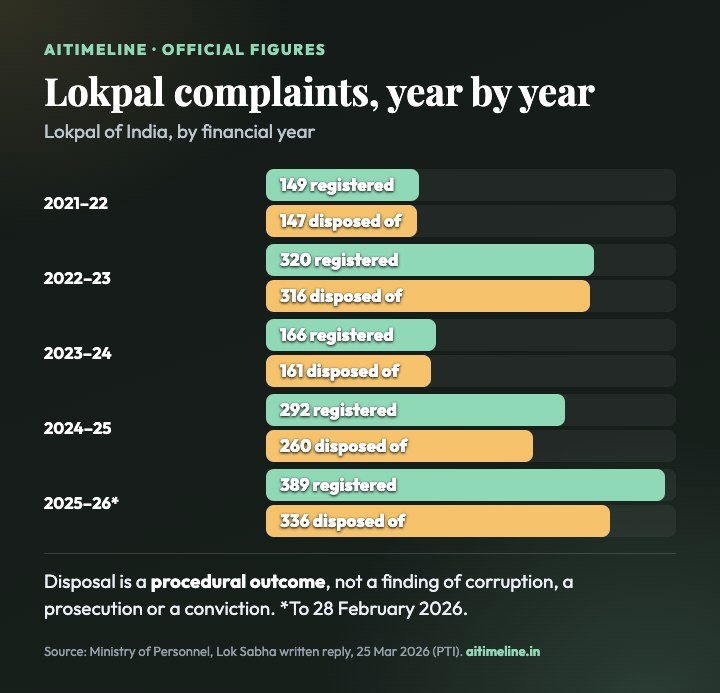
| Financial year | Registered | Disposed of |
|---|---|---|
| 2021–22 | 149 | 147 |
| 2022–23 | 320 | 316 |
| 2023–24 | 166 | 161 |
| 2024–25 | 292 | 260 |
| 2025–26 (to 28 Feb 2026) | 389 | 336 |
The figures come from a written reply by Minister of State Jitendra Singh in the Lok Sabha on 25 March 2026, as reported by PTI; one report of the same reply gives 16 rather than 161 disposals for 2023–24. Disposal can include closure, a direction for preliminary inquiry or investigation, or a finding that the complaint fell outside the Lokpal’s jurisdiction. Better measures of performance would be inquiries completed, prosecutions sanctioned, cases filed and court outcomes, which these figures do not show.
The Lokpal at Work, 2019 to 2026
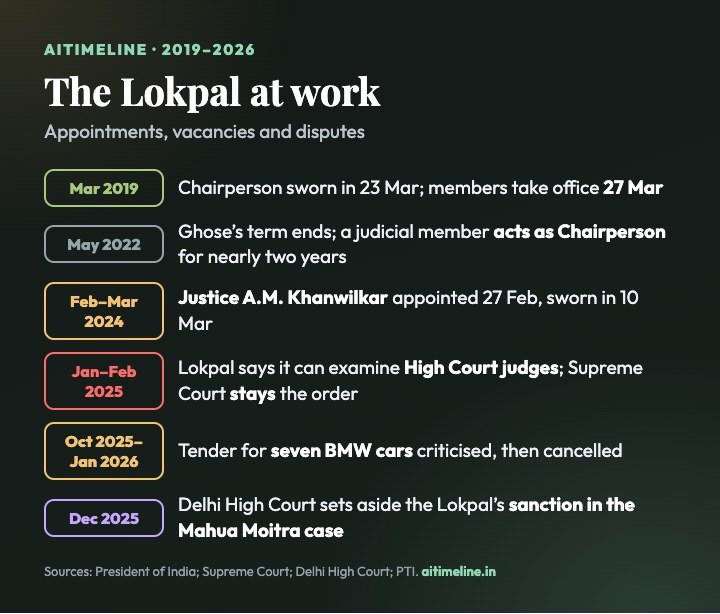
The institution’s first seven years have been marked as much by gaps and disputes as by cases. The Chairperson’s post had no full-time holder from May 2022 to March 2024. In January 2025 the Lokpal’s view that it could examine complaints against High Court judges was stayed by the Supreme Court within a month. Its decision to sanction a CBI chargesheet against Trinamool MP Mahua Moitra was set aside by the Delhi High Court in December 2025, and the scope of its sanction powers is now before the Supreme Court. The BMW tender of October 2025, cancelled after criticism, became a symbol for critics of how far the institution had drifted from the austerity of the 2011 campaign.
Impact of the Anna Hazare Lokpal Movement
- Corruption became a national issue: fasts, television coverage and social media made a 45-year-old bill a mass cause, in a year dominated by the 2G spectrum and, soon after, the coal allocation controversies.
- A long-delayed law: Parliament passed the Lokpal Act in December 2013 after ten failed bills.
- Civil society at the drafting table: the joint committee was an unusual, if short-lived, experiment.
- New political participation: the movement produced the Aam Aadmi Party and shaped the 2014 election mood against the UPA government.
- Institutional independence: it sharpened debate on the CBI and on who appoints watchdogs, alongside the Right to Information Act.
- Implementation gaps: a five-year delay to the first Lokpal, a two-year vacancy at the top, and slow state Lokayukta laws.
- Performance still open: complaint numbers are rising, but published figures say little about prosecutions or convictions.
Key People
| Person | Role |
|---|---|
| Anna Hazare | Social activist from Ralegan Siddhi; led the 2011 fasts; stayed outside party politics |
| Arvind Kejriwal | India Against Corruption organiser; Jan Lokpal drafter; founded AAP in 2012 |
| Kiran Bedi | Former IPS officer and campaign leader; later joined the BJP |
| Prashant Bhushan | Lawyer; joint committee member; co-founded AAP and was later expelled |
| Shanti Bhushan | Former Law Minister; co-chair of the Joint Drafting Committee |
| Justice N. Santosh Hegde | Former Karnataka Lokayukta and Supreme Court judge; joint committee member |
| Swami Agnivesh | Social activist in the early campaign; distanced himself in August 2011 |
| Manmohan Singh | Prime Minister during the 2011 movement and the 2013 Act |
| Pranab Mukherjee | Chaired the Joint Drafting Committee in 2011; as President, gave assent on 1 January 2014 |
| Justice Pinaki Chandra Ghose | First Lokpal Chairperson, 2019–2022 |
| Justice A.M. Khanwilkar | Lokpal Chairperson since March 2024 |
Explore More Timelines
People Also Ask
Frequently Asked Questions
Based on the Act, government records and reporting to 12 November 2026.
⚠️ Editorial Note
This timeline separates the Jan Lokpal proposal from the law Parliament passed. The 27 August 2011 Sense of the House is described as a non-binding commitment, not passage of a bill; accounts differ on whether a formal vote was taken. The Aam Aadmi Party is treated as a separate development: Arvind Kejriwal announced it on 2 October 2012 and it was launched on 26 November 2012, not on 2 October as some summaries state; Anna Hazare did not found or join it. Lokpal complaint disposals are not presented as proof of corruption, prosecutions or convictions, and one report of the March 2026 reply gives a different 2023–24 disposal figure. Justice Khanwilkar was sworn in on 10 March 2024; we could not confirm a separate 12 March swearing-in of members. We found no reliable reports on the outcome of Hazare’s announced fasts of January and July 2026.
Related Reading on AiTimeline
Sources & further reading
Every dated entry above was checked against these references. Last reviewed 12 November 2026.
- The Lokpal and Lokayuktas Act, 2013
- Finance Minister's statement in Lok Sabha on the Lokpal, 27 August 2011
- Status of appointment of Lokpal, 19 July 2018
- Appointment of the first Chairperson and members of the Lokpal, 19 March 2019
- Press communique: appointment of Justice A.M. Khanwilkar as Lokpal Chairperson, 27 February 2024
- Press communique: Justice A.M. Khanwilkar sworn in as Lokpal Chairperson, 10 March 2024
- Lokpal of India: official website
- Common Cause v. Union of India (27 April 2017): Lokpal Act an eminently workable legislation
- Anna Hazare breaks fast, 9 April 2011
- Chronology of Anna's fight against corruption, August 2011
- Hazare ends fast, says fight wouldn't die, 29 August 2011
- Aam Aadmi Party launched amid cheers, hope, 26 November 2012
- Lokpal registered 389 complaints in 2025-26: govt in Lok Sabha, 25 March 2026
- Lokpal logs 389 corruption complaints in 2025-26
- Delhi High Court sets aside Lokpal sanction for CBI chargesheet against Mahua Moitra
- Lokpal cancels controversial BMW car tender after backlash
- Anna Hazare announces hunger strike over Maharashtra Lokayukta delay, 12 December 2025
- Anna Hazare announces indefinite fast from July 5 over Maharashtra's new RTI rules, 22 June 2026
- Civil/political society, protest and fasting: the case of Anna Hazare and the 2011 anti-corruption campaign in India