China’s Bull Semen Market: A Global Livestock Timeline
China is importing bull semen again in 2026, but only from top-10% bulls. See import values, the 92,573-straw restart, the rules and a genetics timeline.
Latest Story
China’s bull semen market is reopening in 2026. China is again importing frozen bull semen from Australia and Canada, but only from bulls ranked in the top 10% of their home country, after years in which imports from the United States, Europe, Canada and Australia were halted one after another. Recorded imports fell from $100.4 million in 2023 to $7.6 million in 2025; by August 2026 just 92,573 straws had arrived.
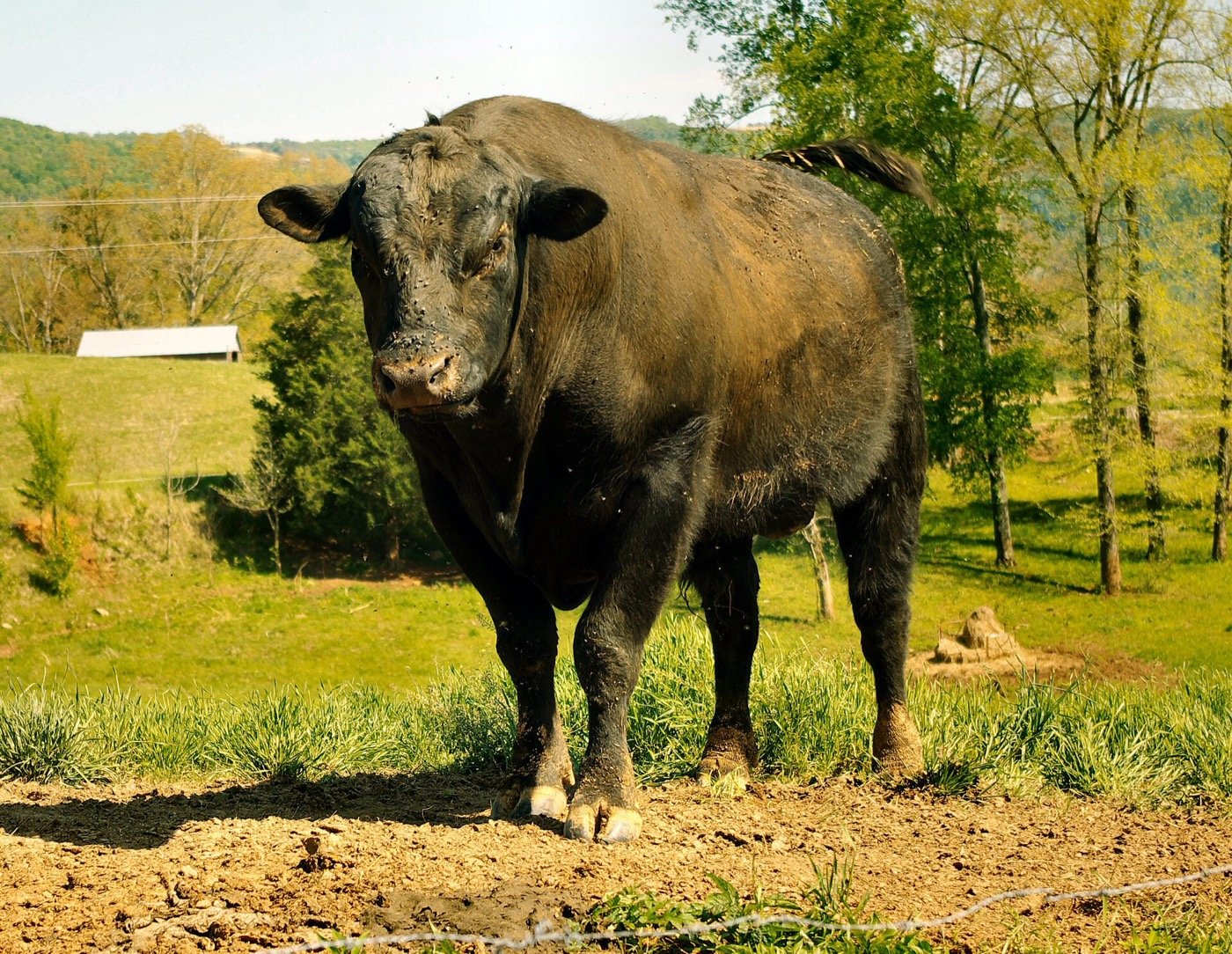
Latest: Reuters reported on 27 October 2026 that China is importing bull semen again, limited to the top 10% of bulls in the producing country (Reuters).
- Suppliers: Australia (since April) and Canada are shipping; US and UK approval is expected by industry sources but not confirmed.
- Volumes: 92,573 straws by the end of August, against roughly 10 million a year before the curbs.
- Next update: when the US or Britain is approved and when full 2026 customs data are published.
💡 Short Answer
China is importing bull semen again in 2026 to improve beef and dairy herds, but under a top-10% rule and a review of more than four months per shipment. Australia resumed in April 2026 and Canada has followed; the US and UK could be next. Recorded imports were $100.4 million in 2023, $58.2 million in 2024 and $7.6 million in 2025, and about 92,573 straws had arrived by the end of August 2026.
How Bull Semen Gets From Bull to Calf
A small frozen straw can carry the genetics of a bull that never leaves his home farm.
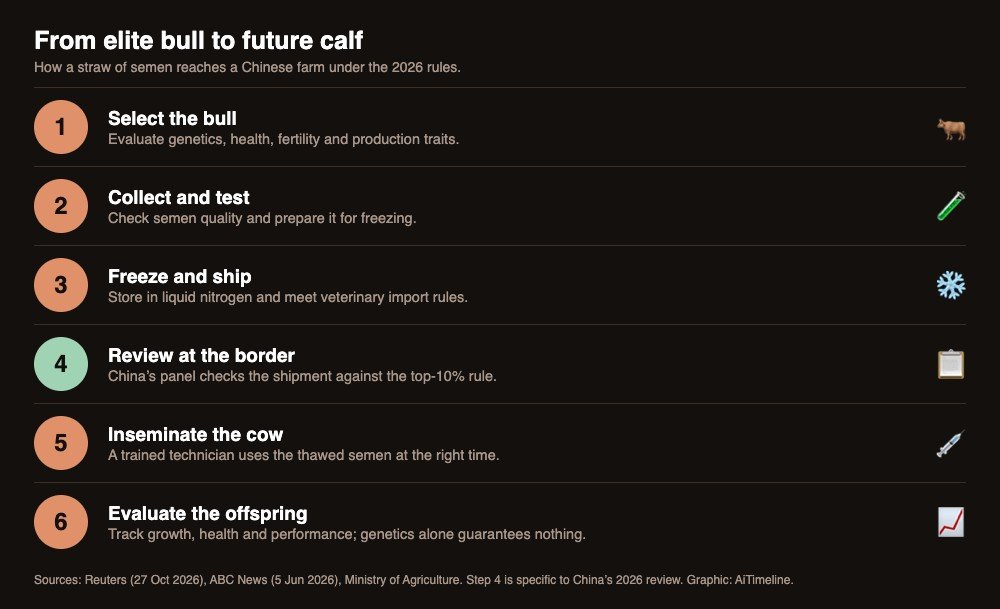
A bull’s genetics can influence the growth rate, meat quality, fertility and productivity of future generations of cattle. In Reuters’ account of an Australian facility, a bull’s semen is divided into hundreds of plastic straws, each holding millions of sperm cells and enough for one insemination, then frozen in liquid nitrogen and shipped (Reuters).
1. Select the bull. Breeders weigh growth, fertility, meat quality, and for dairy sires the milk production expected of daughters.
2. Collect and test. Technicians collect semen and check quality, including concentration and motility.
3. Freeze and ship. Straws are stored in liquid nitrogen and shipped in cryogenic tanks; ABC describes the shipments as held in liquid nitrogen for the trip (ABC News).
4. Review at the border. In 2026 China’s expert panel checks each shipment against the top-10% rule, for more than four months.
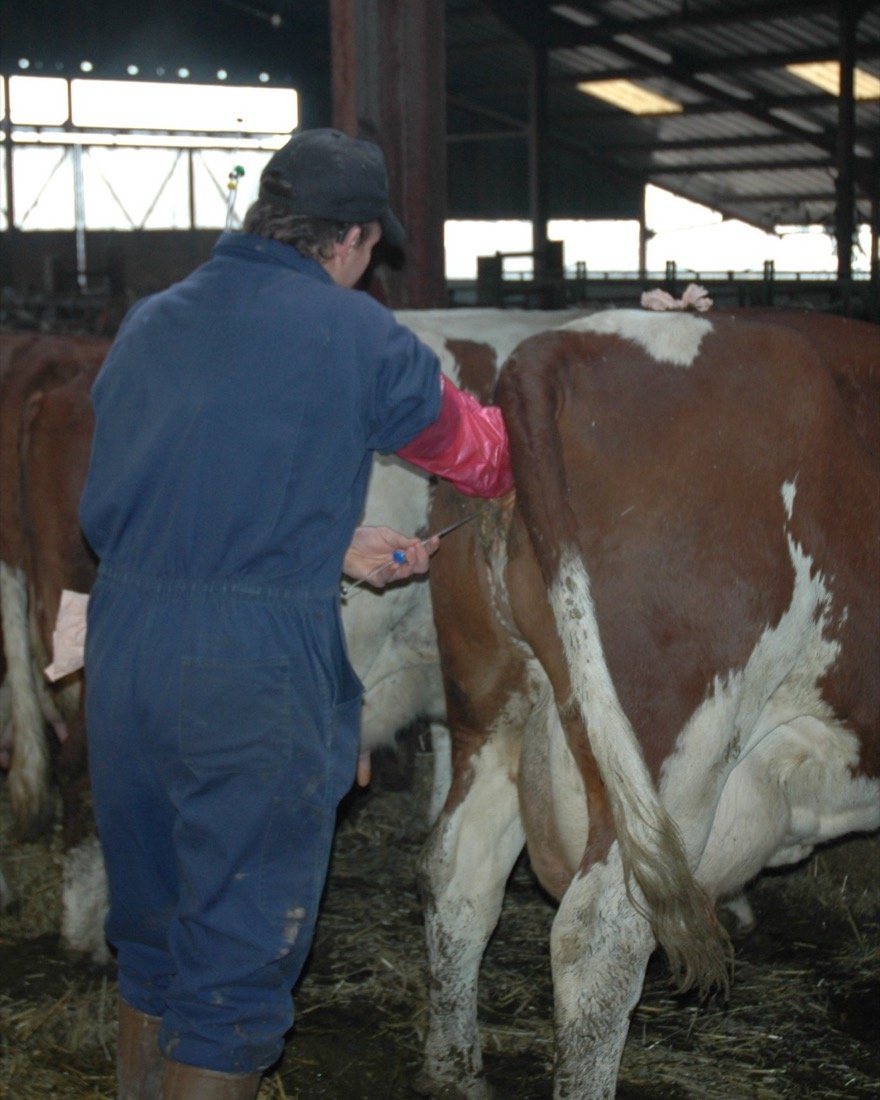
5. Inseminate. A trained inseminator places thawed semen in the cow at the right time; results depend on timing, cow health, semen quality and management.
6. Evaluate the offspring. Calves are tracked for growth, health and performance; a straw does not guarantee a result.
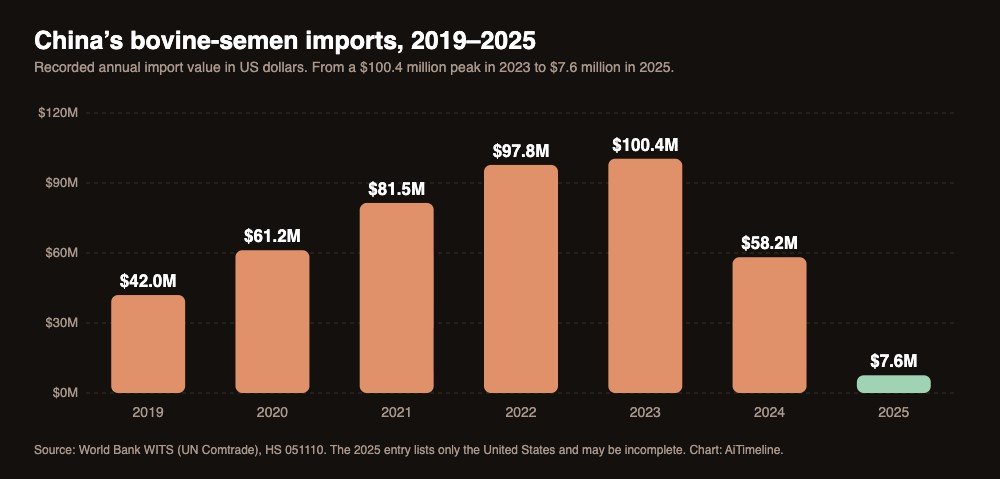
China’s Bovine-Semen Imports, 2019–2025
Recorded annual values from World Bank WITS, which draws on UN Comtrade customs data.
| Year | Recorded imports (US$ million) | From the United States (US$ million) | Change on previous year |
|---|---|---|---|
| 2019 | 41.98 | 34.54 | — |
| 2020 | 61.22 | 54.46 | +46% |
| 2021 | 81.45 | 75.13 | +33% |
| 2022 | 97.75 | 88.58 | +20% |
| 2023 | 100.40 | 89.08 | +3% |
| 2024 | 58.23 | 53.54 | −42% |
| 2025 | 7.61 | 7.61 | −87% |
Imports rose every year from $42.0 million in 2019 to a peak of $100.4 million in 2023, then fell 42% in 2024 and 87% in 2025 (WITS 2023; WITS 2024; WITS 2025). Two cautions apply. WITS reports quantity in kilograms up to 2023 and in items from 2024, so compare dollar values, not volumes, across that break. And the 2025 entry lists only the United States as a partner, so it may be incomplete. Reuters’ wording on cause: China halted imports from one nation after another between 2019 and 2025, so the fall was not a single event.
| Supplier, 2024 | Value (US$ million) | Items |
|---|---|---|
| United States | 53.54 | 8,164,140 |
| Germany | 3.21 | 778,609 |
| France | 1.08 | 433,991 |
| Italy | 0.28 | 101,004 |
| Argentina | 0.10 | 25,928 |
| World total | 58.23 | 9,505,610 |
The United States supplied 92% of 2024 value. That dependence is why US approval is the number the industry is watching: Reuters says the US accounts for about 55% of the roughly $500 million of bull semen shipped globally each year and is expected to be China’s dominant supplier again.
The 2026 Reopening in Numbers
Reuters, 27 October 2026, with Chinese customs data.
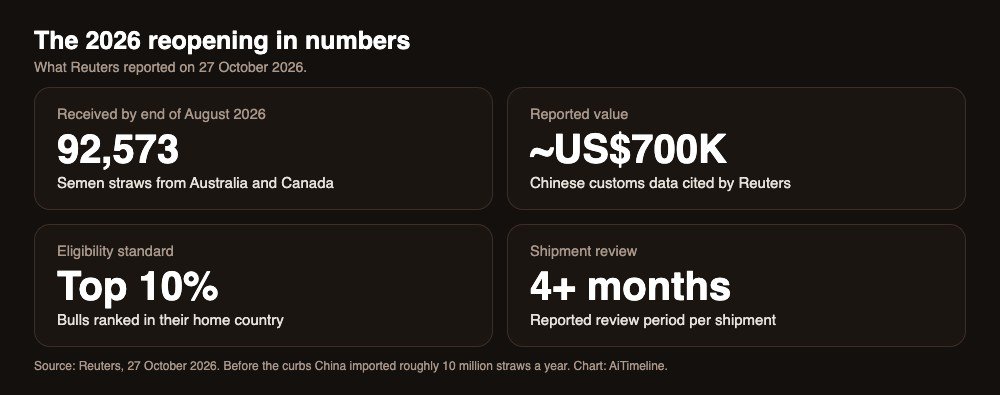
| Measure | Before the curbs | 2026 so far |
|---|---|---|
| Annual straws imported | About 10 million (Reuters) | 92,573 by end of August |
| Value | $58.2 million in 2024 (WITS) | About $700,000 by end of August |
| Suppliers | United States about 92% of value in 2024 | Australia and Canada; US and UK awaited |
| Eligibility | Standard approvals | Top 10% of bulls in the home country |
| Review time | Not reported | More than four months per shipment |
The 2026 customs figures and the WITS series measure different periods and units: 2026 is eight months of straws, WITS is full-year items or kilograms. Do not read the two as a like-for-like comparison. They do show the order of magnitude: the market has reopened at under 1% of its old annual volume.
China’s Bull Semen Market: Key Questions
China’s Bull Semen Market in Nine Points
- Reopening: imports resumed in April 2026, first from Australia, then Canada.
- Standard: only semen from the top 10% of bulls in the country of origin.
- Review: each shipment takes more than four months to approve.
- Volume: 92,573 straws by end of August, against about 10 million a year before.
- Peak: $100.4 million of recorded imports in 2023.
- Collapse: $7.6 million recorded in 2025, with only the US listed.
- Dependence: the US supplied 92% of 2024 value and is not yet re-approved.
- Self-sufficiency: named a national-security priority in 2021; local genetics still lag.
- Limit: genetics alone will not make China self-sufficient in beef or milk.
China Bull Semen Market Timeline, Latest First
From the October 2026 Reuters report back to the first frozen-semen herds. Each entry is tagged and ends with why it matters.
2026
Reuters: China is back, but only the best will do 2026 reopening
Reuters reported that China is buying bull semen again after a near halt that had blocked imports from the United States, Europe, Canada and Australia. Imports are limited to semen from the best 10% of bulls in the producing country, according to government officials, diplomats and genetics companies. Australian and Canadian suppliers are ramping up shipments and the United States and Britain could be approved soon, industry sources said (Reuters; syndicated copy: Daily Waadaa).
An expert panel reviews each shipment for more than four months to check the rule, and some shipments have been only partly approved. China’s agriculture and commerce ministries did not respond to Reuters’ requests for comment.
92,573 straws arrive by the end of August 2026 reopening
By the end of August China had received 92,573 straws worth around $700,000 from Australia and Canada combined, Chinese customs data show, far below the roughly 10 million straws a year imported before the curbs (Reuters). ABS Australia expects to ship about 200,000 straws over the coming year of Wagyu, Angus, Holstein and Jersey semen, more than it sends to all other countries combined.
2026
Australian bull semen ships to China for the first time since 2021 2026 reopening
ABC Rural reported that 24,000 straws had gone to China in April and May, the first Australian cattle-genetics exports to China since 2021: 10,000 in April and 14,000 more in a second shipment. The deal covers Wagyu, Jersey and Holstein semen. China had closed the door on Australian cattle genetics in 2021 during the COVID-19 pandemic, having been Australia’s biggest market for cattle semen and embryos before that (ABC News).
ABS China’s commercial director said farmers want better productivity and beef quality, with strong demand for premium beef in hot-pot restaurants and for Wagyu sires used over dairy cows.
Customs re-accredits an Australian export facility Policy
China’s General Administration of Customs re-accredited the Total Livestock Genetics export facility at Camperdown in south-west Victoria, paving the way for exports to resume. Because of withholding periods before semen can leave the facility, the first shipment did not go until April 2026 (ABC News). A Chinese audit team had visited the facility, a level of scrutiny few other importers apply, ABS’s Australian head told Reuters (Reuters).
Recorded imports fall to US$7.6 million Trade data
World Bank WITS, drawing on UN Comtrade, records China’s 2025 bovine-semen imports at $7.61 million and 1,219,900 items, all from the United States (WITS 2025). That is about 8% of the 2023 value. The 2025 entry lists a single partner, so it may be incomplete; treat it as the recorded figure, not a final total.
One supplier after another is halted Policy
Reuters reported that China halted live-animal and semen imports from one nation after another between 2019 and 2025, and curtailed imports of cattle embryos and live animals; many closures coincided with political confrontations such as the Trump administration’s trade war and frosty relations with Canberra and Ottawa. Some Chinese producers smuggled in semen or live cattle through neighbouring countries including Mongolia, Kazakhstan and Vietnam, a dozen people in the industry said (Reuters).
The causes and dates differ by country, so this was a rolling series of closures rather than a single embargo.
Imports fall to US$58.2 million Trade data
WITS records China’s 2024 bovine-semen imports at $58.23 million and 9,505,610 items. The United States supplied $53.54 million of that, Germany $3.21 million, France $1.08 million, Italy $0.28 million and Argentina $0.10 million (WITS 2024).
Imports peak at US$100.4 million Trade data
China’s recorded bovine-semen imports reached $100.40 million in 2023, of which $89.08 million came from the United States, followed by Germany, Italy, the United Kingdom and France (WITS 2023). Values had climbed from $42.0 million in 2019 (WITS 2019). WITS reports quantity in kilograms up to 2023 and in items from 2024, so volumes before and after cannot be compared directly.
Genetics self-sufficiency becomes a national-security priority Policy
Reuters reported that China declared self-sufficiency in animal genetics a national-security priority in 2021, identifying cattle breeding as a critical weak spot. By 2026 the government had invested millions of dollars in local breeding centres, but local genetics still lag Western countries, industry sources said (Reuters). Recorded imports were $81.4 million that year, still dominated by US semen (WITS 2021).
China adopts genomic selection for young beef bulls Breeding science
According to a 2021 Ministry of Agriculture article, China began using genome-wide selection to choose young beef bulls in 2017 and first published a China beef-cattle genomic selection index in 2020, using a reference population of 2,300 animals. It reported 36 bull stations with more than 2,500 beef and dual-purpose bulls and annual frozen-semen capacity of 44 million doses, which it said largely met domestic demand (Ministry of Agriculture).
The same article says a gap with leading countries remains, and the 2021 plan aims to extend genomic evaluation to most core herds.
National beef-cattle genetic improvement plan, 2011–2025 Policy
The Ministry of Agriculture issued the National Beef Cattle Genetic Improvement Plan (2011–2025). Its own situation review said that in 2010 China had more than 30 beef bull stations and about 1,300 bulls in semen collection, sold more than 15 million doses of frozen semen, and relied on imports for most sires; it also warned that indiscriminate crossbreeding was muddling herd genetics (National Beef Cattle Improvement Center; Ministry of Agriculture).
Genomic selection is proposed, then adopted by breeders Breeding science
The Ministry of Agriculture article credits Meuwissen with proposing genome-wide selection in 2001 and the American Angus Association with applying it first in 2014, after which other developed countries followed. Its stated benefit is earlier selection, shorter generation intervals, faster genetic progress and lower breeding cost (Ministry of Agriculture).
Cattle shift from draught animals to beef producers Breeding science
Chinese beef-cattle genetic improvement began in the 1960s, according to the National Beef Cattle Improvement Center (NBCIC). The Ministry of Agriculture article says cattle were long used as working animals and began to be raised for beef only from the 1970s, about a century later than in the West; imported Simmental, Charolais, Angus and Limousin were crossed with local cattle to create new breeds (Ministry of Agriculture).
1960s
Antibiotics and freezing make artificial insemination practical Breeding science
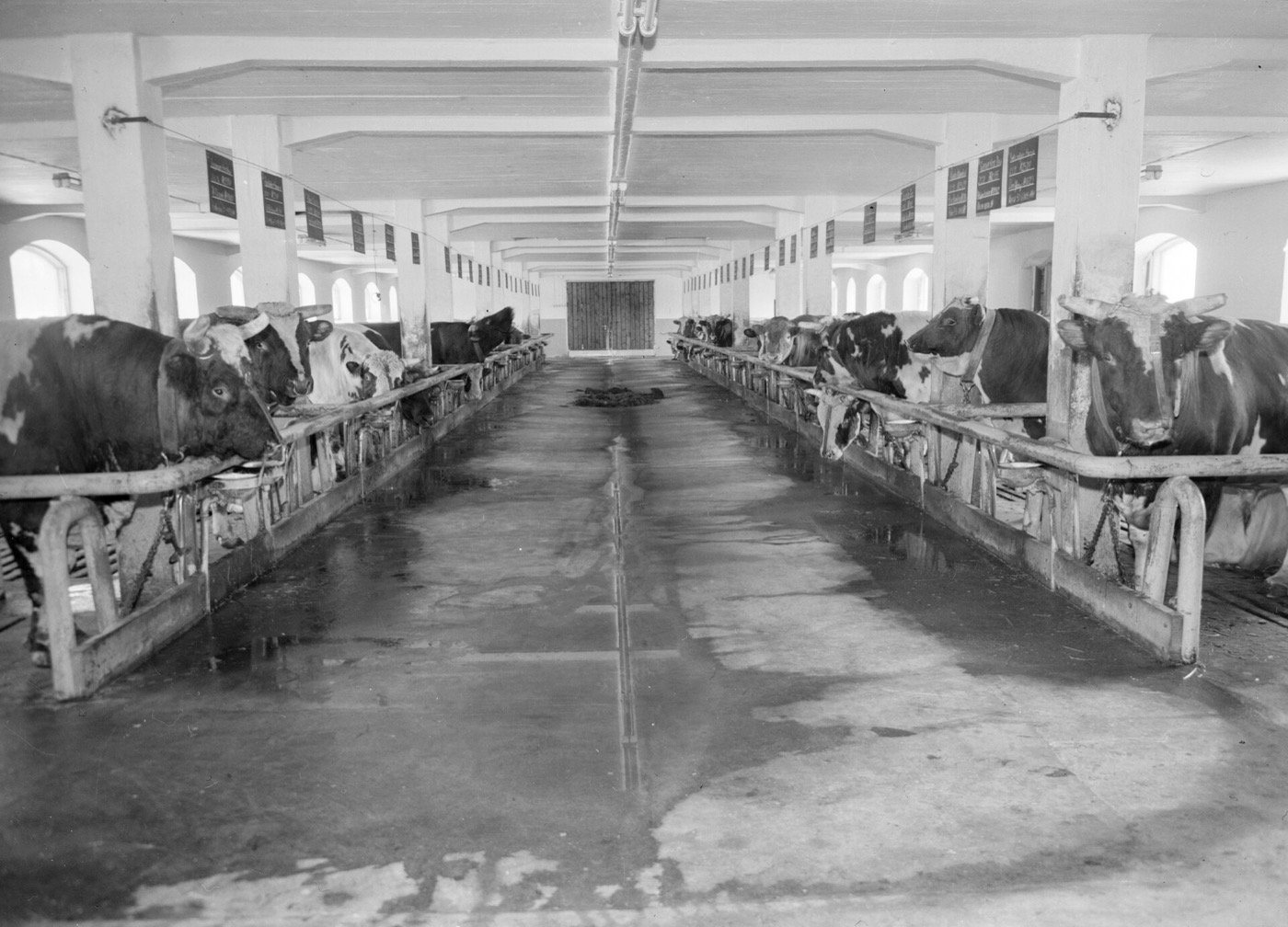
Pioneers such as Ilya Ivanov worked on artificial insemination from 1899, but Wikipedia notes that antibiotics added to semen, first proven with penicillin in 1946, and new freezing and thawing techniques made it far more practical in the livestock industry (Wikipedia). Stations then kept bulls and shipped their semen to many farms, as in this Finnish AI bull hall photographed in 1964.
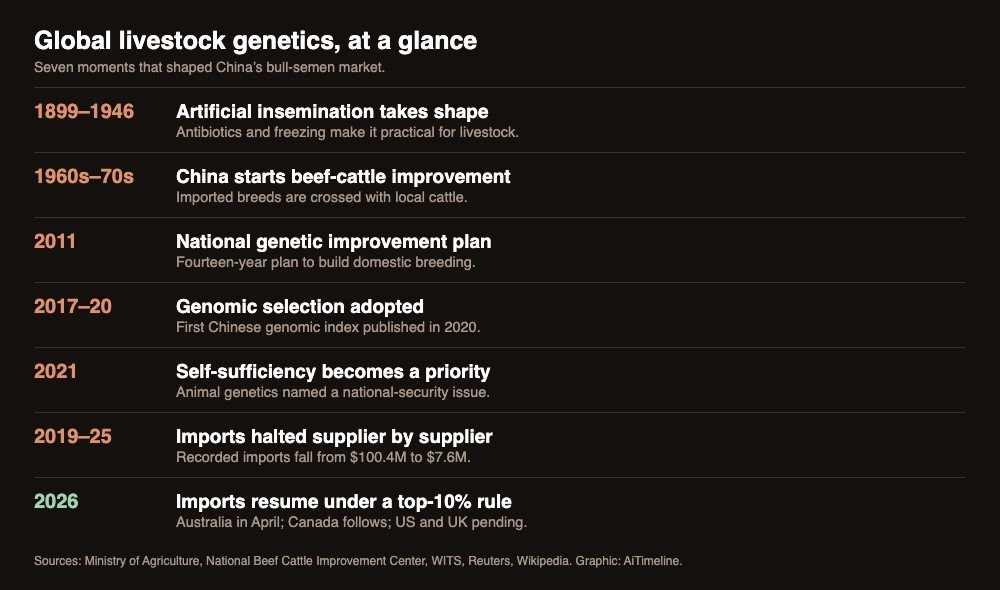
Global Livestock Genetics at a Glance
Why China Wants Premium Cattle Genetics
Meat and milk per animal. Chinese beef carcasses weigh around 150 kg against nearly 400 kg in the United States, and Chinese dairy cows produce less milk than the US herd (USDA, via Reuters). Better genetics can mean faster growth, better marbling, higher-quality milk and less feed per unit.
Rising demand. By 2024 Chinese consumers ate almost twice as much beef and 30% more dairy than a decade earlier, and imports of beef and products such as cream, cheese and butter have grown to $25 billion to $30 billion a year, Reuters says. A wealthier middle class increasingly prefers prime Angus and Wagyu to cuts used in traditional stewing.
Beef on dairy. ABS China says Wagyu sires over Chinese dairy cows let producers raise beef quality while keeping existing dairy herds (ABC News).
A longer game. Industry sources told Reuters China’s eventual goal is to develop world-leading genetics and become an exporter. Genetics “get outdated very quickly,” one Beijing consultant said, which keeps foreign suppliers relevant.
The Main Players
China (customs and ministries)
The General Administration of Customs accredits export facilities. China’s agriculture and commerce ministries did not respond to Reuters’ requests for comment.
ABS Australia
Secured the Wagyu, Jersey and Holstein deal reported by ABC; expects to ship about 200,000 straws in the coming year.
Beijing World Wide Sires
Sells imported genetics to Chinese dairy producers; its CEO says customers keep asking when US semen will return, per Reuters.
United States
Supplied $53.5 million of China’s $58.2 million in 2024 and about 55% of the roughly $500 million global trade; not yet re-approved, per Reuters.
National Beef Cattle Improvement Center
Runs China’s beef-cattle genetic improvement work under the 2011–2025 plan.
Ministry of Agriculture
Reports 36 bull stations and annual frozen-semen capacity of 44 million doses.
Risks and Limitations
Biosecurity. Imported genetic material must meet veterinary requirements. Reuters reports that some producers smuggled semen or cattle through Mongolia, Kazakhstan and Vietnam during the shutdown, which bypasses health checks.
Genetic diversity. Repeatedly using a few elite bulls can raise inbreeding risk unless programmes manage diversity. The Ministry of Agriculture itself warned of muddled herd genetics from indiscriminate crossbreeding.
Local adaptation. Genetics that perform in one climate and feed system may not in another.
Trade and political risk. Many past closures coincided with political confrontations, per Reuters; approvals can change.
Time. Breeding, gestation, calf rearing and herd replacement take years. A shipment does not raise national output quickly, and feed, land, costs and farm economics matter as much as genetics.
What Happens Next?
1. US and UK approvals. Industry sources told Reuters both could be approved soon. The US is expected to be the dominant supplier again.
2. Volumes. ABS Australia expects about 200,000 straws over the coming year, more than it ships to all other countries combined.
3. Full-year data. Customs data for 2026 and a revised 2025 figure will show whether recorded imports recover.
4. Domestic capacity. China’s breeding centres will keep competing with imports at the top end.
Explore More Timelines
People Also Ask
Frequently Asked Questions
Genetics as a Trade Asset, With Limits
China’s return to the bull-semen market shows how livestock genetics has become part of food policy: a frozen straw can influence cattle performance for years, but only through effective breeding and farm management. The reopening is real and small, 92,573 straws against a normal ten million, and conditional on a top-10% rule and a long review. This page will be updated when the US or Britain is approved and when full-year customs data arrive.
Related AiTimeline Stories
⚠️ Editorial Note
Last updated 27 October 2026. The Reuters page blocked our automated checker, so its figures were verified against a syndicated copy of the same story. WITS values come from the World Bank page for HS 051110 (UN Comtrade). We corrected the source brief on several points: the halts ran from 2019 to 2025 and were not a single 2025 event; genomic selection was proposed in 2001, first used by the American Angus Association in 2014 and by China from 2017; the brief’s 2025 chart value is now taken from WITS directly and flagged as possibly incomplete; and the 2026 and historical figures are kept separate because they cover different periods and units.
Sources & further reading
Every dated entry above was checked against these references. Last reviewed 27 October 2026.
- Reuters: China is back in the bull semen market, but only the best will do (27 October 2026)
- ABC News: Australian bull semen exports to China resume after pandemic pause (5 June 2026)
- World Bank WITS: China bovine semen imports by country, 2024
- World Bank WITS: China bovine semen imports by country, 2023
- World Bank WITS: China bovine semen imports by country, 2025
- National Beef Cattle Improvement Center: National Beef Cattle Genetic Improvement Plan 2011-2025
- China Ministry of Agriculture: Beef cattle breeding, past, present and future (17 March 2021)
- Wikipedia: Artificial insemination