West Africa’s Gold Refineries: A Timeline of Economic Sovereignty and Value Addition
West Africa gold refineries explained: how Ghana, Burkina Faso and Mali plan to refine gold at home, what it costs per the IMF and what is still unproven.
Latest Story
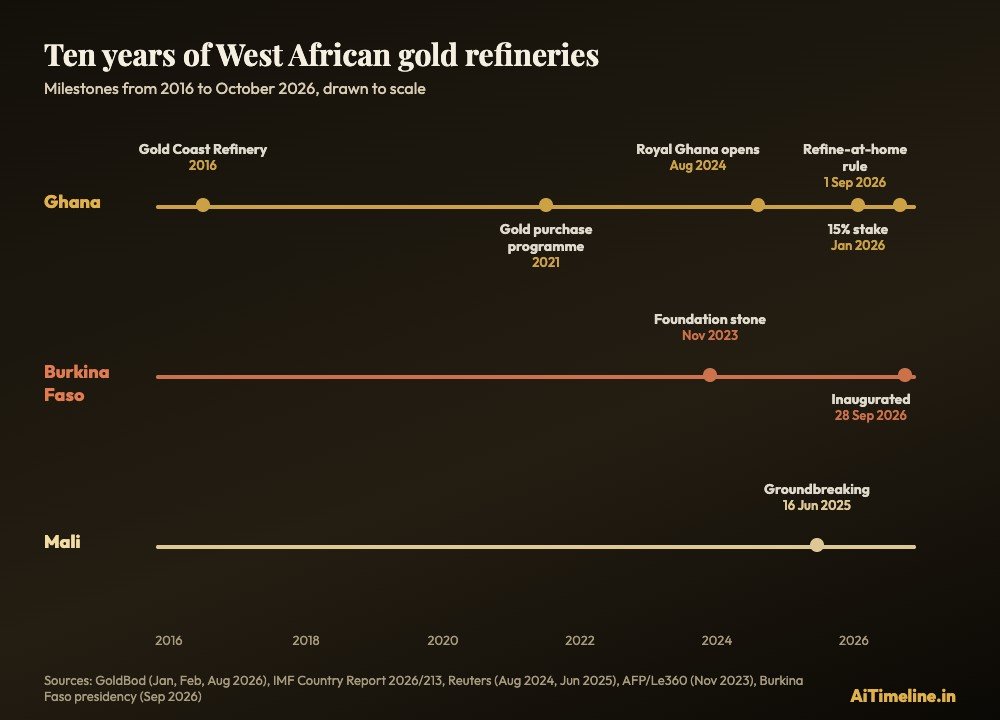
West Africa is one of the world’s major gold-producing regions, and its governments are trying to change who benefits. The West Africa gold refineries story runs through three countries. Ghana has a 2016 refinery it is finally filling, a 2024 plant, a 15% state stake and, from 1 September 2026, a rule that covered exports must be refined at home. Burkina Faso inaugurated its national refinery on 28 September 2026, nearly two years after the date first promised. Mali broke ground on a Russia-backed plant on 16 June 2025 and has published no cost or deadline. Officials call this economic sovereignty. The evidence so far is mostly capacity figures and ceremonies: Burkina Faso’s 164 tonnes is about 1.7 times its 2025 output, and the IMF reports Ghana’s gold purchases lost the central bank over US$1.7 billion in 2025, partly valuation effects. This page separates announcements from output. For background, see AiTimeline’s timelines of Africa’s critical minerals, gold versus silver and gold bull markets.
Tap a stage. The key point: refining is one step in the chain, and a bar still needs buyers who accept it.
Choose a stage above.
💡 Short Answer
Ghana, Burkina Faso and Mali are building or filling gold refineries to keep more of the value of their gold. Ghana requires covered exports to be refined locally from 1 September 2026 and holds 15% of Gold Coast Refinery. Burkina Faso inaugurated RAFFINOR-BF on 28 September 2026 with a stated 164-tonne capacity. Mali began a 200-tonne plant on 16 June 2025. None has yet published audited refining output, and the IMF shows Ghana’s gold purchasing carried heavy costs.
What Is Settled and What Is Not, as of 25 October 2026
Last updated: 25 October 2026. Kept separate from the timeline because announcements and outcomes are different kinds of evidence.
| Question | Position of the sources | Status |
|---|---|---|
| Is Burkina Faso’s refinery open? | The presidency and AFP report the inauguration of RAFFINOR-BF on 28 Sep 2026 in Ouagadougou | Settled |
| Is it refining 164 tonnes a year? | 164 tonnes is the stated first-phase capacity (515 tonnes projected). No output, buyer or accreditation data found | Not reported |
| Must Ghana’s covered exports be refined at home? | Yes. GoldBod’s directive bars unrefined doré exports from 1 Sep 2026 for self-financing aggregators; effects on volumes not yet published | Settled (policy) |
| Does Ghana own part of a refinery? | GoldBod announced a 15% free-carried interest in Gold Coast Refinery on 21 Jan 2026; the agreement’s terms were not published | Settled; terms unseen |
| Did Ghana’s gold purchases lose money? | The IMF reports Bank of Ghana programme losses of over US$1.7 billion in 2025, which it says partly reflect valuation effects | Settled as an IMF estimate |
| Is Mali’s refinery operating? | Construction began 16 Jun 2025 with no deadline or cost announced; no 2026 update found | Unresolved |
| Is any of the three plants LBMA accredited? | No announcement found; GoldBod and Ghana’s Finance Minister describe accreditation as a goal | Not reported |
| Do the refineries create the promised jobs? | Only projections exist: 100 direct and 5,000 indirect (Burkina Faso), about 162 added (Gold Coast, minister’s figure) | Unverified |
West Africa’s Gold Refineries: Key Questions
The Gold Refinery Push in Ten Points
- Burkina Faso: RAFFINOR-BF was inaugurated on 28 September 2026, 34 months after the foundation stone.
- Capacity is not output: 164 tonnes is about 1.7 times Burkina Faso’s 2025 production of more than 94 tonnes.
- Ghana’s rule: unrefined doré cannot be exported by covered aggregators from 1 September 2026.
- Ghana’s stake: a 15% free-carried interest in Gold Coast Refinery, announced 21 January 2026.
- The cost: the IMF reports Bank of Ghana losses of over US$1.7 billion in 2025, partly valuation effects.
- The handover: GoldBod took over the gold programme from the central bank on 1 July 2026.
- Mali: a 200-tonne plant started 16 June 2025 with no deadline or cost published.
- Who is “first”: Reuters called Royal Ghana the first commercial refinery; GoldBod says Gold Coast opened in 2016.
- Accreditation: no new plant has announced LBMA Good Delivery status.
- The test: audited tonnes, net revenue, miner prices, traceability and market acceptance.
West Africa Gold Refineries Timeline, Latest First
Each entry is tagged by country and ends with why it matters. Capacity and projections are labelled as such.
Show only Ghana, Burkina Faso or Mali.
–
2026
Burkina Faso inaugurates its national gold refinery, RAFFINOR-BF Burkina Faso
President Ibrahim Traoré inaugurated the Raffinerie nationale d’Or du Burkina Faso (RAFFINOR-BF) on Monday 28 September 2026. The presidency said the project cost more than 11 billion CFA francs, mobilised by the state, notably through the Société nationale des substances précieuses (SONASP), with the national private sector (Burkina Faso government). In its first phase the plant is to refine 164 tonnes of gold a year, with a projection of up to 515 tonnes later. Authorities say it is meant to take both industrial and artisanal output.
Those are stated design figures, not output. The mines ministry put Burkina Faso’s 2025 production at more than 94 tonnes (Le360, citing AFP), so first-phase capacity is about 1.7 times the country’s annual output. Officials project 100 direct and 5,000 indirect jobs. AiTimeline found no operating data yet: no tonnes refined, no named buyers and no accreditation announcement.
2026
Ghana makes local refining mandatory for covered gold exports Ghana
The Ghana Gold Board (GoldBod) directed all Self-Financing Aggregators to refine gold doré in Ghana before export from 1 September 2026. The directive was issued by its Compliance Directorate on 24 August and published on 26 August; from 1 September no unrefined doré is approved for export (GoldBod). Refining must happen at a refinery approved or designated by GoldBod, the cost falls on the aggregator or its approved offtaker under their commercial arrangements, and it must be settled before export. Aggregators had until 31 August to amend their offtake agreements.
Breaches count as a violation of licence conditions and can bring refused or suspended export approvals and licence suspension or revocation. GoldBod also reserved the right to decide which refinery processes particular gold. The notice does not say how many tonnes it covers or which refinery takes them. The IMF reported that one aggregator, Bawa-Rock, supplied over 60% of artisanal gold exported in 2025 and that GoldBod had licensed a second one, so volumes are concentrated.
2026
An IMF staff paper counts the cost of Ghana’s gold purchases Ghana
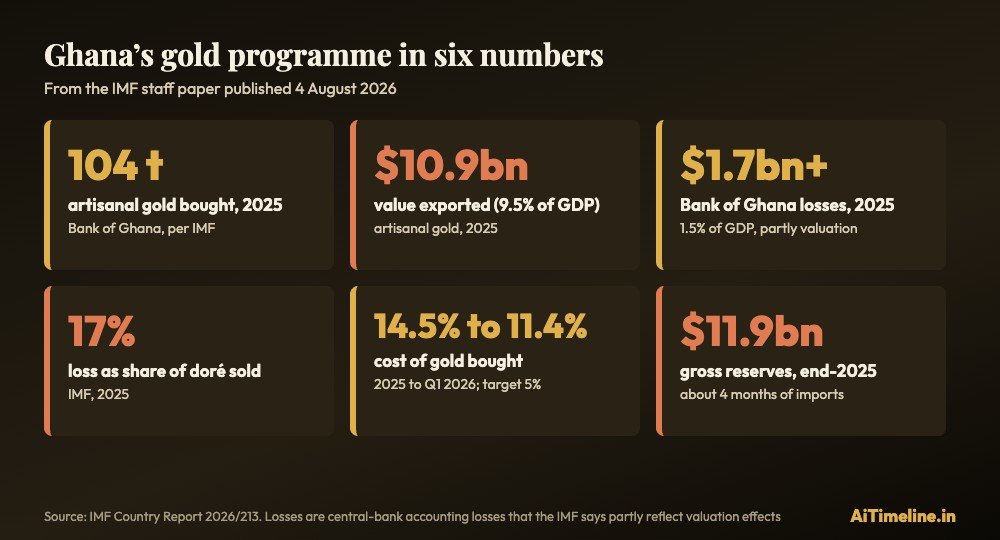
The IMF published a Selected Issues paper on the Bank of Ghana’s Domestic Gold Purchase Programme, announced in 2021 and mostly phased out by end-June 2026. In 2025 the Bank bought and exported about 104 tonnes of artisanal gold for US$10.9 billion (9.5% of GDP). The IMF says the programme “arguably contributed” to Ghana’s macroeconomic stabilisation, but also ran losses of over US$1.7 billion (1.5% of GDP) in 2025, equal to 17% of the value of the doré sold (IMF).
The paper traces the losses to assay and service fees paid to GoldBod, discounts on gold sold to exporters and, most of all, the gap between the exchange rate paid to buy gold and the reference rate used for accounting. It adds that these accounting losses “partly reflect valuation effects rather than economic costs”, but still weaken the Bank of Ghana’s balance sheet, whose negative equity was 6.7% of GDP at end-2025. The 2026 plan it describes has gold refined domestically and validated at an LBMA-certified South African refinery: local refining and outside certification side by side.
2026
GoldBod takes over the Bank of Ghana’s gold-purchase programme Ghana
According to the IMF, gold-purchase activities were fully transferred to GoldBod on 1 July 2026 under a memorandum of understanding. The Bank of Ghana exits the programme, stays on as fiscal agent and as a recipient of monetary gold for its reserves, and the government assumes all costs (IMF). Costs were 14.5% of the gold purchased in 2025 and 11.4% in the first quarter of 2026 after assay fees and service charges were halved; the target is 5%.
The paper also describes an ambition to make domestic gold purchases the main tool to reach 15 months of import cover in reserves by 2028, against an estimated adequacy need of 6 months. It warns that the cost of sterilising those reserves could reach about 3% of GDP, up from 1% in 2025. In other words, the refinery push now sits inside a state-run buying system whose costs the government, not the central bank, carries.
2026
Ghana inspects the first batch of gold refined locally under the new agreement Ghana
Finance Minister Cassiel Ato Forson and GoldBod chief executive Sammy Gyamfi toured Gold Coast Refinery to inspect the first batch of gold refined under the new regime. The agreement has the refinery process all gold GoldBod buys from artisanal and small-scale miners, at one tonne a week from February. The refinery’s executive chairman, Said Deraz, said it can handle up to two tonnes a week and works with Rand Refinery, which GoldBod calls Africa’s only LBMA-accredited refinery (GoldBod).
The minister said the work had created about 162 additional jobs, allowed round-the-clock operation and that 300 kilograms had been supplied the day before. Finished bars carried the stamps of GoldBod, the Bank of Ghana, the refinery and the Ghana Standards Authority. He asked the refinery to pursue LBMA certification. All of this is the government’s and the refinery’s own account of a site visit; AiTimeline found no volumes reported since.
2026
Ghana secures a 15% free-carried interest in Gold Coast Refinery Ghana
GoldBod announced a 15% free-carried interest in Gold Coast Refinery Company Limited. Its chief executive said this means the Republic holds shares without any financial contribution while enjoying full shareholder rights, including dividends. The refining agreement provides for up to one tonne of gold a week to be refined locally from 1 February 2026, to a minimum purity of 99.5% (GoldBod).
GoldBod said the refinery, commissioned in 2016, had been significantly underutilised despite being the largest in the sub-region. It also said Rand Refinery’s involvement is expected to help Ghana reach LBMA-accredited status. “Free carried” means the state pays nothing for the stake; the terms that decide what it is worth (refining fees, dilution, who funds expansion) were not in the announcement, and AiTimeline did not find the agreement published. Gold Coast Refinery is a different company from Royal Ghana Gold Refinery.
2025
Mali breaks ground on a Russia-backed national refinery near Bamako Mali
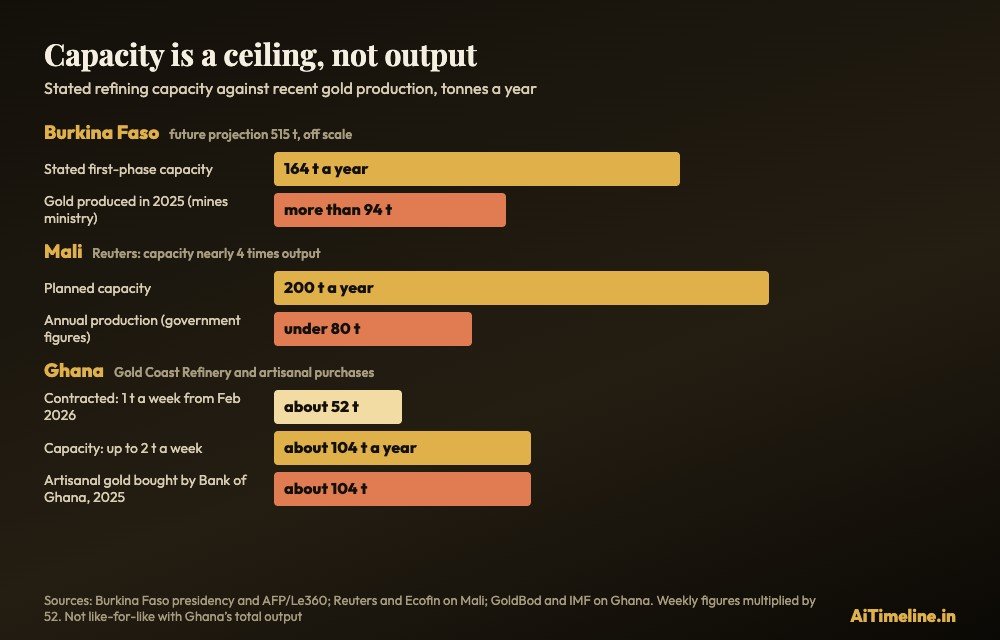
Mali began building a refinery at Sénou, outside Bamako, with a planned capacity of 200 tonnes. Reuters reported a controlling Malian stake and a partnership with Russia’s Yadran Group and a Swiss investment company, and that the government gave no completion deadline (Reuters via Kitco). Assimi Goïta said at the ceremony that Mali’s gold has been exported for refining since 1980, depriving the country of revenue. Ecofin, citing a cabinet communiqué of 28 May, reports ownership of 62% for the state and 38% for Yadran, and says cost and timeline were not disclosed (Ecofin).
Reuters described the capacity as nearly four times Mali’s annual production; Ecofin cites government figures of under 80 tonnes a year. Most declared output comes from industrial mines run by international firms that ship to refiners abroad, and Ecofin reports that more than 85% of 2023 gold exports went to South Africa, Switzerland and Australia. AiTimeline found no 2026 update on construction, so the plant should be treated as under construction, not operating.
GoldBod begins full operations under the Ghana Gold Board Act, 2025 Ghana
GoldBod is the regulator that now orders refining. Its mandate under the Ghana Gold Board Act, 2025 (Act 1140) covers the purchase, sale, refining, value addition and export of gold (GoldBod). The Finance Minister said in February 2026 that it began full operations in May 2025 (GoldBod). GoldBod describes itself as the sole authority with exclusive rights to buy, sell, weigh, grade, assay, value and export gold in Ghana.
By 2025 the Bank of Ghana had become the intermediary for virtually all recorded artisanal gold export proceeds, with GoldBod handling most sourcing, according to the IMF (IMF). The exact start day in May 2025 is not given in the sources AiTimeline reviewed.
2024
Ghana opens Royal Ghana Gold Refinery in Accra Ghana
Reuters reported that Ghana opened its first commercial gold refinery in Accra on Thursday 8 August 2024. The Royal Ghana Gold Refinery can process 400 kilograms a day. It is a joint venture between India’s Rosy Royal Minerals and the Bank of Ghana, which holds 20%. It was to source doré from small-scale and artisanal miners first, with plans to seek licences for large-scale output, and to employ 80 to 120 people directly and about 500 indirectly (Reuters; syndicated copy).
“First” is Reuters’ description. In 2026 GoldBod and the Finance Minister said Gold Coast Refinery had been commissioned in 2016 and then underused, so the two accounts differ on what counts as Ghana’s first refinery. Both describe LBMA accreditation as a goal still ahead. AiTimeline could not open the Reuters page (it returns a bot-protection error) and relies on the syndicated copy for the figures above.
2023
Burkina Faso lays the foundation stone for a refinery in Ouagadougou Burkina Faso
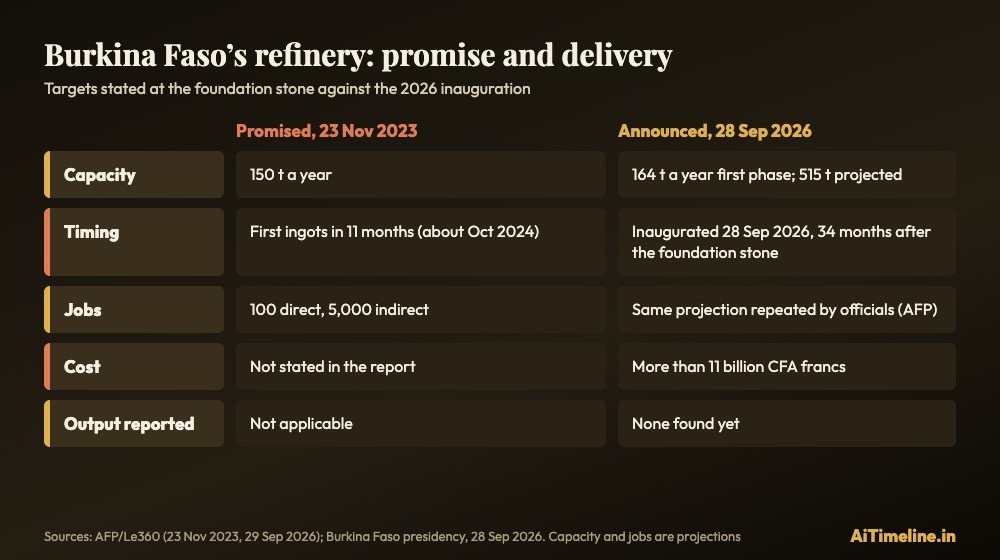
Traoré launched construction on Thursday 23 November 2023. The co-manager’s chief executive, Ismaël Sibi of Marena Gold, said the plant would refine 150 tonnes a year at 99.99% purity, about 400 kg a day, with the first ingots in 11 months and 100 direct and 5,000 indirect jobs (Le360, citing AFP). Traoré said “a lot of gold leaves Burkina fraudulently” and that the country had no control over its gold.
The same report put Burkina Faso’s 2022 output at 57.6 tonnes, down 13.7% from 66.8 tonnes in 2021, with mining 14.3% of state revenue. The inauguration came 34 months after the foundation stone, about two years after the 11-month target, with a stated capacity of 164 tonnes rather than 150. AiTimeline could not open the mines ministry page cited in the source brief and relies on this AFP report for the 2023 event.
Ghana announces its Domestic Gold Purchase Programme Ghana
The Bank of Ghana announced the Domestic Gold Purchase Programme in 2021 to build reserves through local purchases (IMF). The IMF says gold rose from about a fifth of Ghana’s exports in 2021 to more than half, helped by higher prices, less smuggling and more production, and that the surge improved the current account, the exchange rate and debt sustainability.
The same paper estimates that 229 tonnes of artisanal gold worth US$11.4 billion left Ghana unrecorded between 2019 and 2024, and that in 2023 Ghana’s reported exports and the UAE’s reported imports differed by over US$4 billion. In 2025 the government removed taxation on the artisanal sector to support the Bank’s purchases, according to the IMF. Smuggling and reserves, not refining, were the original problem the gold programme was built to solve.
Ghana commissions Gold Coast Refinery, then leaves it underused Ghana
GoldBod said Gold Coast Refinery was commissioned in 2016 and had been significantly underutilised despite being the largest refinery in the sub-region (GoldBod). The Finance Minister said it was commissioned that year by President John Mahama but remained underutilised in the years after (GoldBod).
The plant’s executive chairman says it can refine up to two tonnes a week. What changed in 2026 was not the building but the supply: a contract for one tonne a week of state-purchased gold, a 15% state stake and a rule that covered exports must be refined at home. Capacity existed for a decade without throughput to match.
Five Common Claims, Checked
Each claim rests on something real. Each stops short of what it is often taken to show.
| Claim | What it rests on | What it does not show |
|---|---|---|
| Refining at home keeps the gold’s value in the country | Refining fees, technical jobs and state stakes such as Ghana’s 15% | Net revenue. AiTimeline found no published figure for what refining adds to national income, and gold-purchase costs can outweigh it |
| Burkina Faso’s refinery will process 164 tonnes a year | The presidency’s first-phase capacity | Output. 2025 production was only more than 94 tonnes, and no throughput has been reported |
| Ghana lost US$1.7 billion on gold | The IMF’s estimate of Bank of Ghana losses in 2025 | A pure cash loss. The IMF says the figure partly reflects valuation effects, and credits the programme with helping stabilise the economy |
| Royal Ghana was Ghana’s first refinery | Reuters’ description of the 8 Aug 2024 opening | Priority. GoldBod says Gold Coast Refinery was commissioned in 2016 |
| Mali’s refinery will process all of Mali’s gold | Reuters’ report of the government’s intention and a revised mining code | Compliance or a date. Cost and completion were not disclosed, and most output comes from internationally run mines that sell abroad |
Why West African Countries Want to Refine Gold Locally
Four motives recur in official statements.
1. Retaining more value. Refining converts doré into bullion and keeps fees, laboratory work and skilled jobs at home. Burkina Faso’s president said the country no longer wants only to extract and ship raw material (Burkina Faso government). But refining is one stage; AiTimeline found no published figure for what it adds to national income, and countries seeking more must also develop assaying, secure storage and manufacturing.
2. Control and traceability. Mali’s president said exporting gold for refining abroad since 1980 had deprived the country of revenue, and that a local plant would let it track production and exports (Reuters via Kitco). The IMF estimates 229 tonnes of Ghanaian artisanal gold worth US$11.4 billion left unrecorded in 2019-2024 (IMF).
3. Foreign exchange and reserves. Gold has become more than half of Ghana’s exports, and the IMF says gold-related flows drove an eightfold rise in reserves to US$11.9 billion by end-2025. The same paper shows what that cost the central bank.
4. Jobs and skills. Officials project 100 direct and 5,000 indirect jobs in Burkina Faso and cite about 162 added jobs at Gold Coast Refinery. These are projections or ministerial statements, not audited counts. For another case where processing power sits abroad, see AiTimeline’s lithium supply concentration timeline.
The Challenges That Could Limit the Benefits
Four issues the evidence points to.
Accreditation and market access. International buyers need confidence in purity, chain of custody and origin. The LBMA says Good Delivery refiners must meet high standards of purity and quality, produce at least 10 tonnes of refined gold a year and hold a tangible net worth of at least 15 million pounds (LBMA). Ecofin notes that without such accreditation, bars are ineligible for central bank vaults, gold ETFs or the London market and typically sell at a discount. Even Ghana’s own plan has gold validated at an LBMA-certified South African refinery.
Supply and utilisation. A plant needs legal, traceable gold. Gold Coast Refinery sat underused for years after 2016. Burkina Faso’s 164-tonne first phase exceeds its 94-tonne output, and Mali’s 200 tonnes exceeds under 80 tonnes, much of it from international firms that currently sell abroad.
Prices and the informal trade. If official channels pay too little or too slowly, gold finds other buyers. The IMF notes that Ghanaian artisanal prices are among the highest in the region and that the exchange-rate spread and fees were the main source of the programme’s losses.
Transparency and environment. The IMF says GoldBod has committed to OECD and LBMA due-diligence standards, which it says should be turned into stronger controls and public reporting on purchases, costs and operations. Refining does not by itself curb the environmental damage of unregulated mining.
How to Tell Whether Gold Sovereignty Is Working
Verifiable outcomes, not ceremonies.
Local processing: audited tonnes refined each year. Value retained: fees and revenue that stay in the country. Public finances: net return after purchase, financing and operating costs. Jobs: permanent roles actually filled. Miner incomes: transparent, competitive prices. Traceability: origin of the gold and enforcement of environmental rules. Market access: whether the bars meet international buyers’ standards. Regular, independently audited reporting would let citizens judge. For the history of why gold sits at the centre of monetary policy, see AiTimeline’s Bretton Woods collapse timeline.
What Remains Uncertain?
As of 25 October 2026, on the sources AiTimeline reviewed.
Burkina Faso’s actual throughput. No tonnes, buyers or accreditation have been reported since the inauguration.
Mali’s progress. No cost, completion date or 2026 construction update was found; the 62/38 ownership split comes from a secondary report of a communiqué.
Ghana’s refinery terms. The Gold Coast agreement, fees and dilution terms have not been published, and no post-February volumes were found.
The size of Ghana’s true economic loss. The IMF says part of the Bank of Ghana’s loss is accounting valuation; the economic cost, including sterilisation, is larger or smaller depending on method.
Job numbers. All are projections or ministerial statements.
Figure, Filing or Report?
The same story, sorted by who said it and how strong it is.
| Figure or statement | Source | Type | Caution |
|---|---|---|---|
| 164 t a year now, 515 t projected; more than 11 billion CFA francs | Burkina Faso presidency, 28 Sep 2026 | Government statement | Design capacity, not output |
| More than 94 t produced in 2025 | Burkina mines ministry via AFP/Le360, 29 Sep 2026 | Official figure via news | Second-hand; not seen on a ministry page |
| 150 t a year; first ingots in 11 months; 100 and 5,000 jobs | Marena Gold chief via AFP, 23 Nov 2023 | Company statement via news | Deadline missed by about two years |
| Unrefined doré not approved for export from 1 Sep 2026 | GoldBod notice, 26 Aug 2026 | Regulator directive | Applies to self-financing aggregators and their offtakers |
| 15% free-carried interest; up to 1 t a week from 1 Feb 2026 | GoldBod release, 21 Jan 2026 | Regulator announcement | Contract terms not published |
| About 162 added jobs; 300 kg supplied; up to 2 t a week capacity | Finance Minister and refinery chairman, 4 Feb 2026 | Government and company statement | Not independently verified |
| 104 t, US$10.9 billion; losses over US$1.7 billion; 17% of doré sold | IMF Country Report 2026/213, published 4 Aug 2026 | IMF staff paper | Staff analysis; losses partly valuation effects |
| 200 t capacity; controlling Malian stake; no deadline | Reuters via Kitco, 17 Jun 2025 | News agency | No 2026 update found |
| 62% state, 38% Yadran; Mali output under 80 t | Cabinet communiqué of 28 May 2025 and government figures, via Ecofin | Secondary report | Communiqué not seen directly |
| 400 kg a day; Bank of Ghana 20% | Reuters, 8 Aug 2024 (syndicated copy) | News agency | Reuters page blocked to AiTimeline |
The Story at a Glance
Oldest first, with the country of each entry.
| Date | Event | Country |
|---|---|---|
| 2016 | Ghana commissions Gold Coast Refinery, then leaves it underused | Ghana |
| 2021 | Ghana announces its Domestic Gold Purchase Programme | Ghana |
| 23 Nov 2023 | Burkina Faso lays the foundation stone for a refinery in Ouagadougou | Burkina Faso |
| 8 Aug 2024 | Ghana opens Royal Ghana Gold Refinery in Accra | Ghana |
| May 2025 | GoldBod begins full operations under the Ghana Gold Board Act, 2025 | Ghana |
| 16 Jun 2025 | Mali breaks ground on a Russia-backed national refinery near Bamako | Mali |
| 21 Jan 2026 | Ghana secures a 15% free-carried interest in Gold Coast Refinery | Ghana |
| 4 Feb 2026 | Ghana inspects the first batch of gold refined locally under the new agreement | Ghana |
| 1 Jul 2026 | GoldBod takes over the Bank of Ghana’s gold-purchase programme | Ghana |
| 4 Aug 2026 | An IMF staff paper counts the cost of Ghana’s gold purchases | Ghana |
| 1 Sep 2026 | Ghana makes local refining mandatory for covered gold exports | Ghana |
| 28 Sep 2026 | Burkina Faso inaugurates its national gold refinery, RAFFINOR-BF | Burkina Faso |
| Term | Meaning | Why it matters here |
|---|---|---|
| Doré | A semi-pure alloy poured at a mine; it still needs refining | Ghana now requires covered doré to be refined before export |
| Free-carried interest | Shares the state holds without paying for them | Ghana’s 15% stake in Gold Coast Refinery |
| Self-financing aggregator | A licensed buyer that funds its own purchases of artisanal gold | The group bound by the 1 Sep 2026 refining directive |
| Offtaker | The approved buyer that takes the gold from an aggregator | Offtake agreements had to be amended by 31 Aug 2026 |
| LBMA Good Delivery | The London Bullion Market Association list of accredited refiners | Gives bars access to the London market |
| ASGM | Artisanal and small-scale gold mining | Source of the doré Ghana buys and Burkina Faso wants to refine |
| Design capacity | The most a plant is built to process in a year | Differs from tonnes actually refined |
Who Is Who
Ibrahim Traoré
Head of state. Laid the refinery’s foundation stone on 23 Nov 2023 and inaugurated it on 28 Sep 2026.
SONASP
The national precious substances company, named by the presidency as the state vehicle behind the project.
GoldBod
The Ghana Gold Board, regulator and buyer. Issued the refining directive and took over the gold programme on 1 Jul 2026.
Sammy Gyamfi
GoldBod chief executive. Announced the 15% stake and inspected the first locally refined batch.
Gold Coast Refinery
Accra plant commissioned in 2016; contracted for one tonne a week from Feb 2026, partnered with Rand Refinery.
Assimi Goïta
Transitional president. Led the groundbreaking at Sénou on 16 Jun 2025.
Yadran Group
Russian group named as partner; Ecofin reports a 38% stake. Its head, Irek Salikhov, called the plant a regional hub.
IMF and LBMA
The IMF staff paper supplies Ghana’s cost data; the LBMA sets the Good Delivery standard that bars must meet.
The Popular Story vs the Record
| Popular version | What the record shows |
|---|---|
| Refining at home means the country keeps the gold’s value | Refining is one stage. Ghana’s IMF numbers show US$10.9 billion of exports with over US$1.7 billion of losses at the central bank, and Mali’s plant depends on mines that currently sell abroad |
| Ghana’s first refinery opened in 2024 | Reuters called Royal Ghana the first commercial plant; GoldBod says Gold Coast Refinery was commissioned in 2016 and then underused |
| A refinery’s capacity tells you how much it will refine | Burkina Faso’s 164 tonnes is 1.7 times its 2025 output and Mali’s 200 tonnes is far above under 80 tonnes of production. Capacity is a ceiling |
| The IMF said Ghana wasted US$1.7 billion | It reported Bank of Ghana losses of over US$1.7 billion in 2025, partly valuation effects, while crediting the programme with helping stabilisation |
| A local refinery automatically gets international buyers | Good Delivery accreditation is separate. The LBMA asks for at least 10 tonnes a year of refined gold and 15 million pounds of net worth, and none of these plants has announced it |
| Local refining will end smuggling | The IMF estimates 229 tonnes of Ghanaian artisanal gold worth US$11.4 billion left unrecorded in 2019-2024. Refining helps only if gold is traceable and legal prices are competitive |
Explore More Timelines
People Also Ask
Frequently Asked Questions
Gold Sovereignty Has to Deliver Public Value
West Africa’s refinery push marks a shift from exporting doré to claiming a share of processing. Ghana combines state purchasing, a refining mandate and an equity stake; Burkina Faso has opened a national plant; Mali is building a large one. A refinery is infrastructure, not an outcome. The decisive tests are whether plants run at meaningful scale on traceable gold, whether their bars are accepted abroad, whether the state earns a net return, and whether miners and communities share in it. Until audited data appear, the honest summary is that the buildings are arriving faster than the evidence of their benefits.
Related AiTimeline Stories
⚠️ Editorial Note
Last updated 25 October 2026. Official announcements establish policy decisions, launches and stated capacity; they do not prove commercial success or public benefit. Capacity is separated from output, and state equity from net revenue. Dated facts come from the Burkina Faso presidency, GoldBod, the IMF and Reuters; Mali and Burkina Faso 2023 details come from Reuters and AFP via Kitco and Le360, and Ecofin. Pages AiTimeline could not open (Reuters, the Mali mines ministry, the Burkina Faso energy and mines ministry) were not relied on directly. No Mali update for 2026 was found. Photographs of refineries or officials are not used because their licences could not be verified. This is an economic history, not investment advice.
Sources & further reading
Every dated entry above was checked against these references. Last reviewed 25 October 2026.
- Burkina Faso Government: the President inaugurates the first gold refinery (28 September 2026)
- Le360 Afrique with AFP: Burkina Faso inaugurates its first gold refinery (29 September 2026)
- Le360 Afrique with AFP: Burkina Faso launches construction of a first gold refinery (23 November 2023)
- Ghana Gold Board: mandatory local refining of gold dore before export (26 August 2026)
- Ghana Gold Board: Ghana secures 15% shares in Gold Coast Refinery (21 January 2026)
- Ghana Gold Board: Finance Minister and GoldBod CEO inspect first batch of locally refined gold (4 February 2026)
- IMF Country Report 2026/213: Lessons from the Bank of Ghana's Domestic Gold Purchase Programme (4 August 2026)
- Reuters via Kitco: Mali starts construction of Russia-backed gold refinery (17 June 2025)
- Ecofin Agency: Mali's national gold refinery, a bold step with big questions (2025)
- Reuters: Ghana opens first gold refinery after centuries of mining (8 August 2024), syndicated copy at Daba Finance
- London Bullion Market Association: Good Delivery