China’s Export Boom vs. Consumer Struggle: A Timeline
China's exports rose 36.3% in September 2026 while retail sales grew 1.1%. Timeline of the trade surplus, GDP, the property slump and Beijing's policy.
Latest Story
China’s export boom and weak consumer spending are running in opposite directions. Exports rose 36.3% in September 2026 and the trade surplus reached $938 billion in nine months, yet retail sales grew just 1.1% and property investment fell 20.6%. Factories and overseas buyers are carrying growth; households remain cautious. The timeline below runs from 1978 to the latest data, and it keeps three numbers apart that are often confused: the trade surplus (a dollar level), GDP growth (4.5% in the third quarter) and retail-sales growth. For related stories see AiTimeline’s timelines of container shipping rates, the India GDP rank and the Turkish lira crisis.
💡 Short Answer
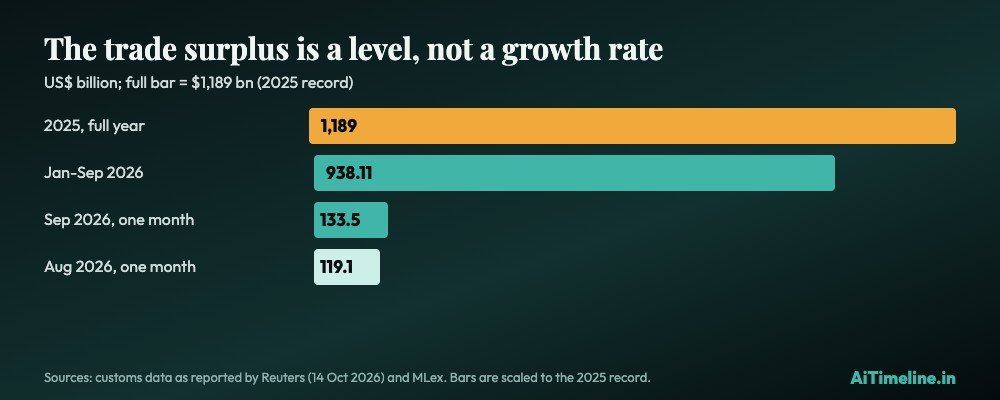
China’s exports are surging while household demand is weak. September 2026 exports rose 36.3% and the January–September surplus was $938.11 billion, close to the record $1.189 trillion for all of 2025. GDP grew 4.5% in the third quarter, but retail sales rose only 1.1% and fixed-asset investment fell 7.2%. The IMF says private domestic demand is lackluster. Households are not shrinking their spending, but it is growing far more slowly than production and exports.
Trade Surplus vs GDP Growth vs Retail Sales
Last updated: 26 October 2026. Three headline numbers that measure different things. None of them is “the economy”.
| Measure | What it counts | Latest figure | What it does not tell you |
|---|---|---|---|
| Trade surplus | Exports minus imports, in US dollars. A level, not a growth rate | $938.11 billion for Jan–Sep 2026; $133.53 billion in Sep 2026; record $1.189 trillion in 2025 | How fast the economy grows, or how much households spend |
| Export growth | Change in the dollar value of exports against the same month a year earlier | +36.3% in Sep 2026 (imports +31.0%) | The size of the surplus; one month only |
| GDP growth | Change in total output of goods and services, year on year | +4.5% in Q3 2026; +4.6% in Jan–Sep; +5.0% in 2025 | Who benefits, or whether the growth is balanced. Net exports are one component |
| Retail sales growth | Value of consumer goods sold, year on year, mostly before price adjustment | +1.1% in Sep 2026 and in Jan–Sep; +3.7% in 2025 (50.12 trillion yuan) | Services spending, which is reported separately (+5% in Jan–Sep 2026) |
| Household spending | Per-capita consumption expenditure from household surveys | +4.4% in 2025 to 29,476 yuan; income +5% nominal | Monthly trend; published once a year in this series |
| Investment | Fixed-asset investment and property development investment | Fixed assets −7.2% and property −20.6% in Jan–Sep 2026 | Which part is state, private or property-related |
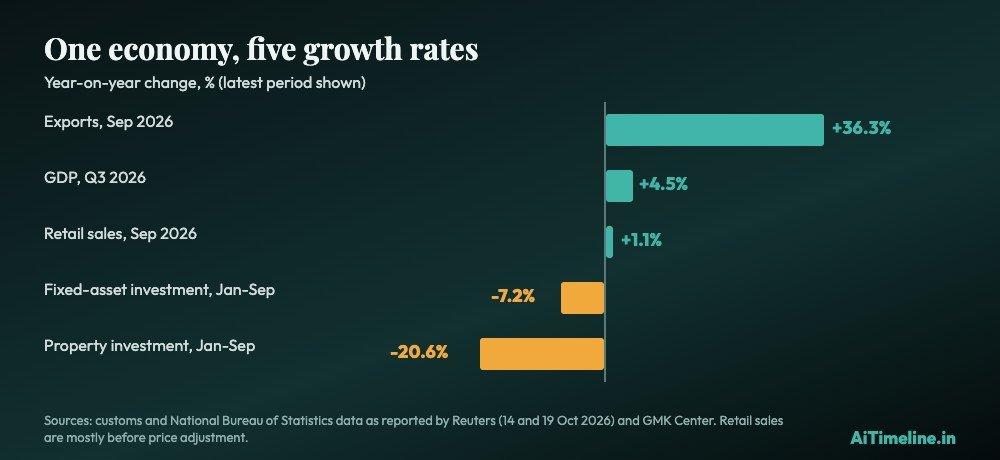
How to read them. The surplus is a level in dollars. Export growth is a percentage change in one month. GDP growth is a percentage change in total output, and net exports are only one part of it. Retail sales growth is a percentage change in goods sold, mostly before price adjustment, so it can look larger than real spending growth. A 36.3% export rise and a 1.1% retail rise are not contradictory, because they measure different parts of the economy.
| Indicator | Period | Figure | Release |
|---|---|---|---|
| Exports | Sep 2026, y/y | +36.3% (forecast 25.5%) | Customs, 14 Oct |
| Imports | Sep 2026, y/y | +31.0% | Customs, 14 Oct |
| Trade surplus | Jan–Sep 2026 | $938.11 billion | Customs, 14 Oct |
| GDP | Q3 2026, y/y | +4.5% (Q2: 4.3%) | NBS, 19 Oct |
| Retail sales of goods | Sep 2026, y/y | +1.1% (forecast 0.6%) | NBS, 19 Oct |
| Fixed-asset investment | Jan–Sep 2026, y/y | −7.2% | NBS, 19 Oct |
| Property investment | Jan–Sep 2026, y/y | −20.6% (5.34 trillion yuan) | NBS, via GMK Center |
| New-home prices | Sep 2026, 70 cities, y/y | −2.8% (Aug: −3.0%) | NBS, via Trading Economics |
China Exports and Consumers: Key Questions
China’s Export Boom in Ten Points
- Exports: up 36.3% year on year in September 2026; imports up 31.0%.
- Surplus: $938.11 billion for January to September, against a record $1.189 trillion for all of 2025.
- GDP: 4.5% growth in the third quarter and 4.6% for nine months, inside the 4.5% to 5.0% target.
- Retail sales: up 1.1% in September and for January to September; services retail up 5%.
- Investment: fixed-asset investment down 7.2% and property investment down 20.6% for nine months.
- Drivers: semiconductor exports up 108.1% and autos up more than 50% in nine months.
- Households: 2025 income up 5% nominal and consumption spending up 4.4%; steady, not strong.
- IMF: private domestic demand lackluster; saving at 42.1% of GDP.
- Pressure: the US and EU press China to rebalance, and the EU will limit hybrid-car exports.
- Open question: whether the 2025 surplus record falls depends on fourth-quarter data.
China’s Export Boom vs Consumer Struggle: Timeline, Latest First
Each entry is tagged and ends with why it matters. Sources are linked in each entry.
2026
Third-quarter GDP beats forecasts, but retail sales grow 1.1% and investment falls Consumers
China’s economy grew 4.5% year on year in the third quarter, up from 4.3% in the second and ahead of the roughly 4.4% forecast in a Reuters poll; quarter-on-quarter growth was 1.2%, and growth for the first nine months was 4.6%, inside the government’s 4.5% to 5.0% target (NBS release; US News/Reuters). Retail sales rose 1.1% in September from a year earlier, beating a 0.6% forecast, to 4,243.3 billion yuan, and also 1.1% over January to September (37,000.1 billion yuan), while retail sales of services grew 5.0%. Per-capita disposable income rose 5.3% in nominal terms and 4.4% in real terms. The NBS gives no price-adjusted retail figure; one economist quoted by Reuters said real retail sales barely grew.
Fixed-asset investment fell 7.2% in January to September (4.2% excluding property), and real-estate development investment fell 20.6%, to 5.34 trillion yuan according to GMK Center. Floor space of new homes sold fell 13.2% (NBS). New-home prices in 70 cities fell 2.8% year on year in September, the slowest drop since December 2025 (Trading Economics).
2026
September exports jump 36.3% and the nine-month surplus reaches $938 billion Exports
Customs data showed exports up 36.3% year on year in September, against a 25.5% forecast and 25.0% in August; imports rose 31.0%. The monthly surplus was $133.53 billion and the January to September surplus $938.11 billion, on course to pass last year’s record $1.189 trillion (Reuters via Yahoo Finance). Chinese state media, citing customs, put January–September exports at 23.2 trillion yuan, up 16.4% (China Daily). Over the nine months semiconductor exports rose 108.1% in value and auto exports rose by more than 50% in both value and volume.
September’s surplus was $34.01 billion with the United States, a 20-month high, and $34.8 billion with the European Union. Washington and Brussels blame Chinese industrial and monetary policy; China’s central bank rejects claims that it keeps the yuan weak. A deal announced earlier in October will limit Chinese hybrid-car exports to the EU, with details expected in December (BNN Bloomberg). Reuters and NBC do not call the $133.53 billion monthly figure a record; the “20-month high” in their reports refers to the surplus with the United States (NBC News). Some other outlets describe the monthly figure as a record, which AiTimeline could not confirm.
9 Oct 2026
Beijing cuts a policy-bank rate, subsidises mortgages and frees 550 billion yuan Policy
After a State Council executive meeting on 28 September called for stronger policy support, the People’s Bank of China on 29 September cut its one-year pledged supplementary lending (PSL) rate, a funding tool for policy banks, by 25 basis points to 1.5%. The same day the finance ministry, central bank and financial regulator announced the first central-government interest subsidy on commercial mortgages: 1 percentage point a year for up to five years on eligible new first-home loans of up to 1 million yuan, for homes of no more than 120 square metres and 1.5 million yuan, from 1 October on a one-year trial (Arbiterz; Caixin).
On 9 October the finance ministry released 550 billion yuan of unused local-government debt quota: 300 billion yuan of general debt for counties’ budgets and 250 billion yuan of special debt for fourth-quarter projects (China Daily). Benchmark lending rates were not cut. The measures target property and local budgets more than household incomes.
2026
IMF: private domestic demand is “lackluster” and consumption should lead IMF
The IMF said real GDP grew 5.0% in 2025, down from 5.4% in 2024. Total domestic demand grew 3.6%, and net exports added 1.6 percentage points to growth. It called private domestic demand lackluster, warned of a possible deeper contraction in property, and named a shift to consumption-led growth its overarching priority (IMF press release). Gross national saving was 42.1% of GDP and household debt 59.4%.
In a companion article the Fund projected 4.5% growth for 2026 and said its recommended package could raise the consumption-to-GDP ratio by about four percentage points over five years. It urged stronger social protection to reduce precautionary saving (IMF).
2026
Official 2025 data: retail sales up 3.7%, investment and property down Consumers
Retail sales of consumer goods reached 50.12 trillion yuan in 2025, up 3.7%. Fixed-asset investment (excluding rural households) fell 3.8% to 48.52 trillion yuan and real-estate development investment fell 17.2% (MLex; NBS release). The same reports record a trade surplus of about $1.189 trillion, the record that 2026 is chasing.
Household figures were steadier: per-capita disposable income rose 5% in nominal terms to 43,377 yuan, and per-capita consumption spending rose 4.4% to 29,476 yuan (Chinese government). Spending did not collapse; it grew more slowly than output.
2025
Evergrande is delisted in Hong Kong Property
Hong Kong’s exchange cancelled China Evergrande’s listing on 25 August 2025 after its shares had been suspended for 18 consecutive months, the point at which exchange rules call for delisting (Global Finance). By mid-August liquidators had recovered almost HK$2 billion and creditors had filed claims of about HK$350 billion (Reuters timeline).
Trade-in subsidies lift sales of cars and appliances Policy
Official figures said more than 37 million consumers bought over 62 million eligible home appliances under the 2024 trade-in programmes, with sales of 270 billion yuan, and more than 6.8 million vehicles were traded in, with sales of about 920 billion yuan (Chinese government). The figures are minimums (“over”), not exact totals.
Subsidies shift purchases forward in the categories they cover. They do not by themselves show that household confidence has recovered.
2024
Hong Kong court orders Evergrande wound up Property
Hong Kong’s High Court ordered Evergrande liquidated after it failed to present a workable restructuring plan, and its shares were suspended the same day (Global Finance). The ruling showed how hard it was to resolve the property sector’s debts, which touch households that paid for unfinished flats, builders, and local-government land revenue.
Reopening restores activity but not a lasting consumer boom Consumers
China ended its zero-COVID controls in late 2022, and many forecasters expected pent-up demand to drive a strong rebound. Services spending recovered, but the property slump and income worries kept households cautious. The IMF’s later assessments describe private domestic demand as weak while exports held up.
2022
Shanghai lockdown disrupts factories, ports and shops Consumers
A prolonged lockdown in Shanghai, home to China’s busiest container port, interrupted production, logistics and retail activity (Wikipedia). The shock overlapped with the property downturn, so uncertainty about jobs and income deepened at the same time.
Evergrande misses payments; the property model is exposed Property
In August 2020 regulators met 12 large developers, Evergrande among them, and piloted caps on three debt ratios, the “three red lines”. In September 2021 a deadline of 23 September for $83.5 million of dollar-bond interest passed without payment to bondholders, according to two sources, and Fitch and Moody’s cut Evergrande deep into junk (Euronews). Tighter credit exposed business models that relied on continued sales and cheap financing.
Pandemic year: exports rise while the world buys goods Exports
Customs data showed goods exports rose 3.6% in 2020 while imports fell 1.1%, giving a surplus of about $535 billion; the customs spokesman said China was the only major economy with positive goods-trade growth that year (Caixin). Exports fell 13.4% in the first quarter before recovering. Sources differ on how that surplus ranks historically, so no “record” is claimed here.
2020
US–China “Phase One” deal pauses part of the tariff fight Background
The two governments signed a Phase One agreement on 15 January 2020. China committed to buy $200 billion of additional US goods and services over two years (Wikipedia). It left most tariffs in place and did not end the strategic rivalry.
2018
The US–China trade war begins Background
A 25% US tariff on about $34 billion of Chinese goods (818 product lines) took effect on 6 July 2018 (USTR), and China answered with tariffs of its own; the dispute widened into technology, industrial policy and supply chains (Wikipedia). Some firms diversified production, and Chinese exporters looked for new markets.
2001
China joins the World Trade Organization Background
China became a WTO member on 11 December 2001 (WTO). Membership deepened access to overseas markets and supported export-oriented manufacturing, helped by foreign investment, industrial clusters and a large workforce.
Reform and opening begins Background
China began its reform and opening-up programme in late 1978 (Wikipedia). Over the following decades foreign investment, export zones and infrastructure made manufacturing a main source of jobs, investment and export earnings, while the balance between investment, exports and household consumption remained a policy question.
Why Can Exports Boom While Consumers Hold Back?
Five forces, with the evidence for each.
| Cause | How it works | Evidence on the record |
|---|---|---|
| Property downturn | Housing is a main store of household wealth; falling prices and unfinished homes make families cautious | Property investment −20.6% in Jan–Sep 2026; Evergrande liquidated 2024 and delisted 2025 |
| Precautionary saving | Worry about jobs, health, pensions and education leads households to save more of any extra income | IMF: gross national saving 42.1% of GDP in 2025; recommends stronger social protection |
| Capacity ahead of demand | Investment in cars, chips and machinery raises output faster than home buyers can absorb it, so firms sell abroad | Semiconductor exports +108.1% and autos +50% in the first nine months of 2026 (Reuters) |
| Different drivers | Exports follow overseas demand, competitiveness and the global technology cycle, not household mood | Exports +36.3% while retail sales +1.1% in the same month |
| Uneven gains | Strong output and trade figures can coexist with slow wage growth or housing losses for many households | Per-capita income +5% nominal in 2025, but retail sales only +3.7% |
The forces reinforce each other. Weak household demand pushes manufacturers to seek overseas customers, while an export-led recovery does not by itself change why households are reluctant to spend. This is not a story in which every Chinese consumer struggles: incomes and retail sales have grown. The point is that production and exports have been more resilient than consumption and investment.
What Is Beijing Doing to Rebalance the Economy?
Measures on the record and their status.
| Measure | What it does | Status |
|---|---|---|
| Consumer trade-in subsidies | Pays households to replace old cars and appliances | 2024: over 62 million appliances and over 6.8 million vehicles (official) |
| PSL rate cut and mortgage interest subsidy | Policy-bank rate cut 25 bp to 1.5%; 1-point subsidy on eligible first-home mortgages for up to five years | Announced 29 Sep 2026; subsidy from 1 Oct, one-year trial |
| Local-government debt quotas | 550 billion yuan of unused quota: 300 billion for county budgets, 250 billion for projects | Announced by the finance ministry on 9 Oct 2026 |
| Social protection and hukou reform | IMF-recommended steps to cut precautionary saving | Recommendation, not enacted policy in the sources read |
| Advanced manufacturing support | Continued investment in strategic industries | Ongoing; part of why output outruns domestic demand |
The IMF argues that support for consumption has been modest relative to the challenge, and that lasting rebalancing needs stronger social protection and household confidence. The policy dilemma is that the manufacturing strategy has created real competitive strengths. Shifting resources toward households may improve balance over time, but it changes how income, public spending and investment are distributed.
What China’s Export Boom Means for the Rest of the World
Benefits and risks, kept apart.
| Effect | For whom | What the record shows |
|---|---|---|
| Cheaper goods and technology | Consumers and firms abroad | Batteries, cars and solar equipment can lower costs and support the energy transition (general effect; not measured here) |
| Rising bilateral surpluses | United States and EU | September 2026 surplus: $34.01 billion with the US (20-month high), $34.8 billion with the EU |
| Trade restrictions | Chinese carmakers | EU deal to limit Chinese hybrid-car exports, details expected in December |
| Pressure to rebalance | Beijing | Washington and Brussels blame industrial and monetary policy; China rejects yuan claims |
| Further EU action | Exporters | Capital Economics warned a wider EU surplus could prompt broader restrictions |
Competitive Chinese goods can lower costs for buyers abroad, but a persistent surplus raises political pressure in countries worried about their own factories and jobs. Governments can respond with tariffs, investigations, subsidies or restrictions. The question is not only whether China exports too much, but whether global demand can absorb its output and whether China can draw more growth from its own households.
What Is Settled and What Is Open, as of 26 October 2026
Kept apart from the timeline because data, claims and forecasts are different kinds of evidence.
| Question | Position of the sources | Status |
|---|---|---|
| September 2026 exports +36.3% and imports +31.0% | Reuters, BNN Bloomberg and other outlets agree | Settled |
| Surplus of $938.11 billion for Jan–Sep 2026 | Reported consistently | Settled |
| Q3 2026 GDP +4.5%, September retail sales +1.1% | NBS release (government mirror) and Reuters agree | Settled |
| Whether 2026 will pass the 2025 record surplus | Depends on Q4 customs data | Open |
| Whether $133.5 billion was a monthly record | Reuters and NBC do not call it one (their 20-month high is the US bilateral surplus); some outlets do | Not confirmed |
| Whether the yuan is kept weak to help exports | US and EU blame policy; the central bank denies it | Contested |
| Real (price-adjusted) retail growth | The NBS publishes no real retail figure; one economist says it barely grew | No official figure |
| Sep–Oct 2026 support measures | PSL cut, mortgage subsidy and 550 billion yuan quota reported by China Daily, Caixin and others | Settled |
The Story at a Glance
Oldest first.
| Date | Event | Type |
|---|---|---|
| Dec 1978 | Reform and opening begins | Background |
| 11 Dec 2001 | China joins the World Trade Organization | Background |
| 6 Jul 2018 | The US–China trade war begins | Background |
| 15 Jan 2020 | US–China “Phase One” deal pauses part of the tariff fight | Background |
| 2020 | Pandemic year: exports rise while the world buys goods | Exports |
| Sep 2021 | Evergrande misses payments; the property model is exposed | Property |
| Spring 2022 | Shanghai lockdown disrupts factories, ports and shops | Consumers |
| 2023 | Reopening restores activity but not a lasting consumer boom | Consumers |
| 29 Jan 2024 | Hong Kong court orders Evergrande wound up | Property |
| 2024 | Trade-in subsidies lift sales of cars and appliances | Policy |
| 25 Aug 2025 | Evergrande is delisted in Hong Kong | Property |
| 19–20 Jan 2026 | Official 2025 data: retail sales up 3.7%, investment and property down | Consumers |
| 18 Feb 2026 | IMF: private domestic demand is “lackluster” and consumption should lead | IMF |
| 28 Sep– 9 Oct 2026 | Beijing cuts a policy-bank rate, subsidises mortgages and frees 550 billion yuan | Policy |
| 14 Oct 2026 | September exports jump 36.3% and the nine-month surplus reaches $938 billion | Exports |
| 19 Oct 2026 | Third-quarter GDP beats forecasts, but retail sales grow 1.1% and investment falls | Consumers |
| Term | Meaning | Why it matters here |
|---|---|---|
| Year on year (y/y) | Change compared with the same period a year earlier | All headline growth rates here use it |
| Trade surplus | Exports minus imports | A level in dollars, not a growth rate |
| Net exports | Exports minus imports as a component of GDP | Added 1.6 points to growth in 2025 (IMF) |
| Retail sales of consumer goods | Value of goods sold to consumers | The main monthly consumption gauge; services are separate |
| Fixed-asset investment | Spending on factories, infrastructure and property | Fell 7.2% in Jan–Sep 2026 |
| Precautionary saving | Saving against uncertainty about future income or costs | The IMF links it to thin social protection |
| Hukou | Household registration that affects access to urban services | Reform could raise consumption, per the IMF |
Who Is Who
General Administration of Customs
Publishes monthly trade data, including exports, imports and the surplus.
National Bureau of Statistics
Publishes GDP, retail sales, investment, property and home-price data.
International Monetary Fund
Annual Article IV assessment; urges a shift to consumption-led growth.
Beijing and the central bank
Set stimulus, property and exchange-rate policy; reject claims of a deliberately weak yuan.
United States and European Union
Run large bilateral deficits with China and press it to rebalance.
Property developers
Evergrande and others whose debts reshaped household confidence and local finances.
Common Claims vs the Record
| Common claim | What the record shows |
|---|---|
| A bigger trade surplus means faster GDP growth | The surplus is a level in dollars. GDP growth in Q3 2026 was 4.5% against exports up 36.3% |
| Chinese consumers have stopped spending | Retail sales still grew 3.7% in 2025 and 1.1% in September 2026; the problem is slow growth, not collapse |
| Exports boom because Chinese people do not buy | Both are partly true, but exports also reflect competitiveness and global demand |
| The property crisis is only about Evergrande | Evergrande is a symbol; property investment fell 17.2% in 2025 and 20.6% in Jan–Sep 2026 across the sector |
| Subsidies have fixed domestic demand | Trade-in programmes lifted specific goods; retail sales growth remained near 1% in 2026 |
| Retail sales growth is the same as household spending | Retail sales count goods; services and per-capita surveys are separate series |
🔄 How This Page Is Updated
AiTimeline updates this page after each monthly customs release (exports, imports, surplus), each National Bureau of Statistics release of retail sales, investment, property and home-price data, and each quarterly GDP report. Latest update: 26 October 2026, covering customs data of 14 October and NBS data of 19 October 2026.
Explore More Timelines
People Also Ask
Frequently Asked Questions
The Next Test Is Domestic Demand
China’s export boom shows the strength of its manufacturing base and its ability to compete in advanced industries. It does not, by itself, deliver a balanced recovery at home. The 2026 data make the gap clear: exports up 36.3% and a near-trillion-dollar surplus beside retail sales up 1.1% and falling property investment. The next phase of the story depends less on how much the factories can produce and more on how confidently households are willing to spend.
Related AiTimeline Stories
⚠️ Editorial Note
Last updated 26 October 2026. The source brief was corrected and extended. It omitted the third-quarter data of 19 October 2026 (GDP +4.5%, September retail sales +1.1%, fixed-asset investment −7.2%, property investment −20.6%, new-home prices −2.8%), which are the figures needed to compare exports with domestic demand. It titled a question “trade surplus in 2026” when the figure is January to September only. It labelled a link “Reuters — Evergrande crisis timeline” that is a Euronews page, and used the same 2025 Reuters timeline for the January 2024 liquidation, which AiTimeline instead sourced to Global Finance. Its claim that the pandemic accelerated online shopping was unsourced and was replaced by customs data for 2020. Verification on 26 October 2026: the third-quarter figures were checked against the National Bureau of Statistics release on the Chinese government’s English site; the 2025 retail total against the NBS annual release; the 6 July 2018 tariff date against the USTR notice; and the September–October support measures against China Daily, Caixin and other reports. Reuters and AP pages could not be opened directly, so the customs dollar figures rely on Reuters copy republished by Yahoo Finance and on NBC News, BNN Bloomberg and CNBC, which agree; the customs release itself was not read. The South China Morning Post trade-war timeline was not read. This page reports data and does not give investment advice. No photographs are used.
Sources & further reading
Every dated entry above was checked against these references. Last reviewed 26 October 2026.
- Reuters via Yahoo Finance: China's September exports surge 36.3%, October 2026
- BNN Bloomberg: China's trade surplus nears record as pressure mounts, October 2026
- National Bureau of Statistics (via gov.cn): Economy in the first three quarters of 2026, 19 October 2026
- GMK Center: Investment in Chinese property fell 20.6% in nine months, October 2026
- IMF: China 2025 Article IV consultation, February 2026
- IMF: How China's economy can pivot to consumption-led growth, February 2026
- MLex: China's GDP grows 5% in 2025 as trade surplus hits record, January 2026
- Chinese government: Consumer goods trade-in programme results, February 2025
- Global Finance: Evergrande delisted from Hong Kong bourse, August 2025
- China Daily: China taps 550b yuan in unused debt quotas, October 2026