Venezuela’s Economic Collapse: Policies & Impact Timeline
Venezuela's economic collapse timeline: oil boom to hyperinflation, sanctions, mass migration and the 2026 Maduro capture. Causes and impact explained.
Latest Story
The Venezuela economic collapse timeline begins with a country holding some of the world’s largest proven oil reserves. Oil supplied most of its foreign currency and government revenue, and about 95% of its exports. When prices fell in 2014, an economy with controls, thin buffers and falling investment went into one of the deepest peacetime contractions on record, followed by hyperinflation from 2016, default in 2017 and mass emigration. US sanctions in 2017 and 2019 deepened the crisis but did not start it. In January 2026 US forces captured Nicolás Maduro, and the interim government has since won conditional sanctions relief while debt, inflation and politics remain unresolved. For parallel stories see AiTimeline’s Lebanon financial collapse and Argentina debt defaults.
💡 Short Answer
Venezuela’s economy collapsed because it depended on oil while running controls, deficits and weak investment, and the 2014 price fall exposed all three. Hyperinflation began in November 2016, default followed in 2017, and US sanctions on finance (2017) and PDVSA (2019) came after the decline had started. About 7 million Venezuelans have left. Recovery since 2026 is conditional and fragile.
Venezuela’s Collapse: Key Questions
The Collapse in Ten Points
- The base: oil was about 95% of exports.
- The trigger: oil prices fell in the second half of 2014 and GDP shrank 3.0% that year.
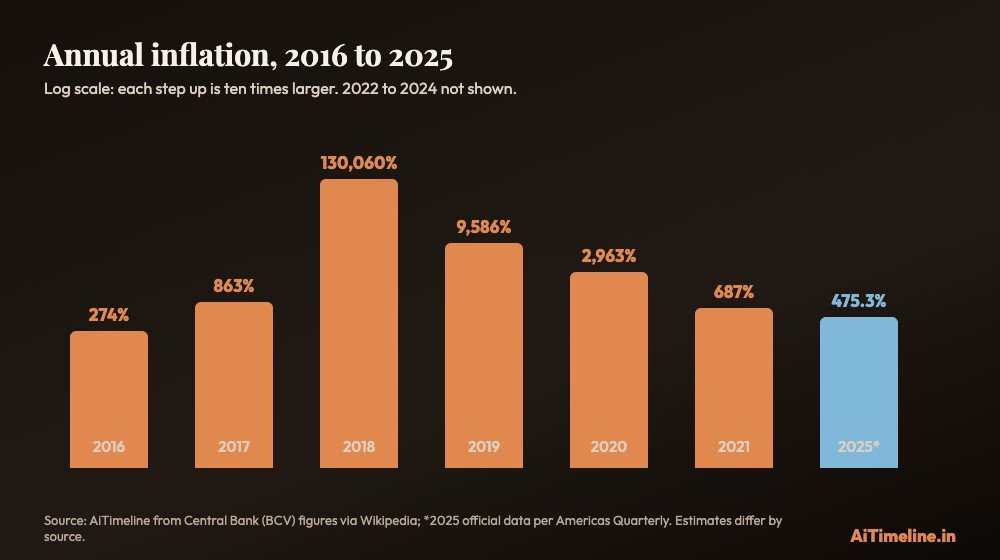
- The money: hyperinflation is dated to November 2016; 2018 inflation was 130,060% on Central Bank data.
- The default: declared in mid-November 2017.
- The sanctions: financial in August 2017, PDVSA in January 2019.
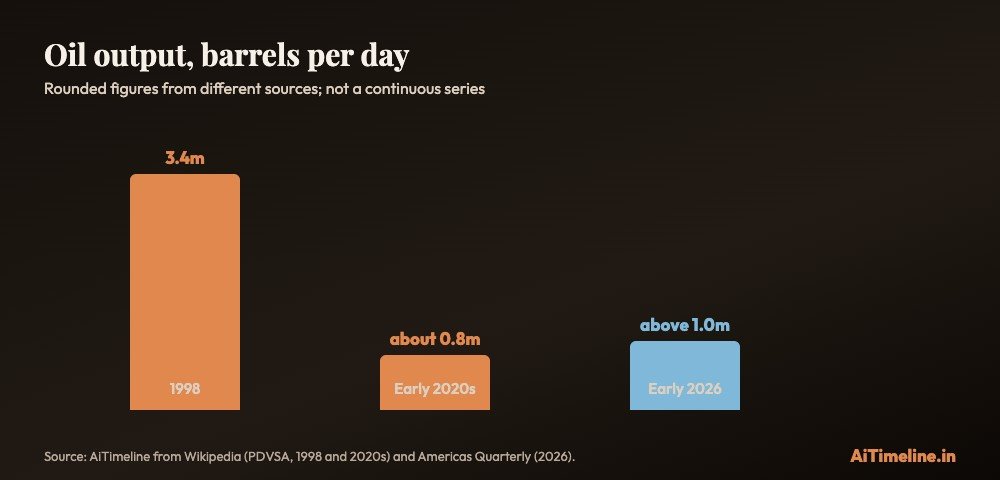
- The output: about 3.4 million barrels a day in 1998, about 0.8 million in the early 2020s.
- The exodus: 6,978,009 refugees and migrants in Latin America and the Caribbean by August 2026.
- The turn: Maduro captured 3 January 2026; Rodríguez interim president from 5 January.
- The relief: GL 46 on 29 January 2026, with conditions.
- The caution: statistics differ widely; always check the source and year.
Venezuela Economic Collapse Timeline, Latest First
Each entry is tagged by thread and ends with why it matters. Use the filter to isolate policy, oil, crisis, sanctions or transition.
Policy, oil, crisis, sanctions or transition? Filter the timeline by thread.
–
Rodríguez promises elections at the UN, but names no date Transition
Interim President Delcy Rodríguez told the UN General Assembly that Venezuela would hold elections as part of a transition to “full democracy” but gave no date (Al Jazeera). Reports say she did not endorse the 2027 timeline the opposition wants. The same week she and President Trump discussed restructuring Venezuela’s sovereign debt, according to Secretary of State Marco Rubio.
No election date, restructuring deal or IMF programme had been announced when this page was last updated.
A reported plan for the largest debt restructuring on record Sanctions and debt
Euronews, citing the Financial Times, reported that the interim government would acknowledge debt of close to $240 billion, against $150–200 billion that markets had assumed, with US bank Centerview Partners advising (Euronews). The total reportedly includes about $60 billion of government and PDVSA bonds, about $40 billion of interest since default, amounts owed to oil companies and suppliers, Chávez-era expropriation claims and loans from China and Russia. The aim is a creditor deal by the end of 2026, though few expect it.
The report puts the economy at about $100 billion, against $370 billion in 2012, and says the IMF resumed ties in April after a seven-year freeze. These are press-reported figures; an IMF estimate of public debt near 180% of GDP, cited in January, could not be verified or reconciled with them.
US licences ease oil sanctions as Venezuela rewrites its hydrocarbons law Sanctions and debt
OFAC issued General License 46 on 29 January 2026, authorising certain dealings in Venezuelan-origin oil by firms established in the US on or before 29 January 2025; it was released the day the National Assembly unanimously approved reforms to the Hydrocarbons Law (Morgan Lewis; Holland & Knight). Further licences in February covered US diluents (GL 47, 3 Feb), supplies and services (GL 48) and ports and airports (GL 30B), and GL 49 (13 Feb) allowed contingent contracts for new oil and gas investment. The licences do not by themselves allow production, and the US retained control over funds payable to the Venezuelan government. Americas Quarterly says the new law cuts royalties from 33% to as low as 15% (Americas Quarterly).
Maduro is captured by US forces and Delcy Rodríguez takes over Transition
The UK House of Commons Library describes Nicolás Maduro’s capture by US forces in January 2026 (House of Commons Library). News reports date the overnight operation to 3 January; the Supreme Court told Vice President Delcy Rodríguez to assume the presidency and the National Assembly swore her in as interim president on 5 January. Maduro was taken to New York to face US drug-trafficking charges.
The Commons briefing says relations with the United States shifted afterwards. AiTimeline could not open the briefing itself (the site blocks automated access) and relies on it for the fact of the capture only.
Oil sanctions tighten again and inflation surges Sanctions and debt
The Bertelsmann BTI 2026 report links the reintroduction of US oil sanctions in early 2025 to a marked resurgence in inflation. Americas Quarterly, citing official data, says prices rose 475.3% in 2025 (Americas Quarterly). The Rio Times reports an IMF projection of about 468% average inflation for 2026, a figure AiTimeline treats as a projection from a secondary source (Rio Times).
Inflation figures differ widely by source: official data, IMF projections and private estimates are not interchangeable.
A disputed election adds political risk to the economy Transition
Venezuela’s National Electoral Council declared Maduro the winner of the 28 July 2024 presidential election, with about 51% against 44% for Edmundo González (AP via News4JAX). The opposition said it had collected tally sheets from most voting machines showing González far ahead; the council did not release machine-level tallies, and the opposition figures were not verified by the council.
Foreign governments and observers questioned the result. The dispute fed the uncertainty facing investors, creditors and sanctions policy.
–24
Sanctions relief is granted, then withdrawn Sanctions and debt
In October 2023 the US eased restrictions on Venezuela’s oil and gas sector under General License 44 after an agreement on electoral conditions (EIA). On 17 April 2024 the State Department said the licence would not be renewed because Maduro’s side had not fully met its commitments; OFAC issued a wind-down licence, GL 44A, to 31 May 2024 (Baker McKenzie).
Years of underinvestment limited how fast output could rise even while the licence ran.
Chevron is allowed to resume limited oil operations Sanctions and debt
OFAC issued General License 41 on 26 November 2022, letting Chevron run its Venezuelan joint ventures on a limited basis after the Maduro government and the opposition Unitary Platform resumed negotiations (Baker McKenzie). It did not lift sanctions generally, did not allow expansion beyond the position of 28 January 2019 and kept PDVSA from receiving profits from Chevron’s oil sales.
Reviving a run-down industry needs maintenance, workers and investment as well as a licence.
COVID-19 hits an economy with little resilience left Crisis
The pandemic arrived after years of contraction and hyperinflation. Central Bank data put 2020 inflation at 2,963% (Wikipedia). Lockdowns and the global fall in oil demand added to the pressure on households and on foreign-currency income, which was already scarce.
AiTimeline has not found a reliable Venezuela-specific output or income figure for 2020, so this entry makes no further numerical claim.
–22
Dollars take over everyday trade and inflation slows from its peak Crisis
An Econalítica survey found about 54% of transactions in September 2019 were in US dollars, rising to 86% in Maracaibo (Wikipedia). Annual inflation fell from 9,586% in 2019 to 2,963% in 2020 and 687% in 2021 on Central Bank (BCV) figures, with other sources giving different totals. In March 2021 the government issued notes of up to 1,000,000 bolívares.
Slower inflation is not lower prices: it means prices rise more slowly, not that earlier increases were reversed.
The US sanctions PDVSA Sanctions and debt
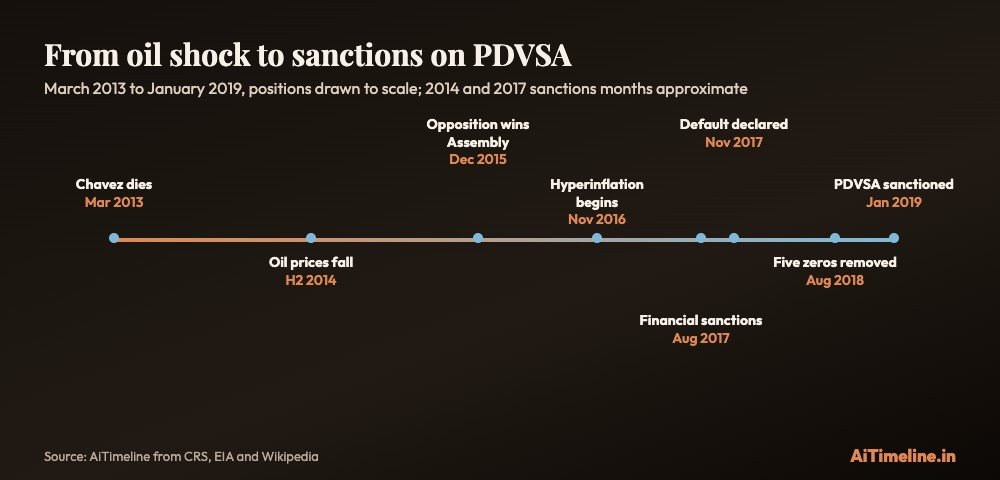
In January 2019 the United States imposed sanctions on Petróleos de Venezuela (PDVSA), sharply limiting its access to US markets and complicating oil sales, payments and financing (EIA). Wikipedia dates the earlier financial sanctions that restricted PDVSA’s access to credit markets to August 2017 (Wikipedia).
The measures came after years of contraction, falling oil output and hyperinflation. Oil sanctions deepened a collapse that was already under way; they did not start it.
Hyperinflation wipes out the bolívar and five zeros are removed Crisis
The bolívar soberano launched on 20 August 2018 at 1 to 100,000 old bolívares, removing five zeros (Wikipedia). The Central Bank reported 130,060% inflation for 2018, while the opposition-led National Assembly estimated about 1.7 million percent; its monthly series peaks at 233% in September 2018.
Redenomination makes numbers shorter, not money more valuable. The range of estimates is itself a sign of how little reliable data existed.
Venezuela and PDVSA fall into default Sanctions and debt
Credit rating agencies declared Venezuela in default in mid-November 2017, with Standard & Poor’s calling it “selective default” (Wikipedia). Financial sanctions on new debt had been imposed that August (Wikipedia). On BCV figures inflation was 863% in 2017.
Default shut the country out of capital markets, which made imports and oil-field maintenance harder to finance.
Hyperinflation begins and shortages become a humanitarian emergency Crisis
Wikipedia dates the start of hyperinflation to November 2016, when monthly inflation had exceeded 50% for 30 days by December (Wikipedia). The Congressional Research Service describes shortages and falling imports that hit food, medicine and public services (CRS).
Reliable official statistics became harder to obtain, so figures for this period carry wide error bars.
The opposition wins control of the National Assembly Crisis
Opposition parties won control of the National Assembly in the December 2015 legislative election, reflecting frustration over shortages, inflation and the wider economy (CRS). The result sharpened the conflict between the government and the opposition-led legislature.
Oil prices fall and the economy enters recession Oil
World oil prices fell sharply in the second half of 2014. Venezuela entered recession, with GDP down 3.0% that year, and petroleum products made up about 95% of exports (Wikipedia). Controls, fiscal pressure and an oil industry short of investment left little room to adjust (CRS).
The oil-price fall was the immediate trigger, but the damage was amplified by choices made during the boom.
Chávez dies and Maduro is elected Policy
Hugo Chávez died in March 2013 and his chosen successor, Nicolás Maduro, won the presidential election the following month (Wikipedia). Inflation, currency distortions and supply problems were already building.
–12
Oil money funds social programmes, but dependence deepens Policy
High oil prices financed social programmes and subsidies that cut poverty in parts of the 2000s and early 2010s. Currency and price controls, expropriations and borrowing meanwhile left the economy dependent on petroleum earnings (CRS).
–09
Nationalisations widen the state’s role as oil peaks at $147 Policy
The Chávez government expanded state ownership in energy and parts of telecommunications, electricity and heavy industry. Oil prices peaked at $147 a barrel in 2008 (Wikipedia). Critics said expropriations and uncertain property rights weakened investment.
Nationalisation does not by itself cause collapse. The outcome depends on management, reinvestment and whether the wider economy stays productive.
Currency controls restrict access to dollars Policy
Venezuela suspended foreign-exchange trading on 23 January 2003 and created the currency control board CADIVI on 6 February, setting the rate at about 1,600 bolívares per dollar (Wikipedia). Access to dollars came to depend on official allocations.
The gap between official and parallel rates later opened room for arbitrage and corruption and left firms short of imported inputs.
The oil strike halts production and PDVSA is purged Oil
A general strike in December 2002 virtually halted oil production for about two months, and nearly 19,000 PDVSA employees were dismissed afterwards (Wikipedia; Wikipedia).
Losing so much expertise and management shaped the company’s later performance.
Hugo Chávez takes office Policy
Chávez became president in February 1999, introduced a new constitution and put oil revenue at the centre of social programmes (Wikipedia). PDVSA was producing about 3.4 million barrels a day in 1998 (Wikipedia).
The later collapse cannot be pinned on one administration; it also reflects long-standing oil dependence.
The Caracazo exposes deep discontent Crisis
After President Carlos Andrés Pérez launched an IMF-recommended package, gasoline prices roughly doubled on 25–26 February and transport fares rose about 30%, setting off riots on 27 February (Wikipedia). The official toll was 277 dead; independent estimates range from 2,000 to 5,000.
The unrest came a decade before Chávez, showing the fragility predated his rule.
“Black Friday” ends the stable bolívar Policy
In February 1983 the government devalued the bolívar from 4.3 to 7.5 per dollar, kept a fixed rate and added capital controls and multiple rates (Monetary and Fiscal History of Latin America). The episode is known as Viernes Negro.
The source gives only the month; the 18 February date is the commonly cited one.
Venezuela nationalises its oil industry Oil
The oil industry was nationalised effective 1 January 1976 and PDVSA became the state operator (Wikipedia). State ownership was not in itself the later cause of collapse; management, investment and diversification mattered more (Monetary and Fiscal History of Latin America).
–74
The oil boom builds wealth and dependence Oil
Oil prices rose sharply after the October 1973 embargo, giving exporters such as Venezuela higher revenue and a larger role for oil in public finance. The 1976 nationalisation followed.
A boom can hide weak spots in other sectors when one commodity dominates exports.
The Main Policies Behind the Collapse
Aim, reported effect and how strong the evidence is.
| Policy | Intended aim | Reported effect | Strength of evidence |
|---|---|---|---|
| Oil dependence | Fund the state and social spending from petroleum | About 95% of exports were petroleum products, so revenue and the economy tracked oil prices | Strong (Wikipedia, CRS, EIA) |
| Price controls | Keep essentials affordable | CRS links controls to market distortions and shortages; they were not the only cause | Moderate |
| Currency controls (CADIVI, from Feb 2003) | Protect reserves and stabilise the economy | Gap between official and parallel rates; arbitrage, corruption and import problems | Strong |
| Money creation to cover deficits | Finance spending as revenue fell | Contributed to the inflation spiral from 2016 | Moderate to strong |
| Weak investment in PDVSA | Maintain output | Output fell from about 3.4 million barrels a day (1998) to about 0.8 million in the early 2020s | Strong on output; causes debated |
| Financial and oil sanctions (2017, 2019) | Pressure the government | Restricted financing, sales and payments; effects varied by measure and period | Strong on restrictions; size of effect debated |
Oil dependence is the base layer. Revenue, foreign currency and government spending moved with a single price. The Congressional Research Service describes high oil prices masking structural weaknesses during the 2000s (CRS).
Controls distorted incentives. Price ceilings were meant to keep essentials affordable; when they failed to cover costs some producers cut supply or left. Currency controls rationed dollars, and the gap between official and parallel rates invited arbitrage and corruption. Controls were not the only cause of shortages, but they contributed.
Deficits met with money creation. As revenue fell and borrowing became harder, the government relied increasingly on monetary financing, which fed the inflation spiral.
Investment collapsed. Weak maintenance, management problems and the wider crisis cut oil output, which reduced the revenue needed to repair infrastructure and fund imports. See also AiTimeline’s OPEC timeline for how oil prices move.
Before and After Sanctions: Separating the Causes
Venezuela’s collapse had several interacting causes; neither sanctions nor domestic policy explains it alone.
| Period | What was happening | Role of sanctions |
|---|---|---|
| 1973 to 2013 | Oil boom and nationalisation; bust; Caracazo; controls; oil peaks at $147 in 2008 | None |
| 2014 to mid-2017 | Oil price fall, recession, shortages, hyperinflation begins in Nov 2016 | None; no broad sanctions yet |
| Aug 2017 to Dec 2018 | Financial sanctions, default, 2018 hyperinflation peak | Limited new financing; added to existing constraints |
| Jan 2019 onward | PDVSA sanctioned; output already low; dollarisation spreads | Tightened sales, payments and financing in an economy already in severe decline |
| Nov 2022 to 2025 | Chevron licence, GL 44 granted then not renewed, disputed 2024 election, sanctions tighten in 2025 | Easing and tightening moved oil exports and inflation |
| 2026 | Maduro captured; new licences; debt plan reported | Conditional easing tied to reforms |
Domestic mismanagement and oil dependence predate the broadest US oil sanctions. Sanctions then intensified financing and production constraints, and the return of oil sanctions in 2025 coincided with a new surge in inflation. See AiTimeline’s US secondary sanctions timeline for how such measures work.
The Inflation Numbers, and Why They Differ
Estimates are not interchangeable; the source and year matter.
| Year | Annual inflation | Source and caution |
|---|---|---|
| 2016 | 274% | Central Bank (BCV) per Wikipedia; IMF 254% |
| 2017 | 863% | BCV; IMF 438%; National Assembly 2,616% |
| 2018 | 130,060% | BCV; National Assembly about 1.7 million percent |
| 2019 | 9,586% | BCV; IMF 19,910% |
| 2020 | 2,963% | BCV; IMF 2,360% |
| 2021 | 687% | BCV; IMF 1,590% |
| 2025 | 475.3% | Official data per Americas Quarterly |
| 2026 | About 468% average (projection) | IMF projection via Rio Times; treat as an estimate |
For 2018 alone, Wikipedia’s table lists 130,060% from the Central Bank, a lower IMF figure and about 1.7 million percent from the National Assembly. A drop in annual inflation does not mean prices fell. Compare this with the Turkish lira crisis and AiTimeline’s global inflation timeline.
How the Crisis Affected Ordinary Venezuelans
What the sources report, with cautions.
| Area | What the sources report | Caution |
|---|---|---|
| Purchasing power | Hyperinflation eroded wages and savings; Central Bank data show triple- to six-figure annual inflation in 2016–2020 | Series differ by source |
| Food and medicine | Falling imports and shortages cut access to essentials (CRS) | Official statistics were limited |
| Healthcare | Hospitals faced shortages of supplies and equipment (CRS) | Figures vary by period |
| Migration | R4V counted 6,978,009 refugees and migrants in Latin America and the Caribbean, August 2026 | Likely an undercount; excludes other regions |
| Public services | Electricity, water and other services suffered from weak maintenance and investment | Qualitative |
| Inequality | Households with dollars or remittances had different options from those on bolívar wages | Qualitative |
R4V, the UN refugee agency and IOM platform, counted 6,978,009 Venezuelan refugees and migrants across 17 countries in Latin America and the Caribbean as of August 2026, and says the true number is likely higher because some governments do not count Venezuelans without regular status (R4V). The totals change with each update.
The Story at a Glance
Dates from the sources listed below.
| Date | Event | Detail |
|---|---|---|
| Oct 1973 | Oil embargo | Prices surge |
| 1 Jan 1976 | Oil nationalised | PDVSA takes over |
| Feb 1983 | Black Friday | 4.3 to 7.5 bolívares per dollar |
| 27 Feb 1989 | Caracazo | Riots; 277 official deaths |
| 2 Feb 1999 | Chávez takes office | |
| Dec 2002 | Oil strike | Nearly 19,000 dismissed |
| Feb 2003 | Currency controls | CADIVI created 6 Feb |
| 2008 | Oil peaks | $147 a barrel |
| Mar to Apr 2013 | Chávez dies; Maduro elected | |
| H2 2014 | Oil price fall | GDP −3.0% in 2014 |
| Nov 2016 | Hyperinflation begins | |
| Nov 2017 | Default declared | After Aug 2017 sanctions |
| 20 Aug 2018 | New bolívar | Five zeros removed |
| 28 Jan 2019 | PDVSA sanctioned | |
| 2020 | COVID-19 | Inflation 2,963% (BCV) |
| 26 Nov 2022 | Chevron GL 41 | Limited operations |
| 18 Oct 2023 | GL 44 | Not renewed Apr 2024 |
| 28 Jul 2024 | Disputed election | CNE: Maduro 51% |
| 3 Jan 2026 | Maduro captured | Rodríguez sworn in 5 Jan |
| 29 Jan 2026 | GL 46 | Hydrocarbons law reform same day |
What Would a Lasting Recovery Need?
More than a rebound in the oil price.
- Monetary stability so wages, savings and prices become predictable.
- Rebuilt oil production and infrastructure through maintenance, investment and transparent management.
- Sound public finances that protect vulnerable households.
- Reliable economic statistics so citizens and investors can judge conditions.
- Simpler currency and market rules that reduce distortions.
- A credible debt settlement: reported claims of about $240 billion await a deal.
- Diversification to reduce dependence on petroleum.
These reforms involve trade-offs. A recovery that stabilises inflation but leaves households without adequate income or services would remain incomplete.
The Lasting Lesson: Resource Wealth Without Resilience
Venezuela’s collapse was an accumulation of vulnerabilities, not one event. Oil dependence left it exposed, controls and deficits distorted markets, falling investment cut production and hyperinflation destroyed purchasing power; sanctions then made a severe crisis harder to manage. The central lesson is that natural-resource wealth does not guarantee economic security. AiTimeline has no Venezuela-specific timelines yet on oil prices, hyperinflation, nationalisation, sanctions or migration, so the related reading below is the nearest available: OPEC+ production cuts, the Syrian civil war and displacement and Lebanon’s collapse.
| Term | Meaning | Why it matters here |
|---|---|---|
| PDVSA | Petróleos de Venezuela, the state oil company | Main source of export earnings |
| CADIVI | Currency control board created on 6 Feb 2003 | Rationed dollars at an official rate |
| Hyperinflation | Monthly inflation above 50% | Dated to Nov 2016 by Wikipedia |
| Redenomination | Cutting zeros from the currency | Five zeros removed 20 Aug 2018 |
| OFAC general licence | US Treasury authorisation for specified activity | GL 44 (2023), GL 46 (2026) |
| Dollarisation | Using US dollars for everyday trade | About 54% of transactions in Sep 2019 |
| R4V | UN-IOM platform for Venezuelan refugees and migrants | Source for migration totals |
Who and What Is in the Story
Hugo Chávez
Expanded state ownership and used oil revenue for social programmes; died 5 March 2013.
Nicolás Maduro
Faced the oil-price fall and hyperinflation; captured by US forces on 3 January 2026.
Delcy Rodríguez
Sworn in on 5 January 2026; promised elections at the UN in September without a date.
Carlos Andrés Pérez
Launched the IMF-backed package that preceded the Caracazo.
PDVSA
Nationalised oil operator; output fell from about 3.4 million barrels a day in 1998.
CADIVI
Created 6 February 2003 to ration dollars at an official rate.
OFAC (US Treasury)
Issued the licences that eased and tightened oil dealings, including GL 44 and GL 46.
R4V
Tracks the regional refugee and migrant response.
The Popular Story vs the Record
| Popular version | What the record shows |
|---|---|
| Sanctions alone destroyed the economy | GDP fell and inflation soared from 2014 and 2016; broad oil sanctions came in January 2019. They worsened an existing collapse |
| Sanctions had nothing to do with it | Financial sanctions (Aug 2017) and PDVSA sanctions (Jan 2019) restricted financing and sales, and inflation surged again when oil sanctions returned in 2025 |
| Nationalisation caused the collapse | Nationalisation was in 1976; the collapse followed decades later. Outcomes depended on management, investment and diversification |
| Oil wealth means a rich economy | Oil was about 95% of exports, so the economy rose and fell with one price |
| Lower inflation means prices fell | Prices rose more slowly; the accumulated increase was not reversed |
| The crisis ended with Maduro’s capture | Inflation, debt, weak infrastructure and political uncertainty continued into late 2026 |
| Statistics are reliable year to year | Official publication was inconsistent; estimates range from 130,060% to about 1.7 million percent for 2018 |
Explore More Timelines
People Also Ask
Frequently Asked Questions
Sources and Further Reading
- Congressional Research Service: Venezuela’s Economic Crisis, Issues for Congress
- US Energy Information Administration: Venezuela country analysis
- World Bank: Venezuela’s Crisis, Oil Prices and Production, 1992-2021
- A Monetary and Fiscal History of Latin America: The History of Venezuela
- UK House of Commons Library: Venezuela, what has happened since Maduro’s capture in January 2026
- R4V: Refugees and migrants from Venezuela
- Americas Quarterly: Venezuela’s economy is accelerating, but will depend on more than oil (Apr 2026)
- Morgan Lewis: Analyzing OFAC General License 46 (Feb 2026)
- Holland and Knight: OFAC authorizes certain Venezuelan oil sector activities (Feb 2026)
- Baker McKenzie: OFAC wind-down licence for Venezuelan oil and gas (Apr 2024)
- Euronews: Venezuela plans biggest debt restructuring in history (24 Jun 2026)
- Al Jazeera: Rodriguez promises elections at UN, gives no date (24 Sep 2026)
- Rio Times: Venezuela inflation to reach 467% in 2026, IMF outlook
- Wikipedia: Hyperinflation in Venezuela
- Wikipedia: Petroleos de Venezuela
- Wikipedia: Economy of Venezuela
- Wikipedia: Caracazo
- Wikipedia: 2002-2003 Venezuelan general strike
- Wikipedia: Hugo Chavez
- AP: Venezuela, what’s next now that Maduro was declared winner (29 Jul 2024)
- Baker McKenzie: OFAC licence authorizing Chevron to resume limited operations (Nov 2022)
Related AiTimeline Stories
⚠️ Editorial Note
Last updated 24 October 2026. This page separates pre-sanctions causes from the later effects of sanctions, and estimates from confirmed events. Corrections to the brief: the Commons Library briefing could not be opened by AiTimeline, so the capture of Maduro is dated from news reports (3 January 2026; Rodríguez sworn in 5 January). The brief’s IMF “about 180% of GDP” debt figure and “triple-digit” inflation line were not verified; official data put 2025 inflation at 475.3%, and press reports in June 2026 put acknowledged debt near $240 billion. The brief’s 1976 entry is kept as the nationalisation, effective 1 January 1976, when PDVSA took over operations. The 1983 devaluation is dated February 1983 in the source, with 18 February the commonly cited day. Added: the 1973 oil boom, 2020 COVID-19, November 2022 Chevron licence and July 2024 election entries from the new brief, plus the 1989 Caracazo figures, the 2002–03 dismissals, the 2024 non-renewal of General License 44, the 2025 sanctions tightening, the January 2026 licences and the June and September 2026 debt and election items. Not independently verified: the brief’s statement that the EU renewed sanctions in 2025 (the Council site blocked automated access), brief claims on price controls driving specific shortages beyond what CRS reports, the IMF 2026 inflation projection (secondary source), oil output of about 1.2 million barrels a day in the second quarter of 2026, the July 2026 licence update, and the sanctions effect sizes. Venezuela’s official statistics are inconsistent; check estimates against the latest Central Bank, IMF and R4V releases before relying on them. This is not financial advice.
Sources & further reading
Every dated entry above was checked against these references. Last reviewed 24 October 2026.
- Congressional Research Service: Venezuela's Economic Crisis, Issues for Congress
- US Energy Information Administration: Venezuela country analysis
- World Bank: Venezuela's Crisis, Oil Prices and Production, 1992-2021
- A Monetary and Fiscal History of Latin America: The History of Venezuela
- UK House of Commons Library: Venezuela, what has happened since Maduro's capture in January 2026
- R4V: Refugees and migrants from Venezuela
- Americas Quarterly: Venezuela's economy is accelerating, but will depend on more than oil (Apr 2026)
- Morgan Lewis: Analyzing OFAC General License 46 (Feb 2026)
- Holland and Knight: OFAC authorizes certain Venezuelan oil sector activities (Feb 2026)
- Baker McKenzie: OFAC wind-down licence for Venezuelan oil and gas (Apr 2024)
- Euronews: Venezuela plans biggest debt restructuring in history (24 Jun 2026)
- Al Jazeera: Rodriguez promises elections at UN, gives no date (24 Sep 2026)
- Rio Times: Venezuela inflation to reach 467% in 2026, IMF outlook
- Wikipedia: Hyperinflation in Venezuela
- Wikipedia: Petroleos de Venezuela
- Wikipedia: Economy of Venezuela
- Wikipedia: Caracazo
- Wikipedia: 2002-2003 Venezuelan general strike
- Wikipedia: Hugo Chavez
- AP via News4JAX: Venezuela, what's next now that Maduro was declared winner (29 Jul 2024)
- Baker McKenzie: OFAC licence authorizing Chevron to resume limited operations (Nov 2022)