Israel Election 2026: Polling, Results and Government Formation
Israel election 2026 live: final polls, past Knesset results, the main parties and how President Herzog and the Knesset will form the next government.
Latest Story
Israel’s 2026 election was held on 27 October 2026, the first general election since the Hamas-led attack of 7 October 2023. Voters choose party lists for the 120-seat Knesset, not a prime minister, and a government needs the confidence of the Knesset, which in practice means a coalition near 61 seats. The final pre-election polls put Gadi Eisenkot’s Yashar ahead, but the exit polls put Benjamin Netanyahu’s Likud first, with neither bloc at 61, so smaller parties, Arab-led lists and the 3.25% threshold could decide who governs. This page separates pre-election polls, exit polls, official results and coalition talks, and will be updated at each stage.
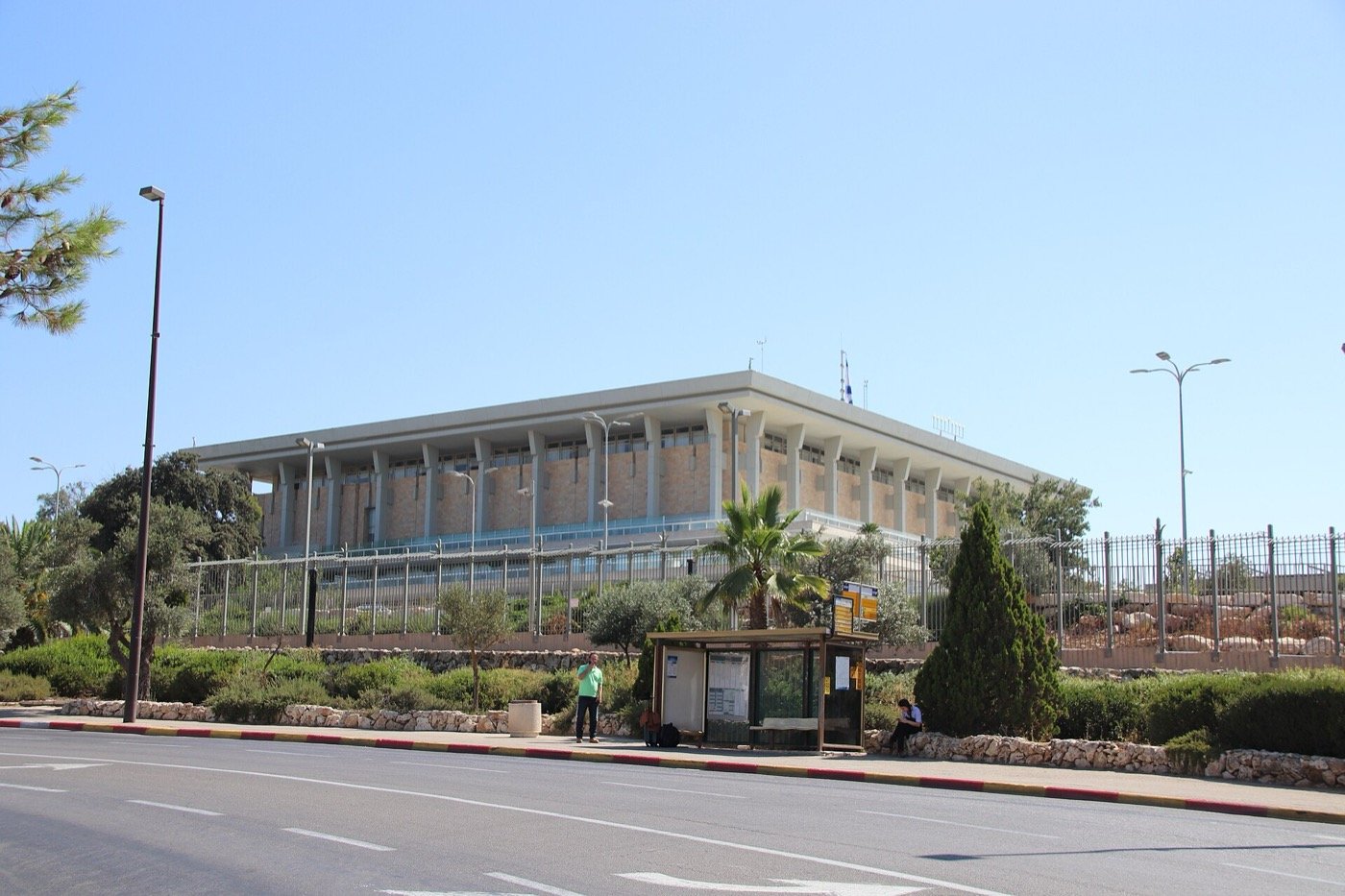
Last updated: 5 November 2026 (Herzog’s consultations in their second day; Eisenkot ahead 56 to 46 in recommendations so far, United Torah Judaism recommending no one; mandate deadline 11 November). Polls closed at 10 p.m. on 27 October. The Central Elections Committee said on 29 October that counting was complete: Netanyahu’s bloc has 53 seats against 48 for the change bloc, with Arab-led lists on 19. Likud is the largest party on 27 seats and Yashar has 21. The figures stay unofficial until the committee publishes the results.
- Exit polls (estimates): Likud 24-25, Yashar 21-23; Netanyahu bloc 50, change bloc 52-53, Arab-led lists 17-18. Revised overnight: Likud 27, blocs near level (The Media Line; Ynet).
- Partial count (about 77.6%, 12:32 p.m. Wednesday): Likud 27, Yashar 22; Netanyahu bloc 54, change bloc 49, Arab-led lists 17 (Joint List 11, Ra’am 6). Preliminary; the last ballots and surplus-vote agreements are still to be settled (Israel National News).
- Partial count (over 85%, 3:07 p.m. Wednesday): Netanyahu bloc 53, change bloc 48, Arab-led lists 19. The Central Elections Committee said 430,000 to 480,000 double-envelope ballots, worth about 12 seats, are still to be counted; the full count is due on 29 October (Times of Israel).
- Partial count (89.8% of regular ballots, Wednesday evening): Likud 26, Yashar 21, Together 12, Joint List 12, The Democrats 8, Otzma Yehudit 7, Shas 7, United Torah Judaism 7, Ra’am 7, Yisrael Beiteinu 7, Religious Zionism 6. Blocs unchanged at 53, 48 and 19; Arab-led lists are at an all-time high. Counting of the double-envelope ballots began at 1:16 a.m. on 29 October and is expected to finish on Thursday evening (Times of Israel).
- Regular ballots fully counted (29 October): Likud 26, Yashar 21, Together 12, Joint List 11, The Democrats 8, Ra’am 8, with Otzma Yehudit, Shas, United Torah Judaism and Yisrael Beiteinu on 7 each and Religious Zionism on 6. Ra’am gained a seat from the Joint List; blocs stay at 53, 48 and 19. The Reservists (2.63%) and Amcha Yisrael (1.6%) are below the 3.25% threshold. The Central Elections Committee estimates up to 480,000 double envelopes and expects to finish counting on Thursday evening (Israel National News; i24NEWS).
- Partial count (about 97.3%, 2:55 p.m. Thursday 29 October): Likud 27, Yashar 21, Together 12, Joint List 11, The Democrats 8, Ra’am 8, Otzma Yehudit, United Torah Judaism and Yisrael Beiteinu 7 each, Religious Zionism 6 and Shas 6. Likud gained a seat from its ally Shas; blocs unchanged at 53, 48 and 19 (Israel National News). By 3:23 p.m., 295,607 double envelopes had been counted of an estimated 430,000 to 480,000, according to the Central Elections Committee (Times of Israel).
- Count completed (29 October): By 4:57 p.m., 392,234 double envelopes had been counted and the blocs were unchanged at 53 and 48 (Times of Israel). Later on Thursday the Central Elections Committee said the count was complete; with 99% of votes entered, Likud 27, Yashar 21, Together 12, Joint List 11, The Democrats 8, Ra’am 8, Otzma Yehudit, United Torah Judaism and Yisrael Beiteinu 7 each, and Shas and Religious Zionism 6 each. The Reservists and Amcha Yisrael won no seats (Haaretz). Final turnout was 77.9%, with 5,716,665 votes cast (Times of Israel).
- Fraud claim: On 28 October Likud said the election had been “stolen by Arab parties” and said it would give evidence to the police, the Shin Bet and the Central Elections Committee, which said it was reviewing the request. No evidence has been made public (The Jewish Chronicle). Separately, committee chairman Justice Noam Sohlberg asked Shin Bet head David Zini to look into suspected foreign funding and election bribery and report within a week; the committee said this was not related to Likud’s claims (i24NEWS). On 29 October the committee’s acting director general, Dean Livne, said the vote was conducted lawfully and that, to the best of his knowledge, there was no evidence of systematic irregularities (Times of Israel). Early on 30 October the committee repeated his statement, calling the fraud reports “entirely unfounded” and saying the investigation would not affect the final results submitted to the president (Times of Israel). On 29 October Likud also alleged, without public evidence, that foreign interference aimed at a takeover of the Knesset; Qatar denied any involvement, and opposition leaders called for an investigation while warning against using the allegations to cast doubt on the result. CNBC reported that parties have until 18 November to challenge the results (CNBC).
- Bribery probe: Police arrested three Bedouin men from the Negev in the early hours of 27 October on suspicion of a scheme to bribe voters to back Ra’am; Ra’am called them “sham arrests” (Times of Israel). On Thursday 29 October four more suspects, including three school principals from Bedouin communities, were detained, taking the total to seven; none has been charged and the suspects deny wrongdoing. Likud said it would petition the election authorities for new votes at polling stations where it alleges bribery or prohibited methods, while not alleging forged ballots or falsified totals; no ruling on that request has been reported as of 31 October (Ynet).
- Official results: the Central Elections Committee published the final results early on 30 October: Likud 27, Yashar 21, Together 12, Joint List 11, The Democrats 8, Ra’am 8, Otzma Yehudit, United Torah Judaism and Yisrael Beiteinu 7 each, and Shas and Religious Zionism 6 each. Of 5,716,665 votes cast, 5,690,778 were valid; the 3.25% threshold was 184,947 votes. The committee said the figures remain subject to integrity checks and minor adjustments, and will be presented to President Herzog on Wednesday, 4 November (Israel National News).
- Government formation: President Herzog’s formal consultations begin after the results are presented to him on 4 November; under the legal timetable he must task a member by 11 November (Ynet). On 28 October he urged parties to avoid another election and keep an “open mind” in coalition talks (Times of Israel). On 29 October, reports citing sources close to Netanyahu said his camp was weighing a unity government with Gadi Eisenkot, either with a rotation in which Netanyahu would hand over after about two years or with a senior ministry for Eisenkot, initially without the ultra-Orthodox parties. Eisenkot had said on 21 October that he would not serve under Netanyahu in a rotation and has given no sign he will discuss the idea (The Jerusalem Post; Israel National News; The Jewish Chronicle). A Channel 14 report that Herzog himself was weighing a rotation with a pardon for Netanyahu was denied by the President’s Office, which called it “completely fake” (The New Arab). Also on 29 October, Eisenkot met Naftali Bennett of Together to discuss forming a government “as quickly as possible”, and met Yair Golan of The Democrats, who separately met Ra’am leader Mansour Abbas; the change bloc cannot reach 61 without support from Arab-led lists. Eisenkot accused Netanyahu of trying to delegitimise the results (Al Jazeera). The new Knesset is due to be sworn in on 10 November (Times of Israel). On 30 October, Kikar HaShabbat reported that Rabbi Dov Lando had told Degel HaTorah lawmakers to open talks with the opposition, and Channel 12 reported that some United Torah Judaism figures were considering letting an Eisenkot-led minority government survive with outside support; the office of UTJ chairman Yaakov Asher denied that any such order had been issued, and conscription of ultra-Orthodox men remains the main obstacle (Fox News). Yashar, Yisrael Beiteinu and Together have discussed replacing Likud’s Knesset speaker, Amir Ohana, once the Knesset is sworn in, a vote that would need support from Arab-led lists (Ynet). On 29 October Avigdor Lieberman said the only coalition Yisrael Beiteinu would consider was one made up of Zionist parties, including Likud “without Bibi” (The Jerusalem Post). On 30 October Golan repeated his call to work with Arab-led parties, and Fitch, keeping Israel’s rating on negative outlook, said a dissolution in early January and fresh elections in early April was its most likely scenario (Times of Israel). On 1 November Together said it would recommend Eisenkot for prime minister, and a senior Joint List official told Walla that the Joint List and Ra’am were expected to do the same (The Jerusalem Post). Lieberman said Yisrael Beiteinu would recommend Eisenkot, with Yair Lapid as Knesset speaker, but still ruled out joining a minority government that relies on Arab-led parties; Shas is expected to recommend Netanyahu (Times of Israel; Israel Hayom). Kan reported that Netanyahu’s associates told Eisenkot there would be no unity talks if Ohana is replaced as speaker; Eisenkot’s associates said joining a Netanyahu government was not on the table (Times of Israel).
- Recommendations so far (4–5 November): On 4 November Religious Zionism and Shas recommended Netanyahu and Yisrael Beiteinu recommended Eisenkot (The Jerusalem Post). On 5 November United Torah Judaism recommended no candidate, saying its priority was protecting yeshiva students’ exemption from military service; Otzma Yehudit recommended Netanyahu; and The Democrats and Ra’am backed Eisenkot. After Ra’am, the Times of Israel put Eisenkot on 56 recommending lawmakers to Netanyahu’s 46 (Times of Israel). The Joint List, Together, Yashar and Likud were due to meet Herzog on the evening of 5 November; Herzog had not yet said whom he would task (The Jerusalem Post).
- Results formally presented, consultations open (4 November): President Herzog opened consultations with every elected list on 4 November, the day the final results were formally presented to him; sessions were expected to continue into Thursday and possibly Friday, with the new Knesset due to be sworn in on 10 November. Under Basic Law: The Government, Herzog must assign the mandate within seven days of the certified results, putting the deadline at 11 November, though he could decide sooner (Ynet). United Torah Judaism was withholding any recommendation pending movement on military-exemption legislation. Ynet’s updated count on 4 November put 48 expected recommendations behind Eisenkot (Yashar, Together, The Democrats and Yisrael Beiteinu) against 46 for Netanyahu (Likud, Otzma Yehudit, Shas and Religious Zionism), with Ra’am, the Joint List and United Torah Judaism uncommitted and free to recommend no one; Herzog received the certified results from Central Elections Committee chairman Justice Noam Sohlberg at noon, and the mandate was expected to be assigned between Friday and the following Tuesday (Ynet). On 3 November Eisenkot, Naftali Bennett, Avigdor Lieberman, Yair Golan and Yair Lapid met in Herzliya and said all their parties would recommend Eisenkot, pledging to replace the “Oct. 7 government” with “a national emergency government” and condemning what they called Likud’s “dangerous and irresponsible” campaign to delegitimise the results (Anadolu Agency). Netanyahu has accused Arab-led lists of having “stolen” the vote; the attorney general asked the Shin Bet to report on the fraud claims, and AFP said no evidence had yet been submitted (RTÉ/AFP). At the handover, Central Elections Committee chairman Noam Sohlberg said the committee had approved the results after finding “no evidence of compromised election integrity,” called the Shin Bet’s inquiry into alleged foreign funding of voting in Arab communities a matter of “suspicions only,” and warned that casting doubt on the results posed a “real danger” to democracy; Herzog said Arab society “must not be smeared” (The Jerusalem Post). Al Jazeera reported that Likud had mooted refusing to recognise the results, repeating claims of irregularities in the Arab vote that police have investigated and discounted, while a separate Shin Bet inquiry continues; on 2 November Netanyahu said he aimed to “form a broad government with our partners and with any other party that wishes to join, provided they do not support terrorism” (Al Jazeera).
💡 Short Answer
Israel voted on 27 October 2026 for a 120-seat Knesset. Exit polls put Likud first with 24 to 25 seats (27 after overnight revisions) and Yashar second, with Netanyahu’s bloc on 50 to 52 and the change bloc on 49 to 53: no side at 61. When the Central Elections Committee completed the count on 29 October, Netanyahu’s bloc had 53 seats, the change bloc 48 and Arab-led lists 19, with Likud on 27 and Yashar on 21. The committee published these as final results early on 30 October, subject to integrity checks, and presents them to President Herzog on 4 November. President Isaac Herzog then consults the parties and tasks one member with forming a government, who has up to 42 days.
Exit Polls and the Early Count
Exit polls are estimates; the partial count is preliminary. Neither is the final result, which the committee published on 30 October.
| Exit poll (estimate, not a result) | Likud | Yashar | Together | Netanyahu bloc | Change bloc | Arab-led lists |
|---|---|---|---|---|---|---|
| Channel 12, 22:00 | 24 | 22 | 12 | 50 | 52 | 18 |
| Channel 13, 22:00 | 25 | 23 | 14 | 50 | 53 | 17 |
| Kan, 22:00 | 25 | 21 | 14 | 50 | 53 | 17 |
| Channel 12, revised | 27 | 21 | — | 52 | 49 | 19 |
| Channel 13, revised | 27 | 22 | — | 51 | 51 | 18 |
| Kan, revised | 27 | — | 13 | 51 | 51 | 18 |
| Partial count, ~77.6% (CEC, preliminary) | 27 | 22 | — | 54 | 49 | 17 |
| Partial count, over 85% (CEC, preliminary) | — | — | — | 53 | 48 | 19 |
| Partial count, 89.8% (CEC, preliminary) | 26 | 21 | 12 | 53 | 48 | 19 |
| Regular ballots 100%, 29 Oct (CEC, preliminary) | 26 | 21 | 12 | 53 | 48 | 19 |
| About 97.3% of all votes, 29 Oct 14:55 (CEC, preliminary) | 27 | 21 | 12 | 53 | 48 | 19 |
| Count completed, 29 Oct (CEC, 99% entered, unofficial) | 27 | 21 | 12 | 53 | 48 | 19 |
The exit polls reversed the order of the final pre-election surveys, putting Likud ahead of Yashar. Early returns favoured Netanyahu’s bloc further, but counts from large cities, Arab towns and double-envelope ballots typically arrive later and can shift the picture. By midday Wednesday, with about 77.6% counted, the margin had narrowed to 54 seats for Netanyahu’s bloc against 49 for the change bloc (Ynet; Israel National News). By 3:07 p.m., with over 85% counted, it stood at 53 to 48, with Arab-led lists on 19 (Times of Israel). With 89.8% of regular ballots counted on Wednesday evening, the blocs were unchanged, with Likud on 26 and Yashar on 21; once all regular ballots were in on 29 October, Ra’am rose to 8 and the Joint List fell to 11, leaving the blocs unchanged. By 2:55 p.m. on 29 October, with about 97.3% of votes counted, Likud had taken a seat from Shas to reach 27, with the blocs still at 53, 48 and 19 (Israel National News). The committee said later on 29 October that the count was complete, with the party and bloc figures unchanged; the committee published them as final results early on 30 October and presents them to President Herzog on 4 November (Haaretz).
Final Pre-Election Polls: Neither Bloc at 61
Pre-election estimates, not results. These figures will stay labelled as polls until verified results are available.
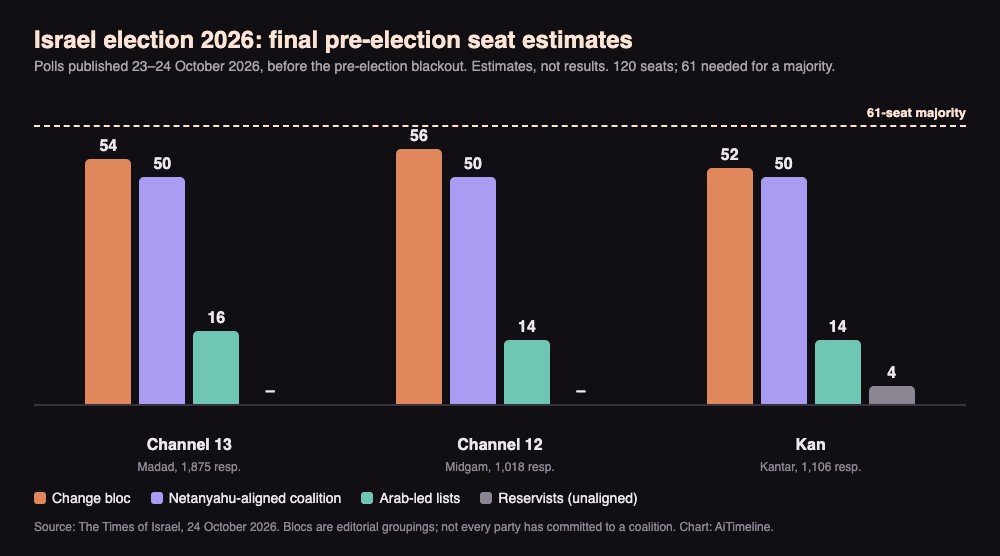
| Pre-election survey (not a result) | Change bloc | Netanyahu-aligned coalition | Arab-led lists | Unaligned | Yashar | Likud | Together |
|---|---|---|---|---|---|---|---|
| Channel 13 (Madad, 1,875 resp., ±2.3) | 54 | 50 | 16 | — | 22 | 19 | 14 |
| Channel 12 (Midgam, 1,018 resp., ±4.4) | 56 | 50 | 14 | — | 23 | 21 | 15 |
| Kan (Kantar, 1,106 resp., ±3.0) | 52 | 50 | 14 | 4 (Reservists) | 22 | 20 | 14 |
| Majority | 61 | 61 | — | — |
Party by party, the three surveys agreed on the order at the top: Yashar first, Likud second, Together third. The bloc labels are editorial groupings used by Israeli media; Yisrael Beiteinu and the Arab-led lists, in particular, have not committed to any coalition (The Times of Israel).
| List | Channel 13 | Channel 12 | Kan | Bloc |
|---|---|---|---|---|
| Yashar (Gadi Eisenkot) | 22 | 23 | 22 | Change |
| Likud (Benjamin Netanyahu) | 19 | 21 | 20 | Coalition |
| Together / B’Yachad (Naftali Bennett, with Yair Lapid) | 14 | 15 | 14 | Change |
| The Democrats (Yair Golan) | 10 | 10 | 8 | Change |
| Joint List | 9 | 9 | 9 | Arab-led |
| Yisrael Beiteinu (Avigdor Lieberman) | 8 | 8 | 8 | Change |
| Otzma Yehudit (Itamar Ben-Gvir) | 8 | 8 | 8 | Coalition |
| United Torah Judaism | 8 | 7 | 8 | Coalition |
| Religious Zionism (Bezalel Smotrich) | 8 | 6 | 7 | Coalition |
| Shas | 7 | 8 | 7 | Coalition |
| Ra’am | 7 | 5 | 5 | Arab-led |
| Reservists (Yoaz Hendel) | Below | Below | 4 | Unaligned |
| Amcha Yisrael (Ofer Winter) | Below | Below | Below | — |
Israel Election 2026: Key Questions
The Election in Ten Points
- Date: 27 October 2026, the first general election since 7 October 2023.
- System: 120 seats, one nationwide constituency, 3.25% threshold.
- Final polls: change bloc 52-56, coalition 50, Arab-led lists 14-16.
- Leader in polls: Eisenkot’s Yashar, ahead of Netanyahu’s Likud.
- New alliance: Bennett and Lapid run together as Together (B’Yachad).
- Threshold risk: Amcha Yisrael and the Reservists polled near 3.25%.
- Exit polls: Likud first (24-27), Yashar second; no bloc at 61.
- Results: final results published 30 October; presented to Herzog 4 November.
- Mandate: Herzog tasks a member within 7 days of official results.
- Deadline: 28 days for a coalition, plus up to 14 more.
Israel Election 2026 Timeline, Latest First
From the 2026 count back to the first Knesset election in 1949. Each entry is tagged and ends with why it matters.
2026
Day two of consultations: UTJ recommends no one, Eisenkot leads 56 to 46 Live
On the first evening of consultations, 4 November, Religious Zionism and Shas recommended Benjamin Netanyahu, while Yisrael Beiteinu recommended Gadi Eisenkot (The Jerusalem Post). On 5 November United Torah Judaism, whose two factions hold seven seats, told Herzog it would recommend no candidate; MK Yitzhak Pindrus said the party had come “to discuss topics and not people” and that protecting Torah students came first (The Jerusalem Post). Otzma Yehudit recommended Netanyahu, and Herzog rebuked its MKs over claims the election was “stolen,” telling them, “You are citing hearsay; it is all speculation.” The Democrats and Ra’am backed Eisenkot, and after Ra’am’s meeting the Times of Israel counted 56 lawmakers recommending Eisenkot and 46 recommending Netanyahu (Times of Israel).
The Joint List, Together, Yashar and Likud were scheduled to meet Herzog later on 5 November, with Likud last. Herzog had not said when he would assign the mandate; the legal deadline is 11 November.
2026
Herzog opens consultations as results are formally presented; Likud weighs disputing them Live
Final results were formally presented to President Herzog on 4 November, and he opened consultations with every elected list the same day, scheduling the smallest parties first “to allow a broad examination of all the options on the table”: Religious Zionism on Wednesday afternoon, then Shas and Yisrael Beiteinu that evening, before Thursday sessions with United Torah Judaism, Otzma Yehudit, The Democrats, Ra’am, the Joint List and Together, ending with the two largest parties, Yashar and Likud, last (Times of Israel). The new Knesset is due to be sworn in on 10 November. Under Basic Law: The Government, Herzog must assign the mandate within seven days of the certified results, putting the deadline at 11 November, though he could decide sooner. Ynet’s updated count on 4 November put 48 expected recommendations behind Eisenkot (Yashar, Together, The Democrats and Yisrael Beiteinu) against 46 for Netanyahu (Likud, Otzma Yehudit, Shas and Religious Zionism), with Ra’am, the Joint List and United Torah Judaism uncommitted and free to recommend no one; Herzog received the certified results from Central Elections Committee chairman Justice Noam Sohlberg at noon, and the mandate was expected to be assigned between Friday and the following Tuesday (Ynet). On 3 November Eisenkot, Naftali Bennett, Avigdor Lieberman, Yair Golan and Yair Lapid met in Herzliya and said all their parties would recommend Eisenkot, pledging to replace the “Oct. 7 government” with “a national emergency government” and condemning what they called Likud’s “dangerous and irresponsible” campaign to delegitimise the results (Anadolu Agency). Netanyahu has accused Arab-led lists of having “stolen” the vote; the attorney general asked the Shin Bet to report on the fraud claims, and AFP said no evidence had yet been submitted (RTÉ/AFP). At the handover, Central Elections Committee chairman Noam Sohlberg said the committee had approved the results after finding “no evidence of compromised election integrity,” called the Shin Bet’s inquiry into alleged foreign funding of voting in Arab communities a matter of “suspicions only,” and warned that casting doubt on the results posed a “real danger” to democracy; Herzog said Arab society “must not be smeared” (The Jerusalem Post).
Al Jazeera reported that Netanyahu’s Likud had mooted refusing to recognise the results, repeating claims of irregularities in the Arab vote that police have investigated and discounted, while a separate Shin Bet inquiry continues. On 2 November Netanyahu said he aimed to “form a broad government with our partners and with any other party that wishes to join, provided they do not support terrorism.” United Torah Judaism was withholding any recommendation pending movement on military-exemption legislation (Al Jazeera).
2026
Joint List says it would vote with an Eisenkot government but not join it Live
Joint List leader Yousef Jabareen told The Guardian on 2 November that the list has no intention of joining an Eisenkot government but would vote with it in the Knesset, which could allow a minority government; he said the list could not be part of a government while the occupation of the West Bank continues. Ra’am leader Mansour Abbas has said he would join if Ra’am receives the internal security portfolio. Both lists have said they will work with the opposition bloc to remove Netanyahu (Al Jazeera).
On the vote-bribery case Netanyahu and Likud have cited, Al Jazeera reported that a court released one of the three suspects on 1 November and ordered another to remain under house arrest. Central Elections Committee chairman Noam Sohlberg said that even if the suspicions were substantiated, they would not undermine the integrity of the election. Ra’am denies involvement.
2026
Together and Yisrael Beiteinu to recommend Eisenkot; Shas backs Netanyahu Live
On 1 November Naftali Bennett’s Together said it would recommend Gadi Eisenkot to President Herzog, and a senior Joint List official told Walla that the Joint List and Ra’am were expected to recommend him too (The Jerusalem Post). Avigdor Lieberman said Yisrael Beiteinu would recommend Eisenkot for prime minister and Yair Lapid for Knesset speaker, while repeating that he would not join a minority government reliant on Arab-led parties, which he said would “survive less than a year”. Hebrew media reported that Shas would recommend Netanyahu (Times of Israel; Israel Hayom).
Kan reported that Netanyahu’s associates had told Eisenkot there would be no talks on a unity government if Amir Ohana is replaced as Knesset speaker; Eisenkot’s associates said the effort to replace him would continue and that joining a Netanyahu government was not on the table. Channel 12 (N12) reported that United Torah Judaism was considering recommending no one (Times of Israel).
2026
Projected recommendations: Eisenkot 60, Netanyahu 46 Live
Ahead of President Herzog’s consultations, Ynet counted the seats of parties that have recommended, or are expected to recommend, each candidate. Gadi Eisenkot would have 60: Yashar 21, Together 12, The Democrats 8, and the Joint List (11) and Ra’am (8), both described as likely. Netanyahu would have 46: Likud 27, Otzma Yehudit 7, Shas 6 and Religious Zionism 6. Yisrael Beiteinu (7), which might back Eisenkot, and United Torah Judaism (7) are undecided. These are projections, not confirmed endorsements, and the president does not have to task the candidate with the most recommendations (Ynet).
Consultations are due to begin on Wednesday, 4 November, the day the results are formally presented, and Herzog must task a member by 11 November. He has urged “creative solutions” and has said he would press for a national unity government if needed. Eisenkot and other opposition leaders have ruled out partnering with Arab-led parties, though Ra’am leader Mansour Abbas has signalled flexibility. Netanyahu remains caretaker prime minister, and the nominee then has 28 days to build a coalition, extendable by 14 (Al Jazeera).
2026
Final results published; no bloc at 61 Live
Early on 30 October the Central Elections Committee published the final results. They match the completed count: Likud 27, Yashar 21, Together 12, the Joint List 11, The Democrats 8, Ra’am 8, Otzma Yehudit, United Torah Judaism and Yisrael Beiteinu 7 each, and Shas and Religious Zionism 6 each. Of 5,716,665 votes cast, 5,690,778 were valid and 25,887 invalid; turnout was 77.9% and the 3.25% threshold was 184,947 votes. The committee said the results remain subject to integrity checks and minor adjustments, and will be presented to President Herzog on Wednesday, 4 November (Israel National News).
The coalition picture did not move. On 29 October Avigdor Lieberman said the only coalition Yisrael Beiteinu would consider was one of Zionist parties, including Likud “without Bibi” (The Jerusalem Post). Yashar, Yisrael Beiteinu and Together have discussed replacing Knesset speaker Amir Ohana after the swearing-in on 10 November, which would need Arab-led lists’ votes (Ynet). On 30 October Yair Golan wrote that “there are no conditional citizens in a democratic Israel”, repeating his call to work with Arab-led parties, and Fitch kept Israel’s rating on negative outlook, calling a dissolution in early January and fresh elections in early April its most likely scenario (Times of Israel).
2026
Netanyahu camp floats unity government with Eisenkot Live
On the morning of 29 October, The Jerusalem Post and Israel National News, the latter citing Maariv, reported that people close to Netanyahu were promoting a national unity government with Gadi Eisenkot. In one version Netanyahu would stay on for about two years and then hand the premiership to Eisenkot under a rotation; in another there would be no rotation and Eisenkot would get a senior ministry. The first government would include Yashar, Otzma Yehudit and Religious Zionism alongside Likud but not the ultra-Orthodox parties, at least until a conscription law passed (The Jerusalem Post; Israel National News).
Both reports said Eisenkot had given no sign he would discuss the proposal. In a 103FM radio interview on 21 October he said: “I unequivocally pledge that I will not serve under Netanyahu in a rotation agreement,” adding that if it happened, “you would see me resign an hour later” (The Jewish Chronicle).
A separate Channel 14 report, aired on 28 October, said President Herzog was considering a rotation in which Netanyahu would serve about two more years, then retire and receive a pardon in his corruption cases. Herzog’s office denied it outright, calling the report “completely fake” and saying it does not speculate on whom it will task with forming a government (The New Arab; The Sunday Guardian).
2026
Count completed: Netanyahu bloc 53, change bloc 48, Arab-led lists 19 Live
By 4:57 p.m. on 29 October, with the double-envelope count almost finished, the Central Elections Committee had counted 392,234 double envelopes and the blocs were still at 53 and 48 (Times of Israel). Later on Thursday the committee said the count was complete. With 99% of votes entered, Likud has 27 seats, Yashar 21, Together 12, the Joint List 11, The Democrats 8, Ra’am 8, Otzma Yehudit, United Torah Judaism and Yisrael Beiteinu 7 each, and Shas and Religious Zionism 6 each; The Reservists and Amcha Yisrael fell below the threshold (Haaretz).
The committee said official results would be published on Wednesday, 4 November, after an additional review of election integrity (Haaretz).
2026
About 97.3% counted: Likud 27 as Shas drops a seat; blocs unchanged Live
With about 97.3% of votes counted at 2:55 p.m. on 29 October, the Central Elections Committee’s preliminary figures gave Likud 27 seats, Yashar 21, Together 12, the Joint List 11, The Democrats 8, Ra’am 8, Otzma Yehudit, United Torah Judaism and Yisrael Beiteinu 7 each, and Religious Zionism and Shas 6 each. Likud’s gain came at the expense of its ally Shas, so the blocs stayed at 53, 48 and 19. The Reservists, on 2.67%, remained below the 3.25% threshold (Israel National News). By 3:23 p.m., 295,607 double envelopes had been counted of an estimated 430,000 to 480,000 (Times of Israel).
The committee’s acting director general, Dean Livne, rejected claims of widespread fraud, saying the vote was conducted lawfully and that, to the best of his knowledge, there was no evidence of systematic irregularities (Times of Israel).
2026
Regular ballots 89.8% counted; double-envelope count begins Live
With nearly all regular ballot boxes counted (89.8%), the Central Elections Committee’s preliminary figures gave Likud 26 seats, Yashar 21, Together 12, the Joint List 12, The Democrats 8, Otzma Yehudit, Shas, United Torah Judaism, Ra’am and Yisrael Beiteinu 7 each, and Religious Zionism 6. That leaves Netanyahu’s bloc on 53, eight short of a majority, the Eisenkot-led bloc on 48 and Arab-led lists on a record 19. The Reservists (2.63%) remained below the threshold. Counting of the 430,000 to 480,000 double-envelope ballots began at 1:16 a.m. on 29 October (Times of Israel).
On 28 October Likud said the election had been “stolen by Arab parties” and demanded an investigation, citing alleged cash handouts and threats at polling stations; the Central Elections Committee said it was reviewing the request. No evidence has been made public (The Jewish Chronicle).
2026
Count passes 85%: Netanyahu bloc 53, change bloc 48 Live
With over 85% of votes counted, the Central Elections Committee’s preliminary figures gave Netanyahu’s bloc 53 seats, the Eisenkot-led change bloc 48 and Arab-led lists 19. At the 84.5% mark, the Reservists (2.7%), People of Israel (1.6%) and Charedi Public (0.2%) were below the 3.25% threshold (Times of Israel).
The committee said 430,000 to 480,000 double-envelope ballots, cast by soldiers, police, diplomats and others and worth about 12 seats, are still to be counted. The full count is due on the afternoon of 29 October, and official results on 4 November. Turnout at the close of polls was 77.7%, up 7.1 points on 2022 (Jerusalem Post). President Herzog urged parties to avoid another election, and Netanyahu called for a right-wing government not dependent on Arab parties (Jerusalem Post).
2026
Count update: Netanyahu’s lead narrows as more ballots are added Live
With about 77.6% of votes counted at 12:32 p.m., the Central Elections Committee’s preliminary figures gave Likud 27 seats and Yashar 22, with Netanyahu’s bloc on 54, the change bloc on 49, and Arab-led lists on 17 (Joint List 11, Ra’am 6) (Israel National News). These are still partial figures and will change before official confirmation on 4 November.
Turnout was 74.3% by 8 p.m., with 5,449,277 of 7,331,981 eligible voters casting a ballot (Ynet).
2026
Exit polls: Likud largest, no bloc at 61 Live
Polls closed at 10 p.m. All three main exit polls put Likud first, with 24 or 25 seats, ahead of Yashar on 21 to 23. Netanyahu’s bloc had 50 in each; the change bloc had 52 (Channel 12) or 53 (Channel 13, Kan); Arab-led lists had a record 17 or 18 (The Media Line; The Times of Israel).
Overnight revisions moved Likud up to 27 in all three, and the blocs closer: Channel 12 then had Netanyahu’s bloc on 52 and Eisenkot’s on 49, while Kan and Channel 13 had them level at 51 each (Ynet). Exit polls are estimates, not results.
2026
Final polls: neither bloc reaches 61 Pre-election poll
The last three mainstream surveys all put Gadi Eisenkot’s Yashar first, with 22 or 23 seats, ahead of Likud on 19 to 21. Channel 12 gave the change bloc 56 seats and the coalition 50; Channel 13 gave 54 and 50; Kan gave 52 and 50. Arab-led lists had 14 to 16, and Kan alone put Yoaz Hendel’s Reservists in the Knesset, with 4 (The Times of Israel; Ynet).
Ofer Winter’s Amcha Yisrael fell just under the 3.25% threshold in all three. These are pollsters’ estimates, with margins of error of 2.3 to 4.4 points, not results.
2026
Supreme Court restores the Joint List Campaign
The Central Elections Committee barred the Joint List from running on 23 September 2026; the Supreme Court overturned that decision on 2 October, so the list is on the ballot. The Joint List has a surplus-vote agreement with Ra’am (Wikipedia summary).
2026
Knesset dissolves; election set for 27 October Election process
The 25th Knesset voted in its final readings to dissolve itself, with no votes against, confirming 27 October as election day; the coalition had agreed the date on 12 July. Before the vote the coalition passed a law keeping compulsory military service for men at 32 months (JNS). Netanyahu’s coalition became the first Israeli government in decades to serve a full four-year term.
2026
Dissolution bill passes a preliminary reading Election process
The Knesset backed a bill to dissolve itself in a preliminary reading by 110 votes to 0, after ultra-Orthodox parties withdrew support from Netanyahu over the stalled military-draft exemption law (Israel Hayom). A first reading in June left the date open, but elections had to be held by 27 October in any case.
2026
Bennett and Lapid form ‘Together’ Campaign
Former prime ministers Naftali Bennett and Yair Lapid announced a joint list, Together (B’Yachad), led by Bennett and including Lapid’s Yesh Atid (JNS; Israel Democracy Institute). Yesh Atid therefore does not run separately in 2026.
2025
Gadi Eisenkot launches Yashar Campaign
Eisenkot, who had served in Benny Gantz’s party and resigned from the Knesset in June 2025, founded the centrist Yashar (“straight” or “upright”) (Jewish Virtual Library). By the final week of the campaign it led every mainstream poll.
Ultra-Orthodox parties quit over the draft law Campaign
Both United Torah Judaism factions resigned from the coalition over stalled conscription legislation, and Shas withdrew its ministers soon after (Wikipedia summary). A 2024 Supreme Court ruling had ended blanket exemptions for yeshiva students (European Parliament Research Service).
2024
Gantz and Eisenkot leave the emergency government Campaign
Benny Gantz and Gadi Eisenkot, who had joined an emergency government and war cabinet after the 7 October attack, quit it in June 2024 (Wikipedia summary).
2023
Hamas-led attack reshapes politics Campaign
The Hamas-led attack on southern Israel became the backdrop to the 2026 campaign. Opposition parties call for an independent state commission of inquiry; the government has favoured a panel it would appoint, with narrower powers (European Parliament Research Service).
2023
Judicial overhaul announced Campaign
Justice Minister Yariv Levin unveiled plans to curb the Supreme Court’s powers, setting off mass protests through 2023 (European Parliament Research Service). Netanyahu’s corruption trial, which he denies, continued alongside.
2022
Netanyahu returns with 64 seats Past election
Likud won 32 seats and formed a coalition of right-wing and religious parties with 64 of 120 seats, Israel’s fifth election in under four years (Wikipedia: 2022 election).
2021
Knesset elects Isaac Herzog president Past election
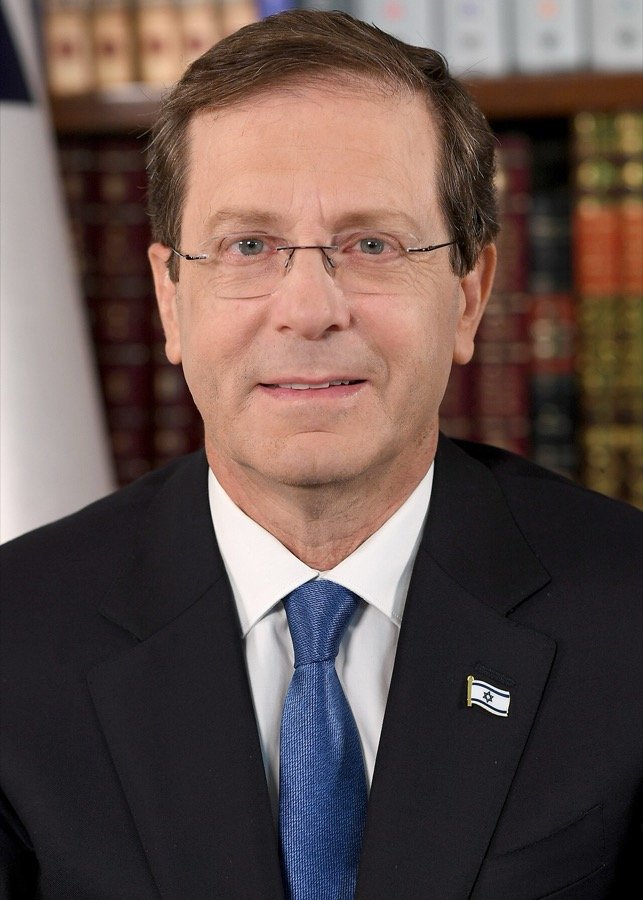
The Knesset elected Isaac Herzog, a former Labour leader, as Israel’s 11th president for a single seven-year term (Wikipedia: 2021 presidential election).
2021
Largest party, but out of power Past election
Likud finished first with 30 seats but could not form a government. Eight parties, including the Arab-led Ra’am, then formed a coalition led first by Naftali Bennett and, from July 2022, by Yair Lapid (Wikipedia: 2021 election).
2020
A third election, then a unity deal Past election
Likud won 36 seats to Blue and White’s 33. After weeks of deadlock during the Covid-19 outbreak, Netanyahu and Benny Gantz formed a rotation government (Wikipedia: 2020 election).
2019
Two elections, no government Past election
Likud and Blue and White tied on 35 seats in April. No government was formed, and in September Blue and White won 33 to Likud’s 32 (Wikipedia: April 2019 election).
1996
Israel’s first direct vote for prime minister Past election
Voters cast separate ballots for prime minister and Knesset, and Netanyahu narrowly beat Shimon Peres. The split ballot weakened large parties and was abandoned after the 2001 vote (Wikipedia: 1996 election).
1949
The first election Past election
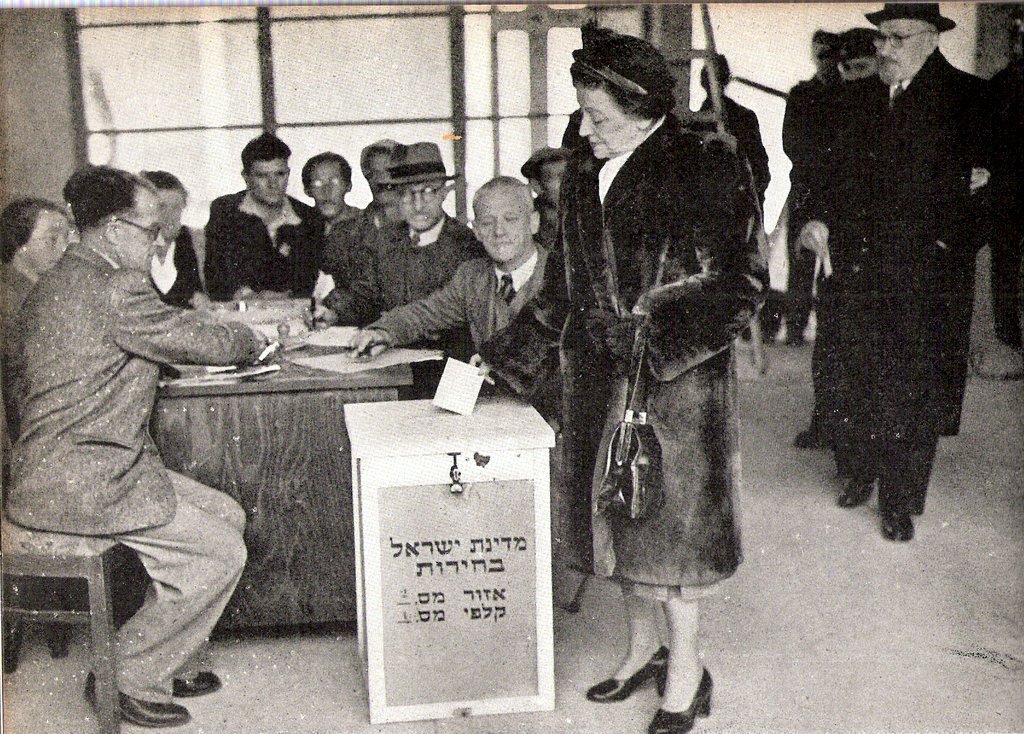
Israel elected a 120-member Constituent Assembly, which became the First Knesset, using nationwide proportional representation (Wikipedia: 1949 election).
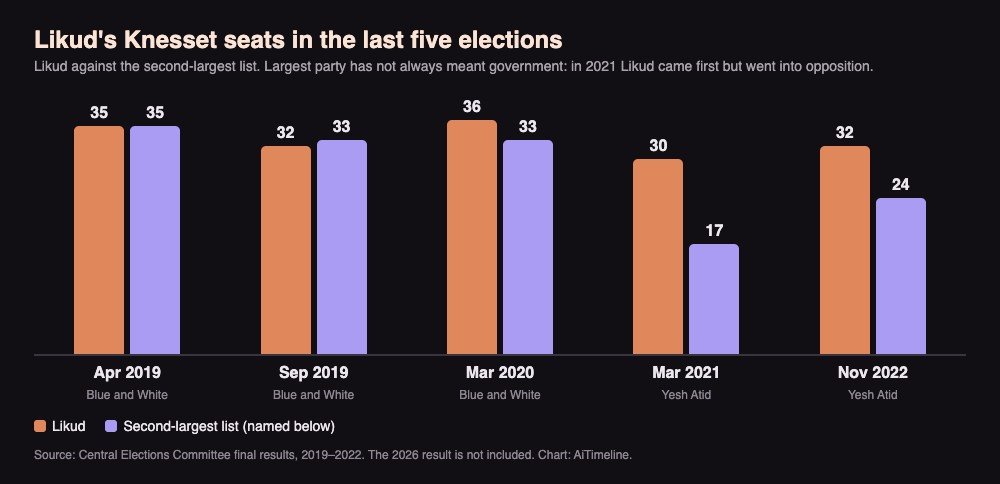
Past Results: Coming First Is Not the Same as Governing
Five elections between 2019 and 2022, from official results.
| Election | Largest list (seats) | Runner-up (seats) | Government that followed |
|---|---|---|---|
| 9 Apr 2019 | Likud 35 / Blue and White 35 (tie) | — | None; repeat election |
| 17 Sep 2019 | Blue and White 33 | Likud 32 | None; repeat election |
| 2 Mar 2020 | Likud 36 | Blue and White 33 | Netanyahu-Gantz rotation, May 2020 |
| 23 Mar 2021 | Likud 30 | Yesh Atid 17 | Bennett-Lapid, 13 Jun 2021 (Likud in opposition) |
| 1 Nov 2022 | Likud 32 | Yesh Atid 24 | Netanyahu, 64 seats, 29 Dec 2022 |
| 27 Oct 2026 | Likud in exit polls (24-27); count under way | Yashar in exit polls (21-23) | Pending |
How Israel’s Election System Works
1. Voters choose a party list. The whole country is a single constituency. Each voter picks one list; there are no local seats and no separate vote for prime minister.
2. Lists must cross 3.25%. A list below the threshold wins no seats, and its votes are effectively lost to its bloc. That is why parties polling near four seats matter so much.
3. Seats are shared proportionally. The 120 seats go to qualifying lists according to their vote share, with surplus-vote agreements between pairs of lists deciding some of the last seats.
4. Parties negotiate a coalition. No party has won a majority alone in Israel’s history, so a government rests on a coalition agreement and a Knesset confidence vote (Basic Law: The Government).
What Happens After Polls Close
Six steps, each with its own legal clock.
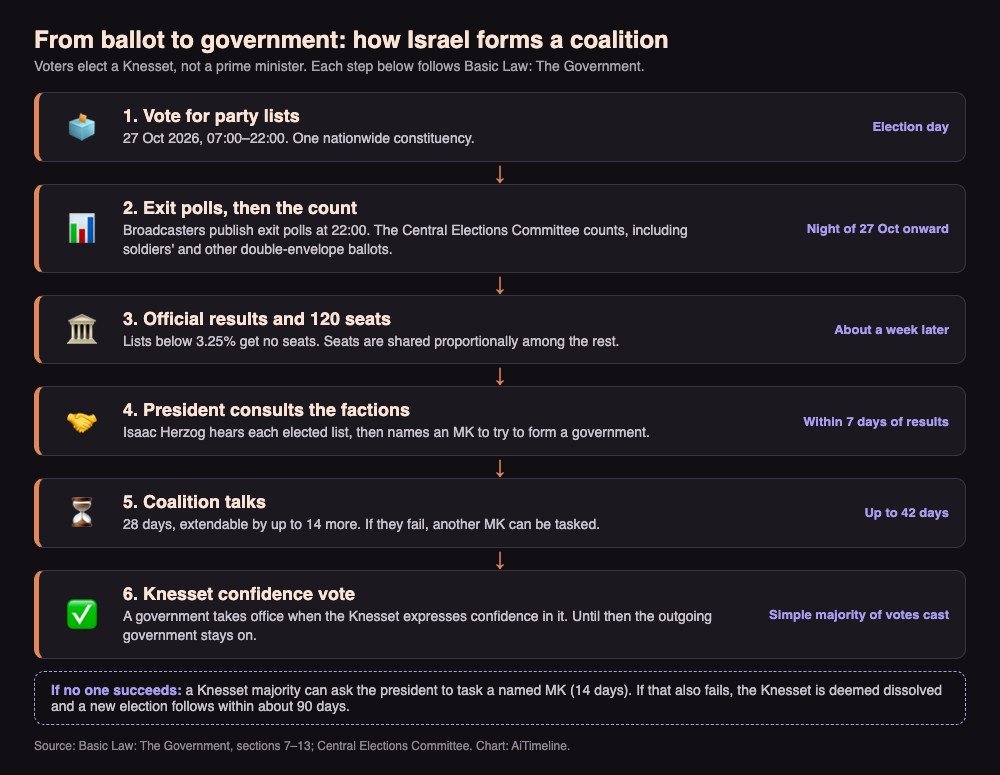
Exit polls are published by broadcasters at 10 p.m. They are estimates and can differ from the count, particularly for lists near the threshold. The count by the Central Elections Committee continues into the next day, when soldiers’ and other double-envelope ballots are added. Official results are due to be confirmed on 4 November.
Within seven days of the official results, the president consults every elected list and tasks one member with forming a government. That member has 28 days, extendable by up to 14. If they fail, the president can task another member, or a majority of the Knesset can ask him to name a specific member, who then gets 14 days. If no government emerges, the Knesset is deemed dissolved and a new election is held. The new government takes office once the Knesset votes confidence in it; until then the outgoing government stays in place (Basic Law: The Government, sections 7-13; Knesset).
What Role Does Israel’s President Play?
President Isaac Herzog is head of state; the prime minister heads the government. Herzog is not on the ballot: the Knesset elected him on 2 June 2021 for a single seven-year term (Wikipedia). His role after the election is procedural but consequential. He must consult the elected lists and give the first mandate to the member he judges best placed to win the Knesset’s confidence, usually the one recommended by the most members. He does not choose the government himself, and any government still needs the Knesset’s vote.
The Main Political Players
Benjamin Netanyahu
Israel’s longest-serving prime minister; leads the outgoing coalition and remains in office as caretaker until a new government is sworn in.
Gadi Eisenkot
Former IDF chief of staff; launched Yashar on 16 September 2025. It led all three final mainstream polls.
Naftali Bennett
Prime minister 2021-22; heads the joint list formed with Yair Lapid on 26 April 2026.
Yair Lapid
Prime minister in 2022; his Yesh Atid runs inside Together rather than as a separate list.
Yair Golan
Centre-left leader; his party polled 8 to 10 seats.
Avigdor Lieberman
Secular right-wing former Netanyahu ally, now a critic; polled 8 seats in each final survey.
Ra’am and the Joint List
Polled 14 to 16 seats together. Ra’am sat in the 2021 government; the Joint List was reinstated by the Supreme Court on 2 October.
Isaac Herzog
Head of state since 7 July 2021. Not on the ballot; he tasks a Knesset member with forming the government.
Explore More Timelines
People Also Ask
Frequently Asked Questions
The Vote Is Only the First Stage
The vote decides the shape of the 26th Knesset. Who governs depends on what comes next: the final results published on 30 October, their presentation to the president on 4 November, President Herzog’s consultations and as many as 42 days of coalition bargaining. The question to watch is not only who wins the most seats, but who can assemble 61.
Related AiTimeline Stories
⚠️ Editorial Note
Live page, last updated 29 October 2026, early morning Israel time (89.8% of regular ballots counted; double-envelope count under way). Pre-election poll figures are labelled as estimates. Exit polls are estimates and were revised overnight; the partial count is preliminary. No official result had been published at the time of writing. Sources disagree on some revised exit-poll party figures, so only the Likud and bloc totals reported by Ynet are shown for revisions. Bloc groupings are editorial. The source brief was corrected on several points: Yair Lapid’s Yesh Atid is not a separate list in 2026 but runs inside Bennett’s Together, formed on 26 April 2026; the 20 May 2026 vote was only a preliminary reading, and the Knesset formally dissolved on 17 July 2026; official results are scheduled for 4 November. The Reuters and Associated Press links in the brief could not be opened from our location, so the facts they were cited for are sourced to other reports. Israeli-government pages on the Knesset site were geo-blocked; the government-formation rules are cited to the published text of Basic Law: The Government. AiTimeline has no timelines yet on Netanyahu, Israel’s presidents or the 2022 election; related stories are linked instead.
Sources & further reading
Every dated entry above was checked against these references. Last reviewed 5 November 2026.
- The Times of Israel: Final polls before election show both blocs short of majority (24 October 2026)
- Ynet: Final Israel election polls put Eisenkot's Yashar ahead of Likud (23 October 2026)
- European Parliament Research Service: Israel's 2026 legislative election (October 2026)
- Jewish Insider: What to watch on Israel's Election Day (27 October 2026)
- JNS: Knesset votes to dissolve, formally sets 27 October election date (17 July 2026)
- Israel Hayom: Knesset dissolution vote set to kick off election countdown (20 May 2026)
- JNS: Bennett, Lapid unite ahead of 2026 elections (April 2026)
- Basic Law: The Government (2001), sections 7-13, via Jewish Virtual Library
- Central Elections Committee for the Knesset (official results)
- Wikipedia: 2026 Israeli legislative election