Muzaffarnagar Riots 2013: Timeline, Causes and Impact
A local killing in Kawal village grew into the 2013 Muzaffarnagar riots. See the timeline, causes and impact, from the Supreme Court ruling to the 2026
Latest Story
The Muzaffarnagar riots of 2013 began with a local killing in Kawal village on 27 August and spread across Muzaffarnagar, Shamli and nearby districts of western Uttar Pradesh, escalating after the Nagla Mandaur mahapanchayat of 7 September. More than 60 people were killed and tens of thousands fled their homes. The Supreme Court intervened in 2014, the Justice Vishnu Sahai Commission reported in 2015–16, and criminal cases were still ending in acquittals in February 2026.
💡 Short Answer
The Muzaffarnagar riots of August–September 2013 began with the killing of three young men in Kawal village on 27 August and escalated after the 7 September mahapanchayat at Nagla Mandaur. More than 60 people were killed and over 40,000 displaced. The Supreme Court held the state prima facie negligent on 26 March 2014, the Sahai Commission blamed intelligence and administrative failures, and many criminal cases have ended in acquittal, including 23 accused in February 2026.
Muzaffarnagar Riots: Key Questions
The Muzaffarnagar Riots in Nine Points
- The trigger: Kawal, 27 August 2013, where Shahnawaz Qureshi, then Gaurav and Sachin, were killed.
- The dispute: accounts differ on what started it; the FIR over Qureshi’s death does not mention harassment.
- The turning point: the 7 September mahapanchayat, after which people returning from it were attacked.
- The toll: more than 60 dead, over 40,000 displaced, 58 relief camps.
- The camps: the NHRC found appalling conditions in October 2013.
- The Supreme Court: prima facie state negligence, no CBI inquiry, compensation ordered.
- The Sahai Commission: intelligence and administrative failure; report tabled 6 March 2016.
- The courts: a few convictions, many acquittals, withdrawal applications reviewed by the Supreme Court.
- The latest: 23 and 37 accused acquitted in two cases in February 2026.
Muzaffarnagar Riots Timeline: From Kawal to the 2026 Verdicts, Latest First
Each entry is colour-coded by phase. Dates follow court records, the NHRC and press reports; where sources differ, we say so.
Kutba case: 37 accused acquitted for lack of evidence Inquiries and courts
What happened: A Muzaffarnagar court acquitted 37 people accused in a case from Kutba village, where eight people were killed during the violence of 8 September 2013. The complaint, filed by a villager named Imran, had named 110 people and alleged that a mob attacked Muslim homes, set them on fire and looted property. The verdict was reported on 25 February 2026, a day after it was delivered.
The finding: The judge held that the prosecution failed to prove the charges beyond reasonable doubt. The reports we found do not mention an appeal.
Mohammadpur Raisingh case: 23 accused acquitted Inquiries and courts
What happened: More than 12 years after the violence, a Muzaffarnagar sessions court acquitted 23 accused in a case relating to Mohammadpur Raisingh village. The prosecution case concerned an attack on houses belonging to another community in September 2013, in which a villager, Raheesuddin, was killed. The charges included murder, arson and looting.
The finding: The court held that the prosecution failed to establish the charges beyond reasonable doubt. Police had named 27 accused; four died during the trial. This is a verdict in one case, not a ruling on every case from the riots.
Charges framed against 19 people, including political leaders Inquiries and courts
What happened: A special court for cases against MPs and MLAs framed charges against 19 people, including BJP leaders Kapil Dev Agarwal and Sanjeev Balyan, former UP minister Suresh Rana and Samajwadi Party MP Harender Malik. The charges, reported on 4 January 2025, relate to violating prohibitory orders and inciting communal tension. Hearing of testimony was listed for 30 January 2025.
Context: Framing was delayed because all the accused had to be present together. The reports we found do not record a verdict in this case.
Two men get 20 years for a gang rape during the violence Inquiries and courts
What happened: A Muzaffarnagar court convicted two men, Maheshvir and Sikander, of gang-raping a Muslim woman as she fled the violence with her young son. Each was sentenced to 20 years’ rigorous imprisonment. A third accused died during the trial.
Why it stood out: It was one of the few convictions for sexual violence during the riots. The survivor had pursued the case through the Supreme Court, and the trial was delayed for years by applications from the accused.
BJP MLA Vikram Saini and 11 others get two years in a Kawal-linked case Inquiries and courts
What happened: A special court sentenced Khatauli MLA Vikram Saini and 11 others to two years in prison for rioting in a case linked to the Kawal violence, when a crowd was returning after the cremation of two Jat youths. The assembly seat was declared vacant, and the Allahabad High Court later suspended the sentence and granted bail. Outlets report the dates of the disqualification and of the High Court order differently (7 or 13 November; 18 or 21 November).
Aftermath: The Khatauli bypoll was held on 5 December 2022. The same court later framed charges against Saini and 26 others in a separate 2013 case.
Eight years on: 1,117 acquitted in 97 decided cases Inquiries and courts
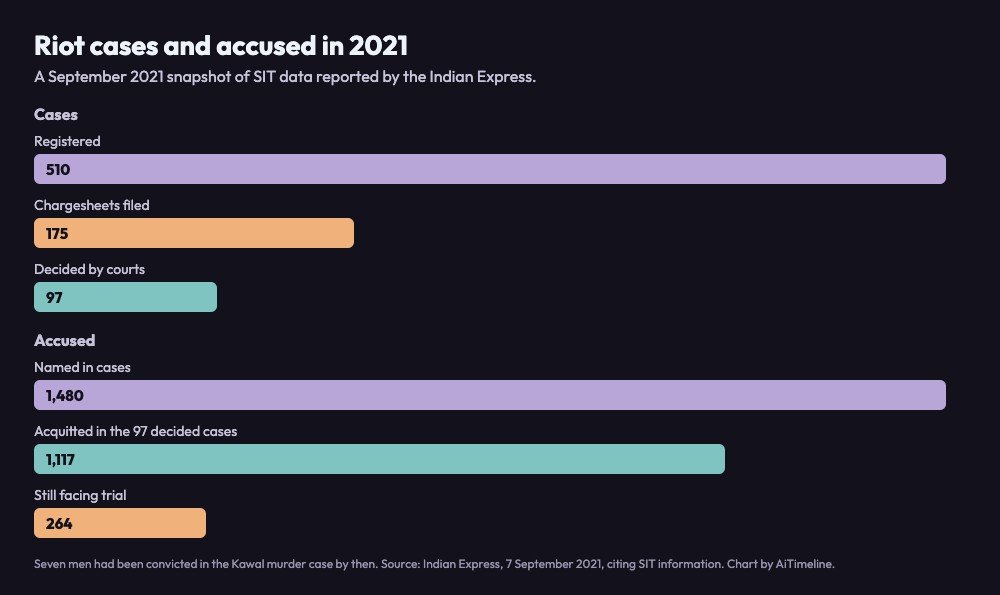
The figures: An Indian Express report based on Special Investigation Team (SIT) information said police had registered 510 cases against 1,480 people and filed chargesheets in 175 cases. Courts had decided 97 cases, acquitting 1,117 accused with lack of evidence cited, and about 264 accused were still facing trial. Seven men had been convicted in the Kawal double-murder case.
How to read it: These are 2021 figures, not a final count. An acquittal means guilt was not proved to the required standard. It does not mean the violence did not happen.
Supreme Court told UP withdrew 77 cases without giving reasons Inquiries and courts
What happened: The amicus curiae told the Supreme Court that Uttar Pradesh had withdrawn 77 riot cases under Section 321 of the Code of Criminal Procedure without giving reasons. On 10 August 2021 the Court had ruled that criminal cases against MPs and MLAs cannot be withdrawn without the permission of the relevant High Court.
A discrepancy: The September 2021 Indian Express report described the state as having decided to withdraw 77 cases, with courts allowing withdrawal in only one at that stage. The two accounts differ on how many withdrawals had actually taken effect.
Court allows UP to withdraw a case against 12 BJP leaders Inquiries and courts
What happened: A special court allowed the Uttar Pradesh government to withdraw a case against 12 BJP leaders, including state minister Suresh Rana, MLA Sangeet Som, former MP Bharatendu Singh and VHP leader Sadhvi Prachi. Earlier in March the same court had accepted a closure report filed by the SIT in a case against Sangeet Som.
Seven men get life for the Kawal murders of Gaurav and Sachin Inquiries and courts
What happened: A Muzaffarnagar court held seven men guilty on 6 February 2019 of killing Gaurav and Sachin in Kawal on 27 August 2013, and sentenced them to life imprisonment on 8 February. The court examined 10 prosecution witnesses and six defence witnesses.
What remained: The killing of Shahnawaz Qureshi is the subject of a separate case against the men accused of it. The sources we found describe that case as still pending.
Sahai Commission report and action-taken report tabled in the Assembly Inquiries and courts
What happened: The one-member commission of retired Allahabad High Court judge Vishnu Sahai had submitted its report of roughly 700 pages in September 2015, after questioning about 377 people. The Uttar Pradesh government tabled the report with its action-taken report in the Assembly on 6 March 2016. Sources give the length as 700 to 775 pages.
Findings: The commission blamed local administrative negligence and intelligence failures. It held a Local Intelligence Unit inspector, Prabal Pratap Singh, mainly responsible for underestimating the 7 September gathering, and recommended departmental action against him and against senior police officer Subhash Chandra Dubey, while crediting Dubey with working to control the violence. It also said the transfers of the district magistrate and the SSP, Surendra Singh and Manjul Saini, fed a perception of bias among Jats.
The fake video: It found that BJP MLA Sangeet Som had uploaded a provocative video that was reportedly shot elsewhere. Critics said the report stopped short of holding politicians or senior state officials accountable.
Supreme Court judgment in Mohd. Haroon v. Union of India Inquiries and courts
The petitions: Writ petitions from victims, the Supreme Court Bar Association and others sought security, a CBI or outside SIT inquiry, FIRs against all culprits, and compensation and rehabilitation. The Court noted that 58 relief camps had been made functional, 41 in Muzaffarnagar and 17 in Shamli.
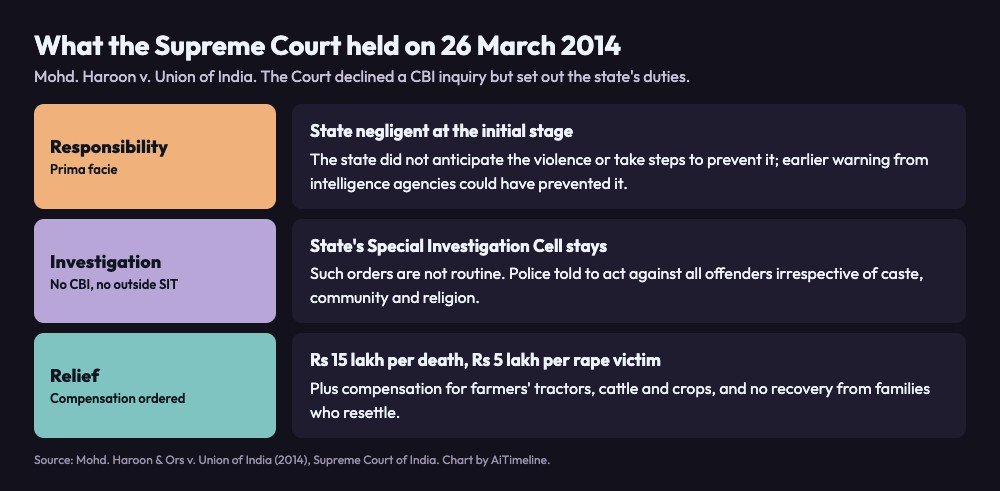
State responsibility: The Court said it prima facie held the state government responsible for being negligent at the initial stage in not anticipating the violence and taking steps to prevent it, and said that earlier warning from central and state intelligence could have prevented it.
Investigation: It declined to order a CBI inquiry or an outside SIT, noting that the state had set up a Special Investigation Cell handling 566 cases, and said such orders are not routine. It directed the police to act against all offenders “irrespective of their caste, community and religion” and to avoid communal bias.
Relief: The state was told to settle compensation of Rs 15 lakh for the families of those killed, pay Rs 5 lakh each to rape victims, compensate farmers for lost tractors, cattle and crops, and allow families that took Rs 5 lakh to resettle where they chose without recovery of the amount. It also said officers responsible for law and order should be brought under the law if negligent.
NHRC notices after reports of children dying in relief camps Violence and displacement
What happened: The NHRC took suo motu cognisance of media reports that at least 40 children had died in relief camps because of extreme cold, with too few blankets, in places including Malakpur in Shamli and Loi in Muzaffarnagar. It issued notices to the UP Chief Secretary and the district magistrates of Muzaffarnagar and Shamli, seeking reports in four weeks. It said most of the dead children were below five.
Caution: The figure of 40 is from the media reports that prompted the notice. It is not a verified toll attributed to camp conditions.
NHRC team finds camp conditions “appalling” Violence and displacement
What the team saw: A team that visited four camps in Shamli on 10 October and three camps and Kutba village in Muzaffarnagar on 11 October found living conditions “appalling”: waterlogged tents, short rations, thin medical care and complaints about the partisan attitude of the police. At Loi camp, where the district health officer denied any deaths, it found that two newborn babies and five others had died.
Education: Students told the team that displacement might stop them from sitting UP Board examinations. The NHRC asked the state to respond within two weeks.
Curfew lifted and army withdrawn; about 42,000 displaced Violence and displacement
What happened: By 17 September the curfew had been lifted from riot-affected areas and the army withdrawn. Reports at that stage counted about 42,000 displaced people. Later estimates are around 50,000, and an official toll of 62 had been reported by 12 September.
Camps: Displaced families sheltered in madrasas, houses, open ground and tents. The Supreme Court later recorded 58 camps.
Violence spreads into villages; army begins evacuations Violence and displacement
What happened: Attacks, arson, looting and killings were reported in several villages. The army began evacuating people on 8 September. Cases later heard by the courts, including Kutba and Mohammadpur Raisingh, trace to attacks on this day.
The geography: Because settlements are spread across villages, it was hard for police and district officials to protect them all. The Supreme Court’s judgment lists Muzaffarnagar, Shamli, Baghpat, Saharanpur and Meerut among the affected districts.
Nagla Mandaur mahapanchayat, then attacks on people returning Violence and displacement
The gathering: A mahapanchayat organised by the Jat community took place at Nagla Mandaur, with attendance reported from over 100,000 to over 150,000 people from Uttar Pradesh, Haryana and Delhi. Police described some speeches as inflammatory. The Supreme Court’s judgment recorded the gathering as the point after which the riot erupted.
The violence: People returning from the gathering were attacked on the road, and reports describe deaths near a canal at Jouli. A news-channel reporter, Rajesh Verma, was killed in Muzaffarnagar city the same day. Counts of the first day’s deaths vary by source.
The failure: The Sahai Commission found that the scale of the gathering was underestimated and not properly monitored.
Meetings and speeches raise the temperature Build-up
What happened: After the Kawal killings, community leaders and politicians held meetings. Reports describe an assembly after Friday prayers on 30 August where BSP and Congress leaders gave inflammatory speeches, and speeches by BJP leaders on 31 August. BSP MP Kadir Rana was later booked for hate speech and surrendered in December 2013. FIRs were registered over several speeches.
What the inquiry looked at: The Sahai Commission examined speeches and mobilisation by leaders from different communities, and a circulating video falsely linked to Kawal.
Three young men are killed in Kawal village Build-up
What happened: Shahnawaz Qureshi was killed in Kawal. Two Hindu youths, the cousins Gaurav and Sachin, were then killed by a mob as they tried to leave. The FIR in Qureshi’s case named seven men.
The trigger is disputed: Accounts describe either a motorbike collision or an alleged eve-teasing episode. The FIR over Qureshi’s death does not mention sexual harassment. The Supreme Court described it as a trivial incident that was given a communal colour.
Why it matters: The Sahai Commission named the Kawal deaths as a key factor in the polarisation that followed. They were the immediate flashpoint, not the whole cause.
What Caused the Muzaffarnagar Riots?
A trigger, a chain and several failures. Not one cause.
The Kawal killings on 27 August 2013 were the trigger. They were not the whole cause. The Sahai Commission and the Supreme Court described a chain: a local killing, communal mobilisation, a misleading video, inflammatory speeches, a very large gathering the administration did not anticipate, and attacks that followed. Each link is described differently by different accounts, so the table below shows who says what.
| Factor | What the record shows | Who says so |
|---|---|---|
| The Kawal killings | Three young men killed on 27 August 2013; the immediate flashpoint | Sahai Commission; Supreme Court |
| Communal polarisation | The deaths were read through community identities and spread into wider mobilisation | Sahai Commission; press reports |
| A misleading video | A video of a beating shot elsewhere was circulated as if it showed Kawal; the commission found an MLA had uploaded it | Sahai Commission, as reported |
| Speeches and gatherings | Leaders of different communities spoke at meetings on 30 and 31 August; the 7 September mahapanchayat drew a very large crowd | Sahai Commission; Supreme Court |
| Intelligence and administrative failure | The gathering was underestimated and badly monitored; the state did not anticipate the violence | Sahai Commission; Supreme Court (prima facie) |
| Political mobilisation | Politicians were charged and investigated over speeches; their individual guilt is a matter for courts | Court records; inquiry observations |
Allegations, inquiry observations and court convictions are not interchangeable. Where a person or group is named, it is because an inquiry, a court or a report named them, not because we attribute guilt to a community.
The Numbers: Deaths, Displacement and Cases
Death and displacement figures differ by source. We give the range and say where each number comes from.
| Figure | What sources say | Note |
|---|---|---|
| Deaths | More than 60; the state told the Court it had compensated the families of 63 deceased; counts of 62 to 65 are reported | Petitioners claimed far more; we found no confirmation |
| Displaced | About 42,000 by 17 September 2013; about 50,000 in later estimates | A petition cited about 40,000 |
| Relief camps | 58, of which 41 in Muzaffarnagar and 17 in Shamli | Supreme Court, 26 March 2014 |
| Mahapanchayat crowd | Over 100,000 to over 150,000 | Estimates differ; the Court recorded the petitioners’ figure |
| Children in camps | At least 40 died, per media reports | Not a verified toll |
| Cases (2021) | 510 cases, 1,480 accused, 97 decided, 1,117 acquitted | A September 2021 snapshot |
What the Supreme Court Said About the State’s Responsibility
The Supreme Court’s 26 March 2014 judgment in Mohd. Haroon v. Union of India is the main legal reference on the state’s duty during communal violence. It found the state prima facie negligent, declined to order a CBI inquiry or an outside SIT, and gave directions on investigation, compensation and rehabilitation.
Court Cases: Convictions, Acquittals and Pending Trials
Hundreds of cases were registered and the outcomes are mixed. The table lists some of the verdicts and proceedings that have been reported. It is a selection, not a full register.
| Case | When | Outcome |
|---|---|---|
| Kawal murders of Gaurav and Sachin | February 2019 | Seven men convicted; life imprisonment |
| Kawal-linked rioting, MLA Vikram Saini and 11 others | October 2022 | Two years in prison; High Court later suspended the sentence |
| Fugana gang rape | May 2023 | Two men convicted; 20 years each |
| Case against 19 people incl. political leaders | January 2025 | Charges framed; no verdict found |
| Mohammadpur Raisingh | February 2026 | 23 acquitted; failed to prove beyond reasonable doubt |
| Kutba | February 2026 | 37 acquitted; failed to prove beyond reasonable doubt |
The acquittals of February 2026 concern specific villages and specific evidence. They are not a ruling on every case from the violence.
Impact of the Muzaffarnagar Riots
Deaths and displacement
More than 60 people died and tens of thousands left their homes, many leaving land, livestock and belongings. Some returned. Others settled elsewhere, because fear and strained relations made return hard.
A second crisis in the camps
The NHRC documented waterlogged tents, short rations and inadequate care in October 2013, and acted on reports of child deaths from cold in December. Children’s schooling and board examinations were disrupted, and farmers lost access to land and income.
Accountability years later
Cases moved slowly. A few produced convictions, including the 2019 Kawal verdict and the 2023 rape conviction. Many others ended in acquittals or withdrawal applications. For how other Indian communal-violence cases played out in court, see our Delhi riots 2020 timeline, 1984 anti-Sikh riots timeline and Manipur violence timeline, or browse the India Political Cases hub.
Politics
The violence reshaped political mobilisation in western Uttar Pradesh. For the later electoral context, see our UP election 2027 timeline.
Six things often told wrongly about the Muzaffarnagar riots
- “The riots began on 7 September.” The chain began with the Kawal killings on 27 August. The violence peaked after the 7 September mahapanchayat.
- “People travelling to the mahapanchayat were attacked.” Reports describe attacks on people returning from it.
- “At least 40 children died in the camps.” That is the figure in the media reports behind the NHRC notice. It is not a verified toll.
- “The Supreme Court ordered a CBI inquiry.” It declined to, and left investigation with the state’s Special Investigation Cell while issuing directions.
- “Acquittals prove nothing happened.” They mean guilt was not proved in that case.
- “The commission blamed one community.” It blamed administrative and intelligence failures and examined speeches by leaders of different communities.
Explore More Timelines
People Also Ask
Muzaffarnagar Riots: Frequently Asked Questions
Conclusion: Preventing the Next Chain
The Muzaffarnagar riots began with a local confrontation and grew through mobilisation, misinformation, inflammatory speeches and failures to prevent escalation. More than 60 people were killed, tens of thousands were displaced, and the criminal cases have run for over a decade.
The Supreme Court’s 2014 judgment and the Sahai Commission both point to the same lesson: timely intelligence, impartial policing, accountability and rehabilitation. The later verdicts show how hard it is to deliver justice when trials take this long.
Related AiTimeline Stories
⚠️ Editorial Note
Last updated 1 November 2026. Dates and holdings follow the Supreme Court judgment of 26 March 2014, NHRC press releases, and press reports of the Sahai Commission and later verdicts. Death, displacement and case figures are reported estimates and snapshots, not a final count. We name individuals only where a court, an inquiry or a report named them, and we do not attribute guilt to any community. The 2021 case statistics come from an Indian Express report of SIT data that we could not open directly. This article is informational and is not legal advice.
Sources & further reading
Every dated entry above was checked against these references. Last reviewed 1 November 2026.
- Supreme Court of India: Mohd. Haroon v. Union of India, judgment of 26 March 2014 (Indian Kanoon)
- National Human Rights Commission: team report on relief and rehabilitation, 21 October 2013
- National Human Rights Commission: notices on children's deaths in relief camps, 26 December 2013
- National Human Rights Commission: statement on riots in Muzaffarnagar, 9 September 2013
- Newslaundry: Muzaffarnagar riots, a case of intelligence failure (Sahai Commission), March 2016
- The Quint: all 23 accused acquitted in 2013 Muzaffarnagar riots case, February 2026
- Scroll: UP court acquits 37 citing lack of evidence, February 2026
- Scroll: UP withdrew 77 riot cases without providing reasons, Supreme Court told, August 2021
- LiveLaw: UP court convicts two in gang rape during 2013 Muzaffarnagar riots, May 2023
- Press Information Bureau: report on Muzaffarnagar disturbances, 17 December 2013