Smoot-Hawley Tariffs: How the 1930 Trade War Hit Global Trade
Smoot-Hawley Tariff Act timeline, 1921-1934: why the US raised tariffs in 1930, how Canada and others retaliated, and what it did to global trade.
Latest Story
The Smoot-Hawley Tariff Act, signed by President Herbert Hoover on 17 June 1930, raised US import duties on thousands of products. It was meant to protect American farmers and manufacturers, but it arrived after the stock market crash, and other countries answered with trade barriers of their own. It did not start the Great Depression, which had already begun, yet it became a lasting warning about what can happen when one country raises trade barriers and its partners respond.
💡 Short Answer
The Smoot-Hawley Tariff Act, signed on 17 June 1930, raised US duties on thousands of goods. Canada and others responded with their own measures, and US exports to retaliating countries fell sharply. The act did not cause the Great Depression, which was already under way, but it added to the collapse of trade at a time when countries needed markets. World trade fell about 66% between 1929 and 1934, from many causes.
Smoot-Hawley: Key Questions
Smoot-Hawley in Nine Points
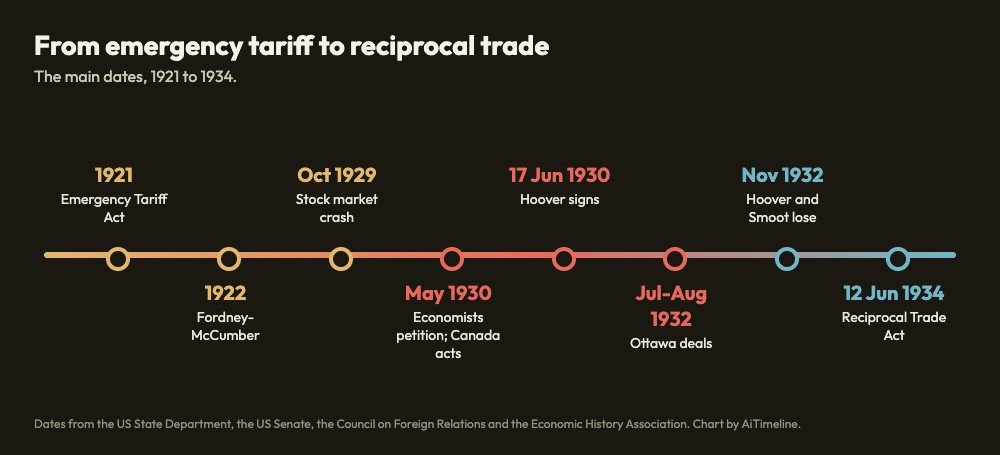
- Origins: post-war farm distress led to the 1921 Emergency Tariff and 1922 Fordney-McCumber, then to Hoover’s 1928 farm-relief pledge.
- Expansion: the bill grew from a farm measure into a general tariff revision as industries lobbied.
- Timing: the crash came in October 1929, before the law; the Depression had already begun.
- Warnings: more than 1,000 economists urged a veto in May 1930; Hoover signed on 17 June.
- Retaliation: Canada acted in May 1930, and an NBER study found US exports fell 28-33% to retaliators.
- Trade collapse: world trade fell about 66% in 1929-34, from many causes at once.
- Not alone: banking failures, deflation, debt and falling demand also drove the crisis.
- Politics: Smoot lost his Senate seat in 1932 and Hawley lost his primary; Hoover lost to Roosevelt.
- Reversal: the 1934 Reciprocal Trade Agreements Act turned US policy towards negotiated tariff cuts.
Smoot-Hawley Timeline: From the 1921 Emergency Tariff to the 1934 Reversal, Latest First
Each entry is colour-coded by period. Dates and figures follow official records and the sources listed below.
Roosevelt signs the Reciprocal Trade Agreements Act Fallout and reversal
What happened: President Franklin D. Roosevelt signed the Reciprocal Trade Agreements Act. It let the president negotiate tariff reductions with other countries, instead of leaving every duty to be set by Congress line by line.
What changed: The US State Department says that from this act on, the United States sought trade liberalisation through bilateral or multilateral tariff cuts. Smoot-Hawley’s product-by-product bargaining was the model the law was meant to replace.
World trade bottoms out Fallout and reversal
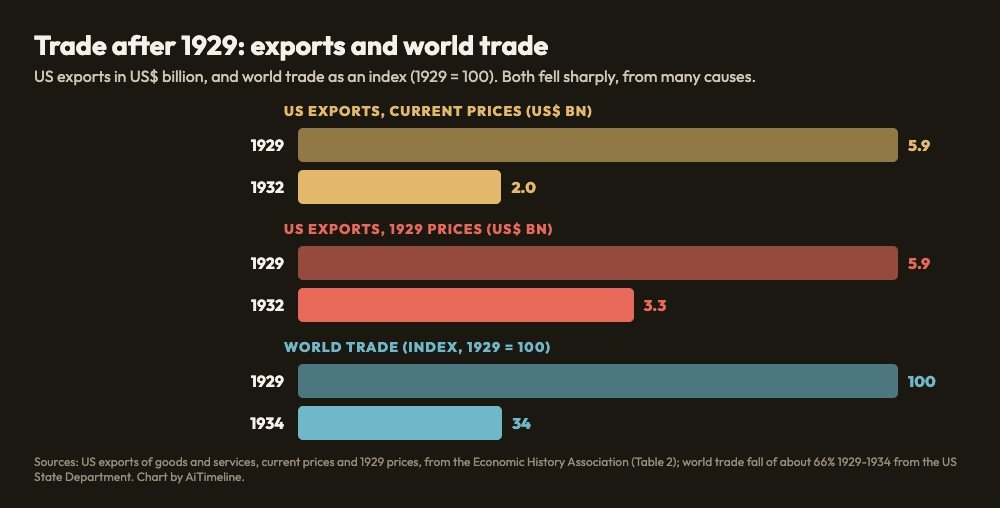
The numbers: The US State Department says world trade declined by about 66% between 1929 and 1934. US exports of goods and services fell from about US$5.9 billion in 1929 to about US$2.0 billion in 1932 and 1933 in current prices; in 1929 prices the fall was about 44%, because prices were falling too.
What caused it: Tariffs, quotas and currency controls were part of the story. So were collapsing incomes, deflation, bank failures and debt problems. No source can cleanly split the 66% between them.
A careful estimate: Economic historian Anthony O’Brien calculates that the 1929-31 fall in US real exports could explain at most about a fifth of the 16.5% fall in real GDP over those years. He calls that an upper bound, since not all of the export decline came from retaliation.
Hoover, Smoot and the Republican majority lose Fallout and reversal
The results: Franklin D. Roosevelt beat Herbert Hoover, who took under 40% of the popular vote and 59 electoral votes, according to the Council on Foreign Relations. Reed Smoot lost his Utah Senate seat to Democrat Elbert D. Thomas, and Democrats won large majorities in Congress.
Hawley: Willis C. Hawley was not beaten in the November vote. He lost the Republican primary for his Oregon House seat earlier in 1932 and left office in March 1933.
How much was the tariff?: It was one issue among many in an election dominated by unemployment, bank failures and falling farm prices. The result cannot be read as a vote on tariffs alone.
Canada turns to Empire preference at Ottawa Act and retaliation
What happened: At the Ottawa Imperial Economic Conference, Canada struck a series of bilateral trade deals with Britain and other parts of the Empire. Canada lowered duties on British goods and kept higher ones on non-British goods, including those from the United States.
What it shows: Canada had already acted against US goods in 1930. Ottawa locked in a shift of trade towards the Empire, which softened the Depression for Canada but did not replace the US market.
The crisis deepens beyond trade Act and retaliation
Beyond tariffs: In 1931 bank failures spread across Europe, and Britain raised tariffs. According to the Economic History Association, Smoot-Hawley did not significantly affect Britain’s decision. Countries used tariffs, quotas and currency controls for their own reasons.
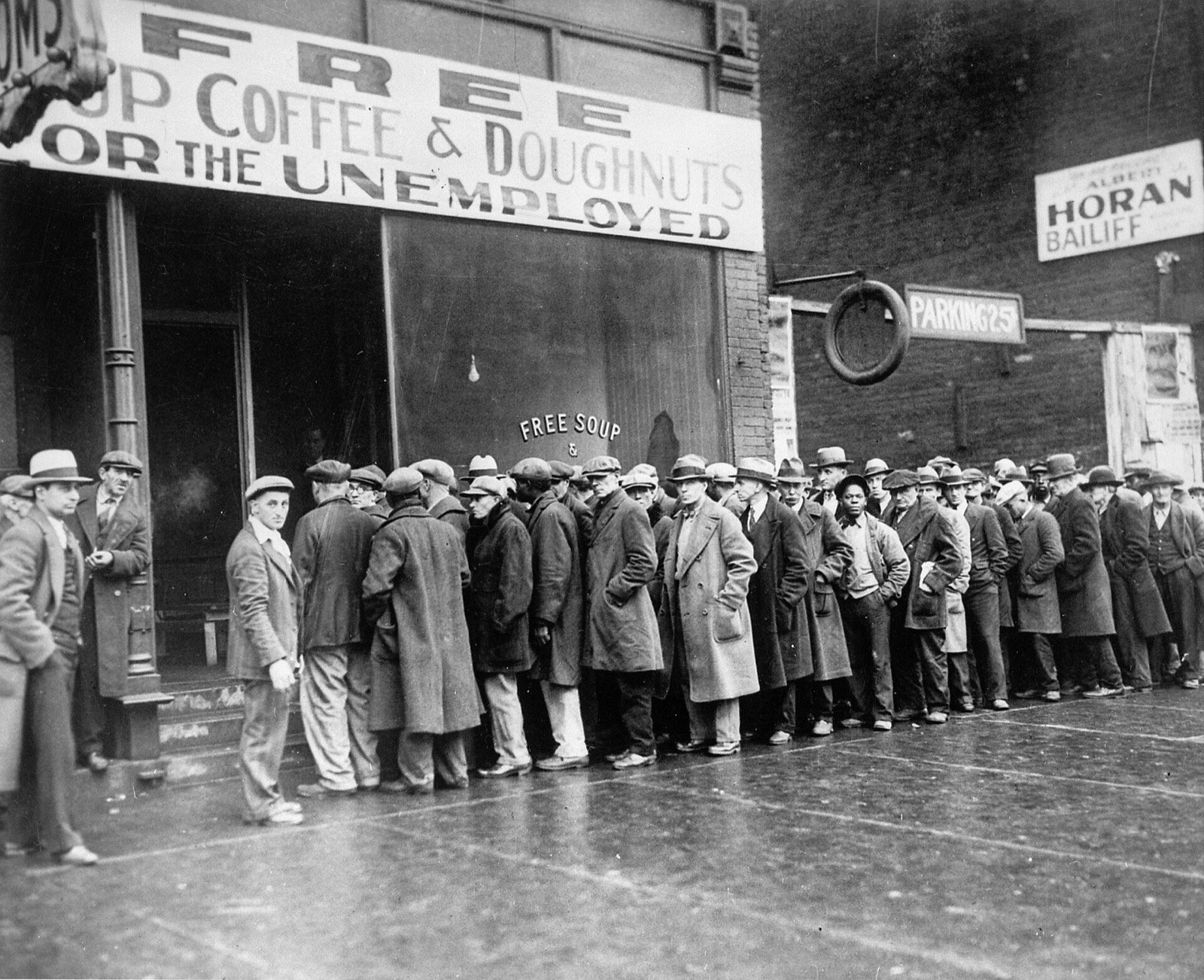
In the US: By February 1931 men were queuing for free soup in Chicago. The country’s unemployment crisis was driven mainly by collapsing demand and bank failures, which Smoot-Hawley neither started nor ended.
Other governments protest and respond Act and retaliation
The protests: Governments objected to the act, and many acted. A 2021 NBER study of 99 countries by Kris James Mitchener, Kirsten Wandschneider and Kevin Hjortshoj O’Rourke documents a trade war after the act. Canada’s new government under R. B. Bennett, elected in August 1930, kept the higher duties on US goods. Reports also say Spain raised duties on US cars.
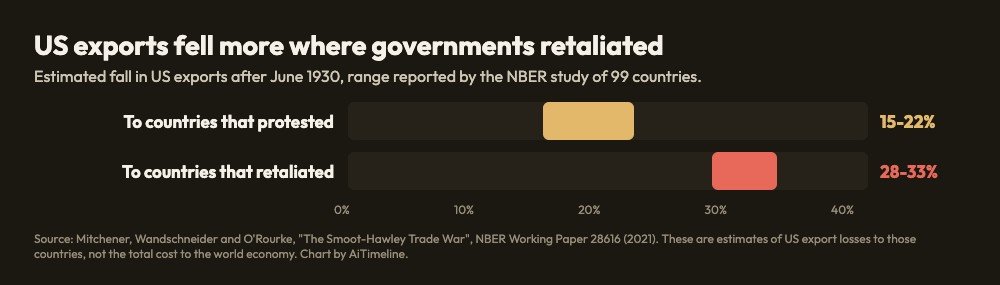
The scale: The study found US exports fell by 15-22% to countries that protested and by 28-33% to countries that retaliated. Those are export estimates for the US only, not a total cost for the world economy.
Hoover signs the Tariff Act of 1930 Act and retaliation
What happened: President Herbert Hoover signed the act despite a petition from more than 1,000 economists urging him to veto it. Industrialists, including Henry Ford, also criticised it. Hoover had privately worried about foreign retaliation but signed.
What it did: The act raised duties on thousands of imports. The Tariff Commission calculated that the average duty on dutiable imports rose by about 2.5 percentage points on the 1928 import mix, from 38.5% to 41.1%. Because many duties were fixed amounts, not percentages, they bit harder as prices fell: one widely cited estimate puts the average on dutiable imports near 59% by 1932.
Congress approves the conference bill Road to the act
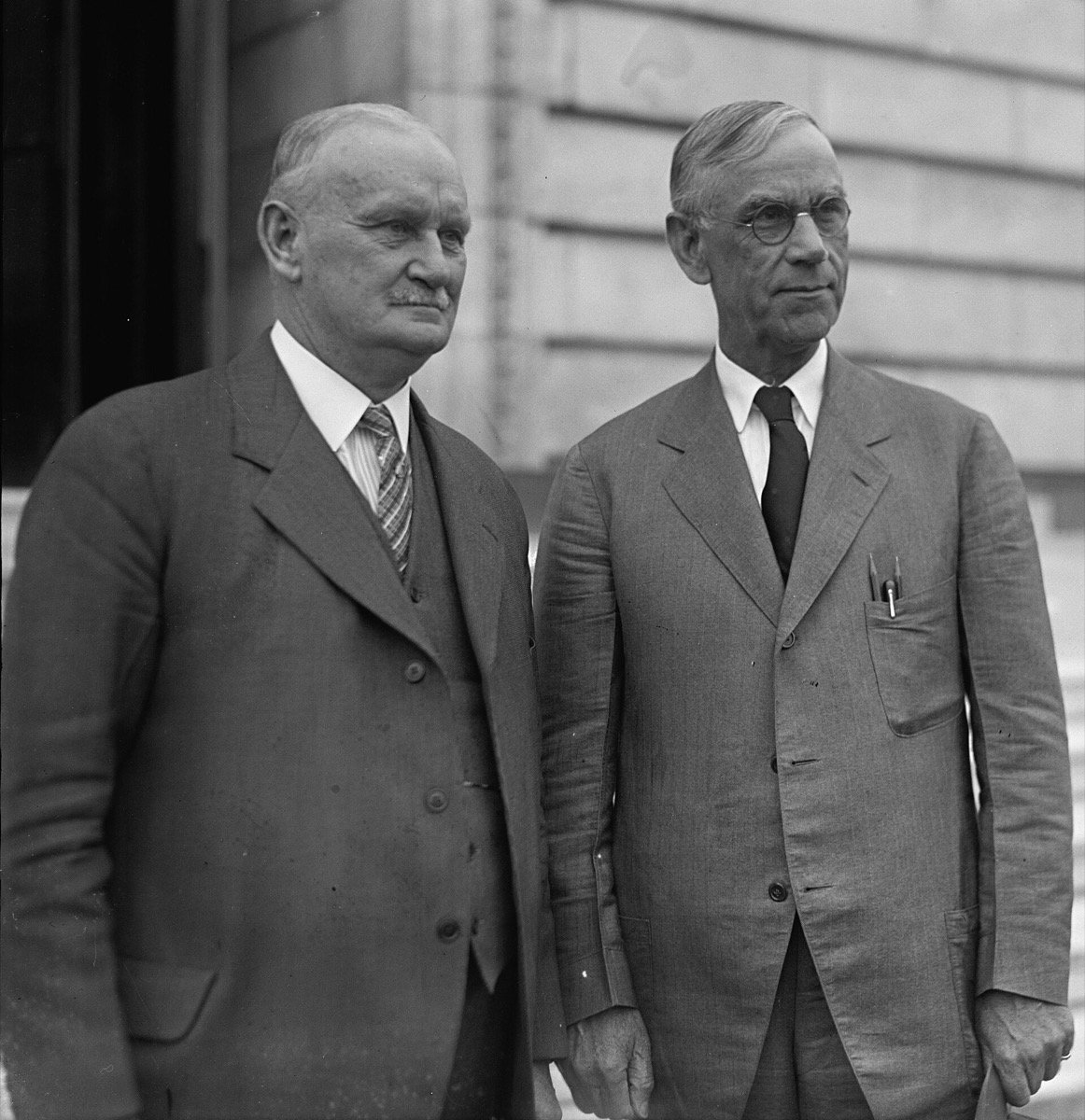
What happened: The Senate agreed to the conference report on 13 June 1930, 44 to 42 on final passage, and the House followed on 14 June. Sources disagree on the House tally: the Economic History Association gives 245-177, while other accounts give 222-153.
Why it matters: The votes were close in the Senate and largely along party lines, even though many economists and some business leaders opposed the bill.
Economists petition; Canada acts first Road to the act
The petition: In May 1930 more than 1,000 US economists signed a petition asking Hoover to veto any tariff bill that passed. The signatories warned of retaliation and of damage to American exports.
Canada: The same month Canada imposed countervailing duties on 16 US products, covering about 30% of US merchandise exports to Canada, according to the Economic History Association. A Journal of Economic History study argues Canada’s 1930 increases were direct responses to Smoot-Hawley.
The Senate passes its own version Road to the act
What happened: The Senate passed its version of the bill on 24 March 1930 after months of debate. The two chambers then had to reconcile different bills.
How different: The Council on Foreign Relations notes that the House version raised rates on 845 products and cut them on 82, while the Senate version raised rates on 890 products and cut them on 235.
The stock market crashes while the bill is in the Senate Road to the act
What happened: Share prices collapsed in late October 1929. The Depression was already beginning, and the tariff bill was still being debated in the Senate.
Why the order matters: The crash came before the tariff law. That is why Smoot-Hawley cannot have started the Depression, although it was signed into law during it. For the crash itself, see our Wall Street Crash timeline.
The House passes the bill Road to the act
What happened: The House passed its tariff bill in late May 1929. The US Senate’s historical account gives 28 May, while the Ways and Means Committee’s history gives 29 May; the day matters little to the story.
The bill’s shape: The House bill raised many farm duties but also raised duties on manufactured goods, a sign of how far the measure had moved from its farm-relief origin.
Hoover takes office with a farm promise Road to the act
What happened: Herbert Hoover became the 31st president. He had campaigned on helping farmers, whose incomes were under pressure, and he asked Congress for a limited tariff revision as part of farm relief.
What went wrong: Once Congress opened the tariff schedules, industries and regions lobbied for their own protection, and the limited revision grew into a general one.
Hoover campaigns on farm relief Road to the act
What happened: During the 1928 campaign Hoover promised help for American farmers, including higher tariffs on farm imports.
The background: Farmers had expanded output to meet wartime demand. After European agriculture recovered, supply rose, prices fell and farm incomes were squeezed through the 1920s.
Fordney-McCumber raises US duties Road to the act
What happened: The Fordney-McCumber Tariff raised US duties above the level set in 1913 and let the president adjust rates by up to 50%.
Why it matters: It made it harder for European countries to earn dollars by exporting to America at a time when they owed war debts. Smoot-Hawley escalated an existing policy rather than starting protectionism.
Emergency Tariff Act protects farmers Road to the act
What happened: Congress passed the Emergency Tariff Act of 1921 to shield farmers as European output recovered after the First World War. It marked a return to higher duties after the lower-tariff Underwood-Simmons Tariff of 1913.
How the Tariff Bill Grew: House, Senate and Final Act
Each chamber rewrote the duties line by line, which is how a farm bill became a general tariff.
| Stage | Date | What it did |
|---|---|---|
| House bill | Passed late May 1929 | Raised rates on 845 products and cut them on 82 (Council on Foreign Relations) |
| Senate bill | Passed 24 March 1930 | Raised rates on 890 products and cut them on 235 (Council on Foreign Relations) |
| Conference report | Senate 13 June, House 14 June 1930 | Reconciled the two bills; Senate final vote 44-42 |
| Signed into law | 17 June 1930 | Tariff Act of 1930, signed by Hoover despite a petition from more than 1,000 economists |
| Average duty on dutiable imports | 1928 import mix | About 38.5% under Fordney-McCumber against 41.1% under Smoot-Hawley (Tariff Commission, via the Economic History Association) |
How Far Did Trade Fall After 1929?
US exports of goods and services fell from about US$5.9 billion in 1929 to about US$2.0 billion in 1932 in current prices, a fall of about two-thirds, but about 44% once price falls are removed. World trade fell by about 66% between 1929 and 1934, according to the US State Department. These are dated figures for the whole Depression period, not the effect of one law.
| Measure | 1929 | Early 1930s | Note |
|---|---|---|---|
| US exports of goods and services, current prices | US$5.9 billion | US$2.0 billion (1932) | About a two-thirds fall in value |
| US exports, constant 1929 prices | US$5.9 billion | US$3.3 billion (1932) | About a 44% fall once prices are held fixed |
| World trade | 100 (index) | About 34 (1934) | Fall of about 66% (US State Department) |
| US exports to Europe | US$2,341 million | US$784 million (1932) | US State Department figures |
| US imports from Europe | US$1,334 million | US$390 million (1932) | US State Department figures |
Who Retaliated Against Smoot-Hawley?
Retaliation is documented, though its scale is debated.
Canada: the clearest case
Canada imposed countervailing duties on 16 US products in May 1930, covering about 30% of US merchandise exports to Canada. A Journal of Economic History study argues Canada’s 1930 increases were direct responses to Smoot-Hawley. In 1932 Canada turned to Empire preference at the Ottawa conference. For the later history of US-Canada tariff fights, see our US-Canada tariffs timeline.
Spain and others
Reports say Spain raised duties on American cars, and the NBER dataset of 99 countries documents a wider pattern of protests and retaliation. Historians disagree over how large it was: the Economic History Association says one earlier writer overstated it.
Britain: not mainly a response
Britain raised tariffs in 1931, but the Economic History Association says Smoot-Hawley did not significantly affect that decision. Not every trade barrier of the 1930s was a reaction to the United States.
Did Smoot-Hawley Cause the Great Depression?
No. It contributed to the contraction of trade within a wider crisis.
The Great Depression was already under way when Smoot-Hawley became law. The stock market had crashed in October 1929, banks were failing, prices were falling and demand was weakening. The tariff arrived into that crisis; it did not create it.
What the tariff did was add a trade barrier at the wrong moment. It closed some export markets for American farmers and manufacturers, invited retaliation and made international cooperation harder when countries were struggling over war debts, currencies and falling prices.
Historians weigh it differently. The US State Department notes that scholars disagree over how much protection the act actually gave and whether it provoked a wave of retaliation. The best-documented effect is on US exports to countries that responded. For the wider crash and what followed, see our Wall Street Crash timeline, and for the monetary system that came out of the era, our history of the Bretton Woods collapse.
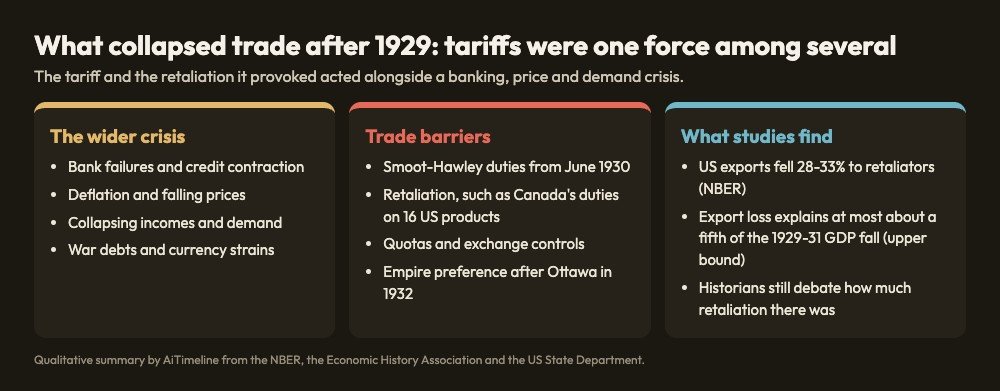
| Force | How it hit trade | Caution |
|---|---|---|
| Collapsing demand | Falling incomes and unemployment meant households and firms bought fewer imports | Hits trade even with no tariffs at all |
| Deflation | Falling prices cut the dollar value of trade and made fixed-amount duties heavier | Part of the 1929-34 fall is a price effect, not a volume effect |
| Bank failures and debt | Credit for trade dried up and debtors struggled to earn foreign currency | Banking crises spread across Europe in 1931 |
| Currency and gold-standard strains | Countries defended exchange rates with controls, quotas and higher duties | Policies differed country by country |
| Tariffs and retaliation | Higher duties, including Smoot-Hawley and the responses to it, closed some markets | Best documented in US exports to retaliating countries |
What Smoot-Hawley Changed: From Tariff Spiral to Reciprocal Trade
After 1934 the United States moved to negotiated tariff cuts through the Reciprocal Trade Agreements Act. The idea that trade barriers should be bargained down, not raised unilaterally, later shaped the post-war General Agreement on Tariffs and Trade (GATT) and the World Trade Organization. Smoot-Hawley did not create those institutions, but it became an enduring reference point in arguments about protectionism.
It is also often invoked in modern tariff disputes. Comparisons need care: the 1930s economy had a gold-standard system, collapsing banks and far less trade in components than today. For modern trade tests, see our timelines on the NAFTA and USMCA saga, the China export boom and the history of US secondary sanctions.
The narrow lesson is not that every tariff causes a depression. It is that trade restrictions can have consequences beyond a country’s borders, and that retaliation can leave exporters, firms and consumers on both sides worse off.
The Terms Behind the Headlines
Specific and ad valorem duties
An ad valorem duty is a percentage of an import’s value. A specific duty is a fixed amount per unit, such as cents per pound.
When prices fell in the early 1930s, specific duties took a larger share of the price, so the effective burden of the tariff rose even though the law had not changed.
Protest versus retaliation
The NBER study separates governments that complained to Washington from those that imposed their own measures. US exports fell 15-22% to the first group and 28-33% to the second.
These are estimates of US export losses, not of the total cost to any economy.
Beggar-thy-neighbour
The phrase describes policies that help one country at its partners’ expense. Raising tariffs to protect domestic producers is the classic example.
If partners respond in kind, trade shrinks for everyone, which is why Smoot-Hawley became its standard historical case.
Six things often told wrongly about Smoot-Hawley
- “Smoot-Hawley caused the Great Depression.” It did not. The Depression began after the 1929 crash and was driven by banking failures, deflation, falling demand and debt problems. The tariff worsened the trade collapse.
- “It cut world trade by two-thirds.” World trade fell by about 66% between 1929 and 1934, but that figure covers every cause, including deflation and the collapse of demand.
- “The NBER study measures the global cost.” It estimates falls in US exports to protesting and retaliating countries (15-22% and 28-33%). It is not a total cost for the world economy.
- “Smoot and Hawley were both voted out in November 1932.” Smoot lost his Senate seat in the general election. Hawley lost his Republican primary earlier in the year.
- “The House vote was 222-153.” Sources differ: 222-153 appears in some accounts and 245-177 in the Economic History Association’s. The Senate vote of 44-42 is consistent.
- “It started US protectionism.” It escalated it. The Emergency Tariff of 1921 and Fordney-McCumber in 1922 had already raised duties.
Explore More Timelines
People Also Ask
Smoot-Hawley Tariffs: Frequently Asked Questions
Conclusion: The Danger of a Tariff Spiral
The Smoot-Hawley Tariff Act began as an attempt to protect American farmers and grew into a sweeping increase in duties. It was passed into a collapsing economy, provoked responses from trading partners and added to the contraction of world trade.
It did not create the Great Depression, and the evidence does not support blaming it for the whole fall in trade. What the record does support is narrower: tariffs can invite retaliation, retaliation costs exporters, and a fall in trade is hard to reverse once partners stop cooperating. That is why 1930 remains a warning about domestic protection and international cooperation pulling in opposite directions.
Related AiTimeline Stories
⚠️ Editorial Note
Last updated 1 November 2026. Dates and figures follow the US State Department Office of the Historian, the US Senate and House histories, the Council on Foreign Relations, the Economic History Association and the NBER. Where sources differ, such as the exact House passage day in 1929 and the House vote tally in 1930, we say so. We do not say Smoot-Hawley caused the Great Depression; the NBER export estimates refer to US exports to protesting and retaliating countries, not to the global economic cost. Articles here are informational and not investment or trade advice.
Sources & further reading
Every dated entry above was checked against these references. Last reviewed 1 November 2026.
- US Department of State, Office of the Historian: Protectionism in the Interwar Period
- US Senate Historical Office: The Senate Passes the Smoot-Hawley Tariff
- US House of Representatives: The Committee on Ways and Means, A History 1789-2019
- NBER: The Smoot-Hawley Trade War (Working Paper 28616)
- Council on Foreign Relations: Herbert Hoover Signs the Smoot-Hawley Tariff Act
- Economic History Association: The Smoot-Hawley Tariff (Anthony O'Brien)
- Journal of Economic History: Trade Wars, Canada's Reaction to the Smoot-Hawley Tariff