National Herald Case Explained: What Was Alleged, What Was Proved & Why It Matters
National Herald case explained: AJL, Young Indian, Swamy's complaint, the ED probe and the 2026 court status. What is alleged, documented and proved.
Latest Story
The National Herald case is about how Young Indian, a not-for-profit company in which Sonia Gandhi and Rahul Gandhi hold 76%, came to control Associated Journals Limited, the publisher of the newspaper Jawaharlal Nehru founded in 1938. Subramanian Swamy alleges cheating and conspiracy; the Enforcement Directorate alleges money laundering and has attached about ₹751.9 crore of assets. As of 2 November 2026, no court has convicted anyone. This record separates what is documented from what is alleged and from what is still undecided.
💡 Short Answer
In 2010-11 the Congress assigned a ₹90 crore debt owed by AJL to Young Indian for ₹50 lakh, and AJL converted it into shares, giving Young Indian about 99% of AJL. Swamy’s 2012 complaint led to summons in 2014. The ED attached assets in 2023 and named the Gandhis in 2025, but a court refused to take cognisance in December 2025. The ED’s appeal is pending. There is no conviction.
National Herald Case: Key Questions
The National Herald Case in Nine Points
- The paper: founded by Nehru in 1938, published by AJL, stopped printing in 2008.
- The debt: AJL owed the Congress about ₹90 crore in interest-free loans.
- The transaction: the debt went to Young Indian for ₹50 lakh and became about 99% of AJL.
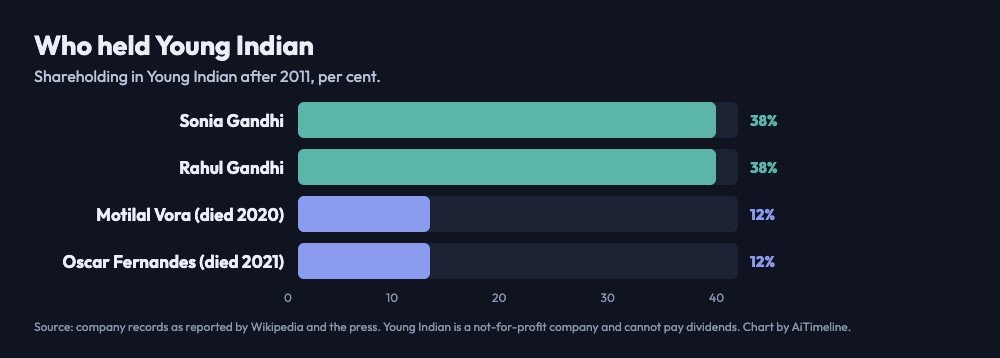
- The owners: Sonia and Rahul Gandhi held 76% of Young Indian.
- The complaint: Swamy alleged cheating and conspiracy in 2012; summons followed in 2014.
- The courts: the High Court (2015) and Supreme Court (2016) refused to quash; neither decided guilt.
- The ED: questioned the Gandhis in 2022, attached ₹751.9 crore in 2023 and filed a complaint in 2025.
- The setback: a court refused cognisance in December 2025 because the case rested on a private complaint.
- The verdict: there is none. No one has been convicted.
Where each part of the case stands
- Swamy’s private complaint (2012): pending before the MP-MLA court at Rouse Avenue, at the evidence stage. The accused are on bail. No verdict.
- ED money-laundering case: the trial court refused to take cognisance of the ED’s prosecution complaint on 16 December 2025. The ED’s revision petition is pending in the Delhi High Court; interim relief was refused on 12 October 2026.
- Delhi Police FIR (3 October 2025): under investigation. We found no report of a police chargesheet.
- Attached properties: about ₹751.9 crore, provisionally attached in 2023, confirmed by the Adjudicating Authority in 2024, possession notices in 2025. Not confiscated.
- Convictions: none.
National Herald Case Timeline, 1938 to 2026, Latest First
Entries are colour-coded by track. Dates follow court records and press reports, and we say where they differ.
High Court refuses ED’s request to freeze the status quo on attached assets ED, tax and police
What happened: The ED asked the court to order the status quo on the properties it had attached, saying the accused were relying on the trial court’s December 2025 order to seek their release before a tribunal. Justice Datta declined to pass any interim order and said he would decide the ED’s petition finally. A separate report says the court also refused to restrain AJL from applying for release of the attached properties.
Next date: One report lists the next hearing on 2 November 2026; PTI says only ‘November’. As of publication we have not seen a report of what happened at that hearing.
What this is not: Refusing interim relief is not a ruling on the merits. The attachments stay in place until a court or tribunal says otherwise.
The ED’s High Court challenge is heard and repeatedly adjourned ED, tax and police
What happened: On 19 February 2026 Justice Swarana Kanta Sharma noted that the matter needed a substantive hearing and listed arguments for 9 March. The case was then renotified for 20 April and, according to India TV, deferred to 25 May. On 10 September Justice Manoj Jain deferred it again, to 9 October.
The ED’s argument: Solicitor General Tushar Mehta argued that the trial court’s reading would make the money-laundering law ‘otiose and redundant’, and that a court’s cognisance of a private complaint stands on a higher footing than a police FIR.
The defence: Sonia Gandhi and Rahul Gandhi have called the ED’s plea an abuse of the process of law and said the trial court’s order is legally sound.
ED appeals; High Court issues notice to the Gandhis ED, tax and police
What happened: The ED challenged the 16 December order in the Delhi High Court. Justice Ravinder Dudeja issued notice to Sonia Gandhi, Rahul Gandhi and the other respondents on the main petition and on the ED’s request to stay the trial court’s order, and listed the case for March 2026.
Status: Issuing notice means the court will hear the other side. It does not mean the High Court agreed with the ED.
Trial court refuses to take cognisance of the ED’s complaint ED, tax and police
What happened: Special Judge Vishal Gogne held that taking cognisance of the ED’s money-laundering complaint was ‘impermissible in law’ because it was founded on Subramanian Swamy’s private complaint and a summoning order, not on a registered FIR for the underlying offence. He said the ED could continue its investigation.
The new FIR: Because the Delhi Police had by then registered an FIR, the judge said it would be premature to decide the merits. In a related order he held that the accused were not entitled to a copy of that FIR, though they could be told it existed.
Reactions: The Congress said ‘truth has prevailed’. BJP spokesperson Shehzad Poonawalla said the order was neither a setback for the ED nor a clean chit, because it did not comment on the merits.
Swamy’s private complaint is listed for evidence Swamy’s complaint
What happened: The court noted that an earlier Delhi High Court stay had not been extended and listed the original 2012 complaint for evidence on 29 November 2025. Swamy told the court he intended to withdraw an appeal pending in the High Court.
Stage: This case is still at the evidence stage, 13 years after it was filed. The accused are on bail. We found no report of a trial verdict as of 2 November 2026.
Delhi Police registers a fresh FIR on the ED’s complaint ED, tax and police
What happened: On a complaint by an ED assistant director, the Economic Offences Wing registered an FIR alleging criminal conspiracy, dishonest misappropriation, criminal breach of trust and cheating (IPC sections 120B, 403, 406 and 420). It names Sonia Gandhi, Rahul Gandhi, Sam Pitroda, Suman Dubey, Sunil Bhandari, Young Indian, Dotex Merchandise and AJL. The ED used its power under Section 66(2) of the PMLA to share information with the police.
When it became public: The FIR was dated 3 October but was first reported on 30 November 2025.
Why it matters: An FIR can supply the ‘scheduled offence’ base that the trial court later said was missing. Reports in December 2025 said the ED planned a fresh prosecution complaint once the police filed their own chargesheet. We found no report that either had been filed as of 2 November 2026.
ED files its prosecution complaint naming Sonia and Rahul Gandhi ED, tax and police
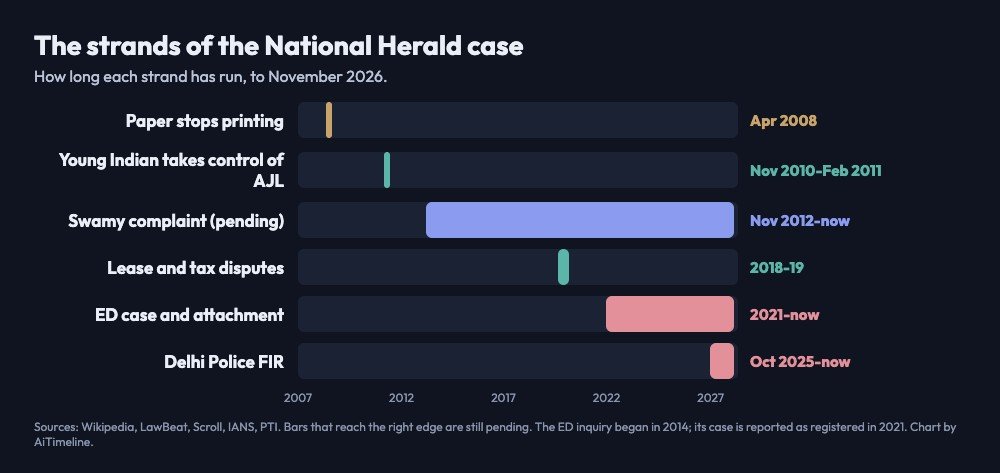
What happened: The ED filed a prosecution complaint, its equivalent of a chargesheet, naming Sonia Gandhi, Rahul Gandhi, Sam Pitroda, Suman Dubey and others. The court fixed 25 April for arguments on cognisance.
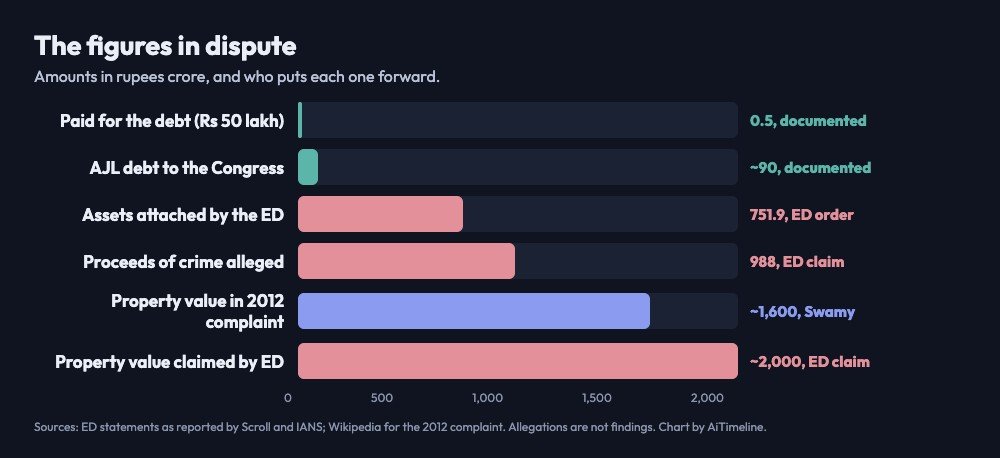
What the ED alleges: That Young Indian took control of AJL properties the ED values at about ₹2,000 crore for ₹50 lakh, and that the proceeds of crime total ₹988 crore. It also alleges about ₹18 crore in bogus donations, ₹38 crore in bogus advance rent and ₹29 crore in bogus advertisements.
Status: These are the agency’s allegations. The trial court refused to take cognisance of this complaint on 16 December 2025, so no court has tested them.
ED pastes possession notices on AJL properties ED, tax and police
What happened: The ED pasted notices to take possession of AJL properties it values at ₹661 crore: Herald House in Delhi, the Herald House building in Bandra, Mumbai, and the AJL building in Lucknow. A notice was also served on a tenant occupying three floors of the Mumbai building, telling it to pay rent to the ED.
What it means: Taking possession under PMLA is an interim step after attachment has been confirmed. Ownership does not pass to the government unless a court later orders confiscation.
PMLA Adjudicating Authority confirms the attachment ED, tax and police
What happened: The authority upheld the November 2023 attachment of about ₹751.9 crore of assets, saying it believed they were proceeds of crime linked to money laundering.
What it is: The Adjudicating Authority is a quasi-judicial body, not a criminal court. Confirmation keeps the assets frozen while the case proceeds. It is not a conviction and not confiscation, and it can be appealed to the Appellate Tribunal.
ED provisionally attaches ₹751.9 crore of assets ED, tax and police
What happened: The ED attached AJL immovable properties in Delhi, Mumbai and Lucknow worth ₹661.69 crore and Young Indian’s equity shares in AJL worth ₹90.21 crore.
Responses: The Congress said the action was an attempt to divert attention from expected defeats in the state elections then under way. The ED said AJL held proceeds of crime in the form of the properties.
ED questions Rahul and Sonia Gandhi and searches Herald House ED, tax and police
Rahul Gandhi: He was questioned over five days, 13 to 15 June and 20 and 21 June 2022. Reported totals range from about 40 hours to more than 50 hours.
Sonia Gandhi: After a delay because she had Covid-19, she was questioned in three rounds in late July 2022, for more than 11 hours in all according to Business Today.
Searches: On 2 August the ED searched Herald House and 11 other locations. On 3 August it temporarily sealed Young Indian’s office in Herald House because no one was available there to complete the search.
Status: Being questioned is not an accusation of guilt. Neither was arrested.
ED registers a money-laundering case ED, tax and police
What happened: The ED had made inquiries since 2014, and reports say it registered its money-laundering case (an Enforcement Case Information Report, or ECIR) in 2021, using the magistrate’s 2014 summoning order in the Swamy complaint as the base offence.
Date note: The ED has not published the ECIR, and reports give only the year. Its dependence on the private complaint is the point the trial court later rejected.
Supreme Court lets the income tax reassessment go ahead ED, tax and police
What happened: The court allowed the Income Tax Department to continue reassessing the 2011-12 incomes of Sonia Gandhi, Rahul Gandhi and Oscar Fernandes, but barred it from giving effect to any demand while appeals were pending. The Delhi High Court had earlier refused to stop the reopening of the assessments.
The department’s case: It argued that Rahul Gandhi had not disclosed his Young Indian directorship and that the shareholders had not disclosed their shares, and that his income for that year should have been about ₹154 crore rather than about ₹68 lakh.
Status: This is a tax dispute, separate from the criminal case. We did not find a final Supreme Court ruling on the appeals.
Government ends the Herald House lease; Supreme Court later stays eviction Corporate transactions
What happened: The Land and Development Office ended AJL’s 56-year lease of Herald House in Delhi, saying no press had run there for about 10 years and the building was being used commercially. It also argued that transferring 99% of AJL’s shares to Young Indian breached the lease.
Court route: A single judge of the Delhi High Court dismissed AJL’s challenge in December 2018, and a Division Bench upheld that on 28 February 2019. On 5 April 2019 the Supreme Court stayed the eviction and issued notice on AJL’s appeal.
Status: We found no report of a final Supreme Court decision on the lease.
Supreme Court refuses to quash, but exempts personal appearance Swamy’s complaint
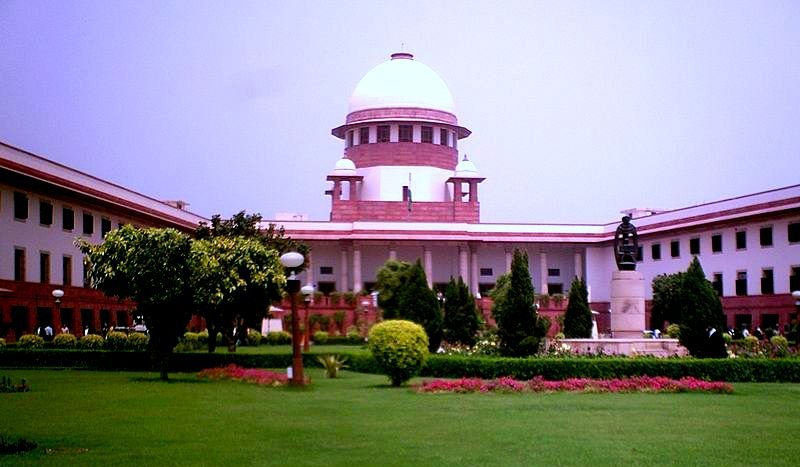
What happened: The Supreme Court declined to quash the criminal proceedings but exempted all five accused from personal appearance. It said the accused could raise their objections before the trial court, and that the magistrate could seek their presence at any stage. Reports say it also expunged adverse remarks the High Court had made.
What it means: The case could continue to trial. Nothing in the order found anyone guilty.
Sonia and Rahul Gandhi appear in court and get bail Swamy’s complaint
What happened: Sonia Gandhi, Rahul Gandhi and the other accused who appeared were granted bail. Sam Pitroda was not present that day. The next date was set for 20 February 2016.
What bail means: Bail lets an accused stay free while a case is pending. It says nothing about guilt.
Delhi High Court refuses to quash the summons Swamy’s complaint
What happened: Justice Sunil Gaur dismissed the pleas to quash the summons and refused to extend a stay that had been in place since 6 August 2014, so the accused had to appear before the trial court.
The remarks: The judge’s observations about the transactions were widely reported as finding a prima facie case. A prima facie view at the summons stage only means there is enough to proceed. The Supreme Court later expunged adverse remarks.
Magistrate summons Sonia Gandhi, Rahul Gandhi and four others Swamy’s complaint
What happened: The magistrate found a prima facie case on Swamy’s complaint and summoned Sonia Gandhi, Rahul Gandhi, Motilal Vora, Oscar Fernandes, Suman Dubey and Sam Pitroda to appear on 7 August 2014.
Sections: Sections 403 (dishonest misappropriation), 406 (criminal breach of trust) and 420 (cheating), read with 120B (criminal conspiracy) of the Indian Penal Code, according to press reports of the order.
Date note: Most reports date the order 26 June 2014; one report dated 26 June says the court acted the day before.
Subramanian Swamy files a private criminal complaint Swamy’s complaint
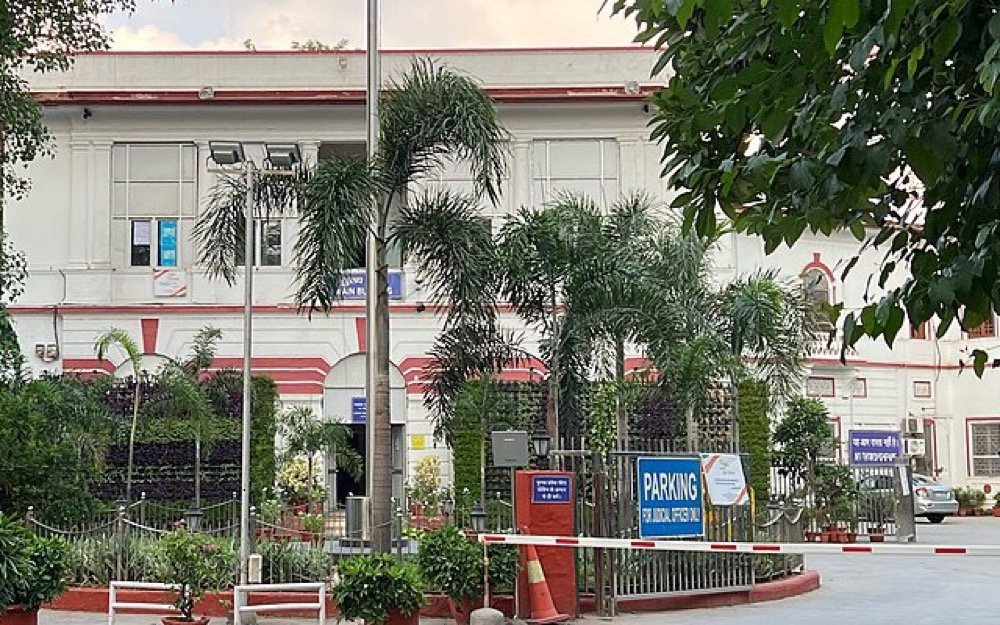
What happened: Swamy, then of the Janata Party and later of the BJP, filed a private complaint alleging that Sonia Gandhi, Rahul Gandhi and others conspired to cheat and misappropriate AJL’s assets through Young Indian. He put the value of the properties at about ₹1,600 crore.
Private complaint: A private complaint is filed by a citizen directly before a magistrate. No police investigation is required for the court to decide whether to summon the accused.
AJL issues shares; Young Indian takes about 99% of AJL Corporate transactions
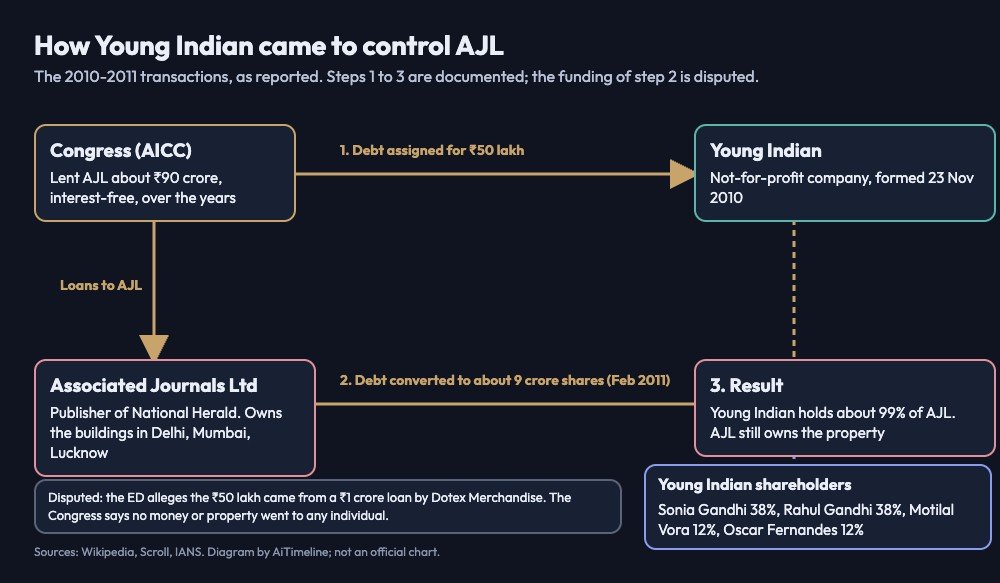
What happened: AJL’s shareholders approved issuing about 9 crore shares of ₹10 each to Young Indian, converting the roughly ₹90 crore AJL owed the Congress. Before this, the All India Congress Committee had assigned that debt to Young Indian for ₹50 lakh. The result was that Young Indian held about 99% of AJL’s shares.
Disputed point: The ED alleges the ₹50 lakh was itself funded through a ₹1 crore loan from a Kolkata company, Dotex Merchandise. The Congress says the arrangement was a lawful conversion of debt into equity to keep the newspaper alive, and that no money or property went to any individual.
Young Indian is incorporated Corporate transactions
What happened: Young Indian was set up as a not-for-profit company under Section 25 of the Companies Act, 1956, now Section 8 of the 2013 Act. Rahul Gandhi became a director on 13 December 2010 and Sonia Gandhi joined the board on 22 January 2011.
Shareholding: Sonia Gandhi and Rahul Gandhi held 38% each, 76% together. Motilal Vora and Oscar Fernandes held 12% each. Suman Dubey and Sam Pitroda were also associated with the company.
Why the structure matters: A Section 25 company cannot pay dividends to its members. The defence says this means no one could profit; the prosecution says control of AJL’s property was the benefit.
National Herald stops printing Newspaper history
What happened: AJL suspended publication of National Herald and its sister papers. By then AJL owed the Congress about ₹90 crore in interest-free loans the party had extended over the years.
Later: National Herald was later revived as a digital publication with a weekly print edition. The revival is part of the Congress’s defence that the restructuring served the newspaper.
The paper is shut during the Quit India Movement Newspaper history
What happened: During the Quit India Movement of 1942 the British authorities cracked down on the nationalist press, and National Herald stopped publishing. It resumed after the war.
Why it matters: The paper’s place in the freedom movement is why the Congress treats the case as an attack on its legacy, and why critics say that legacy cannot excuse how its assets were handled.
Jawaharlal Nehru launches National Herald Newspaper history
What happened: National Herald was launched in Lucknow, with Nehru as its founder. Its publisher, Associated Journals Limited, had been incorporated on 20 November 1937 and, by most accounts, had some 5,000 shareholders, many of them freedom fighters. AJL also published Qaumi Awaz in Urdu and Navjivan in Hindi.
Ownership: AJL was never owned by the Congress party. It was a public company with many shareholders, a point that matters when people ask whose assets were transferred.
How Young Indian Came to Control AJL
The corporate transaction at the centre of every allegation.
The transaction is simpler than it sounds. AJL, a loss-making publisher with valuable buildings, owed the Congress about ₹90 crore. The party assigned the right to recover that debt to Young Indian, a new not-for-profit company, for ₹50 lakh. AJL then turned the debt into shares, and Young Indian ended up holding about 99% of AJL. Sonia and Rahul Gandhi together held 76% of Young Indian.
The prosecution reads this as a takeover of a public company’s property at a fraction of its value. The defence reads it as a routine conversion of debt into equity by a company that, by law, cannot pay its members any profit. The properties are still owned by AJL. Which reading is right in criminal law is the question no court has yet answered.
What Was Alleged, What Is Documented, What Is Not Established
Complainant and agency claims, records, and the questions only a trial can settle.
Claims not yet tested in court
- That the Congress’s loan to AJL was misused to hand control of AJL to Young Indian.
- That Young Indian gained control of properties the ED values at about ₹2,000 crore for ₹50 lakh.
- That the ₹50 lakh was routed through a loan from Dotex Merchandise.
- That the proceeds of crime total ₹988 crore, including bogus donations, rent and advertisements.
- That Sonia Gandhi, Rahul Gandhi and others conspired to cheat and misappropriate.
Sources: Swamy’s complaint, the ED, the Delhi Police FIR.
Facts on the record
- Young Indian was incorporated on 23 November 2010; Sonia and Rahul Gandhi held 38% each.
- AJL owed the Congress about ₹90 crore; the debt was assigned to Young Indian for ₹50 lakh.
- AJL issued about 9 crore shares; Young Indian holds about 99% of AJL.
- A magistrate summoned the accused in 2014; the High Court and Supreme Court refused to quash.
- About ₹751.9 crore of assets are attached, and the attachment was confirmed in 2024.
Sources: company records as reported, court orders, ED orders.
What no court has decided
- Whether any accused committed a crime.
- Whether the transactions amounted to cheating, breach of trust or misappropriation.
- Whether control of AJL’s property was an unlawful financial benefit.
- Whether any accused had criminal intent.
- Whether the attached assets are proceeds of crime in the criminal-law sense.
These questions can be answered only at trial.
Key People and Institutions
Being named, questioned or associated with a company is not a finding of guilt.
| Person or body | Role | Status in the case |
|---|---|---|
| Jawaharlal Nehru | Founded National Herald in 1938 | Historical figure; not part of the proceedings |
| Sonia Gandhi | Young Indian shareholder (38%) and director | Accused in Swamy’s complaint, named in the ED complaint and the Delhi Police FIR; on bail; not convicted |
| Rahul Gandhi | Young Indian shareholder (38%) and director | Same as Sonia Gandhi; questioned by the ED in June 2022; not convicted |
| Motilal Vora | Young Indian shareholder (12%); AJL chairman and Congress treasurer | Accused in the 2012 complaint; died December 2020 |
| Oscar Fernandes | Young Indian shareholder (12%) | Accused in the 2012 complaint; died September 2021 |
| Suman Dubey, Sam Pitroda | Associated with Young Indian | Accused in the complaint; named by the ED |
| Young Indian | Not-for-profit company that holds about 99% of AJL | Named by the ED and in the FIR; its AJL shares are attached |
| Associated Journals Limited | Publisher of National Herald; owns the properties | Its properties are attached; named in the FIR |
| Subramanian Swamy | Complainant since 2012 | Leading evidence in the private complaint |
| Enforcement Directorate | Investigates money laundering under the PMLA | Attached assets; appealing the refusal of cognisance |
| Income Tax Department | Reassessed 2011-12 incomes of the shareholders | Separate tax proceedings |
| Delhi Police (EOW) | Registered the October 2025 FIR | Investigating |
| Courts | Magistrate (2014), Delhi High Court (2015 onward), Supreme Court (2016, 2018, 2019), Special Judge (2025) | No court has ruled on guilt |
The Legal Process Explained
Summons, attachment, cognisance and conviction are different things.
The original complaint
Subramanian Swamy’s complaint of 1 November 2012 alleged offences under Sections 403, 406 and 420 read with 120B of the Indian Penal Code. Because it was a private complaint, the magistrate could summon the accused after examining the complainant and his material, without a police investigation. That happened in June 2014. Summoning means only that the court found enough to proceed.
From the High Court to the Supreme Court
The Delhi High Court stayed the summons in August 2014, then dismissed the challenge on 7 December 2015. The Supreme Court, on 12 February 2016, refused to quash the case but exempted the accused from appearing in person. Neither court decided whether the accused were guilty.
A private complaint is not an agency case
A private complaint is driven by the complainant, who must lead evidence. An agency case is driven by an investigating body such as the police or the ED, which gathers evidence and files a chargesheet. In this matter the two are linked: the ED used the 2014 summoning order on Swamy’s complaint as the ‘scheduled offence’ it needed to open a money-laundering case. The December 2025 order held that this was not enough without an FIR, which is why the Delhi Police FIR of October 2025 now matters.
What the PMLA lets the ED do
Under the Prevention of Money Laundering Act the ED can attach property it believes is proceeds of crime, take possession after confirmation, and file a prosecution complaint. Each step is separate, and none is a finding of guilt.
| Step | What it means | Where this case is |
|---|---|---|
| Provisional attachment | The ED freezes assets for up to 180 days | Done, 21 November 2023 |
| Confirmation | The Adjudicating Authority agrees the freeze should stay | Done, April 2024 |
| Possession | The ED takes charge of attached property | Notices issued, 11 April 2025 |
| Prosecution complaint | The ED asks a special court to try the accused | Filed April 2025 |
| Cognisance | The court agrees to take up the case | Refused, 16 December 2025; appeal pending |
| Trial | Evidence tested, witnesses cross-examined | Not begun in the ED case |
| Conviction or acquittal | The court decides guilt | None |
| Confiscation | Ownership passes to the government after a finding of money laundering | None |
Political Impact
How each side has used the case, presented as positions, not findings.
The Congress response
The Congress has called the case political vendetta from the start. When the High Court refused to quash the summons in December 2015, Rahul Gandhi called it ‘100% political vendetta’ coming from the Prime Minister’s Office, and Sonia Gandhi said she was Indira Gandhi’s daughter-in-law and was not scared of anyone. The party disrupted Parliament over the case that week. During the ED questioning in June 2022, Congress leaders marched in Delhi and many were detained. After the December 2025 order the party said ‘truth has prevailed’, and it called the Delhi Police FIR a ‘baseless’ vendetta.
The BJP position
The BJP says the case is about accountability, not politics, and points out that it began as a private complaint and survived challenges in the High Court and the Supreme Court. BJP leader Ravi Shankar Prasad called it a clear case of corruption and misappropriation when the ED filed its complaint in April 2025. After the December 2025 order, BJP spokesperson Shehzad Poonawalla said it was not a clean chit, and the party said the Gandhis remained accused.
What the case did to Congress politics
The case has kept the party’s two most prominent leaders before a court for more than a decade. Each step, from the 2015 bail hearing to the 2022 questioning and the 2023 attachment, has come during a busy political season, which the Congress cites as evidence of motive and the BJP dismisses as coincidence. For supporters the case reinforced a narrative of persecution; for critics it reinforced one of dynastic entitlement. Neither narrative is a legal finding.
The wider argument about agencies
The case sits inside a larger debate about whether central agencies such as the ED are used selectively against opposition leaders. Opposition parties cite this and similar cases; the government says the agencies act on evidence and that courts provide the check. The trial court’s December 2025 order and the High Court’s October 2026 refusal of interim relief show courts testing the ED’s procedure. The outcome of the ED’s appeal will shape how the PMLA can be used when a case begins as a private complaint.
For related cases involving the Gandhi family and the Congress, see our Rahul Gandhi defamation case timeline, the Bofors scandal: what was proved and the AgustaWestland VVIP helicopter case.
What Is at Stake
- Corporate governance: can a company that owes money to a political party be taken over through a debt-for-equity swap without the consent of its original shareholders being tested?
- Party-linked organisations: the case tests how far a party’s loans to a friendly company, and later its control, are open to criminal scrutiny.
- Financial transparency: not-for-profit companies that hold valuable assets face questions about who benefits from control rather than dividends.
- Criminal liability: whether a lawful-looking corporate transaction can amount to cheating or breach of trust depends on intent, which only a trial can establish.
- Agency powers: the High Court’s answer on private complaints will decide how far the ED can build money-laundering cases on them.
- Law and opposition politics: a case against the leaders of the main opposition party will be read politically whichever way it ends, which raises the bar for clear, reasoned decisions.
Record Check: Common Errors
Where common summaries of this case go wrong
- “The Gandhis have been convicted” or “are out on bail, so they are guilty”. No one has been convicted. Bail says nothing about guilt.
- “The court gave them a clean chit in December 2025.” It refused to take cognisance on a legal ground and said the ED could keep investigating. It did not weigh the evidence.
- “The ED seized ₹5,000 crore of property.” The attached assets are about ₹751.9 crore. The ED values the AJL properties at about ₹2,000 crore and alleges ₹988 crore of proceeds of crime. Larger figures are political estimates.
- “Young Indian owns Herald House.” AJL owns it. Young Indian controls AJL through about 99% of its shares.
- “The ED case and Swamy’s case are the same.” They are separate proceedings in different courts, though the ED relied on Swamy’s case.
- “The properties now belong to the government.” They are attached, not confiscated.
Related but separate matters
- The case over a plot allotted to AJL in Panchkula, Haryana, is a different investigation.
- The Herald House lease dispute and the income tax reassessment are civil and tax matters, not part of the criminal trial.
Explore More Timelines
People Also Ask
National Herald Case: Frequently Asked Questions
Conclusion: A Long Case With No Verdict
The documented facts of the National Herald case are not in dispute: a party debt, a new not-for-profit company owned mostly by the Gandhis, and a debt-for-shares conversion that gave that company control of a historic publisher and its buildings. What is in dispute is what those facts mean in criminal law, and that question has not been answered in 14 years.
The case now turns on two things: whether the Delhi High Court lets the ED’s money-laundering prosecution proceed on Swamy’s complaint, and whether the Delhi Police FIR leads to a chargesheet. Until a trial tests the evidence, the honest summary is the one this record keeps returning to: alleged, documented, not proved.
Related AiTimeline Stories
⚠️ Editorial Note
Last updated 2 November 2026. Court developments follow reports by PTI (via ThePrint), IANS, LiveLaw, Bar & Bench, Scroll, LawBeat, The Tribune and All India Radio; we did not read the court orders themselves. Corporate figures follow company records as reported by Wikipedia and the press. ED figures (₹2,000 crore, ₹988 crore) are the agency’s allegations. Items flagged for review: the outcome of the Delhi High Court listing on 2 November 2026, whether the Delhi Police has filed a chargesheet, the exact filing date of the ED’s April 2025 complaint, and the Supreme Court’s pending matters on the Herald House lease and tax reassessment. Sonia Gandhi, Rahul Gandhi and the other accused have denied wrongdoing and have not been convicted. This article is informational, not legal advice.
Sources & further reading
Every dated entry above was checked against these references. Last reviewed 2 November 2026.
- ThePrint (PTI): Delhi HC turns down ED plea to order status quo on attached properties (12 October 2026)
- Bar & Bench: Delhi High Court refuses to stop AJL from seeking release of properties attached by ED
- Scroll: Delhi court dismisses ED complaint against Rahul, Sonia Gandhi (16 December 2025)
- All India Radio: Delhi HC seeks response from Sonia Gandhi, Rahul Gandhi (22 December 2025)
- The Tribune: Delhi Police file FIR against Sonia, Rahul in National Herald case
- IANS: ED files charges in court against Sonia, Rahul (15 April 2025)
- Scroll: PMLA authority upholds ED attachment of National Herald assets worth nearly Rs 752 crore
- LiveLaw: SC refuses to quash proceedings against Rahul, Sonia; grants exemption from personal appearance (2016)
- LawBeat: Delhi court lists National Herald case for evidence as Delhi HC stay not extended (October 2025)
- Wikipedia: National Herald case