Falklands War: Origins, Key Decisions and British Victory — A Timeline of the 1982 Conflict
Falklands War timeline: Argentina's 2 April 1982 invasion, Thatcher's task force, the Belgrano, San Carlos, Goose Green and the 14 June surrender.
Latest Story
This Falklands War timeline follows the 74-day conflict between Britain and Argentina from its roots in a 200-year-old sovereignty dispute to the surrender in Stanley on 14 June 1982. On 2 April 1982 Argentine forces invaded the Falkland Islands, a British-administered territory in the South Atlantic that Argentina calls the Islas Malvinas. Margaret Thatcher’s government sent a naval task force 8,000 miles to retake them. The war cost 907 lives, brought down Argentina’s military junta and left the sovereignty question where it was.
💡 Short Answer
The Falklands War was fought from 2 April to 14 June 1982. Argentina’s military junta invaded the British-held islands; Britain sent a task force under Operation Corporate. After the sinking of the General Belgrano and HMS Sheffield, British troops landed at San Carlos on 21 May, won at Goose Green and took the hills around Stanley. Argentina surrendered on 14 June. 649 Argentine and 255 British service personnel and three islanders died.
Falklands War 1982: Key Questions
The Falklands War in Ten Points
- The roots: rival claims since the 1760s; Britain’s administration since 1833; Argentina’s claim since independence.
- The trigger: Argentine scrap-metal workers landed on South Georgia on 19 March 1982.
- The invasion: Operation Rosario took Stanley on 2 April; Governor Rex Hunt ordered the garrison to surrender.
- The response: UN Resolution 502 on 3 April; the task force sailed on 5 April.
- Diplomacy failed: Haig’s shuttle ran from 8 April; the US backed Britain on 30 April.
- The Belgrano: 323 dead on 2 May, the war’s deadliest and most debated event.
- Exocets: HMS Sheffield on 4 May and Atlantic Conveyor on 25 May.
- The land war: San Carlos 21 May, Goose Green 28-29 May, the Stanley hills 11-14 June.
- The surrender: 14 June 1982, after 74 days; 907 dead.
- The legacy: the junta fell, Argentina returned to democracy, and the dispute is still open.
Why Did Britain and Argentina Fight Over the Falkland Islands?
An old sovereignty dispute, a military government under pressure and a misread of British intentions.
The Falkland Islands lie in the South Atlantic about 300 miles (480 km) east of the Argentine coast and about 8,000 miles from Britain. The two main islands, East and West Falkland, had about 1,800 inhabitants in 1982, most of them of British descent.
Argentina, which calls the islands the Islas Malvinas, argues that it inherited Spain’s rights at independence in 1816 and that Britain took the islands by force in 1833. Britain points to its own eighteenth-century claim, to continuous administration since 1833 and, increasingly from the 1960s, to the islanders’ right to decide their own future. The UN asked both sides to negotiate in 1965; they did, on and off, for 17 years without agreement. For the full sovereignty story from the first settlements to the present, see our Falkland Islands sovereignty dispute timeline.
By 1982 Argentina’s military government faced high inflation, recession and growing protest. Recovering the islands was a cause that united Argentines. The junta also read British decisions, such as the plan to withdraw the patrol ship HMS Endurance, as a sign that Britain would not fight. A dispute over scrap-metal workers on South Georgia in March 1982 gave it the trigger.
Falklands War Timeline: Latest First
From the 2013 referendum back to the first settlements of the 1760s. Each entry is colour-coded by phase.
Islanders vote to remain a British Overseas Territory Aftermath
What happened: A referendum on the islands’ political status was held on 10 and 11 March 2013. On a turnout of about 92 per cent, 99.8 per cent voted to keep their current status as a British Overseas Territory. Three votes were cast against.
The two positions: The UK government cited the result as the islanders’ clear expression of self-determination. Argentina did not recognise the vote, arguing that the population was not a party to a territorial dispute between two states.
Britain and Argentina restore diplomatic relations Aftermath
What happened: After talks in Madrid in October 1989 and February 1990, the two governments restored full diplomatic relations, which had been broken since the 1982 war.
The formula: Both sides agreed a sovereignty “umbrella”: the talks and agreements would not change either country’s position on sovereignty. That let them cooperate on fishing, communications and confidence-building without either side giving ground on the claim.
RAF Mount Pleasant opens on East Falkland Aftermath
What happened: The new airfield at Mount Pleasant was opened on 12 May 1985 by Prince Andrew, who had flown helicopters with the task force in 1982. It became fully operational in May 1986.
Why it was built: Stanley’s short runway had limited what could reach the islands. A long runway allowed the UK to reinforce the garrison by air from Ascension Island instead of relying on a naval task force.
Raul Alfonsin takes office as Argentina’s civilian president Aftermath
What happened: Argentina held general elections on 30 October 1983. Raul Alfonsin of the Radical Civic Union won and took office on 10 December 1983, ending more than seven years of military rule.
Link to the war: Defeat in the Falklands had shattered the junta’s authority. Its leaders, including Galtieri, were later tried by military and civilian courts over the conduct of the war and the human rights abuses of the dictatorship.
The Franks Report is published Aftermath
What happened: A committee of privy counsellors chaired by Lord Franks reviewed how the government had handled the islands in the years before the invasion. Its report was published on 18 January 1983.
What it found: It concluded that the government could not have foreseen that the junta would invade on 2 April 1982, and that no criticism or blame should attach to the government for the decision. It also set out decisions that may have sent mixed signals, including the planned withdrawal of the patrol ship HMS Endurance.
Galtieri is removed as Argentina’s president Aftermath
What happened: Three days after the surrender in Stanley, the junta removed General Leopoldo Galtieri as president and army commander. General Reynaldo Bignone became president on 1 July 1982 with the task of returning the country to civilian rule.
Why it mattered: The defeat discredited the military government, which had presented the recovery of the islands as a national triumph only weeks earlier.
Argentine forces surrender in Stanley 1982 crisis & war
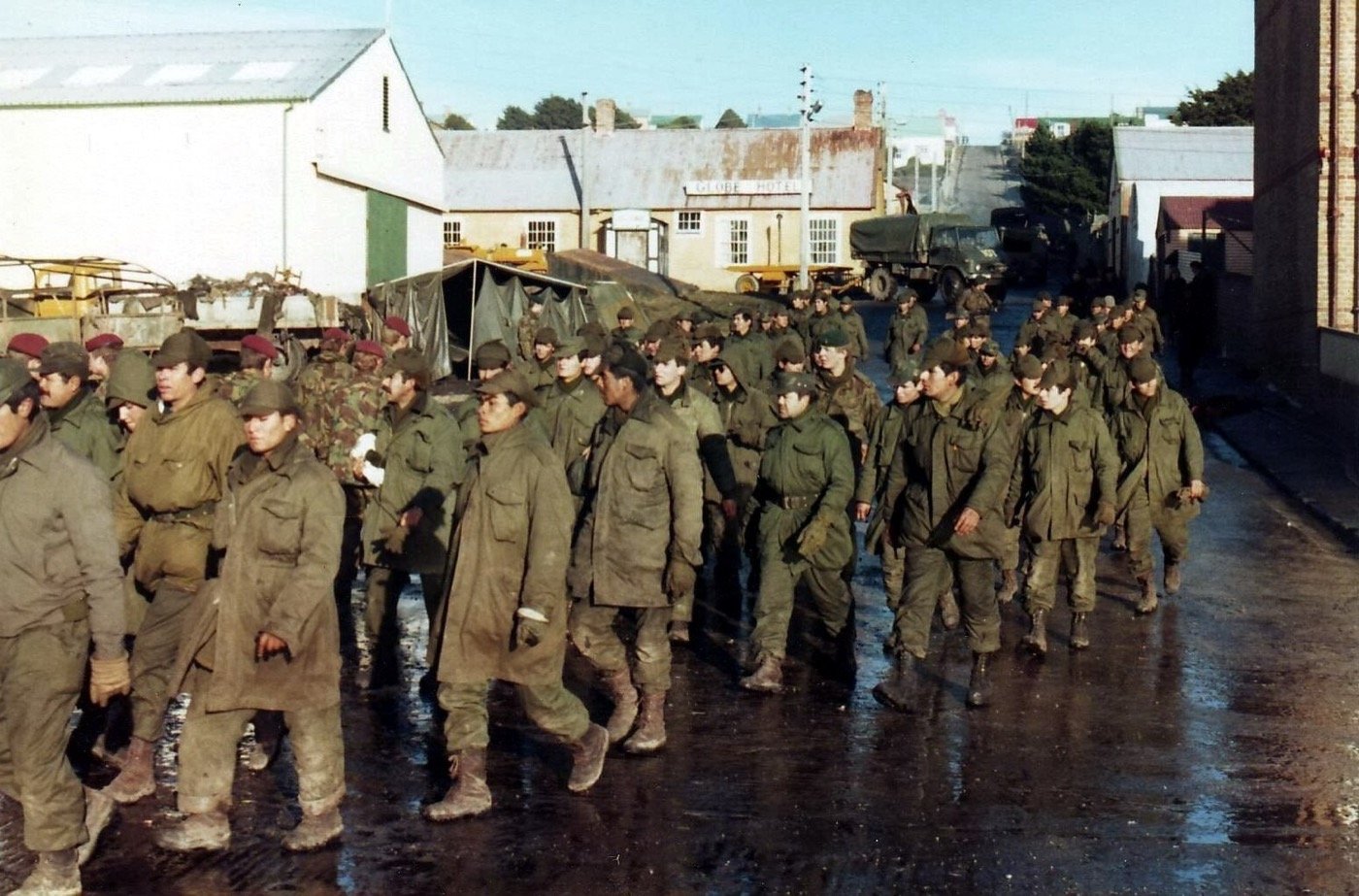
What happened: With British troops on the hills around Stanley, Brigadier General Mario Menendez agreed a ceasefire and signed the surrender of Argentine forces in East and West Falkland to Major General Jeremy Moore on the evening of 14 June 1982.
The end of the war: The conflict had lasted 74 days from the landing on 2 April. About 11,000 Argentine personnel were taken prisoner across the islands and were repatriated over the following weeks. The islands mark 14 June as Liberation Day.
Tumbledown, Wireless Ridge and Mount William 1982 crisis & war
What happened: On the night of 13-14 June the 2nd Battalion Scots Guards attacked Mount Tumbledown, 2 Para attacked Wireless Ridge and Gurkhas moved on Mount William. The fighting on Tumbledown was among the hardest of the war.
Result: By the morning of 14 June the last high ground west of Stanley was in British hands and Argentine resistance was collapsing.
HMS Glamorgan is hit by a land-launched Exocet 1982 crisis & war
What happened: Early on 12 June the destroyer HMS Glamorgan, which had been supporting the night attacks with gunfire, was hit by an Exocet fired from an improvised launcher on land near Stanley. Fourteen of her crew were killed.
Why it was notable: The Argentine forces had adapted a ship-launched missile to fire from a trailer, so ships close to the coast were still at risk days before the surrender.
Mount Longdon, Two Sisters and Mount Harriet 1982 crisis & war
What happened: On the night of 11-12 June, 3 Para attacked Mount Longdon, 45 Commando attacked Two Sisters and 42 Commando attacked Mount Harriet. All three positions were taken. The fight for Longdon cost the British 23 dead, including Sergeant Ian McKay, awarded a posthumous Victoria Cross.
The only civilian deaths: That night a British shell hit a house in Stanley and killed three island women, Susan Whitley, Doreen Bonner and Mary Goodwin. They were the only civilians who died in the war.
Sir Galahad and Sir Tristram are bombed at Fitzroy 1982 crisis & war
What happened: Argentine Skyhawks attacked the landing ships RFA Sir Galahad and RFA Sir Tristram while troops were waiting to go ashore at Port Pleasant, near Fitzroy and Bluff Cove. The fires on Sir Galahad killed 48 people, 32 of them Welsh Guardsmen. Two crew died on Sir Tristram.
Why it happened: The ships were moving troops round the coast to speed up the advance on Stanley, partly because the loss of helicopters on Atlantic Conveyor had left too few to fly them. They were caught in daylight without air cover.
Battle of Goose Green 1982 crisis & war
What happened: 2nd Battalion, the Parachute Regiment, attacked the Argentine positions at Darwin and Goose Green. Its commanding officer, Lieutenant Colonel H. Jones, was killed leading an attack on 28 May and was awarded a posthumous Victoria Cross. Major Chris Keeble took command.
Result: The Argentine garrison surrendered on 29 May. Around 960 prisoners were taken. British dead are usually given as 17 or 18; estimates of Argentine dead range from about 45 to 55.
HMS Coventry and Atlantic Conveyor are sunk 1982 crisis & war
What happened: On Argentina’s national day, Argentine Air Force Skyhawks sank the destroyer HMS Coventry, killing 19. The same afternoon two Argentine Navy Super Etendards hit the container ship Atlantic Conveyor with Exocet missiles; 12 men died and the ship sank under tow on 28 May.
Why the cargo mattered: Atlantic Conveyor carried three of the four RAF Chinook heavy-lift helicopters, six Wessex helicopters and tents and equipment for the land force. Only one Chinook, already airborne, survived. British troops had to walk across East Falkland instead of being flown.
British troops land at San Carlos 1982 crisis & war
What happened: Before dawn on 21 May, 3 Commando Brigade began landing at San Carlos on the west coast of East Falkland. About 4,000 men were ashore by the end of the day.
The cost at sea: Argentine aircraft attacked the ships in what crews called “Bomb Alley”. The frigate HMS Ardent was sunk that day with 22 killed, and HMS Antelope was lost on 23-24 May when an unexploded bomb detonated during defusing. Several other ships were hit by bombs that failed to explode.
SAS raid on Pebble Island 1982 crisis & war
What happened: On the night of 14-15 May, men of the Special Air Service, supported by naval gunfire, attacked the Argentine airstrip on Pebble Island. Eleven aircraft were destroyed or put out of action.
Why it mattered: The light attack aircraft based there could have threatened the coming landing at San Carlos, a few dozen miles to the south-east.
HMS Glasgow and HMS Brilliant come under air attack 1982 crisis & war
What happened: Argentine Skyhawks attacked HMS Glasgow and HMS Brilliant. Brilliant’s Sea Wolf missiles shot down two aircraft, and a bomb passed through Glasgow without exploding.
The pattern: Argentine bombs often failed to go off because they were dropped from very low level and did not arm in time. Several British ships survived hits for that reason.
HMS Alacrity sinks the transport Isla de los Estados 1982 crisis & war
What happened: In the first hours of 11 May, the frigate HMS Alacrity, sent through Falkland Sound to test for mines and Argentine shipping, engaged the naval transport ARA Isla de los Estados with her 4.5-inch gun and sank it.
Correction: Some accounts say the submarine HMS Conqueror sank the ship on 8 May. It was a surface ship, HMS Alacrity, on the night of 10-11 May.
HMS Sheffield is hit by an Exocet 1982 crisis & war
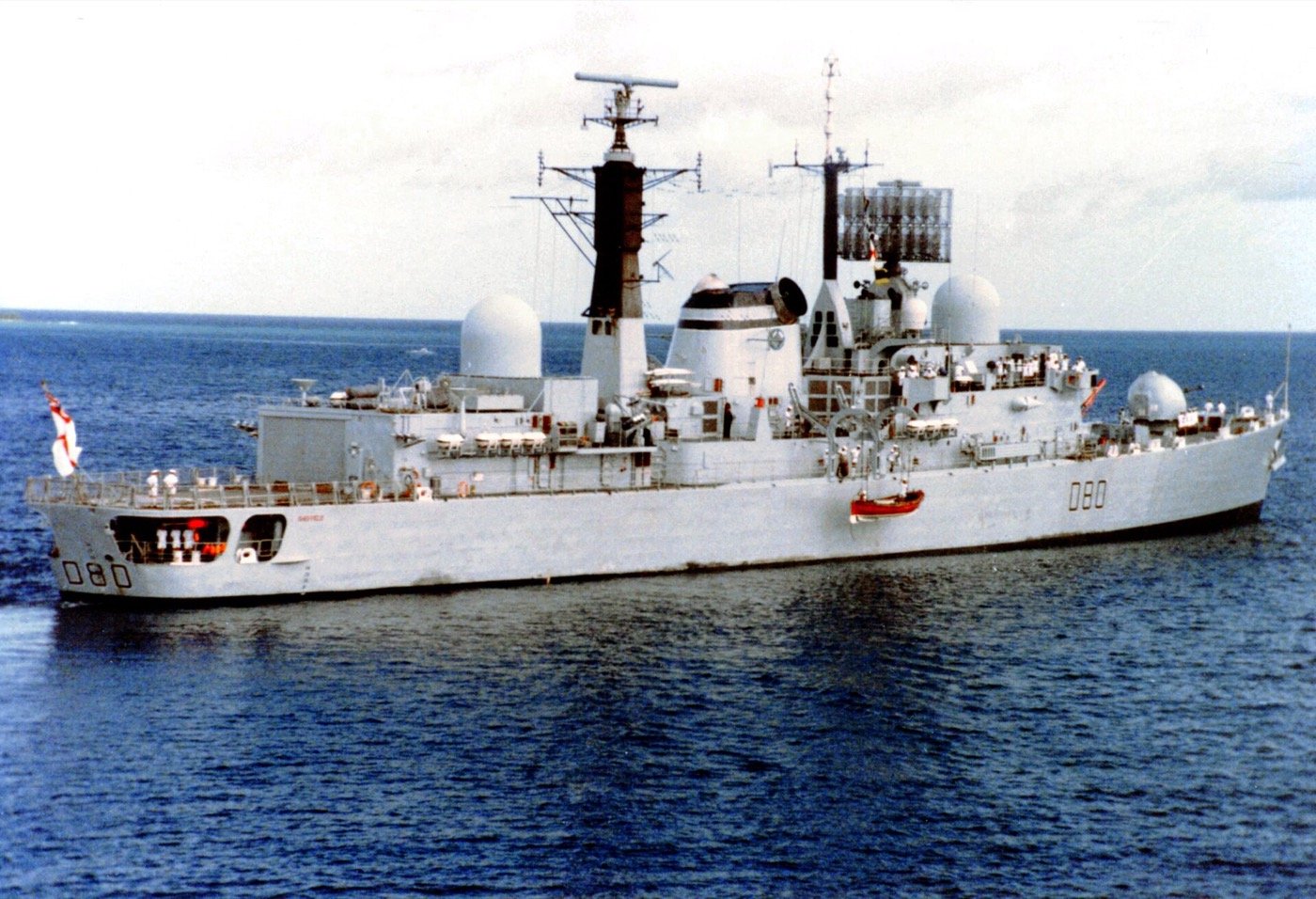
What happened: Two Argentine Navy Super Etendard aircraft each fired an AM39 Exocet missile at ships of the task force. One struck the destroyer HMS Sheffield. Twenty of her crew died and the ship was abandoned. She sank under tow on 10 May.
Why it shocked Britain: It was the first Royal Navy ship lost to enemy action since the Second World War, two days after the sinking of the Belgrano. It showed that Argentina had a weapon that could sink British ships from beyond the range of their defences.
HMS Conqueror sinks the General Belgrano 1982 crisis & war
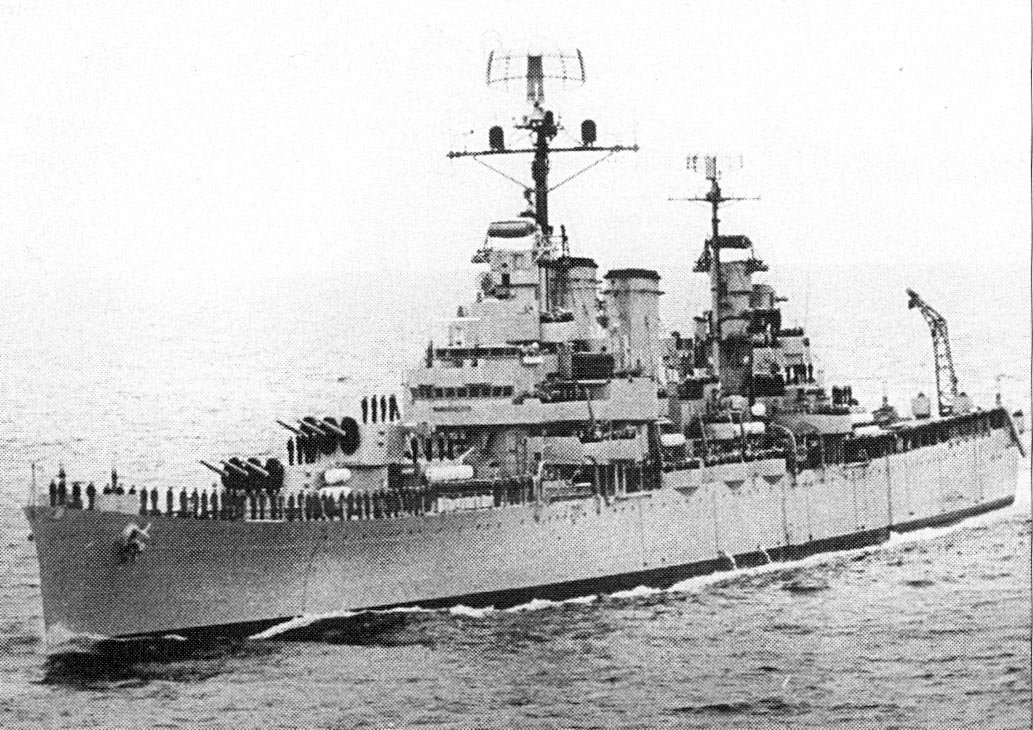
What happened: The nuclear-powered submarine HMS Conqueror, after shadowing the Argentine cruiser ARA General Belgrano and two escorting destroyers, fired three torpedoes. Two hit and the cruiser sank. 323 Argentine personnel died, about half of all Argentine deaths in the war.
The controversy: The ship was outside the 200-mile Total Exclusion Zone and was sailing away from the islands when it was hit. The British war cabinet had changed the rules of engagement that day to allow the attack, and Britain had warned on 23 April that any Argentine ship threatening British forces could be attacked wherever it was. Critics argued the attack was unnecessary and damaged peace efforts; the government argued the cruiser group threatened the task force.
Effect: After the sinking, Argentina’s main surface fleet, including its aircraft carrier, stayed in or near port for the rest of the war.
The first Black Buck raid on Stanley airfield 1982 crisis & war
What happened: A single RAF Vulcan bomber, supported by a chain of Victor tankers from Ascension Island, dropped bombs on Stanley airfield. One bomb hit the runway. Sea Harriers then attacked Stanley and Goose Green.
Assessment: It was one of the longest bombing missions flown up to that time. Its military effect was limited, since the runway was repaired and kept in use by transport aircraft, but it showed Argentina that the British could reach the islands’ mainland bases if they chose.
The US ends mediation and backs Britain 1982 crisis & war
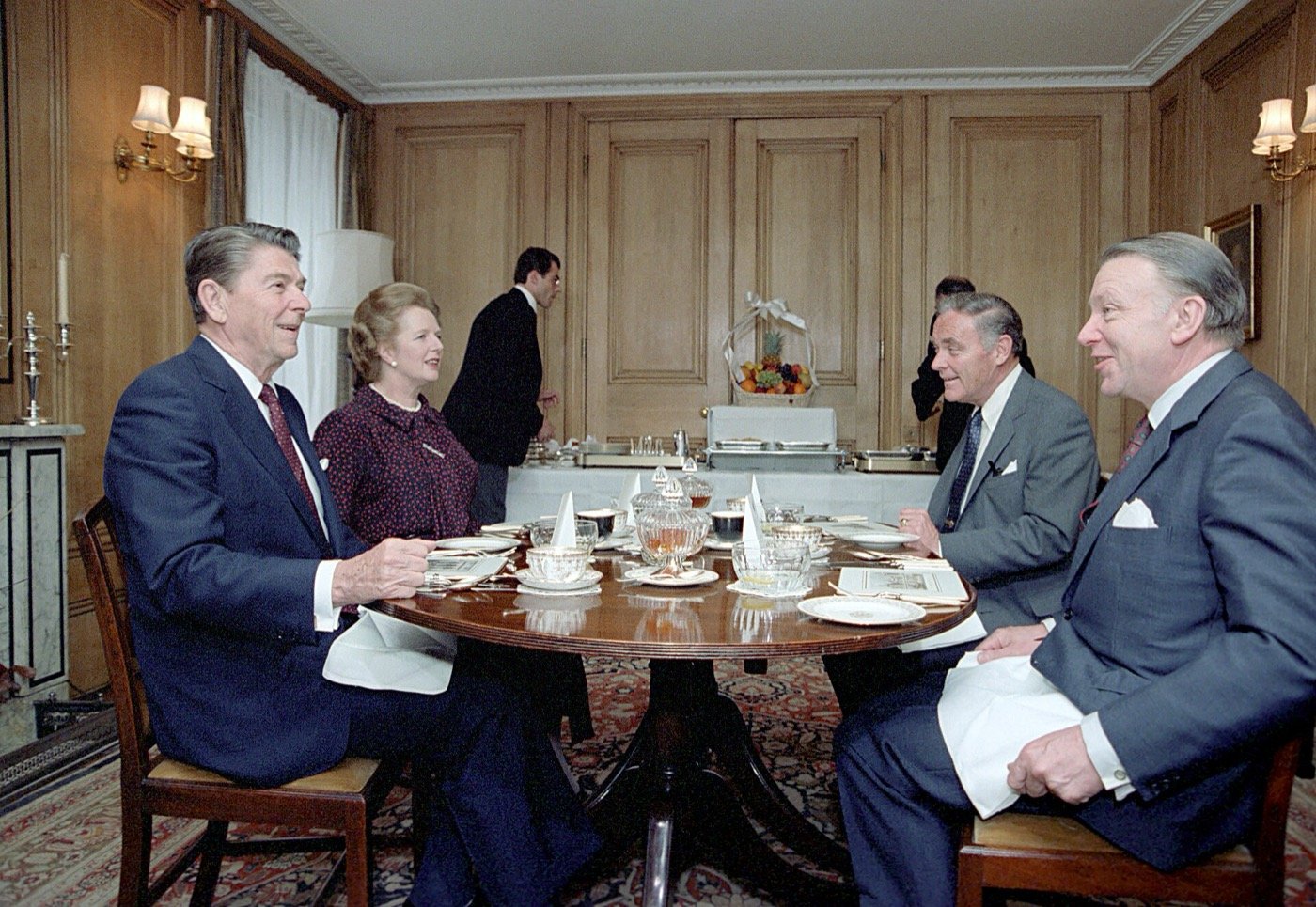
What happened: With the Haig mission failed, President Ronald Reagan’s administration announced that it was supporting the United Kingdom. It suspended military exports and some aid to Argentina and offered material support to Britain.
What Britain received: US help included fuel and facilities at Ascension Island, where the US operated the airfield, intelligence and modern AIM-9L Sidewinder missiles for the Sea Harriers.
Britain declares a Total Exclusion Zone 1982 crisis & war
What happened: Britain announced that from 30 April a Total Exclusion Zone of 200 nautical miles around the islands would apply to any Argentine ship or aircraft, military or civilian, supporting the occupation.
The difference: The earlier zone applied only to warships and naval auxiliaries. The new zone covered aircraft too, and Stanley airfield.
South Georgia is retaken 1982 crisis & war
What happened: British helicopters attacked and disabled the Argentine submarine ARA Santa Fe at Grytviken. Royal Marines and special forces then landed, and the Argentine garrison surrendered that afternoon. The troops at Leith surrendered the next day.
Why it mattered: It was the first British success of the war. Thatcher announced it outside Downing Street, telling reporters to “rejoice at that news”.
Haig’s shuttle diplomacy fails 1982 crisis & war
What happened: US Secretary of State Alexander Haig flew between London and Buenos Aires from 8 April, proposing an Argentine withdrawal, an interim administration and further negotiation. Two rounds of talks over about 12 days produced no deal.
Why it failed: Britain insisted on withdrawal before any talks and on the islanders’ wishes. The junta would not accept terms that did not lead to Argentine sovereignty. A final US proposal of 27 April was rejected by Argentina on 29 April.
The Maritime Exclusion Zone comes into force 1982 crisis & war
What happened: The 200-mile zone announced on 7 April took effect. Argentine warships and naval auxiliaries inside it could be attacked.
Who enforced it: Nuclear-powered submarines could reach the South Atlantic weeks before the surface fleet, so they enforced the zone first.
The task force sails; Lord Carrington resigns 1982 crisis & war
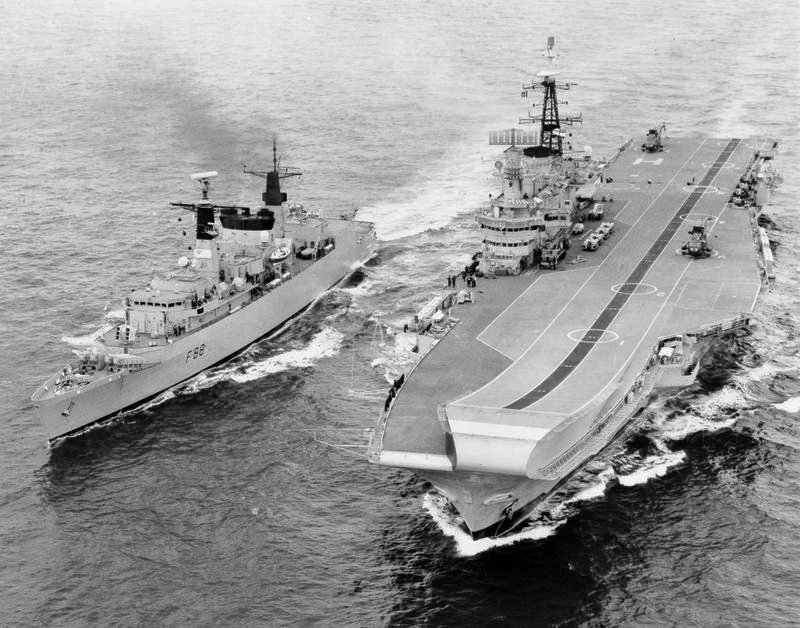
What happened: The carriers HMS Hermes and HMS Invincible left Portsmouth with the first ships of the task force. The campaign to retake the islands was named Operation Corporate. Ships taken up from trade, including liners such as Canberra and Queen Elizabeth 2, followed with troops and supplies.
Political fallout: The same day, Foreign Secretary Lord Carrington and two Foreign Office ministers resigned, accepting responsibility for the failure to foresee the invasion. John Nott offered to resign as Defence Secretary but stayed.
UN Resolution 502 and South Georgia falls 1982 crisis & war
At the UN: The Security Council adopted Resolution 502, demanding an immediate cessation of hostilities and the withdrawal of all Argentine forces, and calling on both governments to seek a diplomatic solution. It passed 10 to 1, with Panama against and China, Poland, Spain and the Soviet Union abstaining.
In London: Parliament met on a Saturday for the first time since the Suez crisis of 1956. Thatcher told MPs a large task force would sail as soon as it was ready.
In South Georgia: Argentine forces landed at Grytviken. A small party of Royal Marines resisted, damaging a corvette and shooting down a helicopter, before surrendering.
Argentina invades the Falkland Islands 1982 crisis & war
What happened: Argentine special forces and marines landed near Stanley before dawn. The British garrison, Naval Party 8901, had about 70 Royal Marines, plus some sailors from HMS Endurance and the Falkland Islands Defence Force. After fighting at Moody Brook and Government House, Governor Rex Hunt ordered the garrison to surrender to avoid civilian bloodshed.
Casualties: One Argentine officer, Captain Pedro Giachino, was killed. There were no British deaths. The garrison and the governor were flown out of the islands.
In Argentina: Crowds celebrated in the Plaza de Mayo in Buenos Aires, a few days after police there had broken up a large protest against the junta’s economic policy.
Reagan calls Galtieri as the invasion fleet sails 1982 crisis & war
What happened: Britain asked for an urgent meeting of the UN Security Council. That evening President Reagan spoke to Galtieri by phone for about 50 minutes and urged him not to invade. Galtieri did not give that assurance.
Why it was too late: The Argentine invasion force was already at sea.
Argentine scrap-metal workers land at South Georgia 1982 crisis & war
What happened: A party of workers employed by Argentine businessman Constantino Davidoff, who had a contract to dismantle old whaling stations, landed at Leith Harbour. Some of them raised an Argentine flag.
Escalation: Britain said they had not got the required permission and sent HMS Endurance with Royal Marines. Argentina sent a naval ship to protect them. Within days the junta brought forward its plan to occupy the Falklands.
Mixed signals and a new junta Origins
In Britain: The 1981 defence review led by John Nott planned to withdraw the Antarctic patrol ship HMS Endurance, and the British Nationality Act 1981 did not give most islanders full British citizenship. Both were later read as signs of a weakening British commitment.
In Argentina: The junta was dealing with high inflation, recession and a regime that had suppressed opponents since 1976. General Leopoldo Galtieri took over as president on 22 December 1981, replacing General Roberto Viola. Occupation plans were drawn up early in 1982.
The “leaseback” plan is rejected Origins
What happened: Foreign Office minister Nicholas Ridley floated an option to transfer sovereignty to Argentina and lease the islands back for a long period. He took it to the islanders in November 1980.
The reaction: The islanders’ representatives opposed it, and when Ridley reported to the Commons on 2 December 1980 MPs on both sides attacked the idea. It was dropped, and talks went back to a freeze on sovereignty.
Talks on sovereignty and links with the mainland Origins
What happened: In 1968 British and Argentine officials drafted a memorandum of understanding that would have opened the way to a transfer of sovereignty, subject to the islanders’ interests. It was abandoned after opposition in Parliament and from the islanders.
Practical links: A 1971 communications agreement led to Argentine air services to the islands and other practical links, without settling sovereignty.
UN General Assembly Resolution 2065 Origins
What happened: The General Assembly recognised a dispute between Argentina and the UK over the islands and invited the two governments to negotiate a peaceful solution, bearing in mind the interests of the population.
Why the wording matters: Argentina reads the resolution as a call to negotiate sovereignty. Britain stresses that the interests and wishes of the islanders must be part of any solution.
Stanley becomes the capital Origins
What happened: The seat of government moved from Port Louis to the new settlement of Stanley, with its better harbour, in the 1840s, and Stanley became the capital in 1845.
The island community: A largely British-descended farming population grew up, based on sheep and wool. By 1982 about 1,800 people lived on the islands.
Britain re-establishes control Origins
What happened: In January 1833 a British warship, HMS Clio, arrived and the Argentine garrison left without fighting. British administration was re-established.
The two views: Argentina regards this as the forcible expulsion of its authorities and has protested ever since. Britain regards it as the reassertion of an earlier claim and points to continuous administration from 1833.
Buenos Aires asserts authority over the islands Origins
What happened: The government in Buenos Aires granted land and rights on East Falkland to settlers and in 1829 appointed Luis Vernet as governor. Britain protested.
Clash with the US: After Vernet seized American sealing ships, the USS Lexington raided the settlement in 1831. That left a weak Argentine presence when the British returned.
Argentina declares independence Origins
What happened: The United Provinces of the Rio de la Plata declared independence from Spain.
The claim: Argentina’s position is that it inherited Spain’s rights to the islands. Britain disputes that Spain held an exclusive title to pass on.
Rival French, British and Spanish settlements Origins
What happened: France founded Port Saint Louis on East Falkland in 1764. Britain set up Port Egmont on Saunders Island in 1766, without knowing of the French. Spain bought out the French settlement in 1767 and renamed it Puerto Soledad.
Crisis and withdrawal: Spain expelled the British in 1770, nearly causing war, then restored Port Egmont in 1771. Britain left in 1774 for economic reasons but left a plaque asserting its claim.
Four things often told wrongly about the Falklands War
- “HMS Conqueror sank the Isla de los Estados on 8 May.” The transport was sunk by gunfire from the frigate HMS Alacrity in Falkland Sound, in the first hours of 11 May.
- “The Argentine Air Force sank Atlantic Conveyor.” The Exocets that hit Atlantic Conveyor, and HMS Sheffield, were fired by Super Etendards of the Argentine Navy. The Air Force’s Skyhawks sank HMS Coventry the same day.
- “Galtieri led the junta through 1981.” General Roberto Viola was president for most of 1981. Galtieri took over on 22 December 1981, about three months before the invasion.
- “Haig’s talks ran on 19-21 April.” Haig’s shuttle began on 8 April and ran to about 19 April. A last US proposal on 27 April was rejected by Argentina on 29 April.
The Five Decisions That Shaped the Falklands War
Political and military choices that decided how the war began and how it ended.
1. The junta’s decision to invade
The Argentine leadership chose force over further talks, expecting a quick occupation and, at most, a diplomatic protest. It misjudged how Britain and the United States would respond. The invasion succeeded in hours; holding the islands proved impossible.
2. Thatcher’s decision to send a task force
Within days the British government decided not to accept the occupation. The first ships sailed on 5 April, three days after the invasion, before diplomacy had run its course. The UN’s Resolution 502 gave the demand for withdrawal international backing, and the presence of the fleet gave it force.
3. Retaking South Georgia first
The recapture of South Georgia on 25 April was a small operation, but it gave Britain an early success and tested its forces in South Atlantic conditions before the main landing.
4. The attack on the General Belgrano
Changing the rules of engagement on 2 May to allow the attack was the most consequential naval decision of the war. It kept Argentina’s surface fleet out of the fight, and it remains the most controversial because 323 men died and the ship was outside the exclusion zone.
5. Landing at San Carlos and advancing on foot
Choosing a sheltered, lightly defended bay for the landing kept losses on the beaches low, even as the ships offshore were hit hard. After the loss of the helicopters on Atlantic Conveyor, commanders chose to march across East Falkland rather than wait, and the night attacks on the hills around Stanley broke the Argentine defence.
Why Did Britain Win the Falklands War?
Britain’s victory was not certain. Its forces were 8,000 miles from home, at the start of the South Atlantic winter, with almost no land-based air cover. Six factors stand out.
- Submarines and sea control: nuclear submarines kept Argentina’s surface fleet near port after 2 May, so the main threat to the task force came from the air.
- Trained, professional troops: British infantry, paratroopers and Royal Marines were regulars trained for night fighting; much of the Argentine army in the islands was made up of conscripts, though some units fought hard.
- Logistics and improvisation: merchant ships taken up from trade, Ascension Island and air-to-air refuelling kept the force supplied over an enormous distance.
- Argentine supply problems: after the exclusion zones, the garrison in the islands was hard to supply by sea and depended on flights into Stanley.
- US support: after 30 April, US fuel, intelligence and AIM-9L Sidewinder missiles strengthened the British campaign.
- Taking the high ground: once the hills west of Stanley fell on 11-14 June, the garrison had no defensible line left.
Argentina had real advantages too: land-based aircraft, Exocet missiles and pilots who pressed home attacks at very low level. Many of the bombs that hit British ships did not explode. If more had, the outcome at San Carlos could have been very different.
The Human Cost of the Falklands War
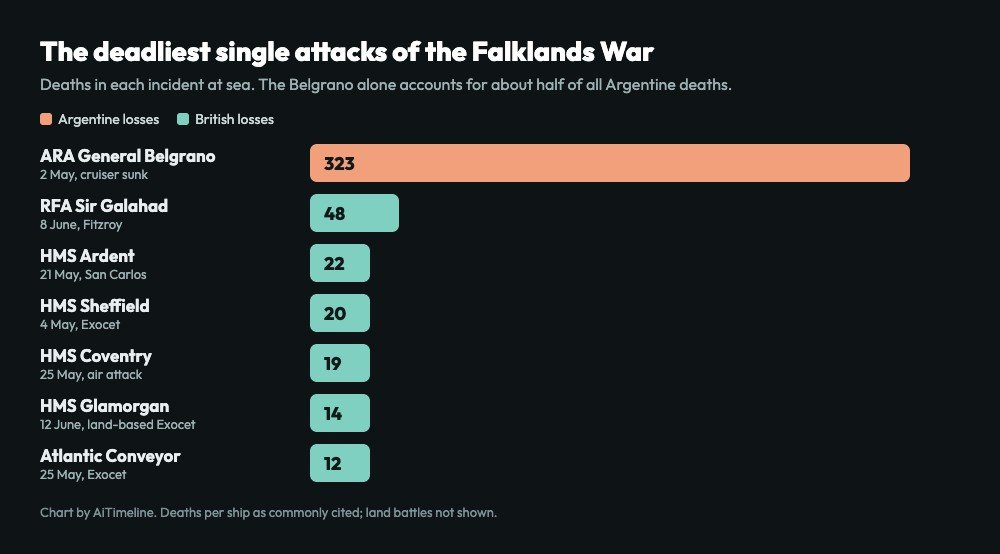
The war lasted 74 days. Its losses were concentrated in a handful of attacks.
| Side | Military deaths | Civilian deaths | Note |
|---|---|---|---|
| Argentina | 649 | — | 323 of them on the General Belgrano |
| United Kingdom | 255 | — | Includes Royal Navy, Army, Royal Marines, RAF, RFA and merchant seamen |
| Falkland Islands | — | 3 | Three women killed in Stanley, 11-12 June |
| Total | 904 | 3 | 907 deaths in 74 days |
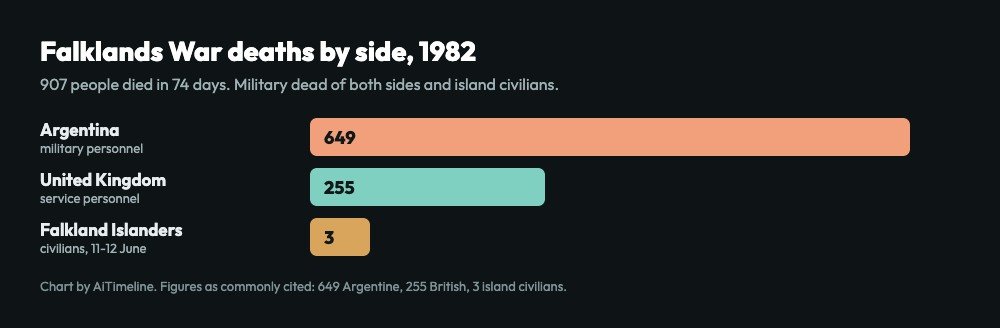
Hundreds more were wounded, many with severe burns from the fires on ships. Veterans on both sides have reported lasting physical and psychological harm, and the war is remembered in Argentina every 2 April as the Day of the Veterans and the Fallen in the Malvinas War, and in the islands every 14 June as Liberation Day.
Ships lost with loss of life
| Ship | Side | Date | How it was lost | Deaths |
|---|---|---|---|---|
| ARA General Belgrano | Argentina | 2 May | Torpedoed by HMS Conqueror | 323 |
| HMS Sheffield | UK | 4 May (sank 10 May) | Air-launched Exocet | 20 |
| ARA Isla de los Estados | Argentina | 10-11 May | Gunfire from HMS Alacrity | Most of the crew |
| HMS Ardent | UK | 21 May | Bombs, San Carlos | 22 |
| HMS Antelope | UK | 23-24 May | Unexploded bomb detonated | 2 |
| HMS Coventry | UK | 25 May | Bombs from Skyhawks | 19 |
| Atlantic Conveyor | UK | 25 May (sank 28 May) | Air-launched Exocet | 12 |
| RFA Sir Galahad | UK | 8 June | Bombs at Fitzroy; later scuttled | 48 |
What Changed After the British Victory?
The war ended the occupation but not the dispute. Britain kept control of the islands, built a permanent garrison and the airfield at Mount Pleasant, and gave the islanders full British citizenship in 1983. Argentina has kept its claim, and since 1994 its constitution describes the recovery of the islands as a permanent goal to be pursued by peaceful means.
In Argentina the defeat brought down the junta and opened the way for the return of democracy in 1983. For the economic crisis that formed part of the background and continued long after, see Argentina’s debt defaults since 1982.
For the islanders, the war hardened their wish to decide their own future, which the 2013 referendum confirmed. Fishing licences and, later, oil exploration transformed the islands’ economy, and both became new points of friction with Buenos Aires.
The war is often compared with other crises in which a misread of the other side’s intentions led to conflict. See the missed Pearl Harbor warnings, the Cuban Missile Crisis and, for another territory claimed by a neighbouring state, the dispute over Ceuta. For naval history, compare Nelson’s tactics at Trafalgar and India’s 1971 raid on Karachi; for a different kind of long-distance operation, the Berlin Airlift. On the UN body that passed Resolution 502, see the history of Security Council reform.
Explore More Timelines
People Also Ask
Falklands War: Frequently Asked Questions
Conclusion: A 74-Day War That Changed the South Atlantic
The Falklands War grew out of a long sovereignty dispute, but its immediate cause was a junta’s gamble in the spring of 1982. Argentina’s invasion forced Britain to choose between accepting the occupation and reversing it by force; Thatcher’s government chose force. The campaign that followed brought controversial naval decisions, deadly air attacks, a hard-won landing and fierce night battles on the hills around Stanley.
Britain achieved its military aim on 14 June 1982. The war left 907 people dead, brought democracy back to Argentina and kept the islands under British administration, while leaving the question of sovereignty exactly where it was.
Related AiTimeline Stories
⚠️ Editorial Note
Last updated 31 October 2026. This is a history of the 1982 war, not a judgment on sovereignty; where the two governments disagree we give both positions. Dates and casualty figures follow official histories and standard references; where accounts differ we say so (for example, British deaths at Goose Green are given as 17 or 18). Some popular summaries of the war contain errors, which we correct in the “Common mix-ups” box. The Argentine names Islas Malvinas and Puerto Argentino refer to the same places as the Falkland Islands and Stanley.
Sources & further reading
Every dated entry above was checked against these references. Last reviewed 31 October 2026.
- US Department of State, Office of the Historian: Crisis in the South Atlantic, the Reagan Administration and the Anglo-Argentine War of 1982
- UN Security Council Resolution 502 (1982)
- National Army Museum: The British Army and the Falklands War
- UK Parliament: The Falklands conflict
- House of Lords Library: Falklands War, 35th anniversary
- Wikipedia: Falklands War
- Wikipedia: 2013 Falkland Islands sovereignty referendum
- Wikipedia: ARA Isla de los Estados