Maha Kumbh Stampede: Causes, Accountability and Changes, Full Timeline
Maha Kumbh stampede 2025 timeline: the 29 January crush at Prayagraj, the 30, 37 and 82 death tolls, the judicial inquiry and HC compensation orders.
Latest Story
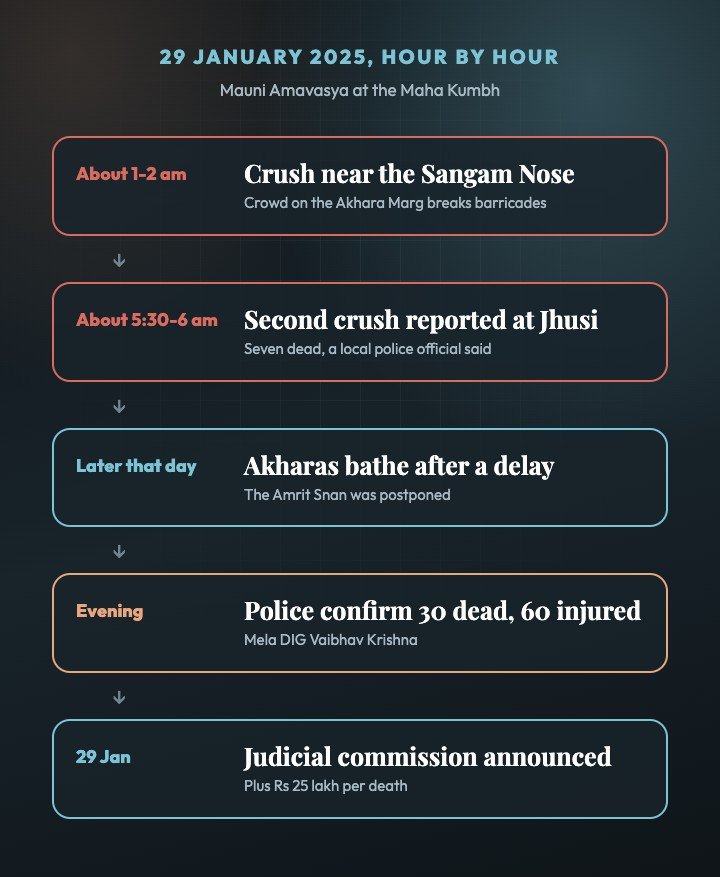
The Maha Kumbh stampede happened in the early hours of 29 January 2025, Mauni Amavasya, when a crowd on the Akhara Marg near the Sangam Nose in Prayagraj pushed through barricades and fell on pilgrims waiting for the holy dip. Police confirmed 30 deaths that evening. The Uttar Pradesh government’s count later rose to 37, and a BBC Hindi investigation put it at no fewer than 82. A judicial commission was set up the same day, and over the next 15 months the Allahabad High Court pushed the state to pay families the ₹25 lakh it had promised. This timeline keeps the official figures, the disputed ones and the court orders apart.
💡 Short Answer
On 29 January 2025, between about 1 and 2 am, a crowd crush near the Sangam Nose at the Maha Kumbh in Prayagraj killed at least 30 people by the first police count; the state’s official toll is 37. Uttar Pradesh appointed a judicial commission under Justice Harsh Kumar and announced ₹25 lakh per death. In April 2026 the Allahabad High Court ruled that the district administration must decide each claim within 30 days. No one has been held responsible.
Maha Kumbh Stampede: Key Questions
The Stampede in Ten Points
- The moment: about 1 to 2 am on 29 January 2025, near the Sangam Nose, on Mauni Amavasya.
- The explanation given: a crowd on the Akhara Marg broke barricades and fell on people waiting to bathe.
- The first count: 30 dead and 60 injured, announced by Mela DIG Vaibhav Krishna about 17 hours later.
- A second crush: reported at Jhusi the same morning, not acknowledged on the day.
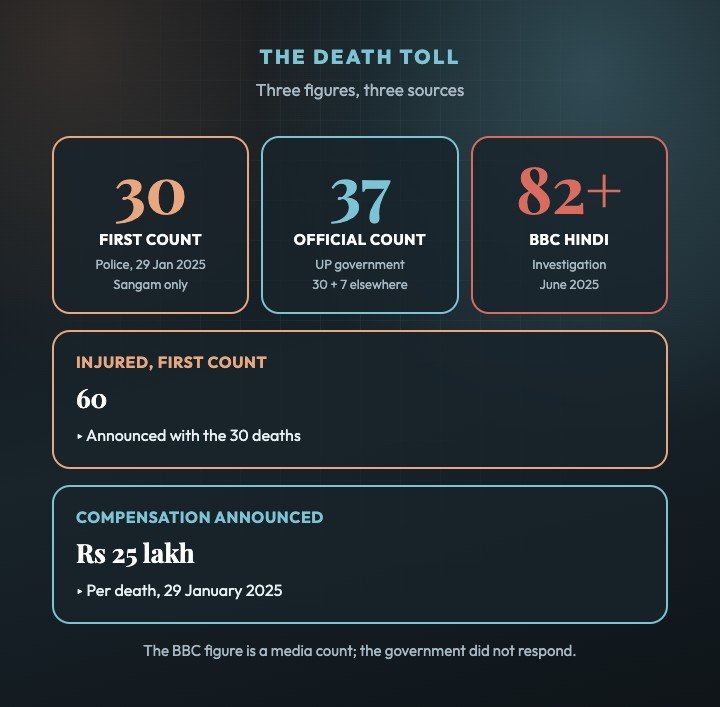
- The official count: 37, the state’s own figure. A BBC Hindi investigation says at least 82.
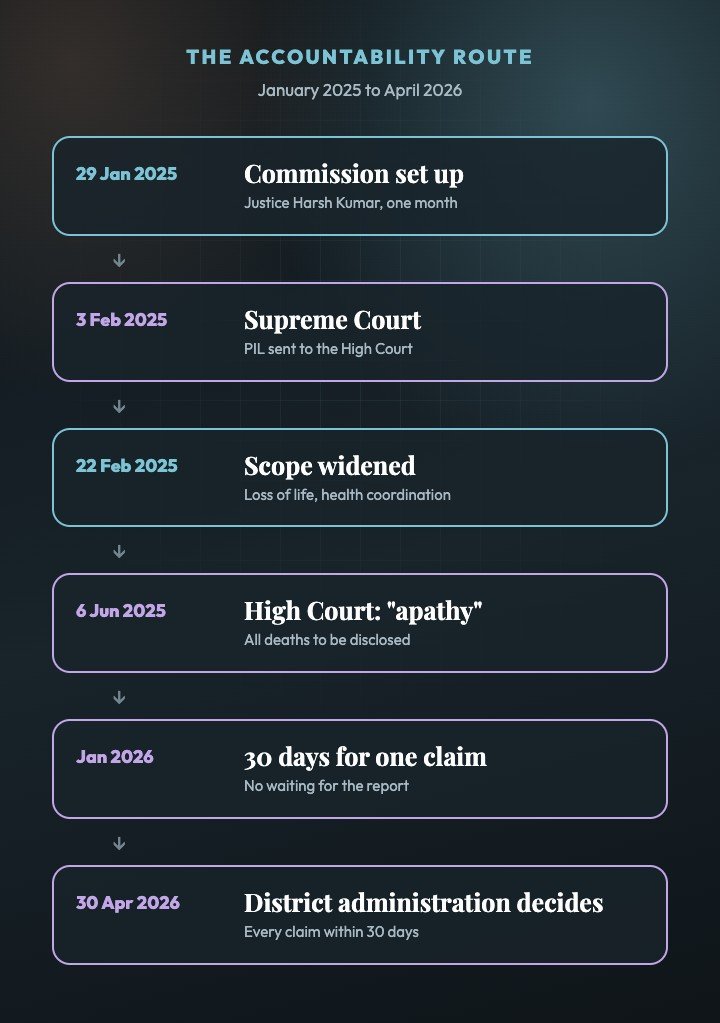
- The inquiry: Justice Harsh Kumar’s commission, widened on 22 February 2025 after High Court pressure.
- The compensation: ₹25 lakh per death, but families were still in court a year later.
- The courts: the Supreme Court sent the PIL to the High Court; the High Court called the delays apathy.
- The rule now: the Meladhikari decides each claim within 30 days, separate from the inquiry.
- The gap: no published finding on who was responsible, 21 months on.
Timeline: From the Night of 29 January to the 2026 Court Orders
Entries are colour-coded by track and run newest first.
No public finding yet on who was responsible Government & inquiry
What is known: The three-member judicial commission was set up to find the causes and circumstances of the crush and to suggest how to prevent another. In court in 2026 the state described the inquiry as continuing, and the High Court’s April 2026 order dealt only with compensation. I found no public report of the commission’s final findings by 5 November 2026.
What that means: No court or inquiry has publicly assigned criminal or individual administrative responsibility for the crush. The existence of an inquiry does not by itself establish negligence by any official.
High Court: district administration, not the commission, decides compensation claims Courts
What happened: Ruling on the claim of a man whose mother, Shiva Devi, died in the crush, the Allahabad High Court set out how ex-gratia claims must be handled. The order was uploaded on 30 April 2026 and reported by LiveLaw that day and by Verdictum and The Indian Express on 1 May. The commission had sent the family’s claim file back to the Mela officer.
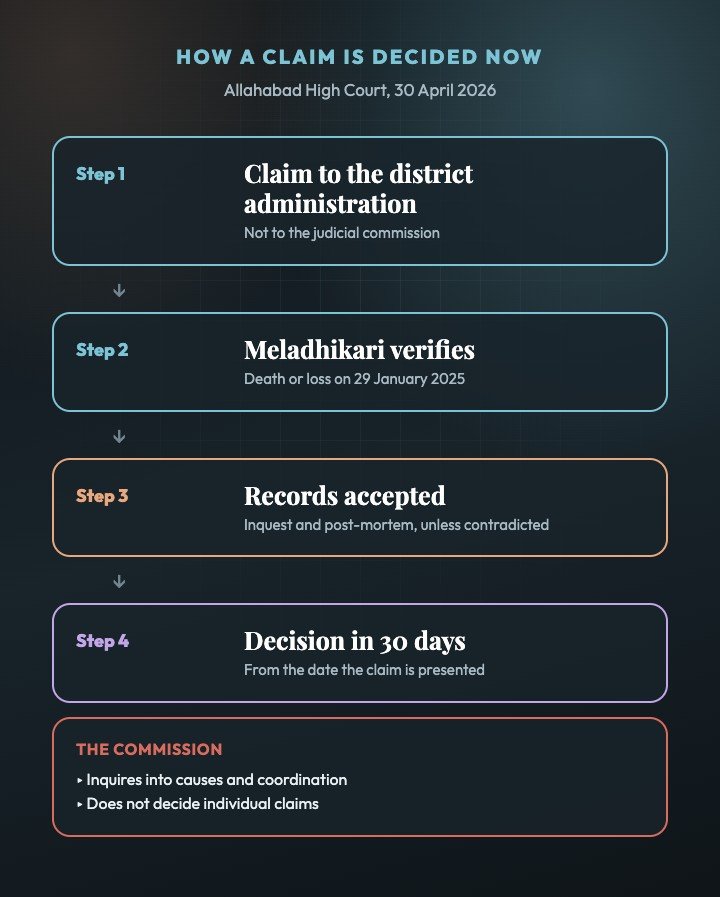
The directions: Claims go to the district administration, not to the judicial commission. The District Magistrate (Mela), or Meladhikari, verifies each death or loss on 29 January 2025. Police inquest reports and post-mortem reports are treated as undisputed unless validly contradicted. A decision must come within 30 days of a claim being presented. In this case the court gave the officer three weeks and listed the matter for 7 May 2026.
High Court gives 30 days to decide a husband’s claim Courts
What happened: The petitioner’s wife died of crush injuries, and her body was handed over in February 2025 without a proper inquest or post-mortem. The state told the court the commission had recorded his statement on 17 December 2025 and that its timeline had been extended. The court refused to wait for the commission and directed it and the Mela Authority to finalise the claim within 30 days, warning that it would take a serious view if the compliance affidavit was not filed by 18 February 2026.
On the date: PTI cites the order as dated 8 January 2026. It was reported by LiveLaw on 27 January and by PTI on 28 January. The brief’s two January entries describe this same order.
BBC Hindi investigation says at least 82 people died Disputed toll
What the BBC reported: After speaking to more than 100 families in 11 states and over 50 districts, BBC Hindi said at least 82 people died, using only cases backed by documents such as death certificates, hospital records or eyewitness accounts. It counted 36 deaths the state recognised, whose families received ₹25 lakh, 26 whose families it said were given ₹5 lakh in cash after signing papers attributing the death to sudden illness, and about 20 with no compensation.
How to read it: This is the BBC’s count, not an official or judicial one. The BBC said it sought the government’s response on the cash payments and received none. The official count remains 37.
High Court calls the compensation delay “apathy” Courts
What happened: Hearing a husband whose wife died in the crush, the Allahabad High Court said the state’s stand on the unpaid compensation was “untenable and smacking of apathy to the plight of the citizen”. It said that once the state had announced ex-gratia payments, it had a “bounden duty” to pay them “with utmost grace and dignity”.
What it ordered: The court noted with concern that the woman’s body was handed over from the Motilal Nehru Medical College mortuary without a proper inquest or autopsy. It ordered the state and Prayagraj’s hospitals to disclose, date-wise, every death and every patient handled from 28 January 2025 to the end of the Mela, and the number of claims received, settled and pending.
Centre tells Lok Sabha it holds no casualty data Government & inquiry
What happened: Answering questions from Congress MPs, the minister said police and public order are state subjects, that crowd management at religious gatherings and inquiries into stampedes fall to state governments, and that no data on deaths or injuries is maintained centrally. He said states should follow crowd-management guidance from the NDMA and BPR&D.
Why it matters: Responsibility for the event, the inquiry and the casualty count rests with Uttar Pradesh. The opposition criticised the reply as evasive.
Commission examines records and questions officials Government & inquiry
What happened: The commission examined documents and recorded statements of officials involved in the Mela arrangements, PTI reported. Reports said it looked at crowd build-up, deployment, exit routes and the emergency and medical response.
What is not known: The brief said about 20 police officers were questioned individually. I could not confirm that number, so it is not used here.
Adityanath says deaths were not “highlighted” to prevent panic Disputed toll
What he said: Speaking to officials at an event on the Mela, the Chief Minister said the injured were taken to hospital, “where some died sadly, but we didn’t let it get highlighted, so that there was no panic.” The Wire reported this as an admission that at least two crushes took place that day.
Context: The government had first confirmed deaths only on the evening of 29 January, about 17 hours after the crush, and had not acknowledged a second incident at the time.
After High Court pressure, the commission’s scope is widened Courts
What happened: The PIL sought a judicial monitoring committee to trace people missing after the crush. On 19 February the bench told the state to spell out the commission’s terms of reference. On Saturday 22 February the Governor, under the Commissions of Inquiry Act, 1952, expanded the inquiry, and on 24 February the court disposed of the PIL with liberty to return.
The new terms: Originally the commission was to find the reasons and circumstances of the incident and suggest how to prevent a recurrence. It was now also to inquire into loss of life and property, if any, and into coordination between the Mela and district administrations and the health services. Its term was extended by one month from 1 March 2025.
Official toll: 30 at the Sangam, seven more elsewhere Disputed toll
What happened: Responding to the opposition in the Assembly, the Chief Minister gave the toll at the Sangam as 30, with barricades near the Sangam Nose giving way under crowd pressure. Reporting on his statements put a further seven deaths in a separate incident elsewhere in the Mela that day, making the official count 37.
The dispute: Opposition leaders said the toll was higher. Reuters had earlier reported about 40 deaths, citing police sources.
Supreme Court sends the PIL to the High Court Courts
What happened: The PIL sought safety guidelines for large gatherings and action against officials. The Supreme Court called the incident unfortunate and a matter of concern but declined to hear it directly, noting that a judicial commission had been set up, and told the petitioner to approach the Allahabad High Court.
Why it matters: The legal fight moved to Allahabad, where the commission’s scope and the compensation cases were later decided.
Commission visits the Sangam Nose Government & inquiry
What happened: The three members visited the site of the crush, met Mela officials and saw the hospital where the injured were treated. The commission said it would examine how the incident happened and recommend measures to prevent another.
Chief Secretary and DGP inspect the site; VVIP passes cancelled Government & inquiry
What happened: The state’s Chief Secretary and Director General of Police visited the Sangam area to review the arrangements. The Mela was declared a no-vehicle zone, VVIP passes were cancelled and one-way routes were enforced for later bathing days.
Judicial commission and ₹25 lakh ex-gratia announced Government & inquiry
What happened: The Chief Minister announced a three-member judicial commission headed by retired Allahabad High Court judge Justice Harsh Kumar, with former DGP V.K. Gupta and retired IAS officer D.K. Singh, and ₹25 lakh for the family of each person who died. The commission was given one month, subject to extension.
What it was asked: To find the reasons and circumstances of the incident and suggest measures to prevent it happening again.
Police confirm 30 dead and 60 injured Crush & casualties
What happened: About 17 hours after the crush, Mela DIG Vaibhav Krishna said 30 people had died, 25 of whom had been identified, and 60 were injured. He said a large crowd on the Akhara Marg broke the barricades and crossed to the other side, falling on devotees who were waiting there for the bathing time.
Correction to the brief: The 30 and 60 figures were announced by the police, not the Chief Minister. Adityanath announced the inquiry and the compensation.
A second crush reported at Jhusi Crush & casualties
What happened: About 3 km from the Sangam, a crush was reported in the Jhusi area. The Hindustan Times quoted a local police official as saying seven people were found dead at the spot because of crowd pressure. The Mela DIG said reports of a second stampede were being verified.
Status: The government did not acknowledge it on the day. The seven additional deaths later included in the official count of 37 are reported as a separate incident; I could not confirm that they are the same seven.
Crush near the Sangam Nose on Mauni Amavasya Crush & casualties
What happened: Shortly before the auspicious hour for the Mauni Amavasya bath, a large crowd moving along the Akhara Marg towards the Sangam pressed against barricades that gave way. People fell and were trampled. Survivors told reporters they had been unable to move and that help was slow to reach them.
Immediate effect: The akharas postponed their Amrit Snan and bathed later in the day, after the crowd eased.
The 2025 Maha Kumbh begins in Prayagraj Government & inquiry
Background: The Maha Kumbh is held at the Sangam, where the Ganga and Yamuna meet and where tradition places the unseen Saraswati. The administration built a temporary city of roads, pontoon bridges, camps, police posts and medical facilities for a crowd expected in the tens of crores over 45 days.
The Death Toll: Three Numbers, Kept Apart
Each comes from a different source and covers a different scope.
| Figure | Where it comes from | Status |
|---|---|---|
| 30 dead, 60 injured | Mela DIG Vaibhav Krishna, evening of 29 January 2025; covers the Sangam crush only | First official figure |
| 7 dead at Jhusi | Local police official quoted by the Hindustan Times, 30 January 2025 | Reported; not acknowledged on the day |
| 37 dead | Uttar Pradesh government: 30 at the Sangam and seven in a separate incident the same day | The state’s official count |
| About 40 dead | Reuters, citing police sources, on 29-30 January 2025 | Reported |
| At least 82 dead | BBC Hindi investigation, 10 June 2025, from documents and family interviews | Media count; government did not respond |
📌 Why the numbers differ
The first count covered only the crush at the Sangam. The official 37 adds a second incident. The BBC’s figure includes families it says were paid ₹5 lakh in cash and others who received nothing; it is the BBC’s count, not a finding. In June 2025 the High Court ordered the state to disclose every death recorded from 28 January to the end of the Mela, which is the record that would settle the question.
What Caused the Maha Kumbh Stampede?
Reported causes and known crowd-crush risks, not a judicial finding.
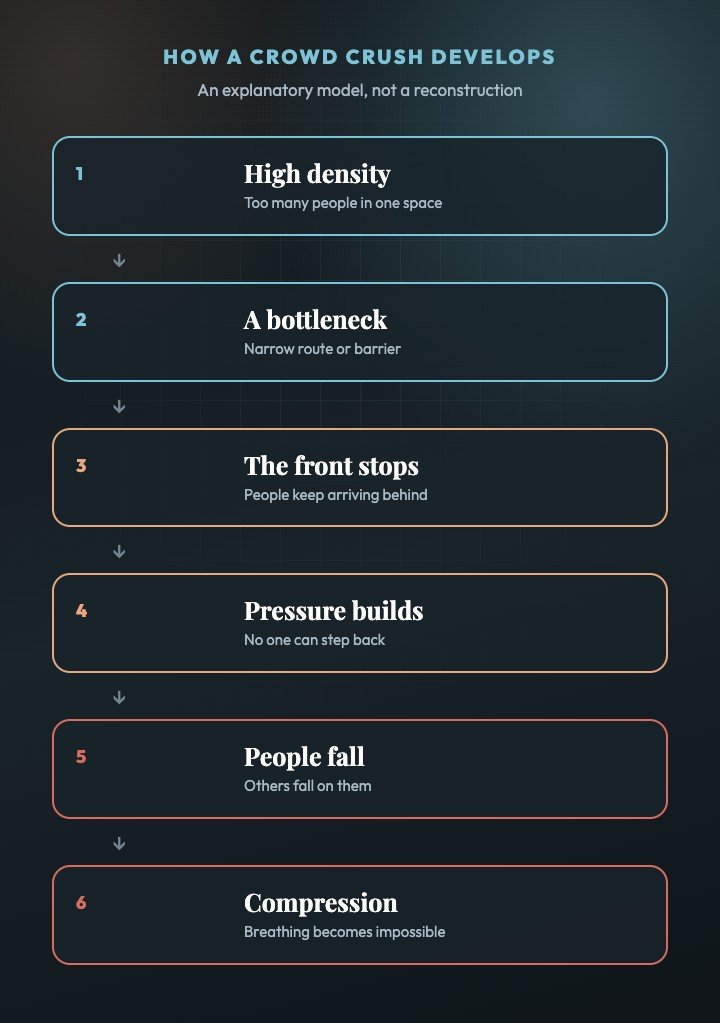
A stampede of this kind is usually a crowd crush: people are packed so tightly that they cannot control their own movement. Nobody needs to run. When the front stops and people keep arriving from behind, pressure builds until someone falls, and those around them fall too.
The official explanation, given by the Mela DIG on 29 January, was that a crowd on the Akhara Marg broke the barricades and crossed to the other side, falling on devotees waiting there for the auspicious hour. Survivors told reporters they were trapped, could not stand up once they fell and waited for help.
Too many people, one hour
- Mauni Amavasya is the busiest bathing day.
- Many wanted to bathe at the same time.
Barricades and bottlenecks
- The Sangam Nose is a narrow destination.
- Barricades meant to guide the crowd gave way.
Falls, then delay
- People who fell could not get up.
- The commission’s widened brief covers health coordination.
Accountability: Who Has Done What
Each institution’s role, as recorded in orders and replies.
| Institution | Role or intervention | Date |
|---|---|---|
| Uttar Pradesh government | Organised the Mela; set up the commission and a police inquiry; announced ₹25 lakh per death | 29 Jan 2025 |
| Supreme Court | Declined the PIL and told the petitioner to approach the High Court | 3 Feb 2025 |
| Governor of Uttar Pradesh | Widened the commission’s terms under the Commissions of Inquiry Act, 1952 | 22 Feb 2025 |
| Union Home Ministry | Told the Lok Sabha that police and public order are state subjects and no central data is held | 18 Mar 2025 |
| Allahabad High Court | Pressed the state on the commission’s scope and on unpaid compensation | Feb 2025 to Apr 2026 |
| Judicial commission | Inquires into causes, circumstances, loss of life and coordination; not individual claims | Continuing |
| District Magistrate (Mela) | Verifies and decides each compensation claim within 30 days | From Apr 2026 |
Established
- The crush happened near the Sangam Nose on 29 January 2025.
- The state’s official toll is 37.
- Compensation is ₹25 lakh per death, decided by the district administration.
Still open
- The commission’s findings on the cause.
- Whether any official was negligent.
- The full death count, which the BBC disputes.
⚖️ On responsibility
No official is named here as responsible for the crush. The existence of a judicial inquiry does not establish negligence, and no court has assigned criminal or administrative blame as of 5 November 2026.
Compensation: What the High Court Changed
Three orders, one family’s claim at a time.
“Apathy”
- Delay called untenable.
- Every death and patient to be disclosed.
- Body released without post-mortem noted.
30 days
- Commission and Mela Authority to decide one claim.
- Compliance by 18 Feb 2026.
- No waiting for the final report.
Who decides
- District administration, not the commission.
- Inquest and post-mortem reports accepted.
- Decision within 30 days.
What Should Change After the Stampede
Lessons for large gatherings, drawn from crowd-safety practice and this case.
Changes for future gatherings
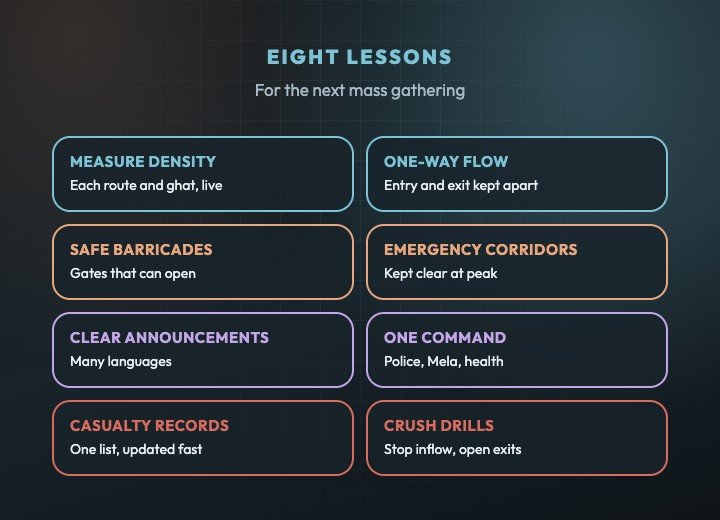
- Measure density, not attendance: watch crowd density on each route and bathing point, with alerts before it becomes unsafe.
- One-way movement: separate entry and exit corridors so crowds do not meet head on. The Mela enforced this after 29 January.
- Barricades that release: barricades should guide people without trapping them, with gates that can be opened.
- Protected emergency routes: ambulances and rescuers need corridors that stay clear at peak hours.
- Clear announcements: loudspeakers, boards and alerts in several languages, for people without smartphones too.
- One command: police, Mela officials, district administration, health services and railways working from one control room.
- Transparent casualty records: one list for the missing, the injured and the dead, updated quickly, so families need not search mortuaries.
- Drills: practise stopping inflow, opening exits and reaching people who have fallen.
Key People and Institutions
Roles as recorded in orders and reports.
| Name | Role | Part in the story |
|---|---|---|
| Yogi Adityanath | Chief Minister of Uttar Pradesh | Announced the commission and the ₹25 lakh ex-gratia |
| Vaibhav Krishna | DIG, Maha Kumbh Mela | Announced the first toll of 30 dead and 60 injured |
| Justice Harsh Kumar | Retired Allahabad High Court judge | Heads the judicial commission |
| V.K. Gupta, D.K. Singh | Former DGP; retired IAS officer | Members of the commission |
| Manoj Kumar Singh, Prashant Kumar | Chief Secretary; DGP | Inspected the site on 30 January 2025 |
| Sanjiv Khanna | Chief Justice of India | Sent the PIL to the High Court on 3 February 2025 |
| Nityanand Rai | Minister of State for Home | Told the Lok Sabha no central casualty data is held |
| Ajit Kumar | Allahabad High Court judge | On both 2026 benches that set 30-day deadlines |
Explore More Timelines
People Also Ask
Frequently Asked Questions
Dated facts from court orders and reporting.
⚠️ Editorial Note
This account is built from Allahabad High Court orders as reported by LiveLaw, Verdictum and PTI, a Lok Sabha reply, and reporting by Scroll, The Tribune, The Wire, the Hindustan Times and South First. Some details differ between sources: the January 2026 order is dated 8 January by PTI but was reported on 27 January; the April 2026 order is dated 13 April in some summaries but was uploaded on 30 April; and injury counts on 29 January varied. The brief this page was built from attributed the first toll to the Chief Minister and the 37 figure to court reporting; both have been corrected. The BBC’s 82 figure is attributed to the BBC. Information is current as of 5 November 2026. This is not legal advice.
Related Reading on AiTimeline
Sources & further reading
Every dated entry above was checked against these references. Last reviewed 5 November 2026.
- Scroll: Uttar Pradesh government orders judicial probe into Maha Kumbh stampede (30 January 2025)
- The Tribune: Maha Kumbh stampede: 30 dead, 60 injured, say UP Police (29 January 2025)
- LiveLaw: UP Govt expands judicial commission's scope following High Court suggestion (24 February 2025)
- The Wire: Adityanath admits downplaying stampede deaths at Kumbh (4 March 2025)
- The Week (PTI): No data on Maha Kumbh stampede maintained by central govt, says MoS Home (18 March 2025)
- LiveLaw: Allahabad HC raps UP govt for apathy over compensation delay (6 June 2025)
- South First: BBC report claims at least 82 dead against official count of 37 (11 June 2025)
- LiveLaw: Allahabad High Court sets 30-day deadline to decide compensation to victim's kin (27 January 2026)
- LiveLaw: District admin, not judicial commission, to decide ex-gratia claims within 30 days (30 April 2026)
- Verdictum: Sanjay Kumar Sharma v. State of UP, Allahabad High Court (1 May 2026)