Paraguay’s Banking Crisis: From the 1995 Bank Failures to Ueno Bank’s Collapse in 2026
Paraguay's banking crisis, from the 1995-98 bank failures and 2002-03 contagion to the Ueno Bank takeover of 3 November 2026. Dates, laws and costs.
Latest Story
Paraguay’s banking crisis is not one event but a pattern. After the financial liberalisation of 1989, undercapitalised banks multiplied under weak supervision, lent to their owners’ companies and hid losses in parallel books. The bill arrived in three waves: in May 1995, when Bancopar and Banco General were intervened; in June 1997, when Banco Unión fell; and in 1998, when the workers’ bank BNT and Banco de Desarrollo closed. Contagion from Argentina and Uruguay brought down Banco Alemán in 2002 and Multibanco in 2003, and by then the crises had cost about 15.7% of GDP. On 3 November 2026 the pattern returned on a new scale, when the central bank took over the digital lender Ueno Bank and froze the accounts of about 2.9 million customers. This timeline follows every stage, from 1989 to the latest developments.
💡 Short Answer
Paraguay’s banking crisis ran in waves. After liberalisation in 1989, weakly supervised banks failed in 1995 (Bancopar, Banco General and two others), 1997 (Banco Unión, Ahorros Paraguayos, BIPSA) and 1998 (BNT, Banco de Desarrollo), and regional contagion closed Banco Alemán in 2002 and Multibanco in 2003. The cumulative direct cost was about 15.7% of GDP, and Law 2334/03 created a deposit guarantee fund. On 3 November 2026 the central bank took over Ueno Bank, with about 2.9 million customers, using that same law.
Paraguay Banking Crisis: Key Questions
Paraguay’s Banking Crises in Ten Points
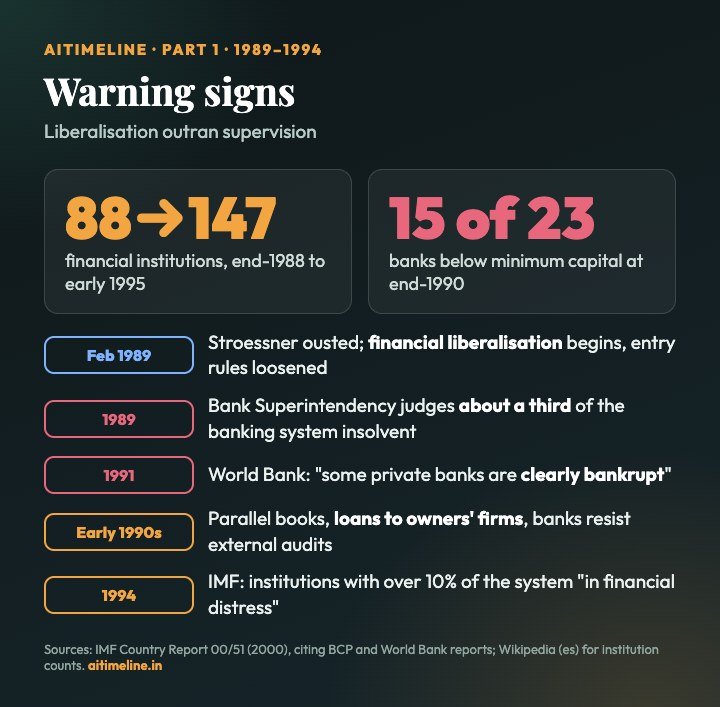
- The roots: liberalisation in 1989 let financial institutions grow from 88 to 147 by early 1995, many undercapitalised.
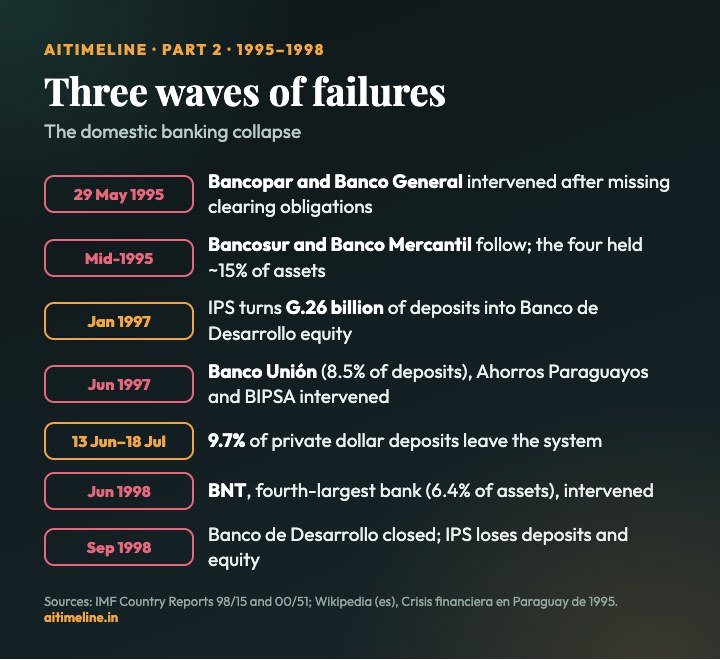
- First wave: Bancopar and Banco General were intervened on 29 May 1995; Bancosur and Banco Mercantil followed.
- Full rescue: the central bank spent about 4% of GDP in 1995 honouring deposits, with no guarantee scheme in place.
- Second wave: Banco Unión, Ahorros Paraguayos and BIPSA fell in June 1997, and 9.7% of private dollar deposits fled in five weeks.
- Third wave: the workers’ bank BNT and Banco de Desarrollo closed in 1998.
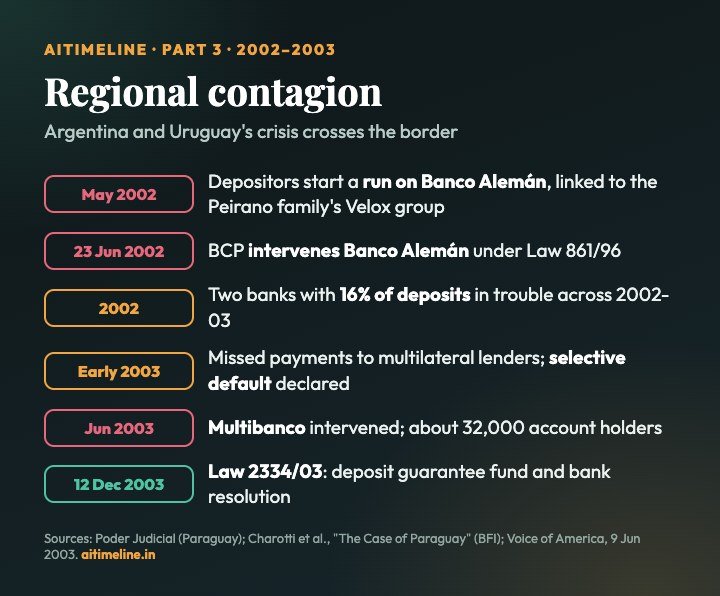
- Contagion: Argentina and Uruguay’s crisis brought down Banco Alemán in June 2002; Multibanco followed in June 2003.
- The bill: about 15.7% of GDP over 1995-2003, mostly paid by the public sector.
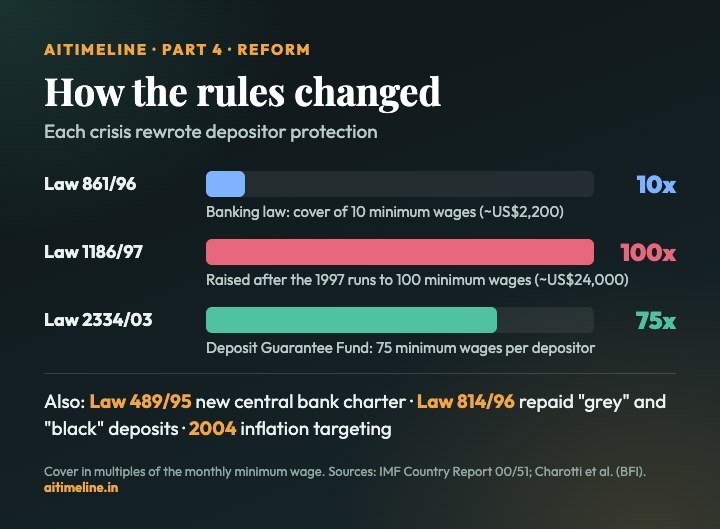
- The reform: Law 2334/03 created a deposit guarantee fund covering 75 minimum wages per depositor.
- 2026: the central bank took over Ueno Bank on 3 November, freezing the accounts of about 2.9 million customers.
- Old patterns: owner-linked lending, pension-fund money at risk and political ties all reappear in the Ueno case.
Timeline: Paraguay’s Bank Failures, 1989 to 2026
Newest first. The most important line runs between the home-grown collapse of 1995-98 and the regional shock of 2002-03.
Banks and regulator call for calm as rumours spread Ueno 2026
What happened: The banking association, whose 14 members include Ueno, called rumours of further interventions “false” and said they were creating uncertainty. The central bank said the rest of the system “maintains adequate levels of solvency and liquidity”.
Signs of strain: Infobae reported record numbers of new accounts being opened elsewhere, which it said explained app problems at the digital wallets Mango, Vaquita and Eko.
Arrests, a central bank resignation and an impeachment push Ueno 2026
Arrests: AP and La Nación reported eight people detained, including founder Federico Miguel Vázquez Villasanti and bank president Juan Manuel Gustale Cardoni; BioBio/EFE counted seven. Prosecutors opened a case for “lesión de confianza” (breach of trust) on a complaint from the central bank board, and courts froze about US$70 million and G.1.62 trillion in assets of directors and holding companies.
Central bank: BCP president Carlos Carvallo resigned on 3 November at President Santiago Peña’s request; board member Liana Caballero took over on an interim basis. Carvallo, appointed by Peña in 2023, had earlier run Financiera Ueno; the BCP said he recused himself from Ueno decisions.
Politics: Opposition senators began pushing impeachment (juicio político) against Peña and Vice-President Pedro Alliana. Peña cancelled his trip to the Ibero-American summit, promised a fast-track law to speed payouts and recover public money, and said those responsible “will have to answer to the courts, without exceptions or privileges”.
Central bank takes over Ueno Bank, freezing accounts of 2.9 million customers Ueno 2026
What happened: After a unanimous board vote late on 2 November, the Banco Central del Paraguay announced early on 3 November that it was opening a resolution procedure for Ueno Bank. Branches closed and services were suspended. The trigger, the BCP said, was a solvency ratio below half the legal minimum; La Nación put it at 5.56% against a 12% floor, after accounting adjustments of more than G.1.6 trillion and an unrestored US$70 million reserve requirement.
Who is affected: About 2.9 million customers, around 60% of Paraguay’s adults. The Deposit Guarantee Fund created by Law 2334/03 covers up to 75 minimum wages, G.228.3 million (about US$38,000) per depositor, which reported estimates say fully covers about 97% of savers. An initial payment of up to G.10 million (about US$1,700) was promised; by law, guaranteed money is due within 15 days, extendable once.
Public money: The state pension and health fund IPS had about US$380 million at the bank (BioBio/EFE: US$355 million, about 9% of its portfolio), and about 32,000 retirees were paid through it. AP put public-sector funds at US$800-850 million, about a quarter of deposits; the power utility ANDE and the Itaipú dam also had money there.
Warnings before the fall Ueno 2026
What was known: AP reported that the central bank warned Ueno in June 2026 about lending to companies linked to its owners. In October ABC Color reported about US$146 million in loans to three companies tied to Grupo Vázquez employees, and Fitch moved its outlook to negative. Less than a week before the takeover the bank announced a US$100 million capital increase.
Ueno grows into the country’s most-used bank Ueno 2026
The rise: Ueno grew out of Financiera Ueno, part of Grupo Vázquez. It received a banking licence in 2023 (ABC Color, via The Paraguay Post) and took over Visión Banco and its network of more than 70 branches. The Paraguay Post called it the country’s fastest-growing lender, and its app-first accounts reached nearly 3 million customers.
Inflation targeting and a calmer decade Reform
What changed: After the 2003 default, the central bank began moving towards inflation targeting in 2004 with a 5% target (plus or minus 2.5 points), and the government cleared its debt arrears. A 2013 fiscal responsibility law later capped the central government deficit at 1.5% of GDP.
Law 2334/03 creates the Deposit Guarantee Fund Reform
What it did: The law set up a deposit guarantee regime funded from private and public resources, covering up to 75 times the minimum wage per depositor, principal and interest included, and set rules for resolving failing banks. It replaced improvised, case-by-case rescues.
Then and now: In 2003 the minimum wage was about US$160, so the cover was about US$12,000. In November 2026 the same 75-wage cover is G.228.3 million, about US$38,000, and it is the framework being used for Ueno.
Multibanco is intervened Regional contagion 2002-03
What happened: The central bank took over Multibanco in the first week of June 2003; on 9 June a judge charged two executives, Pedro Miraglio and Oscar Pérez Samaniego, over loans to affiliated companies made as the intervention approached (Voice of America). LatinNews reported about 32,000 account holders and US$13.5 million of IPS money trapped. The bank was declared bankrupt in 2005.
Paraguay misses debt payments and is declared in selective default Regional contagion 2002-03
What happened: At the start of 2003 the Finance Ministry could not cover wages and missed debt service to multilateral lenders, and rating agencies declared a selective default. The default was on foreign-currency debt; the central bank, not the Treasury, had funded most of the bank support.
Banco Alemán collapses after a run tied to Argentina and Uruguay Regional contagion 2002-03
What happened: Depositors began pulling money from Banco Alemán Paraguayo in May 2002, as Argentina’s deposit freeze and Uruguay’s crisis spread fear through banks owned by regional groups; the bank was linked to Uruguay’s Peirano family and its Velox group. The central bank intervened on 23 June 2002 under Article 118 of the banking law, and Law 1974/02 allowed its assets and liabilities to be transferred.
The bill: The central bank paid depositors about G.128.8 billion under Law 1947/02. A foreign-owned and a locally owned bank with 16% of deposits ran into trouble across 2002-03.
Third wave: BNT and Banco de Desarrollo are closed Domestic collapse 1995-98
What happened: Banco Nacional de Trabajadores, the fourth-largest bank with 6.4% of system assets, was intervened in June 1998 after auditors found losses of almost G.220 billion against the G.16 billion it reported, and more than 90% of its loans overdue. Banco de Desarrollo closed in September 1998 and BUSAIF in the second half of the year.
Scale of the clean-up: Spanish Wikipedia’s account says fewer than 14 of about 40 banks and only 13 or 14 of about 60 finance companies survived the decade’s crises.
Congress raises deposit cover tenfold Reform
What happened: After the June 1997 closures, protests pushed Congress to lift deposit insurance from the banking law’s 10 monthly minimum wages to 100, about US$24,000. The BCP could space payments above 20 minimum wages over a year.
A flight to quality empties local banks Domestic collapse 1995-98
What happened: Between 13 June and 18 July 1997, 9.7% of private foreign-currency deposits left the banking system and 4.5% of all private deposits went. Public banks lost 44% of private dollar deposits and local private banks 23%, while foreign-owned banks gained almost 12 points of market share.
Second wave: Banco Unión, Ahorros Paraguayos and BIPSA Domestic collapse 1995-98
What happened: The BCP intervened Ahorros Paraguayos, the biggest savings and loan association, Banco Unión, the largest privately owned local bank, and Banco de Inversiones de Paraguay (BIPSA), which could not meet depositors’ short-term demands or cover overdrafts at the central bank. Unión had already received G.36 billion in central bank loans by May and G.85 billion more under a rehabilitation programme.
Outcome: Recapitalisation talks failed, and the government decided in early 1998 to liquidate Banco Unión.
Pension money props up Banco de Desarrollo Domestic collapse 1995-98
What happened: The Social Security Institute (IPS) was persuaded to convert G.26 billion of its deposits at Banco de Desarrollo into shares to keep the bank alive. By the end of 1996, 98% of the bank’s deposits already belonged to IPS. It closed anyway in September 1998, and IPS recovered neither deposits nor equity.
New banking law and the fight over “black” deposits Reform
Banking law: Approved by Congress in May 1996, Law 861/96 gave the superintendency power to intervene and close institutions, made external audits compulsory, limited lending to single borrowers and related parties, required owners to be disclosed and set deposit insurance at 10 minimum wages (about US$2,200).
Off-the-books deposits: Congress passed Law 814/96 ordering repayment of undocumented deposits too. A presidential veto was overridden and upheld in court; up to about US$15,000 per depositor was repaid, G.41 billion in all, about 0.2% of GDP.
The central bank pays out to stop a panic Domestic collapse 1995-98
What happened: With no deposit guarantee scheme in place, the government honoured deposits in the failed banks and the BCP lent freely to meet withdrawals. In 1995 alone it spent close to G.700 billion (about US$360 million, 4% of GDP). A new organic law for the central bank, Law 489/95, was passed the same year.
The side effect: The implicit full guarantee meant depositors saw no risk, so weak banks kept attracting money simply by paying higher interest.
First wave: Bancopar and Banco General are intervened Domestic collapse 1995-98
What happened: Bancopar (Banco Comercial Paraguayo) and Banco General, two of the largest private banks, failed to meet their clearing obligations and were intervened. Bancosur and Banco Mercantil followed, along with the finance companies Urundey, Sauce, Vanguardia and Sur de Finanzas and the housing lender Hogar Propio.
What investigators found: Parallel accounting: unrecorded loans, especially to related companies, and large undisclosed deposits. A shortfall of money discovered at the central bank on 24 April 1995, linked to support for Bancopar, had already raised alarm.
Regulators see the problem and wait Roots
Warning signs: The World Bank said in 1991 that “some private banks are clearly bankrupt” and that at least 15 of 23 banks were below minimum capital at the end of 1990. In 1994 the IMF warned that institutions with over 10% of the system were “in financial distress”. Banks resisted external audits, and the law did not let the superintendency require them.
Liberalisation after Stroessner Roots
What happened: After the coup that ended Alfredo Stroessner’s 34-year dictatorship, Paraguay liberalised its financial system: interest rates were freed and reserve requirements that had reached 42% of deposits were cut. Lax entry rules brought a rush of new banks and finance companies, many seriously undercapitalised; institutions rose from 88 at the end of 1988 to 147 by early 1995.
Early verdict: The Bank Superintendency already judged in 1989 that about a third of the banking system was insolvent.
The Crisis in Four Phases
Warning signs, domestic collapse, regional contagion and reform.
1995-98 vs 2002-03: Two Different Crises
The brief’s key distinction, and the one that matters most for understanding 2026.
Home-grown collapse
- Locally owned and public banks.
- Owner-linked loans and parallel books.
- Three waves, years of forbearance.
Imported shock
- Argentina’s freeze, Uruguay’s crisis.
- Banks tied to regional groups.
- Ended with Law 2334/03.
Ueno: a mix of both
- One locally owned digital bank.
- Owner-linked lending alleged.
- First big test of Law 2334/03.
Ueno Bank, November 2026: What We Know
The first days of the biggest bank failure, by customers, in Paraguay’s history.
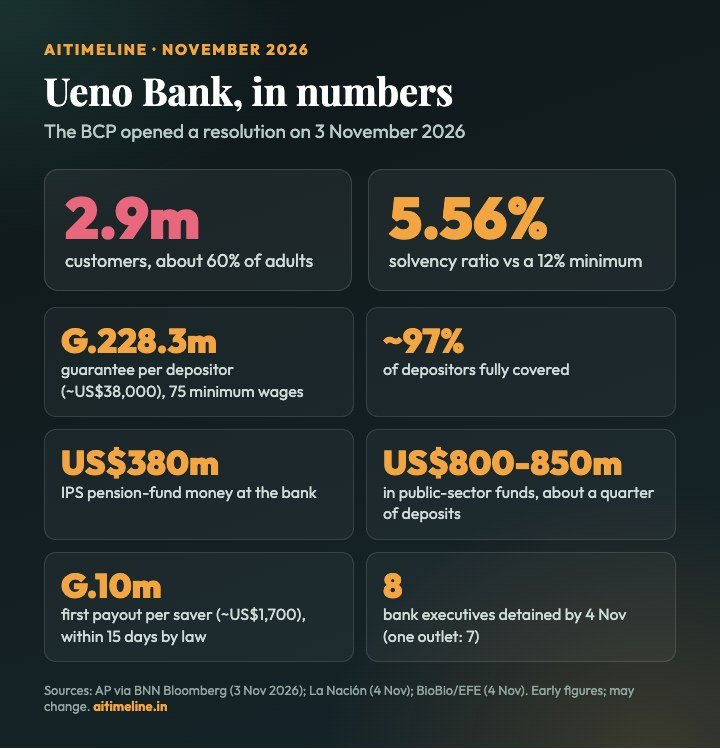
Ueno was built as an app-first bank by Grupo Vázquez, grew out of Financiera Ueno, gained a banking licence in 2023 and absorbed Visión Banco’s branch network. By 2026 it served about 2.9 million customers, around 60% of the country’s adults, and held large sums of public money, from the IPS pension fund to the state power company ANDE.
The central bank’s case is that the bank’s capital was far weaker than its books showed. After adjustments, La Nación reported, its solvency ratio stood at 5.56% against a 12% minimum. AP reported that the regulator had warned Ueno in June about lending to owner-linked companies. Those are the same two problems, related lending and inflated balance sheets, that the IMF documented in 1995 and 1997.
The difference from 1995 is the framework. There is now a Deposit Guarantee Fund with a legal limit, a 15-day payout rule and a resolution procedure. The test of the reforms is whether small savers are paid quickly and whether public bodies such as IPS recover their money.
On the record
- Resolution opened 3 November 2026.
- Guarantee: G.228.3 million per depositor.
- Carvallo resigned 3 November.
- Criminal case for breach of trust opened.
Still unclear
- Whether accounts will move to another bank.
- How much uninsured savers and IPS recover.
- The exact number detained (7 or 8).
- Whether impeachment goes anywhere.
1995 and 2026 Side by Side
What has changed in 31 years, and what has not.
| Question | May 1995 | November 2026 |
|---|---|---|
| Banks taken over | Bancopar, Banco General, then Bancosur and Banco Mercantil | Ueno Bank |
| Trigger | Missed clearing obligations | Solvency below half the legal minimum |
| Size | About 15% of system assets | About 2.9 million customers, ~60% of adults |
| Deposit guarantee | None; the state honoured deposits anyway | 75 minimum wages (G.228.3m, ~US$38,000) |
| Hidden problems | Parallel books, loans to related firms | Alleged owner-linked loans, accounting adjustments |
| Public money exposed | Central bank lent ~4% of GDP in 1995 | ~US$800-850m of public funds, incl. IPS US$380m |
| Accountability | Top officers arrested and tried | Eight detained (or seven), central bank chief resigned |
Why Paraguay’s Banks Collapsed
Seven weaknesses that reinforced each other.
The seven causes
- Liberalisation without safeguards: lax entry rules after 1989 let institutions nearly double in six years.
- Weak supervision: too few supervisors, no power to require external audits, and political pressure on decisions.
- Insider lending: loans to owners’ and shareholders’ companies, the problem flagged again at Ueno in 2026.
- Parallel accounting: unrecorded loans and “grey” and “black” deposits hid the true state of balance sheets.
- Too little capital: 15 of 23 banks were below the minimum at the end of 1990.
- Delayed intervention: rehabilitation programmes kept insolvent banks open; the IMF judged them almost useless.
- Regional contagion: in 2002-03 the shock came from Argentina and Uruguay through ownership links.
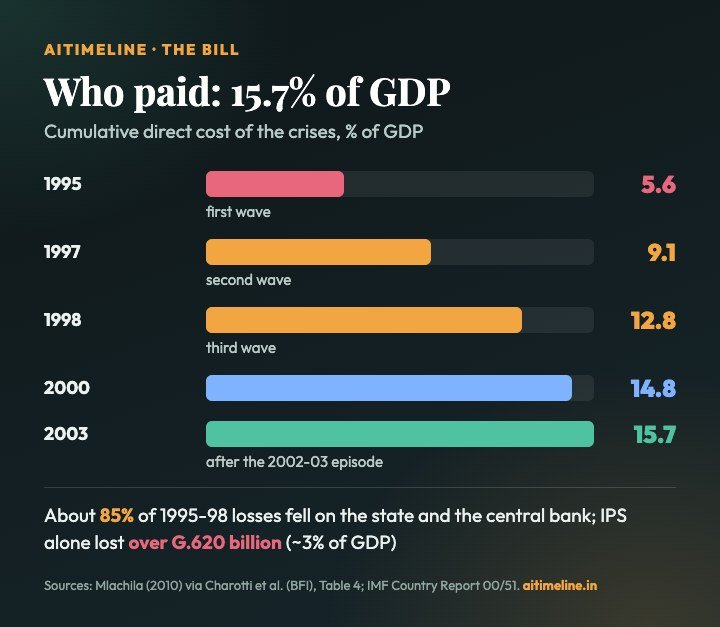
The Cost: 15.7% of GDP
Who paid for the failures of 1995-2003.
| Year | Annual cost, % of GDP | Cumulative, % of GDP |
|---|---|---|
| 1995 | 5.6 | 5.6 |
| 1996 | 0.1 | 5.7 |
| 1997 | 3.4 | 9.1 |
| 1998 | 3.7 | 12.8 |
| 1999 | 0.5 | 13.3 |
| 2000 | 1.5 | 14.8 |
| 2001 | 0.1 | 14.9 |
| 2002 | 0.6 | 15.5 |
| 2003 | 0.2 | 15.7 |
The IMF’s 2000 estimate put direct losses from the 1995-98 waves near G.2,000 billion, about US$900 million or 10% of GDP, and found that about 85% fell on the government and central bank, with uncovered private deposits about 15%. It compared the cost with Venezuela’s early-1990s crisis (about 18% of GDP) and the US savings and loan crisis (3-4%).
How Paraguay Changed Its Banking Rules
The laws that followed each wave.
| Law or measure | Year | What it did |
|---|---|---|
| Law 489/95 | 1995 | New organic law of the Central Bank of Paraguay |
| Law 861/96 | 1996 | General banking law: intervention powers, compulsory audits, related-lending limits, cover of 10 minimum wages |
| Law 814/96 | 1996 | Repayment of off-the-books “grey” and “black” deposits up to about US$15,000 |
| Law 1186/97 | 1997 | Raised deposit cover to 100 minimum wages after the June 1997 runs |
| Laws 1947/02, 1974/02 | 2002 | Payments to depositors and asset transfers in the Banco Alemán case |
| Law 2334/03 | 12 Dec 2003 | Deposit Guarantee Fund (75 minimum wages) and bank resolution procedures |
| Inflation targeting | 2004 | Central bank moves to a 5% inflation target |
The Banks and Institutions in the Story
| Institution | When | Role in the crisis |
|---|---|---|
| Bancopar | May 1995 | Intervened after missing clearing obligations |
| Banco General | May 1995 | Intervened with Bancopar, opening the first wave |
| Bancosur, Banco Mercantil | 1995 | Intervened in the following weeks |
| Banco de Desarrollo | 1997-1998 | Propped up with IPS money; closed September 1998 |
| Banco Unión | June 1997 | Largest private domestic bank, about 8.5% of deposits; liquidated 1998 |
| Ahorros Paraguayos | June 1997 | Largest savings and loan association, Unión’s affiliate |
| BIPSA | June 1997 | Banco de Inversiones de Paraguay, intervened and closed |
| BNT | June 1998 | Workers’ bank, fourth-largest, 6.4% of assets |
| Banco Alemán | June 2002 | Run linked to the Argentina-Uruguay crisis |
| Multibanco | June 2003 | Locally owned bank, about 32,000 account holders |
| Ueno Bank | November 2026 | Digital bank of Grupo Vázquez, about 2.9 million customers |
| IPS | 1997-2026 | Social Security Institute; lost ~3% of GDP in the 1990s, US$380m exposed at Ueno |
| Banco Central del Paraguay | Throughout | Lender of last resort, supervisor and now manager of the guarantee fund |
Lessons From Three Decades of Bank Failures
What Paraguay’s experience shows
- Liquidity support cannot fix insolvency: rehabilitation loans in 1995-98 were mostly lost.
- Clear rules calm depositors: the open-ended rescue of 1995 encouraged risk; the capped cover of 1997 caused a flight to quality.
- Public money follows weak banks: IPS deposits were steered into failing banks in the 1990s and were again exposed at Ueno.
- Delay raises the bill: forbearance in 1996-98 concentrated losses on the public sector.
- Links travel both ways: ownership ties imported Argentina’s crisis in 2002 and political ties shaped the Ueno story in 2026.
“The intervention in May 1995 of Paraguay’s second and third largest private banks … did not come as a surprise.”
IMF, Paraguay: Selected Issues and Statistical Appendix, 2000
Explore More Timelines
People Also Ask
Frequently Asked Questions
Dated facts from IMF reports, court records and news reporting.
⚠️ Editorial Note
The 1990s account is built from the IMF’s Paraguay country reports of 1998 (98/15) and 2000 (00/51), the BFI case study “The Case of Paraguay” by Charotti, Fernández Valdovinos and González Soley, and Spanish Wikipedia’s article on the 1995 crisis. The 2002-03 entries draw on Paraguay’s judiciary, Voice of America and LatinNews; the Ueno entries on AP, EFE, La Nación and Infobae reporting from 3-5 November 2026. The brief this page was built from said “13 banks and 35 financial companies” failed in 1995-98, that 10 of 34 banks had capital deficiencies in March 1995, that the government defaulted on domestic bonds in December 2002, that a January 2003 decree moved public deposits and that Multibanco was intervened in May 2003. We could not verify the first two or the decree, the default was on foreign-currency debt in 2003, and Multibanco was taken over in early June 2003; the page follows the sources. This is not financial advice.
Related Reading on AiTimeline
Sources & further reading
Every dated entry above was checked against these references. Last reviewed 5 November 2026.
- IMF: Paraguay, Selected Issues and Statistical Appendix (Country Report 00/51, 2000)
- IMF: Paraguay, Selected Issues and Statistical Annex, incl. The Financial Crisis of June 1997 (Country Report 98/15)
- Charotti, Fernandez Valdovinos and Gonzalez Soley: The Case of Paraguay (Becker Friedman Institute, University of Chicago)
- Wikipedia (es): Crisis financiera en Paraguay de 1995
- Poder Judicial del Paraguay: Rechazan accion en el caso Banco Aleman
- Voz de America: Multibanco executives charged in Paraguay (9 June 2003)
- AP via BNN Bloomberg: Paraguay seizes major digital bank tied to president (3 November 2026)
- La Nacion: Escandalo financiero en Paraguay, casi tres millones sin acceso a sus ahorros (4 November 2026)
- BioBio Chile / EFE: Que se sabe de la intervencion al Ueno Bank (4 November 2026)
- Infobae: Instituciones paraguayas pidieron calma ante rumores de nuevas intervenciones (5 November 2026)