Waqf Act Challenge: Governing Religious Endowments in India, Full Timeline
Waqf Act challenge timeline: the 2025 amendments, the Supreme Court's September 2025 interim order and the main hearing listed for 21 January 2027.
Latest Story
The Waqf Act challenge is the Supreme Court case over the Waqf (Amendment) Act, 2025, which changed who can create a waqf, how waqf property is registered, who sits on the bodies that run it and who decides when the government claims the land. Parliament passed it in April 2025 after an eight-month process. Petitioners say it violates religious freedom, equality and property rights; the Union government says it regulates the secular management of property. The Court put parts of the law on hold in September 2025 but let the rest run, and the main hearing is now listed for 21 January 2027. This timeline separates what the Court has ordered from what each side argues.
💡 Short Answer
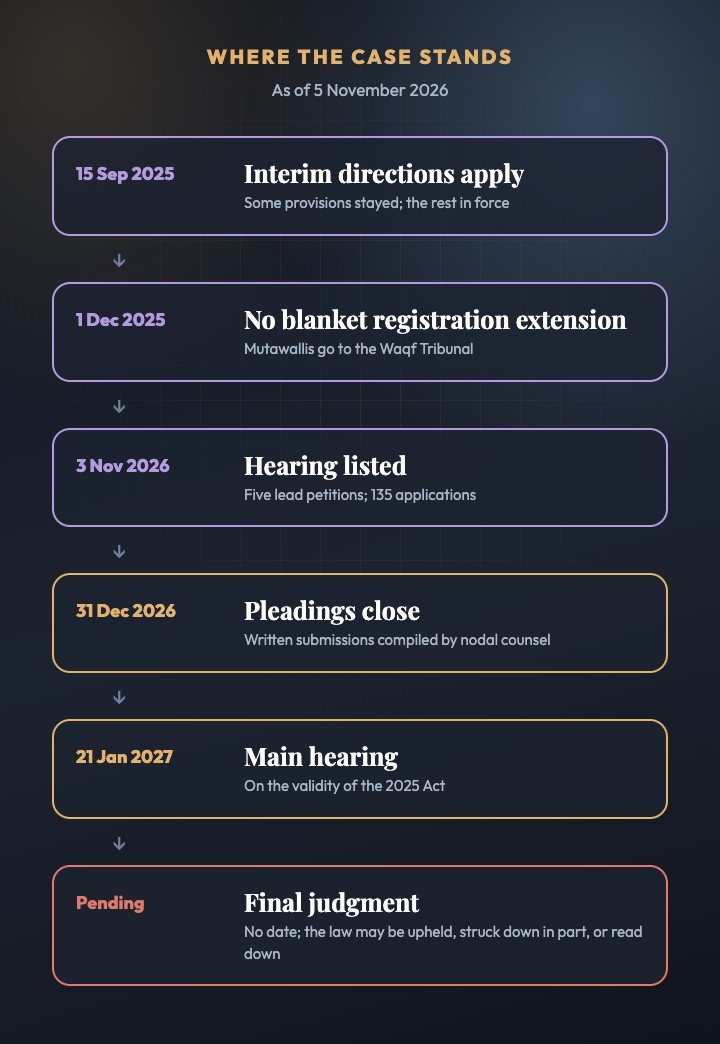
The Waqf (Amendment) Act, 2025 came into force on 8 April 2025. On 15 September 2025 the Supreme Court refused to stay the whole law but stayed the five-year practising-Islam condition and the provisions letting an official decide whether waqf land belongs to the government, and capped non-Muslim members on waqf bodies. On 3 November 2026 the Court listed the main challenge for 21 January 2027. No final ruling on the law’s validity has been given.
Waqf Act Challenge: Key Questions
The Case in Ten Points
- The law: the Waqf (Amendment) Act, 2025 rewrote large parts of the Waqf Act, 1995.
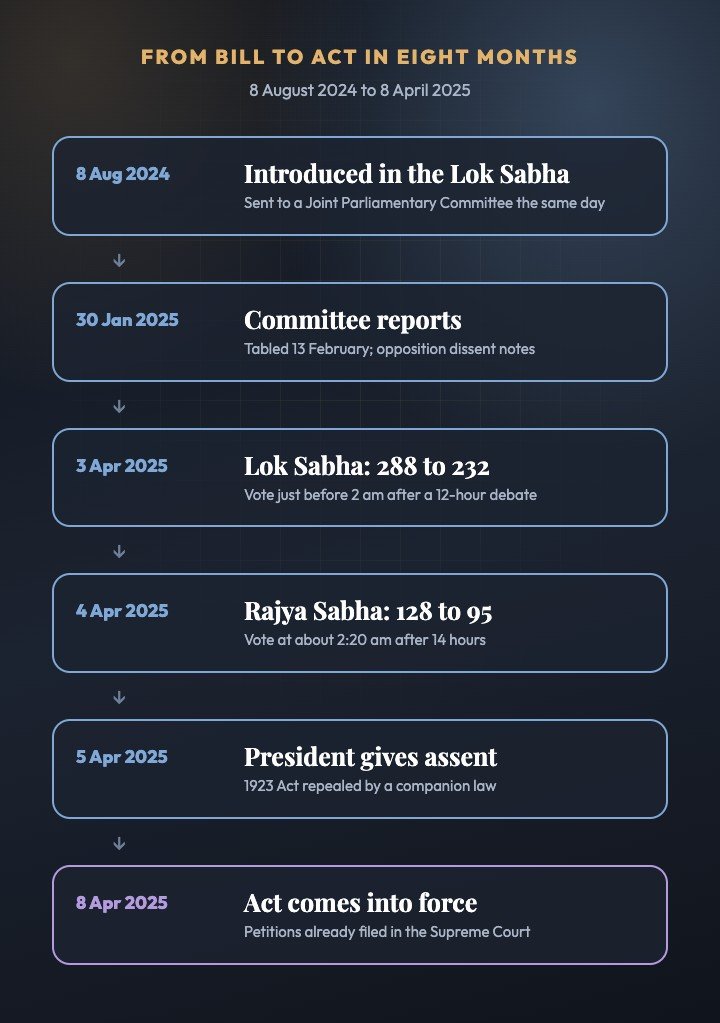
- The process: introduced 8 August 2024, sent to a joint committee, passed by both Houses in the early hours of 3 and 4 April 2025.
- The start: assent on 5 April, in force on 8 April 2025.
- The challenge: over 65 petitions, heard through five lead petitions including Asaduddin Owaisi’s.
- The undertaking: on 17 April 2025 the government promised no denotification of waqf and no new appointments until the next hearing.
- The interim order: 15 September 2025, the whole law not stayed; key provisions put on hold.
- The caps: at most four non-Muslims on the Central Waqf Council and three on a State Board.
- The deadline: UMEED registration closed on 6 December 2025; the Court sent extension requests to the Tribunals.
- The next step: pleadings by 31 December 2026, hearing on 21 January 2027.
- The status: no final ruling; the arguments on both sides are untested.
Timeline: Waqf Law and the Supreme Court Challenge
Entries are colour-coded by track and run newest first. Court orders are separated from arguments.
Supreme Court lists the main challenge for 21 January 2027 Supreme Court
What happened: The bench directed all parties to complete their pleadings by 31 December 2026 and posted the petitions for hearing on 21 January 2027. The nodal counsel told the Court that five petitions had earlier been chosen as lead matters and 135 others treated as interlocutory applications.
The directions: Applicants whose cases had been treated as applications were allowed to file separate writ petitions within two weeks. The nodal counsel is to compile written submissions and the judgments relied on, and the Additional Solicitor General is to respond. Solicitor General Tushar Mehta asked the Court to keep the 17 April 2025 arrangement limiting the hearing to the five lead petitions.
Petitioners press for an urgent hearing; Court says 4 November Supreme Court
What happened: Petitioners told the Court the matter needed to be heard urgently, saying the status of waqf properties was changing while the case waited. Bar & Bench reported that the Court said it would hear the petitions, including pleas for further interim relief, on 4 November. Reports name a bench of Chief Justice Surya Kant and Justice Joymalya Bagchi.
What followed: The matter was taken up on 3 November by a different bench, which set the January date. The reports I found on that hearing do not mention any new interim order.
Court refuses a blanket extension of the UMEED registration deadline Supreme Court
What happened: Petitioners including the All India Muslim Personal Law Board and Asaduddin Owaisi asked for more time to upload waqf property details to the UMEED portal. The Court said the Act itself lets a mutawalli seek more time from the Waqf Tribunal, so it would not order a blanket extension, and disposed of the applications with liberty to go to the Tribunal.
The numbers: Solicitor General Tushar Mehta told the Court about 1,16,600 properties had been uploaded by then. After the ruling the Union government said it would not penalise late registrations for three months after the deadline.
Interim judgment: the law stays, parts of it are put on hold Supreme Court
Stayed: The rule that only a person practising Islam for at least five years can create a waqf, until state governments frame rules on how to prove it. The rule that a property stops being treated as waqf while a designated officer inquires whether it is government land, and the officer’s power to decide title and change revenue records. Until the Tribunal and High Court decide, no one is to be dispossessed and no third-party rights created.
Limited: Non-Muslim members were allowed but capped: no more than four in the Central Waqf Council and three in a State Waqf Board. The Court said the Board’s chief executive officer should, as far as possible, be a Muslim.
Left in force: The registration requirement, which the Court noted has existed in some form since 1923; the end of new waqf by user, which applies only going forward; and the bars on waqf over protected monuments and tribal land in Scheduled Areas.
UMEED Rules are notified Rules & registration
What happened: The Union government notified the rules governing the central portal, the upload of waqf details and the record of each property. The portal itself had gone live on 6 June 2025, which started the six-month window for registering existing waqfs under the new Section 3B.
UMEED portal goes live Rules & registration
What happened: The Ministry of Minority Affairs launched the central portal on which details of every registered waqf were to be uploaded. The Act gives six months from its start, with the Waqf Tribunal able to allow up to six months more in individual cases.
Three days of arguments; interim order reserved Supreme Court
What happened: The bench limited this round to interim relief on three issues: waqf by user, non-Muslim members on the Council and Boards, and the identification of government land as waqf. The petitioners, led by Kapil Sibal and others, argued the law takes control of waqf away from the community. The Union government said waqf is a charitable, secular arrangement and opposed any stay.
The Court: Chief Justice Gavai said repeatedly that laws passed by Parliament carry a presumption of constitutionality and that a strong case was needed for interim relief.
Case moves to Chief Justice Gavai’s bench Supreme Court
What happened: On 5 May Chief Justice Khanna, due to retire within days, said he did not want to reserve an order he would not be in office to deliver, and sent the case to the bench of his successor, B.R. Gavai. The Solicitor General’s assurances were continued. On 15 May the new bench fixed 20 May for arguments on interim relief.
First hearings and the government’s undertaking Supreme Court
16 April: The bench heard the petitions for the first time and raised concerns about waqf by user, non-Muslim members and the Collector’s role, indicating it might pass an interim order. It did not do so that day.
17 April: Solicitor General Tushar Mehta assured the Court that, until the next hearing, no waqf, including waqf by user, would be denotified and no appointments would be made to the Central Waqf Council or State Boards under the new provisions. The Court recorded this, gave the government a week to reply and asked that the challenge proceed on five lead petitions.
Petitions reach the Supreme Court Supreme Court
Who filed: Petitioners included AIMIM MP Asaduddin Owaisi, Congress MP Mohammad Jawed, the All India Muslim Personal Law Board, Jamiat Ulama-e-Hind, the DMK and others. Several BJP-ruled states asked to intervene in support of the law, according to reports.
The argument: They said the law interferes with the right of a religious denomination to manage its own affairs, singles out Muslim endowments for rules not applied to others, and lets officials decide disputed title. The Union government said it regulates the secular management of property.
The amended Act comes into force Parliament
What happened: The Union government notified the date on which the amendment took effect. The 1995 Act was renamed the Unified Waqf Management, Empowerment, Efficiency and Development Act, 1995.
President Droupadi Murmu gives assent Parliament
What happened: The President signed the Bill, along with a companion Bill repealing the Mussalman Wakf Act, 1923. Petitions challenging the new law had already begun to be filed.
Rajya Sabha passes the Bill, 128 to 95 Parliament
What happened: The Rajya Sabha debated the Bill through the day and night of 3 April and passed it in the early hours of 4 April. The opposition parties voted against.
Lok Sabha passes the Bill, 288 to 232 Parliament
What happened: Kiren Rijiju moved the Bill, as revised after the committee, on 2 April. After a debate of about 12 hours, the result was announced just before 2 am on 3 April.
Joint Parliamentary Committee report is tabled Parliament
What happened: The committee, which had adopted amendments proposed by members of the ruling alliance and rejected those moved by the opposition, gave its report to Speaker Om Birla on 30 January and tabled it in both Houses on 13 February. Opposition members filed dissent notes, and there was a dispute in the House over whether parts of their dissent had been left out.
Waqf (Amendment) Bill, 2024 introduced and sent to a committee Parliament
What happened: Kiren Rijiju introduced the Bill in the Lok Sabha. After opposition MPs objected that it was unconstitutional, the government agreed the same day to refer it to a Joint Parliamentary Committee.
What it proposed: A new definition of who may create a waqf, an end to new waqf by user, non-Muslim members on waqf bodies, a role for officials in deciding whether a property is government land, a central digital registry and changes to the tribunals.
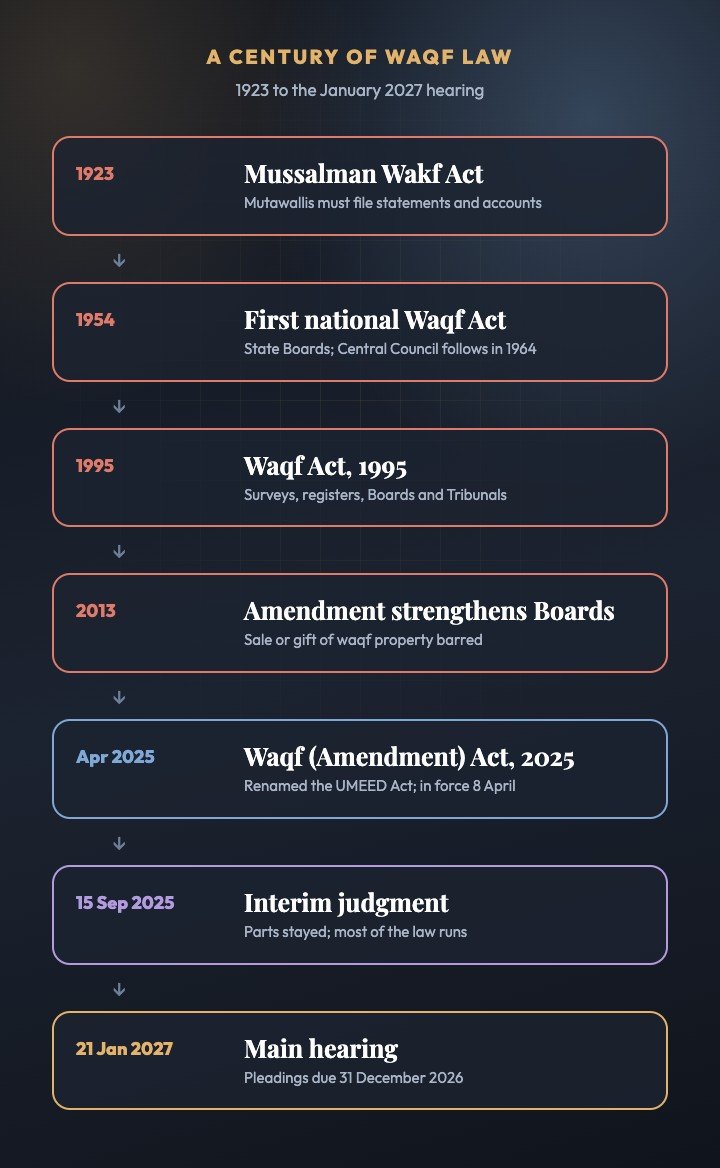
Waqf (Amendment) Act, 2013 Earlier laws
What happened: Parliament amended the 1995 Act to strengthen protection of waqf property. The changes dealt with encroachment, surveys, the powers of the Boards and the make-up of the Waqf Tribunals, and barred the sale or gift of waqf property.
The Waqf Act, 1995 replaces the 1954 law Earlier laws
What happened: The new Act set out how waqf property is surveyed, registered and recorded, how State Waqf Boards are formed and run, and created Waqf Tribunals to decide disputes. It remained the main law, amended, until 2025.
The first national Waqf Act and the Central Waqf Council Earlier laws
What happened: After independence Parliament passed the Waqf Act, 1954, providing for State Waqf Boards to supervise endowments. The Central Waqf Council was set up in 1964 under that Act to advise the government. The 1954 law was amended several times, including in 1984.
Mussalman Wakf Act, 1923 Earlier laws
What happened: The colonial government required mutawallis, the managers of waqfs, to file statements about the property and keep accounts. It was one of the earliest laws to regulate Muslim endowments.
What Is Waqf, and Who Runs It?
A permanent dedication, managed through statutory bodies.
A waqf is a permanent dedication of property by a Muslim for a purpose Muslim law treats as religious, pious or charitable: a mosque, a graveyard, a madrasa, a hospital, help for the poor. Once validly dedicated, the property is not meant to be sold, gifted or inherited. It is run by a manager, the mutawalli. Waqf can be created by a deed, by an oral declaration, or, under the doctrine of waqf by user, recognised through long use for a religious or charitable purpose. Waqf institutions in India go back centuries, long before any statute.
Central Waqf Council
Set up in 1964 to advise the Union government and the State Boards. The 2025 Act adds non-Muslim members, now capped at four by the Court.
State Waqf Boards
Supervise waqfs in each state, keep the register and appoint a chief executive officer. Non-Muslim members are capped at three.
Waqf Tribunals
Decide disputes over waqf property. Under the 2025 Act, appeals lie to the High Court, and the Tribunal can extend registration deadlines.
⚖️ Not the only endowment law
Hindu, Sikh, Christian and other religious and charitable endowments are governed by separate central and state laws that differ from state to state. Whether the 2025 Act treats waqf differently from those is one of the questions petitioners have raised.
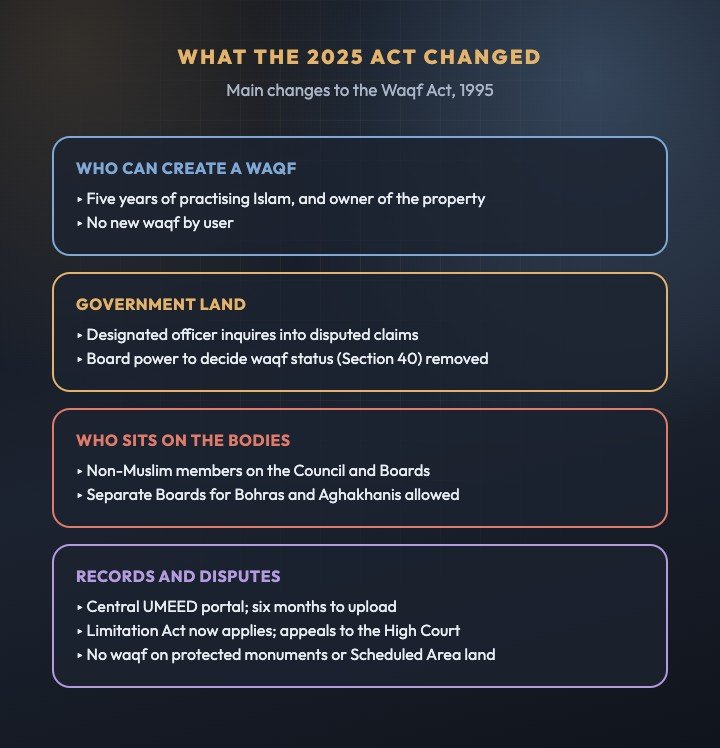
What the 2025 Act Changed
The main amendments to the 1995 Act, and their status after the interim order.
| Area | Change in 2025 | Status after 15 Sep 2025 |
|---|---|---|
| Who can create a waqf | A person who shows they have practised Islam for at least five years and owns the property | Stayed until rules are framed |
| Waqf by user | No new waqf by user; existing registered ones kept unless disputed or government land | In force |
| Government land | A designated officer inquires; property not treated as waqf meanwhile; records changed on the report | Officer’s power to decide title stayed; no dispossession until the Tribunal rules |
| Board power over waqf status | Section 40, which let Boards decide whether property is waqf, removed | In force |
| Membership | Non-Muslim members on the Central Council and State Boards | Capped at four and three |
| Registration | Every waqf to upload details to the central UMEED portal within six months | In force; deadline 6 Dec 2025 |
| Disputes | Tribunal composition changed; appeals to the High Court; Limitation Act applies | In force |
| Monuments and tribal land | Waqf over protected monuments void; none on Scheduled Area land | In force |
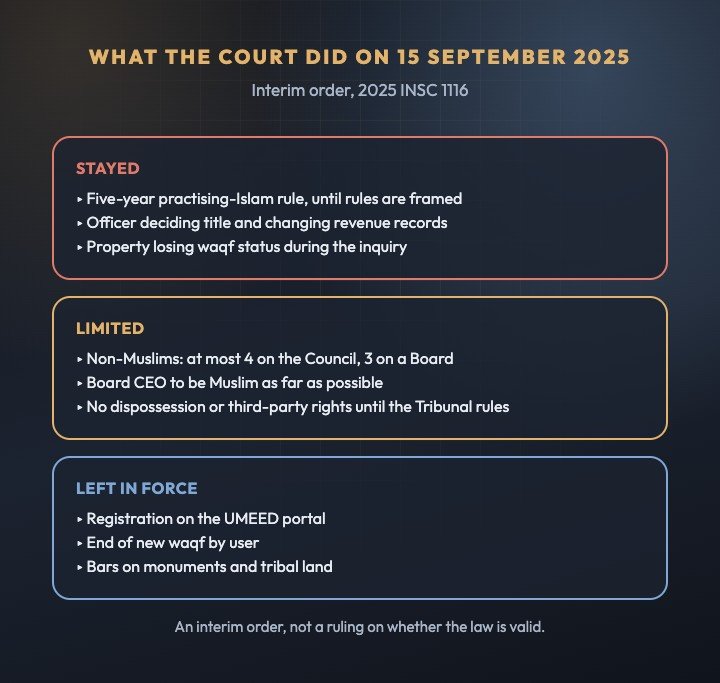
The 15 September 2025 Interim Order
What was stayed, what was limited, and what was left alone.
On hold
- The five-year practising-Islam rule, until rules exist.
- An officer deciding title and changing revenue records.
- Property losing waqf status while the inquiry runs.
Allowed with limits
- Non-Muslims: at most four on the Council, three on a Board.
- The CEO to be a Muslim as far as possible.
- No dispossession or third-party rights until the Tribunal decides.
Not stayed
- UMEED registration.
- The end of new waqf by user.
- Bars on monuments and tribal land.
📌 Why only part of the law was stayed
The bench said laws passed by Parliament are presumed constitutional and can be stayed only in rare cases. It stayed provisions it found open to arbitrary use without rules, or that let an executive officer decide property rights that belong to courts and tribunals. It said its view was not final.
The Arguments on Each Side
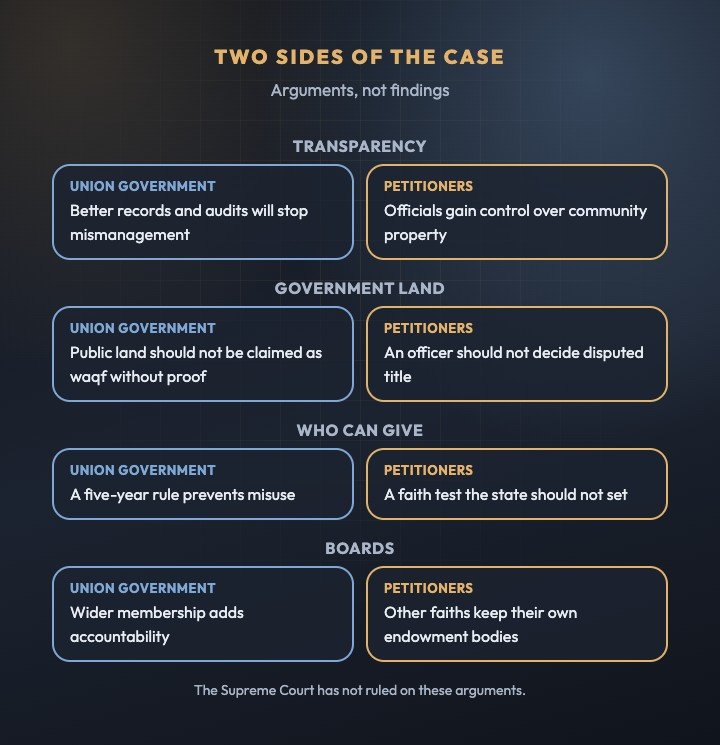
Competing positions, not findings. The Court has not ruled on them.
| Issue | Union government | Petitioners |
|---|---|---|
| Nature of waqf | A charitable, secular arrangement; managing property is not religious practice | A religious institution protected by Articles 25 and 26 |
| Records | Better records and audits will stop mismanagement and encroachment | Old waqfs without deeds risk losing protection |
| Who can give | Eligibility conditions prevent misuse | A five-year faith test is not for the state to set |
| Government land | Public land should not be claimed as waqf without a legal basis | An official should not decide disputed title |
| Membership | Wider membership adds accountability | Other faiths’ endowment bodies are not opened in the same way |
| Disputes | High Court appeals and limitation improve remedies | They weaken protections built up since 1995 |
Key People and Institutions
Roles as recorded in court orders and reports.
| Name | Role | Part in the story |
|---|---|---|
| Kiren Rijiju | Minister of Minority Affairs | Introduced the Bill in 2024 and moved it in 2025 |
| Jagdambika Pal | BJP MP | Chaired the Joint Parliamentary Committee |
| Droupadi Murmu | President of India | Gave assent on 5 April 2025 |
| Sanjiv Khanna | Chief Justice of India until May 2025 | Heard the case in April 2025; recorded the government’s undertaking |
| B.R. Gavai, A.G. Masih | Chief Justice; Supreme Court judge | Delivered the 15 September 2025 interim judgment |
| Dipankar Datta, A.G. Masih | Supreme Court judges | Refused a blanket registration extension on 1 December 2025 |
| M.M. Sundresh, P.B. Varale | Supreme Court judges | Listed the main hearing for 21 January 2027 |
| Tushar Mehta | Solicitor General | Argued for the Union government |
| Asaduddin Owaisi | AIMIM MP | One of the five lead petitioners |
| Kapil Sibal, A.M. Singhvi | Senior advocates | Argued for the petitioners |
Explore More Timelines
People Also Ask
Frequently Asked Questions
Dated facts from the court record and Parliament.
⚠️ Editorial Note
This account is built from the Supreme Court’s interim judgment, PRS Legislative Research and court reporting. The September 2025 order is interim, and the Court said it is not a final view on whether the law is valid. The arguments in this article are the parties’ positions, not findings. Some details differ between outlets: the Lok Sabha vote is sometimes dated 2 April, though it was cast after midnight, and the bench at the 15 October 2026 listing is not named in every report. I found no verifiable record of hearings between December 2025 and October 2026, so none are listed. Information is current as of 5 November 2026. This is not legal advice.
Related Reading on AiTimeline
Sources & further reading
Every dated entry above was checked against these references. Last reviewed 5 November 2026.
- Supreme Court of India: interim judgment of 15 September 2025, 2025 INSC 1116
- PRS Legislative Research: The Waqf (Amendment) Bill, 2024
- Supreme Court Observer: interim judgment summary
- Supreme Court Observer: Court refuses blanket extension for waqf registration (1 December 2025)
- LiveLaw: Parliament passes Waqf (Amendment) Bill 2025
- Bar & Bench: Supreme Court to hear Waqf case on 4 November (15 October 2026)
- Law Trend: Court fixes 21 January hearing, pleadings by 31 December (3 November 2026)
- ThePrint / PTI: SC posts Waqf pleas to 21 January next year (3 November 2026)