Moradabad 1980: The Riots, the Inquiry and a 40-Year Wait
Explore the 1980 Moradabad riots, the Eidgah violence, disputed casualty figures, Justice M.P. Saxena Commission findings and the report's 2023 release.
Latest Story
On 13 August 1980, Eid-ul-Fitr, a confrontation at the Moradabad Eidgah ended in police firing, a deadly stampede and months of communal violence across western Uttar Pradesh. Official death counts ranged from 83 to 289, depending on who was counting and what. A one-member inquiry commission reported in 1983, but its findings stayed unpublished until the state government tabled them in the Assembly in August 2023. This Moradabad riots timeline sets out what happened, what the Justice M.P. Saxena Commission concluded, why its figures differ from others, and why the 40-year delay still shapes the debate.
We keep three things apart: what is established, what the Saxena Commission concluded, and what survivors, parties and historians allege. A commission of inquiry is not a criminal court; its findings are not convictions. Death tolls are given with their source and scope.
💡 Short Answer
The Moradabad riots began on 13 August 1980, when a dispute during Eid prayers at the city’s Eidgah led to stone-throwing, police and PAC firing and a stampede. Violence spread to Sambhal, Aligarh, Bareilly and Allahabad and continued into early 1981. The Justice M.P. Saxena Commission, reporting in 1983, recorded 84 deaths, blamed two Muslim political leaders and cleared the police. Its report was tabled only on 8 August 2023.
Moradabad Riots 1980: Key Questions
The Moradabad Riots in Nine Points
- The day: 13 August 1980, Eid-ul-Fitr, with tens of thousands at prayer.
- The trigger: a reported stray pig, an argument, stones, then police and PAC firing.
- An official killed: Additional District Magistrate D.P. Singh died; the SSP was injured.
- The spread: Sambhal, Aligarh, Bareilly, Allahabad and rural Moradabad, into early 1981.
- The counts: 84 deaths by the commission’s count; 289 in the wider Assembly figure.
- The findings: two Muslim political leaders blamed; police, officials, RSS and BJP cleared.
- The wait: submitted November 1983, tabled 8 August 2023.
- The dispute: survivors and the IUML reject the findings on the firing and the toll.
- No court verdict: nobody has been prosecuted on the basis of the report.
How Many Died? Four Figures, Four Scopes
The single most misquoted fact about Moradabad.
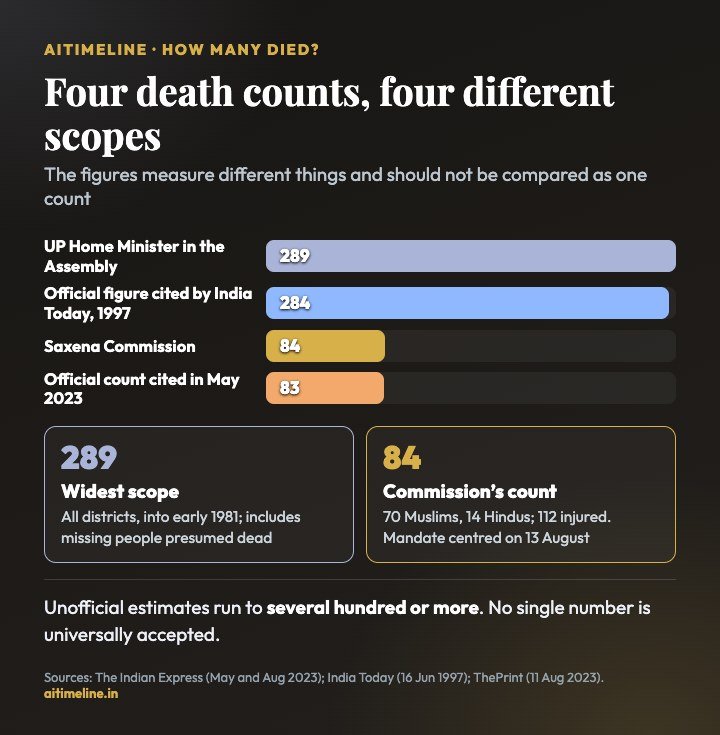
| Source | Deaths | What it covers |
|---|---|---|
| State Home Minister in the Assembly | 289 | All the violence into early 1981; includes missing people presumed dead |
| India Today, June 1997 | 284 | Described as the official figure; unofficial estimates about double |
| Justice M.P. Saxena Commission | 84 (112 injured) | Deaths within its inquiry, centred on 13 August; 70 Muslims, 14 Hindus |
| Official count, as reported May 2023 | 83 (112 injured) | Cited by The Indian Express and others when the Cabinet decided to table the report |
| Eidgah imam, to the commission | 1,000 claimed | At the Eidgah; the commission said no details were given |
The gap between 84 and 289 is not necessarily a contradiction. The commission’s mandate centred on 13 August 1980 and its immediate aftermath; the Assembly figure covered months of violence in several districts and counted the missing. Survivors and many writers believe the true toll was higher than any official figure. We report each number with its source rather than choose one.
13 August 1980: The Morning at the Eidgah
What most accounts agree on, and where they part.
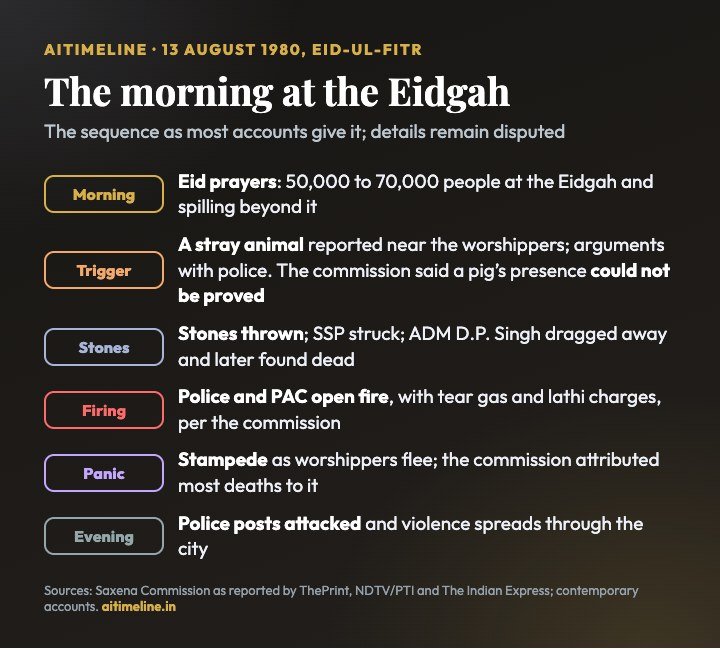
Most accounts agree on the outline: a huge Eid congregation, an argument with police near the prayer ground, stones, an injured senior police officer and a dead additional district magistrate, then firing and a crush. They part on almost everything else. Survivors interviewed in 2024 describe tear gas and gunfire soon after the prayer ended, and police later entering homes. The commission described firing used only after warnings, tear gas and lathi charges failed, with “much control”.
The question of the pig shows how wide the gap is. Many accounts from 1980 say a pig strayed near the worshippers from a neighbouring settlement. The commission said its presence could not be proved and concluded that the story was spread on purpose to inflame the crowd.
Timeline: The Moradabad Riots, 1978 to November 2026
Newest first. Colour shows the type of event.
Where the Moradabad case stands Aftermath & memory
The record: The Saxena Commission report is public, having been tabled on 8 August 2023. Both men it held responsible had died before then. We found no report of any prosecution, compensation scheme or fresh inquiry arising from it.
The dispute: The death toll, the cause of most deaths and the responsibility for the firing remain contested between the commission’s account, the Indian Union Muslim League and survivors’ testimony.
Why it matters: An inquiry report is not a court judgment. Publishing it settled what the commission concluded, not what happened.
Study examines why riot reports are released when they are Aftermath & memory
The paper: “Playing the Blame Game: Commissions of Inquiry and the Timing of Riot Reports in India”, published online on 30 June 2026, looks at delayed riot inquiry reports, including Moradabad’s.
The argument: The authors argue that the timing of a report’s release can serve political purposes, such as shifting blame and shaping debate before elections.
How to read it: This is an academic interpretation of political context, not a finding about the motives of any particular government.
A temple closed since the riots reopens Aftermath & memory
What happened: The district administration reopened the Gauri Shankar temple, which had stayed shut since the 1980 violence. His descendant told ETV Bharat that the priest had been killed during the riots and that the family had stayed away out of fear.
What was found: Excavation and cleaning brought out damaged idols from beneath debris, according to reports.
Context: The district magistrate ordered the reopening on an application by the priest’s descendant. It came weeks after violence in Sambhal in November 2024 and drew renewed attention to 1980.
Survivors speak of an Eid they now call a “black day” Aftermath & memory
The accounts: Residents who were children in 1980 described tear gas and gunfire after the Eid prayer, a crush in which children fell under tents, and police entering homes. One man said his mother was shot dead at home.
On the report: Several said the 2023 report, which cleared the police, added to their grievance rather than closing it.
Weight: These are personal testimonies, reported as such. They have not been tested in court.
IUML rejects the findings Government & politics
What the IUML said: IUML national joint secretary Kausar Hayat Khan told ThePrint the report was false and that the violence was “a pre-planned action by the administration”.
The timing question: He asked why the report was kept hidden for 40 years while the accused were alive, and said the party still demanded compensation for victims every August.
Other critics: Opposition voices questioned why the report was released when it was, and how its conclusions were being presented.
Report tabled in the Uttar Pradesh Assembly Commission
What happened: Nearly 40 years after it was submitted, the Justice M.P. Saxena Commission report was laid before the Assembly in the presence of Chief Minister Yogi Adityanath.
Main findings: It blamed IUML leader Dr Shamim Ahmed Khan and Dr Hamid Hussain alias “Azzi” of the Khaksars, with their supporters. It cleared officials, the police and PAC, ordinary Muslims and Hindus, and the RSS and BJP.
On the deaths: It recorded 84 deaths and 112 injured, and said most deaths in some localities were caused by stampedes, not police bullets.
UP Cabinet decides to make the report public Government & politics
The decision: The Cabinet said it would table the 1983 report in the Assembly. A spokesperson said earlier governments had not allowed it to go before the Cabinet or the House.
How it was found: An official said the report came up during a drive to locate inquiry reports that had been prepared but never tabled, to “give closure to long pending issues”.
Early summary: Khanna said the commission found that a local leader and his supporters had planned the disturbance to defame the administration and blame Valmiki and Punjabi Hindus.
Seventeen years on, no action against anyone Aftermath & memory
The report: India Today wrote that Uttar Pradesh had seen 15 chief ministers and seven different regimes since the riots, but no action had been taken against a single person.
The figures: It put the official death toll at 284 and said unofficial estimates were about double that.
The commission: It noted the Saxena report was “gathering dust” and said the commission had found no pigs near the Eidgah when the trouble began.
Saxena Commission submits its report Commission
Submission: The report was submitted to the Uttar Pradesh government in November 1983. The Indian Express gave the date as 20 November in May 2023 and as 29 November in August 2023; Scroll also gives 29 November.
What happened next: It was not tabled, its contents were not made public, and no action was taken on its recommendations for four decades.
The judge: Saxena had served on the Allahabad High Court; reports describe him as retired when he reported.
Violence subsides after months Violence
Duration: The Indian Express says the violence that began on 13 August continued in several districts and in rural Moradabad until early 1981. ThePrint says the stray clashes in Moradabad subsided in November 1980.
The pattern: Accounts describe the trouble returning in waves, including stabbings and killings in late October 1980.
The toll: The state Home Minister, Swarup Kumari Bakshi, later told the Assembly the total death toll, including the missing presumed dead, was 289.
Unrest spreads beyond Moradabad Violence
What happened: Communal violence followed in the city’s localities and spread to villages and other towns, including Sambhal, Aligarh, Bareilly and Allahabad (now Prayagraj).
The response: Accounts say the army was deployed and that by early September the situation in Moradabad city was largely under control.
The commission’s view: It said the violence continued because of a belief that many Muslims had been killed at the Eidgah, “despite the proof that most died in stampedes”.
Competing blame from Delhi and Lucknow Government & politics
The government: Union minister Yogendra Makwana blamed the RSS. Histories of the riots record Prime Minister Indira Gandhi pointing to “foreign forces” and communal parties.
Others: BJP leader L.K. Advani blamed Muslim organisations; some Muslim leaders compared the Eidgah firing to Jallianwala Bagh.
Later finding: The commission rejected the allegation of RSS or BJP involvement. The BJP had been founded only in April 1980.
Violence erupts at the Moradabad Eidgah Violence
The gathering: Tens of thousands of people, put at 50,000 to 70,000 in different reports, gathered at the Eidgah for Eid prayers.
The trigger: Accounts say a stray pig was seen near the crowd, leading to an argument with police and then stone-throwing. The commission said a pig’s presence could not be proved and blamed a rumour spread to provoke the crowd.
The firing: The Senior Superintendent of Police was struck, and Additional District Magistrate D.P. Singh was dragged away and later found dead. Police and PAC opened fire; many died in a stampede as worshippers fled.
By evening: Police posts were attacked and the violence spread through the city.
A death in custody becomes a political cause Background
What happened: A man named Javed, accused of theft, died after being caught by a crowd. The commission says Shamim Ahmed Khan claimed police had killed him, led a march with the body and secured a magisterial inquiry.
The commission’s reading: It described this as an effort to present himself as “the sole saviour” of the community’s interests.
Caution: This is the commission’s interpretation, published long after the men involved had died.
V.P. Singh becomes chief minister of Uttar Pradesh Government & politics
Context: Vishwanath Pratap Singh took office after the Congress won the May 1980 Assembly election. Indira Gandhi had returned as Prime Minister in January 1980.
Why it matters: His government would face the riots two months later, and appointed the Saxena Commission.
A wedding procession is attacked Background
What happened: When the young Dalit woman in the earlier case was married, the groom’s procession was attacked, reportedly over objections that it disturbed the Ramzan fast-breaking. A clash between the two communities followed.
The commission’s view: It said Shamim Ahmed Khan was inciting residents of the locality at the time.
An Assembly election and a leadership contest Government & politics
The commission’s account: It says Shamim Ahmed Khan, who had revived the Muslim League in Uttar Pradesh, got the party’s ticket in 1980 after being refused one in 1977, and wanted the maximum Muslim vote.
The rivalry: It describes a contest with Congress’s Hafiz Ahmed Siddiqui, who had gained standing by organising a 1979 religious congregation and renovating mosques.
Caution: Critics say this framing places political motives on one side and leaves the police unexamined.
An alleged abduction raises tension Background
The allegation: A Valmiki girl aged 17 to 18 was allegedly abducted and raped by Muslim youths. ThePrint and other accounts date this to March 1980, with the girl rescued a month later; The Indian Express dates it to May. A police case was registered.
The commission’s view: It says the accused found support from a Muslim League leader.
Caution: An earlier crime, and the responsibility for the riots, are separate questions.
Earlier violence in Sambhal Background
What happened: Communal violence broke out in Sambhal, then part of Moradabad district, in 1978.
Longer history: Histories of the city record riots going back to the 19th century and violence after Partition in 1948.
How the Violence Spread
From one prayer ground to five districts.
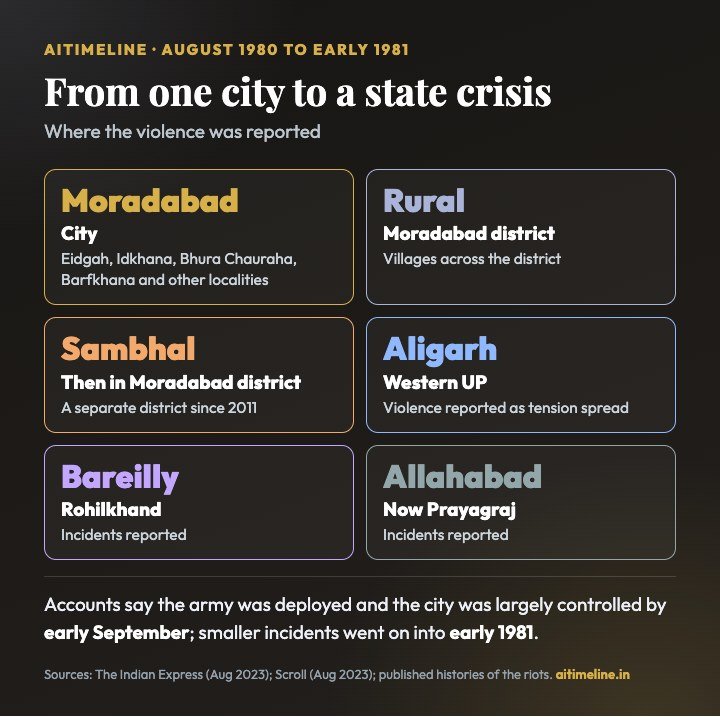
Within hours of the firing, the trouble moved off the Eidgah into the city’s neighbourhoods, and over the following weeks into villages and other towns. The commission’s explanation was belief: people were convinced that large numbers of Muslims, including children, had been shot, and attacks on police posts and Hindu localities brought retaliation. Critics reply that the belief had a basis, because many had died.
What the Saxena Commission Found
The conclusions of one official inquiry, in its own terms.
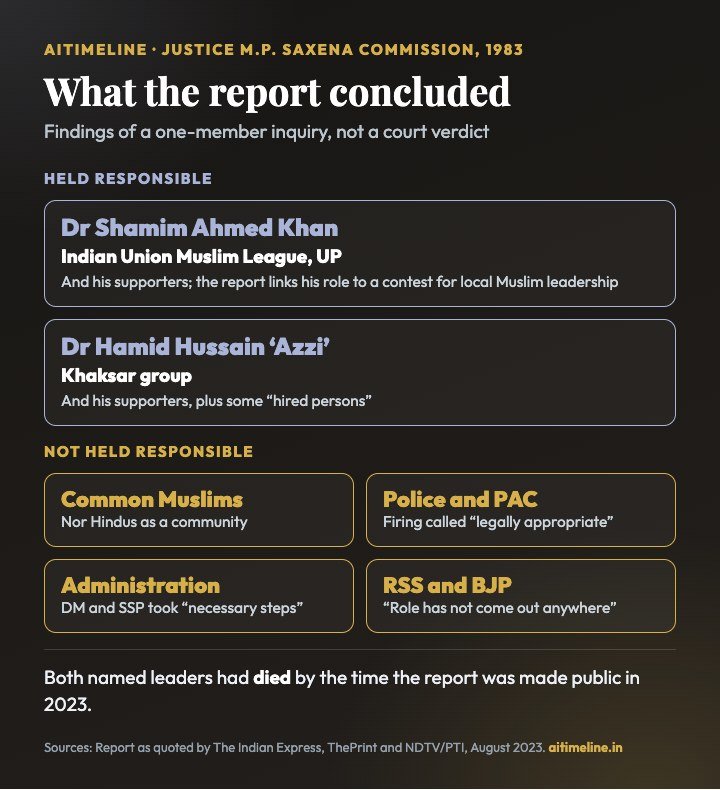
| Question | Commission’s conclusion |
|---|---|
| Who was responsible | Shamim Ahmed Khan (IUML) and Hamid Hussain ‘Azzi’ (Khaksars), their supporters and some hired persons |
| Main cause | Muslim leaders “fulfilling their selfish means”; a leadership contest |
| The pig | Presence could not be proved; a rumour spread to provoke |
| Police and PAC firing | Legally appropriate; “neither too much nor insufficient” |
| Administration | Took necessary precautions and steps |
| RSS and BJP | No role found |
| Ordinary Muslims and Hindus | Not responsible |
| Deaths | 84, mostly from stampedes in some localities |
The report reads the riots as the climax of a local political story: a Muslim League leader who had lost ground to a Congress rival, and who, in the commission’s account, took up every grievance in the months before Eid to rebuild his standing. It also found that two near-identical police complaints against Valmikis, filed before Eid, were false and part of a plan to shift blame.
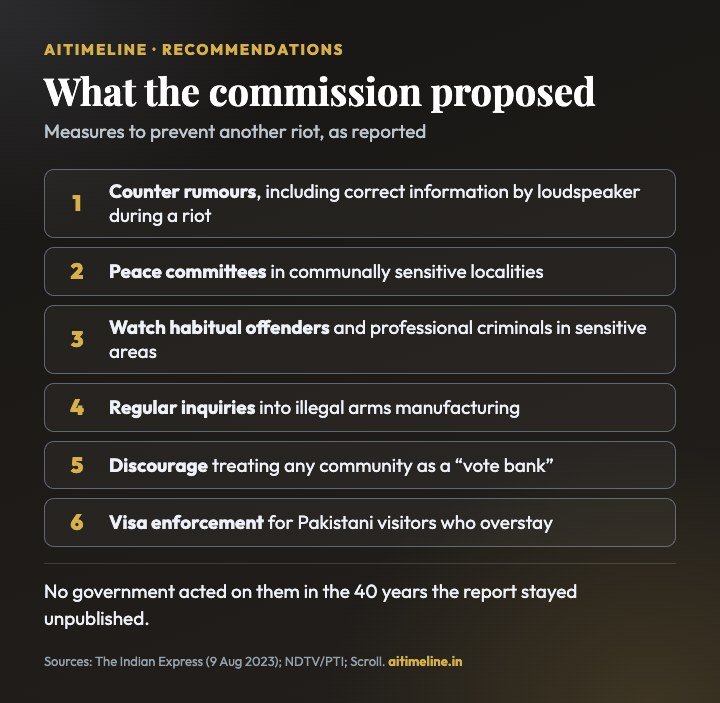
Two cautions apply. First, these are findings of an inquiry, made without the safeguards of a criminal trial, and both men named were dead before anyone outside government could read them. Second, the report’s language, including its description of Muslims being encouraged to see themselves as a “vote bank”, drew criticism when it was published, and should be read in the context of its time.
The 40-Year Wait
Submitted in 1983, tabled in 2023.
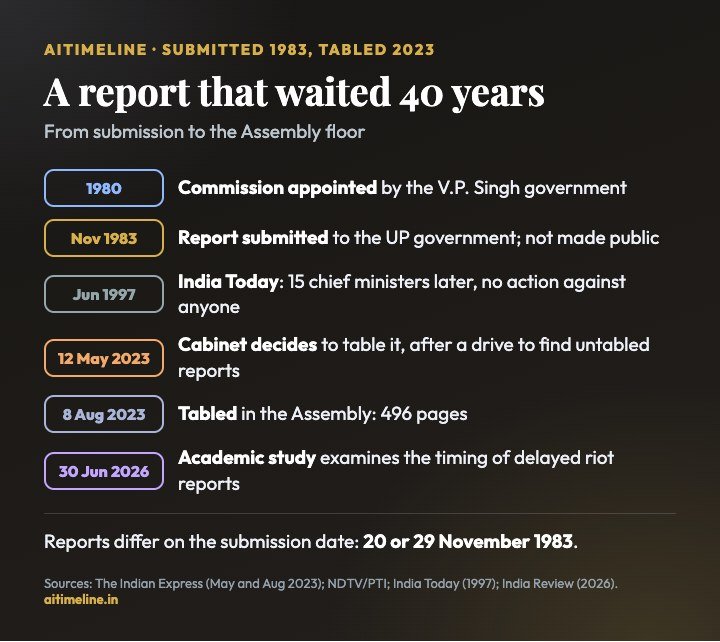
An inquiry report that is not tabled cannot be debated, challenged or acted on. Between 1983 and 2023, Uttar Pradesh was governed by the Congress, the Janata Dal, the BJP, the Samajwadi Party and the Bahujan Samaj Party, and none placed the Moradabad report before the House. By the time it was, the officials it cleared and the men it blamed were largely beyond the reach of any proceedings.
The timing of the release then became an argument of its own. The government said it was clearing a backlog of untabled reports. Opposition parties and the IUML questioned why a report blaming Muslim League leaders and clearing the RSS emerged months before a general election. A 2026 study by Shivangi Seth and Renée Jeffery argues that the release of delayed riot reports can serve political purposes; that is a scholarly interpretation, not a finding about any government’s motive.
Competing Accounts
Each position in its own terms.
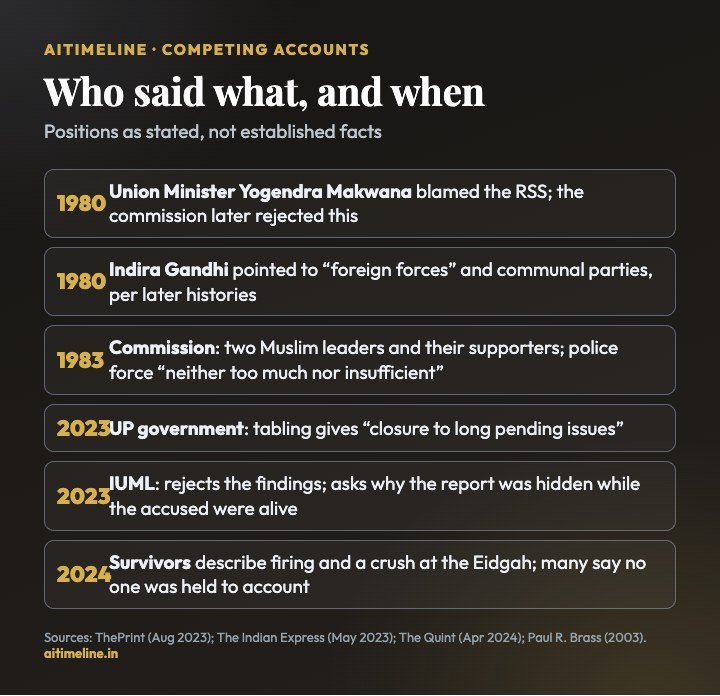
| Issue | Commission’s account | Critics’ and survivors’ account |
|---|---|---|
| The trigger | A rumour of a pig, spread to provoke | An animal did stray in; a minor dispute escalated |
| The firing | Justified, controlled, used after warnings | Opened on a crowd of worshippers; excessive |
| The deaths | 84, mostly from stampede | Far higher; many from bullets |
| Responsibility | Two leaders and their supporters | The police and PAC, and those who ordered them |
| The report’s release | Closure of a pending matter | Politically timed, decades too late |
“If it was true, why was it kept hidden for 40 years when the accused were alive?”
— Kausar Hayat Khan, IUML national joint secretary, to ThePrint, August 2023
Key People
| Person | Role |
|---|---|
| V.P. Singh | Chief Minister of Uttar Pradesh from 9 June 1980; appointed the commission |
| Indira Gandhi | Prime Minister |
| Justice Mathura Prasad Saxena | One-member commission; Allahabad High Court |
| S.P. Arya and V.N. Singh | District magistrate and senior superintendent of police; cleared by the commission |
| D.P. Singh | Additional district magistrate, killed on 13 August 1980 |
| Dr Shamim Ahmed Khan | IUML leader; held mainly responsible by the commission |
| Dr Hamid Hussain ‘Azzi’ | Khaksar leader; also named by the commission |
| Swarup Kumari Bakshi | State Home Minister who gave the Assembly the 289 figure |
| Suresh Kumar Khanna | Minister who tabled the report on 8 August 2023 |
Legal and Accountability Aftermath
What the report could and could not do.
A commission of inquiry can record facts, assign responsibility in its own judgment and recommend action. It cannot convict anyone, and its findings are not evidence of guilt in a criminal trial. The Saxena report’s publication in 2023 therefore did not, by itself, change anyone’s legal position.
No prosecution has followed, and none was realistic by then: the two men named were dead, many witnesses were too, and four decades had passed. Nor did the report’s conclusions about police conduct amount to a court ruling on the many individual allegations about the firing. For survivors, the practical questions are compensation and recognition, neither of which the tabling addressed. The Moradabad case now sits alongside other long-delayed riot inquiries, from 1984 to Bhagalpur, in debates about what inquiries are for.
Why the Moradabad Riots Still Matter
- Policing crowds: how security forces should act when a huge religious gathering turns tense.
- Rumour: the commission put rumour at the centre of the escalation, a concern sharper in the age of messaging apps.
- Counting the dead: 83, 84 or 289 depending on scope, a lesson in why definitions matter.
- Delayed inquiries: a report unpublished for 40 years could not hold anyone to account.
- Memory and politics: the release in 2023 turned history into a live political argument.
- A city’s economy: Moradabad’s brassware trade was badly hit in 1980.
Explore More Timelines
People Also Ask
Frequently Asked Questions
Based on the commission report as published in 2023, official statements and contemporary reporting.
⚠️ Editorial Note
This timeline separates the Saxena Commission’s conclusions from independently established facts and from allegations, none of which is a criminal court finding. We corrected details found in some summaries: D.P. Singh, who was killed, was the additional district magistrate (the district magistrate, S.P. Arya, survived); the 83 figure comes from 2023 reporting, not 1983; and the 2026 study’s first author is Shivangi Seth. Sources differ on whether the earlier assault was in March or May 1980 and whether the report was submitted on 20 or 29 November 1983; we give both. We could not verify a specific reference to Moradabad in the Prime Minister’s Independence Day speech of 1980, or the use of the National Security Act in connection with these riots, and do not state either. We do not name the young woman in the 1980 case.
Related Reading on AiTimeline
Sources & further reading
Every dated entry above was checked against these references. Last reviewed 12 November 2026.
- After four decades, Moradabad riot report tabled in UP Assembly: RSS, officials exonerated (9 August 2023)
- 1980 Moradabad riot: UP Cabinet to table panel report in House (13 May 2023)
- The Moradabad riots of 1980: The incident and its political fallout (18 May 2023)
- 1980 Moradabad riots 'conspiracy' by 2 Muslim leaders: inside inquiry report made public (11 August 2023)
- 1980 Moradabad Riots: Judicial Body Report Gives Clean Chit To BJP, RSS (8 August 2023)
- 1980 Moradabad riots: Judicial inquiry report clearing RSS, BJP tabled in Uttar Pradesh Assembly (9 August 2023)
- Moradabad riots: No action taken even after 17 years (16 June 1997)
- In This Uttar Pradesh Town, Eid Is A 'Black Day' For Many Muslims (12 April 2024)
- Gauri Shankar Temple Reopens After Four Decades (31 December 2024)
- Seth and Jeffery, Playing the Blame Game: Commissions of Inquiry and the Timing of Riot Reports in India, India Review (30 June 2026)