Who Controls Delhi? The Long Battle Between the Centre, CM and Lieutenant Governor
Delhi vs Centre services dispute explained: the 2015 notification, Supreme Court rulings of 2018 and 2023, the 2023 Services Act and what changed by 2026.
Latest Story
The Delhi vs Centre services dispute comes down to one question: who controls the officers who carry out the elected government’s decisions? For eight years after a May 2015 Home Ministry notification, the AAP government and the Union, through the Lieutenant Governor, fought it out in the Delhi High Court and three rounds in the Supreme Court. On 11 May 2023 a unanimous Constitution Bench gave services to the elected government. Eight days later the Centre issued an ordinance, and by August Parliament had passed the Services Act, which created a three-member Authority in which two Centre-appointed officers can outvote the Chief Minister and the LG has the last word. A BJP government elected in 2025 withdrew the challenge to that law. The law stands, untested.
💡 Short Answer
Delhi’s elected government and the Centre disputed control of civil servants from 2015. The Supreme Court ruled for the elected government on 11 May 2023, except on public order, police and land. Parliament then passed the GNCTD (Amendment) Act, 2023, which routes transfers and postings through the National Capital Civil Services Authority, with the LG holding the final say. The challenge to that Act was withdrawn in May 2025 without a ruling.
Delhi vs Centre Services: Key Questions
The Dispute in Ten Points
- 1991: Article 239AA gave Delhi an elected government but kept public order, police and land with the Union. Services were not mentioned.
- 21 May 2015: a Home Ministry notification put services with the LG, months after the AAP won 67 of 70 seats.
- 4 August 2016: the Delhi High Court called the LG the administrative head of Delhi.
- 4 July 2018: the Supreme Court held the LG generally bound by ministers’ advice, but left services open.
- 14 February 2019: a two-judge Bench split on services.
- 11 May 2023: a unanimous Constitution Bench gave services to the elected government.
- 19 May 2023: an ordinance created the National Capital Civil Services Authority.
- 11 August 2023: the Services Act replaced it, with the LG holding the final say on differences.
- 23 May 2025: the new BJP government withdrew the challenge to the Act. No court has ruled on its validity.
- 2026: a new LG and a GAD communication show coordination is still an issue, even with one party in power.
The Constitutional Framework
What Article 239AA gives the elected government, and what it keeps back.
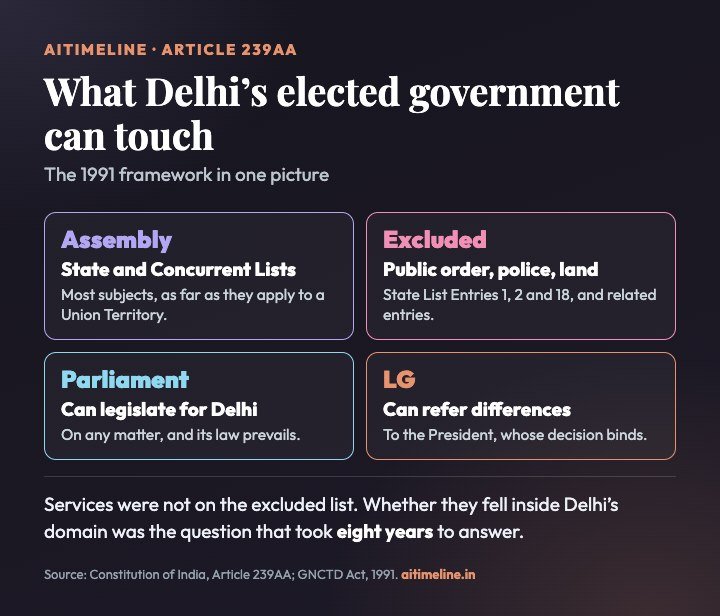
| Provision | What it covers |
|---|---|
| Article 239 | The President administers a Union Territory through an Administrator, in Delhi the Lieutenant Governor |
| Article 239AA(3) | Assembly’s power over State and Concurrent List subjects, except public order, police and land; Parliament can legislate on any matter |
| Article 239AA(4) | Council of Ministers to aid and advise the LG; differences can be referred to the President |
| Article 239AA(7) | Parliament may make laws to give effect to or supplement the Article |
| State List, Entry 41 | State public services, the entry at the heart of the services dispute |
| GNCTD Act, 1991 | The statute that runs the system, amended in 2021 and 2023 |
Timeline: The Battle Over Delhi’s Services
Newest first. Colour shows which institution each event belongs to.
Officers told to put the Chief Minister’s meetings first 2025–26 reset
What it said: A communication from the Delhi government’s General Administration Department asked additional chief secretaries, secretaries and heads of departments to give priority to meetings convened in the Chief Minister’s Office under Chief Minister Rekha Gupta. It also asked that decisions and directions from meetings called by the Union government or the Lieutenant Governor be reported to the offices of the Chief Minister and the Chief Secretary.
Why it was issued: The communication said similar instructions issued on 28 April 2026 were not being followed adequately: some senior officers had missed meetings chaired by the Chief Minister, and decisions taken at Centre or LG meetings were not reaching her office.
Taranjit Singh Sandhu becomes the 23rd Lieutenant Governor Lieutenant Governor
The change: Former diplomat Taranjit Singh Sandhu, India’s Ambassador to the United States from 2020 to January 2024, was sworn in as the 23rd Lieutenant Governor of Delhi. Delhi High Court Chief Justice Devendra Kumar Upadhyaya administered the oath, in the presence of Chief Minister Rekha Gupta, her Cabinet and the Chief Secretary.
The predecessor: Vinai Kumar Saxena, LG since May 2022 and a central figure in the AAP-era disputes, moved to Ladakh as its Lieutenant Governor.
All remaining AAP-era cases reported withdrawn 2025–26 reset
What happened: PTI reported that the BJP-led Delhi government had withdrawn all the cases the previous AAP government had filed against the Union government, the Lieutenant Governor and several senior bureaucrats. Officials said continuing the litigation after the change of government would waste public resources.
The scale: One report, citing official sources, put the total at about 20 cases, 12 of them against the LG. That figure has not been confirmed in court records, so it is given here as reported.
A 2019 memo on DASS postings is withdrawn Centre and Parliament
What changed: The Services Department withdrew its office memorandum of 9 January 2019 on posting Delhi Administration Subordinate Services (DASS) staff to ministerial and executive posts. The new memorandum cites the GNCTD (Conditions of Service of officers and other employees) Rules, 2025 and earlier directions of the Lieutenant Governor.
Keep it separate: This concerns the subordinate DASS cadre. It is not the statutory route under the 2023 Act, which deals with Group A officers and DANICS officers through the National Capital Civil Services Authority.
Supreme Court lets the new government withdraw seven cases Courts
What was dropped: The Supreme Court allowed the Delhi government to withdraw seven petitions filed by the AAP government. They included the challenge to the GNCTD (Amendment) Act, 2023, pleas that the LG is bound by the Council of Ministers’ advice, the dispute over appointing the Delhi Electricity Regulatory Commission chairperson, and challenges to the LG heading committees on solid waste and the Yamuna.
What it means: The Additional Solicitor General said the petitions no longer matched the government’s priorities. Withdrawal is not a ruling. The Court did not decide whether the 2023 Act is constitutionally valid.
Rekha Gupta sworn in as Chief Minister 2025–26 reset
The result: The BJP won 48 of the 70 Assembly seats in the election whose results were declared on 8 February 2025, ending the AAP’s decade in power. Rekha Gupta became Chief Minister on 20 February.
Why it matters: For the first time since 2015, the same party governed Delhi and the Centre. The constitutional arrangement did not change with the result: the 2023 Act stayed in force.
LG may nominate MCD aldermen without the elected government Courts
The ruling: The Supreme Court held that the Lieutenant Governor could nominate 10 aldermen to the Municipal Corporation of Delhi without the aid and advice of the Council of Ministers, because the power comes from the Delhi Municipal Corporation Act, which gives it to the LG by name.
Why it matters: This is a different question from services. It showed that the LG’s position depends on the specific statute: where Parliament gives a power to the LG directly, the 2018 aid-and-advice rule may not apply.
Supreme Court lets the Centre extend the Chief Secretary’s term Courts
The ruling: The Court allowed the Union government to extend Chief Secretary Naresh Kumar’s service by six months beyond his 30 November retirement, over the Delhi government’s objection. It held that the Centre had the power to appoint the Chief Secretary.
Why it matters: The Chief Secretary is one of the three members of the new Authority. Commentators argued the order sat uneasily with the May 2023 Constitution Bench ruling.
President assents: the Services Act replaces the ordinance Centre and Parliament
The passage: The Lok Sabha passed the Bill on 3 August and the Rajya Sabha on 7 August, by 131 votes to 102. With the President’s assent it became law, applying retrospectively from 19 May 2023.
What changed from the ordinance: The Act dropped Section 3A, which had declared that the Assembly could not legislate on services, and modified the Centre’s power over appointments to Delhi’s statutory bodies. The National Capital Civil Services Authority stayed.
How the Authority works: The Chief Minister chairs it; the Chief Secretary and Principal Home Secretary, both appointed by the Centre, are the other members. It decides by majority with a quorum of two. The LG can approve its recommendations or return them; if they still differ, the LG’s decision is final.
Ordinance challenge sent to a Constitution Bench Courts
What happened: Hearing the Delhi government’s challenge to the ordinance, the Court referred to a five-judge Bench the question of how far Parliament can go under Article 239AA(7) in legislating for Delhi. It did not stay the ordinance.
Eight days later, the Centre issues an ordinance Centre and Parliament
What it did: The ordinance created the National Capital Civil Services Authority to recommend transfers, postings, vigilance matters and disciplinary action for Group A and DANICS officers, with the LG holding the final word on differences. Its Section 3A declared that the Assembly had no power to legislate on services.
The response: The AAP government said it overturned the Supreme Court judgment through the back door. The Centre said Delhi’s status as the national capital justified a different arrangement.
Constitution Bench: services belong to the elected government Courts
What it held: The Delhi government has legislative and executive power over “services” under Entry 41 of the State List, including IAS officers posted to Delhi, except services relating to public order, police and land. The LG is bound by the elected government’s decisions on services within its domain.
The reasoning: In a system of collective responsibility, officers are accountable to ministers, and ministers to the legislature. If an elected government cannot control the officers who carry out its decisions, that chain of accountability breaks.
What it rejected: Justice Ashok Bhushan’s 2019 view that services lie wholly outside the Delhi government’s domain.
Five judges hear the services question Courts
The arguments: The Centre argued that Delhi, as the national capital, needed Union control over its administrative services. The Delhi government argued that ministers could not answer to the Assembly for officers they could not control.
Services question referred to a Constitution Bench Courts
What happened: Faced with the 2019 split verdict, a three-judge Bench referred the limited question of control over services to a five-judge Constitution Bench, asking it to examine the scope of Delhi’s legislative and executive power over Entry 41 of the State List.
The 2021 Amendment Act comes into force Centre and Parliament
What it changed: The Act provided that “Government” in laws passed by the Assembly means the Lieutenant Governor, required the LG’s opinion to be obtained before executive action on specified matters, and barred the Assembly and its committees from making rules on day-to-day administration or conducting inquiries into administrative decisions.
The response: The AAP government said it reduced the elected government to an advisory role and challenged it in the Supreme Court. That petition was among those withdrawn in 2025.
A split verdict on services Courts
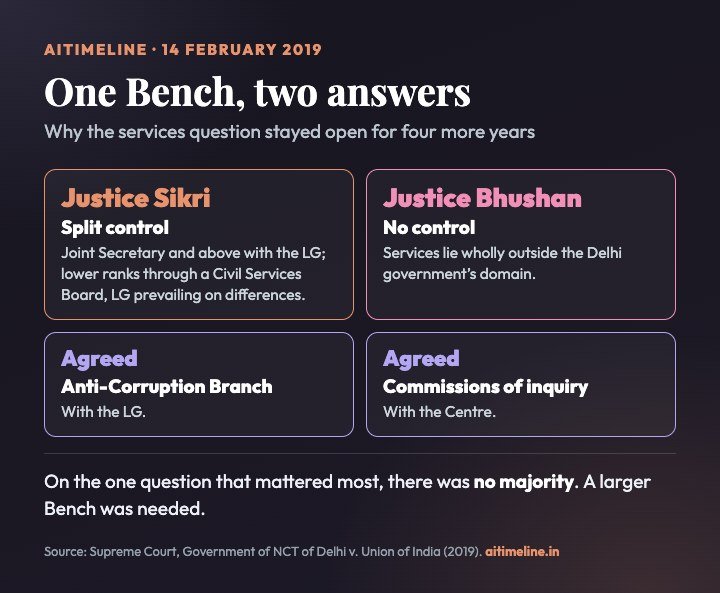
Justice Sikri: Transfers and postings of officers at the level of Joint Secretary and above would be with the LG; for lower ranks the elected government would decide, through a Civil Services Board, with the LG’s view prevailing on differences.
Justice Bhushan: Services were wholly outside the Delhi government’s executive power.
Where they agreed: The Anti-Corruption Branch would stay with the LG, and the Centre could appoint commissions of inquiry. The services question went to a larger Bench.
Constitution Bench: the LG is not an independent ruler Courts
What it held: The LG is generally bound by the aid and advice of the Council of Ministers on matters within the Assembly’s legislative domain. The LG cannot act as an obstructionist; a difference of opinion can be referred to the President, but only on substantial issues and not on every matter.
What it left open: The judgment set out the principles but sent the individual disputes, including services, back to regular Benches. That is where the split came.
Delhi High Court rules for the LG Courts
What it held: The LG is the administrative head of Delhi and not bound by the advice of the Council of Ministers. The May 2015 notification on services was upheld as neither illegal nor unconstitutional.
What followed: The Delhi government appealed to the Supreme Court, which sent the matter to a Constitution Bench in 2017.
Home Ministry notification on services Centre and Parliament
What it said: The notification said services, along with public order, police and land, were outside the Delhi Assembly’s competence, and that the LG would exercise powers over services, consulting the Chief Minister where he saw fit. It also limited the Anti-Corruption Branch to Delhi government employees, excluding central government officers.
Why it mattered: It turned a political quarrel into a legal one. Almost every later case traces back to it.
The acting Chief Secretary dispute Delhi government
What happened: LG Najeeb Jung appointed senior IAS officer Shakuntala Gamlin as acting Chief Secretary. The Chief Minister objected, and his government removed the Services Department principal secretary who had issued the appointment order. The quarrel became public within days.
AAP wins 67 of 70 seats Delhi government
The mandate: The Aam Aadmi Party won one of the largest majorities in Delhi’s history. Its programme depended on directing a bureaucracy whose senior ranks belonged to all-India and central services.
The GNCTD Act takes effect Centre and Parliament
What it set up: The Act laid down the working framework for the Assembly, the Council of Ministers and the LG’s role, including the rules of business. The first Legislative Assembly was elected in November 1993.
The 69th Amendment creates Article 239AA Centre and Parliament
What it did: Article 239AA gave the National Capital Territory a Legislative Assembly and a Council of Ministers headed by a Chief Minister. The Assembly could legislate on State and Concurrent List subjects, except public order, police and land. Parliament kept the power to legislate on any matter for Delhi, and the LG could refer differences with ministers to the President.
Where it came from: A committee set up in December 1987, first headed by Justice R.S. Sarkaria and then by S. Balakrishnan, recommended an elected government for Delhi without full statehood. It reported in December 1989.
Delhi becomes a Union Territory Centre and Parliament
What changed: Delhi lost its Part C State status and its Assembly, and was administered directly by the Union through an Administrator. A Metropolitan Council with advisory powers followed in 1966.
How the Services Act Works
The National Capital Civil Services Authority is where the dispute now lives.
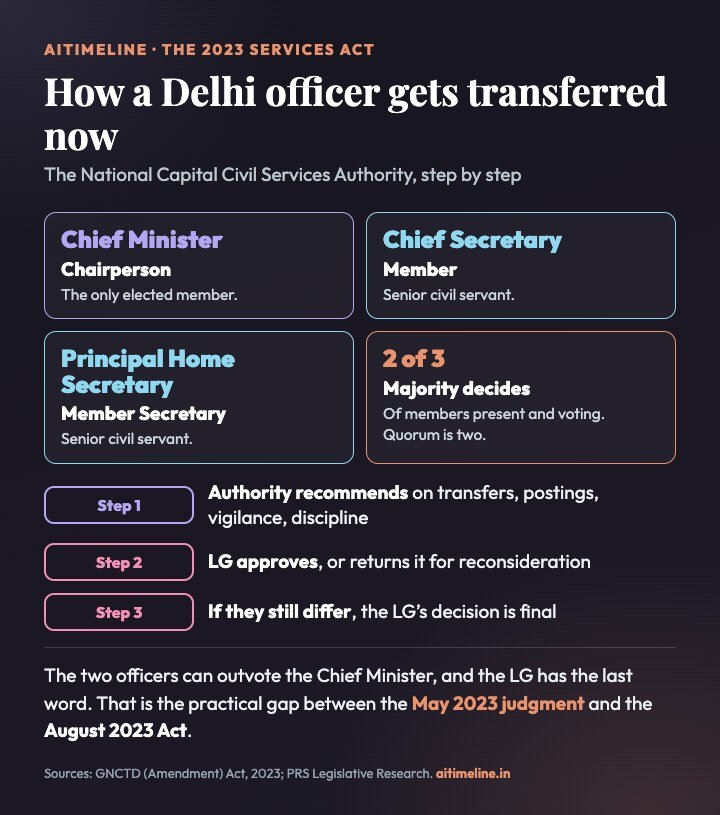
| Issue | Arrangement under the 2023 Act |
|---|---|
| Body | National Capital Civil Services Authority |
| Chairperson | Chief Minister of Delhi |
| Other members | Chief Secretary; Principal Home Secretary (Member Secretary), both appointed by the Centre |
| Covers | Transfers, postings, vigilance and disciplinary matters for Group A and DANICS officers serving Delhi |
| Voting | Majority of members present and voting; quorum of two |
| If the LG disagrees | LG may return the recommendation; on a continuing difference, the LG’s decision is final |
| Legal challenge | Referred to a Constitution Bench July 2023; withdrawn May 2025, not decided |
| Status, November 2026 | In force |
The law does not mean the LG personally transfers every officer in every department. Subordinate cadres such as DASS are handled by the Services Department under separate rules, and individual statutes give some powers to particular officers. What the Act does is decide who wins when the elected government and the Centre disagree about senior officers. Under the 2023 judgment, that was the elected government. Under the Act, it is the LG.
The Supreme Court vs Parliament
One unanimous ruling, and a law passed within 92 days.
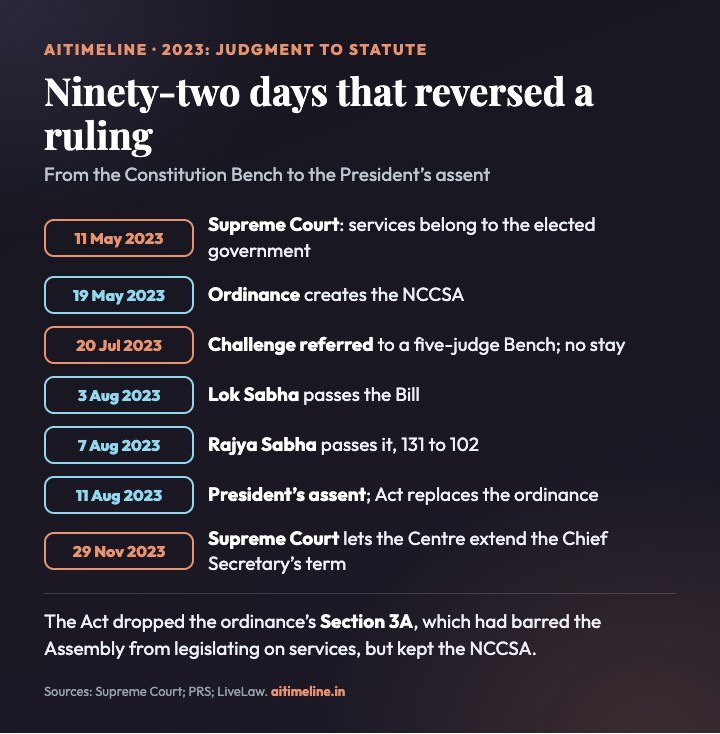
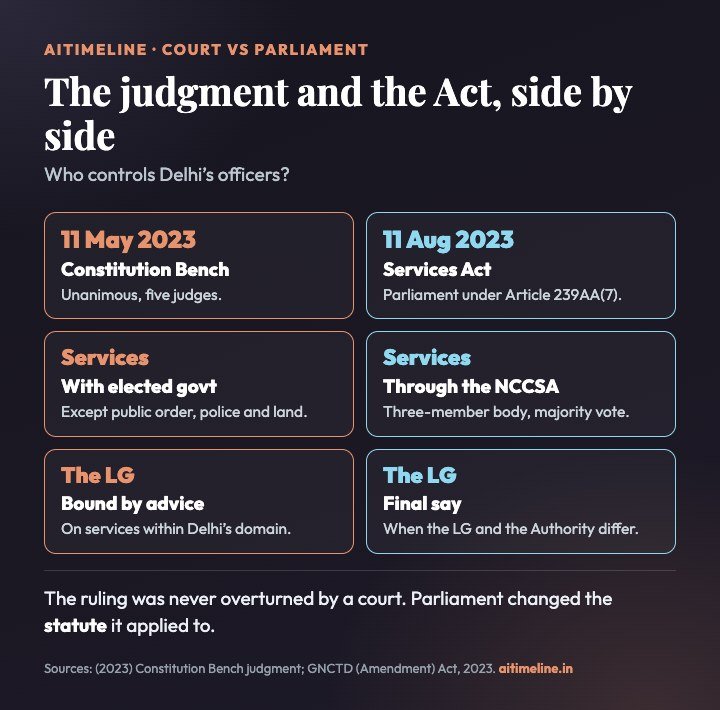
The two are not directly in conflict as legal texts. The judgment interpreted Article 239AA and the GNCTD Act as they stood in May 2023. Parliament then used its power under Article 239AA(7) to change the Act. Whether Parliament can do that in a way that undoes the effect of a constitutional ruling on accountability is the question the Constitution Bench was asked to answer in July 2023. Because the petition was withdrawn, it never did.
The Major Judgments
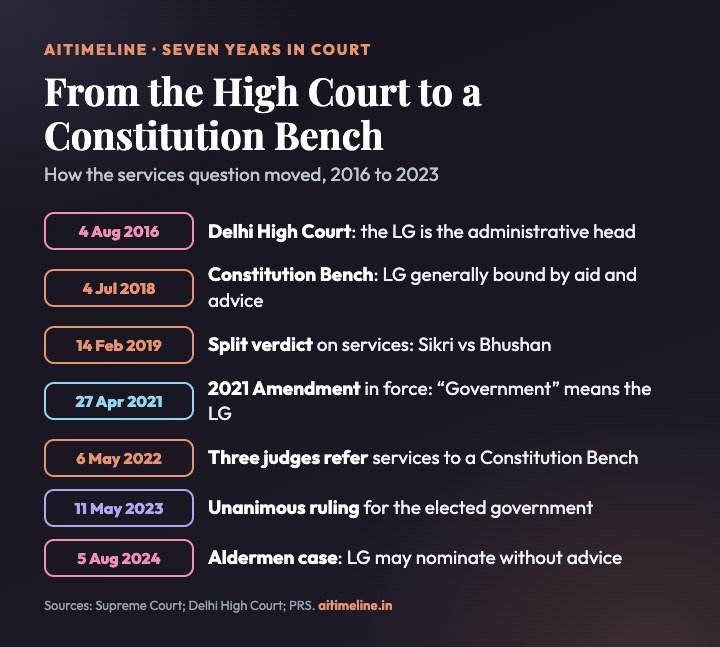
| Case or step | Core issue | Outcome |
|---|---|---|
| Delhi High Court, 4 Aug 2016 | LG’s administrative authority | Supported the LG; upheld the 2015 notification |
| Supreme Court, 4 Jul 2018 | LG and elected government under Article 239AA | LG generally bound by aid and advice within Delhi’s domain |
| Supreme Court, 14 Feb 2019 | Control over services | Split verdict; referred to a larger Bench |
| Supreme Court, 11 May 2023 | Legislative and executive power over services | Elected government, except public order, police and land |
| Supreme Court, 20 Jul 2023 | Parliament’s power under Article 239AA(7) | Referred to a Constitution Bench; no stay |
| Supreme Court, 29 Nov 2023 | Chief Secretary’s extension | Centre allowed to extend Naresh Kumar’s term |
| Supreme Court, 5 Aug 2024 | Nomination of MCD aldermen | LG may act without ministers’ advice under the municipal law |
| Supreme Court, 23 May 2025 | Withdrawal of AAP-era petitions | Permitted; no ruling on the Services Act’s validity |
The 2025–26 Reset
A change of government ended the litigation, not the question.
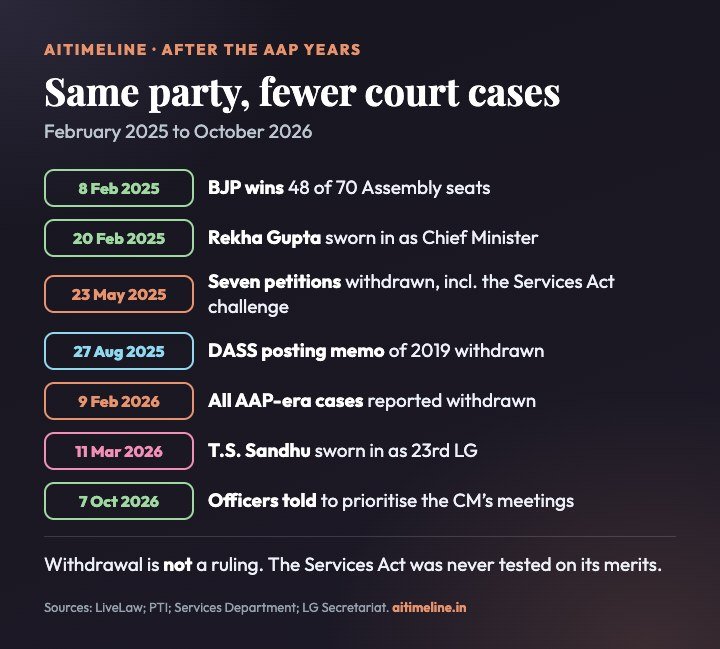
The BJP government’s decision to drop the cases was a political choice, and a predictable one: a government does not usually sue its own party’s Union government. It also means the Services Act will only be tested again if a future Delhi government, of a different party, chooses to challenge it. The 7 October 2026 communication is a reminder that the practical problem the cases were about, officers answering to more than one authority, did not disappear with the litigation.
Why Control Over Services Matters
Ministers answer for officers
The 2023 judgment’s core reasoning: ministers answer to the Assembly, so officers must answer to ministers.
Who goes where
Postings decide who runs water, health, education and finance, and how fast policy moves.
Stability and neutrality
Frequent transfers disrupt departments; officers caught between two masters may avoid decisions.
A capital, not a state
The Union has real interests in the capital. The question is where those interests end.
Who investigates whom
Control of the Anti-Corruption Branch and disciplinary action was at the start of the dispute.
Even with one party
The 2026 directions show that reporting lines still need managing when politics align.
Key People and Institutions
Arvind Kejriwal
Led the AAP government through every round of the services litigation.
Rekha Gupta
BJP; her government withdrew the AAP-era cases.
Jung, Baijal, Saxena
The LGs of the AAP years, 2015 to 2025. Saxena served until March 2026.
Taranjit Singh Sandhu
Former Ambassador to the US; the 23rd LG, sworn in 11 March 2026.
CJI D.Y. Chandrachud
Wrote the unanimous 11 May 2023 judgment on services.
NCCSA
The three-member Authority created in 2023 for service matters.
Key Facts at a Glance
| Detail | Information |
|---|---|
| Constitutional provision | Article 239AA |
| Constitutional amendment | 69th Amendment Act, 1991 |
| Governing statute | GNCTD Act, 1991, in force 1 February 1992 |
| Excluded subjects | Public order, police and land |
| Services notification | 21 May 2015 |
| Delhi High Court ruling | 4 August 2016 |
| Constitution Bench, LG’s role | 4 July 2018 |
| Split verdict on services | 14 February 2019 |
| Constitution Bench, services | 11 May 2023 |
| Services Ordinance | 19 May 2023 |
| Services Act assent | 11 August 2023, effective from 19 May 2023 |
| Challenge withdrawn | 23 May 2025 |
| Current LG | Taranjit Singh Sandhu, since 11 March 2026 |
| Latest development covered | GAD communication, 7 October 2026 |
Explore More Timelines
People Also Ask
Frequently Asked Questions
Checked against the Supreme Court record, PRS and contemporary reporting.
⚠️ Editorial Note
This article keeps three things apart: the constitutional interpretation of Article 239AA by the courts, the statutory framework Parliament created in 2023, and the political decision in 2025 to withdraw the earlier litigation. Withdrawal of a case is not a ruling on whether a law is constitutional. It draws on the Supreme Court’s judgments as reported by LiveLaw, PRS Legislative Research’s analysis of the 2023 Bill and ordinance, the Delhi Services Department’s August 2025 memorandum, the LG Secretariat and PTI. Checking the brief this page began from: the report that all AAP-era cases had been withdrawn is dated 9 February 2026, not 11 February; the DASS memorandum is dated 27 August 2025, not 28 August, and is described here as what it says, a withdrawal of a 2019 posting memorandum; and the 2023 Act differs from the ordinance in dropping Section 3A. The figure of about 20 withdrawn cases comes from one report and is given as reported.
Related Reading on AiTimeline
Sources & further reading
Every dated entry above was checked against these references. Last reviewed 8 November 2026.
- LiveLaw: GNCTD vs LG, Supreme Court holds Delhi government has control over services excluding public order, police and land (11 May 2023)
- PRS Legislative Research: Legislative Brief, Government of National Capital Territory of Delhi (Amendment) Bill, 2023
- PRS Legislative Research: Ordinance Summary, GNCTD (Amendment) Ordinance, 2023
- LiveLaw: Why the GNCTD (Amendment) Act 2023 may not pass constitutional test despite changes from the Services Ordinance
- LiveLaw: Centre has power to appoint Delhi Chief Secretary, Supreme Court allows extension of Naresh Kumar's term (29 November 2023)
- LiveLaw: LG can nominate members to Delhi Municipal Corporation without Delhi government's consent (5 August 2024)
- LiveLaw: Supreme Court allows Delhi government to withdraw petitions filed by AAP government against Centre and LG, including challenge to Services Act (23 May 2025)
- Services Department, GNCTD: Office Memorandum dated 27 August 2025 on posting of DASS cadre officers
- Deccan Herald / PTI: Delhi government withdraws all cases filed by AAP against Centre, LG during its tenure (9 February 2026)
- Lieutenant Governor, Delhi: Taranjit Singh Sandhu takes over as the 23rd Lt. Governor of Delhi (11 March 2026)
- ThePrint / PTI: Prioritise CM's meetings above others, Delhi government tells senior officers (October 2026)