From Criminalisation to Freedom: India’s Long Fight for LGBTQ+ Rights
Section 377 India timeline: from colonial law and the 2009 Naz verdict to the 2018 Supreme Court ruling, marriage case and 2026 transgender-law changes.
Latest Story
Section 377 of the Indian Penal Code made consensual same-sex intimacy a crime in India for more than 150 years. Activists challenged it from the early 1990s. The Delhi High Court struck it down for consenting adults in 2009, the Supreme Court brought it back in 2013, and on 6 September 2018 a five-judge bench decriminalised it for good. That was not the end of the story. The court refused to recognise same-sex marriage in 2023, the new criminal code dropped Section 377 altogether in 2024, and a 2026 amendment to transgender-rights law is now being fought in the Supreme Court. This Section 377 India timeline sets out what happened, in order, and what each ruling did and did not change.
💡 Short Answer
Section 377, in force from 1862, punished “carnal intercourse against the order of nature”. The Delhi High Court read it down in July 2009; the Supreme Court restored it in December 2013. On 6 September 2018, in Navtej Singh Johar v. Union of India, the Supreme Court unanimously decriminalised consensual sex between adults in private. Same-sex marriage is still not recognised (2023), Section 377 vanished with the IPC on 1 July 2024, and the 2026 transgender-law amendment is under challenge.
Section 377: Key Questions
Section 377 in Ten Points
- Colonial law: Section 377 came with the Indian Penal Code, in force from 1862.
- Early challenge: ABVA’s 1991 report and 1994 petition began the legal fight.
- The main case: Naz Foundation filed its PIL in December 2001.
- First win: the Delhi High Court read Section 377 down on 2 July 2009.
- Setback: the Supreme Court restored it in Koushal on 11 December 2013.
- New foundations: NALSA (2014) on gender identity and Puttaswamy (2017) on privacy.
- The turning point: Navtej Singh Johar, 6 September 2018, unanimous.
- Limits: no same-sex marriage or civil unions after Supriyo (2023).
- A new gap: the BNS (2024) has no offence for non-consensual acts against adult men.
- Still open: the 2026 transgender-law amendment is before the Supreme Court.
The 2018 Verdict: What the Supreme Court Decided
The defining moment in the Section 377 story.
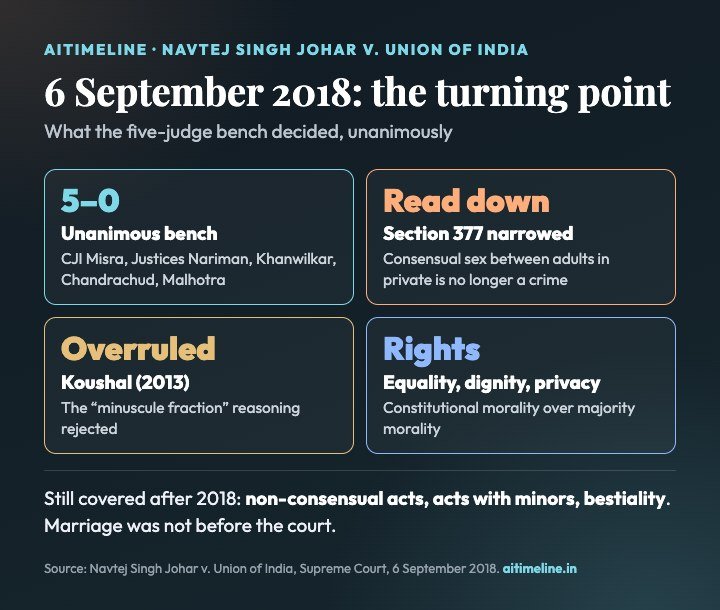
Chief Justice Dipak Misra, writing for himself and Justice A.M. Khanwilkar, called the criminalisation of consensual adult intimacy “irrational, indefensible and manifestly arbitrary”. Justice Rohinton Nariman pointed to the colonial origins of the law and to the fact that homosexuality was no longer treated as a mental disorder. Justice D.Y. Chandrachud wrote that the law had pushed LGBTQ+ people into the closet and made them targets of blackmail and harassment. Justice Indu Malhotra wrote that history owed them an apology.
The court was careful about scope. It did not strike out Section 377 entirely: non-consensual acts, acts with minors and bestiality remained offences. It did not decide marriage, adoption or inheritance, which were not before it. What it did, decisively, was to say that LGBTQ+ citizens hold the same constitutional rights as everyone else, and that popular disapproval is not a reason to deny them.
Crime, Legal, Crime, Legal: How the Law Swung
Eight dates that explain the whole fight.
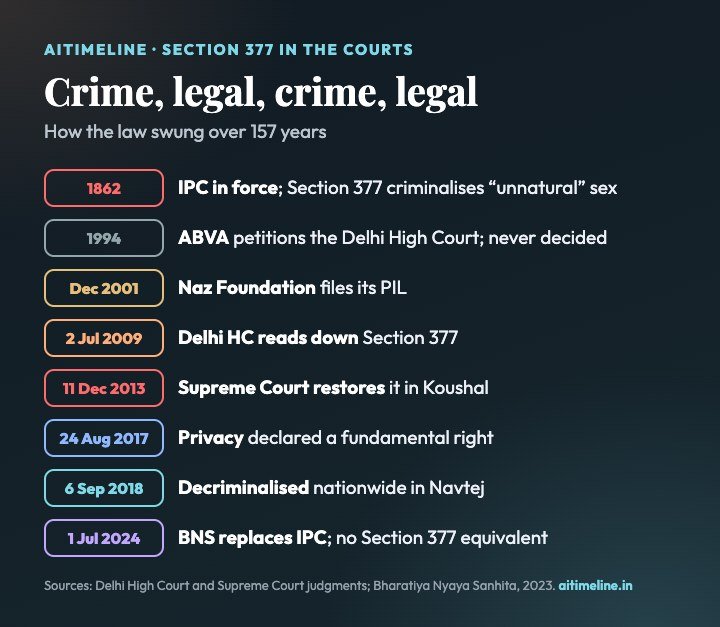
The Naz Foundation case shows how long constitutional litigation can take in India. The petition was filed in 2001, dismissed on standing in 2004, revived by the Supreme Court in 2006, argued over two government positions in 2008 and decided in 2009. It then spent four years on appeal before the Supreme Court reversed it.
Koushal said the courts should defer to Parliament and that only a “minuscule fraction” of Indians were affected. Two later judgments undid that reasoning. NALSA, four months later, treated gender identity as part of personal autonomy. Puttaswamy, in 2017, made privacy a fundamental right and said that sexual orientation is an essential part of it. Once those foundations were in place, the referral to a larger bench in January 2018 made the result in September close to inevitable.
Timeline: Section 377 and LGBTQ+ Rights in India, 1860–2026
Newest first. Colour shows the type of event.
The challenge to the 2026 amendment is still pending Transgender rights
Where things stand: As of 12 November 2026 the Supreme Court has not decided whether the Transgender Persons (Protection of Rights) Amendment Act, 2026 is constitutional. The court has said it will hear the batch finally once the Centre files its reply.
The core questions: Can Parliament remove the statutory right to a self-perceived gender identity that the Supreme Court recognised in NALSA (2014)? Is compulsory medical-board scrutiny consistent with the privacy ruling in Puttaswamy (2017)?
What it does not touch: The case is about legal recognition of transgender people. It does not affect the 2018 ruling that decriminalised consensual same-sex intimacy.
Supreme Court hears a women’s group on the transgender law Transgender rights
What happened: The court issued notice on a public interest petition by Women’s Declaration International India and tagged it with the challenges to the 2026 amendment.
The petition’s concerns: It asks how transgender-rights law interacts with protections for women: reservations in local bodies, prison accommodation, women’s sport and safeguards during arrest and search.
Careful reading: These are the petitioner’s arguments. The court has made no finding on them.
Centre: existing transgender ID cards remain valid Transgender rights
What happened: The Union told the court that transgender identity certificates and cards issued before the amendment took effect will continue. The bench recorded the assurance, subject to the outcome of the petitions.
Complaints heard: Petitioners said some cards had been cancelled or altered after the new law came into force and that the National Portal for Transgender Persons was not working. The bench asked for individual applications rather than a general direction.
Next step: The court said it would post the petitions for final hearing after the Centre’s reply affidavit.
High Court cases on the amendment are frozen Transgender rights
What happened: On the Centre’s transfer petitions, the Supreme Court issued notice and ordered that challenges pending in the Rajasthan, Karnataka, Kerala and Delhi High Courts stay where they are, without proceeding.
Why it matters: It keeps one court, the Supreme Court, as the forum for the constitutional question and avoids conflicting High Court rulings.
The amendment comes into force Transgender rights
What happened: The government notified the Transgender Persons (Protection of Rights) Amendment Act, 2026 into force with effect from 25 May, according to counsel in the Supreme Court.
Effect: New applications for a transgender certificate now go through the amended process, including a designated medical board.
Supreme Court issues notice, refuses an interim stay Transgender rights
What happened: Transgender activists, led by Laxmi Narayan Tripathi, challenged the amendment. In early May the court issued notice to the Centre and the states, but declined to stay the law. Reports date the order 3 or 4 May.
The argument: The petitioners say the narrower definition and medical scrutiny undo the self-identification principle of NALSA and violate equality, dignity, autonomy and privacy.
Parliament passes the Transgender Persons Amendment Law & Parliament
What changed: The amendment replaces the 2019 definition (a person whose gender does not match the gender assigned at birth) with a list of categories: socio-cultural identities such as kinner, hijra, aravani and jogta, intersex variations, and people forced into a transgender identity. Trans men, trans women and genderqueer people are no longer named.
Self-identification: The statutory right to a self-perceived gender identity is removed. A District Magistrate issues the certificate after a designated medical board’s recommendation.
Sexual orientation: The Act says the definition does not include people with different sexual orientations and self-perceived sexual identities.
Penalties: New offences for forcing someone into a transgender identity carry up to life imprisonment.
Delhi High Court revives the BNS “Section 377 gap” petition Courts
What happened: The court restored the PIL it had closed in August 2024, saying the Centre’s decision was “nowhere in sight” after a year and a half, and asked the government to explain what it had done.
The issue: The Bharatiya Nyaya Sanhita has no offence for non-consensual sexual acts against adult men and transgender people of the kind the remaining part of Section 377 used to cover.
Government lists its measures in Parliament Government action
What happened: The ministry set out the steps taken for LGBTQ+ people: joint bank accounts and partner nominees, ration-card household status, health and awareness measures, prison visits, advisories against harassment, and the 2019 Act and its Rules.
The limit: None of these created a legal status for queer couples. They are administrative clarifications.
Review of the marriage verdict dismissed Courts
What happened: The court rejected petitions asking it to review the October 2023 judgment, finding no error apparent on the face of the record.
Effect: The 2023 position stands: no recognition of same-sex marriage under existing law, and no judicially created civil union.
Interim measures for queer couples announced Government action
Bank accounts: There is no bar on queer people opening a joint bank account or naming a partner as nominee.
Ration cards: States were advised to treat partners in a queer relationship as members of the same household for ration cards.
Safety and prisons: The Home Ministry advised on prison visits and on preventing violence, harassment and coercion against queer people.
Public input: The government also invited suggestions on further measures.
Delhi High Court on the missing Section 377 equivalent Courts
What happened: A lawyer argued that the new criminal code left adult male and transgender survivors of non-consensual sexual acts without a remedy. On 13 August the court asked the Centre for its stand; on 28 August it disposed of the PIL, directing the government to treat it as a representation and decide it expeditiously.
What it did not do: The court did not restore Section 377 or create an offence. That is for Parliament.
Bharatiya Nyaya Sanhita replaces the IPC; Section 377 disappears Law & Parliament
What happened: The 164-year-old Indian Penal Code was repealed and replaced. The new code has no equivalent of Section 377.
The gap: After 2018, Section 377 still punished non-consensual acts against adults, acts with minors and bestiality. Minors remain protected under the POCSO Act, but adult men and transgender people who face non-consensual sexual acts have no specific offence in the BNS.
What it does not change: The 2018 decriminalisation is unaffected; consensual adult relationships were already legal.
Cabinet Secretary committee set up Government action
What happened: The government constituted the committee it had promised in court, chaired by the Cabinet Secretary, to examine practical entitlements for queer couples.
Members: Senior officials from Home, Women and Child Development, Health, and the Legislative Department, among others.
Supreme Court declines to recognise same-sex marriage Courts
What it decided: All five judges agreed the court could not read same-sex couples into the Special Marriage Act, 1954, and that there is no unqualified fundamental right to marry. By 3 to 2 it declined to direct a civil-union framework.
Adoption: By 3 to 2 the court did not strike down the rule that unmarried couples cannot adopt jointly. CJI Chandrachud and Justice Kaul would have allowed unmarried, including queer, couples to adopt.
What it affirmed: Queer people have the right to choose a partner and live together without harassment, and the state must protect them.
Marriage-equality petitions reach the Supreme Court Courts
What happened: Same-sex couples asked for recognition under the Special Marriage Act and other laws. The Supreme Court issued notice in November 2022 and in January 2023 pulled nine High Court petitions to itself.
The stakes: Inheritance, insurance, pensions, medical consent and family status all depend on marriage under Indian law.
Madras High Court orders protection for a lesbian couple Courts
What happened: Hearing a couple harassed by their families and the police, the court issued wide guidelines: police sensitisation, quick protection for queer couples, and action against those who offer “conversion therapy”.
Why it matters: It moved the question from criminal law to everyday safety, and the judge wrote openly about unlearning his own prejudice.
Transgender Persons Act comes into force Law & Parliament
What happened: The 2019 Act took effect, banning discrimination against transgender people in education, employment, healthcare, housing, movement and public services, and creating a certificate of identity.
The criticism: Activists said a District Magistrate certificate fell short of the pure self-identification that NALSA had promised.
The Constitution Bench hears the challenge Courts
What happened: Petitioners argued that the law denied equality, dignity and privacy. The Union said it would leave the question of consensual adult acts in private to the “wisdom of the court”.
Why that mattered: With the government not defending the provision on that point, the case turned on constitutional principle.
Koushal is sent to a larger bench Courts
What happened: Hearing the petition of Navtej Singh Johar and others, the court said Koushal needed reconsideration and referred the question to a Constitution Bench.
Why now: Puttaswamy had changed the constitutional landscape five months earlier.
Privacy recognised as a fundamental right Courts
What it decided: Privacy is protected under Articles 14, 19 and 21. The plurality opinion said sexual orientation is an essential attribute of privacy and criticised Koushal’s “minuscule fraction” reasoning.
Why it matters: It gave the Section 377 challenge its strongest foundation.
Curative petitions and new petitioners Movement
What happened: In February 2016 the court sent curative petitions against Koushal to a five-judge bench. In April 2016 dancer Navtej Singh Johar, joined by Sunil Mehra, Ritu Dalmia, Aman Nath and Ayesha Kapur, filed a fresh writ saying the law violated their own rights.
Why it mattered: Petitioners directly affected by the law could not be dismissed as third parties.
NALSA recognises transgender people Courts
What it decided: Transgender people may self-identify their gender as male, female or third gender, and the state must recognise it. It directed reservations, healthcare and welfare measures.
Its place: NALSA is about gender identity. It sat alongside, not inside, the Section 377 litigation, but it showed a different constitutional approach just four months after Koushal.
Review petitions dismissed Courts
What happened: The court refused to review Koushal. The only route left was a curative petition, the last remedy in Supreme Court procedure.
Koushal: the Supreme Court restores Section 377 Courts
What it decided: A two-judge bench set aside the 2009 ruling and held Section 377 constitutional, leaving any change to Parliament.
The reasoning that drew criticism: It said only a “minuscule fraction” of the population was LGBT and that fewer than 200 people had been prosecuted in 150 years.
Effect: Consensual same-sex intimacy was a crime again.
Religious and social groups appeal Movement
What happened: Individuals and religious bodies challenged the Delhi High Court ruling, arguing that only Parliament could change the law. The Union did not appeal.
Hearings: The Supreme Court heard the appeals in early 2012 and reserved judgment in March 2012.
Delhi High Court reads down Section 377 Courts
What it decided: Criminalising consensual sexual acts between adults in private violated Articles 14, 15 and 21. Section 377 remained for non-consensual acts and minors.
Why it mattered: It was the first judicial ruling in India to protect sexual orientation, and it used the idea of constitutional morality.
Two ministries, two positions Government action
What happened: In the Delhi High Court, the Health Ministry and the National AIDS Control Organisation said Section 377 drove men who have sex with men away from HIV prevention. The Home Ministry defended the law.
Why it matters: The split framed the case as public health and rights, not only morality.
Supreme Court sends Naz back for a hearing Courts
What happened: The Supreme Court set aside the High Court’s dismissal, saying the issue deserved a hearing on its merits and could not be shut out on a technicality.
Delhi High Court dismisses the Naz petition Courts
What happened: The court held that Naz Foundation had no standing because no one had been prosecuted at its instance. It was a procedural ruling, not a judgment on the law.
Naz Foundation files its PIL Movement
What happened: The HIV/AIDS NGO challenged Section 377 in the Delhi High Court, saying it obstructed HIV prevention and violated equality, privacy and liberty.
Why it mattered: This was the case that, after eight years, produced the 2009 ruling.
Fire opens a national argument Movement
What happened: A film about two women in a Delhi household drew attacks on cinemas in December 1998 and counter-protests by lesbian and women’s groups.
Why it matters: It brought same-sex love into mainstream public debate.
ABVA: the first report and first petition Movement
The report: ABVA’s Less Than Gay: A Citizens’ Report on the Status of Homosexuality in India called for repeal of Section 377.
The petition: In 1994, after Tihar Jail refused to distribute condoms to inmates, ABVA petitioned the Delhi High Court against Section 377. The petition was never decided and is reported to have lapsed in 2001.
The colonial Penal Code creates Section 377 Law & Parliament
What it said: Whoever voluntarily has “carnal intercourse against the order of nature” with any man, woman or animal faced up to life imprisonment.
Its origins: Drafted under Thomas Babington Macaulay, it reflected Victorian English morality and spread across the British Empire.
How it was used: Prosecutions were rare, but the law fed extortion, police harassment and stigma.
The Judgments That Shaped LGBTQ+ Rights
Six rulings, two courts, fourteen years.
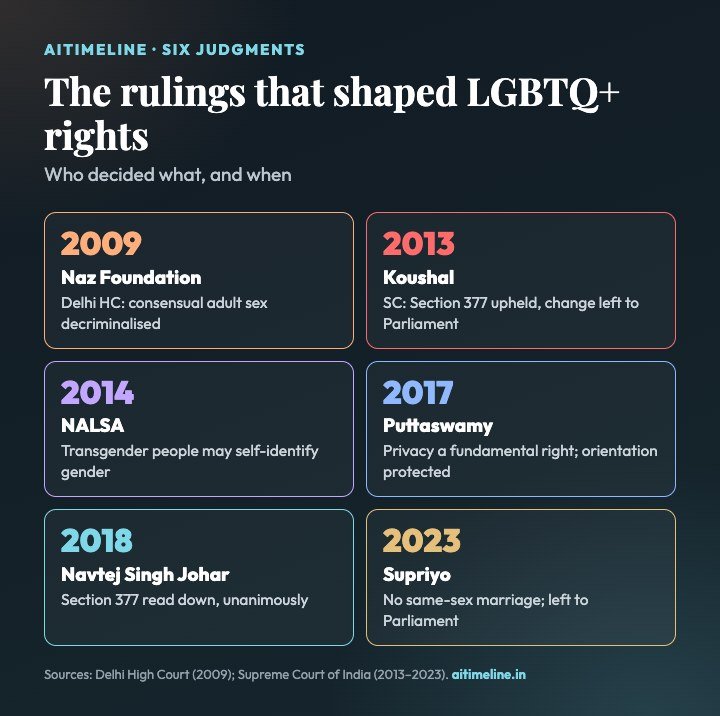
| Judgment | Date | Court and bench | Legal significance |
|---|---|---|---|
| Naz Foundation v. NCT of Delhi | 2 Jul 2009 | Delhi HC; CJ A.P. Shah, J. Muralidhar | Read down Section 377 for consenting adults in private |
| Suresh Kumar Koushal v. Naz Foundation | 11 Dec 2013 | SC; two judges | Reversed Naz; upheld Section 377 |
| NALSA v. Union of India | 15 Apr 2014 | SC; two judges | Third gender recognised; right to self-identify gender |
| K.S. Puttaswamy v. Union of India | 24 Aug 2017 | SC; nine judges | Privacy a fundamental right; sexual orientation part of it |
| Navtej Singh Johar v. Union of India | 6 Sep 2018 | SC; five judges | Consensual same-sex intimacy decriminalised; Koushal overruled |
| Supriyo v. Union of India | 17 Oct 2023 | SC; five judges | No same-sex marriage or court-made civil union; left to Parliament |
What Changed After 2018, and What Did Not
Decriminalisation was a beginning, not the end.
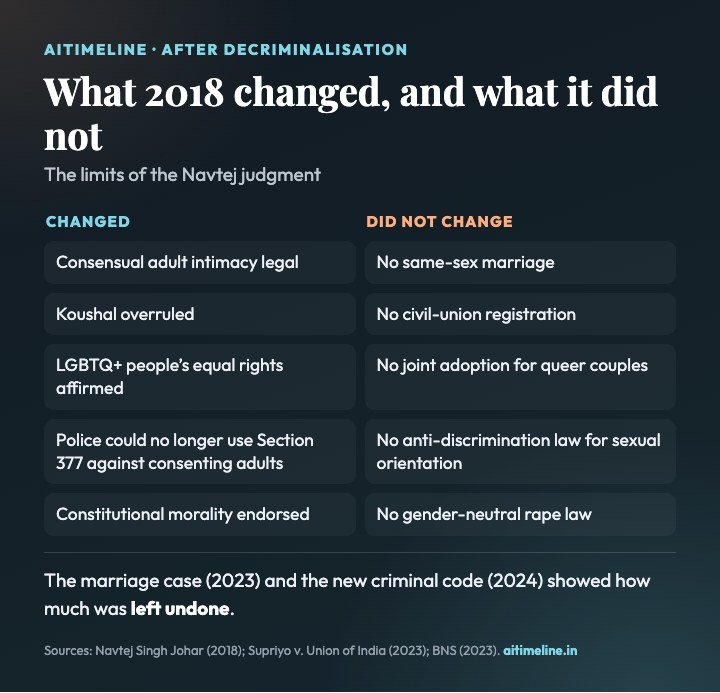
✔️ What became law
- Consensual sexual intimacy between adults in private is not a crime.
- LGBTQ+ people hold equal constitutional rights.
- Police cannot use Section 377 against consenting adults.
✖️ What did not follow
- Marriage, civil unions and joint adoption.
- A general anti-discrimination law covering sexual orientation.
- A gender-neutral framework for sexual offences.
The marriage case was the next test. In Supriyo (2023), all five judges agreed the court could not rewrite the Special Marriage Act. They split 3 to 2 on civil unions and on adoption, with Chief Justice Chandrachud and Justice Kaul in the minority. The government’s promised committee, set up in April 2024, produced administrative fixes: joint bank accounts, a shared ration card, prison visits and advisories against harassment. Useful, but none gives a queer couple a legal status.
The second test came from an unexpected direction. When the Bharatiya Nyaya Sanhita replaced the IPC on 1 July 2024, it did not carry over the part of Section 377 that still punished non-consensual acts. Because the BNS rape offence names only women as victims, adult men and transgender people who suffer such assaults have no specific offence to rely on. The Delhi High Court asked the government to decide the issue in 2024 and revived the case in March 2026 when nothing happened.
Where LGBTQ+ Rights Stand in November 2026
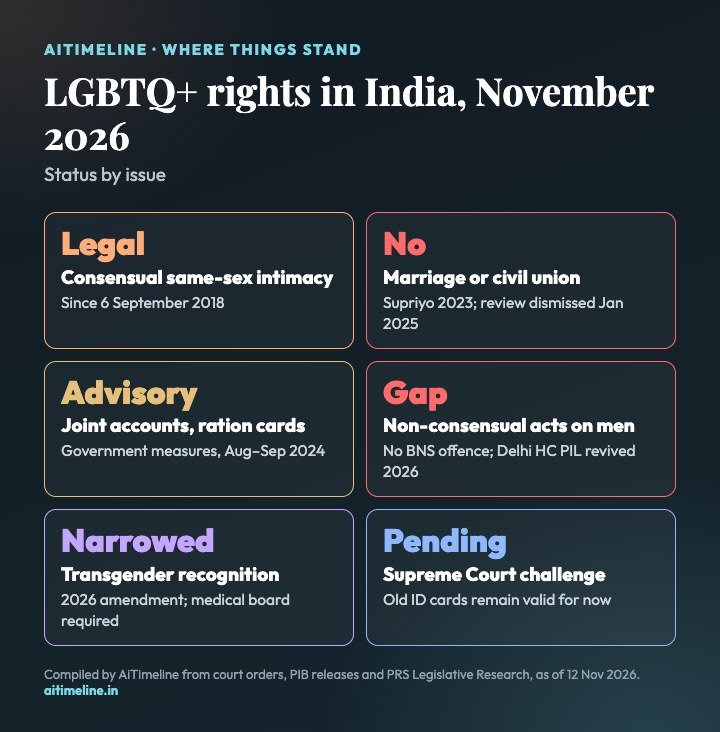
| Area | Position as of 12 November 2026 |
|---|---|
| Consensual same-sex intimacy | Legal between consenting adults in private since 6 September 2018 |
| Same-sex marriage | Not recognised; Parliament has not legislated |
| Civil unions | No registration framework |
| Joint adoption | Not available to unmarried couples, including queer couples |
| Joint bank accounts and nominees | Permitted, per Department of Financial Services advisory (2024) |
| Ration cards | Queer partners may be treated as one household (2024 advisory) |
| Non-consensual acts against adult men and transgender people | No specific BNS offence; Delhi HC PIL pending |
| Transgender legal recognition | 2019 Act as amended in 2026; medical board; challenge pending |
| Conversion therapy | Treated as professional misconduct by the National Medical Commission; no statute |
The 2026 Transgender Law Fight
A separate question from Section 377, and the live one.
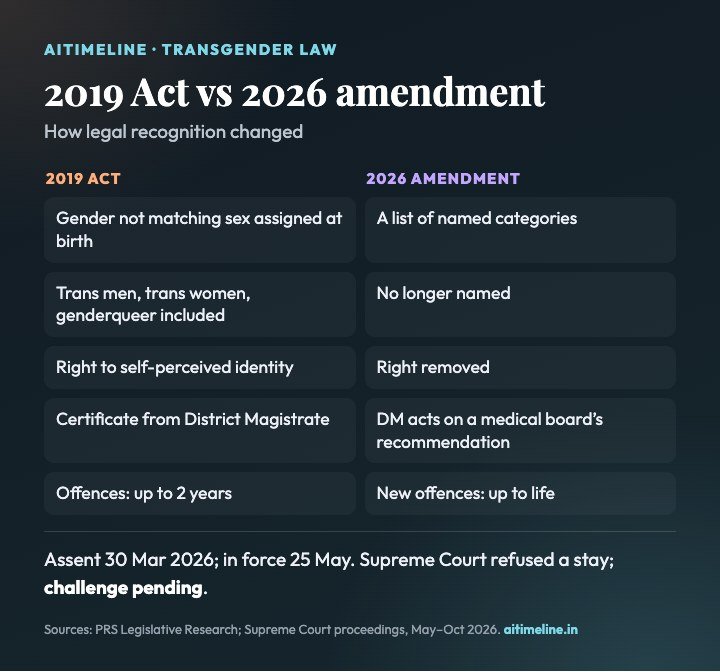
The 2026 amendment is about gender identity, not sexual orientation, and it does not bring back any part of Section 377. But it matters to the same movement because it reverses the principle the Supreme Court set in NALSA: that a person decides their own gender. The amended law lists the categories it recognises, drops trans men, trans women and genderqueer people from the definition, and requires a District Magistrate to act on a medical board’s recommendation.
The government says a tighter definition prevents misuse of welfare schemes and that new offences protect people from being forced into a transgender identity. The petitioners, led by Laxmi Narayan Tripathi, say the law violates equality, dignity, privacy and autonomy. The Supreme Court refused to stay it in May, froze parallel High Court cases in June, recorded the Centre’s assurance on existing identity cards in August, and in October tagged a women’s group’s petition to the batch. No judgment has been delivered.
People and Organisations in the Movement
| Person / organisation | Role |
|---|---|
| AIDS Bhedbhav Virodhi Andolan | Published Less Than Gay (1991); filed the first petition against Section 377 (1994) |
| Anjali Gopalan / Naz Foundation | Filed the 2001 PIL that led to the 2009 ruling |
| Lawyers Collective | Represented Naz Foundation; Anand Grover argued the case |
| Voices Against 377 | Delhi coalition that supported decriminalisation in court |
| Navtej Singh Johar | Dancer; lead petitioner in the 2018 case |
| Sunil Mehra, Ritu Dalmia, Aman Nath, Ayesha Kapur | Co-petitioners in the 2018 case |
| Akkai Padmashali | Transgender activist; petitioner from 2016 |
| Laxmi Narayan Tripathi | NALSA intervenor (2014); lead petitioner against the 2026 amendment |
| Justice A.P. Shah and Justice S. Muralidhar | Delhi High Court bench in Naz (2009) |
| Justice D.Y. Chandrachud | Wrote in Puttaswamy and Navtej; minority view in Supriyo |
| Justice Indu Malhotra | Concurring opinion in Navtej (2018) |
Terms Explained
- Read down: a court narrows how a law applies instead of striking it out entirely.
- Locus standi: the right to bring a case to court.
- Curative petition: the last remedy against a final Supreme Court judgment, after review.
- Constitutional morality: the Constitution’s values, which courts uphold even against majority opinion.
- Self-perceived gender identity: a person’s own sense of their gender, recognised in NALSA.
- BNS: the Bharatiya Nyaya Sanhita, 2023, which replaced the IPC on 1 July 2024.
Explore More Timelines
People Also Ask
Frequently Asked Questions
Based on Supreme Court and High Court judgments, government releases and PRS Legislative Research.
⚠️ Editorial Note
We checked dates against the judgments, court reporting and PRS Legislative Research. Some timelines give March or April 2006 for the Supreme Court’s order reviving the Naz case; we use 3 February 2006. Reports date the first Supreme Court notice on the 2026 amendment to 3 or 4 May 2026, and the 25 May commencement date comes from submissions in court. The 2026 litigation is ongoing; descriptions of petitions are the petitioners’ arguments, not court findings. This page is information, not legal advice.
Related Reading on AiTimeline
Sources & further reading
Every dated entry above was checked against these references. Last reviewed 12 November 2026.
- Navtej Singh Johar v. Union of India, Supreme Court judgment, 6 September 2018
- Naz Foundation v. Government of NCT of Delhi, Delhi High Court, 2 July 2009
- National Legal Services Authority v. Union of India, 15 April 2014
- Justice K.S. Puttaswamy v. Union of India, 24 August 2017
- Navtej Singh Johar v. Union of India: case background and documents
- Supriyo @ Supriya Chakraborty v. Union of India, judgment of 17 October 2023
- This Alien Legacy: The Origins of Sodomy Laws in British Colonialism
- Government measures for the LGBTQI+ community, 1 September 2024
- Delhi HC directs Centre to decide plea on exclusion of Section 377-type offence from BNS (Aug 2024)
- Delhi High Court restores PIL on BNS gap for non-consensual unnatural sex (March 2026)
- The Transgender Persons (Protection of Rights) Amendment Bill, 2026
- Supreme Court stays High Court proceedings on Transgender Amendment Act challenges (15 June 2026)
- Already issued transgender identity cards will continue, Centre tells Supreme Court (17 August 2026)
- Supreme Court seeks Centre's response on plea on transgender law's impact on women (28 October 2026)
- Supreme Court dismisses review petitions in same-sex marriage case (9 January 2025)