11 Lives Lost: What Went Wrong at Bengaluru’s RCB Victory Celebration?
The 4 June 2025 Bengaluru stadium stampede killed 11 at RCB's IPL celebration. D'Cunha Commission findings, court cases and Karnataka's crowd control Bill.
Latest Story
How does a victory celebration end with 11 people dead at the gates of a stadium? The Bengaluru stadium stampede happened on 4 June 2025, the day after Royal Challengers Bengaluru won their first IPL title. Lakhs of fans answered social-media invitations to a stadium built for about 35,000; gates were opened late, police at the gates were few, and there was no medical post. A judicial commission blamed the organisers and the police, the state drafted a crowd-control law, and the courts have so far kept the criminal case from reaching trial. This timeline follows what happened, what each inquiry found, and what is still unresolved.
💡 Short Answer
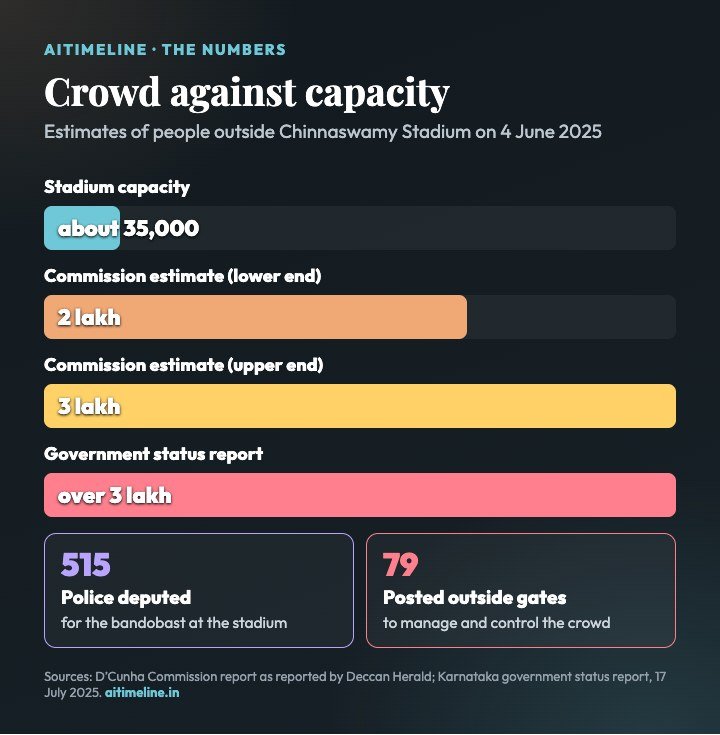
On 4 June 2025 a crowd of 2 to 3 lakh gathered outside Bengaluru’s Chinnaswamy Stadium, which seats about 35,000, to celebrate RCB’s IPL win. Surges at the gates killed 11 people. The D’Cunha Commission blamed reckless announcements, unregulated entry and thin policing. A crowd-control Bill is pending and no chargesheet had been filed by November 2026.
Bengaluru Stadium Stampede: Key Questions
The Tragedy in Ten Points
- 3 June 2025: RCB beat Punjab Kings by six runs to win their first IPL title.
- Morning of 4 June: RCB posts invitations at 7:01 am and a Virat Kohli video at 8:55 am; police had not approved a parade.
- Afternoon of 4 June: 2 to 3 lakh people gather; gates are opened late and 11 people die in crowd surges.
- 5 June: the police commissioner and four officers are suspended; a judicial commission and the High Court step in.
- 6 June: RCB’s marketing head and three others are arrested; released on 12 June.
- 11 July: Justice D’Cunha submits his report; it finds only 79 of 515 police were outside the gates.
- 24 July: the Cabinet accepts the report and orders action against RCB, the KSCA and DNA.
- August 2025: the Crowd Control Bill is introduced and sent to a committee.
- February–March 2026: the High Court closes the public-interest case and holds back the chargesheet.
- 14 July 2026: departmental proceedings against three senior IPS officers are closed.
What Caused the Stampede?
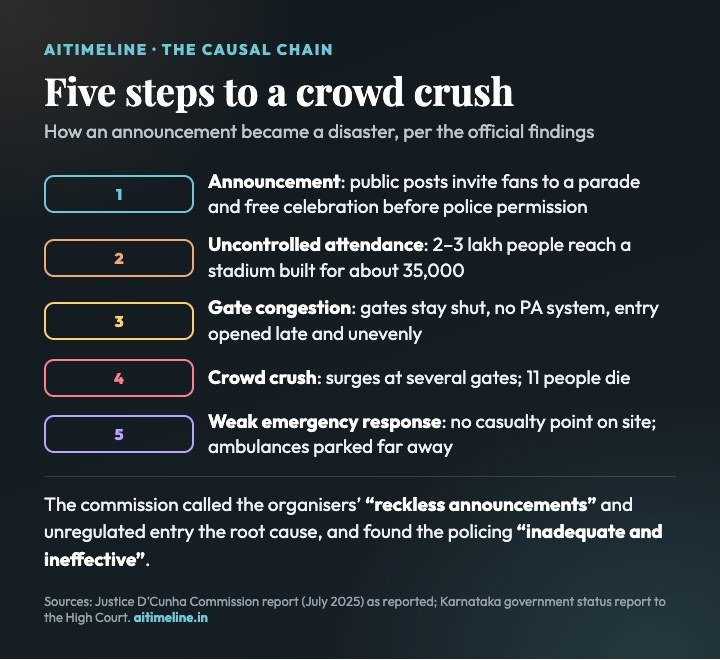
Five links in one chain, each documented in the official findings.
An open invitation
Posts promised a parade and a free celebration within hours, before any permission, and clarified the pass requirement only at 3:14 pm.
No proper application
The only notice to police was a letter on 3 June intimating a possible celebration, not an application under the 2009 assemblies order.
Lakhs for 35,000 seats
No system existed to limit arrivals or turn people back before they reached the gates.
Late, uneven entry
Gates stayed shut with no public-address system; the crowd broke open gates 1, 2 and 21. Gates opened straight onto the footpath.
79 at the gates
Of 515 police deputed, 79 were posted outside the gates; control-room staff did not alert field teams as pressure rose.
No casualty point
No on-site medical centre was set up; ambulances were parked far away and a fire tender came only at police insistence.
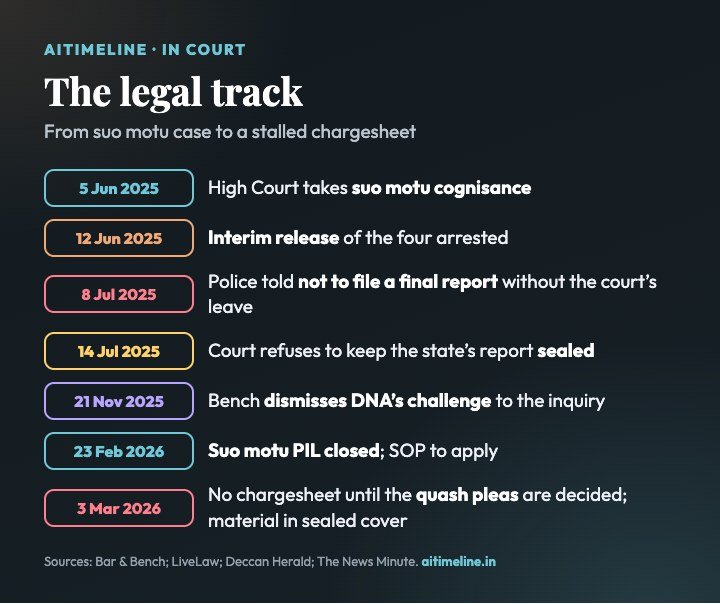
Timeline: From the IPL Final to the Courtroom
Newest first. Colour shows which strand each event belongs to.
Where things stand: reforms pending, no trial yet Reform and aftermath
Safety rules: The crowd-management SOP the High Court ordered to be implemented in February 2026 is the operative safety framework. The Karnataka Crowd Control Bill, 2025 was referred to a Select Committee, and we found no record of it being passed or notified.
Criminal case: The last reported position is the High Court’s March 2026 direction that no chargesheet be filed until it decides the petitions by RCB, KSCA and DNA Entertainment Networks to quash the FIRs. We found no reported ruling on those petitions by early November 2026.
Officers: Departmental proceedings against the three senior IPS officers were closed in July 2026.
Inquiries against three senior IPS officers closed Government and police
The orders: The government dropped the departmental proceedings, initiated under Rule 8(4) of the All India Services (Discipline and Appeal) Rules, against former Bengaluru Police Commissioner B. Dayananda, former Additional Commissioner Vikash Kumar Vikash and former DCP (Central) Shekhar H. Tekkannavar, and exonerated them after examining their written defences and the administrative department’s opinion.
The reaction: BJP leader R. Ashoka asked who, then, was responsible for the 11 deaths.
What it does not mean: This is an administrative decision about disciplinary charges. It is not a court ruling on the stampede, and it does not decide the criminal case against the organisers.
Eleven seats to stay empty at Chinnaswamy Reform and aftermath
What happened: Before IPL 2026, RCB said 11 seats at the stadium would be left empty permanently in memory of those who died. Players were to wear black armbands in matches.
The venue: On 16 March 2026 the state government cleared the KSCA to host IPL 2026 matches at the stadium after mandated safety upgrades.
No chargesheet until the quash petitions are decided Courts
The order: The state sought leave to file the chargesheet. The court said the investigation could continue, but a chargesheet should not be filed until it had heard and decided the June 2025 petitions to quash the FIRs, and orally asked the state to place the proposed chargesheet material before it in a sealed cover.
Next steps: The petitions were heard again on 23 March and posted to 15 April 2026.
High Court closes the suo motu public-interest case Courts
The order: Noting that the state had introduced the Crowd Control Bill and prepared a standard operating procedure for crowd management, the bench disposed of the case. It said the SOP must be implemented until the Bill becomes law, and that the amicus’s concerns about gaps in the Bill could be passed to the legislature’s House Committee.
Can it reopen?: Yes. The court said the case could be revived if concerns remain after the law is enacted.
DNA’s challenge to the judicial inquiry dismissed Courts
The petition: DNA Entertainment Networks had challenged the inquiry by Justice John Michael D’Cunha. It argued that the stampede happened outside the stadium and that it was only managing the event inside, and complained that excerpts of the report had appeared in the media.
The result: The division bench dismissed the petition.
RCB pledges ₹25 lakh to each bereaved family Reform and aftermath
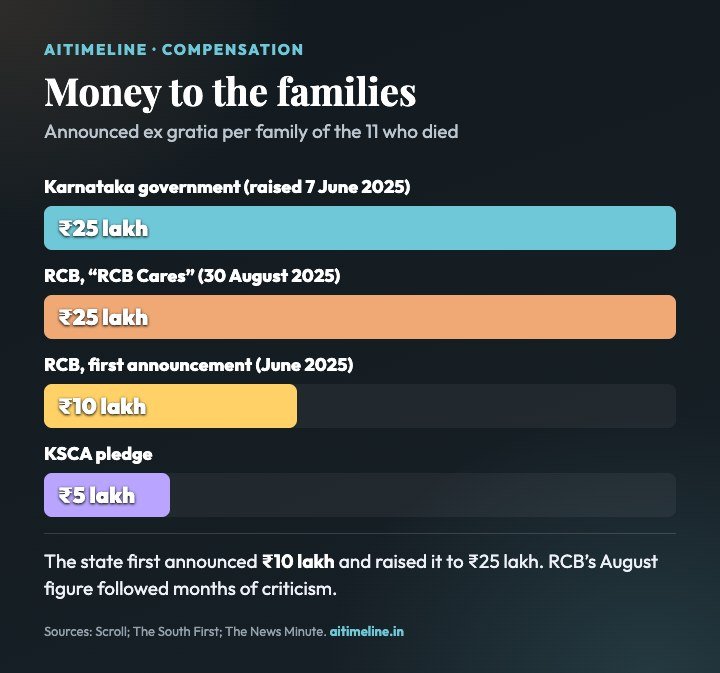
The payment: RCB announced ₹25 lakh for each of the 11 families, calling it the start of a longer commitment under a new initiative, RCB Cares. It had first announced ₹10 lakh per family in June.
Other money: The Karnataka government had raised its ex gratia to ₹25 lakh, and the KSCA pledged ₹5 lakh per family.
Women’s World Cup matches moved out of Bengaluru Reform and aftermath
What happened: The five matches scheduled at Chinnaswamy, including the opener and a possible semi-final, were moved. The opener went to Guwahati and the remaining Bengaluru fixtures to Navi Mumbai.
Why: The KSCA had not obtained the police clearances needed to host the matches.
Crowd Control Bill introduced, then sent to committee Reform and aftermath
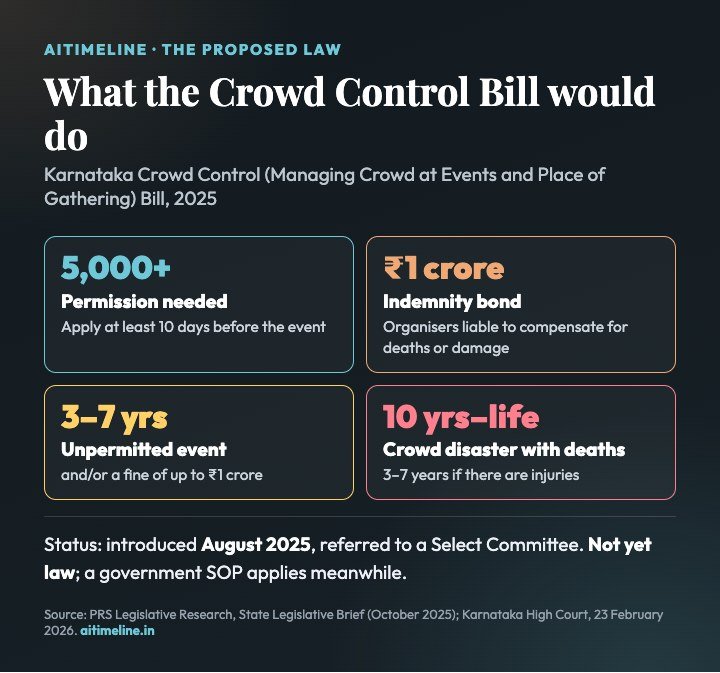
The Bill: The Karnataka Crowd Control (Managing Crowd at Events and Place of Gathering) Bill, 2025 would require permission for events of 5,000 or more people, a ₹1-crore indemnity bond from organisers, and prison terms of three to seven years for unpermitted events.
The referral: After opposition MLAs objected that it could curb protests and gatherings, it was sent to a legislative committee chaired by Home Minister G. Parameshwara.
Suspensions of police officers revoked Government and police
What happened: The government revoked the suspensions of the officers suspended on 5 June. DCP Shekhar H. Tekkannavar’s suspension was revoked on 28 July. Vikash Kumar Vikash had already had his quashed by the Central Administrative Tribunal.
Cabinet accepts the D’Cunha report Government and police
The decision: The Cabinet accepted the commission’s report and decided to take legal action against RCB, the KSCA and DNA Entertainment Networks, and to start departmental inquiries against officials.
The criticism: ThePrint described the decision as the government giving itself a clean chit, since the action targeted the organisers and police officers.
What the commission found Inquiry and findings
Policing: Security was “inadequate and ineffective”. Of 515 police deputed for the bandobast, only 79 were posted outside the gates, and even they were not visible during the crisis.
The organisers: The commission described “reckless announcements” about entry and the failure to regulate the gates as the root cause.
The venue: Its design was unsuitable and unsafe for mass gatherings: entry and exit gates opened straight onto the footpath. It recommended no large events there until safety measures were in place.
The government’s report is made public Government and police
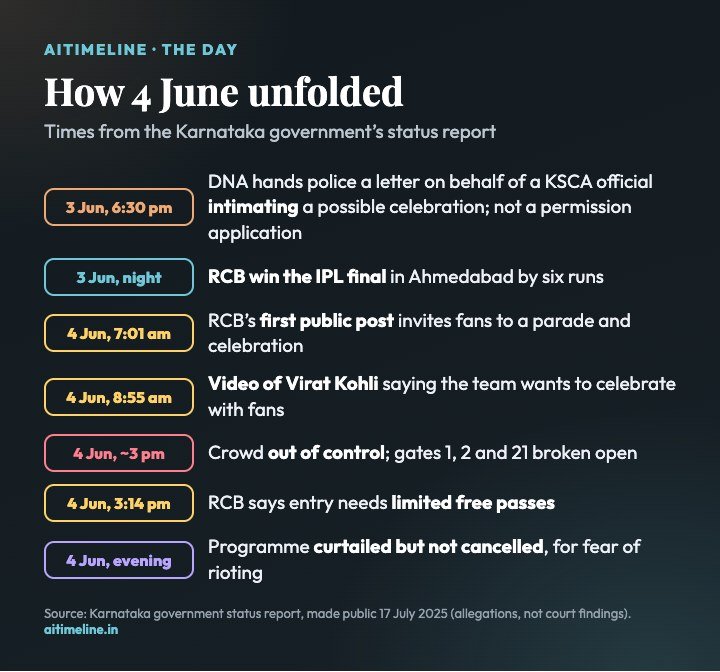
Its account: At 6:30 pm on 3 June, DNA had handed Cubbon Park police a letter on behalf of a KSCA official merely intimating a possible celebration, not a permission application. On 4 June RCB posted an invitation at 7:01 am and a video of Virat Kohli at 8:55 am, and only at 3:14 pm said entry needed limited free passes.
The crowd: More than 3 lakh people gathered. Gates stayed closed, there was no public-address system, and the crowd broke open gates 1, 2 and 21. Police curtailed the programme rather than cancel it, fearing rioting.
High Court refuses to keep the report sealed Courts
The order: The state had filed its status report in a sealed cover. The court said confidentiality of that kind is limited to narrow categories such as national security and privacy, and directed that it be shared with the KSCA, RCB and DNA.
Commission submits its report Inquiry and findings
What happened: The one-man commission, formed on 5 June with a one-month deadline, submitted a two-volume report.
Police told not to file a chargesheet without leave Courts
The order: The court let the investigation continue but restrained the police from filing a final report or chargesheet against RCB, DNA and others without its permission.
Tribunal quashes an IPS officer’s suspension Courts
The order: The tribunal set aside the suspension, said RCB was prima facie responsible for the gathering, and remarked that police are human beings, “neither God nor magician”. It suggested similar relief for the other officers.
The state’s reply: Appealing in the High Court, the government argued that the officers had acted like “servants of RCB”.
Interim release for the four arrested Courts
The order: The court ordered the release of Nikhil Sosale, Sunil Mathew, Kiran Kumar S. and Shamant N.P. Mavinakere, saying they could not be held without material on their personal involvement. It also noted that by the time of the arrests the case had passed to the CID.
State raises compensation to ₹25 lakh Government and police
What happened: The government raised its ex gratia for each family from ₹10 lakh to ₹25 lakh.
Arrests, a sacking and a transfer Government and police
Arrests: Early on 6 June police arrested RCB marketing head Nikhil Sosale at the airport, along with DNA Entertainment’s Sunil Mathew and Kiran Kumar S., and Shamant N.P. Mavinakere.
Government: Chief Minister Siddaramaiah removed his political secretary K. Govindaraj and transferred intelligence chief Hemant Nimbalkar.
KSCA: The High Court granted KSCA office-bearers protection from arrest.
Police chief suspended; three inquiries begin Government and police
Suspensions: The government suspended Commissioner B. Dayananda, Additional Commissioner Vikash Kumar Vikash, DCP Shekhar H. Tekkannavar, ACP C. Balakrishna and Inspector A.K. Girish. Seemant Kumar Singh became commissioner.
Inquiries: A one-man judicial commission under Justice John Michael D’Cunha was set up alongside a magisterial inquiry by Bengaluru Urban Deputy Commissioner G. Jagadeesha. The FIR, naming RCB, DNA and the KSCA, was moved to the CID.
The court: The High Court took suo motu cognisance and asked the state for a report.
Eleven people die outside Chinnaswamy Stadium The day
What happened: Crowds massed at the stadium gates through the afternoon. With entry unregulated and gates opened late, surges developed at several gates. Eleven people died. The state’s figure for the injured was 56; other counts vary.
Inside: The programme inside the stadium was shortened but not cancelled; police said stopping it could cause rioting. The state government had also felicitated the team at Vidhana Soudha that day.
Morning posts draw lakhs of fans The day
What happened: RCB announced a victory parade from Vidhana Soudha to the stadium and a public celebration. A video of Virat Kohli at 8:55 am said the team wanted to celebrate with fans that evening. The posts drew millions of views.
The confusion: Police had not granted permission for a parade. RCB said at 3:14 pm that entry needed limited free passes, after crowds had already gathered.
RCB win their first IPL title The day
What happened: Royal Challengers Bengaluru won the IPL final, ending an 18-year wait.
The request: At 6:30 pm, before the final, DNA had given police a letter on a KSCA official’s behalf intimating a possible celebration. It was not a permission application in the form the 2009 Bengaluru assemblies order requires.
How 4 June Unfolded
Times from the state government’s report to the High Court.
What the Judicial Commission Found and Recommended
Justice John Michael D’Cunha, report of 11 July 2025.
| Area | Finding | Recommendation |
|---|---|---|
| Announcements | “Reckless” posts about entry | No public announcement before permission and planning |
| Policing | 79 of 515 at the gates; not visible during the crisis | Adequate deployment with clear duties |
| Gates | Entry unregulated; exits not opened in time | Safer entry, exit and crowd-flow planning |
| Venue | Gates open onto the footpath; unsafe for mass gatherings | No large events until safety measures are installed |
| Medical | No casualty reception point; ambulances far away | On-site medical infrastructure |
| Command | Control room did not alert field teams | Unified communication and command |
| Accountability | Organisers and named officers at fault | Legal and departmental action |
The Cabinet accepted the report on 24 July 2025. Only a few pages were shared with the media, so much of what is known comes from reported extracts. The commission’s conclusions are recommendations to the government; they do not establish criminal guilt, and RCB, the KSCA and DNA dispute them.
Karnataka’s Crowd Control Bill: What Would Change?
Proposed law, not yet in force.
| Expected attendance | Who grants permission |
|---|---|
| 5,000 to 7,000 | Officer in charge of the local police station |
| 7,000 to 50,000 | Deputy Superintendent of Police |
| Above 50,000 | Superintendent or Commissioner of Police |
PRS flagged two questions: organisers would be liable to compensate regardless of fault, and the three-to-seven-year range gives little guidance on sentencing. Opposition MLAs worried that the civil-disturbance provisions could be used against protests. The High Court left those concerns to the legislature but made the government’s SOP binding in the meantime.
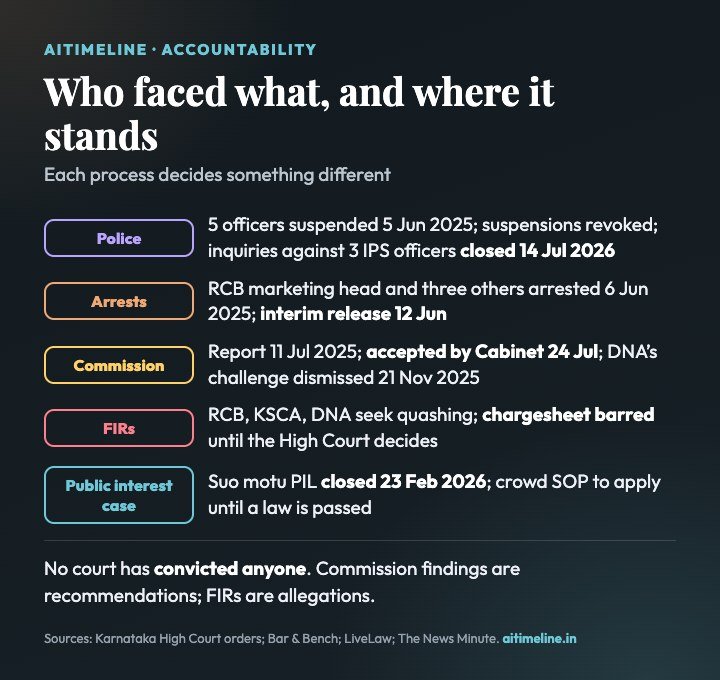
Who Was Held Accountable?
Administrative action, inquiry findings and criminal law run on separate tracks.
| Matter | Status, November 2026 |
|---|---|
| FIRs against RCB, DNA, KSCA | Quash petitions pending; chargesheet not filed |
| Four arrested in June 2025 | Released on 12 June 2025; passports surrendered |
| Three senior IPS officers | Departmental proceedings closed, 14 July 2026 |
| Judicial commission report | Accepted by the Cabinet; DNA’s challenge dismissed |
| Suo motu PIL | Closed 23 February 2026; may be reopened |
| Crowd Control Bill | With a legislative committee; SOP applies |
Lessons for Every Crowded Event
- Permission before publicity: once a free event is announced to millions, no gate plan can keep up.
- Count the crowd, not the seats: a 35,000-seat venue says nothing about how many will come to its gates.
- Police the approaches: the deaths happened outside, where only 79 officers stood.
- Talk to the crowd: no public-address system meant no way to say the gates were full.
- Plan for casualties: a medical post and ambulance route have to exist before the first surge.
- Keep the processes apart: an exoneration, an inquiry finding and a criminal verdict answer different questions.
Key Institutions and People
Royal Challengers Bengaluru
Run by Royal Challengers Sports Pvt Ltd; its posts drew the crowd. Disputes liability and says the event had state sanction.
DNA Entertainment Networks
Organised the celebration; three staff among those arrested.
KSCA
Runs Chinnaswamy Stadium; office-bearers named in the FIR.
Justice John Michael D’Cunha
Retired High Court judge; one-man commission, report 11 July 2025.
B. Dayananda
Commissioner suspended on 5 June 2025; exonerated departmentally in July 2026.
Karnataka High Court
Ran the suo motu case and is hearing the petitions to quash the FIRs.
Explore More Timelines
People Also Ask
Frequently Asked Questions
Checked against court reporting, the state’s status report, the commission’s reported findings and PRS.
⚠️ Editorial Note
The D’Cunha Commission’s findings are inquiry conclusions and recommendations, not criminal convictions. The government’s allegations against RCB, DNA Entertainment Networks and the KSCA are not findings of a criminal court, and the organisations dispute them. The Crowd Control Bill is described here as a Bill under committee scrutiny, not an enacted law. Checking the brief this page began from: the commission submitted its report on 11 July 2025, not 14 July; the High Court closed the suo motu case on 23 February 2026; the figure of 71 injured and the list of gates 2, 2A, 7, 18 and 20 could not be confirmed, so the state’s figure of 56 injured and the gates named in its report (1, 2 and 21) are used; and the November 2025 “contractual responsibilities” proceedings could not be matched to a published order, so the 21 November 2025 dismissal of DNA’s challenge to the inquiry is reported instead.
Related Reading on AiTimeline
Sources & further reading
Every dated entry above was checked against these references. Last reviewed 9 November 2026.
- The News Minute: Bengaluru stampede, police commissioner suspended, CM orders arrest of cricket officials (5 June 2025)
- LiveLaw: Karnataka High Court takes suo motu cognizance of Bengaluru stampede (5 June 2025)
- The South First: High Court grants interim bail to RCB marketing head and three DNA staff (12 June 2025)
- Bar & Bench: Karnataka High Court bars police from filing chargesheet against RCB, others for now (8 July 2025)
- The News Minute: Government report blames RCB and Kohli video for massive crowds (17 July 2025)
- Deccan Herald: Stampede panel says no to big events at Chinnaswamy stadium (23 July 2025)
- The South First: Karnataka Cabinet accepts D'Cunha panel report on Chinnaswamy stampede (24 July 2025)
- PRS Legislative Research: State Legislative Brief, Karnataka Crowd Control Bill, 2025
- Deccan Herald: High Court turns down event management firm's plea against judicial inquiry (21 November 2025)
- Bar & Bench: Karnataka High Court closes suo motu PIL on Chinnaswamy Stadium stampede (23 February 2026)
- LiveLaw: High Court asks State to submit proposed chargesheet material in sealed cover (3 March 2026)
- The News Minute: RCB remembers stampede victims with 11 empty seats, but no chargesheet yet (28 March 2026)
- The News Minute: Former Bengaluru police commissioner Dayananda cleared in Chinnaswamy stampede case (15 July 2026)
- Bar & Bench: CAT quashes suspension of IPS officer Vikash Kumar Vikash (1 July 2025)
- Scroll: RCB announces Rs 25 lakh each for victims' families (30 August 2025)