Nellie Massacre: The 1983 Killings and 43 Years Without Justice
Explore the Nellie massacre timeline, the 1983 Assam violence, Tewary Commission findings, withdrawn criminal cases, Assam Accord and 2025 report release.
Latest Story
On 18 February 1983, armed crowds attacked Nellie and about 13 nearby villages in central Assam and killed Bengali-speaking Muslim residents, many of them women and children, over six to seven hours. The commonly cited official toll is about 1,800; other estimates are near 3,000. Police had been warned three days earlier. An official inquiry criticised the police and blamed the leaders of the Assam Agitation, an unofficial one blamed the decision to hold elections, and the 310 chargesheeted cases were dropped after the 1985 Assam Accord. This Nellie massacre timeline sets out what happened, what the two inquiries found, why no one was convicted, and what changed when both reports were finally laid in the Assam Assembly in November 2025.
The record, meaning the date, the warning, the police cases and their withdrawal, and the 2025 tabling, comes from police and inquiry findings and reporting. Interpretations of who was responsible, including both inquiry reports and the Chief Minister’s 2025 remarks, are attributed. No court has ever ruled on the massacre, and nothing here assigns collective blame to any community or organisation.
💡 Short Answer
The Nellie massacre took place on 18 February 1983 in Nellie and nearby villages of what was then Nagaon district, Assam, during the Assam Agitation and a boycotted state election. About 1,800 Bengali-speaking Muslims were killed by official count, and around 3,000 by other estimates. Police ignored a warning sent three days earlier. Of 688 police cases, 310 were chargesheeted and later withdrawn, and no one has been convicted.
Nellie Massacre 1983: Key Questions
Nellie in Ten Points
- The massacre: 18 February 1983, in Nellie and about 13 nearby villages of central Assam.
- The victims: Bengali-speaking Muslims, many of them women and children.
- The toll: about 1,800 by official count; around 3,000 by other estimates.
- The context: the Assam Agitation and February 1983 elections held despite a boycott.
- The warning: a police wireless message on 15 February was not acted on.
- The official inquiry: the Tewary Commission reported in May 1984 and blamed the agitation leaders.
- The unofficial inquiry: the Mehta Commission blamed the decision to hold the elections.
- The cases: 688 registered, 310 chargesheeted, all dropped after 1985.
- No convictions: withdrawal was not an acquittal; no court ever heard the evidence.
- 2025: both reports were laid in the Assam Assembly on 25 November, 42 years on.
The Warning: Three Days’ Notice
The wireless message of 15 February 1983.
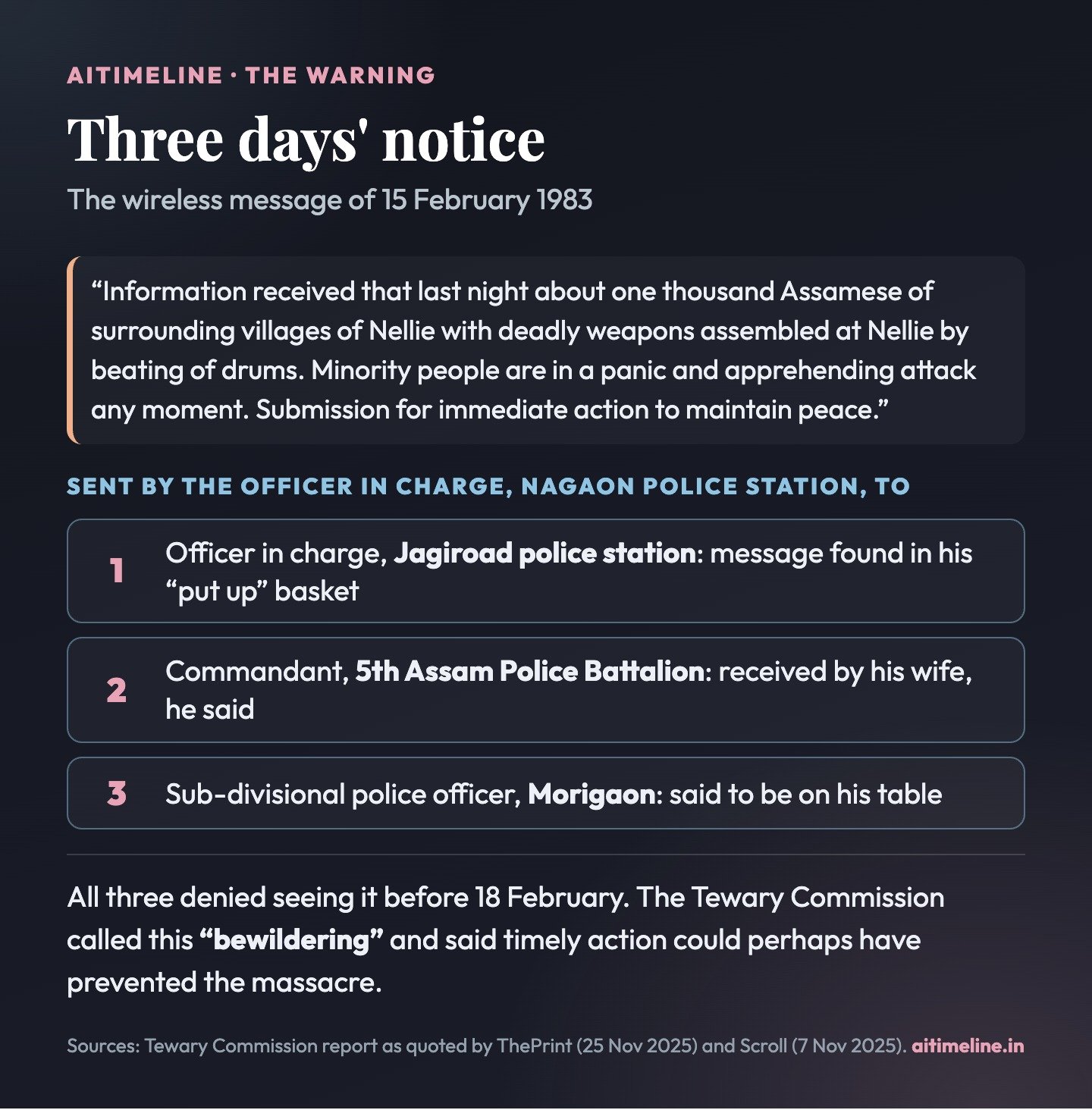
A specific warning. The message named the place, the size of the crowd, its weapons and the people at risk. It went to the three officers with forces nearest to Nellie.
An unexplained failure. Each officer later denied receiving it before the massacre. One said his wife received it; one copy was reportedly found on an officer’s table, and another in a tray of papers. The commission found it “bewildering” that none admitted receiving it, and did not accept the Jagiroad officer’s account.
What else was known. On 17 February villagers asked the Jagiroad police for an armed posting and were turned away, though the officer had a CRPF platoon and other armed police with him. The commission said that force was “not utilized effectively”.
18 February 1983: What Happened at Nellie
Six to seven hours, from morning to the CRPF’s arrival.
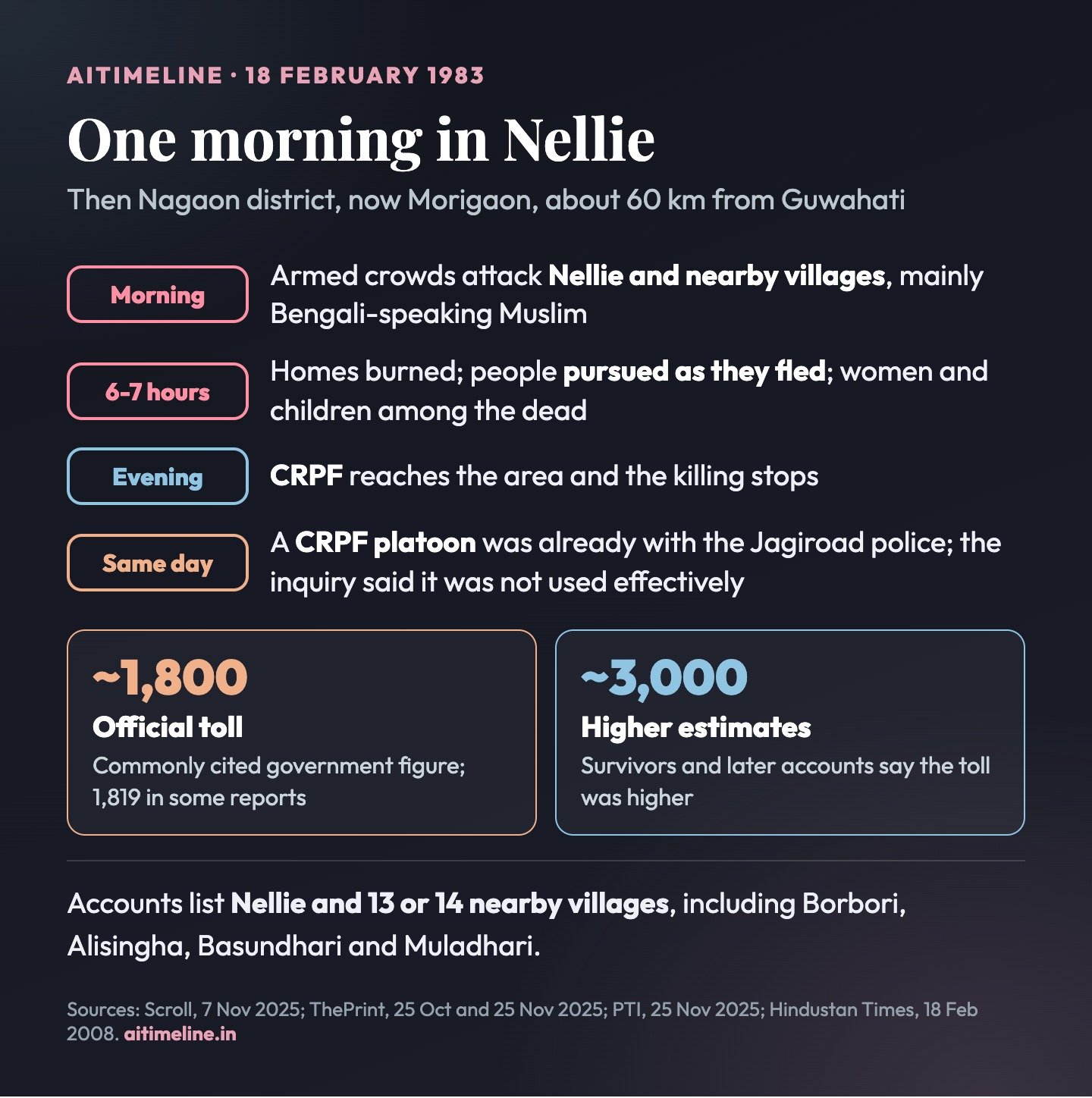
The attack. Accounts describe crowds converging on the villages from several directions from about 8 in the morning, armed with machetes, spears and other weapons. Homes were set alight, and people who ran for the fields were chased down.
The end. The killing stopped only when the Central Reserve Police Force reached the villages in the evening. Survivors allege the local police first told the CRPF there was no trouble and diverted them.
The aftermath. Many of the dead were buried in mass graves. Survivors moved to relief camps, and many families lost several members in a single morning.
Nellie Massacre Timeline, Newest First
Tagged by thread: background, the massacre, the inquiries, the Accord and the cases, and the aftermath.
A scholar says neither report answers the question of justice Aftermath
What she said: Japanese scholar Makiko Kimura told Scroll that neither the Tewary nor the Mehta report gives details of the attackers involved in the violence, and that there has never been a neutral, third-party investigation of the massacre.
On the Tewary report: She called its conclusion on the cause of the violence “very ambiguous” and said it shies away from criticising the government, blaming lower-rank police officers for negligence.
On the Mehta report: She said it placed the blame squarely on the imposition of the elections and was silent on the movement’s leaders.
Both inquiry reports are laid in the Assam Assembly Aftermath
What happened: Chief Minister Himanta Biswa Sarma laid the official Tewary Commission report and the non-official T.U. Mehta Commission report in the Assembly. The government said copies of the Tewary report would be circulated to MLAs and placed in the Assembly library.
No debate: As the government had said in advance, the House did not discuss either report. The Chief Minister described the exercise as an “academic” one that would bring a big chapter of Assam’s history to light.
Why it mattered: It was the first time in 42 years that the Tewary report was available to legislators. It also put two inquiries with opposite conclusions on the record side by side.
Cabinet clears the Tewary report for tabling Aftermath
What happened: The Assam Cabinet approved placing the Tewary Commission report before the Assembly on 25 November.
The Chief Minister’s reading: Sarma said the report described incidents before the massacre that had “antagonised the tribal population” and that, “in an act of retaliation, the tribal community attacked the Muslim community”. He also pointed to demographic change in Assam since 1951.
The criticism: Critics said the framing shifted attention from the scale of the killings and the failure to prosecute anyone. That characterisation is the Chief Minister’s, not a court finding.
The government says it will release the report after 42 years Aftermath
What happened: Himanta Biswa Sarma told reporters the Tewary report had not been tabled earlier because the copy with the government did not carry the chairman’s signature, and that its authenticity had been checked through interviews with officials of the period and forensic tests.
The reaction: Former officials and opposition politicians said a commission’s report should be tabled within six months under the Commissions of Inquiry Act, 1952, and questioned why it was being released just before an election.
Supreme Court upholds Section 6A of the Citizenship Act Aftermath
What happened: A five-judge Constitution Bench upheld Section 6A, which gives legal effect to the Assam Accord’s citizenship dates of 1 January 1966 and 25 March 1971.
Link to Nellie: None directly. The judgment concerned citizenship law, not the 1983 violence or anyone’s criminal responsibility, but it settled the legal framework the Assam Agitation had fought over.
The first major academic study is published Aftermath
What it did: Based on fieldwork and interviews with participants, the book examined why ordinary villagers took part in the violence, and how political mobilisation, land and local rivalries fed into it.
Why it mattered: For decades Nellie had drawn little sustained attention in national discussion. Kimura’s book became the standard reference.
Supreme Court strikes down the IMDT Act Aftermath
What happened: The Supreme Court struck down the Illegal Migrants (Determination by Tribunals) Act, 1983, which applied only to Assam and put the burden of proof on the person alleging that someone was a foreigner.
Link to Nellie: The Act was passed in the same year as the massacre and was a long-standing grievance of the Assam movement. The judgment did not reopen any criminal case about Nellie.
The Tewary report reaches the Assembly, but not the MLAs Inquiry
What happened: According to the present Chief Minister, the AGP government placed the Tewary report in the Assembly in 1987 and promised printed copies to legislators. The copies were never provided, and the Assembly library did not have one.
Why it mattered: For the next four decades journalists and researchers relied on extracts and second-hand accounts of the report’s findings.
The agitation’s leaders take power; the cases are closed Accord and Cases
What happened: The Asom Gana Parishad, formed by leaders of the Assam movement, won the December 1985 Assembly election, and Prafulla Kumar Mahanta became Chief Minister.
The cases: The 310 chargesheeted cases from the 1983 violence were withdrawn. Most accounts link the withdrawal to the Assam Accord; Kimura and others note that it followed the AGP’s arrival in office.
What it meant: No one faced trial for the Nellie massacre. Withdrawal is not an acquittal: no court ever examined the evidence.
The Assam Accord ends the agitation Accord and Cases
What it said: Foreigners who came to Assam on or after 25 March 1971 were to be detected and expelled. Those who came between 1 January 1966 and 24 March 1971 would be removed from the electoral rolls for ten years. Earlier arrivals were to be regularised.
What it did not do: The Accord made no provision for justice for the victims of the 1983 violence.
The unofficial Mehta Commission submits its findings Inquiry
Who set it up: The Asom Rajyik Freedom Fighters’ Association, a non-government body linked to the Assam movement. It was headed by Justice T.U. Mehta, a retired Chief Justice of the Himachal Pradesh High Court, with Ganesh Chandra Phukan and Raihan Shah as members.
What it found: It blamed the Union government, the Election Commission, politicians and the Governor for holding elections when conditions were “not at all congenial” for a free and fair poll, and said Assam had been turned into a “real police state”.
Its limits: It was not a statutory inquiry. The state government barred officials from deposing before it.
The Tewary Commission submits its report Inquiry
What it found on Nellie: The report said a wireless warning sent on 15 February reached three police officers, all of whom denied receiving it in time, and that “some effective preventive action” could perhaps have been taken. It said the force available at Jagiroad police station was not used effectively.
Who it blamed: It held the leaders of the agitation primarily responsible for launching it and for its consequences, and said the decision to hold the elections could not be blamed for the violence.
How it saw the violence: It called it “entirely unwarranted” to give the incidents a communal colour, and described the clashes as rooted largely in land and economic anxieties.
The Assam government appoints the Tewary Commission Inquiry
The mandate: To look into the circumstances leading to the disturbances of early 1983, to assess whether the authorities’ measures were adequate, and to recommend how a recurrence could be prevented.
What it was not: A commission of inquiry can record findings and make recommendations. It cannot convict anyone.
688 police cases are registered Massacre
The cases: Police registered 688 cases over the Nellie killings. 378 were closed for lack of evidence and chargesheets were filed in 310.
Why so few: Survivors and later researchers pointed to weak investigation, intimidation and the political climate. No case reached a verdict.
Survivors count their dead Massacre
What followed: Survivors were moved to relief camps. Many of the dead were buried in mass graves near the villages.
Compensation: Survivors have said the government paid little: one, who lost 12 family members, told Scroll in 2025 that his family received Rs 5,000 and some tin sheets.
The Nellie massacre Massacre
What happened: Beginning around 8 in the morning, armed crowds surrounded and attacked Nellie and nearby villages including Borbori, Alisingha, Basundhari, Muladhari, Bugduba and Silbheta. Homes were burned and people who tried to flee were hunted down.
The victims: Almost all were Bengali-speaking Muslims. Women and children were among the dead.
The toll: The commonly cited official figure is about 1,800; some reports give 1,819. Unofficial estimates are around 3,000, and some survivors put it higher.
How it ended: The killing went on for six to seven hours and stopped only when units of the Central Reserve Police Force arrived in the evening.
Villagers ask for protection, and are refused Massacre
What happened: According to the Tewary report, residents asked the officer in charge at Jagiroad for an armed posting a day before the attack. He refused, citing a lack of police.
What was available: He had a platoon of the CRPF and two sections of the 4th Assam Police Battalion. A further CRPF company reached the area from Nagaon on the night of 17 February for picket duty.
The inquiry’s view: The commission said it did not consider his evidence “at all reliable”.
A warning from Nagaon police station Massacre
The message: “Information received that last night about one thousand Assamese of surrounding villages of Nellie with deadly weapons assembled at Nellie by beating of drums. Minority people are in a panic and apprehending attack any moment.”
Who got it: It was sent by the officer in charge of Nagaon police station to the officer in charge of Jagiroad police station, the commandant of the 5th Assam Police Battalion and the sub-divisional police officer of Morigaon.
What happened to it: All three denied receiving it before the massacre. The Tewary Commission found it “bewildering” that none admitted receiving it.
Polling begins amid a boycott Massacre
What happened: Assam voted under President’s Rule while AASU and AAGSP enforced a boycott. Roads were blocked, bridges damaged and officials resigned rather than serve on poll duty.
The security picture: About 400 companies of central paramilitary forces and 11 Army brigades were deployed. Even so, violence spread across several districts.
The Centre calls elections without revising the rolls Background
What happened: The Union government announced Assembly elections for February 1983, saying the constitutional deadline left no choice. The agitation said the rolls first had to be cleaned of foreigners’ names.
Why it was contested: The Mehta Commission later called the constitutional compulsion “a mere eyewash”. The Tewary Commission said the decision could not be blamed for the violence.
Assam comes under President’s Rule Background
What happened: After a short-lived Congress ministry collapsed, Assam was placed under President’s Rule. The state stayed under central rule until the 1983 elections.
Why it mattered: With no elected government and no settlement in sight, the Centre had to choose between extending central rule and holding elections on the existing rolls.
The Assam Agitation begins Background
The trigger: During the revision of the rolls for the Mangaldoi by-election, a large number of objections were filed against voters alleged to be foreigners.
The demands: Detection of foreigners, deletion of their names from the rolls and deportation of those found to be illegal immigrants.
What followed: Six years of strikes, protests, civil disobedience and economic blockades. The Tewary report counted 358 people killed in clashes between 1979 and 1982.
The Bangladesh war and a longer history of migration Background
Context: Migration into Assam from what is now Bangladesh had gone on for more than a century, under British rule and after independence. The 1971 war brought a new wave of refugees.
Why it matters here: Questions of land, language and voting rights became tied to fears of demographic change. Bengali-origin Hindus and Muslims alike faced growing suspicion, often regardless of their citizenship.
How Many Died at Nellie?
Three numbers that are often mixed up.
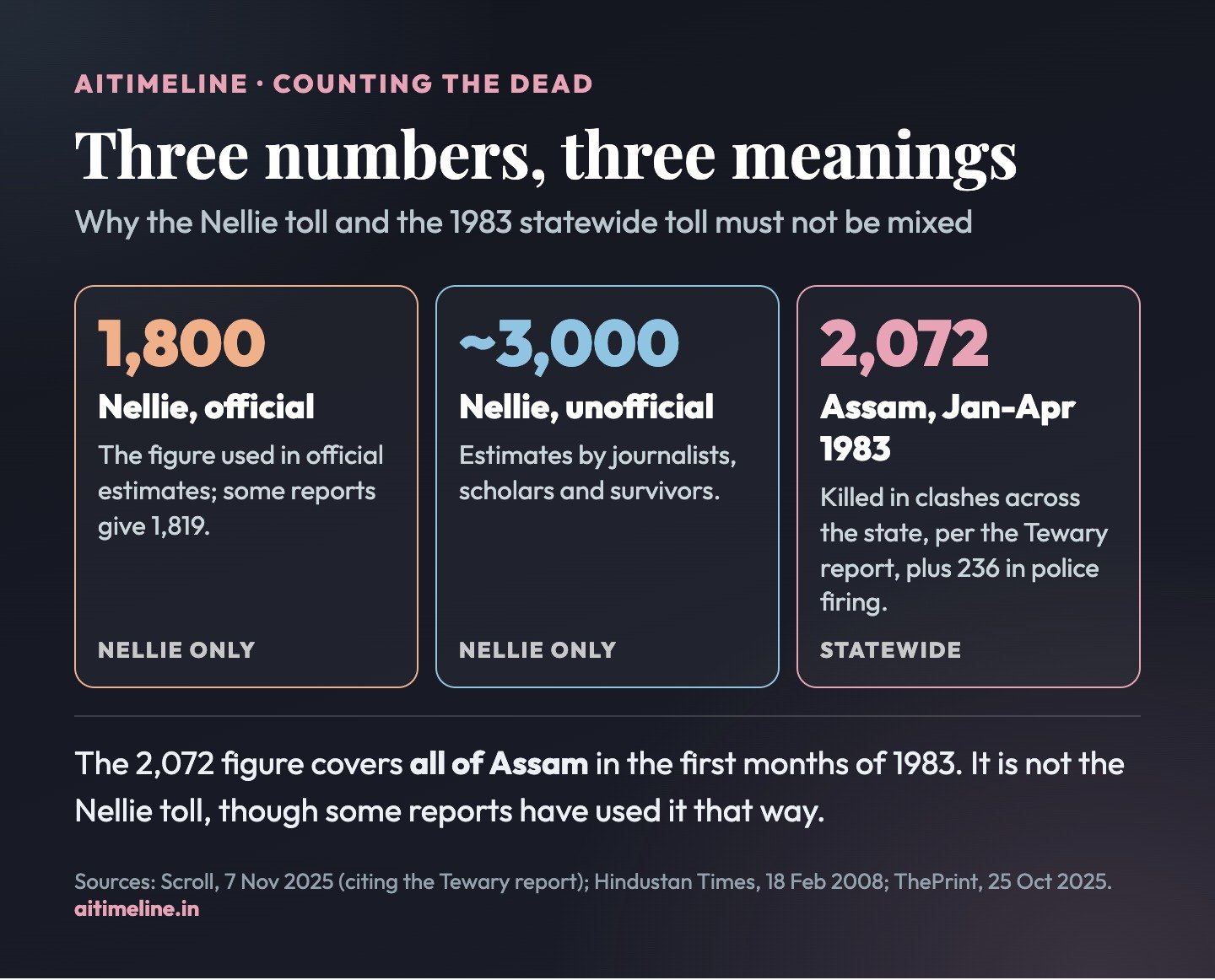
| Figure | What it counts | Source type |
|---|---|---|
| About 1,800 | Killed at Nellie | Official estimate, widely cited |
| 1,819 | Killed at Nellie | Figure given in some press accounts |
| About 3,000 | Killed at Nellie | Unofficial estimates; some survivors say higher |
| 2,072 | Killed in clashes across Assam, early 1983 | Tewary Commission report |
| 236 | Killed in police firing across Assam, early 1983 | Tewary Commission report |
| 358 | Killed in clashes across Assam, 1979-1982 | Tewary Commission report |
Two Inquiries, Two Conclusions
The official Tewary Commission and the unofficial T.U. Mehta Commission.
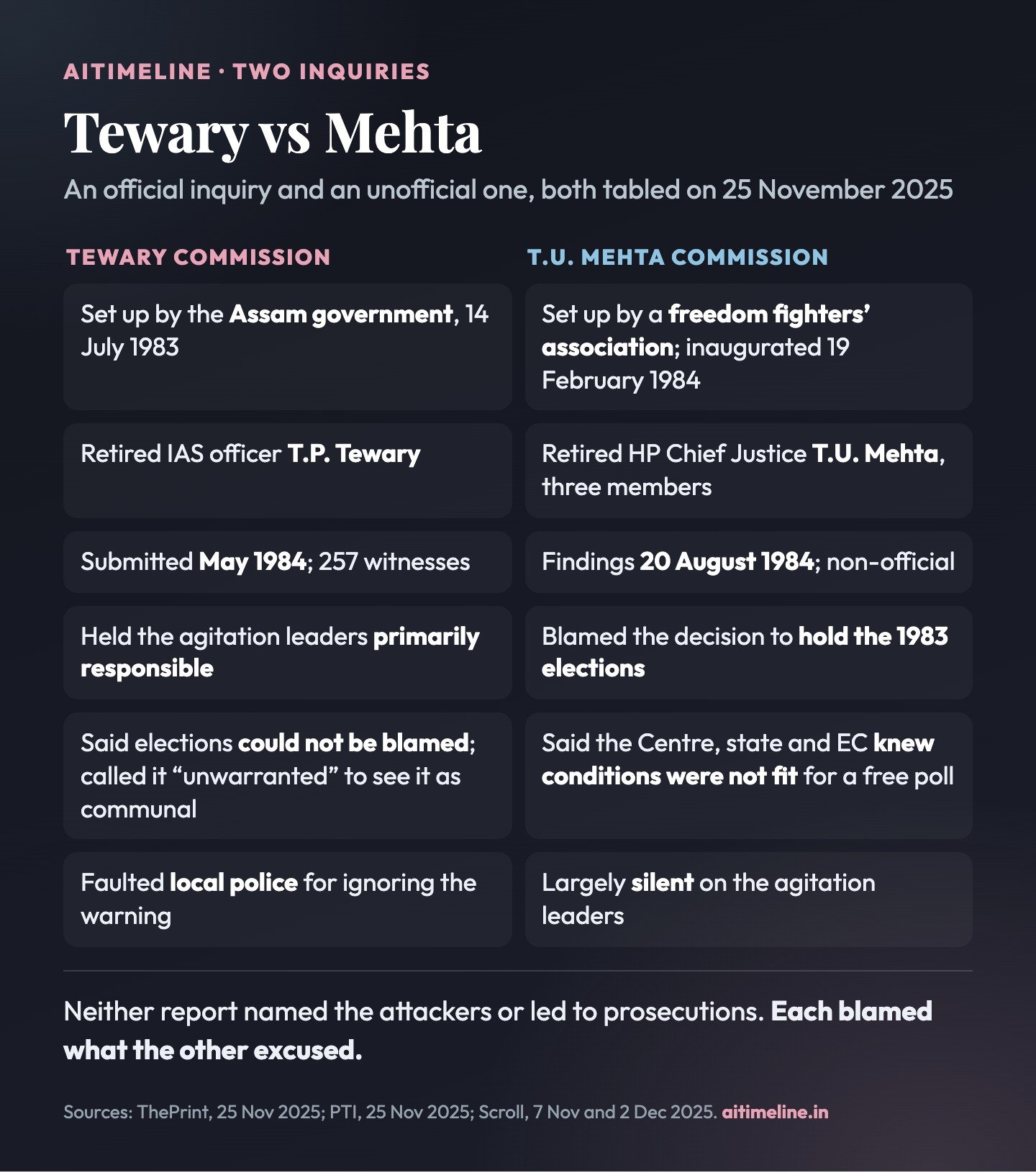
The Tewary Commission. Appointed by Hiteswar Saikia’s Congress government on 14 July 1983 and headed by retired IAS officer Tribhuvan Prasad Tewary, it examined 257 witnesses and reported in May 1984. It documented the ignored warning and the poor use of available forces, held the agitation’s leaders primarily responsible for the movement and its consequences, and said the decision to hold elections could not be blamed. It described it as “entirely unwarranted” to see the violence as communal.
The Mehta Commission. Set up by the Asom Rajyik Freedom Fighters’ Association and headed by Justice T.U. Mehta, it was a private inquiry without statutory powers, and officials were barred from deposing before it. It said the Union government, the Election Commission and the Governor forced elections when conditions were “not at all congenial” for a free and fair poll.
What neither did. Scholar Makiko Kimura points out that neither report gives details of the attackers, and that the Tewary report criticised only lower-ranking police officers. Neither report led to a prosecution.
Tewary vs Mehta
Why No One Was Convicted
From 688 cases to none decided.
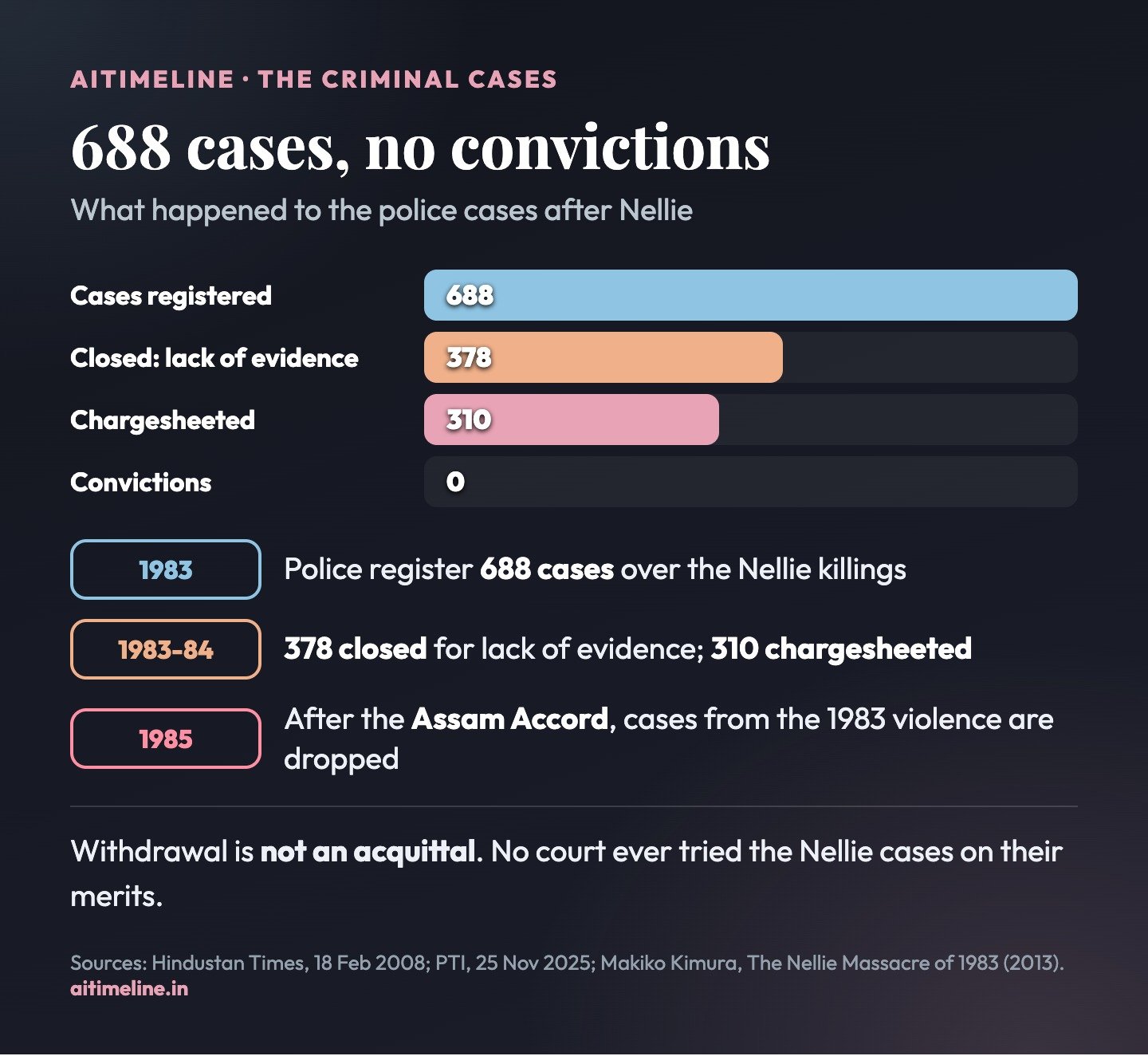
Weak from the start. More than half the cases were closed for lack of evidence before any trial. Survivors were poor, displaced and often afraid to testify.
Dropped in the settlement. The 310 chargesheeted cases were withdrawn after the Assam Accord of 15 August 1985, and the AGP, formed by the movement’s leaders, took office that December. In Kimura’s words, all cases concerning the 1983 election were closed, and nobody has been punished.
What that does and does not mean. A withdrawn prosecution is not a finding of innocence. It also does not cast doubt on what happened, which is recorded in police cases, an official inquiry and survivors’ testimony.
Background: Why Assam Was in Turmoil
From the Mangaldoi by-election to a boycotted poll.
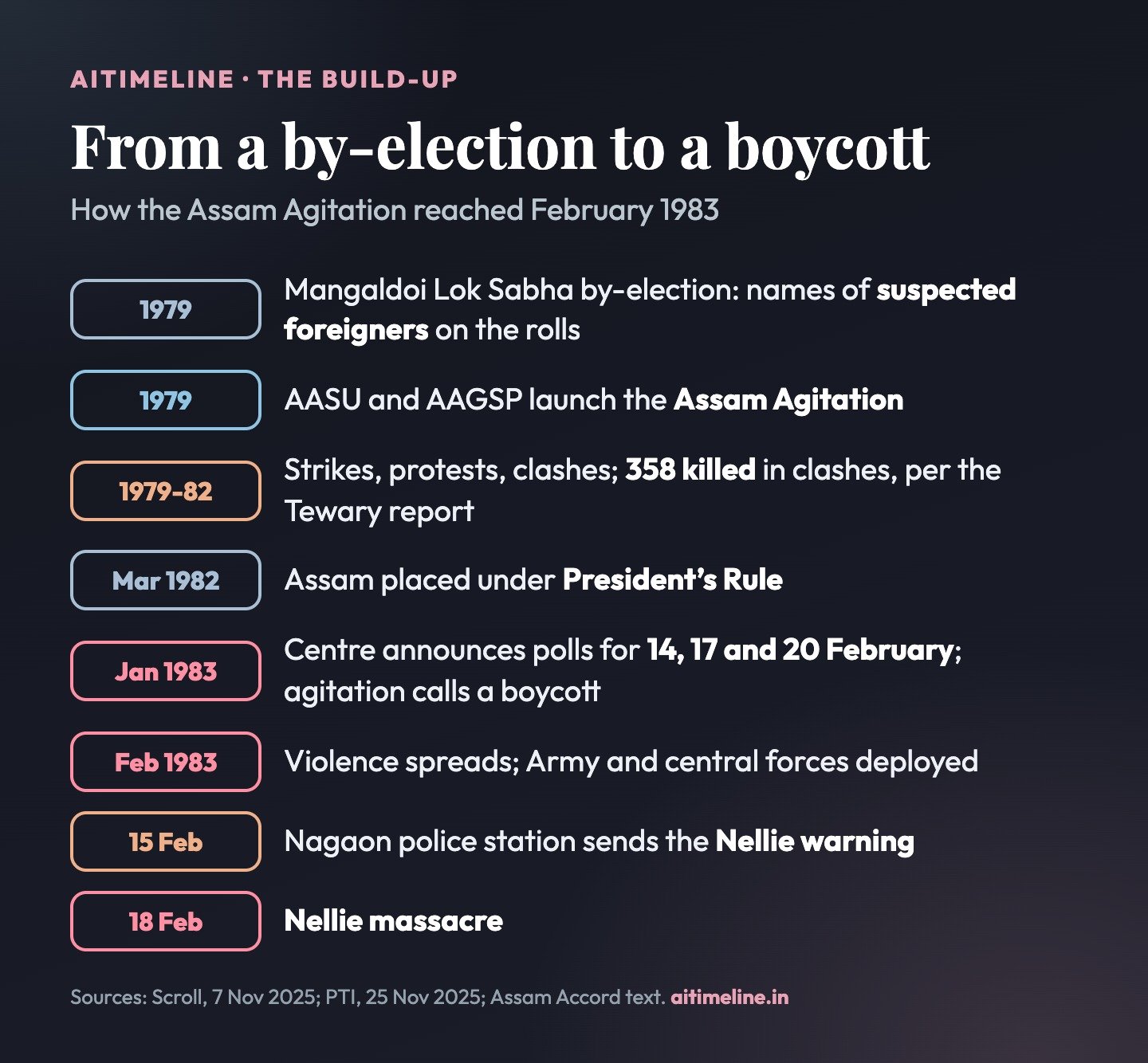
A long-running dispute. Migration into Assam from what is now Bangladesh went back more than a century. By the late 1970s, fears about land, language and political representation had hardened into a mass movement led by AASU and AAGSP, which demanded that foreigners be detected, struck off the rolls and deported.
A forced election. With the state under President’s Rule and no settlement in sight, the Union government held elections in February 1983 on the existing rolls. The movement called a boycott. In many areas the election became a confrontation between those who wanted to vote and those determined to stop them.
A distinction that matters. Legitimate questions about migration and citizenship are separate from violence against civilians. Nothing in that history justifies the killings at Nellie, and the victims were not responsible for the political dispute around them.
After Nellie: From the Accord to the Assembly
What changed in 42 years, and what did not.
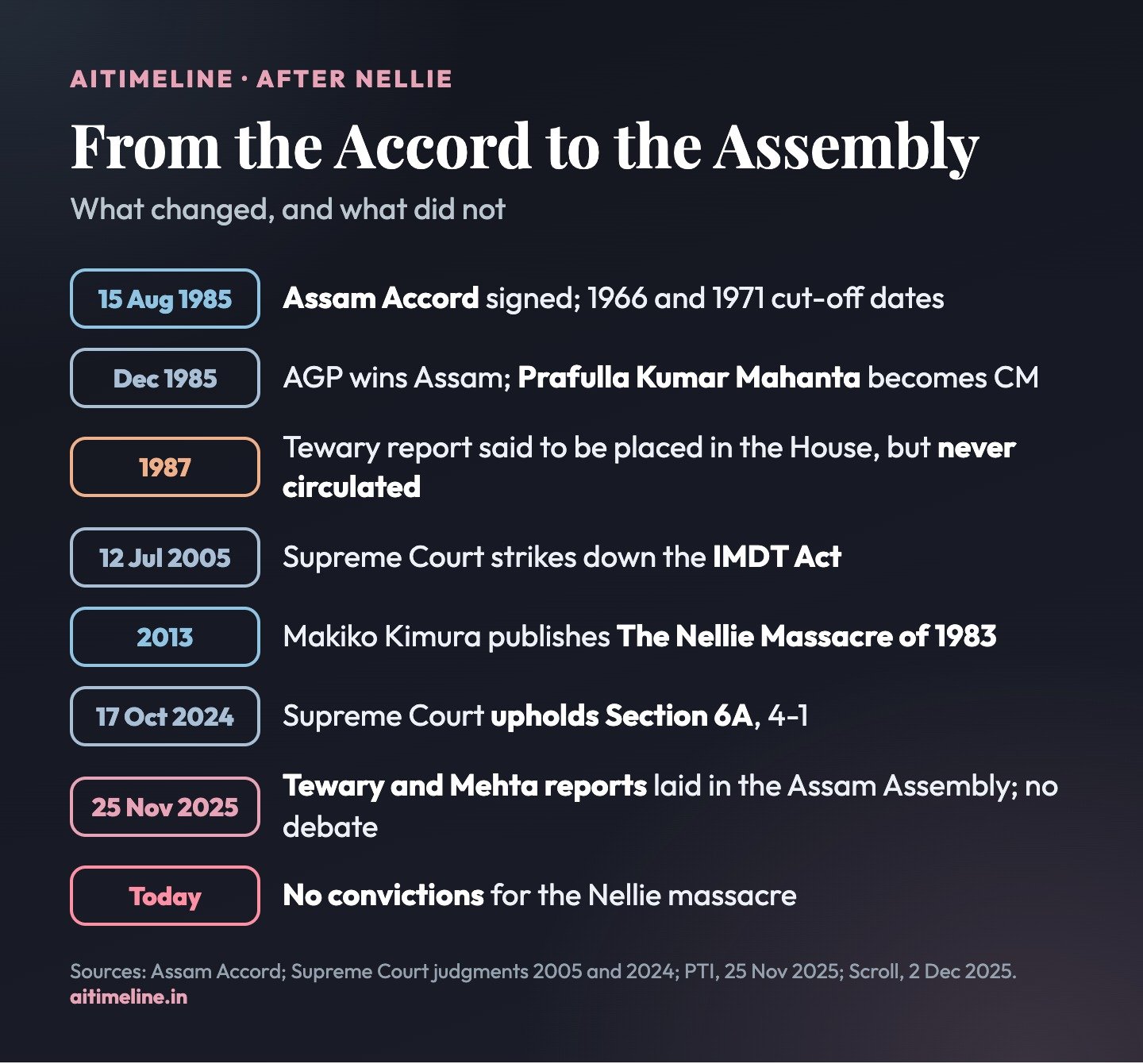
The settlement. The Assam Accord ended the agitation and set the citizenship cut-off dates that still shape Assam’s politics, later tested in the IMDT and Section 6A cases. It said nothing about the victims of 1983.
The report. The Tewary report stayed out of public reach for four decades. When the government laid it in the Assembly on 25 November 2025, alongside the Mehta report, it said the House would not discuss either one.
The open question. Releasing the reports added to the record, but it did not reopen any case or offer survivors redress. As Kimura put it, neither report answers the fundamental question of justice.
Impact and Legacy
No trials, no convictions
For survivors, the absence of any verdict in more than four decades remains the central issue.
Families and livelihoods
Households lost several members, homes and land in a single morning, with little compensation.
Ignored warnings
The unanswered wireless message is still cited as a lesson in acting on credible intelligence during communal tension.
A forgotten massacre
Nellie drew far less national attention than comparable atrocities until the 2025 tabling revived it.
Established, Disputed and Unresolved
- The massacre took place on 18 February 1983.
- Police were warned on 15 February.
- 688 cases were registered and 310 chargesheeted.
- Both reports were laid on 25 November 2025.
- The exact death toll.
- Who bears primary responsibility: the agitation leaders or the decision to hold elections.
- Why the warning was not acted on.
- No independent investigation.
- No individual held criminally responsible.
- No reparations framework for survivors.
Key People and Organisations
Tribhuvan Prasad Tewary
Retired IAS officer who headed the official commission, appointed 14 July 1983, report May 1984.
Justice T.U. Mehta
Retired Chief Justice of the Himachal Pradesh High Court who headed the unofficial inquiry in 1984.
Hiteswar Saikia
Congress leader whose government appointed the Tewary Commission.
Prafulla Kumar Mahanta
AASU leader who signed the Accord and led the AGP government in office when the cases were closed.
Himanta Biswa Sarma
Laid both reports in the Assembly on 25 November 2025.
Makiko Kimura
Author of The Nellie Massacre of 1983: Agency of Rioters (2013).
| Person or organisation | Role |
|---|---|
| All Assam Students’ Union (AASU) | Led the Assam Agitation, 1979-1985 |
| All Assam Gana Sangram Parishad (AAGSP) | Partner organisation in the agitation and the Accord |
| Indira Gandhi | Prime Minister when the February 1983 elections were held |
| Asom Gana Parishad (AGP) | Party formed by the agitation’s leaders; won power in December 1985 |
| Asom Rajyik Freedom Fighters’ Association | Set up the non-official Mehta Commission |
| Central Reserve Police Force | Its arrival in the evening of 18 February ended the killing |
Did You Know?
- A year and a day: the Mehta Commission was inaugurated on 19 February 1984, a year and a day after the massacre.
- Same year: the IMDT Act, struck down in 2005, was passed in 1983, the year of Nellie.
- A signature: the government’s stated reason for not tabling the Tewary report was that its copy lacked the chairman’s signature.
- Two reports, one day: the official and unofficial inquiries reached the Assembly together on 25 November 2025.
- From petitioner to Chief Minister: the IMDT challenge was brought by Sarbananda Sonowal, later Chief Minister of Assam.
- No debate: the House did not discuss either report when they were tabled.
Explore More Timelines
People Also Ask
Frequently Asked Questions
Based on the inquiry findings as reported, contemporary accounts and research.
⚠️ Editorial Note: What We Corrected and What We Could Not Confirm
The brief we started from needed some changes. The Mehta Commission was not a 1985 report organised directly by the agitation’s groups: it was set up by the Asom Rajyik Freedom Fighters’ Association, inaugurated on 19 February 1984, and submitted its findings on 20 August 1984. The brief’s summary of the Tewary report left out its main conclusions: it held the agitation leaders primarily responsible, said the elections could not be blamed, and rejected a communal reading. The Assam Cabinet approved tabling on 13 November 2025 (Tewary) and 23 November (Mehta), after the Chief Minister’s announcement on 23 October. We could not confirm the brief’s reference to clashes in Nagaon on 12 February, so we have not included it. Accounts give 13 or 14 villages besides Nellie, and six or seven hours for the attack. The figure of 2,072 dead in the Tewary report is a statewide toll for early 1983, not the Nellie toll. Reports differ on whether the Tewary report was placed in the Assembly in 1986 or 1987. As of November 2026 it is 43 years since the massacre; the “42 years” in some coverage refers to the 2025 tabling. The withdrawal of the cases was not an acquittal, and descriptions of who took part in the attack are attributed: no court has established individual responsibility.
Related Reading on AiTimeline
Sources & further reading
Every dated entry above was checked against these references. Last reviewed 18 November 2026.
- ThePrint: Of ignored alerts and cover-up, revisiting the 1983 Nellie mayhem as Assam govt looks to table long-buried report (25 October 2025)
- ThePrint: 3,000 Muslims killed in Nellie. But Assam panel report buried for 42 yrs says it wasn't communal (25 November 2025)
- ThePrint (PTI): Assam govt lays non-official Mehta Commission report on 1983 poll violence (25 November 2025)
- The Week (PTI): Placing of Nellie massacre panel reports after 42 years brings to fore Assam's darkest chapter again (25 November 2025)
- Scroll: Why Assam CM's decision to table report on Nellie massacre is being called into question (7 November 2025)
- Scroll: Assam tabled two Nellie reports. Why this Japanese scholar believes none address the question of justice (2 December 2025)
- The Assam Tribune: 'An act of retaliation', Assam CM cites key finding ahead of Nellie report tabling (13 November 2025)
- ThePrint: Nellie massacre and citizenship, when 1,800 Muslims were killed in Assam in just 6 hours (18 February 2019)
- Government of Assam, Implementation of Assam Accord Department: history of the Assam Accord
- Supreme Court of India: Sarbananda Sonowal v Union of India (2005), via Indian Kanoon
- Supreme Court Observer: In Re Section 6A of the Citizenship Act, 1955, judgment summary (17 October 2024)
- Nellie massacre (Wikipedia)