Aaya Ram, Gaya Ram: Haryana Defections Explained
Discover how Gaya Lal's party-switching in Haryana in 1967 created the phrase Aaya Ram, Gaya Ram and led to India's Anti-Defection Law of 1985.
Latest Story
In March 1967, weeks after Haryana’s first Assembly election, an Independent MLA named Gaya Lal changed sides so often in so few days that the man who won him back, Rao Birender Singh, presented him to the press with a joke: “Gaya Ram is now Aaya Ram.” This Aaya Ram Gaya Ram timeline follows the episode from the Speaker vote that broke the Congress majority to President’s Rule in November 1967, and then traces what the phrase led to: the Committee on Defections, the Anti-Defection Law of 1985, the 2003 amendment, and the Supreme Court cases that still shape how defections are judged. Dates and quotations are checked against the court record.
Haryana voted in February 1967, with the general election, not in March; the government was sworn in on 10 March. Accounts of Gaya Lal’s switches differ: three times in nine hours, twice in nine hours, or three times in a fortnight, depending on the source. Rao Birender Singh did not leave office on 2 November 1967; the President’s Proclamation that ended his government is dated 21 November 1967. The Chavan Committee was not a 1973 body: the Lok Sabha asked for it on 8 December 1967 and its report is dated 7 January 1969. And 12 November 1991 was not a hearing date in Kihoto Hollohan: it is the day the Court announced its conclusions, with reasons on 18 February 1992.
💡 Short Answer
“Aaya Ram, Gaya Ram” is the Indian political phrase for a legislator who keeps switching parties. It comes from Haryana in March 1967, when Independent MLA Gaya Lal moved between the Congress and the United Front several times in a few days, and Rao Birender Singh, newly Chief Minister, announced that “Gaya Ram is now Aaya Ram.” Defections brought down Haryana’s Assembly in November 1967 and helped lead to the Anti-Defection Law, the Tenth Schedule added by the 52nd Amendment on 15 February 1985.
Aaya Ram Gaya Ram: Key Questions
The Story in Ten Lines
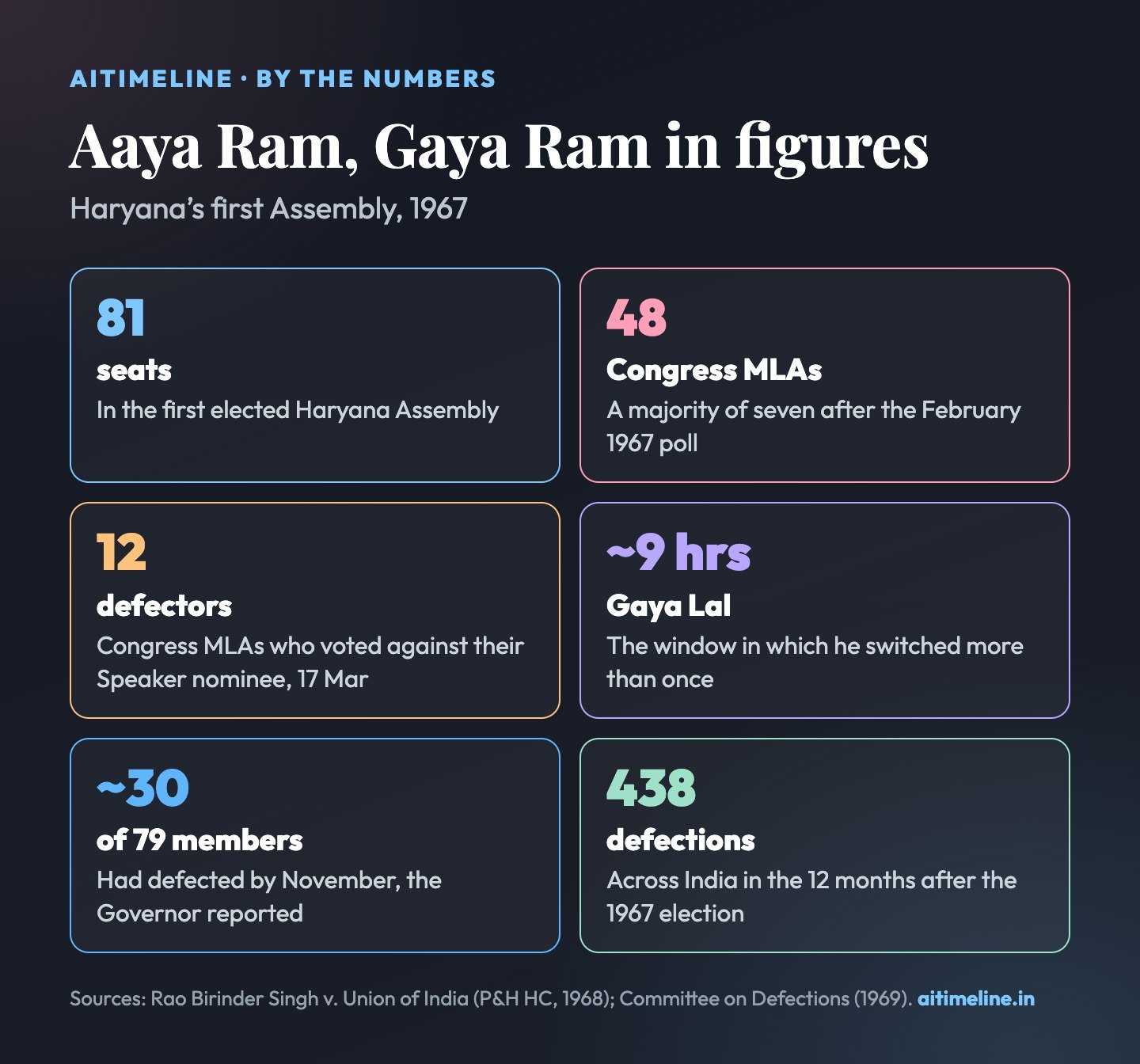
- The election: Congress won 48 of 81 seats in Haryana in February 1967.
- The first break: 12 Congress MLAs voted against their own Speaker nominee on 17 March.
- The switch: Rao Birender Singh became Chief Minister on 24 March at the head of a United Front.
- The phrase: Gaya Lal’s back-and-forth produced “Gaya Ram is now Aaya Ram”.
- The collapse: about 30 of 79 members defected, some three or four times, the Governor reported.
- The end: President’s Rule and dissolution, by Proclamation dated 21 November 1967.
- The national wave: at least 438 defections across India in 12 months, against about 542 in the previous 15 years.
- The law: the Tenth Schedule, added by the 52nd Amendment in 1985.
- The fix: the 91st Amendment in 2003 removed the one-third split exception.
- The courts: Speakers’ decisions are reviewable (1992) and should come within three months (2020).
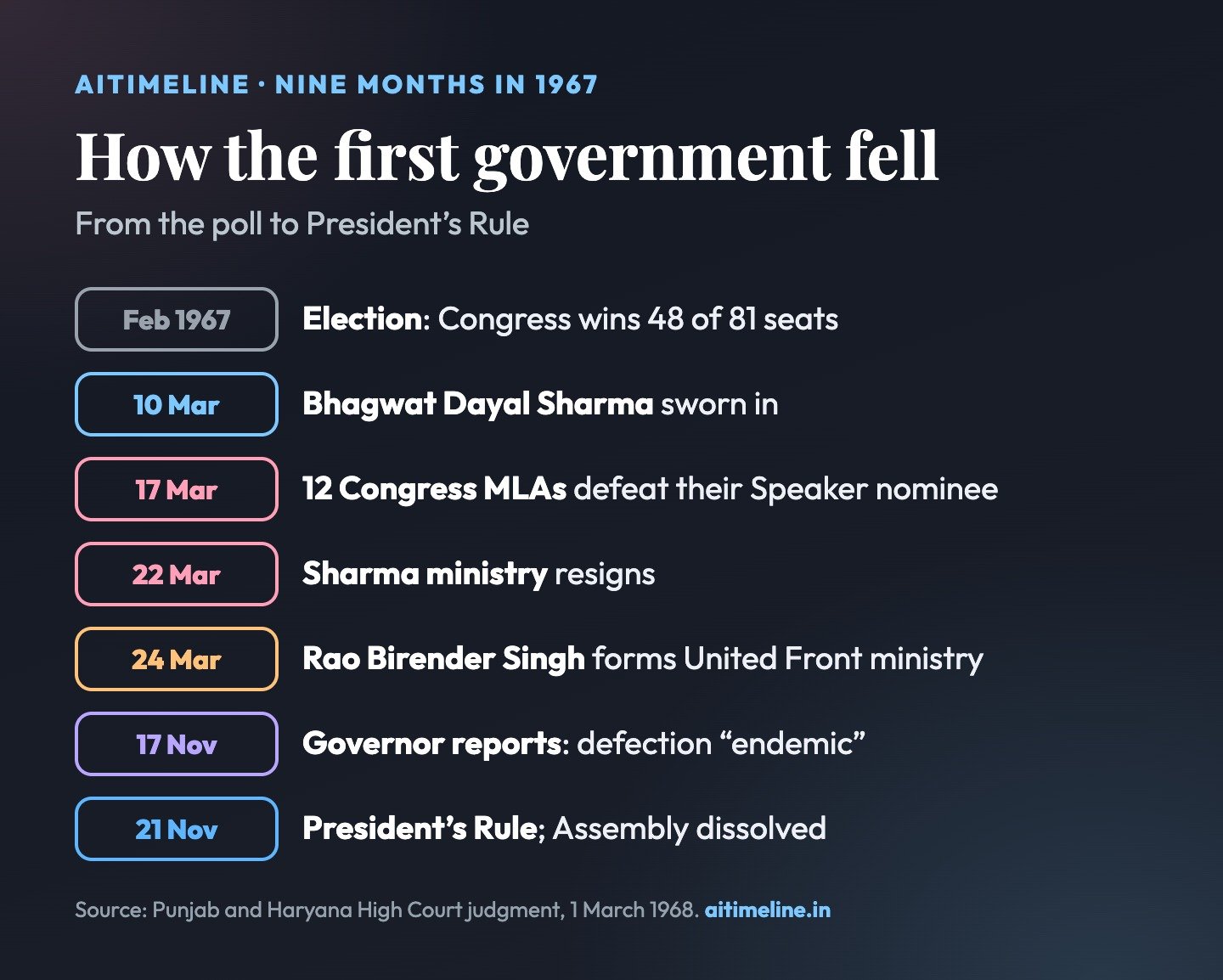
Haryana, 1967: A Majority That Lasted Twelve Days
From the first election to President’s Rule in nine months.
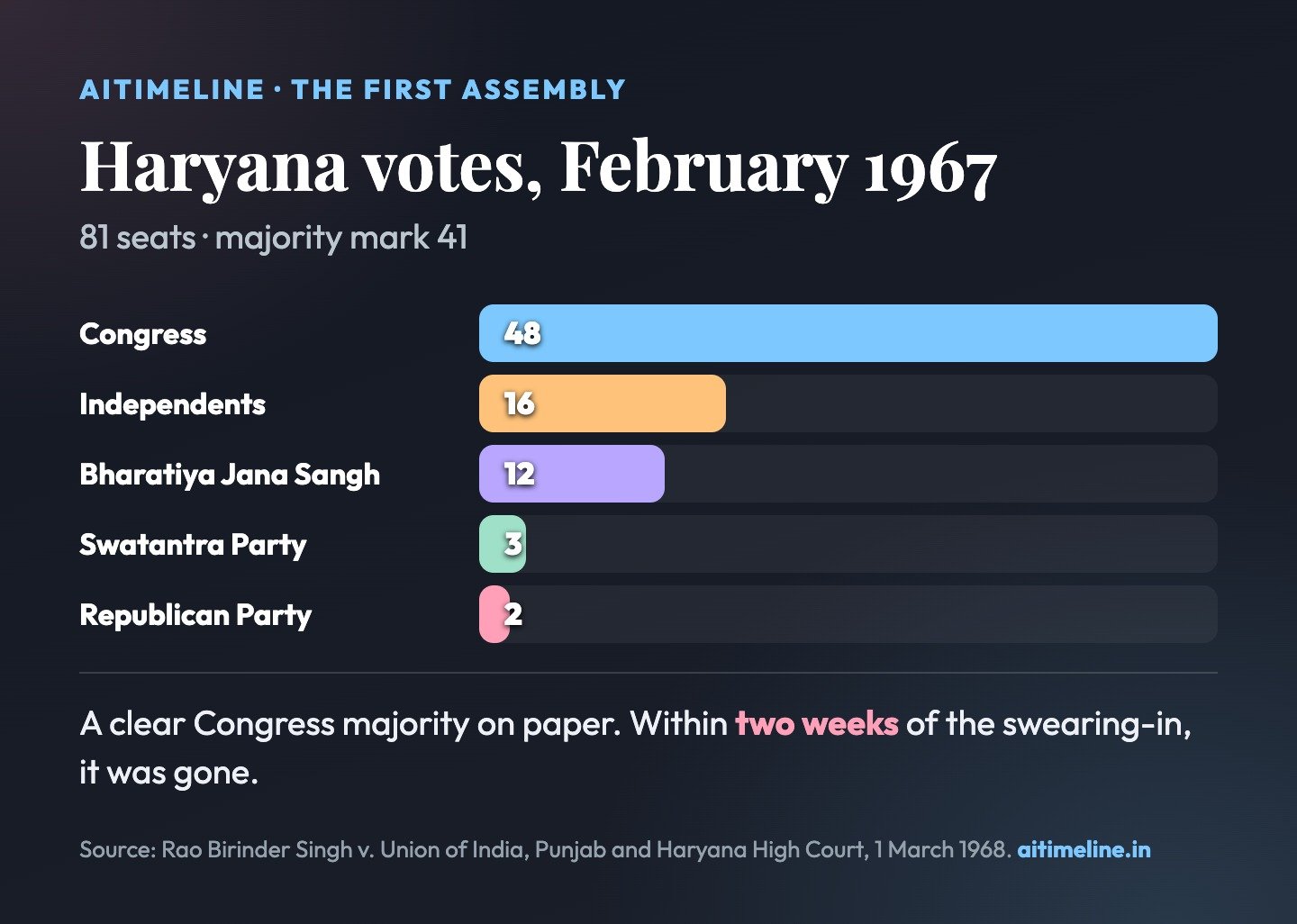
A new State, a familiar party. Haryana was carved out of Punjab on 1 November 1966, and Bhagwat Dayal Sharma, a minister in undivided Punjab, became its first Chief Minister. In February 1967 the Congress won 48 of the 81 seats, a majority of seven.
The Speaker vote. Sharma was sworn in on 10 March. On 17 March the official Congress nominee for Speaker lost because 12 Congress members, among them Rao Birender Singh of Pataudi, voted against him. Rao Birender Singh became Speaker. “So 12 Congress members defected from that party,” the Punjab and Haryana High Court later wrote.
A new government. The Sharma ministry resigned on 22 March. Two days later Rao Birender Singh formed a ministry of the Haryana Samyukta Dal, a United Front of Congress rebels, Independents and opposition members, with 47 members behind him.
No settling down. “Thereafter there were efforts to win over members on both sides and so defections followed,” the court recorded. By November the Governor counted about 30 defectors in a House of 79.
Gaya Lal and the Birth of a Phrase
One MLA, several switches, and a line that outlived them all.
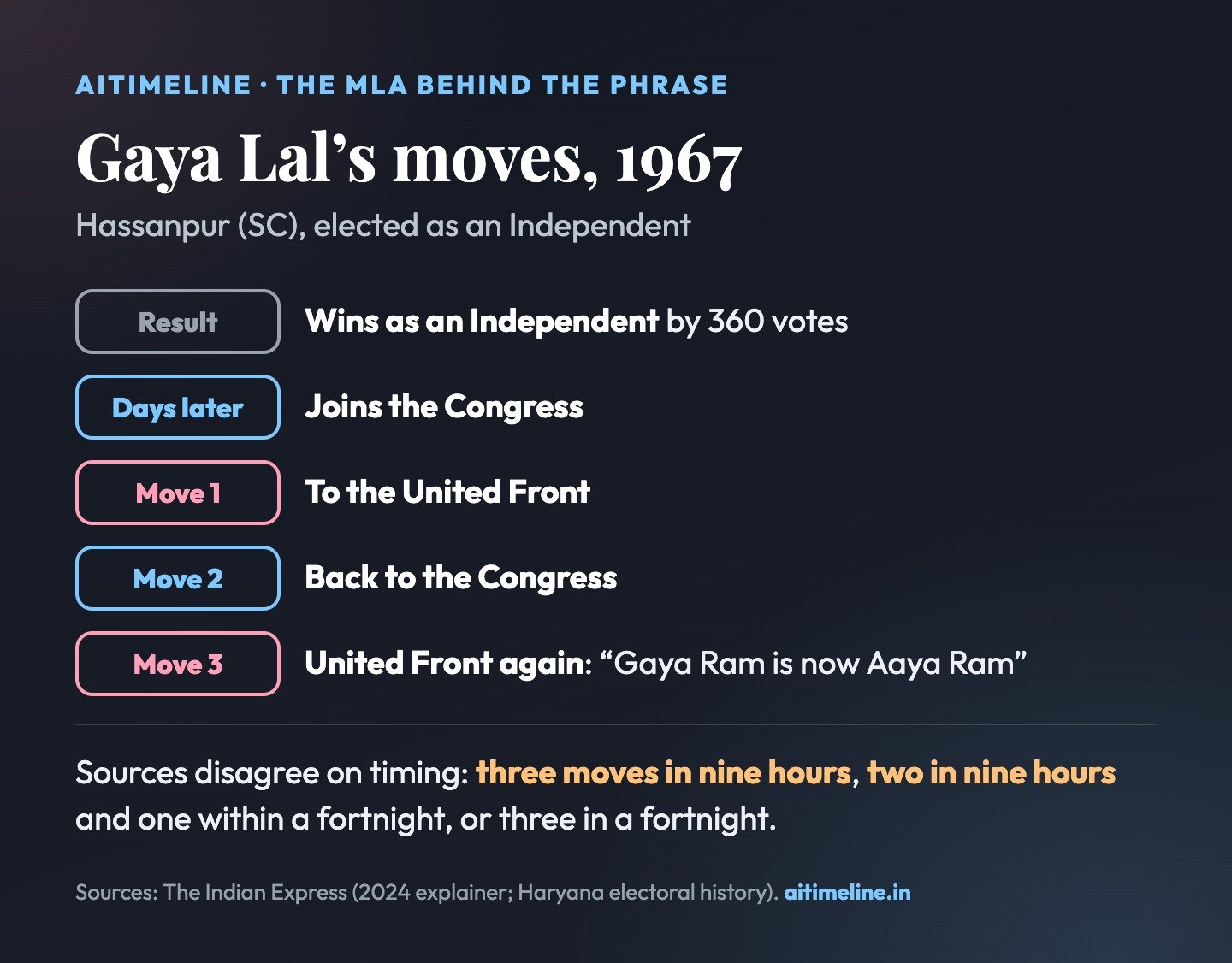
The MLA. Gaya Lal won Hassanpur, a seat reserved for Scheduled Castes, as an Independent, beating the Congress candidate by 360 votes. Within days he joined the Congress.
The switches. As the Congress majority unravelled, he crossed to the United Front, came back to the Congress, and crossed again. The Indian Express’s 2024 explainer says all three moves happened within nine hours; its history of Haryana’s elections says two of them did, with the final move within a fortnight. Either way, the speed was the point.
The line. When Gaya Lal returned to the United Front, Rao Birender Singh brought him before reporters in Chandigarh and said: “Gaya Ram is now Aaya Ram.” The rhyme was too good to fade. Union Home Minister Y.B. Chavan later used it in Parliament to describe turncoats, and it became the standard Hindi shorthand for a politician who changes sides.
The career. Gaya Lal did not stop. He contested on the Arya Sabha ticket in 1972, joined the Bharatiya Lok Dal in 1974, and won in 1977 as a Janata Party candidate.
Aaya Ram Gaya Ram Timeline, 1966 to 2026
Newest first. Each entry is tagged by type.
The merger exception comes under fresh scrutiny Recent disputes
What was reported: The New Indian Express reported that the Supreme Court is examining important questions on the Tenth Schedule, including whether legislators can claim the merger exception on the strength of numbers alone, without the original political party itself merging with another party.
Why it matters: Many constitutional experts read Paragraph 4 as needing two things: a merger of the original party, and the agreement of at least two-thirds of its legislators. If numbers alone were enough, a group of legislators could switch sides without any party decision at all.
Status: These proceedings are pending. Until the Court rules, the questions are open and should not be read as settled law.
TMC and AAP defections revive the debate Recent disputes
What happened: According to The New Indian Express, the Trinamool Congress asked the Lok Sabha Speaker for an early decision on disqualification petitions against MPs elected on its symbol who later aligned with another formation. The Aam Aadmi Party also saw elected representatives resign or join rival parties.
Why it matters: The cases put the spotlight back on the gap the courts have repeatedly flagged: a petition can stay pending while the member keeps sitting and voting.
Supreme Court sets a three-month deadline in the Telangana case Courts
What happened: Ten MLAs elected on the Bharat Rashtra Samithi ticket in 2023 were alleged to have joined the Congress in 2024. The Supreme Court directed the Telangana Speaker to decide the disqualification petitions against them within three months of the judgment, and not to let the MLAs drag out the proceedings.
The warning: The Court said that without a direction it would be allowing the Speaker to repeat the “widely criticized situation of ‘operation successful, patient died’”.
A question for Parliament: It added that it was for Parliament to consider whether giving the Speaker the job of deciding defection cases is “serving the purpose of effectively combating political defections or not”.
Kharge revives the phrase after Nitish Kumar switches sides Recent disputes
What happened: Nitish Kumar took oath as Bihar Chief Minister for the ninth time after his Janata Dal (United) left the Mahagathbandhan, which included the Congress, and allied with the BJP.
The comment: Congress president Mallikarjun Kharge said: “There are many aaya Ram, gaya Rams in the country. He could have stayed had he wanted.”
Why it matters: A change of alliance by a party is not a defection under the Tenth Schedule, but the phrase from 1967 is still how such switches are described in public debate.
The NCP splits Recent disputes
What happened: Ajit Pawar and a group of NCP legislators joined the Shiv Sena-BJP government in Maharashtra, setting off rival claims over the party’s name, symbol and leadership.
The questions: As in the Shiv Sena dispute, the fight was over which faction was the “real” party, and how the Speaker’s role under the Tenth Schedule fits with the Election Commission’s power over party recognition.
Why it matters: In February 2024 the Election Commission and then the Maharashtra Speaker recognised Ajit Pawar’s faction as the NCP, and no legislator was disqualified.
Supreme Court rules on the Shiv Sena split Courts
What happened: The Court held that the legislature party cannot act on its own, cut off from the political party, when appointing a whip, and that the Governor had not had objective material to call a floor test in June 2022.
What it could not do: Because Uddhav Thackeray had resigned rather than face the floor test, the Court said it could not restore his government.
The Speaker’s role: It left the disqualification petitions for the Speaker to decide within a reasonable period. In January 2024 the Speaker recognised Eknath Shinde’s faction as the Shiv Sena and disqualified no one.
The Shiv Sena split Recent disputes
What happened: A majority of Shiv Sena MLAs led by Eknath Shinde rebelled against Chief Minister Uddhav Thackeray. Thackeray resigned on 29 June and Shinde became Chief Minister the next day with BJP support.
Why it matters: Both sides filed disqualification petitions. The case raised questions about party organisation against legislature party, rival whips and the Speaker’s powers.
Decide within three months, the Court tells Speakers Courts
What happened: A Congress MLA in Manipur had joined the BJP government as a minister while a petition to disqualify him lay undecided. The Court held that Speakers must decide disqualification petitions within a reasonable period and that, absent exceptional circumstances, three months is the outer limit.
A wider suggestion: It asked Parliament to consider whether disputes should go to an independent body instead of the Speaker, who usually belongs to a political party.
Why it matters: Later cases, including the 2025 Telangana judgment, treat this as the benchmark.
Rajendra Singh Rana: a claimed split does not save defectors Courts
What happened: BSP MLAs in Uttar Pradesh had claimed in 2003 that they formed a one-third split, and the Speaker had accepted it. The Supreme Court held that the claimed split did not protect them and that they stood disqualified.
The principle: A Speaker’s failure to decide a disqualification petition is itself open to judicial review. Delay cannot be used to defeat the purpose of the Tenth Schedule.
The 91st Amendment removes the split exception Parliament and the law
What changed: The exception that protected a “split” of at least one-third of a legislature party was deleted. It had come to be seen as a route for engineered defections.
What stayed: The merger exception in Paragraph 4 survived: protection applies when the original party merges with another and at least two-thirds of its legislators agree.
New limits: The Council of Ministers was capped at 15% of the House, with a minimum of 12 in the States, and a member disqualified for defection cannot become a minister or hold a remunerative political post until re-elected.
Kihoto Hollohan: the law upheld, the Speaker made reviewable Courts
What happened: The Court gave its reasons for upholding the Tenth Schedule. The majority, Justices Venkatachaliah, K. Jayachandra Reddy and S.C. Agrawal, held that the Speaker acts as a tribunal and that the decision is open to judicial review, ordinarily only after it has been made.
Paragraph 7 struck down: Paragraph 7, which barred courts from disqualification matters, changed the jurisdiction of the High Courts and the Supreme Court, so it needed ratification by half the State legislatures under Article 368. It had not been ratified, and the majority held it invalid and severable.
The minority: Justices L.M. Sharma and J.S. Verma agreed Paragraph 7 needed ratification but would have struck down the whole amendment.
The Court announces its conclusions Courts
What happened: After a hearing that ended on 1 November, the five judges pronounced their operative conclusions on 12 November 1991, after the Diwali vacation, with reasons to follow.
Correction: Some accounts list 12 November 1991 as the date the challenge was heard. It is the date the conclusions were pronounced.
The 52nd Amendment becomes law Parliament and the law
What happened: The President gave assent on 15 February 1985, and the Act was published in the Gazette the same day. It amended Articles 101, 102, 190 and 191 and added the Tenth Schedule.
The grounds: A member elected on a party ticket is disqualified for voluntarily giving up party membership, or for voting or abstaining against the party’s direction without permission unless the party condones it within 15 days. An Independent who joins a party after election is disqualified, as is a nominated member who joins one more than six months after taking the seat.
The exceptions: A split of at least one-third of a legislature party, and a merger backed by at least two-thirds. The Speaker or Chairman decides.
Rajiv Gandhi’s government brings the anti-defection bill Parliament and the law
What happened: After the Congress won a large majority in December 1984, the President’s Address promised an anti-defection bill in the current session. Both Houses passed it unanimously within two days.
Why it matters: Earlier attempts after the 1969 report had lapsed. This time the government had the numbers for a constitutional amendment.
The Committee on Defections reports Defections nationwide
The numbers: “Compared to roughly 542 cases in the entire period between the First and Fourth General Election, at least 438 defections occurred in these 12 months alone,” the report said of March 1967 to February 1968. Of 376 Independents elected, 157 joined parties.
The motive: Of 210 defecting legislators in Bihar, Haryana, Madhya Pradesh, Punjab, Rajasthan, Uttar Pradesh and West Bengal, 116 became ministers in governments they helped form.
Haryana: The report named “multiple acts of defections by the same persons or set of persons” as a disturbing feature, “Haryana affording a conspicuous example”.
Haryana votes again Haryana 1967
What happened: In the fresh election the Congress won 48 seats, the same number as in 1967. Rao Birender Singh’s Vishal Haryana Party came second with 16.
What followed: Indira Gandhi chose Bansi Lal as Chief Minister. He held the post until 30 November 1975, when he moved to the Centre.
High Court dismisses Rao Birender Singh’s challenge Courts
What happened: The former Chief Minister asked the court to quash the President’s Proclamation, arguing that he still had a majority and that the action was mala fide.
The ruling: The court held that the facts in the Governor’s report could not be questioned and that the President’s satisfaction was not open to its review. The petition was dismissed.
Why it matters: The judgment records the official version of the 1967 events, from the Speaker vote to the Governor’s report.
The Lok Sabha asks for a committee on defections Defections nationwide
What happened: The Lok Sabha unanimously resolved that a high-level committee of representatives of political parties and constitutional experts be set up “to consider the problem of legislators changing their allegiance from one party to another and their frequent crossing of the floor”.
Why it matters: This was Parliament’s first formal step against defection, taken weeks after Haryana’s Assembly was dissolved.
President’s Rule: the Assembly is dissolved Haryana 1967
What happened: Acting on the Governor’s report, the President assumed the functions of the State government and dissolved the Haryana Assembly. Rao Birender Singh’s government ended.
Correction: Some accounts say Rao Birender Singh left office on 2 November 1967. The High Court record gives the Proclamation date as 21 November 1967; some lists date the change to 20 November.
The Governor’s report: defection “has become endemic” Haryana 1967
What it said: “In an Assembly with an effective strength of 79, some 30 members have defected one way or the other. Some members have defected not once but even three or four times.”
The motive: “It is not for any ideological reasons that members are defecting from one party to another. The motive is obviously to secure some personal gain.”
The recommendation: He wrote that no stable ministry could be formed without a fresh election and recommended dissolving the Assembly.
“Gaya Ram is now Aaya Ram” Haryana 1967
What happened: Gaya Lal, elected as an Independent, had joined the Congress soon after the result. In the scramble around Rao Birender Singh’s takeover he moved between the Congress and the United Front, the Haryana Samyukta Dal, more than once.
Accounts differ: The Indian Express’s 2024 explainer says he switched three times within nine hours: to the United Front, back to the Congress, then to the United Front again. Its electoral history of Haryana says he switched twice in nine hours and moved to the United Front within a fortnight. Other accounts say three times in a fortnight.
The line: When Gaya Lal returned to his side, Rao Birender Singh presented him to reporters in Chandigarh and declared: “Gaya Ram is now Aaya Ram.” The phrase stuck, and came to mean any legislator who changes sides for advantage.
Rao Birender Singh becomes Chief Minister Haryana 1967
What happened: Elected leader of the Haryana Samyukta Dal, a combination of Congress defectors, Independents and opposition members, Rao Birender Singh formed a ministry with himself as Chief Minister.
What followed: “Thereafter there were efforts to win over members on both sides and so defections followed,” the High Court later recorded. He later formed the Vishal Haryana Party.
The Congress ministry resigns Haryana 1967
What happened: Five days after losing the Speaker’s election, the Sharma ministry resigned. It had lasted less than two weeks after the election.
Why it matters: A party that had won a majority at the polls was out of office without any fresh vote by the people.
Twelve Congress MLAs defeat their own party in the Speaker vote Haryana 1967
What happened: The official Congress nominee for Speaker was defeated because 12 Congress members, including Rao Birender Singh, voted against him. Rao Birender Singh was elected Speaker.
Why it matters: “So 12 Congress members defected from that party,” the High Court later summed up. It was the first crack in the new government.
Bhagwat Dayal Sharma forms the first elected government Haryana 1967
What happened: With a majority of 48 in the 81-member Assembly, the Congress formed the government with Bhagwat Dayal Sharma as Chief Minister.
Why it matters: On paper it was a comfortable majority of seven. It lasted twelve days.
Haryana’s first Assembly election Haryana 1967
The result: Congress 48, Bharatiya Jana Sangh 12, Swatantra Party 3, Republican Party of India 2, Independents 16.
The national picture: The Congress lost ground across India; it won 283 Lok Sabha seats, down from 361, and lost power in several States.
Gaya Lal’s win: In Hassanpur, a seat reserved for Scheduled Castes, Gaya Lal won as an Independent with 10,458 votes, 360 more than the Congress candidate.
Haryana becomes a State Haryana 1967
What happened: Haryana was carved out of Punjab. Bhagwat Dayal Sharma, a minister in undivided Punjab, became its first Chief Minister.
Why it matters: The new State’s first elected Assembly would become the most famous example of defection in Indian politics within months.
Not Just Haryana: The 1967 Defection Wave
What the Committee on Defections found.
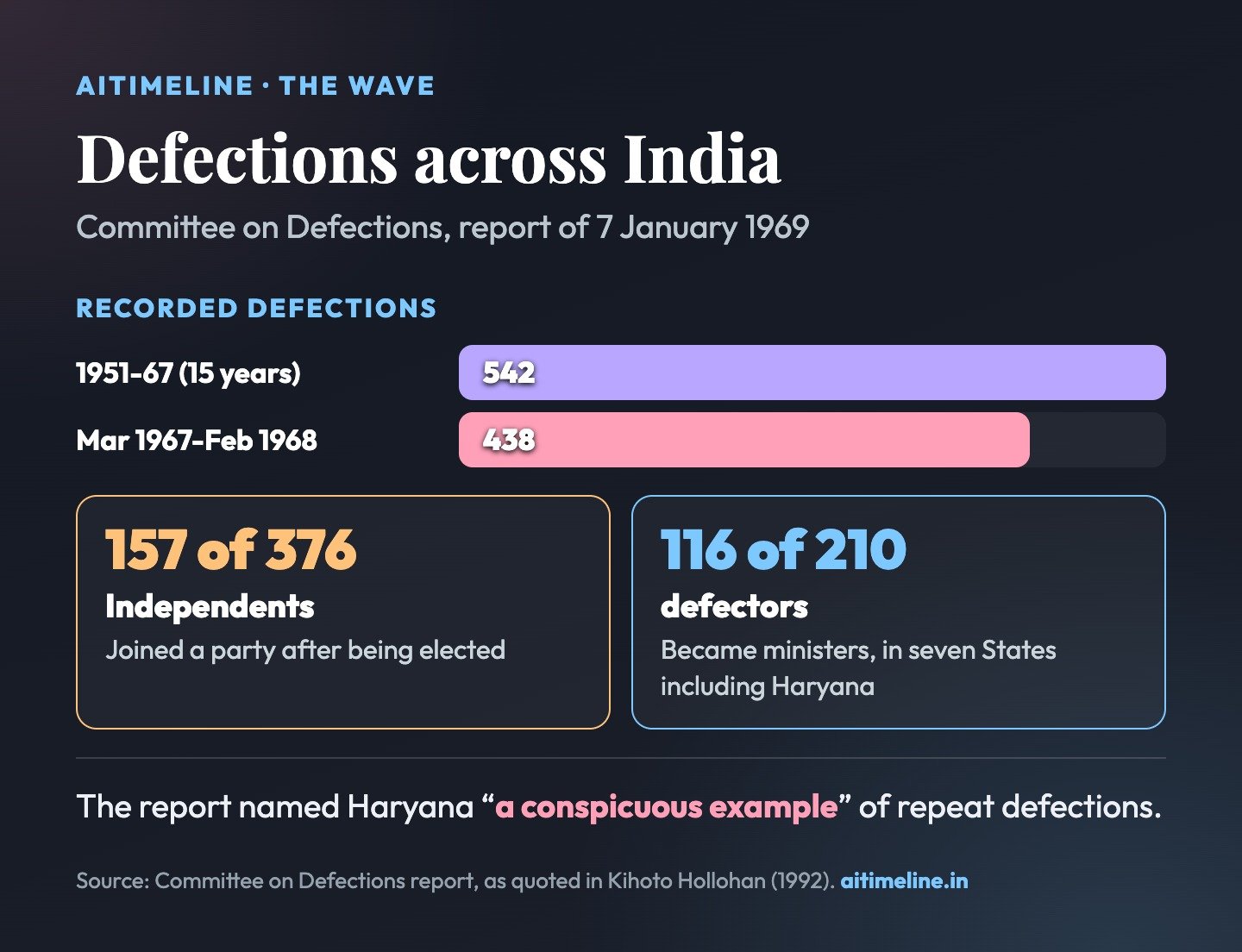
A national pattern. The 1967 elections cut the Congress to 283 Lok Sabha seats from 361 and cost it power in several States. Where majorities were thin, legislators found their votes in demand. The Committee on Defections counted at least 438 defections in the year after the election, against about 542 in the fifteen years before it.
Office as the prize. In Bihar, Haryana, Madhya Pradesh, Punjab, Rajasthan, Uttar Pradesh and West Bengal, 116 of 210 defectors ended up as ministers in the governments their switches created.
Haryana as the example. Among the “disturbing features” the committee listed were “multiple acts of defections by the same persons or set of persons (Haryana affording a conspicuous example)”. The Supreme Court quoted that passage when it upheld the Anti-Defection Law in 1992.
How the Anti-Defection Law Works
The Tenth Schedule, in plain terms.
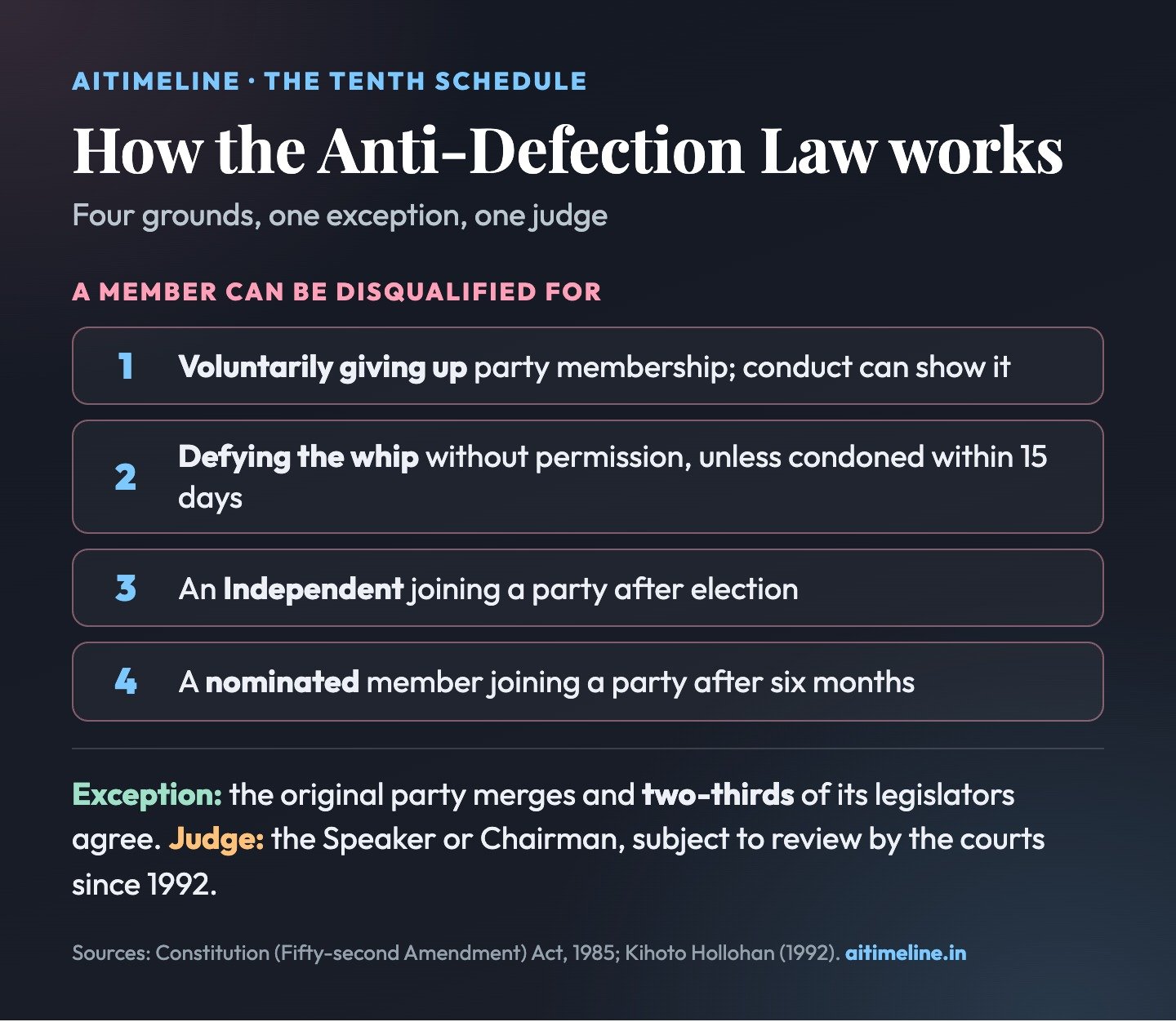
| Situation | Legal position |
|---|---|
| Member voluntarily gives up party membership | Can be disqualified; no formal resignation needed |
| Member defies the party direction in a vote | Can be disqualified unless condoned within 15 days |
| Independent joins a party after election | Can be disqualified |
| Nominated member joins a party after six months | Can be disqualified |
| Original party merges, two-thirds agree | Protected under Paragraph 4 |
| One-third of legislators claim a split | No protection since 2003 |
Conduct counts. “Voluntarily giving up membership” has been read broadly. Public support for a rival party or taking part in its activities can be enough, without a resignation letter.
The merger condition. The two-thirds figure is often described as a licence for two-thirds of legislators to switch. The text is narrower: the original political party must merge, and two-thirds of the legislature party must agree. Whether numbers alone can satisfy it is now before the Supreme Court.
What Changed: the 52nd and 91st Amendments
1985 built the law; 2003 closed its biggest loophole.
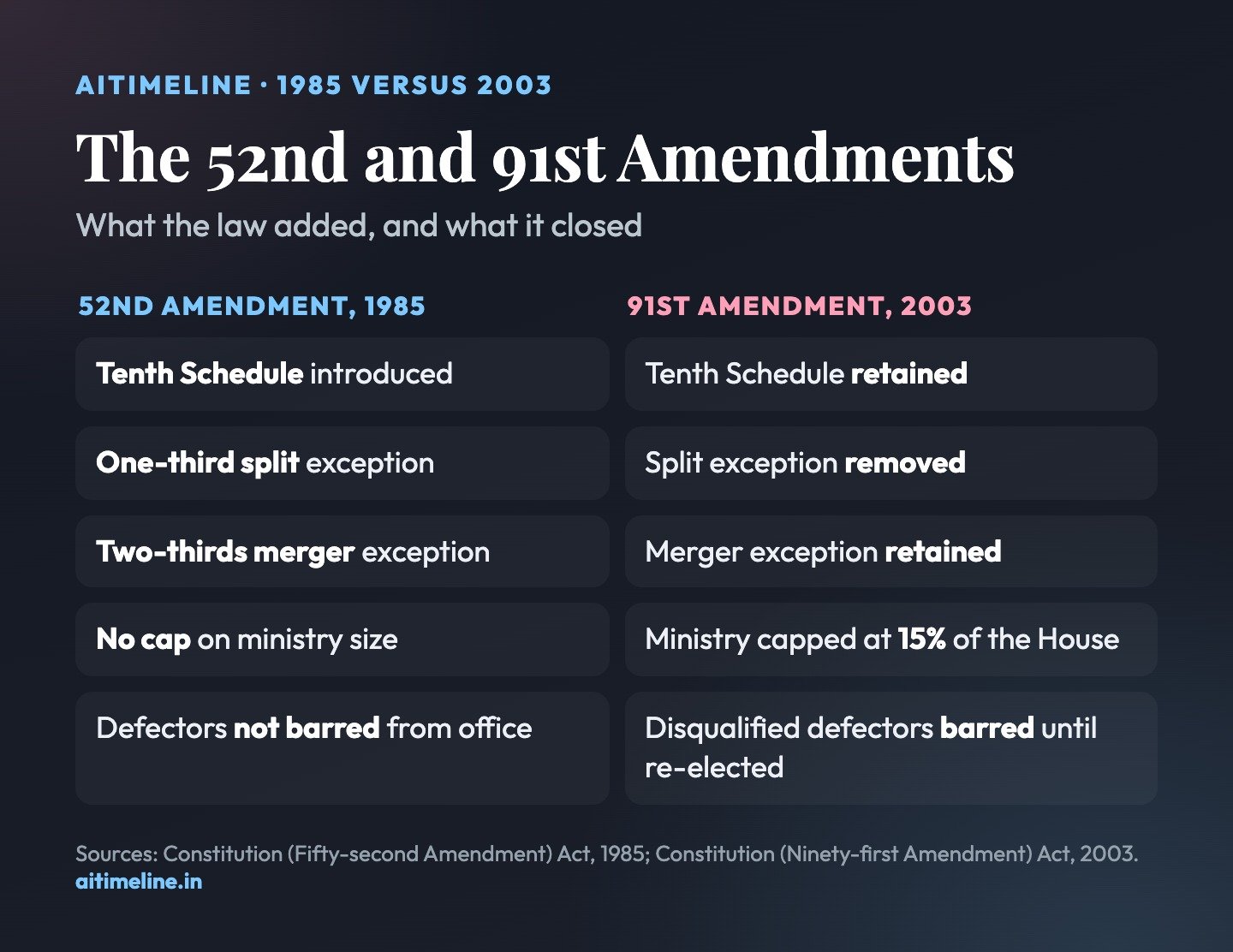
| Feature | 52nd Amendment, 1985 | 91st Amendment, 2003 |
|---|---|---|
| Tenth Schedule | Introduced | Retained |
| One-third split exception | Introduced | Removed |
| Two-thirds merger exception | Introduced | Retained |
| Speaker as adjudicator | Established | Retained |
| Size of Council of Ministers | No cap | 15% of the House; minimum 12 in States |
| Disqualified defector as minister | Not barred | Barred until re-elected |
The Courts and the Tenth Schedule
Five judgments that shape every defection case.
| Case | Date | What it settled |
|---|---|---|
| Kihoto Hollohan | 12 Nov 1991 / 18 Feb 1992 | Law upheld; Speaker reviewable; Paragraph 7 struck down |
| Rajendra Singh Rana | Feb 2007 | Claimed split no shield; Speaker’s inaction reviewable |
| Keisham Meghachandra Singh | 21 Jan 2020 | Three months as the outer limit |
| Subhash Desai | 11 May 2023 | Legislature party cannot act cut off from the party |
| Padi Kaushik Reddy | 31 Jul 2025 | Speaker ordered to decide within three months |
Why the Law Is Still Argued Over
Stability against independence. The law stops governments being toppled by members who change sides for office. It also means a legislator who votes on conscience against the whip risks the seat. The Dinesh Goswami Committee and the Law Commission suggested limiting whips to votes that decide a government’s survival.
The Speaker as judge. Speakers are usually elected from the majority. The Supreme Court has twice, in 2020 and 2025, asked Parliament to consider whether someone else should decide.
Delay. With no deadline in the text, a petition can sit until the defector has served the purpose of the switch. The Court’s phrase for it in 2025 was “operation successful, patient died”.
Party against legislators. The Shiv Sena and NCP disputes turned on which faction was the original party, a question the 1985 law did not foresee.
The merger clause. Whether two-thirds of legislators can claim protection without a merger of the party itself is the open question of 2026.
Who Was Who
Gaya Lal
Independent from Hassanpur (SC), whose switches in March 1967 gave the phrase its name.
Rao Birender Singh
Pataudi MLA, Speaker for six days, Chief Minister from 24 March to November 1967. Later a Union minister.
Bhagwat Dayal Sharma
Led Haryana from 1 November 1966; his elected ministry resigned on 22 March 1967.
Y.B. Chavan
Union Home Minister; chaired the Committee on Defections, which reported on 7 January 1969.
Rajiv Gandhi
His government passed the 52nd Amendment within weeks of the December 1984 election.
Bansi Lal
Became Chief Minister on 21 May 1968, after the fresh election that followed the dissolution.
Did You Know?
- A six-day Speaker: Rao Birender Singh was Speaker from 17 to 23 March 1967 before becoming Chief Minister.
- A five-day minister: the Governor’s report named an MLA who defected after five days as a minister.
- The same 48: the Congress won exactly 48 of 81 seats in both 1967 and 1968.
- A family in politics: Gaya Lal’s son, Udai Bhan, later became president of the Haryana Congress.
- Unanimous in 1985: both Houses passed the anti-defection bill without a vote against it.
- Still in use: Congress president Mallikarjun Kharge used the phrase on 28 January 2024 about Nitish Kumar.
Explore More Timelines
People Also Ask
Frequently Asked Questions
Based on the 1968 High Court judgment, the 1969 Committee report as quoted in Kihoto Hollohan, the 52nd Amendment and later Supreme Court rulings.
⚠️ Editorial Note: What We Checked
We checked the brief we started from against the Punjab and Haryana High Court’s 1968 judgment in Rao Birinder Singh v. Union of India, the Kihoto Hollohan judgment, the Gazette text of the 52nd Amendment and the 2020 and 2025 Supreme Court judgments. Polling in Haryana was in February 1967, not March. The President’s Proclamation is dated 21 November 1967, not 2 November. The Committee on Defections reported on 7 January 1969; it was not a 1973 committee. 12 November 1991 is when the Kihoto conclusions were announced. Gaya Lal’s exact sequence and timing differ between sources, so we give the versions side by side. Matters still before the Supreme Court are described as pending, not as settled law. This article is a historical account and not legal advice.
Related Reading on AiTimeline
Sources & further reading
Every dated entry above was checked against these references. Last reviewed 19 November 2026.
- Punjab and Haryana High Court: Rao Birinder Singh v. Union of India, judgment of 1 March 1968 (Indian Kanoon)
- Supreme Court of India: Kihoto Hollohan v. Zachillhu, judgment of 18 February 1992 (Indian Kanoon)
- Gazette of India: The Constitution (Fifty-second Amendment) Act, 1985 (PDF)
- Supreme Court of India: Keisham Meghachandra Singh v. Speaker, Manipur Legislative Assembly, 21 January 2020 (Indian Kanoon)
- Supreme Court of India: Padi Kaushik Reddy v. State of Telangana, 31 July 2025 (Indian Kanoon)
- The Indian Express: The origins of 'Aaya Ram, Gaya Ram'
- The Indian Express: Haryana, an electoral history
- The New Indian Express: Why the Anti-Defection Law is under fresh scrutiny (3 August 2026)