ADM Jabalpur Case: Habeas Corpus, Emergency, and Rights in India
Explore the ADM Jabalpur case timeline, the 1976 Emergency verdict, Justice H.R. Khanna's dissent and the Supreme Court's 2017 overruling in Puttaswamy.
Latest Story
On 28 April 1976, ten months into the Emergency, the Supreme Court of India was asked a simple question: could a person locked up without trial ask a judge whether the detention was lawful? Four of five judges said no. This ADM Jabalpur case timeline follows the dispute from the June 1975 proclamation and the Presidential Order that shut the courts, through nine High Court rulings for the detainees, the 4-1 judgment and Justice H.R. Khanna’s lone dissent, to the Forty-fourth Amendment and the 2017 Puttaswamy judgment that expressly overruled it. Quotations are taken from the judgments themselves.
1 September 1975 is not the date the Supreme Court consolidated the appeals. It is the date of the Madhya Pradesh High Court judgment in Shivkant Shukla’s own petition, the one that gave the case its name. The Emergency was revoked on 21 March 1977, three days before Morarji Desai’s government took office, not after it. The High Courts were not unanimous in every petition: Justice Khanna counted nine that rejected an absolute bar, while Chief Justice Ray noted others that upheld it. And the 2007 Coelho judgment did not overrule the case; it said it stood “impliedly overruled”. The express overruling came in 2017.
💡 Short Answer
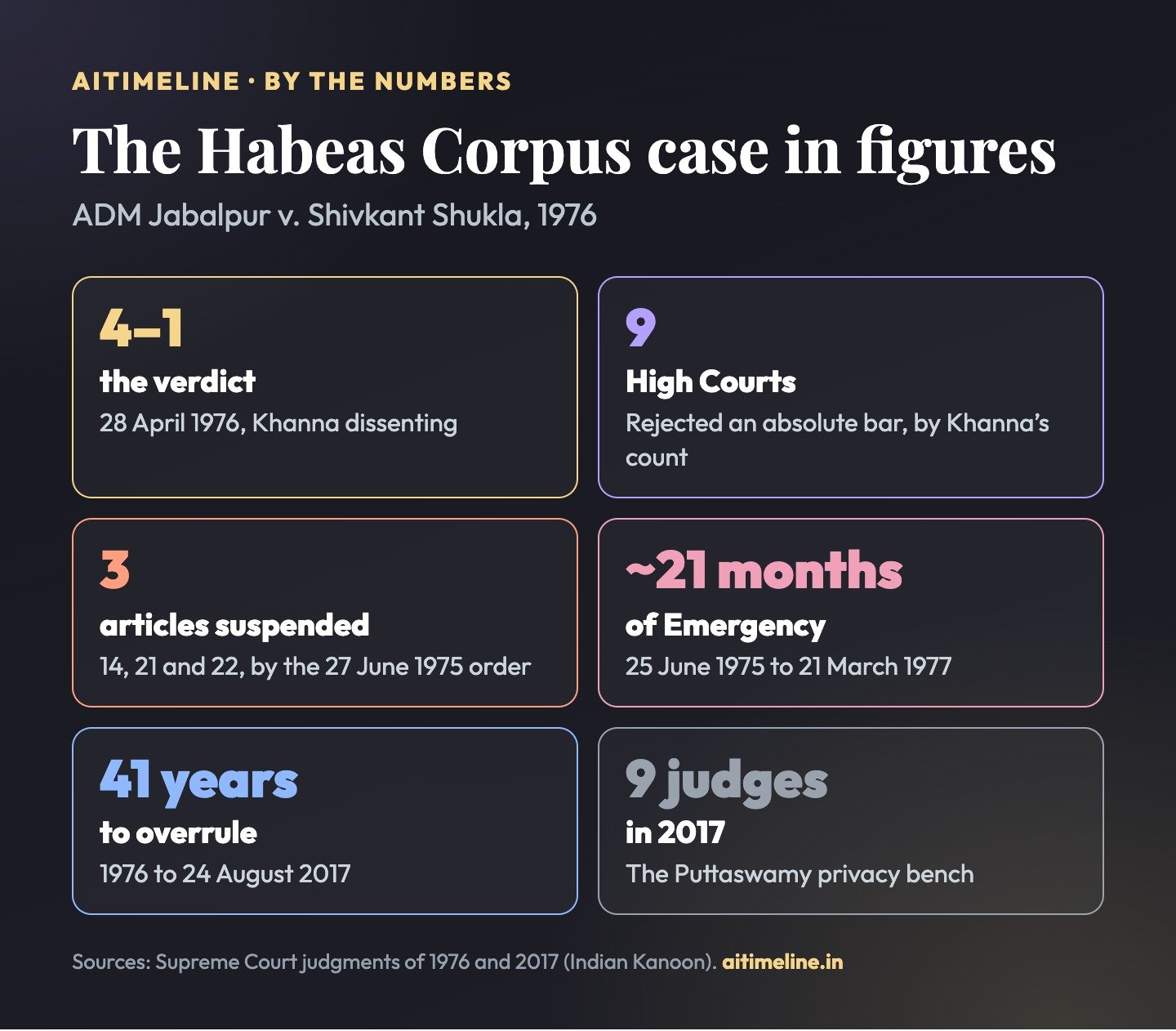
The ADM Jabalpur case (ADM Jabalpur v. Shivkant Shukla, 1976) is the Emergency-era Supreme Court judgment, decided 4-1 on 28 April 1976, which held that because of the Presidential Order of 27 June 1975 detainees could not seek habeas corpus to challenge their detention, even for illegality or bad faith. Justice H.R. Khanna dissented. Parliament barred suspension of Article 21 through the Forty-fourth Amendment, effective 20 June 1979, and the Supreme Court expressly overruled the judgment on 24 August 2017 in the Puttaswamy privacy case.
ADM Jabalpur Case: Key Questions
The Case in Ten Points
- The trigger: the Allahabad High Court voided Indira Gandhi’s election on 12 June 1975.
- The proclamation: a second Emergency, for “internal disturbance”, on 25 June 1975.
- The order: on 27 June 1975 the right to move courts under Articles 14, 21 and 22 was suspended.
- The detentions: thousands were held without trial under MISA.
- The High Courts: nine, by Justice Khanna’s count, held the order was not an absolute bar.
- The ruling: 4-1 for the government on 28 April 1976.
- The dissent: Khanna said Article 21 was not the sole repository of life and liberty.
- The cost: Khanna was passed over for Chief Justice in January 1977 and resigned.
- The fix: the Forty-fourth Amendment put Articles 20 and 21 beyond suspension from 20 June 1979.
- The end: expressly overruled on 24 August 2017 in the Puttaswamy privacy case.
The Question Before the Court
A suspended remedy, or a suspended right?
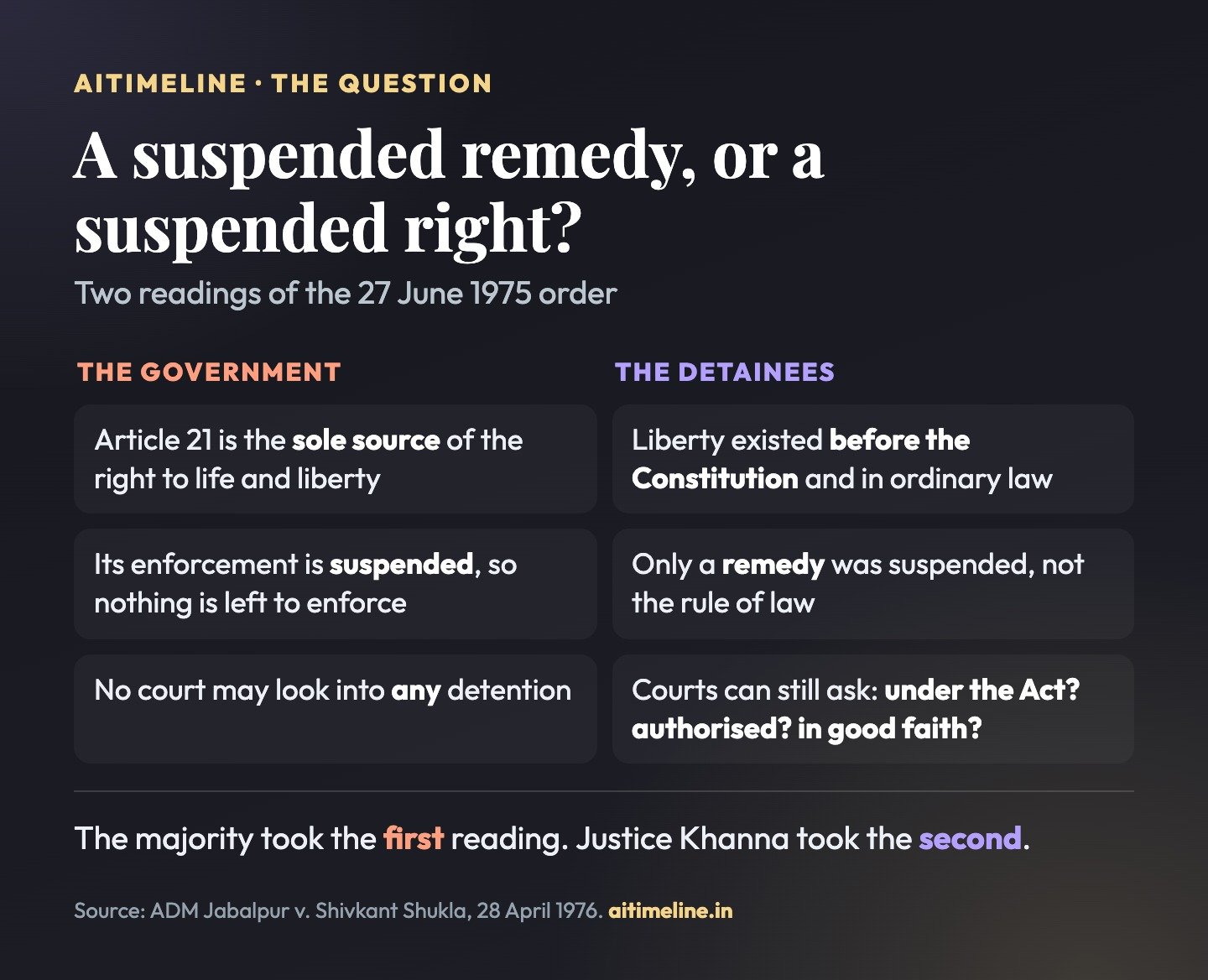
Two articles collide. Article 21 says no person shall be deprived of life or personal liberty except according to procedure established by law. Article 359 lets the President suspend the right to move a court to enforce named fundamental rights during an Emergency. The 27 June 1975 order named Article 21.
The government’s reading. If Article 21 is the only source of the right to liberty, suspending its enforcement leaves a detainee nothing to rely on. Whether the detention was lawful or not, no court could ask.
The detainees’ reading. The order suspended a remedy, not the law. An officer who detains someone must still act under a statute, and ordinary courts had always been able to ask whether he had. A habeas corpus petition asks exactly that.
Nine High Courts Said the Courts Stayed Open
The rulings the Supreme Court set aside.
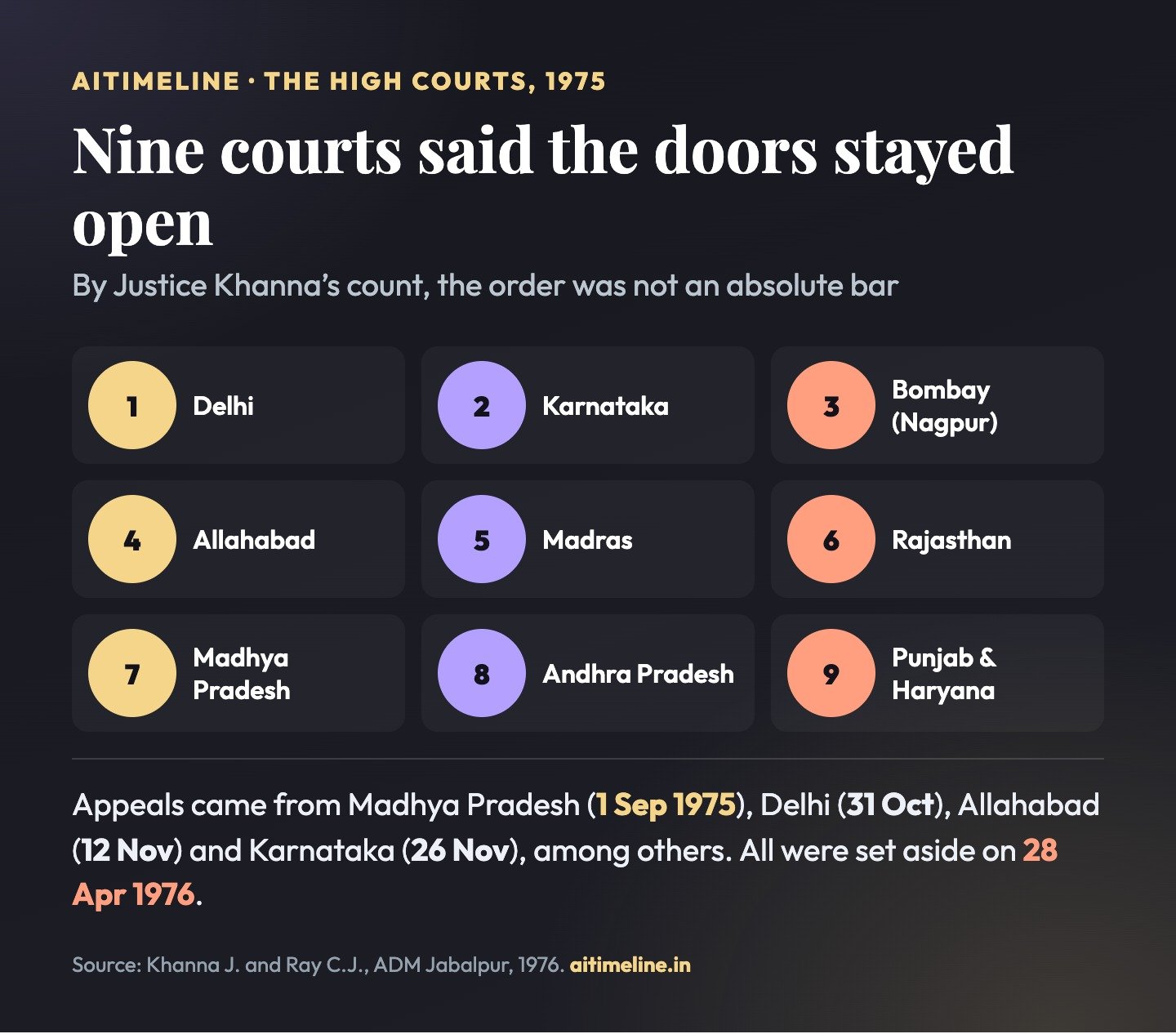
What they held. The courts broadly accepted that a detainee could still show that an order was passed by an officer without power, was not under the Act at all, or was made in bad faith. They differed on how far a court could go beyond that.
Not a clean sweep. Chief Justice Ray’s opinion records that the Andhra Pradesh, Kerala and Madras High Courts had upheld the government’s preliminary objection in petitions before them. Khanna’s count of nine refers to courts that, in the matters he examined, found no absolute bar.
ADM Jabalpur Case Timeline, 1971 to 2017
Newest first. Each entry is tagged by type.
Nine judges expressly overrule ADM Jabalpur in the privacy case Supreme Court
What happened: A nine-judge Constitution Bench unanimously held that privacy is a fundamental right. In the lead opinion, written by Justice D.Y. Chandrachud for himself, Chief Justice J.S. Khehar, Justice R.K. Agrawal and Justice S. Abdul Nazeer, the Court turned to what it called the “discordant notes” in Indian liberty law and dealt with ADM Jabalpur directly.
The words: “The judgments rendered by all the four judges constituting the majority in ADM Jabalpur are seriously flawed,” the opinion said, adding: “ADM Jabalpur must be and is accordingly overruled.” It also overruled Union of India v. Bhanudas Krishna Gawde, which had followed the 1976 decision.
Khanna vindicated: The opinion said “Justice Khanna was clearly right” and that his view “must be accepted, and accepted in reverence for the strength of its thoughts and the courage of its convictions.” Justice Sanjay Kishan Kaul, writing separately, agreed with overruling the case and spoke of burying the majority opinion “ten fathom deep, with no chance of resurrection.”
I.R. Coelho: the Court says ADM Jabalpur stood “impliedly overruled” Supreme Court
What happened: In a judgment about laws placed in the Ninth Schedule, a nine-judge bench reviewed how fundamental rights had been read over the decades. It said that during the Emergency rights were “read even more restrictively as interpreted by the majority” in ADM Jabalpur, and that the restrictive reading of the right to life and liberty “stood impliedly overruled by various subsequent decisions.”
Why it was not enough: “Impliedly overruled” is not the same as an express overruling by a bench larger than the one that decided the case. ADM Jabalpur was a five-judge ruling, and it stayed formally on the books for another ten years.
Why it matters: The 2017 privacy bench quoted this passage and then went further, overruling the 1976 judgment in terms.
Justice H.R. Khanna dies at 95 Aftermath and reform
What happened: Hans Raj Khanna died in Delhi aged 95. Besides his ADM Jabalpur dissent, he was one of the judges in the 1973 Kesavananda Bharati case, whose opinion is usually counted as decisive in establishing the basic structure doctrine.
Later life: After resigning from the Supreme Court in 1977 he chaired the Law Commission, was briefly Union Law Minister in Charan Singh’s government in 1979, and was the joint opposition candidate for President in 1982, losing to Zail Singh.
Why it matters: He did not live to see the 2017 judgment that adopted his dissent as the law.
Articles 20 and 21 can no longer be suspended in an Emergency Aftermath and reform
What happened: The change to Article 359 took effect. Clauses (1) and (1A) now let the President suspend the enforcement of fundamental rights during an Emergency “except articles 20 and 21.”
What it means: Article 21 protects life and personal liberty. Article 20 protects against retrospective criminal laws, double punishment and self-incrimination. Neither can now be put beyond the reach of the courts by a Presidential Order, which is the exact route the government used in 1975.
Why it matters: This is the most direct answer Parliament gave to ADM Jabalpur. A future detainee can always ask a court to examine whether the detention is lawful.
The Forty-fourth Amendment receives presidential assent Aftermath and reform
What happened: The Constitution (Forty-fourth Amendment) Act, 1978, became law after ratification by the States. Its sections were brought into force on different dates in 1979.
What it changed: Besides the Article 359 safeguard, it required a written decision of the Union Cabinet before an Emergency could be advised, approval by each House of Parliament within one month by a special majority, and fresh approval every six months.
Why it matters: The safeguards were designed so that the 1975 sequence, a midnight proclamation followed by an order shutting the courts, could not be repeated in the same way.
Parliament completes passage of the Forty-fourth Amendment Aftermath and reform
What happened: The Lok Sabha accepted the Rajya Sabha’s amendments, completing the bill’s passage through Parliament. Some clauses the government wanted had failed to win the required majority in the Rajya Sabha, where the Congress was still strong.
Why it matters: The Article 359 change survived both Houses. That is why it is the Forty-fourth, not the Forty-fifth, Amendment: the bill had been renumbered while it was in Parliament.
Maneka Gandhi: the Court widens Article 21 Supreme Court
What happened: In a challenge to the impounding of a passport, the Supreme Court held that a law depriving a person of liberty must lay down a procedure that is fair, just and reasonable, not merely any procedure enacted by the legislature.
Why it matters: This was the start of the line of decisions that, in the words of the 2007 Coelho bench, impliedly overruled ADM Jabalpur’s narrow reading of life and liberty.
The Emergency is revoked Political crisis
What happened: The internal Emergency proclaimed on 25 June 1975 was revoked as the general election results came in. The Congress lost power at the Centre.
What followed: Morarji Desai was sworn in as Prime Minister on 24 March 1977, three days after the revocation, at the head of the Janata Party government.
Why it matters: With the proclamation gone, the 27 June 1975 Presidential Order lapsed, and detainees could again go to court.
Khanna is superseded; M.H. Beg becomes Chief Justice Aftermath and reform
What happened: When Chief Justice A.N. Ray retired, the government passed over Justice Khanna, the senior-most judge, and appointed Justice M.H. Beg Chief Justice of India from 29 January 1977. Khanna resigned.
Why it matters: It was the second supersession in four years: Ray himself had been appointed over three senior judges in 1973. It was widely read as a punishment for the dissent and became a central argument in later debates about how judges are appointed.
Reaction: Bar associations across the country protested.
The Supreme Court rules 4-1 against the detainees Supreme Court
The order: “By majority: In view of the Presidential order dated 27 June 1975 no person has any locus standi to move any writ petition under Article 226 before a High Court for habeas corpus or any other writ or order or direction to challenge the legality of an order of detention on the ground that the order is not under or in compliance with the Act or is illegal or is vitiated by mala fides factual or legal or is based on extraneous consideration.”
The other holdings: The majority also held that Section 16A(9) of MISA, which let the government keep the grounds of detention from the courts, was constitutionally valid. The High Court judgments were set aside.
The dissent: Justice Khanna held that Article 21 was not the sole repository of the right to life and liberty, and that the courts could still examine whether a detention had the authority of law.
The appeals are heard by a five-judge bench Supreme Court
What happened: The State and Union governments appealed against the High Court rulings. The appeals were heard together by Chief Justice A.N. Ray and Justices H.R. Khanna, M.H. Beg, Y.V. Chandrachud and P.N. Bhagwati.
The government’s case: Article 21 was the sole source of the right to life and liberty. Once its enforcement was suspended, no court could look into a detention, whatever the ground.
The detainees’ case: The right to liberty existed before the Constitution and in ordinary law; the Presidential Order suspended a remedy, not the rule of law. A court could still ask whether a detention was made under the Act at all, or in bad faith.
Delhi, Allahabad and Karnataka High Courts reject the bar High Courts
What happened: Three more High Courts held that habeas corpus petitions could be heard despite the Presidential Order. Their judgments are among those the Supreme Court set aside in April 1976.
The common thread: The courts broadly accepted that a detainee could show the order was passed by an officer with no power to pass it, was not under the Act, or was made in bad faith.
Why it matters: Justice Khanna counted nine High Courts that had reached the same conclusion: Delhi, Karnataka, Bombay (Nagpur Bench), Allahabad, Madras, Rajasthan, Madhya Pradesh, Andhra Pradesh, and Punjab and Haryana.
The Madhya Pradesh High Court rules in Shivkant Shukla’s petition High Courts
What happened: The Madhya Pradesh High Court ruled against the State’s objection that habeas corpus petitions by detainees could not be heard while the Presidential Order was in force. The Additional District Magistrate of Jabalpur, who had signed the detention order, appealed.
Why the name: Because this appeal was listed first, the whole batch came to be known as ADM Jabalpur v. Shivkant Shukla.
Correction: Some accounts give 1 September 1975 as the date the Supreme Court consolidated the appeals. It is in fact the date of the Madhya Pradesh High Court judgment.
Detainees file habeas corpus petitions High Courts
What happened: Detainees and their families went to High Courts asking for writs of habeas corpus. Many challenged the detention orders as made without authority, without application of mind or in bad faith; some also challenged the Presidential Order itself.
The government’s reply: It raised a preliminary objection: the petitions were, in substance, claims under Article 21, and the right to move a court for that had been suspended.
The Presidential Order suspends Articles 14, 21 and 22 Emergency powers
What happened: The President declared that the right of any person, including a foreigner, to move any court to enforce Articles 14, 21 and 22, and all pending proceedings to that end, would stay suspended while both the 1971 and the 1975 proclamations were in force.
What was different: Earlier orders, in 1962 and 1974, had applied only to people detained under particular laws. This one had no such condition, which the Attorney General stressed before the Supreme Court.
Why it matters: This is the order the majority later held barred every habeas corpus petition. Article 19 was already suspended automatically under Article 358.
The Emergency is announced; arrests begin Political crisis
What happened: Prime Minister Indira Gandhi announced the Emergency on All India Radio. Opposition leaders, including Jayaprakash Narayan, Morarji Desai, Atal Bihari Vajpayee and L.K. Advani, had been arrested overnight. Press censorship followed.
Why it matters: Most detainees were held under MISA, which allowed preventive detention without trial and which was amended during the Emergency to make detentions harder to challenge.
A second Emergency is proclaimed, for “internal disturbance” Emergency powers
What happened: Late at night the President, on the Prime Minister’s advice, proclaimed that a grave emergency existed because India’s security was threatened by internal disturbance.
Two Emergencies at once: The external Emergency proclaimed on 3 December 1971, during the war with Pakistan, was still in force. The Presidential Order of 27 June referred to both.
Why it matters: The Forty-fourth Amendment later removed “internal disturbance” as a ground.
A conditional stay of the Allahabad judgment Supreme Court
What happened: Hearing Indira Gandhi’s appeal, Justice Krishna Iyer granted a conditional stay: she could remain Prime Minister and attend Parliament but could not vote or draw a salary as a member until the appeal was decided.
Why it matters: The Emergency was proclaimed the following night.
The Allahabad High Court sets aside Indira Gandhi’s election Political crisis
What happened: The High Court found Indira Gandhi guilty of corrupt practices in her 1971 election from Rae Bareli and declared the election void.
Why it matters: The judgment, and the protests that followed, are the immediate background to the proclamation of 25 June.
MISA is enacted and an external Emergency proclaimed Emergency powers
What happened: Parliament enacted the Maintenance of Internal Security Act, 1971, allowing preventive detention. In December, during the war with Pakistan, an Emergency was proclaimed on the ground of external aggression.
Earlier suspensions: On 16 November 1974 a Presidential Order suspended the right to move courts under Articles 14, 21 and 22, but only for people detained under Section 3(1)(c) of MISA.
Why it matters: MISA was the law under which most Emergency detainees were held, and the 1971 Emergency was still in force when the 1975 one was proclaimed.
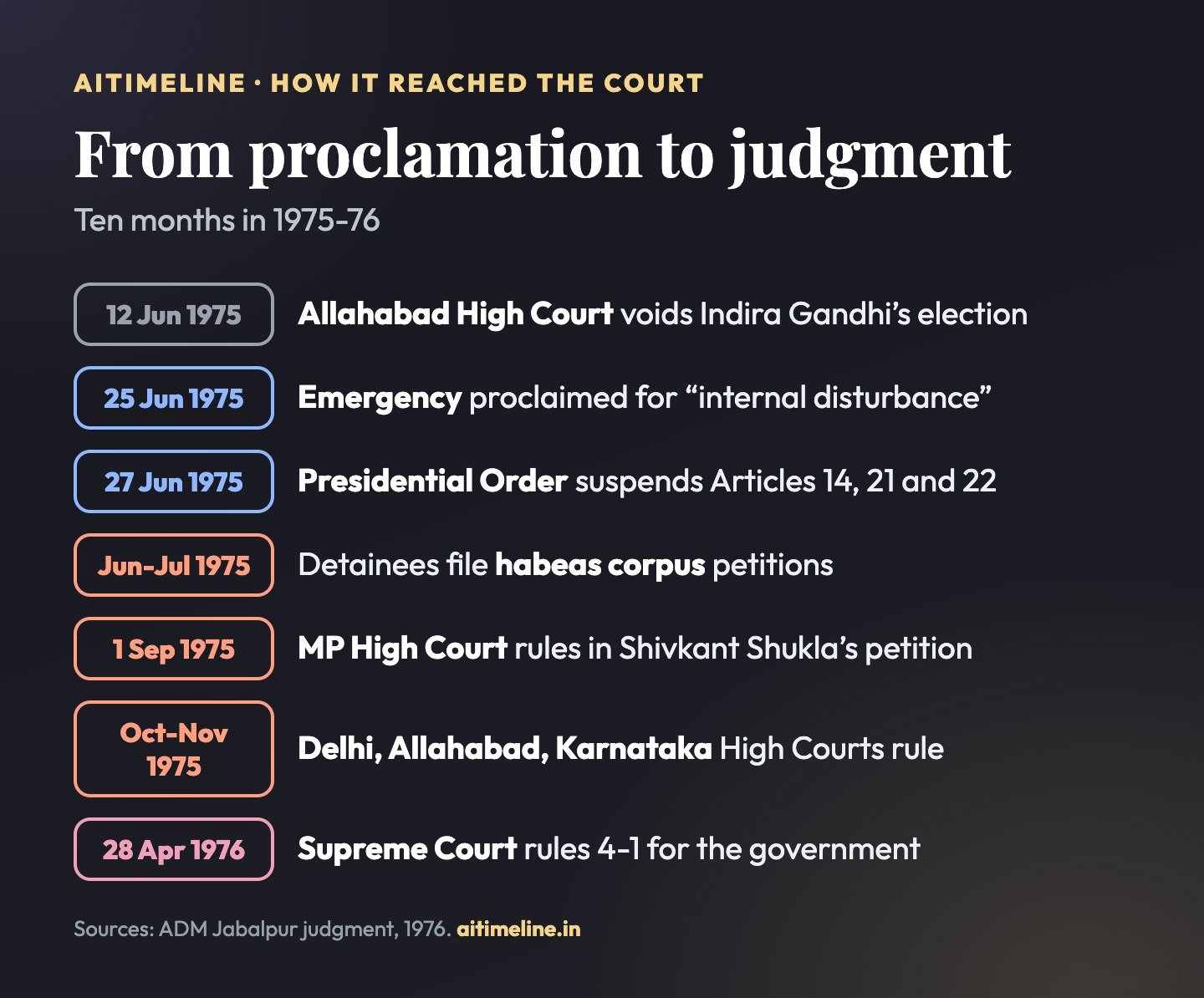
From Proclamation to Judgment
Ten months, step by step.
The Bench and the Majority
Five judges, five separate opinions.
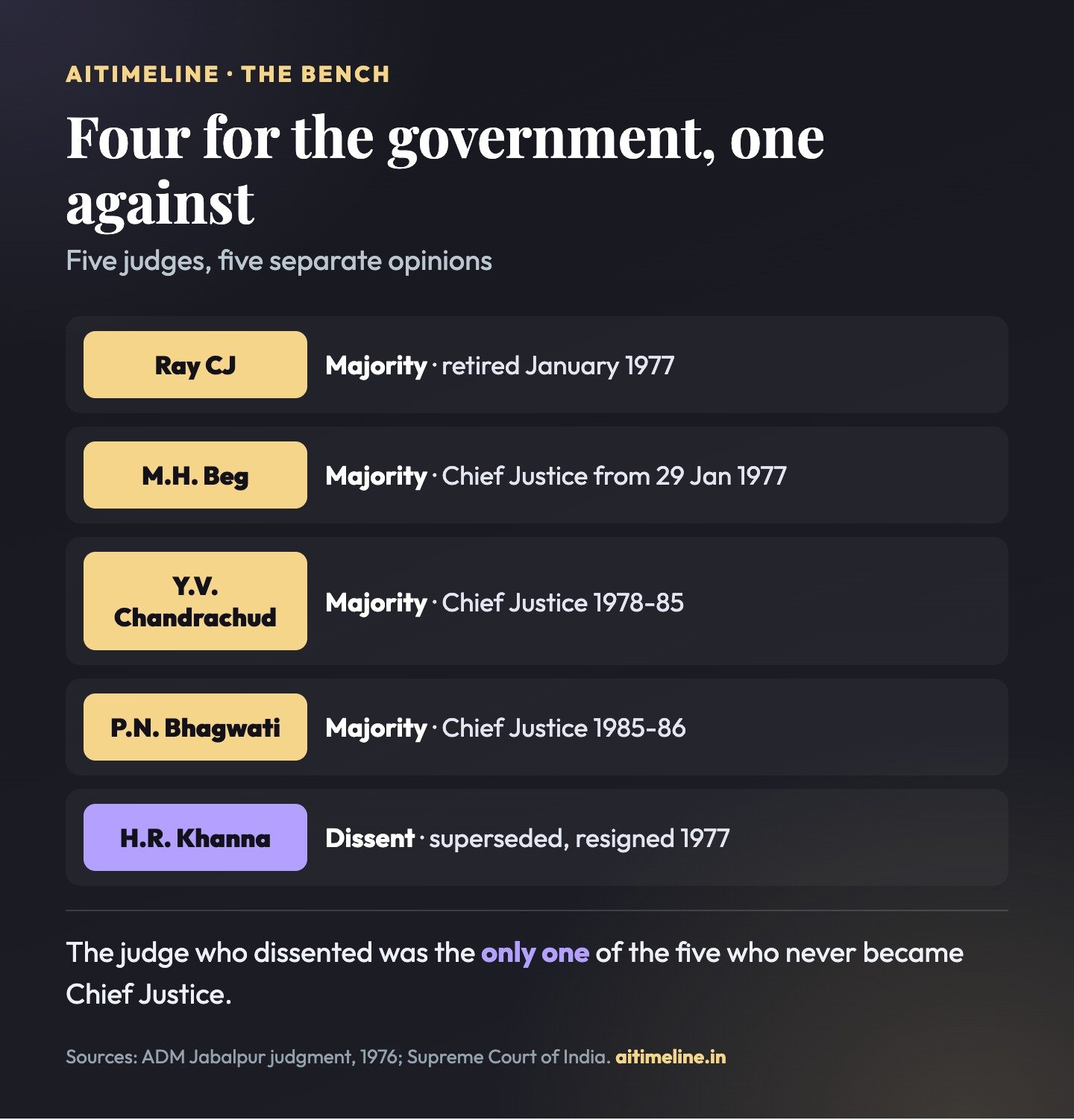
What the majority held. Article 21 was treated as the sole repository of the right to life and personal liberty. With its enforcement suspended, there was no separate “rule of law” right a detainee could fall back on. The order also upheld Section 16A(9) of MISA, which allowed the government to withhold the grounds of detention from the courts.
In their own words. Justice Beg wrote that the State’s care for detainees, who he said were “well housed, well fed, and well treated,” was “almost maternal.” Justice Chandrachud, answering counsel’s fears that detainees might be mistreated or shot, said he had “a diamond-bright, diamond-hard hope that such things will never come to pass.”
The later careers. Three of the four majority judges, Beg, Chandrachud and Bhagwati, went on to become Chief Justice of India. Bhagwati was widely reported in 2011 to have said the majority view was wrong.
| Judge | Position | Afterwards |
|---|---|---|
| A.N. Ray (CJI) | Majority | Retired January 1977 |
| M.H. Beg | Majority | Chief Justice from 29 January 1977 |
| Y.V. Chandrachud | Majority | Chief Justice 1978 to 1985 |
| P.N. Bhagwati | Majority | Chief Justice 1985 to 1986 |
| H.R. Khanna | Dissent | Superseded; resigned 1977 |
Justice Khanna’s Dissent
“Not the gift of the Constitution.”
Rights before the Constitution. “Sanctity of life and liberty was not something new when the Constitution was drafted,” Khanna wrote. The principle that no one shall be deprived of life and liberty without the authority of law “was not the gift of the Constitution. It was a necessary corollary of the concept relating to the sanctity of life and liberty; it existed and was in force before the coming into force of the Constitution.”
A remedy is not a right. He could not accept that, once enforcement of Article 21 was suspended, “there would be no remedy against deprivation of a person’s life or liberty by the State even though such deprivation is without the authority of law or even in flagrant violation of the provisions of law.”
Courts still had a job. On his view, a court could at least ask whether a detention order had been made under the Act by an authorised officer. That was the minimum the High Courts had insisted on.
An appeal to the future. He ended with Chief Justice Hughes’ line that a dissent is “an appeal to the brooding spirit of the law, to the intelligence of a future day.” Forty-one years later, the Supreme Court said his view “must be accepted, and accepted in reverence for the strength of its thoughts and the courage of its convictions.”
The Aftermath: Supersession, Revocation, Amendment
What happened to the judges, the Emergency and the Constitution.
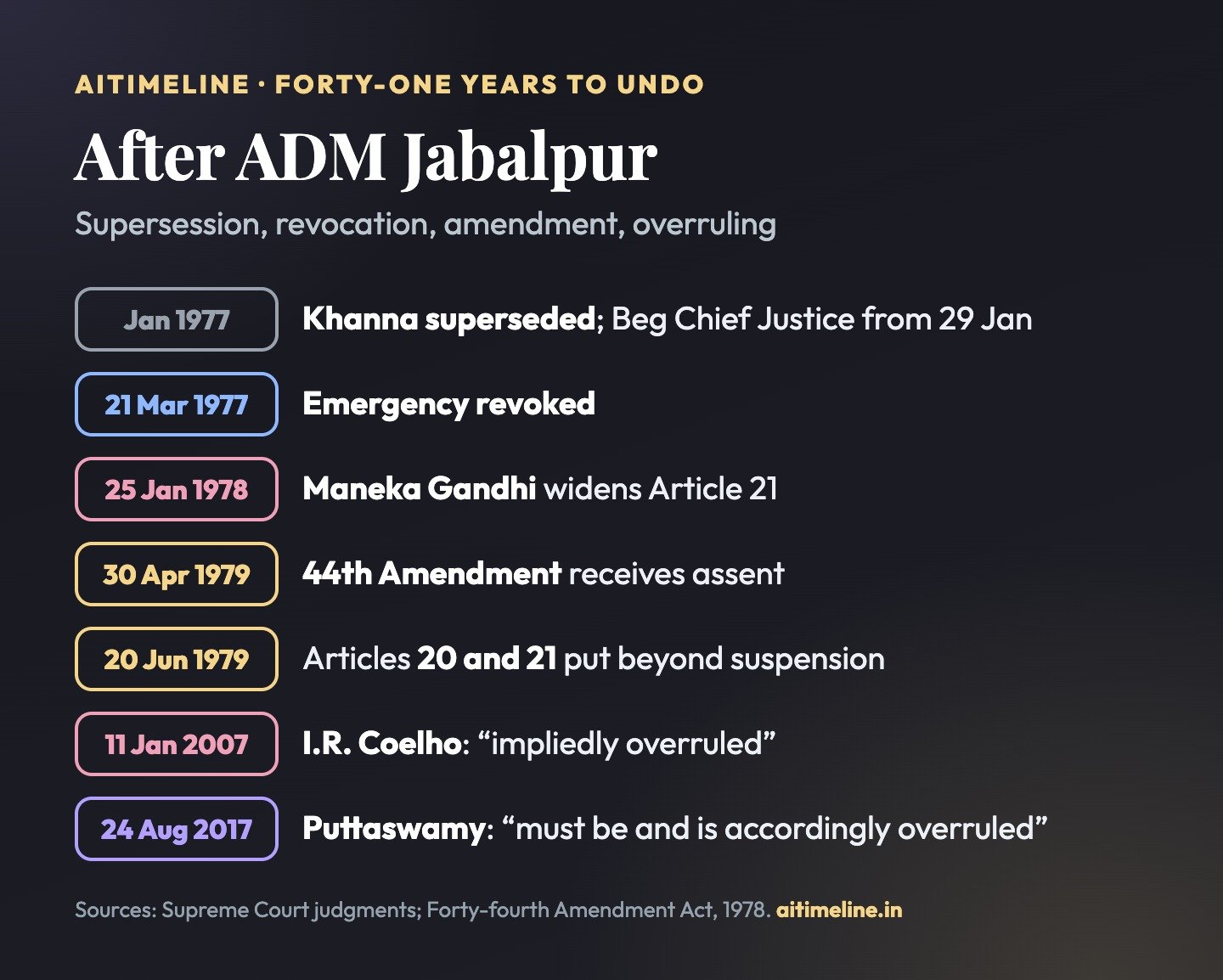
The price of the dissent. When Chief Justice Ray retired in January 1977, the government appointed Justice Beg over Justice Khanna. Khanna resigned. The episode became one of the arguments, years later, for taking appointments out of the executive’s hands.
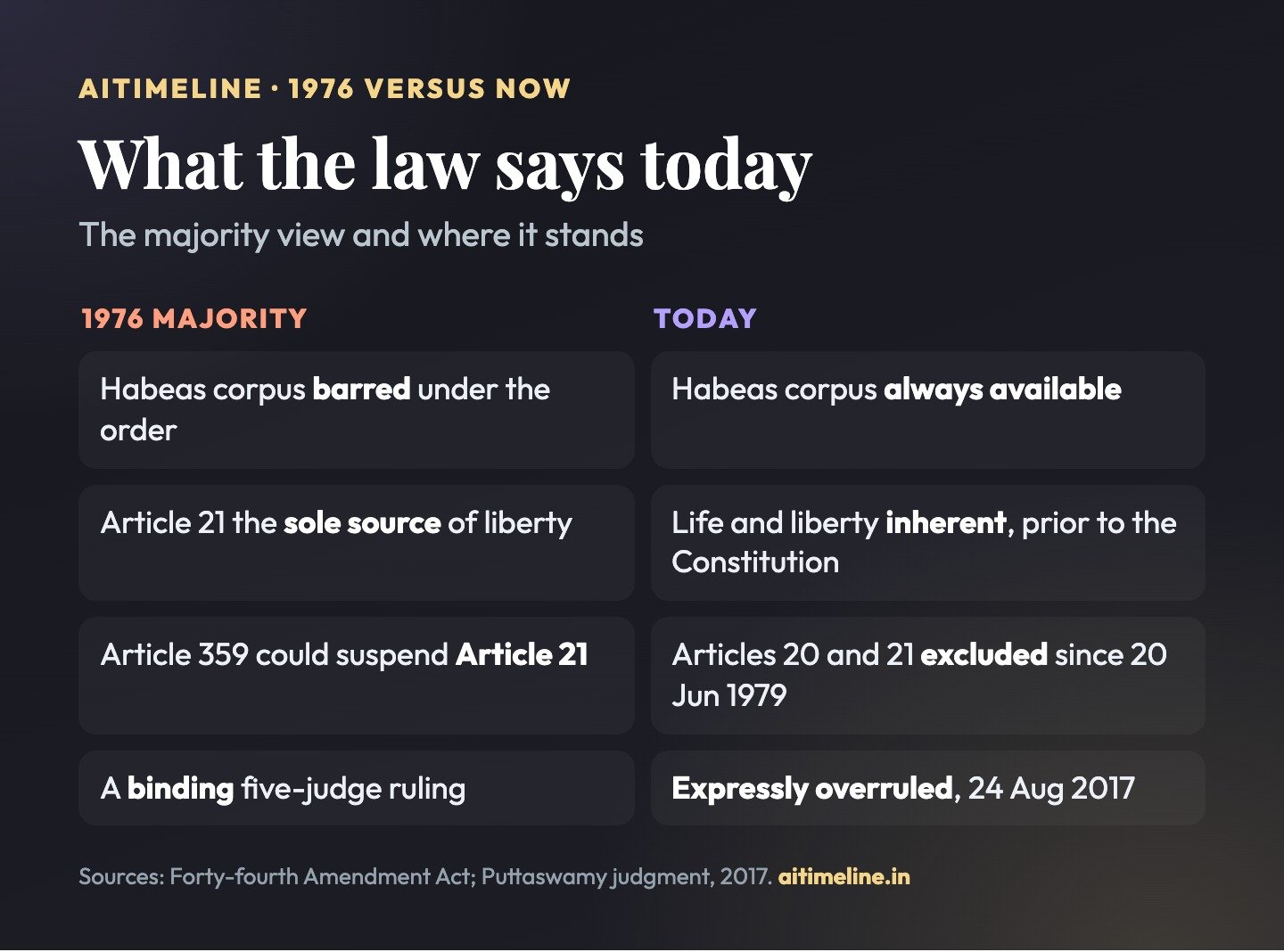
Parliament’s answer. The Janata government’s Forty-fourth Amendment did not try to reverse the judgment by declaring it wrong. It changed the text the judgment relied on: from 20 June 1979, Article 359 no longer allows a Presidential Order to suspend the enforcement of Articles 20 and 21. It also made a future Emergency harder to proclaim and keep.
The courts’ answer. From Maneka Gandhi in 1978 onwards, the Supreme Court read Article 21 broadly, as a guarantee of fair, just and reasonable procedure. By 2007 it described ADM Jabalpur’s reading as impliedly overruled.
2017: “Must Be and Is Accordingly Overruled”
Justice K.S. Puttaswamy (Retd.) v. Union of India, 24 August 2017.
Why a privacy case. To hold that privacy is part of life and liberty, the nine-judge bench had to deal with a judgment that said those rights existed only as the Constitution granted them and could be wholly suspended.
What it said. “Life and personal liberty are inalienable to human existence,” the lead opinion said. “Neither life nor liberty are bounties conferred by the state nor does the Constitution create these rights.” It called the four majority opinions “seriously flawed” and held: “ADM Jabalpur must be and is accordingly overruled.”
The family footnote. The opinion was written by Justice D.Y. Chandrachud, whose father, Justice Y.V. Chandrachud, had been in the 1976 majority. Justice Kaul, concurring, spoke of burying the majority opinion “ten fathom deep, with no chance of resurrection.”
Who Was Who
H.R. Khanna
Senior-most judge in 1977; superseded and resigned. Later Law Commission chairman and 1982 presidential candidate. Died 2008.
A.N. Ray
Presided over the bench and wrote the leading majority opinion.
M.H. Beg
Wrote the “almost maternal” passage. Appointed Chief Justice over Khanna in January 1977.
Y.V. Chandrachud and P.N. Bhagwati
Both later Chief Justice. Both sat on the 1978 Maneka Gandhi bench that widened Article 21.
Niren De
Argued that Article 21 was the sole repository of the right to life and liberty.
Shanti Bhushan
Appeared in the lead appeal; as Law Minister, introduced the Forty-fourth Amendment bill in December 1977.
D.Y. Chandrachud
Wrote that ADM Jabalpur “must be and is accordingly overruled”. Later Chief Justice, 2022-24.
Sanjay Kishan Kaul
Called the case “an aberration in the constitutional jurisprudence of our country”.
Did You Know?
- A New York Times tribute: days after the judgment, a New York Times editorial said that if India found its way back to freedom, someone would surely erect a monument to Justice Khanna.
- Two Emergencies at once: the 1971 external Emergency was still in force in June 1975; the Presidential Order referred to both.
- The name: the Additional District Magistrate of Jabalpur was simply the officer who signed Shivkant Shukla’s detention order.
- Counsel turned minister: Shanti Bhushan argued for the detainees and then, as Law Minister, introduced the amendment that undid the case’s effect.
- A judicial family: Khanna’s nephew, Sanjiv Khanna, was Chief Justice of India from November 2024 to May 2025.
- Kesavananda link: Khanna’s opinion in the 1973 Kesavananda Bharati case is usually counted as decisive for the basic structure doctrine.
Explore More Timelines
People Also Ask
Frequently Asked Questions
Based on the 1976, 2007 and 2017 judgments and the Forty-fourth Amendment.
⚠️ Editorial Note: What We Checked
We checked the brief we started from against the text of the 1976 judgment, the 2007 I.R. Coelho judgment and the 2017 Puttaswamy judgment on Indian Kanoon, and the Forty-fourth Amendment Act. 1 September 1975 is the Madhya Pradesh High Court’s judgment date, not a Supreme Court consolidation date. The Emergency was revoked on 21 March 1977, before the Janata government took office on 24 March. The Article 359 change took effect on 20 June 1979, after assent on 30 April 1979. Hearing dates in the Supreme Court are not given in the judgment, so we describe the hearing only as taking place in 1975-76. Bhagwati’s 2011 remarks are reported, not recorded in any judgment. This article is a historical account and not legal advice.
Related Reading on AiTimeline
Sources & further reading
Every dated entry above was checked against these references. Last reviewed 19 November 2026.
- Supreme Court of India: Additional District Magistrate, Jabalpur v. S.S. Shukla, judgment of 28 April 1976 (Indian Kanoon)
- Supreme Court of India: Justice K.S. Puttaswamy (Retd.) v. Union of India, judgment of 24 August 2017 (PDF)
- Supreme Court of India: I.R. Coelho v. State of Tamil Nadu, 11 January 2007 (Indian Kanoon)
- Supreme Court of India: Maneka Gandhi v. Union of India, 25 January 1978 (Indian Kanoon)
- Legislative Department, Government of India: The Constitution (Forty-fourth Amendment) Act, 1978
- Supreme Court Observer: ADM Jabalpur v. S.S. Shukla, original judgment (PDF)
- The Indian Express: The darkest hour - ADM Jabalpur was a test for SC. Only the dissenter passed it
- LiveLaw: A rare moment in history - Justice D.Y. Chandrachud overrules his father's judgment in ADM Jabalpur case