1987 Jammu & Kashmir Election: Rigging, Aftermath and Legacy
Explore the 1987 Jammu and Kashmir election, rigging allegations, Muslim United Front arrests, the rise of militancy and its lasting political legacy.
Latest Story
On 23 March 1987 nearly eight in ten voters in the Kashmir Valley went to the polls. Many of them backed the Muslim United Front, a new coalition that promised an alternative to Farooq Abdullah’s National Conference and its new partner, the Congress. When the counting was over, the alliance had 66 of 76 seats and the MUF four. The 1987 Jammu and Kashmir election has been described ever since as rigged: counts that stalled for days, agents removed from counting halls, margins smaller than the rejected votes, and hundreds of opposition workers in jail. Within three years several of the MUF’s young campaigners were leading armed groups. This page follows the story from 1982 to November 2026 and separates what is recorded from what is alleged.
The official result is a matter of record: the Election Commission’s constituency returns. The rigging is an allegation, supported by contemporary reporting, memoirs and later statements, and denied by the National Conference; no court, commission or FIR has ever examined it. The link to the insurgency is a historical judgement, and we present 1987 as one major catalyst among several, not as the single cause. Where the brief we started from or common accounts get a fact wrong, we say so in the entry and in the editorial note.
💡 Short Answer
The 1987 Jammu and Kashmir Assembly election, held on 23 March 1987, returned Farooq Abdullah’s National Conference-Congress alliance with 66 of 76 seats. The Muslim United Front won four seats despite about 31 per cent of the Valley vote, alleged mass rigging, and saw hundreds of its workers jailed. The election is widely seen as a major catalyst of the insurgency that began in 1988-90.
1987 Jammu and Kashmir Election: Key Questions
The 1987 Election in Ten Points
- The backdrop: Farooq Abdullah’s elected government was toppled in 1984; he returned in 1986 through a deal with Rajiv Gandhi.
- The challenger: the Muslim United Front was announced on 2 September 1986, led by the Jamaat-e-Islami and other religious groups.
- The vote: polling on 23 March 1987, with Valley turnout near 80 per cent.
- The result: National Conference 40, Congress 26, MUF-backed independents 4.
- The gap: about 31 per cent of the Valley vote produced four seats for the MUF.
- The count: days-long delays, agents removed, and margins smaller than rejected ballots in Bijbehara, Wachi and Shopian.
- The arrests: about 600 MUF workers before the poll and hundreds more after it.
- The campaigners: Mohammad Yousuf Shah became Syed Salahuddin of Hizbul Mujahideen; Yasin Malik led the JKLF.
- The consequence: armed attacks began in 1988; by January 1990 the state was under central rule.
- The open question: no inquiry, commission or FIR has ever examined the allegations.
From a Toppled Government to an Armed Insurgency
The whole story on one page, 1982 to 2026.
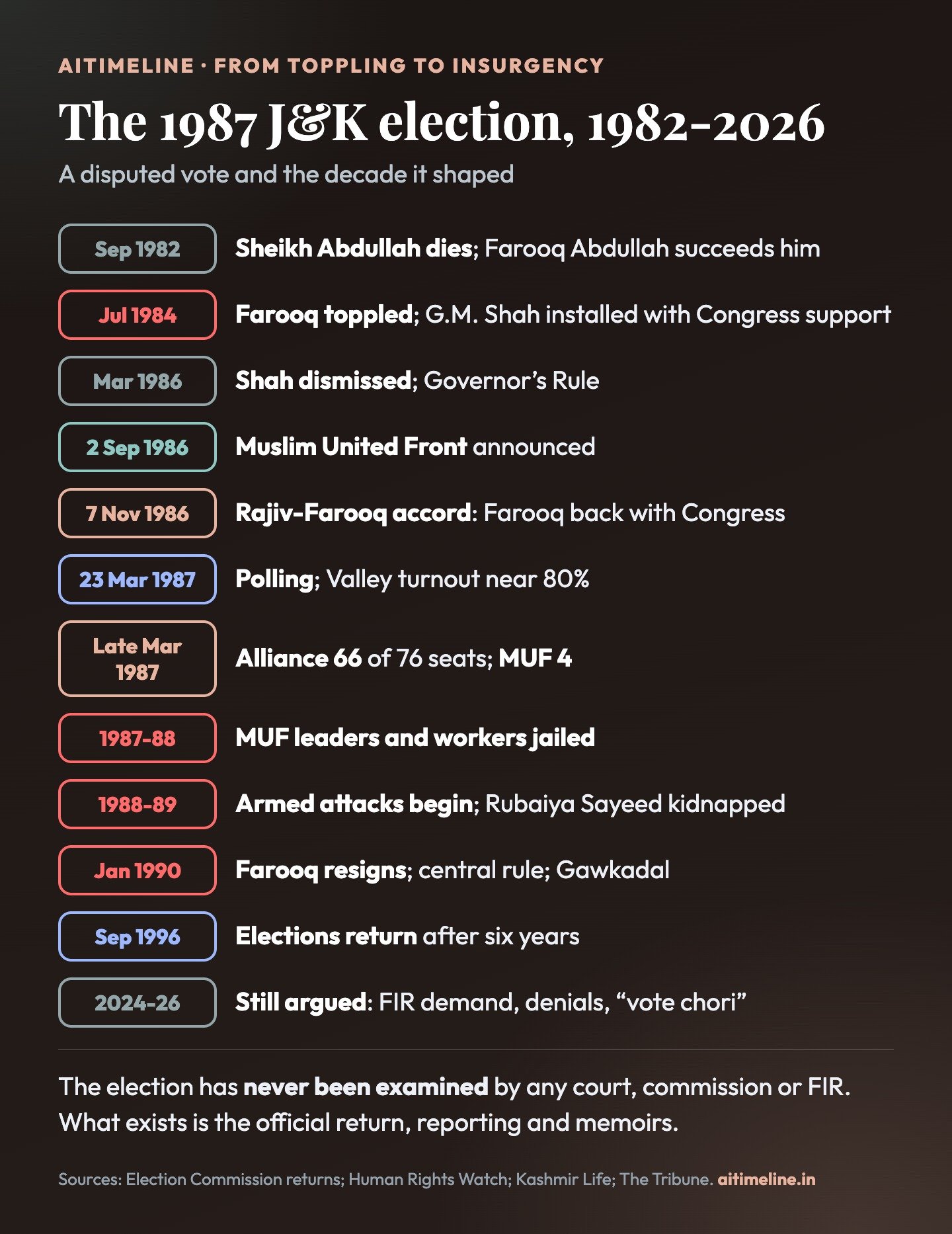
The 1987 election did not create Kashmir’s alienation from Delhi; it crystallised it. In 1984 an elected National Conference government had been removed through defections encouraged by the Congress. In 1986 Farooq Abdullah made peace with Rajiv Gandhi and returned to power in alliance with the party that had ousted him. For many in the Valley, that left no regional party speaking for them, and the Muslim United Front stepped into the gap.
The front drew religious organisations, older opposition figures and, crucially, young men who had never taken part in electoral politics. When their candidates lost seats they believed they had won, and then went to jail, some of them drew a conclusion that the next decade would make deadly: that the ballot could not change anything in Kashmir.
Before the Vote, 1982-1986
Three Chief Ministers in four years, and a deal that emptied the opposition benches.
Sheikh Abdullah’s death in September 1982 handed the National Conference to his son. Farooq Abdullah won a clear mandate in June 1983, beating a Congress campaign led by Indira Gandhi, but in July 1984 a group of his legislators led by his brother-in-law G.M. Shah broke away and Shah became Chief Minister with Congress support. Shah’s government was dismissed in March 1986 after communal violence in Anantnag, and the state came under Governor’s Rule under Jagmohan.
In November 1986 the Rajiv-Farooq accord restored Farooq Abdullah at the head of a National Conference-Congress coalition. Two months earlier, on 2 September 1986, the Jamaat-e-Islami, Qazi Nisar’s Ummat-e-Islami, Maulana Abbas Ansari’s Ittihad-ul-Muslimeen and smaller groups had announced the Muslim United Front. Its demands ranged from the release of political prisoners and the reinstatement of dismissed employees to a settlement of the Kashmir question under the Simla Agreement.
The Result
Official seat totals, Election Commission of India.
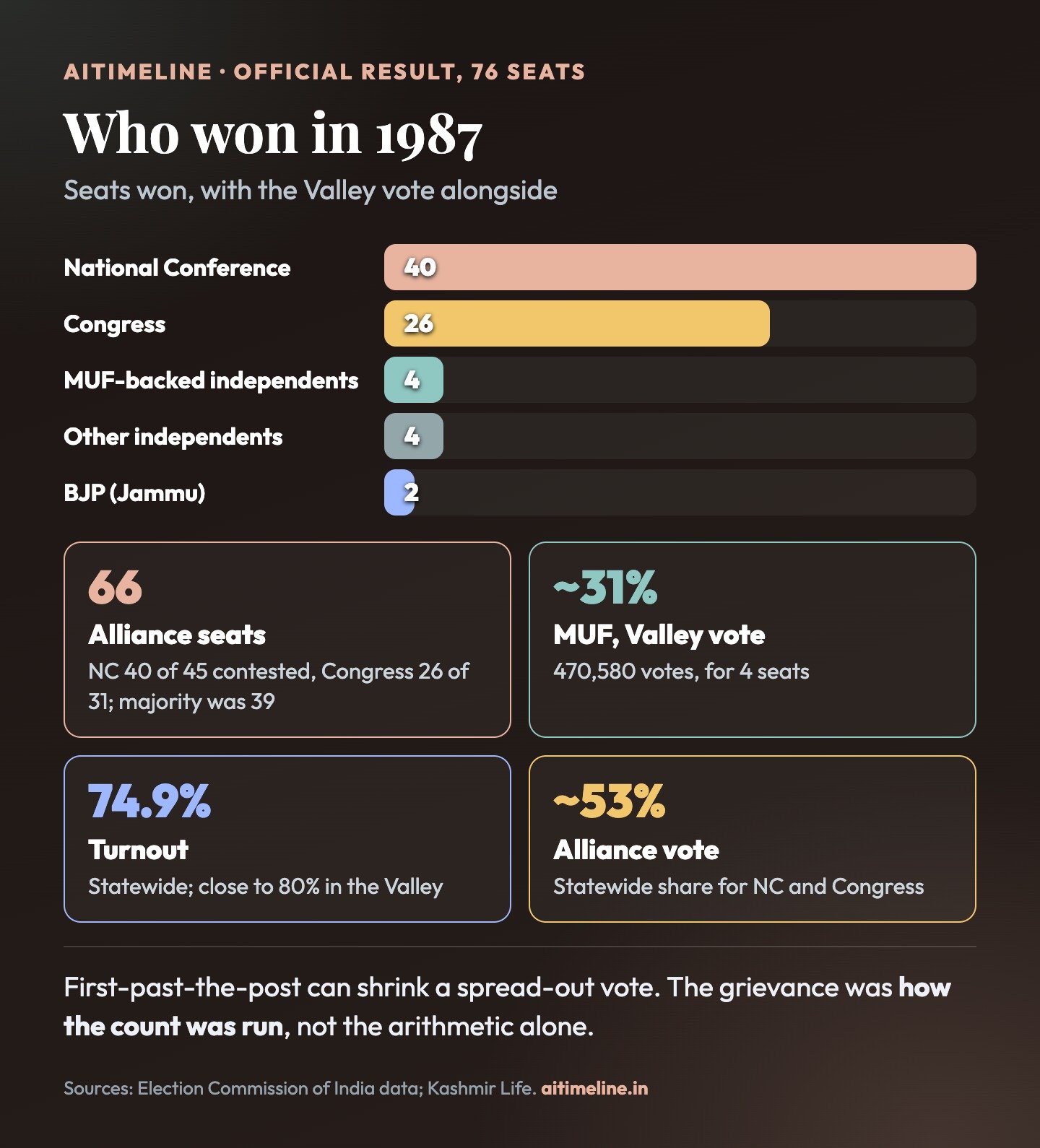
| Party | Seats contested | Seats won | Note |
|---|---|---|---|
| National Conference | 45 | 40 | About 47% of the Valley vote |
| Congress | 31 | 26 | Alliance partner since November 1986 |
| Muslim United Front (as independents) | 40-44 (sources differ) | 4 | 470,580 votes, about 31% of the Valley vote |
| BJP | — | 2 | Both seats in Jammu |
| Other independents | — | 4 | — |
| Total | — | 76 | Majority: 39 |
A first-past-the-post system can turn a third of the vote into very few seats if that vote is spread evenly, so the four-seat tally does not by itself prove manipulation. Analysts who accept that there was rigging generally think it cost the MUF a handful of seats rather than the government; Victoria Schofield suggested four more, and an intelligence source quoted by Kashmir Life about 13. Syed Ali Shah Geelani later claimed 30 to 35. What turned the result into a grievance was how it was produced.
The Count, 24-27 March 1987
Delays, removed agents, and margins smaller than the rejected ballots.
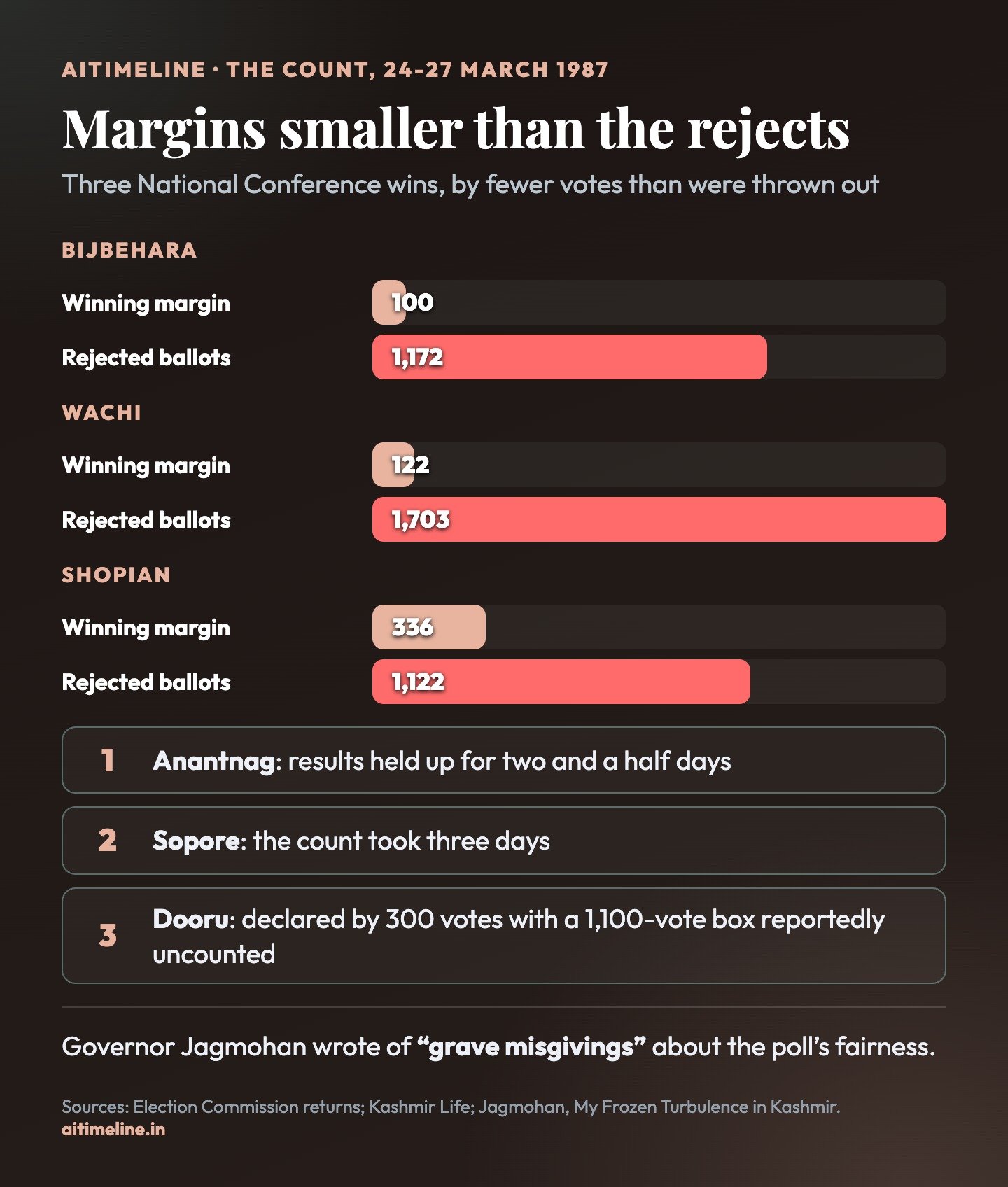
Farooq Abdullah’s own result in Ganderbal came within hours on 24 March. Elsewhere the count crawled. Anantnag took two and a half days, Sopore three, and India Today found some results unannounced almost a week after polling. Opposition candidates described counting halted when they took the lead, agents expelled from counting halls and ballot boxes moved without explanation. Abdul Gani Lone, who lost Handwara by 1,330 votes, was among those who said the count had been manipulated.
The figures that critics return to most often are the margins. In Bijbehara, Wachi and Shopian, National Conference candidates won by fewer votes than the returning officers rejected as invalid. Jagmohan, then Governor, wrote later that the election “caused grave misgivings about their fairness” and singled out exactly this pattern.
Amira Kadal: The Seat Everyone Remembers
A Srinagar constituency, a two-day count, and what its losing campaign became.
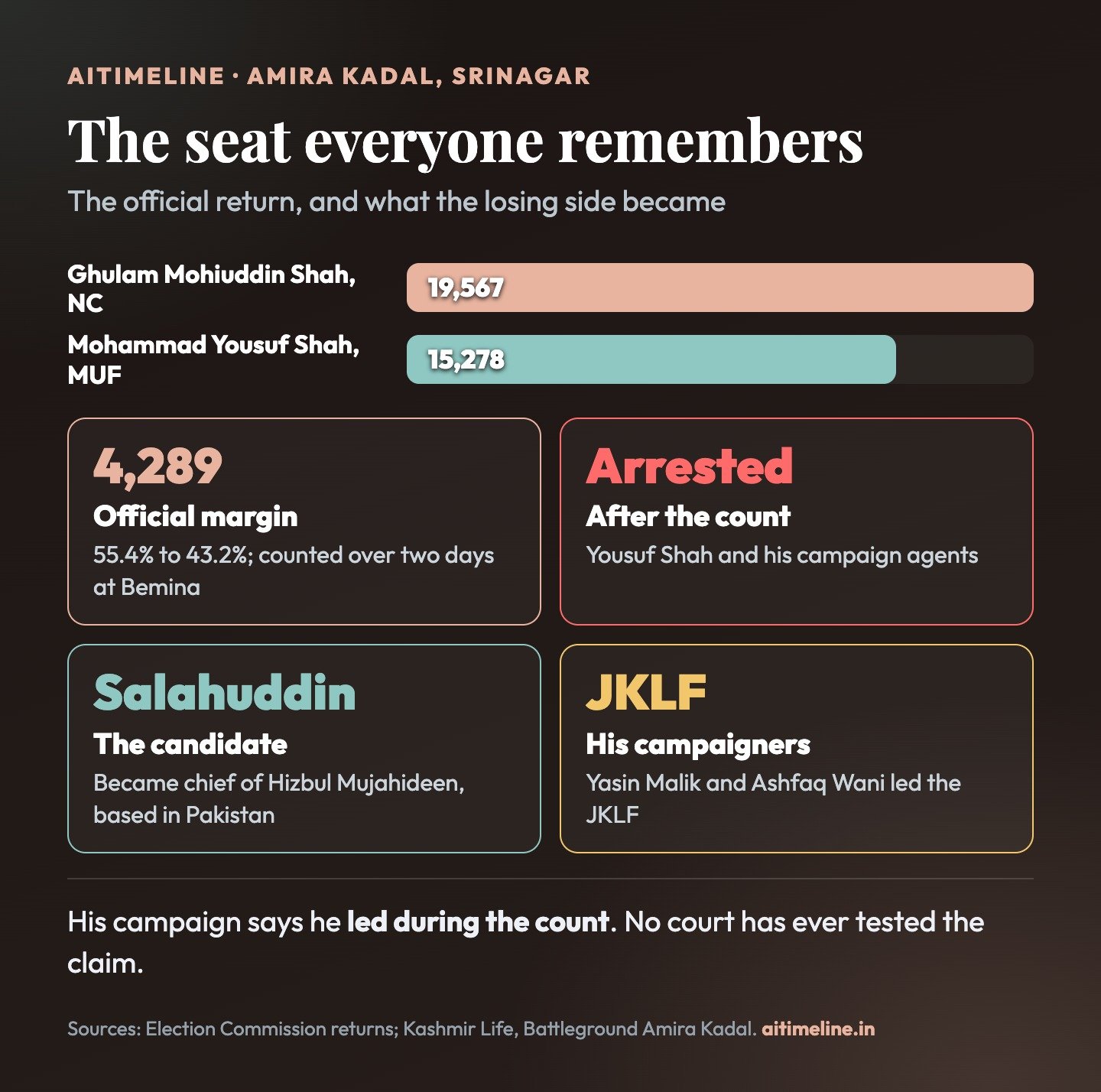
Mohammad Yousuf Shah, a Jamaat-e-Islami teacher, was carried by a crowd to file his nomination on 27 February 1987. His campaign was run by young members of the Islamic Students League, among them Yasin Malik and Ashfaq Majeed Wani. At the counting centre in Bemina, his agents say, he led round after round until a sudden announcement gave the seat to Ghulam Mohiuddin Shah of the National Conference. The official margin was 4,289 votes.
The Amira Kadal margin was not unusually narrow. The seat is remembered because of what followed. Shah and his agents were arrested. Within a few years Shah was Syed Salahuddin, commander of Hizbul Mujahideen, and Malik, Wani and their friends were leading the JKLF. Nothing about the count has ever been tested by a court.
Timeline: The 1987 Jammu and Kashmir Election, 1982-2026
Newest first. Colour shows the strand: before the vote, the campaign and polling, the count and dispute, the road to insurgency, or the legacy.
Where things stand Legacy
No inquiry: No commission, judicial inquiry or FIR has ever examined the 1987 allegations. The People’s Conference has demanded one since at least 2019; we found no government response that took it further.
Still argued: The election remains a live political weapon. In October 2026 the BJP’s Leader of the Opposition called it India’s biggest “vote theft”; the National Conference continues to deny that it rigged the poll.
The two campaigners: Mohammad Yousuf Shah, the MUF candidate at Amira Kadal, heads Hizbul Mujahideen from Pakistan as Syed Salahuddin. Yasin Malik, who worked on his campaign, is serving a life sentence; the NIA’s appeal for the death penalty was still pending in the Delhi High Court at its 14 October 2026 hearing.
BJP calls 1987 the biggest “vote chori” Legacy
What happened: Sunil Kumar Sharma, the BJP’s Leader of the Opposition in the J&K Assembly, answered opposition complaints about the Election Commission by turning to 1987. “If the allegation of vote chori is to be put on someone, it is on the 1987 rigging,” he said, adding that Farooq Abdullah “was made Chief Minister after stealing votes.”
Context: He was responding to the INDIA bloc’s memorandum seeking the removal of the Chief Election Commissioner, reported in the Deccan Chronicle and The Pioneer.
Omar Abdullah asks for “proportional blame” Legacy
What he said: Chief Minister Omar Abdullah, who was 17 in 1987, said “there is no smoke without fire” but asked why the late Mufti Mohammad Sayeed, then head of the J&K Congress, was not also held responsible. “If 1987 was wrong, then please, opposition, blame in proportion.”
Why it matters: It was an unusually open acknowledgement from the Abdullah family that something went wrong, paired with an argument that the blame belongs to the whole alliance.
An Assembly again, and the old argument Legacy
What happened: Jammu and Kashmir, now a Union Territory, voted for an Assembly for the first time in a decade. The National Conference won the most seats and Omar Abdullah was sworn in as Chief Minister on 16 October 2024.
1987 in the campaign: Campaigning in Ganderbal on 15 September 2024, Farooq Abdullah rejected the claim that 1987 caused the insurgency: “Militancy did not start due to NC, and even today there are militants. Are they because of us?” Sajad Lone’s People’s Conference promised a judicial probe into 1987 in its manifesto.
Sajad Lone demands an FIR Legacy
The demand: People’s Conference chairman Sajad Lone, son of Abdul Gani Lone, said the biggest confidence-building measure for Kashmiris would be an FIR “naming Farooq Sahab”, Congress leaders and bureaucrats over 1987. “After all, one lakh people were killed. Thousands were jailed,” he said, reported by The Tribune.
The response: The next day Farooq Abdullah played it down: “As per his will, Lone saheb should do whatever he can.” No FIR was registered.
Yasin Malik sentenced to life Road to insurgency
What happened: Yasin Malik, who as a young activist had worked on Mohammad Yousuf Shah’s 1987 campaign and later led the JKLF, was sentenced to life imprisonment in a terror-funding case after pleading guilty. The court declined the NIA’s request for the death penalty.
Afterwards: In July 2022 Rubaiya Sayeed identified him in court as one of her 1989 kidnappers. The NIA appealed for the death penalty in 2023; the appeal is still pending.
Salahuddin designated a terrorist Road to insurgency
What happened: India designated Syed Salahuddin, the Hizbul Mujahideen chief, an individual terrorist under the amended Unlawful Activities (Prevention) Act, among 18 people named that day.
The link to 1987: Before he took that name he was Mohammad Yousuf Shah, the MUF candidate declared defeated at Amira Kadal in March 1987.
Article 370 and a Union Territory Legacy
What happened: The Centre ended Jammu and Kashmir’s special status and split the state into two Union Territories, which came into being on 31 October 2019. The Supreme Court upheld the move in December 2023.
Relevance: The change reopened the arguments about representation, autonomy and Delhi’s role in Kashmir’s elected politics that 1987 had come to symbolise.
Change of government at the ballot box Legacy
2002: The National Conference lost power. A PDP-Congress coalition took office and Mufti Mohammad Sayeed became Chief Minister on 2 November 2002. Observers widely described the 2002 poll as the most credible since 1977.
2008: The National Conference returned in a coalition with Congress; Omar Abdullah became Chief Minister in January 2009.
Elections return after six years Legacy
What happened: After six years of central rule, Jammu and Kashmir held an Assembly election. The National Conference won a large majority and Farooq Abdullah returned as Chief Minister in October 1996.
The shadow: Separatist groups boycotted the poll, and allegations of coercion and low participation in parts of the Valley followed it, which is why questions of legitimacy outlived the return of an elected government.
Jagmohan returns; Gawkadal Road to insurgency
What happened: Jagmohan was appointed Governor again on 19 January 1990. Farooq Abdullah resigned in protest and the Assembly elected in 1987 ceased to function; central rule followed. On 21 January security forces fired on protesters at the Gawkadal bridge in Srinagar, one of the worst killings of civilians of the early insurgency.
What followed: Militancy, security operations, civilian deaths and mass arrests escalated through 1990, and most of the Valley’s Kashmiri Pandits left in the months that followed.
Rubaiya Sayeed kidnapped Road to insurgency
What happened: JKLF militants abducted Rubaiya Sayeed, daughter of Union Home Minister Mufti Mohammad Sayeed, on 8 December 1989. She was freed on 13 December after the government released five jailed militants.
Why it mattered: The release was celebrated in parts of Srinagar and signalled that the armed movement could force the state’s hand.
A Lok Sabha poll under boycott Road to insurgency
What happened: Militant groups called for a boycott of the general election. Participation in the Valley collapsed and the political atmosphere was now set by threats and armed mobilisation rather than campaigns.
The MUF MLAs: By 1989 the MUF’s small legislative group had broken up; Kashmir Life reports that Jamaat’s MLAs resigned that year.
Bombs in Srinagar Road to insurgency
What happened: The JKLF’s armed campaign began with explosions in Srinagar in the summer of 1988. Strikes, demonstrations and attacks grew through the rest of the year.
Who joined: Human Rights Watch notes that many young men who had worked as MUF polling agents in 1987 joined militant groups, and that the JKLF drew many of them.
The MUF splits Count & dispute
What happened: According to Kashmir Life, MUF convener Maulana Abbas Ansari expelled the Jamaat-e-Islami and its legislators from the front, a decision other leaders called unconstitutional.
Why it matters: Within fifteen months of the vote, the coalition that had channelled the 1987 protest into the ballot box had fractured.
Arrests after the count Count & dispute
What happened: Police raided the Jamaat office in Maisuma at the time of the count. Kashmir Life names Professor Abdul Gani Bhat, Ghulam Mohammad Bhat, Dr Ghulam Qadir Wani, Mohammad Yousuf Shah and others among those held. Most MUF activists were detained until late 1987 or early 1988, according to the political scientist Sumantra Bose.
Yasin Malik: Malik told Kashmir Life he was held for 17 days at the Red-16 centre and later in Jammu jails, released after about a year. Accounts by activists describe beatings of detainees; these allegations were never investigated.
Governor’s view: Jagmohan, then Governor, later wrote that the elections “were followed by the arrest of a number of top-ranking leaders of the MUF”.
A bandh against “rigging” Count & dispute
What happened: The Islamic Students League, the youth group around Yasin Malik, called a shutdown across the Valley to protest the results. MUF leaders also courted arrest at Friday protests over the following weeks.
Why it matters: It was the first organised street response to the result, and many of those who led it would within two years be leading militant groups.
The result: 66 seats for the alliance Count & dispute
Seats: The National Conference won 40 of the 45 seats it contested and Congress 26 of 31, giving the alliance 66 of 76. The BJP won two seats in Jammu. MUF-backed candidates, who ran as independents, won four.
Votes: The alliance took about 53 per cent of the vote statewide. In the Valley, the MUF polled 470,580 votes, about 31 per cent of those cast, according to Kashmir Life; the National Conference about 47 per cent.
Government: Farooq Abdullah continued as Chief Minister at the head of the National Conference-Congress coalition.
A count that took days Count & dispute
What happened: Farooq Abdullah’s own Ganderbal result came on 24 March. Elsewhere counting dragged: Anantnag results were held up for two and a half days and Sopore took three. India Today reported results still unannounced almost a week after polling.
Disputed margins: In several seats the declared margin was smaller than the number of rejected ballots: 100 votes in Bijbehara (1,172 rejected), 122 in Wachi (1,703) and 336 in Shopian (1,122), all won by the National Conference.
The allegations: Opposition candidates alleged counting agents were thrown out, counting was halted when MUF candidates led, and ballot boxes were mishandled. Abdul Gani Lone, who lost Handwara by 1,330 votes, was among those who said the count had been manipulated.
Amira Kadal: the defining seat Count & dispute
The result: National Conference candidate Ghulam Mohiuddin Shah was declared the winner with 19,567 votes to 15,278 for Mohammad Yousuf Shah of the MUF, a margin of 4,289, according to the official returns.
The dispute: Shah’s agents say he led round after round at the counting centre in Bemina before the result was announced. Yasin Malik says the campaign saw “agents were tampering votes”. The claim has never been tested.
What followed: Shah and his agents were arrested. Within a few years Shah was Syed Salahuddin, head of Hizbul Mujahideen; Malik and fellow campaigners led the JKLF.
Polling day Campaign & polling
Turnout: About 74.9 per cent of 35.6 lakh registered voters cast ballots statewide, according to Election Commission data. In the Valley, turnout was close to 80 per cent. Leh, Kargil and Bhadarwah voted later, in June.
The contest: The MUF fielded candidates in 40 to 44 seats, depending on the source, almost all in the Valley, against the National Conference-Congress alliance.
Arrests before the poll Campaign & polling
What happened: About two weeks before polling, at least 600 MUF workers were arrested, the journalist Tavleen Singh reported. The detentions fed the fear, before a single vote was cast, that the election would not be fair.
Context: Local papers had discussed the possibility of rigging during the campaign, given the record of earlier Kashmir polls.
The campaign Campaign & polling
Amira Kadal: On 27 February 1987 a crowd carried Mohammad Yousuf Shah, a Jamaat-e-Islami teacher, to file his nomination at Amira Kadal. His campaign was run largely by young men of the Islamic Students League, including Yasin Malik and Ashfaq Majeed Wani.
The pitch: MUF rallies drew large crowds; some candidates campaigned wearing shrouds. The front’s manifesto called for resolving outstanding issues under the Simla Agreement, Islamic unity and an end to central interference in the state.
Lone steps back: Abdul Gani Lone’s People’s Conference, briefly part of the front, withdrew in January 1987 after a seat dispute and contested on its own.
The Muslim United Front is born Campaign & polling
What happened: Leaders of the Jamaat-e-Islami, the Ummat-e-Islami of Qazi Nisar, Maulana Abbas Ansari’s Ittihad-ul-Muslimeen and other groups announced the Muslim United Front at a Srinagar hotel; its constitution was made public on 6 September.
Its demands: Kashmir Life lists seven, including release of political detainees, reinstatement of dismissed employees, respect for human rights and the rollback of ordinances issued under Governor’s Rule.
The Rajiv-Farooq accord Before the vote
What happened: After an agreement with Prime Minister Rajiv Gandhi, Farooq Abdullah returned as Chief Minister at the head of a National Conference-Congress coalition, the party that had helped remove him in 1984.
Why it mattered: Critics in the Valley saw the deal as the National Conference giving up its role as the voice of regional autonomy. That vacuum was what the MUF set out to fill.
Shah dismissed; Governor’s Rule Before the vote
What happened: After communal violence against Kashmiri Pandits in Anantnag district in February 1986, Governor Jagmohan dismissed G.M. Shah in March and took over the administration. Governor’s Rule was followed by a spell of President’s Rule.
Why it mattered: Government employees dismissed in this period and ordinances issued under Governor’s Rule became MUF grievances.
Farooq toppled, G.M. Shah installed Before the vote
What happened: A breakaway group of National Conference legislators led by Ghulam Mohammad Shah, Farooq Abdullah’s brother-in-law, withdrew support. Governor Jagmohan dismissed Farooq, and Shah became Chief Minister with Congress support.
Why it mattered: The removal of a government that had won a clear majority a year earlier was widely seen in Kashmir as Delhi’s doing, and deepened distrust of elected institutions.
Farooq Abdullah’s first mandate Before the vote
What happened: In his first election as party leader, Farooq Abdullah led the National Conference to 46 of the 76 seats, defeating a Congress campaign led by Indira Gandhi.
Why it mattered: It showed the National Conference’s dominance in the Valley, and the bitter campaign soured relations between Farooq and the Congress.
Sheikh Abdullah dies Before the vote
What happened: Sheikh Mohammad Abdullah, the dominant figure of Kashmiri politics for half a century, died in office. His son Farooq Abdullah succeeded him as Chief Minister.
Background: Sheikh had returned to power in 1975 under an accord with Indira Gandhi, and won the 1977 Assembly election, which is widely regarded as the fairest held in the state up to that time.
Aftermath: From Jail to the Gun, 1987-1990
How some of the MUF’s campaigners left electoral politics.
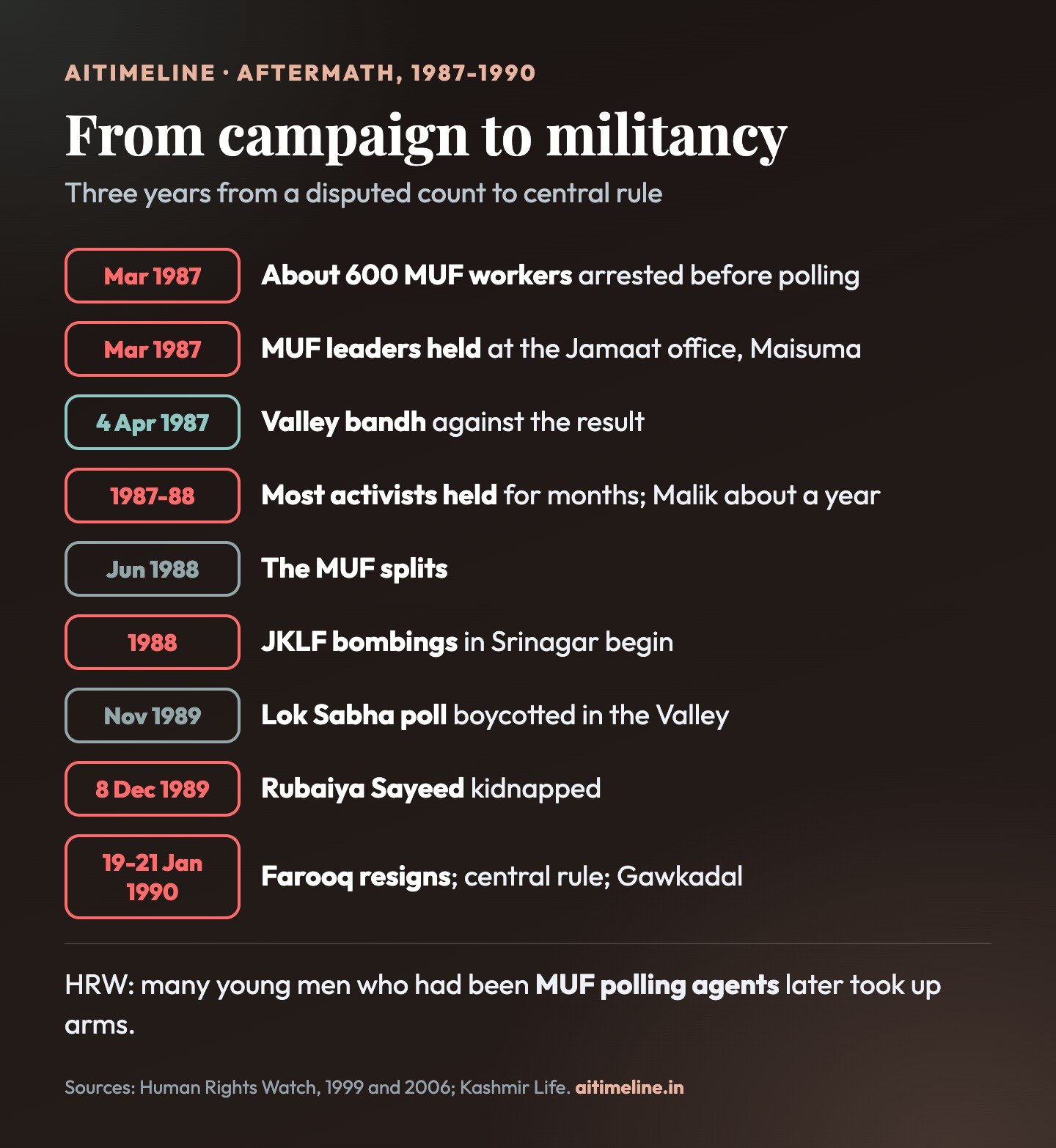
The arrests began before polling and widened after it. Kashmir Life names several MUF leaders held at the Jamaat office in Maisuma at the time of the count. Yasin Malik says he spent 17 days at the Red-16 interrogation centre and the rest of a year in Jammu jails. Activists and journalists later described beatings in custody; none of these allegations was ever investigated.
Human Rights Watch, in 2006, recorded that disillusioned young men, many of them former MUF election agents, took up arms, and that the JKLF drew many of them. The JKLF’s bombings in Srinagar in 1988, the boycott of the November 1989 general election and the kidnapping of Rubaiya Sayeed in December 1989 marked the escalation. When Jagmohan returned as Governor on 19 January 1990, Farooq Abdullah resigned and the Assembly elected in 1987 ceased to function.
Was the 1987 Election Proven to Be Rigged?
What is on the record, what is alleged and what has never been tested.
| Type of evidence | What it shows | Status |
|---|---|---|
| Official returns | Delays, and margins smaller than rejected ballots in several seats | Record |
| Contemporary reporting | India Today and others on delayed results, removed agents, pre-poll arrests | Reported |
| Governor’s memoir | Jagmohan: “grave misgivings” about fairness; MUF leaders arrested | Official’s account |
| Human Rights Watch, 2006 | “Widespread and credible allegations of vote-rigging”; mass arrests | Rights-group finding |
| National Conference | Denies rigging; Farooq has said he did not rig the poll | Denial |
| Courts and commissions | No inquiry, commission or FIR, ever | Untested |
It is accurate to call 1987 an election widely alleged to have been rigged, with strong contemporary evidence of irregularities and the mass arrest of opposition workers. It is not accurate to present each allegation as a proven fact, or to claim that honest counting would have put the MUF in power: most analysts who accept the rigging think it changed a handful of seats, not the government. Our editorial note lists what we could not confirm.
How Did the Election Feed the Insurgency?
One catalyst among several.
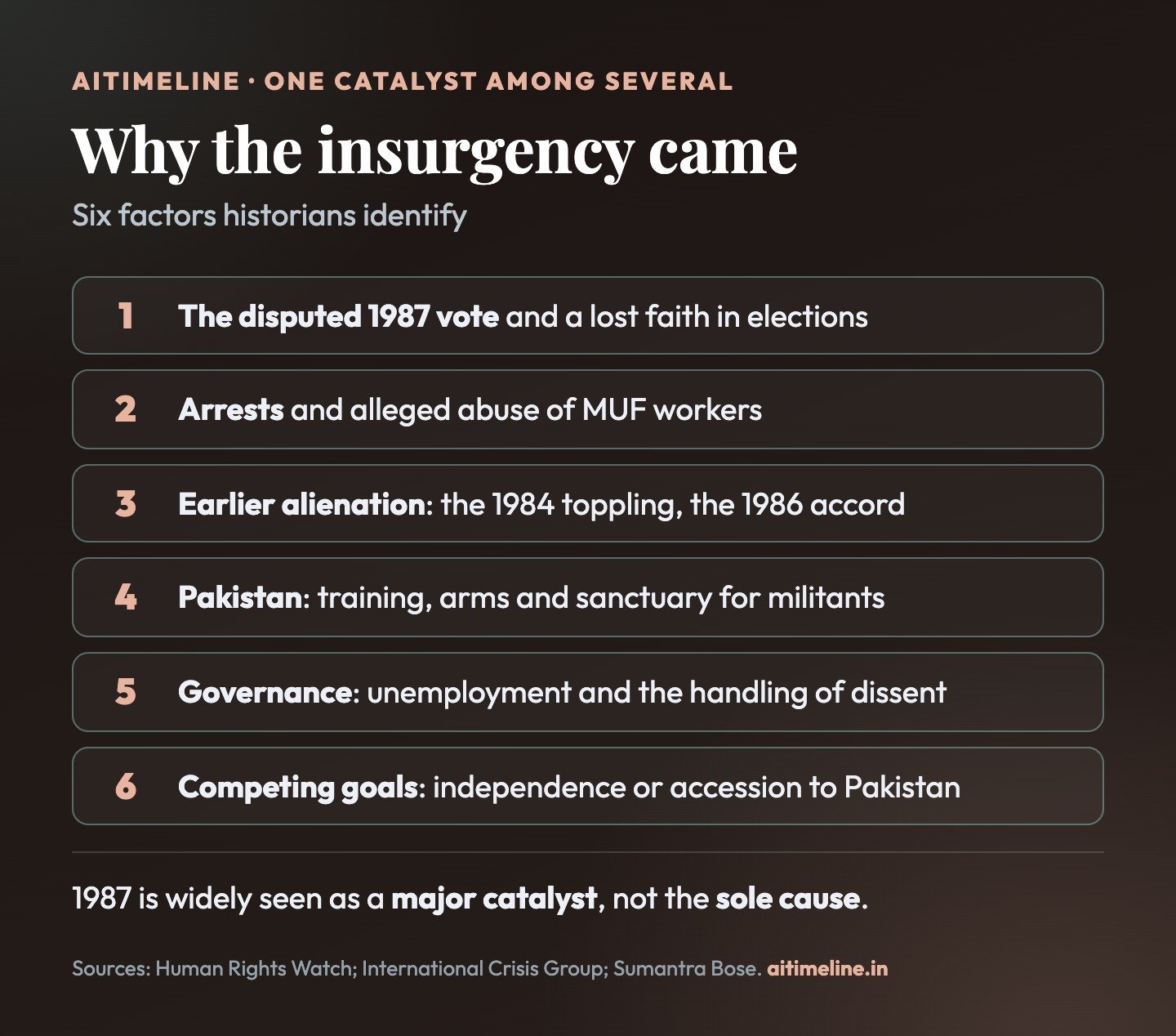
Loss of faith in voting. The MUF campaign had brought thousands of young people into electoral politics for the first time. The result told many of them it was pointless.
Arrests. Jail turned campaign workers into recruits; several of those detained after the count led militant groups within two years.
Earlier alienation. The 1984 toppling and the 1986 accord had already weakened trust in the state’s elected institutions.
Pakistan. Training, arms and sanctuary across the Line of Control turned discontent into armed insurgency.
Governance. Unemployment, corruption and the handling of dissent fed resentment well before 1987.
Competing goals. The JKLF sought independence; Hizbul Mujahideen and others sought accession to Pakistan. The insurgency was never one movement.
The Debate Now, 2024-2026
Who has said what about 1987 recently.
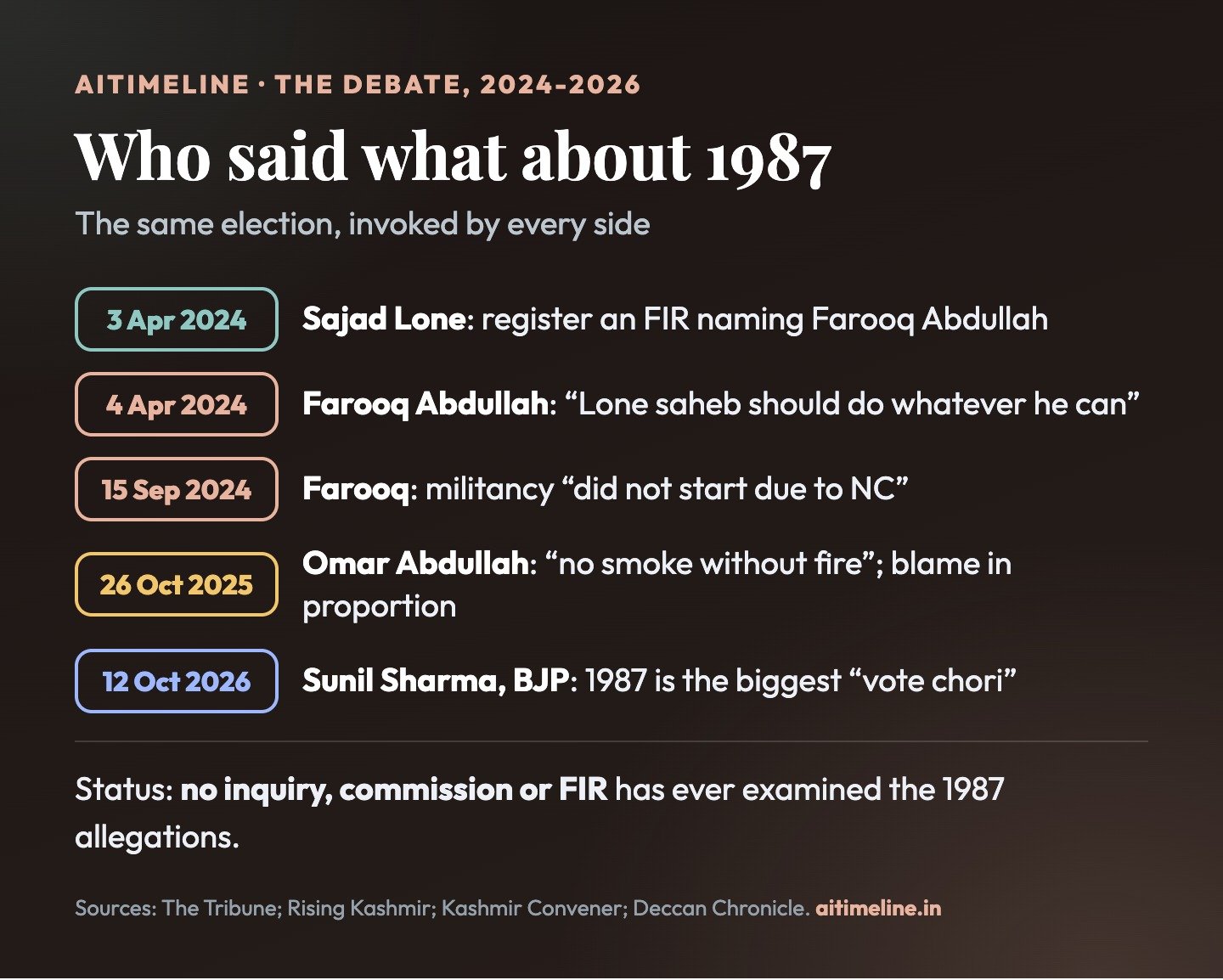
The 1987 election has become a weapon used by every party. The People’s Conference uses it against the National Conference, the BJP against both the National Conference and Congress, and the National Conference answers that militancy has other causes. Omar Abdullah’s 2025 call for “proportional blame” was the first time a member of the Abdullah family came close to accepting that something went wrong, while insisting that Congress, then led in the state by Mufti Mohammad Sayeed, share responsibility.
Key People and Organisations
| Name | Role in 1987 and after |
|---|---|
| Farooq Abdullah | National Conference leader; Chief Minister before and after the election; denies rigging |
| Rajiv Gandhi | Prime Minister; made the November 1986 accord that restored Farooq with Congress support |
| Mufti Mohammad Sayeed | J&K Congress chief in 1987; Union Home Minister in 1989; later founded the PDP |
| Jagmohan | Governor 1984-89 and again in 1990; wrote of “grave misgivings” about the poll |
| Mohammad Yousuf Shah (Syed Salahuddin) | MUF candidate at Amira Kadal; later Hizbul Mujahideen chief; designated a terrorist by India in 2020 |
| Yasin Malik | Islamic Students League leader on Shah’s campaign; later JKLF chief; serving a life sentence since 2022 |
| Syed Ali Shah Geelani | Won Sopore for the MUF; later the leading separatist figure; died 2021 |
| Abdul Gani Lone | People’s Conference leader; lost Handwara by 1,330 votes; alleged the count was rigged; killed 2002 |
| Maulana Abbas Ansari | MUF convener |
| Muslim United Front | Coalition announced 2 September 1986; four seats in 1987; split in 1988 |
Legacy: Why 1987 Still Matters
| Area | Long-term significance |
|---|---|
| Electoral credibility | The benchmark for every later argument about free elections in Kashmir |
| Political participation | A case study in how a disputed vote can drive activists away from politics |
| Militancy | Widely regarded as a key catalyst of the 1988-90 insurgency |
| Party politics | Still used against the National Conference and Congress in 2024-26 |
| Centre-state relations | Part of the wider case about Delhi’s interference in Kashmir’s elected politics |
| Accountability | No inquiry, commission or FIR has ever examined it |
The lesson most often drawn from 1987 is that electoral credibility is not only about declaring a winner. It depends on a transparent count, protection for opposition workers and public confidence that a vote can change something. When those failed, in a state where trust in elected institutions was already thin, the consequences reached well beyond one Assembly.
Explore More Timelines
People Also Ask
Frequently Asked Questions
Based on Election Commission returns, Human Rights Watch, contemporary reporting compiled by Kashmir Life, and reporting to 16 November 2026.
⚠️ Editorial Note: What We Corrected and What We Could Not Confirm
This page separates the official result from allegations of rigging, and treats the election as one catalyst of the insurgency, not its sole cause. Some details in common accounts, including the brief we started from, needed correcting or qualifying. The MUF was announced on 2 September 1986; some accounts date its first meeting to July 1986. The number of seats it contested is given as 40, 42, 43 or 44 in different sources, so we give a range. Abdul Gani Lone lost Handwara by 1,330 votes to the National Conference; we could not find a primary source for the specific claim that ballot boxes were removed overnight there, so we describe his allegation in general terms. We could not confirm reports of pre-stamped ballot papers recovered in Pattan, or that the MUF’s formal symbol was the pen and inkpot, since its candidates stood as independents. We could not locate the Indian Express April 2024 article cited in the brief; the statement that no inquiry has ever been held is our own finding from the record. Exact release dates for most detainees, Yousuf Shah’s place of detention and the date he crossed into Pakistan are not established, and sources differ on when he became Hizbul Mujahideen chief.
Related Reading on AiTimeline
Sources & further reading
Every dated entry above was checked against these references. Last reviewed 16 November 2026.
- Wikipedia: 1987 Jammu and Kashmir Legislative Assembly election (constituency returns, Election Commission of India data)
- Human Rights Watch: "Everyone Lives in Fear": Patterns of Impunity in Jammu and Kashmir (11 September 2006)
- Human Rights Watch: Behind the Kashmir Conflict, background (1999)
- Kashmir Life: MUFfed, Masood Hussain (23 March 2016)
- Kashmir Life: Battleground Amira Kadal, Saima Bhat (24 March 2016)
- Kashmir Life: Dateline 1987, Shakir Mir (24 March 2016)
- Wikipedia: Muslim United Front
- The Tribune: Book Farooq Abdullah, Congress leaders for 1987 poll rigging, says Sajad Lone (4 April 2024)
- The Tribune / PTI: Farooq Abdullah downplays Sajad Lone's FIR remark (5 April 2024)
- Rising Kashmir: Dr Farooq denies 1987 'rigging' triggered terrorism in J&K (16 September 2024)
- Kashmir Convener: Omar Abdullah calls for 'proportional blame' for 1987 election rigging (26 October 2025)
- Deccan Chronicle: BJP trains guns on Omar Abdullah, revives 1987 'rigging' debate (12 October 2026)
- ThePrint: Hizbul chief Salahuddin among 18 designated as terrorists under UAPA (27 October 2020)