Mumbai 1992–93: The Riots, 1993 Blasts and Long Road to Justice
Mumbai riots of 1992-93 and the 12 March 1993 blasts: Babri Masjid demolition, Srikrishna Commission findings, TADA verdicts and compensation for victims.
Latest Story
Between December 1992 and March 1993, Bombay went through two waves of communal rioting and then a wave of terrorist bombs. The Mumbai riots and 1993 blasts killed more than 1,100 people in all: about 900 in the riots that followed the demolition of the Babri Masjid, and 257 in the coordinated explosions of 12 March 1993. They are often told as one story, but in law they are two. The riots produced a judicial inquiry under Justice B.N. Srikrishna and hundreds of separate criminal cases, very few of which ended in conviction. The bombings produced one of India’s longest terrorism trials, 100 convictions, and the execution of Yakub Memon. This is the record of both, from Ayodhya to the Supreme Court’s latest orders.
The riots and the blasts are colour-coded separately in the timeline. We keep apart the findings of the Srikrishna Commission, which was an inquiry and could not convict anyone, the allegations in chargesheets, and the verdicts of courts. Casualty figures are attributed. Where the brief we worked from had a date or detail that the record contradicts, we say so in the entry and in the editorial note.
💡 Short Answer
The Mumbai riots of December 1992 and January 1993, after the Babri Masjid demolition, killed about 900 people. On 12 March 1993, coordinated bombings killed 257. The Srikrishna Commission found police failures and named Shiv Sena leaders over the January riots, but few riot cases ended in conviction. A TADA court convicted 100 people for the blasts; Yakub Memon was hanged in 2015.
Mumbai Riots and 1993 Blasts: Key Questions
The Story in Ten Points
- The trigger: rioting began in Bombay hours after the Babri Masjid was demolished on 6 December 1992.
- Two phases: December 1992, then a deadlier wave from 6 to about 20 January 1993.
- The toll: about 900 killed, 168 missing and some 2,036 injured, per the Supreme Court.
- The blasts: on 12 March 1993, bombs across the city killed 257, starting at the Stock Exchange.
- The inquiry: the Srikrishna Commission found police failures and bias and named Shiv Sena leaders over January.
- No common design: the Commission found no material tying the riots and blasts into one plan.
- The rejection: the Shiv Sena-BJP government rejected the report’s main findings in 1998.
- The trial: a TADA court convicted 100 people for the blasts; 12 were sentenced to death.
- The execution: Yakub Memon, the only one whose death sentence survived appeal, was hanged in 2015.
- Still open: Dawood Ibrahim and Tiger Memon are untried, 97 riot cases are dormant, and the Supreme Court is still monitoring compensation and reforms.
How Many People Died in the Riots and the Blasts?
Two episodes, counted separately.
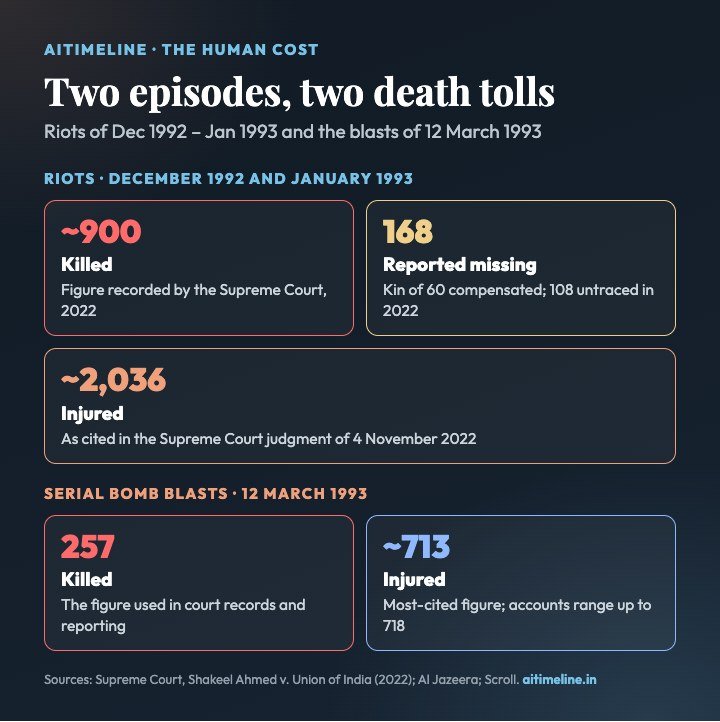
The Supreme Court’s 2022 judgment recorded about 900 deaths, 168 missing and roughly 2,036 injured in the riots. Figures widely cited from the Srikrishna Commission’s report put about 575 of the dead as Muslims and 275 as Hindus. For the blasts, 257 deaths is the figure used throughout the court record; injury counts vary between accounts, from 713 to 718.
Bombay’s violence was part of a wider wave across India after the demolition, but it was among the worst. For other episodes of communal violence and the inquiries that followed, see our timelines of the Godhra train fire and Gujarat riots and the Bhagalpur riots.
Ninety-Six Days: From Ayodhya to the Blasts
How the violence unfolded.
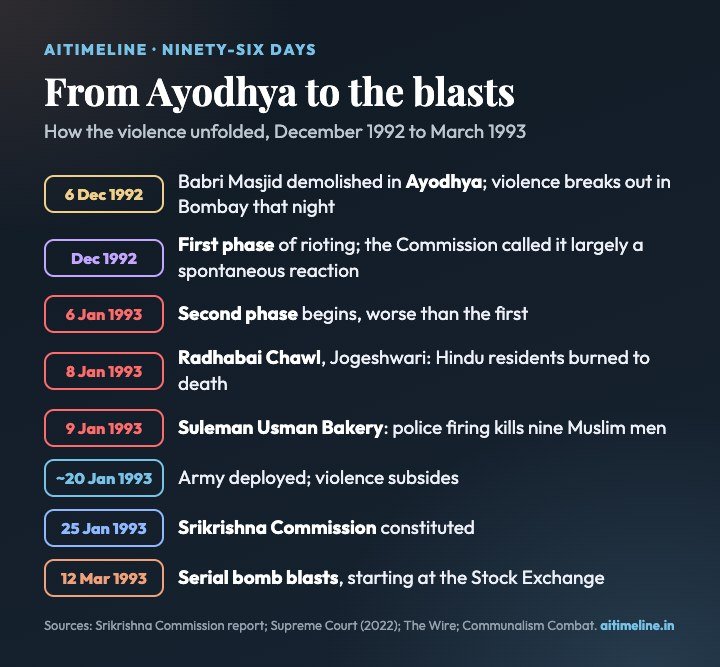
The Commission drew a sharp line between the two phases of rioting. It described the December violence as largely a spontaneous reaction by angered, leaderless Muslim mobs, met in many places by heavy police firing. The January violence was different: it found it aggravated by communal mobilisation and inflammatory propaganda, and named Shiv Sena leaders. Two incidents in early January, the stabbing of Mathadi workers in Dongri and the burning of Hindu residents of a Jogeshwari chawl, were seized on to inflame tension.
12 March 1993: Where the Bombs Went Off
About two hours of explosions, from roughly 1:30 pm.
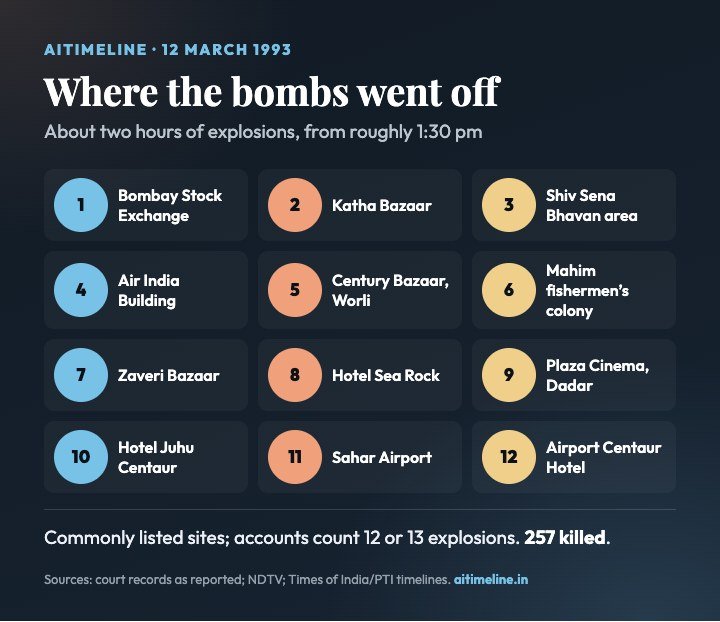
The first bomb, in a car parked in the basement of the Bombay Stock Exchange, went off at about 1:30 pm. Over the next two hours explosions hit commercial districts, a cinema, hotels and the airport. Prosecutors said the RDX and weapons had been landed on the Raigad coast weeks earlier, and that some of the accused had travelled abroad for training. Fifteen years later, in November 2008, Mumbai was attacked again; see our 26/11 Mumbai attacks timeline.
Timeline: The Mumbai Riots, the 1993 Blasts and the Search for Justice
Newest first. Colour shows the strand: riots, the Commission, the blasts investigation, the courts, or context.
Where things stand Courts
Settled: The riots killed about 900 people, the figure the Supreme Court recorded in 2022, and the blasts of 12 March 1993 killed 257. The Srikrishna Commission reported in 1998. The main blasts trial ended in 2007, the Supreme Court decided the appeals in 2013, and Yakub Memon was hanged in 2015. Abu Salem must stay in prison until his 25-year term ends.
Not settled: Dawood Ibrahim and Tiger Memon, named as the central conspirators, have never been tried. Of 253 riot cases Maharashtra reported in 2022, 97 lay dormant because the accused could not be traced. The Supreme Court is still monitoring compensation for families of the missing and the police reforms the state accepted from the Commission.
Supreme Court refuses Abu Salem early release Courts
What happened: The Supreme Court dismissed Abu Salem’s plea for premature release, LiveLaw reported. He had argued that, counting remission, he had already served more than 25 years. The bench held that the 25-year limit in India’s assurance to Portugal did not turn his life sentence into a fixed term, and that jail remission cannot bring the release date forward.
Why it matters: It closes, for now, Salem’s attempt to leave prison before the end of the 25 years, which the Bombay High Court calculated will end in November 2030. The court also found his calculation had counted part of his custody twice.
Bombay High Court: release claim “premature” Courts
What happened: The High Court dismissed Salem’s plea for immediate release, calling it “premature and misconceived” and saying the 25-year term would end only in November 2030, the Free Press Journal reported. The Centre argued that he had served only about 19 years of actual imprisonment.
Why it matters: The ruling set up the Supreme Court challenge decided in September. Salem had first gone to the special TADA court, which rejected his plea in December 2024.
Supreme Court flags “substantial delay” in compensation Courts
What happened: Hearing the compliance case, the bench remarked on the substantial delay in compensating riot victims’ families and gave Maharashtra three months to report on the steps taken under its orders and the 2022 judgment, SCC Online reported.
Why it matters: Two years after the judgment set a nine-month deadline for payments, the court was still asking for proof of compliance.
Police reforms: “hardly any compliance” Commission
What happened: The Supreme Court found Maharashtra had done little to carry out the Commission’s police-reform recommendations that it had accepted. It pointed to housing: a proposal to build only 305 service quarters was, it said, hardly any compliance. It asked the Home Department and the Director General of Police to review implementation and file a better affidavit, LiveLaw reported.
Why it matters: The 2022 judgment had ordered the state to implement those reforms “expeditiously”. The order also flagged non-compliance on compensation and on disciplinary action against some police personnel.
Supreme Court: the state failed the riot victims Courts
What the court held: Deciding a petition filed in 2001, the court held that the state had failed to maintain law and order and to protect residents’ rights under Article 21, so those affected had a right to seek compensation. It recorded about 900 deaths, 168 missing and more than 2,000 injured.
What it ordered: Families of all 900 dead and of 60 missing persons had been paid Rs 2 lakh. The court ordered a committee led by the state legal services authority to trace the families of the other 108 missing, with 9% interest on late payments, all within nine months. It ordered a special cell to trace accused in dormant cases and told the state to implement the police reforms it had accepted.
On the cases: Of 253 riot cases the state reported, 114 ended in acquittal, 6 in conviction, 97 were dormant, 34 were unrelated to the riots, one had abated and one was pending.
Salem must be freed after 25 years Courts
What happened: The Supreme Court held that the Centre was bound by the assurance India gave Portugal in 2002 that Abu Salem would not be executed or jailed for more than 25 years, and must act on it when the term is complete. It counted the period from his detention in Portugal in October 2005.
Why it matters: Salem had been sentenced to life in 2017. The ruling did not free him; it fixed the point at which the government must consider his release.
Farooq Takla brought back from Dubai Blasts probe
What happened: Farooq Takla, an alleged associate of Dawood Ibrahim wanted in the blasts case, was deported from Dubai and arrested by the CBI, 25 years after the attacks.
Why it matters: His return showed the case was still open against absconding accused. Many others named in the conspiracy remain outside India.
Two more death sentences Courts
The sentences: Tahir Merchant and Firoz Abdul Rashid Khan were sentenced to death. Abu Salem and Karimullah Khan got life imprisonment, and Riyaz Siddiqui ten years.
Why Salem was spared: The court was bound by India’s assurance to Portugal that Salem would not face the death penalty.
Abu Salem and five others convicted Courts
What happened: The court convicted six of seven accused tried separately: Mustafa Dossa, Abu Salem, Karimullah Khan, Firoz Abdul Rashid Khan, Riyaz Siddiqui and Tahir Merchant. Abdul Qayyum was acquitted on the same day. All were cleared of waging war against the nation.
Why it matters: These men had been arrested or extradited after the main trial closed, so their cases ran on a separate track.
Yakub Memon hanged Courts
What happened: Yakub Memon, Tiger Memon’s brother and a chartered accountant convicted of handling the conspiracy’s finances, was executed after the Supreme Court heard a last-minute plea through the night and rejected it.
Why it matters: He remains the only person executed in the blasts case. His family and supporters said he had returned to India to cooperate; the courts treated his role in the conspiracy as proved.
Supreme Court decides the appeals Courts
What it held: The court upheld Yakub Memon’s death sentence and commuted the death sentences of the ten other convicts before it to life imprisonment. It upheld most convictions.
Sanjay Dutt: It upheld the actor’s conviction under the Arms Act for illegal possession of weapons, and cut his sentence from six years to five. He was not convicted of the conspiracy. He surrendered in May 2013 and was released from Yerawada jail in February 2016.
The TADA court’s verdicts Courts
Verdicts: Judge Kode began announcing verdicts on 12 September 2006, starting with the Memon family. By the end of 2006 he had convicted 100 accused and acquitted 23.
Sentences: Sentencing ran into 2007 and ended on 31 July 2007: 12 death sentences, 20 life terms and other prison terms. Yakub Memon was among those sentenced to death.
Abu Salem extradited from Portugal Blasts probe
What happened: Abu Salem, accused of supplying weapons for the conspiracy, had been arrested in Lisbon in September 2002. He was extradited to India in November 2005 after India assured Portugal he would not be executed or jailed for more than 25 years.
Why it matters: Because he was extradited after the main trial had closed, he was tried separately, with a verdict only in 2017.
Suleman Bakery: police officers discharged Riots
What happened: After the Commission indicted Joint Commissioner R.D. Tyagi and officers of his Special Operation Squad over the 9 January 1993 firing, the state filed a case against 18 policemen in 2001. In 2003 the trial court discharged nine of them, including Tyagi, The Wire reported.
Why it matters: It became the best-known example of the Commission’s findings against police not leading to convictions. The remaining accused faced a trial slowed by missing and hostile witnesses.
Government rejects the report Commission
What happened: The state government tabled the report with an action-taken report that rejected its key findings, including those against Shiv Sena leaders, and did not act on most of its recommendations.
Why it matters: The gap between the findings and action is what the Supreme Court case filed in 2001 set out to close.
Radhabai Chawl convicts acquitted Courts
What happened: The Supreme Court acquitted 11 Muslim men who had been convicted of the 8 January 1993 arson in Jogeshwari in which Hindu residents of a chawl were burned to death, Communalism Combat reported in May 1998.
Why it matters: The case had been tried under TADA. The magazine faulted the police investigation for arresting the wrong people and letting the real culprits go free.
The Srikrishna report Commission
Main findings: The Commission described the December phase as largely a spontaneous reaction by angered Muslim mobs after the demolition, and the January phase as aggravated by communal mobilisation, naming Shiv Sena leaders. It found failures of police intelligence and prevention, bias among some officers, and some police taking part in rioting, looting and arson.
On the blasts: It found no material showing the riots and the blasts were part of a common design. It treated the blasts as a reaction to events in Ayodhya and Bombay.
Recommendations: Action against 31 police officers and reforms in policing, intelligence and training.
Commission revived, blasts added Commission
What happened: After public criticism, the state reconstituted the Commission. Its terms were expanded to cover the 12 March 1993 blasts and whether the riots and the blasts were linked or part of a common design.
Why it matters: The added question did not merge the criminal cases. The blasts trial went on separately in the TADA court.
Commission disbanded Commission
What happened: The new Shiv Sena-led government wound up the Commission, saying its report would take unduly long.
Why it matters: Civil-liberties groups and opposition parties protested, and the decision was reversed four months later.
Chargesheet filed, CBI takes over Blasts probe
What happened: On 4 November 1993 the Mumbai Crime Branch filed a chargesheet of about 10,000 pages naming 189 accused. On 19 November the Central Bureau of Investigation took over the case.
Why it matters: It became one of India’s largest terrorism prosecutions, tried under TADA, a law that allowed confessions to police as evidence. TADA lapsed in 1995 but pending cases continued.
Sanjay Dutt arrested Blasts probe
What happened: The actor was arrested over weapons, including an AK-56 rifle, that investigators linked to the consignment smuggled in for the conspiracy.
Why it matters: He was acquitted of terrorism charges and convicted only under the Arms Act, a distinction the Supreme Court kept in 2013.
Serial blasts across Bombay Blasts probe
What happened: A car bomb exploded in the basement of the Bombay Stock Exchange, followed over about two hours by explosions at sites including the Air India Building, Zaveri Bazaar, Century Bazaar, Plaza Cinema and three hotels. Accounts count 12 or 13 blasts.
The toll: 257 people were killed and about 713 injured, the most-cited figures.
The conspiracy: Prosecutors said Tiger Memon organised it with Dawood Ibrahim’s network, with RDX and weapons landed on the Raigad coast and some accused trained abroad.
Srikrishna Commission set up Commission
Its mandate: To inquire into the causes of the December and January riots, whether individuals or organisations were responsible, whether police prevention and firing were adequate and justified, and what reforms were needed.
Why it matters: It became the most detailed official account of the riots, though it had no power to convict.
Suleman Usman Bakery firing Riots
What happened: Police led by Joint Commissioner R.D. Tyagi’s Special Operation Squad raided the bakery, saying they had been fired on from the building. Nine Muslim men were killed.
The Commission’s view: It rejected the police version and indicted Tyagi and two officers of the squad.
The second, worse phase Riots
What happened: Violence resumed on 6 January and spread across the city. The stabbing of Mathadi workers in Dongri and the burning of residents of a Jogeshwari chawl on 8 January were seized on to inflame tension. Mobs attacked homes, shops and people, and the Army was called in to help restore order.
The Commission’s view: It found the January phase aggravated by communal mobilisation and named Shiv Sena leaders, and recorded police failures and bias.
The first phase of rioting Riots
What happened: Protests after the demolition turned violent within hours, with arson, looting and attacks across several neighbourhoods. Police opened fire at many places and curfews were imposed.
The Commission’s view: It described the December violence as largely a spontaneous reaction by leaderless, angered Muslim mobs, with the police response in many places heavy-handed.
Babri Masjid demolished Context
What happened: A large crowd of kar sevaks demolished the 16th-century mosque, setting off protests and communal violence in several parts of India.
Why it matters here: It was the immediate trigger for the Bombay riots, and the Commission treated it as the backdrop to the blasts that followed in March.
What Did the Srikrishna Commission Find?
An inquiry, not a trial.
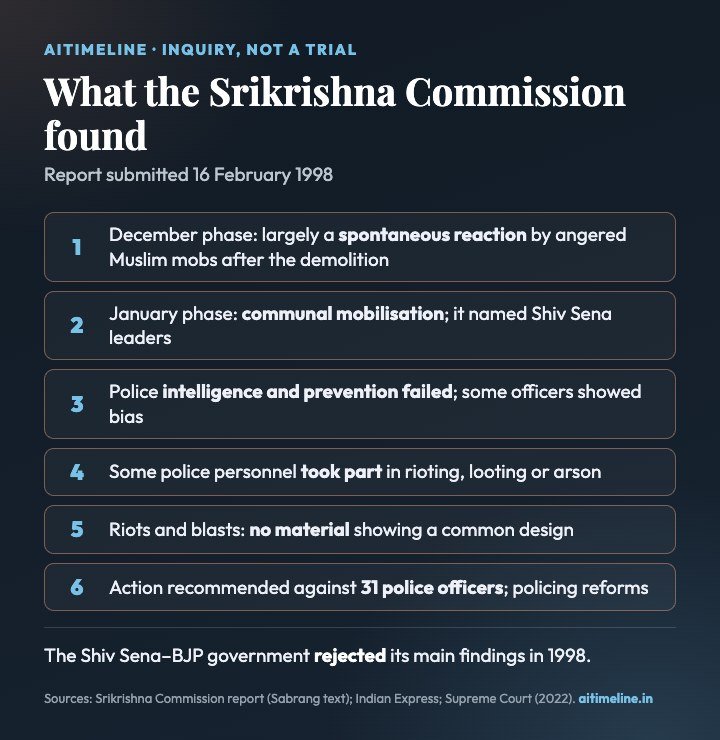
The Commission sat for five years, with a four-month break in 1996 when the Shiv Sena-led government wound it up. It examined 502 witnesses. Its findings on the police were the most damaging: inadequate intelligence and prevention, bias in some officers, failure to register or investigate offences, and some personnel taking part in the violence. It recommended action against 31 officers.
On the question added in 1996, whether the riots and the blasts were part of a common design, it said no material before it showed that. It treated the blasts as a reaction to events in Ayodhya and Bombay. A commission’s findings are not convictions, and the government of the day rejected the main ones. For other inquiries whose reports outlived the governments that ordered them, see the Shah Commission on the Emergency.
The Blasts Trials: From the TADA Court to the Gallows
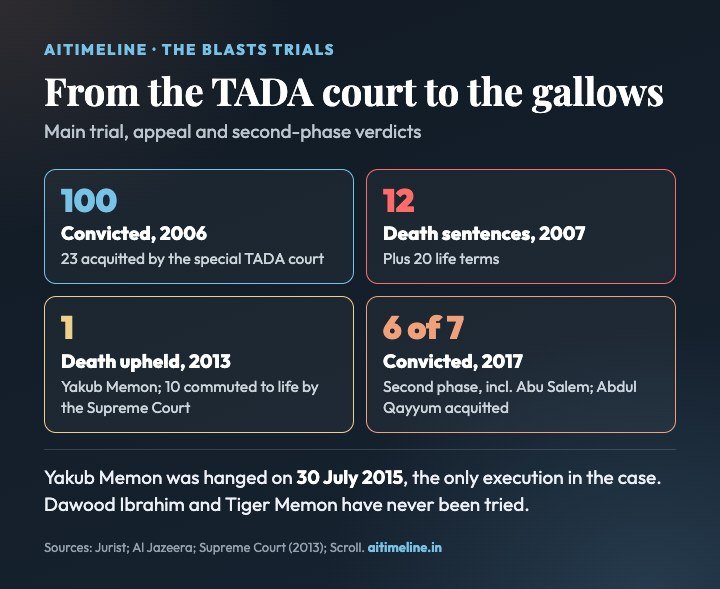
The main trial ran for more than a decade before Judge Pramod Kode of the special TADA court began delivering verdicts on 12 September 2006. By the year’s end he had convicted 100 accused and acquitted 23. Sentencing followed through 2007, ending on 31 July: 12 death sentences and 20 life terms. The Supreme Court’s 2013 judgment left only Yakub Memon’s death sentence standing.
Accused who were caught later, including Abu Salem, extradited from Portugal in 2005, and Mustafa Dossa, were tried separately. Six of seven were convicted in June 2017. Salem was spared the death penalty because of India’s assurance to Portugal, and his attempts to leave prison early were rejected by the Bombay High Court in April 2026 and the Supreme Court in September 2026. For a later blast case that took a different turn in court, see the 2008 Malegaon blast timeline.
What Happened to the Riot Cases?
253 cases, six convictions.
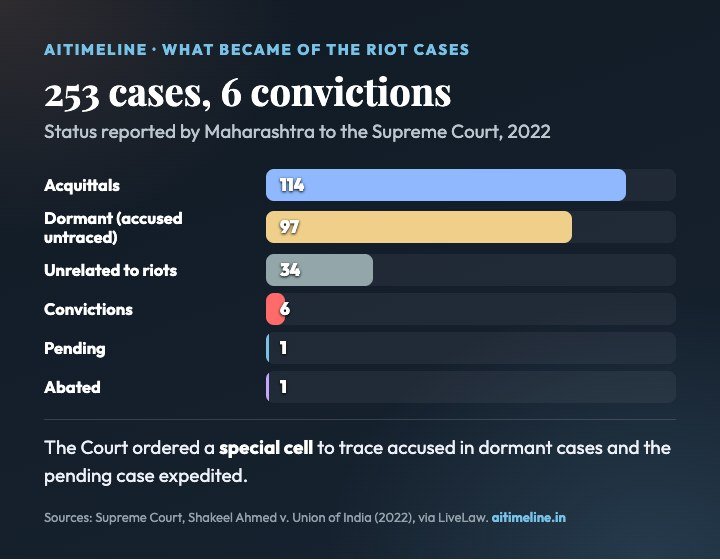
The contrast with the blasts trial is stark. Of 253 riot cases in the category the Supreme Court examined in 2022, six ended in conviction. The best-known prosecution of police, over the Suleman Usman Bakery firing, saw nine of 18 accused officers, including Joint Commissioner R.D. Tyagi, discharged in 2003. A Supreme Court ruling in 1998 freed 11 men convicted over the Radhabai Chawl arson. The same pattern of long delays and few convictions runs through the 1984 anti-Sikh riots.
The Supreme Court’s 2022 Judgment
Shakeel Ahmed v. Union of India, 4 November 2022.
Thirty years after the riots, a bench of Justices Sanjay Kishan Kaul, Abhay S. Oka and Vikram Nath decided a petition filed in 2001 seeking implementation of the Srikrishna report. It held that the state had failed to maintain law and order and to protect residents’ rights to life and liberty under Article 21, so victims had a right to compensation.
The state said it had paid Rs 2 lakh to the families of all 900 dead and of 60 of the 168 missing. The court ordered a committee led by the state legal services authority to trace the families of the other 108, with 9% annual interest on delayed payments, within nine months. It directed a special cell to trace accused in dormant cases, asked the High Court to push trial courts, and told the state to implement the police reforms it had accepted. It also held that riot victims are entitled to free legal aid as victims of ethnic violence.
Compliance has been slow. In May 2024 the court said there was hardly any compliance on police reforms; in September 2024 it noted a substantial delay in compensation.
Riots and Blasts: Why They Are Not One Case
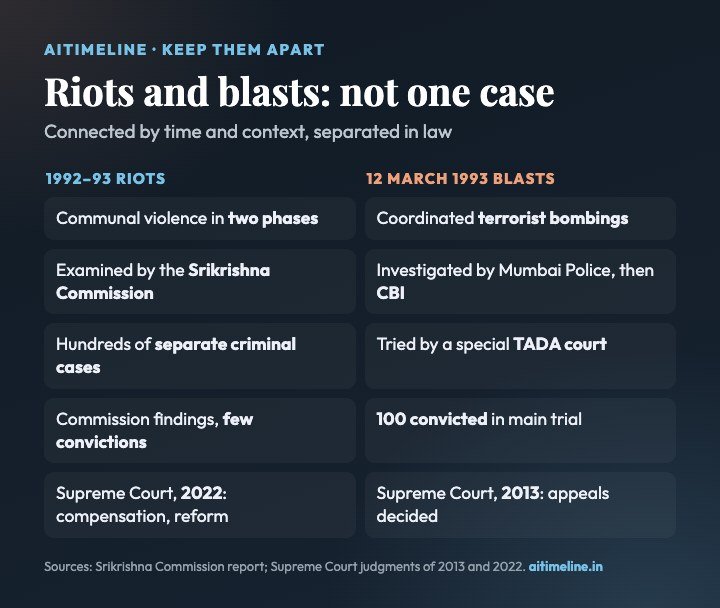
| Issue | 1992–93 riots | 12 March 1993 blasts |
|---|---|---|
| Nature | Communal violence | Coordinated terrorist bombings |
| Deaths | About 900 | 257 |
| Main inquiry | Srikrishna Commission | Mumbai Police, then CBI |
| Legal route | Hundreds of separate criminal cases | Special TADA court trials |
| Outcome | 6 convictions in 253 cases | 100 convicted (2006); 6 more (2017) |
| Key Supreme Court ruling | 2022: compensation, police reform | 2013: appeals; one death sentence upheld |
Facts at a Glance
| Question | Answer |
|---|---|
| Riots began | 6 December 1992 |
| Second phase | 6 to about 20 January 1993 |
| Blasts | 12 March 1993 |
| Commission set up | 25 January 1993 |
| Commission report | 16 February 1998 |
| TADA verdicts | September to December 2006 |
| Supreme Court appeals verdict | 21 March 2013 |
| Yakub Memon executed | 30 July 2015 |
| Second-phase verdict | 16 June 2017 |
| Riots compensation judgment | 4 November 2022 |
| Abu Salem plea dismissed | 10 September 2026 |
Explore More Timelines
People Also Ask
Frequently Asked Questions
Based on court records, the Commission’s report and reporting to 15 November 2026.
⚠️ Editorial Note
This timeline reflects information available on 15 November 2026. It treats the riots and the blasts as separate episodes, and keeps apart Commission findings, chargesheet allegations, trial verdicts and Supreme Court judgments. Riot casualty figures are those recorded by the Supreme Court in 2022; blast injury figures vary by source. Checking the record, we corrected the brief we worked from in four places: the Commission’s mandate was expanded to the blasts when it was revived on 28 May 1996, not in May 1995; the 12 death sentences were handed down in 2007, not on 12 September 2006, when verdicts began; Abdul Qayyum was acquitted on 16 June 2017, not at sentencing in September; and the brief omitted the Commission’s finding that the riots and blasts were not shown to be part of a common design. We could not confirm the brief’s figures of 1,371 A-summary cases and a review of 112 of them, or that 26 accused were discharged in April 1995, and left them out. The Radhabai Chawl acquittal is reported by Communalism Combat; we did not see the judgment itself. We added developments after the brief: Tahir Merchant’s death in 2018, the 2024 Supreme Court orders, and the 2026 rulings on Abu Salem.
Related Reading on AiTimeline
Sources & further reading
Every dated entry above was checked against these references. Last reviewed 15 November 2026.
- Shakeel Ahmed v. Union of India, judgment of 4 November 2022
- State failed to maintain law and order during 1992-93 Bombay riots, victims must be compensated: Supreme Court
- Bombay Riots: Supreme Court seeks Maharashtra Govt's compliance with Justice Srikrishna Commission's recommendations on police reforms
- 1992-93 Bombay riots: SC seeks report on compliance of directions for tracing heirs of victims
- Srikrishna Commission report (full text)
- Indian court convicts six over 1993 Mumbai blasts
- India court issues last verdicts in 1993 Mumbai bombings case
- Supreme Court dismisses gangster Abu Salem's plea for premature release in 1993 Bombay blasts case
- 1993 Mumbai bomb blasts case: Bombay HC dismisses Abu Salem's plea for early release, calls remission claim premature
- Tahir Merchant, convicted in the 1993 Mumbai serial blasts case, dies in Pune
- Ram Deo Tyagi's death and the Suleman Usman Bakery case
- Out of jail in 2030: how Abu Salem pushed India to honour its promise to Portugal
- Tragedy compounded (Radhabai Chawl case)