Assam Agitation & Accord: A Timeline of Key Events (1979-1985)
Explore the Assam Agitation timeline from 1979 to 1985, including AASU protests, the Nellie massacre, the 1983 elections and the Assam Accord.
Latest Story
In April 1979 a routine revision of the voter list for a by-election in Mangaldoi turned up tens of thousands of challenged names. Within weeks Assam’s students were on the streets. This Assam Agitation timeline follows the six-year movement led by the All Assam Students’ Union (AASU) and the All Assam Gana Sangram Parishad (AAGSP): the bandhs and blockades, the collapse of one state government after another, the boycotted election of 1983 and the Nellie massacre, and the Assam Accord of 15 August 1985 that ended it. It then follows the Accord’s cut-off dates through the courts, the NRC and the Supreme Court’s 2024 ruling on Section 6A.
The Mangaldoi by-election was triggered in 1979, not 1978. MP Hiralal Patowary died on 28 March 1979. The movement did not launch in July 1979. AASU’s first bandh was on 8 June 1979 and AAGSP was formed on 26 August. The official Nellie toll is about 1,800, not 2,191; unofficial estimates are around 3,000. And the 1966-71 group did not simply have “citizenship restored”: under the Accord their names were deleted from the rolls and restored after ten years.
💡 Short Answer
The Assam Agitation (1979-1985) was a mass movement led by AASU and AAGSP demanding the detection, disenfranchisement and deportation of foreigners, chiefly migrants from Bangladesh. It began with a bandh on 8 June 1979, after the Mangaldoi roll revision, and ended with the Assam Accord on 15 August 1985. The Accord regularised those who came before 1 January 1966 and set 25 March 1971 as the cut-off for expulsion. Movement leaders formed the Asom Gana Parishad and won power in December 1985.
Assam Agitation and Accord: Key Questions
The Movement in Ten Points
- The trigger: the 1979 revision of the Mangaldoi Lok Sabha rolls after the MP’s death.
- The start: AASU’s 12-hour bandh on 8 June 1979; AAGSP formed on 26 August.
- The demand: detection, disenfranchisement and deportation of foreigners, using 1951 as the base.
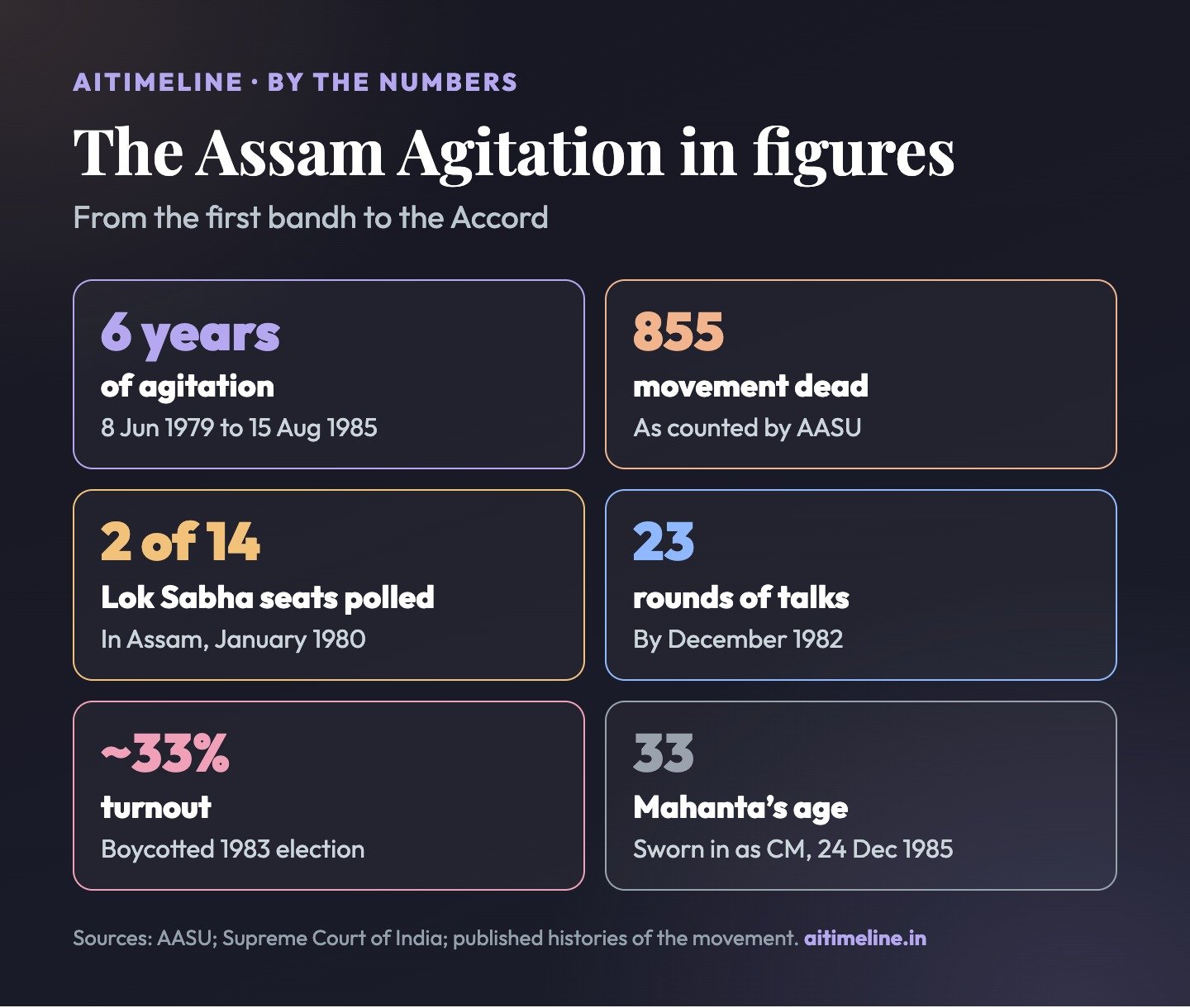
- The shutdown: in January 1980 only 2 of Assam’s 14 Lok Sabha seats could poll.
- The instability: President’s Rule three times and two short-lived ministries by 1982.
- The sticking point: 1951 against 1971, through 23 rounds of talks by December 1982.
- The 1983 election: boycotted, about 33 per cent turnout, and the Nellie massacre on 18 February.
- The Accord: signed on 15 August 1985 with 1966 and 1971 as cut-offs.
- The new party: the AGP, formed on 14 October 1985, took power that December.
- The legacy: Section 6A, the IMDT ruling, the NRC and Clause 6 all trace back to 1985.
Background: Why the Movement Began
Migration, electoral rolls and a decades-old worry.
A long history of migration. Under British rule, tea-garden labourers came from central India, Bengali Hindus filled administrative posts, and from about 1901 Muslim peasants from Mymensingh in east Bengal settled the river flood plains. Partition in 1947 and the 1971 Bangladesh war brought large new movements of people across a porous border.
The fear. For many Assamese organisations the central concern was that non-citizens were being added to electoral rolls and could change the outcome of elections, alongside worries about land, jobs and language. The External Affairs Ministry had flagged foreigners on voter lists in 1963, and in October 1978 Chief Election Commissioner S.L. Shakdhar said it was happening on a large scale.
The other side. Bengali-speaking Muslims and Hindus, many of them citizens of long standing, feared the campaign would lead to wrongful identification, harassment and loss of rights. That fear runs through every later chapter, from 1983 to the NRC.
The Trigger: Mangaldoi, 1979
A by-election that was never held.
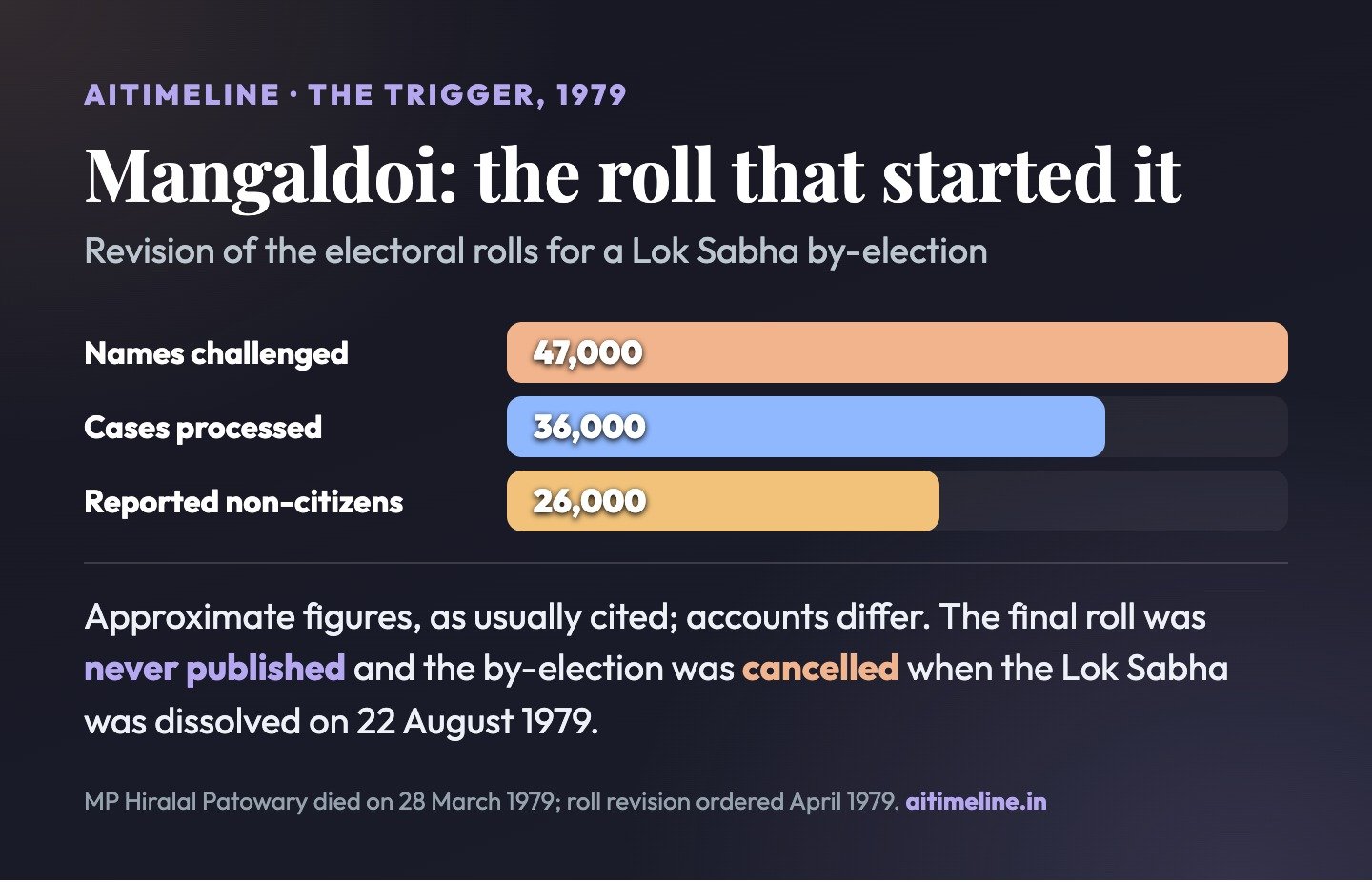
From a by-election to a movement. MP Hiralal Patowary died on 28 March 1979 and the Election Commission ordered a summary revision of the rolls in April. The scale of the challenges turned a long-simmering complaint into a mass campaign. The tribunals were halted, the roll was never finalised, and the by-election was cancelled when the Charan Singh government fell and the Lok Sabha was dissolved.
Treat the numbers with care. The 47,000, 36,000 and 26,000 figures are the ones most often quoted, but they come from accounts of a process that was abandoned midway, and sources differ.
Assam Agitation Timeline, Newest First
Tagged by theme: roots and rolls, protest and state response, talks and laws, elections and violence, the Accord and after.
Supreme Court upholds Section 6A, 4 to 1 Accord and after
What happened: The Supreme Court upheld Section 6A of the Citizenship Act, the provision that put the Assam Accord’s citizenship terms into law. Four judges held it valid. Justice J.B. Pardiwala dissented and would have struck it down with prospective effect.
What the majority said: The Assam Accord was a political solution to the migration problem and Section 6A its legislative solution. The majority also said the detection and deportation of post-1971 migrants should be monitored by the Court.
Why it matters: It settled, for now, the legal basis of the 1966 and 1971 dates agreed in 1985, which had been under challenge since 2012.
Clause 6 committee reports; state accepts most of it Accord and after
What happened: The committee on Clause 6, the Accord’s promise of safeguards for the “Assamese people”, gave its report to Chief Minister Sarbananda Sonowal on 25 February 2020. It proposed that people resident in Assam since 1951 be treated as Assamese for these safeguards.
2024: In September 2024 the Himanta Biswa Sarma government said it would implement 57 of the 67 recommendations that fall within the state’s powers. The list it then published contained 52.
Why it matters: Clause 6 was the part of the Accord about identity rather than migrants. For 35 years nobody had defined who it covered.
Final NRC excludes about 19 lakh people Accord and after
What happened: The updated NRC for Assam was published. Of about 3.3 crore applicants, 19,06,657 were left out. The update used 24 March 1971 as the cut-off, the date fixed by the Assam Accord.
What followed: Those excluded could appeal to Foreigners Tribunals. The list was criticised from all sides, by groups who said it left out genuine citizens and by groups who said it let in migrants. It has not been notified as final by the Registrar General of India.
Connection to 1985: The NRC was the most direct attempt yet to carry out Clause 5 of the Accord.
Supreme Court strikes down the IMDT Act Accord and after
What happened: On a petition by Sarbananda Sonowal, a former AASU president, the Supreme Court declared the Illegal Migrants (Determination by Tribunals) Act, 1983 unconstitutional. Pending cases were moved to Foreigners Tribunals.
The reasoning: The Court held that the Act had become the main barrier to identifying and deporting illegal migrants. It noted that in Assam, unlike the rest of India, the burden of proof lay on the accuser rather than the accused.
Why it matters: AASU had demanded repeal of the IMDT Act from the day it was passed. The Accord itself, in Clause 5.9, recorded their objection.
Prafulla Kumar Mahanta becomes Chief Minister Accord and after
What happened: Candidates of the new Asom Gana Parishad and movement-backed independents won a clear majority in the December 1985 Assembly election. Prafulla Kumar Mahanta, the AASU president who had signed the Accord, was sworn in as Chief Minister on 24 December. He was 33.
The vote: The Lok Sabha polls that had been skipped in Assam in December 1984 were held at the same time. Bengali-speaking Muslim voters largely backed the new United Minorities Front; many plains tribal voters backed the Plains Tribals Council of Assam.
Why it matters: Student leaders who had led a six-year agitation were now running the government that had to implement their own Accord.
Section 6A enters the Citizenship Act Accord and after
What happened: Parliament inserted Section 6A, “Special provisions as to citizenship of persons covered by the Assam Accord”, into the Citizenship Act, 1955, with effect from 7 December 1985.
What it says: People of Indian origin who came to Assam from Bangladesh territory before 1 January 1966 were deemed citizens. Those who came from 1 January 1966 to 24 March 1971, once detected by a Foreigners Tribunal, had to register; for the next ten years they had the rights of citizens except the vote, and at the end of ten years they became citizens.
Why it matters: This turned the political deal of 15 August into law. It is the provision the Supreme Court upheld in 2024.
AASU leaders form the Asom Gana Parishad Accord and after
What happened: At a two-day convention in Golaghat, the agitation’s leaders launched a regional party, the Asom Gana Parishad (AGP). Mahanta became its president. Smaller regional groups merged into it.
Why it matters: It moved the movement from the street into elections. The new party campaigned on carrying out the Accord.
The Assam Accord is signed Talks and laws
Who signed: For the movement: Prafulla Kumar Mahanta (AASU president), Bhrigu Kumar Phukan (AASU general secretary) and Biraj Kumar Sarma (AAGSP). For the governments: R.D. Pradhan, Union Home Secretary, and P.P. Trivedi, Assam Chief Secretary.
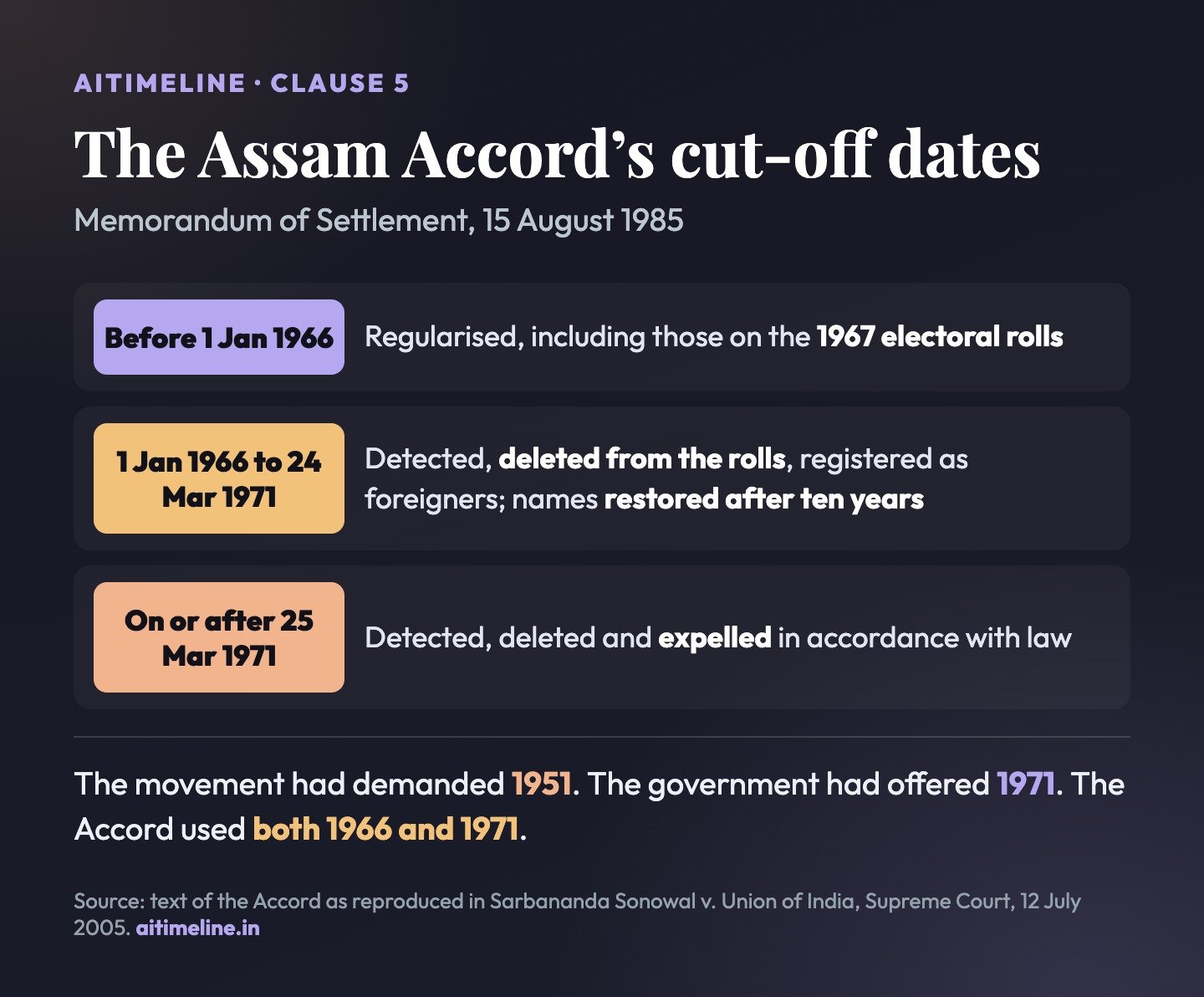
The cut-off dates: Clause 5: those who came before 1 January 1966 to be regularised; those who came from 1 January 1966 to 24 March 1971 to be detected, deleted from the rolls and registered as foreigners, with their names restored to the rolls after ten years; those who came on or after 25 March 1971 to be detected, deleted and expelled.
The rest: Clause 6 promised constitutional, legislative and administrative safeguards for the Assamese people’s cultural, social and linguistic identity. Other clauses covered border fencing, economic development, and the withdrawal of cases against agitators. The Saikia Assembly was to be dissolved and fresh elections held.
Formal talks resume under Rajiv Gandhi Talks and laws
What happened: According to the Accord’s own text, several rounds of informal talks were held during 1984 and formal discussions resumed in March 1985.
What changed: Rajiv Gandhi had a huge majority after the December 1984 general election and was settling several conflicts by negotiation. The movement accepted 1966 as the base date and 1971 as the expulsion cut-off, instead of the 1951 date it had demanded.
Indira Gandhi is assassinated Elections and violence
What happened: Prime Minister Indira Gandhi was killed by two of her bodyguards. Her son Rajiv Gandhi succeeded her and won the December 1984 general election by a landslide.
In Assam: The Lok Sabha election was not held in Assam with the rest of the country. It was held in December 1985, after the Accord, alongside the Assembly election. For most of the 1980s, Assam was largely unrepresented in the Lok Sabha.
The IMDT Act: a separate law for Assam Talks and laws
What happened: The President promulgated the Illegal Migrants (Determination by Tribunals) Ordinance on 15 October 1983. Parliament replaced it with an Act that came into force on 25 December 1983. It applied only to Assam.
How it differed: Everywhere else, the Foreigners Act, 1946 puts the burden of proving citizenship on the person accused. Under the IMDT Act, the burden lay on the accuser, who had to live within 3 km of the accused and pay a fee. It covered only those who entered on or after 25 March 1971.
The reaction: Supporters said it protected genuine citizens, including minorities targeted in 1983, from harassment. AASU said it made detection almost impossible.
The Nellie massacre Elections and violence
What happened: Armed crowds attacked Nellie and about 14 nearby villages and killed Bengali-speaking Muslim residents over six to seven hours. Women and children were among the dead.
The toll: The commonly cited official figure is about 1,800. Unofficial estimates are around 3,000. A figure of 2,191 also circulates, but it is not the standard official count.
The aftermath: The official Tewary Commission blamed agitation leaders as well as the police. Cases were dropped after the Accord. Nobody has been convicted.
Assam votes under a boycott Elections and violence
What happened: The Assembly election went ahead in three phases despite a boycott call by AASU and AAGSP. Official turnout was about 33 per cent. Congress (I) won a large majority and Hiteswar Saikia became Chief Minister.
The security picture: Around 150,000 armed personnel were deployed, according to later accounts. Roads were blocked, bridges burned and officials stayed away from poll duty.
The violence: Clashes spread between many groups, not only Assamese and Bengali: at Nellie, Gohpur, Kokrajhar, Dhemaji, Samaguri and elsewhere.
Elections called; leaders arrested at the airport Elections and violence
What happened: As AASU and AAGSP leaders flew back from talks in New Delhi, the government announced Assembly elections for February. The leaders were arrested on landing at Guwahati airport.
Why elections then: President’s Rule could not then run beyond a year, and the Assembly had been dissolved on 19 March 1982. A constitutional amendment to extend it was discussed but dropped.
Where talks stood: By December 1982 there had been 23 rounds of talks. The cut-off date for identifying foreigners was still the main sticking point.
Governments rise and fall Elections and violence
What happened: Anwara Taimur formed a Congress (I) government in December 1980; it fell in June 1981. Keshab Chandra Gogoi formed another in January 1982; it fell within two months and President’s Rule returned in March 1982.
Why it matters: The movement refused to recognise these governments. Neither side could govern Assam without the other.
Assam declared a disturbed area Protest and state response
What happened: The Governor notified almost all of Assam, except North Cachar Hills district, as a disturbed area for two months from 6 April 1980, under both the state Disturbed Areas Act and the Armed Forces (Special Powers) Act. The Army had been called out in late March.
The court: The Gauhati High Court stayed the notifications on 7 April. On 18 April, after the Supreme Court told it to rehear the matter, it let the notifications take effect but stayed the provisions allowing police and armed forces to fire and use force “even to the causing of death”.
Why it matters: It was the first time the movement had faced emergency security law across almost the whole state.
The first meeting with Indira Gandhi Talks and laws
What happened: Weeks after returning to power, Indira Gandhi met the movement’s leaders. AASU gave her a memorandum on the “continuing influx of foreign nationals” and its effects on Assam’s political, social, cultural and economic life.
The sticking point: The movement wanted the 1951 NRC and census as the basis for identifying foreigners. The government offered 24 March 1971, the date of the Bangladesh war, instead.
Why it matters: The 1985 Accord itself cites this memorandum as the start of the dialogue.
A general election Assam mostly does not hold Elections and violence
What happened: Because no candidates could file nominations in the Brahmaputra Valley, the Lok Sabha election was held only in Karimganj and Silchar, in the Barak Valley. Indira Gandhi’s Congress (I) returned to power nationally.
Why it matters: It showed the movement could shut down the electoral process in most of the state.
First martyr; President’s Rule Protest and state response
What happened: On 10 December the movement held a bandh to stop nominations. At Barpeta, police escorting a candidate clashed with protesters, and Khargeswar Talukdar, the 22-year-old general secretary of the Barpeta AASU unit, was beaten to death. On 12 December the Jogendra Nath Hazarika government fell and Assam came under President’s Rule for the first time.
Why it matters: The movement honours Talukdar as its first martyr. AASU commemorates 10 December as Swahid Diwas.
Satyagraha, picketing, an oil blockade Protest and state response
What happened: During the satyagraha of 12 to 17 November, an estimated 7 lakh people in Guwahati and 20 lakh across Assam courted arrest. From 27 November AASU and AAGSP shut educational institutions and picketed government offices. In December they blocked the movement of crude oil and plywood out of the state.
Why it matters: Many state government employees backed the movement, so administration largely stopped rather than confronting it.
AAGSP is formed Roots and rolls
What happened: AASU and other organisations, including regional parties and cultural bodies, formed the All Assam Gana Sangram Parishad as an ad hoc coalition to run the agitation alongside the students.
Why it matters: It gave the student movement a wider base. AAGSP’s Biraj Kumar Sarma would sign the Accord six years later.
AASU’s first bandh Roots and rolls
What happened: AASU called a 12-hour bandh across Assam demanding the “detection, disenfranchisement and deportation” of foreigners. Historians usually treat this as the start of the Assam Movement.
Why it matters: The three Ds became the movement’s slogan and the basis of every later round of talks.
Mangaldoi: the electoral roll that started it Roots and rolls
What happened: After the death of the sitting MP, the Election Commission ordered a summary revision of the Mangaldoi rolls in April 1979. About 47,000 names were challenged. Of some 36,000 processed, about 26,000 were found to be non-citizens, according to the figures usually cited; accounts differ.
What happened to the by-election: The tribunal process was halted, the final roll was never published, and the by-election was cancelled when the Lok Sabha was dissolved on 22 August 1979.
Why it matters: The numbers turned a long-running complaint into a mass movement.
ULFA is founded, separately Roots and rolls
What happened: A small group founded ULFA with the aim of a sovereign Assam through armed struggle.
Why it matters: ULFA was not part of the Assam Movement and did not share its demand. AASU and AAGSP sought action within the Constitution. The two are often confused.
The Election Commission sounds the alarm Roots and rolls
What happened: Shakdhar said foreigners’ names were being included in electoral rolls on a large scale, and at the demand of political parties. A Union minister repeated the concern in the Rajya Sabha in November 1978.
Background: The External Affairs Ministry had flagged foreigners on voter lists as early as 1963. In 1975 the Home Ministry asked states to use their CID to identify them.
Who Governed Assam, 1978-1985
Five chief ministers and three spells of President’s Rule before the AGP.
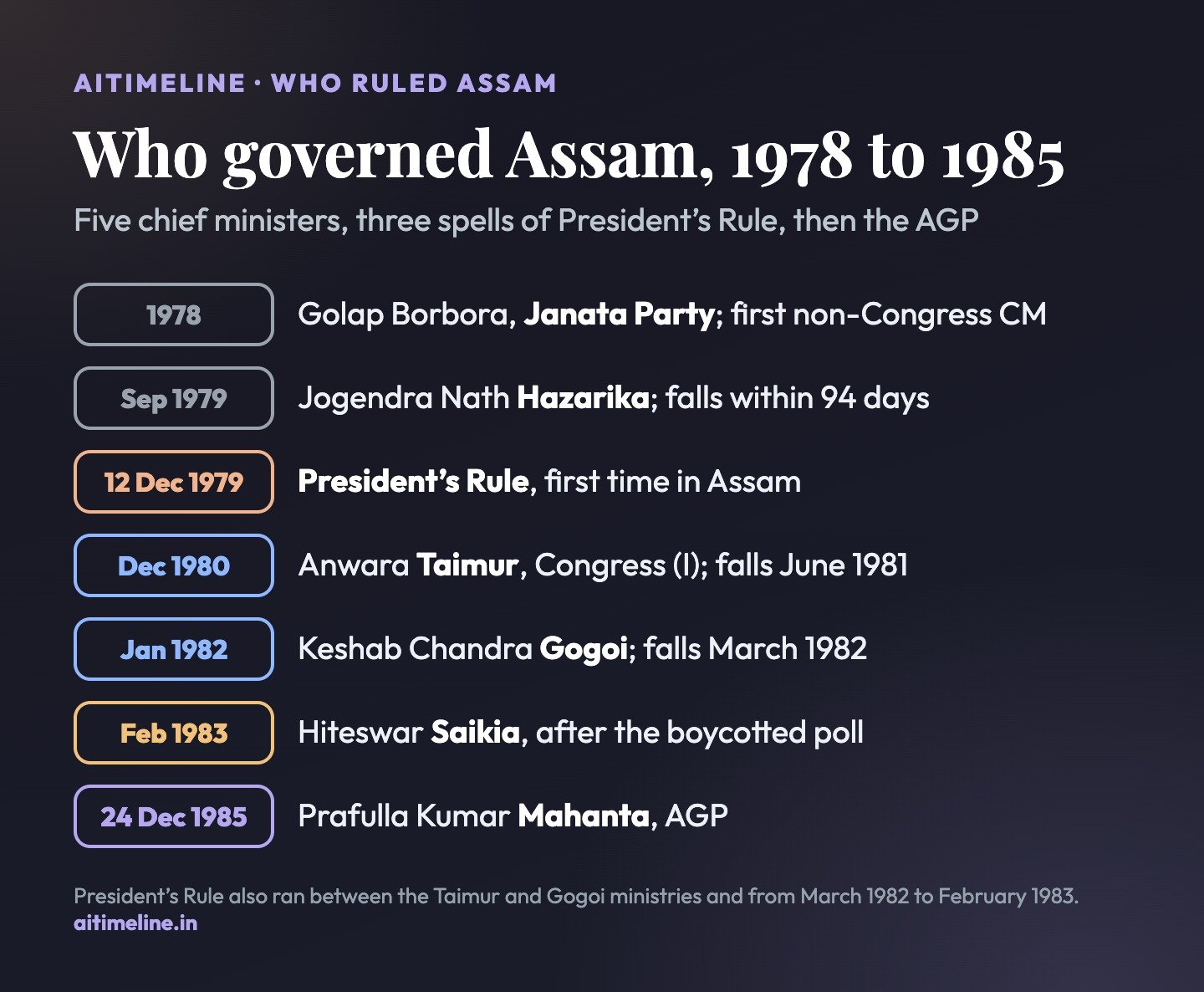
A state without a stable government. The movement did not recognise the Congress (I) ministries formed in 1980 and 1982, and they did not last. Each collapse brought back President’s Rule, which under the rules of the time could not run for more than a year. That limit is what forced the 1983 election.
1983 and 1985: Two Elections
One held against the movement, one won by it.
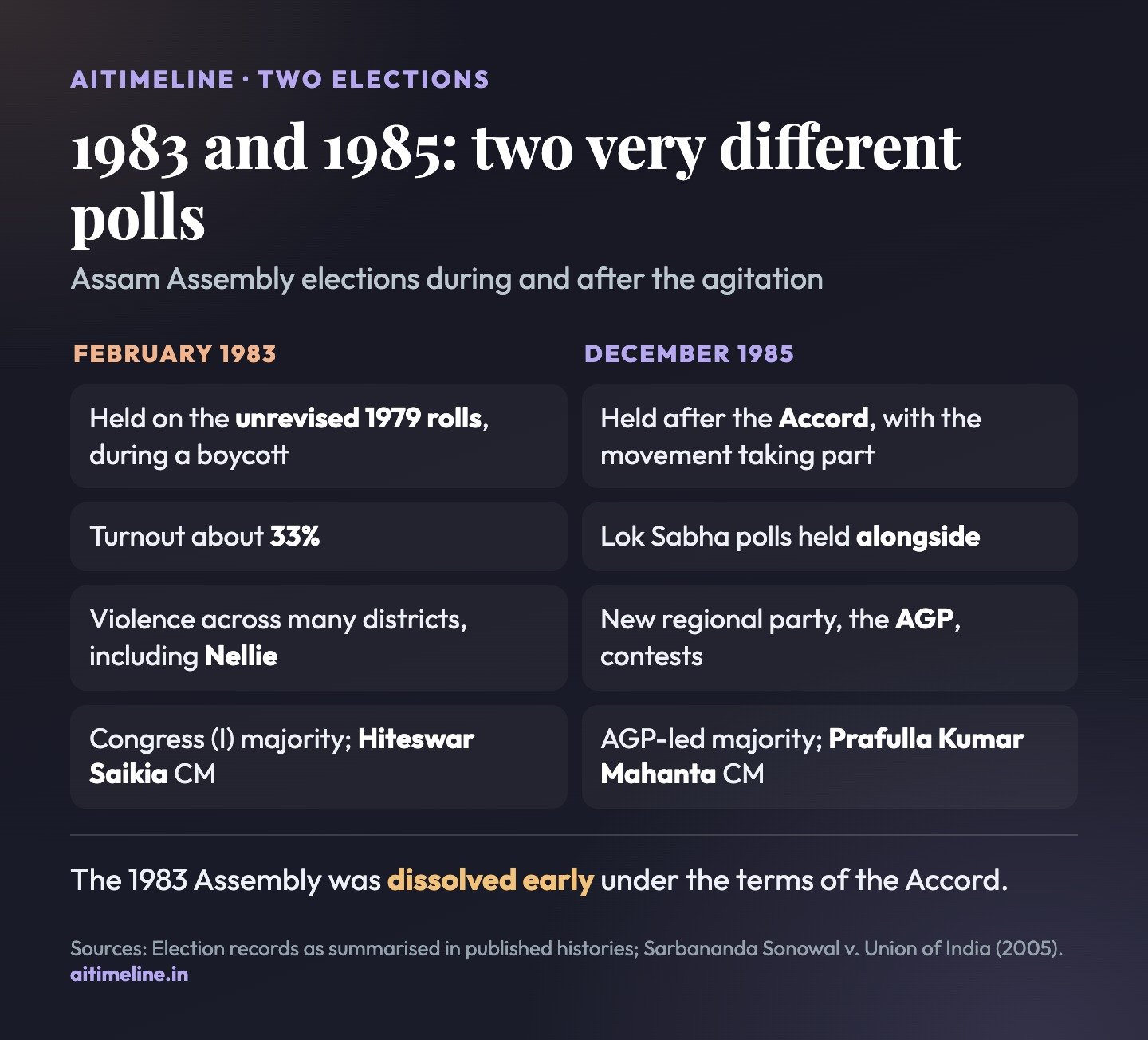
February 1983 vs December 1985
What the Assam Accord Said
The Memorandum of Settlement of 15 August 1985.
| Clause | What it provides | Where it stands |
|---|---|---|
| 5.1-5.2 | 1 January 1966 as base date; earlier arrivals regularised | In law via Section 6A |
| 5.3-5.6 | 1966-71 arrivals detected, off rolls for ten years | Upheld by the Supreme Court, 2024 |
| 5.8 | Arrivals on or after 25 March 1971 detected and expelled | NRC used this date in 2019 |
| 5.9 | “Due consideration” to objections to the IMDT Act | Act struck down, 2005 |
| 6 | Safeguards for Assamese identity and heritage | Report 2020; partly accepted 2024 |
| 7-10 | Development, border fencing, birth and death registers | Implemented in parts |
A compromise on dates. The movement had wanted 1951, the year of the first NRC. The Union government had offered 1971. The settlement used both: 1966 for regularisation and 1971 for expulsion, with a ten-year loss of the vote for those in between.
Who signed. Prafulla Kumar Mahanta and Bhrigu Kumar Phukan for AASU, Biraj Kumar Sarma for AAGSP, Home Secretary R.D. Pradhan and Assam Chief Secretary P.P. Trivedi, in the presence of Rajiv Gandhi.
The IMDT Act: A Separate Law for Assam
In force from 25 December 1983 to 12 July 2005.
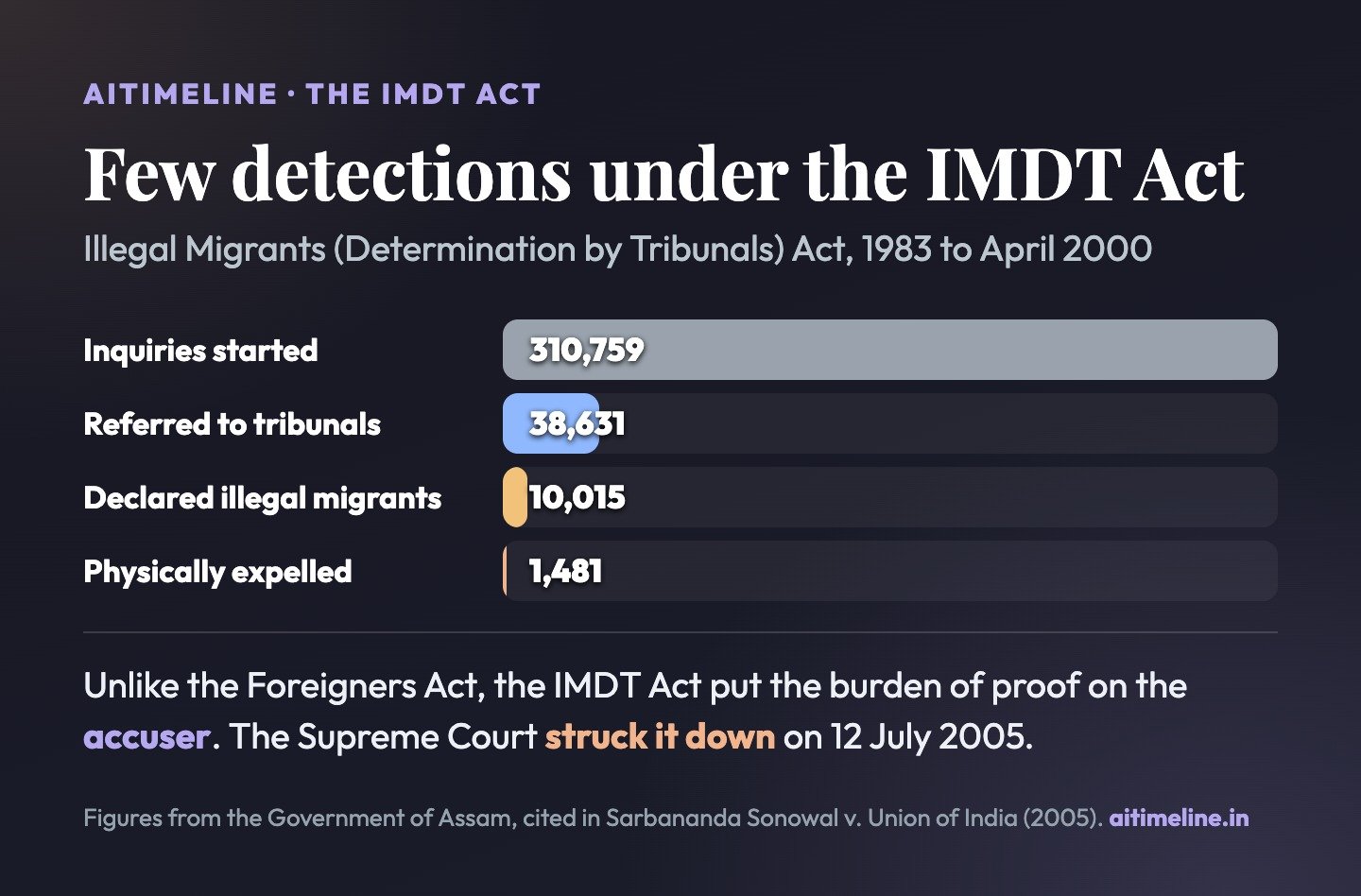
Two views of the same law. The Act’s defenders said it protected genuine citizens, including minorities who had suffered in 1983, from malicious complaints. Its critics, led by AASU, said it made detection nearly impossible. In 2005 the Supreme Court agreed with the critics.
The Legacy: Forty Years On
How the 1985 settlement still shapes Assam’s politics and law.
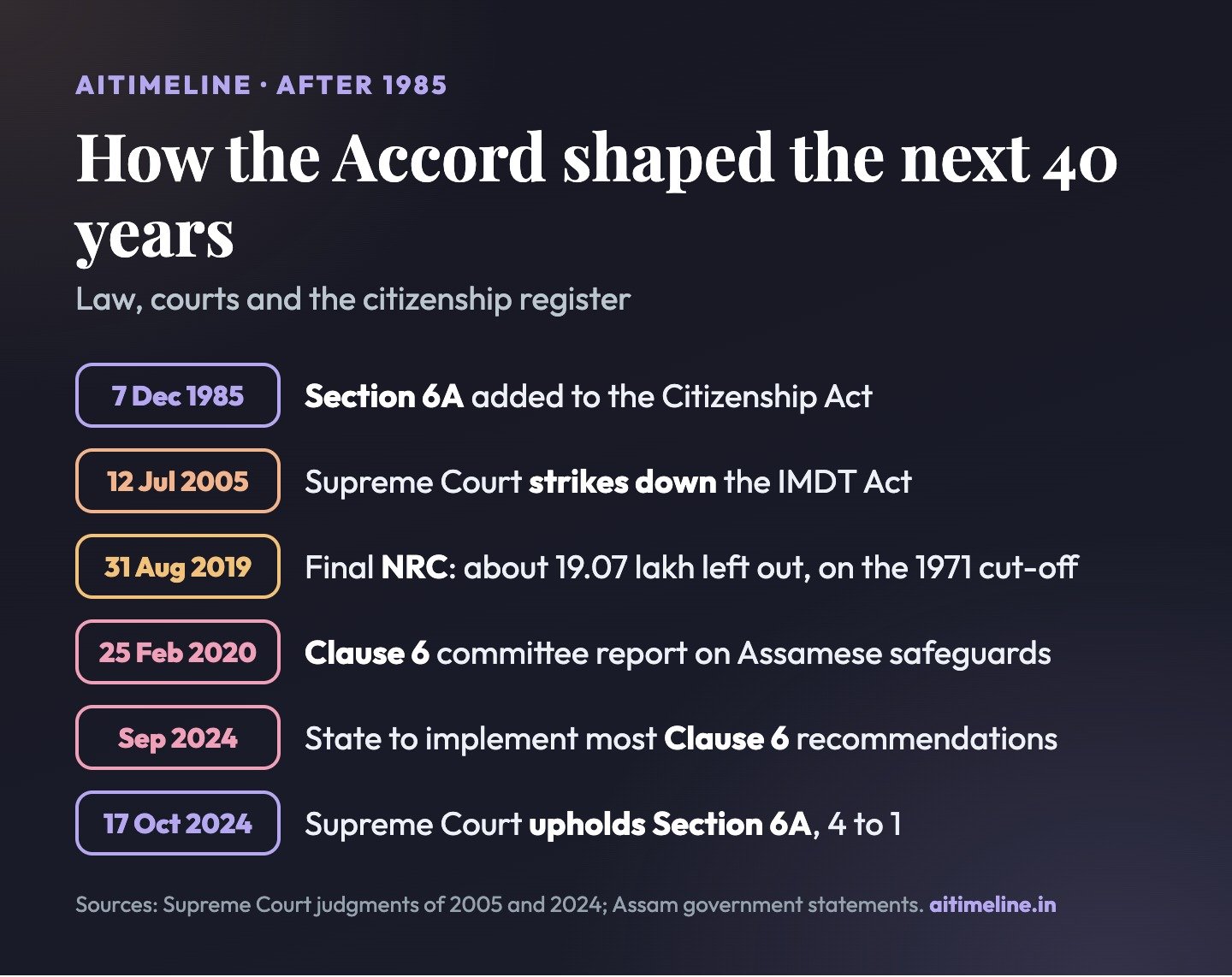
The NRC. The 2019 update of the National Register of Citizens was the most direct attempt to apply Clause 5. It left out about 19 lakh people and satisfied almost no one.
The CAA. The Citizenship (Amendment) Act 2019 offered a route to citizenship to some non-Muslim migrants who came after 1971. AASU led large protests in Assam on the ground that it broke the Accord’s cut-off. Our CAA-NRC protests timeline covers that story.
The human cost. AASU commemorates 855 people killed in the movement. Thousands more, mostly Bengali-speaking Muslims, were killed in the violence of early 1983. The movement is remembered very differently by different communities.
Who Was Who
Prafulla Kumar Mahanta
Signed the Accord, founded the AGP and became Chief Minister on 24 December 1985.
Bhrigu Kumar Phukan
Co-signed the Accord; a public face of the movement and later an AGP minister.
Biraj Kumar Sarma
Signed the Accord for the All Assam Gana Sangram Parishad.
Indira Gandhi
Met the leaders on 2 February 1980, offered 1971 as the cut-off and called the 1983 election.
Rajiv Gandhi
Resumed formal talks in March 1985; the Accord was signed in his presence.
Hiteswar Saikia
Led the Congress (I) government formed after the boycotted 1983 election.
S.L. Shakdhar
Warned in 1978 of foreigners on the rolls; later halted the Mangaldoi tribunals.
Sarbananda Sonowal
Former AASU president whose petition led the Supreme Court to strike down the IMDT Act.
Did You Know?
- Assam in Parliament: because of the 1980 boycott, Assam was largely unrepresented for most of the 7th Lok Sabha.
- Same-day announcement: Rajiv Gandhi announced the Accord in his Independence Day speech on 15 August 1985.
- Mass arrests: an estimated 20 lakh people courted arrest during the November 1979 satyagraha.
- Only one: Anwara Taimur, CM from 1980 to 1981, is the only woman and only Muslim to have led Assam.
- Not the same thing: ULFA, founded in April 1979, sought independence and was never part of the movement.
- Six weeks apart: the Punjab Accord was signed on 24 July 1985, the Assam Accord on 15 August.
Explore More Timelines
People Also Ask
Frequently Asked Questions
Based on the Accord’s text, court records and published histories.
⚠️ Editorial Note: What We Checked
We checked the brief we started from against the text of the Accord as reproduced by the Supreme Court in 2005, the Gauhati High Court’s April 1980 order and published histories. Mangaldoi: MP Hiralal Patowary died on 28 March 1979, so the by-election process began in 1979, not 1978. The launch: AASU’s first bandh was on 8 June 1979 and AAGSP was formed on 26 August 1979, not July. Disturbed areas: the 6 April 1980 notification quoted by the High Court excludes only North Cachar Hills, not Cachar; we give the Army’s deployment only as late March. Nellie: the commonly cited official toll is about 1,800, not 2,191. Clause 5: it restores names to the electoral rolls after ten years; citizenship for that group was set out in Section 6A. Seat totals for the 1985 election vary between sources, so we do not give one. This article is a historical account and not legal advice.
Related Reading on AiTimeline
Sources & further reading
Every dated entry above was checked against these references. Last reviewed 19 November 2026.
- Supreme Court of India: Sarbananda Sonowal v. Union of India, 12 July 2005 (text of the Assam Accord, IMDT Act history and figures), via Indian Kanoon
- Gauhati High Court: Indrajit Baruah v. State of Assam, 18 April 1980 (disturbed-area and AFSPA notifications of 6 April 1980), via Indian Kanoon
- LiveLaw: Supreme Court upholds validity of Section 6A of Citizenship Act recognising Assam Accord by 4:1 majority (17 October 2024)
- Scroll: Explained - why the Supreme Court upheld Assam Accord-driven Section 6A of the Citizenship Act (October 2024)
- EastMojo: Assam CM assures proper execution of Clause 6 committee report (25 February 2020)
- ThePrint: After 45 years of rallying, Assam govt approves 85% of panel proposals to implement Clause 6 (September 2024)
- Government of Assam: Implementation of Assam Accord Department
- Wikipedia: Assam Movement (phases, Mangaldoi roll figures, 1980 and 1983 elections)