2,000 Jeeps Ordered, 155 Delivered: The Scandal That Shook Early India
Explore the 1948 Jeep Scandal involving V.K. Krishna Menon, the Army's failed procurement of 2,000 jeeps, parliamentary scrutiny and the 1960 settlement.
Latest Story
The Jeep Scandal of 1948 began as an emergency purchase for an army at war in Kashmir. India’s High Commission in London, headed by V.K. Krishna Menon, ordered 2,000 reconditioned jeeps from a British firm at £250 each. Payments of 65% were made on 1,004 of them. Only 155 reached India, and the Army rejected them. What followed lasted twelve years: questions in Parliament, a private rebuke from Nehru, an internal Cabinet review, a Public Accounts Committee that wanted judges to fix responsibility, a file the government closed anyway, and a lawsuit in Britain that ended in a settlement in 1960. This page sets out what the record shows, in order, and separates what was admitted from what was only alleged.
💡 Short Answer
In June 1948 India’s High Commission in London, under V.K. Krishna Menon, agreed to buy 2,000 reconditioned jeeps for the Army at £250 each. India paid 65% of the price on 1,004 jeeps, but only 155 were shipped, and they were rejected on arrival in 1949. A replacement contract followed in 1951. Nehru told Parliament he found no corruption; the Public Accounts Committee disagreed and asked for an inquiry by High Court judges. None was held. The government closed the matter in 1954–55 and settled a related lawsuit out of court in 1960.
Jeep Scandal 1948: Key Questions
The Jeep Scandal in Nine Points
- Urgent need: in 1948 the Army was fighting in Kashmir and short of jeeps.
- The order: 2,000 reconditioned jeeps at £250 each, arranged by the High Commission in London under Krishna Menon.
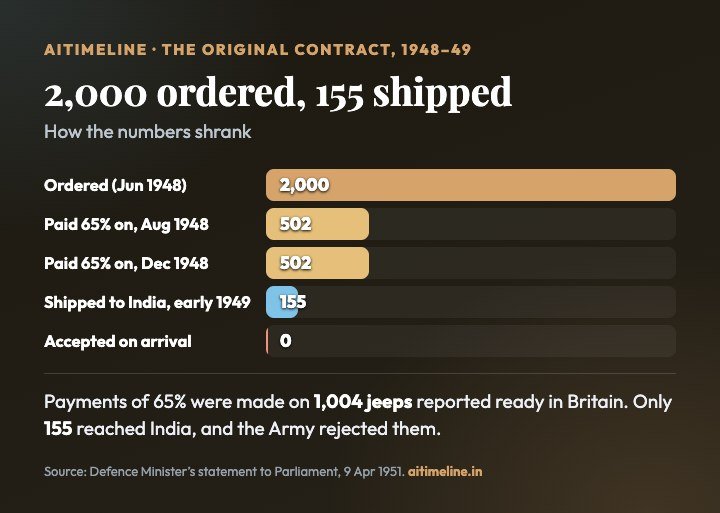
- Money first: 65% of the price was paid on 1,004 jeeps reported ready in Britain.
- Weaker checks: in November 1948 inspection was cut to random checks on 10%, with job cards for the rest.
- 155 jeeps: the only ones shipped, and the Army rejected them in early 1949.
- A rescue deal: 1,007 new jeeps and a £143,162 credit under a contract signed in March 1951.
- Two verdicts: the government found irregularities but no bad faith; the PAC wanted High Court judges to fix responsibility.
- File closed: no judicial inquiry was held, and the government closed the matter in 1954–55.
- No conviction: the case ended with a commercial settlement in 1960, not a court ruling on corruption.
Two Verdicts on One Deal
The real story is the disagreement, not just the missing jeeps.
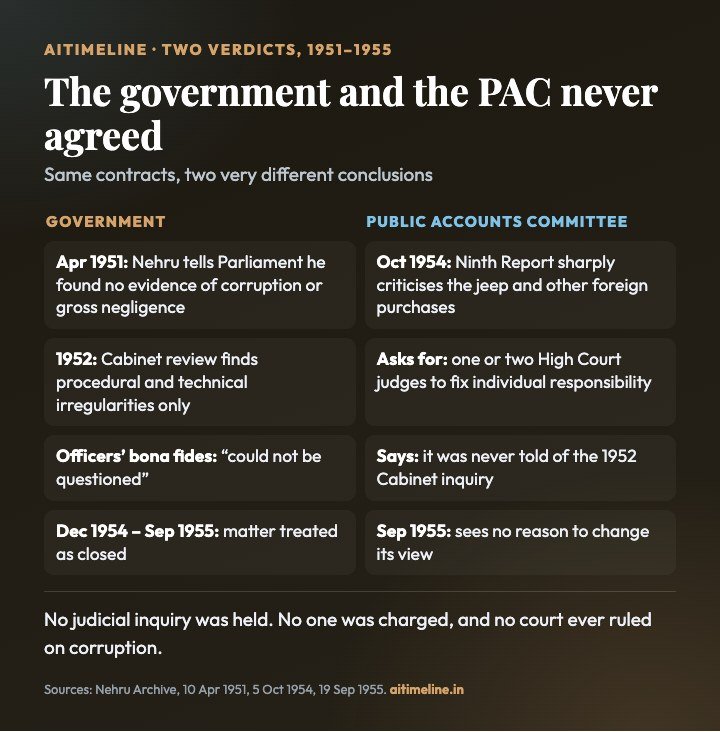
That jeeps were paid for and not delivered is not in dispute. The argument was over what it meant. The government’s line, set by Nehru in 1951 and repeated after a Cabinet review in 1952, was that there had been lapses of procedure in difficult wartime conditions but no corruption and no bad faith. The Public Accounts Committee, which examines how public money is spent, read the same papers and wanted someone held responsible by an independent inquiry.
The committee also complained that it was not told about the 1952 Cabinet review until after it had made its recommendation. The government kept its position, and the inquiry the committee asked for was never set up.
The 1948 Contract: What Was Agreed
As set out to Parliament by the Defence Minister on 9 April 1951.
| Term | Detail |
|---|---|
| Offer received | June 1948, by the High Commissioner in London |
| Official in charge | V.K. Krishna Menon, High Commissioner to the UK |
| Supplier | A British firm; widely reported as Anti-Mistantes |
| Quantity | 2,000 wartime-pattern jeeps |
| Condition | New, or reconditioned “as good as new” |
| Price | £250 a jeep, plus 10% for spare parts |
| Payment | 65% when certified ready; 20% on shipping papers; 15% on arrival |
| Total value | About Rs 80 lakh, as commonly reported |
The terms were not unusual on paper. Paying most of the price when goods are certified ready is common in urgent contracts. The weak point was the certification: the payments were only as good as the inspection behind them, and that inspection was about to change.
Timeline: The Jeep Scandal, 1948–1962
Newest first. Colour shows the strand each event belongs to.
Krishna Menon resigns as Defence Minister Krishna Menon
What happened: V.K. Krishna Menon resigned from the Defence Ministry in the wake of India’s defeat in the 1962 war with China.
Link to 1948: His critics had raised the jeep deal again and again after he entered the Cabinet. His resignation, though, was about the conduct of the 1962 war, not the 1948 contract.
Out-of-court settlement ends the litigation Litigation
Terms: According to Nehru’s statement, the defendants gave up their claims against the Government of India under two contracts that were in arbitration, and the government withdrew its claims against the defendants in the court case.
What it was not: This was a commercial settlement. It was not a criminal judgment and it did not find, or rule out, corruption in the original deal.
Nehru explains the proposed settlement Litigation
What happened: Nehru told the House the government had first preferred to fight the case, but reconsidered when the defendants offered to settle on terms under which both sides would withdraw their claims.
Status: The settlement had been initialled but not finalised when he spoke.
The jeep case returns to Parliament, as a lawsuit Litigation
What happened: Members asked about proceedings in Britain. The government had sued the defendants for about £254,498, and the defendants had filed a counter-claim.
Why it matters: Five years after the government closed the inquiry, the money side of the dispute was still unsettled.
Menon becomes Defence Minister Krishna Menon
What happened: After the 1957 general election, Krishna Menon took charge of the Defence Ministry.
Why critics pointed to it: Opposition members repeatedly cited the jeep affair when attacking his appointment. The appointment itself does not establish wrongdoing in the 1948 purchase.
Menon joins the Union Cabinet Krishna Menon
What happened: Krishna Menon, a Rajya Sabha member from Madras since 1953, was inducted into Nehru’s Cabinet as a Minister without Portfolio.
Why it matters: The timing, soon after the government closed the jeep matter, became part of the opposition case that the inquiry had been wound up to clear his path.
Government announces the case is closed Parliament & PAC
What happened: Secondary accounts report that Govind Ballabh Pant told Parliament the government had made up its mind to close the matter, and that if the opposition was not satisfied it could make it an election issue.
Caveat: We could not reach the Lok Sabha record for this date. The quote is as widely reported, not checked against the debates.
PAC and government restate their positions Parliament & PAC
Government: The 1952 Cabinet inquiry had found procedural and technical irregularities but no reason to question the officers’ bona fides.
Committee: The Public Accounts Committee said it saw no reason to depart from its earlier criticism, while accepting that further action was for the executive to decide.
Finance Minister says the matter may be closed Parliament & PAC
What happened: The Finance Minister told the Lok Sabha the jeep matter could be treated as closed.
The objection: The PAC said it had not been given reasonable time to consider the government’s note, and had not been told about the Cabinet inquiry of 1952.
PAC’s Ninth Report demands accountability Parliament & PAC
Findings: The report was sharply critical of several foreign defence purchases, including the jeep contracts, and of the Defence Ministry and the High Commission in London.
Recommendation: It asked that individual responsibility be assessed by a high-level committee of one or two High Court judges.
Nehru’s note: In an internal note, Nehru accepted that the matter could not simply be left there and that the government had to decide whether more investigation was needed.
Nehru asks why the jeeps were rejected Government review
What happened: Nehru wrote to Mahavir Tyagi about a report from the Director of Audit, Defence Services, which said the 155 jeeps, once condemned, were running after repairs and were reportedly doing good work.
Why it matters: Nehru questioned why the vehicles had been rejected, and said the affair had cost the government money and reputation.
Cabinet committee reviews the contracts Government review
What it found: According to the government’s later account, the review found procedural and technical irregularities, but concluded that the bona fides of the officers involved could not be questioned.
What it was not: This was an internal government review. It was not an independent judicial commission, and its report was not published.
Nehru: no evidence of corruption Parliament & PAC
What he said: Nehru accepted there had been delays, non-compliance with procedure and incomplete inspection, but said his examination had found no evidence of corruption or gross negligence.
His argument: He asked Parliament to judge the deal against the conditions of 1948: an army at war in Kashmir and supplies that were hard to get quickly.
Defence Minister lays the contract before Parliament Parliament & PAC
What he set out: The original requirement, the June 1948 offer, the payment terms, the inspection changes, the 155 jeeps and the replacement contract.
The core problem: The supplier and the Defence Ministry could not agree on what “reconditioned to a condition as good as new” meant.
Replacement contract is signed Procurement
What happened: The new contract, agreed in outline months earlier, was formally signed in early March 1951.
Why the delay: The government said the gap was due to discussion of relatively minor terms, including packing requirements.
Nehru writes to Krishna Menon Government review
What he wrote: Nehru said he had referred the matter to the Finance and Defence Ministries and read the papers, including notes from the Auditor-General. He admitted the transaction was hard to explain publicly and that the government had been caught in an uncomfortable position.
His worry: The replacement arrangement had still not been finalised.
Replacement deal agreed in principle Procurement
Terms: The new contractor was to credit India with £143,162, supply 1,007 new jeeps at £395 each plus £19 for crating, and deliver about 68 a month.
How the credit was worked out: It took into account the payments already made to the original supplier and the estimated cost of bringing the 155 jeeps up to standard.
Talks to rescue the contract Procurement
What happened: The High Commission tried to settle the disagreement with the supplier, but the two sides could not agree on the standard the reconditioned jeeps had to meet.
The way out: The government began to look at turning the original order into a different contract.
First 155 jeeps reach India and are rejected Procurement
What happened: Defence inspectors found the vehicles in unsatisfactory condition and rejected them as unserviceable.
The gap: Two thousand jeeps had been ordered and 65% had been paid on 1,004 of them. Only 155 ever reached India under the original deal.
Second batch paid for after Lloyds certificates Procurement
What happened: Lloyds issued inspection certificates under the new arrangement and the 65% payment on a second batch of 502 jeeps was released.
The government’s defence: It later said these were payments against vehicles reported ready and inspected at the supplier’s premises, not unconditional advances.
Inspection rules are relaxed Procurement
What happened: A claim on the second batch of 502 jeeps was held up because inspection certificates had not been produced. The supplier said the inspecting organisation lacked staff and proposed Lloyds instead.
The change: Indian officials agreed to random inspection of 10% of the vehicles and an examination of job cards for the rest.
First 65% payment released Procurement
What happened: Under the contract, 65% of the price was paid for 502 jeeps reported ready for delivery.
The question: The government said the payment was backed by inspection-related certificates. Critics questioned whether the papers were complete.
Offer for 2,000 reconditioned jeeps accepted Procurement
The deal: The High Commissioner told the Defence Ministry of an offer to supply 2,000 reconditioned wartime-pattern jeeps, guaranteed new or “as good as new”, with deliveries to begin at once. The ministry accepted and the High Commission signed with a British firm.
Payment terms: 65% on certification that the vehicles were ready, 20% against shipping documents, 15% on arrival in India.
The firm: Widely reported as Anti-Mistantes, a little-known company said to have had a capital of only £605.
Army shortages identified Procurement
What happened: An official review of essential military stores found the new Indian Army short of several items, including jeeps.
Why it matters: The urgency of 1948 later became the centre of the government’s defence of the deal.
How the Safeguards Were Loosened
The November 1948 inspection change, and why it mattered.
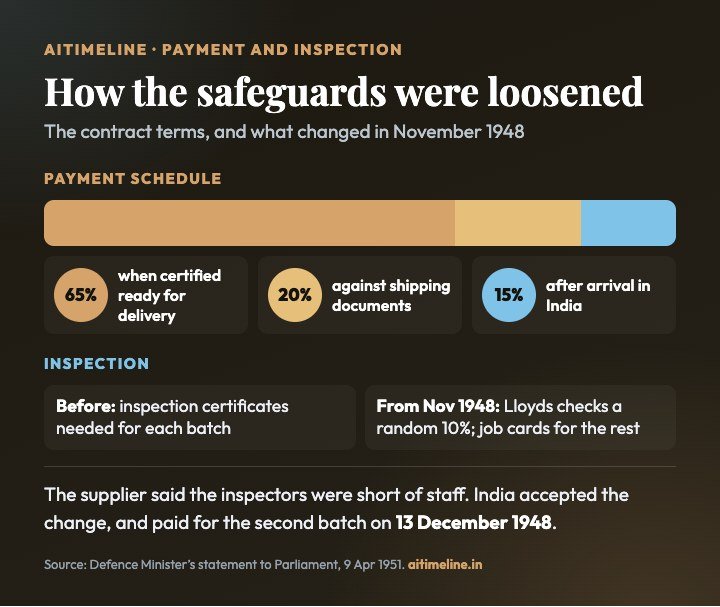
When the claim for the second batch of 502 jeeps was held up for lack of inspection certificates, the supplier said the inspectors were short of staff and offered Lloyds instead. Indian officials agreed to a lighter procedure: Lloyds would check one jeep in ten at random, and the firm’s own job cards would stand in for inspection of the rest. Payment followed on 13 December 1948.
By the end of the year India had paid 65% of the price on 1,004 jeeps that were still in Britain. When the first 155 arrived and failed inspection, the weakness of the arrangement was plain.
✅ What the government said
- Payments were made against vehicles certified ready, as the contract allowed.
- They were not unconditional advances.
- The Army needed jeeps urgently in a war.
- Lapses were procedural, not dishonest.
❓ What critics asked
- Why pay before full inspection?
- Why accept a 10% sample?
- Why choose an untested supplier?
- Who was responsible for the loss?
The Replacement Contract
New jeeps, a new firm and a credit, 1950–51.
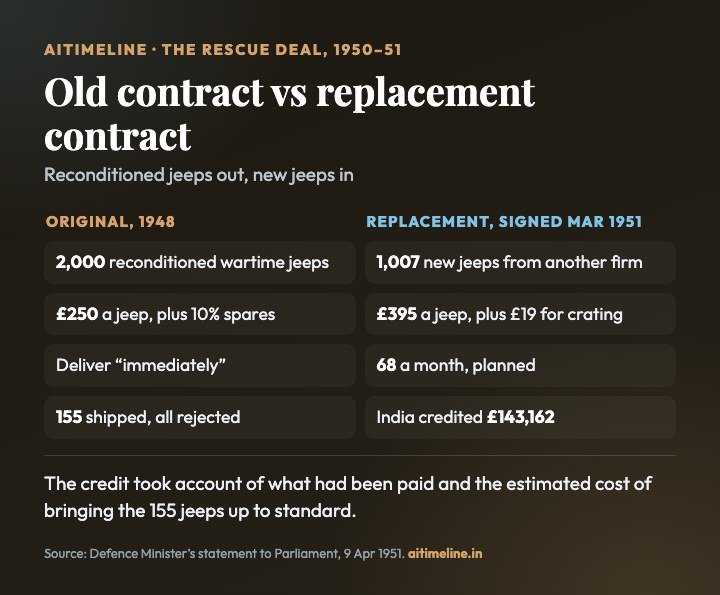
The government’s way out was to fold the old contract into a new one with a different firm. The terms were settled in July and August 1950 and signed in March 1951. The credit of £143,162 was meant to account for what had already been paid and for the cost of bringing the 155 jeeps up to standard.
Secondary accounts say the new supplier delivered far fewer jeeps than planned. We have not found that in the official record, and the government’s 1960 lawsuit and settlement suggest the money side was still open a decade later.
Five Years of Questions
From Parliament to the PAC, and a closed file.
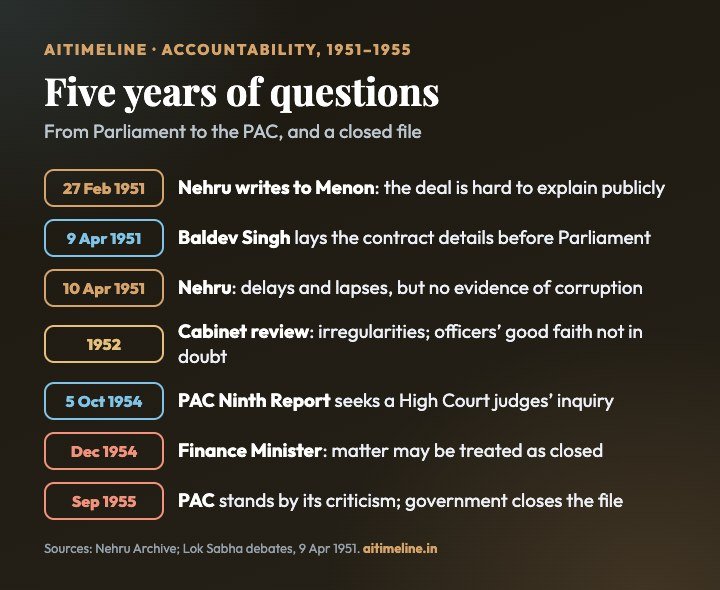
The record is unusually frank in places. In a private letter of 27 February 1951, Nehru told Menon the deal was hard to explain publicly. Six weeks later he defended it in Parliament. In 1954 he wrote to Mahavir Tyagi asking why the 155 jeeps had been rejected at all, after an audit report said they were working after repairs. And when the PAC asked for judges, his own note accepted that the matter could not just be left there. It was left there all the same.
Was the Jeep Scandal Proven Corruption?
What the record supports, and what it does not.
| Acknowledged | Government’s conclusion | Still disputed |
|---|---|---|
| Inspection and procedural lapses | No evidence of corruption or gross negligence (Nehru, 1951) | Whether the PAC’s criticism was answered |
| 2,000 jeeps ordered, 155 shipped | Officers’ bona fides not in question (Cabinet review, 1952) | Who was responsible for the loss |
| Financial loss and damage to reputation | Matter treated as closed (1954–55) | Why no judicial inquiry was held |
On the evidence, the jeep deal was a procurement failure with serious lapses of control. It was never shown to be bribery. Calling it a “scam” is common, but the stronger and more accurate charge is the one the PAC made: that public money was lost and no one was made to answer for it.
Was It Really India’s First Scandal?
The jeep case is usually called independent India’s first big scandal, and it was the first major one over a defence purchase. It was not the only one of its time. In 1951 a parliamentary committee examined H.G. Mudgal, an MP accused of promoting the Bombay Bullion Association’s interests in return for benefits. The House found his conduct incompatible with membership and he resigned before he could be expelled. Later Nehru-era rows, such as the Mundhra affair of 1957–58, followed a similar pattern of a parliamentary challenge and an inquiry.
A more careful description is one of independent India’s earliest major defence procurement scandals. Its themes — urgency, middlemen, payment before proof and a fight over who investigates — returned in later cases such as Bofors and AgustaWestland.
What Happened Next
A minister, a lawsuit and a settlement.
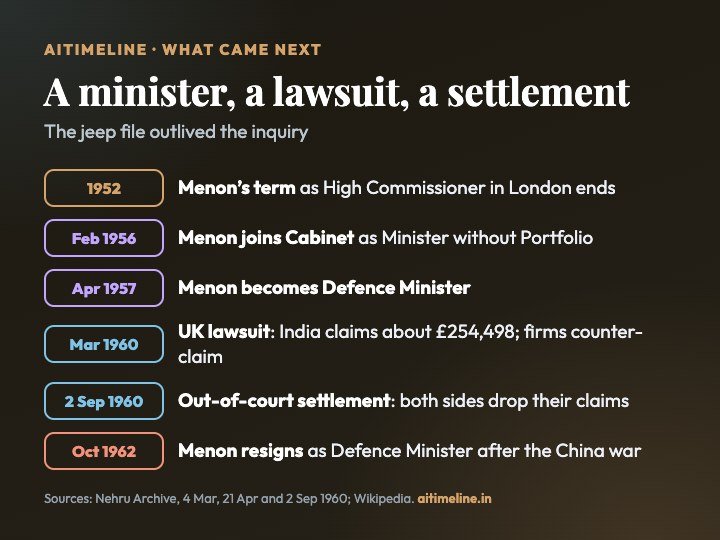
Krishna Menon’s career did not suffer. He entered the Rajya Sabha in 1953, the Cabinet in February 1956 and the Defence Ministry in 1957. Critics cited the jeep deal at every step. Meanwhile the government pursued the money in a British court, claiming about £254,498, until both sides agreed in 1960 to drop their claims. Menon left office in 1962 over the China war, not over jeeps.
Key People and Institutions
| Who | Role in the jeep case |
|---|---|
| V.K. Krishna Menon | High Commissioner in London who arranged and signed the contract |
| Jawaharlal Nehru | Prime Minister; reviewed the papers and defended the deal in Parliament |
| Baldev Singh | Defence Minister who laid the contract details before Parliament, April 1951 |
| N. Gopalaswami Ayyangar | Defence Minister involved in the 1952 review |
| Mahavir Tyagi | Received Nehru’s 1954 letter on the rejected jeeps |
| G.B. Pant | Home Minister; widely reported as announcing the closure in 1955 |
| Public Accounts Committee | Criticised the contracts and asked for a judges’ inquiry |
| Auditor-General and Defence audit | Examined the papers and the state of the jeeps |
Terms Explained
- High Commissioner: the ambassador of one Commonwealth country to another; Menon was India’s first in London.
- Reconditioned jeep: a used Second World War vehicle overhauled for resale; the contract required it to be “as good as new”.
- Inspection certificate: a document confirming goods meet the contract standard; here it triggered the 65% payment.
- Job card: a workshop’s record of repairs done on a vehicle; accepted in place of inspection for 90% of the jeeps.
- Public Accounts Committee: a parliamentary committee that examines government spending, using audit reports.
- Out-of-court settlement: an agreement ending a lawsuit without a judgment on the merits.
Explore More Timelines
People Also Ask
Frequently Asked Questions
Based on the Defence Minister’s statement of 9 April 1951 and Nehru’s papers in the Nehru Archive, with secondary accounts flagged.
⚠️ Editorial Note
The contract figures, dates and positions on this page come from the Defence Minister’s statement to Parliament of 9 April 1951 and from Nehru’s letters and statements in the Nehru Archive. Details that appear only in secondary accounts — the supplier’s name and capital, the Ayyangar committee, G.B. Pant’s 30 September 1955 remark and the replacement firm’s performance — are marked as reported. No court ever ruled that corruption took place in this deal, and nothing here should be read as saying it did.
Related Reading on AiTimeline
Sources & further reading
Every dated entry above was checked against these references. Last reviewed 10 November 2026.
- Parliamentary Debates, 9 April 1951: Defence Minister's statement on the jeep contracts
- To V.K. Krishna Menon, 27 February 1951
- The Jeeps Case, 10 April 1951
- To V.K. Krishna Menon, 13 July 1952
- To Mahavir Tyagi, 25 August 1954
- Objections in PAC Report, 5 October 1954
- Reports of the PAC and Government, 19 September 1955
- In the Lok Sabha: Jeeps Case, 21 April 1960
- In the Lok Sabha: Jeeps Case, 2 September 1960
- The Mudgal Case, 24 September 1951
- What was independent India's first big-ticket scam?
- Jeep scandal case
- V. K. Krishna Menon