Pulwama to Balakot: 15 Days That Changed India–Pakistan Relations
Follow the Pulwama attack, India's Balakot airstrike, Pakistan's response, Abhinandan Varthaman's return and the NIA investigation and trial.
Latest Story
The Pulwama attack and Balakot strike were fifteen days in February 2019 that took India and Pakistan to the edge of war. On 14 February a Jaish-e-Mohammed (JeM) suicide bomber killed 40 CRPF personnel on the Jammu–Srinagar highway. On 26 February Indian jets struck a site near Balakot in Pakistan. A day later the two air forces clashed, an Indian pilot was captured, and on 1 March he came home. The National Investigation Agency (NIA) later charged 19 people, and that trial is still running in Jammu. This page sets out every step in order, and keeps each government’s claims apart from what is independently established.
💡 Short Answer
On 14 February 2019 a car bomb driven by Adil Ahmad Dar hit a CRPF convoy at Lethpora, Pulwama, killing 40 personnel; JeM claimed it. India withdrew Pakistan’s MFN trade status and, on 26 February, struck what it called a JeM training camp near Balakot. Pakistan denied any damage and hit back from the air on 27 February, when India lost a MiG-21 and Wing Commander Abhinandan Varthaman was captured. He was freed on 1 March. The NIA charged 19 people in August 2020; the trial in Jammu had no verdict as of 10 November 2026.
Pulwama and Balakot: Key Questions
The Crisis in Ten Points
- The attack: a car with about 200 kg of explosives hit a CRPF bus at Lethpora on 14 February 2019, killing 40.
- The claim: Jaish-e-Mohammed claimed responsibility and released the bomber’s video.
- First response: India withdrew MFN status on 15 February and raised duties on Pakistani goods to 200%.
- Balakot: Indian jets struck near Balakot on 26 February; India called it a non-military pre-emptive strike.
- Disputed result: India claimed heavy JeM losses; Pakistan said nothing was hit. Neither is independently confirmed.
- Air clash: on 27 February India lost a MiG-21; its claim of downing an F-16 is denied by Pakistan.
- Own goal: an IAF Mi-17 was shot down by India’s own missile over Budgam the same day, killing seven.
- Return: Abhinandan Varthaman came home on 1 March, easing the crisis.
- Investigation: a dead planner’s damaged phone broke the case; the NIA charged 19 in August 2020.
- Now: the trial is pending; no one has been convicted as of 10 November 2026.
Fifteen Days: 14 February to 1 March 2019
The sequence that took two nuclear-armed neighbours to the brink.
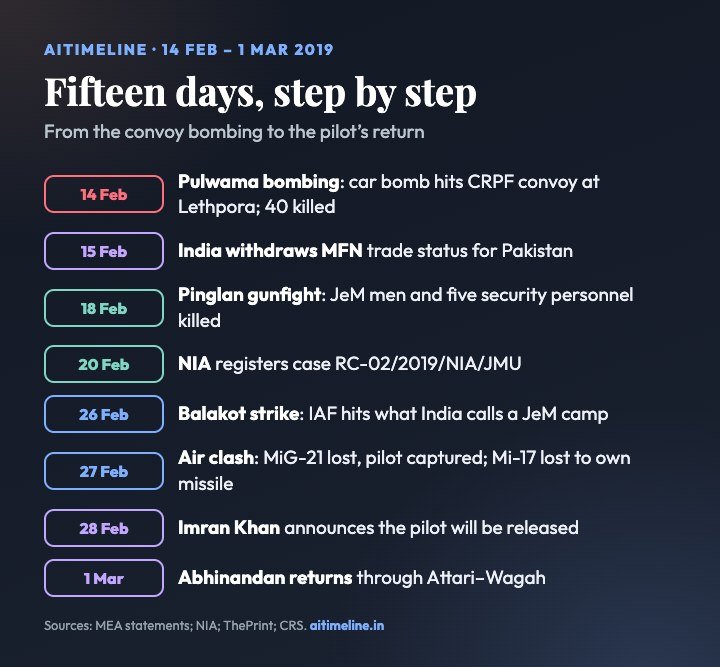
The convoy had been held for days because snow closed the highway. When the road reopened on 14 February, a column of 78 vehicles carrying about 2,500 personnel set off from Jammu, as widely reported. At Lethpora, about 20 km from Srinagar, a Maruti Eeco pulled alongside a bus and exploded. The NIA later said the bomb had been ready since 6 February and was held back only by the weather.
The political pressure for a response was immediate, with a general election weeks away. Over the next twelve days India moved on trade, diplomacy and, finally, the military option, the first air strike across the Line of Control since the 1971 war.
Timeline: Pulwama Attack and Balakot Strike, 2019–2026
Newest first. Colour shows the strand each event belongs to.
Where the case stands Courts
On record: The NIA filed its chargesheet against 19 accused on 25 August 2020, and the special court framed charges on 10 December 2022. Prosecution witnesses have been examined since 2023.
Not decided: No accused has been convicted or acquitted. The NIA’s own case page still lists the matter as under investigation, and five accused living in Pakistan or in hiding have never appeared.
Latest order: The most recent ruling we could find is the 20 August 2026 order refusing bail to Insha Jan. We found no later hearing reported up to 10 November 2026.
Special court refuses bail to Insha Jan Courts
The ruling: The court held that the material in the case diary and chargesheet gave reasonable grounds to treat the accusations against her as prima facie true, so the bar on bail in Section 43-D(5) of the Unlawful Activities (Prevention) Act applied. It also said the risk of her influencing key witnesses could not be ruled out.
Her plea: Her lawyer said she had been in jail for more than six years, that only 49 of 240 prosecution witnesses had testified, and that none had linked her to the crime. The NIA put the number examined at 55.
The allegation: The NIA says Adil Ahmad Dar’s propaganda video was recorded at her house on 28 and 29 January 2019, and cites WhatsApp calls, voice notes and photos found on Umar Farooq’s phone.
Accused plotter reported shot dead in Muzaffarabad Investigation
Who: Arjumand Gulzar Dar, alias Hamza Burhan, a Pulwama man whom Indian officials describe as one of the planners of the 2019 attack, was reported shot dead by unidentified gunmen in Muzaffarabad.
Background: The Home Ministry had designated him a terrorist under the UAPA in 2022. He was not one of the 19 accused in the 2020 chargesheet.
FATF cites Pulwama in a terror-financing report Diplomacy & politics
The finding: The global watchdog used the attack as a case study of e-commerce misuse, noting that aluminium powder used to boost the blast was bought online through Amazon.
Matches the chargesheet: The NIA had alleged in 2020 that accused Waiz-ul-Islam ordered 4 kg of aluminium powder from his Amazon account on the instructions of a Pakistani JeM operative.
Pahalgam brings the 2019 template back Military
What happened: After 26 people were killed at Baisaran near Pahalgam on 22 April 2025, India struck targets in Pakistan on 7 May under Operation Sindoor, a far larger operation than Balakot.
The link: Officials and analysts repeatedly cited Balakot as the precedent: an attack blamed on Pakistan-based groups, followed by a cross-border strike.
Accused Bilal Ahmad Kuchey dies in custody Investigation
What happened: Kuchey, arrested by the NIA on 5 July 2020 and accused of supplying phones to the JeM module, fell ill in Kishtwar district jail and died of a heart attack after being moved to hospital in Jammu.
The case: His death ended the case against him without a verdict. A viral claim that he died of custodial harassment was checked and found misleading.
Satya Pal Malik’s claims about the convoy Diplomacy & politics
His claim: Malik, Governor of Jammu and Kashmir at the time of the attack, said the CRPF had asked for aircraft to move its personnel and that the Home Ministry refused, and that he was told to stay quiet about lapses.
Reaction: Opposition parties demanded answers and a white paper. Home Minister Amit Shah said the BJP had nothing to hide. The claims have not been tested by any inquiry.
Witnesses begin to testify Courts
Progress: The prosecution began examining its witnesses in 2023. By August 2026 between 49 and 55 of the 240 listed witnesses had been heard, according to the two sides’ figures in the bail hearing.
Why it is slow: The defence says the trial could take another decade at this pace. The NIA says it does not need to examine every listed witness.
Charges framed against the accused Courts
The charges: The court framed charges including criminal conspiracy, waging war against the state, murder and attempted murder under the RPC, and terrorism offences under the UAPA.
Significance: Framing charges means the judge found enough material to proceed to trial. It is not a finding of guilt. Insha Jan did not challenge the order, which the NIA later cited against her bail plea.
Abhinandan receives the Vir Chakra Military
The award: Group Captain Abhinandan Varthaman received India’s third-highest wartime gallantry award. The citation credits him with shooting down a Pakistani F-16 on 27 February 2019.
Pakistan’s response: On 23 November Pakistan’s Foreign Office called the claim “entirely baseless”, repeating that no F-16 was lost.
Pakistani minister’s remark in parliament Diplomacy & politics
What he said: Then science minister Fawad Chaudhry appeared to describe Pulwama as an achievement of Imran Khan’s government, then rephrased it to refer to Pakistan’s strike “after the Pulwama incident”.
Two readings: Indian ministers called it an admission. Chaudhry and Pakistan’s Foreign Office said he meant the 27 February air operation and that Pakistan was not involved in the bombing.
NIA charges 19, including Masood Azhar Courts
Who: Seven arrested local men and women; six dead militants including bomber Adil Ahmad Dar and planner Umar Farooq; and six absconders, among them JeM chief Masood Azhar and his brothers Rouf Asgar and Ammar Alvi.
The case: The agency said the attack was a conspiracy run by the JeM’s Pakistan-based leadership, that Umar Farooq infiltrated through the Samba border in April 2018, and that two IEDs of about 160 kg and 40 kg were built and fitted into a Maruti Eeco.
The charges: Sections of the Ranbir Penal Code (including conspiracy, waging war and murder), the UAPA, the Arms Act and the Explosive Substances Act.
More arrests follow the phone trail Investigation
3 March: Insha Jan and her father, Peer Tariq Ahmad Shah, of Hakripora, were arrested, accused of sheltering the JeM men.
March to July: Waiz-ul-Islam, Mohd Abbas Rather, Bilal Ahmad Kuchey and Mohd Iqbal Rather were arrested, accused of buying chemicals online, sheltering militants, supplying phones and moving Umar Farooq.
First arrest, a year after the attack Investigation
Who: A furniture-shop owner near the blast site, accused of scouting convoy movements from December 2018, storing the explosives and driving Adil Dar to the highway on 14 February.
How: Investigators found his photograph in the data recovered from Umar Farooq’s phone.
A damaged phone gives the NIA its lead Investigation
The device: A damaged Samsung phone found where Umar Farooq was killed sat with the Jammu and Kashmir Police for months before it reached the NIA.
What it held: Recovered photos, videos, chats and voice notes, many deleted after being sent to his uncle in Pakistan, documented the planning. Investigators said the audio alone took 14 hours to review.
IAF admits Budgam helicopter was its own Military
The admission: The air chief called the downing of an Mi-17 V5 helicopter at Budgam on 27 February a “big mistake”: it was hit by India’s own Spyder air-defence missile. Six IAF personnel and a civilian on the ground were killed.
Inquiry: A court of inquiry held officers responsible; reports said the helicopter’s friend-or-foe identification system was off.
Pakistan reopens its airspace Diplomacy & politics
What happened: Pakistan fully reopened its airspace to civilian flights, closed since 27 February, ending months of rerouted and longer flights for airlines on India–Europe and India–Gulf routes.
Owner of the attack car killed Investigation
Who: Sajjad Ahmad Bhat of Bijbehara, who the NIA says bought the Maruti Eeco used in the attack in January 2019 and joined the JeM, was killed in a gunfight in Anantnag. Reports put the date between 16 and 18 June.
UN lists Masood Azhar Diplomacy & politics
The listing: After China lifted a technical hold it had used to block earlier proposals, the committee listed the JeM chief, subjecting him to an assets freeze, travel ban and arms embargo.
The wording: The final listing did not mention Pulwama by name, a point Pakistan stressed. India called it a diplomatic success.
Umar Farooq killed at Nowgam Investigation
Who: Muhammad Umar Farooq, a Pakistani national, son of IC-814 hijacker Ibrahim Athar and nephew of Masood Azhar, is described by the NIA as the main planner. He and Pakistani IED expert Mohd Kamran Ali were killed in an encounter, 43 days after the attack.
The evidence: His damaged phone, recovered from the site, later became the NIA’s key evidence.
JeM commander Mudasir Khan killed in Tral Investigation
Who: Mudasir Ahmad Khan, a JeM commander from Tral, was killed in an encounter. Police called him a key conspirator; the NIA later said he supplied gelatin sticks for the bomb.
Abhinandan returns through Attari–Wagah Diplomacy & politics
The return: Pakistan handed Wing Commander Abhinandan Varthaman to Indian officials at the Attari–Wagah border after a delay of several hours. Crowds waited on the Indian side through the day.
De-escalation: His return took the edge off the crisis, though diplomatic and trade measures stayed in place.
Imran Khan announces the pilot’s release Diplomacy & politics
The announcement: Prime Minister Imran Khan said the captured pilot would be released the next day as a “gesture of peace”.
Context: The US, Saudi Arabia, the UAE and others had urged both sides to step back.
Air clash over the Line of Control Military
India’s account: The MEA said Pakistani aircraft targeted military installations on the Indian side and were repelled. It said a MiG-21 Bison shot down a Pakistani aircraft, that India lost one MiG-21, and that the pilot was missing.
Pakistan’s account: Pakistan said it struck open ground near Indian military sites to show capability, shot down two Indian jets and used no F-16s. It later spoke of one pilot in custody.
The pilot: Wing Commander Abhinandan Varthaman ejected over Pakistani-administered Kashmir and was captured. Videos of his capture and questioning circulated widely.
Budgam: The same morning an IAF Mi-17 helicopter crashed in Budgam, killing seven. India later admitted its own missile brought it down.
Indian Air Force strikes near Balakot Military
India’s account: Foreign Secretary Vijay Gokhale said India struck “the biggest training camp of JeM”, eliminating “a very large number” of militants, trainers and commanders, after credible intelligence of another suicide attack. He called it a “non-military preemptive action” and gave no figure.
Pakistan’s account: Pakistan said Indian jets crossed the Line of Control, dropped their payload in an empty forested area while withdrawing, and caused no casualties or damage to infrastructure.
What is established: Both governments agree Indian aircraft crossed into Pakistan and released weapons. Satellite images analysed by independent researchers and foreign reporting did not confirm large-scale destruction, and no independent death toll exists.
NIA takes over the case Investigation
What happened: The NIA re-registered Awantipora police’s FIR 20/2019 as its own case under the Ranbir Penal Code, Explosive Substances Act and UAPA. An NIA team had been at the site since 15 February.
Pinglan gunfight Investigation
Losses: Major Vibhuti Shankar Dhoundiyal and three soldiers of 55 Rashtriya Rifles, a policeman and a civilian were killed, along with three militants.
Who died: The Army said JeM commander Kamran, also called Abdul Rasheed Ghazi, a Pakistani linked to the attack, was among them. The NIA’s later account lists a Pakistani IED expert, Mohd Kamran Ali, as killed on 29 March.
India withdraws MFN status and raises duties Diplomacy & politics
Trade: On 15 February India withdrew Most Favoured Nation trade status from Pakistan. On 16 February it raised basic customs duty on all Pakistani imports to 200%.
Diplomacy: The Ministry of External Affairs briefed envoys and called on Pakistan to act against the JeM. Pakistan rejected any link to the attack.
Suicide bombing at Lethpora Attack
The attack: A Maruti Eeco carrying about 200 kg of explosives was driven into a bus in a convoy of 78 vehicles carrying about 2,500 CRPF personnel. Forty were killed and eight seriously injured, according to the NIA.
Responsibility: Jaish-e-Mohammed claimed the attack and released a video of the bomber, Adil Ahmad Dar of Gundibagh, Kakapora, who had joined the group in 2018.
Response: India blamed Pakistan-based JeM; Pakistan condemned the attack and denied any role.
Who Carried Out the Pulwama Attack?
The group that claimed it, the bomber, and what the investigators allege.
Adil Ahmad Dar of Gundibagh, Kakapora, Pulwama. Aged 21 per the NIA (some reports said 19 or 20). Joined the JeM in 2018. Identified by DNA matched with his father.
Jaish-e-Mohammed, founded by Masood Azhar after his release in the 1999 IC-814 hijack swap. Banned in India and Pakistan; claimed the attack the same day.
Muhammad Umar Farooq, Azhar’s nephew, who the NIA says crossed the Samba border in April 2018 and ran the JeM in Pulwama. Killed on 29 March 2019.
Dar’s local roots mattered to both sides. India’s investigators said JeM’s handlers chose a Kashmiri bomber so the attack would look home-grown. Pakistan pointed to the same fact to deny any link. The NIA’s chargesheet, built mainly on digital evidence, names a chain of Pakistani operatives and local helpers. Those allegations are what the trial is testing.
What Exactly Happened at Balakot?
India’s account, Pakistan’s account, and the narrow ground that is established.
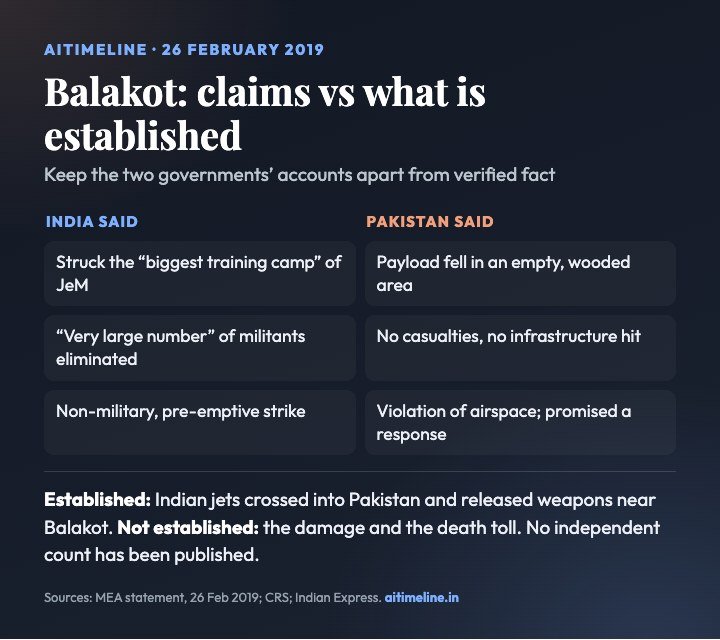
| Question | India said | Pakistan said |
|---|---|---|
| Who spoke | MEA, Foreign Secretary Vijay Gokhale | Army spokesman and government |
| Target | JeM’s biggest training camp | Forested hillside |
| Reason | Credible intelligence of more suicide attacks | Aggression; airspace violated |
| Character | Non-military, pre-emptive | Act of aggression |
| Deaths | “Very large number”, no figure | None |
| Civilians | Target chosen to avoid them | None hurt; trees damaged |
India never released a casualty figure. Numbers that circulated in Indian media came from unnamed sources or politicians, not from the government’s formal statement. Satellite imagery examined by independent analysts and foreign news agencies after the strike showed buildings at the site still standing, though such imagery cannot show what happened inside them. Pakistan kept reporters away for weeks, then took a group to a madrassa building on the hill.
For that reason, this page attributes every claim about the strike’s results. What both sides accept is narrower: Indian aircraft crossed into Pakistani airspace and released weapons near Balakot early on 26 February 2019.
The 27 February Air Clash
A dogfight, a captured pilot, and a helicopter lost to friendly fire.
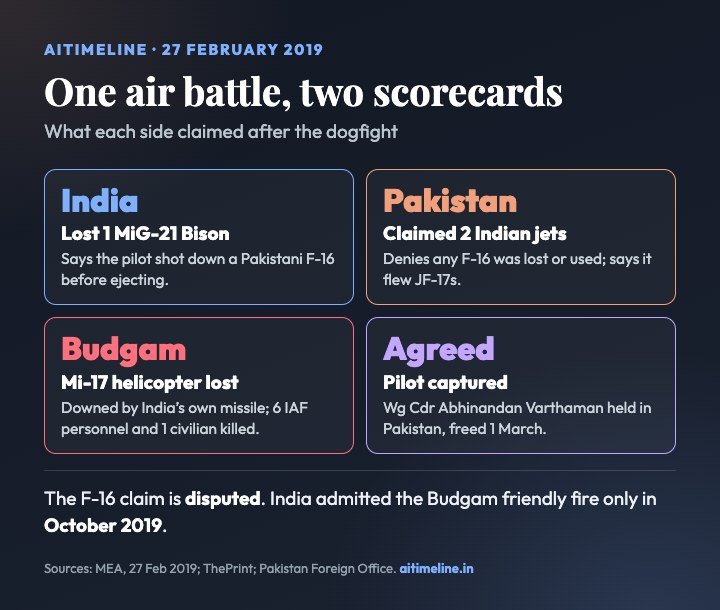
| Event | What happened | Status |
|---|---|---|
| Pakistani air operation | Aircraft crossed the Line of Control and struck near Indian military sites | Both sides agree; Pakistan called it Operation Swift Retort |
| Indian response | IAF jets scrambled and engaged | Agreed |
| Indian aircraft lost | One MiG-21 Bison | India confirmed; Pakistan claimed two |
| Pakistani aircraft lost | India says an F-16 | Pakistan denies |
| Budgam Mi-17 | Shot down by India’s own missile; 7 dead | Admitted by IAF, October 2019 |
| Pilot captured | Wg Cdr Abhinandan Varthaman | Returned 1 March 2019 |
The capture of an Indian pilot was the most dangerous moment of the crisis. Within hours, Pakistan released video of Abhinandan, first bloodied and then drinking tea and declining to answer questions about his mission. The United States, Saudi Arabia and the UAE pressed both governments. On 28 February Imran Khan told Pakistan’s parliament the pilot would be freed as a gesture of peace, and the crisis began to ease.
“In that aerial engagement, one Pakistan Air Force fighter aircraft was shot down by a MiG 21 Bison of the Indian Air Force… In this engagement, we have unfortunately lost one MiG 21. The pilot is missing in action.”
Ministry of External Affairs, 27 February 2019
What Did the NIA Investigation Uncover?
Prosecution allegations, filed in August 2020 and now on trial.
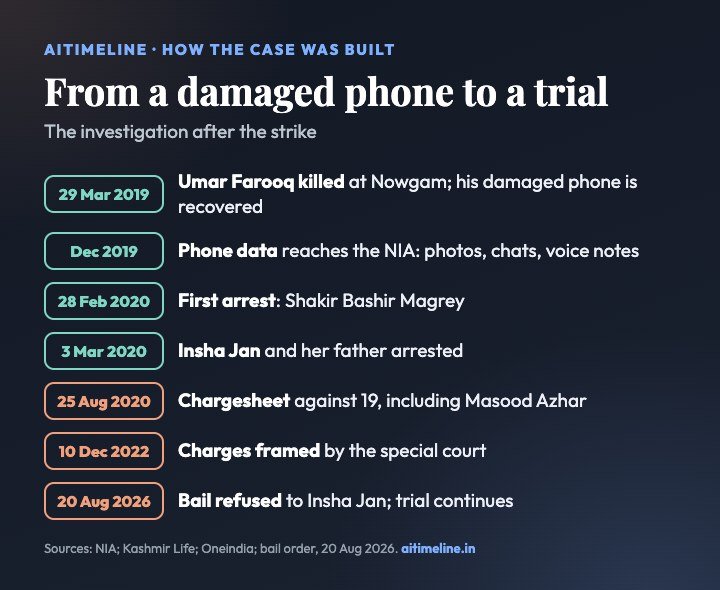
- The infiltration: Umar Farooq, trained in Afghanistan in 2016–17, crossed the Samba border in April 2018 with other Pakistani JeM men, the NIA says.
- The explosives: RDX brought from Pakistan, gelatin sticks supplied by Mudasir Khan, calcium ammonium nitrate and aluminium powder were stored at Shakir Bashir’s house.
- The bomb: two containers of about 160 kg and 40 kg were fitted into a Maruti Eeco bought by Sajjad Bhat, and were ready by 6 February 2019.
- Online purchases: Waiz-ul-Islam is accused of ordering 4 kg of aluminium powder on Amazon; the FATF later cited this.
- The video: Adil Dar’s claim-of-responsibility video was recorded at Insha Jan’s house in late January 2019, the NIA says.
- The money: chats on Farooq’s phone put the cost of the IEDs at about Rs 5.7 lakh, The Indian Express reported.
- The leadership: Masood Azhar, Rouf Asgar and Ammar Alvi are accused of directing the module from Pakistan, before and after the attack.
These are the agency’s allegations. The filing of a chargesheet means the NIA believes it has enough evidence to put the accused on trial; it does not establish the guilt of anyone named in it.
Who Are the 19 Accused?
As listed in the NIA’s press release of 25 August 2020. Status as at that date unless noted.
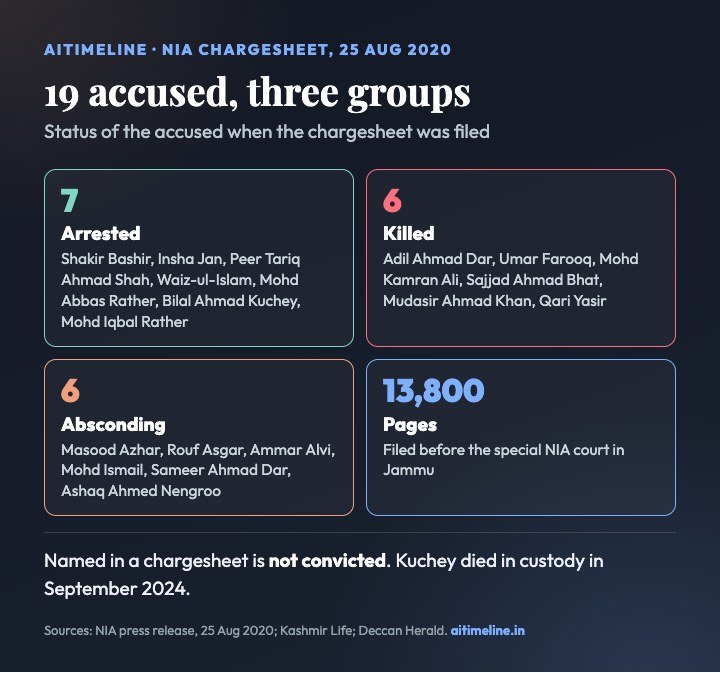
| Person | Role alleged by the NIA | Status |
|---|---|---|
| Adil Ahmad Dar | Suicide bomber | Died in the attack |
| Masood Azhar | JeM chief; directed the conspiracy | Absconding; UN-listed 2019 |
| Rouf Asgar | JeM leader, Azhar’s brother | Absconding |
| Ammar Alvi | Azhar’s brother; guided the operatives | Absconding |
| Muhammad Umar Farooq | Main planner; built the IED | Killed 29 March 2019 |
| Mohd Kamran Ali | Pakistani JeM operative, IED expert | Killed |
| Mudasir Ahmad Khan | Supplied gelatin sticks | Killed 11 March 2019 |
| Sajjad Ahmad Bhat | Bought the Maruti Eeco | Killed June 2019 |
| Qari Yasir | Pakistani JeM commander | Killed 25 January 2020 |
| Shakir Bashir Magrey | Reconnaissance, storage, drove bomber | Arrested 28 February 2020; on trial |
| Insha Jan | Shelter; video recorded at her house | Arrested 3 March 2020; bail refused 2026 |
| Peer Tariq Ahmad Shah | Insha Jan’s father; shelter | Arrested 3 March 2020; on trial |
| Waiz-ul-Islam | Ordered aluminium powder online | Arrested March 2020; on trial |
| Mohd Abbas Rather | Sheltered operatives | Arrested March 2020; on trial |
| Bilal Ahmad Kuchey | Supplied phones | Died in custody, September 2024 |
| Mohd Iqbal Rather | Moved Umar Farooq | Arrested July 2020; on trial |
| Mohd Ismail, Sameer Ahmad Dar, Ashaq Ahmed Nengroo | Operatives and helpers | Absconding at chargesheet |
Those killed in security operations can never be tried. The guilt of the living accused can only be decided by the court. We have not found reports of convictions or acquittals for any of them.
Where the Trial Stands
Seven years on, the case is roughly a quarter of the way through its witnesses.
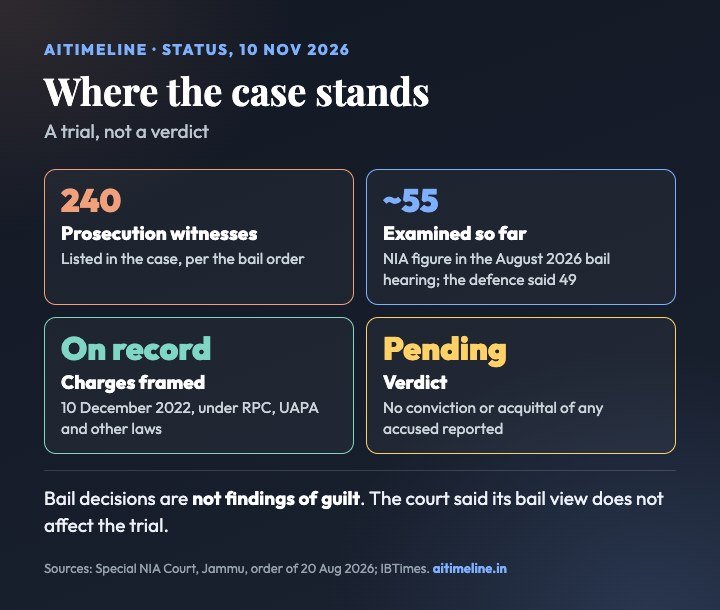
✅ On record
- JeM claimed the attack; the bomber was Adil Ahmad Dar.
- NIA chargesheet against 19 (25 August 2020).
- Charges framed (10 December 2022).
- Bail refused to Insha Jan (20 August 2026).
❓ Not decided
- The guilt of any living accused.
- The damage and deaths at Balakot.
- Whether a Pakistani F-16 was shot down.
- How far Satya Pal Malik’s claims of lapses are true.
How the Crisis Changed India–Pakistan Relations
- Doctrine: after the 2016 surgical strikes, Balakot showed India would use air power across the Line of Control in response to a major attack. That set the pattern Operation Sindoor followed in 2025.
- Diplomacy: India’s campaign helped get Masood Azhar listed by the UN on 1 May 2019, after a decade of blocked attempts.
- Trade and travel: MFN withdrawal, 200% duties and months of closed Pakistani airspace cut already thin links.
- Escalation risk: two nuclear-armed states exchanged air strikes for the first time; outside powers, not a bilateral channel, helped stop it.
- Politics: the strike became a central theme of the 2019 general election campaign; questions about intelligence and convoy security never got a public inquiry.
- Accountability: the IAF took seven months to admit the Budgam friendly fire.
Pulwama and Balakot: Two Separate Milestones
| Detail | Pulwama attack | Balakot strike |
|---|---|---|
| Date | 14 February 2019 | 26 February 2019 |
| Location | Lethpora, Pulwama, Jammu and Kashmir | Near Balakot, Khyber Pakhtunkhwa, Pakistan |
| Carried out by | JeM suicide bomber | Indian Air Force |
| Target | CRPF convoy bus | Site India called a JeM training camp |
| Deaths | 40 CRPF personnel | Disputed; no independent figure |
| Legal follow-up | NIA case; trial in Jammu | None |
Key Facts at a Glance
| Detail | Information |
|---|---|
| Pulwama attack | 14 February 2019, about 3:15 pm |
| Location | Lethpora, Pulwama district |
| Killed / seriously injured | 40 / 8 CRPF personnel |
| Bomber | Adil Ahmad Dar |
| Claimed by | Jaish-e-Mohammed |
| MFN withdrawn | 15 February 2019 |
| NIA case registered | 20 February 2019 |
| Balakot strike | 26 February 2019 |
| Air clash; aircraft lost | 27 February 2019; one MiG-21 Bison (plus Mi-17 to own fire) |
| Pilot released | 1 March 2019 |
| UN listing of Masood Azhar | 1 May 2019 |
| Chargesheet | 25 August 2020; 19 accused; 13,800 pages |
| Charges framed | 10 December 2022 |
| Latest court order | Insha Jan bail refused, 20 August 2026 |
Terms Explained
- MFN status: a WTO principle of equal trade treatment. Withdrawing it allowed India to raise tariffs on Pakistan alone.
- Non-military pre-emptive action: India’s description of Balakot, meaning a strike on a terrorist target, not Pakistan’s forces, to stop an expected attack.
- Chargesheet: the investigating agency’s final report to court naming accused and evidence. It is an accusation, not a verdict.
- Framing of charges: the judge’s formal decision that there is enough material to try an accused.
- Section 43-D(5) UAPA: bars bail if the court finds the accusation prima facie true.
- Friendly fire: casualties caused by one’s own side, as at Budgam.
Explore More Timelines
People Also Ask
Frequently Asked Questions
Checked against MEA statements, the NIA case page and press release, the August 2026 bail order, the Congressional Research Service, Kashmir Life, The Indian Express, ThePrint and Scroll.
⚠️ Editorial Note
“Jaish-e-Mohammed claimed responsibility” describes the group’s own statement. People named in the NIA chargesheet are accused, not convicted, and bail orders are not findings of guilt. Claims about the Balakot strike’s damage and deaths are attributed to the government that made them; neither has been independently verified. India confirmed losing one MiG-21 in the air clash; claims about a Pakistani F-16 and a second Indian jet are disputed. Corrections to the brief this page began from: Insha Jan’s bail order is dated 20 August 2026, not 22 August; Umar Farooq was killed with Pakistani operative Mohd Kamran Ali at Nowgam in Budgam on 29 March 2019; Ammar Alvi (Mohammed Ammar) is Masood Azhar’s brother, not a lower-level operative; the NIA listed the 19 accused as seven arrested, six dead and six absconding. We found no court development after 20 August 2026 up to 10 November 2026.
Related Reading on AiTimeline
Sources & further reading
Every dated entry above was checked against these references. Last reviewed 10 November 2026.
- Ministry of External Affairs: Statement by Foreign Secretary on the strike at Balakot, 26 February 2019
- Ministry of External Affairs: India condemns the terrorist attack in Pulwama, 14 February 2019
- Ministry of External Affairs: Statement by Official Spokesperson, 27 February 2019
- National Investigation Agency: Case RC-02/2019/NIA/JMU (Lethpora convoy attack)
- NIA press release: Chargesheet against 19 accused, 25 August 2020
- Special NIA Court, Jammu: Insha Jan bail order, 20 August 2026 (via LiveLaw)
- IBTimes India: Special NIA court rejects Insha Jan's bail plea
- Kashmir Life: The Lethpora Story
- Congressional Research Service: India, Pakistan, and the Pulwama Crisis
- The Indian Express: Recalling the Pulwama terror attack
- ThePrint: Pakistan rejects India's F-16 claim after Abhinandan's Vir Chakra
- Scroll: Pulwama accused Hamza Burhan reported shot dead in PoK