State Pension Triple Lock: History, Cost, and Future in India
Understand the UK's State Pension Triple Lock, its history, rising costs and 2030 reform, and explore what India's pension system could learn from it.
Latest Story
The State Pension Triple Lock is the British government’s promise to raise the State Pension every year by whichever is highest: inflation, average earnings growth or 2.5%. Introduced by the coalition government in 2010, it has protected pensioners through a pandemic and an inflation spike, but its rising cost has now pushed the government to announce an adjusted Triple Lock from April 2030. This guide explains how the lock works, what it has paid and cost, why it is changing, and what India’s pension system can learn from the debate.
The full new State Pension rises 3.9% in April 2027, to £250.70 a week, under the current lock. The full lock stays until April 2029. From April 2030, the government plans to keep inflation protection and the 2.5% floor but stop earnings growth from pushing the pension permanently ahead of wages. India has no comparable automatic uprating rule for old-age pensions.
💡 Short Answer
The State Pension Triple Lock is a UK policy, in place since April 2011, that raises the basic and new State Pension each April by the highest of CPI inflation, average earnings growth or 2.5%. It will lift the full new State Pension 3.9% to £250.70 a week in April 2027. From April 2030 the government plans an adjusted lock that keeps inflation protection and the 2.5% floor but limits earnings-linked rises.
What Is the State Pension Triple Lock?
Three tests, one winner, every April.
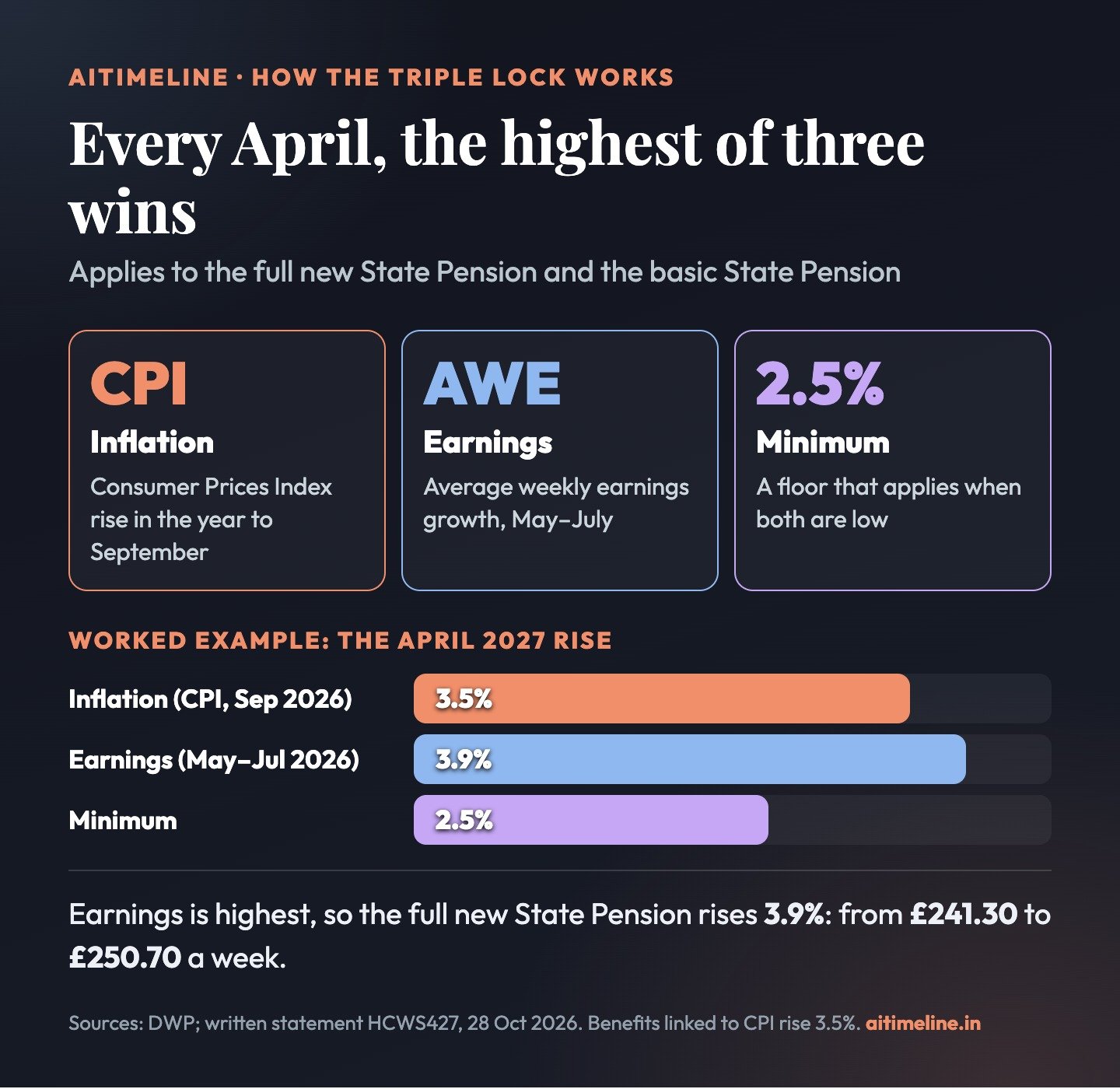
Every autumn the government compares three numbers: CPI inflation in the year to September, growth in average weekly earnings over May to July, and a fixed 2.5%. The State Pension rises by the highest of them the following April. The rule applies to the full rate of the new State Pension and to the basic State Pension.
The law itself only requires those pensions to rise at least in line with earnings. The Triple Lock is a political commitment on top of that, which is why governments have been able to suspend it once and plan to change it, without repealing a statute that guarantees it.
| Example year | Inflation | Earnings | Minimum | Pension rise |
|---|---|---|---|---|
| April 2027 (actual) | 3.5% | 3.9% | 2.5% | 3.9% |
| April 2023 (actual) | 10.1% | 5.5% | 2.5% | 10.1% |
| April 2021 (actual) | 0.5% | -1.0% | 2.5% | 2.5% |
State Pension Triple Lock: Key Questions
What to Know About the Triple Lock
- Highest of three: CPI inflation, average earnings growth or 2.5%, applied every April.
- Policy, not law: the statute only requires earnings-linked rises; the lock is a commitment on top.
- Restored a lost link: pensions had risen with prices only from 1980 to 2010.
- One suspension: the earnings test was dropped for 2022-23 because of pandemic wage distortions.
- Record rise: 10.1% in April 2023, followed by 8.5% in 2024, 4.1% in 2025 and 4.8% in 2026.
- Next rise: 3.9% in April 2027, taking the full new State Pension to £250.70 a week.
- Ratchet effect: because rises never reverse, the pension drifts ahead of wages over time.
- 2030 reform: announced by Prime Minister Andy Burnham on 29 September 2026 and confirmed in the 28 October Budget.
- India: no universal indexed old-age pension; social pensions are fixed and vary by state.
History: How the Triple Lock Came About
Thirty years of price-only rises, then a guarantee.
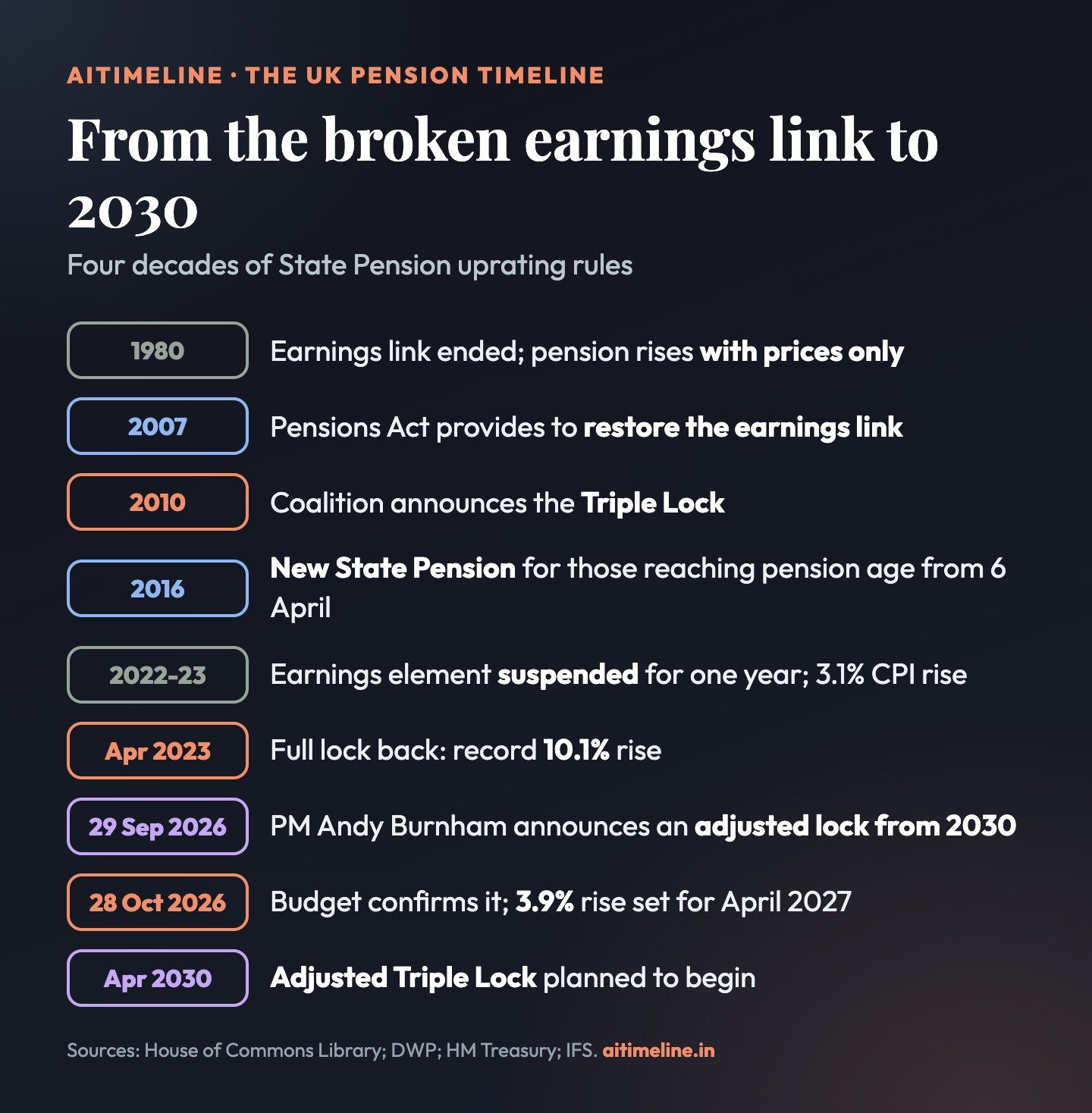
1980 to 2010: prices only. From 1980 the basic State Pension rose only in line with prices. Because wages usually grow faster than prices, the pension slowly lost value relative to average earnings, and more pensioners came to rely on means-tested top-ups.
2007: the link returns on paper. After the Turner Pensions Commission, the Pensions Act 2007 provided for the earnings link to be restored, in 2012 or by the end of the following Parliament at the latest.
2010: the Triple Lock. The Conservative-Liberal Democrat coalition went further, promising that from April 2011 the basic State Pension would rise by the highest of earnings, prices or 2.5%. In 2011 the rise was the RPI figure of 4.6%; from April 2012 the CPI-based formula set the increase, starting with 5.2%.
2015 to 2019: cross-party support. Successive Conservative governments kept the lock. The 2017 Conservative manifesto proposed moving to a ‘double lock’ from 2020, but the confidence-and-supply deal with the Democratic Unionist Party after that election committed to keeping the Triple Lock, and it stayed in the main parties’ 2019 manifestos.
2016: a new State Pension. People reaching pension age from 6 April 2016 moved to a single flat-rate new State Pension. The lock applies to its full rate as well as to the old basic pension.
Every Triple Lock Rise, Year by Year
Which of the three measures won, from 2011-12 to 2027-28.
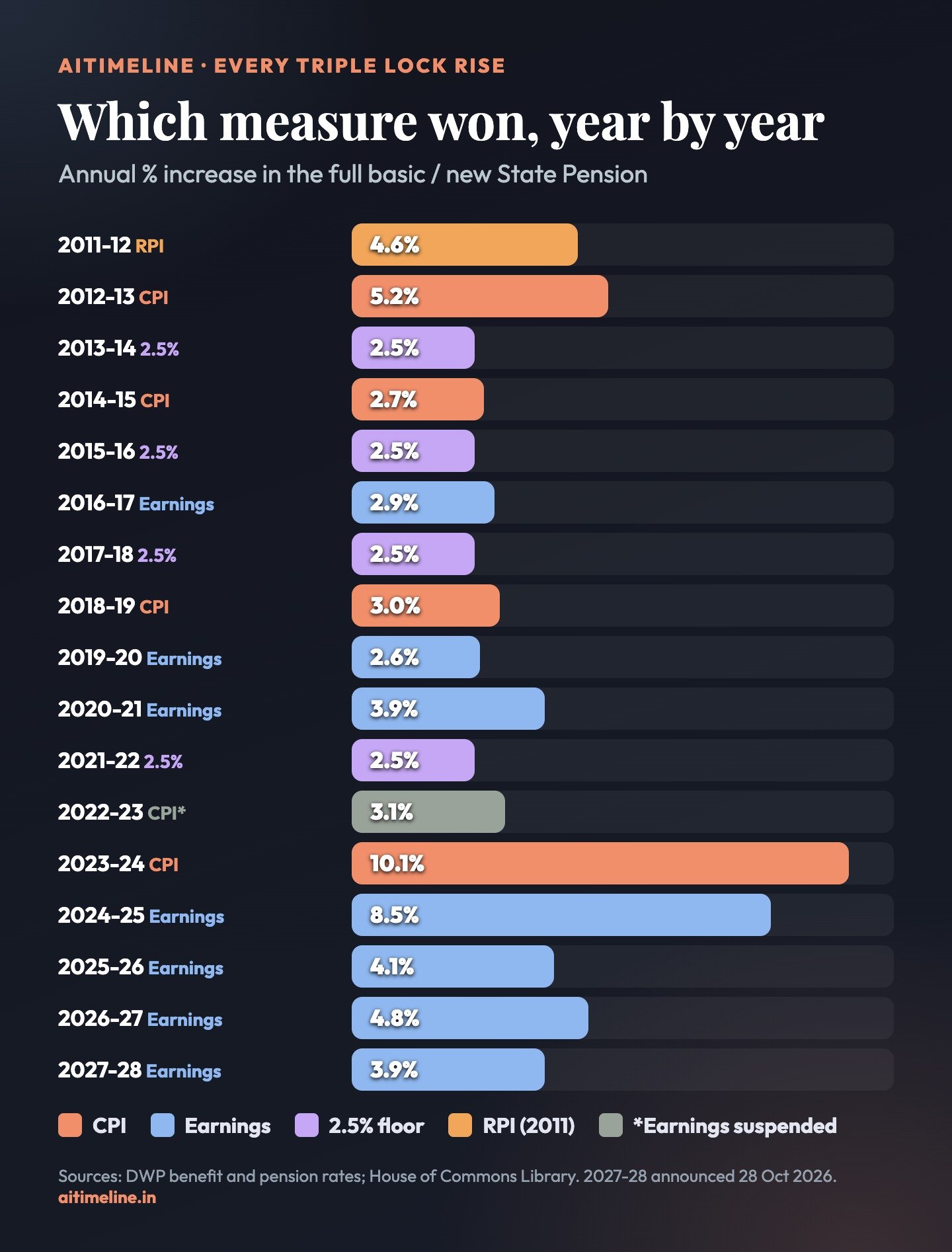
Number of years each measure decided the April increase, 2011-12 to 2027-28 (17 rises).
2022-23: earnings test suspended. 2011-12: RPI guarantee. Earnings has set every rise since April 2024. Source: DWP benefit and pension rates; AiTimeline count.
How Much Does the UK State Pension Pay?
Two systems, depending on when you reached pension age.
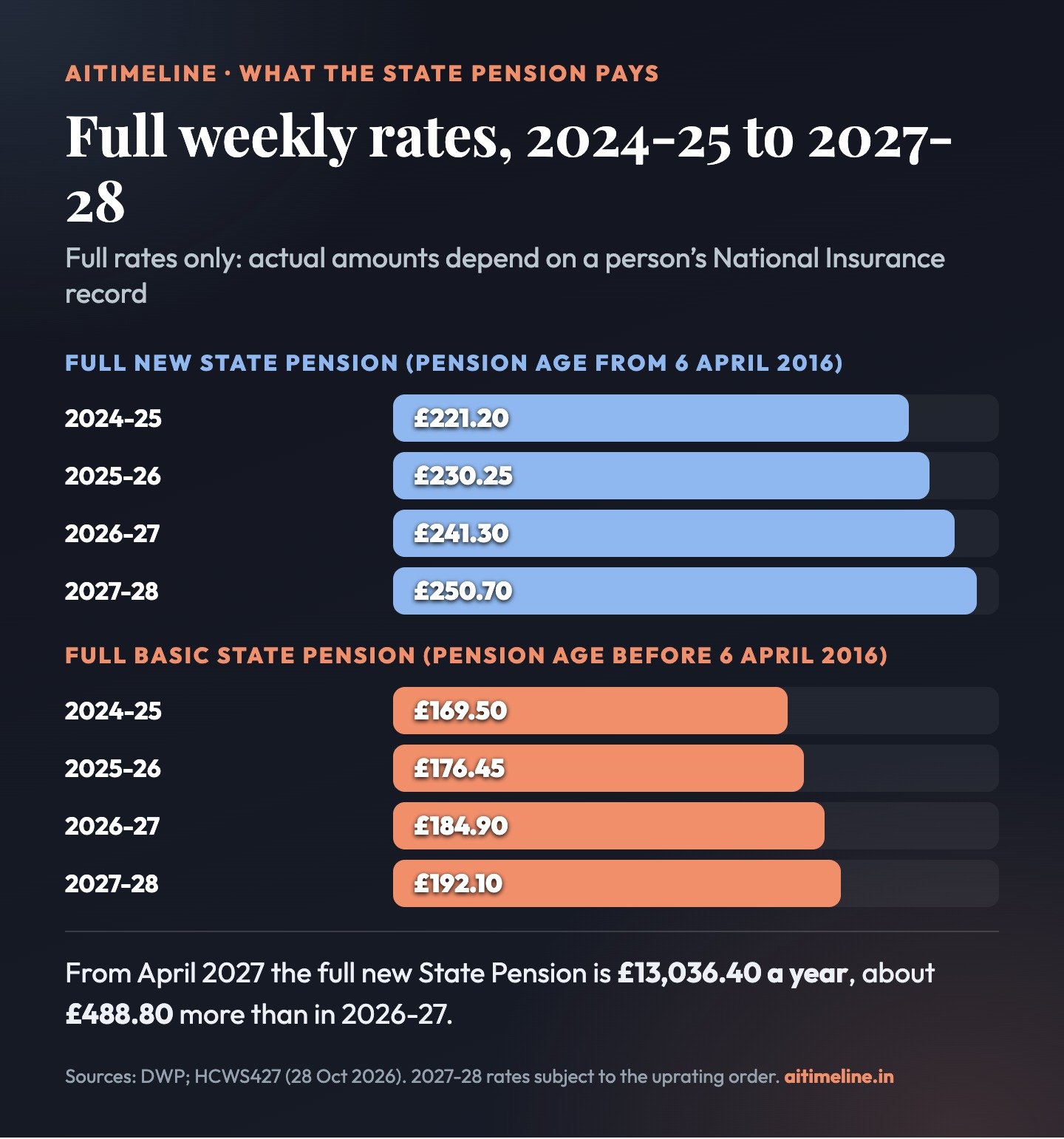
| Financial year | Full new State Pension | Full basic State Pension | Rise |
|---|---|---|---|
| 2024-25 | £221.20 | £169.50 | 8.5% |
| 2025-26 | £230.25 | £176.45 | 4.1% |
| 2026-27 | £241.30 | £184.90 | 4.8% |
| 2027-28 | £250.70 | £192.10 | 3.9% |
The new State Pension applies to people reaching State Pension age on or after 6 April 2016; the basic State Pension to those who reached it earlier. These are full rates. What a person actually receives depends on their National Insurance record: the full new State Pension normally needs 35 qualifying years. The 2027-28 figures come from the government’s 28 October 2026 statement and take effect from April 2027.
What Has the Triple Lock Cost?
A small extra cost each year that compounds into a large one.
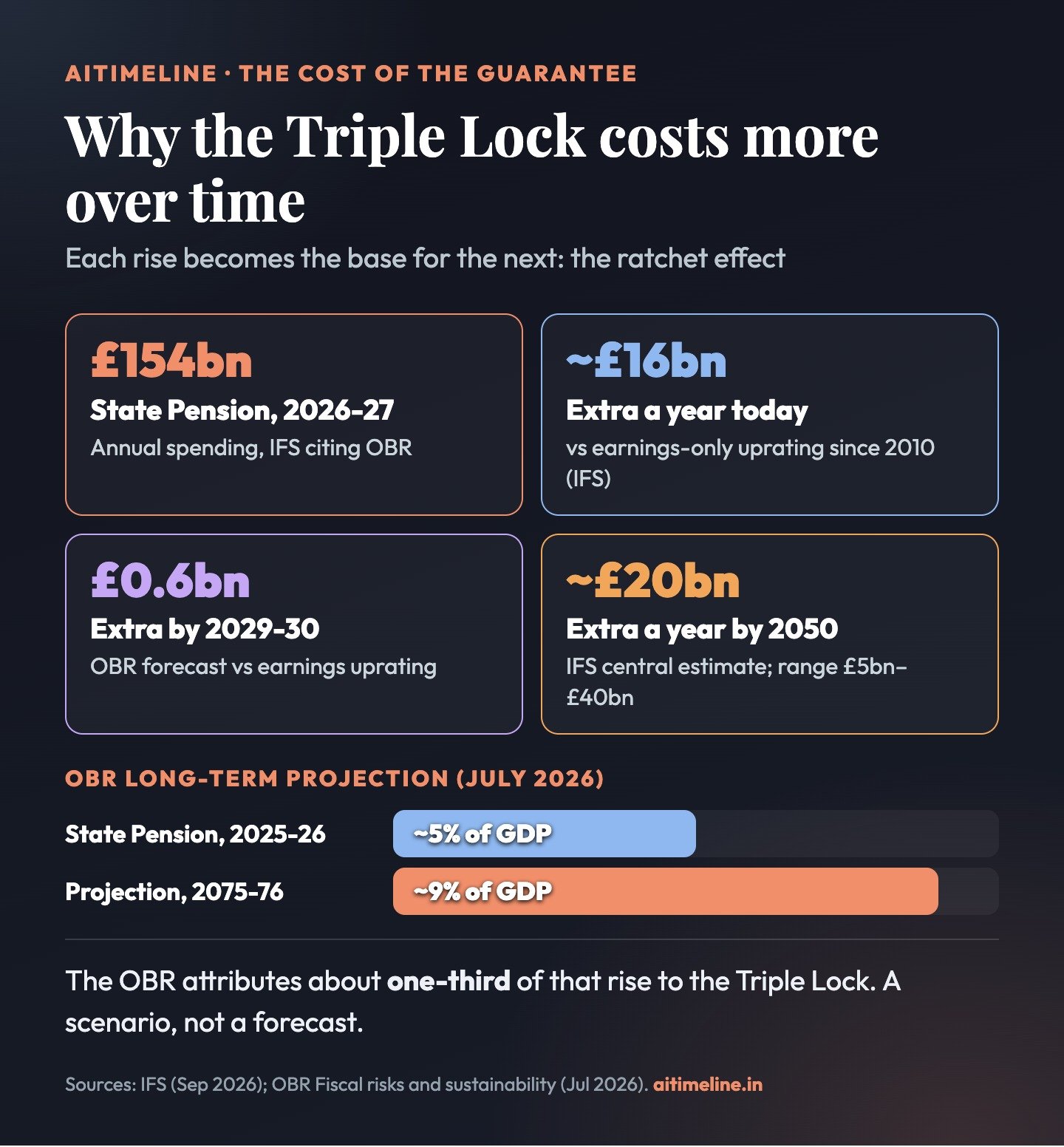
The lock’s cost is not the size of any one year’s rise. It is the ratchet effect: each increase is built into the base, and the pension always takes the highest of three measures. In years when prices outpace wages, pensions rise faster than pay; when wages win, pensions keep up. They never fall back, so over decades the State Pension drifts upwards relative to average earnings.
| Measure | Estimate | Source |
|---|---|---|
| State Pension spending, 2026-27 | ~£154 billion a year | IFS, citing OBR |
| Extra cost today vs earnings-only rises since 2010 | ~£16 billion a year | IFS |
| Extra cost by 2029-30 | ~£600 million a year | OBR forecast, via IFS |
| Extra cost by 2050 if the lock continued | ~£20 billion a year (range £5-40 billion) | IFS, today’s prices |
| Long-term spending path | ~5% of GDP to ~9% by 2075-76 | OBR, July 2026 |
Why the cost is hard to predict. Three things drive it: inflation, because a price shock triggers a large rise; wage growth, which can push rises above inflation; and demography, as more people draw a pension for longer. The OBR’s July 2026 long-term projection showed State Pension spending rising from about 5% of GDP to about 9% by 2075-76, and attributed around a third of that to the Triple Lock. That is a scenario built on assumptions, not a forecast.
Why the UK Is Changing the Triple Lock From 2030
Keep the inflation guarantee, stop the ratchet.
On 29 September 2026, in his Labour conference speech in Liverpool, Prime Minister Andy Burnham said the Triple Lock would remain for the rest of this Parliament but be adjusted from April 2030, with the savings used to build a National Care Service. The Department for Work and Pensions set out the plan in a factsheet, and the 28 October 2026 Budget confirmed it.
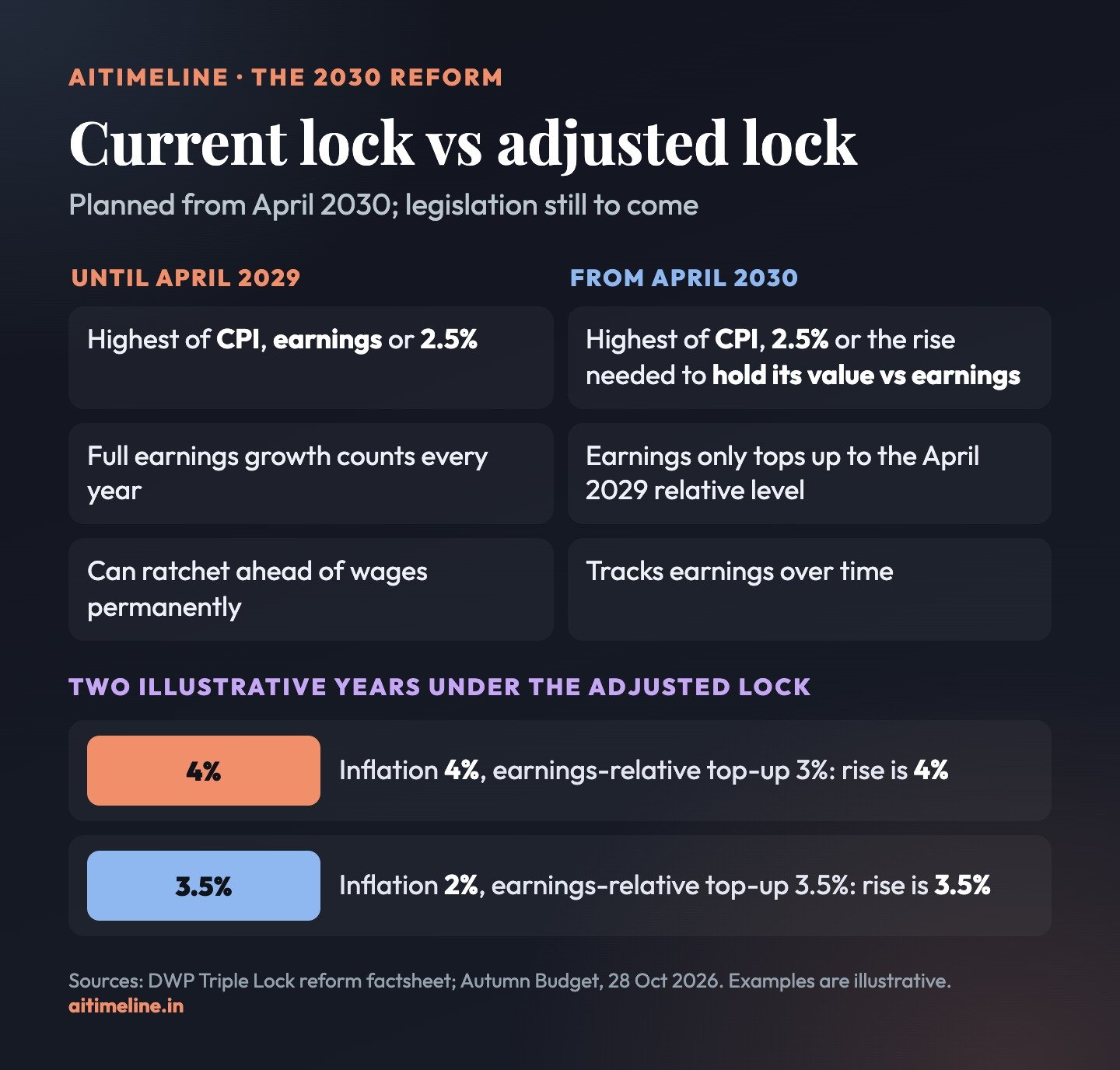
Under the adjusted lock, the State Pension will rise by the highest of CPI inflation, 2.5%, or the amount needed to keep its value relative to earnings as reached in April 2029. Inflation protection and the floor stay; what goes is the automatic, permanent gain against wages in years when earnings growth happens to be the highest measure.
| Feature | Current lock (to April 2029) | Adjusted lock (from April 2030) |
|---|---|---|
| Inflation protection | Yes | Yes |
| Minimum rise | 2.5% | 2.5% |
| Earnings | Full earnings growth is one of the three tests | Only the rise needed to hold the April 2029 value relative to earnings |
| Ratchet against wages | Can build up permanently | Designed to stop it |
| Legal status | Policy commitment | Government plans to legislate in this Parliament |
How it works in practice. If inflation is 4%, the minimum 2.5% and the earnings-relative adjustment 3%, the pension rises 4%. If inflation is 2% and the earnings-relative adjustment is 3.5%, it rises 3.5%. These are illustrative numbers.
How much will it save? The DWP has estimated savings of about £15 billion a year by 2039-40 and about £50 billion by 2049-50. Independent analysts, including the Resolution Foundation and PolicyEngine, warn that the real figure depends heavily on how earnings and prices move and could be far smaller, because the adjusted lock only saves money in years when the old one would have pushed the pension ahead of wages.
Timeline: The Triple Lock, Newest First
Labels mark background, law, annual uprating, reform and India.
Budget sets a 3.9% rise for April 2027 and confirms the 2030 change Uprating
What happened: On Budget day the Department for Work and Pensions set the 2027-28 uprating. The full new State Pension and the full basic State Pension rise by 3.9%, in line with average earnings growth in May to July 2026. The new State Pension goes from £241.30 to £250.70 a week and the basic State Pension from £184.90 to £192.10. Benefits linked to prices rise by the September CPI figure of 3.5%.
The 2030 wording: The Budget kept the full Triple Lock up to April 2029 and said that, from April 2030, the State Pension would rise by the highest of 2.5%, inflation, or the amount needed to keep its value relative to earnings as reached in April 2029.
Still to come: The change needs legislation. The government has said it will legislate in this Parliament; no Bill had been introduced by the end of October.
Andy Burnham announces an adjusted Triple Lock from 2030 Reform
What happened: In his first Labour conference speech as Prime Minister, Andy Burnham said the Triple Lock would stay unchanged for the rest of this Parliament but would be adjusted from April 2030. He said the savings would be used to build a National Care Service.
What it means: Pensions would still rise with inflation and by at least 2.5%, but earnings growth would no longer push the pension permanently higher relative to wages. The DWP’s factsheet says the adjusted lock will make the State Pension rise in line with average earnings over time rather than consistently faster.
Reaction: Conservative leader Kemi Badenoch and Reform UK leader Nigel Farage both criticised the plan. Some headlines called it the end of the Triple Lock; the government calls it an adjustment.
IFS puts the long-term cost at about £20 billion a year Background
The estimate: The IFS estimated that keeping the current Triple Lock until 2050 would add about £20 billion a year to spending in today’s money, compared with raising the pension in line with earnings. Because the lock depends on future inflation and wage growth, the plausible range ran from £5 billion to £40 billion.
Today: The IFS put State Pension spending at about £154 billion in 2026-27 and said the Triple Lock already adds about £16 billion a year compared with earnings-only uprating since 2010. Using the OBR forecast, it said the extra cost in 2029-30 would be relatively small, at about £600 million.
State Pension rises 4.8% Uprating
What happened: The full new State Pension rose from £230.25 to £241.30 a week and the full basic State Pension from £176.45 to £184.90, following average earnings growth of 4.8%.
Why it matters: It was the third year in a row in which earnings, not prices, set the increase, a pattern that critics say shows the ratchet effect at work.
A 4.1% earnings-based rise Uprating
What happened: The State Pension rose by 4.1%, following earnings growth, even though CPI inflation in September 2024 was 1.7%.
8.5% rise as wages catch up with inflation Uprating
What happened: Strong nominal wage growth after the inflation spike gave pensioners an 8.5% increase. The full new State Pension rose to £221.20 a week and the full basic State Pension to £169.50.
Full Triple Lock restored with a record 10.1% rise Uprating
What happened: With the one-year suspension over, the full Triple Lock returned. CPI inflation of 10.1% in September 2022 was the highest of the three measures, so the State Pension rose by 10.1%.
Why it matters: It showed that the lock works as intended in a price shock, protecting pensioners’ purchasing power, but also how quickly it adds to spending.
Earnings element suspended for one year Law
What happened: Pandemic furlough had pushed average earnings down and then sharply back up, so the earnings measure for 2022 was expected to be around 8%. Parliament passed legislation in late 2021 to drop the earnings test for 2022-23 only, and the State Pension rose by 3.1%, in line with CPI.
Why it matters: It was the only time the lock has been set aside. Ministers said it stopped a statistical quirk from feeding into pensions; critics called it a broken promise.
The 2.5% floor does its job Uprating
What happened: In the pandemic year, September CPI was 0.5% and earnings growth was negative. The 2.5% minimum applied, the fourth time it had set the increase.
The new State Pension replaces the old two-tier system Law
What happened: A single flat-rate new State Pension replaced the basic State Pension and the additional State Pension for people reaching State Pension age on or after 6 April 2016. People who reached pension age earlier stayed on the old system.
The lock: The government applied the Triple Lock to the full rate of the new State Pension as well as the basic State Pension. The law itself only requires both to rise at least in line with earnings; the lock is a policy commitment on top.
First rise set by the Triple Lock formula Uprating
What happened: In 2012-13, the CPI-based Triple Lock set the increase for the first time: 5.2%, the September 2011 CPI figure, which was higher than earnings growth and the 2.5% floor.
The year before: In April 2011 the basic State Pension rose by 4.6%, the RPI figure, because the government guaranteed that the first year’s rise would be at least as large as under the old RPI rule.
The coalition creates the Triple Lock Reform
What happened: The Conservative-Liberal Democrat coalition agreed to restore the earnings link for the basic State Pension from April 2011, with a guarantee that it would rise by the highest of earnings, prices or 2.5%. The Emergency Budget of 22 June 2010 confirmed it.
Why: Decades of price-only uprating had left the basic State Pension low compared with wages, and more pensioners were relying on means-tested support.
Pensions Act 2007 plans to restore the earnings link Law
What happened: After the Pensions Commission chaired by Lord Turner, the Pensions Act 2007 provided for the basic State Pension to be linked to earnings again. The Act said the link should be restored in 2012, or by the end of the following Parliament at the latest, subject to affordability.
The earnings link is cut Background
What happened: From November 1980 the basic State Pension rose in line with prices only, rather than the higher of prices or earnings. Because wages usually grow faster than prices, the pension fell steadily as a share of average earnings over the next three decades.
India renews its main social pension programme India
What happened: The Union Cabinet approved the continuation of the National Social Assistance Programme for five years with an outlay of ₹53,428 crore, renaming it the Pradhan Mantri Samajik Sahayata Yojana. The disability pension was renamed and widened, with the disability threshold cut from 80% to 40%.
Old-age pensions: The old-age and widow pensions continue in their existing form. The central contribution to the old-age pension stays at ₹200 a month for people aged 60-79 and ₹500 for those aged 80 and above, with states adding their own amounts. There is no automatic annual increase.
Does India Have a Triple Lock Pension System?
No. India has several schemes, each with its own rules.
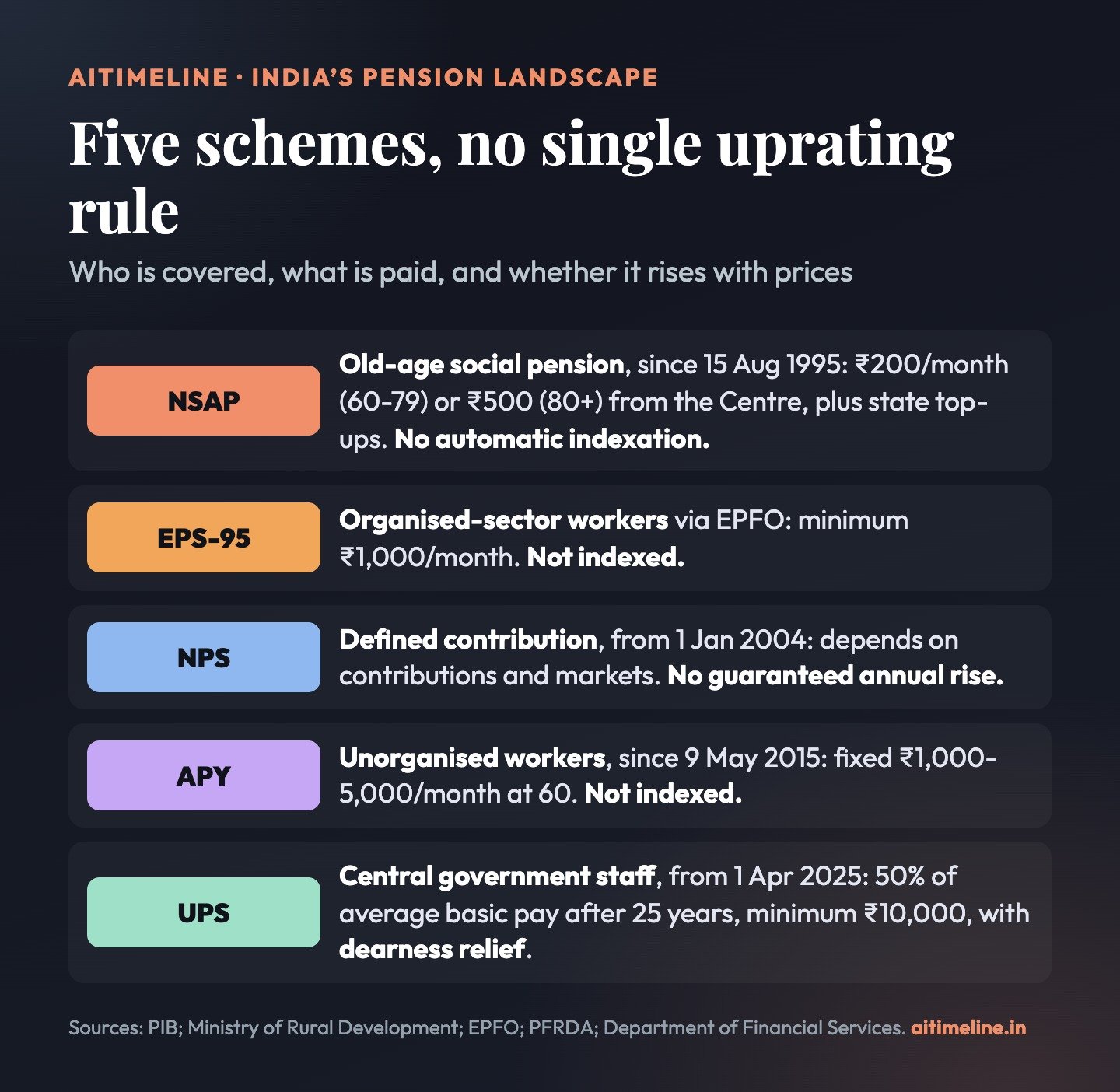
India does not have a single nationwide pension that rises automatically by the highest of inflation, wages or a fixed minimum. Retirement income comes from a mix of social assistance, employer-linked schemes, individual savings and government employee pensions.
National Social Assistance Programme (NSAP). Launched on 15 August 1995, NSAP’s old-age pension (the former Indira Gandhi National Old Age Pension Scheme) gives eligible below-poverty-line elderly people ₹200 a month at 60-79 and ₹500 at 80 and above from the Centre. States add their own amounts, so the total varies widely. On 14 October 2026 the Cabinet renewed the programme to 2030-31 with ₹53,428 crore as the Pradhan Mantri Samajik Sahayata Yojana; the old-age pension continues in its existing form, with no automatic rise.
Employees’ Pension Scheme, 1995 (EPS-95). Run by the EPFO for organised-sector workers, EPS-95 has a government-supported minimum pension of ₹1,000 a month. It is not linked to inflation or wages. Pensioner groups have long sought a higher minimum, and the Labour Ministry told Parliament in July 2025 that the fund’s valuation as of 31 March 2019 showed an actuarial deficit.
National Pension System (NPS). Introduced for central government employees joining from 1 January 2004 and later opened to all citizens, NPS is a defined-contribution scheme. The pension depends on contributions, investment returns and the annuity bought at retirement, with no guaranteed annual increase.
Atal Pension Yojana (APY). Launched on 9 May 2015 for mainly unorganised-sector workers, APY guarantees ₹1,000 to ₹5,000 a month from age 60, depending on contributions and joining age. The government covers shortfalls in the corpus, but the guaranteed amounts are fixed in cash terms, so their real value erodes with inflation.
Unified Pension Scheme (UPS). In force from 1 April 2025 as an option under NPS for central government employees, UPS assures 50% of average basic pay over the last 12 months after 25 years’ service, proportionately less from 10 years, a minimum of ₹10,000 a month, a 60% family pension, and dearness relief linked to inflation. It is the closest Indian equivalent to an inflation lock, but it covers government employees only.
UK Triple Lock vs India’s Pension System
| Feature | United Kingdom | India |
|---|---|---|
| Main public pension | Single State Pension | Multiple schemes by group |
| Uprating formula | Triple Lock for the State Pension | No nationwide formula |
| Inflation protection | Automatic | Government employees only (dearness relief) |
| Earnings link | Yes, until 2029; relative-earnings test from 2030 | None for old-age pensions |
| Minimum annual rise | 2.5% | None |
| Social assistance | Pension Credit | NSAP plus state pensions |
| Contributory / savings | Workplace and private pensions | EPF/EPS, NPS, APY |
Comparing the UK’s full State Pension directly with India’s ₹200 or ₹500 central NSAP contribution would be misleading. Eligibility, state top-ups, contribution histories, living costs and the purpose of the payments are all different.
Could India Adopt a Triple Lock?
The idea of a rule, not necessarily the British rule.
| Potential benefits | Major challenges |
|---|---|
| Stops fixed pensions losing purchasing power to food, medicine and transport costs | Fiscal cost across a very large elderly population |
| A transparent, predictable rule instead of occasional political revisions | Government retirees, private workers and the poor need different designs |
| Better retirement security for low-income elderly people | Choosing an index: general CPI may miss older people’s health costs |
| A common national floor, with states free to pay more | Deciding how the Centre and states share the cost of rises |
| Less reliance on family support as households shrink | More people drawing pensions for longer as life expectancy rises |
The British experience suggests two lessons. First, an automatic rule works: it protected UK pensioners through the 2022-23 inflation shock without a new political fight each year. Second, a rule that always takes the highest of several measures costs more over time than it appears to in any single year, which is why even the UK is now retreating to a simpler inflation-plus-earnings-relative design.
What an Indian Pension Uprating Framework Could Look Like
| Scheme | Approach to examine |
|---|---|
| Social pensions (NSAP) | Regular inflation-linked revision for eligible low-income elderly people |
| EPS-95 minimum pension | Periodic review against adequacy and actuarial sustainability |
| APY | Review guaranteed amounts and their long-term purchasing power |
| NPS | Better access to inflation-linked annuity products |
| UPS | Regular checks on funding adequacy |
| State schemes | A national minimum with state-funded top-ups |
Any such framework would need actuarial estimates, fiscal modelling, clear eligibility rules and an agreed Centre-state funding split before it could be implemented. This is a policy option for discussion, not a government proposal.
Who Pays for Retirement Security?
Ageing societies fund retirement in three broad ways: tax-funded pensions paid from current revenue, contributory pensions built up by workers and employers, and individual savings whose value depends on investment returns. The UK State Pension is paid from current revenue, with National Insurance contributions earning entitlement. India combines tax-funded social assistance, employer and employee contributions and individual savings.
Neither model escapes the basic trade-off the Triple Lock debate exposed: a pension promise has to be generous enough for people to rely on in old age, and affordable enough for the next generation of workers to keep paying for it.
Facts at a Glance
| Detail | Information |
|---|---|
| Country | United Kingdom |
| Announced | 2010 (Emergency Budget, 22 June) |
| First formula-set rise | April 2012 (5.2%) |
| Measures | CPI inflation, average earnings growth, 2.5% |
| Suspension | 2022-23 (earnings test only) |
| Largest rise | 10.1%, April 2023 |
| Full new State Pension | £241.30/week (2026-27); £250.70 (2027-28) |
| 2030 change announced | 29 September 2026, PM Andy Burnham |
| Adjusted lock starts | April 2030 (planned) |
| India NSAP launched | 15 August 1995 |
| India APY launched | 9 May 2015 |
| India UPS in force | 1 April 2025 |
Explore More Timelines
People Also Ask
Frequently Asked Questions
⚠️ Editorial Note
UK rates and rises follow DWP announcements and the 28 October 2026 written statement; 2027-28 rates take effect in April 2027. Cost figures are estimates from the IFS, OBR and DWP and depend on future inflation, earnings and demography. The adjusted Triple Lock is a government plan that still needs legislation. Indian scheme details follow PIB and ministry releases and may change. This page is general information, not financial or retirement advice.
Related Stories
Sources & further reading
Every dated entry above was checked against these references. Last reviewed 23 November 2026.
- GOV.UK (DWP): Triple Lock reform factsheet, State Pension uprating analysis 2026
- GOV.UK (DWP): State Pension uprating analysis 2026
- UK Parliament: Written statement HCWS427, benefit and pension rates 2027-28, 28 October 2026
- House of Commons Library: State Pension triple lock (CBP-7812)
- House of Commons Library: Benefits uprating 2027/28 (CBP-12268)
- Institute for Fiscal Studies: What do you need to know about the triple lock?
- ITV News: Andy Burnham sets out plans to change triple lock from 2030 to pay for social care, 29 September 2026
- PolicyEngine: The adjusted Triple Lock in the Autumn Budget 2026
- Press Information Bureau: Cabinet approves continuation of the National Social Assistance Programme, 2026-27 to 2030-31
- Department of Financial Services: Atal Pension Yojana
- PFRDA: About the National Pension System