Resident Doctors’ Strikes: BMA Pay Dispute Timeline, Negotiations and Deals
Explore the UK resident doctors' strike timeline, from the 2016 contract dispute to the 2024 pay deal and the June 2026 BMA settlement on pay and jobs.
Latest Story
The resident doctors’ strikes in England were the longest period of industrial action by doctors in NHS history. The British Medical Association (BMA) fought the government first over a new contract in 2016, then from 2022 over pay restoration, training places and job security. After 65 strike days in two waves, a 2024 pay deal and a rejected offer in March 2026, resident doctors accepted a revised pay and jobs deal on 29 June 2026. This guide sets out what happened, when, and what each deal actually contained.
Strikes ran from March 2023 to July 2024 (44 days) and from July 2025 to April 2026 (21 days). The September 2024 deal gave an average 22.3% over two years. The June 2026 deal adds an average 6.6% by April 2027 through pay-scale reform, plus up to 4,500 training posts, exam fee refunds and permanent contracts. It applies to England only.
💡 Short Answer
Resident doctors, formerly called junior doctors, went on strike in England over a 2016 contract and then, from 2023, over real-terms pay cuts since 2008, scarce training posts and insecure contracts. A September 2024 deal paused strikes, but they resumed in July 2025. BMA members accepted a revised government pay and jobs deal on 29 June 2026, by 52.9% to 47.1%, ending the dispute.
Why Did Resident Doctors Go on Strike?
Two disputes, linked by one long argument over pay and conditions.
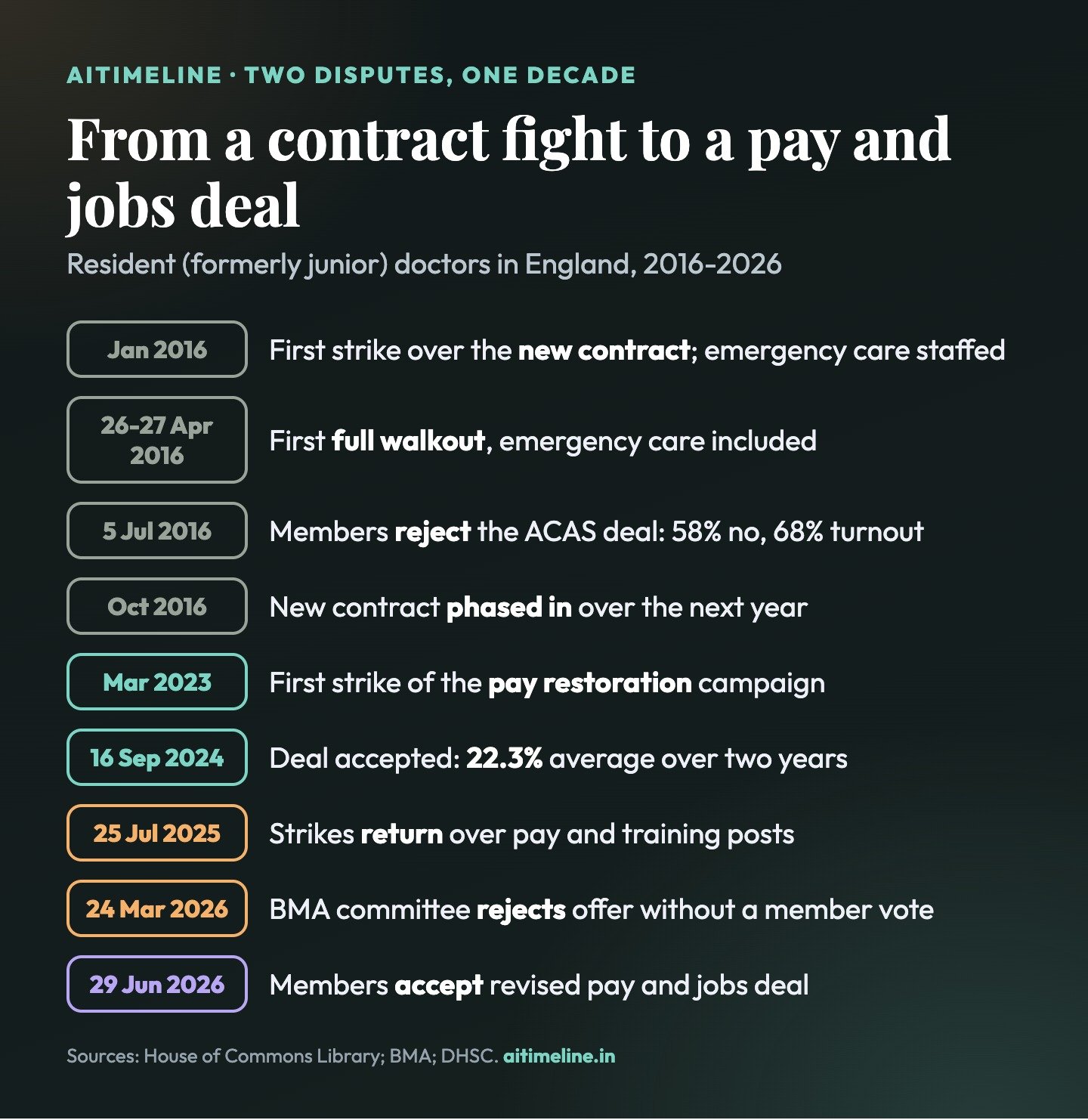
Resident doctors are qualified doctors in postgraduate training, from the two foundation years after medical school to specialty training that can last a decade. The BMA renamed them from ‘junior’ doctors in September 2024 because many have years of experience and carry senior responsibilities.
The pay argument. The BMA said years of below-inflation pay awards after 2008 had cut resident doctors’ real pay by more than a quarter on the RPI measure, and campaigned to restore it to its 2008-09 level. Governments argued that settlements had to be balanced against public spending, disputed the size of the gap, and pointed to rises of 28.9% over three years by 2025.
Beyond pay. From 2025 the dispute widened to include:
- Training bottleneck: too few specialty training posts for the doctors completing foundation training.
- Exam and portfolio costs: mandatory Royal College exams and fees paid out of doctors’ own pockets.
- Pay structure: the 2016 contract’s small number of pay points, with long gaps between rises.
- Job insecurity: locally employed doctors on short fixed-term contracts outside training programmes.
- Rotations and rotas: frequent moves between hospitals, long hours and the effect on family life and training.
Resident Doctors’ Strikes: Key Questions
What to Know About the Resident Doctors’ Strikes
- 2016: a contract dispute, including the first full walkout in NHS history; the contract was imposed after members rejected a deal.
- 2023-24: 44 strike days over pay restoration, including a record six-day walkout in January 2024.
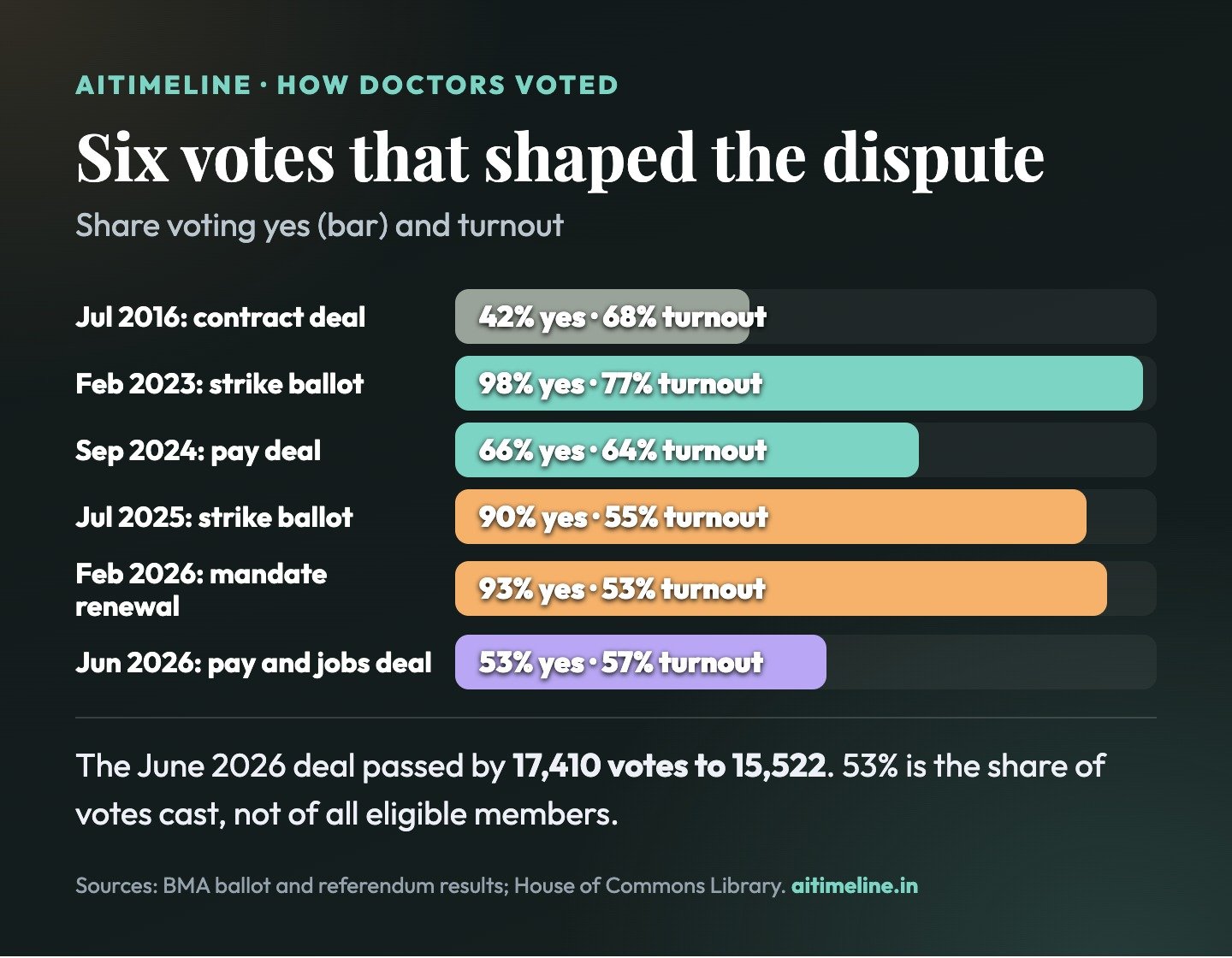
- September 2024: deal accepted by 66%, averaging 22.3% over two years.
- 2025: strikes resumed in July, November and December over pay and training posts.
- March 2026: the BMA committee rejected an offer without a member vote, accusing ministers of moving the goalposts.
- April 2026: a six-day strike, bringing the second wave to 21 days.
- June 2026: a revised offer accepted by 52.9% of votes cast, not 53% of all eligible members.
- Implementation: pay reform from September 2026, 350+ new posts opened in August 2026.
- England only: Scotland, Wales and Northern Ireland have separate arrangements.
How Many Strikes Took Place?
65 days in two waves, plus the 2016 contract strikes.
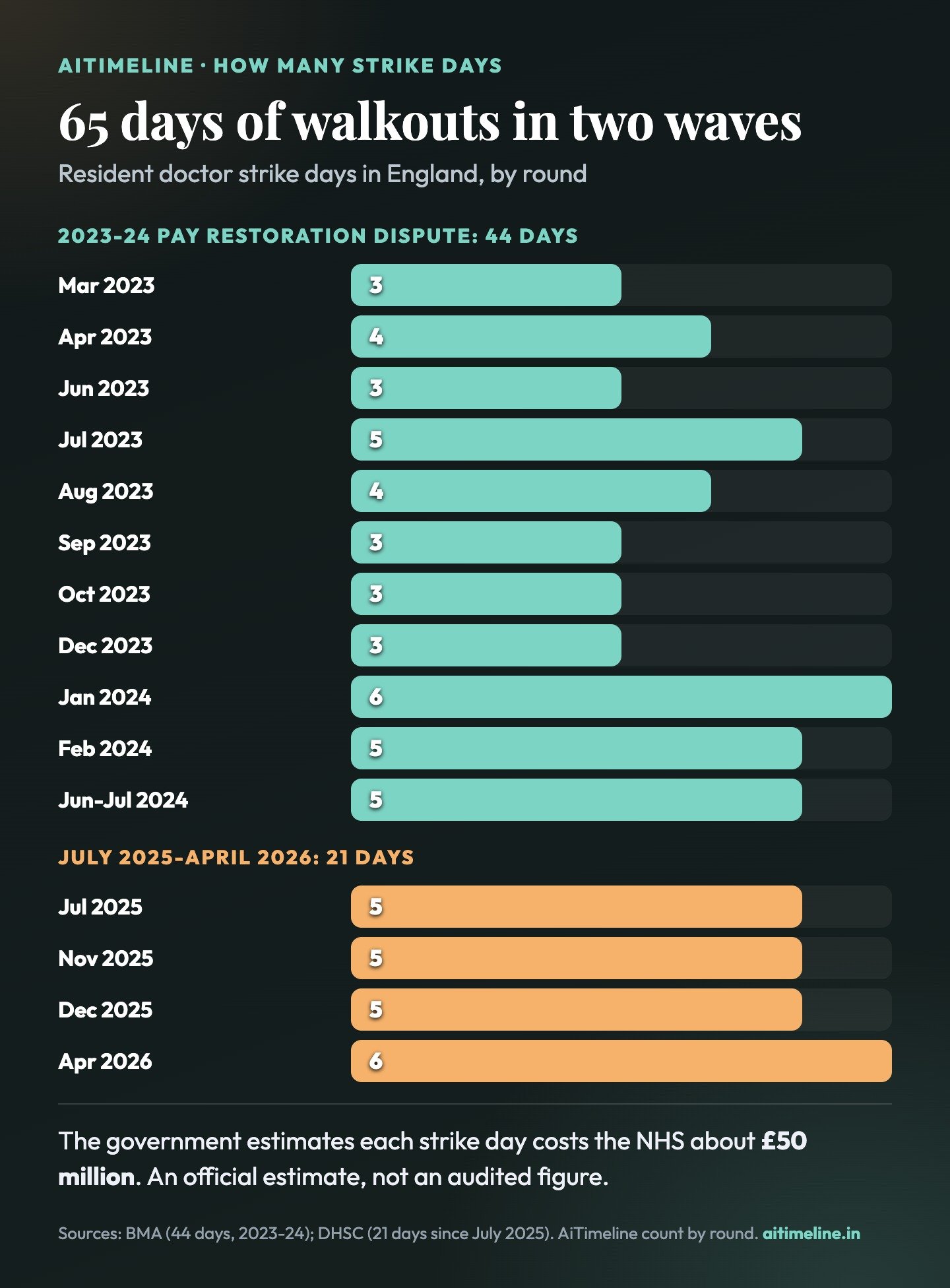
| Period | Strike days | Counted by |
|---|---|---|
| 2016 contract dispute | Five rounds, Jan-Apr 2016 | BMJ / Commons Library |
| March 2023-July 2024 | 44 | BMA |
| July-December 2025 | 15 (three rounds) | DHSC |
| April 2026 | 6 | DHSC |
| Since July 2025, total | 21 | DHSC, June 2026 |
The 15 days in 2025 and the six in April 2026 are already inside the government’s 21-day total, so they should not be added to it. The 2023-24 count is the BMA’s and covers a separate period.
Timeline: From the 2016 Contract to the 2026 Deal
Newest first. Labels mark the 2016 contract, strikes, talks, deals and votes.
Government publishes its first implementation update Deal
What it said: The Department of Health and Social Care reported that the deal is being delivered through five delivery groups reporting to the Resident Doctors Industrial Relations Committee (RDIRC), set up in July 2026 with NHS employers and the BMA.
Progress: More than 350 extra specialty training posts opened on 10 August 2026 for doctors starting from February 2027, and the government said it was on track for 1,000 extra posts in the deal’s first year. The first phase of pay-scale (nodal point) reform reached pay packets from September 2026, giving an average 4.9% rise for 2026-27 when combined with the 3.5% pay review award.
Other workstreams: NHS Employers issued guidance on moving locally employed doctors to substantive contracts on 11 September, and the Academy of Medical Royal Colleges published exam reimbursement guidance on 14 September.
Resident doctors accept the deal, ending the strikes Vote
What happened: BMA members in England voted to accept the government’s revised offer on pay and training places by 17,410 votes to 15,522: 52.9% of votes cast, on a turnout of 57.3% of 57,502 eligible members. The BMA declared the dispute over.
A correction: Some reports, and the BMA’s own press release, described the 53% as a share of eligible members. It is the share of votes cast. As a share of all eligible members, the yes vote was about 30%.
The government’s claim: Health and Social Care Secretary James Murray’s department said the deal would leave resident doctor pay 35.2% higher on average than four years earlier, and that 21 days of strikes had taken place since July 2025.
A revised offer, and a strike called off Deal
What happened: After further talks, the government made a revised formal offer covering pay progression, training places, exam and portfolio fees, and contracts for locally employed doctors. The BMA’s resident doctors committee called off the strike planned for 15 to 19 June and put the offer to members.
What changed: The March offer had been rejected by the committee without a member vote. This time, members decided.
Six-day strike after the March offer is rejected Strike
What happened: Resident doctors in England walked out for six days. The government withdrew a pledge to fund 1,000 extra specialty training posts that it said depended on the deal being accepted. Health Secretary Wes Streeting said the offer did not get better than this, and Prime Minister Keir Starmer called the walkout reckless.
Why it matters: It brought the total since July 2025 to 21 strike days, the figure the government later used when the deal was accepted.
BMA committee rejects the government’s offer Talks
The offer: The government’s March package combined pay-structure reform with the pay review body’s 3.5% award for 2026-27, pay rises built in over three years, up to 4,500 more specialty training places over three years (1,000 of them for that year’s applicants), reimbursement of Royal College exam fees from April and contract reform for locally employed doctors.
Why it was rejected: The committee said the government had moved the goalposts in the last two weeks of talks, reducing the value of the pay investment at the last moment and spreading it over three years.
The response: In a statement on 25 March the government said it was deeply regrettable that the committee had refused members the chance to vote, and that doctors would still get the 3.5% award but significantly less than was on the table.
Strike mandate renewed to August 2026 Vote
What happened: Of 54,432 resident doctors entitled to vote, 26,696 voted yes and 1,885 voted no: 93% in favour on a turnout of 52.54%, above the 50% legal threshold. The result extended the strike mandate for six months, to August 2026.
Reaction: Committee chair Dr Jack Fletcher said the government now had nowhere to run and no means of running out the clock.
Five-day strike in the week before Christmas Strike
What happened: Resident doctors walked out again after BMA members rejected a government proposal focused on training posts and exam costs. Talks continued, but nothing was agreed before the action.
Second five-day walkout Strike
What happened: A second round of strikes took place. The dispute was now as much about the shortage of specialty training posts as about pay, with thousands of doctors competing for each round of places.
Strikes return Strike
What happened: Resident doctors in England went on strike for five days, from 7am on 25 July to 7am on 30 July, after rejecting the 2025-26 pay award as not enough to continue pay restoration.
A new strike mandate Vote
What happened: Resident doctors in England voted for industrial action by 26,766 to about 3,000 of the 29,741 votes cast, 90% in favour on a 55% turnout. The mandate ran for six months.
The trigger: In May 2025 the government accepted the pay review body’s recommendation of 4% plus £750, an average 5.4% rise for resident doctors, which ministers called the highest in the public sector. The BMA said it left pay about a fifth below 2008 levels in real terms.
‘Junior’ doctors become ‘resident’ doctors Deal
What happened: The BMA formally began using the term resident doctors for doctors in postgraduate training. Members had backed the change, 91% in a February 2024 survey, arguing that ‘junior’ misled patients about doctors who may have many years of experience.
Why it matters: The new government agreed during the summer pay talks that the term was preferable, and it has been used in official documents since.
Doctors accept the 2024 pay deal Deal
What happened: Two-thirds of voting members accepted the offer negotiated with the new Labour government. It ended the 2023-24 dispute and its 44 days of strikes.
What it delivered: An extra 4.05% on 2023-24 pay scales, backdated, on top of 6% plus £1,250 already awarded for that year; and 6% plus £1,000 for 2024-25. The government said that averaged a 22.3% rise over the two years compared with 2022-23 scales.
What it did not settle: The BMA said pay restoration to 2008 levels was still its goal, which is why the dispute could return.
New government makes an offer Talks
What happened: After talks with BMA negotiators in July, the government accepted the pay review body’s recommendation of 6% plus £1,000 for 2024-25 and offered extra investment in 2023-24 pay scales. The BMA put the package to members.
Strike on the eve of the general election Strike
What happened: Resident doctors walked out for five days, ending two days before the general election, putting NHS workforce pressures at the centre of the campaign.
The longest strike in NHS history Strike
What happened: Talks collapsed in early December 2023, and after a three-day strike before Christmas, doctors walked out for six days in early January, the longest single strike in the NHS’s history at the time. A further five-day strike followed from 24 to 28 February 2024.
Government imposes a 6% plus £1,250 award Deal
What happened: The government accepted the pay review body’s recommendation for 2023-24: 6% plus a consolidated £1,250 for junior doctors, and said it would not negotiate further on pay. The BMA said it fell far short of restoration.
Context: It was announced on the first day of a five-day strike, from 13 to 18 July, then the longest in NHS history.
First strike of the pay restoration campaign Strike
What happened: Junior doctors in England began a 72-hour full walkout. The BMA’s demand was to restore pay to its 2008-09 real-terms level, which it said had fallen by more than a quarter by its preferred RPI measure.
Why it matters: It began the longest period of industrial action by doctors in NHS history.
98% vote to strike Vote
What happened: Junior doctors in England voted 98% in favour of strike action on a turnout of about 77%, one of the strongest mandates in recent trade union history. The campaign for pay restoration had been launched in 2022, after pay awards fell well below inflation.
New contract phased in 2016 contract
What happened: The 2016 contract was introduced in stages from October 2016. It changed how weekends and unsocial hours were paid, introduced work schedules and exception reporting, and created guardians of safe working hours.
Later significance: Its pay structure, with fewer pay points, became a central grievance in the later dispute and was what the 2026 nodal point reform set out to change.
Five-day strikes suspended 2016 contract
What happened: The BMA announced a series of five-day strikes, including withdrawal of emergency cover. It suspended the first, due from 12 September, after concerns about patient safety, and on 24 September called off the remaining dates.
Doctors reject the ACAS deal Vote
What happened: Junior doctors and medical students voted 58% to 42% to reject the contract deal, on a 68% turnout. BMA junior doctors committee chair Johann Malawana, who had backed the deal, resigned.
The government’s response: Health Secretary Jeremy Hunt said the next day that the contract would be introduced anyway.
A deal brokered at ACAS Deal
What happened: After talks at the conciliation service ACAS, the parties agreed a revised contract that changed weekend pay and the basic pay structure. The BMA negotiating team recommended it to members.
First full walkout in NHS history 2016 contract
What happened: For the first time, junior doctors withdrew emergency as well as routine care. Consultants and other staff covered emergency departments.
Earlier action: Strikes on 12 January and 10 February had kept emergency cover in place, as did 48-hour strikes in March and early April. On 11 February Jeremy Hunt said he would impose the contract.
First junior doctor strike in 40 years 2016 contract
What happened: Junior doctors in England staged their first strike since 1975, over the government’s plan to impose a new contract. Emergency care continued.
What the September 2024 Deal Delivered
A pay settlement that ended one phase of the dispute.
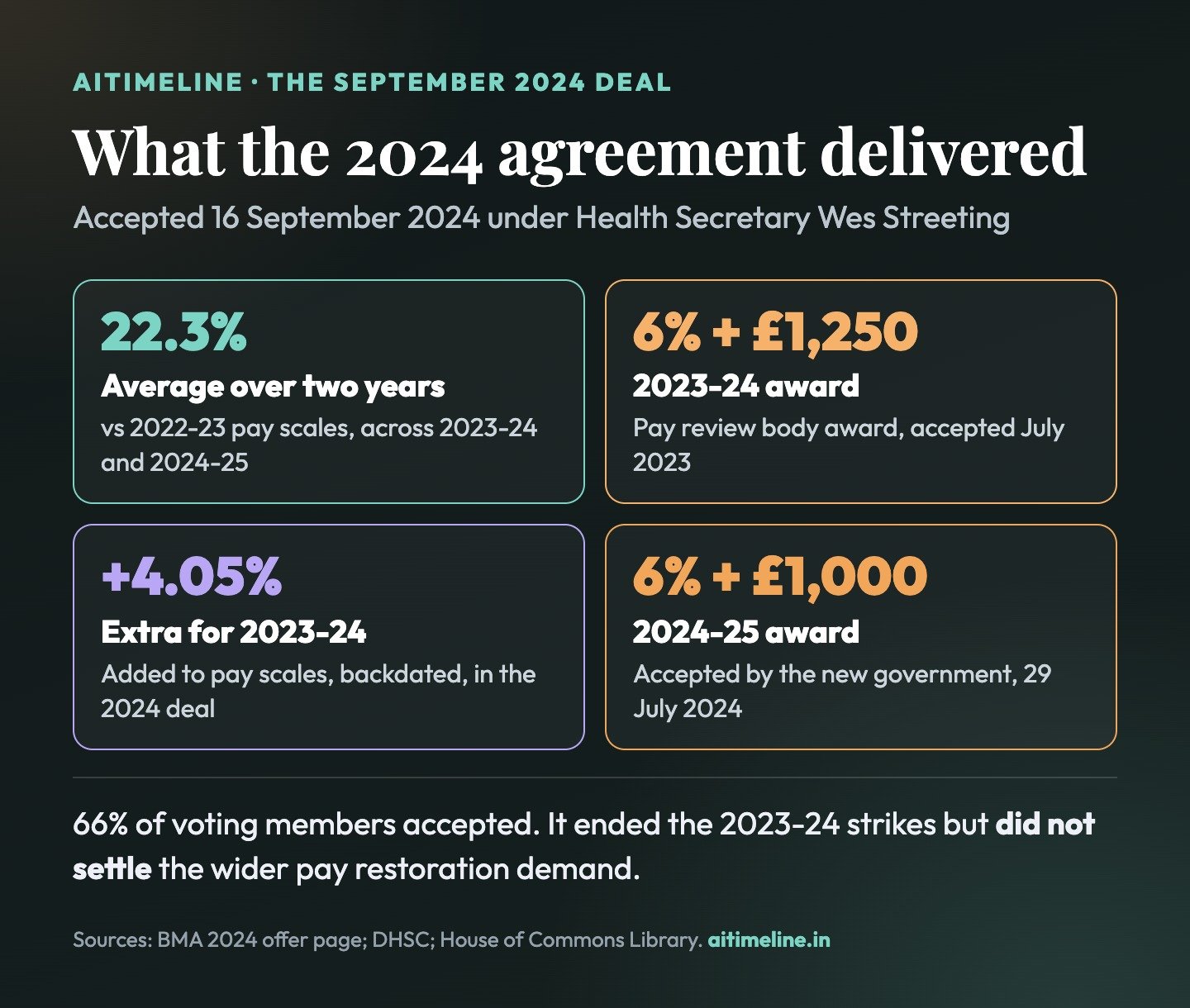
| Element | Detail |
|---|---|
| 2023-24 award | 6% + £1,250 consolidated (July 2023) |
| 2023-24 top-up | +4.05% on pay scales, backdated |
| 2024-25 award | 6% + £1,000 (pay review body) |
| Average over two years | 22.3% vs 2022-23 scales |
| Vote | 66% yes, 64% turnout; result 16 September 2024 |
What Did the 2026 Deal Include?
Pay-scale reform, training jobs and contracts.
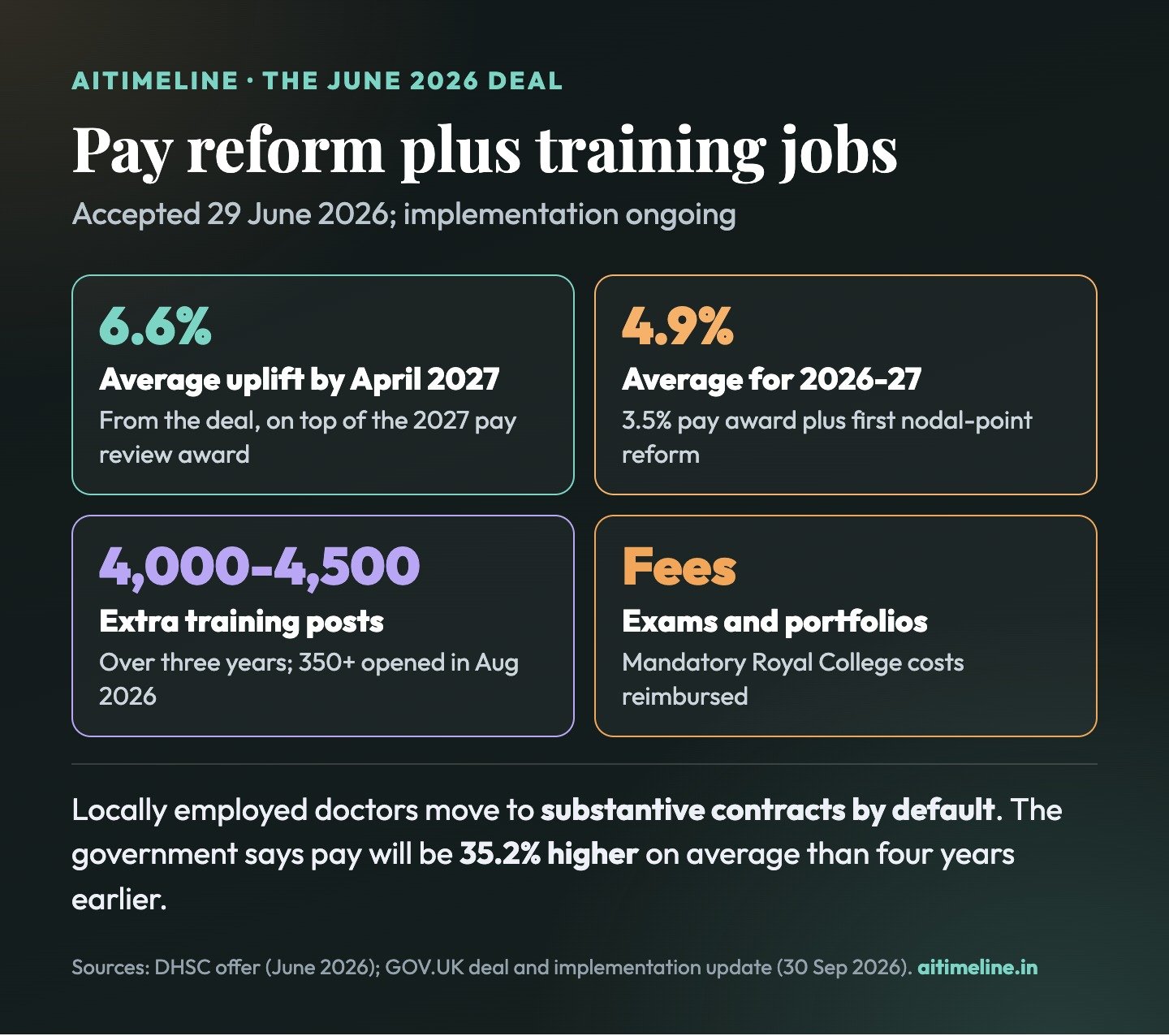
| Area | Main provision |
|---|---|
| Pay | Average 6.6% by April 2027, in addition to the 2027 pay review award |
| 2026-27 pay | Average 4.9%: 3.5% award plus first phase of nodal-point reform |
| Pay progression | Reformed nodal points, with more frequent progression |
| Training | 4,000-4,500 additional posts over three years |
| Exams | Eligible mandatory Royal College exam costs reimbursed |
| Portfolio fees | Eligible mandatory portfolio fees reimbursed |
| Locally employed doctors | Substantive contracts by default, with specified exceptions |
| Working conditions | Measures on career progression and less-than-full-time working |
The 35.2% figure is the government’s average comparison with pay four years earlier. It is not a uniform rise for every doctor, and not a measure of how far individual salaries have recovered against inflation since 2008. The BMA calls the deal a step towards continued pay restoration.
The 2024 Deal vs the 2026 Deal
Why one agreement did not end the dispute and the other did.
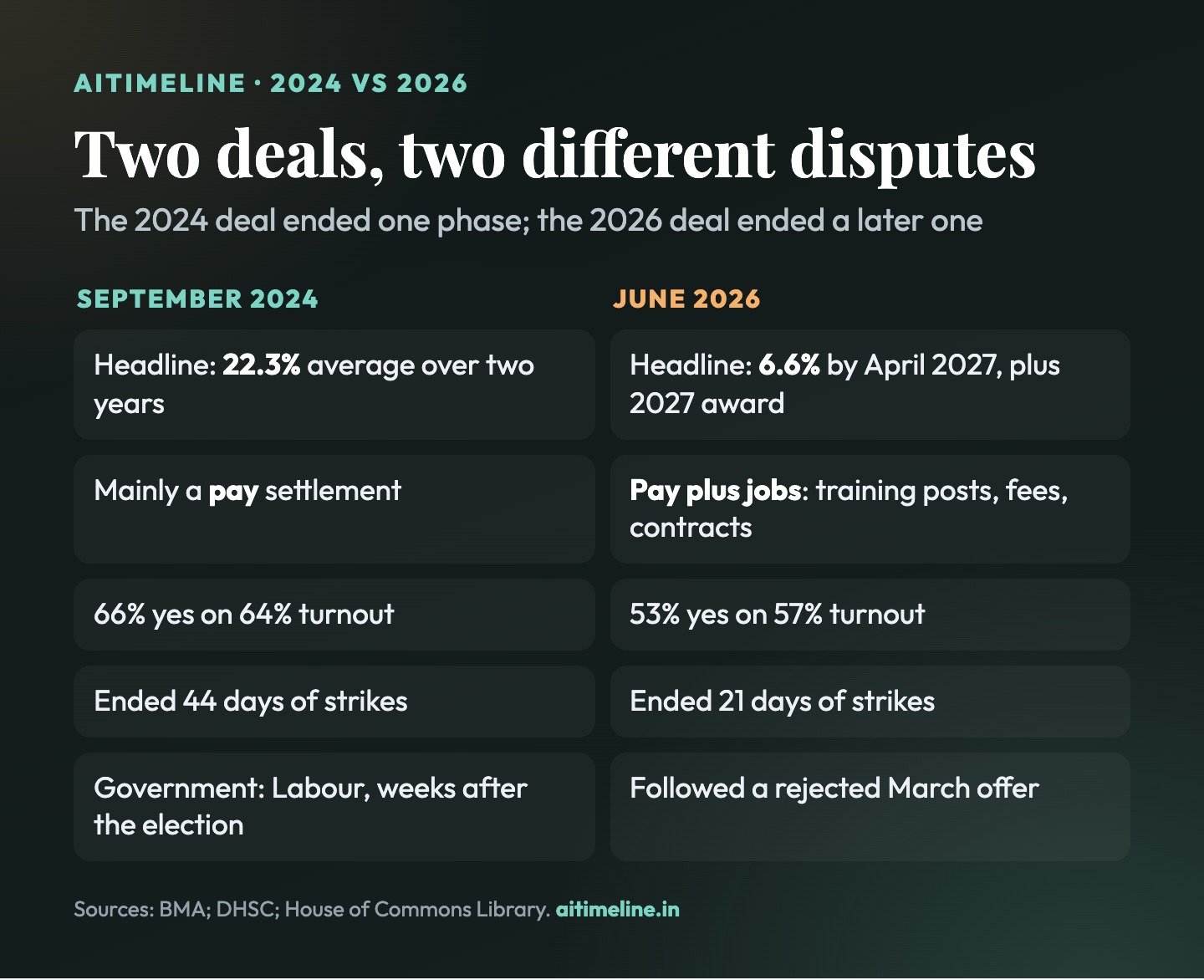
The 2024 agreement was a large one-off correction that left the BMA’s long-term demand intact. When the next pay award came in below what doctors wanted, and training-post shortages worsened, the dispute returned. The 2026 deal tried to close that gap by changing the pay structure itself and tying jobs and costs into the package, which is also why far fewer members voted for it.
How Doctors Voted
Strong strike mandates, narrower deal votes.
What Was the Impact on NHS Patients and Services?
Strikes hit hospital staffing, planned operations and outpatient appointments. Trusts prioritised emergency and urgent care, with consultants covering many resident doctor roles, while routine activity was postponed and rebooked.
The government estimated each day of resident doctor strike action cost the NHS about £50 million. That is an official estimate, not an audited figure for each day, and the real effect varied by hospital, specialty and how many doctors took part.
The dispute also exposed a longer-term workforce problem: doctors who complete medical school and foundation training can still face intense competition for specialty training places, which is why the 2026 deal put as much weight on posts as on pay.
England, Scotland, Wales and Northern Ireland: Are the Deals the Same?
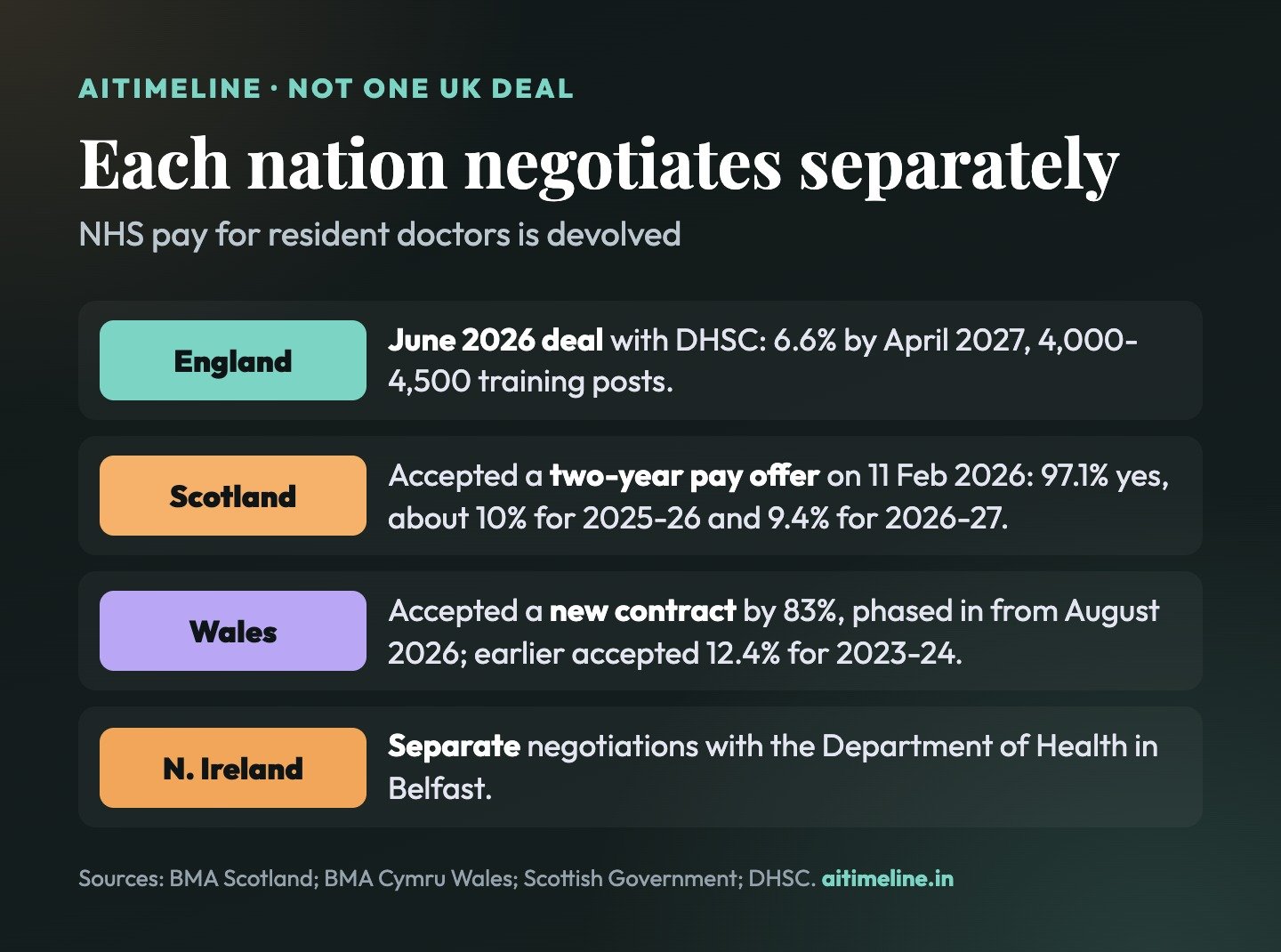
No. NHS pay is devolved.
| Nation | Latest position |
|---|---|
| England | June 2026 pay and jobs deal; implementation ongoing |
| Scotland | Two-year pay offer accepted 11 Feb 2026 (97.1% yes, 62.4% turnout) |
| Wales | New contract accepted (83%), phased in from August 2026 |
| Northern Ireland | Separate negotiations |
The England agreement should not be presented as a single settlement covering every NHS resident doctor in the UK.
Key Facts at a Glance
| Question | Answer |
|---|---|
| Main union | British Medical Association (BMA) |
| Doctors involved | Resident doctors, formerly junior doctors |
| Earlier contract dispute | 2016 |
| Pay dispute | 2022-2026 |
| Main pay demand | Restoration towards 2008 real-terms pay |
| 2024 settlement | 22.3% average across 2023-24 and 2024-25 |
| 2026 settlement accepted | 29 June 2026 (52.9% of votes cast) |
| 2026 average uplift | 6.6% by April 2027, plus the 2027 award |
| Extra training posts | Up to 4,500 over three years |
| RDC chair at settlement | Dr Jack Fletcher |
| Latest position | Settled; implementation ongoing |
A Settlement, Not the End of the Workforce Debate
The dispute grew from a 2016 argument over contract terms into a wider fight over real-terms pay, career progression, training capacity and job security. The 2024 agreement delivered a large pay rise but did not stop the dispute returning in 2025.
The June 2026 deal ended the latest strikes by combining pay-scale reform with training and employment measures. Its long-term significance depends on whether those changes are delivered, whether extra posts become real careers, and whether future pay awards keep pace with inflation. For patients, the immediate result is an end to walkouts; for doctors and NHS employers, the test is recruitment and retention.
Explore More Timelines
People Also Ask
Frequently Asked Questions
⚠️ Editorial Note
Strike dates and vote results follow BMA announcements, the House of Commons Library and DHSC statements. Pay figures such as 22.3%, 6.6%, 4.9% and 35.2% are government averages and do not apply equally to every doctor. The £50 million daily cost is a government estimate. Implementation of the 2026 deal is ongoing, and figures may change. This page is general information, not employment advice.
Related Stories
Sources & further reading
Every dated entry above was checked against these references. Last reviewed 23 November 2026.
- House of Commons Library: Junior doctor contracts in England (CBP-7314)
- BMA: Pay offer for resident doctors in England, 2024
- BMA: Resident doctors in England vote for six months more industrial action (February 2026)
- GOV.UK (DHSC): BMA resident doctors committee rejects landmark deal, 25 March 2026
- GOV.UK (DHSC): Offer to BMA UK resident doctors committee, June 2026
- BMA: Resident doctors in England vote to accept pay and jobs offer, 29 June 2026
- GOV.UK (DHSC): Resident doctors agree deal with government to end strikes, 29 June 2026
- GOV.UK (DHSC): 2026 resident doctors deal implementation update, 30 September 2026
- BMA Scotland: Resident doctors in Scotland vote to accept Scottish government pay offer
- BMA Cymru Wales: Contract reform for resident doctors in Wales