Marine War Risk Insurance: How Insurers Price Dangerous Sea Lanes
Discover how marine war-risk insurance is priced, why premiums surge in Hormuz and the Red Sea, and how India's BMIP protects maritime trade.
Latest Story
Marine war risk insurance is the extra cover that lets a ship enter waters where attack, seizure, mines or blockade are possible. A vessel does not have to be hit to become more expensive: the threat is enough to raise the additional war-risk premium, usually quoted as a percentage of the ship’s insured value for one voyage. On a large tanker, a rate that looks small on paper can be millions of dollars. This timeline traces how the market works, from Lloyd’s coffee house to the Red Sea, the Black Sea and Hormuz in 2026.
The Joint War Committee does not set prices. It maps the risk by listing areas; individual underwriters quote each voyage. Premium figures here are dated market observations or illustrations, not tariffs, and the maths examples are not quotations.
💡 Short Answer
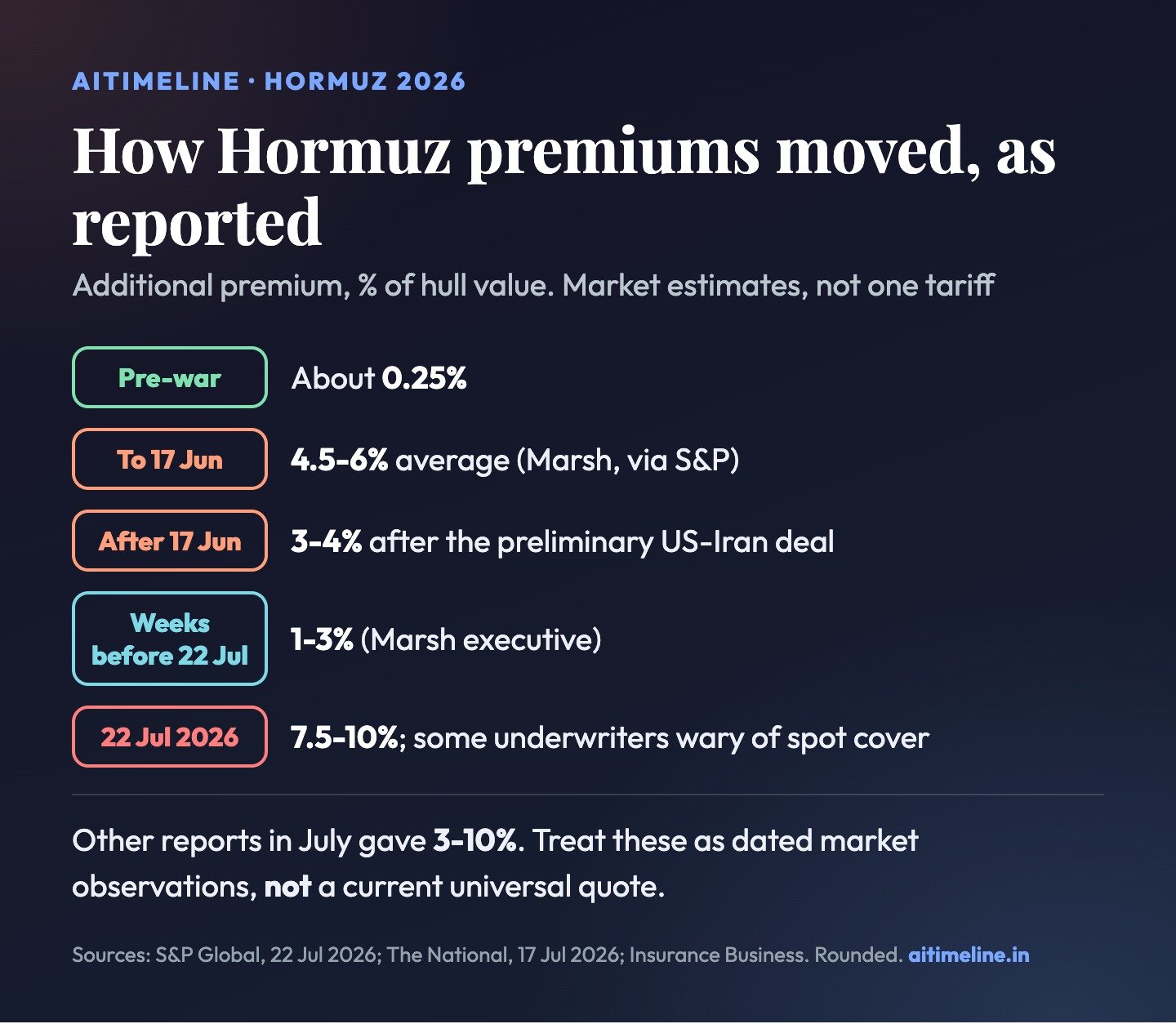
Marine war risk insurance covers war-related losses that ordinary marine policies generally exclude. The extra charge, the additional war-risk premium, is set voyage by voyage as a percentage of hull value: 1% on a US$100 million ship is US$1 million. The Joint War Committee lists high-risk areas but does not set rates. In July 2026 a Marsh executive put Hormuz premiums at 7.5-10% of hull value, up from 1-3% weeks earlier.
What Is Marine War Risk Insurance?
Ordinary marine cover often excludes war. Extra cover fills the gap.
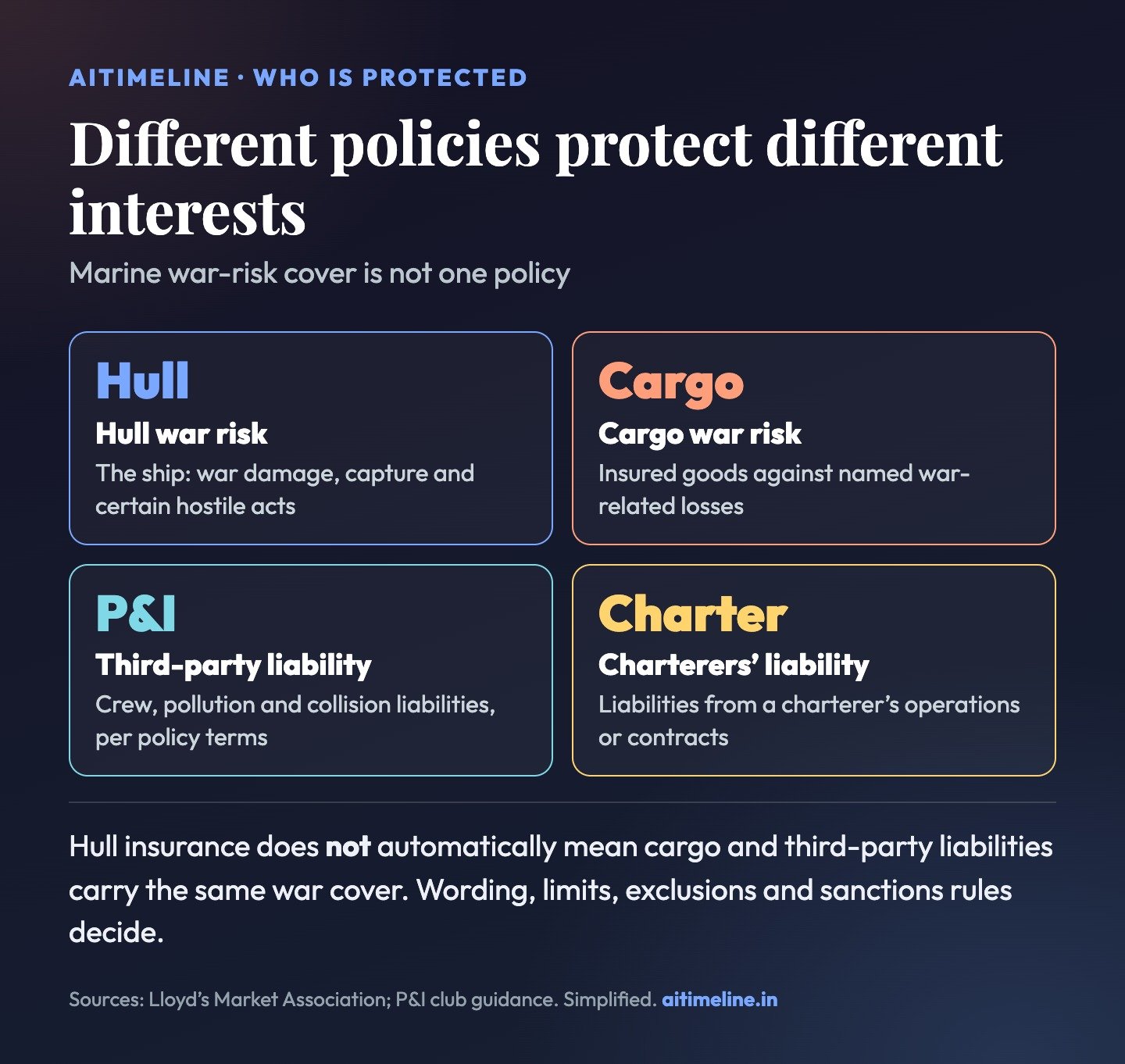
Ordinary marine insurance covers many operational risks, but war-related losses are generally treated separately or excluded. Shipowners and cargo interests may therefore need additional protection when a voyage enters a conflict-affected region. The exact protection depends on the policy wording, exclusions, limits and applicable sanctions rules.
Marine War Risk Insurance: Key Questions
What the Record Shows
- Threat is enough: a ship does not need to be hit to become more expensive to insure.
- Percent of hull value: the charge is rate times insured value, so small rates become seven-figure costs.
- Map, not price: the Joint War Committee lists areas; underwriters quote each voyage.
- 3 March 2026: JWLA-033 added Bahrain, Djibouti, Kuwait, Oman and Qatar.
- July 2026: Hormuz premiums reported at 7.5-10% of hull value, from 1-3% weeks earlier.
- 16 September 2026: JWLA-035 widened the Black Sea listing to nearly the whole basin.
- Availability is not the issue alone: the Lloyd’s Market Association says safety, not cover, kept many ships away.
- India: a sovereign-backed pool launched on 12 May; the government reports premiums down about 35-40% from the peak.
- Human cost: the IMO reported at least 130 attacks and 25 seafarer deaths by mid-November 2026.
How Insurers Price Dangerous Waters
The most familiar measure is the premium as a percentage of hull value.
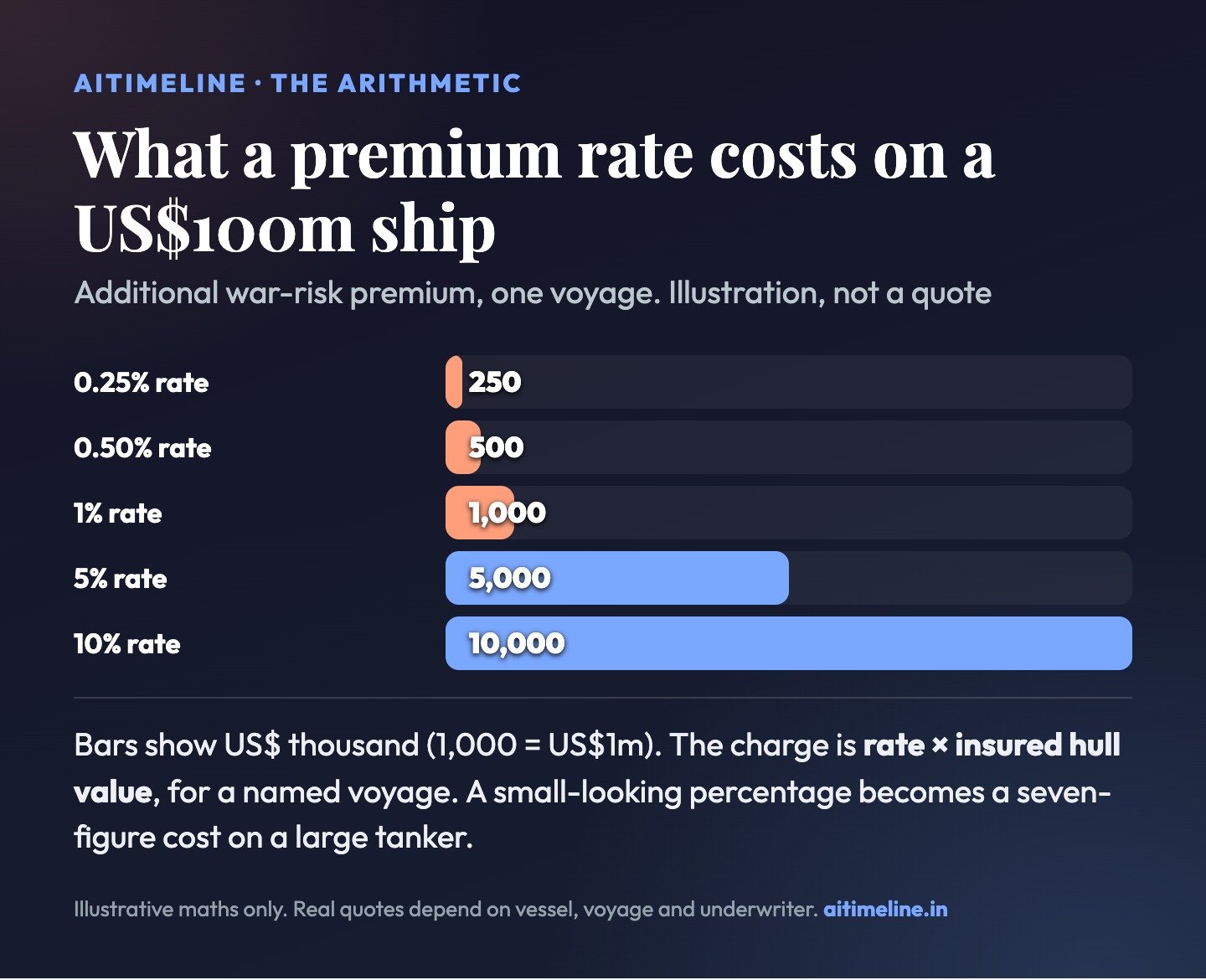
| Hull value | Premium rate | Additional premium |
|---|---|---|
| US$50 million | 0.25% | US$125,000 |
| US$100 million | 0.50% | US$500,000 |
| US$100 million | 1.00% | US$1 million |
| US$100 million | 5.00% | US$5 million |
| US$100 million | 10.00% | US$10 million |
Mathematical examples, not quotations or standard market tariffs. Actual charges depend on the vessel, voyage, cover and underwriting terms.
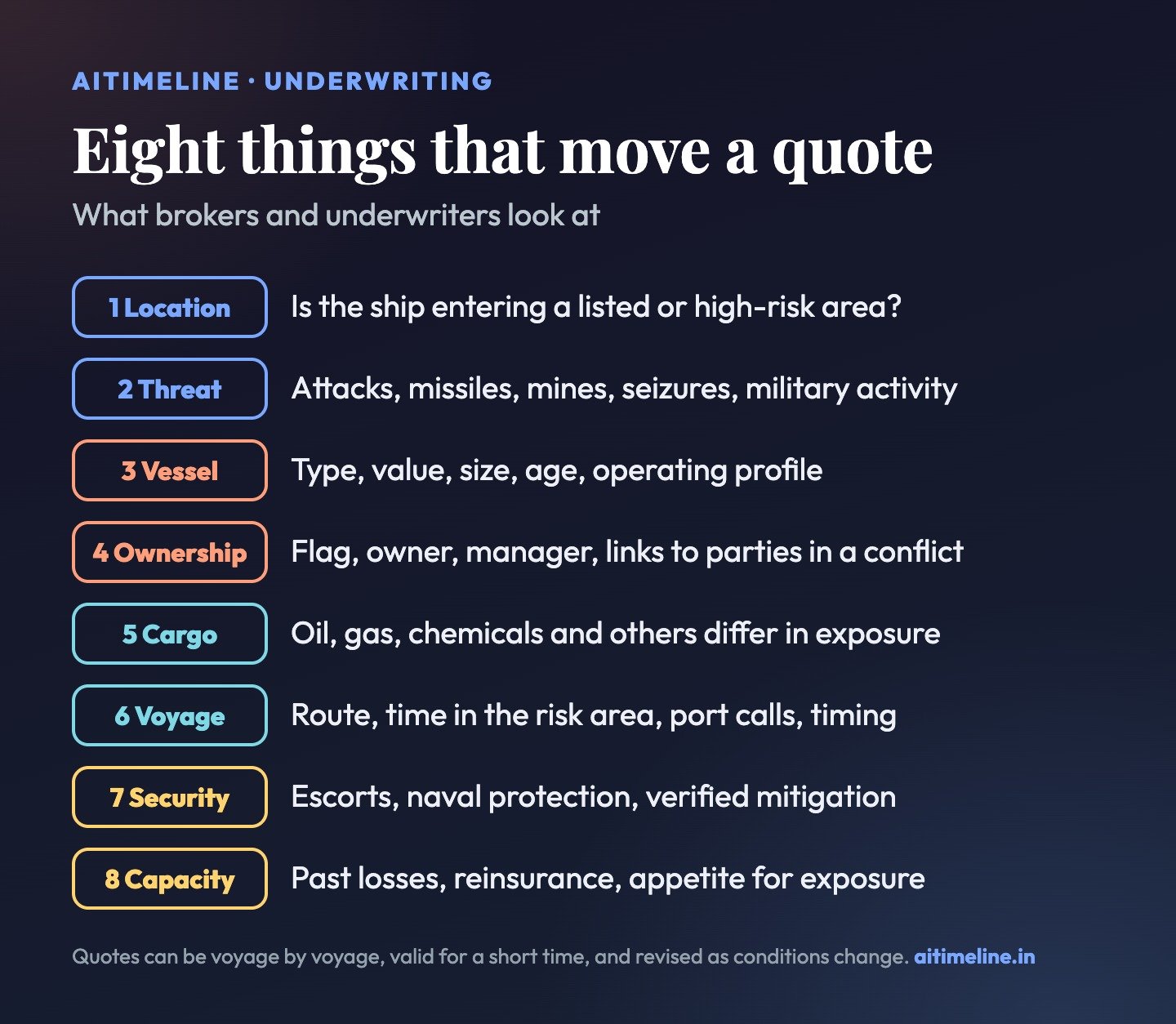
Premiums can be negotiated voyage by voyage. A quote may be valid only for a limited period and can be revised, or cover cancelled and renegotiated, as conditions change.
The Joint War Committee: Mapping Risk, Not Setting Prices
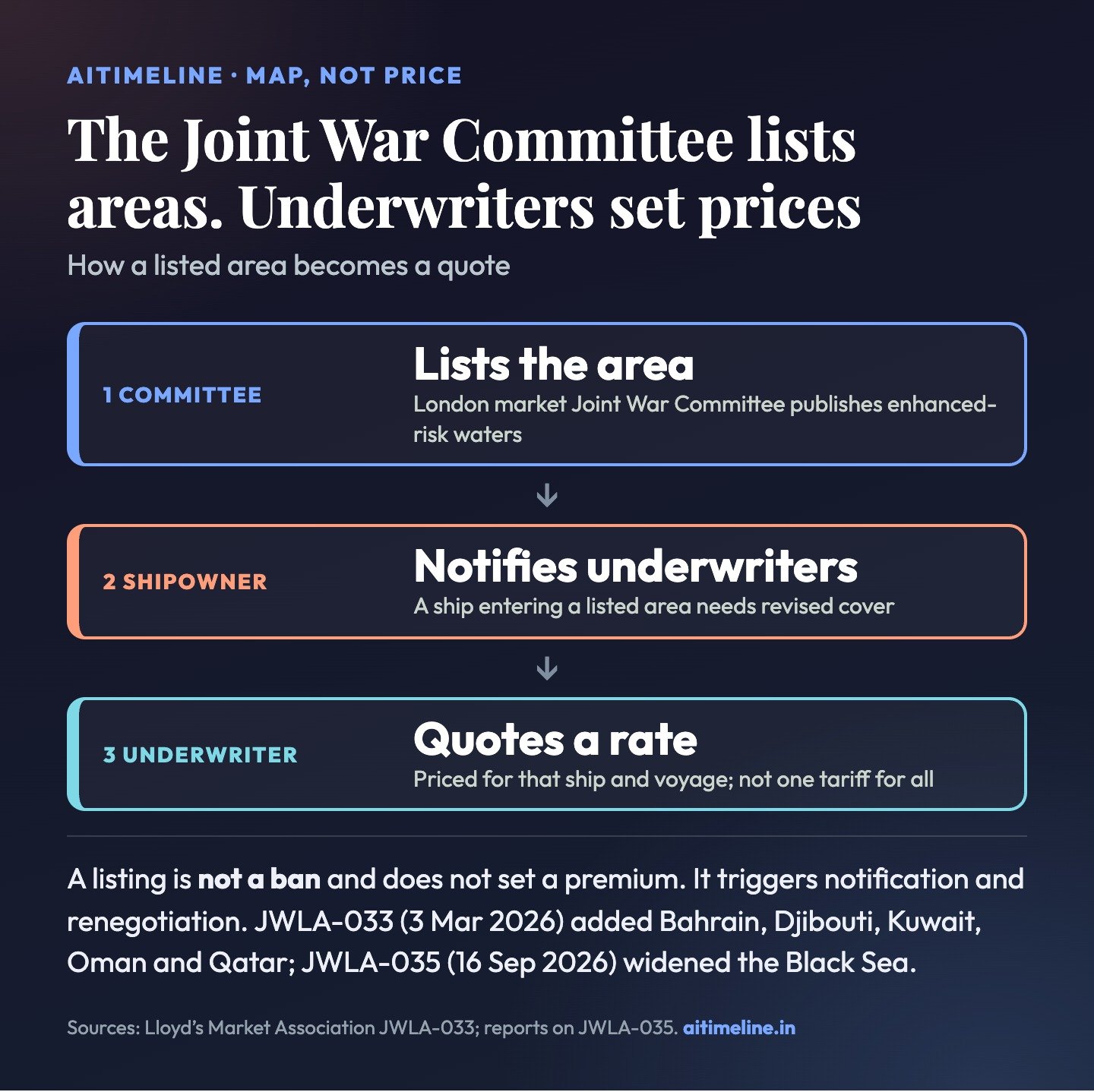
The London market’s Joint War Committee publishes geographical areas it considers to present enhanced war-related risks. Being on the map does not mean that every ship pays the same rate or that insurance is unavailable. Its current guidance also identifies significant risks in the Gulf of Aden, the Strait of Hormuz, the Red Sea and other conflict-affected waters.
Timeline: How War Risk Became a Major Shipping Cost
Newest first. Labels mark origins, crises, market moves, India and data.
IMO count passes 130 verified attacks Data
The count: The International Maritime Organization was reported as confirming at least 130 attacks on commercial vessels in the region since the conflict began, with 25 seafarers killed. Seatrade, citing IMO data to 27 October, had put the Strait of Hormuz, Arabian Gulf and Gulf of Oman total at 121 attacks and 24 deaths.
Stranded ships: A November report said that, as of late October, up to 400 ships carrying around 6,000 seafarers had been unable to leave safely since July.
Caution: Counts differ by outlet and date, and some include attacks by more than one party. Check the IMO’s own pages for the latest figure.
Insurers warn that sanctions complicate losses Data
The warning: S&P Global’s 1 October interview was headlined that war-risk insurance costs were rising as sanctions complicated casualty response. The Lloyd’s Market Association pointed to the growing listed areas in the Black Sea and the Middle East.
Why it matters: A claim, a salvage or a payment that touches a sanctioned party can be delayed or refused, which raises the financial consequence of an incident.
JWLA-035 widens the Black Sea; IMO counts 80 attacks Data
Black Sea: The Joint War Committee issued JWLA-035 on 16 September, extending the Black Sea listed area to cover nearly the whole basin, with the territorial waters of Turkiye, Romania, Bulgaria and Georgia excluded. One report said the new conditions were expected to apply from 19 September.
Hormuz: In the same week the IMO said it had verified 80 attacks on ships in and around the Strait of Hormuz since 28 February, killing at least 22 seafarers. A few outlets reported 20 deaths; the figure moved as cases were confirmed.
India reports BMIP growth India
Policies: The government reported that the pool had issued about 3,000 cargo war-risk policies, 92 hull war-risk policies and three P&I policies by 7 September.
Premiums: It repeated its earlier claim that war-risk premiums had fallen about 35-40% from the peak of the West Asia conflict.
IMO: 70 attacks and 19 seafarer deaths Data
The count: As of 28 August the IMO had verified at least 70 attacks on international shipping since the conflict began and 19 seafarer deaths. Other trackers gave slightly different totals for the same period.
India launches a sovereign-backed P&I product India
What launched: The first policy under the pool’s Protection and Indemnity product went to the Shipping Corporation of India. It covers third-party liabilities including crew and cargo liability, pollution and wreck removal, with an indemnity limit up to US$1.5 billion through the pool’s combined capacity.
Claims by the government: It said war-risk premium rates had fallen about 35-40% from the height of the conflict and that 1,608 cargo and hull war-risk policies had been issued by 29 July.
Hormuz premiums surge again Market
The numbers: S&P Global reported on 22 July that additional war-risk premiums for Hormuz transits had risen from about 1-3% of hull value weeks earlier to 7.5-10%, according to a Marsh executive. A 17 July report quoted the same executive at 3-10%.
Why: Attacks had intensified and some underwriters were less willing to offer spot cover. Marsh also estimated global hull war capacity at about US$2.5-3 billion.
A peace deal cuts premiums; Lloyd’s backs a consortium Market
Premiums: Marsh said premiums had averaged about 4.5-6% before a preliminary US-Iran agreement on 17 June and fell to about 3-4% afterwards.
Capacity: Lloyd’s welcomed a Chubb-led marine war-risk consortium to support Hormuz transits.
Bharat Maritime Insurance Pool launches India
Launch: India formally launched the pool with capacity of US$1.5 billion and a sovereign guarantee of US$1.4 billion (Rs 12,980 crore). It covers hull and machinery, cargo, P&I and war risks for Indian-flagged or controlled vessels and vessels bound to or from India.
First policies: New India Assurance handed the first Marine Hull and Machinery War Policy to Hoger Offshore and Marine Private Limited. A cargo war policy went to Vedanta Sterlite Copper for cable-wire imports.
Cabinet approves the pool India
Decision: The Union Cabinet approved the Bharat Maritime Insurance Pool with a sovereign guarantee of Rs 12,980 crore. Reports said member insurers would offer combined underwriting capacity of about Rs 950 crore under the framework.
Lloyd’s market says war cover is still available Market
The statement: The Lloyd’s Market Association said offers of war cover were being made for Hormuz transits and that offers would stay open until owners judged it safe. On 23 March it said reports that cancelled or unaffordable cover was keeping ships out were not accurate, and that 88% of main Lloyd’s war-market participants still had appetite, from a survey taken the week after hostilities began.
Traffic: S&P Global reported that daily Hormuz transits fell from an average of 135 in February to under 10 in early March.
JWC adds Bahrain, Djibouti, Kuwait, Oman and Qatar Crisis
The change: On 3 March the committee added Bahrain, Djibouti, Kuwait, Oman and Qatar to its listed areas and revised the boundaries covering parts of the Persian/Arabian Gulf, Gulf of Oman, Indian Ocean, Gulf of Aden and Southern Red Sea.
Effect: Insurers issued notices of cancellation so cover could be renegotiated for listed areas. Reports differ on effective dates, so owners had to check their own policy wording.
The Gulf conflict begins Crisis
The shock: The outbreak of the current Middle East conflict on 28 February put ships around the Persian Gulf and the Strait of Hormuz in a heightened threat environment. The IMO dates its attack count from that day.
Insurance: The possibility of attacks, detention and disrupted navigation led underwriters to reassess exposure and reprice.
UN Security Council acts on Red Sea attacks Crisis
The resolution: The Security Council adopted Resolution 2722 on 10 January 2024, requesting reporting on Houthi attacks on merchant and commercial vessels in the Red Sea. The IMO later helped monitor and verify incidents.
Houthi attacks reprice the Red Sea Crisis
Seizure: The Houthis seized the Galaxy Leader on 19 November 2023. On 18 December the Joint War Committee extended its Red Sea listed area to account for missile range.
Rates: Reported quotes in early 2024 reached roughly 0.7-1% of hull value, up from a small fraction of a percent. Figures vary by source and date, and some quotes were described as theoretical.
Russia’s invasion reprices the Black Sea Crisis
Listing: The committee had added Ukrainian and Russian waters in the Black Sea and Sea of Azov to its listed areas in mid-February 2022, ahead of the invasion on 24 February. On 7 March it widened the Black Sea area to cover most of the northern half.
Why it matters: It showed that a listed area can move ahead of an attack, not only after one.
Piracy off Somalia becomes an underwriting concern Origins
The risk: Hijacking, ransom demands, crew detention and vessel seizure made maritime security assessments a routine part of pricing for ships using the Gulf of Aden. The area remains a Joint War Committee listed area today.
Lloyd’s becomes a corporation Origins
The Act: The Lloyd’s Act 1871 incorporated the Society of Lloyd’s and gave it power to make its own bylaws. It also restricted Lloyd’s to marine insurance, a limit a later Act removed in 1911.
Lloyd’s List publishes shipping intelligence Origins
The list: Lloyd’s List was first published by Thomas Jemson in 1734, building on earlier shipping news from the coffee house. News of ships, routes and dangers became a commercial service.
Lloyd’s coffee house, London Origins
Origins: Lloyd’s own history traces its beginnings to a coffee house run by Edward Lloyd in Tower Street, London, mentioned in the London Gazette in 1688. Shipowners, merchants, captains and people arranging insurance met there. Sources differ on the exact first date.
Which Sea Lanes Face Elevated Exposure?
| Sea lane | Why insurers monitor it |
|---|---|
| Strait of Hormuz | Military confrontation, attacks, seizure risks, disruption to energy shipping |
| Red Sea | Houthi threats and attacks on commercial vessels |
| Bab-el-Mandeb | Exposure near the entrance to the Red Sea |
| Gulf of Aden | Regional instability, piracy and conflict-related threats |
| Black Sea | Russia-Ukraine war, attacks on maritime infrastructure, vessel exposure |
| Sea of Azov | Military conflict and restricted commercial navigation |
A listed area is an insurance-market classification, not a declaration that every part of a sea lane is equally dangerous.
Why the Strait of Hormuz Matters So Much
The strait connects the Persian Gulf with the Gulf of Oman and the Indian Ocean, and a substantial share of the world’s seaborne oil and gas trade moves through it. For an oil tanker, a higher premium raises the cost of the voyage, may mean waiting for a safer window, may lead an owner to decline the trip, and can raise freight and delivery costs for cargo owners and importers. The insurance market is therefore a transmission channel between conflict and trade.
It is also why the Lloyd’s Market Association stressed in March that availability of insurance and the physical decision to sail are separate questions.
Suez Canal or the Cape of Good Hope?
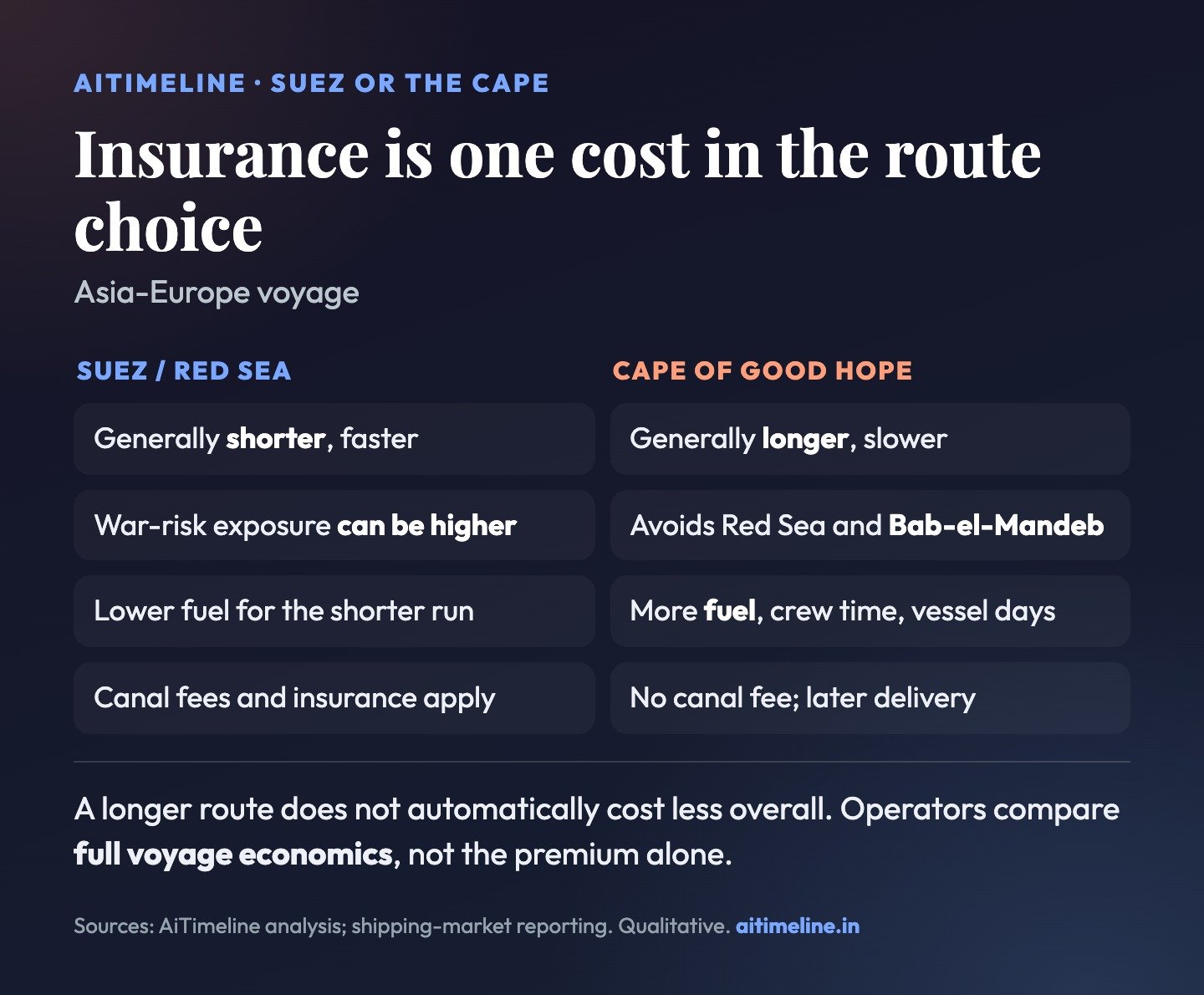
Shipping companies compare full voyage economics rather than the premium alone. Additional fuel, crew time, vessel availability and delivery delays can outweigh the insurance saving. See our related stories on Red Sea shipping attacks and Bab el-Mandeb.
What This Means for India
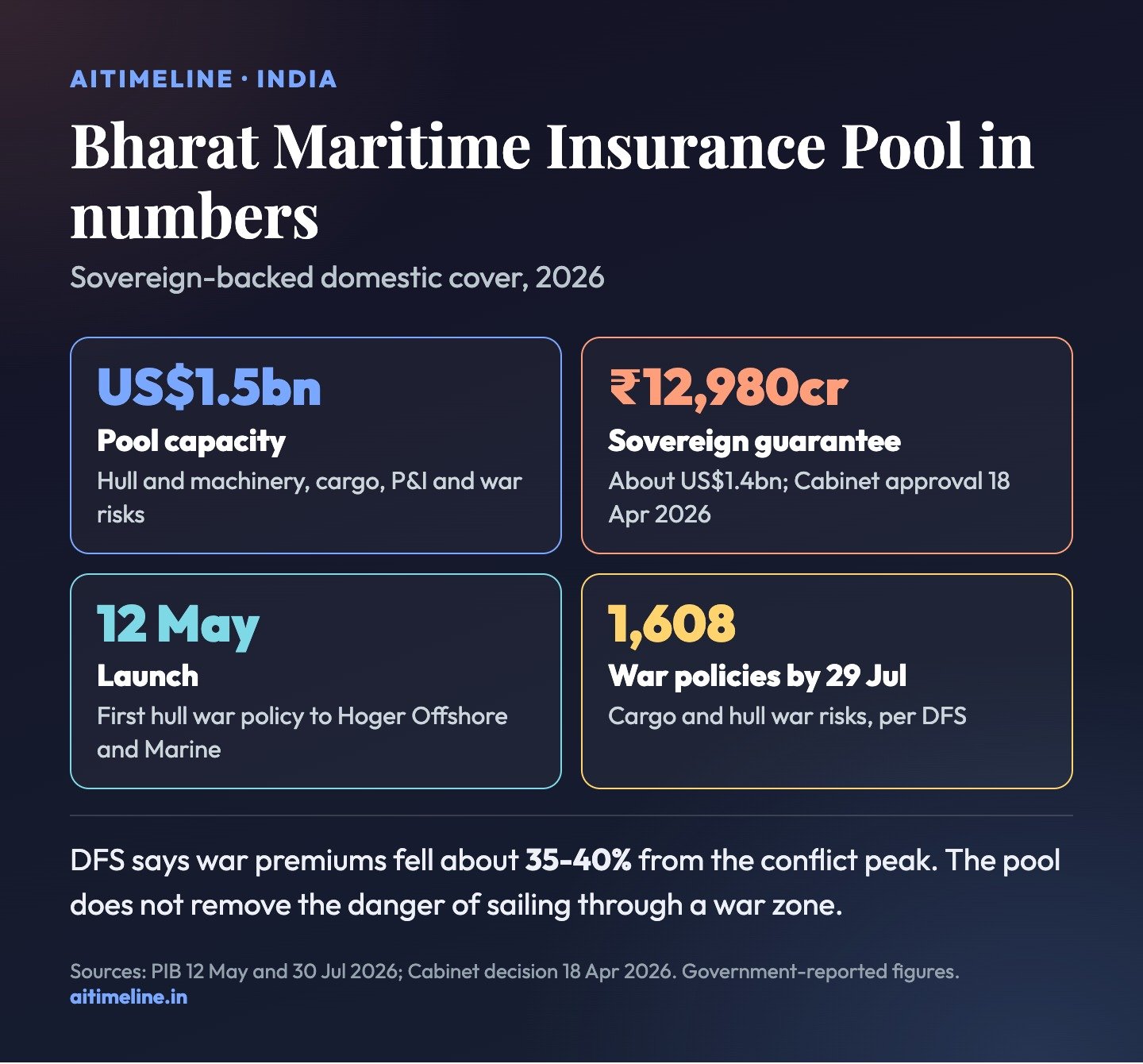
India’s exposure is significant because maritime trade is central to its energy imports and merchandise supply chains. Higher premiums can feed into crude and LNG/LPG costs, import prices and export competitiveness, and they pressure Indian operators seeking international cover. The pool was designed to keep Indian trade insured when foreign cover tightens, including through sanctions. It does not remove the danger of sailing through a conflict zone. For the gas side of the story, see our India LPG import dependence timeline.
Who Ultimately Pays?
The first payer may be the shipowner, cargo owner, charterer or another party, depending on the contract. The cost can then travel along the chain: conflict or threat, higher premium, higher voyage cost, freight or cargo-price adjustment, importer and consumer exposure. How much is passed on depends on competition, contract terms, cargo availability and how long the disruption lasts. Insurance is one component of a wider logistics and commodity-cost calculation.
The Limits of War-Risk Insurance
| Limit | Why it matters |
|---|---|
| Crew safety | Compensation cannot reverse injury or loss of life |
| Sanctions | A policy may not respond to a transaction or claim prohibited by sanctions |
| Exclusions | Not every hostile act is automatically covered |
| Accumulation | Many ships and cargoes can be exposed to one chokepoint at once |
| Reinsurance capacity | Insurers limit exposure when one event could cause very large losses |
| Operations | An insured ship may still lack safe passage, port entry or salvage help |
What to Watch Next
Verified IMO attack counts, Joint War Committee circulars, voyage-specific broker quotes rather than broad estimates, naval protection, sanctions, reinsurance capacity and, for India, further pool policy numbers and claims experience.
Conclusion: The Price of Keeping Trade Moving
Marine war-risk insurance is a financial measure of danger, not a guarantee against it. When conflict threatens a major sea lane, insurers reassess the probability of loss, owners reconsider routes and cargo owners face a new layer of cost. The Red Sea, the Black Sea and Hormuz show how geopolitical events reshape maritime economics well beyond the conflict zone.
For India, the Bharat Maritime Insurance Pool is an attempt to strengthen domestic capacity. The longer-term challenge is the same everywhere: keeping trade moving while protecting ships, cargoes and the people who work at sea.
Explore More Timelines
People Also Ask
Frequently Asked Questions
⚠️ Editorial Note
Premium percentages are dated market observations or illustrative calculations, not guaranteed rates, and sources differ on ranges for the same period. Insurance terms and risk classifications can change quickly. India’s policy counts and premium falls are government-reported. The latest Joint War Committee circular identified here is JWLA-035 (16 September 2026); confirm individual quotations with insurers and brokers. This is not insurance or financial advice.
Related Stories
Sources & further reading
Every dated entry above was checked against these references. Last reviewed 24 November 2026.
- Lloyd's Market Association: Joint War Committee and current listed areas
- Joint War Committee circular JWLA-033 (3 March 2026)
- S&P Global: Middle East shipping insurance costs rise on Hormuz risks (22 July 2026)
- S&P Global: War risk insurance costs rise as sanctions complicate casualty response (1 October 2026)
- Reinsurance News: Safety concerns, not insurance availability, halting Strait of Hormuz, LMA clarifies
- PIB: Bharat Maritime Insurance Pool launched (12 May 2026)
- PIB: BMIP launches first sovereign-backed P&I product (30 July 2026)
- Cabinet approves Bharat Maritime Insurance Pool, sovereign guarantee Rs 12,980 crore (18 April 2026)
- IMO: Middle East, highlighted maritime incidents
- Lloyd's: Coffee and commerce, the history of Lloyd's