Space Debris Timeline: Orbital Safety and Regulations
Explore the history of space debris, major satellite collisions, Kessler syndrome and global regulations shaping orbital safety and space sustainability.
Latest Story
Space debris is human-made material in orbit that no longer serves a purpose: dead satellites, spent rocket stages and fragments from collisions and explosions. This guide follows how the problem grew from Sputnik in 1957, through the 2007 anti-satellite test and the 2009 collision, to today’s tracking, standards and the voluntary Zero Debris Charter, and explains what is, and is not, legally binding.
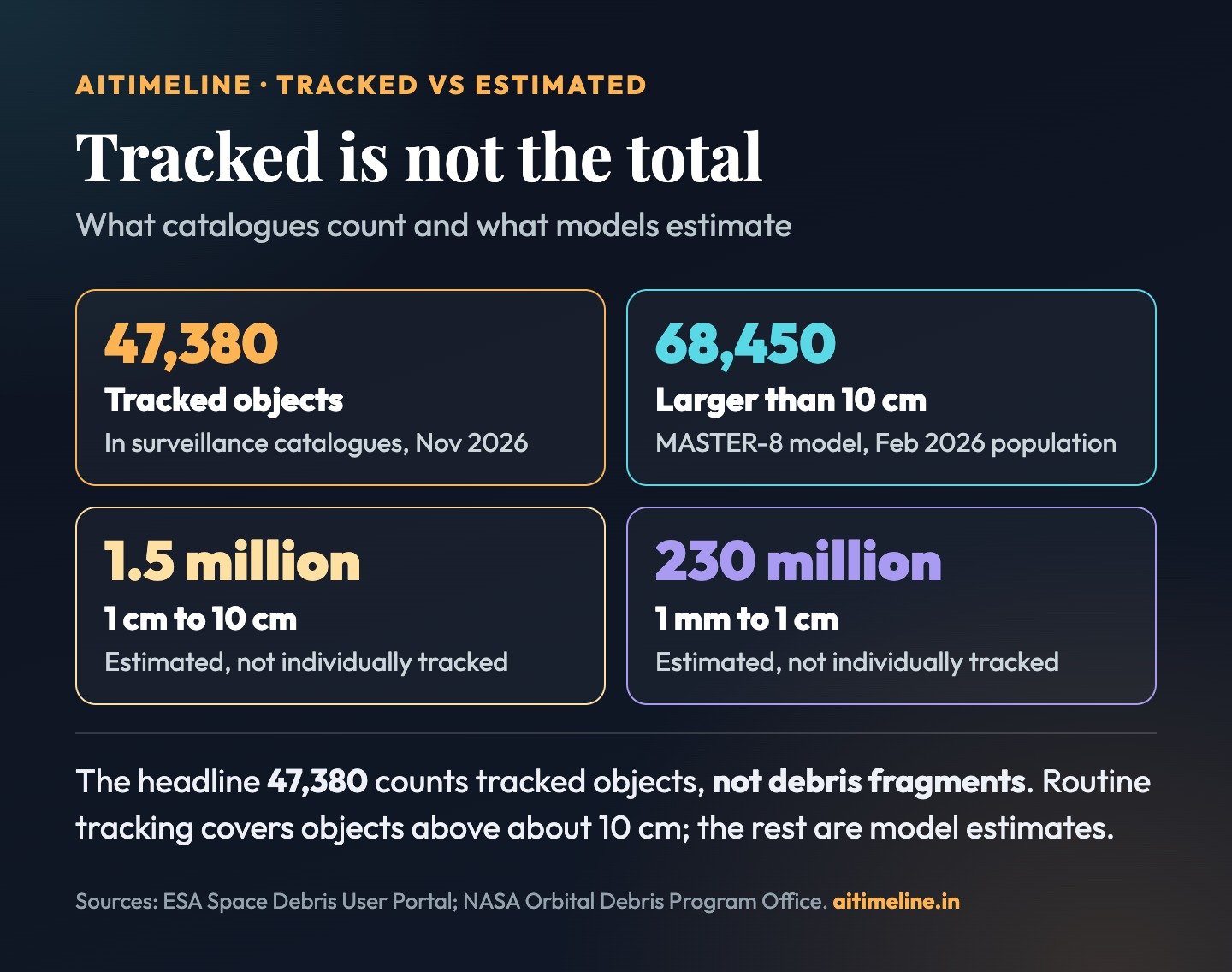
47,380 is a count of tracked objects, not of debris fragments. ESA’s portal lists about 47,380 objects regularly tracked by surveillance networks (17 November 2026). Many are working satellites, and far smaller debris is only estimated by models: about 1.5 million pieces between 1 and 10 cm.
💡 Short Answer
ESA counts about 47,380 regularly tracked objects in Earth orbit and about 15,800 working satellites (17 November 2026). The worst debris events were China’s 2007 Fengyun-1C test and the 2009 Iridium-Cosmos collision. There is no single binding global debris treaty: the UN guidelines, ESA’s Zero Debris Charter and ISO standards are mostly voluntary, with binding duties set through national licensing.
Space Debris by the Numbers
What is tracked, and what is estimated.
Space Debris: Key Questions
Orbital Debris in Ten Points
- Tracked, not total: about 47,380 tracked objects; millions of smaller fragments are estimated only.
- Kessler, 1978: the first paper to describe collision-driven debris growth.
- 2007: Fengyun-1C anti-satellite test, 3,378 cataloged fragments.
- 2009: first major accidental collision, Iridium 33 and Cosmos 2251, 2,201 cataloged fragments.
- 2021: Cosmos 1408 test sent the ISS crew to shelter.
- Rules: the 2007 UN guidelines and 2019 sustainability guidelines are voluntary.
- Standards: ISO 24113 (2010) and ISO 23312:2026 set design requirements.
- Zero Debris: ESA’s charter, published 7 November 2023, aims for debris-neutral missions by 2030.
- Decay: below 600 km, years; above 1,000 km, 1,000 years or more.
- Removal: needed for existing debris, but still technically hard.
Timeline: Space Debris Events and Regulations, 1957 to 2026
Newest first. Labels mark collisions, tests, rules, standards, data and outlook.
Orbital safety remains a growing international challenge Outlook
Where things stand: ESA’s latest statistics list about 47,380 regularly tracked objects and about 15,800 working satellites. Launch activity, large satellite constellations and decades-old debris keep tracking, collision avoidance and disposal at the centre of space policy.
What is being done: Operators and agencies are working on better tracking and data sharing, spacecraft designed for disposal, stronger standards and, for a few high-risk objects, active removal.
ESA updates its orbital environment statistics Data
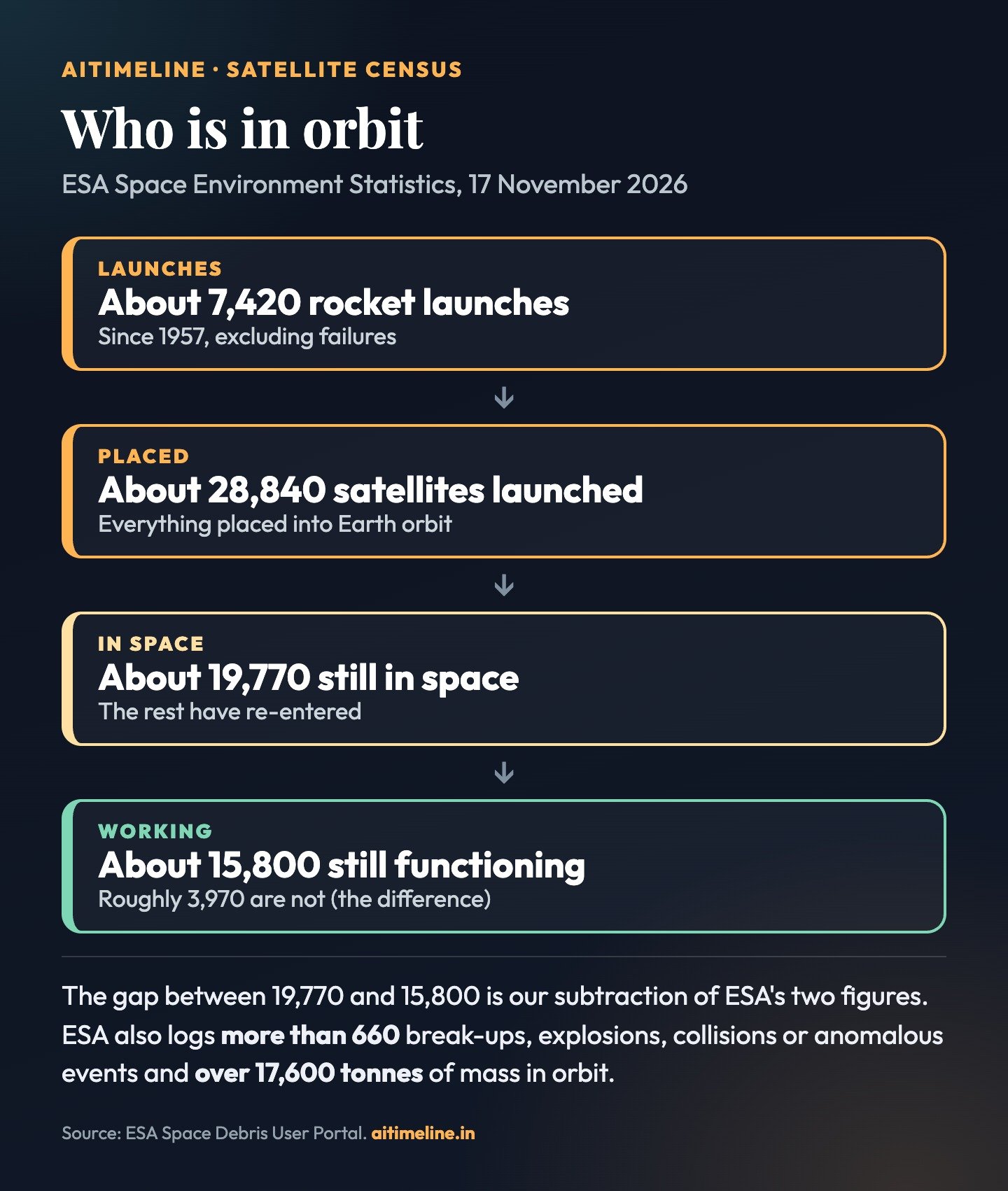
The figures: About 7,420 rocket launches since 1957 (excluding failures) have placed about 28,840 satellites into orbit; about 19,770 are still in space and about 15,800 are still functioning. About 47,380 objects are regularly tracked by space surveillance networks, and ESA records more than 660 break-ups, explosions, collisions or anomalous events.
What they do not say: These are catalogue figures and estimates, not a count of every fragment. Tracked objects are those large enough for surveillance networks; ESA’s MASTER-8 model puts objects larger than 10 cm at about 68,450, those from 1 to 10 cm at about 1.5 million and those from 1 mm to 1 cm at about 230 million.
ISO publishes ISO 23312:2026 Standard
What it covers: ISO 23312:2026, ‘Space systems: Detailed space debris mitigation requirements for spacecraft’, covers the design and operation of uncrewed Earth-orbit spacecraft: avoiding intentional debris release, preventing in-orbit break-ups, end-of-mission disposal, estimating remaining propellant and keeping a debris mitigation plan.
A caution: The full text is paywalled, so this page does not describe what changed from the 2022 edition. Standards are used in contracts and licences; they are not themselves international law.
ESA releases its tenth Space Debris Environment Report Data
What is new: ESA’s Space Debris Office says the tenth edition updates future environment evolution and on-ground re-entry casualty risk. The February 2026 MASTER population was released on 8 September 2026.
Why it matters: These models are how ESA estimates debris too small to track, and how it projects whether the population will grow even without new launches.
EU Space Act proposed Rule
The proposal: The EU’s proposed space legislation includes provisions on orbital traffic coordination, debris mitigation, spacecraft disposal and failure-response planning, as a common framework across member states.
A caution: A proposal is not law. This page has not confirmed where the text stands in Parliament or Council, so it should be distinguished from standards already published and in force.
ESA Space Environment Report 2025 Data
The estimate: ESA reported about 40,000 tracked objects, about 11,000 of them active payloads, and estimated more than 1.2 million debris objects larger than 1 cm, including over 50,000 larger than 10 cm.
The warning: It said not enough satellites leave congested orbits at end of life, that 2024 saw several major fragmentation events adding thousands of objects, and that debris would keep growing even without new launches, because break-ups add objects faster than decay removes them.
NASA updates its orbital debris requirements Standard
What changed: NASA Procedural Requirements NPR 8715.6E, ‘Orbital Debris Mitigation’, sets requirements for NASA spacecraft, acquired launch services and hardware contributions, from mission formulation to reentry and fragmentation notifications.
Scope: It binds NASA employees and contracts, not the public, except as law or contract provides.
Twelve countries sign the Zero Debris Charter Rule
The signatories: ESA reported that twelve countries signed at the Space Council in Brussels, including Austria, Belgium, Cyprus, Estonia, Germany, Lithuania, Poland, Portugal, Romania, Slovakia, Sweden and the United Kingdom.
Growth: By late 2025 ESA reported over 200 signatories from more than 30 countries, including companies, institutions and NGOs. The charter remains non-binding.
ESA publishes the Zero Debris Charter Rule
The goal: The charter is a voluntary framework aiming for future missions to become debris-neutral by 2030, with targets such as a collision risk of 1 in 1,000 or lower and a re-entry casualty risk of 1 in 10,000 or lower, and commitments to clear orbits after missions and share tracking data.
Zero Debris approach: ESA describes its own approach as revising its internal debris requirements towards the same 2030 aim.
United States pledges no destructive direct-ascent ASAT tests Rule
The commitment: In April 2022 the United States announced it would not conduct destructive direct-ascent anti-satellite missile tests, citing the debris they create, and urged other countries to follow.
A caution: It is a national pledge rather than a treaty, and this page has not re-checked every detail of the announcement.
Russia destroys Cosmos 1408 Test
The test: Russia destroyed its defunct Cosmos 1408 satellite in an anti-satellite test, creating a large debris cloud. NASA said the seven ISS crew members closed hatches and took shelter in their return vehicles for about two hours.
The aftermath: The cloud later forced an avoidance manoeuvre by the station, using a docked Progress cargo ship. Estimates of the number of pieces vary by source.
UN adopts 21 long-term sustainability guidelines Rule
What was agreed: During its 62nd session the UN Committee on the Peaceful Uses of Outer Space adopted a preamble and 21 guidelines on policy and regulatory frameworks, safety of space operations, international cooperation and capacity-building, and scientific and technical research.
Beyond debris: They extended the agenda past debris mitigation to the wider sustainability of space activity. They are voluntary.
US issues Space Policy Directive-3 Rule
The directive: SPD-3 set out a US framework for space traffic management: better tracking, information sharing and clearer responsibilities among government agencies.
Why it mattered: It reflected a shift from debris prevention alone to managing a more crowded orbit.
ISO 24113 sets a common design framework Standard
What it did: ISO 24113 gave spacecraft designers and operators a common set of debris mitigation requirements covering debris generation, break-ups and end-of-life disposal.
Since then: It has been revised, and a more detailed companion, ISO 23312, was published in 2022 and replaced by a second edition in October 2026.
Iridium 33 and Cosmos 2251 collide Collision
What happened: The operational US communications satellite Iridium 33 collided with the defunct Russian Cosmos 2251. A 2013 NASA analysis counts 1,603 cataloged Cosmos 2251 fragments and 598 from Iridium 33, 2,201 in all.
The lesson: A dead satellite can stay dangerous for years, and operators need shared tracking and warnings. NASA lists this collision and the Fengyun-1C test as events that significantly increased large debris.
China destroys Fengyun-1C Test
The test: A ballistic kinetic-kill vehicle destroyed China’s Fengyun-1C weather satellite. NASA’s 2013 analysis lists 3,378 cataloged fragments, of which 3,076 were still in orbit then.
The altitude: A 2010 NASA briefing called it the worst on-orbit fragmentation on record. Decay at about 800 km often takes centuries, per NASA’s FAQ, although much of this debris has a high area-to-mass ratio and decays faster.
UN General Assembly endorses debris mitigation guidelines Rule
The path: COPUOS adopted seven Space Debris Mitigation Guidelines in 2007, and the General Assembly endorsed them in Resolution 62/217 on 22 December 2007.
What they say: Limit debris released in normal operations, minimise break-ups, avoid intentional destruction and dispose of spacecraft safely after missions.
IADC adopts common mitigation guidelines Rule
The guidelines: The IADC, which brings together national space agencies and ESA, adopted guidelines on limiting debris in normal operations, preventing accidental explosions, avoiding collisions and end-of-life disposal.
Influence: They became the technical base for the UN’s 2007 guidelines.
NASA issues debris mitigation guidelines Standard
The step: NASA is generally cited as the first space agency to issue comprehensive orbital debris mitigation guidelines, focused on reducing debris creation and limiting the long-term presence of spacecraft and rocket stages.
A caution: We could not open a primary document for the 1995 date, so treat the year as reported rather than confirmed.
Kessler and Cour-Palais describe the debris belt Background
The paper: NASA scientists Donald Kessler and Burton Cour-Palais showed that collisions between orbiting objects could generate fragments and so raise the odds of further collisions.
The idea: This became known as Kessler syndrome: a theoretical cascade, not a claim that orbit is already unusable.
Outer Space Treaty sets the legal foundation Rule
The treaty: Signed by the United States, Soviet Union and United Kingdom, it set principles including state responsibility and international cooperation in space.
What it lacks: It has no detailed debris-removal requirements, but it remains the base of international space governance.
Sputnik 1 begins the space age Background
The launch: Sputnik 1 was the first artificial satellite to orbit Earth. It and its launch vehicle eventually re-entered the atmosphere.
The consequence: Every launch since has added spacecraft and rocket parts to orbit; what stays up depends on altitude.
Understanding Kessler Syndrome
A theoretical cascade, in four stages.
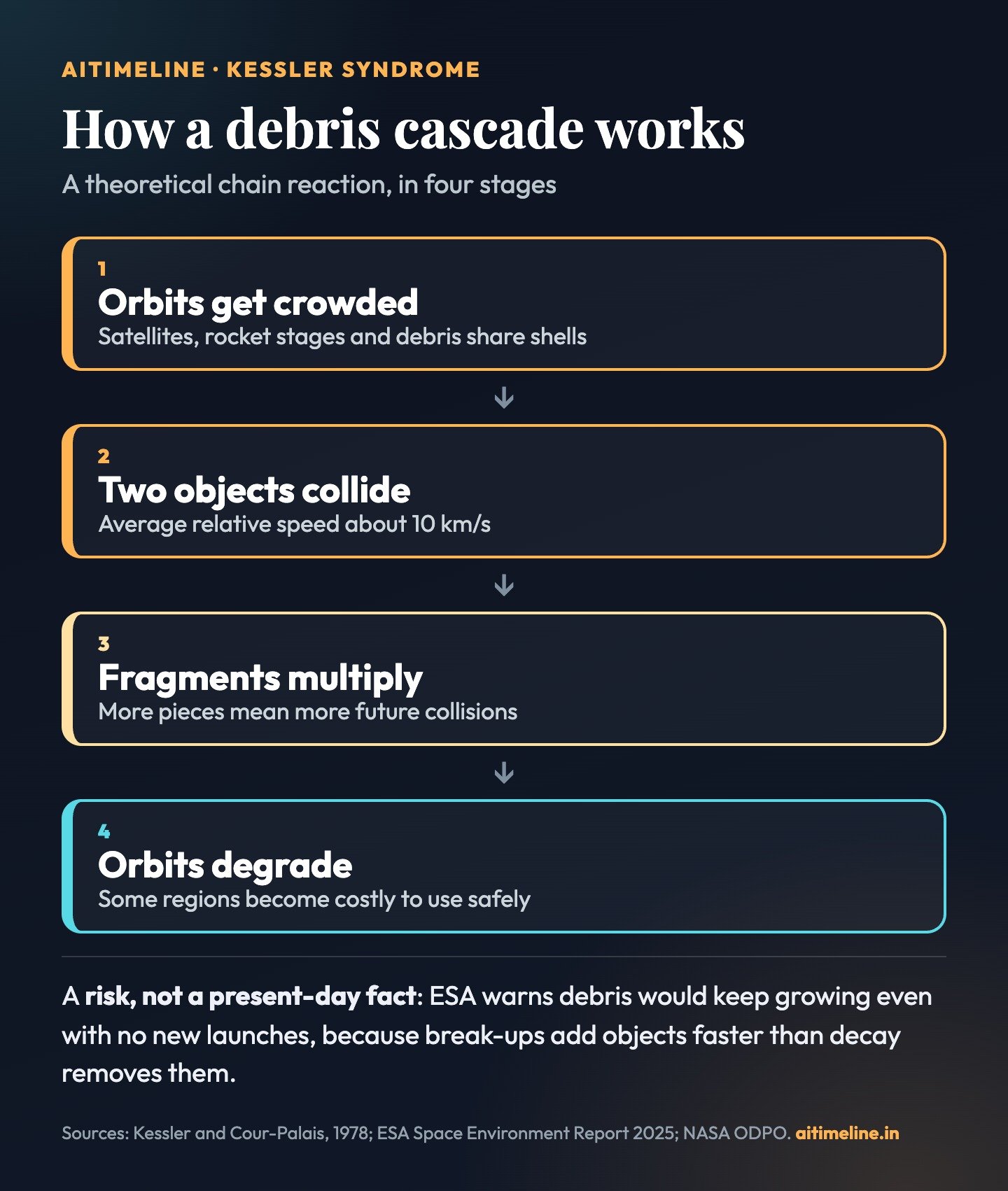
The idea comes from Donald Kessler and Burton Cour-Palais’s 1978 paper. It is a theoretical cascading process, not a claim that Earth’s orbit is already unusable. ESA’s 2025 report nonetheless said debris would keep growing even with no additional launches, because fragmentation adds objects faster than they decay. The risk is greatest where debris and active satellites share heavily used altitudes.
The Events That Changed Orbital Safety
Cataloged fragments from NASA’s analysis.
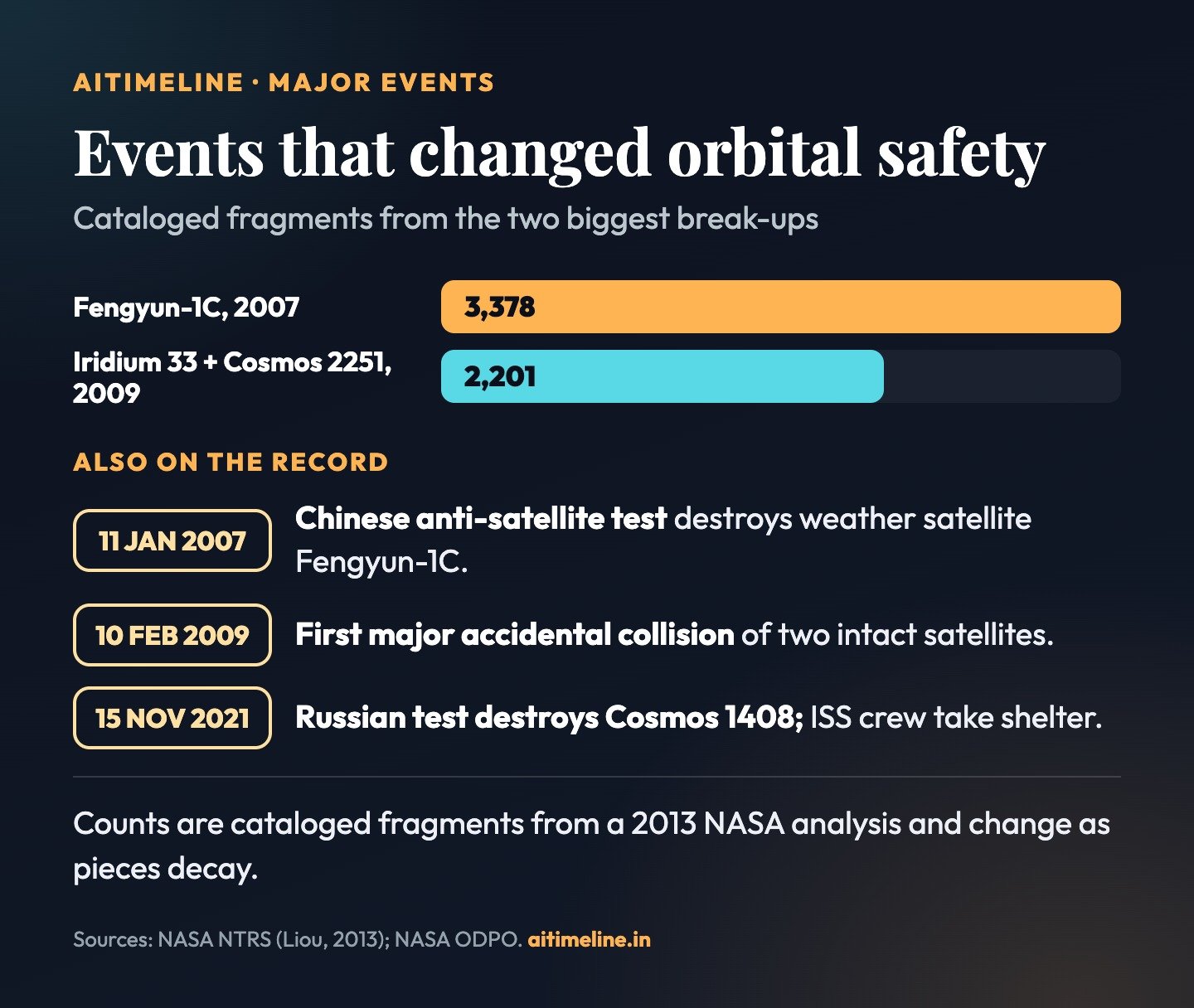
| Date | Event | Type | Cataloged fragments |
|---|---|---|---|
| 11 Jan 2007 | Fengyun-1C destroyed | Anti-satellite test | 3,378 (NASA, 2013) |
| 10 Feb 2009 | Iridium 33 and Cosmos 2251 | Accidental collision | 2,201 (NASA, 2013) |
| 15 Nov 2021 | Cosmos 1408 destroyed | Anti-satellite test | Estimates vary |
Major Regulations and Guidelines
Who sets the rules, and which are binding.
| Year | Instrument | Nature |
|---|---|---|
| 1967 | Outer Space Treaty | Treaty; general principles, no detailed debris duties |
| 1995 | NASA mitigation guidelines (as cited) | Agency guidance |
| 2002 | IADC guidelines | Technical consensus, voluntary |
| 2007 | UN Debris Mitigation Guidelines (7) | Voluntary; UNGA Res 62/217 |
| 2010 | ISO 24113 | Standard |
| 2018 | US Space Policy Directive-3 | National policy |
| 2019 | UN Long-Term Sustainability Guidelines (21) | Voluntary |
| 2023 | Zero Debris Charter | Voluntary pledge |
| 2024 | NASA NPR 8715.6E | Binds NASA programmes |
| 2026 | ISO 23312:2026 | Standard, second edition |
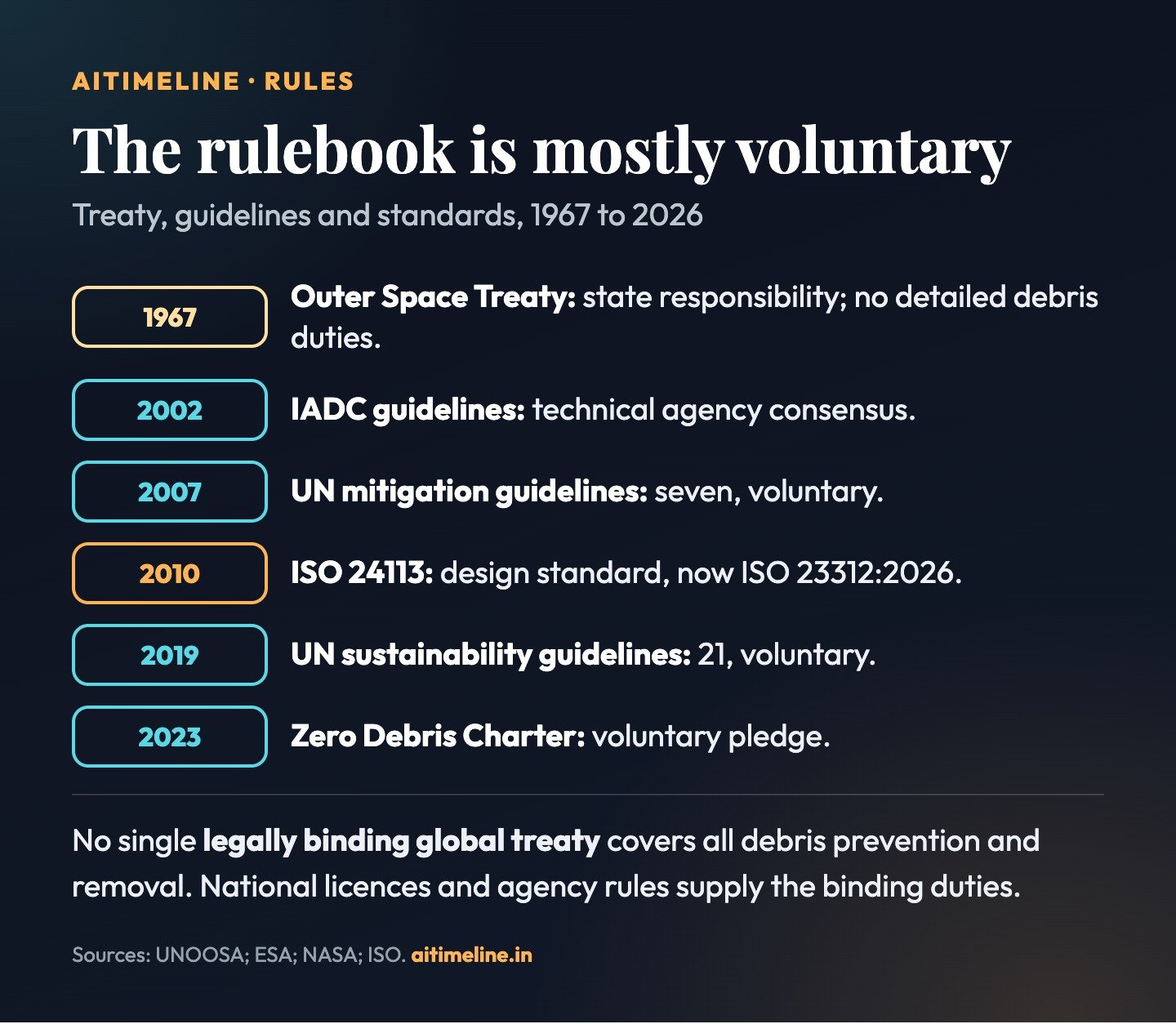
Are there legally binding global debris rules? There is no single comprehensive binding treaty on preventing and removing all space debris. The Outer Space Treaty sets broad principles, while the UN guidelines are voluntary. National laws, licence conditions, agency requirements and standards supply the specific obligations, which is why this system is described as fragmented.
How Long Debris Stays in Orbit
Altitude decides decay.
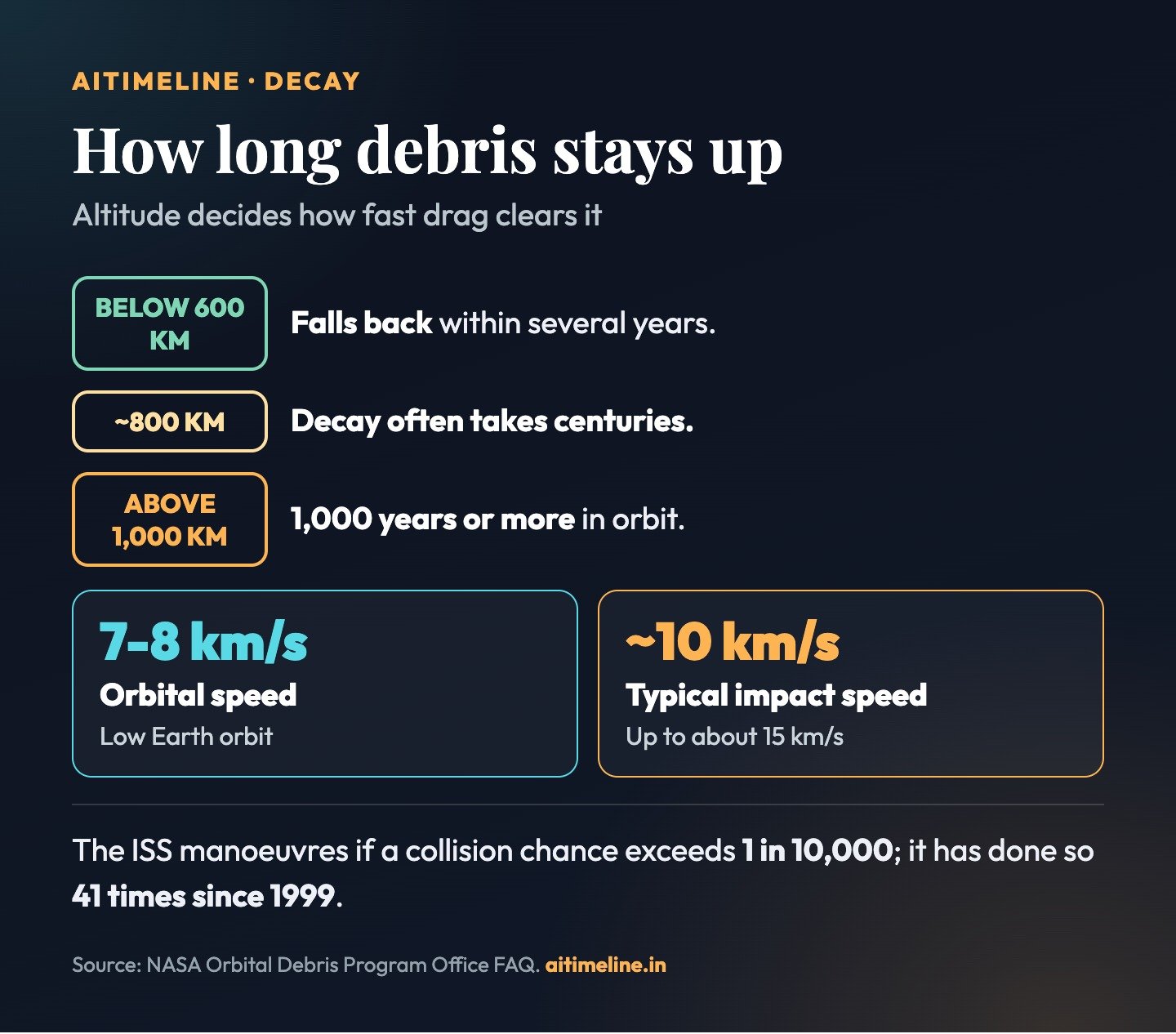
Orbital speed in low Earth orbit is about 7 to 8 km/s, so even a paint fleck carries large energy. NASA says the International Space Station is the most heavily shielded spacecraft ever flown, yet it still manoeuvres when a collision chance exceeds 1 in 10,000, which it has done 41 times since 1999.
How Space Agencies Prevent Orbital Debris
Five layers of defence.
Avoid creating debris
Design to prevent explosions, unnecessary releases and fragmentation.
Manoeuvre when needed
Use tracking data and risk assessments to decide whether to move a satellite.
Plan the end of life
Controlled re-entry or a disposal orbit, depending on the orbit.
Remove stored energy
Vent propellant and discharge batteries so stages cannot explode.
Take down existing debris
Robotic arms, nets, harpoons or servicing craft; hard, costly and legally complex.
The Future of Orbital Safety
An outlook, not a forecast.
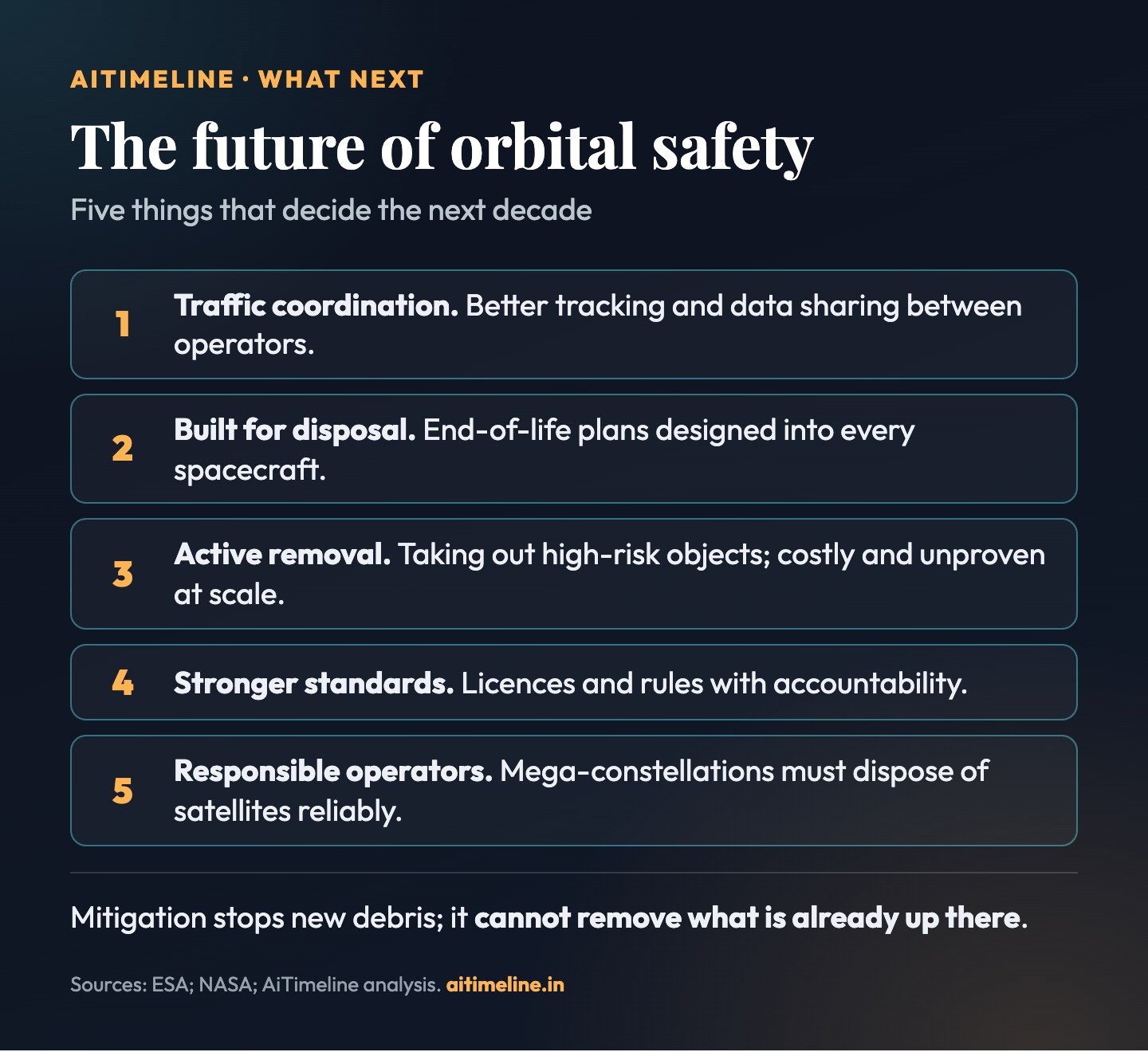
Traffic coordination. More accurate tracking and data sharing between operators lower collision risk. Built for disposal. Future spacecraft will need reliable end-of-life systems designed in. Active removal. Taking out a few high-risk objects could cut collision threats, though cost and technology remain obstacles. Stronger standards. Governments are likely to tighten licensing and accountability; the proposed EU Space Act is one example, though its status was not confirmed here. Responsible commercial operators. Large constellations will shape how much debris is created.
Conclusion: A Shared Environment
Space debris built up gradually as launches expanded, but the 2007 Fengyun-1C test and the 2009 Iridium-Cosmos collision showed how quickly populations can jump. Guidelines, NASA and ISO standards and ESA’s Zero Debris approach have improved the framework for responsible operations.
Mitigation alone is not enough. Better tracking, coordinated manoeuvres, reliable disposal and practical removal of the most dangerous existing debris are all needed. Orbit is a shared environment, and keeping it usable is a collective responsibility.
Explore More Timelines
People Also Ask
Frequently Asked Questions
⚠️ Editorial Note
The draft we received gave ESA’s tracked-object figure as 47,330; ESA’s portal, last updated 17 November 2026, shows about 47,380, which is used here. It also said ESA reported more than 3,300 trackable Fengyun-1C fragments; we could not confirm that attribution and use NASA’s cataloged counts instead (3,378 in a 2013 analysis; about 3,037 in a 2010 briefing). The draft’s 2011 ISS entry and several undated 1979-1999 policy entries could not be verified and were dropped, and the 1995 NASA guidelines are included as widely cited rather than confirmed. The ESA Zero Debris Charter was published on 7 November 2023; the draft dated it only to 2023. The April 2022 US anti-satellite test pledge and the EU Space Act proposal were not re-verified here and are labelled as such. ISO’s own page and the Aerospace Corporation article blocked automated access, so ISO 23312:2026 is described only from its published scope. Estimates for smaller debris come from ESA’s MASTER-8 model. This is information, not engineering or legal advice.
Related Stories
Sources & further reading
Every dated entry above was checked against these references. Last reviewed 26 November 2026.
- ESA Space Debris User Portal: Space Environment Statistics (updated 17 November 2026)
- ESA: Space Environment Report 2025
- NASA Orbital Debris Program Office: Frequently Asked Questions
- NASA: NPR 8715.6E, Orbital Debris Mitigation (effective 18 April 2024)
- NASA NTRS: Liou, orbital debris environment and major break-ups (2013 analysis)
- NASA NTRS: Johnson et al., The characteristics and consequences of the break-up of the Fengyun-1C spacecraft
- UNOOSA: Guidelines for the long-term sustainability of outer space activities adopted (UNIS/OS/518, 2019)
- ESA: World-first Zero Debris Charter goes live
- ESA: Twelve countries sign the Zero Debris Charter
- ISO: ISO 23312:2026, Space systems - Detailed space debris mitigation requirements for spacecraft