UK Fiscal Headroom Explained: Budget, Gilt Yields and Debt
Understand UK fiscal headroom, gilt yields and government borrowing costs, including the £15bn buffer after Budget 2026 and why it is so thin.
Latest Story
UK fiscal headroom is the amount by which the government’s forecast public finances beat its own fiscal rules. It is the buffer that decides how much room the Chancellor has to cut taxes, raise spending or absorb a shock. After Budget 2026 the Office for Budget Responsibility (OBR) put that buffer at about £15 billion against the stability rule in 2029-30. That is a narrow margin, and gilt yields are one reason it can move fast.
Headroom is a forecast margin, not cash. It is not money sitting in a Treasury account, and it moves whenever the OBR revises tax, spending, growth, inflation or borrowing-cost assumptions. The figures are not additive. Headroom against the stability rule, against the investment rule and in different years should not be added together. The £14bn debt-interest figure is the OBR’s comparison with its March forecast, not a Budget decision.
💡 Short Answer
Fiscal headroom is the forecast margin by which the UK meets its fiscal rules. The OBR’s October 2026 forecast gave the Chancellor about £15 billion against the stability rule in 2029-30 and £24 billion against the investment rule, down from £23.6 billion in March. Rising gilt yields and inflation lifted debt interest by about £14 billion a year on average, which is why bond-market moves matter to the Budget.
The £15 Billion Buffer
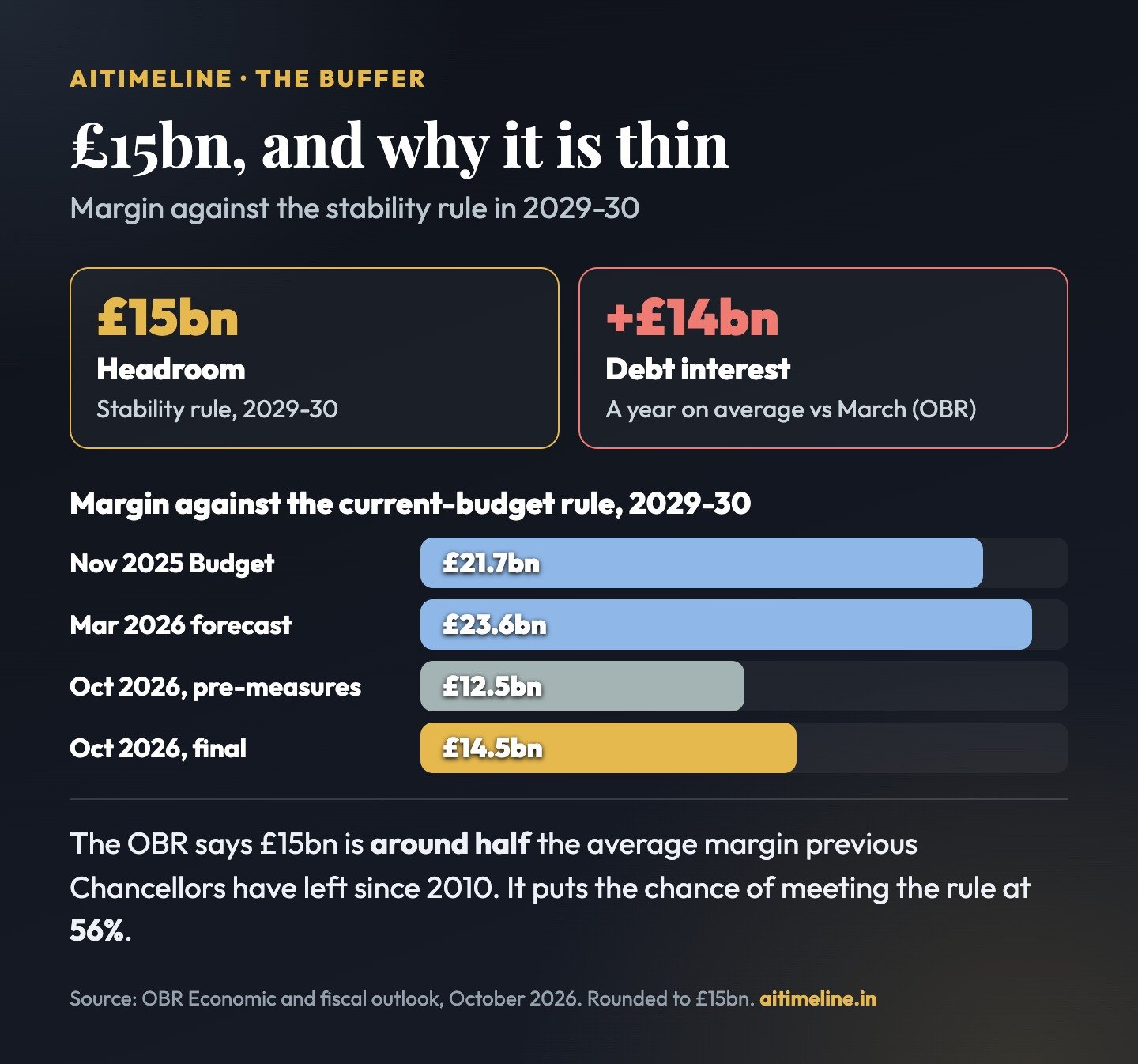
Margin against the current-budget rule in 2029-30, from Budget 2025 to Budget 2026.
UK Fiscal Headroom: Key Questions
Why a Small Move in Yields Can Reshape the Budget
- Headroom is a forecast: it is a margin against the rules, not cash in the bank.
- £15bn, down from £23.6bn: the stability-rule margin in 2029-30 fell from the March forecast.
- £7bn lower than Budget 2025: on the same rule and year, from £21.7bn.
- Half the usual cushion: the OBR says it is around half the average margin left since 2010.
- 6.036% on 7 October: the 30-year gilt yield hit its highest since January 1998.
- £14bn a year: extra debt interest versus March, on average, in the OBR forecast.
- 56% chance: the OBR’s estimate of meeting the stability rule in 2029-30.
- One shock can exceed the buffer: 1 point on rates is £16bn, higher energy £17bn.
Timeline: UK Fiscal Rules, Gilt Yields and Headroom
Newest first. Labels mark rules, shocks, resets, squeezes and Budgets.
After the Budget: a thin buffer and open risks Budget
The position: The Budget left a margin of about £15bn against the stability rule. The OBR says better or worse outcomes than its central forecast are of broadly equal probability, so the buffer can grow or shrink.
The sensitivities: A one percentage point change in gilt yields and Bank Rate expectations could change medium-term borrowing by £16bn. A higher and more sustained energy price peak could add £17bn to borrowing in 2027-28, while a lower path could cut it by £12bn.
What to watch: Gilt yields, inflation, energy prices, tax receipts, productivity and the cost of refinancing and index-linked debt.
The OBR forecasts higher debt interest Budget
What it found: Debt interest is forecast to be £14bn a year higher on average than in March. The OBR links this largely to higher RPI inflation in the near term and higher Bank Rate and gilt rate expectations in the medium term.
The split: Higher Bank Rate and gilt rates add £3.9bn in 2026-27 and an average of £11bn a year across the forecast. RPI revisions add £12bn in 2026-27 and £6.5bn in 2027-28.
The path: Debt interest spending rises from £124bn in 2026-27 to £160bn (4.2% of GDP) in 2031-32.
Healey’s Budget: £15bn against the stability rule Budget
The figures: The OBR confirmed a margin of £15bn against the stability rule in 2029-30, rising to £22bn in 2030-31, and £24bn against the investment rule. Exact margins are £14.5bn and £24.4bn.
The choice: The Chancellor said he used some of the headroom set last year to absorb the impact of the Iran war and protect family budgets, and rejected broad-based tax rises.
The context: The £15bn is £7bn lower than at Budget 2025 and around half the average margin left by Chancellors since 2010. The OBR puts the chance of meeting the rule at 56%. The welfare cap is not met, by about £3bn.
Economists expect headroom to have halved Squeeze
What the poll found: The median forecast put headroom at around £10-12bn, down from £23.6bn at the March forecast. Some economists put it as low as £5bn. The same poll said the Chancellor should rebuild headroom to about £15-16bn to keep bond investors on side.
Why estimates differed: Economists were unsure how the OBR would score higher debt interest, inflation-linked welfare spending and tax receipts.
30-year gilt yield hits a 28-year high Squeeze
What happened: The 30-year gilt yield jumped 13 basis points to peak at 6.036%, its highest since January 1998, passing a record set on 1 October. The 10-year yield rose 10 basis points to 5.48%.
Why: Reuters pointed to inflation and heavy government borrowing worries, with oil above $100 a barrel amid the war involving Iran. The move came a day after the Chancellor met economists employed by primary dealers.
March forecast: £23.6bn of headroom Budget
What it showed: The OBR’s March forecast had the current budget in surplus by £23.6bn in 2029-30. The October forecast puts that figure at £14.5bn, £9bn lower.
Why it fell: Higher interest rates and a higher inflation forecast raised borrowing by an average £11bn a year before policy decisions, and the Middle East conflict weakened the growth outlook.
Budget 2025: a margin of about £22bn Budget
What the OBR said: At the November 2025 Budget the margin against the current-budget rule in 2029-30 was £21.7bn, with a 59% chance of meeting the rule. The margin against the investment rule was £24.4bn.
Why it matters: This is the baseline the October 2026 Budget is measured against, and the headroom the Chancellor said he used.
Rachel Reeves sets the stability and investment rules Reset
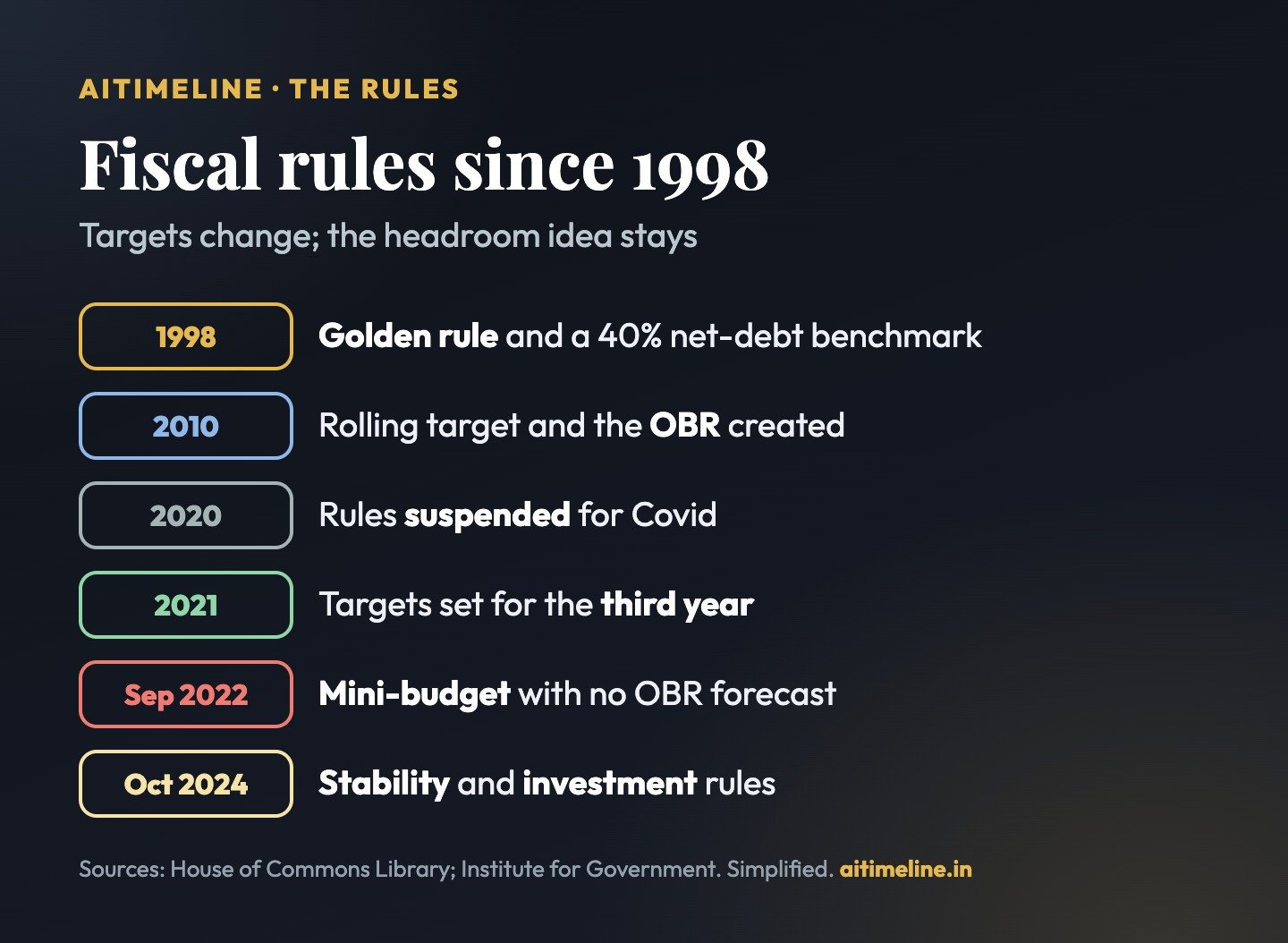
The rules: The stability rule requires the day-to-day budget to be in balance or surplus. The investment rule requires public sector net financial liabilities to fall as a share of GDP.
The change: The debt measure moved from public sector net debt to public sector net financial liabilities, which counts a wider range of financial assets.
Truss’s tax cuts are reversed Reset
What happened: The government reversed most of the mini-budget’s tax cuts. Kwasi Kwarteng was replaced as Chancellor by Jeremy Hunt on 14 October, and a different fiscal approach followed.
The lesson: The episode showed how much weight markets put on transparent forecasts and credible borrowing plans.
The mini-budget shocks the gilt market Shock
What happened: The 23 September package of tax cuts came without an OBR forecast. Investors questioned the plans, sterling weakened and gilt yields surged.
The knock-on: Pension funds using liability-driven investment strategies faced collateral calls as gilt prices fell. The Bank of England temporarily intervened on 28 September to restore orderly trading.
Third-year targets and the post-Covid framework Rules
2020: The pandemic brought furlough, business support and health spending. The government suspended its fiscal rules and debt rose sharply.
2021: A framework returned, balancing the current budget and reducing debt as a share of GDP, set for the third year of the forecast.
Rolling targets and repeated revisions Rules
2010: The coalition adopted a forward-looking framework aimed at balancing the cyclically adjusted current budget over a rolling period and reducing debt as a share of GDP. The OBR was created to produce independent forecasts.
2014-2019: Successive governments changed the timing and measurement of their targets. Rolling targets let them respond to changing forecasts, but also moved the goalposts.
The financial crisis strains the rules Rules
What happened: Borrowing climbed as activity weakened and support measures were introduced. According to the Institute for Government, neither original rule was formally changed, but the way the golden rule was assessed was altered when it looked likely to be missed.
What followed: A temporary operating rule was adopted from 2009, showing how shocks can make fixed targets impractical.
New Labour sets the first modern fiscal rules Rules
The rules: The golden rule: borrow only to invest, not to fund day-to-day spending, over the economic cycle. The sustainable investment rule: keep net debt at a stable and prudent level, with a 40% of GDP benchmark.
The aim: A more predictable and transparent framework, with discipline that still let the government support the economy through the cycle.
Fiscal Rules Since 1998
The targets have changed often. The idea of a margin has not.
How Gilt Yields Affect the UK Budget
Gilts are UK government bonds. A gilt yield is the return investors demand for holding them.
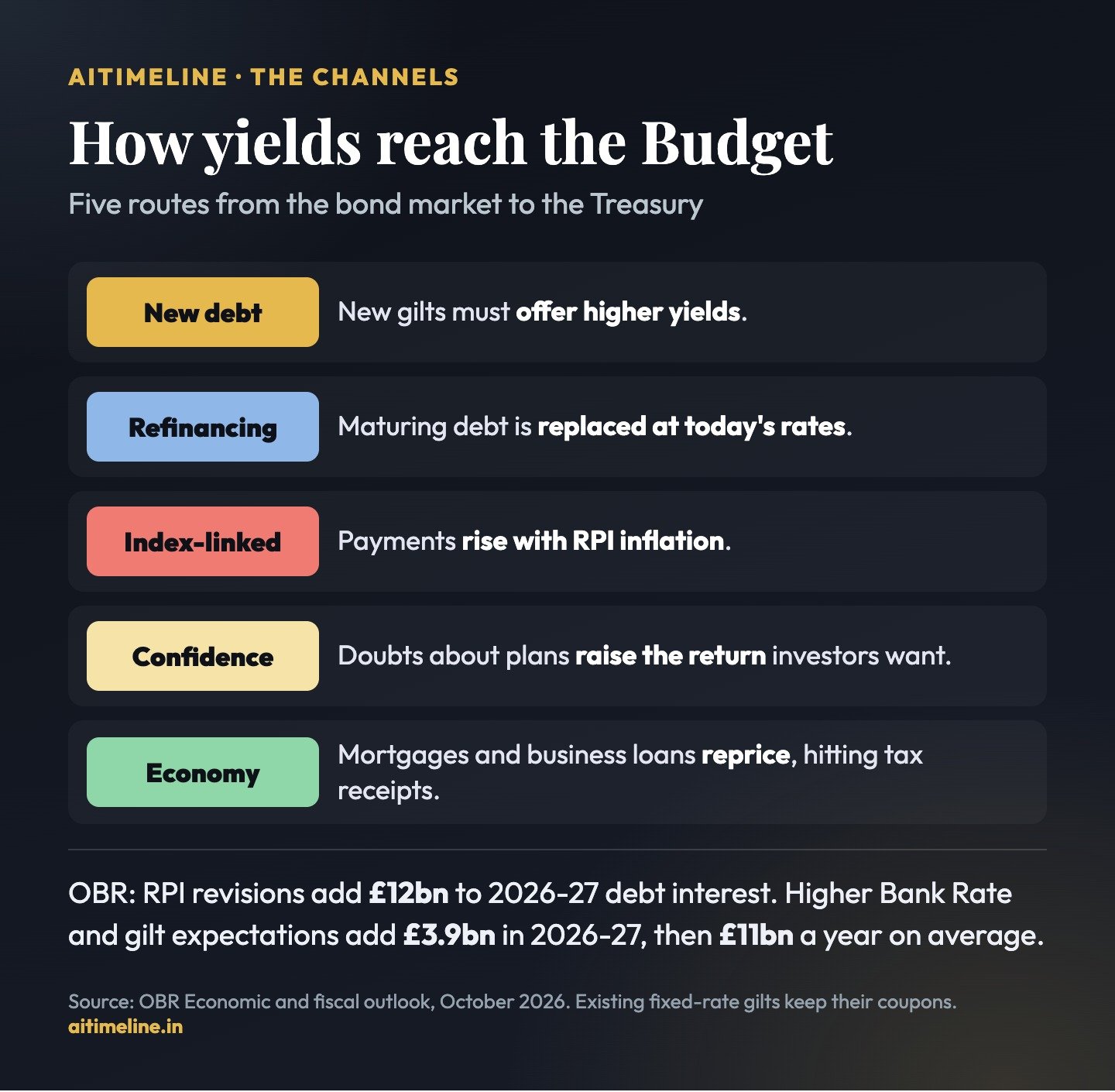
The effect is not immediate across the whole national debt. Existing fixed-rate gilts keep their original coupons until maturity. Index-linked gilts, new borrowing and refinanced debt carry changes in market rates and inflation into government spending. Higher debt interest leaves less for public services and investment, and it can shrink the Chancellor’s headroom.
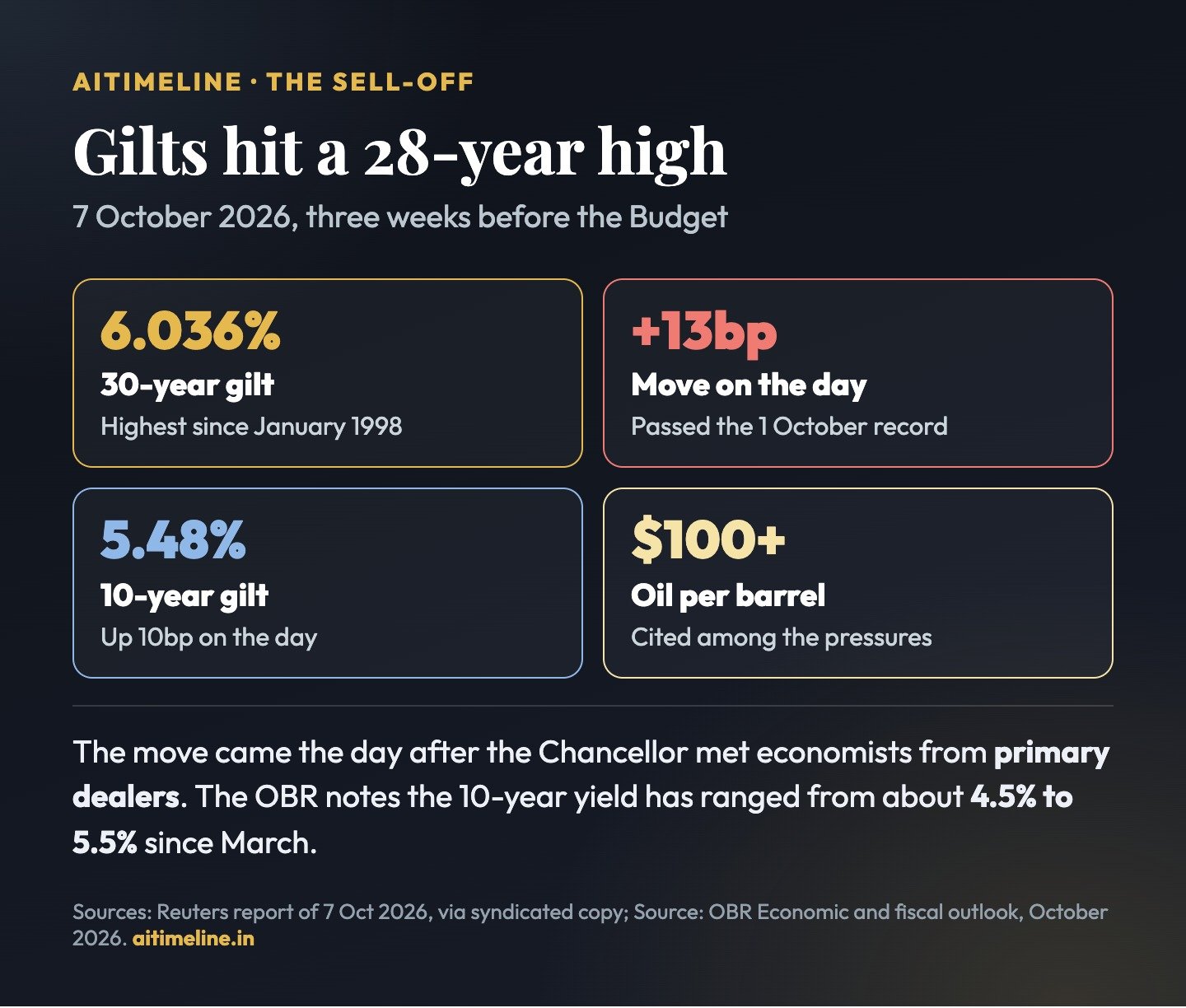
Reuters reported that the move came as a global bond sell-off pushed US 30-year yields to their highest since 2002, with inflation and government borrowing the main worries and oil above $100 a barrel amid the war involving Iran. The OBR notes that the ten-year yield has ranged from about 4.5% to 5.5% since March, and that yields within that range are not unusual by historical standards.
The Debt Interest Bill
The OBR’s October forecast against its March forecast.
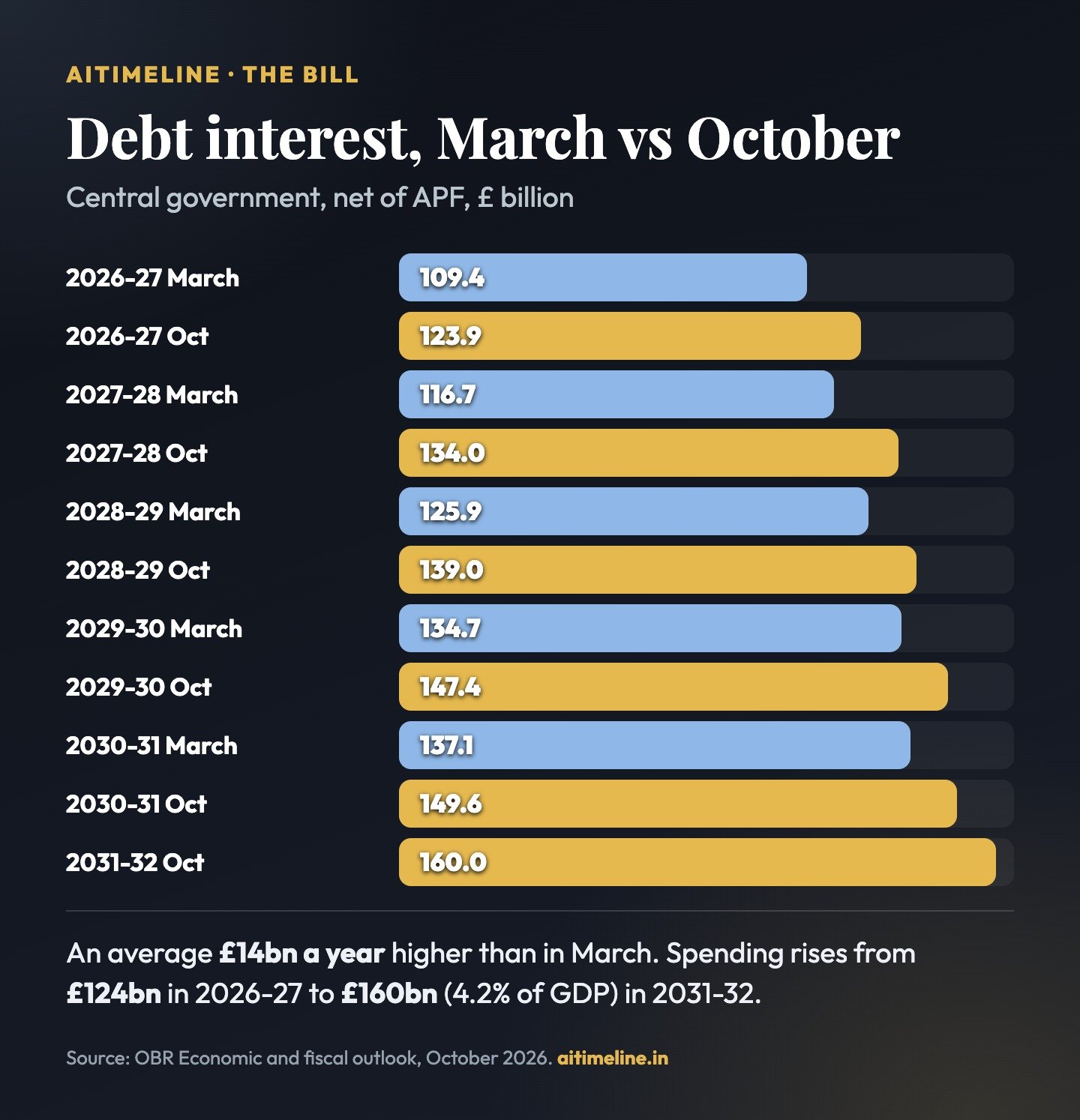
Compared with March, the OBR forecasts debt interest £14bn a year higher on average. It attributes this largely to higher RPI inflation in the near term and higher Bank Rate and gilt rate expectations later. Revisions to RPI add £12bn in 2026-27 and £6.5bn in 2027-28. Higher rates and gilt yields add £3.9bn in 2026-27 and an average of £11bn a year across the forecast. These two figures overlap with, and should not be added to, the £14bn total.
Understanding the UK’s Fiscal Rules
The stability rule, the investment rule and the welfare cap.
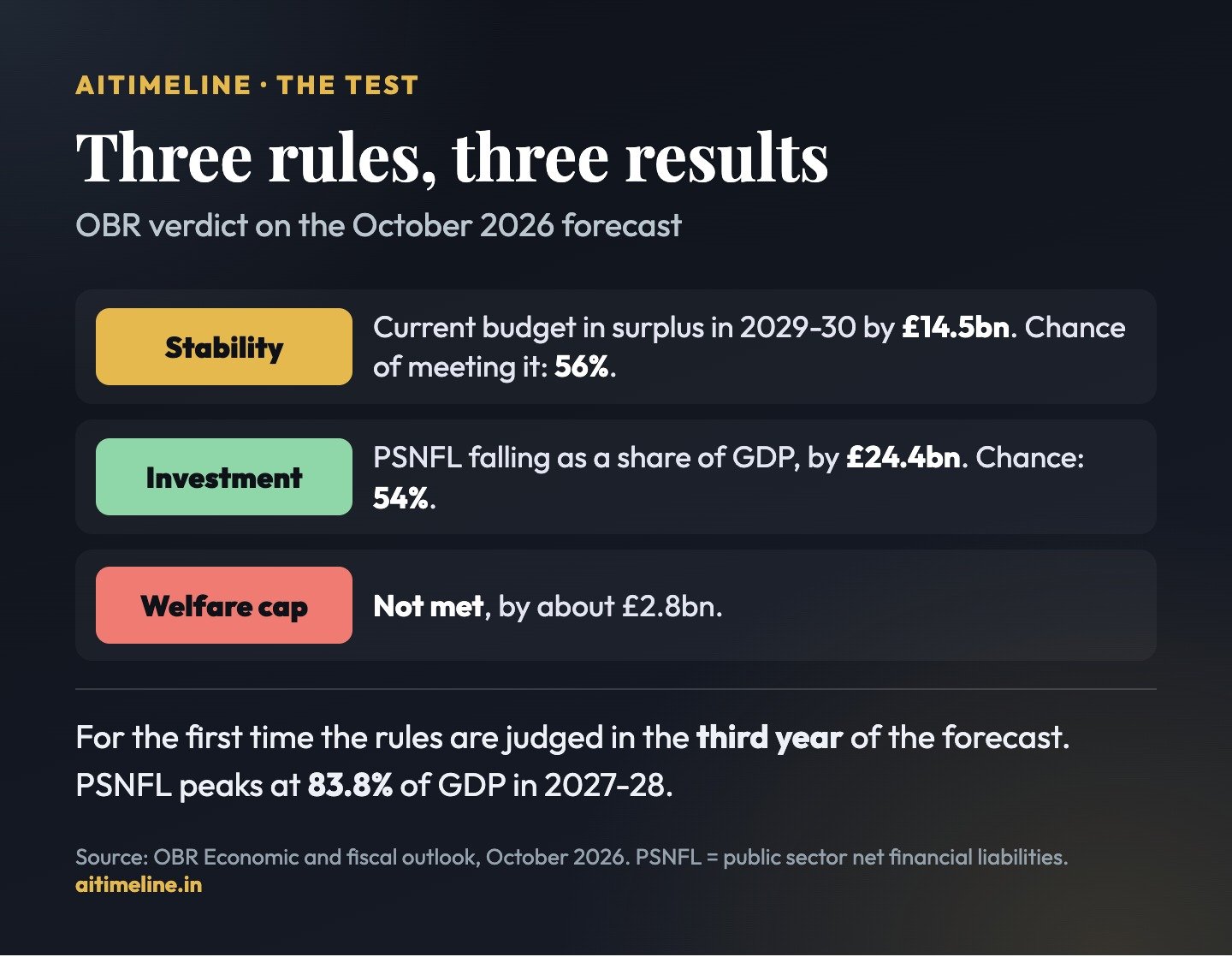
The stability rule requires the current budget, day-to-day spending covered by tax receipts, to be in balance or surplus in the target year. In the OBR’s October forecast the current budget is still in deficit in 2028-29, by £7.8bn, and reaches a surplus of £14.5bn in 2029-30. The investment rule requires public sector net financial liabilities to fall as a share of GDP. They peak at 83.8% of GDP in 2027-28. The welfare cap covers specified social security spending and excludes some payments, including the State Pension.
| Indicator | Latest position |
|---|---|
| Stability-rule margin, 2029-30 | £15bn (£14.5bn) |
| Stability-rule margin, 2030-31 | £22bn |
| Investment-rule margin, 2029-30 | £24bn (£24.4bn) |
| March 2026 forecast, 2029-30 | £23.6bn |
| Budget 2025, 2029-30 | £21.7bn |
| 30-year gilt peak, 7 Oct 2026 | 6.036% |
| Extra debt interest vs March, average | £14bn a year |
| Debt interest, 2026-27 and 2031-32 | £124bn and £160bn |
| Chance of meeting stability rule | 56% |
How Fast Can the Buffer Disappear?
OBR sensitivities set against the £15bn margin.
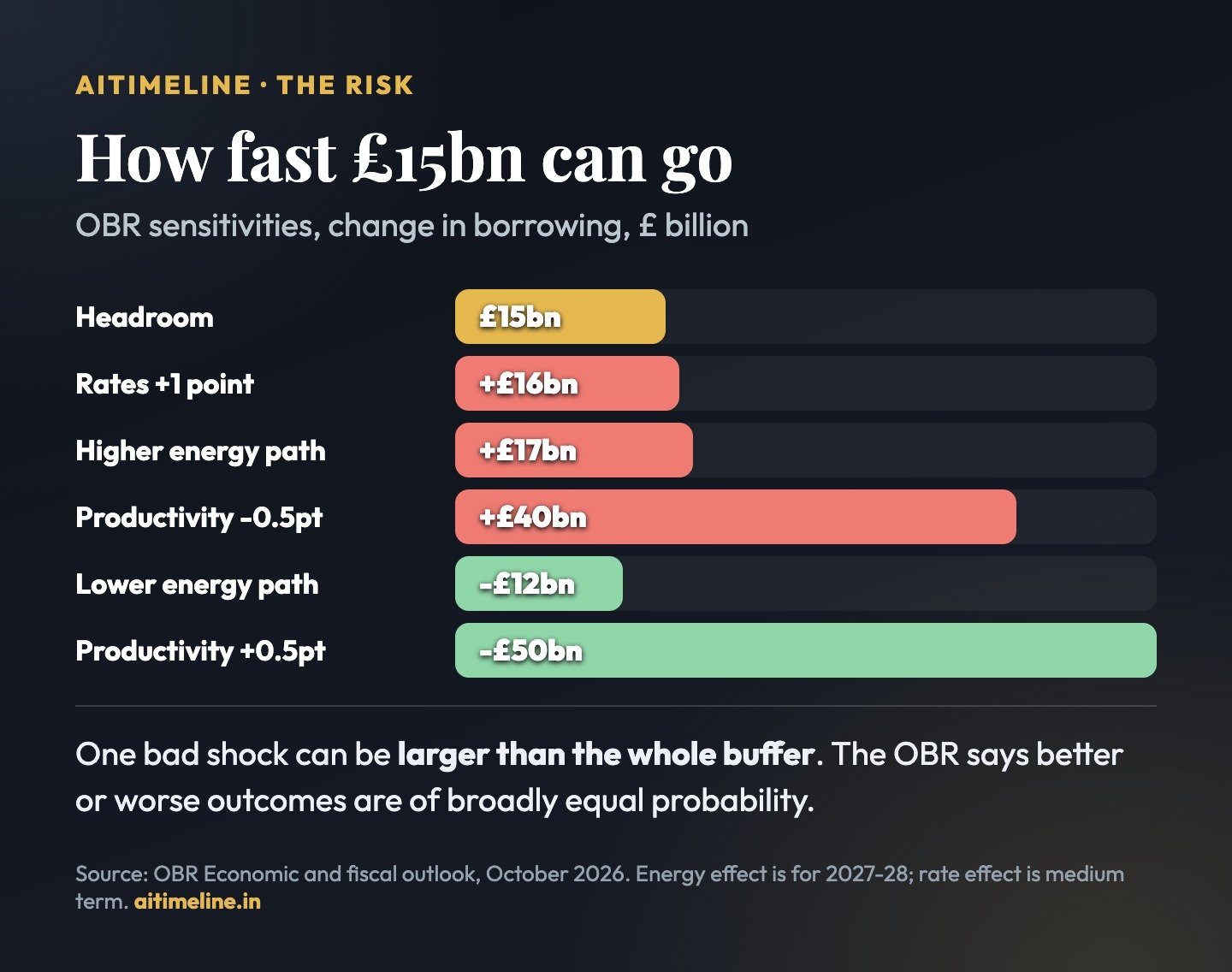
A reduction in headroom does not mean the government cannot borrow. It means the forecast is closer to breaching the rules. The Chancellor then has five choices: raise taxes, reduce or delay spending, support growth and productivity, accept a smaller buffer, or change the framework. Each has trade-offs, and frequent rule changes can themselves unsettle investors.
The 2022 mini-budget is the warning. Large unfunded tax cuts without an OBR forecast helped trigger a gilt sell-off, collateral calls on pension funds and a temporary Bank of England intervention. Not every rise in borrowing causes a crisis, but investors need transparent, affordable and credibly forecast plans.
Who Feels the Pressure?
Households: mortgage borrowers refinancing may face higher repayments, and higher inflation reduces purchasing power. Businesses: higher financing costs can delay investment. Public services: debt interest competes with the NHS, education and transport for money, which makes tough choices more likely without guaranteeing cuts. Investors: higher yields reduce the market value of existing bonds, but offer better returns on new ones.
What to Watch After Budget 2026
Watch gilt yields, inflation and energy prices, growth and productivity, tax receipts against forecast, and debt interest as maturing gilts are refinanced. The OBR expects real GDP growth of around 1¼% in 2026 and 1% in 2027 and warns that higher energy prices and interest rates could weigh on activity.
Conclusion: Headroom Measures Resilience
Fiscal headroom looks like a technical Treasury calculation, but it shapes taxes, public services, investment and household finances. From the rules of the late 1990s to the 2022 gilt turmoil and the October 2026 Budget, the record shows how closely public finances depend on credibility and market conditions.
The £15bn margin gives the Chancellor some room, but not a large safety net. Higher borrowing costs, inflation or weaker growth could reduce it quickly, and a single shock can be as large as the whole buffer.
Explore More Timelines
People Also Ask
Frequently Asked Questions
⚠️ Editorial Note
Figures come from the OBR’s October 2026 forecast and contemporaneous Reuters reports. The March 2026 figure of £23.6bn and the Reuters poll are shown as reported; the OBR file shows the March surplus for 2029-30 at £23.6bn. The Reuters articles are cited through syndicated copies because the original pages could not be opened by our checker. Headroom figures refer to different rules and years and should not be added together. This article is editorial information, not financial advice.
Related Stories
Sources & further reading
Every dated entry above was checked against these references. Last reviewed 25 November 2026.
- Office for Budget Responsibility: Economic and fiscal outlook, October 2026
- HM Treasury: Budget 2026 speech
- HM Treasury: Budget 2026, breathing space for today, hope for the future
- Institute for Government: Current UK fiscal rules
- Institute for Government: Fiscal rules in the UK since 1997
- Reuters: UK 30-year gilt yields hit 28-year high in global selloff (7 Oct 2026)
- Reuters poll: UK's Healey should rebuild fiscal headroom to about 15-16 billion pounds
- House of Commons Library: The UK's fiscal targets (CBP-9329)