Challenger Disaster O-Ring Warnings: A Timeline of Overruled Concerns
Challenger disaster timeline: Thiokol engineers' O-ring warnings, the reversed no-launch call and the Rogers Commission findings from 1977 to 2026.
Latest Story
The Challenger disaster O-ring warnings came from engineers at Morton Thiokol, who told NASA on the evening of 27 January 1986 that the booster seals had not been shown to work in the forecast cold. Management reversed their no-launch recommendation, and Challenger lifted off the next morning at 36°F and broke apart 73 seconds later. This timeline runs newest first, from the 2026 anniversary back to the 1977 test that first showed the joint bending, and keeps the 27 January teleconference at the centre.
💡 Short Answer
On 27 January 1986 Morton Thiokol engineers recommended against launching Challenger below 53°F because the booster O-ring seals had not been shown to work in cold. After a private caucus, Thiokol management reversed the recommendation and NASA launched at 36°F on 28 January. The Rogers Commission found a joint design too sensitive to temperature and a flawed decision process: the final decision-makers did not know of the engineers’ objection.
Challenger Disaster O-Ring Warnings: Key Questions
The Challenger O-Ring Warnings in Ten Points
- Old flaw: joint rotation was seen in a 1977 test, years before the first erosion.
- First damage: STS-2 in November 1981 showed primary O-ring erosion.
- Warnings in writing: Boisjoly’s 31 July 1985 memo called a field-joint failure “a catastrophe of the highest order”.
- Cold clue: 51-C, at 53°F, had the worst blow-by before 51-L.
- 27 January: two teleconferences, at 5:45 p.m. and 8:45 p.m., and a 30-minute Thiokol caucus.
- Reversal: management recommended launch at about 11 p.m. and faxed it at about 11:45 p.m.
- Launch: 36°F air, a joint at about 28°F, and smoke from the joint at under one second.
- Finding: the decision-makers did not know of the initial no-launch recommendation.
- Fix: a redesigned joint and an independent safety office.
- Lesson: an engineer raising a safety concern should not have to prove failure first.
Challenger Disaster O-Ring Warnings Timeline, Latest First
Each entry is tagged by theme and ends with why it matters. Use the filter to isolate a theme. The 27 January teleconference entries are the core.
Warnings, the launch night or the investigation? Filter the Challenger timeline by theme.
–
2026
NASA marks the 40th anniversary at Kennedy Space Center Investigation & legacy
NASA held its annual Day of Remembrance on Thursday 22 January 2026, six days before the 28 January anniversary, with the Astronauts Memorial Foundation and the Kennedy Space Center Visitor Complex. Families of the Challenger crew gathered at the launch site, and the ceremony moved from the Space Shuttle Atlantis building to the Space Mirror Memorial for a wreath-laying. NASA Administrator Jared Isaacman issued a statement honouring those lost. The event also recognises Apollo 1 and Columbia.
2021
Allan McDonald, who refused to sign the launch approval, dies at 83 Investigation & legacy
McDonald directed the shuttle Solid Rocket Motor project for Morton Thiokol and was at Kennedy Space Center on the night of 27 January. The Rogers Commission record shows he kept arguing for a delay after Thiokol management reversed itself, and news obituaries say he refused to sign the launch authorisation; Thiokol’s Joe Kilminster signed and faxed it instead. He later spoke about the decision with pride and became a speaker on engineering ethics. He died after a fall, aged 83.
2012
Roger Boisjoly dies at 73 Investigation & legacy
Boisjoly was the engineer whose July 1985 memos warned of a “catastrophe of the highest order”. He received the American Association for the Advancement of Science award for Scientific Freedom and Responsibility in 1988 and, on 13 May 2010, donated six boxes of his papers to Chapman University. He died in January 2012 after a cancer diagnosis.
2003
Columbia is lost, and investigators hear Challenger again Investigation & legacy
When Space Shuttle Columbia disintegrated on re-entry on 1 February 2003, the Columbia Accident Investigation Board concluded that NASA had not set up a “truly independent” safety office and that the ineffective safety culture behind Challenger had also contributed to the second loss. The Rogers Commission had recommended an independent safety office reporting to the NASA Administrator, and NASA created one in 1986.
1988
Discovery returns the shuttle to flight after 975 days Investigation & legacy
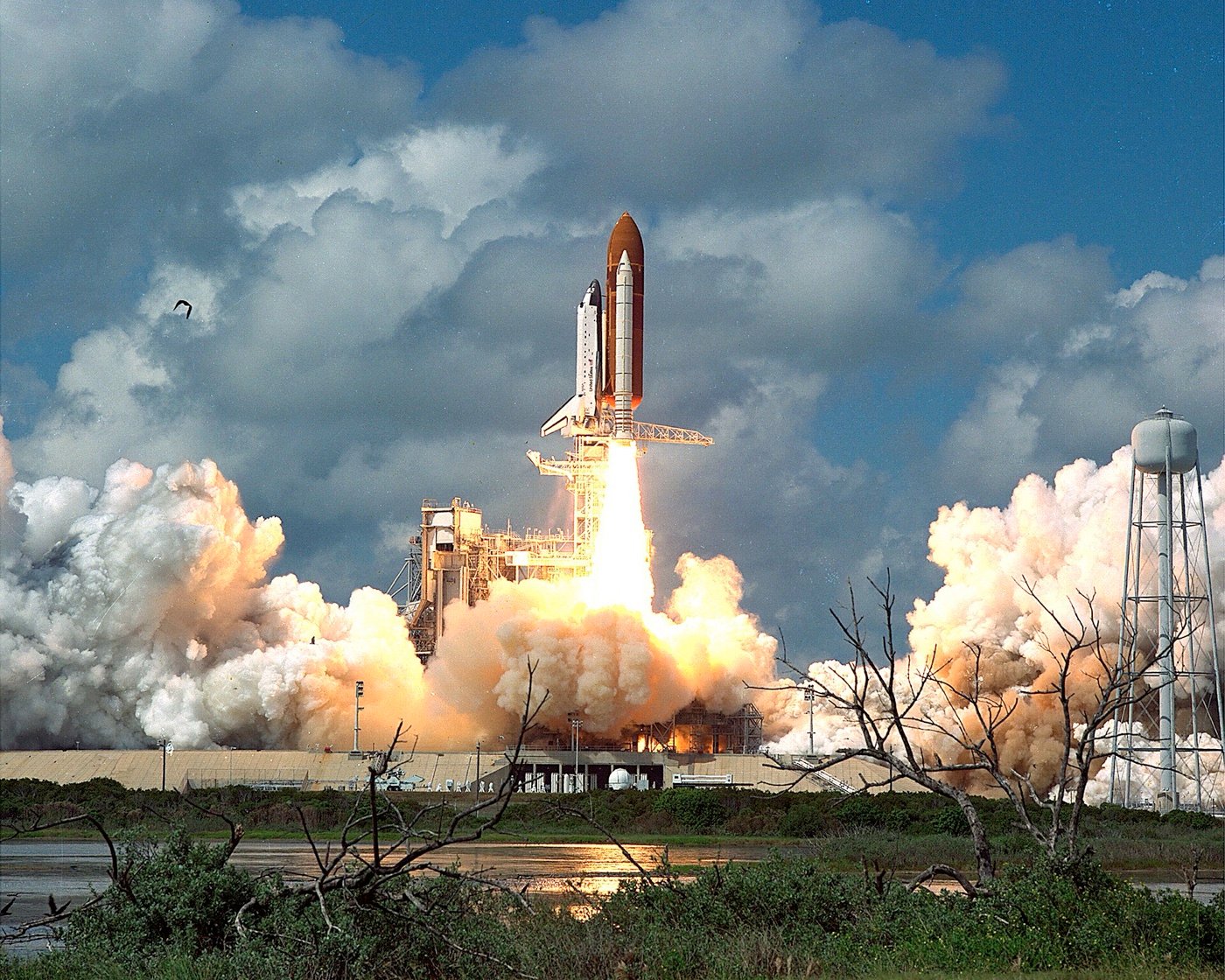
Discovery lifted off at 11:37 a.m. EDT on 29 September 1988 on a four-day mission, the first since Challenger. The redesigned solid rocket motor joint added a capture feature on the tang to limit joint rotation, another O-ring and heaters. Wikipedia reports that the new segment joints showed no signs of leakage or overheating on STS-26.
NASA acts on the findings: redesign, safety office, new orbiter Investigation & legacy
NASA’s response to the commission, Actions to Implement the Recommendations, is dated 14 July 1986. In 1986 NASA created an Office of Safety, Reliability and Quality Assurance reporting to the Administrator, as the commission had specified. In August Reagan approved a replacement orbiter, later named Endeavour, and the shuttle stopped carrying commercial satellites. On 29 October 1986 the House Science and Technology Committee agreed that the joint was the cause and that NASA and Morton Thiokol had failed to act despite numerous warnings.
1986
The Rogers Commission report: a design flaw and a flawed decision Investigation & legacy
The report, dated 6 June 1986, found the physical cause in the failure of the pressure seal in the aft field joint of the right Solid Rocket Motor, a design “unacceptably sensitive” to temperature, dynamic loading and other factors. Chapter V said the decision to launch was flawed: those who made it were unaware of the recent history of O-ring problems and of Thiokol’s initial written no-launch recommendation, and “if the decisionmakers had known all of the facts, it is highly unlikely that they would have decided to launch”. It called for a joint redesign, restructured shuttle management and an independent safety office. Sources differ on the date: NASA’s copy is dated 6 June, Wikipedia says it was submitted and released on 9 June.
1986
Public hearings put the launch-eve decision on the record Investigation & legacy
The commission held public hearings on 25, 26 and 27 February on how the launch was approved. Roger Boisjoly told the commission that during the Thiokol caucus the engineers “were being put in a position to prove that we should not launch rather than being put in the position and prove that we had enough data to launch”. Allan McDonald also testified. News obituaries later quoted commission executive director Alton Keel calling McDonald’s intervention at the hearing the turning point of the commission.
1986
Rogers says the launch decision process “may have been flawed” Investigation & legacy
After the closed sessions, Chairman Rogers issued a statement that the commission had found that the decision-making process “may have been flawed” and that the President had been so advised. Acting NASA Administrator William Graham was asked not to include on NASA’s internal investigating teams anyone involved in that process. The commission’s role changed from overseer to active investigator.
1986
Closed sessions at Kennedy reveal Thiokol’s first answer was “no” Investigation & legacy
In a closed session on 10 February the commission first learned of the troubled history of the joint and seals and that Thiokol had initially recommended against launch on 27 January because of low-temperature concerns. On 13 February it saw film, video and telemetry suggesting the joint and seal may have malfunctioned. The 14 February session heard NASA and contractor participants in the 27 January discussion.
1986
Feynman drops clamped rubber into ice water on live television Investigation & legacy
During a televised hearing on 11 February, physicist Richard Feynman compressed a sample of O-ring material in a clamp, put it in a glass of ice water and showed that it lost resilience at low temperature. Feynman later insisted on adding his own observations on reliability to the report as Appendix F, in which he criticised NASA management’s understanding of risk.
1986
Reagan appoints the Rogers Commission Investigation & legacy
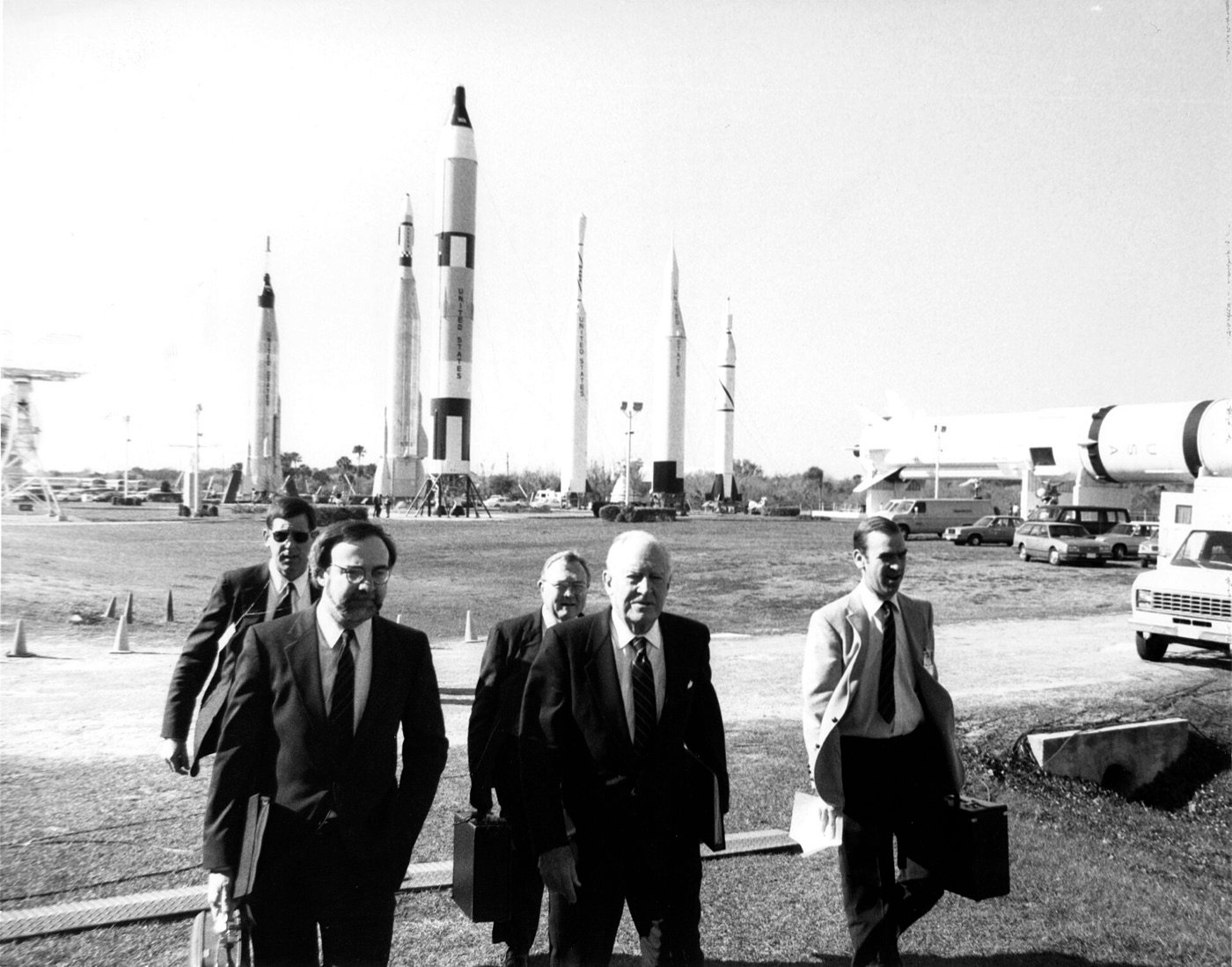
President Reagan announced the commission on 3 February 1986 under Executive Order 12546 and members were sworn in by Chairman Rogers on 6 February. Members included vice-chairman Neil Armstrong, Sally Ride, Chuck Yeager and Richard Feynman. The commission divided into four panels and later interviewed more than 160 people, examining almost 6,300 documents.
1986
A memorial service at Johnson Space Center Investigation & legacy
On 31 January Ronald and Nancy Reagan travelled to Johnson Space Center for a memorial service, where an Air Force band sang “God Bless America” and NASA T-38 jets flew a missing-man formation overhead. The Rogers report prints Reagan’s words from that day: “The future is not free.”
1986
Reagan addresses the nation from the Oval Office Investigation & legacy
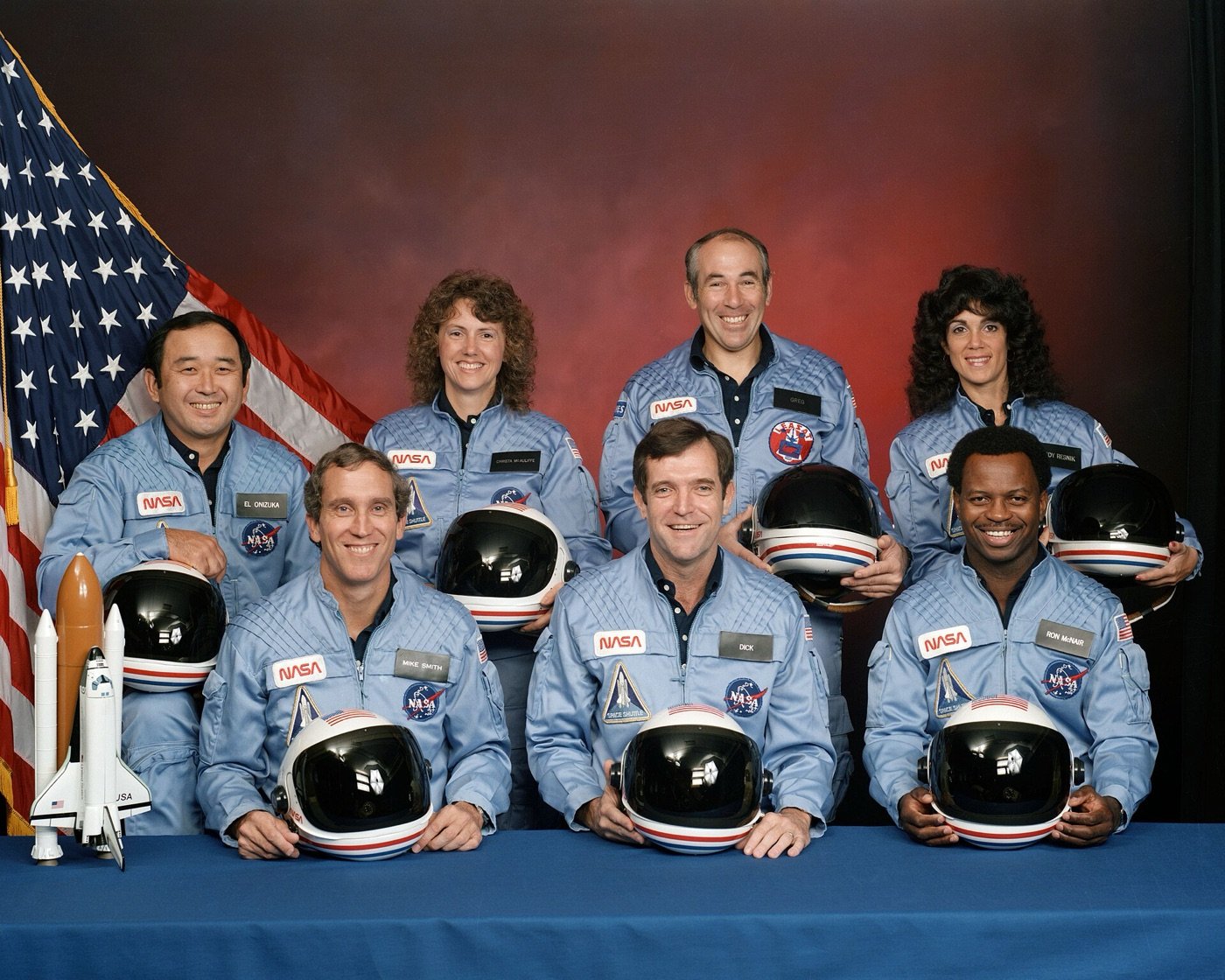
Reagan had been due to give the State of the Union that evening. He postponed it and addressed the nation about the disaster from the Oval Office; the State of the Union was rescheduled for 4 February. The crew were commander Francis R. (Dick) Scobee, pilot Michael J. Smith, mission specialists Judith A. Resnik, Ellison S. Onizuka and Ronald E. McNair, and payload specialists Gregory B. Jarvis and S. Christa McAuliffe, the Teacher in Space participant.
1986
73 seconds: Challenger breaks apart after a flame breaches the tank Launch eve & launch day
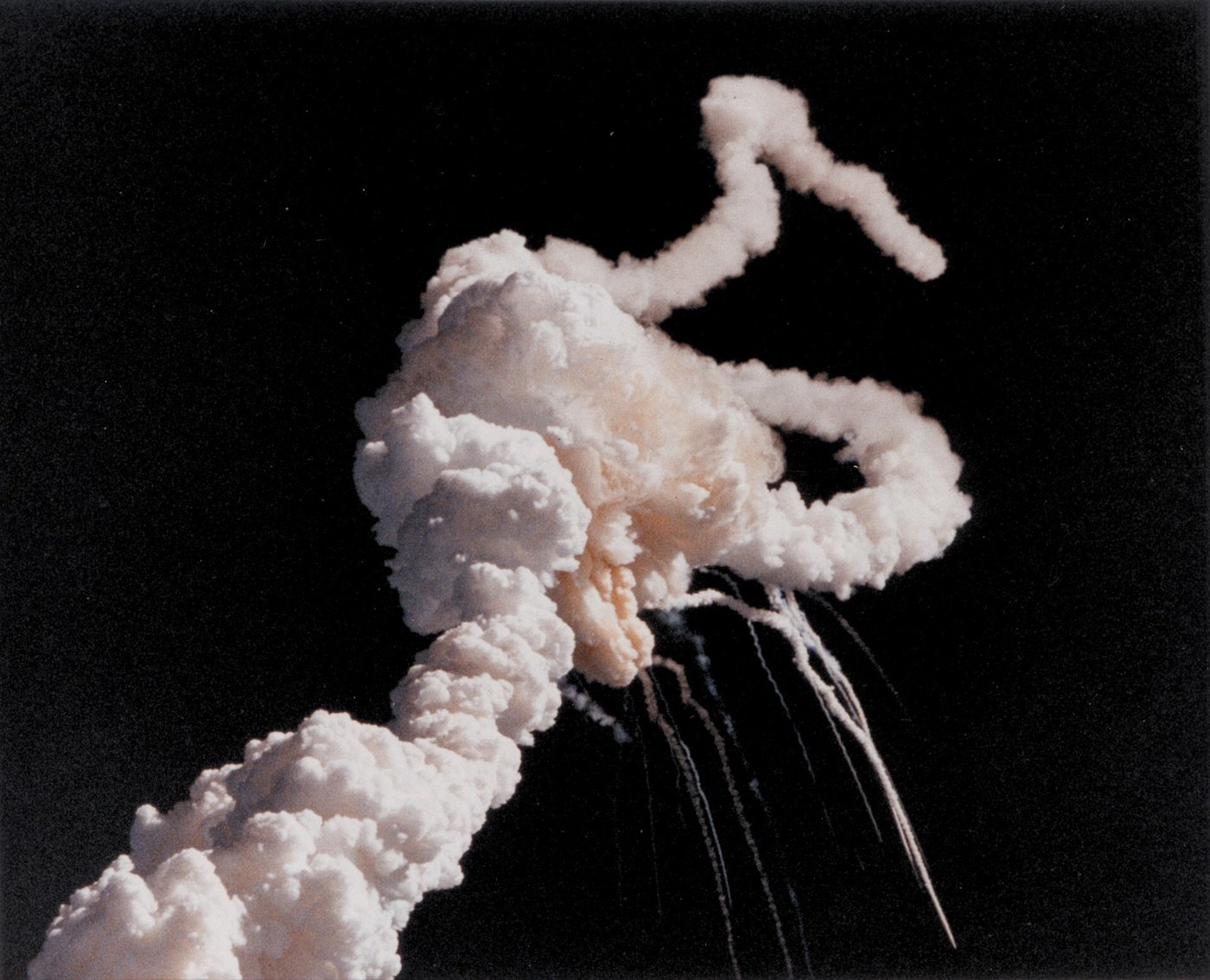
Challenger lifted off at 11:38 a.m. Eastern Standard Time. At 0.678 seconds a puff of gray smoke spurted from the aft field joint of the right booster, and eight more puffs of blacker smoke followed by 2.5 seconds. At 58.788 seconds image-enhanced film showed the first flame near the joint, and by 59.262 seconds a continuous plume. The plume reached the external tank, and at about 64.66 seconds its colour changed as it mixed with leaking hydrogen. The vehicle was destroyed in an explosive burn of propellants at 73 seconds and all seven crew members died. The boosters flew out of the fireball and were destroyed by range safety at 110 seconds.
1986
Ice on the pad, 36°F air and a joint at 28°F Launch eve & launch day
The ambient air temperature at launch was 36°F, 15°F colder than any previous launch. The commission estimated the coldest point on the right aft field joint, at the 300-degree position, at 28°F ± 5°F; the sunlit side was about 50°F. At 9:00 a.m. Rockwell, the orbiter contractor, told NASA’s Mission Management Team that it could not assure it was safe to fly because of ice on the pad. The launch, intended for 9:38 a.m., went at 11:38 a.m.
1986 · 11 pm
Thiokol management reverses; the recommendation to launch is faxed Launch eve & launch day
When the teleconference resumed at about 11 p.m., Thiokol management said it had reassessed: temperature effects were a concern, but the data were “admittedly inconclusive”. Joe Kilminster read the rationale recommending launch and said that was Morton Thiokol’s recommendation. George Hardy asked for it in writing; Kilminster faxed it to Kennedy and Marshall at about 11:45 p.m. At Kennedy, Allan McDonald asked how NASA could launch below the qualification temperature and said he would not want to explain it to a board of inquiry; he was told it was not his concern and that his points would be passed on in an advisory capacity.
1986 · 10:30 pm
Thiokol’s 30-minute caucus: “take off your engineering hat” Launch eve & launch day
The teleconference recessed and Thiokol held an off-net caucus of about 30 minutes in Utah. Arnold Thompson and Roger Boisjoly voiced strong objections; Thompson walked to the table and sketched his concern on a pad, and Boisjoly showed photographs. Boisjoly testified that Senior Vice President Jerry Mason said a management decision was necessary and asked Vice President of Engineering Robert Lund to take off his engineering hat and put on his management hat. A final review by Mason, Lund, Kilminster and Wiggins concluded there was a margin of three times the previous worst erosion and that the secondary O-ring would seal even if the primary did not. Boisjoly said he was never polled.
1986 · 8:45 pm
Thiokol’s engineers recommend no launch below 53°F Launch eve & launch day
The second teleconference began about 8:45 p.m. after Thiokol’s charts arrived by fax. Roger Boisjoly presented his concern about the field joint at low temperature, and Vice President Robert Lund presented the conclusion: do not launch with an O-ring temperature below 53°F, the lowest of any previous flight (STS 51-C, January 1985). Kilminster said that on the engineering recommendation he could not recommend launch. Marshall’s George Hardy was reported by both McDonald and Boisjoly as “appalled”. Stanley Reinartz noted that the motor was qualified from 40°F to 90°F, and Larry Mulloy challenged the data; Mulloy testified he said, in context, “My God, Thiokol, when do you want me to launch, next April?” Kilminster then asked for a five-minute off-net caucus.
1986 · 5:45 pm
The first teleconference: the 18°F forecast and a suggestion to delay Launch eve & launch day
Morton Thiokol’s Bob Ebeling called Allan McDonald that afternoon with the weather forecast: as low as 18°F overnight, with about 22°F near 6 a.m. and 26°F at the 9:38 a.m. launch time. McDonald told him to involve the vice president of engineering. Marshall’s Judson Lovingood set up a teleconference whose first phase began at 5:45 p.m. Thiokol presented concerns about low temperature on the O-rings, with an opinion that launch should be delayed, and proposed that NASA’s Level II programme manager at Johnson be informed. The commission’s testimony shows Marshall’s project manager did not escalate the issue to Level II.
1986
The flight readiness chain never mentions the O-ring problem Warnings & design history
Thiokol’s Certification of Flight Readiness for the 51-L booster set was signed on 9 January 1986, and an endorsement was signed on 15 January by Kilminster and by Mulloy. The commission found that no mention of the O-ring problems in the booster joint appeared in several inches of paper comprising the entire chain of readiness reviews for 51-L. Level III managers believed there was ample margin to fly with O-ring erosion provided a leak check at 200 pounds per square inch was done.
1985
NASA headquarters is told it is “safe to fly”; Thiokol forms a task force Warnings & design history
On 19 August Thiokol and Marshall briefed NASA Headquarters on seal erosion. The briefing concluded the seal was a critical matter but that “it is safe to continue flying existing design” if each joint was leak-checked at 200 psig and was free of contamination. The next day Lund announced a Thiokol O-ring task force, noting that “the result of a leak at any of the joints would be catastrophic”. On 22 August Arnold Thompson wrote that the O-ring seal problem had “lately become acute”.
1985
Boisjoly’s memos: “a catastrophe of the highest order” Warnings & design history
On 22 July 1985 Boisjoly wrote that NASA might give the motor contract to a competitor, or there might be a flight failure, if Thiokol did not find a timely solution. On 31 July he wrote to Lund, in a memo titled “O-ring Erosion/Potential Failure Criticality”, that if the 51-B scenario occurred in a field joint “the result would be a catastrophe of the highest order—loss of human life”, and that he feared “losing a flight along with all the launch pad facilities”. He asked for a dedicated team with the field joint as top priority.
A resilience test and a 51-B inspection show the seal is temperature-sensitive Warnings & design history
Joint seal problems occurred on each of the four flights after 51-C: 51-D (12 April), 51-B (29 April), 51-G (17 June) and 51-F (29 July). A 3 June Thiokol bench test found that at 100°F an O-ring kept contact with the metal, at 75°F it lost contact for 2.4 seconds, and at 50°F it did not reestablish contact in ten minutes. On 25 June the 51-B nozzle joint was inspected: the primary seal eroded 0.171 inch and did not seal, and the secondary eroded 0.032 inch. Mulloy called it “a new and significant event”.
1985
NASA’s review of the 51-C cold flight concludes “condition is acceptable” Warnings & design history
After 51-C, Thiokol prepared an 18-page analysis for the 51-E review, and Mulloy took it to the Shuttle Projects Office review. It stated: “Low temperature enhanced probability of blow-by. STS 51-C experienced worst case temperature change in Florida history. STS 51-E could exhibit the same behavior. Condition is acceptable.” It went to the Level I review on 21 February 1985.
1985
STS 51-C flies at 53°F with the worst blow-by yet Warnings & design history
Flight 51-C was launched on 24 January 1985 with O-rings at 53°F, the coldest flight to that time. Four joints had problems, and Thiokol described the worst case blow-by yet, with soot and a 110-degree arc of black grease on one joint. Boisjoly later pointed to the 51-C arc, compared with a lesser arc on a warmer October 1985 flight, as evidence that temperature mattered. The 53°F figure became Thiokol’s recommended limit on 27 January 1986.
1984
STS 41-B: erosion at two joints Warnings & design history
Until STS 41-B, O-ring erosion or blow-by was infrequent, found on STS-2 (November 1981), STS-6 (April 1983) and a Thiokol test motor. When 41-B flew on 3 February 1984, the primary O-rings in both the left forward field joint and the right nozzle joint were eroded. Thiokol engineers filed a problem report.
1983
Level I waives the joint’s Criticality 1 status Warnings & design history
On 17 December 1982 Marshall changed the field joint seal from Criticality 1R, which assumed the secondary O-ring was a redundant backup, to Criticality 1, a single point of failure. On 28 March 1983 Associate Administrator Weeks approved a waiver, less than a week before STS-6 launched on 4 April. Weeks said the booster was thought of as “one of the least worrisome things we had in the program” and denied any link to STS-6.
STS-2 shows the first in-flight erosion of a primary O-ring Warnings & design history
The shuttle’s first mission, STS-1, flew on 12 April 1981. After the second flight, in November 1981, inspection revealed the first in-flight erosion of a primary O-ring, 0.053 inch in the right booster’s aft field joint, the worst then found on a field joint. The anomaly was not reported at the Level I Flight Readiness Review for STS-3 on 9 March 1982, nor given a tracking number on Marshall’s problem assessment system.
Tests and memos reveal “joint rotation” Warnings & design history
A 1977 hydroburst test found that, contrary to design expectations, the tang and clevis bent away from each other, reducing the pressure on the O-ring in the milliseconds after ignition; Thiokol’s Arnold Thompson put the opening at up to 52 thousandths of an inch. Marshall engineer John Q. Miller wrote on 9 January 1978 that proper sealing was “mandatory to prevent hot gas leaks and resulting catastrophic failure”, and on 19 January 1979 called Thiokol’s position on the clevis joint “completely unacceptable”.
What the Flight History Showed
How Cold Was It, and Compared With What?
The Story at a Glance
Dates and figures from the Rogers Commission report and secondary sources.
| Date | Event | Detail |
|---|---|---|
| 1977 | Joint rotation seen | Hydroburst test: tang and clevis bend apart |
| Nov 1981 | STS-2 | First in-flight primary O-ring erosion |
| 17 Dec 1982 | Criticality 1 | Joint reclassified as a single-point failure |
| 28 Mar 1983 | Waiver | Level I approves; STS-6 flies 4 Apr |
| 24 Jan 1985 | STS 51-C | O-rings at 53°F; worst blow-by so far |
| 31 Jul 1985 | Boisjoly memo | “A catastrophe of the highest order” |
| 20 Aug 1985 | Task force | Thiokol O-ring task force formed |
| 27 Jan 1986 | 5:45 pm | First teleconference; delay suggested |
| 27 Jan 1986 | 8:45 pm | Thiokol recommends no launch below 53°F |
| 27 Jan 1986 | ~10:30 pm | 30-minute Thiokol caucus |
| 27 Jan 1986 | ~11:00 pm | Thiokol recommends launch; fax at ~11:45 |
| 28 Jan 1986 | 11:38 am | Launch at 36°F; breakup at 73 seconds |
| 3–6 Feb 1986 | Commission | Rogers Commission formed and sworn in |
| 11 Feb 1986 | Feynman | Ice-water demonstration on television |
| 6–9 Jun 1986 | Report | Flawed design and flawed decision |
| 29 Sep 1988 | STS-26 | Return to flight after 975 days |
| 1 Feb 2003 | Columbia | Board revisits the safety-culture findings |
| 22 Jan 2026 | 40th anniversary | NASA Day of Remembrance at Kennedy |
How the Booster Joint Was Meant to Seal
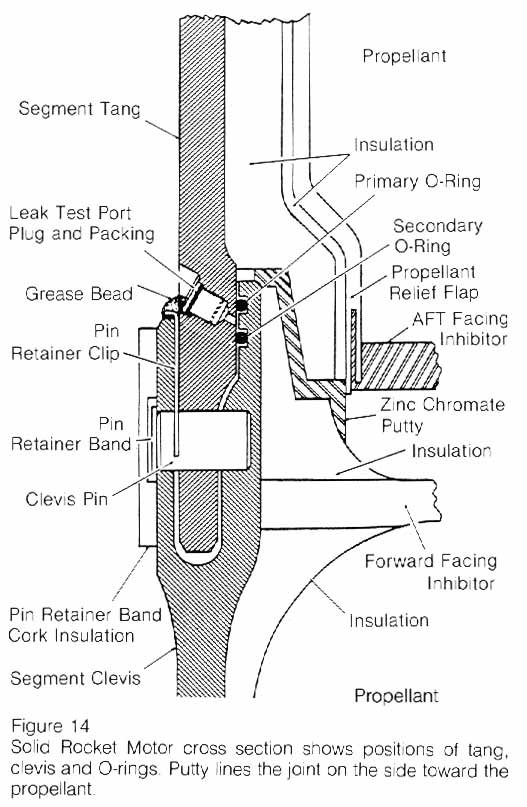
1. Segments were stacked at Kennedy. Each solid rocket booster was assembled from segments joined in the field; the joint had a tang that fitted into a U-shaped clevis.
2. Two rubber O-rings sat in the joint. A primary O-ring was meant to seal, with a secondary O-ring as backup, and putty lined the side facing the propellant.
3. Ignition pressurised the case. The motor’s pressure made the case swell, and the tang and clevis bent apart, opening a gap in milliseconds: joint rotation.
4. The seal had to close fast. The primary O-ring had to move into the gap before hot gas passed; cold rubber responded more slowly, as Thiokol’s June 1985 bench test and Feynman’s demonstration showed.
5. The backup was weaker than assumed. Marshall’s 1979 memo said joint rotation could disengage the secondary O-ring, so the joint was reclassified Criticality 1 in December 1982.
6. On 28 January it did not seal. Smoke appeared at 0.678 seconds, a flame at 58.788 seconds and a plume at 59.262 seconds.
The central lesson: the O-ring was where the failure began, but the joint’s design and the way warnings were handled shaped the outcome.
| Term | Meaning | Why it matters here |
|---|---|---|
| Field joint | Joint where booster segments were stacked together at Kennedy | The right aft field joint failed |
| Tang and clevis | A tongue that fits into a U-shaped groove between segments | Their gap opened on ignition (joint rotation) |
| Primary and secondary O-ring | Two rubber seals in the joint, the second intended as a backup | Joint rotation weakened the backup |
| Blow-by and erosion | Hot gas passing a seal, and seal material burned away | Seen on earlier flights, worst on 51-C |
| Criticality 1 / 1R | NASA failure categories; 1R assumed a working redundant backup | Changed from 1R to 1 on 17 Dec 1982 |
| Flight Readiness Review | Level I to III reviews certifying a shuttle for flight | None recorded the O-ring history for 51-L |
| Launch Commit Criteria | Rules defining go and no-go conditions | None set a joint temperature limit |
| Off-net caucus | Private discussion with the teleconference muted | Thiokol management reversed its position in one |
Who Is Who in the Story
Roger Boisjoly
Wrote the 22 and 31 July 1985 memos and opposed the launch on 27 January; testified he was never polled.
Allan McDonald
Kept arguing for delay from Kennedy; news obituaries say he refused to sign the launch authorisation.
Robert Lund
Presented the 53°F no-launch recommendation, then was asked to put on his management hat.
Joe Kilminster
Said he could not recommend launch, then read the rationale for launch and faxed it.
Larry Mulloy
SRB project manager who challenged Thiokol’s data and testified to the “next April” remark.
George Hardy
Reported as “appalled” at Thiokol’s first recommendation; asked for the written fax.
William P. Rogers
Former Secretary of State who led the presidential commission and issued the 15 February statement.
Richard Feynman
Physicist who showed O-ring rubber losing resilience in ice water and wrote Appendix F.
Why Were the Engineers’ Warnings Overruled?
Incomplete communication. The Rogers Commission found the launch decision-makers were unaware of the O-ring history, of Thiokol’s initial written recommendation against launch below 53°F and of the engineers’ continuing opposition.
Conflict between data and judgment. Thiokol said the data were “admittedly inconclusive”. NASA managers challenged whether cold was proven to cause damage, since distress had occurred at 75°F, too.
Who had to prove what. Boisjoly testified the meeting’s tone was that the engineers had to prove it was unsafe to launch. The commission’s own review of all flights showed 4 of 4 cold flights with damage.
A recurring problem treated as acceptable. The 51-C, 51-B and other flights had been judged “acceptable” or safe to fly, and the 1983 waiver kept the joint flying as a single-point failure.
A flawed process. A NASA structure allowed internal flight safety problems to bypass key shuttle managers. The commission did not trace the accident to one individual or motive.
What Changed After Challenger
A new joint. The redesign added a capture feature on the tang, another O-ring and heaters.
An independent safety office. NASA created an Office of Safety, Reliability and Quality Assurance in 1986; the 2003 Columbia board said it was still not truly independent.
A longer grounding. The shuttle was grounded for 975 days, and commercial satellites were moved to expendable rockets.
A case study. Challenger is taught in engineering ethics, whistleblowing and group decision-making, and Boisjoly and McDonald became speakers on the subject.
The Popular Story vs the Record
| Popular version | What the record shows |
|---|---|
| The engineers predicted the explosion | They warned the seal might not work in the cold and that no data supported confidence. Boisjoly feared a field-joint failure with loss of life, but nobody predicted the exact sequence |
| NASA overrode a firm Thiokol “no” | Thiokol management reversed its own recommendation in the caucus and faxed a written recommendation to launch; NASA managers challenged the data, though Marshall’s George Hardy said he would not recommend launch if Thiokol did not |
| Launch decision-makers heard everything | The commission found they were unaware of the initial written no-launch recommendation and of the engineers’ continuing opposition |
| 36°F was the O-ring temperature | 36°F was the air; the joint was estimated at 28°F ± 5. Thiokol’s 53°F was an O-ring temperature from 51-C |
| The cold alone caused the accident | The commission blamed a joint design unacceptably sensitive to temperature, dynamic loading and material properties |
| The O-ring risk was a surprise | Joint rotation showed up in 1977, erosion in 1981, and the risk was written down in July 1985 |
| There was a NASA temperature rule that was broken | Mulloy testified there was no launch commit criterion for joint temperature |
| Reagan spoke to the nation on 31 January | He addressed the nation from the Oval Office on the evening of 28 January; 31 January was the Houston memorial service |
| The shuttle flew again quickly | Discovery flew on 29 September 1988, 975 days after the accident |
The Challenger Disaster in Numbers
| Measure | Figure | Source and caveat |
|---|---|---|
| Launch time | 11:38 a.m. EST, 28 Jan 1986 | Rogers Commission Chapter III |
| Time to loss | 73 seconds; last telemetry 73.618 s | Rogers Commission Chapter III |
| Air temperature | 36°F, 15°F colder than any earlier launch | Measured about 1,000 ft from Pad 39B |
| Joint temperature | 28°F ± 5°F, 300-degree point | Commission estimate |
| Forecast | Low of 18°F; 22°F near 6 a.m.; 26°F at 9:38 | Testimony quoting launch operations |
| Thiokol limit | Do not launch below 53°F O-ring temperature | Calculated for 51-C by Thiokol |
| Distress by temperature | 3 of 20 at 66°F+; 4 of 4 at 63°F or below | Rogers Commission Chapter VI |
| Thiokol caucus | About 30 minutes | Recessed about 10:30 p.m. |
| Recommendation fax | About 11:45 p.m. EST | Rogers Commission chronology |
| Earlier launches | 24 prior shuttle flights under existing criteria | Mulloy testimony |
| Commission work | 14 members; 160+ interviews; ~6,300 documents | Rogers Commission Appendix A |
| Grounding | 975 days from accident to STS-26 | Wikipedia (STS-26) |
Explore More Timelines
People Also Ask
Frequently Asked Questions
Related AiTimeline Stories
⚠️ Editorial Note
Facts were checked on 21 October 2026 against the Rogers Commission report (NASA History Office), Wikipedia for secondary detail and AP for the 2026 anniversary. The timeline separates the commission’s technical findings from its findings on the decision process. It does not claim that engineers predicted the exact accident sequence or blame a single person. Sources differ on the date the report was released (6 June by NASA’s copy, 9 June by Wikipedia). President Reagan addressed the nation on 28 January and spoke at the memorial service on 31 January. McDonald’s refusal to sign is from news obituaries; the commission record shows him arguing for delay.
Sources & further reading
Every dated entry above was checked against these references. Last reviewed 21 October 2026.
- Rogers Commission Report, Chapter III: The Accident
- Rogers Commission Report, Chapter IV: The Cause of the Accident
- Rogers Commission Report, Chapter V: The Contributing Cause of the Accident
- Rogers Commission Report, Chapter VI: An Accident Rooted in History
- Rogers Commission Report, Appendix A: Commission Activities
- Space Shuttle Challenger disaster
- STS-26
- NASA and families of fallen astronauts mark 40th anniversary of space shuttle Challenger accident