Youth Engagement and Gen Z in Indian Politics: A Complete Guide
How young Indians actually vote, organise and engage with democracy — Election Commission data, National Youth Policy history, Lokniti-CSDS survey
Latest Story
Ananya Verma is twenty minutes into a queue that snakes around a government school in Lucknow, phone in one pocket and a laminated voter slip in the other, when she starts thinking not about which symbol she will press but about whether the diploma she finished last year will actually get her a job. Two hundred kilometres away in a Bundelkhand village, a young farmer waiting at a different booth is thinking about groundwater and the price of diesel. In Bengaluru, a first-time voter who worked through the night on a client call is thinking about the metro line that still doesn’t reach her flat. All three are part of what election reporting habitually calls “the youth vote” or, more recently, “Gen Z” — a shorthand so widely used that it is easy to forget it describes roughly a fifth of a billion people who do not agree with each other about very much at all.
This guide is built around a simple, evidence-based premise: young Indians are not a single political bloc, and any account of their politics that treats them as one is doing something closer to marketing than analysis. What is true, and well documented across official data and independent research, is that India’s demographic structure — a median age around 29 years and hundreds of millions of citizens under thirty — makes the political behaviour of young people a structurally significant part of how Indian democracy functions, whatever any individual young voter happens to believe. This is a reference about political participation in the broadest sense: voting, but also volunteering, protest, digital advocacy, student politics, civic organising and the quieter, harder-to-measure forms of engagement that happen between elections rather than during them.
This is also a YMYL (Your Money or Your Life) topic in the specific sense that it touches elections, governance and public institutions, so this guide is written to a standard that separates official data (the Election Commission of India, the Lok Sabha Secretariat, the Ministry of Statistics and Programme Implementation, NITI Aayog and the National Youth Policy), survey findings (named research organisations, reported with their own caveats about sample and method), academic research, and independent journalism and commentary at every point they diverge. It does not name any political party as uniquely representative of young voters, does not predict the outcome of any current or future election, and does not treat any single survey’s findings as a settled fact about “what Gen Z wants” — because, as the reporting above illustrates, no single answer to that question exists.
Ananya’s ballot choice, whatever it turns out to be, will be counted alongside hundreds of millions of other eligible voters’ choices, in a country where the largest single age cohort in the electorate was born after the internet arrived but before it was in every pocket. That timing — not any one election result, not any one party’s messaging — is the fact this guide is built to explain: how India arrived at a system of universal adult franchise and an 18-year voting age, how successive generations of young Indians have used that system, and why the accurate answer to “how does Gen Z vote in India” is a set of regionally and demographically specific findings, not a single sentence.
📋 Executive Summary
India’s Generation Z — broadly, citizens born from the late 1990s through the early 2010s — forms one of the largest cohorts of young citizens of any democracy in the world, a product of the country’s demographic structure rather than any single political event. Since the Constitution’s commencement in 1950 established universal adult franchise and the 61st Constitutional Amendment lowered the voting age from 21 to 18 in 1989, successive expansions of higher education, the 2015 launch of Digital India, and near-universal smartphone and social-media adoption have progressively changed how young Indians access political information and organise, without making their preferences uniform. The 2024 Lok Sabha general election — held across seven phases from 19 April to 1 June 2024, with results declared on 4 June — drew more than 968 million eligible electors and a turnout of 66.1%, the second-largest election exercise in Indian history after 1951-52. This guide separates Election Commission data, government statistics, named survey findings, academic research and independent commentary throughout, and treats “what young voters want” as an empirical question answered differently by different studies, regions and individuals — not as a single, settled narrative.
🧠 60-Second Overview
Youth engagement in Indian politics covers far more than voting: it includes campaigning, protest, student union activity, civil-society volunteering and digital advocacy, by a population cohort — India’s citizens under 30 — that Census-based and UN Population Fund estimates place at several hundred million people, among the largest such cohorts of any country. India’s voting age has been 18 since a 1989 constitutional amendment; the 2024 general election, India’s most recent Lok Sabha poll, saw 66.1% turnout among more than 968 million eligible electors. Research bodies including Lokniti-CSDS have repeatedly found that young voters’ stated priorities — employment, education, price rise, local governance — vary by region, income and gender rather than forming one uniform “youth agenda,” and no major national party is empirically shown to hold a durable, exclusive claim on the youth vote. Digital platforms have become a significant channel for political information and campaigning since the 2014 and 2019 general elections, alongside continuing person-to-person campaigning, student politics and civic organising that remain equally significant, especially outside major cities.
⚠️ Editorial Note & Scope
This is a YMYL topic touching elections, governance and public institutions. This guide separates official statistics and election data (Election Commission of India, Lok Sabha Secretariat, MoSPI, NITI Aayog, Census of India), named survey findings (Lokniti-CSDS, Pew Research Center, CVoter and similar organisations, reported with their own stated sample sizes and methods where available), academic and institutional research (peer-reviewed studies, UNDP and UNESCO publications), and independent journalism and commentary at every point they diverge. It does not claim that any political party uniquely represents young voters, does not predict the outcome of any election, and does not present any single survey’s findings as a universal description of “what Gen Z thinks” — youth political preference in India varies substantially by state, caste, class, gender, religion and urban-rural location, and this guide treats that variation as the central fact to be explained, not a complication to be smoothed over. Figures for 2025-2026 reflect the most recent officially available data as of this update and may be revised; this guide is maintained as a living reference and updated as the Election Commission, MoSPI, NITI Aayog, UNDP, UNESCO and credible survey organisations publish new material.
Who, What, When, Where, Why and How
One-Minute Summary
- Voting age in India: 18, since 28 March 1989 (61st Constitutional Amendment).
- Gen Z (Pew definition): born 1997-2012. India’s policy “youth” (National Youth Policy 2014): ages 15-29.
- 2024 Lok Sabha election: 7 phases, 19 April-1 June 2024; results 4 June 2024; 66.1% turnout of 968M+ electors.
- Women’s votes cast in 2024: 312 million, a record, per the Election Commission of India.
- Youth vote is not one bloc: Lokniti-CSDS and other surveys find preferences vary by state, caste, income and gender.
- Key youth-policy milestones: 1988 (first policy), 2003 (revised), 2014 (current, ages 15-29), 2015 (Digital India).
What the Evidence Actually Shows
- India’s voting age has been 18 since 1989, following the 61st Constitutional Amendment Act — a change that pre-dates every member of Generation Z.
- Young Indian voters are not a uniform bloc: Lokniti-CSDS and other survey organisations have repeatedly found that stated priorities and party preference among young voters vary substantially by state, caste, income, gender and urban-rural location.
- Political participation is broader than voting — it includes campaigning, protest, student politics, civic volunteering and digital advocacy, forms of engagement that are harder to measure than turnout but are consistently documented in academic research.
- The 2024 Lok Sabha election was the second-largest election exercise in Indian history by scale, after 1951-52, with more than 968 million eligible electors and 66.1% turnout, per the Election Commission of India.
- Women’s voter turnout reached a record 312 million votes in 2024, per ECI data, part of a longer-run narrowing of the gender gap in Indian voter turnout documented since the 2000s.
- Digital platforms have become a significant channel for political information and campaigning since the 2014 general election, without replacing person-to-person campaigning, which independent election researchers continue to document as decisive in much of rural India.
- India’s National Youth Policy (2014) defines “youth” as citizens aged 15-29 for policy purposes — a different, broader definition than the Gen Z birth-year cohort this guide also discusses, and the two terms are not interchangeable.
- Student politics in India has a continuous history from before independence through today, including major nationally significant movements, and remains an active training ground for a share of the country’s political leadership.
- Media and digital literacy, not just internet access, is now treated by election authorities and researchers as a distinct civic-education priority, given the documented spread of political misinformation on social platforms.
- This is a living reference: as the Election Commission, MoSPI, NITI Aayog, UNDP, UNESCO and credible survey organisations publish new data, this guide will be revised, not replaced.
The Vocabulary of Democratic Participation, Defined
Ten terms this guide uses precisely and consistently throughout.
Democracy
A system of government in which citizens hold, directly or through elected representatives, the authority to shape public decisions — in India’s case, a parliamentary republic built on universal adult franchise since the Constitution’s commencement in 1950.
Voting
The act of casting a ballot in an election — one specific, time-bound form of political participation, distinct from the broader, continuous forms of civic engagement this guide also covers.
Electoral Participation
Involvement in the electoral process broadly — voting, but also campaigning, poll observation, contesting office and voter-awareness work — as distinct from participation in civic life outside election cycles.
Political Participation
Any activity through which a citizen seeks to influence public decisions or hold institutions accountable, including but not limited to voting — protest, lobbying, volunteering, digital advocacy and party membership all qualify.
Student Unions
Elected or appointed representative bodies within colleges and universities, historically one of India’s most significant training grounds for future political leadership across the spectrum.
Civil Society
The space of voluntary, non-governmental organisation — NGOs, community groups, advocacy networks — through which citizens, including large numbers of young Indians, engage in public issues outside formal party politics.
Public Policy
The decisions and frameworks governments adopt to address collective problems — youth engagement with public policy ranges from formal consultation processes to informal advocacy and protest.
Digital Campaigning
The use of social media, messaging platforms and digital advertising by parties, candidates and citizens to share political information and mobilise supporters — a significant and growing channel in Indian elections since 2014, alongside continuing traditional campaigning.
Election Literacy
Public understanding of how elections and institutions function — registration, EVMs, the model code of conduct — promoted in India through Election Commission initiatives including electoral literacy clubs in schools and colleges.
Civic Participation
Engagement in community and public life beyond electoral politics — volunteering, local governance participation, civic tech projects and community organising — a category this guide treats as at least as significant as voting for understanding youth engagement.
📈 Democracy Insight
Political participation extends well beyond elections and includes volunteering, advocacy, public consultation and civic initiatives. Measuring youth engagement by voter turnout alone — the most commonly reported statistic — systematically understates how many young Indians are politically active in other ways, from student governance to civic-tech volunteering to organised protest.
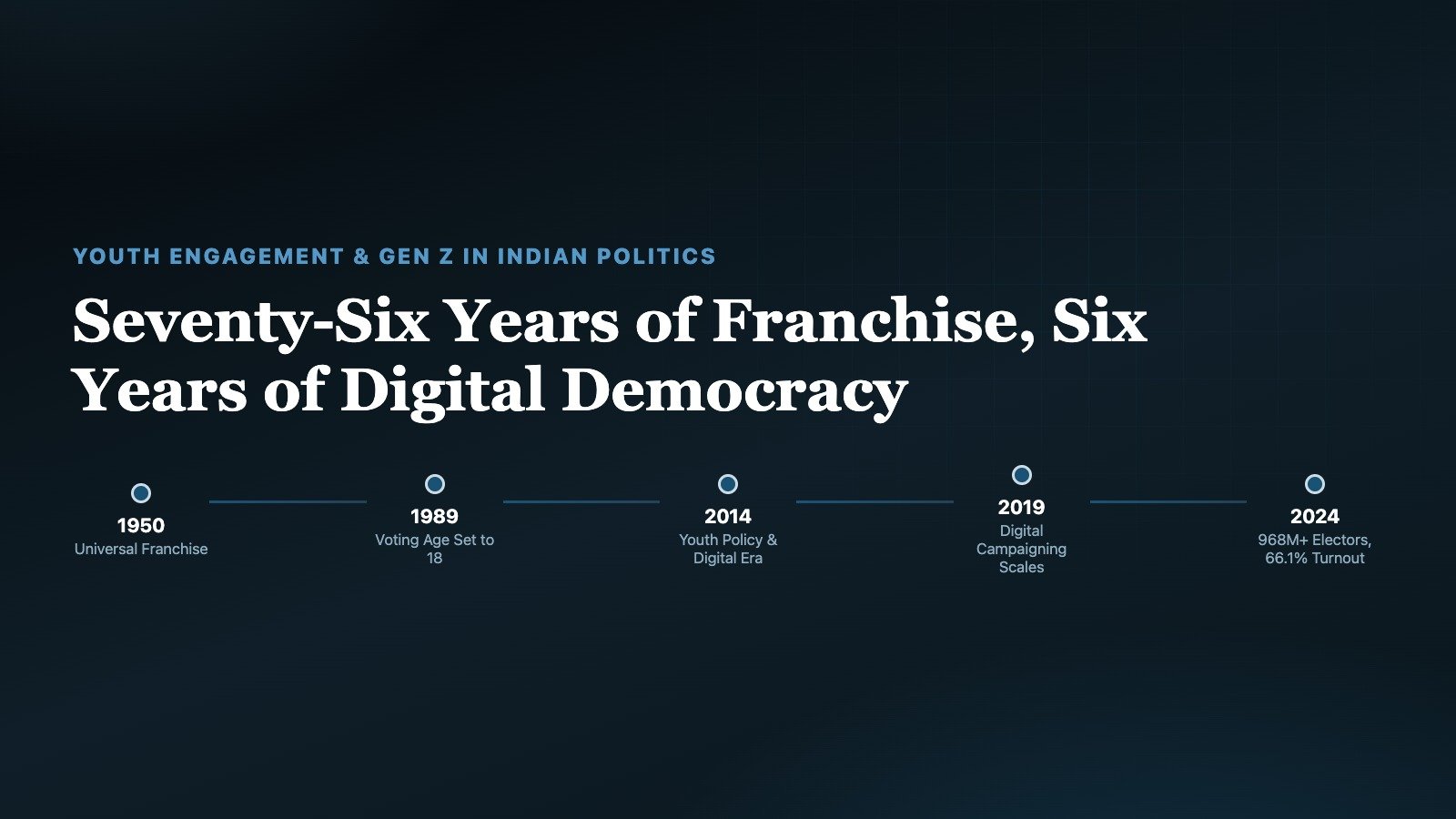
The Complete Timeline: From Universal Franchise to Digital Democracy
Reverse-chronological. Each entry separates political context, social context, youth participation, policy impact and current relevance.
The 2024 Lok Sabha Election and the 2025-2026 State Election Cycle
Political context: The 18th Lok Sabha general election was held in seven phases from 19 April to 1 June 2024, with results declared on 4 June 2024 — the second-largest election exercise in Indian history by scale, after 1951-52.
Social context: More than 968 million citizens were eligible to vote, and turnout was recorded at 66.1%; 642 million votes were cast, including a record 312 million by women voters, per the Election Commission of India.
Youth participation: The Election Commission’s pre-poll enrolment drives, including provisions allowing 17-year-olds to pre-register ahead of turning 18, aimed specifically at first-time voters; post-poll academic and survey research on the youth vote for this election was still being published and consolidated as of this update, and this guide will incorporate verified findings as they are peer-reviewed or officially released rather than anticipate them.
Policy impact: State elections through 2025-2026 continued to test party strategies aimed at younger voters, including manifesto commitments on employment and skilling, without any single approach showing a consistent, generalisable advantage across states.
Current relevance: This is the most recent full national election cycle and remains the primary current dataset for any evidence-based discussion of contemporary Indian youth voting behaviour.
The 2019 General Election and the Consolidation of Digital Campaigning
Political context: The 17th Lok Sabha election, held in seven phases in April-May 2019, was the first general election in which digital and social-media campaigning operated at full national scale across all major parties, building on techniques first tested widely in 2014.
Social context: Smartphone penetration and mobile data affordability had both increased sharply since 2014, expanding the population reachable through digital political messaging well beyond urban, English-speaking audiences.
Youth participation: Independent election researchers documented young, first-time voters as a demographically significant share of the 2019 electorate, consistent with India’s population structure, though — as in every cycle — survey research found their party preferences distributed across the political spectrum rather than concentrated in one direction.
Policy impact: Political parties across the spectrum expanded dedicated digital and social-media operations after 2019, a structural change in Indian campaigning that has persisted into subsequent state and national elections.
Current relevance: 2019 is generally treated by election researchers as the point at which digital campaigning became a standard, not experimental, part of the Indian electoral toolkit.
Digital India, Smartphone Adoption and the Data Revolution
Political context: The Digital India programme was launched on 1 July 2015 as a government initiative to expand digital infrastructure, digital literacy and online service delivery across the country.
Social context: A sharp reduction in mobile data prices from 2016 onward, widely reported in industry and government data, accelerated smartphone-based internet adoption across income groups and geographies far faster than earlier fixed-line or cybercafe-based internet access had reached.
Youth participation: This period is when a majority of India’s Gen Z cohort — most already born, some still to be born within the 1997-2012 range — began forming their primary relationship with digital information access during adolescence, a formative context markedly different from that of India’s Millennial generation.
Policy impact: Expanded digital access became the infrastructure underlying subsequent digital-campaigning, e-governance and civic-tech initiatives referenced throughout the rest of this timeline.
Current relevance: This period is the direct infrastructural foundation for the “digitally native” framing commonly applied to Indian Gen Z in later media and academic commentary.
The 2014 General Election and the National Youth Policy Update
Political context: The 16th Lok Sabha election in April-May 2014 recorded turnout of approximately 66%, then among the highest in Indian general-election history, and is widely credited by election researchers as the first Indian general election in which social-media campaigning played a substantial, visible national role.
Social context: India’s government separately revised the National Youth Policy in 2014, defining “youth” as citizens aged 15-29 for policy purposes and setting priority areas spanning education, employment and skill development, health, sports, and social and political participation.
Youth participation: Academic and survey research on this election, including Lokniti-CSDS post-poll studies, documented significant youth voter interest without finding uniform party preference across the youth demographic — a finding consistent with subsequent election cycles.
Policy impact: The 2014 National Youth Policy remains the current official policy framework defining “youth” for Indian government programming as of this update, cited throughout the rest of this guide.
Current relevance: The policy definition set in 2014 — ages 15-29 — is why this guide distinguishes “youth” in the Indian policy sense from “Gen Z” in the birth-cohort sense used elsewhere; the two overlap substantially but are not identical categories.
A Nationwide Anti-Corruption Movement Draws Large-Scale Youth Participation
Political context: A nationwide civil-society movement against corruption, associated with activist Anna Hazare and the India Against Corruption campaign, gathered sustained public attention through 2011, centred on demands for a stronger anti-corruption ombudsman law (the Lokpal Bill).
Social context: Independent journalism and academic commentary at the time widely documented the movement’s participation as unusually youth-heavy and urban-middle-class in composition, organised substantially through early social-media and SMS-based mobilisation rather than exclusively through traditional party or union structures.
Youth participation: Researchers studying Indian civil society have subsequently cited this movement as a significant, non-electoral example of large-scale youth political engagement — participants who were not necessarily voting-age or formally affiliated with any party but were nonetheless actively shaping public debate and policy pressure.
Policy impact: Parliament passed the Lokpal and Lokayuktas Act in 2013, establishing an anti-corruption ombudsman mechanism at the national level, a legislative outcome independent analysts and journalists have connected to the sustained public pressure this movement generated.
Current relevance: This episode remains the standard reference point researchers cite when illustrating that Indian youth political engagement is not confined to elections — and it predates, by several years, the smartphone-era digital organising this guide’s later timeline entries describe.
India’s Second National Youth Policy
Political context: The Indian government adopted a revised National Youth Policy in 2003, replacing the country’s first youth policy issued in 1988, reflecting the changed economic and social conditions of the post-liberalisation decade.
Social context: The 2003 policy period coincided with continued expansion of India’s higher-education sector and growing formal-sector employment aspirations among young Indians entering the workforce after the 1991 economic reforms.
Youth participation: The policy period saw sustained growth in student politics and campus-based civic organisations, alongside the earliest stages of internet access on Indian university campuses.
Policy impact: The 2003 policy broadened the government’s stated youth-development priorities compared with 1988, ahead of the more detailed 2014 revision that remains current policy.
Current relevance: This period is the direct institutional bridge between India’s early post-independence youth-policy framework and the digital-era policy environment Gen Z has grown up within.
-2000s
Economic Liberalisation and the Expansion of Higher Education
Political context: India’s 1991 economic liberalisation reforms opened the economy to greater private investment and global trade, a structural shift that reshaped employment expectations for the generation that would become the parents of today’s Gen Z cohort.
Social context: Higher-education enrolment expanded substantially over the following two decades, alongside the growth of private engineering, management and professional colleges, changing the educational backdrop against which subsequent generations, including Gen Z, formed political and economic expectations.
Youth participation: Campus and student politics continued as an active institution through this period, alongside the earliest professional-sector youth organisations and the growth of civil-society and NGO activity engaging young volunteers.
Policy impact: The employment and economic-opportunity expectations shaped during this period are frequently cited by researchers, including in Lokniti-CSDS survey work, as a continuing throughline in what younger voters say they prioritise decades later.
Current relevance: Economic-opportunity concerns documented among voters in this period remain among the most consistently cited priorities in youth-focused election surveys through the 2019 and 2024 cycles.
The Voting Age Is Lowered to 18 and India’s First Youth Policy Is Adopted
Political context: Parliament passed the 61st Constitutional Amendment Act in December 1988, amending Article 326 to lower the minimum voting age for Lok Sabha and state legislative assembly elections from 21 to 18; it received presidential assent and came into force on 28 March 1989.
Social context: The same period saw the Indian government adopt its first National Youth Policy in 1988, formally establishing youth development as a distinct government policy category for the first time.
Youth participation: The lowered voting age immediately and substantially expanded the eligible electorate to include millions of 18-to-20-year-olds who had previously been excluded, a structural change whose effects are still directly relevant to every subsequent election this timeline covers.
Policy impact: Every Indian election since 1989 has been conducted under the 18-year voting age this amendment established — including every election India’s Gen Z cohort has itself become eligible to vote in.
Current relevance: This is the single most directly relevant historical event to this guide’s subject: without the 1989 change, most discussion of “Gen Z voters” in India today would not apply to citizens under 21.
-1980s
The Growth of Organised Student Politics
Political context: Student unions and campus political organisations grew into a significant, nationally visible feature of Indian politics through the 1970s and 1980s, with student-led mobilisation playing a documented role in several major political developments of the period.
Social context: University and college campuses functioned as one of the primary spaces where young Indians engaged in organised political activity, well before digital platforms existed, establishing a tradition of student politics that continues, in altered form, today.
Youth participation: Student union elections and campus political organisations during this period served as an early training and recruitment pathway into mainstream party politics for a substantial share of India’s subsequent political leadership across the spectrum.
Policy impact: The institutional structures established during this period — elected student unions, campus political wings affiliated with national parties — remain largely intact at many Indian universities today.
Current relevance: Contemporary campus activism and student politics, including recent movements over examination administration and education policy discussed later in this timeline, operate within institutional structures that trace directly to this period.
The Constitution Establishes Universal Adult Franchise; India Holds Its First General Election
Political context: The Constitution of India, which came into force on 26 January 1950, established universal adult franchise from the outset — every adult citizen, regardless of caste, religion, gender, literacy or property ownership, gained the right to vote, a decision that was internationally unusual at the time for a country at India’s then level of literacy and economic development.
Social context: India’s first general election, held between October 1951 and February 1952, was — at the time — the largest exercise of democratic franchise in world history, conducted across a vast, largely rural and predominantly non-literate electorate using specially designed ballot-box and symbol systems to enable participation regardless of literacy.
Youth participation: The voting age at this founding election was 21, not 18 — the lower voting age familiar to every subsequent generation, including Gen Z, was not introduced until the 1989 change described elsewhere in this timeline.
Policy impact: This election established the Election Commission of India’s operational template — symbol-based ballots, extensive rural polling infrastructure — much of which, in updated electronic form, remains the basis for how Indian elections, including the 2024 general election, are conducted today.
Current relevance: Every subsequent milestone in this timeline, including every expansion of youth participation, operates within the universal-franchise foundation this election established.
📜 History Insight
India’s youth-and-democracy story does not begin with smartphones. Universal adult franchise in 1950, the 1989 voting-age reduction, decades of organised student politics, and successive National Youth Policies all predate the digital era by years or decades — the internet and social media changed how young Indians engage with these existing institutions, not whether the institutions or the underlying right to participate existed in the first place.
Who Is Generation Z, and Why Does India’s Demographic Profile Matter?
Definitions, population structure and what “youth” means across different Indian institutions.
“Generation Z” is a birth-cohort label, not an Indian government category. The most widely used definition, from the US-based Pew Research Center, places Gen Z as those born between 1997 and 2012 — meaning, as of 2026, the oldest members are in their late twenties and the youngest are still in school. India’s own policy apparatus uses a different, broader term: the National Youth Policy 2014 defines “youth” as citizens aged 15 to 29, a category that includes the younger half of the Millennial generation alongside all of Gen Z currently old enough to be counted. This guide uses “Gen Z” specifically when discussing the birth-cohort framing common in global media and research, and “youth” when referring to the broader Indian policy category — the two terms overlap substantially but are not synonyms, and conflating them is one of the most common imprecisions in casual coverage of this topic.
India’s demographic structure is central to why this cohort matters politically. The country’s median age was approximately 29.8 years as of 2024, and roughly two-thirds of the population falls within the working-age 15-64 bracket, per UN Population Fund and Census-derived estimates — a markedly younger age structure than that of most large, high-income democracies. This is commonly described as India’s “demographic dividend”: the economic and political potential of having a very large working-age and youth population relative to dependents, a potential that economists and policymakers, including NITI Aayog, generally treat as conditional on adequate education, employment and skilling outcomes rather than automatic.
Political participation and voting are not the same thing. Voting is a discrete, periodic act. Political participation is a continuous category that includes campaigning, protest, civic volunteering, student governance, digital advocacy, public consultation responses and, for a smaller number, direct candidacy for office. A young Indian who has never voted — because they are not yet 18, or chose not to register — may nonetheless be highly politically engaged through campus activism, civic-tech volunteering or digital organising; conversely, a high turnout rate among young voters does not, by itself, indicate broader civic engagement. Research on Indian political participation, including academic work published through institutions such as the Centre for the Study of Developing Societies, consistently treats these as related but distinct phenomena requiring separate measurement.
Digital platforms have reshaped the channels through which political information reaches young Indians — but civic engagement beyond elections predates those platforms by decades, through student unions, civil-society organisations and community-level governance participation, and continues alongside digital engagement rather than having been replaced by it, particularly outside major urban centres where internet access, while growing rapidly, remains less uniform than in metropolitan India.
Measuring any of this precisely is harder than it sounds. “Youth population” figures differ depending on whether a source uses the UN’s 15-24 definition, India’s own National Youth Policy 15-29 band, or the Pew Research Center’s Gen Z birth-cohort definition — three overlapping but distinct categories that different official and research publications use inconsistently, and that this guide is careful to label explicitly wherever a specific figure is cited, rather than presenting one number as if it answered all three questions at once. Cross-national comparisons of “youth engagement” face a similar problem: countries measure voter turnout, civic volunteering and digital participation differently enough that a single global ranking of youth political engagement is not something this guide treats as a settled, citable fact.
🇮🇳 India Insight
India has one of the world’s largest youth populations by absolute size, making younger citizens a structurally significant part of democratic life — not because of any single election result, but because of demographic arithmetic that will continue to shape Indian politics for decades regardless of any individual election’s outcome.
India’s Demographic Dividend and Gen Z’s Stated Priorities
Education, employment, entrepreneurship, climate and technology — what survey research actually finds, region by region.
Education
India’s higher-education enrolment has expanded substantially over the past three decades, and educational attainment is one of the variables most consistently linked, in academic and survey research, to political engagement levels — more educated respondents tend to report higher rates of both voting and non-electoral participation, though the relationship is not uniform across states or social groups. Concerns about educational quality, examination administration and access to higher education recur as stated priorities in youth surveys and have, at points, driven the student-protest movements discussed later in this guide. The gross enrolment ratio in Indian higher education has risen over successive government reporting periods, per All India Survey on Higher Education data published by the Ministry of Education, though researchers and policymakers, including NITI Aayog, continue to identify gaps between enrolment growth and graduate employability as a distinct, separately measured concern.
Employment
Employment and job creation are among the most consistently cited priorities in Lokniti-CSDS and other post-poll surveys of young Indian voters across multiple election cycles, a finding independent of which party a given respondent supports. MoSPI’s Periodic Labour Force Survey series is the official government data source most frequently cited by researchers studying youth employment and unemployment trends, distinct from survey-based political-priority research; this guide treats employment as an economic-data question answered by MoSPI and a political-priority question answered separately by survey research, and does not conflate the two. This site’s dedicated Youth Unemployment in India timeline, linked later in this guide, covers the underlying labour-market data in full detail, including sector-wise and state-wise variation that a single national figure does not capture.
Entrepreneurship
Government initiatives including Startup India, launched in January 2016, and Skill India have targeted youth entrepreneurship and employability as an explicit policy priority since the mid-2010s, alongside a documented rise in the number of India-based startups and government-recognised “unicorn” companies over the same period. Independent survey and industry research describes growing interest in entrepreneurship and self-employment among young Indians, particularly in urban areas and among more educated respondents, though formal-sector job security remains a competing and, in several surveys, more commonly prioritised aspiration than founding a new venture. Access to early-stage capital, mentorship and digital infrastructure varies substantially by region, which researchers cite as a factor shaping where youth entrepreneurship activity concentrates within the country rather than it being evenly distributed.
Climate Concerns
Climate and environmental concern appears as a stated priority among young Indians in several academic and survey studies, consistent with global research on generational attitudes toward climate change, though it typically ranks below employment and economic-opportunity concerns in most Indian post-poll survey research to date — a finding this guide reports as survey data, not as a normative judgement about which priority is more legitimate. Youth-led environmental and climate advocacy groups have grown in visibility in India over the past decade, operating largely as civil-society and civic-participation activity distinct from party-affiliated politics, and intersecting with the broader energy-transition policy questions covered in this site’s dedicated Renewable Energy Transition timeline.
Technology and Artificial Intelligence
Familiarity with digital tools and, increasingly, artificial intelligence applications is a defining feature of how Indian Gen Z accesses information, including political information, compared with earlier generations. This technological fluency is a channel through which engagement happens rather than a political preference in itself — it shapes how young Indians encounter political content, not what they conclude from it. Government digital-service platforms, from Aadhaar-linked service delivery to state-level e-governance portals, have simultaneously changed how young citizens interact with the state administratively, a related but distinct trend from political campaigning and civic advocacy covered elsewhere in this guide.
Digital Misinformation and the Fact-Checking Ecosystem
How false political content spreads among young, digitally connected voters — and what counters it.
The same platform features that make social media an efficient channel for legitimate political information — rapid sharing, algorithmic amplification, low publishing barriers — also make it an efficient channel for false or misleading content, a dynamic documented by election authorities, independent fact-checking organisations and academic researchers studying Indian elections since at least 2014. During election periods specifically, the Election Commission of India has used tools including the cVigil citizen-reporting app to allow voters to flag suspected Model Code of Conduct violations, and has run voter-facing myth-versus-reality communication aimed at correcting circulating misinformation about the voting process itself, distinct from party-political misinformation, which falls outside the Commission’s direct remit.
Independent fact-checking organisations operating in India — a category that has grown substantially since the mid-2010s — typically verify viral claims, images and video against original sources and publish corrections, work that academic media-literacy researchers describe as necessary but insufficient on its own, since corrections generally reach a smaller audience than the original false claim. This is why election authorities, researchers and civil-society organisations increasingly frame the response as media and election literacy education — building young voters’ own evaluative skills — rather than relying solely on after-the-fact correction, a framing this guide’s earlier Digital Insight box reflects.
🔬 Research Insight
Surveys consistently show that young voters often prioritise employment, education, economic opportunity and governance, though preferences vary across individuals and regions. No credible national survey has found a single, uniform “Gen Z agenda” in India — every major study documents meaningful variation by state, income, gender, caste and urban-rural location, which is itself the most robust and consistently replicated finding in this research area.
Social Media, Digital Campaigning and Election Literacy
How digital platforms changed political communication — and what they didn’t change.
Social media’s role in Indian political communication grew from a marginal presence before 2014 to a standard part of every major party’s campaign operation by 2019, driven by the combination of Digital India-era infrastructure investment and a sharp, well-documented fall in mobile data prices from 2016 onward. For young, digitally native voters, platforms including WhatsApp, YouTube, Instagram and X function as significant sources of political information, campaign content and, at times, viral misinformation — all three simultaneously, which is precisely why election literacy and media literacy have become distinct civic-education priorities rather than an assumed byproduct of internet access.
The Election Commission of India runs electoral literacy clubs in schools and colleges and observes National Voters’ Day on 25 January each year — marking the Commission’s 1950 founding date — specifically to build voter awareness and registration among young, first-time-eligible citizens ahead of their first election. Digital misinformation during election periods is a documented concern raised by election authorities, independent fact-checking organisations and academic researchers alike; it is not unique to India or to youth audiences, but the speed and scale at which misinformation can spread on high-penetration platforms among digitally native users is a specific feature of the current Indian information environment that election-literacy programming is explicitly designed to address.
None of this has eliminated traditional, in-person campaigning. Independent election researchers and journalists continue to document door-to-door canvassing, public rallies and local-level party organisation as decisive factors in many constituencies, particularly in rural India, where digital reach — while growing rapidly — remains less saturated than in major cities. The accurate description of contemporary Indian campaigning is both digital and traditional channels operating simultaneously, not a wholesale replacement of one by the other.
📱 Digital Insight
Social media has expanded access to political information while also increasing the importance of media literacy and fact-checking. Wider access to information is not the same as more accurate information reaching every voter equally — a distinction election-literacy programming and independent fact-checkers both treat as central to their work.
Youth Leadership, Women in Politics and Rural-Urban Participation
Representation, and where participation gaps persist.
Youth Leadership
The average age of Indian Lok Sabha members has been a recurring subject of academic and journalistic analysis, with researchers noting that formal political representation by age-15-to-29 “youth,” as the National Youth Policy defines the category, remains proportionally smaller than that cohort’s share of the overall population — a pattern common to most democracies and not unique to India. Youth wings of major political parties, along with independent youth-led civic organisations, function as the primary formal pathway into electoral candidacy for younger Indians who pursue it. Academic researchers studying political recruitment in India note that candidacy for state and national office typically requires resources — organisational backing, name recognition, campaign finance — that take time to accumulate, which several researchers cite as a structural, rather than purely attitudinal, explanation for why elected representation skews older than the electorate as a whole.
Women in Politics
Women’s voter turnout has risen steadily relative to men’s over successive Indian general elections, reaching a record 312 million votes cast by women in the 2024 general election per Election Commission data — part of a longer-run narrowing of India’s gender turnout gap documented since the 2000s. Women’s representation among elected candidates and legislators remains a separate, distinct measure from turnout, and is addressed by specific legislative and policy measures, including reservation provisions for women in local governance bodies since the 1990s and, more recently, the Constitution (One Hundred and Sixth Amendment) Act, 2023 — passed by the Lok Sabha on 20 September 2023 and the Rajya Sabha the following day, and popularly known as the Nari Shakti Vandan Adhiniyam — which reserves roughly one-third of seats in the Lok Sabha and state legislative assemblies for women. Per official government notification, the amendment formally came into force on 16 April 2026, though the reservation itself remains inoperative pending a delimitation exercise tied to the next Census, meaning practical implementation is not expected before a subsequent general election cycle. This site’s dedicated Women’s Reservation Bill timeline covers this legislative history in full detail.
Rural vs Urban Participation
Voter turnout in Indian general elections has historically been comparable, and at times higher, in rural constituencies relative to urban ones — a pattern that runs counter to a common assumption that urban, digitally connected youth are more electorally engaged than their rural counterparts. What differs between rural and urban young voters, per available survey and academic research, is less the likelihood of voting and more the channels through which political information reaches them and the specific issues they report prioritising, which frequently track local economic conditions — agricultural income and rural employment in many rural constituencies, urban infrastructure and formal-sector job availability in many urban ones. Internet and smartphone access, while it has grown rapidly nationwide since the 2015-2018 period this guide’s timeline documents, is still not uniformly distributed between rural and urban India, a gap the Digital India programme and successive telecom-infrastructure policy have explicitly targeted rather than treated as fully closed.
Political Representation
Representation of young citizens in formal political office is distinct from youth voter turnout and youth civic participation more broadly — a young population can be highly electorally active while remaining underrepresented among elected officials, a pattern documented in India as in most democracies, and one that youth-focused civil-society organisations and some party youth wings have specifically identified as a priority area for institutional reform. Local governance bodies — panchayats and municipal corporations — are, per available research, generally the entry point where younger and more diverse candidates first stand for elected office, before any progression toward state or national-level candidacy.
Public Consultation, E-Governance and Civic Tech
The quieter, non-electoral channels through which young Indians engage with government directly.
Voting and protest are the most visible forms of political engagement, but a substantial and growing channel operates through formal and informal government-citizen consultation. The Right to Information Act, 2005 — passed by Parliament on 15 June 2005 and in full force from 12 October 2005 — gives every citizen, including young first-time users of the mechanism, a legal right to request information from public authorities, with a 30-day response requirement in most cases; independent journalism has documented its use in exposing major public-accountability cases in the years since. MyGov.in, launched on 26 July 2014 and run by the National Informatics Centre, is a government-run citizen-engagement platform explicitly designed to crowdsource public input on policy and government initiatives, one of the more direct digital-era channels through which younger, digitally connected citizens can engage with government beyond elections.
Civic-tech volunteering — open-data projects, election-monitoring tools, public-service delivery apps built by independent developer and civil-society communities — has grown alongside these official platforms, generally organised outside formal party structures and often youth-led. Researchers studying Indian civil society treat this ecosystem of consultation mechanisms, transparency law and civic-tech volunteering as a meaningful complement to electoral participation, particularly relevant for understanding the political engagement of citizens too young to vote or who choose not to engage with party politics directly.
Head-to-Head Comparisons
The four distinctions readers ask about most often.
Political Participation vs Voting
Gen Z vs Millennials (India)
Traditional Campaigning vs Digital Campaigning
Election Awareness vs Political Activism
How Elections Work in India: A Practical Guide
From registration to result, in the order a first-time voter experiences it.
Eligibility and Pre-Registration
Any Indian citizen turning 18 on or before the qualifying date set by the Election Commission is eligible to register; the Commission allows 17-year-olds to pre-register ahead of turning 18, specifically to reduce first-time-voter enrolment delays.
Electoral Roll Registration
Voters register via Form 6 (or online through the National Voters’ Service Portal / Voter Helpline app), after which the Election Commission issues a Voter ID (EPIC) card and includes the voter on the electoral roll for their constituency.
Election Announcement and Model Code of Conduct
The Election Commission announces poll dates and phases, triggering the Model Code of Conduct, a set of guidelines governing permissible campaign and government conduct until results are declared.
Campaigning
Registered parties and candidates campaign through rallies, door-to-door canvassing, print and broadcast media, and digital platforms, subject to Model Code of Conduct restrictions and Election Commission oversight of campaign finance and conduct.
Polling
Voters cast their ballot via Electronic Voting Machine (EVM) at their designated polling station, verified against the electoral roll and, since 2013, with the option to select NOTA (“None of the Above”) if they do not wish to vote for any listed candidate. Since nationwide rollout in the 2019 general election, EVMs are paired with a Voter-Verified Paper Audit Trail (VVPAT), first piloted in Nagaland in September 2013, which prints a paper slip showing the voter’s recorded choice behind a transparent window, giving the voter a visual check and providing an auditable paper record if electronic and paper counts are ever compared.
Counting and Results
Votes are counted at designated centres under Election Commission supervision, typically within days of the final polling phase, with results formally declared and winning candidates certified by the Commission.
State and Local Election Trends
Why national figures only tell part of the story.
India’s federal structure means state legislative assembly elections, held on staggered schedules across the country’s 28 states and union territories, are at least as frequent a point of contact between young voters and the electoral process as the five-yearly Lok Sabha general election — in most years, at least one and often several states hold assembly polls. Turnout, party performance and the salience of specific issues vary substantially by state, consistent with the broader finding that Indian youth political preference is regionally differentiated rather than nationally uniform. Local body elections — panchayats in rural India and municipal corporations in urban areas — represent a third, still more localised layer, and are the level of government at which reservation provisions for women, discussed later in this guide, have applied longest and most extensively.
Through 2025-2026, several states conducted assembly elections and by-elections; this guide reports state-level developments only where covered by Election Commission data releases or credible, dated independent reporting, and does not extrapolate national-level youth-voting conclusions from any single state’s result — a common analytical error the state-by-state variation documented throughout this guide is specifically intended to guard against.
Student Politics, Protest and Civic Organising
Campus activism as a continuous institution, not an occasional news event.
Organised student politics has been a continuous feature of Indian public life since well before independence, and college and university student unions remain, in many institutions, formally elected bodies affiliated — directly or indirectly — with national political parties’ youth wings. This structure means campus politics functions simultaneously as civic education, a training ground for future political leadership, and, periodically, a platform for protest movements that extend well beyond any single campus, including movements concerning examination administration and higher-education policy that have drawn sustained national attention in recent years, discussed in dedicated detail in this site’s linked coverage of student protests and education-policy controversies.
Civic organising beyond formal student politics — volunteering with civil-society organisations, participating in community governance structures, engaging in civic-tech and public-data initiatives — represents a growing, if less centrally measured, category of youth political engagement. Researchers studying Indian civil society note that this category is particularly significant for understanding the political engagement of young people who are not yet voting-eligible, or who choose not to engage with formal party politics, but are nonetheless actively involved in public life.
Government-run volunteering programmes are among the oldest formal channels for this kind of engagement. The National Service Scheme, launched in September 1969 across 37 universities with roughly 40,000 student volunteers to coincide with Mahatma Gandhi’s birth centenary, remains active today under the motto “Not Me But You,” requiring enrolled student volunteers to complete 120 hours of community service annually over two years, including a mandatory residential camp in an adopted village — a structure that predates, by decades, the digital-era civic-tech volunteering this guide discusses elsewhere, and illustrates that organised, non-electoral youth civic participation is not a recent phenomenon in India.
Did You Know?
- Many first-time voters participate in voter-awareness campaigns, including Election Commission electoral literacy club activities, before they become eligible to cast their first ballot.
- India’s first general election (1951-52) required specially designed, symbol-based ballot systems to enable participation by a largely non-literate electorate — an accessibility solution that shaped the ballot-symbol system still used, in electronic form, today.
- The NOTA (“None of the Above”) option has been available to Indian voters since 2013, following a Supreme Court direction, giving voters a formal way to register non-endorsement of any listed candidate.
- National Voters’ Day, observed every 25 January, marks the Election Commission of India’s founding date in 1950 and is used specifically to promote voter registration among newly eligible young citizens.
- The 61st Constitutional Amendment that lowered India’s voting age to 18 in 1989 predates the birth of every member of Generation Z by at least eight years.
Data Reference Tables
Youth population, election participation, voting-age history, digital adoption, survey findings and policy milestones, in one place.
Voting Age and Franchise History
| Year | Development | Effect |
|---|---|---|
| 1950 | Constitution commences | Universal adult franchise established for all citizens |
| 1951-52 | First general election | Held at voting age 21; largest democratic exercise in the world at the time |
| 1988-89 | 61st Constitutional Amendment | Voting age lowered from 21 to 18, effective 28 March 1989 |
| 2013 | NOTA introduced | Voters gain a formal “None of the Above” ballot option |
| 2019 | 17th Lok Sabha election | Digital campaigning reaches full national scale |
| 2024 | 18th Lok Sabha election | 66.1% turnout of 968+ million electors; second-largest election exercise in Indian history |
National Youth Policy Milestones
| Year | Policy | Key Feature |
|---|---|---|
| 1988 | India’s first National Youth Policy | First formal government youth-development framework |
| 2003 | Revised National Youth Policy | Broadened priorities for the post-liberalisation era |
| 2014 | National Youth Policy (current) | Defines “youth” as ages 15-29; sets five priority areas |
| 2015 | Digital India launch | National digital-infrastructure and literacy programme begins |
2024 Lok Sabha Election: Key Figures (Election Commission of India)
| Metric | Figure |
|---|---|
| Polling phases | 7 phases, 19 April – 1 June 2024 |
| Results declared | 4 June 2024 |
| Eligible electors | More than 968 million |
| Overall turnout | 66.1% |
| Total votes cast | 642 million |
| Women’s votes cast | 312 million (record high) |
These tables are deliberately narrow — each cites a specific, dated, sourced figure rather than a broad characterisation. Read together, they show a consistent pattern: the legal and institutional framework for youth political participation in India (universal franchise, the 18-year voting age, National Youth Policy definitions) was largely settled decades before Generation Z’s oldest members were born, while the channels through which that participation happens (digital campaigning, civic tech, social-media-driven civic movements) have changed substantially within Gen Z’s own lifetime. Both halves of that pattern matter for understanding the subject accurately.
🔮 Future Watch
Future discussion of youth political engagement in this space should be read only from official sources: Election Commission of India announcements and data releases, MoSPI and Census-based statistics, NITI Aayog publications, National Youth Policy documents, and peer-reviewed academic or named survey-organisation research. This guide does not predict election outcomes or forecast youth voting behaviour; where institutional reform proposals or research agendas are cited, they are labelled as such, not as settled future outcomes.
Key Institutions Referenced in This Guide
Eight bodies whose data and mandates this guide draws on directly.
Election Commission of India (ECI)
The independent constitutional authority responsible for administering elections to the Lok Sabha, Rajya Sabha, state legislatures and the offices of President and Vice-President, founded 25 January 1950.
Lok Sabha
The directly elected lower house of India’s Parliament, whose members are chosen through general elections such as the 2024 poll detailed in this guide’s timeline.
Rajya Sabha
The indirectly elected upper house of India’s Parliament, whose members are chosen by state legislative assemblies and, for a smaller number of seats, nominated — a different representative mechanism from the Lok Sabha’s direct elections.
NITI Aayog
India’s premier public-policy think tank, replacing the Planning Commission in 2015, which publishes research and policy recommendations relevant to youth employment, skilling and the demographic dividend.
MoSPI
The Ministry of Statistics and Programme Implementation, the official source of India’s labour-force, employment and demographic survey data, including the Periodic Labour Force Survey.
National Youth Policy
India’s official youth-development policy framework, currently the 2014 version, which defines “youth” as citizens aged 15-29 and sets national priority areas for youth development.
UNDP
The United Nations Development Programme, which publishes research and supports programming on youth development, civic participation and democratic governance globally, including in India.
UNESCO
The United Nations Educational, Scientific and Cultural Organization, which publishes research on youth civic education, media literacy and participation relevant to the election-literacy themes this guide covers.
Lokniti-CSDS
A research programme of the Centre for the Study of Developing Societies conducting pre-poll and post-poll surveys of Indian voter behaviour, including youth-focused analysis, widely cited by academics and journalists covering Indian elections.
Pew Research Center
A US-based nonpartisan research organisation whose widely used generational definitions — including the 1997-2012 Gen Z birth-year range this guide cites — and cross-national social and political attitude surveys inform global discussion of youth engagement.
🏭 Policy Insight
Governments and institutions have responded to India’s large youth population through a range of measures including the National Youth Policy, Election Commission electoral literacy programming, and targeted skilling and entrepreneurship initiatives. These are institutional responses to a demographic fact, not evidence of any particular political strategy succeeding or failing with young voters specifically.
Related AiTimeline References
Continue reading on related economic and civic topics.
NEET-UG Controversy: Student Protests Timeline
Women’s Reservation Bill: A Timeline
Opposition Protests: India’s Political Discourse
Renewable Energy Transition: India’s Path
Explore More Timelines
Frequently Asked Questions
Straight answers to the questions readers and AI assistants ask most about youth engagement and Gen Z in Indian politics.
India’s Youth Engagement in Global Context
What comparison with other democracies can, and cannot, tell us.
India is frequently described, in both official and independent commentary, as having one of the largest youth populations of any country — a claim well supported by UN Population Fund and Census-derived demographic data, and distinct from a claim about youth political engagement being uniquely high or low compared with other democracies, which is a separate empirical question with a much less settled answer. International bodies including UNDP and UNESCO track youth civic-participation indicators across countries as part of broader democratic-governance and education research, but methodological differences — what counts as “participation,” how surveys are sampled, whether digital and offline engagement are measured together or separately — mean that a single, precise global ranking of youth political engagement is not something credible research treats as settled, and this guide does not assert one.
What comparative research does support is a broader, cross-national pattern also visible in India-specific data: younger citizens’ relationship with democratic institutions is shaped heavily by the specific economic and technological conditions of their formative years, not by age alone. India’s Gen Z came of age during the Digital India era, a period of rapidly falling data costs and rising smartphone penetration described earlier in this guide’s timeline — a formative context specific to India’s own infrastructure trajectory, not simply a local instance of a single, universal “global Gen Z” pattern imported wholesale from other countries’ experience. Readers seeking rigorous cross-national comparison are directed to named, dated comparative studies from UNDP, UNESCO, Pew Research Center and peer-reviewed academic journals rather than to generalised media commentary on “what Gen Z wants globally,” a framing this guide treats with the same caution it applies to unsupported claims about a single national youth consensus.
Why Young Citizens Will Shape the Future of Indian Democracy
India’s young population represents a significant, structurally durable force in democratic life — expressed through voting, public debate, entrepreneurship, community action and civic engagement, not through any single, uniform political identity. The evidence assembled throughout this guide points in one consistent direction: youth priorities evolve over time, differ across communities, states and individuals, and resist the kind of tidy generational narrative that headlines often prefer. A first-time voter in Lucknow, a young farmer in Bundelkhand and a first-time voter in Bengaluru share a legal right to vote established decades before any of them were born — and very little else about how they will use it.
That variation is not a gap in the research; it is the finding. Understanding Generation Z’s role in Indian democracy requires the same evidence-based approach this guide has applied throughout — official Election Commission and government data, named survey research reported with its own methodology and caveats, peer-reviewed academic study, and institutional analysis from bodies including NITI Aayog, UNDP and UNESCO, read together rather than any single source treated as definitive. As India’s next elections approach, and as this guide is updated to reflect them, that discipline — evidence over narrative, data over headline — remains the most reliable way to understand how young citizens are actually shaping, and will continue to shape, the future of Indian democracy.
None of this requires certainty about outcomes this guide cannot responsibly provide. What it requires, and what this guide has tried to model throughout, is a willingness to hold several things true at once: that India’s youth population is demographically enormous and politically consequential; that this same population is internally diverse enough that no single survey, headline or party’s messaging captures it fully; and that the institutions — universal franchise, the Election Commission, the National Youth Policy, a growing ecosystem of civic-tech and consultation platforms — through which that engagement happens are themselves still developing. Readers who take one thing from this guide should take this: ask which specific data source a claim about “young voters” rests on, and expect the honest answer, more often than not, to be “it depends on which young voters, and where.”
Sources & further reading
Every dated entry above was checked against these references. Last reviewed 15 September 2026.