Underwater Data Centers: How the Ocean Became AI’s Newest Cooling System
How sealed pods use seawater to cool AI servers, from Project Natick to Highlander China. History, engineering, costs, environment and 100 FAQs explained.
Latest Story
It is 2 a.m. on a July night inside a hyperscale data hall in Ashburn, Virginia, and the noise never stops. Rows of steel racks stretch into the dark, each one drawing enough electricity to power a dozen houses, and above them a wall of computer-room air handlers roars at a pitch that makes conversation impossible without a headset. An engineer doing a walkthrough presses a palm against a rack door and feels heat radiating through the metal even with the cooling system running flat out. Every one of the GPUs behind that door is trying to shed roughly the same heat as a household toaster, multiplied by tens of thousands, and someone has to carry all of it away before the silicon throttles or dies. This is the unglamorous physical reality behind every headline about artificial intelligence: underwater data centers exist because moving that heat has become one of computing’s hardest and most expensive engineering problems, and the ocean is one of the few places on Earth that offers a genuinely stable, low-cost place to put it.
🧠 AI Overview Summary
Underwater data centers are sealed, pressure-rated server pods submerged in the ocean, using surrounding seawater instead of air conditioners to remove server heat. Pioneered by Microsoft’s Project Natick (2015-2024) and now commercially operated by China’s Highlander in Hainan since 2025, they can cut cooling energy sharply and deploy faster than land facilities, but remain a niche complement to conventional data centers, not a replacement.
Underwater Data Centers: Key Questions
Who, What, Why, When, Where and How
What to Know About Underwater Data Centers
- Cooling, not computing, is the bottleneck: a modern AI rack can draw 100-130 kW, and air conditioning already consumes roughly 40% of a typical data center’s total electricity.
- Microsoft proved the concept, then shelved it: Project Natick ran 855 servers off Scotland for over two years with a failure rate about one-eighth that of an equivalent land server population, but Microsoft ended the active program in 2024.
- China moved it from research to revenue: Highlander’s Hainan facility became the first underwater data center operated as a paying commercial service, not an experiment, in 2025.
- The physics is simple; the engineering is not: seawater is an excellent heat sink, but corrosion-proofing, pressure hulls, subsea power and fiber, and remote-hands maintenance all add real cost and risk.
- AI is the reason this matters now: global data-center electricity demand grew about 17% in 2025 and AI-focused facilities alone grew roughly 50%, according to the IEA, making every viable cooling alternative worth evaluating.
- Environmental impact is still being studied, not settled: peer-reviewed researchers flag localized thermal and acoustic effects on marine life as open questions, not resolved non-issues.
- It is a complement, not a replacement: underwater pods fit coastal edge and niche deployments; hyperscale AI training clusters still belong on land, near power and fresh water for now.
- Standards bodies are already involved: the Open Compute Project is formalizing immersion and liquid-cooling specifications that underwater systems build on, signaling this is treated as real infrastructure, not a novelty.
- Deployment speed is a genuine selling point: a prefabricated capsule can go from factory to seabed in months, versus one to two years to permit and build a conventional facility.
Why Engineers Started Looking at the Ocean
Data centers have always generated heat — that part is not new. What changed is the density. A rack of servers in the early 2000s might have drawn 2-5 kilowatts; a rack of NVIDIA GB200 NVL72 hardware built for AI training draws on the order of 120-132 kilowatts, and every one of those kilowatts eventually leaves the chips as heat that has to go somewhere. Air can carry heat away, but air is a poor conductor, so moving enough of it fast enough requires large fans, chilled water loops, and industrial refrigeration — machinery that itself burns electricity, sometimes 30-45% of a facility’s total power draw on top of the computing load itself. That overhead is what data-center engineers track obsessively as Power Usage Effectiveness (PUE), the ratio of total facility power to power actually reaching the servers. The industry-wide average, per the Uptime Institute’s 2025 Global Data Center Survey, has been stuck near 1.54 for six straight years despite enormous investment in efficiency — meaning for every unit of energy a server uses computing, roughly another half-unit is spent just keeping it cool and running the building around it.
Around 2014, engineers inside Microsoft’s data-center group ran a back-of-envelope calculation that reframed the problem entirely: nearly half the world’s population lives within about 200 kilometers of a coastline, and the ocean near most of those coastlines sits at a cold, remarkably stable temperature just a few dozen meters down — no seasonal swings, no heat waves, no chillers required. If you could seal a data center inside a pressure-rated capsule and lower it to the seabed, the surrounding seawater itself becomes the cooling system, for free, indefinitely. That idea became Project Natick, and it is the direct ancestor of everything this article covers.
It took over a decade for that back-of-envelope calculation to turn into a paying commercial service, and the gap between those two moments — a 2014 internal proposal and a 2025 revenue-generating facility off Hainan — is itself the story most coverage skips over. In between sat years of unglamorous, mostly unpublicized work: pressure-testing hulls, proving corrosion-resistant coatings actually hold up after months underwater, negotiating seabed rights and subsea cable landings, and waiting two full years just to gather enough server-failure data to say anything statistically meaningful about reliability. None of that is dramatic enough to headline a news story, which is exactly why a guide like this one, built to sit with the topic rather than chase a single announcement, is useful: it can show the slow engineering underneath the fast headlines.
What This Article Covers — and What It Doesn’t Claim
This guide separates four different things that get blurred together in most coverage of this topic: proven research findings (what Project Natick’s two-year deployment actually measured), commercial deployments (Highlander’s Hainan facility, which is generating revenue today), active pilots and startups (Subsea Cloud, Nautilus Data Technologies, and others still validating their approach), and engineering proposals or future scenarios that have not been built yet. It does not claim underwater data centers will replace conventional facilities — no credible engineering source makes that claim, and neither do we. Where this guide cites a number, it also tells you which of those four categories it came from, so you can judge how much weight to put on it yourself rather than taking every figure in this space at face value.
The Vocabulary: 15 Terms Worth Knowing First
Plain-language definitions before the deep dive — each one maps to a DefinedTerm in this page’s structured data.
Data Center
A purpose-built facility housing networked computer servers, storage, and networking equipment, with dedicated power, cooling, and physical security. Ranges from a small closet-sized server room to a hyperscale campus covering millions of square feet.
Server
A computer built to run continuously and serve requests from other machines rather than a single user — the basic unit of computing that a data center exists to house, power, and cool.
Rack
A standardized steel frame, usually 42U (about 1.86 meters tall), that holds multiple servers stacked vertically. Rack power density has become the defining constraint in modern data-center design.
GPU
Graphics Processing Unit — a chip built for massively parallel math, originally for rendering images, now the workhorse of AI model training and inference because neural-network math parallelizes well across thousands of small cores. GPU racks are the single biggest driver of the heat-density problem this article covers.
CPU
Central Processing Unit — the general-purpose chip that runs an operating system, orchestrates tasks, and handles logic a GPU is not suited for. Every server has one or more CPUs even when GPUs do the AI math.
AI Accelerator
Any chip purpose-built for AI workloads — NVIDIA’s H100/GB200, AMD’s MI300 series, Google’s TPUs, and similar silicon. Faster and more power-dense at AI math than general-purpose GPUs or CPUs, and correspondingly harder to cool.
Cooling
The systems and processes that remove waste heat from computing hardware to keep it within safe operating temperatures — typically the second-largest line item in a data center’s power bill after the servers themselves. The choice of cooling method is the single biggest lever operators have over that bill.
Heat Exchanger
A device that transfers heat from one fluid to another (chip to coolant, coolant to seawater) without mixing them — the physical component that lets an underwater pod dump server heat into the ocean without ever exposing the electronics to water.
Liquid Cooling
Using a liquid — usually water or a dielectric fluid — instead of air to carry heat away from chips, because liquid conducts heat far more efficiently than air. Increasingly mandatory for AI racks above roughly 40-50 kW.
Immersion Cooling
Submerging servers directly in a non-conductive dielectric fluid inside a tank, so the fluid contacts components directly rather than flowing through pipes to cold plates. Single-phase (fluid stays liquid) or two-phase (fluid boils and recondenses) variants exist.
Edge Computing
Placing computing resources physically close to where data is generated or consumed — a coastal city, for instance — to cut the latency (delay) of sending data to a distant central data center and back. It is the deployment model most underwater data centers realistically fit today.
Latency
The time delay between a request being sent and a response arriving, driven mostly by physical distance and the number of network hops in between. Measured in milliseconds; matters enormously for real-time applications like gaming, trading, and voice.
Fiber Optic Cable
Cable that carries data as pulses of light through glass fibers rather than electricity through copper — the physical medium underlying essentially all high-capacity internet and data-center networking today.
Subsea Cable
Fiber-optic cable laid across an ocean floor to connect continents. Per TeleGeography’s 2026 map, roughly 694 such systems and over 1.5 million kilometers of cable now carry the vast majority of intercontinental internet traffic.
Renewable Energy Integration
Powering data-center operations from wind, solar, or marine energy sources (wave/tidal) instead of, or alongside, the grid — increasingly paired with underwater or coastal facilities that sit near offshore wind farms.
Terms That Get Confused With Each Other
Four related but distinct concepts this article keeps carefully separate
Coverage of this topic routinely blurs four related-but-different ideas together, which is worth untangling once, clearly, before going further. An underwater data center is a fully sealed pod submerged on or near the seabed, using surrounding seawater as its cooling medium — Highlander’s Hainan facility and Project Natick are the two examples this article centers on. A floating data center, like Nautilus’s Stockton 1, sits on a barge on the water’s surface and pumps in water for cooling rather than submerging the whole facility. Immersion cooling submerges individual servers in a tank of dielectric fluid, almost always on land — it shares underwater deployment’s core physics (liquid conducts heat better than air) without any of the marine engineering. And edge computing is a deployment strategy, not a cooling method at all: it means placing compute physically close to users to cut latency, which an underwater pod can serve as one option among several, alongside small land-based edge facilities. Treating any two of these as interchangeable is the single most common source of confusion in mainstream coverage of this space.
A Short History of the Data Center, Before the Ocean Got Involved
Context: why hyperscale and AI computing created the heat problem underwater data centers respond to
The first purpose-built data centers date to the 1940s and 50s, when room-sized computers like ENIAC needed dedicated space, power, and primitive air handling just to survive their own vacuum tubes. For decades afterward, “the computer room” was a modest, single-organization affair — a bank’s mainframe, a university’s research cluster — and cooling meant little more than commercial air conditioning.
That changed with the commercial internet. As dot-com-era companies raced to get online in the late 1990s, purpose-built colocation facilities emerged to host servers for many customers at once, and cooling became an engineering discipline in its own right rather than an afterthought. The 2006 launch of Amazon Web Services, followed by Google Cloud and Microsoft Azure, created the modern cloud computing era: instead of every company running its own server room, a handful of hyperscale operators built enormous, hyper-efficient campuses and rented out capacity. Scale brought real efficiency gains — a hyperscale facility could justify custom cooling engineering that a small server room never could — but it also concentrated heat generation into single sites drawing hundreds of megawatts.
Then came the current inflection point. The generative-AI boom that began accelerating around 2022-2023 changed the hardware profile of a typical new data center almost overnight. Training and running large language models rewards raw parallel throughput, which is what GPUs and dedicated AI accelerators deliver — and that throughput comes bundled with power density that older air-cooling designs were never built for. The International Energy Agency’s Electricity 2026 report found data-center electricity demand grew about 17% globally in 2025, with AI-focused facilities alone surging roughly 50%, and projected total data-center consumption to more than double to around 945 terawatt-hours by 2030 — more than Japan’s entire current electricity use. That is the demand curve underwater data centers, immersion cooling, and every other alternative cooling approach are responding to.
It’s worth being precise about what changed and what didn’t. The underlying physics of heat removal hasn’t changed at all — liquids have always conducted heat better than air, and the ocean has always been cold and stable near most coastlines. What changed is the economics: when a rack drew 2-5 kW, the modest efficiency gains from exotic cooling weren’t worth the engineering complexity, so nearly everyone used air. When a rack draws 120+ kW, air cooling stops being merely inefficient and becomes physically incapable of removing the heat fast enough, which converts liquid, immersion, and underwater cooling from optional efficiency plays into practical necessities for a growing share of new deployments. That threshold-crossing, more than any single breakthrough, is why this topic has moved from a research curiosity to a live commercial category within about a decade.
Six Projects That Define This Field
Ranked by real-world engineering and commercial impact, not hype
Coverage of this topic tends to lump every underwater-adjacent project together, which flattens real differences in scale, maturity, and evidence quality. The six entries below are ranked by demonstrated real-world impact — a commercially operating facility outranks a well-funded pilot, which outranks a design that exists mainly on paper — not by press coverage or novelty. Two, Highlander and Project Natick, anchor the entire field and are worth comparing directly.
Project Natick vs Highlander: Research Pilot vs Commercial Deployment
Commercial deployment
Proven research
Pilot / startup
Commercial (floating)
Commercial (reported)
Standards body
The Full Timeline: From the Colocation Boom to the Seabed
Newest first. Filter by type, or browse the full record below.
Immersion and Liquid-Cooling Standards Consolidate Industry-Wide
Engineering breakthrough: OCP’s Cooling Environments project has organized liquid cooling into five interoperable areas — cold plates, coolant distribution units, immersion, door heat exchangers, and heat reuse — giving underwater and land-based liquid-cooled systems a shared technical vocabulary for the first time.
Historical background: This work didn’t begin in 2026. It traces back through the immersion-specific specifications OCP published in 2022 (below) and years of individual vendor liquid-cooling designs that had no common interoperability layer at all. Consolidating five previously separate cooling categories into one coherent framework is the culmination of that multi-year standards push, not a sudden invention.
Technical explanation: In practice, this means a cold-plate loop from one vendor, a coolant distribution unit from another, and an immersion tank from a third can increasingly be specified against the same interface documents rather than requiring bespoke integration engineering for every combination — the kind of interoperability that turned rack-mount servers themselves into a commodity decades earlier.
Business significance: Standardization lowers the cost of building underwater and immersion systems because vendors can build to a shared spec instead of proprietary designs, the same dynamic that made cloud computing itself scale efficiently.
Current relevance: As AI rack density keeps climbing past what air cooling can handle, this is the plumbing-level groundwork that makes the rest of this timeline commercially repeatable rather than one-off engineering projects.
China’s Highlander Launches the First Commercial-Scale Underwater Data Center
Engineering breakthrough: A 1,300-tonne sealed module was lowered roughly 35 meters into the sea off Hainan in February 2025, using seawater cooling that its operator says cuts cooling-related energy consumption by around 90% compared with an equivalent land facility.
Historical background: This is the moment underwater data centers crossed from research pilot (Project Natick) into a paid commercial service — the single most-cited development in this field’s history to date.
Technical explanation: The module reportedly delivers compute equivalent to roughly 60,000 conventional PCs, and Highlander’s stated long-term plan is to scale the Hainan site to around 100 such modules.
Business significance: At full build-out, Highlander projects annual savings of about 122 million kWh of electricity, 105,000 tons of freshwater, and 68,000 square meters of land versus an equivalent land facility — figures from the operator, not yet independently audited.
Current relevance: Every commercial and policy discussion about underwater data centers since 2025 references Hainan as the proof point that the model can generate revenue, not just research data — it is the fact that turned this from a thought experiment into an active industry category, even though it remains one facility, not yet a scaled fleet.
Microsoft Ends the Active Project Natick Program
Engineering breakthrough: None — this is a business decision, not a technical failure. Microsoft has been explicit that Natick’s own data was positive; the program simply did not fit where Microsoft chose to invest as AI reshaped its infrastructure priorities.
Historical background: Natick began as an internal proposal in 2014 and ran active deployments for a decade. Ending it does not erase what it measured — the reliability findings below remain the most-cited data point in this entire field.
Technical explanation: Ending an “active program,” in Microsoft’s own language, meant the company stopped funding new pod deployments and day-to-day operations — it did not mean erasing or repudiating Natick’s engineering documentation, sensor logs, or reliability dataset, which continue to be referenced in cooling and reliability research inside and outside Microsoft.
Business significance: Microsoft stated it would continue using Natick as a research platform for reliability and sustainability concepts, including liquid immersion cooling, rather than abandoning the underlying thermal-engineering questions.
Current relevance: Coverage that frames this as proof underwater data centers “don’t work” misreads the record — Microsoft’s own reliability numbers were strong; the decision was about strategic focus, not a debunked hypothesis.
The Generative-AI Boom Rewrites Data Center Hardware Demand
Engineering breakthrough: Large language models made GPU and AI-accelerator clusters the fastest-growing category of data-center hardware, and those chips run far hotter per rack than the CPU-heavy racks that preceded them.
Historical background: Data-center hardware had been drifting toward higher density for over a decade — see the 2011-2013 liquid-cooling research entry below — but generative AI compressed what might have been a slow, multi-year transition into roughly eighteen months, catching plenty of existing facilities without enough power or cooling headroom to host the new hardware.
Technical explanation: A single modern AI training rack can draw well over 100 kW — NVIDIA’s GB200 NVL72 draws roughly 120-132 kW — density that mandates direct liquid cooling because air alone cannot remove that much heat fast enough.
Business significance: This is the direct cause of renewed interest in every alternative cooling approach covered in this article, underwater deployment included; the industry didn’t rediscover the ocean out of curiosity, it needed the thermal headroom.
Current relevance: Every underwater and immersion-cooling project active today is, in some sense, downstream of this one hardware shift.
Open Compute Project Formalizes Its Immersion Cooling Sub-Project
Engineering breakthrough: OCP published formal Immersion Requirements documents covering both single-phase (fluid stays liquid) and two-phase (fluid boils and recondenses) immersion cooling, standardizing dielectric fluid, tank, and IT-equipment specifications.
Historical background: Immersion cooling research long predates this — the 2022 milestone was standardization, not invention — but a shared spec is what let hyperscale operators start deploying immersion at real scale with confidence in interoperability.
Technical explanation: The single-phase specification covers fluid that stays liquid throughout the cooling cycle, circulated and re-cooled externally; the two-phase specification covers fluid engineered to boil at a low temperature directly on hot components, then recondense and drip back down — a more complex but more efficient approach still used mostly in specialized, high-density deployments.
Business significance: Underwater data-center designs borrow directly from this immersion-cooling research base rather than reinventing thermal engineering from scratch.
Current relevance: Every immersion or underwater pitch made after 2022 can point to a named, versioned OCP specification instead of a proprietary claim, which is part of why enterprise buyers and investors increasingly treat this category as engineering rather than novelty.
Nautilus Data Technologies Launches a Floating, Water-Cooled Facility
Engineering breakthrough: “Stockton 1” operates on a 90-meter barge on the San Joaquin River, using river water for cooling instead of submerging the facility itself — a floating-and-water-cooled model distinct from a fully underwater pod.
Historical background: Floating, water-cooled data centers were not a new idea in 2021 — shipboard and barge-based computing concepts had circulated in the industry for years — but Stockton 1 became one of the first to actually operate commercially at meaningful scale in the United States.
Technical explanation: The facility delivers about 7 MW of IT capacity, drawing cooling water from the river and returning it at a controlled temperature rather than relying on chillers.
Business significance: Nautilus demonstrates a middle path between conventional air-cooled buildings and fully submerged pods — useful anywhere a data center sits near a large, stable body of water but doesn’t need or want to be underwater.
Current relevance: Nautilus remains a useful reference point for readers who conflate every water-adjacent data center with the fully submerged model this article otherwise focuses on — the two approaches solve overlapping problems with different engineering trade-offs.
Project Natick’s Phase 2 Pod Is Retrieved — and the Reliability Data Lands
Engineering breakthrough: After more than two years submerged with zero human intervention, Microsoft’s team pulled up the Northern Isles pod and analyzed all 855 servers and their support infrastructure.
Technical explanation: Only six of the 855 submerged servers failed, versus a comparable rate of eight failures the team modeled for an equivalent population of land-based servers over the same period — Microsoft characterized the underwater servers as up to roughly eight times more reliable.
Historical background: Researchers attributed the lower failure rate to the sealed nitrogen atmosphere inside the capsule, which removed oxygen corrosion and humidity swings, and to the complete absence of human physical contact with the hardware for the entire deployment.
Business significance: This is the single data point every underwater-data-center pitch since has referenced — and it is real, published, primary-source Microsoft research, not a marketing estimate.
Current relevance: This remains, as of 2026, the only large-scale, multi-year reliability dataset for underwater server deployment publicly available from a major operator — every later commercial project, including Highlander’s, operates in this data point’s shadow, for better or worse.
A Wave of Underwater-Data-Center Startups Begins to Form
Engineering breakthrough: Independent of Microsoft, smaller ventures began exploring deeper-water deployment (targeting thousands of meters, not tens) and modular pod designs meant to be manufactured, not custom-built, for each site.
Historical background: Natick’s Phase 2 was already underway and unpublished at this point, but the concept had enough public visibility from Phase 1 (see 2016) to attract independent capital and engineering talent.
Technical explanation: Targeting depths in the thousands of meters, rather than the tens of meters Natick and later Highlander used, means designing pressure hulls to withstand dramatically higher external pressure — a harder, more expensive engineering problem, but one that opens up siting options far from congested shallow coastal waters.
Business significance: None of these early startups had Microsoft’s balance sheet, which shaped the category’s early business model toward smaller pilot deployments and enterprise partnerships rather than the large, capital-intensive builds hyperscalers can fund internally.
Current relevance: Subsea Cloud, which later claimed pressure-testing at depths up to 3,000 meters, traces its roots to this period of renewed interest predating Natick’s published results.
Project Natick Phase 2: 855 Servers Go Down Off Orkney
Engineering breakthrough: Microsoft deployed the “Northern Isles” datacenter — a single cylindrical pressure vessel packing 12 racks and 855 servers — about 117 feet (36 meters) down off Scotland’s Orkney Islands, powered in part by the local grid’s high share of wind and tidal generation.
Historical background: Phase 2 was the direct successor to the 105-day Phase 1 test off California (see 2016) — the jump from a short coastal trial to a multi-year North Sea deployment represented a large increase in engineering ambition and risk.
Technical explanation: The pod was filled with dry nitrogen instead of oxygen-rich air, sealed at the factory, and designed to run completely unattended — no on-site staff, no scheduled maintenance visits — for its full multi-year deployment.
Business significance: This was a full-scale proof-of-concept, not a lab demo: real production-class servers, run under real conditions, for long enough to generate statistically meaningful reliability data.
Current relevance: The 855-server, 12-rack scale of Northern Isles is still cited today as a reference point for what a single underwater module can realistically house, including by later companies describing their own module capacity.
Project Natick Phase 1 Concludes Off the California Coast
Engineering breakthrough: A smaller proof-of-concept vessel, roughly the size of a shipping container, ran for 105 days about half a mile offshore near San Luis Obispo, California, validating the basic premise that a sealed server pod could survive and operate underwater.
Historical background: This was the first real-world test of the 2014 proposal (below) — short in duration and modest in scale compared with Phase 2, but the deployment that proved the idea wasn’t purely theoretical.
Technical explanation: The Phase 1 vessel used simpler, less power-dense hardware than Phase 2 would later carry, and ran for just over three months rather than years — enough to validate that a sealed pod could survive real ocean conditions without flooding or overheating, but not enough to measure long-term reliability.
Business significance: A short, low-cost pilot like this is a standard way engineering organizations de-risk an unconventional idea before committing to a multi-year, higher-cost deployment — the same pattern many underwater and immersion-cooling startups have followed since.
Current relevance: Phase 1’s short runtime meant it could validate engineering feasibility but not long-term reliability — that had to wait for Phase 2’s multi-year deployment.
Microsoft Publicly Announces Project Natick
Engineering breakthrough: Microsoft went public with the underwater-data-center concept and its first small-scale test, framing it explicitly as speculative research rather than a product roadmap.
Historical background: Public disclosure came roughly a year after the original internal proposal (see 2014), giving Microsoft time to build and test the Phase 1 vessel before going public — a deliberate sequencing of quiet internal validation before external announcement.
Technical explanation: At this stage, the public technical detail was limited to the basic concept — a sealed capsule, seawater cooling, coastal siting — rather than the specific reliability figures that would only arrive years later once Phase 2 data was analyzed.
Business significance: The announcement gave the broader industry its first credible signal that a major hyperscale operator was taking underwater deployment seriously enough to fund real engineering, not just a thought experiment.
The Idea Is Born: An Internal Microsoft Proposal
Engineering breakthrough: A Microsoft employee’s internal research paper proposed that, since nearly half the world’s population lives within about 200 km of a coast, subsea deployment could simultaneously cut latency for coastal users, cut cooling costs via stable seawater temperatures, and cut construction time versus a land facility.
Historical background: This is the direct conceptual root of every underwater data-center project that followed, including the Chinese commercial deployments a decade later — none of them had to independently rediscover the core insight.
Technical explanation: The original proposal reportedly modeled cooling savings from stable seawater temperature alongside deployment-speed gains from prefabricated, factory-sealed construction — the same two benefits every underwater data-center project since has continued to lead with.
Business significance: Internal research proposals like this rarely become public projects; that this one eventually produced a decade of funded engineering work and, ultimately, an entire commercial industry category is unusual, and worth noting as context for how uncertain the idea’s prospects looked at the outset.
Liquid and Immersion Cooling Research Accelerates
Engineering breakthrough: As rack power density climbed beyond what air cooling could comfortably handle, both academic labs and hardware vendors intensified research into direct-to-chip liquid cooling and full immersion cooling as alternatives.
Historical background: This period followed several years of air-cooling designs gradually running out of headroom as processor power density rose through the 2000s, pushing both academic researchers and hardware vendors toward liquid-based alternatives that had previously been considered too complex or costly for mainstream deployment.
Technical explanation: Liquid conducts heat far more efficiently than air per unit volume, which is why every high-density cooling approach discussed in this article — underwater included — ultimately routes heat through a liquid medium at some stage.
Business significance: Vendors that invested early in liquid-cooling research during this less-publicized period were better positioned, a decade later, to meet the sudden AI-driven demand for high-density cooling described elsewhere in this timeline.
Current relevance: This research base is what Project Natick built on rather than starting cooling engineering from zero; underwater deployment is best understood as liquid/immersion cooling taken to its logical extreme, using an entire ocean as the heat sink.
Modular, Containerized Data Centers Go Mainstream
Engineering breakthrough: Vendors including Sun Microsystems (“Project Blackbox”) and Microsoft (self-contained IT PACs) began shipping data centers as prefabricated, factory-sealed modules rather than site-built rooms — the direct design ancestor of the sealed underwater pod.
Historical background: Before this period, data centers were almost universally purpose-built rooms or buildings constructed on-site, a slow and inflexible process that shipping-container-style modules were explicitly designed to replace.
Technical explanation: A modular unit ships pre-wired, pre-cooled, and pre-racked from the factory, needing only power, network, and a foundation pad on arrival — cutting deployment time from many months to weeks, a template later adapted for sealed underwater pods.
Business significance: Modular construction cut deployment time dramatically and proved that a data center didn’t need to be a permanent building poured on-site — a prerequisite mental shift for anyone later proposing to build one that gets lowered into the ocean.
Amazon Web Services Launches — the Cloud Computing Era Begins
Engineering breakthrough: AWS’s launch (followed within a few years by Google Cloud and Microsoft Azure) shifted computing from company-owned server rooms to rented capacity on hyperscale operators’ infrastructure.
Historical background: Before AWS, most organizations built and ran their own server rooms regardless of scale, an inefficient model that left most hardware idle most of the time — cloud computing’s core insight was that pooling demand across many customers let a smaller number of operators run hardware far more efficiently.
Technical explanation: AWS launched with basic compute and storage services; the infrastructure investment that followed — including advanced cooling research once density rose — was funded by the recurring revenue this rental model generated at a scale no single enterprise data center ever achieved.
Business significance: Concentrating demand into a small number of enormous operators gave those operators both the capital and the incentive to fund exotic cooling research — including, eventually, underwater deployment — that no individual enterprise IT department could have justified alone.
Post-Dot-Com Subsea Cable Buildout and the Colocation Boom
Engineering breakthrough: The late-1990s dot-com boom triggered massive overbuilding of transoceanic fiber-optic cable capacity; even after the 2000-2001 crash, that surplus capacity became the backbone connecting the colocation data centers that proliferated through the early 2000s.
Historical background: This period established the subsea-cable infrastructure — today numbering roughly 694 systems and over 1.5 million kilometers of cable per TeleGeography’s 2026 map — that any coastal underwater data center still depends on for connectivity.
Technical explanation: Fiber-optic cable capacity is added in discrete, expensive tranches — laying a new transoceanic cable system takes years and significant capital — so the surplus built during the dot-com boom took most of the following decade to be fully absorbed by growing internet traffic.
Business significance: That overbuilt capacity kept international bandwidth costs low for years afterward, indirectly subsidizing the growth of colocation and, eventually, cloud computing by making it cheap to connect distributed data centers together.
Colocation Data Centers Emerge With the Commercial Internet
Historical background: As the commercial internet took off, purpose-built facilities renting rack space and bandwidth to multiple customers — colocation, or “colo” — emerged as a distinct business, moving cooling and power from an afterthought to a core engineering discipline for the first time.
Business significance: Colocation introduced the idea that computing infrastructure itself could be a rented service rather than something every company built in-house — the direct commercial ancestor of the cloud-computing model AWS would formalize a decade later.
Current relevance: Every cooling innovation in this timeline, underwater deployment included, sits on top of the basic colocation business model this decade established: purpose-built, shared, professionally-run computing infrastructure.
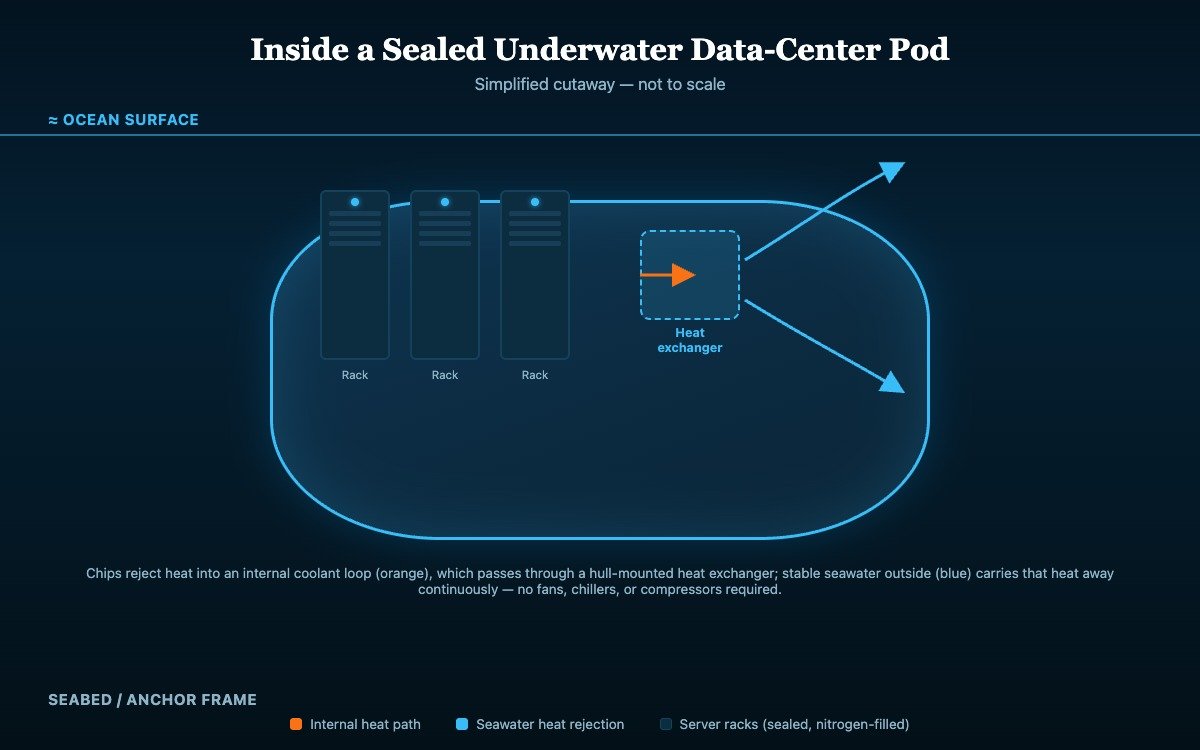
Simplified cutaway of a sealed underwater data-center pod: server racks, internal heat exchanger, and the seawater loop that replaces conventional air conditioning. Diagram: AiTimeline.
How Underwater Data Centers Actually Work
The engineering chain from a hot GPU to cold seawater, step by step
Strip away the novelty and an underwater data center is a fairly conventional cooling problem solved with an unconventional heat sink. Nothing about the servers themselves changes — the innovation is entirely in how heat gets from the chip to somewhere it can dissipate safely.
- Manufacture and load the pressure vessel: racks, servers, networking, and power gear are installed and tested inside a sealed steel cylinder at a factory, not on site — the same “build it complete, then ship it” logic as the modular data centers of the 2008-2010 period.
- Purge the atmosphere: the interior is filled with dry nitrogen instead of ordinary air, removing the oxygen and humidity that cause corrosion and static-related failures over years of unattended operation.
- Seal and pressure-test: the vessel is sealed to withstand external water pressure at its target depth (Natick’s Orkney pod: about 117 feet down; Highlander’s Hainan modules: about 35 meters; Subsea Cloud has pressure-tested pods rated to 3,000 meters) with margin for storms and current.
- Tow and lower to the seabed or a subsea frame: a barge or support vessel positions the pod, then lowers it onto a pre-installed base structure on or near the seafloor, typically within a few kilometers of shore.
- Connect subsea power and fiber: armored cables — the same class of infrastructure used for offshore wind farms and short-haul subsea telecom links — deliver electricity in and data out, landing at a coastal substation and network point of presence.
- Let seawater do the cooling: inside the pod, heat from the chips transfers to an internal coolant loop, which passes through a heat exchanger in contact with the outer hull; the surrounding seawater — stable and cold at depth — carries that heat away continuously, with no fans, chillers, or compressors required.
- Operate lights-out: once sealed, there is no human access without hauling the pod back to the surface. Monitoring, remote diagnostics, and workload management all happen over the network connection, exactly like managing a remote server rack, just with no possibility of a technician walking over to check a blinking light.
- Retrieve, refresh, and redeploy: when hardware needs replacing — typically pegged to a 5-10 year refresh cycle, similar to land facilities — the entire pod is raised, opened at a facility on land, refitted, and can be resealed and redeployed rather than demolished.
🛠 Technology Insight
Underwater data centers are designed as sealed modules that minimize maintenance requirements while using surrounding seawater for passive cooling. The entire engineering premise depends on getting steps 1-3 above right on the first try — there is no opening the pod to fix a mistake once it’s on the seabed.
Who Powers This Ecosystem
The research bodies, standards groups, and hardware makers behind the numbers in this article
International Energy Agency (IEA)
The intergovernmental body whose Electricity 2026 report is the primary independent source for global data-center power-demand figures cited throughout this article.
Uptime Institute
Runs the data-center industry’s most-cited annual survey; its 2025 finding of a stalled 1.54 average PUE is the benchmark every cooling alternative, underwater included, gets measured against.
NVIDIA
Its GB200 NVL72 AI rack, drawing roughly 120-132 kW and mandating direct liquid cooling, is the clearest illustration of why air cooling alone no longer suffices for frontier AI hardware.
AMD
Competes with NVIDIA in AI accelerators via its MI300-series chips, contributing to the same industry-wide rack-density trend driving demand for liquid and immersion cooling.
Intel
Supplies CPUs that still handle general-purpose orchestration work alongside GPU/accelerator racks in most AI data centers, and participates in OCP cooling-standards work as a hardware vendor.
Google Cloud
One of the three dominant hyperscale operators whose land-based facility footprint sets the efficiency and scale bar that any alternative deployment model, including underwater, is compared against.
Microsoft Azure
Azure’s parent company, Microsoft, is also the originator of Project Natick — giving it a uniquely direct research relationship to underwater deployment among the three major hyperscalers.
Amazon Web Services (AWS)
AWS’s 2006 launch is widely credited with starting the modern cloud-computing era that concentrated data-center investment into the hyperscale operators funding today’s cooling research.
None of these organizations operate in isolation. The IEA and Uptime Institute supply the independent measurement that keeps operator claims honest; the Open Compute Project turns individual vendors’ cooling engineering into shared, interoperable standards; NVIDIA, AMD, and Intel build the chips whose power density created the problem in the first place; and Google Cloud, Microsoft Azure, and AWS represent the land-based hyperscale default that underwater deployment is measured against, not competing with directly. Reading coverage of this topic with that structure in mind — who measures, who standardizes, who builds the heat source, who runs the baseline — makes it far easier to tell an independent finding from a vendor claim.
Cooling Technology, Compared
Where underwater deployment fits among air, liquid, and immersion cooling
Every cooling method in data-center engineering solves the same basic problem — get heat out of silicon faster than the silicon makes it — with a different trade-off between cost, density, and complexity. Air cooling, still the default for most of the world’s data centers, blows chilled air across server components; it’s cheap, simple, and well understood, but air is a poor heat conductor, so it runs out of headroom somewhere around 20-30 kW per rack. Liquid cooling routes a coolant — usually water or a water-glycol mix — directly to cold plates mounted on the hottest components (CPUs, GPUs), removing heat far more efficiently and supporting the 100+ kW racks that modern AI hardware requires. Immersion cooling goes a step further, submerging entire servers in a dielectric fluid that doesn’t conduct electricity, eliminating fans altogether and handling even higher densities. Underwater deployment is best understood as immersion cooling’s logical extreme: instead of a tank of fluid on a data-center floor, the entire pod sits inside the largest, most thermally stable fluid reservoir on the planet.
Air Cooling vs Liquid Cooling
Immersion Cooling vs Underwater Data Centers
Underwater Data Center vs Floating Data Center
Power Usage Effectiveness: The Number That Matters Most
If there is one metric that explains why any of this matters commercially, it’s PUE — total facility power divided by power actually reaching IT equipment. A PUE of 2.0 means a data center burns as much energy on cooling, lighting, and power conversion as it does on computing itself; a PUE of 1.1 means almost all of it goes to computing. The Uptime Institute’s 2025 global survey put the industry-wide weighted average at 1.54, essentially unchanged for six consecutive years despite heavy investment — a sign that air-cooling-era facilities are running into a hard efficiency ceiling. Underwater and immersion systems report substantially better figures in pilot conditions (commonly cited in the 1.1-1.2 range), because removing mechanical chillers removes their entire energy overhead, not just a fraction of it. Highlander’s own claim of roughly 90% lower cooling-specific energy use for its Hainan facility is consistent with that mechanism, though it’s a vendor figure, not yet an independently audited one.
| Cooling approach | Typical PUE | Practical rack density | Maturity (2026) |
|---|---|---|---|
| Air cooling (CRAC/CRAH) | 1.5–2.0 | Up to ~30 kW | Dominant, legacy standard |
| Direct-to-chip liquid cooling | 1.2–1.4 | Up to ~130 kW | Rapidly scaling, AI-driven |
| Immersion cooling (tank-based) | 1.03–1.2 | 150 kW+ | Commercial, growing |
| Underwater deployment | ~1.1–1.2 (pilot data) | Site-dependent | One commercial site, several pilots |
Marine Engineering and Subsea Networking
The parts of an underwater data center that have nothing to do with computing are, in many ways, the harder engineering problems. The pressure hull has to survive not just static water pressure at depth but decades of wave loading, storm surge, and potential seismic activity, using corrosion-resistant alloys and coatings borrowed directly from offshore oil-and-gas and naval engineering. Biofouling — the buildup of barnacles, algae, and marine organisms on any submerged surface — can reduce heat-transfer efficiency at the hull over time, requiring either resistant coatings or periodic cleaning, and researchers studying Natick’s retrieved pod found measurable biological growth despite protective coatings. Subsea power and fiber cables are the same class of infrastructure used for offshore wind farms and short-hop telecom links — armored, buried where possible near shore, and routed to avoid shipping lanes and anchor zones. None of this is exotic engineering in isolation; offshore wind, subsea telecom, and undersea oil infrastructure have used these techniques for decades. What’s new is combining them with data-center-grade uptime requirements, where an unplanned pod retrieval to fix a failed component is vastly more disruptive than a routine maintenance visit to a land facility.
Maintenance and Reliability: The Honest Trade-off
Sealing a data center away from humans cuts both ways. Project Natick’s finding — roughly one-eighth the failure rate of comparable land servers — is real and well-documented, and the mechanism is plausible: no dust, no accidental bumps, no humidity swings, no oxygen-driven corrosion. But that same sealing means a failed component cannot be swapped in place. If a power supply or network card fails inside a submerged pod, the entire unit typically has to be raised, which is expensive, weather-dependent, and can take a submerged facility offline for days rather than the minutes a land-based hot-swap would require. The practical answer engineers have converged on is redundancy over repairability: overprovision components, design for graceful degradation as individual servers fail, and plan retrieval around scheduled multi-year refresh cycles rather than reactive repairs — the same philosophy subsea telecom repeaters and offshore platforms have used for decades. This is a genuine design trade-off, not a free upgrade: a land data center can restore a failed node to full redundancy within minutes of a technician noticing an alert, while a submerged pod runs in a degraded state, on its remaining redundant capacity, until the next scheduled or emergency retrieval — which is why capacity planning for an underwater deployment has to assume a higher and longer-duration failure tolerance than a conventional facility would.
🌟 Did You Know?
Microsoft’s Project Natick demonstrated that a sealed underwater data center could operate reliably for years with a relatively low hardware failure rate compared with comparable land-based environments — roughly one failed server for every eight that failed on land over the same two-year window.
Manufacturing and Supply Chain
An underwater data-center pod draws on two supply chains that rarely overlap: conventional server manufacturing (the same racks, chips, and networking gear used in any land facility) and marine/offshore engineering (pressure hulls, corrosion-resistant coatings, subsea cable, and specialized deployment vessels). That second supply chain is why underwater projects can’t simply scale the way a land data center can by ordering more standard shipping-container modules. Pressure-hull fabrication requires shipyard-grade welding and testing capacity, which is a smaller and more specialized industry than general data-center construction; Highlander’s stated path to roughly 100 modules at Hainan depends as much on that manufacturing throughput as on demand. This is also where the modular, factory-built philosophy of the 2008-2010 containerized-data-center movement pays off directly: because the compute portion of a pod is built and tested exactly like a standard module, most of the schedule risk in a project like this sits in the marine-engineering half, not the IT half.
AI Infrastructure and the GPU Demand Curve
Why this cooling problem specifically traces back to artificial intelligence
A CPU is built for flexibility — a handful of powerful cores that can run almost any instruction in sequence, ideal for an operating system juggling many different tasks. A GPU inverts that trade-off: thousands of simpler cores doing the same type of math simultaneously, which happens to be exactly what training a neural network requires, since most of that work reduces to enormous matrix multiplications that parallelize cleanly. That architectural difference is why the AI boom shifted data-center hardware purchasing toward GPUs and dedicated AI accelerators so quickly, and why power density per rack roughly quadrupled in the space of a few hardware generations. NVIDIA’s GB200 NVL72 — a single liquid-cooled rack housing 72 GPUs — draws on the order of 120-132 kW, with NVIDIA’s own specifications mandating direct-to-chip liquid cooling with inlet temperatures held between 20-25°C and flow rates around 80 liters per minute. Air cooling is not a viable option at that density; it isn’t a matter of preference.
CPU vs GPU Infrastructure
Renewable Energy Integration
Why coastal and underwater facilities keep pairing with wind and marine power
Underwater and coastal data centers have a structural advantage most inland facilities lack: proximity to offshore wind, and in some designs, wave or tidal generation. Project Natick’s Orkney deployment deliberately drew on a local grid with a very high share of wind and tidal power, treating renewable integration as part of the experiment, not an afterthought. Reporting on China’s HiCloud facility near Shanghai describes a similar pairing with offshore wind. The engineering logic is straightforward: offshore wind farms already require subsea power cables and marine-grade infrastructure reaching the coast, so a nearby underwater data center can share that same cable corridor and substation connection rather than building redundant infrastructure. This doesn’t make underwater facilities inherently “green” — that depends entirely on the actual generation mix feeding the connection — but the physical adjacency is a genuine, engineering-level synergy that land-locked data centers can’t replicate as easily. Wave and tidal power integration, by contrast, remains mostly at the research and pilot stage industry-wide, and no major underwater data-center operator has published a production deployment drawing primary power from wave energy specifically as of 2026.
Environmental Considerations: What’s Established, What’s Still Being Studied
This is the section where hype most needs to be resisted in either direction. On one side, seawater cooling genuinely eliminates the chemical water consumption and evaporative losses that chiller-based land facilities incur — Highlander’s own figures claim roughly 105,000 tons of freshwater saved annually at full build-out, a real and meaningful category of impact. On the other side, peer-reviewed researchers have flagged open questions that remain open, not resolved. A study published in Scientific Reports (Nature) on heat-wave-resilient underwater computing architecture specifically models thermal stress scenarios for submerged systems, underscoring that ocean temperature isn’t perfectly stable everywhere or forever — marine heat waves are a documented, increasing phenomenon. Separately, marine biologists and environmental engineers have raised three specific concerns that deserve to be named precisely rather than waved away: localized thermal pollution from concentrated heat rejection in coastal waters, which could alter biodiversity for species that rely on stable temperatures for breeding and migration; underwater noise and vibration from mechanical components, which can affect marine animals sensitive to acoustic disturbance; and electromagnetic fields from subsea power cables, an effect already studied for offshore wind and telecom cables but not yet extensively for the specific configuration of a clustered data-center deployment.
🌿 Sustainability Insight
Researchers are evaluating whether underwater deployments can reduce cooling energy consumption, but environmental impacts and lifecycle economics require continued study. Neither the optimistic operator figures nor the worst-case environmental warnings currently making the rounds are backed by long-term, independent, multi-site data — because at commercial scale, this technology has existed for barely a year.
Regulatory and Permitting Landscape
There is no dedicated, underwater-data-center-specific regulatory regime anywhere in the world as of 2026. Instead, projects are permitted under whatever existing marine and offshore-infrastructure frameworks a given jurisdiction already applies to comparable seabed installations — the same categories of approval that cover subsea telecom cables and offshore wind foundations, typically involving environmental-impact assessment, maritime-safety sign-off, and coordination with fishing and shipping authorities over seabed rights and exclusion zones. China’s approval of Highlander’s Hainan site, and the earlier UK process that allowed Project Natick’s Orkney deployment, both moved through those general-purpose channels rather than a purpose-built underwater-data-center law. That absence of dedicated regulation cuts two ways: it has made early deployment faster, since operators aren’t waiting on new legislation, but it also means the environmental open questions in the section above are being resolved case by case, project by project, rather than against a settled, industry-wide standard. Environmental researchers studying this space have generally called for continued monitoring and study rather than either blanket approval or a moratorium — a position consistent with the broader evidence-still-developing theme running through this article.
Economics: Deployment Speed vs Lifecycle Cost
The economic pitch for underwater deployment rests on three claims, each with different strength of evidence. First, speed: Microsoft cited roughly 90 days from factory to operational seabed deployment for a Natick-style pod, versus one to two years to permit, build, and commission a land facility — a genuine, well-documented advantage for anyone needing capacity fast. Second, reduced cooling capex and opex: eliminating chillers and CRAC units removes both their purchase cost and their ongoing electricity draw, which Highlander estimates at roughly 90% of cooling-specific energy for its site — plausible given the underlying physics, though not yet independently audited across a full year of operation. Third, land and water savings, which matter disproportionately in dense coastal markets like Hainan, Singapore, or parts of Northern Europe where buildable land or fresh water for cooling is itself scarce and expensive. Working against these advantages: retrieval-based maintenance is expensive and weather-dependent when it’s needed, marine engineering and pressure-hull manufacturing add real upfront cost per unit of compute versus a simple warehouse building, and the entire commercial track record — one operational site with a multi-year history — is too short to model long-term total cost of ownership with confidence. Every serious economic case for this technology today should be read as directionally promising, not proven at scale.
Traditional vs Underwater Data Centers
Edge Computing vs Hyperscale Data Centers
Where a coastal underwater node actually fits in the broader cloud architecture
An underwater data center is far more likely to function as an edge computing node than as a hyperscale AI training campus, and the distinction matters for understanding where this technology realistically fits. A hyperscale facility centralizes enormous compute capacity in one location to maximize efficiency of scale; an edge node sacrifices some of that efficiency to sit physically closer to users, cutting the network latency for time-sensitive applications like gaming, video conferencing, or financial trading. A single Highlander-style pod, with capacity comparable to tens of thousands of PCs, is a rounding error next to a hyperscale AI campus that can span millions of square feet and consume hundreds of megawatts — but it doesn’t need to compete on that axis. Its value proposition is proximity to a coastal population center with sub-10-millisecond latency, not raw scale.
Edge Computing vs Hyperscale Data Centers
Data Tables: The Numbers in One Place
The figures scattered through this article — a depth here, a PUE range there, a company name attached to a claim two sections back — are consolidated below into three reference tables: the compressed version of this timeline, the companies and organizations actually involved, and the hardware components an AI data center’s cooling system has to serve. Each is meant to be skimmable on its own, without re-reading the surrounding prose.
| Year | Milestone | Why it matters |
|---|---|---|
| 2014 | Underwater data center first proposed internally at Microsoft | Conceptual origin of the entire field |
| 2018 | Project Natick Phase 2 deploys 855 servers off Orkney, Scotland | First full-scale, multi-year proof of concept |
| 2020 | Natick pod retrieved; ~1/8th land failure rate confirmed | The reliability data every later project cites |
| 2024 | Microsoft ends active Project Natick program | Research phase closes; findings remain valid |
| 2025 | Highlander launches commercial underwater DC, Hainan | First paid commercial deployment, not a pilot |
| 2026 | OCP consolidates liquid/immersion cooling standards | Shared technical foundation for future scaling |
| Provider | Category | Relevance to underwater/cooling |
|---|---|---|
| Microsoft Azure | Hyperscale cloud | Originated Project Natick; land-based Azure remains its primary infrastructure |
| Google Cloud | Hyperscale cloud | Publishes its own PUE/efficiency data; not publicly pursuing underwater deployment |
| Amazon Web Services | Hyperscale cloud | Largest cloud provider by revenue; sets the scale benchmark this niche is compared against |
| Highlander | Underwater DC operator | Operates the only commercial-scale underwater data center as of 2026 |
| Subsea Cloud | Underwater DC startup | Pursuing deep-water (up to 3,000m) pod deployment, pilot stage |
| Nautilus Data Technologies | Floating/water-cooled operator | Adjacent model: floating barge, not fully submerged |
| Component | Role in an AI data center | Typical cooling need |
|---|---|---|
| CPU | General orchestration, OS, I/O | Air or basic liquid cooling |
| GPU / AI accelerator | Model training and inference math | Direct liquid cooling (100+ kW racks) |
| Network switch/router | Inter-server and external connectivity | Air cooling, moderate load |
| Storage array | Model weights, training data, logs | Air cooling, low-moderate load |
| Power distribution unit | Converts and distributes facility power | Air cooling; heat output rises with rack density |
Facts Worth Knowing
- Project Natick’s Phase 1 test vessel was named “Leona Philpot,” after a character from Microsoft’s own Halo video game franchise.
- A single NVIDIA GB200 NVL72 rack draws roughly the same power as 100 typical American homes.
- Nearly half the world’s population lives within about 200 kilometers of a coastline — the original geographic logic behind underwater data-center placement.
- TeleGeography’s 2026 map counts roughly 694 submarine cable systems carrying the vast majority of intercontinental internet traffic — the same class of infrastructure that connects coastal underwater data centers to the internet.
- Highlander’s Hainan modules are designed to be retrieved, refitted, and redeployed rather than scrapped at end of life — closer to a ship’s maintenance cycle than a building’s.
- Data-center cooling can account for roughly 40% of total facility electricity use before removing chillers — the single biggest efficiency lever the industry has left to pull.
⚖️ Engineering Insight
Cooling often represents one of the largest operational challenges for modern AI data centers, making innovative thermal management strategies an active area of research — underwater deployment is one candidate among several, not a settled answer.
Who Actually Owns This Space
Strip the coverage down to ownership and the picture is narrower than the headlines suggest. Exactly one company, Highlander, operates a confirmed commercial-scale underwater data center today. Exactly one company, Microsoft, ran the research program that produced the field’s core reliability data, and it is no longer actively deploying pods. Everyone else covered in this article — Subsea Cloud, Nautilus Data Technologies, HiCloud — sits somewhere between an early pilot and a separate-but-adjacent floating-water-cooled model. That’s a small, concentrated field for a topic that generates outsized media attention, and it’s worth keeping in mind when a headline implies this is a broad, multi-vendor industry rather than a handful of specific, individually-traceable projects.
Geographically, the picture is similarly concentrated rather than global. China currently has the only confirmed commercial-scale deployment (Highlander) plus at least one additional reported project (HiCloud), giving it a clear lead on actual operational sites, generally attributed in coverage to strong state-industrial coordination on infrastructure projects and specific coastal siting incentives. The United Kingdom hosted the foundational research (Project Natick’s Orkney deployment) but that program has since ended. The United States has pilot and adjacent activity — Subsea Cloud’s trials and Nautilus’s floating Stockton facility — without a fully submerged commercial site of its own. Norway has hosted Subsea Cloud pilot deployments. No major, publicly confirmed underwater data-center project has been documented in India, continental Europe outside Norway and the UK, or Africa as of 2026; those regions’ data-center growth has focused on conventional and land-based liquid-cooled facilities instead.
Explore More Timelines
Future Watch: Where the Engineering Roadmap Actually Points
Based only on published research, official announcements, and industry roadmaps — not speculation
Three developments are grounded enough in current, published plans to discuss with confidence, without drifting into speculative timelines. First, Highlander’s own stated roadmap targets scaling the Hainan site toward roughly 100 modules; whether that timeline holds depends on manufacturing throughput and demonstrated multi-year reliability data the company has not yet published. Second, OCP’s cooling-standards work is on a public track toward broader interoperability across cold-plate, immersion, and heat-reuse specifications, which lowers the engineering barrier for new entrants regardless of whether they build on land or underwater. Third, renewable-paired coastal siting — locating data centers, underwater or not, alongside offshore wind infrastructure to share subsea cable corridors — is an active design pattern in current offshore-wind and data-center planning discussions, though production examples remain limited to the handful covered in this article.
What the roadmap does not currently support: claims that underwater deployment will become the default for AI training clusters, that it will replace land-based hyperscale campuses at scale, or that environmental questions are already settled favorably. Every credible primary source referenced in this article — Microsoft, the IEA, the Uptime Institute, OCP, and the peer-reviewed research on marine thermal effects — treats this as one promising tool among several, still accumulating evidence, not a foregone conclusion.
On the funding side, the honest picture is that this remains a small category relative to overall data-center capital spending, which continues to flow overwhelmingly toward conventional and liquid-cooled land facilities to meet AI demand. Highlander’s build-out is backed by Chinese state and industrial partners rather than the kind of venture-capital rounds typical of a Silicon Valley infrastructure startup; Subsea Cloud has disclosed customer and partner relationships (Chevron, Laborde Marine, Oracle, per company statements) more than specific funding figures. That funding pattern is itself informative: this looks less like a venture-backed technology bet racing to prove product-market fit, and more like targeted, patient infrastructure investment in a niche with a plausible but not yet fully validated payback case — a distinction worth keeping in mind before extrapolating rapid, VC-style scaling onto a field that has grown mostly through direct industrial and government backing so far.
What would actually change this outlook, in either direction? On the upside: a second and third independently-verified commercial deployment matching or beating Highlander’s efficiency claims would turn a single data point into a trend; published multi-year reliability data from Hainan, once the site has been running long enough to generate it, would do for the commercial era what Natick’s two-year study did for the research era. On the downside: a serious hardware failure requiring an expensive unplanned retrieval, or a peer-reviewed study documenting measurable ecological harm at an operating site, would meaningfully weaken the case for expansion. As of this writing, neither has happened — the evidence base is still thin enough that either outcome remains plausible, which is precisely why this article treats the technology as promising and unproven rather than settled in either direction.
🌐 Infrastructure Insight
Rather than replacing traditional facilities, underwater data centers may complement land-based cloud infrastructure for selected edge-computing and coastal applications — the same way floating data centers, modular pods, and immersion cooling each carved out a niche without displacing the conventional data center.
Executive Summary
Underwater data centers submerge sealed, pressure-rated server pods in the ocean to use stable seawater temperatures for passive cooling instead of mechanical air conditioning. Microsoft’s Project Natick (2014-2024) proved the engineering concept, running 855 servers off Scotland for over two years with roughly one-eighth the failure rate of comparable land servers, before the program was formally retired. In 2025, China’s Highlander company moved the concept from research to commerce, launching a 1,300-tonne commercial underwater data center off Hainan that claims roughly 90% lower cooling energy use, with plans to scale toward 100 modules at that site. The driving force behind renewed interest is AI: global data-center electricity demand grew 17% in 2025 alone, with AI-specific facilities surging roughly 50%, per the International Energy Agency, as GPU racks drawing 100-plus kilowatts outpace what air cooling can handle. Underwater deployment builds directly on immersion and liquid-cooling research standardized by the Open Compute Project. It is best understood as a promising complement for coastal, edge, and water-or-land-constrained deployments — not a replacement for conventional hyperscale data centers, and not yet proven at the scale or duration needed to settle its long-term economics or environmental impact.
Frequently Asked Questions
100 questions, grouped by topic — from basics to engineering detail
The questions below are grouped in the same order this article covers the topic: basics and terminology first, then Project Natick specifically, Highlander and China’s commercial deployments, the underlying cooling engineering, AI and hardware, environmental impact, economics, reliability and maintenance, adjacent technologies, and finally companies, geography, and sourcing. Each answer is written to stand alone — useful if you arrived here from a search result rather than reading top to bottom — and is hedged to match the actual evidence level behind it, whether that’s published research, an operator’s own claim, or an open question nobody has settled yet.
Why the Future of Data Centers May Extend Beneath the Surface
Go back to that hot, roaring data hall from the opening of this article. The engineer standing in it is not choosing between “normal data centers” and “underwater data centers” — that framing was never accurate. They’re choosing among a widening menu of cooling strategies, of which submerging the whole facility in the ocean is one of the more radical, and so far one of the most narrowly proven. Project Natick’s decade of research established, with real data, that the core physics works and that isolation from air and humans can meaningfully improve hardware reliability. Highlander’s Hainan facility established, in 2025, that the concept can run as an actual commercial service, not just a research platform. Neither of those facts means every future data center will be underwater, and no engineer, company, or credible research body covered in this article claims that.
What seems genuinely likely, based only on what’s published today: advances in pressure-hull manufacturing, subsea power and networking, and the same liquid- and immersion-cooling standards work happening industry-wide will keep making underwater deployment cheaper and more repeatable for the specific situations where it makes sense — dense coastal cities, water-stressed regions, edge-latency-sensitive applications, and sites where speed of deployment matters more than raw scale. Land-based facilities will keep handling the bulk of hyperscale AI training and general cloud computing, because that’s where the economics and the engineering track record are strongest today. The most honest conclusion the current evidence supports is also the least dramatic one: the ocean has become a legitimate, if still small, part of how the internet’s physical infrastructure is built — not because it’s the future replacing the past, but because it’s one more tool, validated by a decade of research and now a year of commercial operation, added to an industry that badly needed more ways to solve a heat problem AI made urgent.
Explore More on AiTimeline
Sources & further reading
Every dated entry above was checked against these references. Last reviewed 15 September 2026.
- Microsoft: Project Natick — Underwater Datacenter Findings
- IEA — Electricity 2026
- Uptime Institute — Global Data Center Survey Results 2025
- Open Compute Project — Immersion Cooling
- Heat Wave Resilient Systems Architecture for Underwater Data Centers, Scientific Reports
- TeleGeography — Submarine Cable Map
- South China Morning Post — China Launches World's First Commercial Underwater Data Centre in Hainan
- DataCenterDynamics — Subsea Cloud Proposes Data Centers in Deep Ocean Water