Harley-Davidson: The Full History of an American Motorcycle, 1903-2026
The full Harley-Davidson history: the 1903 Milwaukee shed, the V-twin, Knucklehead to Milwaukee-Eight, the AMF era, the 1981 buyback, LiveWire and India.
Latest Story
The garage door is still down when the engine turns over. It is early, the kind of early where the street outside is quiet enough that a single kick and a cough of exhaust sound like an event. The rider has done this hundreds of times — choke, ignition, a half-second of nothing, then the engine settles into a lopsided, uneven idle that no four-cylinder machine ever quite manages. That rhythm is not an accident. It is the sound of two pistons sharing one crankpin at a 45-degree angle, a mechanical decision made in Milwaukee, Wisconsin more than a century ago, and it has outlived the men who made it, the company that nearly lost the right to keep making it, and at least three separate eras in which industry analysts predicted the whole thing would not survive the decade. Harley-Davidson is 123 years old in 2026. The question worth asking is not whether the company is famous — it obviously is — but how a motorcycle maker that started in a converted shed the size of a suburban bedroom outlasted wars, a depression that killed most of its competitors, a corporate owner that nearly wrecked it, and two full generations of Japanese and European motorcycles built to be objectively better on paper. This is that story, told with the dates that are documented, the numbers that are verifiable, and the places where the company’s own version of events and the historical record don’t quite line up.
🧠 AI Overview Summary
Harley-Davidson is an American motorcycle manufacturer founded in 1903 in Milwaukee, Wisconsin, by William S. Harley and brothers Arthur, Walter and William A. Davidson. Built around air-cooled V-twin engines since 1909-1911, the company survived the Great Depression, supplied roughly 20,000 motorcycles for World War I and about 90,000 for World War II, endured a troubled 1969-1981 ownership by AMF, and was bought back by its own executives in 1981. It introduced the Evolution engine (1984), Softail (1984), Dyna (1991), the Porsche-developed V-Rod (2002) and the Milwaukee-Eight engine (2017), and entered electric motorcycles with LiveWire, spun off as an independent public company in 2022.
Harley-Davidson: Key Questions
Who, What, Why, When, Where and How
What to Know About Harley-Davidson’s History
- It started tiny: the first motorcycle was built in a 10-by-15-foot shed in the Davidson family’s Milwaukee backyard, with “Harley-Davidson Motor Co.” reportedly painted on the door.
- The V-twin was not an instant hit: the first factory V-twin, offered around 1909, had reliability problems severe enough that it was pulled from the lineup before a redesigned, dependable version returned around 1911.
- Wars built the brand as much as riders did: the US military bought over 20,000 Harley-Davidsons in World War I and roughly 90,000 in World War II, cementing a reputation for toughness that outlasted both conflicts.
- Harley-Davidson was one of very few American motorcycle makers to survive the Great Depression intact, as annual sales collapsed from 21,000 units in 1929 to 3,703 in 1933.
- The AMF years (1969-1981) are the most contested period in company history: production volume rose sharply, but declining build quality during this stretch is widely cited by historians, former dealers and riders alike.
- The 1981 management buyout, not any single motorcycle, is arguably the most consequential event in modern company history — it restored the quality focus that later let the Evolution engine and Softail platform rebuild the brand’s reputation.
- Harley-Davidson didn’t invent the V-twin engine configuration — other manufacturers, including some earlier American and European builders, used V-twin layouts before Harley’s version existed. What Harley-Davidson built was the cultural association, not the engineering first.
- The company tried to trademark its own exhaust sound in 1994 and formally withdrew the application in 2000 after competitors objected — a rare case of a manufacturer trying to own an acoustic signature.
- Electrification arrived carefully, not suddenly: a decade separates the 2014 LiveWire concept from LiveWire’s 2022 spin-off into its own publicly traded company, reflecting how much engineering and market-testing sat between the idea and the business.
- Harley-Davidson entered and then exited local manufacturing in India (2011-2020) before restructuring around a distribution and co-development partnership with Hero MotoCorp — a case study in how hard it is for a legacy brand to localize.
⚠️ How This Guide Separates Fact From Folklore
Harley-Davidson’s history comes to most readers pre-mixed with company marketing, biker-bar legend and genuine documented record, and the three don’t always agree. Where a claim in this guide rests on Harley-Davidson’s own historical materials, it’s labeled as company account. Where it rests on independent documentation — period newspapers, government contracts, corporate filings, court records — it’s presented as documented history. Where it’s a story that circulates widely among riders without solid documentation behind it, it’s labeled folklore, including in the dedicated myths section further down. This distinction matters more for Harley-Davidson than for most companies, because so much of its value as a brand rests on a mythology that grew up around the real events — and the real events are, on their own, interesting enough not to need the embellishment.
Six Motorcycles That Changed the Company
Ranked by lasting engineering and business impact, not nostalgia
Engineering leap
Business turnaround
Origin point
Longevity record
Technology outlier
Electrification pioneer
The Complete Timeline: Reverse Chronological
From the 2025 leadership change back to the 1903 Milwaukee shed — newest first
Arthur Starrs Becomes CEO, Closing the Zeitz Era
What changed: Jochen Zeitz, who had led Harley-Davidson since February 2020, announced his retirement in April 2025; it was confirmed for October 1, 2025, with Arthur Starrs — previously an executive at Topgolf — named as his successor.
Why it mattered: Zeitz’s five-year tenure had been defined by the pandemic-era “Rewire” cost restructuring, the multi-year “Hardwire” strategic plan, and the LiveWire spin-off. His departure marked the end of the specific turnaround era that followed 2020, handing a leaner but more narrowly focused company to an outsider CEO for the first time in years.
Long-term significance: Every ownership and leadership transition in Harley-Davidson’s history — AMF in 1969, the buyback in 1981, Zeitz in 2020, Starrs in 2025 — has been followed by a strategic reset. Whether the pattern holds again is, as of this writing, an open question rather than a documented outcome.
LiveWire Becomes an Independent Public Company
What changed: Harley-Davidson announced in December 2021 that its LiveWire electric-motorcycle division would merge with a special-purpose acquisition company (SPAC) at an implied valuation of roughly $1.77 billion; the transaction closed in 2022, and LiveWire began trading publicly under the ticker LVWR.
Motorcycle/technology: LiveWire retained the S2 Del Mar and other electric platforms developed inside Harley-Davidson, now built and sold as a separately capitalized company that could pursue its own investors and partnerships.
Why it mattered: It let Harley-Davidson pursue electrification without betting its core, cash-generating cruiser and touring business on EV adoption timelines it couldn’t control — a hedge, not an all-in wager.
Sportster S Arrives With the First New Sportster Engine Since 1986
What changed: The Sportster S introduced the liquid-cooled Revolution Max 1250T engine, 1,252 cc and rated at 121 horsepower — the first genuinely new engine under the Sportster nameplate since the air-cooled Evolution Sportster motor arrived in 1986.
Why it mattered: It signaled Harley-Davidson was willing to retire an air-cooled architecture that had defined an entry-level nameplate for six and a half decades, in favor of a modern, emissions-compliant, higher-output platform shared with the Pan America adventure bike.
Rider/market impact: It split opinion sharply — performance-focused reviewers praised the power and handling, while traditionalists mourned the end of the classic air-cooled Sportster line in its original form.
A New CEO Arrives as Harley-Davidson Exits India Manufacturing
What changed: Jochen Zeitz took over as CEO in February 2020 (permanently from May 2020), succeeding Matthew Levatich. Months later, on September 24, 2020, Harley-Davidson announced it would end local sales and manufacturing in India, closing its Bawal, Haryana assembly plant at a cost of roughly $75 million in restructuring and about 70 jobs.
Why it mattered: The India exit was one of the clearest public admissions that a decade-long localization strategy — building bikes domestically to dodge import duties — had not produced the volumes it needed to justify the plant. Zeitz’s arrival, alongside the “Rewire” restructuring announced in July 2020, set the stage for the narrower, more profitable product strategy that followed.
Long-term significance: India wasn’t abandoned — it was restructured, reopening months later as a distribution and later co-development partnership with Hero MotoCorp, covered in full in this guide’s India section.
The Production LiveWire Ships
Motorcycle/engine: The LiveWire, Harley-Davidson’s first production electric motorcycle, began customer deliveries in September 2019 (briefly paused for a charging-system issue, resuming in October). It used a 15.5 kWh battery, produced 105 hp and 86 lb-ft of torque, and offered a claimed 146-mile city range at a launch price above $29,000.
Why it mattered: Five years after the Project LiveWire concept toured the country gathering rider feedback, Harley-Davidson had a real, sellable electric motorcycle in dealerships — a genuinely long product-development runway by motorcycle-industry standards.
Market impact: Sales were modest at the premium price point, which contributed directly to the decision two years later to spin LiveWire out as its own brand and, eventually, its own company.
Milwaukee-Eight Replaces Twin Cam
Engine: The Milwaukee-Eight — named for its eight valves — replaced the Twin Cam in Touring models for 2017 (Softail models followed for 2018), with displacements including 107 and 114 cu in, later joined by a 117 cu in variant.
Why it mattered: It addressed persistent complaints about Twin Cam heat management and vibration at idle, using a new cooling fin design, a dual counter-balancer and reworked cylinder heads for better airflow, while staying air-cooled (with optional oil-cooled heads on some models) rather than switching to full liquid cooling.
Rider impact: Touring riders in particular reported noticeably reduced engine heat at the rider’s legs in traffic — a small-sounding fix that mattered enormously to owners who spent hours a day in the saddle.
Project LiveWire Debuts — and India Starts Building Street Models
What changed: In June 2014, Harley-Davidson showed the media Project LiveWire, an electric motorcycle concept, then toured it around the US and internationally to gather rider reactions before any commitment to production. In the same year, the Bawal, India plant began building the Street 500 and 750 models for both the domestic Indian market and export.
Why it mattered: 2014 captures two very different bets Harley-Davidson was making at once — a long-horizon wager on electric powertrains, and a shorter-horizon wager on smaller-displacement, lower-cost motorcycles built for price-sensitive markets like India and Southeast Asia.
The Bawal, Haryana Assembly Plant Opens
What changed: Two years after entering the Indian market, Harley-Davidson established local assembly at Bawal, Haryana, beginning with Sportster models, then adding Dyna (2012) and Softail (2013) lines as completely knocked-down (CKD) kit assembly.
Why it mattered: Local assembly reduced India’s steep import duties on completely built motorcycles, a strategy several premium global brands have used to compete in high-tariff markets — with mixed long-term success, as the 2020 closure would later show.
Harley-Davidson Enters India; Buell Is Discontinued
What changed: Harley-Davidson formally entered the Indian market in August 2009. In the same year, the company shut down its Buell sportbike subsidiary, ending production on October 30, 2009 after 136,923 units built since 1993’s initial investment.
Why it mattered: 2009 is a study in contrasts — expanding into a fast-growing, price-sensitive Asian market while simultaneously retreating from a performance-sportbike segment closer to home, during the depths of the global financial crisis. CEO Keith Wandell’s rationale for cutting Buell was that sportbikes offered high competition and thin margins compared with the core cruiser business.
V-Rod Launches With a Porsche-Developed Engine
Motorcycle/engine: The VRSC V-Rod introduced the Revolution engine, a liquid-cooled, 60-degree V-twin of 69 cu in (1,130 cc) developed jointly with Porsche Engineering, producing roughly 115 horsepower — a significant jump over any air-cooled Harley engine of the era.
Why it mattered: It was Harley-Davidson’s most direct answer yet to Japanese and European “power cruisers,” proving the company could build a genuinely high-performance, modern powertrain when it chose to — even though the V-Rod’s styling and mechanical layout departed sharply from traditional Harley design language.
Long-term significance: The V-Rod line was discontinued after the 2017 model year. Its Revolution engine family, however, became the technical and philosophical ancestor of the later Revolution Max engines used in the Pan America and Sportster S.
Twin Cam Engine Replaces Evolution
Engine: The Twin Cam 88 (88 cu in) replaced the Evolution engine in Harley’s Big Twin models for the 1999 model year, adding a second camshaft for improved breathing, before a counter-balanced Twin Cam 88B version reached Softail models in 2000 to preserve that platform’s rigid-mount feel without excess vibration.
Why it mattered: Twin Cam kept pace with rising displacement and emissions expectations through 2017, though it also became known among long-time mechanics for cam-chain-tensioner wear issues in early years — a real, documented reliability footnote rather than folklore.
Dyna Family Debuts
Motorcycle: The FXDB Sturgis introduced the Dyna platform for the 1991 model year, using a rubber-mounted Evolution engine in a more traditional visible-shock frame — positioned between the hardtail-look Softail and the full-dress Touring range.
Why it mattered: Dyna gave Harley-Davidson a genuine middle option: more performance-oriented handling and lighter weight than Softail, without sacrificing the rubber engine mounts that made rubber-isolated Big Twins comfortable at highway speed.
Fat Boy Introduced
Motorcycle: The FLSTF Fat Boy arrived for 1990 with solid disc-style wheels front and rear, a heavy, minimalist silhouette, and an Evolution engine in the Softail chassis. Designer Willie G. Davidson has been widely quoted attributing the name to a blend of two 1945 atomic-bomb nicknames, “Fat Man” and “Little Boy” — a company account repeated in most retrospectives, though not independently documented in period press.
Why it mattered: Its later screen appearance in Terminator 2: Judgment Day (1991) turned it into one of the most recognizable individual Harley-Davidson models among people who have never ridden a motorcycle.
Evolution Comes to the Sportster
Engine: The air-cooled Evolution engine reached the Sportster line in 883 cc and 1,100 cc forms in 1986 (a 1,200 cc version followed in 1988), replacing the long-serving Ironhead engine that had powered Sportsters since 1957.
Why it mattered: It modernized Harley’s entry-level and lightweight nameplate with the same aluminum-engine reliability gains the Big Twin line had received two years earlier, extending the Evolution engine’s reputation as the platform that rebuilt Harley-Davidson’s credibility.
Evolution Engine and Softail Launch Together
What changed: 1984 delivered two of the most consequential Harley-Davidson products of the modern era in the same year: the all-aluminum Evolution (“Evo”) V-twin engine, and the Softail chassis (FXST), which hid a working rear suspension under the transmission to preserve the visual look of a rigid-framed, hardtail motorcycle.
Why it mattered: Evolution addressed the oil-leak and reliability reputation that had dogged the outgoing Shovelhead engine, particularly during the AMF years. Softail let Harley-Davidson sell nostalgia and modern engineering at once — a look-backward, ride-forward combination competitors struggled to copy for years.
Long-term significance: Every Harley-Davidson engine and cruiser platform introduced since traces its engineering lineage, directly or indirectly, back to decisions made in this single year — three years after the company had bought itself back from AMF.
H.O.G. Founded; Import Tariff Granted
What changed: Harley-Davidson launched the Harley Owners Group (H.O.G.), a factory-sponsored riders’ club, in 1983 — the same year the Reagan administration, responding to a Harley-Davidson petition to the US International Trade Commission, imposed a five-year escalating tariff on imported heavyweight motorcycles (over 700 cc).
Why it mattered: The tariff gave the newly independent company breathing room against Japanese competitors just as it was retooling manufacturing quality; H.O.G. began building the brand-loyalty infrastructure that later became central to Harley-Davidson’s marketing identity. Notably, Harley-Davidson asked the government to end the tariff a year early, in 1987, stating it no longer needed the protection — a detail the company has repeatedly highlighted as evidence the strategy worked.
Thirteen Executives Buy the Company Back From AMF
What changed: A group of thirteen Harley-Davidson executives, led by Vaughn Beals and including styling chief Willie G. Davidson, arranged a highly leveraged buyout of the company from AMF for approximately $80 million, at roughly 25 cents per pre-split share, taking Harley-Davidson private and independent again.
Why it mattered: The buyout group’s stated priority was rebuilding manufacturing quality and rider trust that many felt had eroded under AMF ownership. Beals, who had joined Harley-Davidson under AMF in 1975 to run engineering, later studied Honda’s Marysville, Ohio plant and introduced just-in-time manufacturing and statistical process control to Harley’s own factories.
Long-term significance: Nearly every product milestone that followed — Evolution, Softail, the 1983 tariff, H.O.G., the eventual 1986 public stock offering — flows from this one transaction. It is difficult to identify a more consequential single event in the company’s second century.
FX Super Glide Creates the “Factory Custom”
Motorcycle: Styling director Willie G. Davidson combined the frame and rear suspension of the big FLH Electra Glide with the lighter front forks of the XLH Sportster to create the FX Super Glide — a factory-built motorcycle designed to look like a rider’s own custom project.
Why it mattered: Before the Super Glide, custom styling was something individual owners did to their bikes; Davidson made it something the factory could sell directly. The original “boattail” rear fairing was not well received by buyers, and more conventional styling options soon followed — but the concept of the factory custom stuck permanently.
AMF Acquires Harley-Davidson
What changed: American Machine and Foundry (AMF), a diversified leisure-products conglomerate best known for bowling equipment, acquired Harley-Davidson in 1969, beginning a twelve-year ownership period that ended with the 1981 buyback.
Why it mattered: AMF invested capital and pushed production volume up substantially at a moment when Harley-Davidson faced serious competitive pressure from Honda, Kawasaki, Suzuki and Yamaha. That production push is widely, and separately, cited by riders, dealers and later company leadership as coinciding with a decline in build quality — a period covered in full in this guide’s dedicated AMF section.
Shovelhead Replaces Panhead
Engine: The Shovelhead V-twin, named for rocker covers resembling an inverted shovel blade, replaced the Panhead for 1966 and remained in production through 1984, spanning the entire AMF ownership period.
Why it mattered: Because Shovelhead’s production years overlap almost exactly with AMF’s ownership, the engine became historically (and somewhat unfairly) associated with the quality complaints of that era, even though many Shovelhead-generation issues traced to manufacturing and quality-control decisions rather than the underlying engine design itself.
Electra Glide Introduces the Electric Starter
Motorcycle: The Electra Glide added an electric starter to the Duo-Glide-based touring platform, ending the era in which every Harley-Davidson rider had to kick-start a big twin.
Why it mattered: It made long-distance touring dramatically more approachable — no more kick-starting a heavy motorcycle at every fuel stop — and established the Electra Glide nameplate that, in updated form, remains part of the Touring lineup today.
The Sportster Debuts
Motorcycle/engine: The XL Sportster introduced the “Ironhead” overhead-valve V-twin, evolved from the earlier K-model, positioned as a lighter, sportier alternative to Harley’s big touring twins and aimed partly at buyers drawn to smaller British motorcycles.
Why it mattered: The Sportster became Harley-Davidson’s longest continuously evolving nameplate, running through Ironhead, Evolution and eventually Revolution Max engines across nearly seven decades — an unusually long run for any single motorcycle name in the industry.
Panhead Replaces Knucklehead
Engine: The Panhead, named for rocker covers shaped like inverted cooking pans, introduced aluminum cylinder heads and hydraulic valve lifters, running in production from 1948 to 1965.
Why it mattered: Hydraulic lifters reduced the frequent valve-adjustment maintenance the Knucklehead had required, making the engine notably more livable for ordinary riders rather than dedicated home mechanics.
The 74-Cubic-Inch Knucklehead Arrives
Engine: Harley-Davidson added a 74 cu in FL Knucklehead alongside the existing 61 cu in EL, giving riders a larger-displacement option just as the United States moved toward entering World War II.
Why it mattered: The larger engine’s added torque and durability made it a natural basis for the military-adapted machines that followed within months of America’s entry into the war.
The Knucklehead Introduces Overhead Valves
Engine: The EL, universally nicknamed “Knucklehead” for rocker-box covers that resembled a clenched fist, was Harley-Davidson’s first production overhead-valve V-twin, at 61 cu in (1,000 cc), and introduced a recirculating lubrication system that replaced the total-loss oiling of earlier designs.
Why it mattered: Overhead valves allowed better airflow and higher performance than the side-valve Flathead design it complemented in the lineup, while the recirculating oil system was a genuine reliability advance riders could feel immediately.
Long-term significance: The Knucklehead remains one of the most sought-after collector engines in the brand’s history, both for its engineering-first status and for the visual signature of those rocker covers, which set the “-head” naming convention (Panhead, Shovelhead) that followed for the next five decades.
The Flathead Arrives as the Great Depression Begins
What changed: Harley-Davidson introduced the 45 cu in (750 cc) side-valve “Flathead” V-twin in the same year the US stock market crashed and the Great Depression began. Annual sales, which had reached about 21,000 motorcycles in 1929, would fall to roughly 3,703 by 1933.
Why it mattered: The Flathead’s simplicity — fewer moving parts than an overhead-valve design, easier and cheaper to manufacture and repair — made it a practical, durable workhorse precisely when riders and the military (in the WLA that followed a decade later) needed low-cost reliability more than outright performance.
Harley-Davidson Becomes the World’s Largest Motorcycle Manufacturer
What changed: Harley-Davidson produced 28,189 motorcycles in 1920 and had built a dealer network reaching 67 countries, making it, by most industry accounts, the largest motorcycle manufacturer in the world at that time.
Why it mattered: This peak came less than two decades after the company’s founding in a backyard shed — and just nine years before the Depression would cut annual sales by more than 80%, a reminder of how quickly early-20th-century industrial fortunes could turn.
World War I: Over 20,000 Motorcycles Go to the US Military
What changed: With US entry into World War I, Harley-Davidson supplied more than 20,000 motorcycles to the military, primarily for dispatch, reconnaissance and courier duty, alongside rival Indian Motocycle, which also supplied heavily during the war.
Why it mattered: Wartime contracts gave Harley-Davidson large-scale production experience and stress-tested its motorcycles under conditions no civilian market could replicate, feeding directly into the durability reputation the brand carried into the 1920s.
A Reliable V-Twin Finally Returns
What changed: After the troubled 1909 V-twin was withdrawn, Harley-Davidson returned in 1911 with a redesigned V-twin using mechanically operated intake valves in place of the earlier atmospheric (suction-operated) valves, dramatically improving reliability.
Why it mattered: This is, functionally, the real birth of the Harley-Davidson V-twin as riders know it today — a design robust enough to remain in continuous, if constantly evolving, production for well over a century afterward.
The First V-Twin Is Offered — and Struggles
What changed: Building on a February 1907 prototype, Harley-Davidson offered its first production 45-degree V-twin around 1909, roughly 1,000 cc and about 7 horsepower. Its atmospheric intake valves, which relied on engine suction rather than mechanical actuation to open, proved unreliable, and the engine was withdrawn from the catalog.
Why it mattered: It’s a useful corrective to the popular image of Harley-Davidson’s V-twin arriving fully formed — the design that became iconic took a public failure and a two-year redesign to get right.
Harley-Davidson Motor Company Is Incorporated
What changed: The company was formally incorporated on September 17, 1907, with the four founders taking defined roles: Walter Davidson as president and general manager, William S. Harley as chief engineer, William A. Davidson as works manager, and Arthur Davidson as secretary and sales manager. The company also built a new factory that year on what became Juneau Avenue, still the site of Harley-Davidson’s Milwaukee headquarters today.
Why it mattered: Incorporation turned a four-man workshop partnership into a structured company capable of raising capital, signing contracts and scaling production — the organizational foundation everything since has been built on.
The First Motorcycle Is Completed in a Milwaukee Backyard
What changed: William S. Harley, then in his early twenties and working as an apprentice draftsman, had begun sketching engine designs around 1901, intending to motorize a bicycle. Working with his childhood friend Arthur Davidson, the pair completed a working motorcycle in 1903, built in a small wooden shed — company materials describe it as roughly 10 by 15 feet — in the Davidson family’s backyard.
Why it mattered: Everything documented in this guide, every engine generation, every ownership change, every rider culture built up around the brand, traces back to this one small, hand-built machine and the four young men who built and sold it.
Rider/market impact: Company accounts describe only a handful of machines completed in the first year or two of operation — this was still a hobbyist-scale operation, years away from the incorporated company it would become in 1907.
The Milwaukee Shed: The Founding Story in Full
What’s documented, what’s company account, and what’s simply missing from the record
William S. Harley’s Early Engine Work
William S. Harley was born in Milwaukee in 1880 and, by his early twenties, was working as an apprentice draftsman at a metalworking company while pursuing an interest in small engines on the side. Company accounts date his first sketches of an engine meant to motorize a standard bicycle to around 1901. That detail matters because it places the real starting point of Harley-Davidson two years before the date the company itself celebrates as its founding — the idea preceded the finished product by a meaningful stretch.
Harley’s early ambition wasn’t a motorcycle in the modern sense. It was closer to what period sources called a “motor bicycle” — a standard pedal-bicycle frame with a small helper engine attached, a category several inventors on both sides of the Atlantic were experimenting with at the same time. The distinction matters because the first Harley-Davidson attempt, by the company’s own later account, wasn’t powerful enough to climb an ordinary hill without pedaling assistance — an underwhelming result that pushed the design toward something closer to a purpose-built motorcycle rather than a motorized bicycle.
The Davidson Brothers Join
Arthur Davidson, a childhood friend of Harley’s, worked with him on the earliest engine experiments. Arthur’s older brother Walter Davidson, then working as a machinist for a railroad in Kansas, returned to Milwaukee to help the project and is generally credited by company historians as the one who pushed the design toward a genuine motorcycle rather than a motor-assisted bicycle. A third brother, William A. Davidson, the eldest of the Davidsons and a skilled tool-and-die maker, joined the operation as it grew — by most accounts formally by 1907, when the company incorporated and he took on the role of works manager.
This four-person structure — one engineer (Harley) and three brothers with complementary skills (Walter in sales and management, William A. in manufacturing, Arthur in sales and correspondence) — is unusual among early 20th-century industrial startups for how cleanly the roles divided, and it’s a structure company historians often point to as an early explanation for why Harley-Davidson survived where many contemporaries, built around a single founder, did not.
The First Motorcycle and Its First Customers
The finished 1903 motorcycle used a small single-cylinder engine — company materials cite a displacement in the range of roughly 7 cubic inches (about 116 cc) — installed in a purpose-built loop frame rather than a repurposed bicycle frame, addressing the power and durability problems of the earlier motor-bicycle attempts. It was built, per company history, in a wooden shed in the Davidson family’s backyard, commonly described as about 10 by 15 feet, with “Harley-Davidson Motor Co.” reportedly written on the door — a detail so frequently repeated it has become one of the company’s defining images, even though independent period documentation of the sign itself is not something this guide can verify beyond the company’s own account.
What is well documented is that Harley-Davidson production in these earliest years was tiny by any later standard — a handful of machines built essentially by hand, sold locally in Milwaukee, years before anything resembling a factory or a national dealer network existed. This is worth stating plainly because it’s easy, looking back from a company that would become the world’s largest motorcycle manufacturer within two decades, to underestimate how genuinely small and uncertain this beginning was.
1906-1907: The First Real Factory, and Incorporation
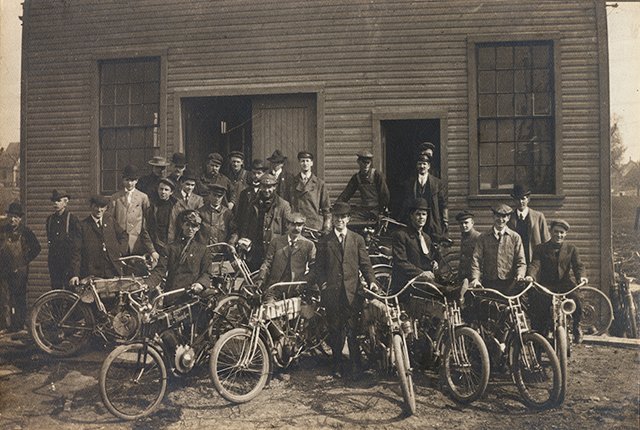
Harley-Davidson employees outside the Chestnut Street (later Juneau Avenue) factory, 1906. Public domain (published before 1931), source: Harley-Davidson Museum Archives, via Wikimedia Commons.
By 1906, the growing operation had outgrown the backyard shed and moved into a small plant on Chestnut Street in Milwaukee (the street was later renamed Juneau Avenue), the same general site that remains Harley-Davidson’s corporate headquarters today. The following year, on September 17, 1907, the founders formally incorporated the Harley-Davidson Motor Company, converting an informal partnership into a structured corporation with defined executive roles, as detailed in this guide’s main timeline.
Incorporation is a less romantic milestone than “the first motorcycle,” but it is arguably the more important one for the company’s long-term survival: it created a legal and financial structure capable of raising outside capital, signing supply and dealer contracts, and — critically, decades later — being sold to AMF and bought back again. A backyard partnership can’t do any of those things.
Early Dealers and Early Expansion
Harley-Davidson’s dealer network began expanding almost immediately after those first machines proved sellable, with the company signing on independent dealers in Milwaukee and then further afield within the first several years of operation. This early emphasis on building an independent dealer network, rather than selling only direct or through department-store-style retailers as some competitors did, is frequently cited by business historians as a structural advantage that compounded over decades — by 1920, as covered in the main timeline, that network had grown to dealers in 67 countries.
How the Early Motorcycle Engine Actually Worked
Plain-language mechanical concepts, explained for readers who aren’t engineers
Understanding why later Harley-Davidson engineering choices mattered requires a basic grasp of what an early-1900s motorcycle actually had to solve, mechanically. None of it was obvious at the time — every component below was a genuine engineering problem that took years of iteration to get right.
Single-Cylinder Engine
Harley-Davidson’s earliest motorcycles used one cylinder, the simplest possible engine layout. It’s mechanically straightforward but limited in power and prone to vibration, since a single piston firing creates an uneven pulse of force rather than a smooth, overlapping one.
V-Twin Layout
Two cylinders arranged in a V-shape sharing a single crankpin. It roughly doubles power over a single, and the 45-degree angle Harley-Davidson settled on became both a packaging decision (it fit a motorcycle frame well) and, eventually, a sound signature, since the two pistons don’t fire at perfectly even intervals.
Atmospheric (Suction) Valves
An early, simpler way to let air/fuel into a cylinder: the piston’s own downward motion sucks a spring-loaded valve open. Cheap to build, but unreliable at higher engine speeds — the exact flaw that doomed Harley-Davidson’s original 1909 V-twin.
Mechanically Operated (F-Head) Valves
A camshaft physically pushes the intake valve open at the correct moment, rather than relying on suction. Far more reliable at speed — this is the fix that made the 1911 V-twin work where the 1909 version hadn’t.
Belt Drive
Early Harley-Davidsons used a leather (later rubber/fabric) belt to carry power from the engine to the rear wheel, similar in principle to a bicycle chain but simpler and quieter. Belts could slip in wet weather and stretch over time, limiting how much power they could reliably transmit.
Chain Drive
A metal roller chain, borrowed from bicycle engineering, offered a more positive, slip-resistant connection than a belt and became standard as engines grew more powerful. Modern Harley-Davidsons mostly use toothed rubber belts again for final drive — a case of the original problem (slip) being solved by better materials rather than abandoning the concept.
Magneto Ignition
A magneto is a small generator that produces its own spark-igniting electricity as the engine turns, without needing a battery — essential on early motorcycles that had no reliable onboard electrical charging system.
Carburetion
A carburetor mixes air and fuel in the correct ratio before it enters the cylinder. Early carburetors were crude, hand-adjusted devices; company lore holds that some of the earliest experimental engines used improvised parts, including household tin, before purpose-built carburetors became available — a detail this guide treats as folklore rather than confirmed fact.
Loop Frame
A frame design where the main tube loops down and around the engine, rather than using a bicycle-style diamond frame. It gave the engine a stronger mounting point and became standard on Harley-Davidson’s first true motorcycle in 1903, replacing the earlier motor-bicycle approach.
Rigid Frame / Leaf-Spring Fork
Early Harley-Davidsons had no rear suspension at all (a “rigid” or “hardtail” frame) and used a simple leaf-spring front fork. Real rear suspension didn’t arrive until the 1950s Duo-Glide; before that, seat springs and tire flex did most of the work of absorbing bumps.
Early Brakes
The earliest machines relied on a rear coaster-style or belt-based brake, similar in principle to a bicycle’s, with front brakes and more effective mechanical drum brakes arriving as speeds and weights increased through the 1910s and 1920s.
Why “Reliability” Was the Whole Sales Pitch
Roads in the 1900s-1910s were mostly unpaved and poorly maintained even in cities. A motorcycle that could be trusted not to break down on a rutted road, far from a repair shop, had genuine, non-negotiable value — which is exactly the reputation early endurance racing (covered next) was designed to prove.
How Racing Built Harley-Davidson
The difference between what wins on a track and what sells in a showroom
Long before advertising budgets, motorcycle manufacturers proved their products by racing them, publicly, against each other. For a company selling “reliability” as its core promise, competitive results weren’t just marketing — they were closer to product testing conducted in front of an audience.
Early Endurance Competitions
The earliest competitive proving grounds for American motorcycles weren’t speed races at all — they were endurance runs, sometimes spanning hundreds of miles over genuinely bad roads, scored on reliability and consistency rather than outright pace. Company and period accounts describe Walter Davidson himself competing in, and performing strongly in, endurance competitions in the years just after incorporation, results the young company used directly in its sales materials. These early contests, organized under bodies like the Federation of American Motorcyclists, were as much about proving a machine wouldn’t strand its rider as about winning outright.
Board-Track Racing
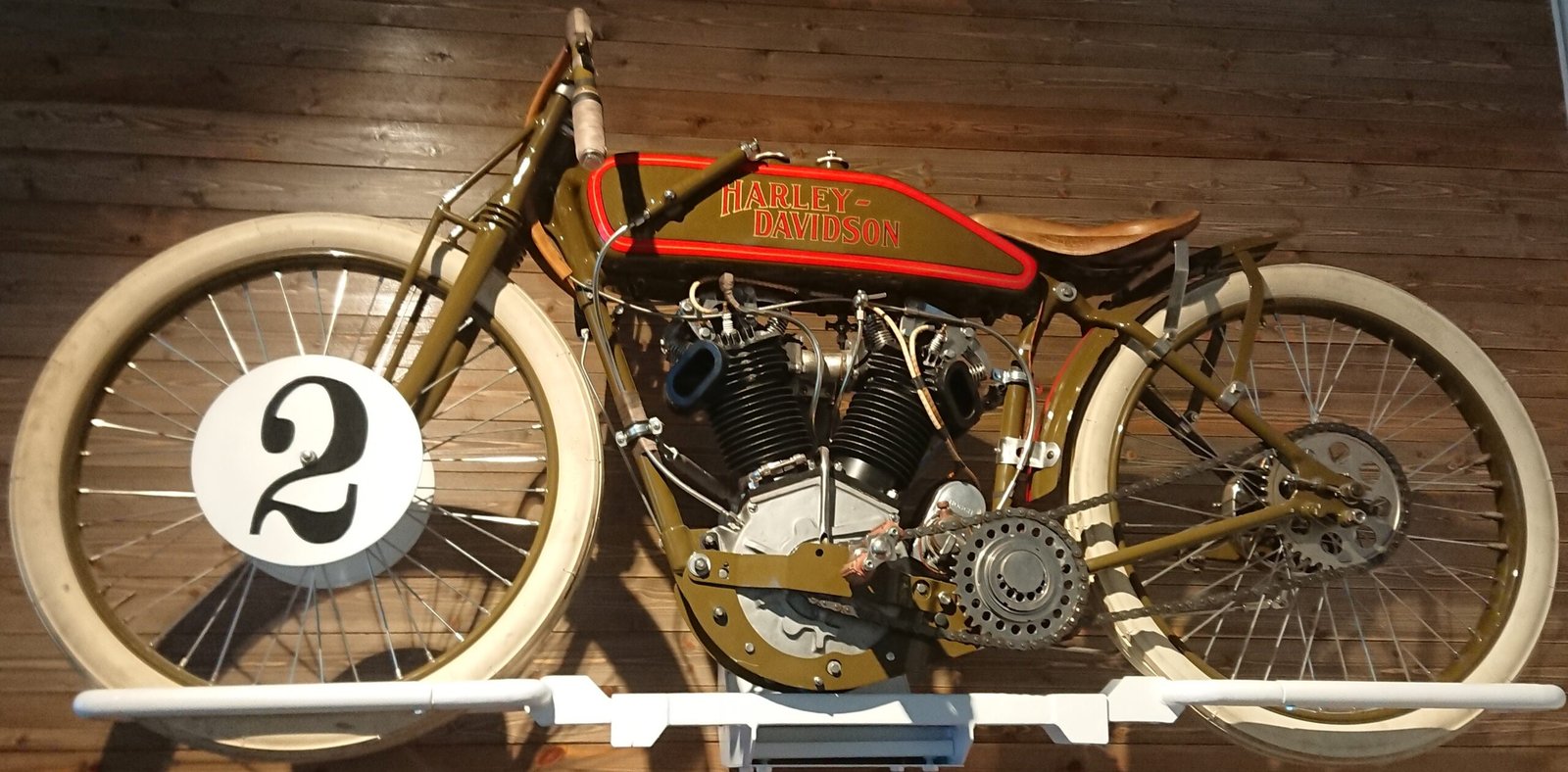
A 1924 Harley-Davidson FHA 8-Valve board-track racer, the type of factory machine the “Wrecking Crew” rode. Photo: Stanislav Kozlovskiy, CC BY-SA 4.0, via Wikimedia Commons.
Through the 1910s and into the 1920s, motorcycle racing’s most spectacular — and most dangerous — venue was the board track: steeply banked ovals built entirely from wooden planks, sometimes tilted so severely that riders could hold speeds approaching or exceeding a mile a minute in the corners. Harley-Davidson fielded a factory racing team, informally and later formally nicknamed the “Wrecking Crew,” which dominated board-track and dirt-track competition through the late 1910s and early 1920s. Racer Otto Walker is widely credited as the first motorcycle racer to complete a 100-mile-per-hour lap, at Fresno, California in 1921, riding a factory Harley-Davidson.
Board-track racing declined sharply by the late 1920s, driven by a combination of high fatality rates among both riders and spectators, the enormous cost of maintaining wooden tracks, and the economic pressures of the approaching Depression. Very few board tracks survived past the early 1930s.
Hill Climbs and Dirt-Track Racing
As board tracks faded, hill climbing — a discipline where riders attempt to power specially prepared motorcycles up steep, often loose-surfaced grades — and dirt-track oval racing became the dominant American motorcycle sports through the 1920s and 1930s. Both formats demanded different engineering priorities than board-track speed: traction, low-end torque and rider control mattered more than outright top speed, and Harley-Davidson’s factory and dealer-supported racing programs adapted accordingly.
Land Speed Racing and Joe Petrali
Harley-Davidson’s most famous individual speed record from this era belongs to Joe Petrali, a veteran factory racer, who set an American motorcycle land-speed record of 136.183 mph at Daytona Beach, Florida on September 13, 1937, riding a specially streamlined, Knucklehead-derived racing machine. The record stood for years and remains one of the most frequently cited individual achievements in the company’s early racing history.
Racing Technology vs. Production Technology
It’s worth being precise about a distinction that gets blurred in a lot of motorcycle-history writing: a factory racing machine and a showroom motorcycle are not the same product wearing different paint. Racing bikes in this era typically ran higher compression, stripped-down frames, no lighting or road equipment, and hand-fitted engine components no production line could replicate at scale or price. What racing actually transferred to production motorcycles wasn’t usually the exact hardware — it was proven principles: which valve arrangements held up under sustained stress, which frame geometries handled predictably, which failure points needed reinforcing before a design reached ordinary customers. Racing was Harley-Davidson’s real-world engineering laboratory, even when the racing engine itself never went on sale.
The 1910s and 1920s: Becoming a Major Manufacturer
Expansion, exports and the first real competitive threats
The two decades between incorporation and the Depression transformed Harley-Davidson from a promising local manufacturer into, by 1920, the largest motorcycle company in the world. That growth wasn’t accidental — it rode on three overlapping trends: a genuinely expanding US market for personal motorized transport, a rapidly built-out international dealer network, and the production discipline the company had learned from wartime contracts.
Factory capacity on Juneau Avenue expanded repeatedly through the 1910s to keep pace with demand, and the dealer network that had started with a handful of Milwaukee-area outlets grew into an international operation, with Harley-Davidson motorcycles sold across Europe, Asia, Africa, Australia and Latin America by the early 1920s. The Model J and JD, F-head V-twins produced through most of the 1910s and 1920s, became the backbone of that expansion — dependable, well-supported by a growing dealer parts and service network, and available in configurations for solo riding, sidecar use and light commercial delivery work.
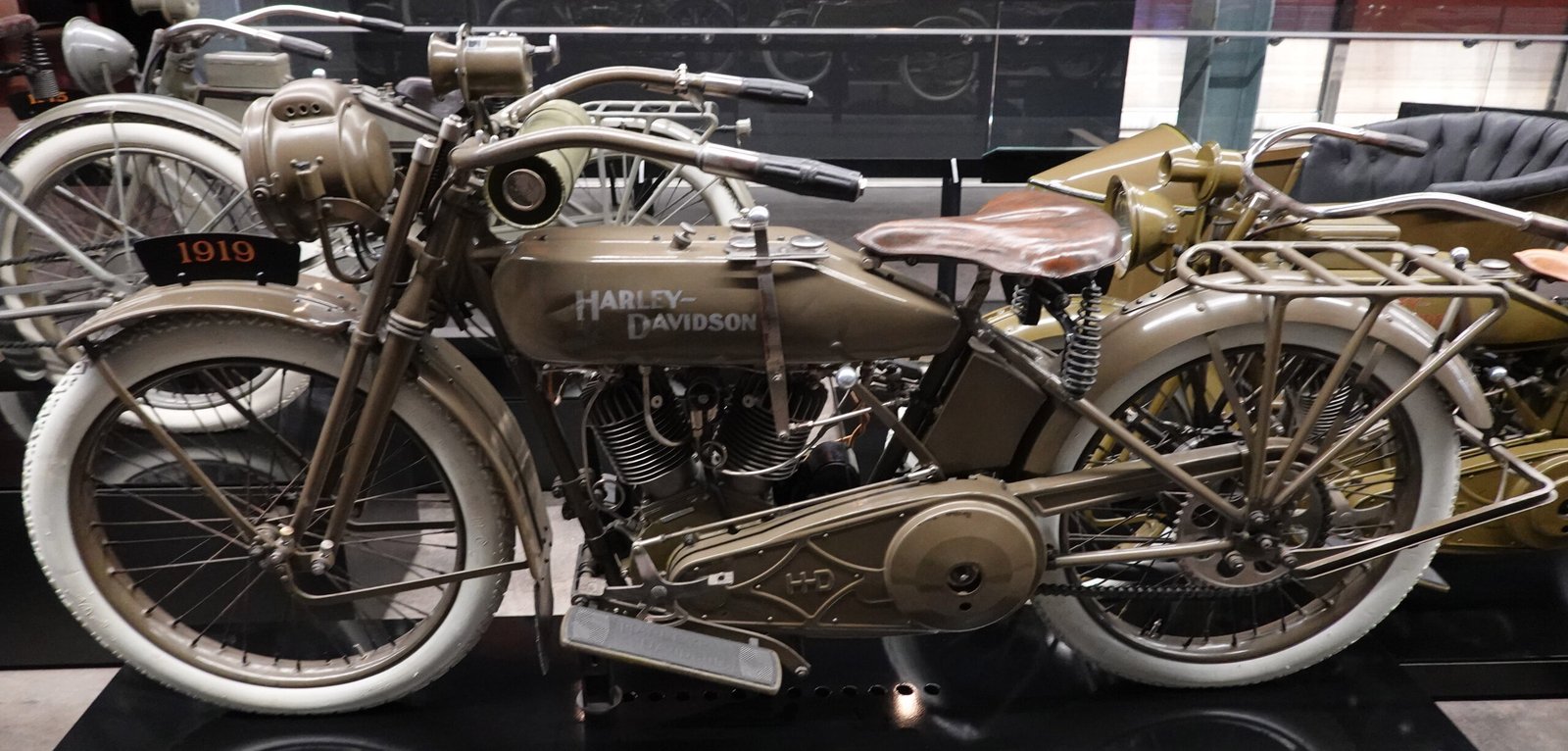
A preserved 1919 Harley-Davidson built to US Army specification, from the WWI era covered in this guide’s timeline. Photo: DrReload, CC BY 4.0, via Wikimedia Commons.
Competition intensified through the period as well. Indian Motocycle Manufacturing Company remained Harley-Davidson’s most direct domestic rival throughout the 1910s and 1920s, while dozens of smaller American manufacturers — Excelsior, Henderson, Cleveland, Ace and others — competed for the same buyers. Most of these smaller manufacturers would not survive the decade that followed. The automobile also emerged as a slower-burning but ultimately more significant threat during this period: as Ford’s Model T and its competitors pushed car prices down through the 1910s and 1920s, motorcycles increasingly repositioned from general-purpose transportation toward sport, recreation and specialized commercial use — a shift in the American transportation market that motorcycle manufacturers, Harley-Davidson included, had to adapt their marketing around rather than reverse.
The Great Depression: Survival, Not Romance
How Harley-Davidson endured while most American motorcycle manufacturers did not
It would be easy, and inaccurate, to tell the Depression-era chapter of Harley-Davidson’s history as a triumphant survival story. It wasn’t triumphant. It was closer to a company barely holding on while a great many of its competitors did not survive at all.
The numbers alone make the scale of the collapse clear: annual sales fell from roughly 21,000 motorcycles in 1929 to about 3,703 by 1933, an 82% drop in four years. Dealers closed. Production lines that had run at near-capacity through the 1920s idled for extended stretches. Harley-Davidson, like every other manufacturer of discretionary consumer goods in this period, had no meaningful tool for reversing collapsing demand — disposable income for a motorcycle simply vanished for most American households.
What kept the company alive through this stretch was a combination of unglamorous, practical decisions rather than any single dramatic strategy. The 1929 Flathead engine, described in the main timeline, proved well-suited to the moment: cheaper to manufacture, simpler to maintain, and durable enough to keep existing motorcycles running longer, reducing the pressure on new-motorcycle sales that the company couldn’t generate anyway. Harley-Davidson also leaned on international sales, where dollar-denominated exports to less-affected markets offered some revenue cushion domestic sales couldn’t provide, and on servicing the substantial installed base of motorcycles already sold in the 1920s boom — parts and service revenue from existing owners mattered enormously when new-unit sales had collapsed.
By most historical accounts, Harley-Davidson and Indian were the only two American motorcycle manufacturers of any real scale to survive the Depression intact. Excelsior-Henderson ended production in 1931. Cleveland Motorcycle Manufacturing Company closed in 1929. Ace had already been absorbed into Indian in 1927. The Depression didn’t just hurt Harley-Davidson — it functionally ended the era of the multi-manufacturer American motorcycle industry, leaving what became, for the next several decades, essentially a two-company domestic market.
The 1930s: From Flathead to Knucklehead
How a depression-scarred company still found room to innovate
That Harley-Davidson launched its most celebrated pre-war engine, the Knucklehead, in 1936 — squarely in the middle of a decade defined by economic hardship — says something about how the company balanced survival spending with strategic investment. The Knucklehead wasn’t a reckless bet made without regard for the economic climate; it was a calculated move to differentiate the brand from Indian and from the smaller performance-oriented rivals still active in the racing scene, at a moment when the worst of the Depression’s demand collapse had begun to ease.
The Flathead engine, introduced in 1929 and detailed in the main timeline, continued in parallel production through the 1930s and beyond — its low cost and mechanical simplicity kept it relevant for price-sensitive buyers and, later, for military applications, even after the more powerful Knucklehead arrived for riders who could afford and wanted the performance step up. Having two active engine architectures serving different price points simultaneously — rather than one engine trying to serve every buyer — is a pattern Harley-Davidson would return to repeatedly in later decades, echoed in the modern split between Sportster/Street-oriented smaller engines and Big Twin Touring/Softail platforms.
Styling also matured meaningfully during the 1930s: streamlined tank designs, art-deco-influenced paint schemes and chrome trim became more prominent as the decade wore on, reflecting broader industrial-design trends of the era and giving Harley-Davidson motorcycles a visual identity that started to diverge clearly from the more utilitarian look of the 1910s and 1920s.
World War II: Motorcycles as Military Equipment
Production numbers, the WLA, and what the war meant industrially — not a celebration of combat
This section covers Harley-Davidson’s role as a wartime industrial supplier. It is not an account of combat, and it doesn’t romanticize war — the significance here is manufacturing scale, engineering adaptation and the durability reputation that outlasted the conflict, not battlefield heroics.
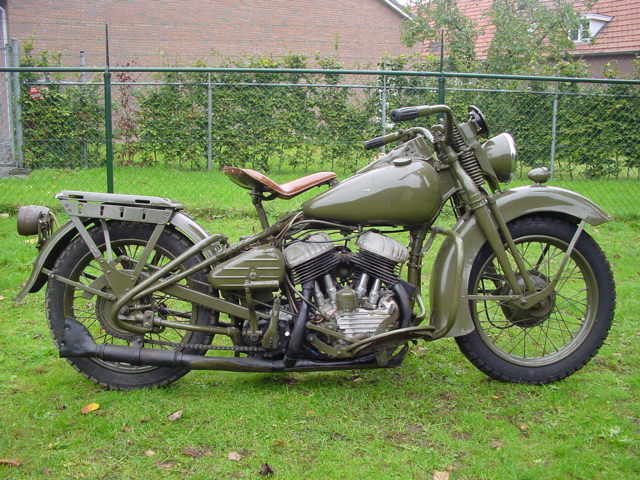
A 1940 Harley-Davidson WLA, the militarized 45-cubic-inch Flathead built for WWII service. Photo: Yesterdays Antique Motorcycles / Classic Motorcycle Archive, CC BY-SA, via Wikimedia Commons.
When the United States entered World War II, Harley-Davidson converted a large share of its manufacturing capacity to military production, most prominently the WLA — a militarized version of the 45 cu in Flathead-powered WL model, adapted with blackout lighting, ammunition-box mounts, a heavy-duty luggage rack and other field modifications specified by the Army. Documented figures put total wartime military motorcycle production at roughly 90,000 units, the large majority WLA and the closely related WLC variant built for Canadian forces. A substantial additional share — at least 30,000 units by some documented accounts — went to the Soviet Union under the Lend-Lease program, a detail that rarely makes it into popular retellings of the company’s wartime history but is well documented in period government records.
The WLA’s core engineering brief was straightforward: reliability under harsh field conditions, ease of field repair by non-specialist mechanics, and tolerance for poor fuel and rough terrain, rather than outright performance. Those priorities, tested at genuinely enormous scale across multiple theaters of war, reinforced a reputation for toughness that Harley-Davidson’s marketing leaned on heavily for decades afterward — arguably one of the most consequential pieces of unpaid brand-building in the company’s history, even though it came at the cost of the war itself.
The postwar transition brought a wave of veterans home already familiar with motorcycles from military service, alongside a large volume of ex-military WLA units sold as war-surplus at low prices — both factors that historians generally credit with helping seed the postwar American motorcycle culture and customization scene covered in the next section, including the eventual “chopper” aesthetic, which grew partly out of riders modifying cheap, plentiful surplus military machines.
Postwar America: 1940s Through 1960s
Highways, Hollywood, customization and the first real foreign competition
The Late 1940s: Coming Home to a Changed Market
Postwar America brought rising incomes, the beginnings of the interstate highway system (formally launched in 1956 under the Federal-Aid Highway Act), and a large population of veterans who had learned to ride, and often to repair, motorcycles during their service. Harley-Davidson’s Panhead engine, introduced in 1948, arrived directly into this environment, and the company’s touring-oriented Hydra-Glide (1949), which added a telescopic front fork in place of the older leaf-spring design, positioned the brand for the longer-distance highway riding that better roads were starting to make practical.
Hollister, “The Wild One,” and the Outlaw Image
In July 1947, a large gathering of motorcyclists in Hollister, California, coinciding with an American Motorcyclist Association-sanctioned race event, drew national press attention after reports of rowdy behavior and minor property damage, amplified by a widely circulated (and, by many later accounts, partly staged) Life magazine photograph. The incident is frequently linked to a claim that the AMA responded by stating that 99% of motorcyclists were law-abiding, implying the remaining “one percent” were troublemakers — the supposed origin of the “one-percenter” label some motorcycle clubs later adopted for themselves. This guide treats that specific AMA quote as disputed folklore rather than a confirmed documented statement, a distinction covered further in the myths section below.
Hollister’s cultural echo grew substantially with the 1953 film The Wild One, starring Marlon Brando as the leader of a fictional motorcycle gang loosely inspired by the incident. In a detail that surprises many readers, Brando’s character rode a Triumph Thunderbird 6T in the film — a British motorcycle, not a Harley-Davidson — even though the film is widely and inaccurately remembered as cementing Harley-Davidson’s “outlaw” image specifically. The association between Harley-Davidson and rebellious motorcycle culture in the American imagination grew more from later decades of marketing, customization culture and motorcycle-club history than from this particular film.
Touring, Police Work and Sport Riding Diverge
Through the 1950s and 1960s, Harley-Davidson’s product line increasingly split along the lines that still define the brand today. The Duo-Glide (1958) added rear suspension to the touring platform for the first time, and the Electra Glide (1965) added electric starting, both aimed squarely at comfortable long-distance and highway riding. Police departments across the US and internationally adopted Harley-Davidsons in large numbers for traffic and highway patrol duty, a relationship that continues into the present and that the company has long used as a durability and reliability credential in its marketing. At the other end of the range, the Sportster (1957, detailed in its own section below) targeted lighter, sportier riding, positioned partly as a response to smaller, quicker British motorcycles gaining popularity with younger American riders.
Customization Culture and Motorcycle Clubs
The postwar decades also saw the rise of home-garage customization — stripping fenders and excess equipment, altering frame geometry, swapping components between models — that eventually became known as the “chopper” style, built substantially around cheap, plentiful surplus military and early postwar Harley-Davidsons. Motorcycle clubs, ranging from mainstream AMA-chartered touring and social clubs to a small number of clubs that developed reputations for criminal activity and were designated “outlaw” by the AMA’s own chartering system, both grew during this period — two very different threads of the same broader postwar motorcycling boom that are frequently, and unhelpfully, collapsed into a single stereotype in popular culture.
The First Real Foreign Competition
British manufacturers — Triumph, BSA, Norton — built meaningful US market share through the 1950s and into the 1960s with lighter, faster, more overtly sporting motorcycles that appealed particularly to younger riders and to the emerging café-racer and flat-track scenes. That competitive pressure was real but manageable for Harley-Davidson through most of the 1950s and 60s. The more consequential threat arrived from Japan: Honda’s “You meet the nicest people on a Honda” advertising campaign, launched in the US in 1963, helped expand the entire American motorcycle market by bringing in huge numbers of new, often younger and first-time riders through small, inexpensive, reliable machines — and by the late 1960s and early 1970s, Honda, Kawasaki, Suzuki and Yamaha were moving decisively upmarket into larger-displacement motorcycles that competed directly with Harley-Davidson’s core business, just as the company entered its most turbulent ownership period.
The Sportster: Harley-Davidson’s Longest-Running Nameplate
Not a product advertisement — a look at why one name outlasted three engine generations
No Harley-Davidson nameplate has run longer, or changed more while running, than the Sportster. It launched in 1957 as a lighter, sportier alternative to the company’s big touring twins, aimed partly at buyers considering smaller British motorcycles, and it has been in continuous production in some form for nearly seven decades since — an unusual run in an industry where model names typically get retired or fundamentally reinvented every decade or so.
Ironhead: 1957-1985
The original XL Sportster used the “Ironhead” overhead-valve V-twin, evolved from the earlier K-model, and ran with periodic updates for nearly three decades. It built the Sportster’s reputation as a rider’s motorcycle — lighter and more responsive than the big touring twins, if also, by most contemporary and later accounts, rougher-edged and less refined in outright reliability than the larger models.
Evolution Sportster: 1986-2021
The air-cooled Evolution engine reached the Sportster in 883 cc and 1,100 cc forms in 1986, with a 1,200 cc version following in 1988, bringing the same aluminum-construction reliability gains the Big Twin line had received two years earlier. The Evolution Sportster became the entry point into the Harley-Davidson brand for an enormous number of riders over its 35-year run, prized for accessible pricing, light weight relative to the Touring and Softail ranges, and a genuinely broad range of factory and aftermarket customization options.
Sportster S and Revolution Max: 2021-Present
The 2021 Sportster S marked the biggest change in the nameplate’s history: a liquid-cooled Revolution Max 1250T engine, 1,252 cc and 121 horsepower, replacing the air-cooled architecture that had defined every Sportster before it. A smaller-displacement Nightster, using a related 975 cc Revolution Max variant rated around 90 horsepower, later joined the lineup, alongside continuing air-cooled models like the Iron 883 for buyers who wanted the traditional formula. The original Sportster line had already been discontinued in Europe in 2020 over emissions compliance, a preview of the broader shift the Revolution Max models represented.
The Sportster’s relationship to the rest of the Harley-Davidson range has always been positional as much as mechanical: it exists to be the accessible, lower-displacement entry point beneath the Softail, Dyna (while it existed) and Touring families, and its engine choices have tracked the company’s broader strategic priorities in each era — simplicity and cost in the Ironhead years, reliability and refinement in the Evolution years, and performance-and-emissions modernization with Revolution Max.
Electra Glide and the Rise of Touring
How a motorcycle became a highway home away from home
The Touring family exists to answer a specific question: how far, and how comfortably, can a motorcycle carry a rider and a passenger with luggage? Harley-Davidson’s answer developed in stages, each addressing a specific limitation of the version before it.
The Hydra-Glide (1949) added a telescopic front fork, replacing the older leaf-spring design and meaningfully smoothing the ride at speed. The Duo-Glide (1958) added genuine rear suspension for the first time, ending the rigid-frame era for touring models. The Electra Glide (1965) added an electric starter, removing the physical demand of kick-starting a heavy touring motorcycle at every stop — a change that, as covered in the main timeline, mattered enormously to everyday usability even though it wasn’t the kind of change that made for dramatic marketing copy.
Fairings — the wind-deflecting bodywork mounted around the front of the motorcycle — became standard equipment on touring models through the 1960s and 1970s, addressing the wind fatigue that made genuine long-distance highway riding punishing without them. Hard luggage cases, larger fuel tanks and increasingly integrated audio and, eventually, navigation electronics followed over subsequent decades, turning the Touring range into what many owners describe, without much exaggeration, as a highway-going second living room. Touring’s strategic importance to Harley-Davidson is straightforward: these are typically the highest-margin models in the range, favored by older, more established riders with the disposable income to spend on premium features, and the segment where the company has faced the least direct pricing pressure from Japanese and European competitors over the decades.
Harley-Davidson Under AMF: An Objective Account
Separating what’s documented from what’s become dealer-room legend
No period in Harley-Davidson’s history generates more passionate disagreement than 1969 to 1981, when the company was owned by American Machine and Foundry, a diversified conglomerate whose other businesses included bowling equipment, tennis rackets and other leisure products.
What AMF Did
AMF acquired Harley-Davidson in 1969 and invested significant capital in expanding manufacturing capacity, aiming to push annual production up sharply to meet what looked, at the time, like growing demand for large motorcycles. That expansion is documented and undisputed. What’s more contested is how well the company executed that growth: numerous riders, dealers and, later, Harley-Davidson’s own post-buyback leadership described a marked decline in build quality during this period, citing inconsistent assembly, parts fitment issues and quality-control lapses that became a persistent theme in owner complaints and dealer feedback through the 1970s.
What’s Documented vs. What’s Folklore
It’s important to be precise here: the broad claim that quality declined under AMF is widely corroborated across independent sources — riders, dealers, journalists and the buyout group itself all pointed to it — which places it closer to documented history than folklore. Specific anecdotes that circulate about this era, however — particular horror stories about individual factory conditions, exact defect rates, or claims about labor relations at specific plants — often can’t be traced to a solid primary source and should be treated with more caution than the broad, well-corroborated pattern they’re usually offered to illustrate.
The Competitive Backdrop
AMF’s ownership period coincided almost exactly with Honda, Kawasaki, Suzuki and Yamaha’s push into larger-displacement motorcycles, described in the postwar section above. A company already fighting quality perceptions was simultaneously losing ground to competitors offering, in many contemporary reviews, more advanced engineering — electric starting, smoother multi-cylinder engines, disc brakes — at competitive prices. The combination of internal quality problems and external competitive pressure is what made the AMF era existentially dangerous for the company, not either factor alone.
What AMF Got Right
A fully objective account has to include this: AMF’s capital investment did keep Harley-Davidson operating and expand its manufacturing footprint at a moment when the company might otherwise have lacked the resources to compete at all. Several members of the 1981 buyout group, including Vaughn Beals, joined the company during the AMF years and used that period to learn the operational and manufacturing lessons — including, for Beals, a close study of Honda’s own Marysville, Ohio plant — that they later applied after regaining independence. The AMF era is best understood not as a simple villain in the story, but as a genuinely mixed period whose failures created the conditions, and whose survivors provided the leadership, for the recovery that followed.
The 1981 Management Buyback: The Turning Point
Why this transaction matters more than any single motorcycle
By the late 1970s, AMF’s board was reportedly losing patience with a motorcycle division that required continued capital investment without matching returns, against a backdrop of intensifying Japanese competition. Inside Harley-Davidson, a group of thirteen executives concluded that the company’s survival depended on regaining control of decisions AMF’s corporate structure made slowly or, in their view, poorly.
Led by Vaughn Beals — who had joined the company under AMF in 1975 to oversee engineering — and including styling director Willie G. Davidson, the group arranged a highly leveraged buyout, purchasing the company from AMF in 1981 for approximately $80 million, at roughly 25 cents per pre-split share. The transaction was financed with substantial debt, a genuinely risky structure for a company already facing declining sales and reputational damage — this was not a comfortable, well-capitalized rescue, but a high-stakes bet by insiders who believed they understood how to fix problems AMF’s corporate ownership structure hadn’t solved.
What the new ownership group did differently is documented and specific, not just a change in ownership on paper. Beals studied Japanese manufacturing methods directly, adapting just-in-time inventory management and statistical process control — quality-monitoring techniques that catch defects during production rather than after — to Harley-Davidson’s own factories. The company also successfully petitioned for the 1983 import tariff on heavyweight motorcycles described in the main timeline, buying time for those manufacturing reforms to take hold before facing unrestricted competition again. Notably, and tellingly, Harley-Davidson asked to have that tariff protection lifted a year early, in 1987 — a company confident enough in its own turnaround to give back a competitive advantage most companies would have kept as long as possible.
The results showed up gradually rather than overnight: the Evolution engine and Softail platform, both launched in 1984, were the first major products developed fully under the new ownership’s quality priorities, and their reception — covered in the next section — is generally treated by historians as the moment the turnaround became visible to ordinary buyers rather than just to insiders. Harley-Davidson returned to the public stock markets in 1986, five years after the buyout, a milestone widely read as the market’s own vote of confidence in the recovery.
The Evolution Engine: Why It Mattered So Much
The engineering side of the 1980s turnaround
It’s tempting to credit the 1981 buyout alone for saving Harley-Davidson, but a leveraged buyout changes who owns a company, not whether its products work. The Evolution engine, launched in 1984, is the piece that had to prove the new ownership’s management changes actually translated into a better motorcycle.
Evolution replaced the Shovelhead with an engine built around aluminum cylinder heads and cylinders in place of the older iron construction, reducing weight and improving heat dissipation — a direct response to the oil-tightness and reliability complaints that had dogged the Shovelhead, fairly or not, throughout the AMF years. Improved gasket designs and machining tolerances, enabled by the statistical process control Vaughn Beals had introduced from his study of Japanese manufacturing methods, addressed the oil-leak reputation head-on.
The manufacturing significance ran deeper than the engine itself. Evolution was the first major Harley-Davidson product built under a genuinely reformed production process — tighter tolerances, better quality checks at each stage, and manufacturing discipline the AMF-era plants had, by most accounts, not consistently maintained. Riders who bought Evolution-powered motorcycles through the mid-to-late 1980s and 1990s frequently cite the engine’s reliability, relative to its Shovelhead predecessor, as the moment their trust in the brand was restored — a claim this guide treats as a widely repeated rider sentiment rather than an independently measured statistic, since no rigorous public failure-rate comparison between the two engines is available. What is documented is that Evolution remained in Big Twin production for fifteen years (1984-1999) and in Sportster models even longer, an unusually long run that speaks to how well the underlying design held up.
Softail: Old Look, New Engineering
How Harley-Davidson learned to sell nostalgia without sacrificing ride quality
The Softail, introduced alongside the Evolution engine in 1984, solved a specific design tension: riders who loved the clean, minimal look of a rigid-frame (“hardtail”) motorcycle from the 1940s and 50s didn’t actually want to give up modern rear suspension and its comfort benefits. The Softail’s answer was to hide the rear shock absorbers underneath the transmission, horizontally mounted and largely out of sight, so the motorcycle could carry the visual silhouette of a hardtail while still absorbing bumps like a modern suspended motorcycle.
That combination — heritage styling with contemporary engineering underneath, rather than a straightforward retro reissue or a straightforwardly modern design — became one of Harley-Davidson’s most commercially important product strategies, and the Softail platform expanded over the following decades into some of the brand’s best-known individual models, including the Fat Boy (1990) and later Heritage Softail and Softail Slim variants. In 2018, Harley-Davidson consolidated the Dyna platform into an updated Softail chassis running the Milwaukee-Eight engine, ending Dyna as a separate model family and leaving Softail as the sole heir to that “classic look, modern ride” positioning within the cruiser range.
Dyna: The Middle Option
1991-2017 — filling the gap between Softail and Touring
Dyna launched in 1991 with the FXDB Sturgis, using a rubber-mounted Evolution engine in a frame that, unlike Softail, didn’t disguise its rear shocks — a more conventional, visible-suspension cruiser layout that traded some of Softail’s retro styling for a lighter, more performance-oriented riding feel. Dyna occupied real estate between Softail’s heritage-focused cruisers and the larger, heavier Touring range: less weight and more agile handling than a full dresser, without the fully exposed rigid-look styling constraints of Softail.
The Dyna name was retired in 2017, with its models folded into the redesigned 2018 Softail platform once the Milwaukee-Eight engine and a new frame made it possible to deliver Dyna’s handling characteristics within a single, simplified chassis strategy — a consolidation that reduced platform complexity for Harley-Davidson’s manufacturing and engineering teams, even as it meant the end of a nameplate with a loyal following of its own.
The Touring Family: Electra Glide to Road Glide
Road King, Street Glide, Road Glide and the modern long-distance Harley-Davidson
Beyond the Electra Glide covered earlier, three additional nameplates rounded out the modern Touring family, each distinguished primarily by fairing design and equipment level rather than a fundamentally different chassis.
The Road King (FLHR), introduced in 1994, offered a lighter, more classically styled alternative to the fully enclosed Electra Glide — a removable windshield in place of a fixed fairing, aimed at riders who wanted touring capability without the Electra Glide’s more enclosed, bodywork-heavy look. It has remained in continuous production for over three decades, an unusually long run even by Harley-Davidson’s patient product-lifecycle standards.
The Road Glide traces its lineage to the earlier Tour Glide, introduced around 1980, and was substantially reworked and relaunched under the Road Glide name by the late 1990s. Its defining feature is a frame-mounted fairing — sometimes nicknamed the “shark nose” for its shape — which steers with the front wheel independently of the handlebars, a distinctly different feel from the handlebar-mounted “batwing” fairing used on Electra Glide and Street Glide models.
The Street Glide arrived for the 2006 model year as a lower, more streamlined take on the batwing-fairing formula, trimming the fairing profile and adding blacked-out trim for a leaner, more aggressive “bagger” look that proved enormously popular with custom and aftermarket-parts culture. Street Glide’s success helped popularize the broader “bagger” aesthetic — a touring motorcycle styled to look sleeker and less bulky than a traditional full-dress tourer — across the wider cruiser and touring motorcycle market, well beyond Harley-Davidson’s own lineup.
Modern Touring models have progressively added rider-assistance and connectivity technology — Bluetooth-linked infotainment systems, GPS navigation, cornering-adaptive electronics and, on recent Milwaukee-Eight-powered models, ride modes and traction-control systems — features that would have been unimaginable on the analog-gauge Electra Glides of the 1960s and 70s.
VRSC / V-Rod: The Porsche-Engineered Outlier
Why Harley-Davidson’s most technologically radical motorcycle looked nothing like its others
By the late 1990s, Harley-Davidson faced a specific competitive gap: Japanese and European “power cruisers” offered far higher horsepower than anything in the traditional air-cooled Harley-Davidson lineup could match, appealing to a performance-oriented buyer the brand’s traditional models weren’t reaching. The V-Rod, launched in 2002 under the VRSC model designation, was the company’s answer.
Its Revolution engine — a liquid-cooled, 60-degree V-twin of 69 cubic inches (1,130 cc) producing roughly 115 horsepower — was co-developed with Porsche Engineering, a striking departure for a company whose entire brand identity rested on air-cooled, 45-degree V-twins. Liquid cooling, a higher-revving performance character and Porsche’s involvement in the design process all represented a genuinely different engineering philosophy from anything else Harley-Davidson built at the time.
The V-Rod’s styling matched its mechanical departure: a long, low, drag-bike-inspired silhouette with a radiator visible up front — something no traditional Harley-Davidson had ever needed — made it instantly recognizable as different, for better or worse, depending on which segment of the company’s customer base was asked. It never approached the sales volume of the traditional cruiser and touring lines and was discontinued after the 2017 model year, but its Revolution engine family proved directly influential on the later Revolution Max engines that power the Pan America adventure-touring motorcycle and the Sportster S — evidence that even a commercially modest product line can leave a lasting engineering legacy.
Buell: Harley-Davidson’s Sportbike Experiment
A 26-year relationship, and why it ended
Erik Buell, a former Harley-Davidson engineer and roadracer, founded the Buell Motorcycle Company as an independent manufacturer in 1983, building sportbikes around Harley-Davidson-sourced engines. Harley-Davidson took a 49% minority stake in 1993 for roughly $500,000, expanded to majority ownership in 1998, and Buell operated as a Harley-Davidson subsidiary through the 2000s, producing sport and sport-touring motorcycles positioned to compete with Japanese and European performance brands — a market segment Harley-Davidson’s own traditional lineup didn’t address.
Harley-Davidson discontinued the Buell brand in October 2009, ending production after 136,923 units built since the initial 1993 investment. Then-CEO Keith Wandell’s stated reasoning, per company and press accounts, centered on strategic focus: sportbikes faced intense competition and thin margins compared with Harley-Davidson’s core cruiser business, and because Harley-Davidson dealers typically didn’t carry other manufacturers’ brands, spinning Buell off as an independent line for sale through non-Harley dealers wasn’t considered commercially viable either. Buell’s closure, alongside the same-year discontinuation of the MV Agusta ownership stake Harley-Davidson had also held briefly, marked a clear strategic narrowing back toward the core business during the depths of the 2008-2009 global financial crisis.
The 2000s: Globalization, Diversification and a Financial Crisis
Growth, overreach and correction in a single decade
The 2000s opened with Harley-Davidson near the peak of its post-buyback recovery — the Twin Cam engine had modernized the Big Twin range, the V-Rod had shown the company could build genuinely modern performance engineering, and demand, particularly for Touring models, remained strong through most of the decade. Harley-Davidson Financial Services, the company’s captive lending arm, grew substantially during this period, financing a large share of retail motorcycle purchases and, for a time, contributing meaningfully to overall company profitability.
That growth also created exposure the company hadn’t fully priced in. The 2008-2009 global financial crisis hit motorcycle sales hard, as big-ticket discretionary purchases like a new Harley-Davidson were exactly the kind of spending American consumers cut first, and it simultaneously exposed credit risk in Harley-Davidson Financial Services’ loan portfolio as more borrowers struggled to keep up with payments. The company responded with cost reductions, production cuts and a renewed focus on core products — the same period, notably, in which Buell and the MV Agusta stake were both discontinued, described above, as Harley-Davidson pulled back toward its traditional cruiser and touring strength rather than continuing to diversify outward.
Internationally, the 2000s and early 2010s saw Harley-Davidson push harder into markets outside North America and Western Europe than in any prior decade, entering India in 2009 and expanding assembly and distribution efforts across Asia and Latin America — a response to a maturing, aging core US customer base and a recognition that long-term volume growth would have to come from markets where Harley-Davidson had historically had little presence.
LiveWire and Electrification: Harley-Davidson Enters the Electric Era
A decade-long, deliberately cautious transition — not a sudden pivot
Harley-Davidson’s move into electric motorcycles unfolded slowly and publicly, in a way few other major product transitions in the company’s history have. That pace was arguably deliberate: an electric powertrain challenges almost every element of the brand’s traditional identity — the V-twin sound, the vibration, the mechanical rhythm riders describe as part of the experience — so the company had strong reason to test the market carefully rather than commit fully in one step.
Project LiveWire: The Concept Phase
Project LiveWire debuted to media in June 2014 as a running concept, not a committed production plan. Harley-Davidson then toured the prototype across dealerships in the US and internationally over the following months and years, letting existing riders and prospective new customers test-ride the motorcycle and gathering feedback before making any production commitment — an unusually long and public market-research phase for a motorcycle manufacturer.
Production LiveWire: 2019
Five years after the concept’s debut, the production LiveWire began customer deliveries in September 2019. Its specifications reflected a genuinely premium positioning: a 15.5 kWh battery, 105 horsepower, 86 lb-ft of torque, a claimed 146-mile city riding range, and a launch price above $29,000 — well into the territory of Harley-Davidson’s most expensive traditional Touring models, not positioned as a budget or entry-level electric option.
Why an Electric Motorcycle Challenges Harley-Davidson’s Identity
This is worth stating directly rather than glossing over: much of what riders describe as the Harley-Davidson experience — the uneven exhaust note covered in this guide’s sound section, the mechanical vibration through the frame at idle, the ritual of a V-twin settling into rhythm — simply doesn’t exist on an electric powertrain. LiveWire’s near-silent operation and instant, linear torque delivery are, by most engineering measures, objectively smoother and more capable in a straight-line performance sense. Whether that counts as an improvement or a loss depends entirely on what a given rider values about the traditional experience, and the company has never claimed electric motorcycles will simply replace the V-twin lineup — the two have been marketed and engineered as separate, coexisting propositions rather than a planned succession.
LiveWire Becomes Its Own Company
Harley-Davidson announced in December 2021 that LiveWire would separate into an independently operated brand, and then into a fully independent publicly traded company through a SPAC merger completed in 2022, trading under the ticker LVWR. This corporate separation let LiveWire pursue its own capital-raising and strategic partnerships — including, subsequently, investment interest from other automakers exploring electric two-wheelers — without requiring Harley-Davidson’s core, profitable internal-combustion business to fund every stage of EV development and market-building on its own balance sheet. It’s a hedge, not a wholesale bet: Harley-Davidson retains an ownership stake and dealer-network ties to LiveWire, but the financial risk of the electric transition sits with a separately capitalized entity.
Modern Harley-Davidson: Categories, Technology and Current Direction
What the company builds today, and what’s genuinely confirmed versus what may still change
By the mid-2020s, Harley-Davidson’s product range spans several genuinely distinct categories, each serving a different riding priority.
Cruiser
Softail-based models carrying the classic, low-slung silhouette this guide has traced from the original 1984 Softail through Fat Boy, Heritage Classic and Softail Slim variants — the range most people picture when they picture “a Harley.”
Touring
Electra Glide, Road King, Street Glide and Road Glide models, powered by the Milwaukee-Eight engine family, built for long-distance comfort with progressively more advanced infotainment and rider-assistance electronics.
Adventure Touring
The Pan America, Harley-Davidson’s first genuine adventure-touring motorcycle, uses the liquid-cooled Revolution Max engine platform and represents the clearest attempt yet to compete directly against BMW, KTM and Japanese adventure-touring rivals in a segment Harley-Davidson had never previously entered.
Sport
Sportster S and Nightster models, also on Revolution Max architecture, positioned as more performance- and handling-focused than the traditional cruiser lineup, alongside continuing air-cooled Sportster variants for traditionalist buyers.
Electric
LiveWire, now an independently operated public company as described above, continues to be sold through participating Harley-Davidson dealers even as it operates as a separate corporate entity.
Heritage
Models like the Heritage Classic explicitly reference 1940s-50s styling cues — wide whitewall-adjacent tires, classic fenders, retro paint and badging — while running fully modern Milwaukee-Eight engines and electronics underneath, a direct descendant of the styling philosophy the original Softail pioneered in 1984.
Since 2020, company strategy has been shaped by CEO Jochen Zeitz’s “Rewire” cost-restructuring phase and the subsequent multi-year “Hardwire” strategic plan, which prioritized what the company called its markets and segments “that matter” over broad geographic and product-line expansion, alongside continued investment in pre-owned motorcycle programs, parts and accessories, and the electric-motorcycle business now housed in LiveWire. Zeitz retired as CEO effective October 1, 2025, succeeded by Arthur Starrs, a leadership change too recent, as of this writing, for its strategic direction to be fully assessed.
On emissions and regulation, Harley-Davidson’s engineering has had to adapt continuously — the Milwaukee-Eight’s cooling refinements, the shift to liquid-cooled Revolution Max engines for newer performance and adventure models, and the discontinuation of the traditional-format Sportster in European markets in 2020 over emissions compliance are all documented responses to tightening standards, not speculative future concerns. Specifications for any current model year should always be verified against Harley-Davidson’s own official regional product pages before being treated as current, since a given model’s availability and exact specification can vary meaningfully by market and change from one model year to the next — the India-market 2026 Heritage Classic specifications cited later in this guide, for example, were pulled directly from Harley-Davidson’s own official India product page rather than assumed to carry over from prior model years or other markets.
Iconic Harley-Davidson Motorcycles: A Reference Table
Introduction years verified against company and independent historical sources
| Model | Introduced | Engine | Category | Why It Mattered |
|---|---|---|---|---|
| First motorcycle | 1903 | Single-cylinder, ~7 cu in | Origin | The founding product, hand-built in Milwaukee |
| Model 5-35 V-twin | c. 1909 | 45° V-twin, atmospheric valves | Engine milestone | First V-twin offering; withdrawn after reliability problems |
| Redesigned V-twin | 1911 | F-head, mechanical intake valves | Engine milestone | The reliable V-twin that founded the lasting engine family |
| Model J / JD | 1915-1929 | F-head V-twin | Touring/general | Backbone of Harley’s rise to the world’s largest manufacturer by 1920 |
| Flathead (“D” model) | 1929 | 45 cu in side-valve V-twin | General/military basis | Simple, cheap engine that helped the company survive the Depression |
| Knucklehead (EL) | 1936 | 61 cu in OHV V-twin | Performance | First overhead-valve Harley; recirculating oil system |
| WLA | 1940-1945 | 45 cu in Flathead | Military | ~90,000 built for WWII military service, cemented durability reputation |
| Panhead | 1948 | 61/74 cu in OHV V-twin | General | Aluminum heads, hydraulic lifters — easier ownership |
| Hydra-Glide | 1949 | Panhead | Touring | First telescopic front fork on a production Harley |
| Sportster (XL) | 1957 | Ironhead OHV V-twin | Sport/entry | Longest continuously evolving Harley-Davidson nameplate |
| Duo-Glide | 1958 | Panhead | Touring | First rear suspension on a Harley touring model |
| Electra Glide | 1965 | Panhead, later Shovelhead | Touring | First electric starter on a Harley-Davidson |
| Shovelhead | 1966 | 61/74/80 cu in OHV V-twin | General | Ran through the entire AMF ownership era |
| FX Super Glide | 1971 | Shovelhead | Cruiser | Invented the “factory custom” concept |
| Evolution Softail (FXST) | 1984 | Evolution V-twin | Cruiser | Hidden rear suspension in a hardtail-look frame; post-buyback turnaround product |
| Fat Boy | 1990 | Evolution V-twin | Cruiser | Solid-disc wheels; later a pop-culture icon via Terminator 2 |
| Dyna (FXDB Sturgis) | 1991 | Evolution V-twin | Cruiser | Rubber-mounted engine, visible-shock middle option |
| Road King | 1994 | Evolution, later Twin Cam/M8 | Touring | Lighter, removable-windshield touring alternative to Electra Glide |
| V-Rod (VRSC) | 2002 | Revolution, liquid-cooled | Performance | Porsche-developed engine; most technologically radical Harley ever sold |
| Street Glide | 2006 | Twin Cam, later M8 | Touring | Popularized the modern “bagger” aesthetic |
| LiveWire | 2019 | Electric, 15.5 kWh battery | Electric | First production Harley-Davidson-built electric motorcycle |
| Pan America | 2021 | Revolution Max, liquid-cooled | Adventure touring | First genuine Harley-Davidson adventure-touring motorcycle |
| Sportster S | 2021 | Revolution Max 1250T | Sport | First new Sportster engine since 1986 |
Engine Evolution: Every Generation Explained
From the 1903 single to the electric powertrain
| Engine | Years | Configuration | Cooling | Valve Arrangement | Typical Displacement | Why It Mattered |
|---|---|---|---|---|---|---|
| Early Single | 1903-c.1909 | Single-cylinder | Air | Atmospheric intake | ~7 cu in (116 cc) | Founding engine; proved the basic concept |
| F-Head V-Twin | 1911-1929 | 45° V-twin | Air | Intake overhead, exhaust side-valve | ~50-74 cu in | First reliable V-twin; founded the lasting layout |
| Flathead | 1929-1973 (various models) | 45° V-twin | Air | Side-valve (both valves in the block) | 45-80 cu in | Simple, cheap, durable — Depression- and WWII-era backbone |
| Knucklehead | 1936-1947 | 45° V-twin | Air | Overhead valve | 61-74 cu in | First OHV Harley; recirculating oil system |
| Panhead | 1948-1965 | 45° V-twin | Air | Overhead valve, hydraulic lifters | 61-74 cu in | Aluminum heads; far less maintenance than Knucklehead |
| Shovelhead | 1966-1984 | 45° V-twin | Air | Overhead valve | 74-80 cu in | Spans the AMF era; more power, uneven build-quality reputation |
| Evolution (“Evo”) | 1984-1999 (Big Twin); Sportster to 2021 | 45° V-twin | Air | Overhead valve | 61-74 cu in (Big Twin); 53-74 cu in (Sportster) | Aluminum construction; the post-buyback reliability turnaround engine |
| Twin Cam | 1999-2017 | 45° V-twin | Air | Overhead valve, dual camshafts | 88-103 cu in | Bigger displacement for a bigger, heavier modern motorcycle range |
| Revolution | 2002-2017 | 60° V-twin | Liquid | Overhead camshaft (DOHC) | 69 cu in (1,130 cc) | Porsche co-developed; V-Rod’s high-revving performance engine |
| Milwaukee-Eight | 2017-present | 45° V-twin | Air (some oil-cooled heads) | Overhead valve, 4 valves/cylinder | 107-121 cu in | Solved Twin Cam heat/vibration complaints; current Touring/Softail engine |
| Revolution Max | 2021-present | 60° V-twin | Liquid | Overhead camshaft (DOHC) | 975-1,250 cc | Powers Pan America and Sportster S/Nightster; modern performance platform |
| Electric Powertrain | 2019-present (LiveWire) | Permanent-magnet electric motor | Liquid (battery/motor) | N/A | 15.5 kWh battery, 105 hp | Zero direct emissions; instant torque; fundamentally different riding character |
Harley-Davidson Design Language: What’s Engineering, What’s Branding
Why a Harley-Davidson is recognizable from fifty yards away, silhouette alone
Few vehicles of any kind are as instantly identifiable by outline as a Harley-Davidson, and that recognizability is a mix of genuine engineering constraints and deliberate, decades-refined branding choices — worth separating out rather than treating as one undifferentiated “classic look.”
V-Twin Engine Layout
The 45-degree V-twin’s shape — narrow at the crankcase, wide at the cylinder heads — directly dictates the visual mass sitting between a rider’s knees on every air-cooled model, a genuine mechanical constraint that shapes the whole silhouette around it.
Low Seat Height & Long Wheelbase
Cruiser-style ergonomics place the seat low and the footpegs forward, stretching the wheelbase for stability at highway speed rather than agility at low speed — a genuine handling trade-off, not purely cosmetic, that shapes the “rider triangle” (the seat/peg/handlebar relationship) every Harley-Davidson cruiser and touring model shares.
Chrome Trim
Extensive chrome plating on engine covers, exhaust and trim has no performance function — it’s a decades-old styling convention, tracing back to 1930s-40s industrial design trends, that Harley-Davidson leaned into as a visual signature more heavily and more consistently than most competitors.
Fuel Tank Shape and Badging
The teardrop tank shape and the Bar & Shield emblem mounted on it are pure identity markers — recognizable at a glance, deliberately unchanged in basic proportion across decades of otherwise significant engineering change underneath.
Exhaust Layout
Dual exhaust pipes running the length of the frame serve a real function (routing hot gases away from the rider) but their visible, often chromed, staggered or shotgun-style configuration is also a heavily marketed styling element in its own right — function and branding genuinely overlapping.
Paint and Heritage Color Schemes
Named, often historically referential paint schemes and pinstriping continue a visual tradition from the 1930s-50s, reinforcing continuity with the brand’s past on motorcycles that are, mechanically, entirely modern underneath.
The Sound of a Harley: What’s Physics, What’s Legend
A factual explanation, not a marketing claim
Ask most riders why a Harley-Davidson “sounds like a Harley,” and the answer usually stops at “it’s a V-twin” — which is true but incomplete. The distinctive, uneven exhaust rhythm, sometimes phonetically described as “potato-potato,” comes from a specific mechanical detail: Harley-Davidson’s traditional Big Twin engines use a single crankpin shared by both cylinders in the 45-degree V arrangement, which means the two cylinders don’t fire at evenly spaced intervals the way a symmetrical engine layout would. One cylinder fires, a short gap follows, then the second cylinder fires, then a longer gap follows before the cycle repeats — an uneven firing order that produces the syncopated exhaust note riders associate with the brand.
Exhaust pipe design, engine displacement and idle speed all shape the specific tone and volume, which is why not every V-twin, and not every Harley-Davidson model, sounds identical — a Sportster’s smaller-displacement engine and a Touring model’s larger one produce audibly different notes even with the same basic firing-order physics underneath. Aftermarket exhaust systems, which remove or modify the stock muffling, can amplify the effect considerably — and also frequently run afoul of local noise regulations, an ordinary and well-documented point of friction between some riders and law enforcement in many jurisdictions.
Harley-Davidson’s most unusual chapter in this story is well documented: the company filed a US trademark application in February 1994 attempting to register the exhaust sound of its V-twin engines as a protected trademark — an attempt to claim legal ownership over an acoustic signature, not just a visual one. Nine competing manufacturers formally opposed the application, arguing that the sound resulted from an engine configuration (a V-twin with a shared crankpin) that wasn’t unique to Harley-Davidson and couldn’t legitimately be owned by one company. After six years of contested proceedings, Harley-Davidson withdrew the application in June 2000.
Modern emissions and noise regulations add a genuine engineering constraint that older motorcycles never had to satisfy: contemporary Harley-Davidsons ship with mufflers and catalytic converters designed to meet current sound and emissions standards, which means a stock modern Harley-Davidson cannot legally reproduce the raw, unmuffled exhaust note of a stripped-down vintage racing machine or a heavily modified custom bike — a real regulatory limit, not a design failure, and one that applies equally to every other manufacturer’s motorcycles sold in the same markets.
Harley-Davidson Culture: Riders, Rallies and Community
How a manufacturer became a lifestyle brand without losing the manufacturing
The Harley Owners Group (H.O.G.)
Founded in 1983, the same year as the import-tariff decision covered earlier, H.O.G. gave Harley-Davidson something few manufacturers had built deliberately at that scale: a factory-sponsored community structure connecting owners to each other, not just to the dealer network. Local chapters, organized rides, and company-sponsored rallies turned motorcycle ownership into an ongoing social relationship with the brand rather than a single purchase transaction — a marketing and retention strategy other manufacturers across multiple industries have since tried to imitate, with varying success.
Rallies: Sturgis and Daytona
The Sturgis Motorcycle Rally in South Dakota traces back to 1938, founded by racer and Indian Motorcycle dealer J.C. “Pappy” Hoel alongside the Jackpine Gypsies motorcycle club, originally centered on racing rather than any single brand. Daytona Beach’s motorcycle gathering, now known as Daytona Bike Week, has similarly deep roots in racing dating to the 1930s. Both events grew over subsequent decades into the largest recurring motorcycle gatherings in the United States, and while neither started as Harley-Davidson-specific events, both became closely associated with Harley-Davidson culture as the brand’s rider community grew through the postwar decades and the H.O.G. era.
Women Riders and Harley-Davidson
Dot Robinson’s history with Harley-Davidson is genuinely documented, not folklore. In 1935, Harley-Davidson invited her and her husband Earl to operate a dealership, which the couple ran in Detroit until 1971. Robinson competed in AMA-sanctioned endurance competition, winning the Jack Pine National Endurance Championship by 1940 — by most accounts, the first woman to win an AMA national competition — after having competed in it since at least 1934. In 1940, she co-founded the Motor Maids with Linda Dugeau, an organization frequently cited as the oldest continuously operating women’s motorcycle club in the United States, and served as its first president for 25 years.
It’s worth a direct correction here, since the two get confused constantly: Augusta and Adeline Van Buren’s celebrated 1916 transcontinental motorcycle ride — 5,500 miles from Brooklyn to Los Angeles in 60 days, the first documented solo cross-country ride by women on motorcycles — was completed on Indian Power Plus motorcycles, not Harleys. It’s an important piece of American women’s motorcycling history, but it belongs to a rival brand’s story, not Harley-Davidson’s, and this guide won’t misattribute it the way some retrospectives casually do.
Veterans and Military Riders
The relationship between military service and Harley-Davidson ownership, touched on in the WWII and postwar sections above, has continued into the present through organizations connecting veteran riders and through the company’s long-running relationships with police and military procurement. It’s a genuine, documented thread running through the brand’s history, distinct from — and often blurred with, in popular retellings — the separate outlaw-club mythology covered in the myths section below.
Customization and Motorcycle Clubs
Customization culture, from the postwar chopper scene through the modern bagger aesthetic popularized by the Street Glide, remains one of the largest secondary economies built around any single manufacturer’s products — an entire industry of aftermarket parts, paint, and mechanical modification exists because Harley-Davidson motorcycles are built on a platform that invites and rewards individual modification. Motorcycle clubs span an enormous range, from mainstream social and charity-riding organizations to a small number with documented histories of organized criminal activity; treating the entire spectrum of Harley-Davidson club culture as a single stereotype, in either direction, misrepresents a genuinely broad and varied rider community.
Harley-Davidson Around the World
Expansion, adaptation and the limits of a distinctly American design abroad
Harley-Davidson’s international story has never been a simple story of American success exported wholesale. Different markets have rewarded, and sometimes rejected, the brand’s core proposition — large-displacement, cruiser-style, air-cooled V-twins — in very different ways.
Europe has been a Harley-Davidson export market since the company’s earliest decades, with dealer networks dating to the pre-World War I era described earlier in this guide. European emissions and licensing regulations, generally stricter than US equivalents, have shaped which specific models the company sells there — the 2020 discontinuation of the traditional air-cooled Sportster in European markets, noted earlier, is a direct example of regulation determining product availability by region.
Asia, beyond the India market detailed below, represents some of Harley-Davidson’s most significant growth opportunity and some of its hardest localization challenges: markets like Japan and South Korea have established premium-motorcycle buying cultures that have proven receptive to the brand, while much of Southeast Asia’s motorcycle market is dominated by small-displacement commuter bikes far removed from Harley-Davidson’s traditional product category, requiring the smaller Street-family and X440-style models (the latter covered in the India section) to compete at all.
Australia has a long-running, culturally significant Harley-Davidson rider base, with road-trip and touring culture well suited to the brand’s traditional strengths — long, straight highways and a strong domestic custom-motorcycle scene.
Latin America includes Brazil, where Harley-Davidson has operated local assembly for the domestic market for decades, one of the company’s longer-running international manufacturing relationships outside the United States, reflecting Brazil’s historically high import tariffs on fully built foreign vehicles — a strategy directly comparable to, and considerably more durable than, the India assembly effort covered next.
Harley-Davidson in India
Entry, local assembly, exit, and a new partnership model
India is one of the clearest case studies anywhere in Harley-Davidson’s history of how difficult it is for a premium, legacy Western brand to localize successfully in a large, price-sensitive, high-tariff motorcycle market — and the company’s own strategy there has changed direction more than once within a fifteen-year span.
Market Entry and Local Assembly (2009-2014)
Harley-Davidson formally entered the Indian market in August 2009. In 2011, it established a completely-knocked-down (CKD) assembly plant in Bawal, Haryana, initially assembling Sportster models before adding Dyna (2012) and Softail (2013) lines, a strategy aimed at reducing India’s steep import duties on fully built motorcycles. In 2014, the Bawal plant began building the smaller-displacement Street 500 and Street 750 models for both the domestic Indian market and for export to other markets — the clearest sign the company was trying to reach beyond its traditional large-displacement customer base toward India’s much larger volume of buyers seeking mid-size motorcycles.
Exit From Local Manufacturing (2020)
On September 24, 2020, Harley-Davidson announced it would discontinue sales and manufacturing operations in India, closing the Bawal plant at a reported cost of roughly $75 million in restructuring charges and about 70 jobs, citing weak demand relative to the investment required. The decision came the same year Jochen Zeitz took over as CEO and launched the broader “Rewire” cost-restructuring plan described earlier — India’s exit fit a company-wide pattern of narrowing focus rather than an isolated market-specific failure.
The Hero MotoCorp Partnership
Rather than abandoning India entirely, Harley-Davidson restructured around a distribution and brand-licensing partnership with Hero MotoCorp, India’s largest domestic motorcycle manufacturer, under which Hero markets, sells and services Harley-Davidson motorcycles through its own dealer network — a meaningfully different model from the direct-investment CKD-assembly approach the company had tried before. The partnership was reported as extended in late 2024, and it has also produced genuine co-developed product: the Harley-Davidson X440, engineered jointly with Hero MotoCorp and built at Hero’s facilities, targets the mid-size segment the earlier Street 500/750 export strategy had aimed at, this time through a local manufacturing partner rather than Harley-Davidson’s own plant.
What the India Story Teaches
Taken as a whole, India shows a premium global brand testing three different strategies inside one decade and a half — direct local assembly, full withdrawal, and finally a lighter-weight distribution-and-co-development partnership — a more candid picture of trial, error and adaptation than the smooth “global expansion” narrative that dominates most corporate retrospectives, including, at times, Harley-Davidson’s own.
Human Stories From the Archive
Short, documented vignettes — reconstructions, not invented dialogue
👤 The First Customer
- Historical reconstruction, based on company accounts: Sometime in 1903 or shortly after, a Milwaukee resident became the first person outside the founders to own a Harley-Davidson motorcycle — one of a handful built that first year in the Davidson family’s backyard shed. No verified period record of that individual buyer’s name or their exact experience survives in sources this guide could confirm, which is itself telling: the company that would one day track sales in the hundreds of thousands began so small that its very first transaction went largely unrecorded.
🏆 Walter Davidson’s Endurance Runs
- Documented history: In the years immediately following incorporation, Walter Davidson personally competed in organized endurance competitions, and the young company used his strong results directly in its earliest sales and advertising materials — a founder literally riding his own product to prove its reliability, rather than delegating that job to a hired racer.
⛳️ Dot Robinson at the Dealership Counter
- Documented history: From 1935 to 1971, Dot Robinson and her husband Earl ran a Harley-Davidson dealership in Detroit — meaning the woman who won the Jack Pine National Endurance Championship and co-founded the Motor Maids also spent 36 years on the other side of the counter, selling and servicing the same motorcycles she raced and rode competitively.
✋ A Dispatch Rider’s War
- Historical reconstruction, based on documented military records: Among the roughly 90,000 Harley-Davidson motorcycles built for WWII military service, the WLA’s most common role was courier and dispatch duty — carrying messages and orders between units, often over rough or shelled terrain, where a motorcycle’s speed and maneuverability offered real advantages over slower vehicles. This guide does not have access to a specific named rider’s firsthand account and does not invent one; the aggregate production and deployment record is what’s documented.
🔨 The Buyout Group’s Bet
- Documented history: In 1981, thirteen Harley-Davidson executives — none of them wealthy outside investors, all of them people whose careers depended on the company’s survival — personally staked their professional futures on a highly leveraged $80 million buyout at a moment when the company’s reputation and market share were both in genuine decline. It is a rare case in American corporate history of a company’s own management, rather than an outside financier, betting on a turnaround they intended to execute themselves.
Harley-Davidson Myths vs. Historical Evidence
Where the popular story and the documented record disagree
| Popular Claim | What the Evidence Actually Shows |
|---|---|
| “HOG” comes from a live pig ridden on victory laps by 1920s racers | Widely repeated folklore with no solid period documentation behind it. What’s documented is that “H.O.G.” became the company’s own backronym — the Harley Owners Group — when it launched in 1983, and “HOG” is also, separately, Harley-Davidson’s actual New York Stock Exchange ticker symbol since its 1986 public offering. |
| Harley-Davidson invented the V-twin engine | False. V-twin engine configurations were used by other manufacturers before Harley-Davidson’s version existed — Harley-Davidson didn’t originate the layout, it made a specific, refined version of it (from 1911 onward) culturally synonymous with its own brand. |
| Marlon Brando rode a Harley-Davidson in The Wild One (1953), cementing the brand’s outlaw image | False. Brando’s character rode a Triumph Thunderbird 6T, a British motorcycle. The Harley-Davidson “outlaw” association built up over subsequent decades of separate marketing, customization culture and club history, not from this specific film. |
| The AMA officially declared 99% of motorcyclists law-abiding after the 1947 Hollister incident, coining “one-percenter” | Disputed. This specific quote is widely repeated but not solidly traceable to a confirmed period AMA statement — this guide treats it as folklore, though the Hollister incident and its press coverage are themselves documented events. |
| Harley-Davidson legally trademarked its exhaust sound | False, and the opposite actually happened. The company filed to trademark the sound in 1994, nine competitors formally opposed the application, and Harley-Davidson withdrew it in 2000 after six years of contested proceedings. |
| Quality was uniformly terrible on every AMF-era (1969-1981) motorcycle | Overstated but not baseless. A documented, broadly corroborated decline in build-quality consistency during this period is real and widely cited by riders, dealers and the company’s own later leadership — but specific extreme anecdotes about individual factories or defect rates often can’t be traced to a solid primary source. |
| AMF was a hostile outside raider with no real interest in motorcycles | More complicated than the stereotype suggests. AMF’s chairman at the time of the acquisition, Rodney C. Gott, was reportedly himself a Harley-Davidson enthusiast, and AMF did invest real capital in expanding manufacturing capacity — the ownership period’s problems were about execution and quality control, not simple corporate indifference. |
| The WLA military motorcycle was officially nicknamed the “Liberator” | This nickname circulates in some retellings but isn’t consistently documented in period military or company records this guide could verify — treated here as folklore rather than a confirmed official designation. |
| Every “first Harley-Davidson” claim about a single surviving 1903 machine is settled historical fact | Century-old provenance claims for any manufacturer’s earliest surviving products are inherently difficult to verify with full certainty. Harley-Davidson’s own museum preserves early machines it presents as among the company’s oldest surviving examples; treat specific “definitively the first ever built” claims about any single artifact with the same caution you’d apply to any hundred-plus-year-old provenance claim. |
Comparison Tables
Head-to-head references for the questions readers actually ask
Sportster vs. Softail
Softail vs. Touring
Petrol Harley-Davidson vs. Electric (LiveWire)
AMF Era (1969-1981) vs. Post-1981 Era
Explore More Timelines
Master Timeline: 65 Milestones at a Glance
The complete quick-reference version of everything covered in this guide
| Year | Event | Motorcycle / Technology | Why It Mattered |
|---|---|---|---|
| 1901 | William S. Harley begins engine sketches | Small engine for a bicycle | The true starting point, two years before the first finished machine |
| 1903 | First motorcycle completed | Single-cylinder, ~7 cu in | Founding product, built in a backyard shed |
| 1906 | First real factory | Chestnut Street (later Juneau Ave) plant | Outgrew the backyard shed |
| 1907 | Company incorporated | — | Structured corporation with defined founder roles |
| 1908 | Walter Davidson’s endurance-run results | Early F-head singles/twins | Early proof-of-reliability marketing |
| 1909 | First V-twin offered | 45° V-twin, atmospheric valves | Withdrawn after reliability problems |
| 1911 | Reliable V-twin returns | F-head, mechanical intake valves | Real birth of the lasting V-twin line |
| 1914-1921 | “Wrecking Crew” factory racing team dominates | Board-track and dirt-track racers | Built the performance and durability reputation |
| 1917-1918 | WWI military contracts | Model J and related F-head twins | Over 20,000 units supplied to the US military |
| 1920 | World’s largest motorcycle manufacturer | 28,189 units produced | Dealers in 67 countries |
| 1921 | First 100-mph racing lap | Factory board-track racer | Otto Walker, Fresno, California |
| 1929 | Flathead introduced; Depression begins | 45 cu in side-valve V-twin | Simple, cheap engine for a hard decade |
| 1932 | Servi-Car introduced | Three-wheeled utility/police vehicle | Ran in production for 41 years, to 1973 |
| 1933 | Depression sales bottom out | 3,703 units, down from 21,000 in 1929 | Harley-Davidson and Indian were the only major US survivors |
| 1936 | Knucklehead launches | 61 cu in OHV V-twin | First overhead-valve Harley; recirculating oiling |
| 1937 | Land speed record | Modified Knucklehead-based racer | Joe Petrali, 136.183 mph, Daytona Beach |
| 1941 | 74 cu in Knucklehead (FL) added | Larger-displacement OHV V-twin | Set up wartime-capable torque and durability |
| 1942-1945 | WWII military production | WLA/WLC (45 cu in Flathead) | ~90,000 built; ~30,000+ to USSR via Lend-Lease |
| 1947 | Hollister gathering and press coverage | — | Seeded the “outlaw biker” media narrative |
| 1948 | Panhead replaces Knucklehead | Aluminum heads, hydraulic lifters | Far less maintenance-intensive |
| 1949 | Hydra-Glide | Telescopic front fork | First on a production Harley |
| 1952 | K-model introduced | Side-valve twin, foot shift option | Direct predecessor to the Sportster |
| 1953 | Indian Motocycle ceases production | — | Left Harley-Davidson as the dominant surviving US manufacturer |
| 1953 | The Wild One released | — | Brando rode a Triumph, not a Harley — a persistent myth |
| 1957 | Sportster (XL) debuts | Ironhead OHV V-twin | Longest continuously evolving Harley nameplate |
| 1958 | Duo-Glide | Rear suspension added | First rear suspension on a Harley tourer |
| 1960 | Topper scooter introduced | 165cc scooter, unusual for Harley | Ran 1960-1965, a rare non-V-twin product |
| 1963 | Honda’s US ad campaign accelerates Japanese competition | — | Reshaped the whole American motorcycle market |
| 1965 | Electra Glide; Harley-Davidson goes public | Electric starter added | First IPO, four years before the AMF sale |
| 1966 | Shovelhead replaces Panhead | 61/74/80 cu in OHV V-twin | Spans the entire AMF ownership period |
| 1969 | AMF acquires Harley-Davidson | — | Begins the most contested 12 years in company history |
| 1971 | FX Super Glide | Electra Glide frame + Sportster forks | Invented the “factory custom” |
| 1973 | Servi-Car production ends | — | After 41 years and roughly three generations of police/commercial use |
| 1977 | Low Rider and XLCR Café Racer | Custom-styled factory models | Expanded the factory-custom concept from 1971 |
| 1980 | Sturgis model with belt final drive | Rubber belt replaces chain | Quieter, lower-maintenance final drive returns |
| 1981 | Management buyback from AMF | $80 million leveraged buyout | The single most consequential ownership event in company history |
| 1983 | H.O.G. founded; import tariff granted | — | Community-building and trade protection arrive together |
| 1984 | Evolution engine + Softail launch | Aluminum V-twin + hidden-suspension frame | The turnaround becomes visible in showrooms |
| 1986 | Evolution reaches Sportster; company returns to NYSE | 883/1,100 cc Evolution twins | IPO raised $52.8 million; ticker “HOG” |
| 1987 | Import tariff lifted a year early, at Harley’s request | — | Confidence signal that the turnaround had worked |
| 1990 | Fat Boy introduced | Solid-disc wheels | Later a pop-culture icon via Terminator 2 |
| 1991 | Dyna family debuts | Rubber-mounted Evolution engine | Middle ground between Softail and Touring |
| 1993 | Harley-Davidson takes 49% Buell stake | — | Begins a 16-year sportbike experiment |
| 1994 | Road King introduced; sound trademark filed | Removable-windshield tourer | Two very different 1994 milestones |
| 1998 | Buell majority ownership; Road Glide relaunched | Frame-mounted “shark nose” fairing | Tour Glide’s successor formalized |
| 1999 | Twin Cam replaces Evolution | 88 cu in dual-camshaft V-twin | Bigger displacement for a bigger motorcycle range |
| 2000 | Sound trademark application withdrawn | — | Ended a six-year contested legal effort |
| 2002 | V-Rod (VRSC) launches | Porsche-developed Revolution engine | Most technologically radical Harley ever built |
| 2003 | 100th anniversary | — | Major company-wide celebration, a century after the shed |
| 2006 | Street Glide introduced | Trimmed batwing fairing | Popularized the modern “bagger” aesthetic |
| 2008-2009 | Global financial crisis impact | — | Sharp sales decline; credit exposure at Harley-Davidson Financial Services |
| 2009 | Buell discontinued | 136,923 units built since 1993 | Strategic refocus toward the core cruiser business |
| 2009 | Harley-Davidson enters India | — | Begins a 15-year strategic experiment |
| 2011 | Bawal, Haryana assembly plant opens | CKD Sportster assembly | Local manufacturing to offset Indian import duties |
| 2014 | Project LiveWire debuts; India builds Street 500/750 | Electric concept; mid-size petrol twins | Two very different bets in one year |
| 2017 | Milwaukee-Eight replaces Twin Cam; V-Rod discontinued | 107-121 cu in air-cooled V-twin | Solved Twin Cam heat/vibration complaints |
| 2018 | Dyna consolidated into Softail | Milwaukee-Eight Softail platform | Simplified the cruiser lineup to one chassis family |
| 2019 | Production LiveWire ships | 105 hp, 15.5 kWh battery | First production Harley-Davidson-built electric motorcycle |
| 2020 | Zeitz becomes CEO; India manufacturing exits | “Rewire” restructuring plan | Bawal plant closed; strategic narrowing begins |
| 2020 | Traditional Sportster discontinued in Europe | — | Emissions compliance forced the change |
| 2021 | Sportster S and Pan America launch; “Hardwire” plan announced | Revolution Max 1250T engine | First new Sportster engine since 1986 |
| 2022 | LiveWire spun off as independent public company | SPAC merger, ticker LVWR | Electrification funded separately from the core business |
| 2024 | Hero MotoCorp partnership extended in India | X440 co-developed model | Distribution/co-development replaces direct local assembly |
| 2025 | Arthur Starrs becomes CEO | — | Closes the Zeitz-era turnaround chapter |
People Also Ask
Frequently Asked Questions
40 questions from riders, buyers, historians and researchers
Explore More on AiTimeline
⚠️ Editorial Note & Sources
This guide was researched and written by AiTimeline’s editorial team, compiled from Harley-Davidson’s own official history and current product pages, independent encyclopedic and journalistic sources, and documented government/military records, with company narrative, disputed folklore and independently verified history clearly distinguished throughout rather than presented as a single uniform account. Current-year specifications (including the 2026 Heritage Classic figures cited above) were pulled directly from Harley-Davidson’s official regional product pages and should be independently re-verified before being relied on for a purchase decision, since specifications and availability vary by market and model year. This article is editorial and historical in nature, not financial, legal or investment advice.
📚 Sources & Research Notes
Official Harley-Davidson sources: Harley-Davidson corporate history materials; Harley-Davidson Museum; Harley-Davidson official India product pages (current model specifications); LiveWire corporate materials.
Historical/encyclopedic records: Wikipedia entries for Harley-Davidson, Harley-Davidson Sportster, Buell Motorcycle Company, AMF, Vaughn Beals, Motor Maids, Augusta and Adeline Van Buren, LiveWire (motorcycle company), Harley-Davidson India, Jochen Zeitz — cross-referenced for dates, production figures and corporate-transaction details.
Independent journalism and industry sources: automotive and motorcycle-industry trade coverage referenced for touring-model introduction years and recent leadership changes.
Where documented sources disagreed on an exact date (for example, some Road Glide model-year records), this guide states the most widely corroborated year and notes the discrepancy rather than presenting a single figure as certain.
More Than a Motorcycle
It would be convenient to end this guide with something tidy — a line about legacy, or heritage, or the road ahead. But the honest version of Harley-Davidson’s story doesn’t resolve that neatly, and it shouldn’t. This is a company that has been, at different points in the same 123 years, a two-man backyard workshop, the largest motorcycle manufacturer on Earth, a wartime industrial supplier, a near-casualty of its own owner’s mismanagement, a management-led insurgency against its own parent company, and — as of the last decade — the reluctant, careful sponsor of an electric motorcycle brand it no longer fully owns. None of those chapters cancel the others out. They’re all just true, at different times, about the same company.
What actually connects the 1903 shed to the motorcycle rolling out of a dealership today isn’t a straight line of inevitable success. It’s a repeated pattern of decisions about what to protect and what to change — keep the V-twin, but redesign it eleven separate times; keep the silhouette, but hide the suspension underneath it; keep the company, but buy it back at genuine personal financial risk when the alternative was watching it fail under someone else’s ownership. Every one of those decisions could have gone the other way. Enough of them didn’t. That, more than any single engine or any single year, is the actual mechanism behind the sound a rider hears when the engine settles into rhythm before sunrise — a hundred and twenty-three years of people repeatedly deciding this particular machine was worth saving.
Sources & further reading
Every dated entry above was checked against these references. Last reviewed 15 September 2026.