China’s Economic Rise and Slowdown: A Timeline of Reform, Growth, Debt and Rebalancing
China GDP grew 4.3% in Q2 2026 as property investment fell 19.2%. A fact-checked timeline of China's economy from 1978 reform to the 2026 slowdown.
Latest Story
A slowing economy does not always look like a crisis. In China in August 2026, it looks like a container port working near capacity, an electric-car assembly line running a second shift, and a chipmaking export order sheet that keeps getting longer. It also looks like a half-built apartment tower with no cranes on it, a 24-year-old with a finished degree and no offer, and a household that just chose, for the fourth month running, to leave more money sitting in a bank account than the year before. Both descriptions are true at once, and neither is the whole picture. China’s economic slowdown in 2026 is not one problem — it is the interaction of a multi-year property correction, cautious households, a still-large export and manufacturing machine, an aging population, and a government publicly acknowledging, as Premier Li Qiang did on 17 August 2026, that domestic demand remains “insufficient.” This is not the story of a collapsing economy, and it is not the story of an economy about to reclaim its old growth rate either. It is the story of a growth model built over four decades — on rural reform, exports, WTO entry, infrastructure and property — now being asked to run on a different fuel, and of how well the machine built for the old fuel is coping with the change.
Every figure above is a published official statistic with its source and release date. GDP, industrial output, retail sales, investment and CPI/PPI come from the NBS; trade figures from the General Administration of Customs; credit and loan data from the PBOC. Where a figure looks negative it is shown with a minus sign rather than described only in words — PPI, property investment and fixed-asset investment are all still contracting. No forecast or projection appears in this panel.
🧠 AI Overview Summary
China’s 2026 slowdown is not one problem. It is the interaction of a multi-year property downturn (investment down 19.2% in the first seven months), weak household consumption (retail sales up just 0.6% in July), cautious credit demand (new bank loans contracted in July), and demographic pressure (a fourth straight year of population decline), running alongside a genuinely strong export and manufacturing sector (exports up 23.9% in July, driven by AI hardware and semiconductors). Real GDP still grew 4.3% year-on-year in the second quarter of 2026 — official data, not a collapse — but the government itself, through the State Council on 17 August 2026, has acknowledged that domestic demand is “insufficient” and that some industries face rising difficulty. The deeper story is a four-decade growth model built on exports, infrastructure and property now being pushed toward one built more on consumption, productivity and technology — a transition that is underway, not finished.
China’s Economy: Key Questions
Ten things the record actually shows
- Growth is slowing, not stopping. Q2 2026 real GDP grew 4.3% year-on-year, down from a stronger start to the year, but still positive and still among the faster growth rates of any major economy.
- Property is the single biggest drag. Real estate investment fell 19.2% in the first seven months of 2026, new housing starts fell 24%, and new-home prices have now declined for 37 consecutive months.
- Exports are the clearest bright spot. July exports rose 23.9% year-on-year to $397.85 billion, with semiconductor export value nearly doubling and overall high-tech exports up 40.7%.
- Credit demand, not credit supply, is the constraint. New yuan loans contracted by ¥340 billion in July 2026 — households and firms borrowing less, even though the PBOC has kept policy accommodative.
- The 1994 fiscal reform still shapes today’s problems. Centralising tax revenue in 1994 pushed local governments toward land sales for funding — the same “land finance” model now under stress as property cools.
- WTO entry in 2001 is still the biggest single growth event. Two decades on, China’s trade surplus reached $687.37 billion in the first seven months of 2026 alone.
- 2008’s stimulus bought growth by adding debt. The ¥4 trillion package after the global financial crisis leaned on local-government financing vehicles (LGFVs) that are now a recognised debt risk.
- Deflation risk is real but not simple. Consumer prices rose just 0.5% year-on-year in July and producer prices fell 3.5%, but this reflects weak demand and overcapacity more than a single “China is in deflation” headline captures.
- Demographics compound every other pressure. China’s population fell for a fourth straight year in 2025, births hit a record low, and the working-age share of the population is shrinking every year.
- Zhu Rongji’s death in August 2026 closes a chapter. The premier who restructured state enterprises, rebuilt the banking system and negotiated WTO entry died on 12 August 2026, as the growth model he helped build faces its clearest test yet.
China’s Growth Machine: The Legacy Timeline
Four decades of growth did not run on one engine the whole way. It shifted: rural reform, then exports, then infrastructure and property, then technology and AI. Twenty milestones, newest first, trace how each phase solved the previous one’s limits — and created the next one’s problems.
The Two-Speed Rebalancing Challenge
What happened: Growth slowed through the year — Q2 GDP grew 4.3% year-on-year (0.9% quarter-on-quarter, down from 1.3% in Q1) — while July activity data showed industrial output up 4.5%, retail sales up just 0.6%, and fixed-asset investment down 6.7% for the first seven months. On 17 August, Premier Li Qiang told a State Council meeting that “insufficient domestic demand remains a prominent issue” and called for expanding private investment and stabilising external demand.
Why it matters: This is the first time in 2026 the government has this explicitly acknowledged the demand shortfall at this level, while simultaneously leaning on the one part of the economy — exports — that is still growing fast.
Manufacturing and AI Investment Lead a Fragile Stabilisation
What happened: China’s population fell for a fourth consecutive year (to 1.405 billion, down 3.39 million), with births dropping to a record-low 7.92 million. Meanwhile, investment in AI infrastructure, semiconductors, EVs and advanced manufacturing accelerated, giving industrial output a stronger footing even as the property downturn continued into its fourth year.
Why it matters: 2025 is the year the “old economy, new economy” divergence became visible in the data, not just in policy speeches — setting up the two-speed dynamic that defines 2026.
The Property Crisis Deepens, Deflation Risk Emerges
What happened: Country Garden, previously China’s largest developer by sales, defaulted on $11 billion in offshore bonds in late 2023, deepening the crisis that began with Evergrande. Consumer prices turned negative on a year-on-year basis at points through 2023 and 2024, prompting a September 2024 package of rate cuts and property-support measures from the PBOC and Politburo.
Why it matters: This period confirmed the property crisis was systemic, not confined to Evergrande, and forced Beijing’s first coordinated stimulus response since the pandemic.
Zero-COVID’s Final Year
What happened: A two-month lockdown of Shanghai, one of China’s most important economic and financial centres, disrupted supply chains and consumer spending nationally. Zero-COVID controls continued through most of the year before a rapid policy reversal in December 2022 following public protests.
Why it matters: 2022 delayed the property crackdown’s reckoning by adding a second, unrelated shock to consumer confidence and small-business activity in the same years.
Evergrande and the Property Crackdown
What happened: China Evergrande Group, then the world’s most indebted developer, began missing payments to suppliers and bondholders as the Three Red Lines policy restricted its access to new financing. The crisis spread confidence effects across the property sector and its huge network of suppliers and homebuyers.
Why it matters: This is the moment the property sector’s debt-funded growth model, in place since the 2000s, was shown to be unsustainable at the scale it had reached.
COVID Shock and the Three Red Lines
What happened: China’s economy contracted sharply in early 2020 during the Wuhan lockdown before recovering to post 2.3% full-year growth — the only major economy to grow that year. In August, regulators introduced the “Three Red Lines”: caps on developers’ liability-to-asset ratio (below 70%), net debt-to-equity ratio (below 100%) and cash-to-short-term-debt ratio (above 1x).
Why it matters: The Three Red Lines were designed to deflate the property bubble in a controlled way. Instead, they cut off financing to already-overleveraged developers just as sales began softening — the direct trigger for Evergrande’s crisis a year later.
US-China Trade War Begins
What happened: The United States began imposing tariffs on Chinese goods under Section 301 of the Trade Act, and China responded with retaliatory tariffs. Multiple escalation rounds followed over the next several years, restructuring parts of global supply chains toward Southeast Asia and other manufacturing hubs.
Why it matters: This began the shift from a largely cooperative US-China trade relationship toward the “tactical truce” of 2026, and pushed China further toward the higher-value manufacturing and semiconductor self-sufficiency goals it is pursuing today.
“New Normal” and Made in China 2025
What happened: Chinese leadership formally described slower, more sustainable growth as the “new normal” (xin changtai) and unveiled the Made in China 2025 industrial policy, targeting self-sufficiency in ten strategic manufacturing sectors including robotics, semiconductors and electric vehicles. A supply-side structural reform push began cutting overcapacity in steel and coal.
Why it matters: This is the formal starting point of the shift this article calls “old economy to new economy” — the deliberate policy pivot from investment-led growth toward technology-led growth that is still playing out in 2026.
World’s Second-Largest Economy, Xi Jinping Era Begins
What happened: China overtook Japan to become the world’s second-largest economy by nominal GDP in 2010, cementing two decades of export- and investment-led growth. Xi Jinping became General Secretary of the Communist Party in November 2012, launching an anti-corruption campaign and, over subsequent years, gradually more state-directed economic priorities.
Why it matters: This period marks the peak of the investment-and-property growth model, before the structural rebalancing push that followed later in the decade.
Global Financial Crisis and the Four Trillion Yuan Stimulus
What happened: As the global financial crisis hit Chinese exports, Beijing announced a ¥4 trillion (roughly $586 billion) stimulus package covering infrastructure, post-earthquake reconstruction in Sichuan, housing and rural development. Because local governments could not legally borrow directly, much of the spending flowed through newly created local-government financing vehicles (LGFVs).
Why it matters: China’s stimulus helped support global demand during the crisis — a genuine positive contribution — but it also entrenched debt-funded infrastructure and property investment as the default response to any slowdown, a habit still being unwound in 2026.
SARS and the Post-Zhu Consolidation
What happened: Zhu Rongji’s premiership ended in March 2003, handing a restructured banking system, a leaner state-owned sector and a WTO-integrated economy to his successors. The SARS outbreak that same year briefly disrupted growth before a rapid rebound.
Why it matters: The institutional foundations Zhu built — the asset-management companies that absorbed bad bank loans, the leaner SOE sector, WTO membership — became the platform for the 2003–2007 investment and export boom that followed.
WTO Entry
What happened: China formally joined the World Trade Organization on 11 December 2001, the outcome of 15 years of negotiations led on the Chinese side by Premier Zhu Rongji. Accession locked in tariff reductions, opened Chinese markets to foreign investment, and gave Chinese exporters guaranteed access to global markets.
Why it matters: WTO entry is arguably the single largest event in China’s economic rise. It converted China’s low-cost manufacturing base into the “world’s factory,” pulled in enormous foreign direct investment, and set the stage for two decades of export-led growth and foreign-exchange reserve accumulation.
Zhu Rongji Becomes Premier: SOE, Banking and Housing Reform
What happened: Zhu Rongji became premier in March 1998 and launched a sweeping restructuring of state-owned enterprises under the policy of “grasping the large, letting go of the small,” laying off tens of millions of SOE workers over several years. In 1999 his government created four state asset-management companies to absorb bad loans from the major state banks, and 1998 also ended welfare housing distribution, creating China’s first private housing market.
Why it matters: Zhu’s reforms are the direct ancestor of two of 2026’s biggest stories: the 1998 housing-market creation is the root of today’s property crisis, and the banking clean-up gave China’s financial system the capacity to fund the growth of the 2000s. He went on to lead the WTO negotiations to their 2001 conclusion.
Fiscal and Tax-Sharing Reform
What happened: China restructured how tax revenue was divided between central and local government, sharply increasing the central government’s share of budgetary revenue while leaving local governments responsible for most spending on education, infrastructure and services, but without a matching share of stable tax revenue.
Why it matters: This is the least-discussed but arguably most consequential reform on this timeline. Starved of stable tax revenue, local governments turned to selling land-use rights — “land finance” — to fund themselves, a practice that fuelled both the property boom of the 2000s–2010s and the local-government debt and LGFV risks now weighing on the 2026 economy.
Deng Xiaoping’s Southern Tour
What happened: Deng Xiaoping, then 87 and holding no formal government post, toured Shenzhen, Zhuhai, Guangzhou and Shanghai, publicly endorsing market reforms and foreign investment after several years of political caution following 1989. The tour’s momentum led the 14th Party Congress later that year to formally adopt the goal of a “socialist market economy.”
Why it matters: The southern tour restarted reform momentum that had stalled, unlocking the wave of foreign investment and private enterprise growth that defined the 1990s, and set the institutional direction that led to WTO entry a decade later.
Coastal Opening and Urban Reform
What happened: Beijing extended the Special Economic Zone model by opening 14 additional coastal cities to foreign trade and investment, and began extending market-oriented reforms from agriculture into state-owned urban industry, including early experiments with enterprise autonomy and price reform.
Why it matters: This scaled the SEZ experiment from four isolated zones into a broader coastal manufacturing and export corridor — the geographic backbone of China’s later role as the “world’s factory.”
Special Economic Zones: Shenzhen
What happened: China designated Shenzhen, Zhuhai, Shantou and Xiamen as its first Special Economic Zones, offering tax incentives and looser regulation to attract foreign investment and export-oriented manufacturing, with Shenzhen — adjacent to Hong Kong — becoming the flagship experiment.
Why it matters: The SEZs were the controlled testing ground for market mechanisms the rest of the country would later adopt, and Shenzhen’s transformation from fishing town to manufacturing and technology hub became the physical proof that reform could work.
Reform and Opening Begins
What happened: The Third Plenum shifted the Communist Party’s central focus from class struggle to economic construction. The Household Responsibility System, piloted informally by farmers in Xiaogang village, Anhui province, let rural households farm assigned plots and sell surplus output, replacing collective farming. Township and village enterprises (TVEs) began emerging as a new form of rural, non-state industry.
Why it matters: This is the starting point of everything that follows on this timeline. Rural reform alone lifted agricultural output and rural incomes sharply in the years after 1978, and it established the principle — market incentives within a state framework — that every subsequent reform on this list extended into a new sector.
The Planned Economy Era
What happened: The People’s Republic of China was founded in October 1949 on a Soviet-style centrally planned economy. The Great Leap Forward (1958) attempted rapid industrialisation through collectivisation and contributed to a severe famine. The Cultural Revolution (1966–1976) further disrupted economic institutions and education. By Mao Zedong’s death in 1976, China remained a poor, largely agrarian economy relative to its regional neighbours.
Why it matters: This period is the baseline against which every subsequent reform is measured — the starting point the 1978 reforms deliberately moved away from, and the reason “planned economy failure” sits at the root of nearly every institutional choice China made afterward.

Shenzhen, China’s first and most successful Special Economic Zone. Photo: Hao Li, public domain, via Wikimedia Commons.
Follow the Growth: Where Did China’s Growth Come From, Stage by Stage?
At every stage of this timeline, the honest question is not “was there growth” but “where did it come from.” The answer keeps changing.
| Period | Where growth came from | What it built |
|---|---|---|
| 1978 | Agriculture and rural reform | Household income, rural surplus |
| 1980s | Rural industry (TVEs) and coastal opening | Manufacturing base, SEZs |
| 1990s | Investment and urbanisation | Urban infrastructure, private enterprise |
| 2000s | WTO accession and exports | “World’s factory,” FX reserves |
| 2008–2012 | Credit and infrastructure stimulus | Highways, rail, LGFV debt |
| 2010s | Property and investment | Urban housing stock, developer debt |
| 2020s | Technology, manufacturing, exports | AI hardware, EVs, semiconductors |
| 2026 | The unresolved question | Domestic consumption — not yet a growth engine at scale |
China’s Two-Speed Economy: Strong Factories, Weak Households
The single most useful lens for understanding 2026: two different economies are running inside one set of national accounts.
It is entirely possible for a country’s factories to be busy while its households are cautious, and China in 2026 is a clear example. Exports rose 23.9% year-on-year in July, semiconductor export value nearly doubled, and investment in AI infrastructure, EVs and advanced manufacturing kept expanding. At the same time, retail sales grew just 0.6%, fixed-asset investment fell 6.7% in the first seven months of the year, new bank loans contracted, and household deposits kept rising as families saved rather than spent. These are not contradictory facts. Export demand comes from foreign buyers and is largely unaffected by a Chinese household’s confidence in its own home value or job security. Manufacturing investment in strategic sectors is substantially state-directed and policy-supported, insulating it from the same consumer sentiment that drives retail spending. The result is a genuine divergence: strong external demand and industrial capacity, weak internal demand and confidence, running side by side in the same GDP print.
Stronger in 2026
- Exports (+23.9% y/y in July)
- Semiconductor and AI hardware exports
- Electric vehicles and solar manufacturing
- Advanced manufacturing investment
- Industrial output (+4.5% y/y)
Weaker in 2026
- Household consumption (retail sales +0.6% y/y)
- Property investment (−19.2% y/y)
- Private investment and credit demand
- Construction and housing starts
- Consumer confidence and new bank lending
📜 Why This Matters for the World
A strong manufacturing sector paired with weak domestic demand means China increasingly needs to sell what it builds to someone else. More exports plus weaker domestic absorption raises trade-friction risk with major partners, which is part of why tariff and export-control disputes with the United States remain unresolved even after 2026’s de-escalation from peak rates.
China’s Property Crisis: Why It Still Matters Most
No other sector explains as much of China’s 2026 slowdown as property.
Property and its related construction supply chains — steel, cement, glass, appliances, furniture — once accounted for a large share of Chinese GDP by most independent estimates, and an even larger share of local government revenue through land sales. When property investment falls 19.2% year-on-year, as it did in the first seven months of 2026, the effect radiates outward: fewer construction jobs, less demand for building materials, falling local-government land-sale revenue, and, for the roughly 70% of Chinese household wealth some estimates suggest is held in real estate, a direct hit to how wealthy families feel even without selling anything. New-home prices have now declined for 37 consecutive months. New housing starts fell 24% in the first seven months of 2026, and completions fell 23.2% — meaning even the pipeline of already-committed projects is shrinking, not just new commitments.
| Period | Property market event | Effect |
|---|---|---|
| 1998 | Housing reform ends welfare housing | Private housing market created |
| 2000s | Urbanisation-driven housing boom | Rapid price and construction growth |
| 2008 | Stimulus channels credit into property | Investment-led growth entrenched |
| 2010s | Property becomes core of local finance | Land sales fund most local budgets |
| Aug 2020 | Three Red Lines introduced | Developer financing sharply restricted |
| 2021 | Evergrande liquidity crisis | Confidence shock spreads sector-wide |
| 2022–24 | Country Garden default, prices keep falling | Crisis confirmed as systemic |
| 2025–26 | 37-month price decline streak continues | Investment down 19.2% Jan–Jul 2026 |
Local Government Debt and LGFVs, Explained Simply
Local governments in China are responsible for most public spending — schools, roads, hospitals, local infrastructure — but the 1994 fiscal reform left them without a matching share of stable tax revenue. Two workarounds filled the gap. First, local governments sold long-term land-use rights to developers, a revenue source now called “land finance.” Second, because local governments were legally barred from borrowing directly for most of this period, they created local government financing vehicles (LGFVs) — nominally independent companies that borrow on the local government’s implicit backing to fund infrastructure. Both mechanisms worked well while property prices and land values were rising. When property investment falls 19.2% year-on-year, land-sale revenue falls with it, and LGFVs still carrying debt from projects built during the 2008-stimulus and 2010s boom face a genuine fiscal squeeze. It is important to separate central government debt, local government debt, LGFV debt, corporate debt and household debt — these are different balance sheets with different risk profiles, and combining them into one alarming headline number, as some commentary does, obscures more than it reveals.
Why Aren’t Chinese Households Spending More?
Retail sales growth of 0.6% year-on-year in July 2026, against industrial output growth of 4.5%, is the clearest single number describing China’s demand problem. Several factors compound each other. Falling property values have reduced the paper wealth of homeowning families, who represent a large share of urban China. Employment uncertainty, including a youth unemployment rate for 16-to-24-year-olds (excluding students) that stood at 14.9% in June 2026 even after months of improvement, makes households cautious about committing to large purchases. China’s social safety net — pensions, healthcare coverage, unemployment insurance — remains less comprehensive than in many high-income economies, which historically pushes households toward precautionary saving rather than spending. And demographic pressure adds a longer-run reason to save: an aging population needs to fund its own retirement with less certainty about state support. Household deposits still grew through 2026, even as new borrowing contracted — direct evidence of a population choosing caution over consumption, not a population without money to spend.
Is China in Deflation?
The honest answer requires separating three different price measures rather than using one blanket claim. Headline consumer price inflation (CPI) was positive but very weak in July 2026, at 0.5% year-on-year, its slowest pace since January. Core CPI, which excludes volatile food and energy prices, was a similarly soft 0.9%. Producer prices (PPI) — what factories charge at the gate — fell 3.5% year-on-year in July, an improvement from a 4.1% decline in June, but still a continuation of a factory-gate deflation streak stretching back roughly three years. This combination — barely positive consumer inflation alongside persistent producer-price deflation — reflects industrial overcapacity and weak demand pushing factory-gate prices down, while consumer prices are held up by services and food costs that respond more slowly. It is more accurate to describe China as facing persistent disinflationary pressure with pockets of producer-price deflation than to say simply “China is in deflation.”
Manufacturing Strength and the Overcapacity Debate
China’s manufacturing sector is not weak — industrial output grew 4.5% year-on-year in July 2026, and China remains the dominant global producer of EVs, solar panels, batteries, steel and increasingly AI hardware and advanced semiconductors. The debate is about what happens to that output when domestic demand cannot absorb it at the same pace it is produced. Industrial capacity built for a faster-growing domestic market increasingly has to find buyers abroad, which is a large part of why exports have stayed strong even as retail sales stagnate. This is not necessarily a problem for China’s GDP arithmetic in the short run — exports still count as output — but it raises the trade-friction risk described in the two-speed economy section above, since trading partners facing a surge of competitively priced Chinese exports have historically responded with tariffs or anti-dumping measures.
China-US Trade in 2026
As of August 2026, the US-China trade relationship is best described as a tactical truce rather than a resolved dispute. Tariffs that escalated as high as roughly 145% on the US side and 125% on the Chinese side earlier in 2026 have been de-escalated to around 30% and 10% respectively, with a suspension of additional reciprocal duties extended to 10 November 2026. Washington has also partially eased semiconductor export controls, approving limited exports of Nvidia’s H200 AI chip to China in January 2026 under a volume cap and an additional tariff on advanced computing chips, after tightening controls through 2025. Neither side has fully backed away from its underlying position: the US still maintains substantial tariffs on strategic Chinese sectors including EVs and solar, and disputes over semiconductors and rare earths remain unresolved. This is a genuinely separate story from China’s domestic structural issues — property, demographics, consumption — which would exist with or without the tariff dispute.
Old Growth Engine vs. Emerging Growth Engine
These are overlapping models in transition, not a completed replacement.
| Old growth engine | Emerging growth engine |
|---|---|
| Property and construction | AI infrastructure and software |
| Infrastructure investment | Advanced manufacturing |
| Land sales (local finance) | Semiconductors and chips |
| Low-value exports | Higher-value exports (EVs, solar) |
| Heavy industry | Green technology |
| Debt-funded investment | Productivity-led growth (goal, not yet achieved) |
Is China Facing a Japan-Style Lost Decade?
China 2026 vs Japan Post-1990
The comparison is useful, not predictive. China shares real similarities with Japan’s post-1990 experience: a property bubble correction, an aging population, and a local-government/bank financing model strained by falling asset values. But the differences are just as material. China’s growth rate, even slowed, remains far above Japan’s 1990s average. China retains capital controls Japan did not have, giving policymakers more room to manage the exchange rate and capital flows. And China’s government has moved faster and more directly to cap developer leverage (the Three Red Lines) than Japan’s regulators moved on its banking sector after 1990, though critics argue China’s own response has been slow in other respects, particularly household stimulus. The honest conclusion is that China shows some early-1990s-Japan symptoms without yet showing the multi-decade stagnation outcome — and whether it avoids that outcome depends substantially on the household-demand transition still underway in 2026.
✅ What the Evidence Supports
- A genuine, serious multi-year property correction
- Weak household consumption and cautious credit demand
- A real demographic headwind that will persist for decades
- A strong, growing export and advanced-manufacturing sector
- A government publicly acknowledging demand weakness
❌ What the Evidence Does Not Support
- An imminent economy-wide banking collapse
- A simple “China’s economy is collapsing” narrative
- A guarantee China follows Japan’s exact 1990s path
- A claim that all official statistics are fabricated
- Certainty about whether the transition succeeds
Is China’s Economy Collapsing?
No credible analysis reduces China’s 2026 situation to “collapse.” Real GDP grew 4.3% year-on-year in the second quarter — official data, independently plausible against high-frequency indicators like exports and industrial output, both of which also grew. Exports rose 23.9% in July. The banking system, while carrying real stress in property-linked lending, has not experienced the kind of systemic bank run or currency crisis that defined genuine emerging-market collapses in the past. China retains a very large industrial base, a high national savings rate, substantial foreign-exchange reserves, and a government with more direct policy tools — state-owned banks, capital controls, direct control over large SOEs — than most economies facing a comparable slowdown. What the evidence does support is a serious, multi-year structural slowdown with real human costs in construction, property-linked industries and among young job-seekers, combined with a policy response that, as of the 17 August 2026 State Council meeting, is still being calibrated rather than fully deployed.
Can China Grow Without a Property Boom?
This is the question the entire rebalancing effort is trying to answer. The old formula — property, infrastructure and debt-funded investment — delivered decades of fast growth but is now contracting by nearly a fifth a year in investment terms. The proposed replacement — consumption, services, technology and productivity — is explicitly the direction of 2026 policy statements, including the State Council’s 17 August call to “unlock the potential of domestic demand” and expand private investment in “emerging industries, new infrastructure and consumption upgrading.” But intention is not the same as completion. Consumption’s share of GDP has grown only gradually over the past decade, credit demand from households remains weak, and the emerging sectors — AI, semiconductors, advanced manufacturing — while genuinely strong, are not yet large enough in employment terms to fully replace what a shrinking construction and property sector once provided. The realistic answer, based on the data available in August 2026, is: partially, and slowly, with the outcome still open.
China’s Economic Paradox: The Legacy Is Also the Constraint
This is the analytical thread that connects every section above.
The policies that built China’s extraordinary rise are the same policies now producing some of its hardest 2026 problems. Export success built the world’s factory — and built external dependence, visible today in the trade-friction risk from a two-speed economy leaning harder on exports. Infrastructure investment built roads, rail and power grids — and built debt and LGFV exposure, the direct descendant of the 2008 stimulus and the 1994 fiscal reform that pushed local governments toward off-budget borrowing. Property development built household wealth for hundreds of millions of families — and built the vulnerability now weighing on consumer confidence, since a large share of household net worth sits in an asset class that has fallen in value for 37 straight months. Local-government investment built China’s cities — and built the LGFV debt now constraining local fiscal capacity just as it is most needed to support households. Manufacturing dominance built industrial strength — and built the overcapacity and trade-friction risk now shaping the US-China relationship. A high national savings rate funded four decades of investment — and built the weak consumption share that is now the single biggest obstacle to the growth model China says it wants next. None of this means the original policies were mistakes; each solved a real problem of its era. It means growth models carry their own expiry conditions, and China’s is currently negotiating the terms of its own succession.
Who’s Who: The Institutions and Companies Behind This Story
State Council
China’s chief administrative authority, chaired by the premier. Its 17 August 2026 meeting publicly acknowledged “insufficient domestic demand” and set the current policy direction.
Li Qiang
Premier of China since March 2023, chairs the State Council. Called for stabilising external demand and expanding private investment at the 17 August 2026 meeting.
People’s Bank of China (PBOC)
China’s central bank. Reported July 2026 new yuan loans contracting by ¥340 billion and said it would maintain an “appropriately loose” monetary stance.
National Bureau of Statistics (NBS)
Publishes China’s official GDP, industrial output, retail sales, investment, CPI and PPI data — the primary source for every current figure in this article.
Deng Xiaoping
Paramount leader who launched reform and opening in 1978 and reignited it with the 1992 southern tour, without holding China’s top formal government title.
Zhu Rongji
Premier from 1998 to 2003; restructured state enterprises and banks, created the private housing market, and negotiated WTO entry. Died 12 August 2026, aged 97.
Evergrande
Once the world’s most indebted developer; its 2021 liquidity crisis triggered the wider property-sector reckoning. Ordered into liquidation by a Hong Kong court in January 2024.
Country Garden
Formerly China’s largest developer by sales; defaulted on $11 billion in offshore bonds in late 2023 and has since pursued an offshore-debt restructuring, avoiding liquidation so far.
Three Red Lines
2020 rules capping developer liability-to-asset, net debt-to-equity and cash-to-short-debt ratios. Designed to deflate the property bubble; widely seen as the direct trigger of the Evergrande crisis.
LGFVs
Local government financing vehicles — entities that borrow on local governments’ implicit backing to fund infrastructure, since local governments were long barred from borrowing directly.
Shenzhen
China’s first and most successful Special Economic Zone (1980), transformed from a fishing town into a major manufacturing and technology hub.
World Trade Organization
China acceded on 11 December 2001 after 15 years of negotiation, an event this article identifies as the single largest driver of China’s export-led growth era.
What the Slowdown Means for People
Aggregate statistics describe averages; the slowdown’s effects are uneven across different groups. Construction and property-linked workers face the most direct impact, as new housing starts fell 24% in the first seven months of 2026. Recent graduates face a genuinely difficult market: youth unemployment for ages 16 to 24, excluding students, stood at 14.9% in June 2026, an improvement from earlier in the year but still historically elevated, with more than ten million new graduates entering the market each summer. Homeowners in cities where prices have fallen for three consecutive years have seen paper wealth decline, even without selling. Small businesses tied to household spending — retail, hospitality, services — face the direct consequence of retail sales growing just 0.6%. Export-sector and advanced-manufacturing workers, by contrast, are in one of the stronger parts of the current economy, reflecting the two-speed divide running through nearly every part of this story.
Global Impact: Who Feels China’s Slowdown
China’s demand patterns ripple through commodity markets, manufacturing competition and trade flows well beyond its borders. Weaker Chinese construction activity affects demand for iron ore, copper and other industrial metals, with knock-on effects for commodity-exporting economies. Strong Chinese export growth in EVs, solar panels, batteries and electronics puts competitive pressure on manufacturers in Japan, South Korea, Germany and increasingly Southeast Asia, since a two-speed economy leaning on exports to offset weak domestic demand tends to price aggressively in foreign markets. The United States remains China’s most consequential and contested trade relationship, with tariffs and technology-export controls still being actively negotiated in 2026. ASEAN economies sit in an ambiguous position: some benefit as supply chains diversify away from China under tariff pressure, while others compete directly with Chinese exports in the same product categories.
What Does China’s Slowdown Mean for India?
India sits in a genuinely mixed position relative to China’s 2026 slowdown. On one hand, a “China+1” supply-chain diversification trend, accelerated by US-China tariff tension since 2018, has directed some electronics, EV-component and manufacturing investment toward India as multinationals hedge against China concentration risk. On the other hand, China’s manufacturing strength has not weakened — industrial output still grew 4.5% year-on-year in July 2026 — so Indian manufacturers in solar, EVs and electronics compete against a still-formidable, export-hungry Chinese industrial base rather than a retreating one. China’s commodity demand patterns also affect India indirectly through global metals and energy pricing. The realistic framing is competitive coexistence rather than a simple opportunity narrative: India gains at the margin from diversification decisions, but does not gain from China’s underlying manufacturing capacity weakening, because it largely has not.
📊 Macroeconomic Context, Not Investment Advice
This section describes macroeconomic transmission channels only — property, commodities, industrial metals, manufacturing competition and trade flows — and is not investment guidance. Property, bond and commodity markets respond to many factors beyond China’s economy, and past patterns do not determine future outcomes. Consult a qualified financial adviser for investment decisions.
Is China’s Economy Really Slowing? Fact vs. Interpretation
| Category | Example |
|---|---|
| Fact | Q2 2026 real GDP grew 4.3% year-on-year; retail sales grew 0.6% in July; property investment fell 19.2% Jan–Jul (all NBS) |
| Interpretation | Whether this constitutes a “hard landing,” a “soft landing,” or a “managed rebalancing” is an analyst judgment, not a published statistic |
| Policy response | The 17 August 2026 State Council meeting proposed expanding private investment and stabilising external demand — a proposed direction, not yet an implemented spending package |
| Uncertainty | Whether household consumption recovers fast enough to offset the property drag before local-government fiscal stress deepens further is genuinely unresolved as of August 2026 |
📜 Why China GDP Estimates Sometimes Differ
Independent analysts sometimes publish GDP estimates below NBS figures, citing methodology differences, the pace of statistical revisions, and a preference for high-frequency proxies like electricity generation, freight volumes or satellite-based activity measures. This does not mean alternative estimates are automatically more accurate — every measurement approach carries its own error margins and assumptions — but it is a genuine, actively debated methodological question among China economists, not a fringe claim, and this article treats NBS figures as official data while flagging that independent estimates exist.
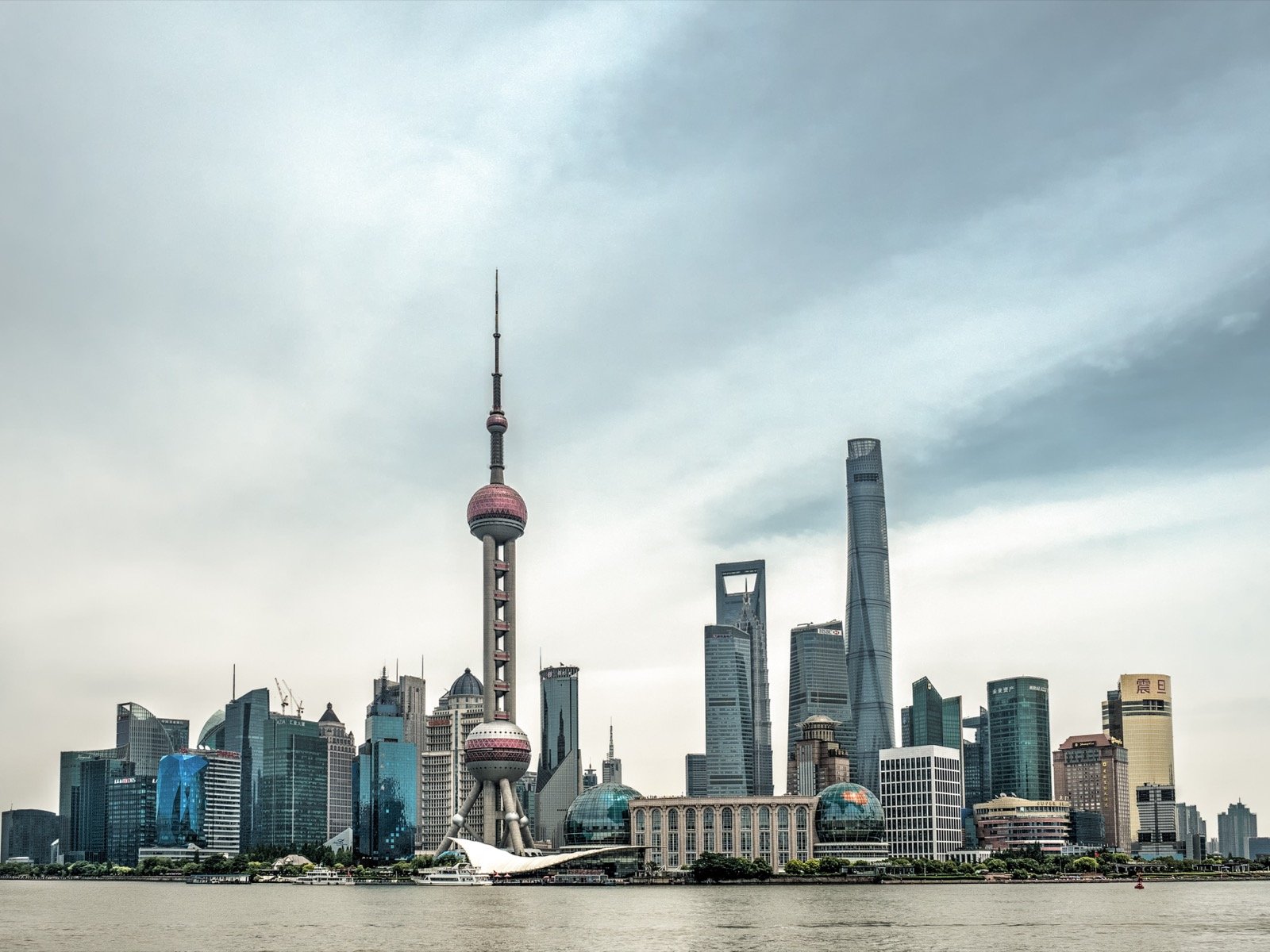
Shanghai’s Pudong district, built up largely after China’s 1990s and 2000s investment boom. Photo: Ermell, CC0, via Wikimedia Commons.
Discover: Facts Worth Knowing
- China’s trade surplus in just the first seven months of 2026 ($687.37 billion) is larger than the annual GDP of all but about 20 countries worldwide.
- Zhu Rongji negotiated China’s WTO accession and died on the same timeline, 25 years later, that his own reforms helped create.
- New home prices in China’s 70 major cities have now fallen for 37 consecutive months — more than three full years.
- China’s working-age population has declined every year since roughly 2015, a full decade before the current slowdown became a headline story.
- Semiconductor export value nearly doubled year-on-year in July 2026, even as fixed-asset investment excluding property still contracted.
Explore More Timelines
People Also Ask
Frequently Asked Questions
Every answer is drawn from the official data and historical record covered above.
⚠️ Editorial Note
This article separates official Chinese government data (NBS, PBOC, General Administration of Customs, State Council) from independent reporting and analysis (Reuters, CNBC, Xinhua, and other outlets cited throughout). Historical claims are cross-checked against IMF, World Bank and WTO historical records where available. This is editorial analysis, not investment, legal or policy advice, and current figures will be updated as newer official releases become available.
Sources & further reading
Every dated entry above was checked against these references. Last reviewed 15 September 2026.
- China's fixed-asset investment down 6.7 pct in first seven months (Xinhua)
- Chinese premier stresses fulfilling full-year development targets, State Council meeting 17 Aug 2026 (Xinhua)
- China's economy slows further in July as retail sales barely grow, investment slump steepens (CNBC)
- China's exports growth beats estimates in July, as AI-driven shipments surge (CNBC)
- China July bank loans contract for second time in 2026 on weak demand (Reuters via Investing.com)
- Zhu Rongji, the 'economic czar' who helped turn China into a powerhouse, dies at 97 (CNN)
- China's population falls again as birth rate drops to lowest since 1949 (PBS NewsHour)