Swiss Glacier Melt Rates: A Timeline of Accelerated Loss
Swiss glaciers lost 5.5% of their ice in 2026, second only to 2022. Melt-rate timeline since 1850, record years, causes and what it means for the Alps.
Latest Story
Swiss glacier melt rates have hit record territory three times in five years. In 2026 Switzerland’s glaciers lost about 5.5% of their remaining ice, second only to 2022’s 5.9%, according to the monitoring network GLAMOS and the Swiss Academy of Sciences. Since the end of 2021, nearly one-fifth of the country’s glacier ice has gone. 2022 set the record. 2026 came close. How much ice is Switzerland losing, and why is it speeding up?
This timeline runs from the Little Ice Age maximum around 1850 to the 2026 results published on 1 October. It separates mass balance (what a glacier gains and loses each year), volume loss (how much ice disappears) and percentages, which are always taken from a shrinking base. That last point explains how 2025 could rank fourth in percentage while being only an average year in cubic kilometres.
💡 Short Answer
Swiss glaciers lost about 5.5% of their remaining ice volume in 2026, the second-largest annual loss on record after 2022 (about 5.9%), GLAMOS and the Swiss Academy of Sciences reported on 1 October 2026. Low winter snow and a summer of repeated heatwaves drove it. Since the end of 2021, nearly a fifth of Swiss glacier ice has melted, and about 24% was lost in the decade 2015–2025.
Swiss Glacier Melt Rates: Key Questions
Swiss Glacier Loss in Ten Points
- 2026: about 5.5% of the ice lost, second only to 2022.
- Record: 2022, about 5.9%, with low snow, heat and Saharan dust.
- Five years: nearly one-fifth of Swiss glacier ice gone since the end of 2021.
- Decade: about 24% lost in 2015–2025, the most negative decade on record.
- Volume: about 45.1 km³ left at the end of 2025, down from roughly 75 km³ in 2000.
- Early melt: Glacier Loss Day came on 29 June 2026; the freezing level stayed above 4,000 m for 76 days.
- Extinction: Plattalva vanished in September 2026; about 30 small glaciers went that year.
- Percent vs volume: a percentage of a shrinking reserve; 2025 lost only 1.4 km³ but ranked fourth.
- Water: peak meltwater has probably passed, a risk for dry summers downstream.
- Covers help locally, but only emission cuts decide how much Alpine ice survives.
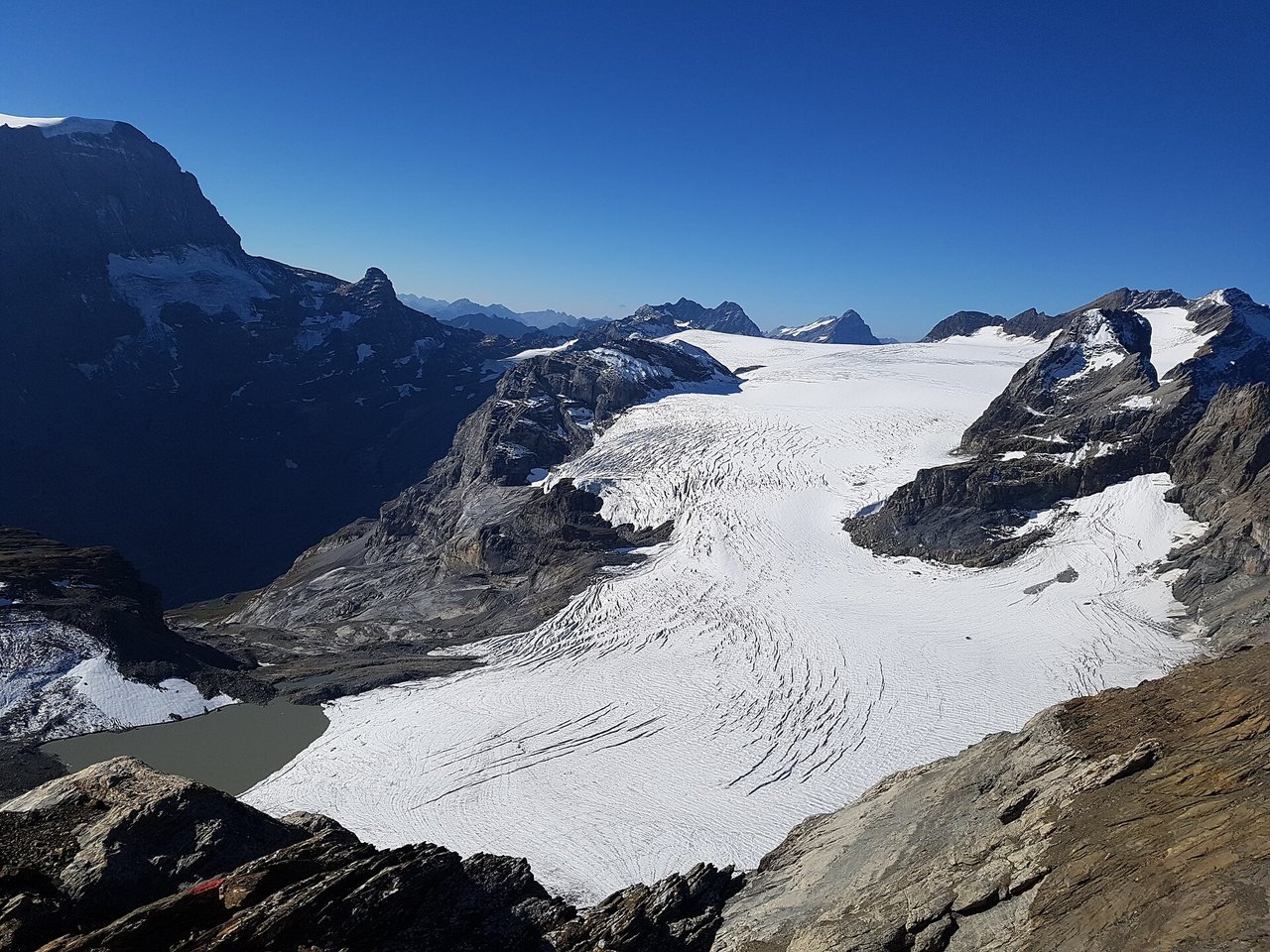
What “Glacier Melt Rate” Actually Means
Five measurements, five different stories.
Gain minus loss
Snow and ice gained versus lost over the glacier year (1 Oct–30 Sep), in metres of water equivalent. 2022: about −3.1 m w.e.
Ice that disappears
In km³ or as a share of what remains. The headline 5.5% for 2026 is this measure.
Where the front ends
Measured since the 1880s. Fronts can lag years behind thinning higher up.
How far the surface drops
2.5 to 4 m on average in 2026; up to 13 m at Aletsch’s lowest point.
Ice-covered landscape
About 755 km² at the end of 2025, roughly 30% less than in 2000.
When winter snow runs out
After this date, glaciers burn older ice. 29 June in 2026.
Swiss Glacier Melt: The Full Timeline
Newest first, back to the Little Ice Age maximum.
2026
2026: 5.5% gone, second only to 2022
GLAMOS and the Swiss Academy of Sciences report that Swiss glaciers lost about 5.5% of their remaining ice in the 2025/26 glacier year, the second-largest percentage decline on record. Over five melt seasons, 2022 to 2026, Switzerland lost nearly a fifth of its glacier ice. Average ice thickness fell 2.5 to 4 metres; some glacier tongues lost up to 10 metres. The Allalin, Clariden, Rhône and Aletsch glaciers saw record melt. Between July and September, about 2,200 billion litres of meltwater ran off, more than four times Swiss annual drinking-water use.
“Alpine glaciers have no chance of surviving in the long term under such conditions,” said GLAMOS head Matthias Huss. “What used to be extreme events, by definition rare and very intense, now occur almost every summer.”
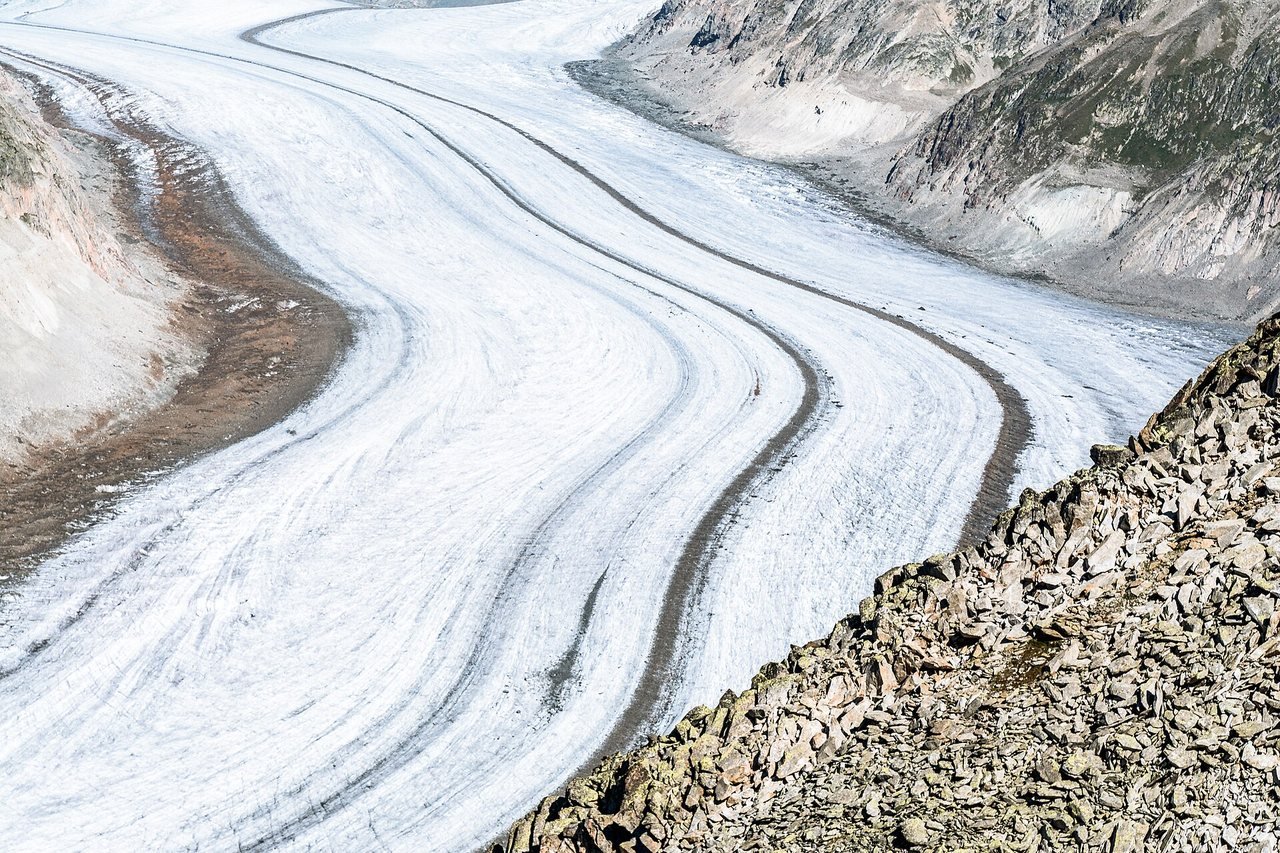
Plattalva declared extinct
The Plattalva Glacier disappears completely in September and is declared extinct. Around 30 small glaciers are estimated to have vanished during 2026, bringing the total since 2016 to about 160. On the Great Aletsch Glacier, the lowest monitoring point records about 13 metres of ice-thickness loss for the year.
2026
Glacier Loss Day comes early
By 29 June the average Swiss glacier has already melted all the snow it gained over winter and starts losing older ice, an extremely early Glacier Loss Day. From May to September the 0°C level sits above 4,000 metres for 76 days, more than double the average. Between mid-June and mid-July the Rhône Glacier thins by about 4 metres.
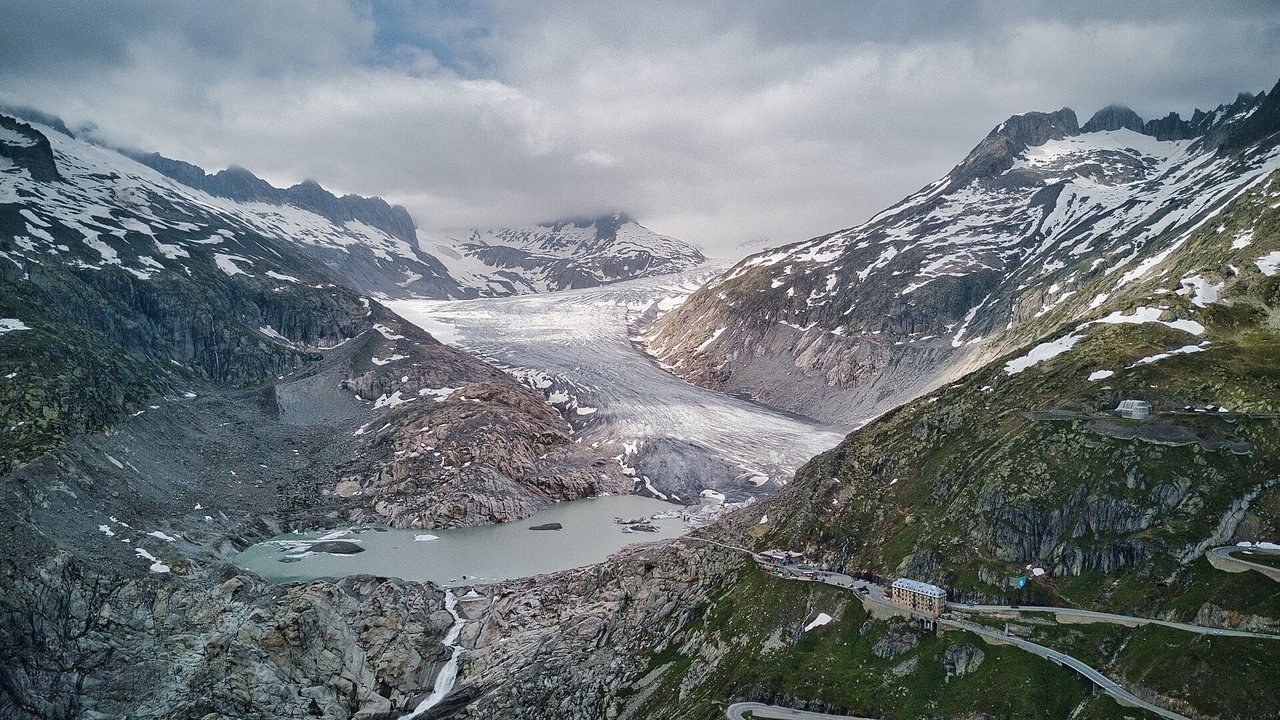
2025/26
Thin snow, no protection
Snowfall over winter is well below the long-term average at all elevations. Thin snow matters twice: it adds little new mass, and it disappears early, exposing darker ice that absorbs far more sunlight.
2025
2025: 3.0% lost, a quarter in a decade
GLAMOS reports a loss of about 3.0%, or 1.4 km³, the fourth-largest percentage loss since detailed observations began in the 1950s, after 2022, 2023 and 2003. After a winter about 13% short of snow, a June heatwave (the second-warmest June after 2003, and the warmest ever recorded at the Jungfraujoch) pushed glaciers toward 2022 levels before a cooler July with fresh snow avoided the worst. Switzerland holds about 45.1 km³ of ice, roughly 30 km³ less than in 2000, and glacier area is down about 30% to around 755 km².
2025
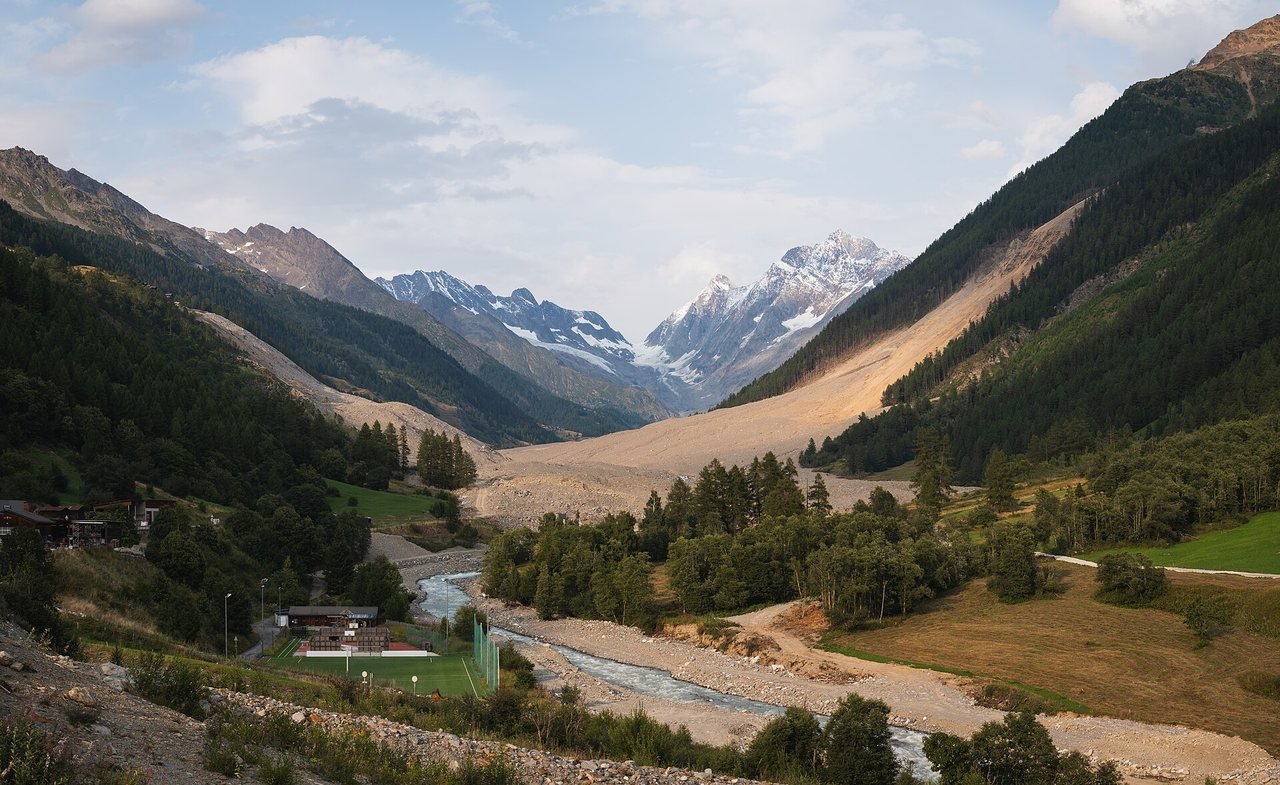
Birch Glacier collapse buries Blatten
The Birch Glacier, overloaded by millions of cubic metres of rock that had fallen onto it from the Kleines Nesthorn, collapses. Ice, rock and debris bury most of the village of Blatten. Its roughly 300 residents had been evacuated on 19 May after geologists warned of the risk; one 64-year-old man was killed. The cause was rock loading rather than melt, but the event made mountain hazards in a warming Alpine environment national news.
2024: a snowy winter is not enough
Winter 2023/24 brings about 30% more snow than average, and conditions stay favourable into June. Then a hot July and August, and heavy Saharan dust on the snow, accelerate melt. August 2024 records the largest monthly loss ever measured for that month, and the year ends with about 2.5% of the ice gone.
2023: a second extreme year
Another low-snow winter and a hot summer strip about 4.4% of the remaining ice (first reported as about 4%). In two years, Switzerland loses about a tenth of its glacier ice, as much as in the three decades from 1960 to 1990.
2022: the record year
The modern record. A winter with little snow, Saharan dust that darkened the snowpack in spring, and a long, hot summer combine. Swiss glaciers lose about 5.9% of their volume (first reported as roughly 6%), with an average mass balance of about minus 3.1 metres water equivalent. Snow vanishes even from summit levels, and glacier fronts collapse into rock and meltwater.
2025
The most negative decade
GLAMOS calculates that Switzerland lost about 24% of its ice volume in the ten years to 2025, against 17% in 2010 to 2020, 14% in 2000 to 2010 and 10% in the decade to 2000. The periods 2010–2020 and 2015–2025 overlap, but the trend is unambiguous.
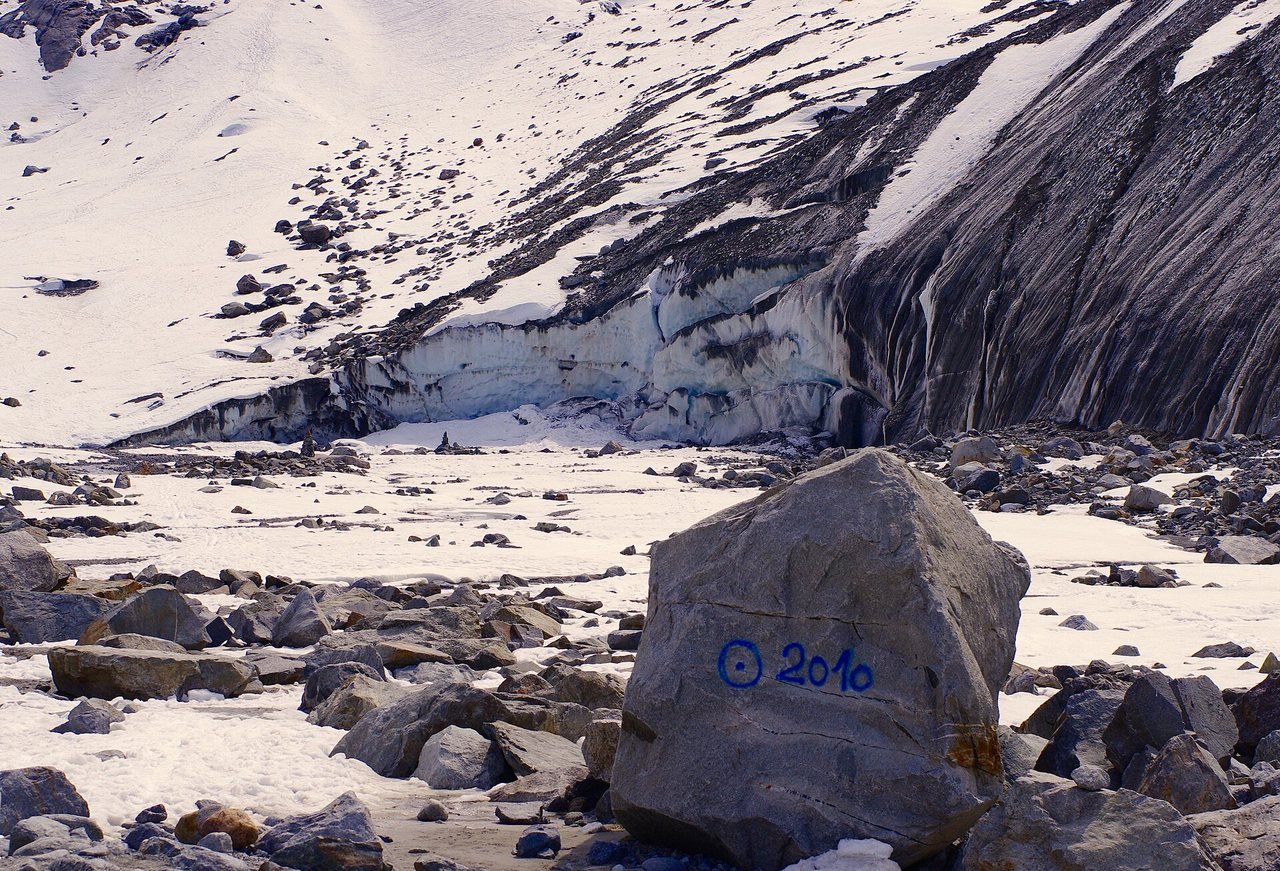
The European heatwave summer
The record European heat of 2003 produces one of the worst glacier years then measured. June 2003 remains the benchmark: GLAMOS ranked June 2025 second only to it. 2003 stayed a reference point until it was overtaken by 2022, 2023 and, in 2026, again.
About 75 km³ of ice
At the start of the century Switzerland holds roughly 75 km³ of glacier ice, by GLAMOS’s reconstruction. Annual losses in the following two decades mostly run between about 0.5% and 2.5% of the remaining volume.
2016
More than 1,000 glaciers vanish
Comparing glacier inventories, researchers find that more than 1,000 Swiss glaciers disappeared completely between 1973 and 2016, and about 100 more between 2016 and 2022. Most were small, but they are the first part of the system to go.
Detailed Swiss-wide observations
More glaciers come under regular, detailed mass-balance observation. The 2022, 2023 and 2026 rankings are made against this record; GLAMOS excludes slightly larger estimated losses in 1921, 1928 and 1947 because measurements then were too sparse.
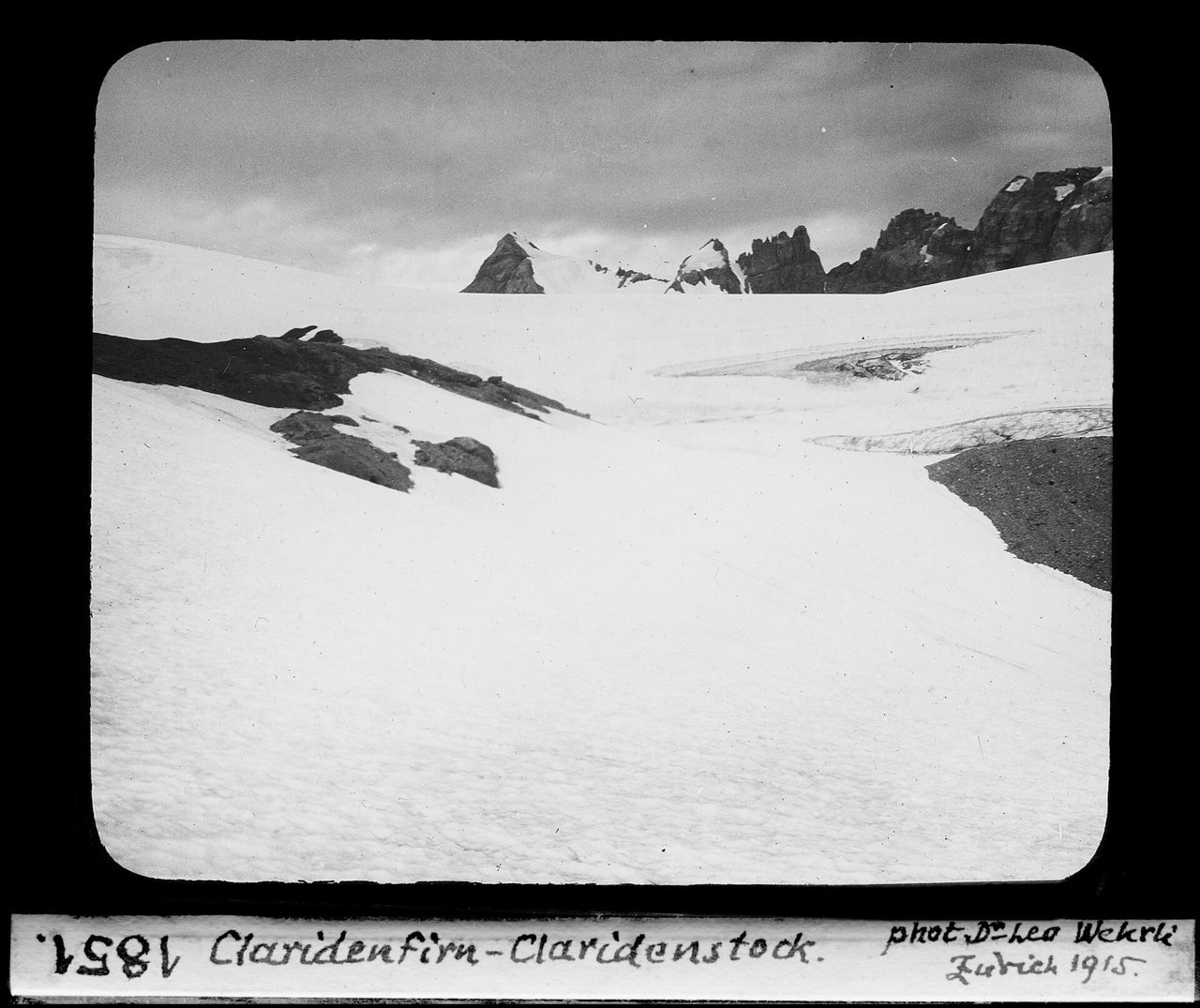
The Claridenfirn series begins
Measurements of snow accumulation and melt begin on the Claridenfirn in canton Glarus. More than a century later the series still runs, and in 2026 it recorded another year of record melting.
1893
Systematic length measurements
Scientists begin measuring where glacier fronts end each year, and in 1893 the Swiss natural science society sets up a glacier commission to coordinate the work. Annual length-change reports, today published as the Swiss Glacier Bulletin, become the backbone of the national record.
End of the Little Ice Age
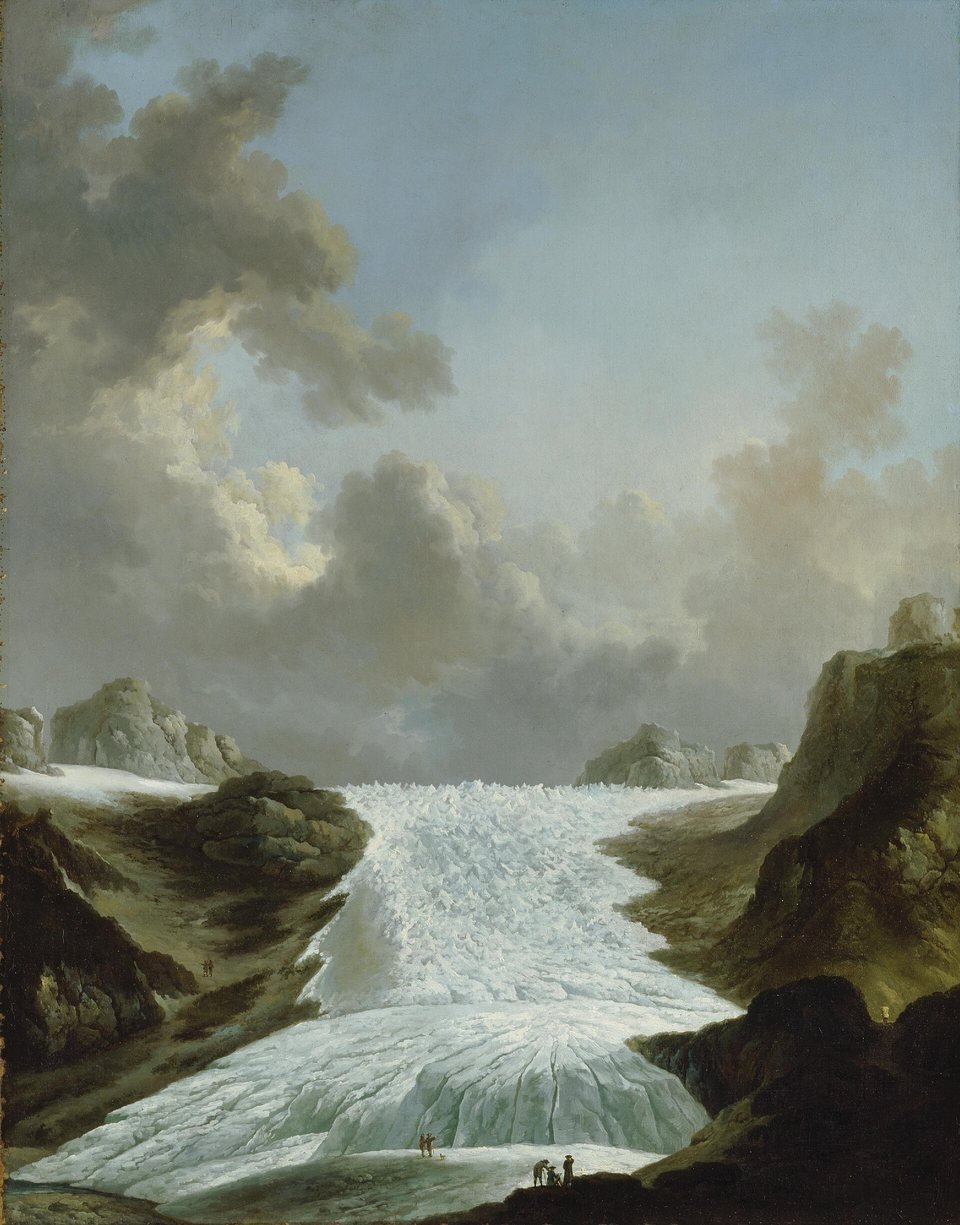
After centuries of a cooler climate, many Alpine glaciers reach their last major high stand around the middle of the 19th century. The Rhône Glacier reaches down to the valley floor at Gletsch. From here, retreat dominates, interrupted by small advances in the 1910s–1920s and 1970s–1980s.
Five Bad Years in One Chart
Annual loss as a share of the ice left the year before.
The Acceleration, Decade by Decade
The Shrinking Reserve
Roughly 75 km³ in 2000, about 42–43 km³ after 2026.
Pick a starting ice volume, an annual loss rate and a time span. Watch the losses compound.
Why does 5.5% in 2026 mean less ice than 5.9% in 2022, yet still feel worse? Because each percentage is taken from a smaller reserve.
Annual loss: 5.5%
Years
A mathematical illustration, not a forecast. Real glacier change depends on snowfall, temperature, glacier geometry and other conditions, and losses do not stay constant from year to year.
Why Are Swiss Glaciers Melting Faster?
Warmer, longer summers
More energy for melting, and more days with the freezing level high above the glaciers. In 2026 it stayed above 4,000 m for 76 days. GLAMOS’s Matthias Huss calls current warming 100% attributable to human-caused climate change.
Less winter protection
Fresh snow reflects most sunlight and feeds the glacier. Thin snow vanishes early and exposes dark ice, which absorbs far more energy. 2025 was 13% short; 2026 was well below average everywhere.
A darker surface
Saharan dust lowers reflectivity. It amplified melt in 2022 and especially 2024, but had no significant effect in 2025. An amplifier, not the trend.
Still catching up
Glaciers respond to decades of climate. Even a cool, snowy year cannot rebuild what earlier warming has committed them to lose.
What Glacier Loss Means for Switzerland
Peak meltwater has passed
Glaciers feed the Rhine, Rhône, Inn and Ticino in hot, dry summers. Short term, extreme melt raises runoff (2,200 billion litres in July–September 2026). Long term there is less ice to melt: GLAMOS says peak meltwater has likely passed.
Changing seasonal flows
Hydropower supplies most of Switzerland’s electricity. Reservoirs, rain and snowmelt cushion the effect, so there is no sudden collapse, but shifting summer flows complicate planning.
Unstable slopes and new lakes
Retreating ice exposes loose rock and leaves new lakes; warming permafrost weakens steep slopes. The 2025 Blatten collapse showed how fast a hazard can escalate, and why monitoring and early evacuation matter.
Tourism and identity
Viewpoints, hiking routes, huts and ski areas built around ice must adapt as glaciers retreat and fragment.
Glaciers in the 2026 Headlines
| Glacier | Canton | 2026 detail | Status |
|---|---|---|---|
| Great Aletsch | Valais | ~13 m thickness lost at lowest point | Record melt |
| Rhône | Valais | ~4 m thinner, mid-June to mid-July | Record melt |
| Allalin | Valais | Named among record-melt glaciers | Record melt |
| Claridenfirn | Glarus/Uri | Series running since 1914 | Record melt |
| Plattalva | Glarus | Vanished in September | Declared extinct |
| Pizol | St Gallen | Gone before 2026; photographed 2006–2025 by Huss | Lost (2019) |
Can Switzerland Save Its Glaciers?
Locally, a little. White geotextile covers spread over small, valuable patches, such as the ice grotto at the Rhône Glacier or ice under ski runs, can cut summer melt there by more than half. They are expensive, need annual work and only make sense on a few hundred square metres. They cannot be scaled across mountain ranges.
The real lever is global warming. Huss says it is almost too late to save many Alpine glaciers, and scientists warn that about half of Alpine glaciers could disappear within 20 years without drastic emission cuts. But how much ice remains by 2100 still depends on the emissions pathway. Some Swiss glaciers will not survive in their present form, and climate action still matters for the ice that remains.
“Alpine glaciers have no chance of surviving in the long term under such conditions.”
GLAMOS and the Swiss Academy of Sciences, 1 October 2026
The Glacier-Loss Numbers at a Glance
| Year or period | Reported change | Why it matters |
|---|---|---|
| 2000 | About 75 km³ of ice | GLAMOS reconstruction; start of the modern comparison |
| 2003 | Among the largest losses | Benchmark heat year until 2022; exact % not published in the reports we checked |
| 2022 | About 5.9% lost | Largest annual percentage loss; ~−3.1 m w.e. |
| 2023 | About 4.4% lost | ~10% gone in two years |
| 2024 | About 2.5% (1.2 km³) | Despite ~30% extra winter snow |
| 2025 | About 3.0% (1.4 km³) | Fourth-largest % loss; average in absolute terms |
| End of 2025 | About 45.1 km³ left | ~30 km³ below 2000; area ~755 km², down ~30% |
| 2015–2025 | About 24% lost | The most negative decade on record |
| 2026 | About 5.5% lost | Second-largest; Glacier Loss Day 29 June |
| 2022–2026 | Nearly one-fifth lost | Five melt seasons since the end of 2021 |
| After 2026 | ~42–43 km³ (est.) | AiTimeline arithmetic, not an official figure |
📏 How to read these numbers
Annual percentages are measured against the ice left the year before, not a fixed baseline, so they are not directly additive. Volume estimates for 2000 and 2025 come from GLAMOS’s reconstruction; the post-2026 figure is AiTimeline arithmetic. These are national averages and do not describe every glacier.
Corrections to Figures Circulating Online
“2003: about 3.5%”
2003 ranks among the biggest losses, but we could not find a 3.5% figure in GLAMOS’s published reports, so we do not use it.
“2025 heatwaves in June and August”
GLAMOS points to a June heatwave, followed by a cooler July with fresh snow. The low-snow winter plus June heat drove the 3.0% loss.
“Over 1,000 glaciers disappeared”
True, but over 1973–2016. About 100 more went in 2016–2022 and roughly 30 in 2026.
“6% in 2022, 4% in 2023”
Those were the first estimates. GLAMOS’s updated ice-volume series gives 5.9% and 4.4%.
Did You Know?
- Over a century of data: the Claridenfirn mass-balance record started in 1914 and is still running.
- Funeral for a glacier: the Pizol Glacier was mourned with a public ceremony in 2019 after it shrank too small to measure.
- Two years, a tenth: 2022 and 2023 together removed as much ice as 1960–1990.
- Glacier year: Swiss glaciologists count from 1 October to 30 September, which is why results come out each autumn.
- Four times the taps: July–September 2026 meltwater exceeded four years of Swiss drinking-water use.
Quick Quiz: How Well Do You Understand Glacier Melt?
1. What does a glacier’s annual mass balance measure?
2. Why can a percentage loss rise while the volume lost falls?
3. Which year holds the Swiss record for percentage loss?
4. When was Glacier Loss Day in 2026?
5. Which glacier was declared extinct in September 2026?
6. What made 2022 so severe?
Explore More Timelines
People Also Ask
Frequently Asked Questions
The Bigger Picture
A glacier does not vanish in one dramatic moment. It thins, retreats, fragments and is finally struck from the inventory. Switzerland’s measurements show how quickly that process accelerates when low snowfall and intense heat arrive together, as they did in 2022, 2023 and 2026. The 2026 figure is striking, but the deeper story is the accumulation of losses over decades, and a shrinking reserve left to absorb the next hot summer. The question is no longer only how fast Switzerland’s glaciers are melting. It is how much ice, water and Alpine landscape will remain as the climate keeps warming.
Related AiTimeline Stories
⚠️ Editorial Note
Last updated 3 October 2026. The 2026 figures come from the GLAMOS/Swiss Academy of Sciences results published on 1 October 2026, as reported by AP and SWI swissinfo.ch; the full 2026 GLAMOS report should be consulted when available. Historical volumes, decade losses and the 2022–2025 annual percentages come from GLAMOS’s annual reports for 2024 and 2025. Blatten details come from contemporaneous reporting. Figures marked as estimates are AiTimeline arithmetic. We did not use a widely shared 2003 figure (3.5%) that we could not trace to GLAMOS.
Sources & further reading
Every dated entry above was checked against these references. Last reviewed 3 October 2026.
- SWI swissinfo.ch: A fifth of Swiss Alpine ice has vanished in five years (1 October 2026)
- AP via PBS NewsHour: Swiss glaciers lost more than 5% of ice volume in 2026
- GLAMOS: Annual mass balance of Swiss glaciers in 2024/2025 (report)
- Swiss Academy of Sciences (SCNAT): And Swiss glaciers continue to melt (1 October 2025)
- GLAMOS: Annual mass balance of Swiss glaciers in 2023/2024 (report)
- University of Zurich: Severe melting of glaciers despite heavy snowfall at high altitudes (2024)
- France 24: Swiss village largely destroyed by glacier collapse (29 May 2025)
- GLAMOS – Glacier Monitoring Switzerland (data portal)