Mumbai–Ahmedabad Bullet Train: Complete Project Milestones & Route Timeline
Track India's first bullet train's real 2026 progress: viaducts, undersea tunnel, stations, route map, cost and the verified 2027 opening target.
Latest Story
Nine years after Narendra Modi and Shinzo Abe broke ground in Ahmedabad, the Mumbai-Ahmedabad bullet train has moved past the point where progress could be measured in ceremonies. Piers, viaducts and a 7-kilometre tunnel under Thane Creek now stand where there was only a foundation stone and a financing agreement. What has not yet arrived is a passenger. This piece tracks exactly how far India’s first dedicated high-speed rail corridor has actually got, section by section, and what still separates a finished structure from a running railway.
🧠 In 60 Seconds
The Mumbai-Ahmedabad High-Speed Rail (MAHSR) corridor is a 508 km dedicated line using Japanese Shinkansen technology, under construction since 2017. As of July 2026, NHSRCL reports 453 km of pier work, 359 km of viaduct and 215 km of track bed complete, with tunnelling underway for India’s first undersea rail tunnel beneath Thane Creek. Land acquisition is effectively finished. The first commercial trains are officially targeted for the Surat-Bilimora stretch on August 15, 2027; the full corridor to Mumbai is targeted around 2029. No official passenger fare has been confirmed yet.
Mumbai–Ahmedabad Bullet Train: What Is the Current Status?
What You Need to Know
- Land acquisition is essentially complete: Gujarat at 100%, Maharashtra at 99.83%, and the Union Territory stretch fully acquired, as of early 2026.
- Civil works lead the project: pier and viaduct construction are the most advanced components; track, electrification and signalling trail behind.
- The undersea tunnel is India’s first: a 7 km stretch under Thane Creek, part of a longer 16–21 km bored tunnel between BKC and Shilphata/Sawli in Thane.
- Construction completion, testing and commercial service are three different milestones, not one—this article keeps them separate throughout.
- 320 km/h is the planned commercial speed, not a guarantee of every kilometre—design speed is 350 km/h, and real journeys will average less due to stops and speed-restricted stretches.
- India’s next-generation rolling stock is JR East’s E10 Shinkansen, still in development in Japan alongside India’s own line; a 24-train order was confirmed in 2023.
- No fare has been officially finalised—figures circulating in media (₹250 minimum, ₹3,000–₹5,000 for the full route) are unconfirmed estimates, not tariffs.
- Project cost has grown well beyond the original 2017 estimate, driven mainly by land-acquisition compensation and scope additions, and the final figure is still not settled.
- MAHSR is a pilot, not the endpoint—seven more high-speed corridors are in various stages of survey and DPR, led by Delhi–Varanasi, but none has moved to construction.
What Is the Mumbai–Ahmedabad High-Speed Rail Project?
MAHSR stands for the Mumbai-Ahmedabad High-Speed Rail corridor — a 508 km dedicated railway line connecting Mumbai’s Bandra-Kurla Complex to Ahmedabad’s Sabarmati, running through Maharashtra, Gujarat and a short stretch of Dadra and Nagar Haveli. It is being built and executed by the National High Speed Rail Corporation Limited (NHSRCL), a joint venture of the Ministry of Railways and the state governments of Maharashtra and Gujarat.
Calling it “a faster train” undersells what is actually being built. MAHSR is a standalone high-speed rail system: its own elevated track structure (nearly the entire alignment runs on viaduct, not at ground level), its own 25kV AC overhead electrification, its own cab signalling and automatic train control, and its own stations — physically and operationally separate from the existing Indian Railways broad-gauge network that Vande Bharat and other trains share. A conventional train, however upgraded, still runs on track shared with freight and other passenger services, with speed capped by curves, crossings and mixed traffic. A dedicated high-speed line removes those constraints by design, which is what allows 320 km/h operation in the first place.
2017: India and Japan Launch the Bullet Train Project
The diplomatic groundwork was laid two years earlier. On December 12, 2015, Prime Ministers Narendra Modi and Shinzo Abe signed a bilateral agreement in New Delhi committing Japan to finance and transfer Shinkansen technology for India’s first high-speed line. The formal construction launch came on September 14, 2017, when Modi and Abe jointly laid the foundation stone in Ahmedabad — the moment usually cited as the project’s start date, even though the corridor’s actual civil works did not meaningfully begin for several more years while land acquisition, detailed design and tendering proceeded.
Japan’s role was never simply exporting a finished railway. The Japan International Cooperation Agency (JICA) structured this as a technology-transfer partnership: Japan supplies Shinkansen engineering standards, rolling stock design, signalling philosophy and decades of operating experience with zero passenger fatalities from derailment or collision in the Shinkansen’s history; India supplies the land, the civil construction workforce, local contractors and the eventual operating organisation. The stated objective was not just one railway line but building domestic Indian capability — engineering firms, precast-concrete manufacturing, tunnelling expertise — that could carry into future corridors.
Why Japan’s Shinkansen Technology Was Chosen
The Shinkansen was selected over European or Chinese high-speed systems primarily on its safety and punctuality record over six decades of continuous operation, and its experience building high-speed lines through seismically active, densely populated terrain not unlike western India’s coastline. Key elements being adapted include dedicated, fully grade-separated track (no level crossings anywhere on the alignment), centralised traffic control, automatic train control that prevents a train from exceeding safe speed regardless of driver input, and an earthquake early-warning system that can trigger automatic braking before strong shaking reaches a moving train.
None of this is being copied wholesale. Track structures, viaduct design and tunnel lining are being engineered for Indian geology, monsoon rainfall and construction practice, with Japanese consultants working alongside Indian engineering firms and contractors rather than building the line themselves.
How the Bullet Train Is Being Financed
MAHSR is financed overwhelmingly through Japanese soft loans routed through JICA, alongside equity from the Government of India, Maharashtra and Gujarat. JICA’s cumulative loan commitment to the project has reached roughly ¥1,050 billion (about ₹59,396 crore) across five tranches since 2017, with the fifth tranche — ¥400 billion, about ₹22,627 crore — signed in December 2023, described by JICA as the largest single commitment in the agency’s history. These loans reportedly carry concessional terms of roughly 0.1% annual interest with a long repayment tenure, though exact terms vary by tranche.
The original 2017 project cost estimate was approximately ₹1.08 lakh crore. That figure is now dated: a February 2026 parliamentary reply put actual expenditure at ₹86,939 crore as of December 31, 2025, while media reporting in March 2026 cited government estimates of the eventual cost rising toward roughly ₹1.98 lakh crore, attributed largely to land-acquisition compensation, utility-shifting costs and scope changes accumulated over nine years. None of these numbers should be read as final — a project still mid-construction, with rolling stock, signalling and testing costs yet to be fully booked, will not have a settled total cost until much closer to commissioning.
2018–2026: The Land Acquisition Challenge
Land acquisition was, for years, the project’s binding constraint, not tunnelling or track. Gujarat’s largely rural, agricultural land parcels were acquired relatively quickly; Maharashtra’s stretch runs through denser, more contested urban and semi-urban land around Mumbai and Thane, plus forest and coastal-zone clearances, and progressed far more slowly through the early 2020s. As of the most recent official figures, Gujarat has acquired 100% of the 951.14 hectares required across its eight districts, Maharashtra has reached 99.83% of its 429.71 hectares, and the Union Territory of Dadra and Nagar Haveli and Daman and Diu has acquired its full 7.90 hectares. NHSRCL has also reported that all 1,651 utilities requiring relocation along the alignment have been shifted.
This is worth stating plainly rather than politically: the multi-year land-acquisition delay is the single biggest reason MAHSR’s construction timeline slipped from the optimistic early targets (2022, then 2023) floated when the project was announced. It is not unique to this project — land acquisition for linear infrastructure across multiple states, with compensation disputes litigated up to the Gujarat High Court, is a structural feature of Indian infrastructure delivery, not a MAHSR-specific failure.
How the MAHSR Corridor Is Being Built
Elevated Guideway
Precast box-girder segments launched onto piers; carries roughly 90% of the alignment.
River & Steel Crossings
25 river bridges and 28 steel bridges planned across major rivers including the Narmada, Tapi and Mahi.
Mountain & Undersea
8 mountain tunnels in Maharashtra’s hilly Palghar stretch, plus the 21 km BKC–Shilphata bored tunnel with its 7 km undersea section.
12 Along the Corridor
From an underground terminus at Mumbai BKC to at-grade and elevated stations across Gujarat.
Slab Track System
Japanese ballastless slab track, laid with cement-asphalt-mortar (CAM) injection for stability at high speed.
25kV AC OHE + ATC
Overhead traction masts, substations, and automatic train control/signalling integrated corridor-wide.
India’s First High-Speed Rail Viaduct Network
The viaduct is where MAHSR has made its most visible progress. NHSRCL builds most spans using precast segments cast at dedicated yards along the route, then erected onto piers using launching girders that place a full span in a single lift — a method that lets crews advance the elevated structure far faster than in-situ concrete pours would allow. As of July 2026, NHSRCL reports 453 km of pier foundation work and 359 km of completed viaduct out of the roughly 460 km of the corridor planned to run elevated.
Mumbai–Ahmedabad Bullet Train Route Map
12 stations, verified against NHSRCL’s published station list
Mumbai (Bandra-Kurla Complex) ↓ Thane ↓ Virar ↓ Boisar ↓ Vapi ↓ Bilimora ↓ Surat ↓ Bharuch ↓ Vadodara ↓ Anand/Nadiad ↓ Ahmedabad ↓ Sabarmati
The route runs south-to-north along India’s western coastal industrial belt, leaving Mumbai underground before rising onto viaduct through Thane and Palghar district’s hill sections into Gujarat, where the alignment flattens out across the Gujarat plains through Surat, Bharuch and Vadodara before terminating near Ahmedabad’s Sabarmati riverfront, close to the existing Sabarmati railway station.
Mumbai–Ahmedabad Bullet Train Stations
| Station | State/UT | Major City/Area | Current Status | Key Role |
|---|---|---|---|---|
| Mumbai (BKC) | Maharashtra | Bandra-Kurla Complex | Underground station – foundation/base slab under construction | Southern terminus, financial district access |
| Thane | Maharashtra | Thane | Under construction | Suburban/metro interchange |
| Virar | Maharashtra | Virar | Under construction | Northern Mumbai suburbs |
| Boisar | Maharashtra | Boisar, Palghar dist. | Under construction | Industrial belt access |
| Vapi | Gujarat | Vapi | Under construction | Gujarat border town, industrial hub |
| Bilimora | Gujarat | Bilimora | Under construction | First-phase test-section endpoint |
| Surat | Gujarat | Surat | Advanced construction | Diamond/textile hub, major ridership node |
| Bharuch | Gujarat | Bharuch | Under construction | Narmada crossing |
| Vadodara | Gujarat | Vadodara | Advanced construction | Central Gujarat interchange |
| Anand/Nadiad | Gujarat | Anand | Under construction | Regional dairy/agri belt |
| Ahmedabad | Gujarat | Ahmedabad | Under construction | Commercial capital of Gujarat |
| Sabarmati | Gujarat | Ahmedabad (Sabarmati) | Under construction | Northern terminus, links to existing rail hub |
Per-station completion percentages are not publicly disclosed by NHSRCL; status here reflects the corridor-wide construction phase each station falls into as of mid-2026.
Where Will India’s First Bullet Train Run?
Maharashtra: Mumbai → Thane → Palghar region (Virar, Boisar). This stretch carries the corridor’s hardest engineering — the underground BKC terminus, the undersea/mountain tunnel package, and dense urban land.
Gujarat: Vapi → Surat → Bharuch → Vadodara → Ahmedabad region. Flatter terrain and faster land acquisition made this stretch the construction leader, which is why the first operational section is planned here rather than in Maharashtra.
The corridor deliberately threads together Mumbai’s financial district, Surat’s diamond and textile economy, and Vadodara and Ahmedabad’s industrial and administrative bases — three of western India’s largest urban economies plus the port and industrial belt around Vapi and Bharuch. What ridership this actually generates once trains run is not something that can be responsibly forecast years out; treat any specific passenger-volume projection as an estimate, not a measured outcome.
India’s First Undersea Rail Tunnel
The signature engineering feature of MAHSR is a 7 km stretch running beneath Thane Creek — part of a longer 16–21 km bored tunnel connecting the underground Mumbai BKC station to Shilphata, near Sawli/Ghansoli in Thane. It is important to be precise here: the entire BKC–Shilphata tunnel is not undersea — only the roughly 7 km segment that actually passes beneath the creek qualifies as India’s first undersea rail tunnel. The rest of the bore runs beneath land, some of it through hard rock via drill-and-blast/NATM methods and mountain sections further north in Palghar district using separate tunnels.
As of mid-2026, tunnel-boring-machine assembly was underway for the BKC–Sawli bore, following breakthroughs on two of the separate Palghar mountain tunnels (announced January 2026 and February 2026). A dedicated 11.17-hectare casting yard at Mahape, Thane, is producing the roughly 77,000 precast segments needed to form 7,700 tunnel-lining rings. The main TBM drive for the undersea section was expected to begin around October 2026, per project reporting.
How the Bullet Train Tunnel Is Being Built
Two tunnelling methods are in play. The undersea and soft-ground sections beneath Thane Creek and the Mumbai side use tunnel boring machines (TBMs) — rotating cutter-head machines that excavate and simultaneously install precast concrete ring segments as lining, chosen because they handle soft marine clay and variable water pressure more safely than blasting. The harder-rock mountain sections in Palghar district use the New Austrian Tunnelling Method (NATM), which excavates in stages and stabilises each section with sprayed concrete and rock bolts before advancing. Ventilation shafts and emergency cross-passages are standard features of both tunnel types on this scale, though NHSRCL has not published a detailed public schematic of the undersea section’s specific safety systems.
2024–2026: From Civil Construction to Railway Systems
A viaduct with no track, no power and no signalling is not a railway — it is a concrete structure. This is the gap that trips up most casual readings of MAHSR’s “progress”: a headline like “90% of the elevated structure complete” says nothing about whether trains can run on it. By 2024, NHSRCL’s own reporting had shifted emphasis from pure civil metrics (piers, girders) toward track-bed construction, electrification masts and station internal fit-out — the systems layer that actually turns a structure into an operating railway. That transition is still underway through 2026: track-bed and slab-track work trails viaduct completion by roughly 150 km, and full systems integration (signalling talking to electrification talking to rolling stock) has not yet been demonstrated end-to-end on any stretch.
2026: Track and System Integration
As of the July 2026 data cited in NHSRCL’s most recent public update: reinforced-concrete track bed is complete across 215 route-km, with Japanese-style slab track (using cement-asphalt-mortar/CAM injection for a rigid, low-maintenance base) laid across 91 route-km. Overhead electrification masts number more than 9,000, covering roughly 200 route-km of the 2x25kV AC traction system. Noise barriers, required along residential stretches to meet sound limits at 320 km/h, are up across 297 km. None of this constitutes commercial service — it constitutes the systems layer being built ahead of testing.
Surat–Bilimora: India’s First Bullet Train Test Section
The roughly 50 km Surat–Bilimora stretch (sometimes described more broadly as the Surat–Vapi, ~100 km segment) is Gujarat’s most construction-advanced section and the corridor’s designated test bed. Some official statements in early 2026 pointed to an initial trial-run target around mid-August 2026 on this stretch; Railways Minister Ashwini Vaishnaw has more recently and more specifically confirmed that commercial service on this section is targeted for August 15, 2027. These are not the same milestone: a trial run tests equipment at low-to-medium speed with no fare-paying passengers; commercial service means a published timetable and ticketed operation. As of mid-2026, the section had not yet entered either stage — construction and track-laying were still the active work.
Which Shinkansen Train Will India Use?
India’s Ministry of Railways confirmed a tender for 24 trainsets designed for 320 km/h operation in 2023, and the trains selected are JR East’s next-generation E10 series Shinkansen — unveiled by JR East only in March 2025 as the successor to the E2 and E5 series, built in 10-car formations. This is a genuinely unusual arrangement: MAHSR will not receive hand-me-down Japanese trains, but a model still being finalised for Japan’s own network, introduced in both countries at roughly the same time. Because a purpose-built E10 fleet cannot be ready for the corridor’s earlier testing phases, Japan has separately offered to gift an older E5 and E3 series trainset to support initial commissioning and dynamic testing ahead of the E10 fleet’s arrival, which is reported for around 2030 revenue-service readiness. Do not assume every trainset photographed on this corridor before then is the final E10 model — check the specific announcement.
Will the Mumbai–Ahmedabad Bullet Train Run at 320 km/h?
Three different numbers get conflated here, and they matter. Design speed — the structural and track-geometry limit the corridor is engineered for — is 350 km/h. Planned commercial operating speed, the figure actually used for revenue service, is 320 km/h. Average journey speed will be meaningfully lower than either, because trains accelerate and decelerate around each of 12 stations, run at reduced speed through station throats and any temporarily speed-restricted stretches, and do not hold top speed continuously end to end. None of the three should be substituted for another when reading a headline number.
How Long Will the Bullet Train Take From Mumbai to Ahmedabad?
NHSRCL’s planning figures put an express service (stopping at roughly 4 of the 12 stations) at about 1 hour 58 minutes, and an all-stations service at about 2 hours 17 minutes — against a current road/conventional-rail journey of 6–7 hours. These remain planning estimates, not a published commercial timetable; NHSRCL has not yet released fare classes, frequency or a stop-by-stop schedule for actual service, so treat the exact minute figures as indicative until the operator publishes a real timetable closer to 2027.
How Much Will a Mumbai–Ahmedabad Bullet Train Ticket Cost?
The final passenger fare has not yet been officially confirmed. Figures reported in the press — a minimum fare around ₹250 and a full Mumbai–Ahmedabad journey estimated in the ₹3,000–₹5,000 range depending on class — are officials’ indicative estimates, not a published tariff. Two seating classes are reportedly planned (2×2 and 2×3 configurations, roughly analogous to business and standard class). Fares this far from commercial launch typically move as costs, competing modes and government subsidy decisions evolve, so any number quoted today should be read as a planning assumption.
How Safe Will India’s Bullet Train Be?
MAHSR is being built around the same safety principles that underpin the Shinkansen’s decades-long record: fully dedicated, grade-separated track with no level crossings; automatic train control that overrides unsafe driver inputs; centralised traffic control monitoring the whole corridor in real time; and continuous track and structure monitoring for early defect detection. None of that amounts to a guarantee against every possible failure — no rail system, including the Shinkansen itself, claims a literal zero-accident record across all incident types, and it would be inaccurate to promise one for a system that has not yet operated a single passenger service in India.
How the Bullet Train Will Handle Earthquakes
Japan’s Shinkansen network pioneered seismic early-warning systems that detect a quake’s initial, faster-travelling P-waves and can automatically cut traction power and apply brakes before the more damaging S-waves reach a moving train. Adapting an equivalent earthquake early-warning and automatic-braking capability has been repeatedly cited by NHSRCL and the Railway Ministry as part of the technology transfer for MAHSR, alongside seismic design standards for viaducts, piers and tunnels calibrated to the corridor’s specific geology. Western India’s coastal and hilly stretches are not among the country’s most seismically active zones, but a high-speed line built to run at 320 km/h treats even moderate seismic risk as a first-order design constraint, not an afterthought.
Environmental Impact of the Bullet Train
An elevated line 508 km long, built mostly on piers through farmland, forest and coastal-adjacent stretches, carries real environmental costs: land use change, tree felling along the alignment, construction-phase emissions and dust, and disruption to local water flows around river crossings and the Thane Creek tunnel works. Set against that, electric high-speed rail run on grid power is generally far less carbon-intensive per passenger-kilometre than short-haul flights or private vehicle trips over the same distance, assuming reasonable ridership materialises once the line opens. The honest framing is that MAHSR is neither an unambiguous environmental win nor a straightforward cost — it is a tradeoff whose net effect depends heavily on how much car and air travel it actually displaces once operational, which cannot be measured before the line is running.
How the Bullet Train Could Change Mumbai–Ahmedabad
The corridor connects two of western India’s largest economic centres directly to Surat’s diamond and textile trade and Vadodara’s industrial base, which could plausibly increase business travel frequency, cluster new development around stations (particularly BKC, Surat and Sabarmati), and shift some tourism and short-business-trip traffic away from flights and long highway drives. These are reasonable expectations, not measured outcomes — no independent post-opening study of MAHSR’s actual economic effect can exist yet, since no section has opened. Treat every specific job-creation or GDP-impact number in circulation as a pre-project estimate rather than a result.
Is Mumbai–Ahmedabad India’s First Bullet Train Corridor Only?
MAHSR was always meant to be a proof of concept, not a one-off. The Union Budget 2026-27 named seven high-speed rail corridors under study, at very different stages of readiness — none of them under construction.
Delhi–Varanasi
958 km via an Ayodhya spur; DPR completed October 2020; land acquisition expected to begin late 2026/2027; estimated ₹1.71 lakh crore.
Mumbai–Pune / Pune–Hyderabad
Combined 767 km; LiDAR surveys conducted; awaiting ministry approval.
Hyderabad–Chennai
778 km; final alignment submitted November 2025.
Hyderabad–Bengaluru
618 km; survey work ordered September 2025.
Chennai–Bengaluru
Land surveys to Kolar completed; environmental assessment done by March 2024.
Varanasi–Siliguri / Varanasi–Howrah
Newly named corridors for eastern India; DPR not yet submitted as of 2026.
What MAHSR proves or fails to prove — can India build, tunnel, electrify, signal and eventually safely operate a dedicated high-speed line on schedule and budget — is the real input every one of these seven proposals is watching, more than any single completion date.
Bullet Train vs Vande Bharat: What’s the Difference?
| Feature | Mumbai–Ahmedabad Bullet Train (MAHSR) | Vande Bharat |
|---|---|---|
| Railway type | Dedicated high-speed rail | Semi-high-speed conventional rail |
| Dedicated track | Yes — fully separate alignment | No — shares existing broad-gauge network |
| Design speed | 350 km/h | 180 km/h (test-certified; typically runs slower) |
| Planned operating speed | 320 km/h | Up to 130–160 km/h depending on route |
| Technology base | Shinkansen-derived (E10 series) | Indigenous Indian design (ICF/BEML) |
| Status (2026) | Under construction, not yet operational | In commercial service on multiple routes |
| Primary role | Point-to-point intercity high-speed travel on one dedicated corridor | Faster conventional intercity travel across the existing network nationwide |
Bullet Train vs Flight: Which Is Faster?
Top speed favours neither mode in isolation — a plane cruises far faster than any train. The comparison that matters is station-to-station, door-to-door: the bullet train’s planned BKC and Sabarmati terminals sit inside or near the city cores, avoiding the airport transfer, security screening and check-in buffer that typically adds well over an hour to a Mumbai–Ahmedabad flight on each end. On a roughly 2-hour rail journey against a ~70-minute flight plus transfers, the two could end up comparable door-to-door for many travellers, with rail likely winning on frequency and weather reliability and flight retaining an edge for travellers already near an airport. This is a reasonable expectation based on how other city-pairs with high-speed rail have played out elsewhere, not a measured India-specific result.
Bullet Train vs Mumbai–Ahmedabad Conventional Rail
MAHSR vs Existing Conventional Rail
Mumbai–Ahmedabad Bullet Train Dashboard — August 2026
| Component | Latest Status | Progress | Next Milestone | Source |
|---|---|---|---|---|
| Land acquisition | Effectively complete | ~100% | N/A — complete | Govt. statements, Mar 2026 |
| Pier work | Under construction | 453 km | Full corridor pier completion | NHSRCL update, Jul 2026 |
| Viaduct | Under construction | 359 km | Full corridor viaduct completion | NHSRCL update, Jul 2026 |
| River / steel bridges | Under construction | 17 of 25 river; 15 of 28 steel | Remaining major crossings | NHSRCL update, Jul 2026 |
| Mountain tunnels | Under construction | 4 of 8 complete | Remaining Palghar breakthroughs | NewsOnAir, Jan–Feb 2026 |
| Undersea tunnel (BKC–Sawli) | TBM assembly stage | Not publicly quantified in km | Main TBM drive, ~Oct 2026 | Swarajya, 2026 |
| Track bed / slab track | Under construction | 215 km RC bed; 91 km slab track | Extend to Gujarat test section | NHSRCL update, Jul 2026 |
| Electrification | Under construction | 9,000+ masts across 200 km | Extend coverage corridor-wide | NHSRCL update, Jul 2026 |
| Rolling stock | On order | 24 trains (E10 series) tendered | First testing trainsets (E5/E3 gift) | Ministry of Railways, 2023 |
| Testing / trial run | Not yet started | Not publicly confirmed | Trial run, Surat–Vapi stretch | Various official statements, 2026 |
Master Project Timeline
Track-Laying, Systems Integration and Tunnel Breakthroughs
Status: 453 km piers, 359 km viaduct, 215 km track bed complete (July 2026 data); two Palghar mountain-tunnel breakthroughs achieved; TBM assembly begins for the BKC–Sawli undersea tunnel.
Why it matters: This is the year civil works and railway systems (track, power, signalling) finally run in parallel rather than civil work alone.
Tunnel Excavation and Station Fit-Out Begin
Status: BKC underground station foundation work advances; mountain-tunnel excavation in Palghar’s hill sections gets underway using NATM.
Why it matters: Marks the shift from mostly flat-terrain Gujarat construction toward the corridor’s hardest engineering, in and around Mumbai.
Rolling-Stock Tender and Fifth JICA Loan Tranche
Status: Ministry of Railways confirms a 24-train order for 320 km/h operation; JICA signs its fifth ODA loan tranche (¥400 billion) in December 2023.
Why it matters: Locks in the financing and the specific rolling-stock family (later confirmed as the E10 series) years before track is ready to run trains on.
Gujarat Viaduct Construction Accelerates
Status: With Gujarat’s land acquisition largely settled, pier casting and viaduct erection ramp up sharply on the flatter Gujarat stretch, well ahead of Maharashtra.
Why it matters: Establishes Gujarat, not Mumbai, as the corridor’s construction leader — the reason the first operational section is planned there.
Land Acquisition Grinds Through Maharashtra
Status: Detailed design proceeds while land acquisition in Maharashtra’s denser, contested parcels lags far behind Gujarat’s pace; compensation disputes reach the courts.
Why it matters: This is the single biggest reason the project’s early completion targets (2022, then 2023) slipped.
Foundation Stone Laid in Ahmedabad
Status: Modi and Abe formally launch construction on September 14, 2017, two years after the 2015 bilateral financing agreement.
Why it matters: The official start date of India’s high-speed rail era, and of NHSRCL’s execution mandate.
India–Japan Bilateral High-Speed Rail Agreement
Status: Modi and Abe sign the agreement in New Delhi that commits JICA financing and Shinkansen technology transfer to what becomes MAHSR.
Why it matters: The diplomatic and financial template every later JICA tranche builds on.
Next phase: Trial operations on the Surat–Vapi test stretch. Commercial service: officially targeted for the Surat–Bilimora section on August 15, 2027 — the latest official target, not yet revised as of this writing. Full corridor: targeted around 2029, per government statements; some reporting references Thane-linked stretches reaching operational status by 2028 ahead of the final Mumbai segment. Treat any date beyond the 2027 first-section target as a plan, not a certainty.
Why Has India’s First Bullet Train Taken So Long?
No Single Cause
- Land acquisition across two states plus a Union Territory, with compensation disputes litigated in court.
- A near-total absence of prior Indian precedent for dedicated high-speed rail civil engineering at this scale.
- 460+ km of elevated viaduct — itself a multi-year undertaking even with rapid precast methods.
- India’s first undersea rail tunnel, requiring specialised TBM procurement and a dedicated casting yard.
- 12 new stations, several requiring complex urban integration (notably underground BKC in Mumbai).
- Financing structured across five sequential JICA loan tranches rather than one upfront sum.
- Environmental and forest clearances along coastal and hill stretches in Maharashtra.
- Global supply-chain and construction disruption during 2020–21.
- Sequencing constraints — track, electrification and signalling cannot meaningfully start until viaduct sections are structurally complete.
- Testing and safety certification, which has not even begun corridor-wide as of 2026, still lies ahead.
5 Hardest Engineering Challenges
What Has the Bullet Train Project Actually Completed?
✅ Completed
- Land acquisition across Gujarat, Maharashtra and the UT stretch (~100%)
- Utility relocation (1,651 utilities shifted)
- 4 of 8 mountain tunnels (Palghar)
- Two mountain-tunnel breakthroughs (Jan & Feb 2026)
❌ Not Yet Complete
- Full corridor viaduct (359 of ~460 planned elevated km)
- Undersea tunnel excavation (TBM assembly stage only)
- Track, electrification and signalling corridor-wide
- Rolling stock delivery, testing, trial runs, commercial service
What Still Needs to Happen Before Passengers Can Ride?
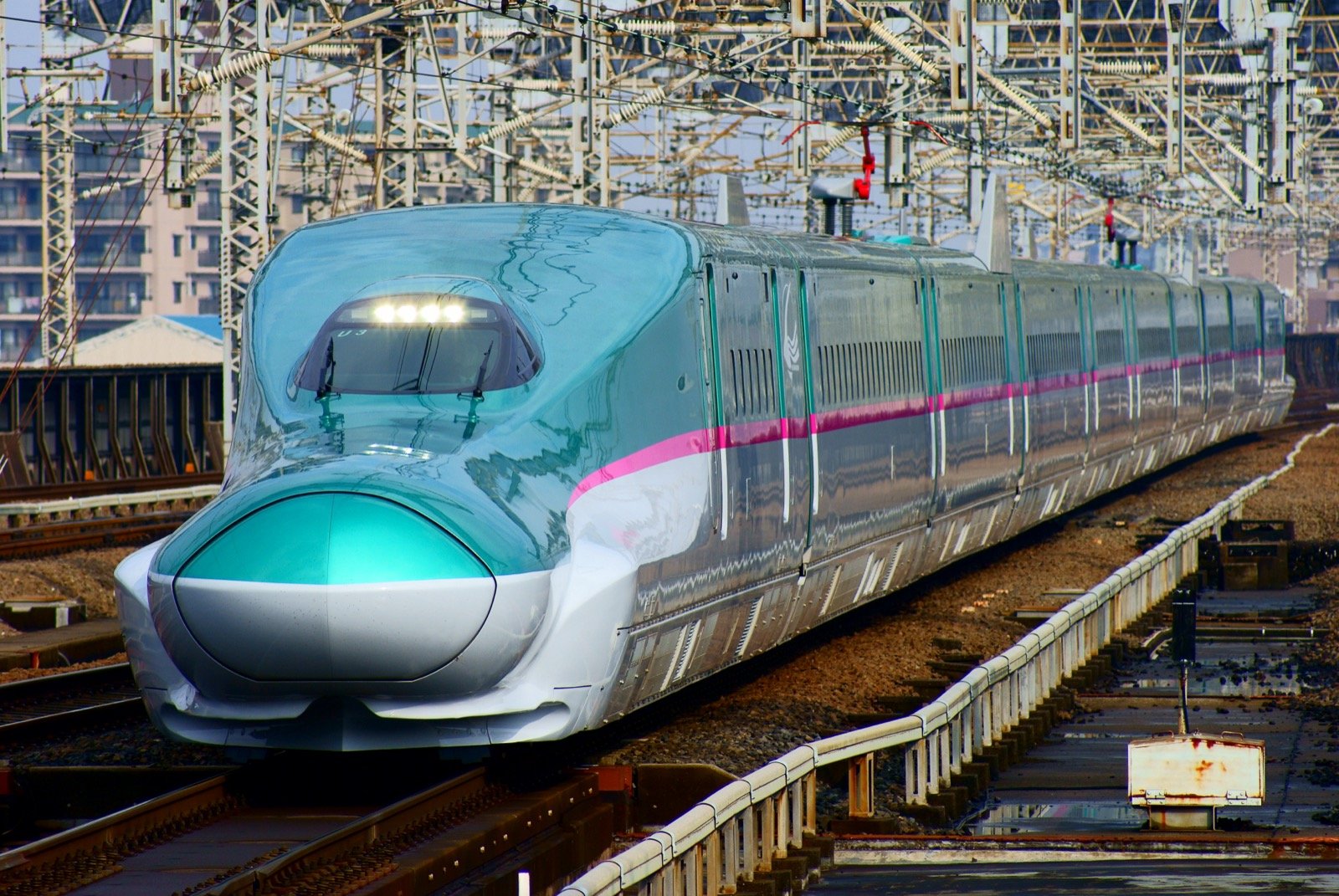
A Shinkansen E5 series trainset in Japan — the lineage India’s E10 fleet is descended from. Photo: Nanashinodensyaku / Wikimedia Commons, CC BY-SA 4.0.
What India Is Learning From Japan’s Shinkansen
The partnership’s real output is not one railway line. Japan provides technology, operational expertise and financing; India provides construction execution, local engineering firms, land and workforce. Together the stated goal is an Indian high-speed rail ecosystem — domestic capability in precast viaduct construction, tunnelling, slab-track laying and eventually rolling-stock manufacturing — that outlasts MAHSR itself and carries into the seven corridors now in planning. India is not importing a finished Japanese railway; it is importing a methodology and building the capacity to run it independently.
What the Mumbai–Ahmedabad Project Could Mean for India’s Rail Future
If MAHSR opens on anything close to its current targets and operates reliably, it becomes the reference case for whether the other seven proposed corridors move from DPR to actual construction, and on what timeline. Domestic contractors that have now built hundreds of kilometres of high-speed viaduct, cast tunnel-lining segments and laid slab track have skills that did not exist in India in 2017 — skills that a future indigenous high-speed rolling-stock programme could plausibly draw on. Whether that translates into private-sector participation, a domestic manufacturing base, or export capability is a genuinely open question that will be answered by execution over the next several years, not by this article.
Explore More Timelines
People Also Ask
Frequently Asked Questions
⚠️ Editorial Note
This article distinguishes construction completion, testing, trial operation and commercial passenger service throughout because official reporting on MAHSR frequently blurs them. Construction-progress figures (piers, viaduct, track-bed km) are drawn from NHSRCL’s public updates and Ministry of Railways statements as reported in Indian media through August 2026; cost, land-acquisition and JICA financing figures are drawn from parliamentary replies, JICA press releases and government statements cited inline. Fare figures, exact per-station completion percentages, and dates beyond the confirmed August 2027 first-section target are officials’ estimates or media projections, not settled facts, and are labelled as such. This is editorial content compiled from publicly available sources; it may contain inaccuracies and is not a substitute for NHSRCL’s or the Ministry of Railways’ own official releases.
Sources & further reading
Every dated entry above was checked against these references. Last reviewed 15 September 2026.
- National High Speed Rail Corporation Limited (NHSRCL) — Official Site
- PIB — Redefining Inter-City Mobility: High-Speed Rail Corridors in India
- JICA — ODA Loan Fifth Tranche for Mumbai-Ahmedabad High Speed Rail Project
- NewsOnAir — Railway Minister Announces 1.5 km Tunnel Milestone in MAHSR Project
- NewsOnAir — Second Mountain Tunnel Breakthrough in MAHSR Project, Palghar
- NewsOnAir — First Bullet Train to Run Between Mumbai-Ahmedabad on August 15, 2027
- Swarajya — TBM Assembly Begins for 16 km BKC-Sawli Tunnel Including 7 km Undersea Section
- Mumbai-Ahmedabad Bullet Train Progress Roundup, August 21, 2026