UAE Archaeological Discoveries Timeline: 60,000 Years of Hidden Human History
Explore the UAE archaeological discoveries timeline, from Jebel Faya tools and the Marawah pearl to Bronze Age tombs, Mleiha, Ed-Dur and Gulf trade.
Latest Story
The “60,000 years” in this headline is an editorial hook, not a scientific boundary — archaeological evidence at Jebel Faya in Sharjah now reaches back 210,000 to 120,000 years, according to dating published by the Sharjah Archaeology Authority (SAA) in Scientific Reports, superseding an earlier 125,000-year estimate from 2011. A separate 2026 study in Nature Communications documents repeated human occupation at the nearby Jebel Buhais rock shelter across roughly 60,000 to 16,000 years ago — a different site, a different dataset, and the actual source of the “60,000 years” figure people search for. Both matter, and this article keeps them separate rather than blending two sites into one number.
📑 Jump to a section18 sections
Evidence July 2026: DCT Abu Dhabi announced a major tomb (11m × 2.5m) in the Qattara Archaeological Cemetery, Al Ain, dated to the Wadi Suq and Late Bronze Age (c. 2000–1300 BCE) and built partly from re-used Umm Al Nar-period stone. It served hundreds of individuals over at least a millennium; isotopic and DNA analysis is underway.
Evidence March 2026: A Nature Communications study on the Jebel Buhais rock shelter documented repeated human occupation spanning roughly 60,000 to 16,000 years ago, showing adaptation to severe climate swings and drought — the study behind this article’s “60,000 years” hook.
Recognition 2026: Saruq Al-Hadid (Dubai) and four Sharjah sites — Jebel Faya, Khorfakkan’s historical towers/forts, Nahwa and Wadi Al Helo — were added to the ICESCO Heritage List. Jebel Faya also received a Dh2 million research grant for 2026–2028.
Evidence July 2025 (recognition), January 2025 (fieldwork): UNESCO inscribed Sharjah’s Faya Palaeolandscape as a World Heritage Site — the only Arab-region inscription that year, and the first desert Palaeolithic site on the list. Separately, a new DCT Abu Dhabi fieldwork campaign on Sir Bani Yas Island uncovered a Christian cross moulded on a plaster plaque, announced August 2025.
📌 UAE Archaeology in 100 Words — AI Overview
Stone tools at Jebel Faya, Sharjah, show human presence in Arabia 210,000 to 120,000 years ago. Marawah Island preserves the UAE’s earliest known architecture and, in a layer dated to 5,800–5,600 BCE, what Abu Dhabi authorities call the world’s oldest known natural pearl. Hafit-period beehive tombs (c. 3200–2700 BCE) and the Umm Al Nar culture (c. 2600–2000 BCE) reveal organised Bronze Age societies trading with Mesopotamia and the Indus Valley. Iron Age Saruq Al-Hadid and falaj irrigation followed. Mleiha and Ed-Dur later connected the region to Rome, Persia and India, before Christian communities at Sir Bani Yas and Siniya Island, then early Islamic Julfar.
UAE Archaeology: Key Questions
Key Takeaways
- The territory of the modern UAE was not an isolated desert — for tens of thousands of years it sat at a crossroads of migration, maritime trade and oasis agriculture.
- Jebel Faya’s evidence now runs to 210,000 years, per Sharjah Archaeology Authority dating in Scientific Reports — well beyond the “60,000 years” headline figure, which actually comes from a separate Jebel Buhais rock-shelter study.
- Marawah Island preserves the UAE’s earliest known architecture and, in a 5,800–5,600 BCE layer, the pearl Abu Dhabi authorities call the world’s oldest known natural pearl.
- Hafit tombs (c. 3200–2700 BCE) and the Umm Al Nar culture (c. 2600–2000 BCE) show organised Bronze Age society with real Mesopotamian and Indus Valley trade links, not isolated settlement.
- Falaj irrigation in southeast Arabia is now understood by most specialists to predate its introduction into Iran by several centuries — a regional-priority claim, not a “UAE invented irrigation” claim.
- Saruq Al-Hadid, a major Iron Age metalworking site under Dubai’s desert, was found in 2002 when Sheikh Mohammed bin Rashid Al Maktoum spotted dark, ore-stained sand from a helicopter.
- Mleiha and Ed-Dur connected pre-Islamic southeast Arabia to Rome, Parthia/Persia and India through coins, glass and pottery — trade evidence, not political rule by any of those powers.
- Christian communities existed in the pre-Islamic and early Islamic Gulf: a monastery at Sir Bani Yas (7th–8th century CE) and, discovered more recently, a monastery and pearling town on Siniya Island.
- The word “oldest” throughout this article means “oldest currently documented” — archaeology is cumulative, and new excavation regularly revises dates.
- New discoveries are still arriving: a major Al Ain tomb (July 2026), a Jebel Buhais climate-adaptation study (March 2026), and five UAE sites added to the ICESCO Heritage List (2026).
Before Dubai: 210,000 Years of UAE History in One Timeline
The condensed version — each stage is covered in full in the master timeline below.
The real story is not a list of ruins. It is that this stretch of southeastern Arabia has repeatedly been a place people moved through, settled and traded across — connecting Africa, Mesopotamia, Persia and India long before oil, federation or skyscrapers entered the picture.
UAE Archaeological Timeline: Palaeolithic to Early Islamic Era
Chronological, oldest first — site, emirate, what was found, why it matters, and when archaeologists actually found it.
120,000 BP
Jebel Faya: Earliest Evidence of Human Presence
What was found: 18 archaeological layers in a rock shelter, including stone hand-axes and tool assemblages resembling early modern-human toolkits from East Africa, luminescence-dated across a span of roughly 210,000 to 120,000 years.
Why it matters: It is the oldest currently documented evidence of human presence in the UAE, and one of the strongest data points for repeated, adaptable human occupation of arid Arabia rather than a single migration event.
4300 BCE
Jebel Buhais: A Necropolis Spanning Four Ages
What was found: An extensive necropolis with hundreds of Neolithic burials (carbon-dated to the early 5th millennium BCE) containing jewellery of seashell, oyster pearl and carnelian, plus later Bronze, Iron and Hellenistic-age graves at the same site.
Why it matters: It documents nomadic herding communities in eastern Arabia well before permanent settlement appears elsewhere, and — via a separate rock-shelter study nearby — repeated human occupation across roughly 60,000 to 16,000 years.
BCE
Ghagha Island: Among the Earliest Known Buildings
What was found: Simple circular stone rooms preserved nearly a metre high, carbon-14 dated to at least 8,500 years old, alongside stone arrowheads and a later burial from about 5,000 years ago.
Why it matters: DCT Abu Dhabi says the find shows settled Neolithic life developing from local conditions, ahead of the long-distance maritime trade that later defined the region.
5,600 BCE
Marawah Island: Village, Pearls and the UAE’s Earliest Architecture
What was found: Collapsed Neolithic stone structures — the UAE’s earliest known architecture — with multiple rooms and animal-keeping areas, imported ceramics, worked flint, painted plaster fragments, and, in a layer dated to 5,800–5,600 BCE, a small pink pearl.
Why it matters: DCT Abu Dhabi describes the “Abu Dhabi Pearl” as the world’s oldest known natural pearl, and the earliest known evidence of pearling found anywhere — proof that Gulf pearling predates commercial pearling by thousands of years, not evidence of continuous industrial-scale pearling since the Neolithic.
2700 BCE
Hafit Period: The UAE’s Beehive Tombs
What was found: More than 500 domed stone tombs at the foot of Jebel Hafeet, each a single chamber 2–3m wide within a ring wall 3–4m tall, containing imported pottery linking the site to Mesopotamia, Iran and the Indus Valley.
Why it matters: These are the earliest clear evidence of organised, monumental burial practice in the region, and the namesake period for the Bronze Age chronology used across southeast Arabia.
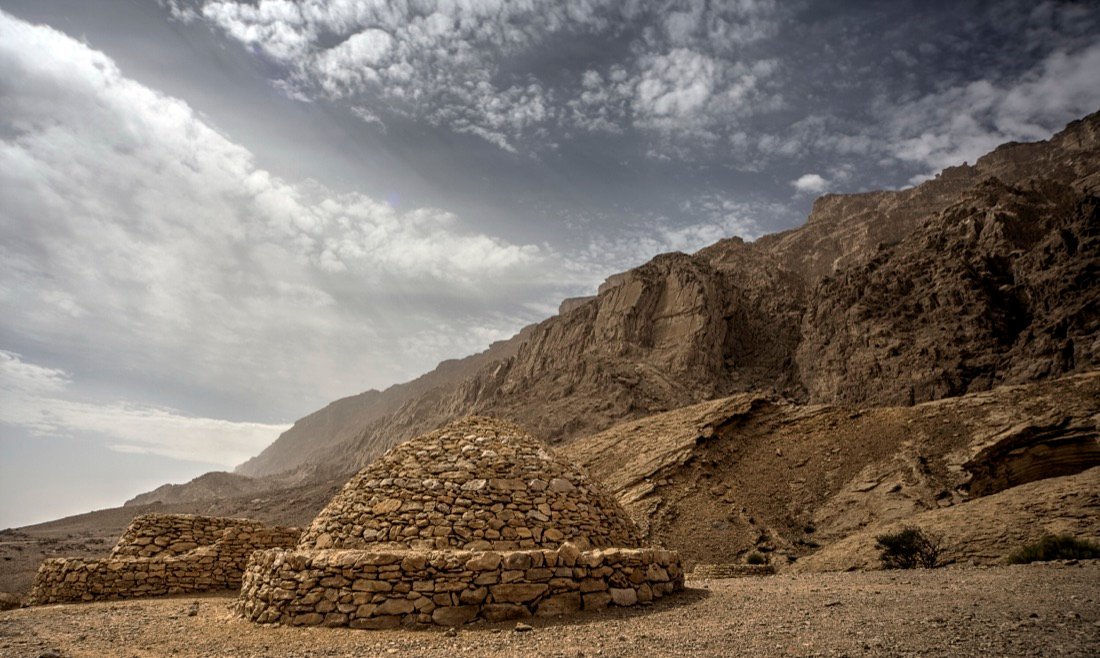
Hafit-period beehive tombs, Jebel Hafeet, Al Ain · UNESCO World Heritage Site since 2011. Wikimedia Commons, CC BY-SA 4.0.
2000 BCE
Umm Al Nar: The Bronze Age Culture That Connected the Gulf
What was found: Circular above-ground tombs 6–12m in diameter with well-fitted outer walls and multiple burial chambers, plus a substantial settlement on Umm Al Nar island active in regional commerce.
Why it matters: Artefacts show trade with both Mesopotamia and the Indus Valley Civilisation — imported carved soapstone vessels and carnelian beads point to the culture acting as a maritime link between the two, not an isolated local society.
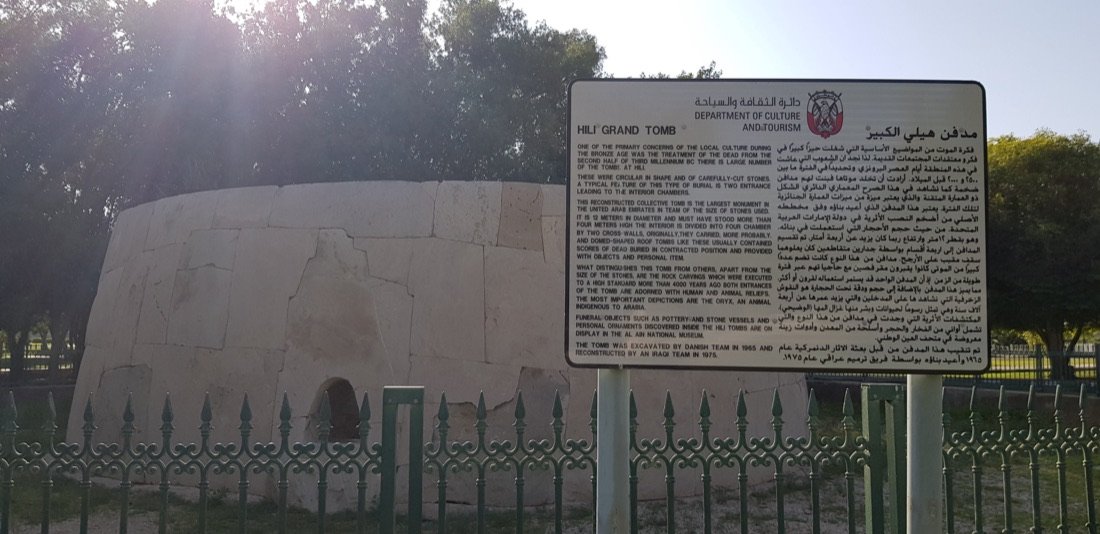
Hili Grand Tomb, Al Ain — an Umm Al Nar-period circular tomb, part of the largest Bronze Age site in the UAE. Wikimedia Commons, CC BY-SA 4.0.
BCE
Falaj Irrigation Reaches Al Ain
What was found: Underground gravity-fed water channels (aflaj) linked to Iron Age II settlements; tufa dating from a falaj near Nizwa places functioning channels in the 10th–9th century BCE, roughly 400 years before Achaemenid Persian influence in the region.
Why it matters: Most specialists working in southeast Arabia now agree qanat/falaj technology was in use here from the start of Iron Age II — evidence for a regional priority claim, not proof the UAE alone invented underground irrigation, which several ancient regions developed independently.
700 BCE
Muweilah: An Iron Age Settlement in Sharjah
What was found: A fortified 4–5 hectare Iron Age II settlement of twelve buildings, including a columned administrative hall (Building II) with west-Iranian architectural influence, destroyed in a single catastrophic fire around 700 BCE.
Why it matters: The fire preserved thousands of artefacts, animal bones and plant remains in place — an unusually complete snapshot of a complex desert settlement rather than a simple camp.
1,300 BP
Saruq Al-Hadid: Metalworking Beneath the Dubai Desert
What was found: A remote desert metalworking centre active from roughly 5,000 years ago, peaking in the Iron Age about 3,000 years ago and continuing almost to the early Islamic period, with about 10,000 bronze, iron and gold objects recovered from an estimated 10% of the site.
Why it matters: The scale of production — far beyond local need — points to organised trade with the wider region, and its location deep in the desert, away from any visible water source, remains archaeologically unusual.
3rd c. CE
Mleiha: Coins, Camels and a Trading Kingdom
What was found: A major pre-Islamic trading centre with a coin-casting mould, Roman coins (Augustus, Tiberius), Nabataean, Seleucid and Indian coins, monumental tombs, and burials of camels and horses — including camel-hybrid remains — buried beside their owners.
Why it matters: From the early 3rd century BCE, Mleiha was a key waypoint for caravans crossing the Arabian Peninsula, linking Indian Ocean and Mediterranean trade networks by camel — not merely a local oasis settlement.
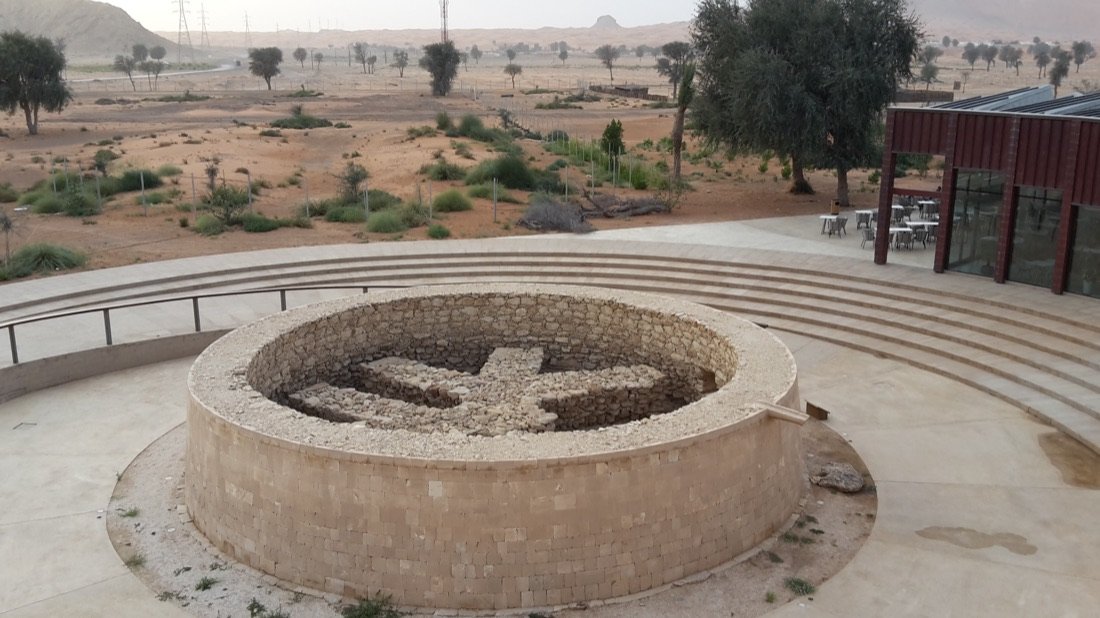
An excavated tomb at Mleiha, Sharjah — a site occupied from the Bronze Age through the pre-Islamic trading kingdom. Wikimedia Commons.
2nd c. CE
Ed-Dur: One of the Gulf’s Major Ancient Trading Settlements
What was found: A temple to Shamash, the pre-Islamic sun deity, and coins from Rome (Augustus, Tiberius), Nabataea, Characene (southern Mesopotamia), South Arabia, Parthia/Persis and India, alongside Roman glass and Parthian pottery.
Why it matters: Ed-Dur’s finds place it inside the trade world described in the Periplus of the Erythraean Sea — linking Roman Egypt and the eastern Mediterranean with India via the Gulf — but the coins are evidence of trade contact, not of Roman, Parthian or Persian political rule over the site.
8th c. CE
Sir Bani Yas: A Christian Monastery in the Gulf
What was found: A church, monastery and courtyard houses dating to the 7th–8th centuries CE, discovered by the Abu Dhabi Islands Archaeological Survey in 1992, with a January 2025 fieldwork campaign uncovering a Christian cross moulded on a plaster plaque.
Why it matters: Evidence links the community to the Church of the East, a denomination that reached from the Middle East to India and China — documenting the religious diversity of the Gulf before and during the early Islamic centuries, not a contradiction of Islamic history.
mid-8th c. CE
Siniya Island: A Monastery and the Gulf’s Oldest Known Pearling Town
What was found: A previously unknown Late Antique/early Islamic monastery, plus a roughly 12-hectare pearling town with courtyard buildings, dense housing, oyster-shell middens, several pearls and the earliest well-dated pearl diver’s weight yet found in the Emirates.
Why it matters: The Umm Al Quwain Department of Tourism and Archaeology describes it as the oldest pearling town found in the Arabian Gulf and one of the largest surviving urbanised settlements yet found in the UAE, comparable in scale to medieval Julfar.
15th c. CE
Julfar: The Port That Connected the Gulf to the Indian Ocean
What was found: A major medieval Gulf port town, with imported Chinese porcelain and Southeast Asian ceramics excavated at the al-Nudud site, exporting pearls, dates and horses across a network reaching Africa, India, Southeast Asia and China.
Why it matters: At its 14th–15th century peak, Julfar was one of the most important Gulf ports for pearls and taxes — direct archaeological continuity between ancient Gulf trade and the pearling economy that shaped the region right up to the 20th century, before oil.
Jebel Faya: Evidence of Early Humans in Arabia
A stone tool is easy to overlook. At Jebel Faya, a handful of carefully shaped rocks helped reopen one of archaeology’s biggest questions.
Jebel Faya sits in a rock shelter in the Buhais-Faya mountain range near Al Madam, Sharjah. Since 2003, a joint University of Tübingen and Sharjah Archaeology Authority project has cut through 18 distinct archaeological layers spanning the Middle Palaeolithic through the Neolithic. Luminescence dating — which measures when quartz grains in stone tools or sediment were last exposed to light — placed the earliest tool assemblage at roughly 125,000 years old when first published in Science in 2011. Subsequent SAA research, published in Scientific Reports, extended the documented occupation window to between 210,000 and 120,000 years ago.
The tools themselves resemble East African hand-axe traditions of a similar age. Debated That resemblance supports the possibility of an early human dispersal through Arabia rather than solely along the Nile-Levant corridor — but it is one line of evidence feeding a live scientific debate, not proof of a single migration route. In July 2025, UNESCO inscribed the site as the “Faya Palaeolandscape,” the only Arab-region World Heritage inscription that year and the first desert Palaeolithic site on the list.
Did Early Humans Travel Through the UAE?
Evidence versus interpretation, kept separate.
Two broad models compete for how modern humans first reached Asia: a “northern route” through the Levant and Sinai, and a “southern route” across the Bab-el-Mandeb strait into Arabia and onward toward South Asia. Jebel Faya’s early dates and East African-style tools are cited as evidence for the southern route being viable earlier than once assumed. Climate matters here: during wetter interglacial periods, Arabia held lakes, grasslands and river systems that would have made a Red Sea crossing and inland movement far more plausible than today’s hyper-arid desert suggests — a shift researchers call “Green Arabia.”
EVIDENCE
Early, well-dated stone tools at Jebel Faya; palaeoclimate data showing wetter Arabian periods capable of supporting migration corridors.
DEBATED INTERPRETATION
Whether Jebel Faya specifically documents the “southern route” out of Africa, as opposed to one of several possible dispersal pulses.
WHAT IT DOESN’T SHOW
A single, dated, unbroken migration path from Africa to South Asia through the UAE — no site provides that level of continuous evidence.
WHY IT MATTERS
Jebel Faya reopened this question by showing Arabia was climatically viable for human movement far earlier than older models assumed.
The Abu Dhabi Pearl, and Pearling Before Oil
The Abu Dhabi Pearl is faint pink, about 0.3cm long, and was recovered from a Marawah Island layer radiocarbon-dated to 5,800–5,600 BCE. DCT Abu Dhabi describes it as the world’s oldest known natural pearl and the earliest known evidence of pearling anywhere — a claim tied to current archaeological knowledge, not a permanent ceiling on what future excavation might find. Alongside it, Marawah’s stone houses represent the UAE’s earliest known architecture, standing for several hundred years and including outdoor space for animals and food preparation.
It is tempting to draw a straight line from this single Neolithic pearl to the pearling towns that anchored the pre-oil Gulf economy into the 20th century — sites like Julfar and, more recently, Siniya Island. The archaeological record supports pearling as a genuinely ancient Gulf practice, but not an unbroken, continuously commercial industry across eight millennia; the scale, organisation and export economy of historic pearling towns developed much later, as places like Siniya (6th–8th century CE) and Julfar (medieval period) show.
Bronze Age Trade: Magan, Mesopotamia and the Indus Valley
Hafit and Umm Al Nar communities were not trading in isolation.
Mesopotamia (Sumer & Akkad)
Cuneiform tablets describe a copper- and diorite-trading partner called “Magan,” including a recorded 20-ton copper shipment around 1800 BCE. Copper-artefact chemical analysis links Mesopotamian imports to Bronze Age mining sites across the Oman Peninsula.
Indus Valley Civilisation
Indus pottery, carnelian beads and carved soapstone vessels appear at Umm Al Nar-culture sites; Indus seals and beads found in interior Oman suggest Indus merchants themselves were present in the region during the late 3rd millennium BCE.
Magan
Modern archaeological and geological evidence places Magan across Oman and the UAE, but its precise territorial boundaries — and whether the UAE alone can claim the name — remain debated among specialists, not settled by any single excavation.
Copper
Southeast Arabian copper mining and smelting fed Mesopotamian demand across the Bronze Age; over 150 copper sites have been identified across the Oman Peninsula, with production concentrated more heavily in modern Oman than the UAE.
🛣 Was the UAE Part of Magan?
Not as a settled, uncontested fact. Scholars generally associate the Mesopotamian-texts’ “Magan” with the copper- and stone-producing region spanning present-day Oman and the UAE, based on chemical matches between Mesopotamian copper artefacts and Omani ore deposits. But Magan’s exact borders, its relationship to the modern UAE specifically, and whether it functioned as a single polity at all remain live scholarly questions — “the UAE was Magan” overstates a genuinely nuanced, still-debated identification.
Saruq Al-Hadid: The Metalworking Mystery Beneath Dubai’s Desert
In 2002, Sheikh Mohammed bin Rashid Al Maktoum, Ruler of Dubai, was flying over the desert by helicopter when he noticed an unusual dark patch of sand — ore residue staining the dunes. That observation led archaeologists to Saruq Al-Hadid, a site with no visible water source, far from any obvious reason for permanent settlement, yet used for metalworking from roughly 5,000 years ago through to almost the early Islamic period, peaking in the Iron Age about 3,000 years ago.
With only an estimated 10% of the site excavated, researchers have already recovered around 10,000 objects — bronze, iron and gold implements, jewellery, shell discs and bronze snake figurines — now displayed at Dubai’s Saruq Al-Hadid Archaeological Museum in Shindagha. The scale of production points to a trade centre rather than a small workshop, though exactly why this specific, waterless desert spot became a metalworking hub remains an open archaeological question. Saruq Al-Hadid was added to the ICESCO Heritage List in 2026.
Christianity in the Pre-Islamic and Early Islamic Gulf
Long before either site was excavated, written sources hinted that Christianity had reached the Gulf via the Church of the East, a denomination whose network stretched from the Middle East to India and China. Archaeology confirmed it. On Sir Bani Yas Island, the Abu Dhabi Islands Archaeological Survey found a 7th–8th century CE church, monastery and courtyard houses in 1992; a new DCT Abu Dhabi fieldwork campaign in January 2025 added a Christian cross moulded on plaster, announced that August. On Siniya Island, Umm Al Quwain, a previously unknown monastery was found alongside a roughly 12-hectare pearling town, both dated to the late 6th through mid-8th centuries CE and announced in 2023.
Together, the two sites document a genuinely mixed religious landscape in Late Antique and early Islamic southeast Arabia — evidence of coexistence and continuity through the transition to Islam, not a contradiction of it.
How Do Archaeologists Know These Sites Are Thousands of Years Old?
No single method carries a UAE excavation. Radiocarbon dating measures decaying carbon-14 in organic material — bone, shell, charcoal — and dated the Ghagha Island buildings and the Marawah pearl layer. Luminescence dating (used at Jebel Faya) measures when quartz grains in stone tools or sediment last saw sunlight, useful where no organic material survives. Stratigraphy — reading the sequence of soil and occupation layers, as at Jebel Faya’s 18 layers — establishes relative order even before absolute dates are attached. Pottery typology, comparing imported ceramic styles to dated sequences elsewhere (Mesopotamia, the Indus Valley), helped date Hafit and Umm Al Nar trade contacts. Isotopic and DNA analysis, now underway on the 2026 Qattara Cemetery tomb, adds diet, health and migration data on top of a site’s basic chronology.
UAE Archaeological Sites by Emirate
| Emirate | Major Site | Period | Why It Matters |
|---|---|---|---|
| Abu Dhabi | Marawah Island | Neolithic | Earliest architecture + world’s oldest known natural pearl |
| Abu Dhabi | Jebel Hafeet / Hili | Bronze Age | Beehive tombs, Umm Al Nar tombs, Mesopotamian/Indus trade |
| Abu Dhabi | Sir Bani Yas | Late Antique (7th–8th c. CE) | Christian monastery, Church of the East |
| Abu Dhabi | Qattara Cemetery, Al Ain | Wadi Suq / Late Bronze Age | Major tomb announced July 2026, isotopic/DNA study underway |
| Dubai | Saruq Al-Hadid | Iron Age (peak) | Major metalworking centre, discovered 2002 |
| Sharjah | Jebel Faya | Palaeolithic | Earliest human evidence in the UAE, UNESCO 2025 |
| Sharjah | Jebel Buhais | Neolithic–Hellenistic | Multi-period necropolis; 60,000–16,000-year occupation study |
| Sharjah | Muweilah | Iron Age II | Fortified settlement preserved by a catastrophic fire |
| Sharjah | Mleiha | Pre-Islamic (3rd c. BCE–3rd c. CE) | Coins, camel burials, Arabian trade hub |
| Umm Al Quwain | Ed-Dur | Pre-Islamic (1st c. BCE–2nd c. CE) | Temple of Shamash, Roman/Parthian/Indian trade goods |
| Umm Al Quwain | Siniya Island | Late Antique–early Islamic | Monastery + Gulf’s oldest known pearling town |
| Ras Al Khaimah | Julfar (Kush, al-Mataf, al-Nudud) | Medieval (peak 14th–15th c.) | Indian Ocean port; pearls, dates, horses to China |
10 UAE Archaeological Discoveries That Changed Gulf History
Ranked by historical significance, not headline size.
What UAE Archaeology Proves — and What It Doesn’t
| Claim | Evidence Level |
|---|---|
| Humans lived in Arabia deep in prehistory | Strong evidence |
| Jebel Faya proves one exact Out-of-Africa migration route | Debated |
| The UAE had organised Neolithic settlements | Strong evidence |
| Pearling existed in the UAE thousands of years ago | Strong evidence |
| Ancient southeast Arabia traded internationally | Strong evidence |
| The UAE was definitively ancient Magan | More nuanced / debated |
| Falaj irrigation was invented exclusively in the UAE | Debated (regional priority claim, not exclusivity) |
| Rome politically ruled the UAE | Not supported — trade evidence only |
| Christian communities existed in the pre-Islamic/early Islamic Gulf | Strong evidence |
| “Oldest” claims (pearl, buildings, etc.) are permanent records | Not supported — means oldest currently documented |
Latest UAE Archaeological Discoveries, 2024–2026
| Date | Site / Emirate | Discovery | Source |
|---|---|---|---|
| Jan 2024 | Ed-Dur, Umm Al Quwain | New Roman coins and a possible shrine from renewed excavation | The National |
| Jul 2025 | Faya, Sharjah | UNESCO World Heritage inscription (Faya Palaeolandscape) | UNESCO |
| Jan/Aug 2025 | Sir Bani Yas, Abu Dhabi | Christian cross moulded on plaster, new fieldwork campaign | DCT Abu Dhabi / The National |
| Mar 2026 | Jebel Buhais, Sharjah | Rock-shelter study: repeated occupation 60,000–16,000 years ago | Nature Communications |
| Jul 2026 | Qattara Cemetery, Al Ain | Major Wadi Suq/Late Bronze Age tomb, isotopic/DNA study underway | DCT Abu Dhabi |
| 2026 | Dubai & Sharjah (5 sites) | ICESCO Heritage List inscriptions: Saruq Al-Hadid, Jebel Faya, Khorfakkan towers, Nahwa, Wadi Al Helo | ICESCO |
| 2026 | Faya, Sharjah | Dh2 million research grant approved for 2026–2028 | Sharjah Archaeology Authority |
Explore More Timelines
People Also Ask
Frequently Asked Questions
The UAE Before the Skyscrapers
Modern UAE history is usually told through oil, federation, cities and rapid development. Archaeology pushes the starting point back much further — and keeps pushing it. Stone tools at Jebel Faya, now dated to 210,000 years ago, raise real questions about early human migration through Arabia. Marawah preserves evidence of Neolithic community life and the world’s oldest known natural pearl. Hafit and Umm Al Nar tombs reveal organised Bronze Age societies trading with Mesopotamia and the Indus Valley. Mleiha and Ed-Dur connected the region to Rome, Persia and India. Sir Bani Yas and Siniya Island show a genuinely mixed religious landscape before and during the rise of Islam.
The discoveries don’t tell one simple story. They reveal repeated cycles of migration, climate change, settlement, trade and adaptation across tens of thousands of years — and because excavation continues, at Jebel Faya, at Qattara, at Siniya, the timeline is still changing.
⚠️ Editorial Note
This page separates directly cited evidence from genuine scholarly debate and clearly labels superlatives (“oldest known,” “world’s oldest”) as reflecting current archaeological knowledge, not permanent records. Compiled from Sharjah Archaeology Authority, Abu Dhabi’s Department of Culture and Tourism, UNESCO, Umm Al Quwain’s Department of Tourism and Archaeology, and peer-reviewed research including Science, Scientific Reports and Nature Communications. Updated as new excavation results are published; not a substitute for primary academic sources.
Sources & further reading
Every dated entry above was checked against these references. Last reviewed 15 September 2026.
- Sharjah Archaeology Authority - Jebel Faya rock shelter dating to 200,000+ years
- DCT Abu Dhabi - Abu Dhabi Pearl: World's Oldest Known Natural Pearl, Marawah Island
- Abu Dhabi Culture - Hafit Tombs, UNESCO World Heritage Site
- Abu Dhabi Culture - Umm Al Nar Bronze Age culture
- DCT Abu Dhabi - New Abu Dhabi archaeological discoveries reveal 8,500-year-old buildings, Ghagha Island
- The National - Ancient Christian cross found on Sir Bani Yas Island
- Khaleej Times - Oldest pearling town in the Arabian Gulf discovered on Siniya Island
- The National - Roman coins and possible shrine unearthed at Ed-Dur, Umm Al Quwain