Fukushima Nuclear Disaster: Timeline of Failures, Impact and Legacy
Fukushima nuclear disaster timeline: 2011 earthquake and tsunami, three meltdowns, radiation findings, treated-water releases and the decades-long cleanup.
Latest Story
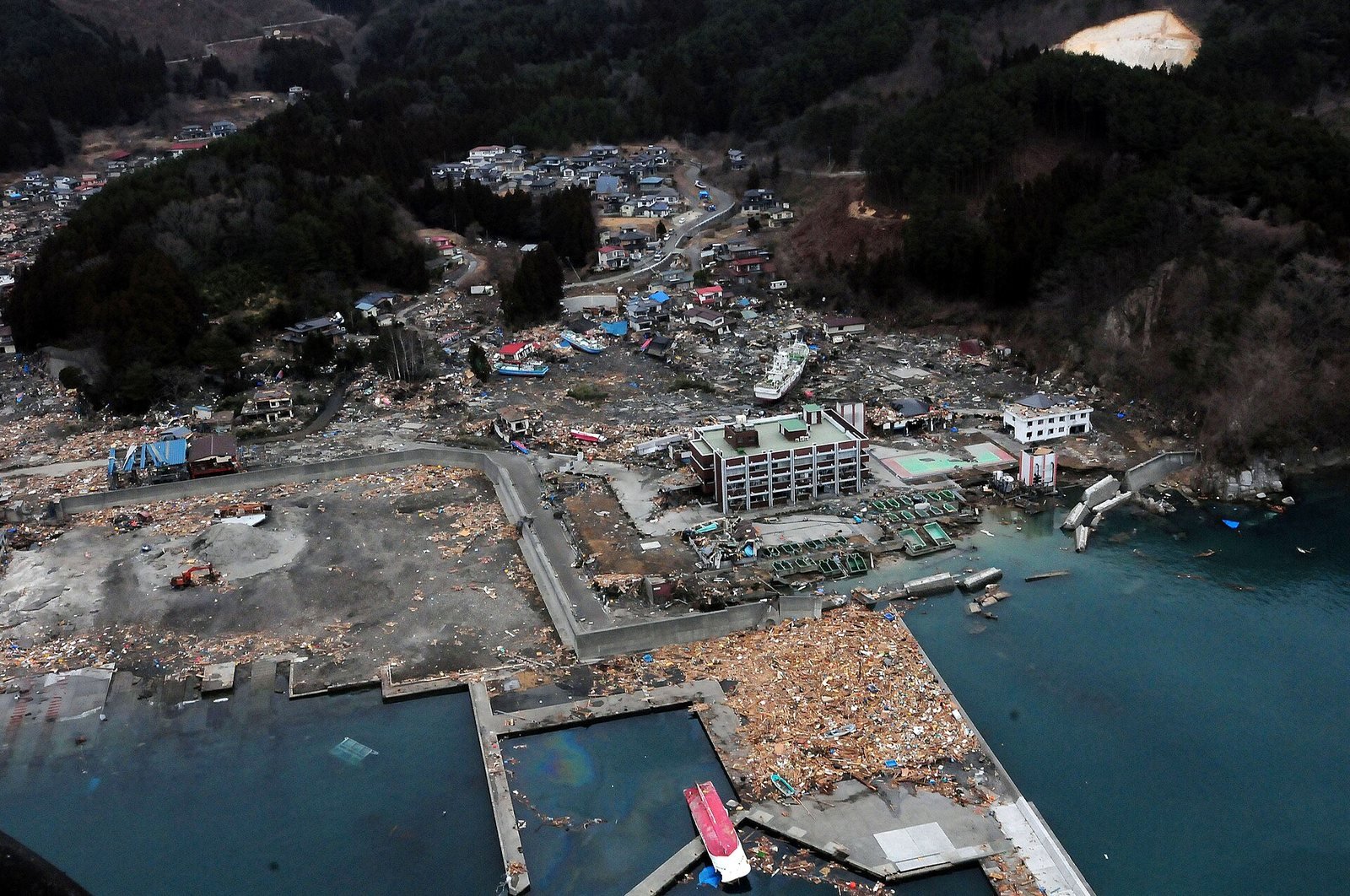
The Fukushima nuclear disaster began on 11 March 2011, when a magnitude 9.0 earthquake and the tsunami that followed cut power and cooling at the Fukushima Daiichi nuclear power station in Japan. The fuel in three reactors melted, hydrogen explosions wrecked four reactor buildings, and radioactive material spread over land and sea. It was rated Level 7, the highest on the international scale, alongside Chernobyl. The earthquake and tsunami killed more than 15,900 people; those deaths were not caused by radiation. Fifteen years on, removing the melted fuel and releasing treated water are still under way, with decommissioning targeted for around 2051.
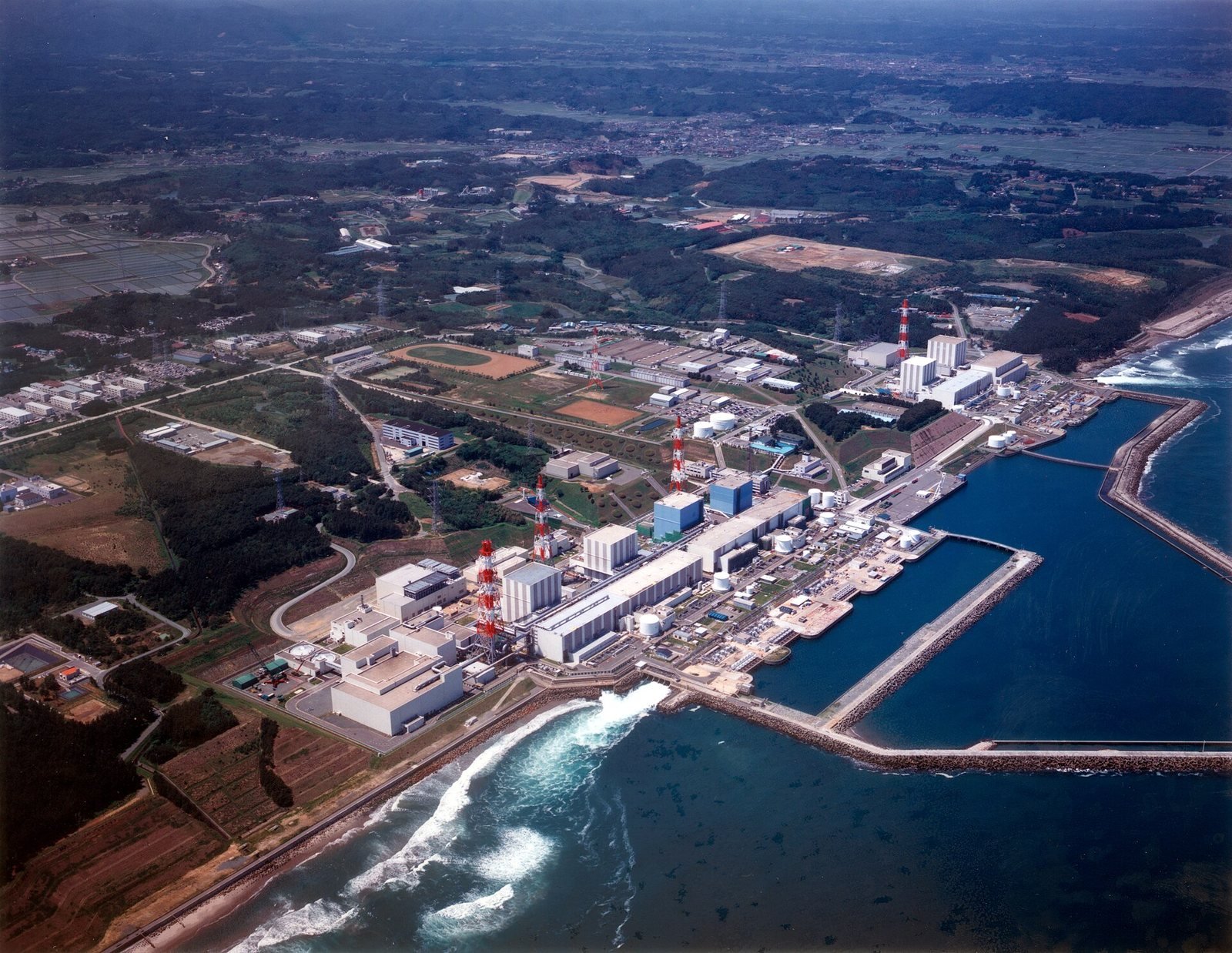
Treated water: the 25th release since August 2023 began on 26 October 2026 and is due to finish by 13 November (IAEA).
- IAEA review: sixth review mission since the discharge began, 11–15 May 2026 (METI).
- Unit 1: large cover finished 19 January 2026; spent-fuel removal planned for fiscal 2027–2028 (TEPCO).
- Melted fuel: two small samples taken from Unit 2; full-scale removal not before 2037.
- Next update: when new IAEA reports, TEPCO decommissioning updates or Japanese government figures are published.
💡 Short Answer
The Fukushima nuclear disaster was a reactor accident at the Fukushima Daiichi plant in Japan that began on 11 March 2011. A tsunami about 15 metres high flooded backup power, cooling failed and three reactor cores melted, with hydrogen explosions and radioactive releases. It is rated INES Level 7. UNSCEAR has found no documented radiation health effects among residents; the more than 15,900 deaths in the region were caused by the earthquake and tsunami. Clean-up is expected to last until about 2051.
Fukushima Nuclear Disaster: Key Questions
The Fukushima Nuclear Disaster in Nine Points
- Trigger: a magnitude 9.0 earthquake and a tsunami about 15 metres high on 11 March 2011.
- Failure: loss of all power and cooling at a plant designed for a 5.7-metre tsunami.
- Meltdowns: Units 1, 2 and 3; hydrogen explosions at Units 1, 3 and 4.
- Rating: INES Level 7, like Chernobyl, but with roughly a tenth of its release.
- Deaths: the 15,901 tsunami deaths were not radiation deaths.
- Health: no documented radiation-attributable effects among residents, per UNSCEAR.
- Displacement: about 160,000 evacuees at the peak; 22,625 still in 2026.
- Water: treated-water releases since August 2023; 25th round in October 2026.
- Clean-up: melted-fuel removal from 2037 at the earliest; goal of about 2051.
Fukushima Nuclear Disaster Timeline: Key Events, Latest First
From the latest treated-water release back to the earthquake of 11 March 2011. Each entry is tagged and ends with why it matters.
2026
25th release of treated water begins Latest
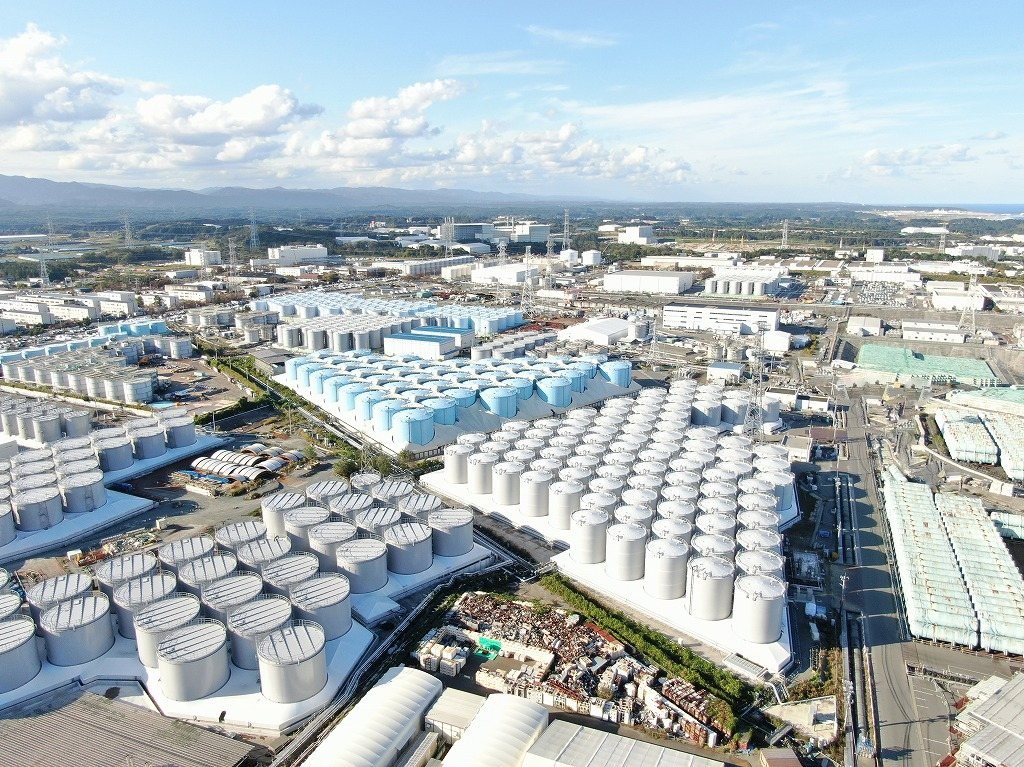
TEPCO began the 25th discharge of ALPS-treated water since August 2023, about 7,800 tonnes diluted with seawater and released through a tunnel roughly 1 km offshore, scheduled to finish by 13 November. The IAEA said its independent check of this batch found tritium far below Japan’s operational limit of 1,500 becquerels per litre, and that about 188,000 cubic metres had been discharged in total since 2023 (IAEA; TEPCO discharge history).
TEPCO plans about 62,400 tonnes in eight rounds in the fiscal year to March 2027. This is a planned, monitored release of treated and diluted water, a different process from the uncontrolled releases of March 2011.
2026
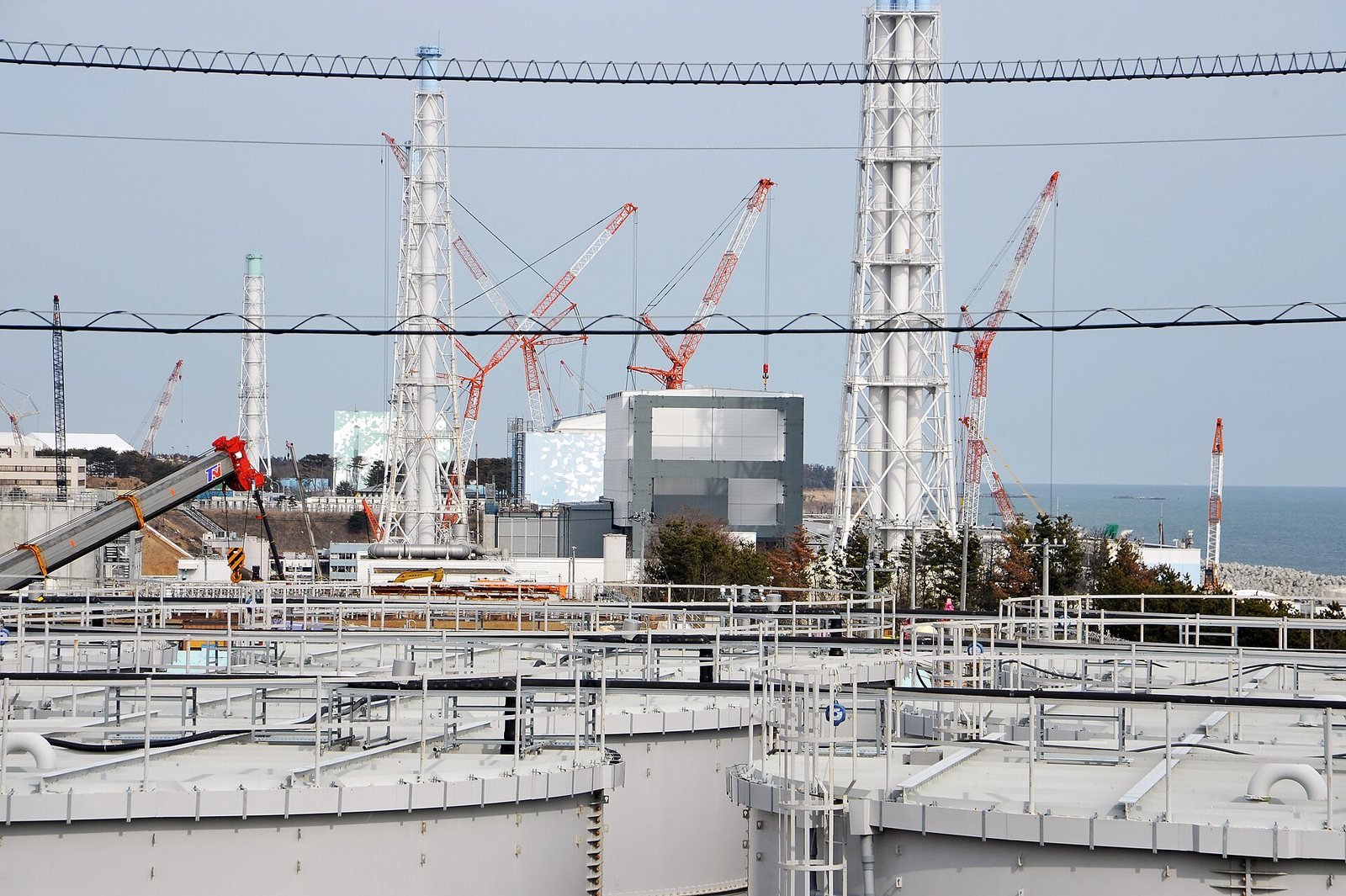
IAEA’s sixth review mission since the discharge began Treated water
Six IAEA officials and eight international experts, from Argentina, Canada, China, France, South Korea, Russia, the United States and Vietnam, reviewed on-site and sea-area monitoring and visited the discharge facilities and tank-dismantling areas (METI, 15 May 2026). The report of the previous, fifth mission (December 2025) found nothing inconsistent with international safety standards (IAEA report, PDF).
The programme remains contested, particularly among fishing communities and in neighbouring countries. The IAEA’s technical findings and those concerns are both part of the continuing debate.
2026
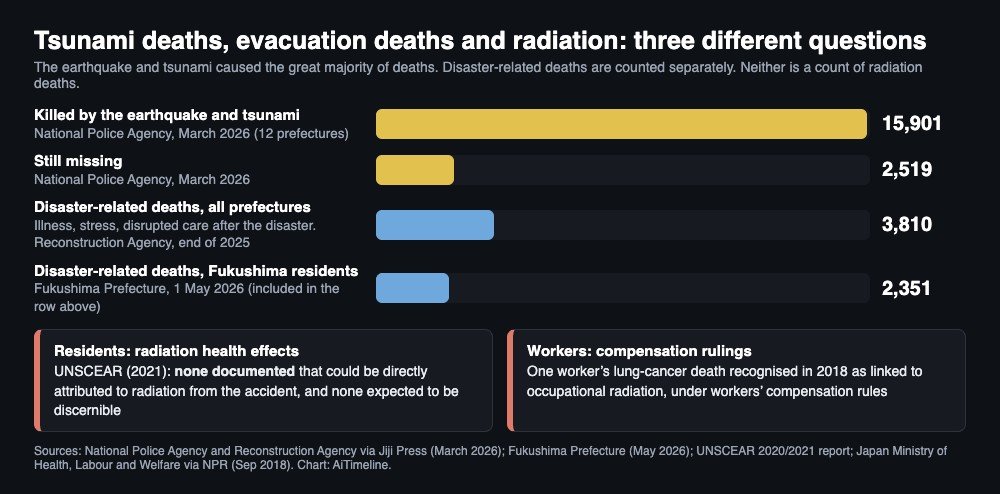
15 years on: 2,519 still missing, 26,281 still displaced People & health
Police put the earthquake and tsunami toll at 15,901 dead and 2,519 missing. Separately, the Reconstruction Agency counted 3,810 “disaster-related” deaths, from causes such as illness and stress during evacuation, as of the end of 2025. About 26,281 people were still listed as evacuees nationwide on 1 February 2026, and evacuation orders remained in parts of seven Fukushima municipalities (Jiji Press via Adnkronos).
Fukushima Prefecture counted 2,351 disaster-related deaths of its own residents as of 1 May 2026, more than any other prefecture (Fukushima Prefecture).
2026
Large cover completed over the Unit 1 reactor building Decommissioning
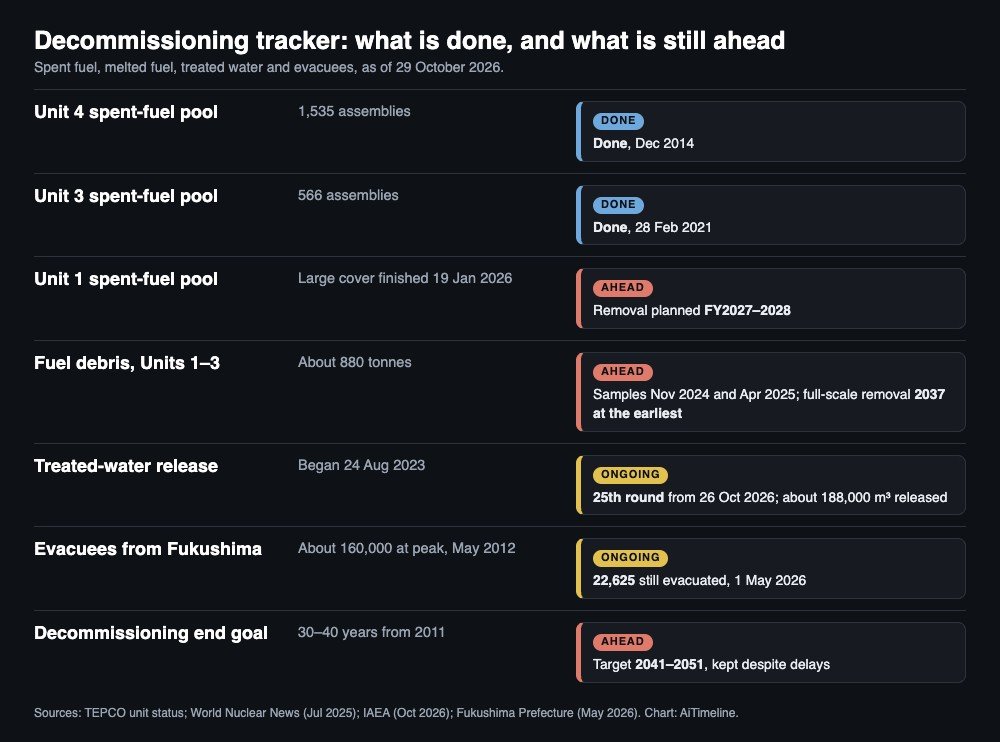
TEPCO finished installing a large cover over Unit 1 to limit dust and rainwater while rubble is cleared from the damaged upper floor. An overhead crane and dust-monitoring equipment were being commissioned for rubble removal, and removal of the fuel still in Unit 1’s spent-fuel pool is planned for fiscal 2027–2028 (TEPCO unit status).
2025
China halts Japanese seafood imports again Treated water
China banned all Japanese seafood on the day discharges began in August 2023. It allowed imports to resume from most prefectures in June 2025, keeping Fukushima and nine other prefectures excluded, and the first shipment arrived in November (Al Jazeera). On 19 November 2025 China told Japan it was halting imports again, citing the need for further monitoring of the water release, amid a separate row over Prime Minister Sanae Takaichi’s remarks on Taiwan (Adnkronos).
AiTimeline could not find reporting of a change to the November 2025 halt as of 29 October 2026.
2025
Full-scale removal of melted fuel pushed back to 2037 or later Decommissioning
TEPCO said it would need 12 to 15 years of preparation before large-scale removal of fuel debris could begin at Unit 3, moving the start from the early 2030s to 2037 at the earliest. It kept the goal of finishing decommissioning within 30 to 40 years of the accident, meaning by about 2051 (World Nuclear News).
Courts clear former TEPCO executives Courts
Japan’s Supreme Court finalised the acquittal of former TEPCO vice-presidents Sakae Muto and Ichiro Takekuro, ending the only criminal trial from the accident; they had been charged over the deaths of more than 40 hospital patients during evacuation (AFP via Solar Daily). In June the Tokyo High Court overturned a 2022 ruling that four former executives pay TEPCO ¥13.32 trillion in a shareholder suit, finding the tsunami was not foreseeable (JURIST). The shareholders said they would appeal.
Apr 2025
First samples of melted fuel retrieved from Unit 2 Decommissioning
Using a remotely operated device inserted into the Unit 2 containment vessel, TEPCO retrieved its first small sample of fuel debris in November 2024, weighing under a gram, and a second sample from a different location in April 2025 (World Nuclear News). The samples are being analysed to plan the much larger removal job.
2023
Japan begins releasing treated water into the Pacific Treated water
Water used to cool the damaged reactors, together with groundwater and rainwater that entered the buildings, had been treated by the Advanced Liquid Processing System (ALPS) and stored in about 1,000 tanks. ALPS removes most radionuclides but not tritium, so the water is diluted with seawater before release. The IAEA’s comprehensive report of July 2023 found the plan consistent with international safety standards, with a negligible radiological impact on people and the environment (IAEA).
China imposed a blanket ban on Japanese seafood the same day; fishing groups in Fukushima said they had not consented. An assessment that the impact is negligible does not mean every public concern has disappeared.
UNSCEAR: no documented radiation health effects among residents People & health
The UN scientific committee concluded that no adverse health effects among Fukushima residents had been documented that could be directly attributed to radiation exposure from the accident, and that none were expected to be discernible in future. It judged the rise in thyroid cancers detected among young people most likely the result of highly sensitive screening rather than radiation (UNSCEAR FAQ).
The committee also stressed the serious effects of the disaster and evacuation on mental and social well-being. Its radiation findings do not mean the accident caused no harm.
Spent fuel removed from the Unit 3 pool Decommissioning
TEPCO removed all 566 fuel assemblies from the spent-fuel pool at the top of the damaged Unit 3 building, working remotely under a dome-shaped cover. Unit 4’s pool had already been emptied in December 2014 (TEPCO).
Worker’s lung cancer death recognised for compensation People & health
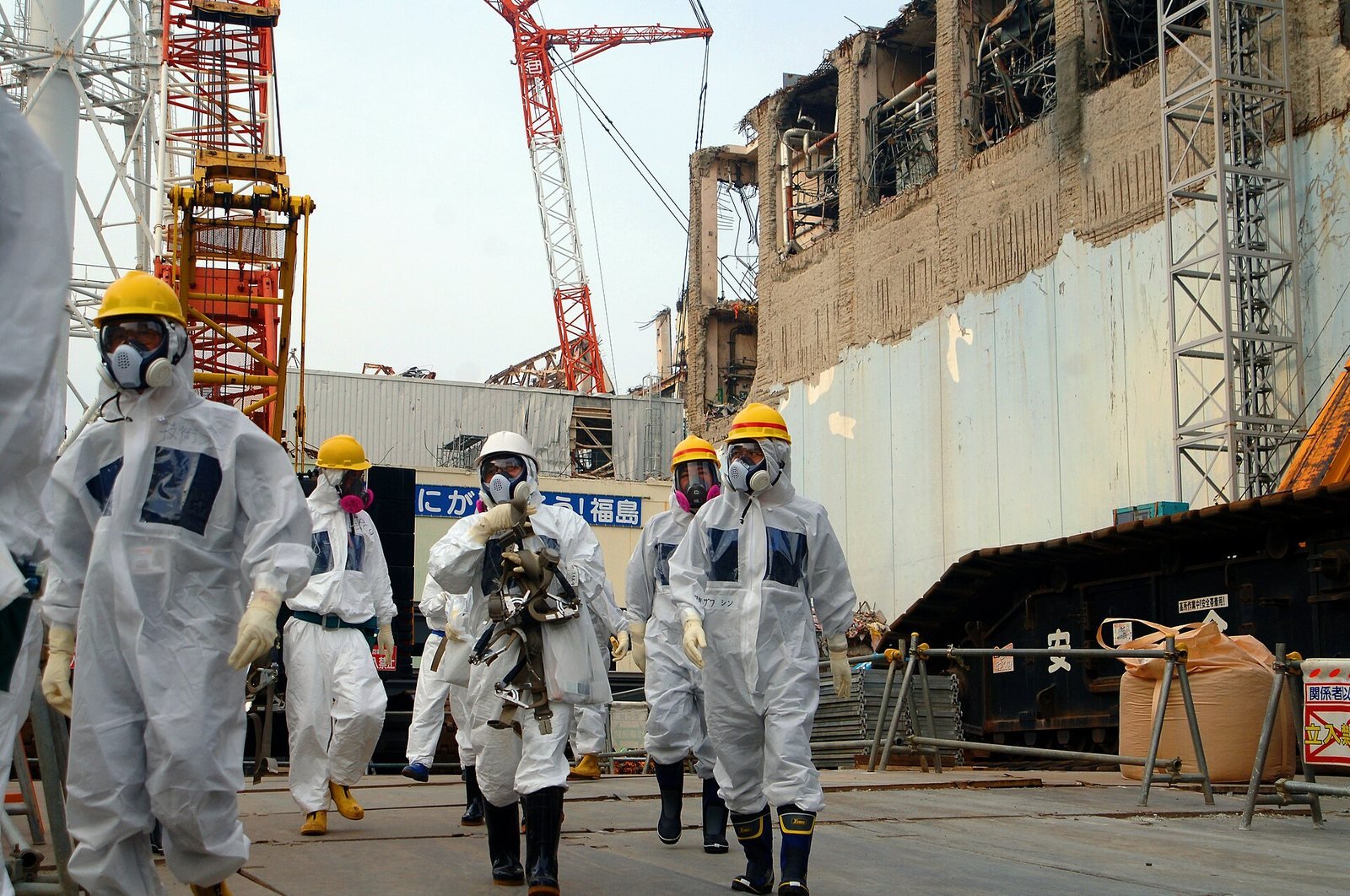
The labour ministry ruled that a former worker in his 50s, who had measured radiation at Fukushima Daiichi after the accident, had died of lung cancer linked to occupational radiation exposure, and that his family should be compensated (NPR). It was the first such death recognised.
The ruling applied compensation criteria for workers. It was not a scientific finding about the population, and it is distinct from UNSCEAR’s assessment of residents.
2012
Diet commission calls the accident “man-made” Investigation
The parliamentary commission concluded that the accident was “a profoundly man-made disaster” that could have been foreseen and prevented, blaming collusion between the government, regulators and TEPCO. Its findings fed into the creation of the Nuclear Regulation Authority in September 2012 and new safety standards in 2013. The IAEA later found that the plant’s tsunami assumptions had not been adequately updated (IAEA Director General report).
2011
Government declares ‘cold shutdown condition’ Investigation
The government announced that the reactors had reached a stable cold-shutdown condition, with temperatures held below 100°C and releases under control. It did not mean the reactors had been repaired, the melted fuel removed or the site made safe. A decommissioning roadmap followed that month.
2011
Accident rated Level 7, the highest on the INES scale Accident
Japan raised its provisional rating from Level 5 to Level 7 on the International Nuclear and Radiological Event Scale, the same category as Chernobyl, on the basis of estimated radioactive releases. Officials estimated Fukushima’s releases at roughly a tenth of Chernobyl’s.
2011
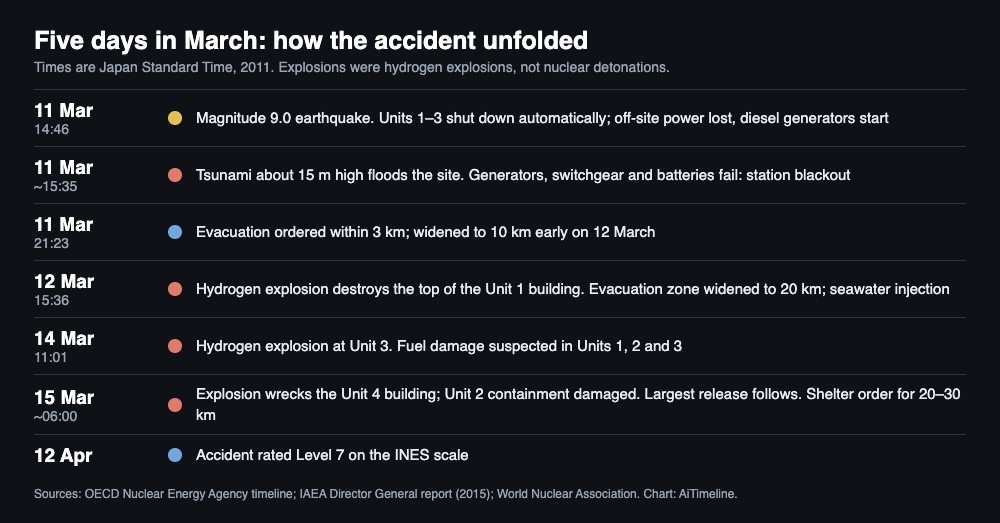
Unit 4 explodes; Unit 2 containment damaged Accident
An explosion wrecked the upper Unit 4 building, which had been shut down and defuelled before the earthquake; hydrogen from Unit 3 is thought to have flowed in through shared pipes. At about the same time the Unit 2 containment was damaged, and the largest single release of radioactive material followed (OECD NEA timeline). Residents between 20 and 30 km were told to shelter indoors.
2011
Hydrogen explosion damages Unit 3 Accident
A hydrogen explosion destroyed the upper structure of the Unit 3 reactor building and exposed its spent-fuel pool. Water levels in Units 1, 2 and 3 had fallen below the top of the fuel, and fuel damage was suspected in all three (OECD NEA).
2011
Unit 1 explodes; evacuation zone widened to 20 km Accident
With battery power exhausted and cooling lost, workers vented the Unit 1 containment. A hydrogen explosion then destroyed the building’s upper structure. It was a chemical explosion, not a nuclear detonation. The evacuation zone was extended from 10 km to 20 km, and seawater was injected into Unit 1 that evening, making the reactor unusable but cooling the core (OECD NEA).
2011
Earthquake and tsunami knock out power and cooling Accident
The earthquake shut down the three operating reactors, Units 1, 2 and 3, automatically; Units 4 to 6 were already offline for inspections. Off-site power was lost and emergency diesel generators started. About 50 minutes later a tsunami about 15 metres high, far above the site’s design basis of about 5.7 metres, flooded the generators, switchgear and batteries (IAEA; World Nuclear Association). An evacuation order for a 3 km radius was issued that evening.
Along the coast, the tsunami killed thousands. Those deaths were caused by the earthquake and tsunami, not by radiation. For the earthquake in context, see the deadliest earthquakes since 1906.
Why Did the Fukushima Nuclear Disaster Happen?
A chain of failures, not one.
The Fukushima nuclear disaster was not caused by a single broken part. A natural hazard overwhelmed safety systems that had been designed for a smaller one, and each failure made the next more likely.
1. The tsunami exceeded the plant’s protection
The site’s tsunami design basis was about 5.7 metres. The wave that arrived was about 15 metres. TEPCO had internal estimates from 2008 suggesting a much larger tsunami was possible but had not acted on them, a point both the Diet commission and the IAEA highlighted (IAEA report).
2. Power supplies failed together
The earthquake cut off-site power. The tsunami then flooded emergency diesel generators, switchgear and batteries, many of them in basements. The plant lost almost all AC and DC power, a “station blackout” affecting several units at once.
3. Cooling was lost
Nuclear fuel keeps producing heat after a reactor shuts down. Without pumps, the water covering the fuel in Units 1, 2 and 3 boiled away, and the fuel overheated and melted.
4. Hydrogen built up and exploded
Overheated zirconium cladding reacted with steam to make hydrogen, which leaked into the reactor buildings and exploded in Units 1, 3 and 4.
5. Regulation and preparedness fell short
Investigations found that the regulator and the operator were too close, risk assessments were not updated and plans did not foresee a long blackout across several reactors. Similar failures to act on warnings appear in other disasters, from the Challenger O-ring warnings to the Bhopal gas leak.
Human and Environmental Impact
⚠️ Keep these numbers separate
The earthquake and tsunami killed 15,901 people, and 2,519 are still missing. Those deaths were not caused by radiation. Disaster-related deaths, 3,810 nationwide, came from illness and stress after the disaster, including during evacuation. UNSCEAR found no documented health effects among residents that could be directly attributed to radiation from the accident.
- Earthquake and tsunami: 15,901 dead and 2,519 missing across 12 prefectures, according to police in March 2026 (Jiji Press).
- Disaster-related deaths: 3,810 nationwide by the end of 2025; 2,351 among Fukushima residents by May 2026, the largest share of any prefecture (Fukushima Prefecture).
- Evacuation: about 160,000 Fukushima residents were evacuees in May 2012; 22,625 still were on 1 May 2026 (Fukushima Prefecture).
- Radiation and health: no documented radiation-attributable effects among residents (UNSCEAR); one worker death recognised for compensation in 2018.
- Land and sea: caesium contaminated land to the north-west of the plant. Decontamination and decay have lowered radiation in most areas; evacuation orders remain in parts of seven municipalities.
- Livelihoods: farming, fishing and tourism suffered from contamination and loss of confidence; seafood import bans in several countries continued for years.
The UNSCEAR finding does not erase the harm of the disaster. Displacement, family separation, lost homes and work, and disrupted health care were serious harms in their own right, and they account for many of the disaster-related deaths.
Fukushima vs Chernobyl: What Was Different?
Both are Level 7. The shared rating is a category, not a statement that the accidents were alike.
| Feature | Fukushima Daiichi | Chernobyl |
|---|---|---|
| Country | Japan | Soviet Ukraine, now Ukraine |
| Date | 11 March 2011 | 26 April 1986 |
| Trigger | Earthquake and tsunami; loss of power and cooling | Flawed reactor design and a safety test run under unstable conditions |
| What happened to the reactors | Cores of three reactors melted; hydrogen explosions damaged four buildings | Reactor 4 exploded and its graphite burned for days |
| Estimated release | Roughly a tenth of Chernobyl’s (Japanese estimates, 2011) | The largest release from a nuclear power accident |
| Radiation health findings | No documented effects among residents attributable to radiation (UNSCEAR) | Acute radiation deaths among responders; thousands of thyroid cancers in children exposed |
| Main challenge today | Fuel debris, treated water, decommissioning to about 2051 | Containment under the New Safe Confinement; exclusion zone |
| INES rating | Level 7 | Level 7 |
Fukushima’s Legacy: What Changed in Nuclear Safety?
- Flood protection: higher sea walls and waterproofed or relocated critical equipment at nuclear plants.
- Backup power and cooling: mobile generators, pumps and water sources that can work through a long blackout.
- Hydrogen control and venting: filtered vents and hydrogen recombiners to prevent explosions.
- Independent regulation: Japan’s Nuclear Regulation Authority, created in September 2012, and stricter standards from July 2013 before any reactor could restart.
- Emergency planning: preparation for accidents affecting several reactors at once, better radiation monitoring and clearer public communication.
- Decommissioning technology: robots and remote tools for work in places no person can enter.
Fukushima also reshaped energy policy. Japan shut all its reactors and restarted only those that met the new rules; Germany chose to phase out nuclear power, completing it in 2023; other countries kept or expanded nuclear energy under revised safety requirements. See how countries restarted nuclear power after Fukushima, why the world is rethinking reactors and India’s nuclear power plans. For disaster preparedness more broadly, see early-warning systems for mountain disasters and earthquake risk in the Himalaya.
Decommissioning: Where the Clean-Up Stands
As of 29 October 2026. This section is updated when TEPCO, the IAEA or the Japanese government publish new reports.
Is Fukushima Safe Today?
It depends on the place and the activity. The damaged reactors are permanently shut down and the site is in a long decommissioning process. Most of Fukushima Prefecture is open, and radiation, food and water are monitored. Evacuation orders remain in parts of seven municipalities close to the plant.
The treated-water release is monitored by Japan and reviewed by the IAEA, which has found it consistent with international safety standards. It is still opposed by some fishing communities and neighbouring governments. Fukushima is not a finished clean-up story: removing about 880 tonnes of melted fuel, managing radioactive waste and rebuilding communities will take decades.
Explore More Timelines
People Also Ask
Fukushima Nuclear Disaster: Frequently Asked Questions
A Lesson Still Being Learned
The Fukushima nuclear disaster showed how an extreme natural event can overwhelm a nuclear plant when its safety systems fail together. The earthquake and tsunami caused immense loss of life; the loss of cooling at Fukushima Daiichi caused meltdowns, explosions and radioactive releases that forced tens of thousands from their homes for years.
Its lessons are simple to state and hard to apply: assess risks beyond past experience, protect backup systems from the extremes, and plan for failures that happen at the same time. The clean-up that runs to mid-century will test whether those lessons hold.
Related AiTimeline Stories
⚠️ Editorial Note
Last updated 29 October 2026. This article keeps the earthquake and tsunami death toll separate from radiation-related health findings, and relies on UNSCEAR for health conclusions. Primary sources include the IAEA Director General’s report, the OECD Nuclear Energy Agency timeline, UNSCEAR, TEPCO, METI and Fukushima Prefecture. We corrected the source brief in places: its figure of “more than 20,000” killed or missing mixes counts, so we give police figures (15,901 dead, 2,519 missing) and the separate disaster-related death count (3,810); the brief’s February 2024 entry named no specific event and was replaced with dated IAEA milestones. We added the first fuel-debris samples (2024–25), the July 2025 delay to 2037, the 2025 court rulings, China’s seafood bans, the 2018 worker compensation ruling and the October 2026 release round. The decommissioning and treated-water sections will be updated as new IAEA and Japanese government reports are published. AiTimeline has no dedicated pages yet on Chernobyl or the 2011 Tohoku earthquake; related coverage is linked above.
Sources & further reading
Every dated entry above was checked against these references. Last reviewed 29 October 2026.
- IAEA: The Fukushima Daiichi Accident, Report by the Director General (2015, PDF)
- OECD Nuclear Energy Agency: Timeline for the Fukushima Daiichi nuclear power plant accident
- UNSCEAR: 2020/2021 Fukushima report, frequently asked questions
- TEPCO: Status of each unit at Fukushima Daiichi
- METI: IAEA conducts sixth review mission on ALPS treated water discharge (15 May 2026)
- IAEA: Tritium level far below Japan's operational limit in 25th batch of ALPS treated water (October 2026)
- World Nuclear News: Fuel debris removal from Fukushima reactors delayed (29 July 2025)
- Fukushima Prefecture: Damage caused by the earthquake and tsunami (May 2026)
- Jiji Press via Adnkronos: 26,000 people still evacuated 15 years after Tohoku triple disaster (March 2026)