UP Election 2022 Results Timeline: How BJP Won Uttar Pradesh and SP Emerged as the Main Challenger
UP Election 2022 results: BJP won 255 seats (41.29%), SP 111 seats (32.06%). Full party-wise table, 2017 comparison and ECI-verified analysis.
Latest Story
In the 2022 Uttar Pradesh Assembly election, the Bharatiya Janata Party won a second consecutive term in India’s largest state, taking 255 of 403 seats with its allies crossing 273. The Samajwadi Party more than doubled its 2017 tally to 111 seats, becoming the state’s dominant opposition force in the process. This page walks through the verified UP Election 2022 results — seat counts, vote shares, the 2017 comparison, and what the result actually changed in Uttar Pradesh politics — using Election Commission of India data as the primary source throughout.
📌 Who Won the 2022 UP Election? — AI Overview
The BJP-led National Democratic Alliance won the 2022 Uttar Pradesh Assembly election, taking 273 of 403 seats (BJP 255, allies 18), comfortably past the 202-seat majority mark. The BJP polled 41.29% of the vote. The Samajwadi Party-led alliance won 125 seats (SP 111, allies 14) on 36.60% of the vote, more than doubling its 2017 total and becoming the principal opposition. Yogi Adityanath was sworn in for a second term as Chief Minister on March 25, 2022 — the first UP chief minister in decades to return after completing a full five-year term.
Last fact-checked: August 24, 2026 · Primary data source: Election Commission of India, Statistical Report on the General Election 2022 to the Legislative Assembly of Uttar Pradesh.
UP Election 2022: Key Questions
Key Takeaways
- BJP retained power with 255 seats (41.29% vote share), down 57 seats from its 312-seat sweep in 2017 but still a clear majority on its own.
- SP more than doubled its tally, rising from 47 seats in 2017 to 111 in 2022 — a gain of 64 seats and over 10 percentage points of vote share.
- BSP collapsed to a single seat, down from 19 in 2017, despite still polling 12.88% of the vote — a stark illustration of how India’s first-past-the-post system can separate vote share from seat share.
- Congress won only 2 seats, continuing its long decline in the state.
- Alliance seats are not party seats. The NDA’s 273 and SP+’s 125 each include smaller allied parties — treating those totals as the BJP’s or SP’s own seat count is a common but incorrect simplification.
- Yogi Adityanath returned for a second full term, sworn in March 25, 2022 — a rare feat in Uttar Pradesh, where incumbents had historically struggled to win back-to-back terms.
- Voter turnout dipped slightly to around 61.03%, down about 0.2 percentage points from 2017’s 61.24%.
- The BJP-SP contest hardened into the state’s central axis, with BSP and Congress both reduced to marginal players in seat terms.
- The election ran in 7 phases over nearly a month (February 10 – March 7, 2022), reflecting the logistical scale of polling in India’s most populous state.
- This result set the baseline against which the 2027 Uttar Pradesh Assembly election is now being measured — see our UP Election 2027 timeline for the current cycle.
UP Election 2022 Explained in 60 Seconds
For readers who don’t follow Uttar Pradesh politics closely
Uttar Pradesh has 403 Assembly constituencies. In each one, voters elect a single MLA (Member of the Legislative Assembly) — whoever gets the most votes in that constituency wins, regardless of what share of the vote they got. To form the state government, a party or alliance needs a majority: at least 202 of the 403 seats.
In 2022, the BJP won 255 seats on its own — comfortably above that line — so it formed the government again, with Yogi Adityanath continuing as Chief Minister. The Samajwadi Party won 111 seats, making it the largest opposition party by a wide margin over the BSP and Congress.
Seat Share vs Vote Share
Two numbers describe how a party performed: seat share (what fraction of the 403 seats it won) and vote share (what fraction of all votes cast across the state went to it). These can diverge sharply under India’s first-past-the-post system, where only the top vote-getter in each constituency wins — there is no reward for finishing a close second, even repeatedly.
The clearest example from this election is the BSP: it polled 12.88% of the vote — more than one in eight voters statewide — but won only 1 of 403 seats, because its vote was spread fairly evenly across many constituencies without concentrating enough to finish first in most of them. The BJP, by contrast, converted 41.29% of the vote into 63% of the seats, because its support was more efficiently distributed — strong enough to win narrow contests in a large number of constituencies.
Party-wise Result Table
Individual party figures, verified against ECI data. Alliance totals are shown separately below.
| Party | Seats won | Seats contested | Vote share | Change vs 2017 (seats) |
|---|---|---|---|---|
| BJP | 255 | 370 | 41.29% | −57 |
| Samajwadi Party (SP) | 111 | 347 | 32.06% | +64 |
| Bahujan Samaj Party (BSP) | 1 | 403 | 12.88% | −18 |
| Indian National Congress (INC) | 2 | 399 | ~2.3% | −5 |
| Apna Dal (Sonelal) — NDA ally | 12 | 17 | — | — |
| NISHAD Party — NDA ally | 6 | 16 | — | — |
| Rashtriya Lok Dal (RLD) — SP+ ally | 8 | 33 | — | — |
| Suheldev Bharatiya Samaj Party (SBSP) — SP+ ally | 6 | 17 | — | — |
| Others / independents | 2 | — | — | — |
⚠️ Alliance Seats Are Not the Same as Party Seats
The BJP’s own tally is 255 seats. Its National Democratic Alliance (NDA) total — the number reported as “273” in most headlines — adds Apna Dal (Sonelal)’s 12 and the NISHAD Party’s 6. Likewise, the Samajwadi Party’s own tally is 111; its SP+ alliance total of 125 adds RLD’s 8 and SBSP’s 6. Reporting an alliance figure as if it were a single party’s seat count is one of the most common errors in coverage of Indian state elections — this page keeps the two separate throughout.
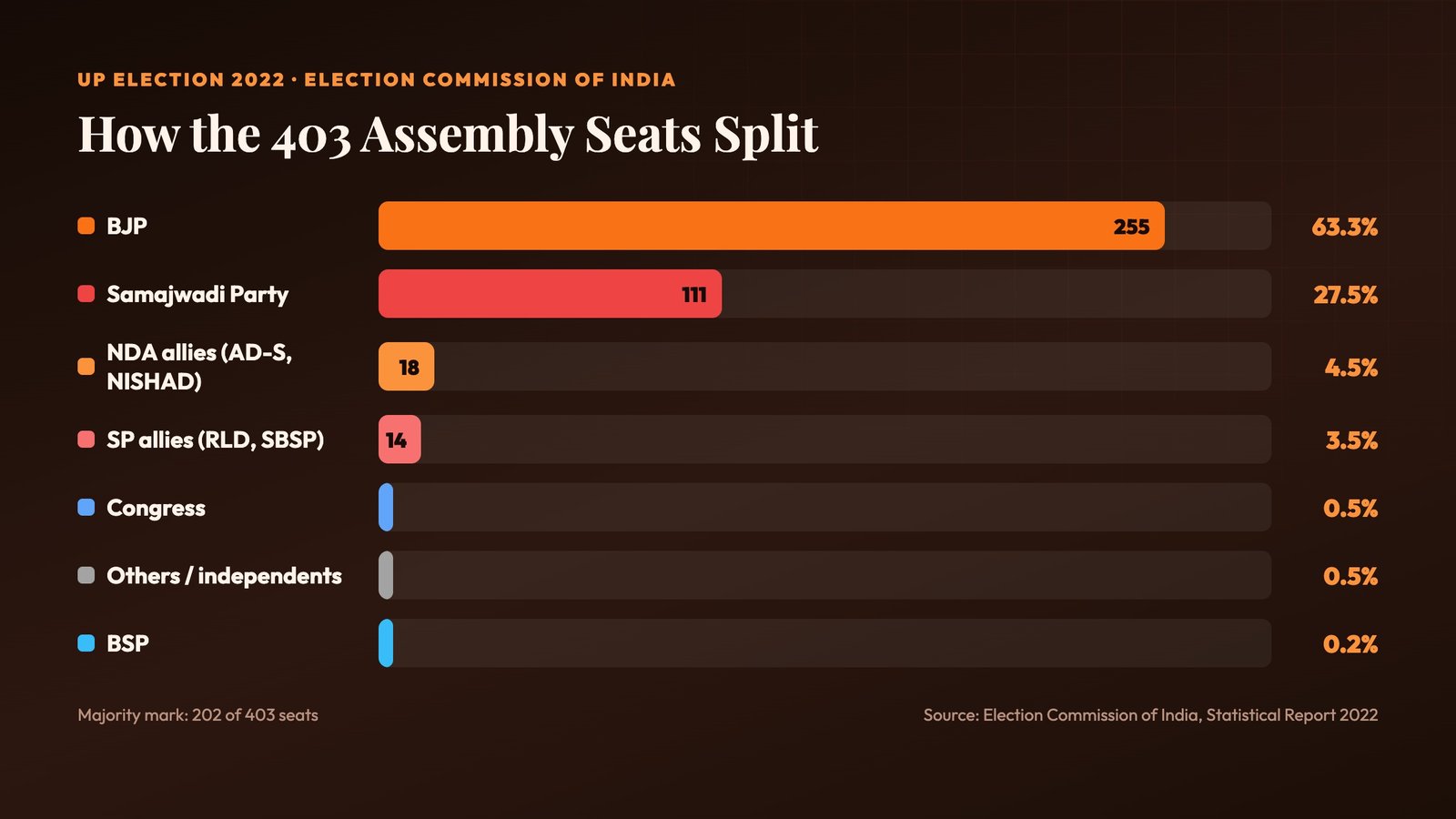
Source: Election Commission of India, Statistical Report 2022
The 403-Seat Assembly
Verified seat distribution, grouped by party and alliance
Source: Election Commission of India, Statistical Report 2022. Full individual-party figures are in the table above; this chart groups minor allies for legibility.
Constituency-by-Constituency Results
Search or filter all 403 Uttar Pradesh Assembly constituencies — winner, runner-up, margin and total votes, sourced from ADR's constituency-level analysis of the Election Commission's 2022 results
Source: constituency boundaries © DataMeet India community (CC BY 2.5 India), joined to ADR's 2022 winner data by constituency name (402 of 403 matched exactly; 1 constituency, Dhaulana, could not be reliably matched and is shown in grey).
BJP
Runner-up: Naim Ul Hasan (SP) — 81,588 votes (39.79%)
Margin: 203 votes (0.10%)
Total votes polled: 205,067
BJP
Runner-up: Rakesh Kumar Verma (SP) — 118,503 votes (41.07%)
Margin: 217 votes (0.08%)
Total votes polled: 288,519
SP
Runner-up: Kamlesh Saini (BJP) — 90,288 votes (40.24%)
Margin: 234 votes (0.10%)
Total votes polled: 224,374
BJP
Runner-up: Munshiram (RLD) — 77,677 votes (38.86%)
Margin: 258 votes (0.13%)
Total votes polled: 199,914
SP
Runner-up: Sharad Kumar Awasthi (BJP) — 98,538 votes (41.85%)
Margin: 261 votes (0.11%)
Total votes polled: 235,461
SP
Runner-up: Om Prakash Pandey (BJP) — 69,360 votes (34.21%)
Margin: 269 votes (0.13%)
Total votes polled: 202,743
BJP
Runner-up: Amarjeet Singh (SP) — 101,691 votes (43.04%)
Margin: 307 votes (0.13%)
Total votes polled: 236,259
BJP
Runner-up: Jaiveer (RLD) — 90,616 votes (46.18%)
Margin: 315 votes (0.16%)
Total votes polled: 196,226
BJP
Runner-up: Dr. Dharam Singh Saini (SP) — 103,799 votes (38.35%)
Margin: 315 votes (0.12%)
Total votes polled: 270,652
BJP
Runner-up: Rajesh Yadav (SP) — 77,443 votes (39.72%)
Margin: 357 votes (0.18%)
Total votes polled: 194,967
SP
Runner-up: Lakhan Singh Rajput (BJP) — 80,392 votes (40.10%)
Margin: 473 votes (0.24%)
Total votes polled: 200,455
Nirbal Indian Shoshit Hamara Aam Dal
Runner-up: Shailendra Yadav Lalai (SP) — 86,514 votes (35.91%)
Margin: 719 votes (0.30%)
Total votes polled: 240,920
SP
Runner-up: Raghvendra Pratap Singh (BJP) — 84,327 votes (40.82%)
Margin: 771 votes (0.37%)
Total votes polled: 206,586
BJP
Runner-up: Mohd Yusuf Ansari (SP) — 147,602 votes (45.88%)
Margin: 782 votes (0.24%)
Total votes polled: 321,704
SP
Runner-up: Manvendra Pratap Singh (BJP) — 107,453 votes (43.37%)
Margin: 836 votes (0.34%)
Total votes polled: 247,762
BJP
Runner-up: Anoop Sanda (SP) — 91,706 votes (41.78%)
Margin: 1,009 votes (0.46%)
Total votes polled: 219,508
Apna Dal (Soneylal)
Runner-up: Veer Singh Patel (SP) — 72,084 votes (34.67%)
Margin: 1,048 votes (0.50%)
Total votes polled: 207,930
BJP
Runner-up: Arvind Singh Yadav (SP) — 123,662 votes (43.91%)
Margin: 1,111 votes (0.39%)
Total votes polled: 281,597
Apna Dal (Soneylal)
Runner-up: Sushma Patel (SP) — 74,801 votes (38.62%)
Margin: 1,206 votes (0.62%)
Total votes polled: 193,664
INC
Runner-up: Bajrang Bahadur Singh (BJP) — 83,935 votes (39.69%)
Margin: 1,246 votes (0.59%)
Total votes polled: 211,490
BJP
Runner-up: Radhey Shyam Jaiswal (SP) — 98,096 votes (42.18%)
Margin: 1,253 votes (0.54%)
Total votes polled: 232,552
BJP
Runner-up: Omprakash Baba Dubey (SP) — 81,065 votes (39.08%)
Margin: 1,326 votes (0.64%)
Total votes polled: 207,419
BJP
Runner-up: Neeraj Chaudhary (RLD) — 95,720 votes (37.96%)
Margin: 1,445 votes (0.57%)
Total votes polled: 252,142
BJP
Runner-up: Mohhamad Aslam Rainee (SP) — 97,183 votes (38.40%)
Margin: 1,457 votes (0.58%)
Total votes polled: 253,077
BJP
Runner-up: Anjani (SP) — 92,044 votes (40.95%)
Margin: 1,647 votes (0.73%)
Total votes polled: 224,745
SP
Runner-up: Satish Chandra (BJP) — 62,591 votes (37.55%)
Margin: 1,662 votes (1.00%)
Total votes polled: 166,700
SP
Runner-up: Dr. Sangeeta Balwant (BJP) — 90,780 votes (40.06%)
Margin: 1,692 votes (0.75%)
Total votes polled: 226,595
SP
Runner-up: Dayaram Chaudhary (BJP) — 84,250 votes (38.99%)
Margin: 1,779 votes (0.82%)
Total votes polled: 216,093
SP
Runner-up: Kushagra Sagar (BJP) — 108,735 votes (43.50%)
Margin: 1,834 votes (0.73%)
Total votes polled: 249,964
BJP
Runner-up: Jagdish Prasad (SP) — 85,604 votes (42.73%)
Margin: 2,111 votes (1.05%)
Total votes polled: 200,323
SP
Runner-up: Satyavir Tyagi (BJP) — 104,924 votes (41.33%)
Margin: 2,180 votes (0.86%)
Total votes polled: 253,869
SP
Runner-up: Abhay Kumar Alias Dhiraj Ojha (BJP) — 72,934 votes (38.65%)
Margin: 2,649 votes (1.40%)
Total votes polled: 188,715
BJP
Runner-up: Mohd.Mujata ba Siddiqui (SP) — 100,825 votes (40.89%)
Margin: 2,732 votes (1.11%)
Total votes polled: 246,588
SP
Runner-up: Laxmikant (Apna Dal (Soneylal)) — 62,935 votes (30.04%)
Margin: 2,812 votes (1.34%)
Total votes polled: 209,512
SP
Runner-up: Chhote Singh (Nirbal Indian Shoshit Hamara Aam Dal) — 66,966 votes (28.29%)
Margin: 2,816 votes (1.19%)
Total votes polled: 236,741
BJP
Runner-up: Vijay Pal Singh (SP) — 89,149 votes (43.78%)
Margin: 2,921 votes (1.43%)
Total votes polled: 203,607
SP
Runner-up: Ambrish Rawat (BJP) — 110,576 votes (39.79%)
Margin: 2,982 votes (1.07%)
Total votes polled: 277,908
SP
Runner-up: Chhatra Pal Singh (BJP) — 120,790 votes (45.41%)
Margin: 3,355 votes (1.26%)
Total votes polled: 266,003
SP
Runner-up: Neelam Karvariya (BJP) — 75,116 votes (40.28%)
Margin: 3,439 votes (1.84%)
Total votes polled: 186,497
SP
Runner-up: Prashant Kumar Singh Rahul (Nirbal Indian Shoshit Hamara Aam Dal) — 80,874 votes (37.71%)
Margin: 3,543 votes (1.65%)
Total votes polled: 214,451
Apna Dal (Soneylal)
Runner-up: Rameshwar Dayal (SP) — 74,368 votes (38.97%)
Margin: 3,797 votes (1.99%)
Total votes polled: 190,821
SP
Runner-up: Dhirendra Bahadur Singh (BJP) — 62,359 votes (28.78%)
Margin: 3,807 votes (1.76%)
Total votes polled: 216,700
BJP
Runner-up: Rameshwar Singh Yadav (SP) — 99,063 votes (43.76%)
Margin: 3,810 votes (1.68%)
Total votes polled: 226,375
BJP
Runner-up: Sarvesh Kumar Shakya (SP) — 94,166 votes (38.35%)
Margin: 3,984 votes (1.62%)
Total votes polled: 245,542
SP
Runner-up: Mamtesh Shakya (BJP) — 87,957 votes (40.06%)
Margin: 4,001 votes (1.82%)
Total votes polled: 219,549
BJP
Runner-up: Yasar Shah (SP) — 103,550 votes (44.69%)
Margin: 4,078 votes (1.76%)
Total votes polled: 231,708
BJP
Runner-up: Ranjeet Suman (SP) — 86,898 votes (42.91%)
Margin: 4,441 votes (2.19%)
Total votes polled: 202,531
BJP
Runner-up: Umesh Pandey (SP) — 74,584 votes (33.26%)
Margin: 4,448 votes (1.98%)
Total votes polled: 224,258
BJP
Runner-up: Neeraj Nalinish (SP) — 95,037 votes (43.86%)
Margin: 4,572 votes (2.11%)
Total votes polled: 216,688
BJP
Runner-up: Anil Kumar Pal (SP) — 101,481 votes (42.57%)
Margin: 4,608 votes (1.93%)
Total votes polled: 238,364
BJP
Runner-up: Alok Kumar Shakya (SP) — 92,441 votes (42.97%)
Margin: 4,767 votes (2.22%)
Total votes polled: 215,153
BJP
Runner-up: Daud Ahmad (SP) — 94,506 votes (40.66%)
Margin: 4,871 votes (2.10%)
Total votes polled: 232,436
SP
Runner-up: Ravindra Nath Tripathi (BJP) — 95,853 votes (38.29%)
Margin: 4,885 votes (1.95%)
Total votes polled: 250,365
BJP
Runner-up: Shaz Ishaq (SP) — 103,039 votes (40.82%)
Margin: 5,028 votes (1.99%)
Total votes polled: 252,406
BJP
Runner-up: Narendra Singh Verma (SP) — 86,869 votes (39.51%)
Margin: 5,222 votes (2.38%)
Total votes polled: 219,853
Nirbal Indian Shoshit Hamara Aam Dal
Runner-up: Jay Chand (SP) — 84,970 votes (35.08%)
Margin: 5,223 votes (2.16%)
Total votes polled: 242,230
SP
Runner-up: Ajay Shankar Dubey (BJP) — 86,818 votes (39.52%)
Margin: 5,230 votes (2.38%)
Total votes polled: 219,700
SP
Runner-up: Sapna Kashyap (BJP) — 92,029 votes (41.42%)
Margin: 5,334 votes (2.40%)
Total votes polled: 222,190
Suheldev Bharatiya Samaj Party
Runner-up: Ravi (BJP) — 77,855 votes (36.87%)
Margin: 5,495 votes (2.60%)
Total votes polled: 211,187
BJP
Runner-up: Ramthirth Paramhans (SP) — 78,226 votes (39.12%)
Margin: 5,509 votes (2.75%)
Total votes polled: 199,986
Suheldev Bharatiya Samaj Party
Runner-up: Chhathu Ram (BJP) — 73,481 votes (36.81%)
Margin: 5,514 votes (2.76%)
Total votes polled: 199,617
BJP
Runner-up: Firoz Khan (SP) — 101,708 votes (42.04%)
Margin: 5,560 votes (2.30%)
Total votes polled: 241,937
SP
Runner-up: Dr. Jamuna Prasad Saroj (Apna Dal (Soneylal)) — 85,884 votes (38.48%)
Margin: 5,590 votes (2.50%)
Total votes polled: 223,169
BJP
Runner-up: Avinash Kushwaha (SP) — 78,875 votes (37.61%)
Margin: 5,621 votes (2.68%)
Total votes polled: 209,724
SP
Runner-up: Shailesh Kumar Singh "Shailu" (BJP) — 69,508 votes (36.61%)
Margin: 5,837 votes (3.07%)
Total votes polled: 189,885
BJP
Runner-up: Vijay Singh (SP) — 92,036 votes (40.50%)
Margin: 5,912 votes (2.60%)
Total votes polled: 227,230
SP
Runner-up: Chandrapraka sh Singh (BJP) — 86,509 votes (40.43%)
Margin: 6,065 votes (2.83%)
Total votes polled: 213,969
BJP
Runner-up: Anil Kumar Doharey (SP) — 114,786 votes (42.29%)
Margin: 6,090 votes (2.24%)
Total votes polled: 271,435
SP
Runner-up: Dharmendra Kumar Singh Shakya (BJP) — 99,431 votes (40.36%)
Margin: 6,100 votes (2.48%)
Total votes polled: 246,366
Nirbal Indian Shoshit Hamara Aam Dal
Runner-up: Ram Kishore Bind (SP) — 67,215 votes (31.23%)
Margin: 6,231 votes (2.89%)
Total votes polled: 215,254
Suheldev Bharatiya Samaj Party
Runner-up: Dr. HARENDRA PRASAD (BJP) — 84,328 votes (37.76%)
Margin: 6,292 votes (2.82%)
Total votes polled: 223,351
BJP
Runner-up: SINGH Vijay Singh (SP) — 78,110 votes (38.20%)
Margin: 6,297 votes (3.08%)
Total votes polled: 204,469
RLD
Runner-up: Ramveer Upadhyay (BJP) — 98,437 votes (40.60%)
Margin: 6,437 votes (2.65%)
Total votes polled: 242,482
BJP
Runner-up: Mohd Asif Khan (SP) — 88,082 votes (37.72%)
Margin: 6,479 votes (2.77%)
Total votes polled: 233,517
RLD
Runner-up: Pramod Utwal (BJP) — 86,140 votes (40.05%)
Margin: 6,532 votes (3.04%)
Total votes polled: 215,085
SP
Runner-up: Devender Nagpal (BJP) — 101,957 votes (41.64%)
Margin: 6,540 votes (2.67%)
Total votes polled: 244,837
BSP
Runner-up: Mahendra (Suheldev Bharatiya Samaj Party) — 81,304 votes (40.54%)
Margin: 6,583 votes (3.28%)
Total votes polled: 200,572
SP
Runner-up: Amarpal Maurya (BJP) — 75,893 votes (35.79%)
Margin: 6,621 votes (3.12%)
Total votes polled: 212,030
BJP
Runner-up: Suraj Singh (SP) — 89,829 votes (44.87%)
Margin: 6,699 votes (3.35%)
Total votes polled: 200,215
BJP
Runner-up: Kiran Verma (SP) — 76,544 votes (35.77%)
Margin: 6,719 votes (3.14%)
Total votes polled: 213,967
BJP
Runner-up: Mohd Ahmed Hameed (RLD) — 94,687 votes (44.22%)
Margin: 6,733 votes (3.14%)
Total votes polled: 214,112
BJP
Runner-up: Rajkumar Urf Raju Yadav (SP) — 93,048 votes (43.56%)
Margin: 6,766 votes (3.17%)
Total votes polled: 213,589
SP
Runner-up: Chandra Prakash Mishra Matiyari (BJP) — 72,077 votes (35.53%)
Margin: 6,963 votes (3.43%)
Total votes polled: 202,856
BJP
Runner-up: Shailendra Singh Gangwar (SP) — 118,536 votes (45.41%)
Margin: 6,970 votes (2.67%)
Total votes polled: 261,009
BJP
Runner-up: Gajraj Singh (RLD) — 90,828 votes (36.84%)
Margin: 7,034 votes (2.85%)
Total votes polled: 246,567
BJP
Runner-up: Kartikey Rana (SP) — 86,786 votes (35.83%)
Margin: 7,104 votes (2.93%)
Total votes polled: 242,193
RLD
Runner-up: Tejendra Singh (BJP) — 95,963 votes (45.49%)
Margin: 7,107 votes (3.37%)
Total votes polled: 210,952
BJP
Runner-up: Ram Pratap Yadav (SP) — 95,254 votes (41.40%)
Margin: 7,175 votes (3.12%)
Total votes polled: 230,100
BJP
Runner-up: Yogesh Verma (SP) — 100,275 votes (43.55%)
Margin: 7,312 votes (3.18%)
Total votes polled: 230,276
SP
Runner-up: Keshav Prasad Maurya (BJP) — 98,941 votes (43.28%)
Margin: 7,337 votes (3.21%)
Total votes polled: 228,626
SP
Runner-up: Ajay Kumar (BJP) — 72,221 votes (35.15%)
Margin: 7,393 votes (3.60%)
Total votes polled: 205,453
BJP
Runner-up: Sanjay Garg (SP) — 135,761 votes (46.32%)
Margin: 7,434 votes (2.54%)
Total votes polled: 293,112
SP
Runner-up: Siddharth Shanker (BJP) — 96,117 votes (38.96%)
Margin: 7,559 votes (3.06%)
Total votes polled: 246,734
SP
Runner-up: Parmeshwar Lal (BJP) — 87,728 votes (36.73%)
Margin: 7,610 votes (3.19%)
Total votes polled: 238,844
SP
Runner-up: Avadhesh Kumar (Nirbal Indian Shoshit Hamara Aam Dal) — 85,828 votes (34.67%)
Margin: 7,696 votes (3.11%)
Total votes polled: 247,560
SP
Runner-up: Gaurav Verma (BJP) — 95,424 votes (42.11%)
Margin: 7,711 votes (3.40%)
Total votes polled: 226,617
BJP
Runner-up: Surendra Kumar (SP) — 98,627 votes (40.93%)
Margin: 7,745 votes (3.21%)
Total votes polled: 240,941
SP
Runner-up: Riya Shakya (BJP) — 89,492 votes (39.19%)
Margin: 7,765 votes (3.40%)
Total votes polled: 228,340
SP
Runner-up: Suresh Awasthi (BJP) — 68,973 votes (45.35%)
Margin: 7,924 votes (5.21%)
Total votes polled: 152,099
BJP
Runner-up: Mohd Adil (SP) — 121,725 votes (40.79%)
Margin: 7,942 votes (2.66%)
Total votes polled: 298,393
BJP
Runner-up: Rajeshwari (SP) — 83,764 votes (39.32%)
Margin: 7,998 votes (3.75%)
Total votes polled: 213,048
BJP
Runner-up: Mohd. Arshad Khan (SP) — 89,708 votes (36.11%)
Margin: 8,052 votes (3.24%)
Total votes polled: 248,447
BJP
Runner-up: Dr. Lalit Pratap Baghel (SP) — 89,990 votes (38.19%)
Margin: 8,104 votes (3.44%)
Total votes polled: 235,619
SP
Runner-up: Anjani Kumar Srivastava (BJP) — 116,313 votes (45.03%)
Margin: 8,184 votes (3.17%)
Total votes polled: 258,320
SP
Runner-up: Mehi Lal (BJP) — 83,175 votes (38.10%)
Margin: 8,484 votes (3.89%)
Total votes polled: 218,312
SP
Runner-up: Vikram Singh (BJP) — 88,238 votes (41.22%)
Margin: 8,601 votes (4.02%)
Total votes polled: 214,050
BJP
Runner-up: Madan Bhaiya (RLD) — 118,734 votes (37.68%)
Margin: 8,676 votes (2.75%)
Total votes polled: 315,095
SP
Runner-up: Hariom Yadav (BJP) — 87,419 votes (41.99%)
Margin: 8,805 votes (4.23%)
Total votes polled: 208,192
BJP
Runner-up: Sunil Sonkar (Suheldev Bharatiya Samaj Party) — 91,928 votes (37.51%)
Margin: 9,160 votes (3.74%)
Total votes polled: 245,074
RLD
Runner-up: Maninder Pal (BJP) — 92,567 votes (39.61%)
Margin: 9,182 votes (3.93%)
Total votes polled: 233,667
BJP
Runner-up: Usha Verma (SP) — 72,286 votes (36.97%)
Margin: 9,233 votes (4.72%)
Total votes polled: 195,511
BJP
Runner-up: Bhagwat Saran Gangwar (SP) — 101,876 votes (44.20%)
Margin: 9,237 votes (4.01%)
Total votes polled: 230,503
BJP
Runner-up: Jitendra Kumar (SP) — 88,561 votes (35.88%)
Margin: 9,251 votes (3.75%)
Total votes polled: 246,794
BJP
Runner-up: Tanveer Khan (SP) — 100,629 votes (44.83%)
Margin: 9,313 votes (4.15%)
Total votes polled: 224,447
BJP
Runner-up: Ujjwal Raman Singh (SP) — 80,199 votes (39.47%)
Margin: 9,328 votes (4.59%)
Total votes polled: 203,189
SP
Runner-up: Om Prakash Verma (BJP) — 96,951 votes (41.18%)
Margin: 9,328 votes (3.96%)
Total votes polled: 235,438
SP
Runner-up: Triveniram (BJP) — 64,782 votes (31.05%)
Margin: 9,383 votes (4.50%)
Total votes polled: 208,647
SP
Runner-up: Bahoran Lal Maurya (BJP) — 109,993 votes (42.26%)
Margin: 9,409 votes (3.62%)
Total votes polled: 260,250
BJP
Runner-up: Arjun Singh (SP) — 98,115 votes (41.35%)
Margin: 9,476 votes (3.99%)
Total votes polled: 237,304
BJP
Runner-up: Santosh Pandey (SP) — 73,466 votes (34.85%)
Margin: 9,533 votes (4.52%)
Total votes polled: 210,835
BJP
Runner-up: Shyam Sundar Sharma (BSP) — 74,378 votes (33.09%)
Margin: 9,580 votes (4.26%)
Total votes polled: 224,786
BJP
Runner-up: Rajesh Kumar Verma (SP) — 91,256 votes (40.73%)
Margin: 9,701 votes (4.33%)
Total votes polled: 224,055
BJP
Runner-up: Dr. Hargovind Bhargava (SP) — 96,506 votes (39.60%)
Margin: 9,716 votes (3.99%)
Total votes polled: 243,719
SP
Runner-up: Dinesh Chaudhary (BJP) — 84,178 votes (35.04%)
Margin: 9,844 votes (4.10%)
Total votes polled: 240,258
SP
Runner-up: Arun Veer Singh (BJP) — 91,827 votes (43.24%)
Margin: 10,428 votes (4.91%)
Total votes polled: 212,372
BJP
Runner-up: Afzaal Kausar (SP) — 95,536 votes (40.35%)
Margin: 10,478 votes (4.43%)
Total votes polled: 236,786
BJP
Runner-up: Alagu Prasad (Suheldev Bharatiya Samaj Party) — 72,688 votes (33.62%)
Margin: 10,553 votes (4.88%)
Total votes polled: 216,222
BJP
Runner-up: Kameshwar Alias Kishan Dixit (SP) — 88,900 votes (45.41%)
Margin: 10,722 votes (5.48%)
Total votes polled: 195,782
BJP
Runner-up: Supriya Aron (SP) — 88,163 votes (44.94%)
Margin: 10,768 votes (5.49%)
Total votes polled: 196,168
RLD
Runner-up: Suresh Kumar (BJP) — 92,945 votes (42.53%)
Margin: 10,806 votes (4.94%)
Total votes polled: 218,541
BJP
Runner-up: Manoj Kumar (SP) — 76,974 votes (36.65%)
Margin: 10,917 votes (5.20%)
Total votes polled: 210,031
SP
Runner-up: Rajnish Kumar Gupta (BJP) — 93,553 votes (44.43%)
Margin: 10,935 votes (5.19%)
Total votes polled: 210,567
SP
Runner-up: Rakesh Dhar Tripathi (Apna Dal (Soneylal)) — 80,186 votes (35.27%)
Margin: 10,956 votes (4.82%)
Total votes polled: 227,363
BJP
Runner-up: Jagram Paswan (SP) — 90,175 votes (43.62%)
Margin: 10,971 votes (5.31%)
Total votes polled: 206,720
BJP
Runner-up: Rais Ahmad (SP) — 89,917 votes (41.02%)
Margin: 11,179 votes (5.10%)
Total votes polled: 219,183
BJP
Runner-up: Vivek Singh (SP) — 91,629 votes (37.60%)
Margin: 11,425 votes (4.69%)
Total votes polled: 243,697
BJP
Runner-up: Manoj Kumar Rajvanshi (Suheldev Bharatiya Samaj Party) — 79,627 votes (35.97%)
Margin: 11,465 votes (5.18%)
Total votes polled: 221,341
SP
Runner-up: Sanjay Yadav (BJP) — 63,591 votes (36.03%)
Margin: 11,855 votes (6.72%)
Total votes polled: 176,471
BJP
Runner-up: Narendra Pal Singh (SP) — 75,916 votes (34.80%)
Margin: 11,893 votes (5.45%)
Total votes polled: 218,144
BJP
Runner-up: Mukesh Srivastava (SP) — 98,106 votes (42.54%)
Margin: 12,056 votes (5.23%)
Total votes polled: 230,613
BJP
Runner-up: Anoop Kumar Gupta (SP) — 99,868 votes (39.87%)
Margin: 12,172 votes (4.86%)
Total votes polled: 250,504
Apna Dal (Soneylal)
Runner-up: Madhuri Verma (SP) — 75,505 votes (37.81%)
Margin: 12,184 votes (6.10%)
Total votes polled: 199,694
SP
Runner-up: Salil Vishnoi (BJP) — 66,897 votes (42.83%)
Margin: 12,266 votes (7.85%)
Total votes polled: 156,209
SP
Runner-up: Dharmraj Nishad (BJP) — 69,595 votes (32.39%)
Margin: 12,336 votes (5.74%)
Total votes polled: 214,843
Apna Dal (Soneylal)
Runner-up: Ajay (SP) — 76,679 votes (37.38%)
Margin: 12,524 votes (6.11%)
Total votes polled: 205,129
BJP
Runner-up: Digvijay Narayan (SP) — 63,464 votes (25.32%)
Margin: 12,622 votes (5.04%)
Total votes polled: 250,627
BJP
Runner-up: Aslam Ali (SP) — 112,400 votes (40.14%)
Margin: 12,628 votes (4.51%)
Total votes polled: 280,013
BJP
Runner-up: Zafar Alam (SP) — 107,603 votes (42.60%)
Margin: 12,786 votes (5.06%)
Total votes polled: 252,587
SP
Runner-up: Anand Swarup Shukla (BJP) — 58,290 votes (33.00%)
Margin: 12,951 votes (7.33%)
Total votes polled: 176,654
BJP
Runner-up: Vishambhar Prasad Nishad (SP) — 58,225 votes (36.30%)
Margin: 13,006 votes (8.11%)
Total votes polled: 160,419
SP
Runner-up: Arti Tiwari (BJP) — 92,784 votes (38.45%)
Margin: 13,079 votes (5.42%)
Total votes polled: 241,298
SP
Runner-up: Suneel Verma (BJP) — 99,832 votes (41.57%)
Margin: 13,155 votes (5.48%)
Total votes polled: 240,151
SP
Runner-up: Nagendra Pratap Singh Patel (Apna Dal (Soneylal)) — 75,609 votes (33.76%)
Margin: 13,209 votes (5.90%)
Total votes polled: 223,984
BJP
Runner-up: Roshan Lal Verma (SP) — 89,030 votes (41.71%)
Margin: 13,277 votes (6.22%)
Total votes polled: 213,455
SP
Runner-up: Baba Gorakhnath (BJP) — 90,567 votes (41.83%)
Margin: 13,338 votes (6.16%)
Total votes polled: 216,515
BJP
Runner-up: Dr. Ram Prakash Kushwaha (SP) — 79,410 votes (37.49%)
Margin: 13,417 votes (6.33%)
Total votes polled: 211,830
SP
Runner-up: Krishnamurari (BJP) — 60,781 votes (30.25%)
Margin: 13,561 votes (6.75%)
Total votes polled: 200,957
SP
Runner-up: Padam Sen Chaudhary (BJP) — 90,087 votes (38.98%)
Margin: 13,574 votes (5.87%)
Total votes polled: 231,104
SP
Runner-up: Dr. Rajesh Singh (BSP) — 80,038 votes (30.91%)
Margin: 13,630 votes (5.26%)
Total votes polled: 258,897
BJP
Runner-up: Suneel Kumar Lala (SP) — 89,498 votes (41.52%)
Margin: 13,817 votes (6.41%)
Total votes polled: 215,550
SP
Runner-up: Musarrat Ali (BSP) — 69,728 votes (27.79%)
Margin: 13,945 votes (5.56%)
Total votes polled: 250,872
SP
Runner-up: Manjoo Saroj (BJP) — 72,811 votes (32.94%)
Margin: 14,149 votes (6.40%)
Total votes polled: 221,016
BJP
Runner-up: Ansar Ahmad (SP) — 76,862 votes (36.47%)
Margin: 14,324 votes (6.80%)
Total votes polled: 210,773
BJP
Runner-up: Kapil Kumar (SP) — 85,755 votes (35.62%)
Margin: 14,345 votes (5.96%)
Total votes polled: 240,760
Apna Dal (Soneylal)
Runner-up: Bhagwati Prasad (SP) — 67,253 votes (34.23%)
Margin: 14,474 votes (7.37%)
Total votes polled: 196,466
SP
Runner-up: Rakesh Singh (BJP) — 78,009 votes (38.69%)
Margin: 14,489 votes (7.19%)
Total votes polled: 201,651
BJP
Runner-up: Fasiha Manzar Ghazala Lari (SP) — 76,072 votes (36.76%)
Margin: 14,670 votes (7.09%)
Total votes polled: 206,915
SP
Runner-up: Neelam (BJP) — 69,034 votes (31.57%)
Margin: 14,733 votes (6.74%)
Total votes polled: 218,657
INC
Runner-up: Nagesh Pratap Singh Urf Chhote Sarkar (BJP) — 69,593 votes (41.49%)
Margin: 14,741 votes (8.79%)
Total votes polled: 167,754
BJP
Runner-up: Chandra Shekhar Yadav (SP) — 87,295 votes (36.21%)
Margin: 14,921 votes (6.19%)
Total votes polled: 241,076
BJP
Runner-up: Manjula Singh (SP) — 66,343 votes (33.63%)
Margin: 15,214 votes (7.71%)
Total votes polled: 197,300
SP
Runner-up: Sangeeta Devi Urf Sangeeta Pratap Jaiswal (BJP) — 71,134 votes (30.33%)
Margin: 15,226 votes (6.49%)
Total votes polled: 234,531
Nirbal Indian Shoshit Hamara Aam Dal
Runner-up: Kunwar Kaushal Singh (SP) — 74,932 votes (33.23%)
Margin: 15,331 votes (6.80%)
Total votes polled: 225,463
BJP
Runner-up: Arun Verma (SP) — 69,495 votes (34.15%)
Margin: 15,754 votes (7.74%)
Total votes polled: 203,496
Jansatta Dal Loktantrik
Runner-up: Girish Chandra (SP) — 51,515 votes (30.88%)
Margin: 15,767 votes (9.45%)
Total votes polled: 166,804
BJP
Runner-up: Dr. Munna (SP) — 75,187 votes (36.94%)
Margin: 15,793 votes (7.76%)
Total votes polled: 203,527
BJP
Runner-up: Agam Kumar Maurya (SP) — 99,576 votes (40.15%)
Margin: 15,841 votes (6.39%)
Total votes polled: 248,030
SP
Runner-up: Akhilesh Kumar Mishra (BJP) — 84,777 votes (35.87%)
Margin: 16,036 votes (6.79%)
Total votes polled: 236,330
BJP
Runner-up: Rajpal Singh Saini (RLD) — 84,306 votes (37.98%)
Margin: 16,345 votes (7.36%)
Total votes polled: 221,969
BJP
Runner-up: Sushila Saroj (SP) — 90,541 votes (36.84%)
Margin: 16,548 votes (6.73%)
Total votes polled: 245,742
BJP
Runner-up: Akshaybar Nath Kanaujiya (SP) — 83,910 votes (39.06%)
Margin: 16,573 votes (7.72%)
Total votes polled: 214,812
BJP
Runner-up: Manbodh Prasad (Suheldev Bharatiya Samaj Party) — 65,439 votes (36.80%)
Margin: 16,608 votes (9.34%)
Total votes polled: 177,800
SP
Runner-up: Suryamuni Tiwari (BJP) — 69,667 votes (32.84%)
Margin: 16,661 votes (7.85%)
Total votes polled: 212,118
BJP
Runner-up: Murli Manohar Jaiswal (SP) — 68,897 votes (37.22%)
Margin: 16,861 votes (9.11%)
Total votes polled: 185,108
SP
Runner-up: Prashant Singh (Nirbal Indian Shoshit Hamara Aam Dal) — 74,255 votes (32.10%)
Margin: 17,247 votes (7.46%)
Total votes polled: 231,341
BJP
Runner-up: Jugendra Singh Yadav (SP) — 80,292 votes (38.15%)
Margin: 17,247 votes (8.19%)
Total votes polled: 210,489
SP
Runner-up: Dhananjay Singh (Janata Dal (United)) — 79,830 votes (34.91%)
Margin: 17,527 votes (7.66%)
Total votes polled: 228,695
BJP
Runner-up: Ram Sharan (SP) — 90,641 votes (39.53%)
Margin: 17,608 votes (7.68%)
Total votes polled: 229,293
BJP
Runner-up: Amit Gaurav (SP) — 83,778 votes (40.50%)
Margin: 17,609 votes (8.51%)
Total votes polled: 206,870
BJP
Runner-up: Ashutosh Upadhyay (SP) — 73,200 votes (37.68%)
Margin: 18,082 votes (9.31%)
Total votes polled: 194,282
SP
Runner-up: Dr.Sanjay Sinh (BJP) — 70,121 votes (36.93%)
Margin: 18,096 votes (9.53%)
Total votes polled: 189,864
BJP
Runner-up: Madan Gopal (SP) — 60,311 votes (31.66%)
Margin: 18,192 votes (9.55%)
Total votes polled: 190,500
SP
Runner-up: Sangeet Singh Som (BJP) — 100,373 votes (41.27%)
Margin: 18,200 votes (7.48%)
Total votes polled: 243,206
BJP
Runner-up: Tarayambak Nath (SP) — 69,871 votes (31.57%)
Margin: 18,329 votes (8.28%)
Total votes polled: 221,334
BJP
Runner-up: Pt. Radha Krishan Sharma (SP) — 70,532 votes (36.83%)
Margin: 18,424 votes (9.62%)
Total votes polled: 191,509
BJP
Runner-up: Baijnath (SP) — 93,834 votes (39.99%)
Margin: 18,457 votes (7.87%)
Total votes polled: 234,642
Apna Dal (Soneylal)
Runner-up: Sarvesh Ambedkar (SP) — 96,409 votes (39.97%)
Margin: 18,543 votes (7.69%)
Total votes polled: 241,231
BJP
Runner-up: Saurabh (RLD) — 93,100 votes (41.28%)
Margin: 18,694 votes (8.29%)
Total votes polled: 225,543
SP
Runner-up: Alka Rai (BJP) — 92,684 votes (37.64%)
Margin: 18,759 votes (7.62%)
Total votes polled: 246,214
SP
Runner-up: Dr. Priya Ranjan Ashu Diwakar (BJP) — 77,919 votes (39.80%)
Margin: 19,151 votes (9.78%)
Total votes polled: 195,795
SP
Runner-up: Upendra Tiwari (BJP) — 73,162 votes (38.57%)
Margin: 19,354 votes (10.20%)
Total votes polled: 189,662
SP
Runner-up: Ajay Pratap Singh (BJP) — 114,707 votes (41.62%)
Margin: 19,684 votes (7.14%)
Total votes polled: 275,608
SP
Runner-up: Raghunandan Singh Bhadauriya (BJP) — 74,742 votes (39.44%)
Margin: 19,987 votes (10.55%)
Total votes polled: 189,492
BJP
Runner-up: Tej Narayan (SP) — 93,424 votes (40.40%)
Margin: 19,990 votes (8.64%)
Total votes polled: 231,258
BJP
Runner-up: Mahendra Kumar Singh (SP) — 87,776 votes (39.34%)
Margin: 20,281 votes (9.09%)
Total votes polled: 223,131
BJP
Runner-up: Naveen (SP) — 64,256 votes (34.04%)
Margin: 20,340 votes (10.78%)
Total votes polled: 188,754
BJP
Runner-up: Utkarsh Verma Madhur (SP) — 107,085 votes (39.74%)
Margin: 20,578 votes (7.64%)
Total votes polled: 269,472
BJP
Runner-up: Ravindra Kumar (BSP) — 68,516 votes (29.50%)
Margin: 20,593 votes (8.87%)
Total votes polled: 232,233
SP
Runner-up: Chandrika Prasad Upadhyay (BJP) — 83,895 votes (34.62%)
Margin: 20,876 votes (8.61%)
Total votes polled: 242,357
BJP
Runner-up: Munindra Shukla (SP) — 86,257 votes (35.73%)
Margin: 21,073 votes (8.73%)
Total votes polled: 241,399
BJP
Runner-up: Ram Govind (SP) — 81,953 votes (37.82%)
Margin: 21,352 votes (9.85%)
Total votes polled: 216,698
BJP
Runner-up: Kamlesh Chandra Diwakar (SP) — 70,271 votes (35.80%)
Margin: 21,512 votes (10.96%)
Total votes polled: 196,261
BJP
Runner-up: Satish Kumar Nigam (SP) — 77,462 votes (41.24%)
Margin: 21,535 votes (11.47%)
Total votes polled: 187,814
BJP
Runner-up: Vinay Shankar (SP) — 75,132 votes (32.98%)
Margin: 21,645 votes (9.50%)
Total votes polled: 227,784
BJP
Runner-up: Hasib Khan (SP) — 65,393 votes (33.33%)
Margin: 21,769 votes (11.10%)
Total votes polled: 196,180
SP
Runner-up: Rajendra Pratap Singh Urf Moti (BJP) — 86,019 votes (38.79%)
Margin: 22,051 votes (9.94%)
Total votes polled: 221,762
SP
Runner-up: Vijay Kumar Rajbhar (BJP) — 86,214 votes (33.57%)
Margin: 22,216 votes (8.65%)
Total votes polled: 256,855
BJP
Runner-up: Mukhya Gurjar (SP) — 97,753 votes (36.35%)
Margin: 22,382 votes (8.32%)
Total votes polled: 268,924
BJP
Runner-up: Jitendra Kumar Dohare (SP) — 66,184 votes (33.81%)
Margin: 22,447 votes (11.47%)
Total votes polled: 195,746
SP
Runner-up: Sunita Singh (BJP) — 72,239 votes (30.95%)
Margin: 22,456 votes (9.62%)
Total votes polled: 233,390
SP
Runner-up: Bandana Singh (BJP) — 60,578 votes (31.17%)
Margin: 22,515 votes (11.59%)
Total votes polled: 194,340
BJP
Runner-up: Surendra Singh Patel (SP) — 82,632 votes (37.41%)
Margin: 22,531 votes (10.20%)
Total votes polled: 220,910
BJP
Runner-up: Vijay Kumar (INC) — 66,491 votes (32.71%)
Margin: 22,824 votes (11.23%)
Total votes polled: 203,268
BJP
Runner-up: Sanjay Kumar (SP) — 50,571 votes (29.31%)
Margin: 22,974 votes (13.31%)
Total votes polled: 172,557
BJP
Runner-up: Nandita Shukla (SP) — 84,109 votes (39.22%)
Margin: 23,218 votes (10.83%)
Total votes polled: 214,439
BJP
Runner-up: Inder Sain (SP) — 93,133 votes (34.42%)
Margin: 23,449 votes (8.67%)
Total votes polled: 270,590
SP
Runner-up: Raja Bharatendra Singh (BJP) — 78,905 votes (33.92%)
Margin: 23,770 votes (10.22%)
Total votes polled: 232,615
SP
Runner-up: Lal Bahadur (BJP) — 97,628 votes (37.93%)
Margin: 23,878 votes (9.28%)
Total votes polled: 257,411
BJP
Runner-up: Ramesh Chandra Dubey (SP) — 77,355 votes (30.90%)
Margin: 23,922 votes (9.56%)
Total votes polled: 250,342
BJP
Runner-up: Vijay Bahadur Yadav (SP) — 102,306 votes (40.14%)
Margin: 24,070 votes (9.44%)
Total votes polled: 254,865
SP
Runner-up: Chandra Prakash Shukla (BJP) — 70,094 votes (32.46%)
Margin: 24,179 votes (11.20%)
Total votes polled: 215,925
BJP
Runner-up: Madhusudan Sharma (SP) — 54,125 votes (28.43%)
Margin: 24,235 votes (12.73%)
Total votes polled: 190,382
SP
Runner-up: Satyendra Rai (BJP) — 60,094 votes (29.10%)
Margin: 24,307 votes (11.77%)
Total votes polled: 206,518
BJP
Runner-up: Laxmi Dhangar (SP) — 86,966 votes (35.78%)
Margin: 24,327 votes (10.01%)
Total votes polled: 243,058
Apna Dal (Soneylal)
Runner-up: Prem Chandra (Suheldev Bharatiya Samaj Party) — 46,599 votes (24.56%)
Margin: 24,463 votes (12.89%)
Total votes polled: 189,713
BJP
Runner-up: Ram Deo (SP) — 60,100 votes (28.95%)
Margin: 24,487 votes (11.79%)
Total votes polled: 207,611
BJP
Runner-up: Varun Singh (SP) — 88,888 votes (38.76%)
Margin: 24,610 votes (10.73%)
Total votes polled: 229,315
BJP
Runner-up: Brijesh Kumar Verma (SP) — 57,185 votes (24.36%)
Margin: 24,890 votes (10.60%)
Total votes polled: 234,764
BJP
Runner-up: Krishna Patel (Apna Dal (Kamerawadi)) — 64,699 votes (33.01%)
Margin: 25,063 votes (12.79%)
Total votes polled: 195,981
BJP
Runner-up: Chandra Prakash Maurya (SP) — 68,385 votes (33.31%)
Margin: 25,115 votes (12.23%)
Total votes polled: 205,319
SP
Runner-up: Ranvendra Pratap Singh (BJP) — 66,703 votes (35.41%)
Margin: 25,181 votes (13.37%)
Total votes polled: 188,359
SP
Runner-up: Harendra Kumar (BJP) — 86,446 votes (33.23%)
Margin: 25,206 votes (9.69%)
Total votes polled: 260,152
BJP
Runner-up: Babita Devi (RLD) — 83,159 votes (33.86%)
Margin: 25,255 votes (10.28%)
Total votes polled: 245,601
SP
Runner-up: Ram Surat (BJP) — 55,858 votes (28.91%)
Margin: 25,306 votes (13.10%)
Total votes polled: 193,244
BJP
Runner-up: Ram Prakash (SP) — 79,947 votes (30.44%)
Margin: 25,485 votes (9.70%)
Total votes polled: 262,674
BJP
Runner-up: Padamrag Singh Yadav (SP) — 88,576 votes (35.68%)
Margin: 25,687 votes (10.35%)
Total votes polled: 248,222
BJP
Runner-up: Ram Magan (SP) — 91,422 votes (39.73%)
Margin: 25,691 votes (11.17%)
Total votes polled: 230,094
BJP
Runner-up: Bhagelu Ram (SP) — 70,682 votes (31.85%)
Margin: 25,723 votes (11.59%)
Total votes polled: 221,945
BJP
Runner-up: Mohammad Yunus (RLD) — 101,246 votes (38.99%)
Margin: 25,830 votes (9.95%)
Total votes polled: 259,670
SP
Runner-up: Mriganka Singh (BJP) — 105,148 votes (43.46%)
Margin: 25,887 votes (10.70%)
Total votes polled: 241,947
SP
Runner-up: Kamal Dutt Sharma (BJP) — 80,330 votes (39.84%)
Margin: 26,065 votes (12.93%)
Total votes polled: 201,638
BJP
Runner-up: Raish Chandra Shukla (SP) — 71,682 votes (39.66%)
Margin: 26,182 votes (14.49%)
Total votes polled: 180,745
BJP
Runner-up: Narad Rai (SP) — 77,634 votes (38.28%)
Margin: 26,239 votes (12.94%)
Total votes polled: 202,812
BJP
Runner-up: Rambali Verma (SP) — 55,750 votes (29.13%)
Margin: 26,244 votes (13.71%)
Total votes polled: 191,387
BJP
Runner-up: Ravinder Chaudhary (SP) — 77,807 votes (32.94%)
Margin: 26,306 votes (11.14%)
Total votes polled: 236,220
BJP
Runner-up: Arvind Kumar (SP) — 51,922 votes (31.83%)
Margin: 26,442 votes (16.21%)
Total votes polled: 163,139
SP
Runner-up: Dr Yashwant Singh (BJP) — 70,704 votes (31.67%)
Margin: 26,451 votes (11.85%)
Total votes polled: 223,282
BJP
Runner-up: Arti (SP) — 107,828 votes (40.21%)
Margin: 26,576 votes (9.91%)
Total votes polled: 268,177
SP
Runner-up: Poonam Saroj (BJP) — 68,039 votes (29.80%)
Margin: 26,649 votes (11.67%)
Total votes polled: 228,291
RLD
Runner-up: Prashant Chaudhary (BJP) — 80,041 votes (36.94%)
Margin: 27,380 votes (12.64%)
Total votes polled: 216,692
BJP
Runner-up: Arshad Jamal Siddiqui (SP) — 72,521 votes (36.76%)
Margin: 27,458 votes (13.92%)
Total votes polled: 197,269
BJP
Runner-up: Arvind Rajbhar (Suheldev Bharatiya Samaj Party) — 87,544 votes (34.77%)
Margin: 27,687 votes (11.00%)
Total votes polled: 251,791
BJP
Runner-up: Gomti Yadav (SP) — 120,134 votes (37.65%)
Margin: 27,788 votes (8.71%)
Total votes polled: 319,052
BJP
Runner-up: Mohd Naim (SP) — 71,643 votes (34.96%)
Margin: 27,829 votes (13.58%)
Total votes polled: 204,940
RLD
Runner-up: Umesh Malik (BJP) — 102,783 votes (40.21%)
Margin: 28,310 votes (11.07%)
Total votes polled: 255,624
BJP
Runner-up: Brajesh Kumar Prajapati (SP) — 58,387 votes (29.76%)
Margin: 28,425 votes (14.49%)
Total votes polled: 196,221
BJP
Runner-up: Brahmashank ar Tripathi (SP) — 65,177 votes (32.40%)
Margin: 28,681 votes (14.26%)
Total votes polled: 201,183
SP
Runner-up: Arvind Jaiswal (BJP) — 51,623 votes (23.03%)
Margin: 29,103 votes (12.98%)
Total votes polled: 224,138
BJP
Runner-up: Vinay Tiwari (SP) — 97,240 votes (37.40%)
Margin: 29,294 votes (11.27%)
Total votes polled: 259,993
BJP
Runner-up: Rahul Yadav (SP) — 96,301 votes (35.26%)
Margin: 29,343 votes (10.74%)
Total votes polled: 273,133
RLD
Runner-up: Sahender Singh Ramala (BJP) — 82,372 votes (39.24%)
Margin: 29,508 votes (14.06%)
Total votes polled: 209,904
SP
Runner-up: Ajeet Kumar Urf Raju Yadav (BJP) — 94,440 votes (39.14%)
Margin: 29,529 votes (12.24%)
Total votes polled: 241,292
BJP
Runner-up: Richa Singh (SP) — 88,826 votes (39.86%)
Margin: 29,933 votes (13.43%)
Total votes polled: 222,861
Jansatta Dal Loktantrik
Runner-up: Gulshan Yadav (SP) — 69,297 votes (35.19%)
Margin: 30,315 votes (15.39%)
Total votes polled: 196,940
SP
Runner-up: Jagpal Singh (BJP) — 76,262 votes (29.35%)
Margin: 30,745 votes (11.83%)
Total votes polled: 259,855
BJP
Runner-up: Vijay Kumar (SP) — 92,001 votes (36.46%)
Margin: 30,939 votes (12.26%)
Total votes polled: 252,356
BJP
Runner-up: Uday Raj (SP) — 102,766 votes (40.14%)
Margin: 31,061 votes (12.13%)
Total votes polled: 256,018
BJP
Runner-up: Abhinav Kumar (SP) — 95,542 votes (38.94%)
Margin: 31,128 votes (12.69%)
Total votes polled: 245,372
BJP
Runner-up: Prabhakar Pandey (SP) — 57,894 votes (29.05%)
Margin: 31,567 votes (15.84%)
Total votes polled: 199,307
SP
Runner-up: Kapil Deo (BJP) — 63,166 votes (28.84%)
Margin: 32,097 votes (14.65%)
Total votes polled: 219,050
BJP
Runner-up: Dr. Sanjay Kumar (SP) — 54,915 votes (29.13%)
Margin: 32,309 votes (17.14%)
Total votes polled: 188,542
BJP
Runner-up: Rajesh Kumar Agarwal (SP) — 96,694 votes (40.30%)
Margin: 32,320 votes (13.47%)
Total votes polled: 239,946
BJP
Runner-up: Arvind Kumar Singh Gope (SP) — 95,817 votes (35.03%)
Margin: 32,402 votes (11.84%)
Total votes polled: 273,557
BJP
Runner-up: Sultan Beg (SP) — 83,955 votes (36.76%)
Margin: 32,480 votes (14.22%)
Total votes polled: 228,387
BJP
Runner-up: Saifurrahama n Urf Chhuttan Bhai (SP) — 79,554 votes (30.71%)
Margin: 32,955 votes (12.72%)
Total votes polled: 259,033
Nirbal Indian Shoshit Hamara Aam Dal
Runner-up: Rohit Shukla (SP) — 69,648 votes (28.38%)
Margin: 33,587 votes (13.69%)
Total votes polled: 245,391
BJP
Runner-up: Deep Narayan Singh (Deepak Yadav) (SP) — 80,397 votes (34.07%)
Margin: 33,662 votes (14.27%)
Total votes polled: 235,972
BJP
Runner-up: Pooja Shukla (SP) — 105,206 votes (40.29%)
Margin: 33,953 votes (13.00%)
Total votes polled: 261,099
BJP
Runner-up: Sudhir Kumar (SP) — 68,836 votes (34.85%)
Margin: 34,132 votes (17.28%)
Total votes polled: 197,535
SP
Runner-up: Manoj (BJP) — 45,648 votes (24.71%)
Margin: 34,187 votes (18.51%)
Total votes polled: 184,712
SP
Runner-up: Mohan Kumar Lodhi (BJP) — 66,686 votes (33.24%)
Margin: 34,290 votes (17.09%)
Total votes polled: 200,601
BJP
Runner-up: Sudesh Sharma (RLD) — 78,730 votes (35.17%)
Margin: 34,619 votes (15.46%)
Total votes polled: 223,867
BJP
Runner-up: Rajesh Pratap Rao Urf Banti Bhaiya (SP) — 80,478 votes (36.40%)
Margin: 34,790 votes (15.74%)
Total votes polled: 221,074
BJP
Runner-up: Sheetal Kushwaha (BSP) — 70,257 votes (27.57%)
Margin: 34,974 votes (13.72%)
Total votes polled: 254,828
SP
Runner-up: Dr. Ramkumari Maurya (BJP) — 90,450 votes (33.95%)
Margin: 35,050 votes (13.16%)
Total votes polled: 266,396
SP
Runner-up: Ram Naresh Kushwaha (BJP) — 68,062 votes (29.53%)
Margin: 35,063 votes (15.21%)
Total votes polled: 230,465
BJP
Runner-up: Km Vimlesh Kumari (SP) — 77,523 votes (34.01%)
Margin: 35,367 votes (15.52%)
Total votes polled: 227,934
BJP
Runner-up: Yogesh Pratap Singh Urf Yogesh Bhaiya (SP) — 72,637 votes (37.49%)
Margin: 35,472 votes (18.31%)
Total votes polled: 193,761
BJP
Runner-up: Babulal (BSP) — 48,766 votes (22.11%)
Margin: 35,559 votes (16.12%)
Total votes polled: 220,547
BJP
Runner-up: Zeba Rizwan (Independent) — 51,251 votes (25.27%)
Margin: 35,781 votes (17.64%)
Total votes polled: 202,787
BJP
Runner-up: Ramnath Singh Sikarwar (INC) — 60,077 votes (29.27%)
Margin: 36,497 votes (17.78%)
Total votes polled: 205,257
SP
Runner-up: Subhash Passi (BJP) — 73,076 votes (30.88%)
Margin: 36,635 votes (15.48%)
Total votes polled: 236,636
Suheldev Bharatiya Samaj Party
Runner-up: Ramraj (BJP) — 76,513 votes (30.05%)
Margin: 36,865 votes (14.48%)
Total votes polled: 254,608
BJP
Runner-up: Rupawati Beldar (SP) — 53,109 votes (26.71%)
Margin: 37,101 votes (18.66%)
Total votes polled: 198,827
BJP
Runner-up: Abdul Mannan (BSP) — 64,627 votes (31.61%)
Margin: 37,103 votes (18.15%)
Total votes polled: 204,445
BJP
Runner-up: Dayashankar Verma (SP) — 90,996 votes (33.56%)
Margin: 37,648 votes (13.89%)
Total votes polled: 271,107
BJP
Runner-up: Ajay Kapoor (INC) — 76,351 votes (37.06%)
Margin: 37,760 votes (18.33%)
Total votes polled: 206,018
SP
Runner-up: Naresh Saini (BJP) — 96,633 votes (34.34%)
Margin: 37,880 votes (13.46%)
Total votes polled: 281,373
Apna Dal (Soneylal)
Runner-up: Kirti (SP) — 64,389 votes (29.71%)
Margin: 38,113 votes (17.58%)
Total votes polled: 216,739
Suheldev Bharatiya Samaj Party
Runner-up: Ashok Kumar Singh (BJP) — 86,575 votes (31.03%)
Margin: 38,116 votes (13.66%)
Total votes polled: 278,996
BJP
Runner-up: Pritinder Singh Kakku (SP) — 80,735 votes (34.10%)
Margin: 38,129 votes (16.10%)
Total votes polled: 236,794
BJP
Runner-up: Ramhet Bharti (SP) — 78,531 votes (35.31%)
Margin: 38,160 votes (17.16%)
Total votes polled: 222,425
BJP
Runner-up: Suman Shakya (SP) — 72,998 votes (34.99%)
Margin: 39,316 votes (18.84%)
Total votes polled: 208,634
BJP
Runner-up: Viresh Yadav (SP) — 86,367 votes (35.75%)
Margin: 39,324 votes (16.28%)
Total votes polled: 241,581
BJP
Runner-up: Surendra Singh Gandhi 'Raju Gandhi' (SP) — 68,635 votes (34.71%)
Margin: 39,512 votes (19.98%)
Total votes polled: 197,716
BJP
Runner-up: Kailash Chaursia (SP) — 78,766 votes (34.58%)
Margin: 39,876 votes (17.51%)
Total votes polled: 227,751
BJP
Runner-up: Anand Sen (SP) — 53,415 votes (24.40%)
Margin: 40,616 votes (18.55%)
Total votes polled: 218,920
BJP
Runner-up: Ajay Pratap Singh Alias Pintu (SP) — 66,046 votes (33.13%)
Margin: 40,655 votes (20.39%)
Total votes polled: 199,352
BJP
Runner-up: Ashfaque (SP) — 93,695 votes (38.05%)
Margin: 40,776 votes (16.56%)
Total votes polled: 246,225
BJP
Runner-up: R S Kushwaha (SP) — 85,479 votes (36.10%)
Margin: 41,009 votes (17.32%)
Total votes polled: 236,815
BJP
Runner-up: Brijesh Chandra Lal (SP) — 50,831 votes (24.68%)
Margin: 41,127 votes (19.97%)
Total votes polled: 205,952
Nirbal Indian Shoshit Hamara Aam Dal
Runner-up: Vijay Pratap Kushwaha (Independent) — 46,840 votes (22.85%)
Margin: 41,451 votes (20.22%)
Total votes polled: 204,959
SP
Runner-up: Rajesh Singhal (BJP) — 65,376 votes (26.70%)
Margin: 41,697 votes (17.03%)
Total votes polled: 244,853
BJP
Runner-up: Ramjeevan (SP) — 60,170 votes (26.97%)
Margin: 41,881 votes (18.77%)
Total votes polled: 223,078
BJP
Runner-up: Rambhual Nishad (SP) — 36,251 votes (19.93%)
Margin: 41,936 votes (23.06%)
Total votes polled: 181,863
BJP
Runner-up: Vikrama Yadav (SP) — 72,488 votes (31.53%)
Margin: 42,008 votes (18.27%)
Total votes polled: 229,907
BJP
Runner-up: Ramesh Chandra (SP) — 63,328 votes (34.57%)
Margin: 42,349 votes (23.12%)
Total votes polled: 183,192
BJP
Runner-up: Rachna Singh (SP) — 80,743 votes (33.02%)
Margin: 42,351 votes (17.32%)
Total votes polled: 244,540
BJP
Runner-up: Anil Verma (SP) — 84,339 votes (35.39%)
Margin: 42,411 votes (17.80%)
Total votes polled: 238,295
BJP
Runner-up: Rajkumar Rawat (BSP) — 57,692 votes (26.03%)
Margin: 42,507 votes (19.18%)
Total votes polled: 221,637
BJP
Runner-up: Kajal Nishad (SP) — 79,376 votes (35.37%)
Margin: 42,656 votes (19.01%)
Total votes polled: 224,393
BJP
Runner-up: Krishna Kumar Ojha (SP) — 75,199 votes (34.82%)
Margin: 42,684 votes (19.76%)
Total votes polled: 215,978
BJP
Runner-up: Ankit Parihar (SP) — 84,108 votes (33.93%)
Margin: 43,010 votes (17.35%)
Total votes polled: 247,886
SP
Runner-up: Kamal Kumar (BJP) — 82,630 votes (30.40%)
Margin: 43,162 votes (15.88%)
Total votes polled: 271,785
SP
Runner-up: Rajesh Kumar Singh (BJP) — 91,514 votes (33.42%)
Margin: 43,178 votes (15.77%)
Total votes polled: 273,839
BJP
Runner-up: Dr. ANCHAL (SP) — 70,112 votes (33.08%)
Margin: 43,179 votes (20.37%)
Total votes polled: 211,963
BJP
Runner-up: Satyabhan (SP) — 53,048 votes (27.74%)
Margin: 43,329 votes (22.66%)
Total votes polled: 191,228
BJP
Runner-up: Yashpal Singh Rawat (SP) — 62,575 votes (27.87%)
Margin: 43,406 votes (19.34%)
Total votes polled: 224,489
BJP
Runner-up: Manoj Tiwari (SP) — 51,043 votes (24.64%)
Margin: 43,447 votes (20.97%)
Total votes polled: 207,179
BJP
Runner-up: Yashpal Singh Yadav (SP) — 73,814 votes (31.46%)
Margin: 44,529 votes (18.98%)
Total votes polled: 234,631
BJP
Runner-up: Dr. Jitendra Singh Yadav (SP) — 54,162 votes (29.10%)
Margin: 44,686 votes (24.01%)
Total votes polled: 186,149
BJP
Runner-up: Swami Prasad Maurya (SP) — 71,015 votes (31.59%)
Margin: 45,014 votes (20.02%)
Total votes polled: 224,836
Suheldev Bharatiya Samaj Party
Runner-up: Kalicharan (BJP) — 69,228 votes (28.00%)
Margin: 45,632 votes (18.45%)
Total votes polled: 247,266
BJP
Runner-up: Man Pal Singh (SP) — 77,145 votes (32.92%)
Margin: 46,265 votes (19.74%)
Total votes polled: 234,326
Apna Dal (Soneylal)
Runner-up: Abhay Patel (Apna Dal (Kamerawadi)) — 72,191 votes (29.25%)
Margin: 46,472 votes (18.83%)
Total votes polled: 246,793
BJP
Runner-up: Brijesh Kumar (RLD) — 64,826 votes (26.69%)
Margin: 47,269 votes (19.46%)
Total votes polled: 242,922
BJP
Runner-up: Ramashankar Prasad Singh (Apna Dal (Kamerawadi)) — 63,366 votes (28.70%)
Margin: 47,614 votes (21.56%)
Total votes polled: 220,823
BJP
Runner-up: Rakesh Babu (SP) — 75,190 votes (30.26%)
Margin: 47,691 votes (19.20%)
Total votes polled: 248,451
BJP
Runner-up: Praval Pratap Singh (BSP) — 98,679 votes (32.83%)
Margin: 47,924 votes (15.94%)
Total votes polled: 300,588
Apna Dal (Soneylal)
Runner-up: Saurabh Singh (SP) — 38,777 votes (19.30%)
Margin: 48,052 votes (23.91%)
Total votes polled: 200,930
BJP
Runner-up: Kunwar Chand (SP) — 69,099 votes (27.44%)
Margin: 48,697 votes (19.34%)
Total votes polled: 251,816
BJP
Runner-up: Tejpal Singh (RLD) — 75,466 votes (31.65%)
Margin: 48,948 votes (20.53%)
Total votes polled: 238,419
BJP
Runner-up: Divya Gangwar (SP) — 70,733 votes (29.52%)
Margin: 50,409 votes (21.04%)
Total votes polled: 239,625
BJP
Runner-up: Upendra Pal Singh (SP) — 78,207 votes (33.52%)
Margin: 51,578 votes (22.11%)
Total votes polled: 233,325
BJP
Runner-up: Roopali Dixit (SP) — 55,576 votes (25.77%)
Margin: 53,235 votes (24.69%)
Total votes polled: 215,626
BJP
Runner-up: Ram Bhajan Chaubey (SP) — 71,635 votes (33.95%)
Margin: 53,690 votes (25.44%)
Total votes polled: 211,012
BJP
Runner-up: Sandeep Yadav (SP) — 42,007 votes (23.88%)
Margin: 54,883 votes (31.19%)
Total votes polled: 175,941
SP
Runner-up: Akash Saxena (Honey) (BJP) — 76,084 votes (34.62%)
Margin: 55,141 votes (25.09%)
Total votes polled: 219,757
BJP
Runner-up: Kiranpal Singh (RLD) — 58,172 votes (27.10%)
Margin: 55,683 votes (25.94%)
Total votes polled: 214,653
BJP
Runner-up: Abhishek Mishra (SP) — 104,440 votes (31.90%)
Margin: 56,186 votes (17.16%)
Total votes polled: 327,373
BJP
Runner-up: Avtar Singh Bhadana (RLD) — 60,890 votes (26.25%)
Margin: 56,315 votes (24.28%)
Total votes polled: 231,959
BJP
Runner-up: Vinay Agarwal (SP) — 52,622 votes (25.23%)
Margin: 56,640 votes (27.16%)
Total votes polled: 208,569
SP
Runner-up: K K Misra (BJP) — 86,517 votes (34.34%)
Margin: 56,820 votes (22.55%)
Total votes polled: 251,978
Apna Dal (Soneylal)
Runner-up: Tilak Chandra Ahirwar (SP) — 84,982 votes (30.68%)
Margin: 58,595 votes (21.15%)
Total votes polled: 276,999
BJP
Runner-up: Birpal Singh (RLD) — 68,046 votes (28.00%)
Margin: 59,163 votes (24.35%)
Total votes polled: 243,015
BJP
Runner-up: Ranvijay Singh (SP) — 61,301 votes (28.30%)
Margin: 59,365 votes (27.41%)
Total votes polled: 216,619
SP
Runner-up: Haidar Ali Khan Alias Hamza Mian (Apna Dal (Soneylal)) — 65,059 votes (30.52%)
Margin: 61,103 votes (28.67%)
Total votes polled: 213,160
BJP
Runner-up: Krishnabhan (SP) — 74,035 votes (28.48%)
Margin: 61,428 votes (23.63%)
Total votes polled: 259,931
BJP
Runner-up: Chandrawati Verma (SP) — 77,394 votes (29.87%)
Margin: 61,979 votes (23.92%)
Total votes polled: 259,108
BJP
Runner-up: Sushil Kumar Tibrewal (SP) — 64,942 votes (25.46%)
Margin: 62,731 votes (24.59%)
Total votes polled: 255,079
BJP
Runner-up: Narendra Singh Kusawaha (BSP) — 42,466 votes (17.94%)
Margin: 62,911 votes (26.57%)
Total votes polled: 236,733
BJP
Runner-up: Amrendra Nishad (SP) — 76,423 votes (29.57%)
Margin: 65,357 votes (25.29%)
Total votes polled: 258,442
BJP
Runner-up: Uday Narayan (SP) — 48,651 votes (21.47%)
Margin: 66,472 votes (29.34%)
Total votes polled: 226,581
BJP
Runner-up: Banshi Singh (SP) — 70,377 votes (27.13%)
Margin: 67,084 votes (25.86%)
Total votes polled: 259,387
SP
Runner-up: Prof. S.P. Singh Baghel (BJP) — 80,692 votes (32.74%)
Margin: 67,504 votes (27.39%)
Total votes polled: 246,498
BJP
Runner-up: Harish Kumar (SP) — 60,615 votes (27.61%)
Margin: 68,025 votes (30.99%)
Total votes polled: 219,519
BJP
Runner-up: Anurag Singh Bhadouriya (SP) — 84,197 votes (32.70%)
Margin: 68,731 votes (26.69%)
Total votes polled: 257,468
SP
Runner-up: Ram Singh (BJP) — 57,699 votes (25.74%)
Margin: 71,036 votes (31.69%)
Total votes polled: 224,150
BJP
Runner-up: Purnmasi Dehati (Suheldev Bharatiya Samaj Party) — 52,249 votes (24.40%)
Margin: 72,543 votes (33.87%)
Total votes polled: 214,152
BJP
Runner-up: Charu Kain Kain (BSP) — 65,302 votes (25.98%)
Margin: 74,341 votes (29.57%)
Total votes polled: 251,380
BJP
Runner-up: Sita Ram Kushwaha (SP) — 71,909 votes (28.45%)
Margin: 76,353 votes (30.20%)
Total votes polled: 252,793
BJP
Runner-up: Kiran Prabha Keshari (BSP) — 60,702 votes (23.26%)
Margin: 76,608 votes (29.36%)
Total votes polled: 260,921
BJP
Runner-up: Nirmesh Mangal (Independent) — 59,168 votes (22.53%)
Margin: 76,903 votes (29.28%)
Total votes polled: 262,672
BJP
Runner-up: Rameshvar (BSP) — 47,979 votes (20.11%)
Margin: 77,623 votes (32.53%)
Total votes polled: 238,600
BJP
Runner-up: Vikas Yadav (SP) — 36,605 votes (19.05%)
Margin: 80,896 votes (42.09%)
Total votes polled: 192,202
BJP
Runner-up: Hemraj Verma (SP) — 70,299 votes (29.55%)
Margin: 81,472 votes (34.25%)
Total votes polled: 237,878
BJP
Runner-up: Fateh Bahadur Singh Gill (SP) — 70,622 votes (28.00%)
Margin: 82,261 votes (32.61%)
Total votes polled: 252,262
BJP
Runner-up: Pooja Yadav (SP) — 60,989 votes (25.01%)
Margin: 86,844 votes (35.62%)
Total votes polled: 243,821
BJP
Runner-up: Dilnawaz Khan (RLD) — 59,468 votes (23.49%)
Margin: 89,657 votes (35.41%)
Total votes polled: 253,197
BJP
Runner-up: Narendra Kumar Sharma (BSP) — 57,339 votes (23.47%)
Margin: 90,645 votes (37.10%)
Total votes polled: 244,299
SP
Runner-up: Vivek Shakya (BJP) — 68,739 votes (27.10%)
Margin: 90,979 votes (35.87%)
Total votes polled: 253,630
BJP
Runner-up: Surendra Kumar Munni (RLD) — 72,195 votes (26.28%)
Margin: 97,095 votes (35.35%)
Total votes polled: 274,689
BJP
Runner-up: Sanjeev Kumar (BSP) — 53,799 votes (20.45%)
Margin: 100,856 votes (38.34%)
Total votes polled: 263,054
BJP
Runner-up: Subhawati Upendra Dutt Shukla (SP) — 62,109 votes (24.84%)
Margin: 103,390 votes (41.34%)
Total votes polled: 250,067
BJP
Runner-up: Vishal Verma Chandra (SP) — 44,668 votes (18.25%)
Margin: 105,537 votes (43.12%)
Total votes polled: 244,766
BJP
Runner-up: Bhusan Singh Bundela (Guddu Raja) (BSP) — 69,335 votes (20.81%)
Margin: 107,215 votes (32.18%)
Total votes polled: 333,155
BJP
Runner-up: Pradeep Mathur (INC) — 49,056 votes (18.61%)
Margin: 109,803 votes (41.65%)
Total votes polled: 263,621
BJP
Runner-up: Kiran Ramesh Khatik (BSP) — 74,327 votes (22.07%)
Margin: 110,451 votes (32.79%)
Total votes polled: 336,798
BJP
Runner-up: Shabbir Abbas (BSP) — 41,447 votes (17.22%)
Margin: 112,370 votes (46.67%)
Total votes polled: 240,752
BJP
Runner-up: Manisha Ahlawat (RLD) — 43,960 votes (17.98%)
Margin: 118,072 votes (48.29%)
Total votes polled: 244,493
BJP
Runner-up: Rajkumar Bhati (SP) — 79,850 votes (22.57%)
Margin: 138,218 votes (39.07%)
Total votes polled: 353,777
BJP
Runner-up: Sunil Choudhary (SP) — 62,806 votes (18.04%)
Margin: 181,513 votes (52.12%)
Total votes polled: 348,228
BJP
Runner-up: Amarpal Sharma (SP) — 108,047 votes (22.43%)
Margin: 214,835 votes (44.60%)
Total votes polled: 481,686
How Different Parts of UP Voted
Seat counts only — grouped by editorial region, not an ECI classification
⚠️ Methodology Note
Western UP, Rohilkhand, Awadh, Purvanchal and Bundelkhand are editorial/geographic groupings, not official Election Commission electoral divisions. Bundelkhand (Jhansi, Lalitpur, Jalaun, Banda, Chitrakoot, Hamirpur, Mahoba) and Rohilkhand (Bareilly, Bijnor, Budaun, Moradabad, Pilibhit, Rampur, Shahjahanpur) follow commonly-cited district lists for those regions. Awadh, Purvanchal and Western UP are broader and less uniformly defined across sources — a handful of border districts (e.g. Kanpur, Etawah, Faizabad/Ayodhya, Bahraich) could reasonably be grouped differently depending on the source consulted. Only seat counts are shown below, because that is the one figure directly reproducible from this page's verified constituency-level data (403 seats, joined to district via the boundary dataset in the map above). Party vote share by region is not shown, because ADR's constituency dataset only records the winner's and runner-up's vote totals, not every candidate's — a true regional vote-share figure cannot be reproduced from it without risking a misleading estimate.
| Region | Districts | Seats | BJP | SP | BSP | Congress | Others |
|---|---|---|---|---|---|---|---|
| Western UP | 15 | 87 | 64 | 15 | 0 | 0 | 8 |
| Rohilkhand | 7 | 48 | 28 | 20 | 0 | 0 | 0 |
| Awadh | 20 | 119 | 87 | 28 | 0 | 0 | 4 |
| Purvanchal | 21 | 129 | 61 | 45 | 1 | 2 | 20 |
| Bundelkhand | 7 | 19 | 14 | 3 | 0 | 0 | 2 |
BJP won a majority of seats in every one of these five regions. Its widest regional seat margin was Awadh (87 of 119) and its narrowest was Purvanchal, where it still won 61 of 129 seats but SP took 45 — SP's best regional seat share anywhere in the state by this grouping. Rohilkhand was BJP's next-closest region by seat share (28 of 48). These are seat-count patterns only, directly reproducible from the constituency-level table above; this page does not claim a demographic or causal explanation for them, and readers should treat any such explanation from other sources as analysis, not as data.
Seat total: 402 of 403 (1 constituency, Dhaulana, could not be reliably matched to a district in the boundary dataset used and is excluded from this table).
BJP vs SP: The Election in One Comparison
The two parties that defined the 2022 result
BJP vs Samajwadi Party
What does this actually mean?
The BJP retained its majority even after losing 57 seats compared with 2017 — its 2017 tally of 312 was an unusually large sweep, and 255 was always going to look smaller by comparison while still being comfortably above the 202-seat majority line. Losing seats and losing power are different things, and this result was the former, not the latter.
The Samajwadi Party's gain of 64 seats mattered even though it did not win government, because it converted SP from a distant third-place finisher in seat terms (behind BJP and, in vote share, competitive with BSP) into the clear principal opposition, with a vote share increase of more than 10 percentage points. That repositioning — not government formation — is why SP's 2022 result is treated as significant heading into the next cycle.
How Uttar Pradesh Changed Between 2017 and 2022
Seat-by-seat comparison, verified against ECI data for both elections
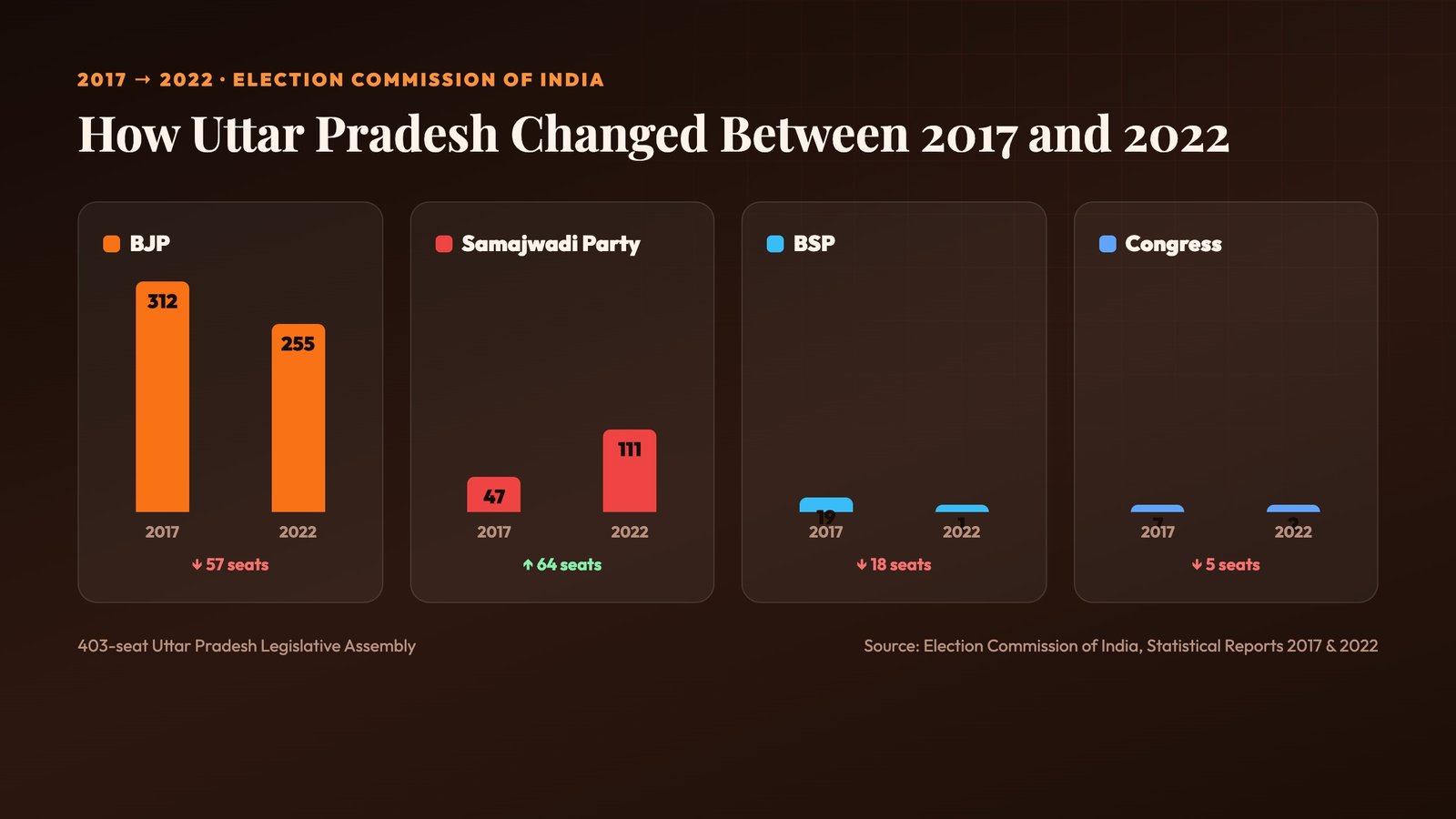
Source: Election Commission of India, Statistical Reports 2017 & 2022
| Party | 2017 seats | 2017 vote % | 2022 seats | 2022 vote % | Change |
|---|---|---|---|---|---|
| BJP | 312 | 39.67% | 255 | 41.29% | −57 seats, +1.62pp vote |
| Samajwadi Party | 47 | 21.82% | 111 | 32.06% | +64 seats, +10.24pp vote |
| BSP | 19 | 22.23% | 1 | 12.88% | −18 seats, −9.35pp vote |
| Congress | 7 | 6.25% | 2 | ~2.3% | −5 seats |
Why did BJP lose seats compared with 2017 while still comfortably forming the government? Its 2017 result of 312 seats on 39.67% of the vote was among the largest mandates in UP's electoral history — a high bar. In 2022 the BJP's vote share actually rose slightly, to 41.29%, but a stronger, more consolidated opposition (chiefly SP, which absorbed much of BSP's lost ground in seat-winning terms) meant fewer of BJP's individual constituency contests were won by comfortable margins. The party still cleared the 202-seat majority mark with room to spare.
Note on 2017 context: In 2017, the Samajwadi Party contested in electoral alliance with the Congress; by 2022, SP had rebuilt its own alliance around RLD and SBSP instead. This is part of why comparing SP's "solo" seat figures across the two elections requires care — the alliance structure itself changed between cycles.
UP Election 2022: The Full Timeline
From the 2017 result to the political consequences that followed — chronological, sourced
Previous Assembly election: BJP's 2017 sweep
What happened: The BJP won 312 of 403 seats in the 2017 UP Assembly election, one of its largest state mandates, defeating an SP-Congress alliance (SP 47 seats) and a BSP that still held 19 seats on 22.23% of the vote. Yogi Adityanath was appointed Chief Minister on March 18, 2017, beginning his first term.
Why it matters: This is the baseline every 2022 comparison in this article is measured against.
Source: Election Commission of India, 2017 Statistical Report (cross-checked via Wikipedia's ECI-sourced infobox).
Two events that shaped the run-up to 2022
What happened: Two developments dominated Uttar Pradesh's political backdrop between elections. First, India's COVID-19 second wave (April–May 2021) hit UP hard; Reuters and other outlets reported bodies, some believed to be COVID-19 victims, found in and along the Ganga, prompting the state government to order a crackdown on the practice and promise cremation assistance. Second, the year-long farmers' protest against three central farm laws — with a significant base in western UP — ended when Parliament repealed the laws in late November 2021, after Prime Minister Modi announced the repeal on November 19, 2021.
Why it matters: Both events were widely cited in contemporaneous political commentary as pressure points the BJP had to manage before the 2022 campaign, particularly in western UP; this article treats that as commentary, not as a certified cause of the eventual result.
Source: NBC News, May 2021; CNN, December 2021.
Alliances take shape ahead of the election
What happened: The Samajwadi Party built its SP+ alliance around Rashtriya Lok Dal and Suheldev Bharatiya Samaj Party. The BJP retained its existing NDA partnership with Apna Dal (Sonelal) and added the NISHAD Party as a formal ally for this election.
Source: Election Commission of India, 2022 Statistical Report (alliance seat totals reconcile exactly to 403).
Election Commission announces the schedule
What happened: The ECI announced poll dates for Uttar Pradesh alongside four other states (Punjab, Uttarakhand, Goa, Manipur), setting the seven-phase UP schedule running from February 10 to March 7.
Source: Election Commission of India.
Seven-phase voting
What happened: Voting for the 403 seats was conducted in seven phases over nearly four weeks, the standard practice for Uttar Pradesh given its size and the security arrangements a state of its scale requires.
Turnout: Final voter turnout across all phases came in at approximately 61.03%, marginally lower than 2017's 61.24%.
Source: Election Commission of India.
10
Counting and results
What happened: Votes cast across all seven phases were counted; the BJP-led NDA crossed the majority mark, and the Election Commission declared results for all 403 seats: BJP 255 (41.29%), SP 111 (32.06%), BSP 1 (12.88%), Congress 2.
Source: Election Commission of India, Statistical Report on the General Election 2022 to the Uttar Pradesh Legislative Assembly.
25
Government formation: Yogi Adityanath sworn in for second term
What happened: Governor Anandiben Patel administered the oath of office to Yogi Adityanath as Chief Minister, with Keshav Prasad Maurya and Brajesh Pathak sworn in as Deputy Chief Ministers, at a ceremony attended by Prime Minister Narendra Modi and senior BJP leaders.
Why it matters: Adityanath became one of a small number of UP chief ministers to return to office after completing a full five-year term — a state where high turnover of incumbents had been the historical norm.
Source: Business Standard, March 25, 2022.
onward
Verified political consequences
What happened: With BSP reduced to 1 seat and Congress to 2, SP's 111 seats made it the unambiguous principal opposition in the 18th UP Assembly for the first time since well before 2017. This is a verified change in the Assembly's composition, not a prediction.
Why it matters: The BJP-SP axis this result established has continued through the state's subsequent electoral contests, including the 2024 Lok Sabha election in UP. For how that contest has developed since, see AiTimeline's UP Election 2027 timeline.
Source: Election Commission of India, 2022 Statistical Report (seat composition).
Why Did BJP Win the 2022 UP Election?
Verified facts, separated from editorial analysis
Verified facts: The BJP entered the election as the incumbent, having completed a full term with Yogi Adityanath as Chief Minister. It contested in alliance with Apna Dal (Sonelal) and the NISHAD Party. It won 255 seats on 41.29% of the vote — a vote share slightly higher than its already-large 2017 tally of 39.67%.
Analysis and interpretation (not official election data): Political commentary and post-election analysis by Indian news organizations at the time generally pointed to a combination of factors: the advantage of incumbency itself, the BJP's organizational reach into rural and semi-urban Uttar Pradesh, welfare-scheme delivery (such as foodgrain distribution during the pandemic period) that the party campaigned on directly, and a law-and-order narrative built around Adityanath's first term. Some post-poll survey research, including work by Lokniti-CSDS, examined how different demographic groups voted and how welfare-scheme beneficiaries leaned; where this article does not cite a specific percentage from that research, it is because the relevant figure was not independently verified for this page — readers wanting those numbers should consult Lokniti-CSDS's published post-poll data directly rather than take them from secondary summaries.
These are explanatory factors discussed in contemporaneous reporting and analysis, not figures certified by the Election Commission. Treat this paragraph as analysis, not as the same category of fact as the seat and vote-share numbers above.
How the Samajwadi Party Expanded Its Position in 2022
SP's seat count rose from 47 in 2017 to 111 in 2022, and its vote share climbed from 21.82% to 32.06% — a gain of more than 10 percentage points, the single largest vote-share swing of any major party in this election. Contesting 347 seats directly, with RLD (33 seats contested, 8 won) and SBSP (17 contested, 6 won) as its principal allies, SP built an alliance that performed particularly strongly in western Uttar Pradesh, a region where RLD has historic organizational strength among Jat voters.
The result made SP, not BSP or Congress, the clear principal opposition in the 18th Uttar Pradesh Assembly — a position it had not held outright since well before the 2017 election. That repositioning, more than the government-formation outcome, is why 2022 is treated as a turning point for the party heading into subsequent elections.
BSP and Congress: What the 2022 Results Showed
The BSP's 2022 result was the most dramatic single-party swing in the election: from 19 seats and 22.23% of the vote in 2017 down to just 1 seat, despite still polling 12.88% — more than one in eight votes cast statewide. As explained in the seat-share-vs-vote-share section above, this is a direct consequence of a spread-out vote base under first-past-the-post rules, not evidence that the party's support evaporated to the same degree its seat count did.
Congress won 2 seats, continuing a decline that has left it a marginal force in UP Assembly politics for over a decade; its 2017 tally, won in alliance with SP, was 7 seats. The party contested independently in 2022 across 399 constituencies.
Neither result should be read as either party's permanent political end — these are the verified figures from a single election, not a forecast.
Bharatiya Janata Party (BJP)
India's ruling national party; won 255 of 403 UP Assembly seats in 2022, leading the NDA alliance to 273 seats overall and retaining power in the state.
Samajwadi Party (SP)
Regional party led by Akhilesh Yadav; won 111 seats in 2022 (up from 47 in 2017), leading the SP+ alliance to 125 seats and becoming the principal opposition.
Election Commission of India (ECI)
The constitutional authority responsible for conducting and certifying Indian elections, including publishing the official statistical reports this article's figures are drawn from.
Uttar Pradesh Legislative Assembly
The 403-member state legislature (Vidhan Sabha) elected in this contest; a party or alliance needs 202 seats to form the government.
What Changed After the 2022 Result?
Immediate consequence: government formation
The BJP-led NDA formed the government with its 273-seat majority. Yogi Adityanath was sworn in as Chief Minister for a second term on March 25, 2022, becoming the first UP chief minister in a long stretch of the state's history to return to office after completing a full five-year term — multiple news reports at the time noted this was the first such instance in several decades.
Opposition landscape
SP emerged from the election as the unambiguous principal opposition party in the Assembly, a position reinforced by its 111-seat tally against BSP's single seat and Congress's two. This restructured how opposition politics functioned in the state legislature for the term that followed.
Longer-term political relevance
The 2022 result set the terms of the BJP-SP contest that has defined Uttar Pradesh politics since — including the 2024 Lok Sabha election in the state and the run-up to the next UP Assembly election. This page focuses on the verified 2022 result itself; for how that contest has developed since, see our dedicated UP Election 2027 timeline, which tracks the current cycle's schedule, alliances and candidates as they are officially confirmed.
💡 Worth Knowing
- The BSP's 12.88% vote share in 2022 was higher than the vote share several parties elsewhere in India have used to win dozens of seats — the gap between its vote share and its 1-seat result is a textbook illustration of how first-past-the-post elections work.
- The Samajwadi Party's 2022 vote share (32.06%) was its highest in a UP Assembly election in over a decade.
- All 403 results were declared on a single counting day, March 10, 2022, despite polling having stretched across seven phases and nearly a month.
- Uttar Pradesh's Assembly is the largest of any Indian state, which is why its elections are conducted in multiple phases rather than on a single day.
Explore More Timelines
Uttar Pradesh Chief Ministers: Recent Context
Only the context needed to place the 2022 result — not a full CM history
present
Yogi Adityanath — second term
Began a second consecutive term as Chief Minister following the 2022 election result, with Keshav Prasad Maurya and Brajesh Pathak as Deputy Chief Ministers.
Yogi Adityanath — first term
First term as Chief Minister following the BJP's 312-seat win in the 2017 Assembly election, with Keshav Prasad Maurya and Dinesh Sharma as Deputy Chief Ministers.
Frequently Asked Questions
✅ How We Verified This Page
Every seat count and vote-share figure on this page is checked against the Election Commission of India's statistical reports for the 2017 and 2022 Uttar Pradesh Legislative Assembly elections — the constitutionally mandated primary source for Indian election results. Alliance totals (NDA, SP+) are shown separately from individual-party totals throughout, and are cross-checked by confirming they sum correctly against the 403-seat total. Contextual details such as the exact date and location of the Chief Minister's swearing-in ceremony are drawn from contemporaneous news reporting. Any statement attributing a cause to the election result (the "Why BJP Won" section) is explicitly labeled as analysis or commentary, not as ECI data. One vote-share figure — Congress's approximate 2.3% — is sourced to secondary reporting rather than an independently confirmed ECI decimal figure and is marked with a tilde (~) accordingly.
Reviewed by: AiTimeline editorial team · Last reviewed: August 24, 2026 · Primary source: Election Commission of India.
⚠️ Editorial Note
This is a factual results explainer, not political commentary or advocacy for any party. Interpretive claims about why the result turned out as it did are clearly separated from the verified seat and vote-share figures throughout this page. Content is editorial and AI-assisted, compiled from the sources cited; if you spot an error, we welcome corrections.
Sources & further reading
Every dated entry above was checked against these references. Last reviewed 15 September 2026.
- Election Commission of India — Uttar Pradesh General Legislative Election 2022 (Statistical Report archive)
- Election Commission of India — Past Elections Statistics
- 2022 Uttar Pradesh Legislative Assembly election — Wikipedia (secondary, cross-check)
- 2017 Uttar Pradesh Legislative Assembly election — Wikipedia (secondary, cross-check)
- Business Standard — Yogi Adityanath sworn in for 2nd term as UP CM