Pokémon Timeline 1996–2026: From Game Boy Phenomenon to the 30th Anniversary
Explore Pokémon's 30-year timeline from Red and Green on Game Boy in 1996 to Pokémon GO, Scarlet and Violet, Switch 2 and the franchise's 2026 anniversary.
Latest Story
In February 1996, Pokémon did not arrive on cutting-edge hardware. It launched on the Game Boy, a handheld Nintendo had released years earlier, with monochrome graphics and a link cable for multiplayer. Inside that technically modest cartridge was an unusually powerful idea: your creatures were not the same as your friend’s. To finish the collection, you had to find someone, connect two Game Boys, and trade. That single design decision turned a solitary role-playing game into a social network before social networks existed. Thirty years later, the Pokémon timeline runs from that Game Boy cartridge through a television anime, a trading card game, global expansion, wireless and internet trading, a mobile AR phenomenon, open-world console games, a digital card app and, in 2026, a 30th anniversary that bridges straight into the next hardware generation on Nintendo Switch 2.
Last updated: 3 September 2026. Every release date below is checked against an official Pokémon Company, Nintendo or Game Freak source. Where a detail is fan or media terminology rather than an official label — for example “Generation 10” — that is stated explicitly. Sales and shipment figures carry a source and date; this article is editorial history, not a marketing summary.
🧠 AI Overview Summary
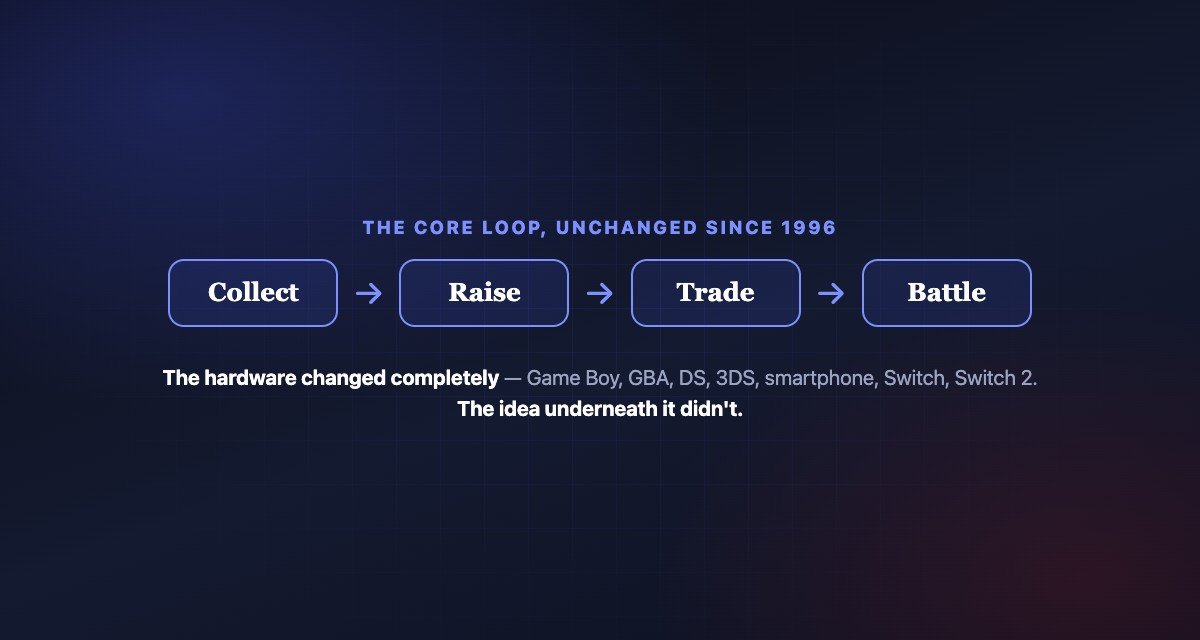
Pokémon began with Red and Green on the Game Boy in Japan on 27 February 1996. The Trading Card Game followed in October 1996 and the television anime in April 1997. The franchise expanded internationally from September 1998, added wireless trading in 2004 and internet trading in 2006, reached a new mass audience with Pokémon GO in 2016, moved to a fully open-world core RPG structure with Scarlet and Violet in 2022, and entered the Nintendo Switch 2 era in 2025 with Legends: Z-A. On 27 February 2026, Pokémon turned 30 and The Pokémon Company announced Pokémon Winds and Pokémon Waves, new RPG entries exclusive to Nintendo Switch 2, for a simultaneous worldwide launch in 2027. Across every hardware generation, the core loop — collect, raise, trade, battle — has stayed the same.
Pokémon’s biggest technological innovation wasn’t better graphics. It was giving players a reason to connect with each other.
Pokémon at 30: Key Questions
Pokémon’s first 30 years, in ten facts
- The game came first. Pocket Monsters Red and Green released in Japan on 27 February 1996, followed by the TCG in October 1996 and the anime in April 1997 — game, then cards, then anime, not the order fans often assume.
- Trading was never optional. Red and Green each contained species the other lacked. Completing a Pokédex required finding another player and connecting Game Boys via the Link Cable, making trading part of progression from day one.
- International growth took over two years. Pokémon Red and Blue reached North America in September 1998; the US Trading Card Game followed in early 1999.
- Connectivity evolved in five distinct steps. Link Cable (1996) → local wireless (2004) → internet Wi-Fi trading (2006) → worldwide simultaneous launch (2013) → cloud storage via Pokémon HOME (2020).
- Pokémon GO changed who plays, not what the game is about. Its July 2016 launch replaced the Game Boy screen with a smartphone and the living room with real streets, but the goal — catch one more creature — was unchanged from 1996.
- Scarlet and Violet, not Legends: Arceus, is the first fully open-world core RPG. Arceus (January 2022) introduced large open areas; Scarlet and Violet (November 2022) removed the region’s internal loading walls entirely.
- Nintendo Switch 2 launched 5 June 2025 — this is no longer a future console. Legends: Z-A followed on 16 October 2025 with both a Switch and a Switch 2 Edition.
- The 30th anniversary is a year, not a day. Pokémon Day (27 February 2026) is the headline moment, but Pokopia, Champions, TCG products and Pokémon GO events extend the celebration through 2026.
- Winds and Waves are confirmed for 2027, not 2026. They were announced on Pokémon Day 2026, are exclusive to Nintendo Switch 2, and launch worldwide in 2027 — treat any earlier date, or a region name, as unconfirmed.
- The commercial story includes real technical criticism. Scarlet and Violet sold over 10 million units in three days — a Nintendo record — while also drawing widely reported frame-rate and performance complaints. Both are part of the record.
How Did a 1996 Game Boy RPG Become a 30-Year Entertainment Ecosystem?
Not by changing what the game asks you to do — by changing how you do it.
Every generation of Pokémon has answered the same underlying question: how do you make collecting and connecting feel new again? The pieces of the loop — collect, raise, trade, battle — have appeared in some form in nearly every mainline release since 1996. What moved was the technology carrying that loop from one player to another.
The Pokémon Flywheel
Why the franchise isn’t just a video game series
Pokémon’s durability owes as much to cross-media reinforcement as to any single game. A new region introduces creatures; the anime gives them personalities; the Trading Card Game lets players own and trade physical pieces of that world; merchandise and events keep the characters present between releases; and the next game brings players back to start again.
The Origin Era — 1996 to 1999
On 27 February 1996, Pocket Monsters Red and Pocket Monsters Green launched in Japan for the Game Boy. The concept is widely credited to Satoshi Tajiri, whose childhood interest in collecting insects is often cited as an inspiration; the games were developed by Game Freak and published by Nintendo, with Creatures Inc. as a founding rights and business partner. The Pokémon Company itself was not established until 1998, formed by Nintendo, Game Freak and Creatures to manage the expanding brand as it grew beyond a single video game.
The core innovation was not graphical — Game Boy hardware in 1996 was already several years old and monochrome. It was structural: Red and Green each contained Pokémon the other version lacked. No single player could complete the collection alone. Two Game Boys, connected by a Link Cable, could trade creatures neither game could produce on its own. Progression required another person.
🔸 Version exclusives became a business model too
Releasing two versions with partial-overlap rosters — later Blue in Japan, then Red and Blue internationally — encouraged players to buy a second copy or find a trading partner. It has appeared in nearly every mainline generation since, from Gold/Silver to Scarlet/Violet, making it one of Pokémon’s longest-running commercial and social mechanics at once.
The Pokémon Trading Card Game followed quickly — launching in Japan in October 1996, just eight months after the original games, developed with Wizards of the Coast for its later international rollout. The television anime debuted in Japan on 1 April 1997, turning game sprites into recurring characters. The correct order is game, then cards, then anime — not the reverse many fans assume.
⚠️ The Mew rumor, without overclaiming
A hidden, uncatchable Mew — discoverable through a well-known glitch, and distributed officially through Japanese magazine promotions and events — became one of Pokémon’s first viral phenomena, fuelling playground rumors and speculation well before the internet made that easy. It is fair to call Mew an early hype driver; it is not possible to attribute a specific sales lift to it without a named source, so this article does not.
Pokémon Red and Blue launched in North America in September 1998, backed by the anime’s US syndication debut and an early wave of Trading Card Game products; the US Trading Card Game itself followed in early 1999. A widely reported incident briefly interrupted the anime’s momentum in Japan: an episode broadcast on 16 December 1997 (“Dennou Senshi Porygon”) used flashing red-and-blue strobe effects that reportedly triggered photosensitive seizures in some young viewers, prompting a temporary broadcast halt and the episode’s permanent removal from rotation — a genuine early controversy, not just a curiosity.
Generation II arrived with Pokémon Gold and Silver in Japan in November 1999, on the backward-compatible Game Boy Color. It added 100 new species, a real-time day/night clock, and breeding — establishing the template of a new region, new mechanics and a new roster that every subsequent generation would follow.
Generational Expansion — 2000 to 2005
Pokémon Ruby and Sapphire (Japan, November 2002; internationally, 2003) moved the series to the Game Boy Advance: full color, the Hoenn region, double battles and Abilities, a mechanic that added a passive effect to every Pokémon and deepened competitive strategy. In 2004, Pokémon FireRed and LeafGreen supported the Game Boy Advance Wireless Adapter — the first step away from a physical Link Cable, not an outright replacement of it. Cable trading remained supported; wireless simply reduced how often a cable was required.
The Connected Era — 2006 to 2012
Pokémon Diamond and Pearl launched in Japan in September 2006 on the Nintendo DS, introducing Nintendo Wi-Fi Connection and the Global Trade Station (GTS). For the first time, a trading partner could be a stranger on another continent rather than a classmate with a second Game Boy. The social circle around Pokémon expanded from the person next to you to players anywhere with an internet connection.
In 2009, The Pokémon Company held the first officially organized Pokémon World Championships, formalizing what had been years of regional and playground competition into a structured global tournament circuit — the point at which battling stopped being only a feature of the games and became its own competitive scene.
The Global 3D Era — 2013 to 2015
Pokémon X and Y launched on the Nintendo 3DS in October 2013 and were the first mainline games released simultaneously worldwide, ending years of staggered regional rollouts. They also moved the series into full 3D and introduced Mega Evolution. A worldwide day-one launch is a smaller-sounding milestone than a new region, but it changed the series’ entire release rhythm going forward.
The Pokémon GO Era — 2016 to 2018
Pokémon GO launched in July 2016, developed by Niantic in partnership with The Pokémon Company and Nintendo. Its real innovation was not augmented reality as a visual trick — it was turning real geography into the game map. A street became a route; a park became a habitat; a landmark became a PokéStop or Gym; a smartphone became a Pokédex. Millions of people who had never owned a Game Boy suddenly understood, for a few weeks in city parks worldwide, why catching one more creature had kept players engaged since 1996.
The Switch Era — 2019 to 2021
Pokémon Sword and Shield (November 2019) moved the core RPG series onto the Nintendo Switch, Nintendo’s hybrid home-and-portable console — not the franchise’s first console appearance overall, since spin-offs and remakes had reached home consoles before, but the first time a numbered core-series generation launched there. In February 2020, Pokémon HOME introduced cloud storage: a player’s collection could move between compatible games without a physical connection of any kind — the digital-era descendant of the 1996 Link Cable.
The Open-World Era — 2022 to 2024
Pokémon Legends: Arceus (January 2022) introduced large, connected open areas and more direct, action-oriented catching — a meaningful step change, though not a fully seamless open world in the sense the next release would deliver. Pokémon Scarlet and Violet (November 2022) removed the region’s internal loading boundaries entirely, making Paldea the first fully open-world core Pokémon RPG. Nintendo confirmed the two titles sold more than 10 million units combined worldwide within their first three days — the fastest-selling launch in Nintendo’s history to that point.
⚠️ Commercial success and technical criticism are both part of the record
Scarlet and Violet’s record sales are well documented. So is the widely reported criticism at launch of frame-rate drops, visual glitches and general performance issues on Nintendo Switch hardware. Both facts describe the same release; neither cancels out the other.
In October 2024, Pokémon Trading Card Game Pocket launched as a mobile-first card-collecting and battling app with streamlined mechanics and digital card presentation. It is a distinct product from both the physical TCG and from Pokémon TCG Live, the existing digital implementation of traditional tabletop-style play — not a straightforward digitisation of the physical card game, but its own design built around fast, mobile-first collecting.
| Format | What it is |
|---|---|
| Physical TCG | Collect and play printed cards, in person or by mail |
| Pokémon TCG Live | Digital implementation of traditional tabletop-style TCG rules and deck-building |
| Pokémon TCG Pocket | Mobile-first collecting app with streamlined battles, launched October 2024 |
2025: The Switch 2 Transition
Nintendo Switch 2 launched globally on 5 June 2025 — this is Nintendo’s current-generation hardware, not an upcoming one. Pokémon Legends: Z-A followed on 16 October 2025, released simultaneously as a standard Nintendo Switch title and a Nintendo Switch 2 Edition with improved resolution and frame rate. Set in Lumiose City (the Kalos region’s capital, first seen in X and Y) and bringing back Mega Evolution, Z-A also pushed core battle design further toward real-time, dynamic elements — another step away from strictly static turn-based presentation, though not a conversion of every Pokémon battle into full action combat. A story expansion, Mega Dimension, followed as downloadable content in December 2025.
2026: Pokémon at 30
27 February 2026 marked exactly 30 years since Red and Green, and became the year’s central news hook as Pokémon Day. The anniversary is not a single day of celebration — The Pokémon Company confirmed a year-long 30th-anniversary programme running across 2026, spanning games, the Trading Card Game, Pokémon GO events and Pokémon Masters EX content.
Two major releases anchored the anniversary year outside the RPG line. Pokémon Pokopia launched 5 March 2026 on Nintendo Switch 2 — a life-simulation game in which the player, transformed from a Ditto into human-like form, builds a Pokémon paradise alongside creature companions. It signals that Pokémon’s future is not limited to mainline RPGs; the brand already supports battle games, mobile card apps, AR and now life simulation under one IP. Pokémon Champions launched 8 April 2026 on Nintendo Switch and Switch 2, described by The Pokémon Company as a standalone game built entirely around competitive Pokémon battling — pulling a mechanic that had always lived inside the mainline RPGs into its own dedicated product, with an Android and iOS release following on 17 June 2026.
30 Years — What Changed
| 1996 | 2026 |
|---|---|
| Monochrome Game Boy | Nintendo Switch 2 |
| 151 original species | Well over 1,000 documented species across the Pokédex |
| Local Link Cable trading | Global online ecosystem: cloud storage, mobile apps, worldwide launches |
| Japan-only launch | Simultaneous worldwide releases as standard practice |
| One video game series | Games, TCG (physical, Live and Pocket), anime, Pokémon GO, competitive league |
2027: What’s Next — Pokémon Winds & Pokémon Waves
The headline announcement of Pokémon Day 2026 was Pokémon Winds and Pokémon Waves, revealed on 27 February 2026 as the next entries in the mainline RPG series. The Pokémon Company’s own announcement site confirms the games are being released exclusively on Nintendo Switch 2 in a simultaneous worldwide release in 2027. The setting is an open world of windswept islands and a vast ocean, with three starter Pokémon revealed at announcement — Browt (Grass), Pombon (Fire) and Gecqua (Water) — alongside two special-design Pikachu, Mr. Windychu and Ms. Wavychu, whose in-game role has not yet been detailed.
❓ Is Pokémon Generation 10 coming in 2026?
Pokémon Winds and Pokémon Waves were officially announced on 27 February 2026 for a worldwide 2027 launch on Nintendo Switch 2. Gaming press and fans commonly refer to this new era as “Generation 10”, but as of this update The Pokémon Company has not used that numbering as an official label for the games. This article uses the official names, Winds and Waves, and flags “Generation 10” as common fan and media terminology.
Pokémon’s Next Era — Confirmed vs. Unknown
| Status | Date | Milestone | What we actually know |
|---|---|---|---|
| 🟢 Released | 5 Jun 2025 | Nintendo Switch 2 | Nintendo’s current-generation hybrid console |
| 🟢 Released | 16 Oct 2025 | Pokémon Legends: Z-A | Standard Switch edition plus a Switch 2 Edition |
| 🟢 Released | 5 Mar 2026 | Pokémon Pokopia | Switch 2 life-simulation title |
| 🟢 Released | 8 Apr 2026 | Pokémon Champions | Dedicated battle game, Switch/Switch 2; mobile followed 17 Jun 2026 |
| 🟢 Confirmed | 27 Feb 2026 | Winds & Waves announced | New Pokémon RPG pair, official reveal trailer and site live |
| 🟢 Confirmed | 2027 | Winds & Waves global launch | Simultaneous worldwide release, exclusive to Nintendo Switch 2 |
| ⚪ Unknown | TBD | Exact Winds/Waves release date | Not officially announced beyond “2027” |
| ⚪ Unknown | TBD | Full Pokédex / new-species count | Not officially confirmed |
| ⚪ Unknown | TBD | Region name, story, villain team | Not officially revealed |
🔸 What’s not confirmed yet
No exact release date, region name, Pokédex count, battle-gimmick mechanic, DLC plan or sales forecast has been announced for Winds and Waves. Treat any specific figure or date beyond “2027, Nintendo Switch 2, worldwide simultaneous” as speculation until The Pokémon Company confirms it.
The Full 30-Year Timeline
Newest first — the milestones that changed technology, distribution or the game itself, not every title ever released
Pokémon Winds & Pokémon Waves — worldwide launch
Status: Officially confirmed for 2027; exact date not yet announced.
Why it matters: Marks the franchise’s next mainline generation and its first RPG pair built natively for Nintendo Switch 2.
30th anniversary & Winds/Waves announcement
What happened: Exactly 30 years after Red & Green, The Pokémon Company unveiled Pokémon Winds and Pokémon Waves for Nintendo Switch 2, 2027.
Pokémon Champions launches
Why it matters: The first standalone Pokémon game built entirely around competitive battling, separating a mechanic that had always lived inside the RPGs.
Pokémon Pokopia launches
What it is: A life-simulation spin-off in which the player, as a human-transformed Ditto, builds a Pokémon paradise.
Pokémon Legends: Z-A releases
What it is: Set in Lumiose City, brings back Mega Evolution and pushes battles toward more real-time, dynamic pacing.
Nintendo Switch 2 launches
Why it matters: Ends years of “next Nintendo hardware” speculation and becomes the platform for every subsequent Pokémon release, including Winds & Waves.
Pokémon TCG Pocket launches
Why it matters: A mobile-first card-collecting app, distinct from both the physical TCG and Pokémon TCG Live.
Pokémon Scarlet & Violet release
Why it matters: The first fully open-world core-series Pokémon RPG; also drew widely reported technical-performance criticism.
Pokémon Legends: Arceus releases
Why it matters: Introduces large open areas and more direct, action-oriented catching — a step toward, not the same as, Scarlet/Violet’s full open world.
Pokémon HOME launches
Why it matters: Cloud storage moves collections between compatible games without any physical connection — the digital descendant of the Link Cable.
Pokémon Sword & Shield release
Why it matters: First numbered core-series generation on Nintendo’s Switch hybrid console.
Pokémon GO launches
Why it matters: Turned real-world geography into the game map via GPS and smartphone cameras, reaching a mass audience beyond existing fans.
Pokémon X & Y release
Why it matters: First mainline games launched simultaneously worldwide; moved the series into full 3D and introduced Mega Evolution.
First official Pokémon World Championships
Why it matters: Formalizes Pokémon as an organized global competitive scene, not just playground battling.
Pokémon Diamond & Pearl release
Why it matters: Nintendo Wi-Fi Connection and the Global Trade Station move trading online for the first time.
FireRed & LeafGreen add wireless trading
Why it matters: First step away from a physical Link Cable, using the GBA Wireless Adapter.
Pokémon Gold & Silver release
Why it matters: Sets the template for every future generation — new region, new mechanics (breeding, day/night), new roster.
Pokémon Red & Blue reach North America
Why it matters: Begins Pokémon’s international expansion, alongside the anime’s US syndication debut.
Pokémon anime debuts in Japan
Why it matters: Turns game characters into recurring television personalities, widening Pokémon from a game into a media ecosystem.
Pocket Monsters Red & Green launch
Why it matters: The original release. Version-exclusive Pokémon and Link Cable trading establish the collect-trade loop that still defines the franchise.
The Scale of the Ecosystem, Carefully
Pokémon’s strength is not simply game sales — the ecosystem spans video games, the Trading Card Game, anime and film, mobile apps, licensed merchandise and competitive events. The Pokémon Company’s own reporting, cited widely in gaming press around the 30th anniversary in 2026, put cumulative video-game shipments at more than 515 million units and cumulative Trading Card Game production at more than 85 billion cards since 1996. This article does not state a single lifetime franchise revenue figure, because The Pokémon Company does not publish one methodology that combines games, cards, merchandise, licensing and media into a single audited number; any headline dollar figure circulating publicly is a third-party estimate, not an official total.
Game Freak
Developed the original 1996 games and continues to develop the core RPG series, including Scarlet/Violet and Legends: Z-A.
Nintendo
Publishes the mainline games and manufactures the hardware — Game Boy through Nintendo Switch 2 — Pokémon has shipped on.
Creatures Inc.
Co-created the franchise alongside Nintendo and Game Freak; also develops spin-off titles.
The Pokémon Company
Established in 1998 by Nintendo, Game Freak and Creatures to manage the Pokémon brand across games, anime, TCG and licensing worldwide.
Niantic
Developed and, at launch, operated Pokémon GO in partnership with The Pokémon Company and Nintendo since 2016.
Pokémon: The Series
Running since April 1997; Ash Ketchum served as the anime’s protagonist for over two decades before the series introduced new lead characters, Liko and Roy, in 2023.
Why Did Pokémon Survive 30 Years?
✅ Five reasons it lasted
- Collecting — humans respond to completion, discovery and rarity.
- Social exchange — trading makes another person part of the gameplay itself.
- Generational reset — every era brings a new region, new creatures, new mechanics.
- Cross-media reinforcement — games feed the anime, the anime feeds cards, cards feed collecting, characters feed merchandise.
- Technology without abandoning the core loop — cable to wireless to Wi-Fi to GPS to cloud to open world, while collect/raise/trade/battle stayed intact.
❌ What technology alone doesn’t explain
- Better graphics did not create the trading incentive — the version-exclusive design did, starting in 1996.
- Pokémon GO’s success was not really about AR novelty — it was about mapping the game onto real places people already went.
- Hardware transitions (Game Boy to DS to Switch to Switch 2) explain distribution, not why players kept returning generation after generation.
Someone who was 10 years old when Pokémon Red and Blue arrived in North America in 1998 is now approaching 40. Many now introduce their own children to the franchise — through Pokopia’s family-friendly life-simulation format, or a first Trading Card Game pack. That generational handoff is one reason the 30th anniversary reads differently from a routine game-franchise milestone: Pokémon is no longer only childhood nostalgia for one generation. It is nostalgia being actively passed to the next.
Explore More Timelines
People Also Ask
Frequently Asked Questions
Explore More on AiTimeline
⚠️ Editorial Note
This article separates officially confirmed dates and figures (sourced to The Pokémon Company, Nintendo or Game Freak) from fan and media terminology such as “Generation 10”, which is labelled explicitly wherever it appears. Unreleased content — principally Pokémon Winds and Pokémon Waves — is described only using details The Pokémon Company has officially confirmed as of 3 September 2026; anything else circulating publicly is speculation. This content is editorial and AI-assisted, not an official Pokémon Company or Nintendo publication.
Sources & further reading
Every dated entry above was checked against these references. Last reviewed 15 September 2026.
- Pokémon Winds and Pokémon Waves — official announcement site
- Pokémon Legends: Z-A — official release date
- Pokémon Pokopia — Nintendo Switch 2, official product page
- Pokémon Champions comes to Android and iOS on June 17 — official Pokémon news
- Nintendo Switch 2 — official product site
- Pokémon TCG production surpasses 85 billion cards — PokeGuardian
- The Pokémon Company — official site
- Pokémon Pokopia launching March 5, 2026 — official Pokémon news