Supreme Court Judges’ Press Conference 2018: The Crisis That Put India’s Judiciary in the Spotlight
Supreme Court judges' press conference 2018: the 12 January letter, roster rulings, the Loya judgment and the impeachment notice, explained step by step.
Latest Story
The Supreme Court judges’ press conference of 2018 took place on 12 January 2018, when Justices Jasti Chelameswar, Ranjan Gogoi, Madan B. Lokur and Kurian Joseph spoke to journalists at Justice Chelameswar’s residence in New Delhi and released a letter to Chief Justice Dipak Misra about the Court’s administration, including how important cases were assigned to benches. It was an unprecedented public step by sitting judges of the Court. This page keeps three things apart: the judges’ stated concerns, the Supreme Court’s own findings, and political reactions such as the impeachment notice. For other cases where courts, commissions and politics interacted, see the Nirbhaya case, the 2G spectrum case and the electoral bonds ruling; each has its own, different legal outcome.
💡 Short Answer
On 12 January 2018 four senior Supreme Court judges said publicly that the Court’s administration was not in order and that important cases were being assigned selectively. No court ruled on those complaints. The Supreme Court did rule in April and July 2018 that the Chief Justice alone is the master of the roster, and it dismissed the Loya petitions on 19 April 2018. An impeachment notice was refused admission on 23 April 2018.
How the Crisis Unfolded
Six steps from the 2017 bench dispute to the 2018 rulings. Tap a step; the key event is selected first.
Tap a step. The key event is the 12 January press conference.
Choose a step above.
Supreme Court Judges’ Press Conference: Key Questions
The 2018 Judges’ Press Conference in Ten Points
- The event: four senior judges addressed the press on 12 January 2018 and released a letter.
- The stated concern: important cases assigned selectively to chosen benches, and the administration of the Court.
- The trigger text: the letter cites the 27 October 2017 R. P. Luthra order, not the Loya case.
- The Loya link: Gogoi said yes when asked if it was about Loya; Chelameswar said not just Loya.
- The roster: a subject-wise roster took effect on 5 February 2018.
- The law: the Court held twice in 2018 that the Chief Justice alone is the master of the roster.
- The Loya ruling: petitions dismissed on 19 April 2018 on the ground of natural causes.
- The notice: 64 valid signatures, submitted on 20 April and refused admission on 23 April 2018.
- The aftermath: all four had left the bench by 17 November 2019; Gogoi was Chief Justice from 3 October 2018.
- The caution: no court ruled on the judges’ complaints, and allegations should not be read as findings.
How the Crisis Unfolded: The Timeline, Latest First
Each entry is tagged as a stated concern, a judicial finding, a political reaction or court administration, and ends with why it matters.
Concern, court finding or political reaction? Filter the timeline by what kind of statement each entry is.
–
Two of the four judges criticise Ranjan Gogoi’s Rajya Sabha nomination Political reaction
President Ram Nath Kovind nominated former Chief Justice Ranjan Gogoi to the Rajya Sabha on 16 March 2020, four months after Gogoi retired on 17 November 2019. Former Justice Kurian Joseph said Gogoi had “compromised” principles of judicial independence and recalled the 2018 press conference (LiveLaw). Former Justice Madan Lokur said the nomination itself was not unexpected but that it had come so soon was surprising, and several former judges and Opposition leaders also objected (Scroll).
Gogoi said that being in Parliament would let him present the judiciary’s views to the legislature and said he would explain his decision after taking the oath, which he did on 19 March.
Keep the strands apart: these were opinions of former judges and politicians about a post-retirement appointment. They are not findings on the 2018 complaints.
Kurian Joseph and Madan Lokur retire; the original four have left the bench Court administration
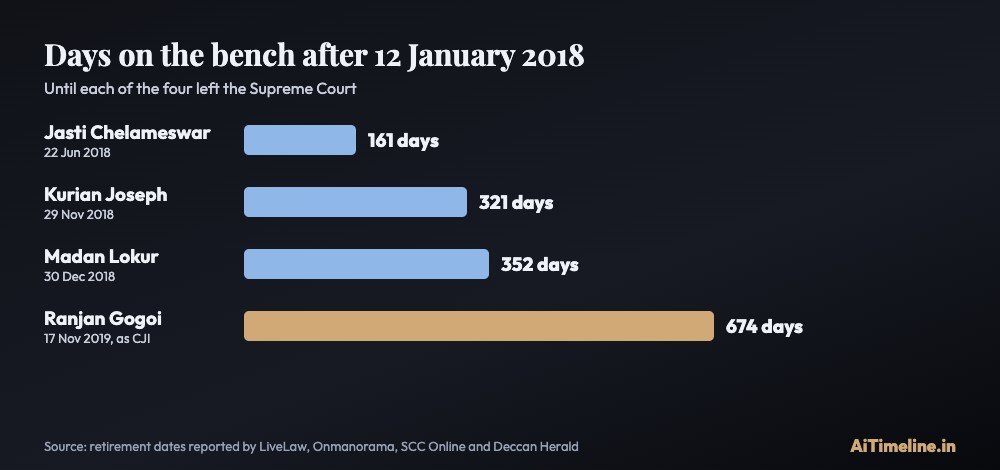
Justice Kurian Joseph retired on 29 November 2018 (Onmanorama). Justice Madan Lokur retired on 30 December 2018, according to his official Supreme Court profile (sci.gov.in). Of the four, only Ranjan Gogoi, by then Chief Justice, was still serving, until 17 November 2019.
The chart below counts the days each of the four stayed on the Supreme Court bench after 12 January 2018, using the retirement dates AiTimeline could confirm.
Dipak Misra retires; Ranjan Gogoi takes charge as Chief Justice Court administration
Chief Justice Dipak Misra retired on 2 October 2018 and Justice Ranjan Gogoi took charge on 3 October as the 46th Chief Justice, serving until 17 November 2019 (Deccan Herald). The Wikipedia account of the crisis reports that Misra recommended Gogoi as his successor on 4 September, following the practice of recommending the next most senior judge (Wikipedia).
Justice Chelameswar retires Court administration
Justice Jasti Chelameswar, at whose residence the press conference was held, retired on 22 June 2018 (LiveLaw). His retirement changed the make-up of the Collegium of the five senior-most judges.
2018
Shanti Bhushan v. Supreme Court of India: the Chief Justice is the master of the roster Judicial finding
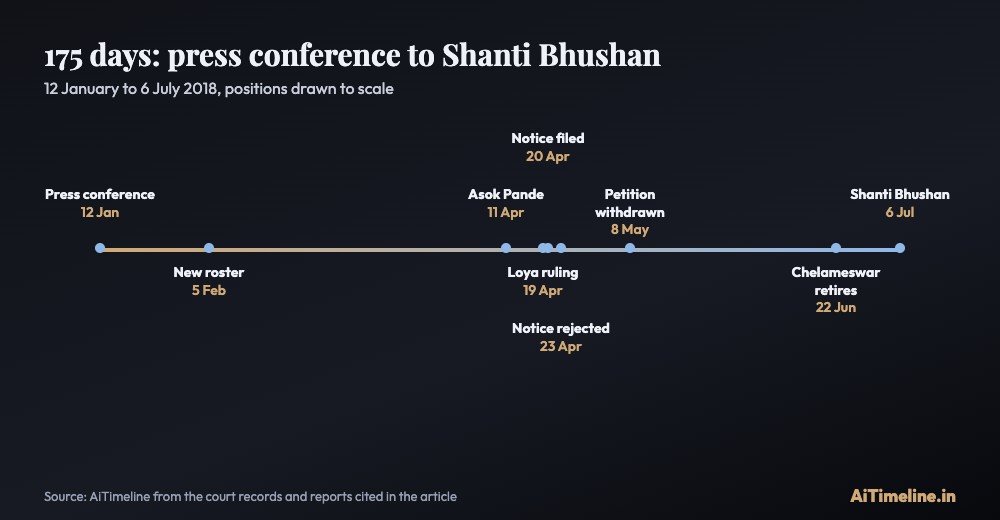
Senior advocate and former law minister Shanti Bhushan asked the Supreme Court to clarify the Chief Justice’s authority as master of the roster, to set out procedure for preparing the roster, and to read “Chief Justice of India” in the Court’s rules as a collegium of the five senior-most judges. The petition itself accepted that the Chief Justice is the master of the roster (judgment).
The bench led by Justice Sikri disposed of the petition. It held that the established position, supported by earlier decisions including a three-judge ruling in Asok Pande v. Supreme Court of India, is that the Chief Justice, not a collegium, allocates cases and constitutes benches (judgment; LiveLaw). Its closing paragraphs note that every institution should keep trying to improve its systems.
What it did not do: AiTimeline searched the judgment text and found no reference to the January press conference. It decided who holds the roster power, not whether the judges’ complaints about how it was used were right.
2018
Congress MPs withdraw their Supreme Court challenge to the rejection of the notice Political reaction
Rajya Sabha MPs Pratap Singh Bajwa and Amee Yajnik, represented by Kapil Sibal, challenged Vice-President Naidu’s rejection in the Supreme Court. A five-judge constitution bench headed by Justice Sikri declined Sibal’s request for a copy of the administrative order forming the bench and asked him to argue the case on merits. Sibal did not press the petitions and they were dismissed as withdrawn (SCC Online). The Attorney General noted that only two of the 64 members who signed the notice had approached the Court.
2018
Vice-President Venkaiah Naidu rejects the impeachment notice Political reaction
M. Venkaiah Naidu, as Chairman of the Rajya Sabha, refused to admit the notice. He applied the test of whether, if every statement in the notice were believed, it would amount to “proved misbehaviour” under Article 124(4), and said it found virtually no concrete verifiable imputation. He had consulted constitutional and legal experts, including former secretaries-general of both Houses (LiveLaw; The Tribune; The Quint).
The Congress called the order illegal and hasty and said it would go to the Supreme Court. This was a procedural decision at the admission stage by a parliamentary officer. It was neither a trial nor a judicial finding on the allegations in the notice.
2018
Seven Opposition parties submit a notice to remove the Chief Justice Political reaction
Parties led by the Congress gave the Vice-President a notice seeking the removal of Chief Justice Dipak Misra. It was first signed by 71 members; seven had since retired from the House, leaving 64 (The Tribune). Reports list five grounds, including alleged antedating of an order in a medical-college matter, a land-allotment affidavit and misuse of the master-of-the-roster power to send sensitive cases to chosen benches (ThePrint).
The notice drew on the press conference but was a political document. Its charges were allegations, not findings, and none of them was tested in a court or inquiry committee.
2018
The Supreme Court dismisses the petitions seeking an inquiry into Judge Loya’s death Judicial finding
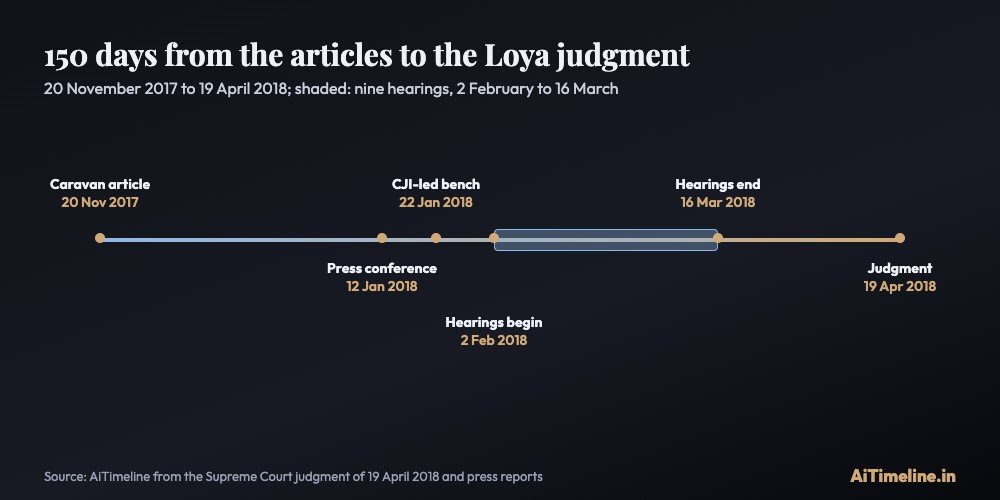
In a judgment written by Justice D. Y. Chandrachud, the bench held there was “absolutely no merit” in the petitions. It said there was no reason to doubt the clear and consistent statements of four judicial officers, that the documentary material indicated the death was due to natural causes, and that there was no ground for reasonable suspicion warranting further inquiry. Hearings ran from 2 February to 16 March 2018 (judgment).
The Court also called the conduct of the petitioners and intervenors lacking in good faith and a misuse of the judicial process. It said the conduct prima facie amounted to criminal contempt but chose not to start proceedings.
Scope: this was a finding about the cause of Judge Loya’s death and the petitions based on two Caravan articles. It did not rule on the press conference or on how the roster was used. Critics of the order and defenders of it both exist; the judgment text is linked so readers can judge it.
2018
Asok Pande is decided; Justice Chelameswar declines to hear Shanti Bhushan’s petition Judicial finding
A three-judge bench decided Asok Pande v. Supreme Court of India on 11 April 2018, holding that the Chief Justice alone is the master of the roster. The Shanti Bhushan judgment later relied on it (judgment). Shanti Bhushan filed his own petition in early April; when it was mentioned before Justice Chelameswar’s bench, the judge declined to hear it, saying he did not want another reversal of his order within 24 hours (LiveLaw), apparently a reference to the November 2017 episode.
2018
A subject-wise roster takes effect Court administration
A new roster took effect on 5 February 2018. Chief Justice Misra kept letter petitions and public interest litigation along with several other categories, while benches headed by the twelve senior-most judges were assigned defined subjects, for example labour and indirect tax to Justice Chelameswar (LiveLaw). It was revised again that year, including from 2 July and 7 August.
Some commentators said it would not settle the dispute, because the complaint was about sensitive cases, not categories. The Chief Justice still decided who sat on which bench.
2018
A bench led by the Chief Justice takes up the Loya petitions Court administration
The Loya petitions, which had been before a bench headed by Justice Arun Mishra, were listed before a bench of the Chief Justice with Justices A. M. Khanwilkar and D. Y. Chandrachud (Deccan Herald). On 22 January it remarked that the pleas were serious but that aspersions should not be cast (Business Standard). The judgment later records that substantive hearings began on 2 February.
2018
Talks between the Chief Justice and the four judges Court administration
Bar & Bench reported on 16 January that the Chief Justice and the four judges had begun talks (Bar and Bench). Udayavani reported on 18 January that Misra met the four for around 10 to 15 minutes before court (Udayavani). The Wikipedia chronology places an informal meeting on 15 January (Wikipedia). Sources therefore disagree on the dates; none reported a published settlement.
On 16 January the Loya pleas before Justice Mishra’s bench were directed to an “appropriate bench”.
2018
The four judges return to court; officials say the matter is settled Political reaction
On Monday 15 January the four judges attended court. Attorney General K. K. Venugopal called the crisis a storm in a teacup and said it was settled, and Bar Council of India chairman Manan Kumar Mishra said the story was over (Legally India). The judges themselves did not announce that their concerns had been met.
2018
Reactions pour in; the Bar forms a delegation to mediate Political reaction
Lawyers, former judges and political parties responded with both support and criticism (Newslaundry: who said what). The Bar Council of India formed a seven-member delegation on 13 January. It met judges of the Supreme Court on Sunday 14 January (Udayavani).
2018
Four senior judges hold a press conference Stated concern
Justices Jasti Chelameswar, Ranjan Gogoi, Madan B. Lokur and Kurian Joseph spoke to journalists and released a seven-page letter to Chief Justice Dipak Misra. Justice Chelameswar said the Court’s administration was “not in order” and that efforts to persuade the Chief Justice had failed (The Leaflet). The letter has no date line. Chelameswar said they had gone to the Chief Justice with a letter “a few months back” and again that morning, but failed to convince him (Legally India, quoting the NDTV broadcast); other reports say the letter was sent about two months earlier.
The letter cites the 27 October 2017 order in R. P. Luthra v. Union of India and the Memorandum of Procedure for appointing judges, says the Chief Justice is “only the first amongst the equals,” and says important cases were assigned selectively to benches “of their preference” without a rational basis (National Herald; The Quint). It also says such orders affected the independence of the High Courts. These were the judges’ stated concerns, not findings.
The Loya question: the letter does not name Judge Loya’s case. At the conference a journalist asked, “Is this about Loya?” and Justice Gogoi answered yes, while Chelameswar was heard to say it was not just about Loya (Newslaundry transcript; The Wire). The Wikipedia chronology, citing the Times of India, adds that at the morning meeting the four had asked the Chief Justice to move the Loya case to a more senior bench and he refused.
The medical-college dispute: two benches, two orders in 24 hours Stated concern
In a petition about a medical-college admissions case, Justice Chelameswar’s bench on 9 November ordered a hearing before a constitution bench of the five most senior judges. On 10 November a bench led by the Chief Justice set that order aside and said the Chief Justice is the master of the roster (Wikipedia, citing the Guardian and India Today). On 14 November a bench of Justices R. K. Agarwal, Arun Mishra and A. M. Khanwilkar dismissed advocate Kamini Jaiswal’s petition, calling it forum shopping and contemptuous but not starting contempt (Bar and Bench). On 1 December the same bench dismissed a second petition by the Campaign for Judicial Accountability and Reforms and imposed costs of Rs 25 lakh (SCC Online).
The case concerned allegations about attempts to influence judicial outcomes. The dispute described here is about which bench should hear it; it is not proof that any case was manipulated.
2017
The Caravan publishes articles questioning Judge Loya’s death Stated concern
Articles in The Caravan of 20 and 21 November 2017 reported the family’s doubts about the circumstances of Judge B. H. Loya’s death. The Supreme Court later recorded that the petitions before it were founded on these two articles (judgment). Judge Loya was a special CBI judge who had been hearing the Sohrabuddin Sheikh encounter case.
2014
Judge B. H. Loya dies in Nagpur Judicial finding
Brijgopal Harkishan Loya died on 1 December 2014 in Nagpur, where he had travelled for a colleague’s daughter’s wedding, while presiding over the CBI special court in Mumbai (judgment). The Supreme Court’s 2018 judgment concluded that the death was due to natural causes. That finding is discussed above; it is not repeated as the answer to every question about the Loya matter.
Supreme Court Judges’ Press Conference 2018: What the Letter Said
The letter has no date line and AiTimeline read it through published full texts, linked in the sources.
The letter begins by saying it is written “with great anguish and concern” to highlight certain judicial orders. It then focuses on the order of 27 October 2017 in R. P. Luthra v. Union of India, which concerned finalising the Memorandum of Procedure for appointing judges (The Quint). It says the Chief Justice is “only the first amongst the equals” and that being the master of the roster does not confer a superior authority over colleagues.
Its central complaint is that cases with far-reaching consequences had been assigned selectively to benches “of their preference”, without a rational basis, and that this must be guarded against. It refers to the 4 July 2017 decision in the Karnan contempt case, notes that none of the seven judges there commented on the Memorandum of Procedure, and says some orders affected the independence of the High Courts (National Herald). It closes by saying more orders would be specified later if the first issue were addressed.
What the letter does not say: it does not accuse the Chief Justice of corruption, does not name the Loya case, and does not call for his removal.
| Statement | Who made it | Type | What happened to it |
|---|---|---|---|
| The Chief Justice assigned important cases selectively to benches “of their preference” | The four judges’ letter, 12 Jan 2018 | Stated concern | Not adjudicated. The Shanti Bhushan judgment of 6 Jul 2018 decided who holds the roster power but does not mention the press conference |
| The Chief Justice is the master of the roster; it is not a collegium’s power | Supreme Court, 11 Apr and 6 Jul 2018 | Judicial finding | Settled law as of 2018 (Asok Pande, Shanti Bhushan) |
| Judge Loya’s death was due to natural causes; no ground for an inquiry | Supreme Court, 19 Apr 2018 | Judicial finding | Petitions dismissed; the Court relied on statements of four judicial officers and documents |
| The Chief Justice committed “misbehaviour” including misuse of the roster | Seven-party impeachment notice, 20 Apr 2018 | Political allegation | Refused admission on 23 Apr 2018; never tested in court or an inquiry committee |
| The rejection of the notice was illegal and hasty | Congress, 23 Apr 2018 | Political reaction | Petition filed 7 May; dismissed as withdrawn 8 May 2018 |
| The matter is settled | Attorney General and Bar Council chairman, 15 Jan 2018 | Official statement | The judges did not say their concerns had been met |
| Gogoi compromised judicial independence by accepting a Rajya Sabha seat | Former Justice Kurian Joseph, Mar 2020 | Opinion of a former judge | Not a legal finding; Gogoi said he would explain after taking the oath |
What Does Master of the Roster Mean?
The power at the heart of the dispute.
The Supreme Court hears a large number of cases, and a roster decides which bench hears which kind of matter. By convention and, as the Court held in 2018, in law, the Chief Justice prepares the roster and constitutes benches. The Constitution is silent on the phrase. The Shanti Bhushan judgment records that the petitioner himself accepted the Chief Justice is the master of the roster and argued only that the power should be exercised by a collegium of five senior judges, which the bench did not accept (judgment).
The open question is not who holds the power but how it is used and whether the process is visible enough to command trust. The 2018 judgments answered the first; the judges’ letter raised the second, and no court has ruled on it.
Where Each Strand Stands
As verified on 23 October 2026. “Not checked” means AiTimeline did not verify it, not that nothing changed.
| Strand | Body | Latest outcome AiTimeline verified | Final? |
|---|---|---|---|
| The judges’ January 2018 complaints | Four Supreme Court judges | Letter and press conference of 12 Jan 2018; no court ruled on the complaints | No ruling exists on them |
| Who controls the roster | Supreme Court | Asok Pande, 11 Apr 2018; Shanti Bhushan, 6 Jul 2018 | Yes for 2018; current rules not checked |
| Judge Loya’s death | Supreme Court | Petitions dismissed, 19 Apr 2018 | Yes as to the cause of death |
| Removal of the Chief Justice | Rajya Sabha Chairman; Supreme Court | Notice refused admission 23 Apr 2018; petition withdrawn 8 May 2018 | Yes |
| The new roster | Supreme Court administration | Subject-wise roster effective 5 Feb 2018; revised later in 2018 | Current roster not checked |
| The four judges’ careers | Retirements and appointment | All four had left the bench by 17 Nov 2019; Gogoi was CJI 3 Oct 2018 to 17 Nov 2019 | Yes |
The Impact on the Judiciary
Transparency. A written, subject-wise roster replaced the earlier practice from 5 February 2018 and was revised several times that year. The Chief Justice still decided who sat on which bench.
Public trust. The public sight of judges disagreeing with their Chief Justice prompted both support and concern. Bar leaders moved within a day to mediate, and officials said on 15 January that the matter was settled, while the judges did not.
The parliamentary route. The impeachment notice showed that removing a Supreme Court judge requires a process through Parliament. Its refusal at the admission stage and the withdrawal of the Congress MPs’ petition meant the allegations were not tested.
The people involved. Within two years all four judges had left the bench and one had become Chief Justice and then a Rajya Sabha member, which two of the others criticised publicly.
The Legacy: What Was Settled and What Was Not
Settled in 2018: the Chief Justice alone is the master of the roster, and the Loya petitions were dismissed on the ground of natural causes.
Not settled by any court: whether the cases the four judges had in mind were assigned fairly, and whether the process should be made more visible. Those remain questions of practice and trust.
For other stories about accountability and the courts see the 1984 anti-Sikh riots and the Emergency of 1975 to 1977, and for how a corruption allegation was argued over decades see the Bofors timeline.
The Story at a Glance
Dates from the sources listed below, with the type of each entry.
| Date | Event | Type |
|---|---|---|
| 1 Dec 2014 | Judge Loya dies in Nagpur | Background |
| 20-21 Nov 2017 | Caravan articles on the death | Background |
| 9-10 Nov 2017 | Medical-college bench dispute | Stated concern |
| 12 Jan 2018 | Press conference and letter | Stated concern |
| 15 Jan 2018 | Judges back in court; “settled” claims | Official statement |
| 22 Jan 2018 | CJI-led bench takes the Loya petitions | Court administration |
| 5 Feb 2018 | Subject-wise roster takes effect | Court administration |
| 11 Apr 2018 | Asok Pande decided | Judicial finding |
| 19 Apr 2018 | Loya petitions dismissed | Judicial finding |
| 20 Apr 2018 | Impeachment notice submitted | Political allegation |
| 23 Apr 2018 | Notice refused admission | Political reaction |
| 8 May 2018 | Challenge withdrawn | Political reaction |
| 22 Jun 2018 | Chelameswar retires | Court administration |
| 6 Jul 2018 | Shanti Bhushan decided | Judicial finding |
| 3 Oct 2018 | Gogoi takes charge as CJI | Court administration |
| 16 Mar 2020 | Gogoi nominated to the Rajya Sabha | Political reaction |
| Term | Meaning | Why it matters here |
|---|---|---|
| Master of the roster | The Chief Justice’s power to allocate cases and constitute benches | The centre of the dispute; confirmed by the Court in 2018 |
| Roster | The list assigning categories of cases to benches | A subject-wise roster took effect on 5 Feb 2018 |
| Collegium | The five senior-most judges, who recommend judicial appointments | Shanti Bhushan asked that “Chief Justice” be read as this body for the roster; the Court refused |
| Memorandum of Procedure | The document governing appointments to the higher judiciary | The letter cites a 27 Oct 2017 order about it |
| Constitution bench | A bench of five or more judges for constitutional questions | The Chelameswar bench ordered one in Nov 2017; the letter says the MoP matter belonged before one |
| Impeachment (Article 124(4)) | Removal of a Supreme Court judge for proved misbehaviour or incapacity | The notice of 20 Apr 2018 was refused admission |
| Admission stage | The Chairman’s decision whether to admit a removal motion | Naidu rejected the notice here, without an inquiry |
| First among equals | The Chief Justice sits with equal judicial weight to other judges | Phrase used by the letter and by the 2018 judgments, to different effect |
Who Is Who in the Story
Justice Jasti Chelameswar
Hosted the press conference at his residence; asked about impeachment, he is reported to have said it was for the nation to decide. Retired on 22 June 2018.
Justice Ranjan Gogoi
One of the four; Chief Justice from 3 October 2018 to 17 November 2019; nominated to the Rajya Sabha on 16 March 2020.
Justice Madan B. Lokur
One of the four; retired on 30 December 2018 and later criticised the 2020 nomination.
Justice Kurian Joseph
Retired on 29 November 2018; said in 2020 that Gogoi had compromised judicial independence.
Dipak Misra
The addressee of the letter; Chief Justice until 2 October 2018. The impeachment notice against him was refused admission.
M. Venkaiah Naidu
Refused to admit the notice on 23 April 2018 after consulting legal experts.
Shanti Bhushan
Senior advocate and former law minister; his petition produced the 6 July 2018 roster judgment.
B. H. Loya
Died on 1 December 2014 in Nagpur; the Supreme Court held on 19 April 2018 that the material showed natural causes.
The Popular Story vs the Record
| Popular version | What the record shows |
|---|---|
| The judges accused the Chief Justice of corruption | The letter does not allege corruption. It says important cases were assigned selectively to benches of the Chief Justice’s preference and cites the 27 Oct 2017 Luthra order |
| The press conference was about Judge Loya and nothing else | The letter does not name the case. Justice Gogoi said yes when asked if it was about Loya; Justice Chelameswar was heard saying it was not just Loya |
| The Supreme Court investigated and cleared the judges’ complaints | It decided who holds the roster power. The Shanti Bhushan judgment does not mention the press conference, so the complaints were neither confirmed nor rejected |
| The Loya judgment proved the press conference wrong | It found Judge Loya’s death was due to natural causes. That is a finding on one question, not on the administration complaints |
| The Chief Justice was impeached | The notice was refused admission on 23 Apr 2018, so no impeachment process began |
| The four judges called for impeachment | Justice Chelameswar is reported to have said it was for the nation to decide; the notice came from Opposition parties |
| The crisis ended on 15 January | Officials said it was settled, but talks continued, the roster changed in February and the Court ruled on the roster in April and July |
Explore More Timelines
People Also Ask
Frequently Asked Questions
Sources and Further Reading
- Supreme Court of India: Shanti Bhushan v. Supreme Court of India, judgment of 6 July 2018
- Supreme Court of India: Tehseen Poonawalla and connected cases (Judge Loya), judgment of 19 April 2018
- National Herald: Complete text of the letter to the Chief Justice by four top SC judges
- The Quint: Full text of the letter submitted by four senior SC judges
- The Leaflet: We are discharging our duty to the nation, Justice Gogoi
- Newslaundry: After the judges’ press conference, who said what
- The Wire: Loya case the tipping point, four SC judges say
- LiveLaw: Breaking, new subject-wise roster system in SC from February 5
- LiveLaw: Justice Chelameswar refuses to hear Shanti Bhushan’s PIL
- LiveLaw: CJI is the master of roster, SC dismisses Shanti Bhushan’s petition
- LiveLaw: Reasons given by the Vice President for rejecting the motion for the CJI’s impeachment
- The Tribune: Venkaiah Naidu rejects impeachment notice against CJI Dipak Misra
- The Quint: Why the Vice President rejected the impeachment motion
- ThePrint: Five reasons behind the impeachment motion against CJI Dipak Misra
- SCC Online: Petition challenging rejection of the impeachment notice withdrawn
- Bar and Bench: CJI Misra meets four senior judges
- Legally India: BCI chairman claims everything is totally fine at the SC
- Udayavani: SC crisis, BCI delegation meeting SC judges
- Deccan Herald: Supreme Court’s new bench to hear Loya death case on January 22
- Business Standard: Pleas on Loya’s death serious but don’t cast aspersions, SC
- LiveLaw: SC Collegium dynamics to change with Justice Chelameswar’s retirement
- Onmanorama: Justice Kurian Joseph retires from SC
- Deccan Herald: Next CJI Justice Gogoi takes charge on October 3
- Scroll: Two ex-SC judges, Opposition condemn Gogoi’s Rajya Sabha nomination
- LiveLaw: Rajya Sabha nomination, Justice Gogoi compromised, says Justice Kurian Joseph
- Supreme Court of India: Justice Madan Bhimrao Lokur profile
- Legally India: Seniormost SC judges turn to press after disagreement with CJI
- SCC Online: Supreme Court imposes Rs 25 lakh costs on CJAR, petition dismissed
- Bar and Bench: Contemptuous but not initiating contempt, SC dismisses Kamini Jaiswal petition
- Wikipedia: 2018 Supreme Court of India crisis
Related AiTimeline Stories
⚠️ Editorial Note
Last updated 23 October 2026. This is editorial information, not legal advice. The judges’ stated concerns, the Supreme Court’s findings and political reactions are labelled separately, and the press conference did not establish that every concern was proved. Corrections to the draft brief: the impeachment notice was submitted on 20 April 2018 and rejected on 23 April (the brief’s entry combined them); the letter does not name the Loya case, but Justice Gogoi answered yes when asked at the conference whether it was about Loya, so the page does not say the judges declined to link them; the roster of February 2018 took effect on 5 February; the Bar Council delegation was formed on 13 January and met judges on 14 January; the Shanti Bhushan judgment is dated 6 July 2018 on its face (Writ Petition (Civil) 789 of 2018) and followed the three-judge Asok Pande decision of 11 April 2018, which the brief omitted; and the letter’s cited order is R. P. Luthra of 27 October 2017, not Collegium publication. Reports differ on the date of the Chief Justice’s meeting with the four judges (15, 16 or 18 January), so the page gives all three. Checked in a browser on 23 October 2026: Lokur retired on 30 December 2018 (Supreme Court profile); Chelameswar said the judges went to the Chief Justice again on the morning of 12 January (Legally India, quoting NDTV); the Rs 25 lakh costs of 1 December 2017 were imposed on the Campaign for Judicial Accountability and Reforms by the bench that had dismissed Kamini Jaiswal’s petition on 14 November. Not verified: the exact date of the letter (no date line; reports say a few months or about two months before 12 January); that the four asked for the Loya case to be moved that morning (Times of India via Wikipedia only); and the roster currently in force. Check the Supreme Court website before relying on any of these.
Sources & further reading
Every dated entry above was checked against these references. Last reviewed 23 October 2026.
- Supreme Court of India: Shanti Bhushan v. Supreme Court of India, judgment of 6 July 2018
- Supreme Court of India: Tehseen Poonawalla and connected cases (Judge Loya), judgment of 19 April 2018
- National Herald: Complete text of the letter to the Chief Justice by four top SC judges
- The Quint: Full text of the letter submitted by four senior SC judges
- The Leaflet: We are discharging our duty to the nation, Justice Gogoi
- Newslaundry: After the judges' press conference, who said what
- The Wire: Loya case the tipping point, four SC judges say
- LiveLaw: Breaking, new subject-wise roster system in SC from February 5
- LiveLaw: Justice Chelameswar refuses to hear Shanti Bhushan's PIL
- LiveLaw: CJI is the master of roster, SC dismisses Shanti Bhushan's petition
- LiveLaw: Reasons given by the Vice President for rejecting the motion for the CJI's impeachment
- The Tribune: Venkaiah Naidu rejects impeachment notice against CJI Dipak Misra
- The Quint: Why the Vice President rejected the impeachment motion
- ThePrint: Five reasons behind the impeachment motion against CJI Dipak Misra
- SCC Online: Petition challenging rejection of the impeachment notice withdrawn
- Bar and Bench: CJI Misra meets four senior judges
- Legally India: BCI chairman claims everything is totally fine at the SC
- Udayavani: SC crisis, BCI delegation meeting SC judges
- Deccan Herald: Supreme Court's new bench to hear Loya death case on January 22
- Business Standard: Pleas on Loya's death serious but don't cast aspersions, SC
- LiveLaw: SC Collegium dynamics to change with Justice Chelameswar's retirement
- Onmanorama: Justice Kurian Joseph retires from SC
- Deccan Herald: Next CJI Justice Gogoi takes charge on October 3
- Scroll: Two ex-SC judges, Opposition condemn Gogoi's Rajya Sabha nomination
- LiveLaw: Rajya Sabha nomination, Justice Gogoi compromised, says Justice Kurian Joseph
- Wikipedia: 2018 Supreme Court of India crisis